Category Archives: John Wilkes Booth

1865: Harriet Ruth Crandall to Edwin R. Adams

This letter was written by Harriet (“Hattie”) Ruth Crandall (1843-1913), the daughter of John Crandall (1808-1895) and Mary Ann Ackerman (1814-1898) of Watertown, Jefferson county, New York. Hattie wrote the letter to Edwin R. Adams (1841-1926) whom she would marry in 1866.

Edwin was born in Dexter, New York, the son of Henry Adams (1806-1895) and Emily Dickinson Ackerman (1811-1908) of Pillar Point, New York, a ninth generation descendant of the Henry Adams Family of Braintree, Massachusetts, which included U. S. presidents John Adams and President John Quincy Adams. He married Hattie Crandall (1843-1913) of Watertown, New York, in 1866, and together they had three children. Adams was appointed a second lieutenant in the 36th Regiment, 16th Brigade, and 4th Division of the National Guard of the State of New York on April 6, 1865, effective from February 16, 1865. After the war, Adams pursued a career as a farmer, and he later served as overseer of highways in Brownville, Jefferson County, New York. His sister Jane Adams (1839-1921) married Alfred Ackerman (d.1913), and together they built the first hotel in Twin Lakes, Wisconsin, in the late 1870s, under the name Twin Lake Summer Resort.

This letter was once in a large collection of letters to and from his fiancée, Hattie Crandall. Two letters from Hattie to Edwin refer to major war-related events in 1865. In a letter dated April 23, 1865, Hattie laments the tragic death of President Lincoln: “the just God takes those who can be least spared and so at this final hour he permitted the hand of the assassin to strike down our President when he was so much needed and leave the country to mourn and well might the confederacy dress in mourning for they have lost their best friend, as well as the North.” In a June 18, 1865 letter to Adams, Hattie expressed joy at the capture of John Wilkes Booth in April and of Jefferson Davis in May. “I suppose the boys in the army will be coming home before many days at least they are looking for them around here. We can not complain of the good news in relation to the capture of ‘Jeff,’ it seems as if his capture and that of Booth and others would partially cancel the Death of our President.”

Watertown, New York, in 1865

Transcription

Addressed to Mr. E. R. Adams, Pillar Point, New York

Watertown [New York]
June 1865

Dear E.,

I have finally taken my seat to write you again although several weeks have passed since I intended to have written. The night after you left here we got the sad news of Rinda’s death which affected us all deeply & so it is the house of joy is turned to one of mourning in a few short hours. It would have been a great consolation to have been with her through her sickness although it would have been hard to have seen her suffer so much. Her disease finally terminated in Dropsy on the brain, but she is now at rest and I know they say it is for the best that it is so but it seems as if I never could be reconciled to have it so in this world.

We are all usually well but Mother. Her eyes are quite bad and have been most of the time since she got back. She was very tired and has not got fairly rested yet, but one thing favors us and that is our milk goes to the factory, as the old saying is no great loss but some small gain. If the factory at Rodman have lost Parker’s milk, we get ours drawn by them to the Hill factory.

It is very lonely and still here today. All the noise made is the birds singing and the scratching of my poor old pen. All the rest have gone to church and I stay at home tonight and watch the bees. What a warm, sultry day it is. I think a good shower could be appreciated by every one now, suppose you start out again and see if it would bring rain. Mr. Graves gave us quite a surprise last night by coming in our house, although we expected him some time in the course of the summer. He is agent for a mowing machine in this county and he will spend some time around here. He left the rest of the family well. Irving’s family were also in good health but were all very lonely and surely how lonely it must be without no Rinda there.

I suppose the boys in the army will be coming home before many days—at least they are looking for them around here. We can not complain of the good news in relation to the capture of “Jeff.” It seems as if his capture and that of Booth and others would partially cancel the death of our President.

How does Gert prosper? I should like to see her much and should be happy to see you be up here. It is about time they come home from church so I shall have to be about the eating arrangement and will bid goodbye for the present. The same as ever, your Hattie

1865: Wisconsin Homefront letters to Henry Nolop, 4th Wisconsin Cavalry

The following letters were written by Elizabeth (Gard) Nolop (1834-1909), a native of England, who married Henry Nacey Nolop (1834-1916) in 1854. At the time of her letter, the Nolop’s had five children—Fannie (b. 1855), Carrie (b. 1857), George (b. 1859), Harriet (b. 1861), and Alma (b. 1863).

Also writing was Henry’s father, George Nolop (1804-1886), a native of Germany, who lived for a time in Canada and then came to Hixton, Jackson county, Wisconsin, about 1861. The letters were written to Henry Nolop near the end of his term of service in the 4th Wisconsin Cavalry Co. I. He mustered out in August 1865. After the Civil War, he returned home and was a farmer and a blacksmith.

Henry and his brother Daniel George Nolop (1844-1925) both served in the 4th Wisconsin Cavalry. Another son, “John” George Nolop, Jr. (1838-1922) served in Co. I, 14th Wisconsin Infantry from January 4, 1865 to October 9, 1865.

To read Henry Nolop’s Civil War letters, go to—1864-65: Henry Nacey Nolop to Elizabeth (Gard) Nolop.

Letter 1

Hixton, [Wisconsin]
April 23, 1865

My dear Henry,

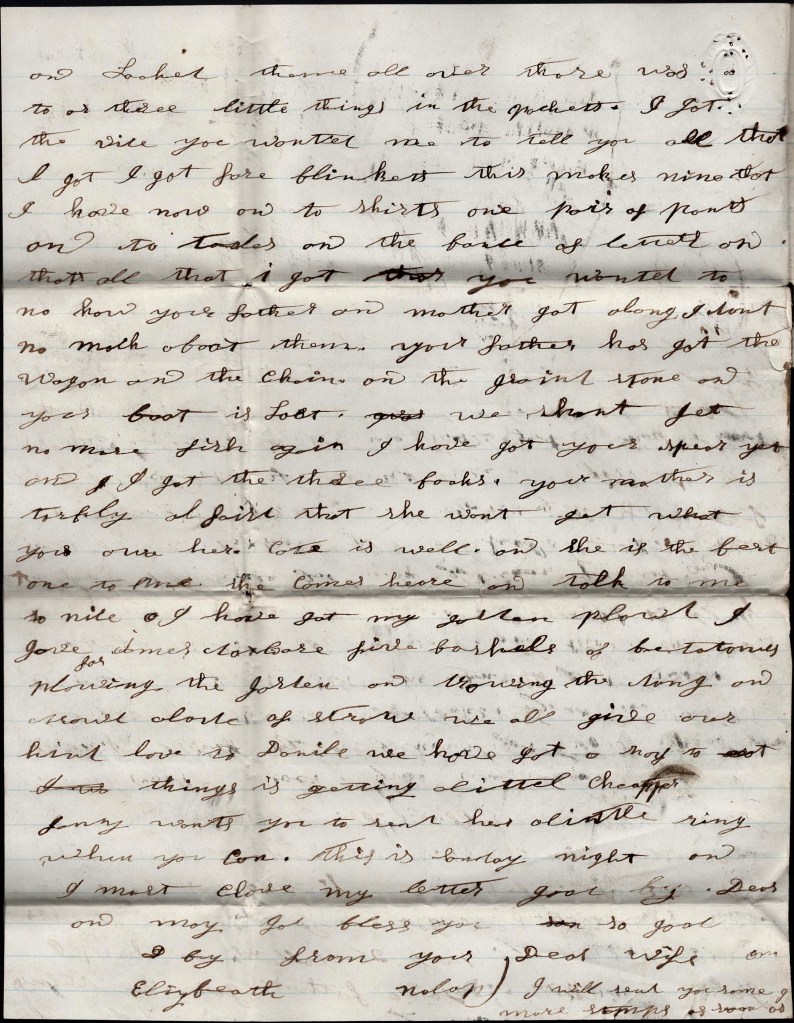
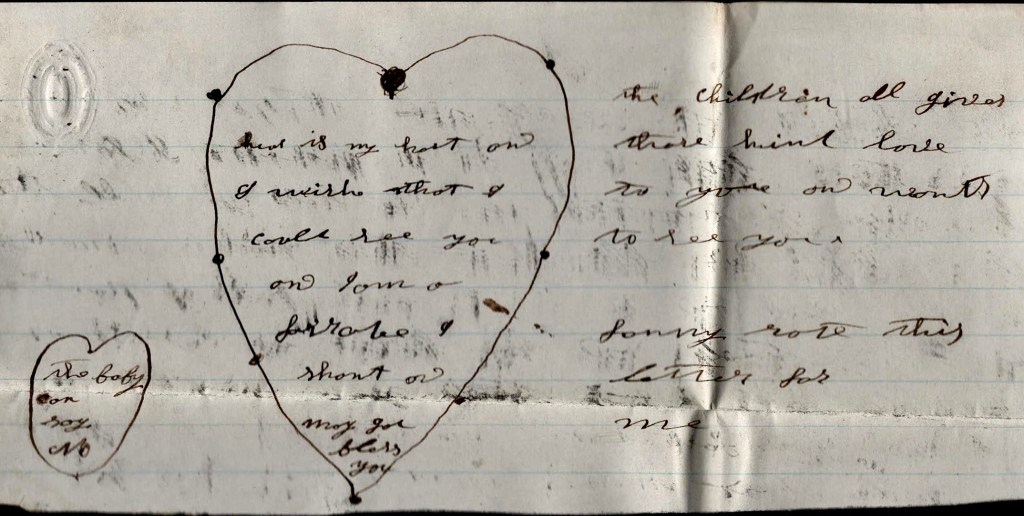
It is with pleasure that I can sit down to write a few lines to let you know that we are all well at home and I hope these few lines will find you the same. I got a letter from you last night and I was glad to hear that you was so well. [It was] the letter that you put the candy in and the children was all so pleased to get it. There was none for the baby [but] they parted it. I was sorry to hear that you was so near the fighting and [though] you told me in your letter that I must not fret so much, but I can’t help it. I fret more now that you have gone where you are but I hope the Lord will speed the time when you can come home again. There was so many that went from here that got killed and wounded and I don’t know when I shall hear the news myself. William Curran was wounded in his hip and had to have his leg cut off.

Abraham Lincoln is dead. He was shot.

I have got my cow from Mr. Curran. I had to pay 25 dollars for her. I got the clothes. Your father got the things and looked them all over. There was two or three little things in the pockets. I got the vile. You wanted me to tell you all that I got. I got four blankets. This makes nine that I have now, and two shirts, one pair of pants…

You wanted to know how your father and mother get along. I don’t know much about them, Your father has got the wagon and the chain and the grind stone and your boot is lost. We shan’t get no more fish again. I have got your spear yet and I got the three hooks. Your mother is tolerably afraid that she won’t get what you owe her. Cate is well and she is the best one to me. She comes here and talks to me. Tonight I have got my garden plowed. I gave [ ] five bushels of [ ]. The Jordans are mowing the [ ]. We all send our kind love to Daniel. We have got enough to eat. Things is getting a little cheaper. Fanny wants you to send her a little ring when you can. This is Sunday night and I must close my letter. Goodbye dear and may God bless you. So goodbye. From your dear wife, — Elizabeth Nolop


Letter 2

Hixton, Jackson county, Wisconsin
April 23, 1865

Dear Henry,

I hope these few lines will find you and Dan in good health. Your family is all well. We have news that the war is over. Mobile gave up. So far so good. But the news of the murder of Abe Lincoln is not so good.

William Curran, Co. G, 5th Wisconsin Infantry. Had a leg amputated from wound received at the Battle of Sailor’s Creek on 6 April 1865

Poor William Curran has lost his leg at Richmond. Old Mr. [John H.] Curran is going down to him tomorrow. When he gets the bad news that his Mother died, he will feel bad enough. 1

We have the worst of weather here this spring. We done nothing yet on the land, On the 21st it began to snow and now we have plenty of snow on the ground. I have heard from Gerry Martin. He is in St. Louis, Mo. Maybe he will be sent to the plains to keep the Injens quiet. Enlisting and drafting is stopped altogether.

I wish you would let me know how the soldiers felt when they heard that the President was killed. Wonder what they would do if they had that fellow that fired the pistol. I don’t think that the leading Rebels will fare so well with Andy Johnson as they would with Old Abe. But we shall find out.

We had a good laugh about Dan not finding bottom in the camp at Carrollton. I hope he has got dry footing now and is in good spirits. I think you all will be home soon. Tell Dan that Mother is going to save lots of eggs and butter for him against he comes home. Dr. Negus sends his best love to you both. He is at Mrs. Martin’s for a day or two. The fact is, he is weather bound. The road is too bad to travel. He is bound for Sparta.

Mr. Coles’ son got clear but they took him again and now they have him in Milwaukee. It will go pretty hard with him.

Mother and me send our love to you and Dan. Write soon—that is, when you get a chance. And tell Dan to write. So no more at present. From your father, — G. Nolop

To Mr. Henry Nolop, 4th Cavalry, Co. I, Wisconsin Volunteers, Baton Rouge, La.

1 John “William” Curran (1840-1915) served in Co. G, 5th Wisconsin Infantry. He was badly wounded on 6 April 1865 at the Battle of Sailor’s Creek and had to have his left thigh amputated. William was the son of Rev. John H. Curran (1805-1881)—a blacksmith and local Methodist minister—and Elizabeth McKinney (1808-1865). Elizabeth died on 14 April 1865, just a few days after her son was wounded.


Letter 3

Hixton, Jackson county, [Wisconsin]
May 1, 1865

Dear Henry,

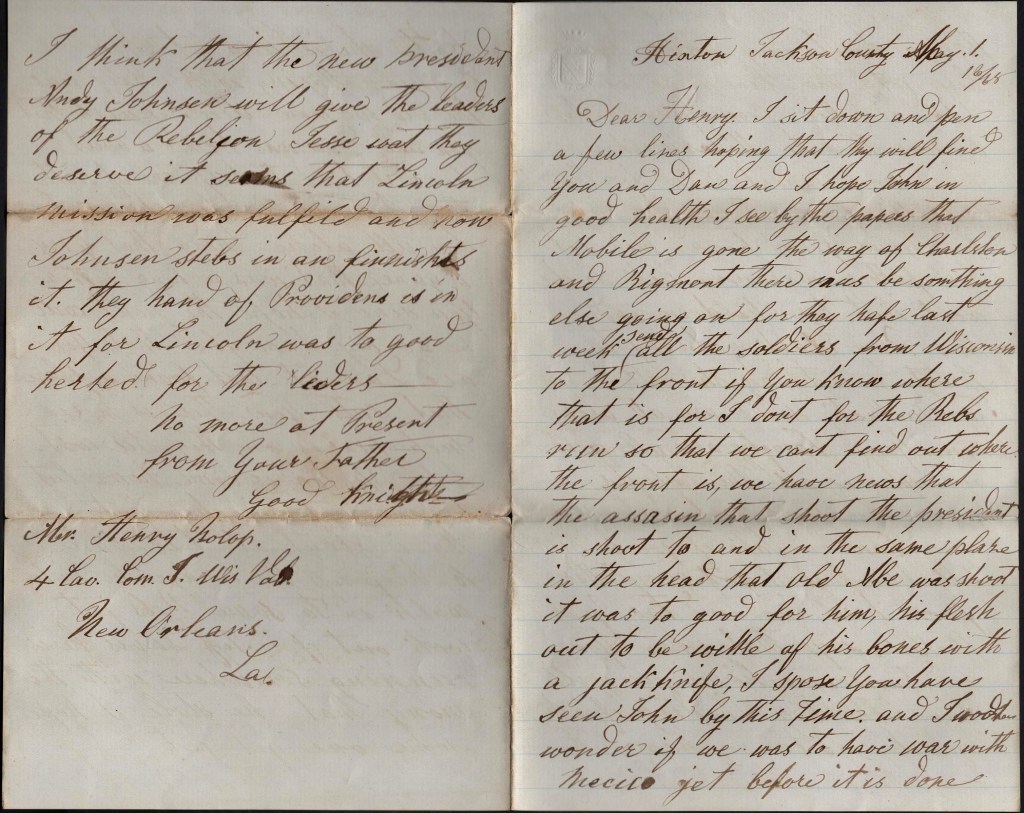
I sit down and pen a few lines hoping that they will find you and Dan, and I hope John, in good health. I see by the papers that Mobile is gone the way of Charleston and Richmond. There must be something else going on for they have last week sent all the soldiers from Wisconsin to the front. If you know where that is for I don’t, for the Rebs run so that we can’t find out where the front is.

We have news that the assassin that shot the President is shot too and in the same place in the head that Old Abe was shot. It was too good for him. His flesh ought to be whittled off his bones with a jackknife.

I suppose you have seen John by this time and I wouldn’t wonder if we was to have war with Mexico yet before it is done.

There is hardly any sowing done here yet—the land is so wet. I had a letter from Gerry Martin. He was then in Missouri. Where he is now, I don’t know for they marched from there. His wife had news from Fond-du-lac that her father was very sick so she went with her children adn Mrs. Perry Clark yesterday to Sparta and today she will be in Fond-du-lac so we are all alone now. Your family are all well and so are all the neighbors. Your mother sends her love to you and Dan and John. If you see him, tell him that I got one letter from him and sent two. Your mother says that when you and Dan come home, we will have the big pudding—if it can be got anyhow.

Kate she is now at Mr. Curran’s stopping with Mary since the Old Woman died. I wish that you and Dan was home about harvest time to help me off with the harvest for you know I am all alone now that Gerry is gone. That was a long letter you sent, I hope the next will be as big. I am glad that you and Dan at last found a place that suits you. There is more such places on the seacoast. John Ashton is coming home but I have not see him yet.

This is about all. Tell Dan to keep up his courage yet. Look out for Jeff Davis. He is running somewhere with the money that he stole. I hope someone gets it. I think that the new President Andy Johnson will give the leaders of the Rebellion just what they deserve. It seems that Lincoln’s mission was fulfilled and now Johnson steps in and finishes it. The hand of Providence is in it for Lincoln was too good-hearted for the leaders.

No more at present. From your Father. Good night.

to Mr. Henry Nolop, 4th Cavalry Co. I, Wisconsin Vols. New Orleans, La.

1865: Emma E. Davis to William Sidney Gray

This letter was written by Emma E. Davis (1842-1927) of Strafford county, New Hampshire, the daughter of Alfred Davis (1819-1898) and Chloe Parker (1822-1902). We learn from the letter that Emma was working as a store clerk in Boston during the last year or two of the Civil War. It appears she must have married Jacob Childs (ten years her senior) sometime shortly after this letter was penned and lived out her days in Worcester, Massachusetts.

Emma wrote the letter to her cousin, William Sydney Gray (1836-1907) of Stratford, Coos county, New Hampshire. “Sydney” was the oldest of six children born to Thomas Gray (1810-1882) and Olive F. Davis (1810-1895). Syndey enlisted August 1862 to serve in Co. F, 12th New Hampshire Infantry. He was wounded slightly in the head at Chancellorsville and again at Chapin’s Farm.

Emma expressed shock at the news of the assassination of President Abraham Lincoln and marvels that she saw the benefit performance of J. Wilkes Booth at the Boston Museum a year earlier.

[Note: This letter is from the Sic Parvis Magna Collection and was transcribed and published on Spared & Shared by express consent.]

Transcription

Adressed to Mr. William S. Gray, Washington D. C., Co. F, 12th Regt. N. H. V., Point Lookout, Md.

Boston, Massachusetts
May 28th 1865

Cousin Sidney,

As I was looking over some of my letters this afternoon (it being so stormy that I could not attend church), I happened to take up your last and stopped and read it, and if I recollect right, I have not answered it. And having nothing particular to do this afternoon I thought to spend a few minutes in answering it.

I suppose you are truly glad that your time expires soon. How many happy hearts there will be when those brave soldiers come marching home. I am truly thankful that this “cruel war is so nearly at an end.” It seemed as news came over the wire that Lee had surrendered that our whole land was filled with rejoicing. Boston was all excitement. All places of business were closed and all the Military and Fire Companies of Boston and the adjacent towns marched through the principal streets and bells were rung and cannon fired.

The 10th of April was a day long to be remembered in Boston. But it seemed that their rejoicing was soon to be turned to mourning. The morning of the 15th I shall never forget. As I went to the store everybody looked so sad that I wondered what could be the reason of it. Upon entering the [store] I asked one of the salesmen why it was everyone looked so sad. And they said, did you not know that our President had been killed. I could hardly believe it. But upon opening the paper, I found that it must be so. And upon returning home that afternoon the buildings were everywhere draped in mourning. Such a sad sight as Boston presented that week will be long remembered.

It seems dreadful that such a good man as Lincoln was should die by the hand of the assassin. I saw J. Wilkes Booth a year ago this month in the Museum. That was the only time I ever went to the Museum. It was his benefit evening. It was a tragical performance. It hardly seems possible he could ever have committed such a crime as he personated that evening.

Advertisement appearing in the Boston Evening Transcript, Friday, May 20, 1864

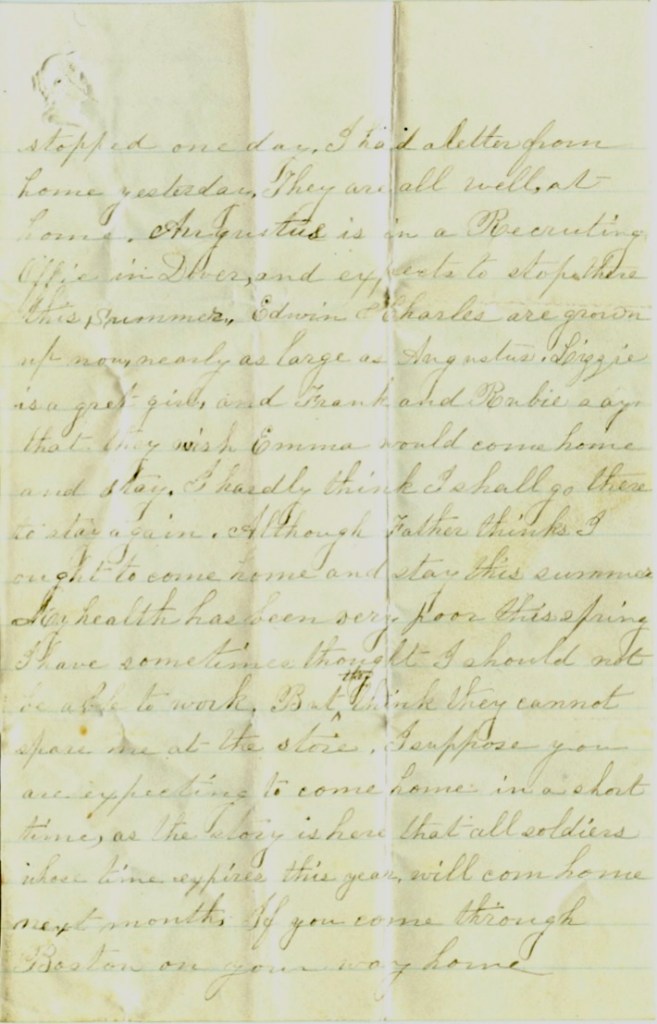
But I suppose you will want to hear of something else so I will leave that. I presume you knew that Augustus had again enlisted for three years in the 17th US Regulars—the same regiment he was in before. He enlisted the 14th of March. I was home this spring and stopped one day. I had a letter from home yesterday. They are all well at home. Augustus is in a Recruiting Office in Dover, and expects to stop there this summer. Edwin & Charles are grown up now, nearly as large as Augustus. Lizzie is a great girl and Frank and Rubie say that they wish Emma would come home and stay. I hardly think I shall go there to stay again although Father thinks I ought to come home and stay this summer.

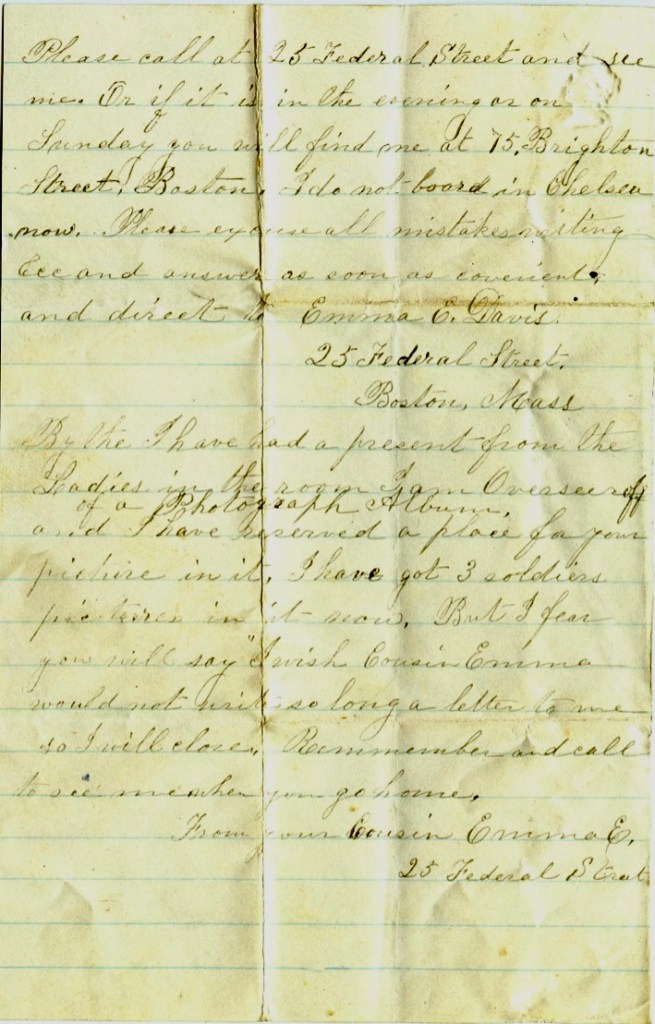
My health has been very poor this spring. I have sometimes thought I should not be able to work but they think they cannot spare me at the store. I suppose you are expecting to come home in a short time, as the story is here that all soldiers whose time expires this year will come home next month. If you come through Boston on your way home, please call at 25 Federal Street and see me. Or if it is in the evening or on Sunday, you will find me at 75 Brighton Street, Boston. I do not board in Chelsea now. Please excuse all mistakes writing, &c., and answer as soon as convenient and direct to Emma E. Davis, 25 Federal Street, Boston, Mass.

By the [by], I have a present from the ladies in the room. I am Overseer Officer of a photograph album and I have reserved a place for your picture in it. I have got three soldiers pictures in it now but I fear you will say, “I wish Cousin Emma would not write so long a letter to me so I will close.” Remember and call to see me when you go home. From your cousin, — Emma E., 25 Federal Street

How do you suppose Uncle Jeff likes his headquarters now?

1865: William C. Guest to James A. Guest

I could not find an image of William but here is one of Robert R. Russell of Co. H, 160th New York Infantry (Missing Letters File)

The following letter was written by William C. Guest (1839-1875) who enlisted as a private at Sodus, New York, on 9 September 1864 to serve in Co. C, 160th New York Infantry. He survived the war and was discharged on 1 June 1865 in Washington D. C.

Regrettably there is no family tree information on this branch of the Guest family that I could find on-line. The letter was addressed to “Dear Father” but the envelope was addressed to James A. Guest who was born in Cattaraugus county, New York, in 1831 so he would be too young to be the author’s father. My hunch is that James was an older brother who had previously served in the Civil War in the 26th New York Battery and was, by May 1865, working as an express agent in Belle Plaine, Iowa, where he was enumerated in the 1870 census. Sometimes letters and envelopes get mixed up, or sometimes a letter from one child gets forwarded to another. James’ military records indicate that his parents were Henry Guest and Rachel Beadle of Seneca county, New York.

The 160th New York Infantry was organized and later recruited from the counties of Cayuga, Seneca, Wayne, Ontario, Allegany, Erie and Wyoming. By the time William enlisted (or was drafted) into the regiment, they had seen action in the Department of the Gulf, the fall of Port Hudson, and the Red River Expedition. By the fall of 1864 when William joined them, they had returned to the East and specifically to the Shenandoah Valley where they fought with Gen. Sheridan against Gen. Early’s men. They sustained many casualties in the battles of Opequan and Cedar Creek.

William’s letter tells us about the trip to Washington D. C. to participate in the Grand Review in May and, while enroute, witnessing the Lincoln Funeral Train not long after it had left Washington on its way north to Baltimore on 21 April 1861. He also refers to the remains of John Wilkes Booth being on the gunboat Montauk at the Navy Yard.

[Note: This previously unpublished letter was graciously made available for transcription and publication on Spared & Shared expressly by the Sic Parvis Magna, Gratias Lesu Collection.]

Transcription

Addressed to Mr. James A. Guest. Belle Plaine, [Benton County] Iowa

Camp Stoneman
Near Washington D. C.

May 1, 1865

Dear Father,

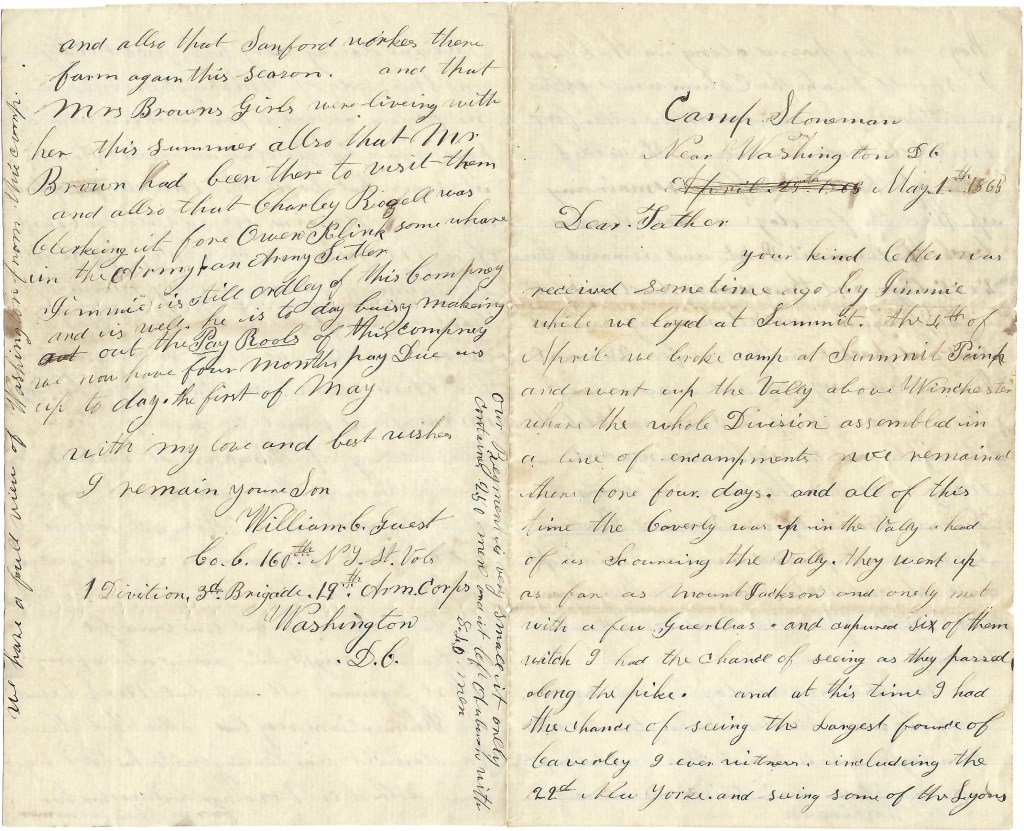
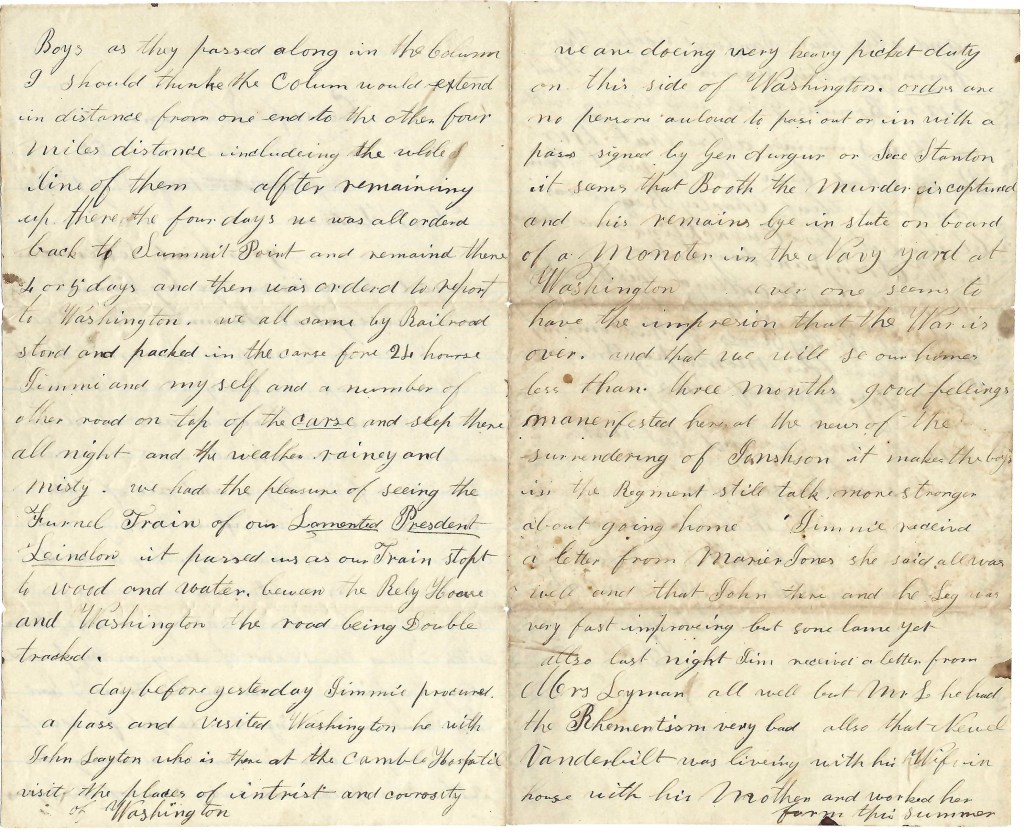
Your kind letter was received some time ago by Jimmie while we laid at Summit. The 4th of April we broke camp at Summit Point and went up the Valley above Winchester where the whole division assembled in a line of encampments. We remained there for four day and all of this time the cavalry was up in the Valley ahead of us scouring the Valley. They went up as far as Mount Jackson and only met with a few guerrillas and captured six of them which I had the chance of seeing as they passed along the pike, And at this time I had the chance of seeing the largest force of cavalry I ever witnessed including the 22nd New York and seeing some of the Lyons boys as they passed along in the column. I should think the column would extend in distance from one end to the other four miles distance including the whole line of them.

After remaining up there the four days, we was all ordered back to Summit Point and remained there 4 or 5 days and then was ordered to report to Washington. We all came by railroad stored and packed in the cars for 24 hours. Jimmie and myself and a number of others rode on top of the cars and slept there all night, and the weather rainy and misty. We had the pleasure of seeing the funeral train of our lamented President Lincoln. It passed us as our train stopped to wood and water between the Relay House and Washington, the road being double tracked.

Day before yesterday Jimmie procured a pass and visited Washington. He with John Layton who is there at the Campbell Hospital visit the places of interest and curiosity of Washington.

We are doing very heavy picket duty on this side of Washington. Orders are no persons are allowed to pass out or in with a pass [unless] signed by Gen. [Christopher C.] Augur or Secretary [Edwin] Stanton. It seems that Booth, the murder[er] is captured and his remains lie in state on board of a monitor [USS Montauk] in the Navy Yard at Washington. 1

Everyone seems to have the impression that the war is over and that we will see our homes [in] less than three months. Good feeling manifested here at the news of the surrendering of Johnston. It makes the boys in the regiment still talk more stronger about going home. Jimmie received a letter from Marier Jones. She said all was well and that John [was] there and his leg was very fast improving but some lame yet. Also last night Jim received a letter from Mrs. Lyman. All [were] well but Mr. Lyman. He had the rheumatism very bad. Also that Neu__ Vanderbilt was living with his wife in [the same] house with his mother and worked her farm this summer and also that Sanford works their farm again this season and that Mrs. Brown’s girls were living with her this summer. Also that Mr. Brown had been there to visit them. And also that Charley Rozell was clerking it for Owen Klink somewhere in the army for an army sutler.

Jimmie is still Orderly of this company and is well. He is today busy making out his pay rolls of this company. We now have four months pay due us to to today—the first of May.

With my love and best wishes, I remain your son, — William C. Guest

Co. C., 160th New York State Vols., 1st Division, 3rd Brigade, 19th Army Corps, Washington D. C.

Our regiment is very small. It only contains 250 men and it left Auburn with 840 men. We have a full view of Washington from this camp.


1 Readers are referred to another letter I transcribed in 2021 that was penned by Henry Washington Landes who served as a guard aboard the USS Montauk describes witnessing the autopsy of Booth performed onboard. See Henry Washington Landes Letters & Diaries.