The following letter was written by Van Buren Wintersteen (1836-1867), the eldest son of James and Sally (Roath) Wintersteen of Montville, Geauga county, Ohio.
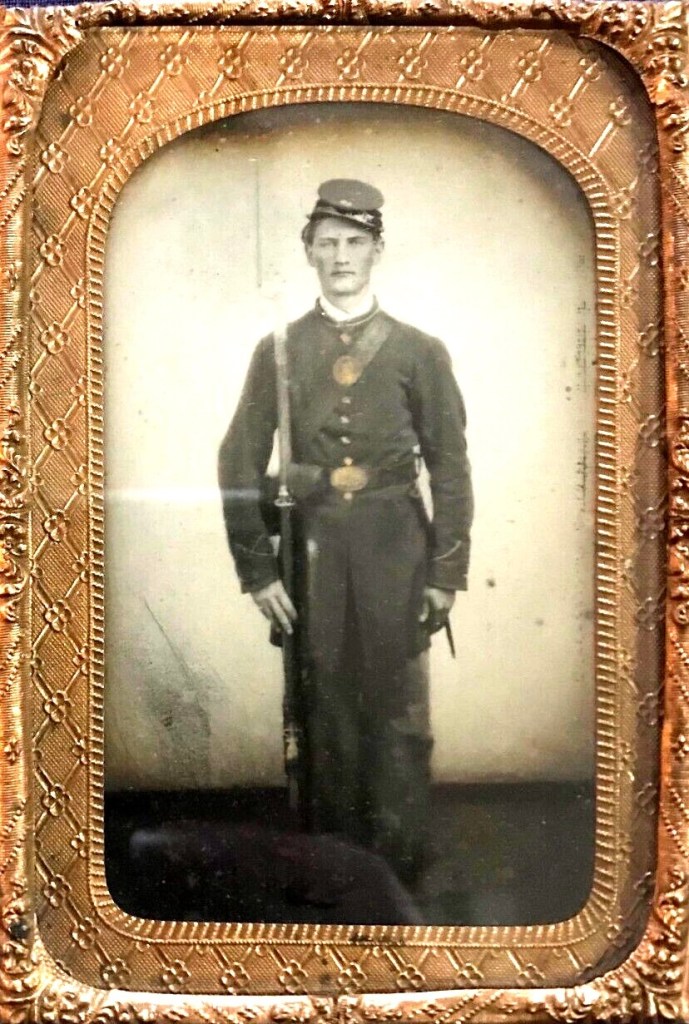
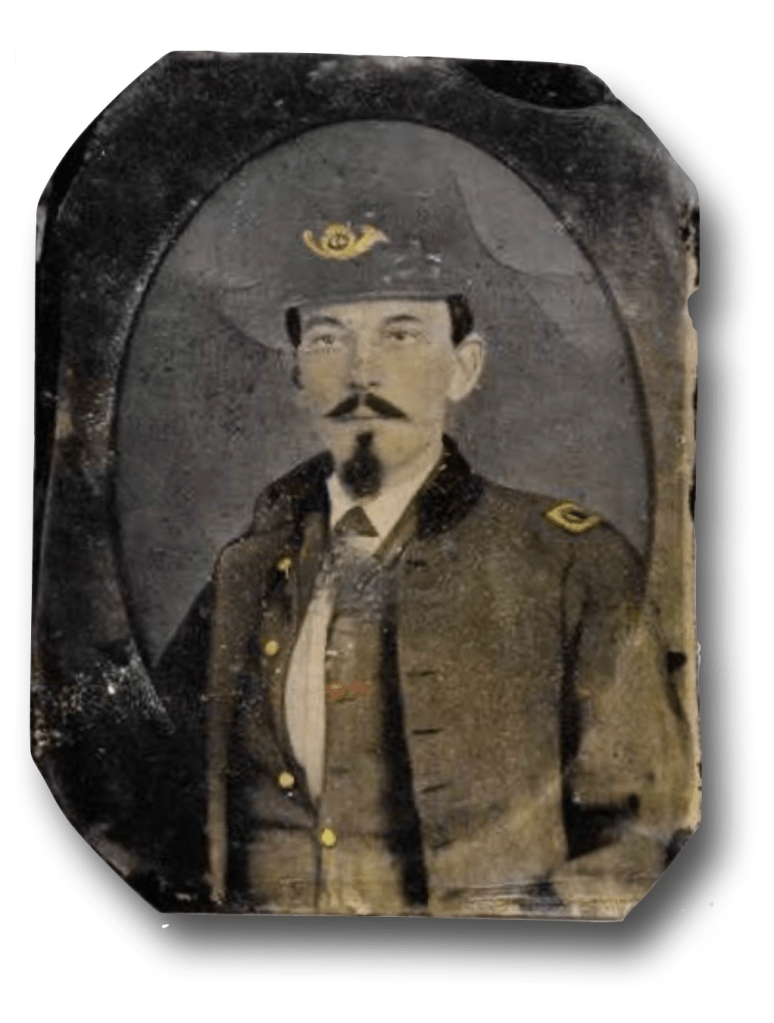
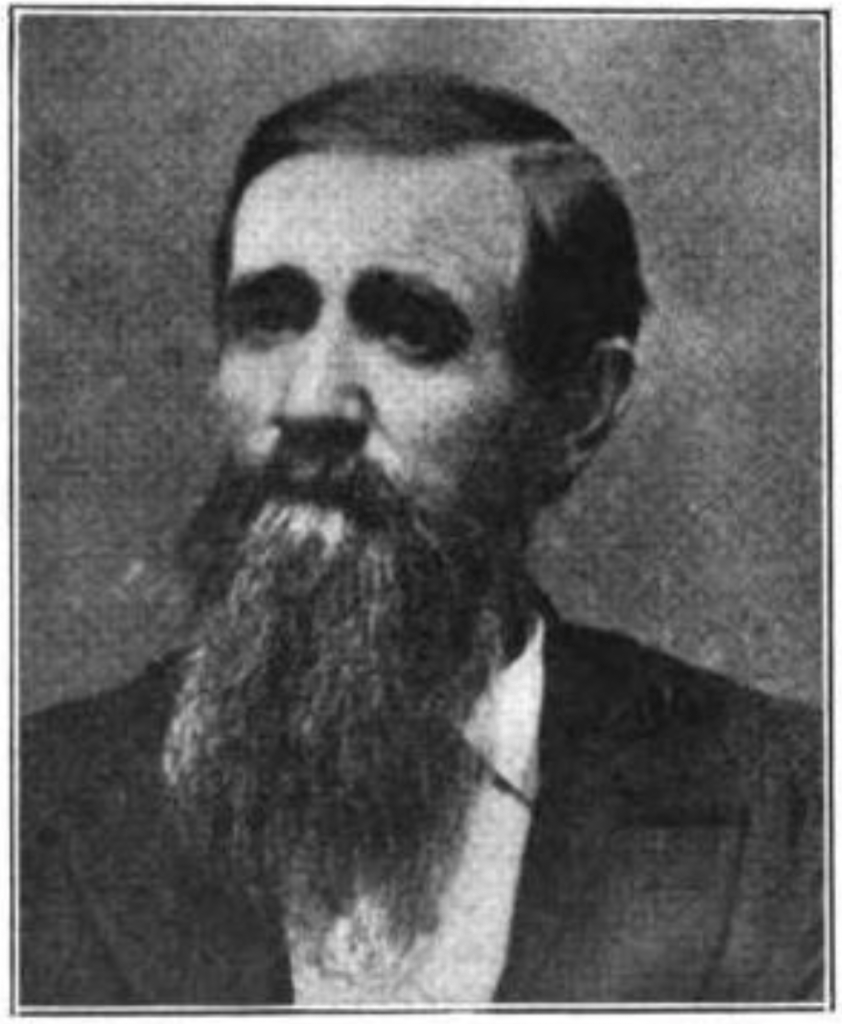
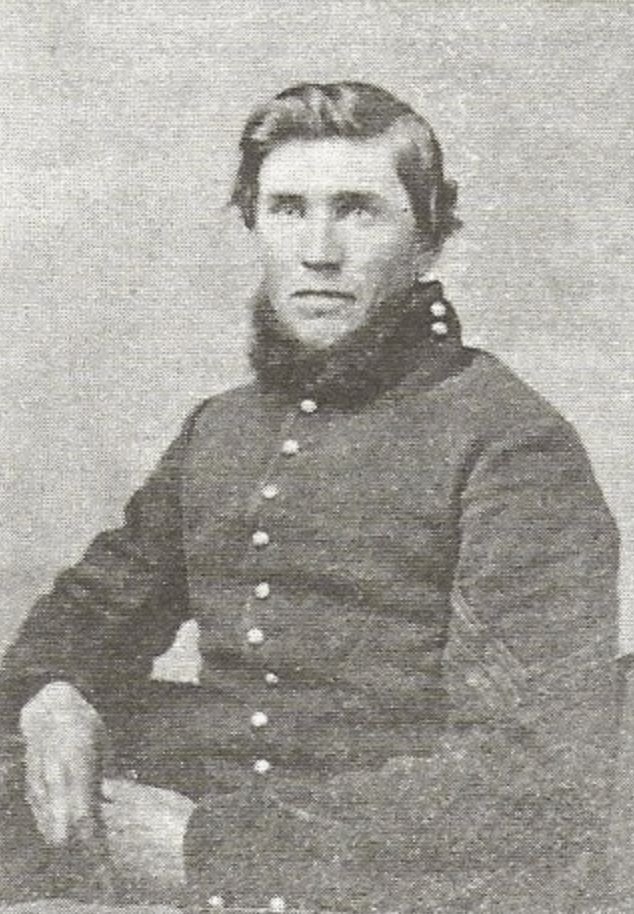
I could not find an image of V. B. Wintersteen but here is one of Phillip Bradley who also served in Co. B, 88th OVI
Wintersteen mustered into Co. B, 88th Ohio Infantry as a private on 26 June 1862 and mustered out on 26 September 1862. During those three months of service he was on duty as a prison guard in Hoffman’s Battalion at Johnson’s Island Prison in Sandusky Bay. Most of Hoffman’s Battalion were enlisted for three years and consisted of four companies of men who not only served as guards but helped construct the camp; some of the men also participated in a military campaign in western Virginia during 1862. During the summer of 1862, however, Wintersteen and others were recruited to serve just three months to supplement the guard force.
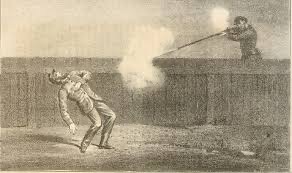
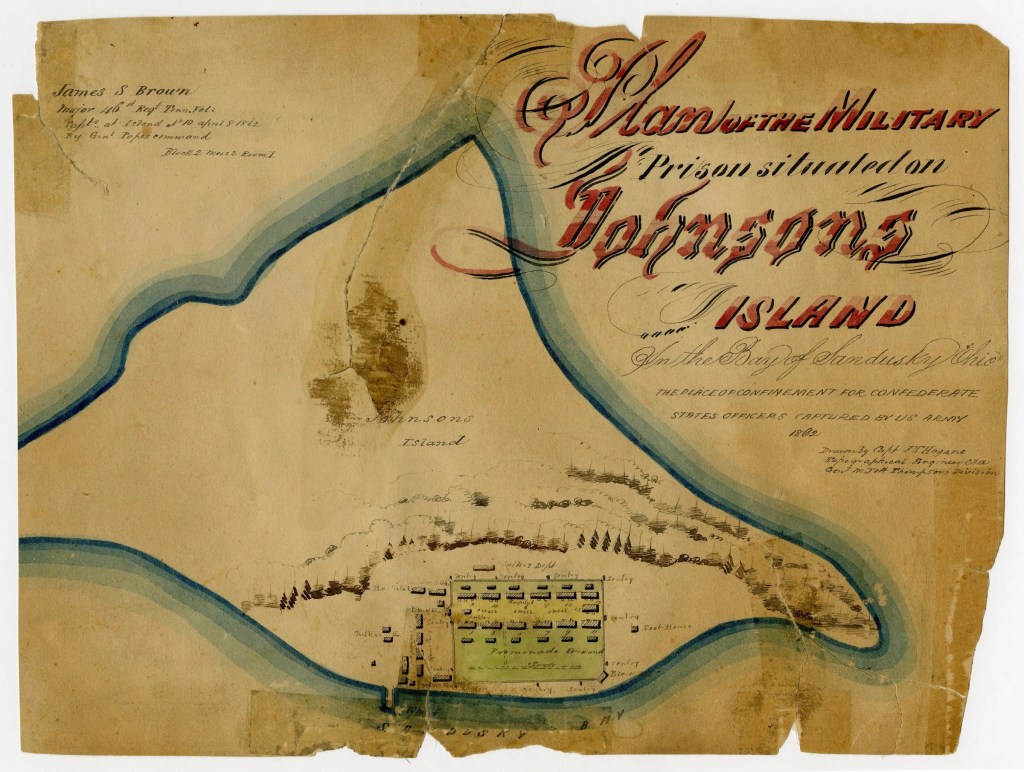
The initial detainees at Johnson’s Island were captured at Fort Donelson and Island No. 10 in the spring of 1862. Generally, those first captured in 1862 experienced exchanges after approximately five months, while individuals arriving post-Gettysburg in July 1863 remained incarcerated for 12 to 18 months. Notably, the prisoners who came in April 1862 were released in September, prior to the onset of the severe winter winds that swept across Sandusky Bay. The regulations governing the prison mandated the extinguishing of lights and the requirement for prisoners to be in bed at specified times; they were expected to demonstrate prompt and unquestioning obedience to the guards’ directives, observing the demarcation line strictly. Fortunately, not all guards adhered to these rules rigidly. There are recorded instances of prisoners being shot at close range, with bullets missing so substantially that those imprisoned speculated whether the guard had intentionally missed or was merely inept as a marksman.
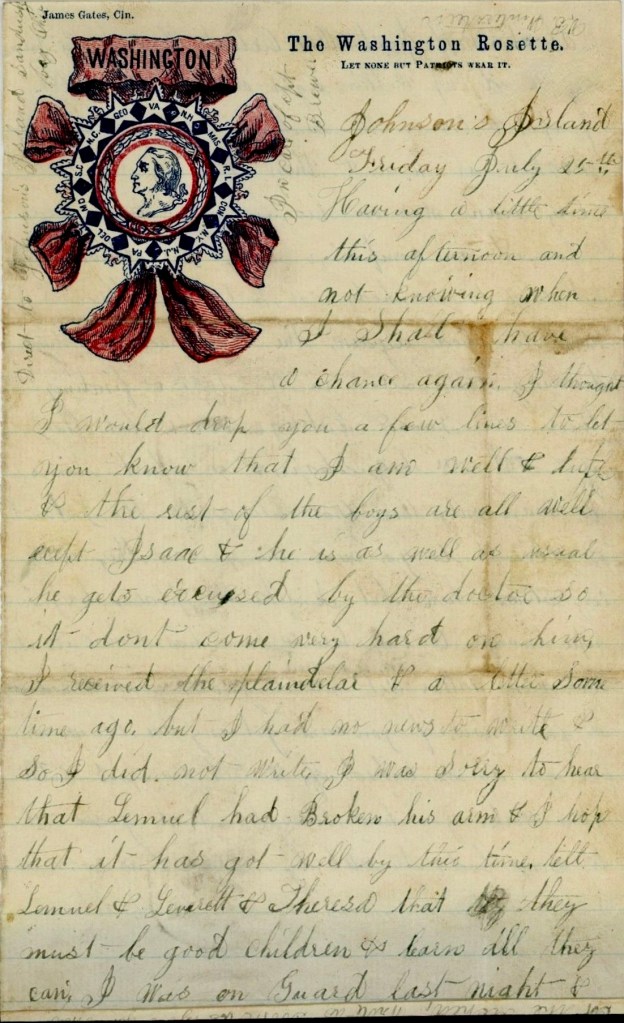
Having a little time this afternoon and not knowing when I shall have a chance again, I thought I would drop you a few lines to let you know that I am well & tough, and the rest of the boys are all well except Isaac [D. Nickerson] & he is as well as usual. He gets excused by the doctors so it don’t come very hard on him.
I received the [Cleveland] Plain Dealer and a letter some time ago but I had no news to write & so I did not write. I was sorry to hear that Lemuel had broken his arm and I hope that it has got well by this time. Tell Lemuel & Leverett & Theresa that they must be good children & learn all they can.
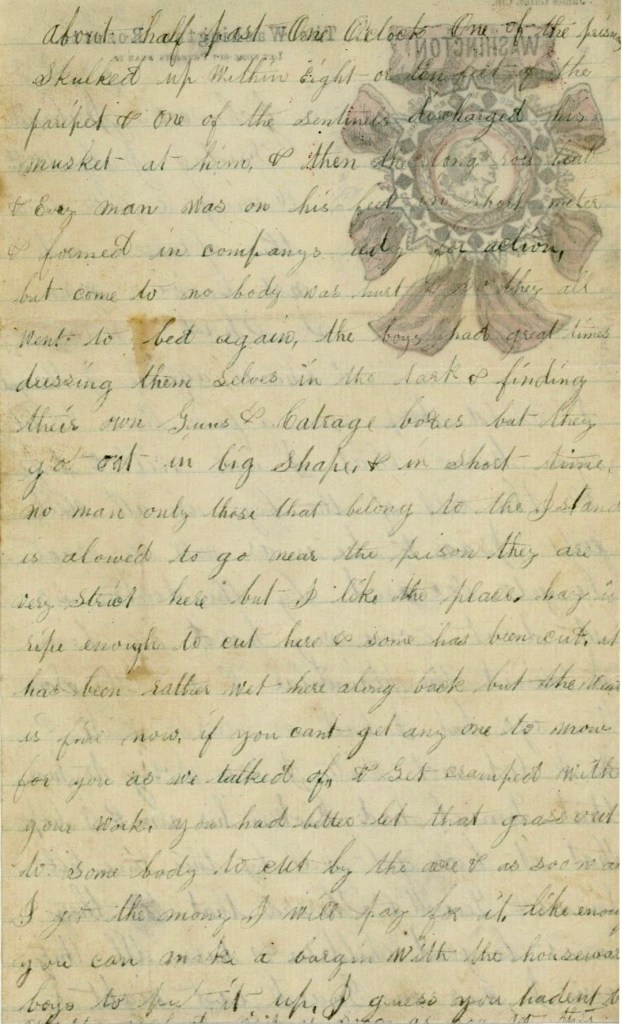
I was on guard last night & about half past one o’clock one of the prisoners skulked up within eight or ten feet of the parapet & one of the sentinels discharged his musket at him, and then the long roll beat & every man was on his feet in short meter & formed in companies ready for action. But come to nobody was hurt & so they all went to bed again. The boys had great times dressing themselves in the dark and finding their own guns and cartridge boxes but they got out in big shape & in short time. No man—only those that belong to the Island—is allowed to go near the prison. They are very strict here but I like the place.
Hay is ripe enough to cut here and some has been cut. It has been rather wet here along back but the weather is fine now. If you can’t get anyone to mow for you as we talked of & get cramped with your work, you had better let that grass out to somebody to cut by the acre & as soon as I get the money, I will pay for it. Like enough you can make a bargain with the houseware boys to put it up. I guess you hadn’t…[rest of letter is missing]
Direct to Johnson’s Island, Sandusky Bay, Ohio. In care of Capt. [Daniel] Brewer, V. B. [Van Buren] Wintersteen
The following diary fragment and two letters written by 35 year-old Capt. John White (1829-1909), Quartermaster of the 5th Alabama Infantry. They are from the collection of Jason Politte who purchased them in the early 1990s from an antique store in Little Rock, Arkansas, and has graciously offered them for transcription and posting on Spared & Shared. They have never been previously published to his knowledge.
John White was the son of lawyer John White, Sr. (1778-1842) and Abigail Dickinson (17xx-1834) who migrated from Virginia to Tennessee, and from there to Northern Alabama in 1814. The Whites lived at Courtland, Lawrence county, Alabama, where John was born in 1829, and then relocated to Talladega county. John had two older brothers who had careers of distinction. Alexander was a member of the US Congress (in 1851) and later chief justice of the Supreme Court of Utah. He was made immortal by his “Bonnie Blue Flag” Speech. Another brother, Robert was a successful physician.
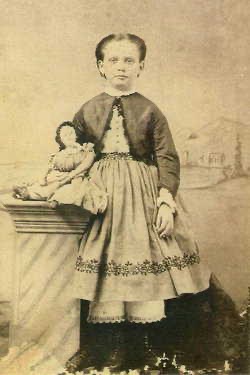
Kate Belle C. White (b. 1858) was Capt. White’s youngest daughter when he was held a prisoner of war. This image appears to date to 1864. She later married and relocated to Little Rock, Arkansas, where these letters and diary surfaced in an Antique Store.
It was here in the heartland of Alabama that John met and married Mary Jane Finley (1832-1874), the daughter of Alva and Sarah (Hall) Finley of Talladega. The couple were in enumerated in Talladega, Alabama, in the 1850 US Census; John practicing law like his father, having been admitted to the bar in 1849. Their oldest child, Sarah Alvena White (1849-1917) was born in Talladega. John and his family relocated to Cahaba, Dallas county, Alabama in 1858 and took their mail at the Moseley’s Grove post office. A second daughter named Kate Belle Champman White (1858-1942) was born in Dallas county. Undoubtedly there were other children born to the couple but these two may have been the only ones to survive childhood (a 9 year-old son named Charles appears in the 1860 census). After the war, John lived in Selma, and later Birmingham.
In early March 1862, John enlisted in the Confederate service at Cahaba as a private in Co. F, 5th Alabama Infantry. After about three months, he was promoted to captain and appointed as the quartermaster of the regiment. However, his service was interrupted when he was captured on 4 July 1863 during the retreat from Gettysburg. Subsequently, he was taken to Johnson’s Island, near Sandusky, Ohio, where he was held with other Confederate officers until 13 March 1865, when he was finally chosen for exchange. The two letters presented here were written in June 1864, after nearly a year of captivity. These are typical prisoner of war letters, limited to one page and subject to censorship review. Additionally, the diary fragment documents his journey from Johnson’s Island Prison back to Alabama via Point Lookout, Maryland, and City Point, Virginia, eventually arriving at Aikens Landing on the James River, where he was exchanged and granted a furlough to visit his family. The diary concludes before his arrival at home, as the reunion with his family was delayed due to the presence of Union troopers occupying Selma and the surrounding region, including Cahaba, where the raiders successfully liberated Union soldiers held in the prison there (see Wilson’s Raid and the Battle of Selma).
A brief obituary for Capt. White was posted in the Selma Times on 11 May 1909 which read in part: “Captain White was born at Courtland, Alabama, April 17, 1829. He served in both the War between the States, and the Mexican War (1st Alabama Regiment), gaining distinction in both hostilities. He was a lawyer by profession and until his retirement was accorded to be one of the leading legal exponents of the state. He was a member of the Episcopal church and of the masonic fraternity and was always held in high esteem among the citizens of Alabama…”
Letter 1
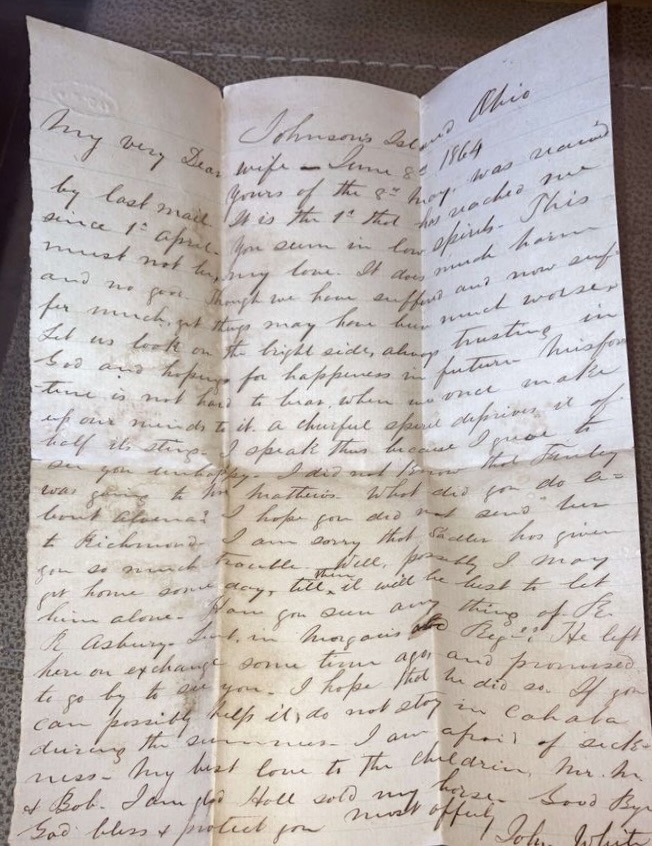
Johnson’s Island, Ohio June 8th 1864
My very dear wife,
Yours of the 8th May was received by last mail. It is the 1st that has reached me since 1st April. You seem in low spirits. This must not be, my love. It does much harm and no good. Though we have suffered and now suffer much, yet things may have been much worse. Let us look on the bright side, always trusting in God and hoping for happiness in future. Misfortune is not hard to bear when we once make up our minds to it. A cheerful spirit deprives us of half its sting. I speak thus because I grieve to see you unhappy.
I did not know that Finley was going to Mr. Mathew’s. What did you do about Alvena? I hope you did not send her to Richmond. I am sorry that Sadler has given you so much trouble. Well, possibly I may get home some day. Till then, it will be best to let him alone. Have you seen anything of R. R. Asbury, Lieut. in Morgan’s Regiment? 1 He left here on exchange some time ago, and promised to go by to see you. I hope that he did so. If you can possibly help it, do not stay in Cahaba during the summer. I am afraid of sickness. My best love to the children, Mr. M[athews] & Bob. I am glad Hall sold my horse. Goodbye. God bless & protect you. Most affectionately, — John White.
1 Reuben R. Asbury [Asberry] served as a 2nd Lieutenant in Co. F, 52st Alabama (Partison Rangers). He was from Talladega and was taken prisoner at Shelbyville, Tennessee, while riding with Col. Morgan on 27 June 1863. He was sent first to Louisville, to Columbus (OH), then Baltimore, and finally to Johnson’s Island. He was exchanged on 3 May 1864 at Point Lookout, Maryland.
Letter 2
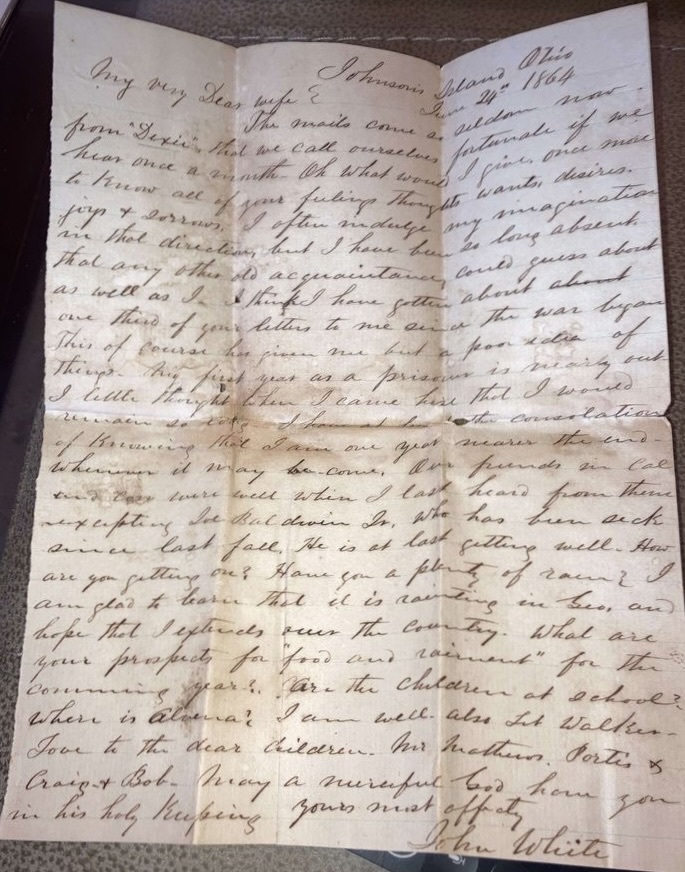
Johnson’s Island, Ohio June 24, 1864
My very dear wife,
The mails come so seldom now from “Dixie” that we call ourselves fortunate if we hear once a month. Oh what would I give once more to know all of your feelings, thoughts, wants, desires, joys & sorrows. I often indulge my imagination in that direction, but I have been so long absent that any other old acquaintance could guess about as well as I. I think I have gotten about one third of your letters to me since the war began. This of course has given me but a poor idea of things.
My first year as a prisoner is nearly out. I little thought when I came here that I would remain so long. I have at least the consolation of knowing that I am one year nearer the end—whenever it may come. Our friends in Cal[ifornia] and Can[ada] were well when I last heard from them, excepting Joe Baldwin, Jr. who has been sick since last fall. He is at last getting well. 1 How are you getting on? Have you a plenty of rain? I am glad to learn that it is raining in Georgia and hope that it extends over the country. What are your prospects for “food and raiment” for the coming year? Are the children at school? Where is Alvena? I am well. Also Lt. Walker. Love to the dear children, Mr. Mathews, Portis and Craig and Bob. May a merciful God have you in his holy keeping. Yours most affectionately, — John White.
1 One of John White’s sister married Joseph J. Baldwin, the author of “Flush Times in Alabama and Mississippi” and “Party Leaders.” He later moved his family to California where he became a member of the California Supreme Court and died there during the Civil War.
Transcription of Diary
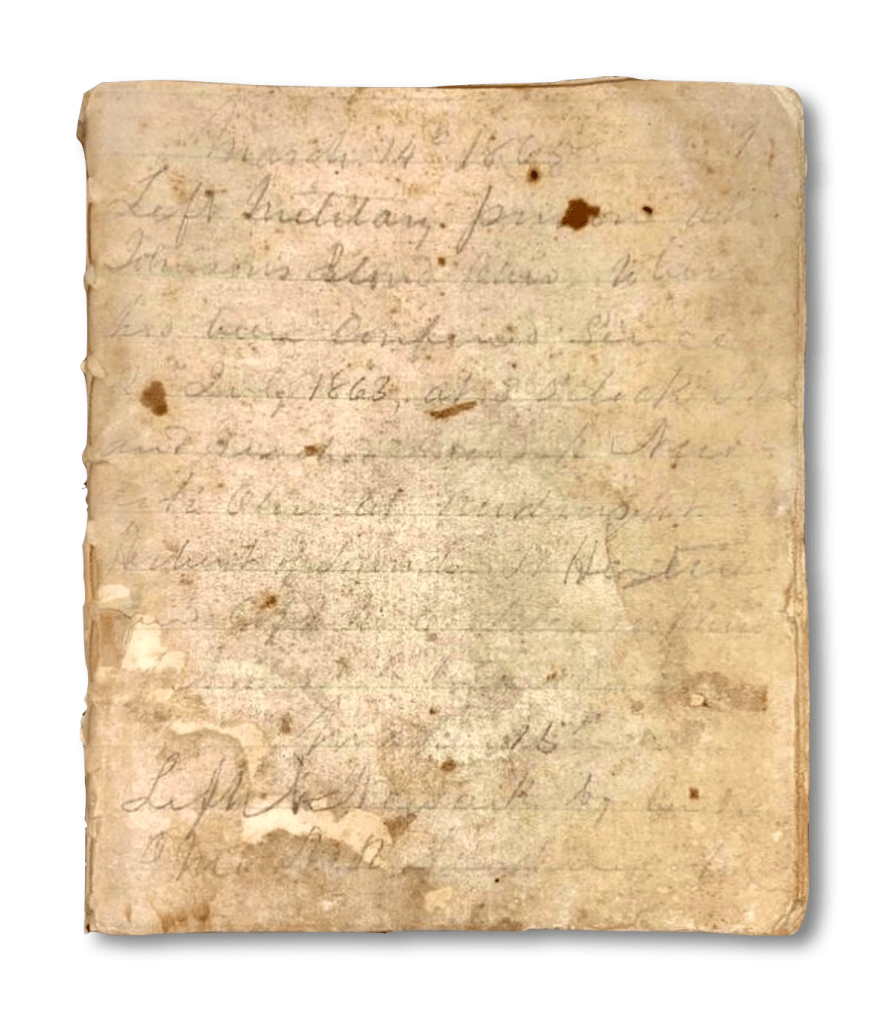
March 14th, 1865 — Left military prison at Johnson’s Island, Ohio, where I had been confined since 21st July, 1863 at 8 o’clock p.m., and reached Newark, Ohio, at midnight. [Remainder of this date’s entry is illegible.]
March 15th — Left Newark by Baltimore & Ohio railroad leaving for Wheeling Virginia. Passed through Zanesville, Ohio, at 9 in the evening. Struck the Ohio River at Bellaire, four miles below Wheeling at 3am [on the] 16th. Did not go to Wheeling but went directly down river (on railroad) towards Cumberland. The country through which we passed shows signs of the mountains and is not very rich.
March 16th — Left Bellaire on the Ohio four miles below Wheeling at five o’clock a.m. Traveled all day towards Cumberland, Maryland, making very slow time. The country is little else than mountains. This road (the Baltimore & Ohio) is a tremendous work. We have passed through six tunnels today, one of which is one-and-a-half miles in length. Night found us in the mountains.
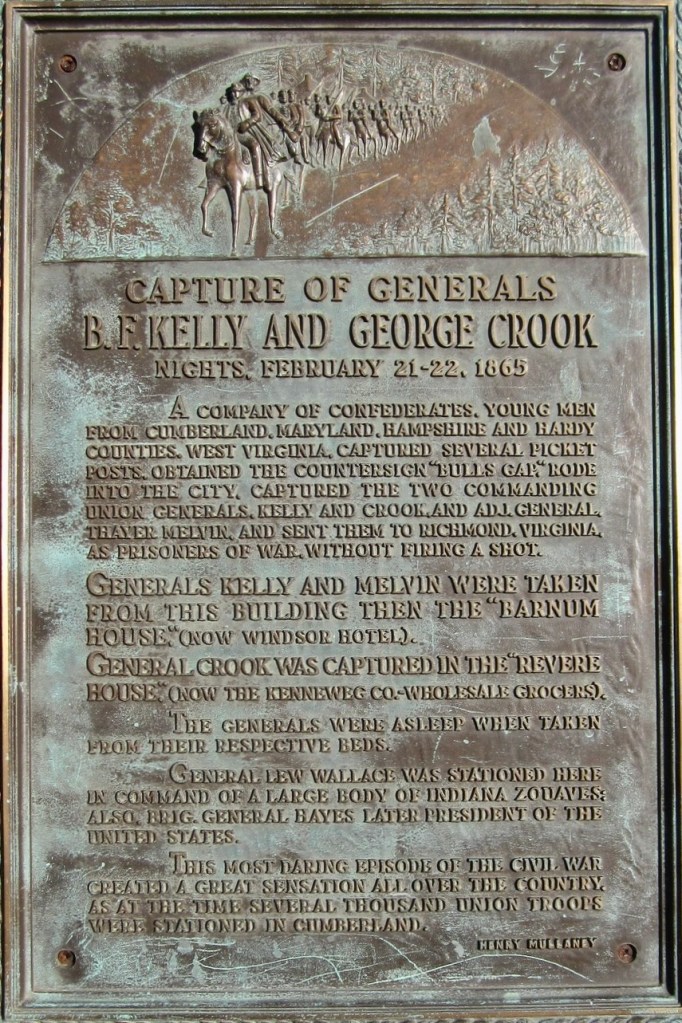
March 17th — After passing Cheat Mountain which divides the waters of the Ohio from those of the Potomac, we came to and descended one of the branches of the latter to Cumberland, Maryland, where we arrived about 12 a.m. Here we learned that a bridge had been washed away below which has since detoured us. This is the place where Lt. McNeill captured Gens. Crook and [B. F.] Kelly.
March 18th — Left Cumberland at 10 am. Crossed the Potomac about ten miles below and traveling very slowly. Passed a tunnel 1,300 yards long 50 miles above Martinsburg.
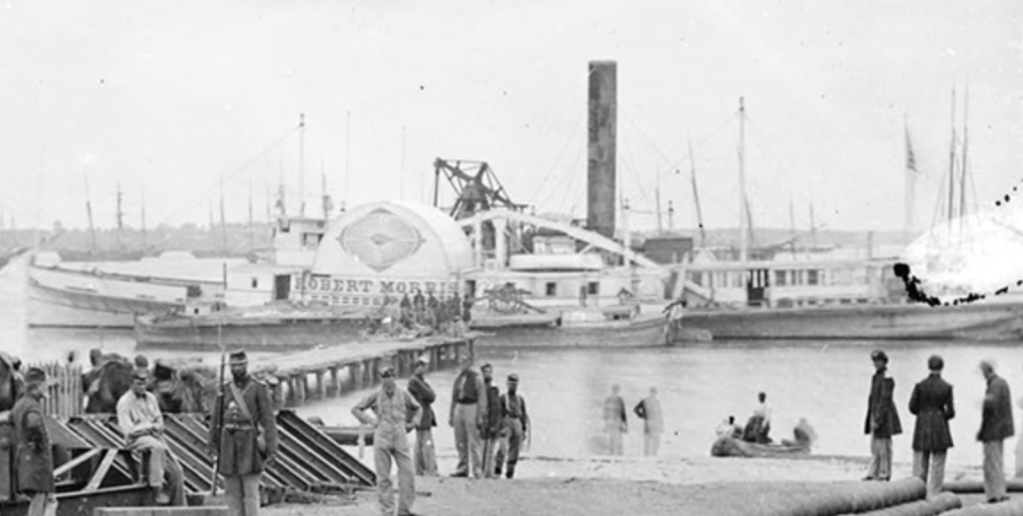
March 19th — At daylight found ourselves at Martinsburg [West Virginia] —a place which I have not forgotten. 1 Left at sunup and got to Harpers Ferry at ten. This is a [mountainous?] ground [?] The passages through the mountains for the two rivers seems to have been cleared by the hand of Omnipotence. Left at 11. Reached Baltimore at sunset. Were marched straight on board of the Steamer Robert Morris. Were allowed no communication whatsoever with anyone. Brothers were not permitted to see their sisters. Left at 11 o’clock p.m. for Point Lookout.
1 The 5th Alabama passed through Martinsburg, West Virginia, on 14 June, 1863 enroute to Gettysburg. John S. Tucker of the 5th Alabama wrote in his diary: “Reached Martinsburg at sundown and drove the Yankees out in double quick time. Captured several pieces of artillery and a good many stores. Some of the women and children were delighted to see us though the town is rotten to the core.”
The steamer Robert Morris
March 20th — Reached Point Lookout at 11 o’clock a.m. and left at three pm. Passed Fortress Monroe about 9 p.m. and anchored six miles above for the night. The weather during our whole trek has been very fine and wonderfully different from Johnson’s Island.
March 21st — Started for City Point at daylight where we arrived at 1 p.m. Left at nine and reached Aiken’s Landing—alias Varina—at night when we anchored in the stream till morning.
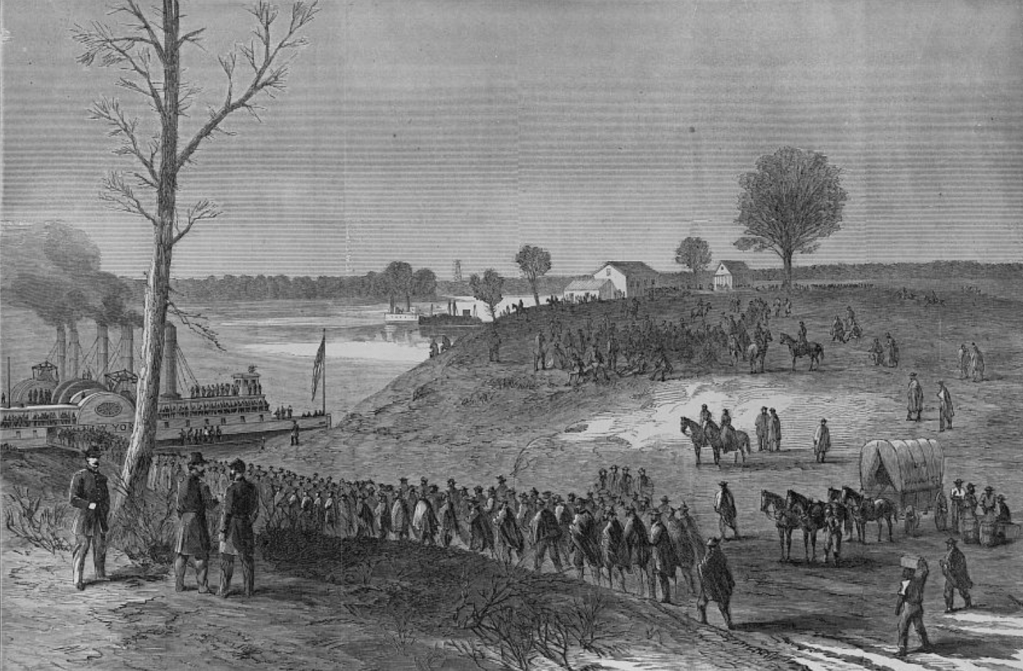
Union POWs being exchanged for Confederate POWs at Aiken’s (Varina’s) Landing on the James River in 1865. (Harper’s Weekly)
March 22nd — At 10 a.m. marched across a neck of land to a point one mile from Varina where we were delivered to Col. [William H.] Hatch 2 at 7 p.m. and left for Richmond which we reached at 4. Stopped at American Hotel, board $50 per day. Took tea at Wm. H. Richardson’s. Got furlough for 30 days after supper.
2 Col. William Henry Hatch was one of the Confederate Agents of Exchange. He was arrested by Federal authorities after the cessation of hostilities and held in Libby Prison, accused of stealing from Union POWs.
March 23rd — Called to see General A[lexander] R. Lawton. He instructed me to leave a note stating that I had lost my place as QM of 5th Alabama and my address. He said that when my furlough was out I would be subject to orders but that I had better write him again then and await his orders at home. Left Richmond for home at 10 p.m. and drew pay to 2nd March.
March 24th — Have been ever since 6 p. m. 23rd coming from Richmond to this place, Danville, a distance of 140 miles. The railroads are in a most wretched condition. Here we are to stay till 9 a.m. in morning.
Saturday, March 25th. Sunday — Left Danville 9 a.m. and reached Greensboro, North Carolina, at 3 p.m., 45 miles. Here we learned that the train does not leave till tomorrow, 10 o’clock. Maj. Foster, Lt. Webster and others who left Richmond yesterday evening overtook us here. Went to see George B. Hall. The weather here is cold and windy.
March 26th Sunday — Left Greensboro at 11 am and reached Salisbury at 6 pm. 42 miles. Left in an hour and arrived at Charlotte at 2 a.m., 45 miles. Weather good.
Monday March 27th — Leaving Charlotte at 8 a.m., reached Blackstock [South Carolina], 50 miles and end of railroad at 2 p. m. From this place we had to walk. We made about 12 miles and slept at an old negro’s. Fairfield District. Weather clear.
Tuesday March 28th — Started at daylight. Walked three miles to breakfast and then made 17 miles by night, being five miles from Newberry where we are to take the cars for Abbeville. Weather cloudy and pleasant.
Wednesday March 29th — Made 5 miles to Newberry where we take cars, reaching Abbeville [ ] miles at 3 p.m. Drew rations and had them cooked. Started at sunset on foot for Washington, Georgia. Marched 9 miles through rain, mud, and darkness when we camped under a blanket tent.
Thursday March 30th — Left camp at daylight and at 5 miles overtook wagon train which took us to within 9 miles of Washington from which place we walked 7 1/2 miles and slept in a portico. It rained on us very hard early in the morning but blew off clear and cold about 10 a.m.
Friday March 31st — Got to Washington at sunup and left on cars at 8 and a half and went 18 miles to the Augusta & Atlanta Railroad. At Barnett 58 miles from Augusta and 113 from Atlanta by 11 a. m. Left for Covington—the end of track—at 11 1/2 a. m. Reached in 73 miles by sunset. Here we staid all night.
Saturday, May [should be April] 1st — From Covington to Atlanta it is 41 miles by railroad and 30 by the wagon road. I walked it starting at 6 am and getting to Atlanta at 4 a.m. next day. Weather fine.
Sunday April 2nd — Left Atlanta for West Point [Georgia] at 8 a.m. which we reached at 4 p.m. Left for Montgomery at 5 where we arrived at 4 a.m. Put up at Exchange.
Monday, April 3rd — Here I learned that the Yanks had taken Selma the evening before, thus cutting me off from home. Never was I so disappointed. Found Mrs. Clarke and a Mr. Alexander coming up to Jacksonville in an ambulance. As I could not get home, I determined to go with them to Talladega. Reached Lauchlen McCauley’s of Wetumpka. Stayed all night. He is well.
the 51st Alabama Cavalry.
Tuesday, April 4th — Hearing at Wetumpka that the Yanks were coming down from Talladega, I turned to the left from the plank road and spent the night at Mr. Frank Sims’ 17 miles from Wetumpka. I found him a very clever man.
Wednesday, April 5th — Did not leave Mr. Sims’ that evening when hearing that the reported [Wilson’s] raid was a [ ] we left to the plank road. Traveled 9 miles, stayed at Mr. Adam Heil’s. He an invalid. His wife a very disagreeable woman. 7 miles below Blackford’s [?] factory.
Thursday April 6th — Traveled 24 miles to Sylacauga where we spent the night. Saw Mr. Simpson and wife at factory. Very kind. Stayed the night with Dr. W. C. Patterson.
Friday April 7th. Rained all night and made the road so bad that I could not go any further with Mrs. Clarke so they left me.
[end of diary]
Capt. John White’s small, hand-stitched diary fragment. The first page is barely legible, the pencil markings being smudged. The remainder of the diary is far more legible.
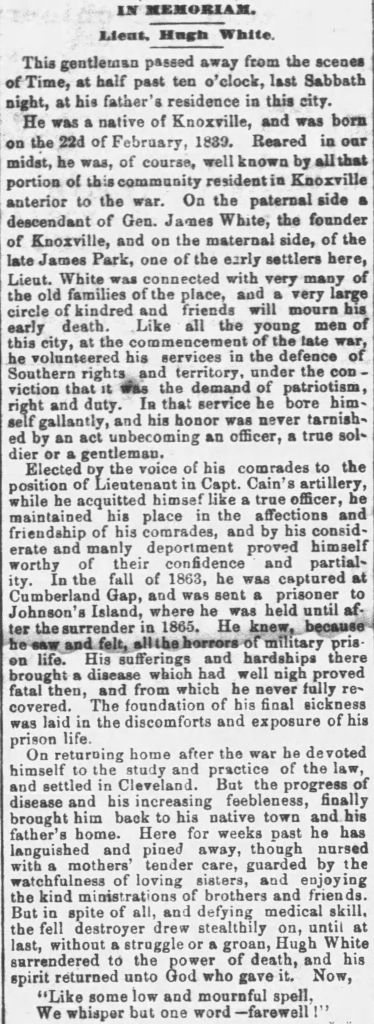
The following letter was written by Hugh Lawson White (1839-1871), the son of Judge George M. White (1800-1884) and Isabella McNutt (1780-1842) of Knoxville, Tennessee. When the Civil War began, “like all the young men of Knoxville,” Hugh volunteered his services “in the defense of Southern rights and territory under the conviction that it was the demand of patriotism, right and duty.” He was elected by his comrades as a Lieutenant in Capt. W. C. Kain’s Light Artillery Company. In the fall of 1863, he was captured at Cumberland Gap and sent a prisoner to Johnson’s Island where he was held until after the surrender in 1865. While in prison, he contracted a disease which impaired him and no doubt prematurely ended his life in 1871. After the war he studied and practiced law for a time but his health failed him.
Transcription
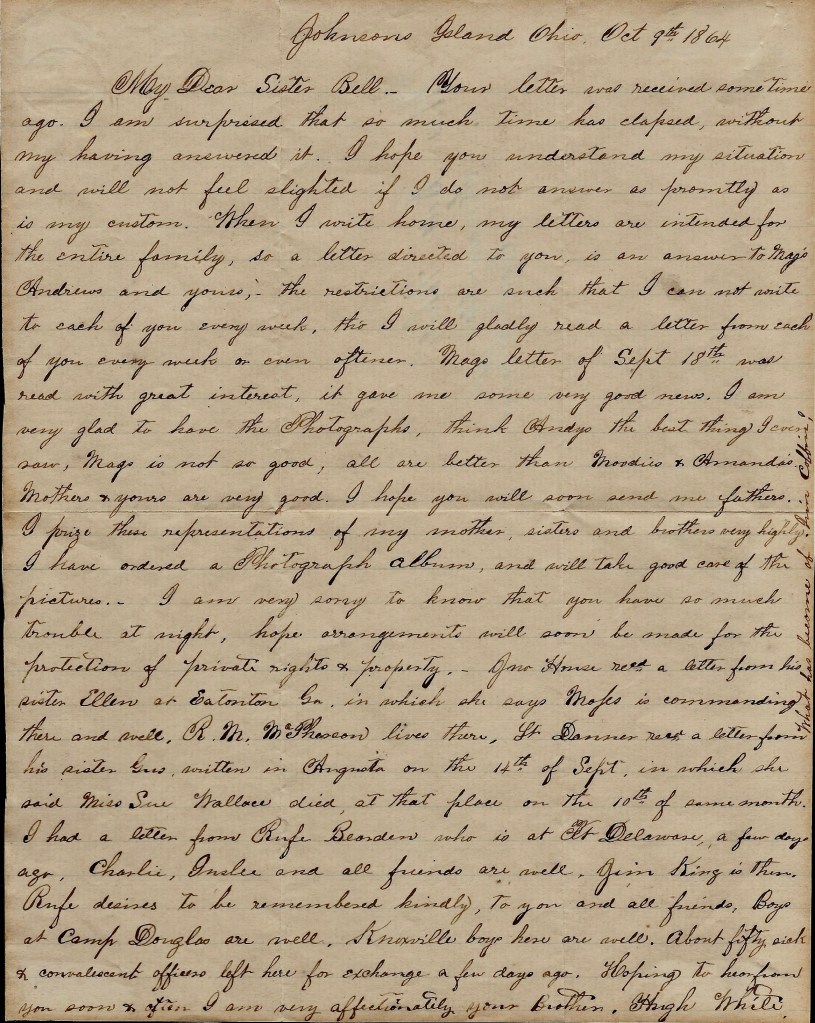
Johnson’s Island, Ohio October 9th 1864
My dear sister Bell,
Your letter was received sometime ago. I am surprised that so much time has elapsed without my having answered it. I hope you understand my situation and will not feel slighted if I do not answer as promptly as is my custom. When I write home, my letters are intended for the entire family, so a letter directed to you is an answer to Mag’s, Andrew’s and yours. The restrictions are such that I cannot write to each of you each week though I will gladly read a letter from each of you every week or even oftener. Mag’s letter of September 18th was read with great interest. It gave me some very good news. I am very glad to have the photographs. Think Andy’s the best thing I ever saw. Mag’s is not so good. All are better than Moodie’s and Amanda’s. Mother’s and yours are very good. I hope you will soon send me father’s. I prize these representations of my mother, sisters, and brothers very highly. I have ordered a photograph album and will take good care of the pictures. I am very sorry to know that you have so much trouble at night. Hope arrangements will soon be made for the protection of private rights and property. Jno. House received a letter from his sister Ellen at Eatonton, Ga., in which she says [brother] Moses [White] 1 is commanding there and well. R. M. McPherson lives there. Lt. Danner received a letter from his sister Gus, written in Augusta on the 14th of September, in which she said Miss Sue Wallace died at that place on the 10th of same month. I had a letter from Rufe Beardon who is at Ft. Delaware a few days ago. Charlie, Inslee and all friends are well. Jim King is there. Rufe desires to be remembered kindly to you and all friends. Boys at Camp Douglas are well. Knoxville boys here are well. About fifty sick and convalescent officers left here for exchange a few days ago. Hoping to hear from you soon & often. I am very affectionately your brother, — Hugh White
What has become of Jim Coffin!
1 Moses P. White (1829-1907) of Knoxville was the Colonel of the 37th Tennessee Infantry.
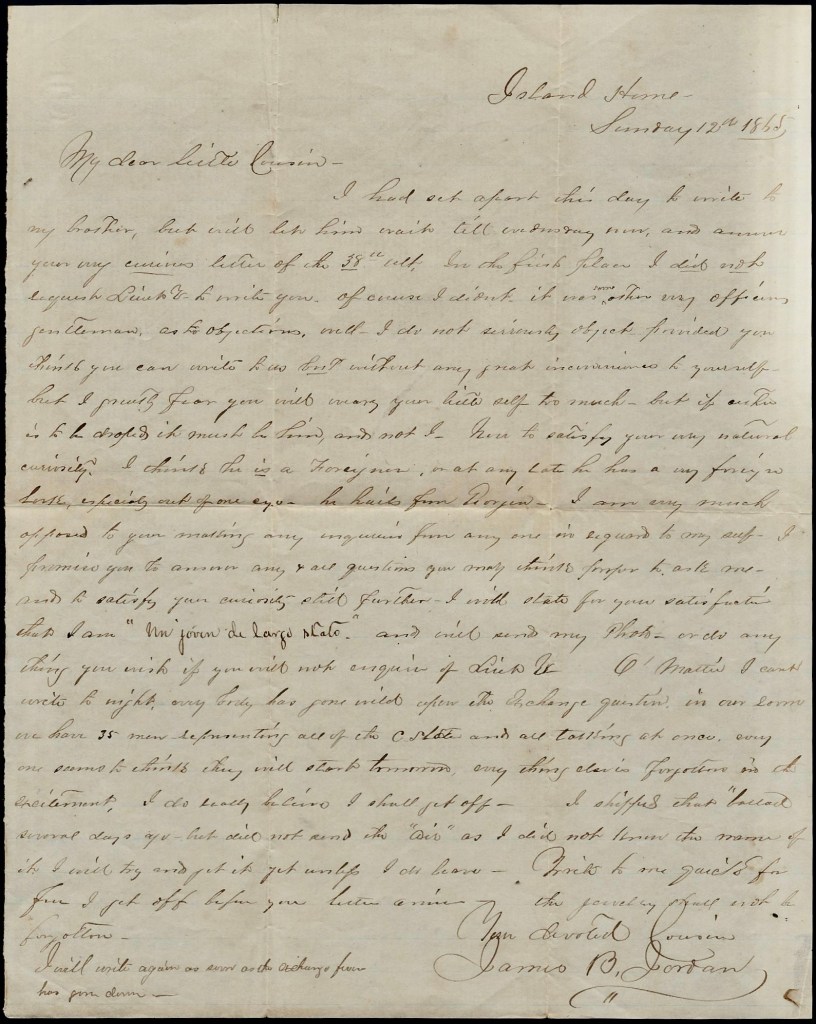
The following letter was written by 1st Lt. James Berry Jordan (1837-1899), a Confederate Prisoner of War (POW) at Johnson’s Island near Sandusky, Ohio. Jordan was a resident of Wake county, North Carolina, when he enlisted in late May 1861 as a 1st Lieutenant in Co, D, 26th North Carolina Infantry. With his excellent handwriting, he was soon after given the Adjutant’s job in the regiment. He was wounded in the hip at the Battle of Gettysburg and was taken prisoner. He was first sent to David’s Island and then in mid-September 1863 sent to Johnson’s Island which he humorously called his “Island Home” after 18 months of captivity there.
A week after this letter was written, Jordan went sent to Point Lookout, Maryland, and then to Ft. Delaware where he was released on 12 June 1865.
Jordan wrote the letter to Martha (“Mattie’) Elizabeth Fearn (1845-1936) with whom he would marry on 26 September 1866. Mattie lived with her parents, Samuel and Elizabeth (Owen) Fearn in Milton, Trimble county, Kentucky.
Note: “James Berry Jordan,” born 8 June 1838 is the way his name appears in the family bible.
Transcription
Island Home Sunday, [March] 12th 1865
My dear little cousin,
I had set apart this day to write to my brother, but will let him wait till Wednesday now and answer your very curious letter of the 38th ult. In the first place, I did not request Lieut. V. L. write you. Of course I didn’t—it was some other officer gentleman. As to objections, well, I do not seriously object provided you think you can write to us, but without any great inconveniences to yourself. But I greatly fear you will weary your little self too much, But if either is to be dropped, it must be him, and not I.
Now to satisfy your very natural curiosity. I think he is a foreigner, or at any rate, he has a very foreign look—especially out of one eye. He hails from Georgia. I am very much opposed to your making any inquiries from anyone in regard to myself. I promise you to answer any and all questions you may think proper to ask me and to satisfy your curiosity still further, I will state for your satisfaction that I am “Nu joven de large stato” and will send my photo, or do anything you wish if you will not enquire of Lieut. V.
Oh Mattie, I can’t write tonight. Everybody has gone wild upon the exchange question in our room. We have 35 men representing all of the Confederate States and all talking at once. Everyone seems to think they will start tomorrow. Everything else is forgotten in the excitement. I do readily believe I shall get off. I shipped that “ballad” several days ago but did not send the “air” as I did not know the name of it. I will try and get it yet unless I do leave.
Write to me quick for fear I get off before your letter arrives. The jewelry shall not be forgotten. Your devoted cousin, — James B. Jordan
I will write again as soon as the exchange fever has gone down.
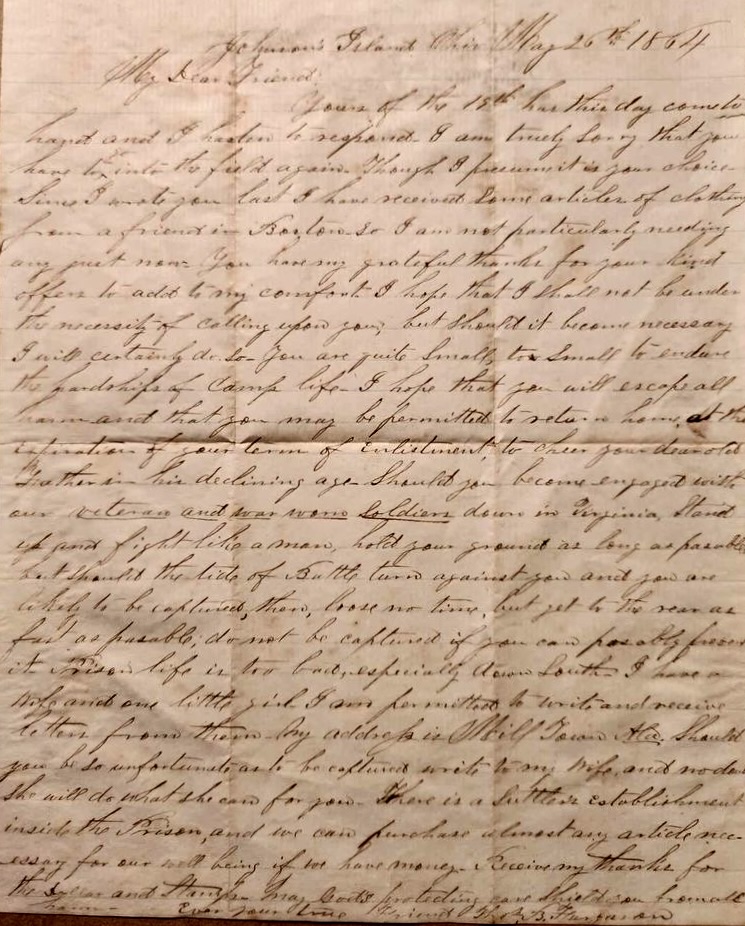
The following letter was written by Thomas Benjamin Fargason (1831-1918) of Co. D, 14th Alabama Regiment. Thomas mustered into the regiment as a sergeant in August 1861 but was commissioned a lieutenant prior to the Battle of Gettysburg when he was taken prisoner on 2 or 3 July 1863. He was first taken to Fort McHenry, then Fort Delaware, and later to Johnson Island where he wrote this letter in late May 1864 after almost eleven months of confinement.
The date of Lt. Fargason’s capture at Gettysburg varies and the regimental history informs us that they were engaged on both 2 July and 3 July. They did participate in Picket’s charge on the 3rd but the more likely opportunity for capture seems to have been on the evening of 2 July when they joined in the attempt to break through the Union lines at Plum Run and suffered severe losses before falling back.
Prisoner of War (POW) letters generally make for dull reading since the content was screened by censors who made certain nothing sensitive was revealed in them. This, combined with the fact that they were limited in length to a single page to make it easier on censors to do their job, usually resulted in a letter that served little purpose but to inform recipients the prisoner was still alive. Correspondence between Confederate officers held at Johnson’s Island and southern-sympathizing citizens living in the North are occasionally found but it’s very unusual to find a letter written by a Confederate POW to a Union Soldier. Unfortunately the Union soldier is not named in the letter.
Thomas was the son of John Fargason (1800-1866) and Elizabeth Mason (1797-1879). He was married in 1857 to Laura Walker Duncan (1836-1900) and had a young daughter named Ella, born in September 1860. When he was enumerated in Tallapoosa county, Alabama, in 1860, as a 29 year-old farmer and the owner of two slaves (40 y.o. female and 12 y. o. male). Later in life, he appears to have become a minister.
[Note: This letter is from the private collection of Jonathan Peace and was made available for transcription and publication on Spared & Shared by express consent.]
Transcription
Johnson’s Island, Ohio May 26th 1864
My dear friend,
Yours of the 19th has this day come to hand and I hasten to respond. I am truly sorry that you have to go into the field again, though I presume it is your choice. Since I wrote you last, I have received some articles of clothing from a friend in Boston, so I am not particularly needing any just now. You have my grateful thanks for your kind offers to add to my comfort. I hope I shall not be under the necessity of calling upon you, but should it become necessary, I will certainly do so. I hope that you will escape all harm and that you may be permitted to return home at the expiration of your term of enlistment to cheer your dear old Father in his declining age. Should you become engaged with our veteran and war-worn soldiers down in Virginia, stand up and fight like a man. Hold your ground as long as possible, but should the tide of battle turn against you and you are likely to be captured, then lose no time, but get to the rear as fast as possible. Do not be captured if you can possibly prevent it. Prison life is too bad—especially down South. I have a wife and one little girl. I am permitted to write and receive letters from them. My address is Mill Town, Alabama. Should you be so unfortunate as to be captured, write to my wife and no doubt she will do what she can for you. There is a Sutler’s establishment inside the prison and we can purchase almost any article necessary for our well being if we have money. Receive my thanks for the dollar and stamps. May God’s protecting care shield you from all harm.
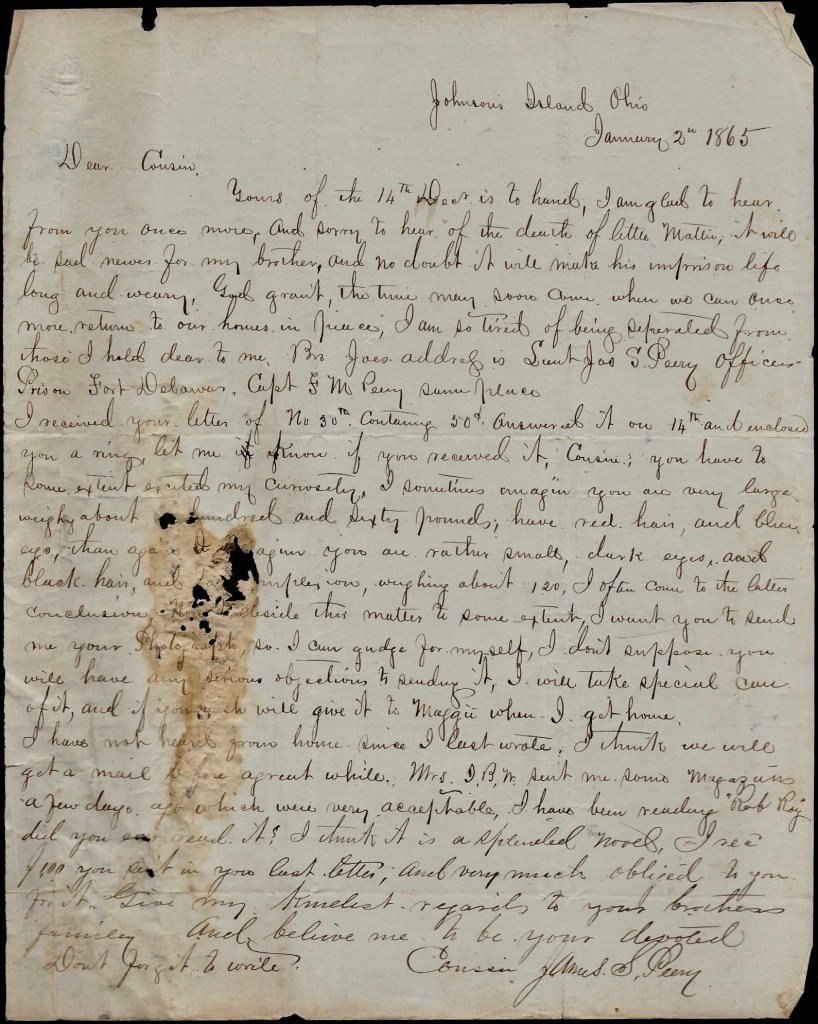
The following letter was written by James Spotts Peery (1837-1905) who entered the Confederate service as a 1st Lieutenant of Co. G, 45th Virginia Infantry in May 1861. By July 1862 he had been promoted to Captain of his company. He was wounded and taken prisoner on 5 June 1864 at Piedmont, Virginia, and transferred into the officer’s prison at Johnson’s Island (Ohio) on 22 June 1864 where he wrote this letter in January 1865.
When James took the Oath of Allegiance to be released from prison on 15 June 1865, he was described as 28 years old, standing 5 feet, 10 inches tall, with hazel eyes and dark hair. He gave his residence as Jeffersonville, Virginia.
James was the son of Harvey George Peery (1801-1869) and Rebecca Williams (1805-1890) of Tazewell county, Virginia.
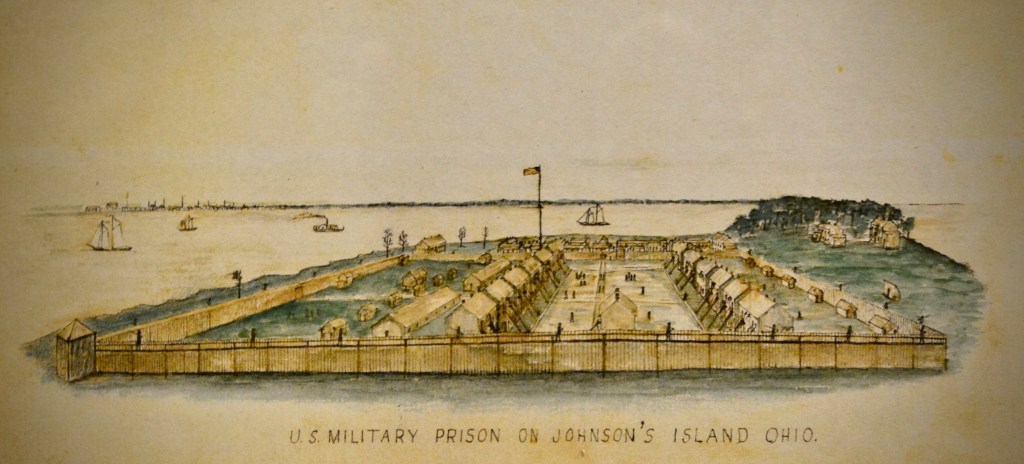
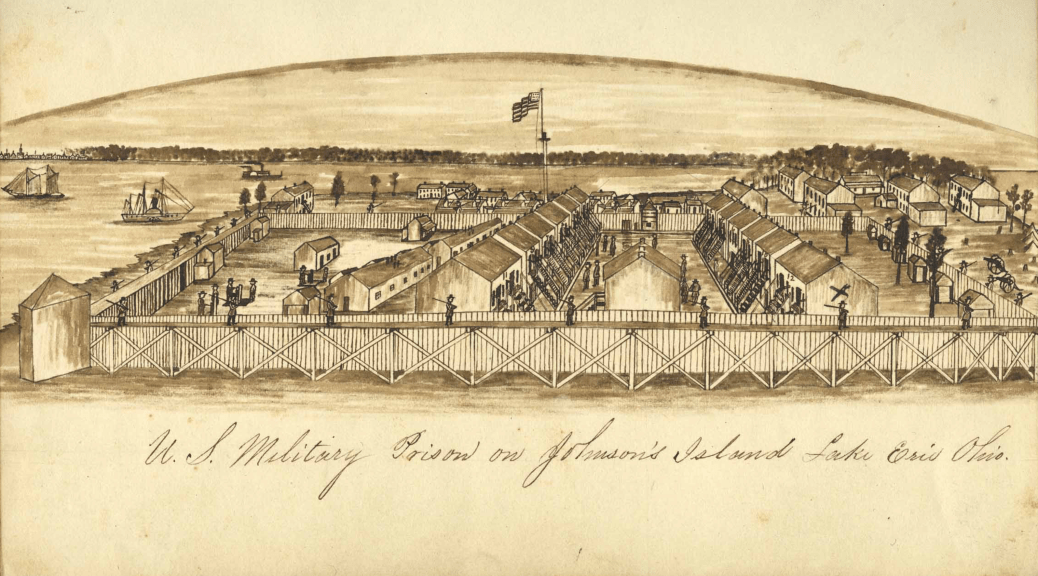
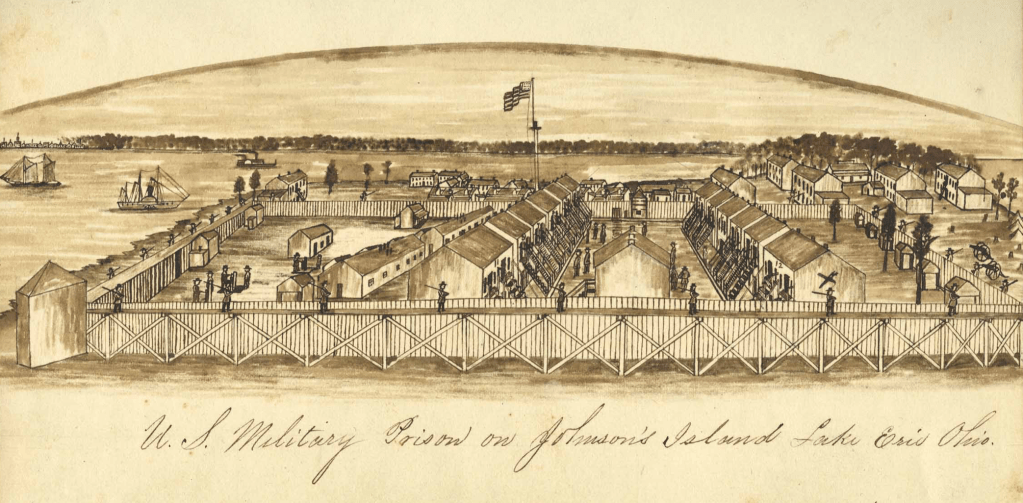
The military prison on Johnson’s Island, Lake Erie, Ohio(Encyclopedia Virginia)
Transcription
Johnson’s Island, Ohio January 2nd 1865
Dear Cousin,
Yours of the 14th December is to hand. I am glad to hear from you once more and sorry to hear of the death of little Mattie. It will be sad news for my brother and no doubt it will make his imprisoned life long and weary. God grant the time may soon arrive when we can once more return to our homes in peace. I am so tired of being separated from those I hold dear to me. Brother Joe’s address is, Lieut. Jos. S. Peery, Officer’s Prison, Fort Delaware, Capt. F. M. Peery, same place.
I received your letter of November 30th containing 50 cents. Answered it on 14th and enclosed you a ring. Let me know if you received it.
Cousin, you have to some extent excited my curiosity. I sometimes imagine you are very large, weighing about a hundred and sixty pounds; have red hair and blue eyes. Then again I imagine you are rather small, dark eyes, and black hair, and [ ] complexion, weighing about 120. I often come to the latter conclusion. Now to decide this matter to some extent, I want you to send me your photograph so I can judge for myself. I don’t suppose you will have any serious objections to sending it. I will take special care of it and if you wish, will give it to Maggie when I get home.
I have not heard from home since I last wrote. I think we will get a mail before a great while. Mrs. J. B. W. sent me some magazines a few days ago which were very acceptable. I have been reading “Rob Roy.” Did you ever read it? I think it is a splendid novel. I received $1 you sent in your last letter and very much obliged to you for it. Give my kindest regards to your brothers family. And believe me to be your devoted cousin, — James S. Peery
This letter was written by William Hazzard Wigg (1809-1875), a South Carolina native who worked in the District of Columbia prior to and during the Civil War as a government worker. He was married in July 1853 to Emma Maria Stevens (1825-1899) of Connecticut—the sister of Admiral Thomas Holdup Stevens, Jr., U. S. Navy. By his first wife, Margaret Euphemia Patterson (1809-1848), Wigg had at least three children before she died in 1848, one of which was Samuel Patterson Wigg (1842-1862) who met his death on the battlefield at Sharpsburg in September 1862 carrying the regimental banner in Co. H, 1st South Carolina Infantry. Wigg recovered his son’s remains from the battlefield the following January though his final resting place remains unknown.
William was the son of William Hutson Wigg (1777-1827) and Sarah Galt Martin (1783-1809). He was sometimes referred to as “Capt.” or “Maj.” Wigg though I’m unaware if he was ever in the military. Clearly the Civil War tested his loyalty and he may have, indeed, clandestinely done all in his power to aid the Southern cause. Newspaper notices from the period indicate he was frequently harassed and arrested by the military authorities and he was the object of derision by loyalists who knew of his southern heritage and family connections. He was still working for the Internal Revenue Service as late as 1870.
Charles Jones Colcock Hutson
Wigg wrote the letter to his relative, Lieut. Charles Jones Colcock Hutson of Co. H, 1st South Carolina Infantry, who was Adjutant of the regiment when he was taken prisoner at Harper’s Farm, Virginia, on 6 April 1865 and sent to Johnson’s Island on 17 April 1865. He was released on Oath of Allegiance on 6 June 1865. At the time of his release from prison he was described as 23 years old and a resident of Pocotaligo, South Carolina. Charles’ father was Richard Woodward Hutson. Readers will notice that Charles served in the same regiment and company as Wigg’s son, Samuel P. Wigg.
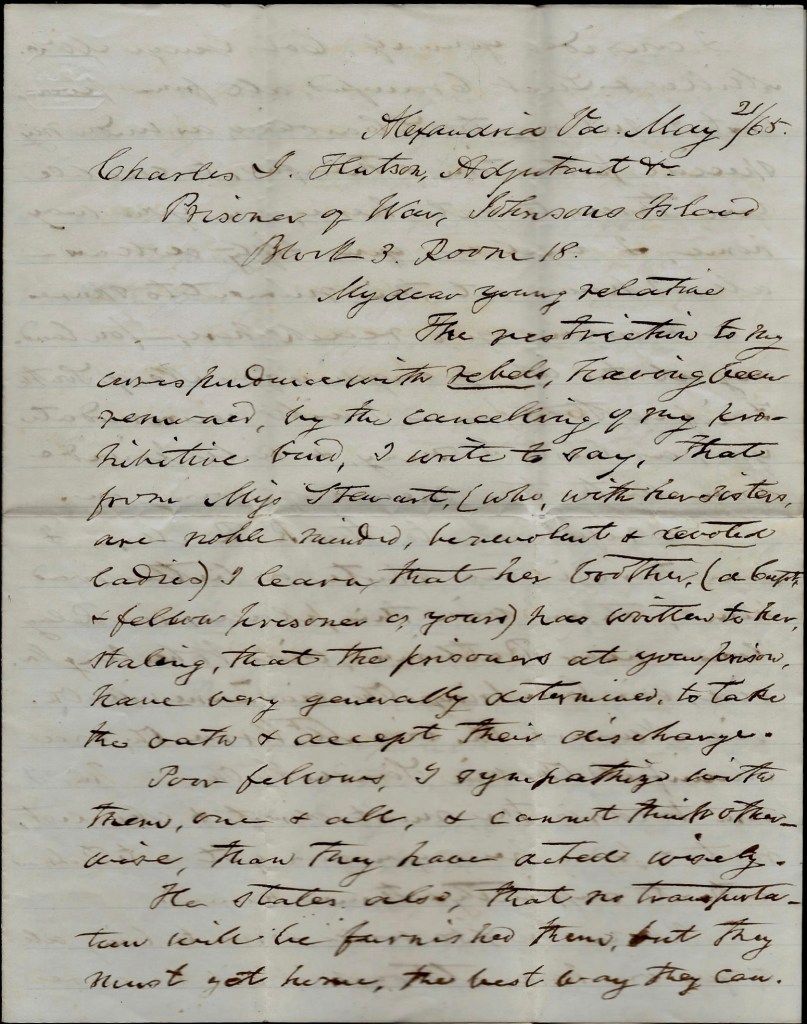
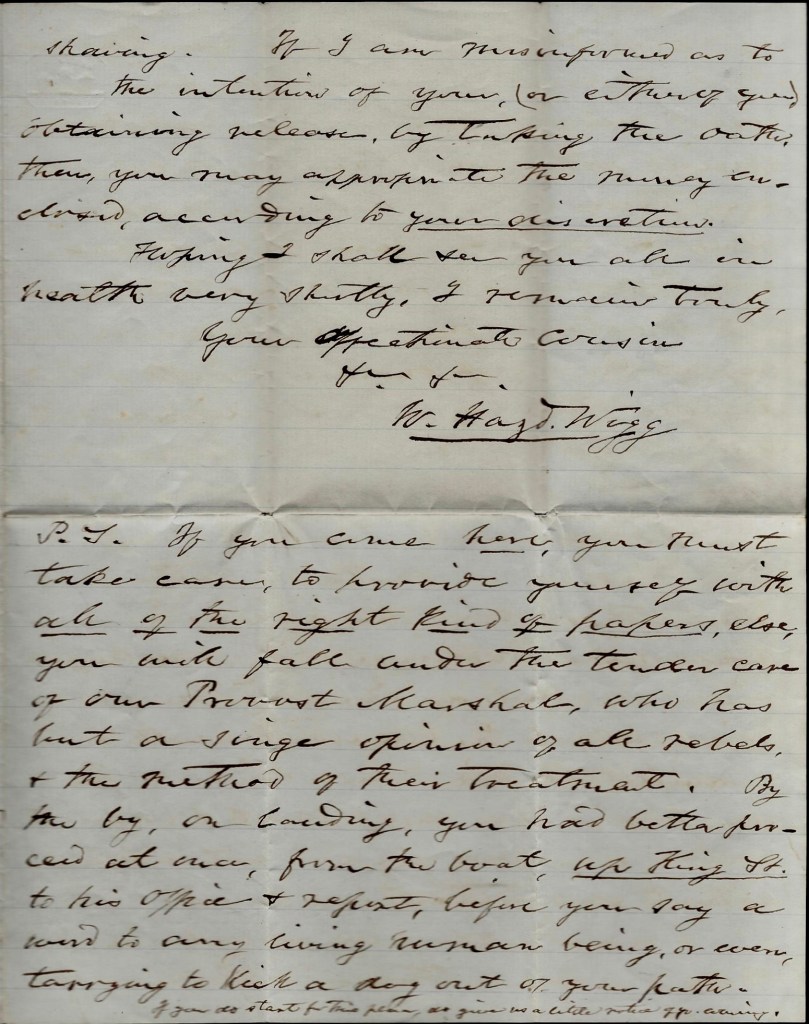
Wigg’s letter conveys $50 to his young relative, Charles Hutson, for his use with two other officers from South Carolina, to make their way from Johnson’s Island Prison, as soon as they were released, to Alexandria, Virginia, where he would meet them, give them lodging and the means to make the rest of their journey home to South Carolina. He advises them to make sure their papers are in order and to go immediately to the Provost Marshal’s office in Alexandria when they arrive, not taking time “to kick a dog out of your path” in order to show their papers and avoid arrest.
Transcription
Alexandria, Virginia May 2, 1865
Charles J. Hutson, Adjutant & Prisoner of War Johnson’s Island, Block 3, Room 18
My dear young relative,
The restriction to my correspondence with rebels having been removed by the cancelling of my prohibitive [ ], I write to say that from Miss Stewart (who with her sisters are noble-minded, benevolent & devoted ladies), I learn that her brother (a Capt. & fellow prisoner of yours) has written to her stating that the prisoners at your prison have been generally determined to take the oath [of allegiance] and take their discharge.
Advertisement for rent of home placed by W. H. Wigg in the Alexandria Gazette on 8 July 1865
Poor fellows. I sympathize with them, one and all, and cannot think otherwise than they have acted wisely. He states also that no transportation will be furnished them but they must get home the best way they can. I consider yourself, Col. George W. C. Miller, & Lieut. Crawford all from poor, lost, and subjugated South Carolina as under my special protection & therefore, to enable you three to get here on your way home, I enclose you fifty dollars—all I have at this moment to share. And when you reach here (on landing at the wharf, enquire for No. 9, South Fairfax Street), I will accommodate you as best I may & will provide you with the means of going on.
On reference to the railroad map, I find there is no shorter or better road home than via this place, via Relay House near Baltimore, via Wheeling, Va., via Cambridge, OH, via Zanesville, OH, via Newark, OH, via Mt. Vernon, OH, via Mansfield, OH, via Sandusky, OH. This I am told is the most direct and cheapest rout & from here you can get on to Richmond without difficulty and thence home.
I hope the $50 will serve to bring all of you on here although it will be close shaving. If I am misinformed as to the intention of your (or either of you) obtaining release by taking the oath, then you may appropriate the money enclosed according to your discretion.
Hoping I shall see you all in health very shortly, I remain truly your affectionate cousin, &c. &c, — W. Haz. Wigg
P. S. If you come here, you must take care to provide yourself with all of the right kind of papers, else you will fall under the tender care of our Provost Marshal who has but a single opinion of all rebels & the method of their treatment. By the by, on landing, you had better proceed at once from the boat up King Street to his office & report before you say a word to any living human being, or even tarrying to kick a dog out of your path. If you do start for this place, do give us a little notice of your coming.
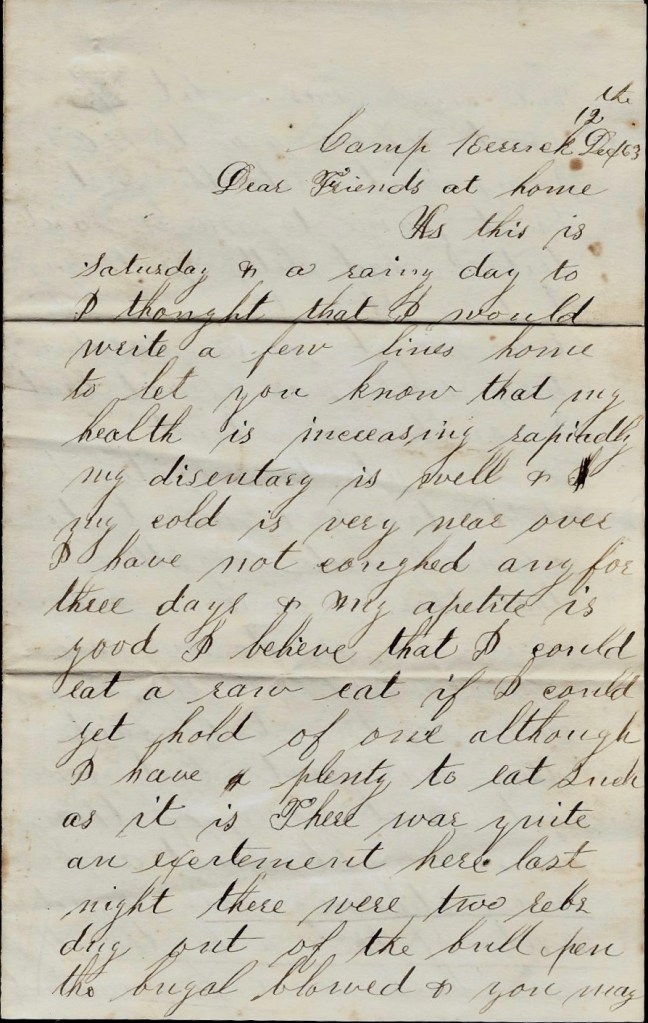
This letter was written by a soldier named “Willy” who served in Co. F, 12th Ohio Volunteer Cavalry (OVC) while serving as a guard at Johnson’s Island, near Sandusky, Ohio. Unfortunately there are many soldiers by the name of William in the company and he gives no further clues to his identity.
The 12th OVC was organized at Camp Cleveland and mustered into federal service on 24 Nov. 1863. From Dec. 1863-Feb. 1864, the 12th was on duty at Camp Chase in Columbus, Ohio. Half of the regiment was on detached duty at Johnson’s Island near Sandusky, Ohio, during that period. In Feb.-Mar. 1864, the 12th was on duty at Camp Dennison near Cincinnati, Ohio.
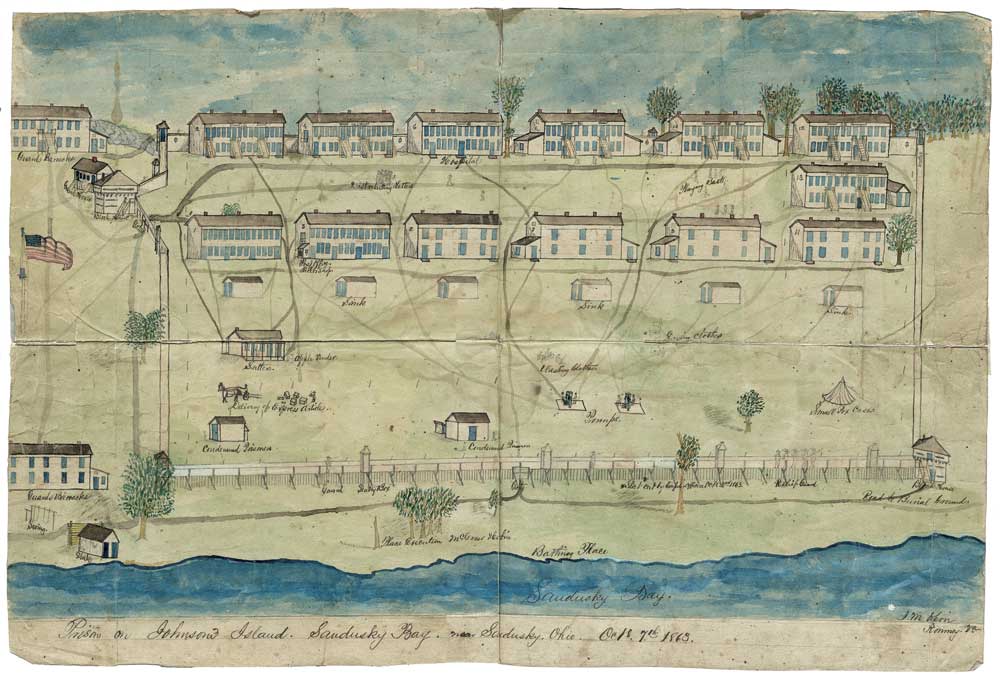
Willy datelined his letter from Camp Herrick which was no doubt named after John F. Herrick, the Lt. Colonel of the 12th OVC. His letter contains a description of an attempt by two prisoners to escape the prison yard by tunneling in mid-December 1863.
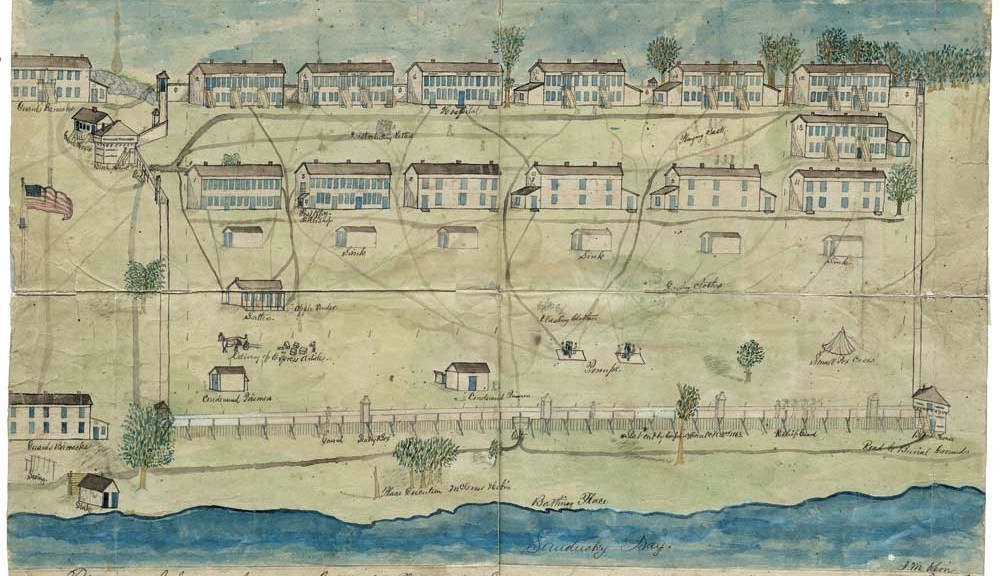
Rendering of Prison at Johnson’s Island in October 1863
Transcription
Camp Herrick December 12th 1863
Dear Friends at Home,
As this is Saturday & a rainy day too, I thought that I would write a few lines home to let you know that my health is increasing rapidly. My dysentery is well & my cold is very near over. I have not coughed any for three days & my appetite is good. I believe that I could eat a raw cat if I could get hold of one although I have plenty to eat—such as it is.
There was quite an excitement here last night. There were two rebs dug out of the bull pen. The bugle blowed & you may bet there was a lot of scart officers in the 12th OVC. I [was] up and out the first [when] Lieut. came to me and said that I had better go to my tent & stay there for fear there might be a hard time & he was afraid that I could not stand it so I went to my tent, laid down, & went to sleep. I had forgotten that there was any rebs out. In about an half of an hour, the companies came to their tents [and] said there was not but two got out. One of them was caught just as he was sticking his head out of the hole. The other came back in a few minutes & gave himself up so then that great scare was over.
I have not done any duty yet and the Orderly [Charles H. Sherburne] says that I need not until I get stout although I feel as well as I ever did. But I hant got my full strength yet.
Our Captain [Merville L. Saunder] has just got back from Columbus. He went to see what he could do about our pay. What he made out I cannot tell.
As this little sheet is most full, I shall have to close. This is from your son & friend, Willy. Address to Camp Herrick, 1st Battalion, 12th O. C., Co. F, Johnson’s Island, Ohio





 Spared & Shared 23