Category Archives: Kansas Territory

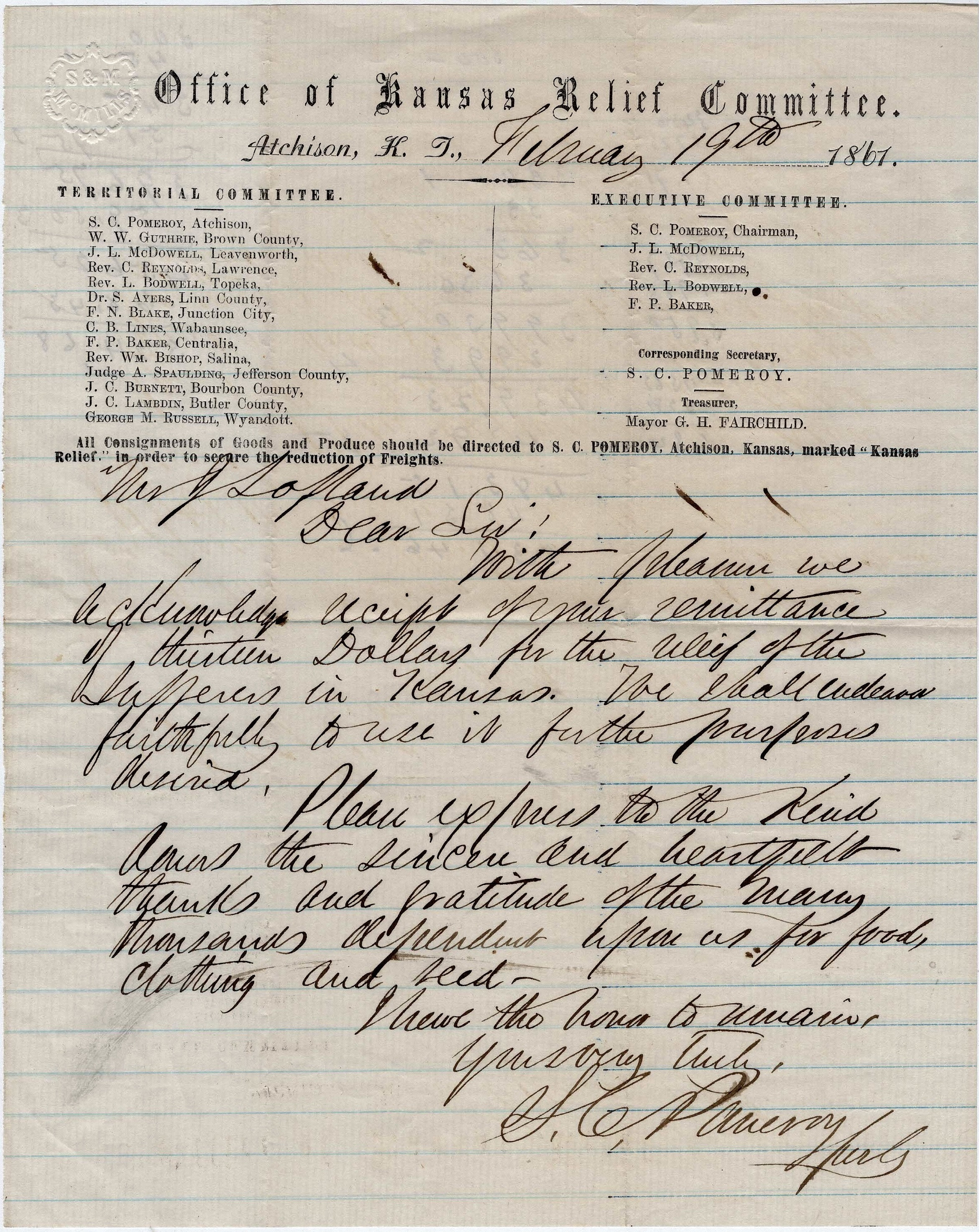
1861: Samuel Clarke Pomeroy to J. Lofland

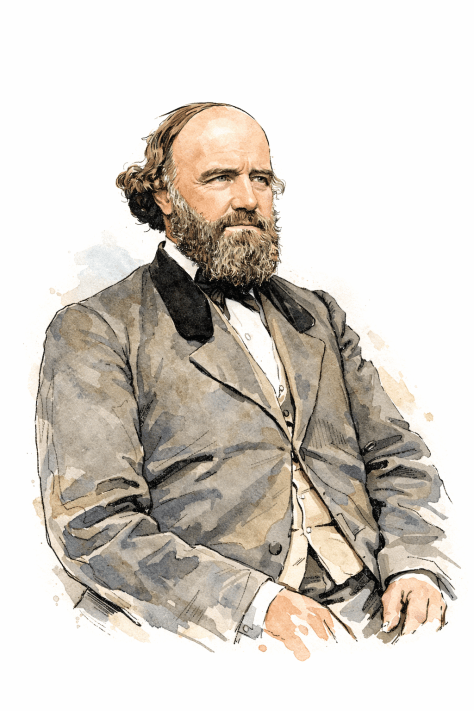
Samuel C. Pomeroy (1816-1891)

The following letter was written by Samuel Clarke Pomeroy (1816-1891), a man who was legendary in the historical lore of Kansas history. A biographical sketch of Pomeroy posted in the Digital History of the Kansas City Public Library gives us a summary of lifetime accomplishments. He and Jim Lane were the first two Senators from the State of Kansas—both rather controversial figures to say the least.

“Pomeroy spent nearly the first 40 years of his life on the east coast, where he went to college, had a brief career as an educator, and held various political offices. Born in Southampton, Massachusetts, in 1816, Pomeroy attended college at Amherst, Massachusetts, from 1836 to 1838. Following his collegiate career, Pomeroy worked as an educator in New York State for four years before returning to Massachusetts. Once back in the Bay State, Pomeroy held several political offices, including a term as a state representative from 1852 to 1853.

In 1854, Pomeroy started working for the NEEAC and relocated to Kansas, where he became politically and financially involved in the “Bleeding Kansas” dispute. He initially settled in Kansas City, Missouri, where he worked as a financial officer for the New England Emigrant Aid Society (NEEAC) by helping new migrants’ families find temporary accommodation in Kansas City so that the heads of household could travel into the territory and stake their claim. He also began to invest in townships in Kansas, and in 1855, held a significant stake in recently formed town of Osawatomie.

Pomeroy relocated to Lawrence in time to take part in several seminal Free-State events. He was captured while supporting the Free-State side during the so-called “Wakarusa War” of November and December 1855, which nearly resulted in an assault on Lawrence by 2,000 Missourians. He also served as the Chairman for the Lawrence Committee of Public Safety, a position that tested Pomeroy’s leadership skills, restraint, and political savvy…

An emblematic Northern émigré, Pomeroy found himself elected to represent Kansas as a senator upon the territory’s promotion to statehood in 1861. He had lived in Kansas for less than seven years when he was elected to the Senate, but he went on to serve in the body for more years (12) than he actually lived in the “Sunflower State.” During his years in Washington, he not only served as a senator during the Civil War, but also in the early days of Reconstruction. Notably, he served as campaign chairman for Ohio Senator Solomon P. Chase in his short-lived effort to contest the Republican nomination in 1864. Pomeroy also sponsored Senate Bill 392, which created Yellowstone National Park in 1871. After his aforementioned bribery scandal in 1873, Pomeroy spent the remainder of his life in the Northeast and died in Massachusetts in 1891.

Although he ended his political career in mild disgrace, Samuel Pomeroy remains an exemplar for all of the noteworthy aspects of Northern migration during the Bleeding Kansas period. He came to Kansas with the NEEAC, fought for Free-Soil, made a fortune in the railroad industry, and became a senator. When modern Kansans tell the popular, NEEAC dominated story of the birth of the state, they tell a variation of Pomeroy’s story, even if they have never heard his name.”

In the following letter, written in his own hand, Samuel Pomeroy wrote an acknowledgement for the receipt of money donated for the relief of Kansas settlers suffering through a severe drought. Ministers of all denominations from Kansas travelled back East to solicit donations for farmers whose crops dried up for the want of rain. This drought lasted from June 1859 to late 1860 and resulted in up to a third of the population leaving the state just prior to Statehood in 1861.

T R A N S C R I P T I O N

Office of Kansas Relief Committee
Atchison, Kansas Territory
February 19th 1861

Mr. J. Lofland,

Dear sir, with pleasure we acknowledge receipt of your remittance of thiirteen dollars for the relief of the sufferers in Kansas. We shall endeavor faithfully to use it for the purposes desired.

Please express to the kind donors the sincere and heartfelt thanks and gratitude of the any thousands dependent upon us for food, clothing and seed.

I have the honor to remain yours very truly, — S. C. Pomeroy
1861: Levi Clark to Charles M. Heaton

This letter was written by Levi Clark (1799-1862) of Newark, New Jersey, who was married to Eliza Crane (1801-1834). Levi wrote the letter to his brother-in-law, Charles M. Heaton (1805-1899), of South Bend, Indiana. Charles was married in 1833 to Ann Crane (1810-1899), a milliner. In politics, Charles threw his support behind fellow South Bend editor, journalist, and politician Schuyler Colfax who rewarded him with a good position in the government land office at Washington in 1860 where he remained for the next twenty years.

Due to his friendship with Colfax and his appointment to the Land Office in Washington D. C., Levi requests a letter of introduction from Charles to enable him to meet with Colfax, attempt to resolve his land title issues in Kansas, and hopefully also land himself an appointment in and Land Office in Kansas or with the Indian Bureau under the new Lincoln Administration. City directories suggest that Levi remained in Newark until his death in January 1862, less than a year after this letter was written.

Though it was no doubt painful to Levi, his tirade against the corruption of the former Buchanan Administration is almost comical to read. The letter was written on 4 March 1861—the very day of Lincoln’s inauguration and day Levi hoped Lincoln would begin to “turn out to the last one the most corrupt set of unmitigated scoundrels there is in this or any other country ever produced.”

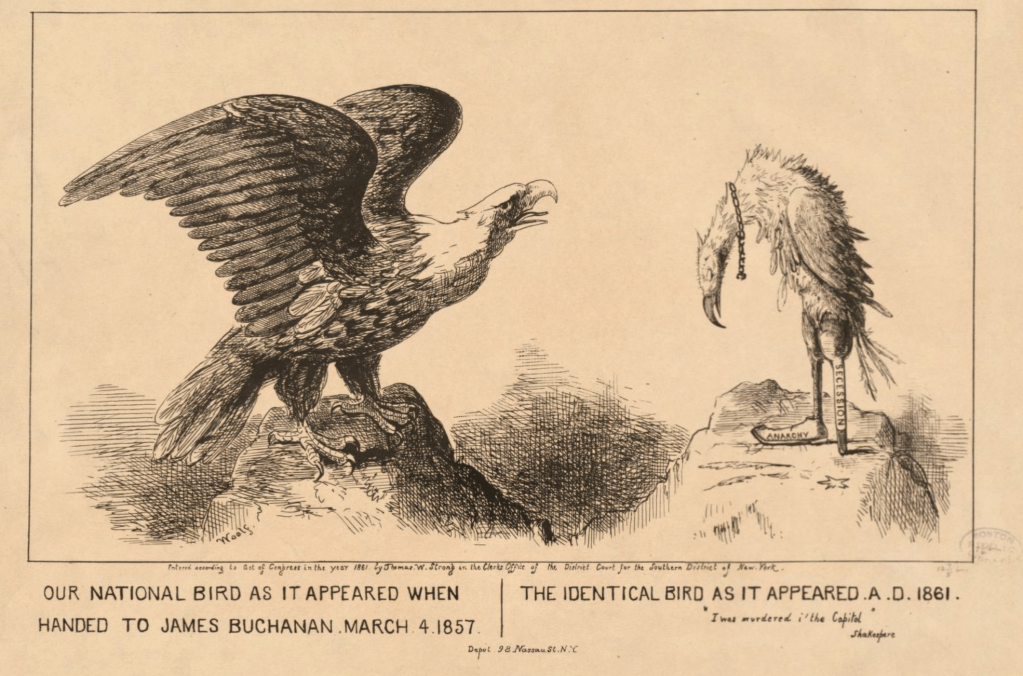
“The iconic national bird, representing the Union, is strong and healthy at the beginning of Democrat James Buchanan’s administration, but by the time Republican Abraham Lincoln assumed the Presidency, it is gaunt and emaciated reflecting the secession of 11 southern states from the Union. This political cartoon highlights the rising tensions over states’ rights during the antebellum period and the ultimate dissolution of the Union in 1861. The fact that Buchanan’s administration was riddled with corruption and charges of bribery and graft, only worsened the toll that years fighting over slavery and states’ rights had taken on the nation’s vitality.”
Artist: M. A. Woolf

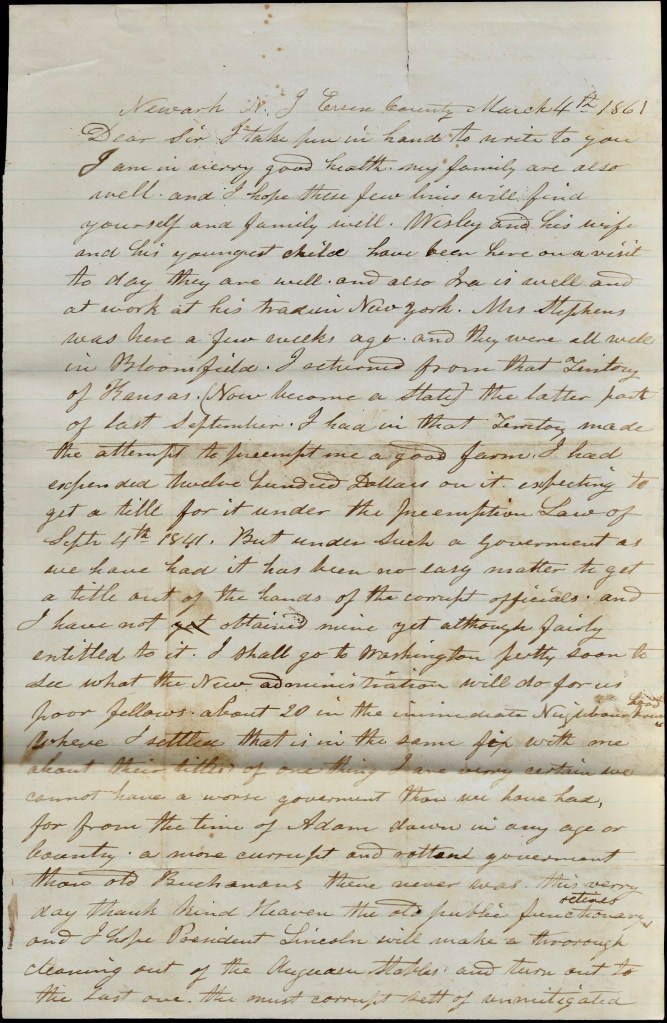
Transcription

Newark, Essex County, New Jersey
March 4, 1861

Dear Sir,

I take pen in hand to write to you. I am in very good health. My family are also well and I hope these few lines will find yourself and family well. [My son] Wesley and his wife and his youngest child have been here on a visit today. They are well and also [my son] Ira is well and at work at his trade in New York. Mrs. Stephens was here a few weeks ago and they were all well at Bloomfield.

I returned from that Territory of Kansas (now become a State) the latter part of last September. I had in that Territory made an attempt to preempt me a good farm. I had expended twelve hundred dollars on it expecting to get a title for it under the Preemption Law of September 4th 1841. But under such a government as we have had, it has been no easy matter to get a title out of the hands of the corrupt officials and I have not obtained mine yet although fairly entitled to it.

I shall go to Washington pretty soon to see what the new [Lincoln] Administration will do for us poor fellows—about twenty in the immediate neighborhood where I settled that is in the same fix with me about their titles. Of one thing I am very certain, we cannot have a worse government than we have had for from the time of Adam down in any age or country, a more corrupt and rotten government than Old Buchanan’s there never was. This very day, thank kind Heaven, the old public functionaries actives and I hope President Lincoln will make a thorough cleaning out of the Augean Stable and turn out to the last one the most corrupt set of unmitigated scoundrels there is in this or any other country ever produced.

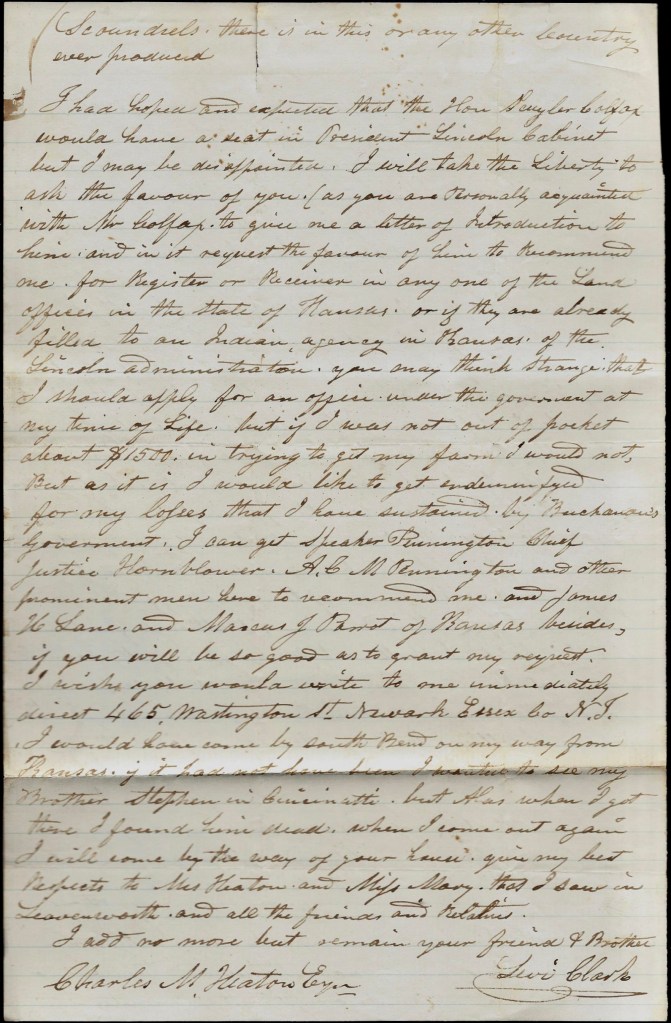
I had hoped and expected that the Hon. Schuyler Colfax would have a seat in President Lincoln’s Cabinet but I may be disappointed. I will take the liberty to ask the favor of you (as you are personally acquainted with Mr. Colfax) to give me a letter of introduction to him and in it request the favor of him to recommend me for Register or Receiver in anyone of the Land Offices in the State of Kansas, or if they are already filled, to an Indian Agency in Kansas of the Lincoln Administration. You may think strange that I should apply for an office under the government at my time of life, but if I was not out of pocket about $1500 in try to get my farm, I would not. But as it is, I would like to get indemnified for my losses that I have sustained by Buchanan’s government. I can get Speaker Pennington, Chief Justice Hornblower, A. C. M. Pennington and other prominent men here to recommend me and James H. Lane and Marcus J. Parrot of Kansas besides, if you will be so good as to grant my request.

I wish you would write to me immediately. Direct to 465 Washington Street, Newark, Essex County, New Jersey. I would have come by South Bend on my way home to see my brother Stephen in Cincinnati, but alas! when I got there I found him dead. When I come out again, I will come by the way of your house. Give my best respects to Mrs. Heaton and Miss Mary that I saw in Leavenworth, and all the friends and relatives.

I add no more but remain your friend & brother, — Levi Clark

to Charles M. Heaton