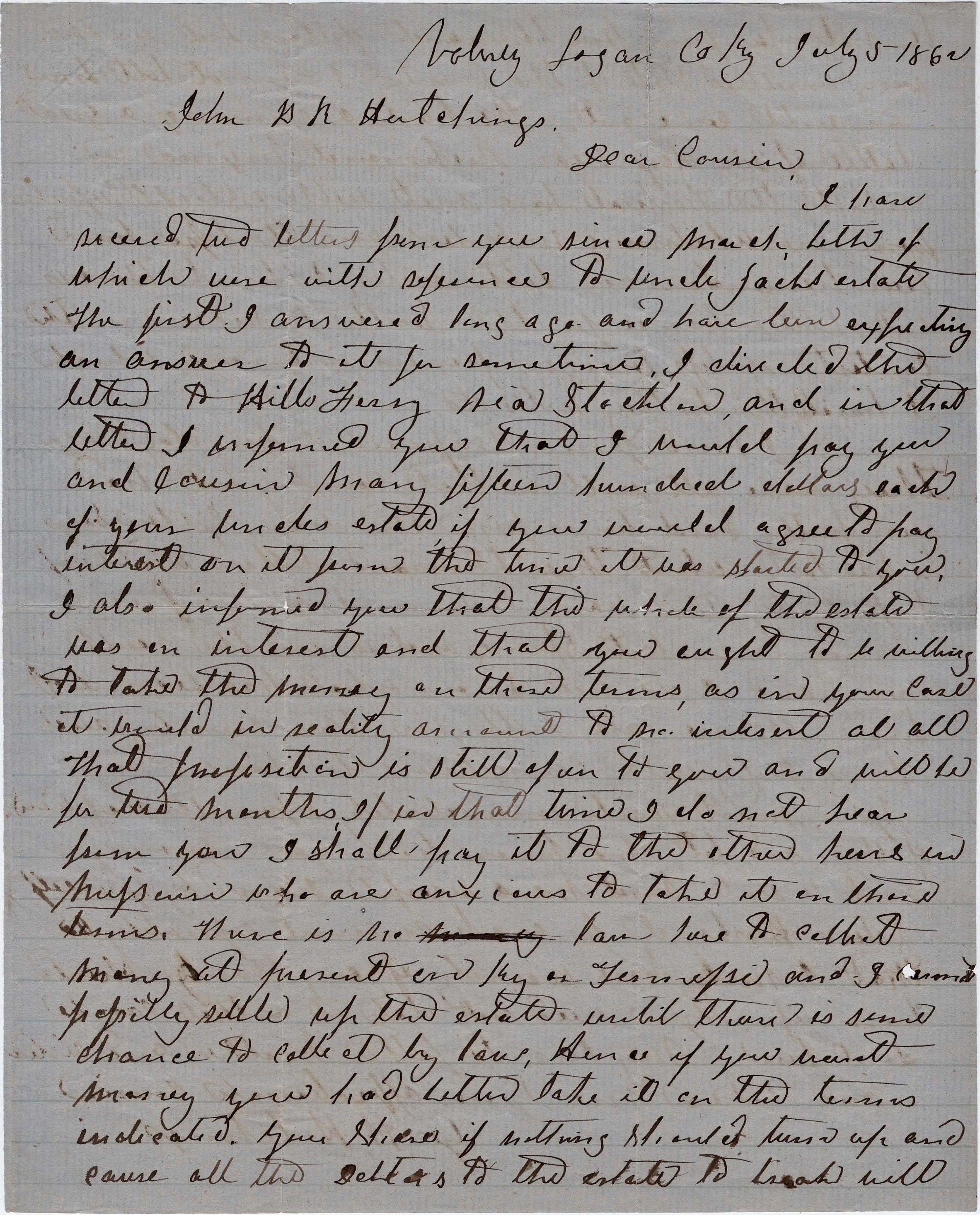
The following letter was written by George H. Hutchings (1822-1883), the son of Robert Hutchings (1790-1850) and Almeda Browder (1797-1872). George was married to Minerva Baker (1825-1918) in 1845 and was residing in Volney, Logan county, Kentucky at the time he wrote this letter on 5 July 1862.
George wrote the letter to his brother requesting him to take action on a proposal offered for the settlement of an Uncle’s estate. The substance of this transaction is uninteresting but the other half of the letter makes frequent references to the Civil War such as its impact on the economy, the division of family loyalties, the prospect of the South’s success, and the recent news of the Seven Days Battles before Richmond.
T R A N S C R I P T I ON
Volney, Logan county, Kentucky July 5, 1862
John B. R. Hutchings,
Dear cousin, I have received two letters from you since March, little of which were with reference to Uncle Jack’s estate. The first I answered long ago and have been expecting an answer to it for some time. I directed the letter to Hill’s Ferry via Stockland and in that letter I informed you that I would pay you and cousin Mary fifteen hundred dollars each of your Uncle’s estate if you would agree to pay interest on it from the time it was started to you. I also informed you that the whole of the estate was in interest and that you ought to be willing to take the money on these terms as in your case it would in reality amount to no interest at all. That proposition is still open to you and will be for two months. If in that time I do not hear from you, I shall pay it to the other heirs in [ ] who are anxious to take it on those terms.
There is no law here to collect money at present in Kentucky or Tennessee and I cannot possibly settle up the estate until there is some chance to collect by law. Hence if you want money, you had better take it on the terms indicated. Your share if nothing should turn up and cause all the debts to the estate to [ ] will be not far from five thousand dollars but in the very unsettled state of the country, I cannot tell how we will come out.
We have a rumor of a great battle of six days near Richmond, Virginia, in which the Federals have met with a slight repulse from overwhelming numbers and the losses have been tremendous on both sides. I think there is but little chance for the South to succeed in the contest unless foreign powers intervene, which I hardly think they will do.
I heard from Missouri a few days ago. They were all well in that country but had seen pretty hard times from the war. Gillon says he has lost about three thousand dollars worth of property by the war. Edmund joined Price’s army early last spring and is in the South now, and I do not know what has become of him. We are all well in this country and doing pretty well considering the times.
You must write immediately upon the reception of this and let me know how your money must be sent. Send me a receipt signed by yourself, sister and husband for each amount separately that I may have security if anything should turn up. You need not date it as that can be done here. My love to father, mother, and sister, and believe me your affectionate cousin, — George H. Hutchings
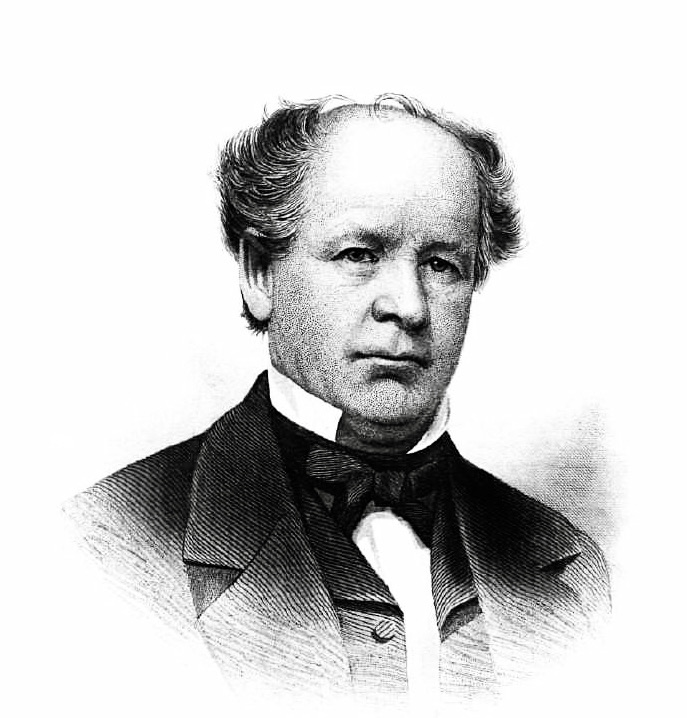
The following letter was written by Horatio Dalton Newcomb (1809-1874) of Louisville, Kentucky. He wrote the letter to Sumner Wells of Chicopee, Massachusetts. The following biographical sketch of Newcomb appears in the Biographical Encyclopedia of Kentucky of the Dead and Living Men of the Nineteenth Century, published in 1878:
Horatio Dalton Newcomb
Newcomb, Horatio Dalton, merchant and manufacturer, son of Dalton Newcomb, a distinguished farmer of Massachusetts, was born August 10, 1809, at Bernardston, near Springfield, Massachusetts. He received a good practical education, and, after working on his father’s farm for a time, he taught school in his native state, but, being dissatisfied with his prospects in that direction, took the agency for a book, and traveled through several of the states, finally locating at Louisville, Kentucky, in 1832. He engaged, for a while, as clerk in a small business house; afterwards, in various mercantile enterprises, but which he accumulated some means; entered the commission house of E.E. Webb; was soon after admitted to partnership, and began a career of remarkable mercantile success. In 1837, he went into the liquor business; and subsequently established a large grocery trade, with his brother, Warren Newcomb, under the style of H.D. Newcomb & Bro., becoming one of the largest grocery establishments in the West. In 1863, his brother retired from the business, and a few years afterwards died in New York, a millionaire. The house soon became Newcomb, Buchannan & Co., devoting themselves entirely to operations in whisky. In 1850, after the projection of the Cannelton Cotton Mills, at Cannelton, Indiana, by J.C. Ford, Hamilton Smith, and others, when the enterprise was on the eve of a failure, he came forward with a large secured capital, placing the establishment on a sure foundation, and, though his commercial interests were valuable, a great part of his fortune was made in connection with the Cannelton Mills. In 1856, in connection with his brother, Dwight Newcomb, he leased the Cannelton Coal Mines, form which he retired after several years’ successful operation, In 1871, having amassed a large fortune in the legitimate channels of trade, he abandoned active commercial pursuits for his own interests, and devoted himself, with great energy, to the cause of the Louisville and Nashville Railroad, and was its most influential and substantial friend. He took large stock in the road; worked hard for its success, loaning his own credit for the establishment of that of the company; for sixteen years was one of its directors; at the death of Hon. James Guthrie, in 1859, became its president; as such carried the road through its financial embarrassments; and, for some time, bore the financial burdens of the company. Mainly through his great business ability and inexhaustible resources, the Louisville and Nashville Railroad was made the most successful and powerful railroad enterprise in the South. While actively engaged in business pursuits, he never lost sight of the interests of the city. After the burning of the Galt House, through his instrumentality, chiefly, the present magnificent hotel was built. He was one of the organizers of the Louisville Board of Trade, and was its first president; erected some of the finest buildings, and was variously concerned in most movements of importance to the city of Louisville. He was a man of marked peculiarities, as well as marked talents. He was a clear-sighted financier, steady and self-confident rather than aggressive, at all times conservative and safe; was valued among his acquaintances for his liberality and kindness of disposition; his tastes were always upward, and, although not ostentatious in his patronage, he was concerned in all art and public improvements; possessed of extraordinary gifts, he had few equals in the business world, and the withdrawal of such great resources as he possessed was a loss to his adopted city. He died of apoplexy, at his house in Louisville, in 1874, and probably left behind him no enemies, for he was a man singularly without malice. Mr. Newcomb was twice married; first, in 1838, to Miss Cornelia W. Read. The only remaining child of this marriage is H. Victor Newcomb, of Louisville, Vice-President of the Louisville and Nashville Railroad. In 1872, he was married to Miss Mary C. Smith, eldest daughter of John B. Smith, of Louisville, a lady who has ever been distinguished for her beauty of person, and brilliancy of mind and manners.
Transcription
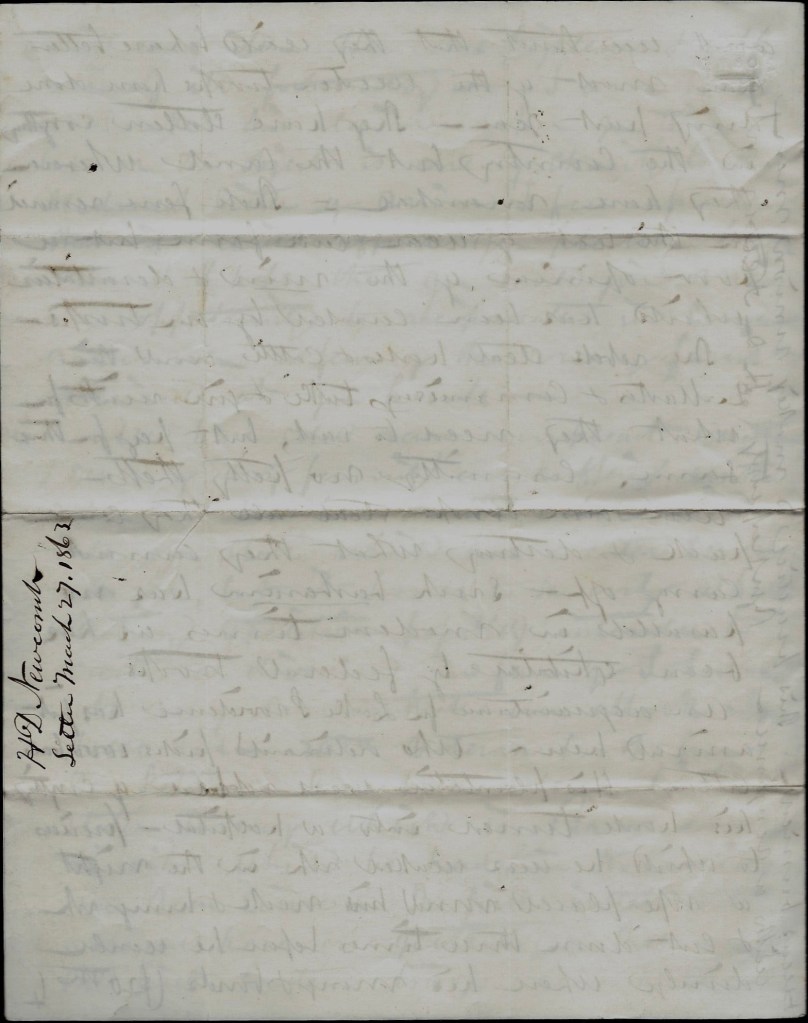
Louisville, Kentucky March 27, 1863
Sumner Wells, Esq., Chicopee [Mass.]
Dear sir, enclosed please find check of my firm upon E. D. Morgan [ ] New York for $5,000 in accordance with your telegram of this date. I presume that you have dated the purchase of a home for my sister in accordance with my instructions of 20th inst.
You will have the title examined & be assured that it is all right. Should the home require any repairs, have them done. You will also have the house insured against loss by fire. I presume that an insurance of $2500 or $3000 would be sufficient. I leave this point to your good judgement. You will have the deed made to Dwight Newcomb & when recorded, forward the same to me. Also a statement of all other expenses. I am sorry to make this claim upon your time but as the object is one of charity to a widowed sister of mine, I feel assured that it would afford you pleasure to act and I hope that you will give me an opportunity to reciprocate in some manner a few of the many favors received at your hands.
We have cold, raw, unpleasant weather & some of my family are suffering with colds. We fear another rebel raid into our state which has created some alarm, but it proves to be only a horse stealing expedition possibly intended to create a diversion in favor or Johnston who may contemplate an attack upon Rosecrans.
20th Veteran troops from the Potomac have been ordered to this state among which is Burnside’s old division which he had in North Carolina. The first installment arrived here yesterday. These are the first Eastern troops we have had and we trust that they will behave better than most of the Western troops have done this past year. They have stolen everything in the country but the land wherever they have marched. Those few removed from the seat of war confirm but a poor opinion of the men & desolation which has been caused by our troops.
The rebels steal horses and cattle and the quartermaster and commissary take and give receipts for what they need to eat, but pay for the same, committing no petty thefts. Our own troops steal all they can pack and destroy what they cannot carry off. Such barbarism has no parallel in modern times as has been exhibited by federal troops.
An acquaintance from Lake Providence has just arrived here who ordinarily picks 1,000 bales cotton. His plantation was robbed of everything, his house turned into a hospital previous to which he was waked up in the night, a rope placed round his neck, and hung up and cut down three times before he would divulge where his money and bonds were buried. This practice is making Union men with a vengeance.
Major John L. Davidson, 26th Kentucky Infantry, killed at Shiloh
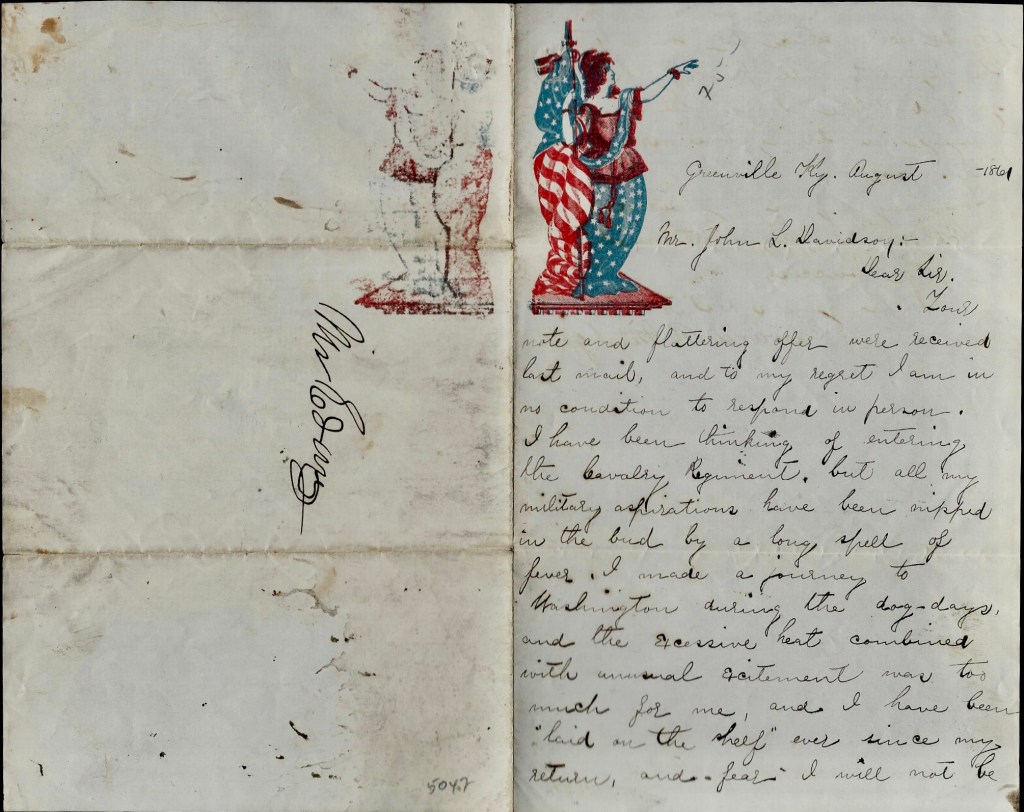
The following letter was written by Edward Rumsey Weir, Jr. (1839-1906), the son of Edward Rumsey Weir, Sr. (1816-1891) and Harriet Rumsey Miller (1822-1913) of Greenville, Muhlenberg county, Kentucky. Edward, Sr. was “an attorney, merchant, politician, and soldier. Greenville, Kentucky, native. Member of the House of Representatives of the Commonwealth of Kentucky from Muhlenberg County from 1841 to 1842. Attorney in Muhlenberg County in 1850. Owned twenty-nine enslaved persons in Muhlenberg County in 1850. Attorney and merchant in Muhlenberg County in 1860. Owned forty enslaved persons in Muhlenberg County in 1860. Served in the Muhlenberg County Home Guard in 1861. Member of the House of Representatives of the Commonwealth of Kentucky from Muhlenberg County from 1862 to 1865.” [See Kentucky Historical Society] According to the Archivist at Western Kentucky University, Edward , Sr. was “also an abolitionist; he emancipated some of his slaves and assisted with their recolonization in Liberia. After the outbreak of the Civil War, he used his wealth and influence to advocate for the Union and to recruit and equip home guards and companies for the regular army. As Confederates moved through Muhlenberg and surrounding counties, Weir’s wife Harriet removed with their children to Jacksonville, Illinois and returned home only after the fall of Forts Henry and Donelson in 1862.” [See Weir Family Collection]
Edward, Jr., served as an officer with the 11th and 35th Kentucky Volunteer Infantry and saw action at Shiloh and Corinth and elsewhere. Many of his letters, archived atWestern Kentucky University’s Special Collections, “provide much detail of his life in camp at Calhoun, Kentucky with his servant Jesse, and his fears for the Weir home amid reports of Confederate theft. He reports on incidents such as the arrival of non-English speaking German “cannonniers,” troop losses from illness, and a young Indiana wife who visits the camp, only to find her husband dead. He provides vivid descriptions of his actions at the Battle of Shiloh and of his regiment’s advance on Corinth, Mississippi, including his arrival at the deserted town of Farmington, Mississippi. He tells of seeing Confederate general John Hunt Morgan approach the Union lines at Farmington under a flag of truce, and the doubts of the colonel in command that he was actually “Morgan of Kentucky.” Illness compels Weir to resign from the 11th Kentucky Infantry in 1863, but later that year he receives a commission in the 35th Kentucky Mounted Volunteer Infantry, and writes of his march through Kentucky into Virginia and of the fighting at Saltville. Prior to being mustered out in 1864, Weir expresses regret at leaving the 11th Kentucky, whose men he thought superior to those of the 35th. He also alludes to wrongs committed by other officers of the 35th that could attract lawsuits.”
Edward’s letter was addressed to John Littlejohn Davidson (1830-1862), the son of James W. and Priscilla Quinn (Jones) Davidson of Elton, Kentucky. John worked at a dry goods store in Nashville, Tennessee, before the Civil War and then enlisted on 9 September 1861 and was commissioned Major of the 26th Infantry Regiment Kentucky on 8 March 1862. He was killed at the Battle of Shiloh in Shiloh, Tennessee on 7 April 1862.
Transcription
Greenville, Kentucky August 1861
Mr. John L. Davidson Dear Sir,
Your note and flattering offer were received last mail and to my regret, I am in no condition to respond in person. I have been thinking of entering the Cavalry Regiment but all my military aspirations have been nipped in the bud by a long spell of fever. I made a journey to Washington during the dog-days and the excessive head combined with unusual excitement was too much for me, and I have been “laid on the shelf” ever since my return, and fear I will not be fir for active service for some time. The regiment will probably be organized before I am well enough to engage in stirring business of any kind.
You may rely on my secrecy. With most heart-felt wishes for your success. I am yours respectfully, — Edward R. Weir, Jr.






 Spared & Shared 23