Category Archives: Lee’s Surrender at Appomattox

1865: Edwin Ruthbon Brush to Amy Brush

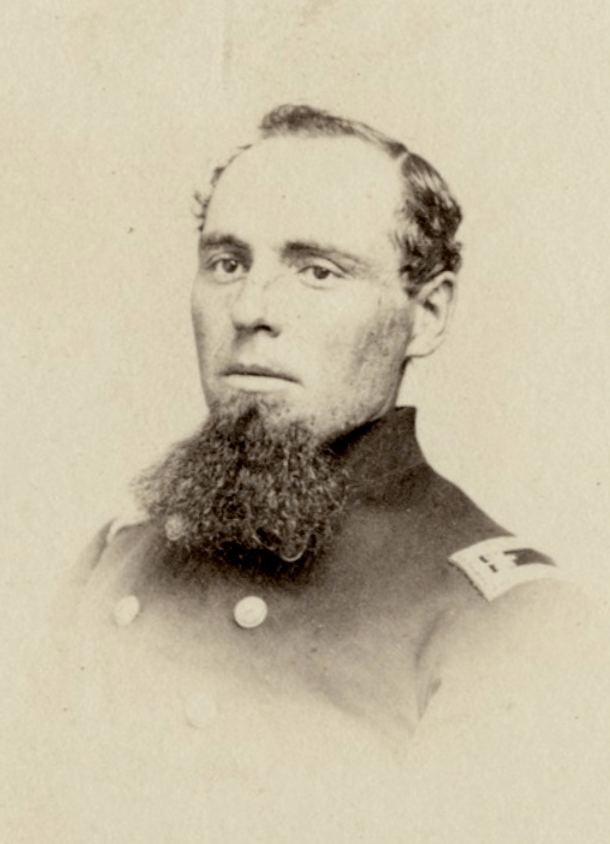
I could not find an image of Edwin but here is one of William Sawin who also served as an Asst. Surgeon in the 2nd Vermont Infantry (Photo Sleuth)

The following letters were written by Edwin Ruthbon Brush (1836-1908) who was drafted into the service on 17 July 1863 as a private in Co. H, 2nd Vermont Infantry and three months later was promoted to Assistant Surgeon of the regiment.

Brush graduated from the University of Vermont at Burlington in 1858 and took over the medical practice of his father, Dr. Salmon Brush (1804-1887) in Cambridge, Lamoille county, Vermont. Edwin wrote the letter to his wife, Amy R. Brush (1836-1915).

Edwin was with the regiment from the time they fought at Rappahannock Station in November 1863 through the Battle of Sailor’s Creek in April 1865. In the second letter, he describes the mood of the army following the assassination of President Lincoln and shares portions of conversations he’s had with rebel soldiers going home following Lee’s surrender.

Letter 1
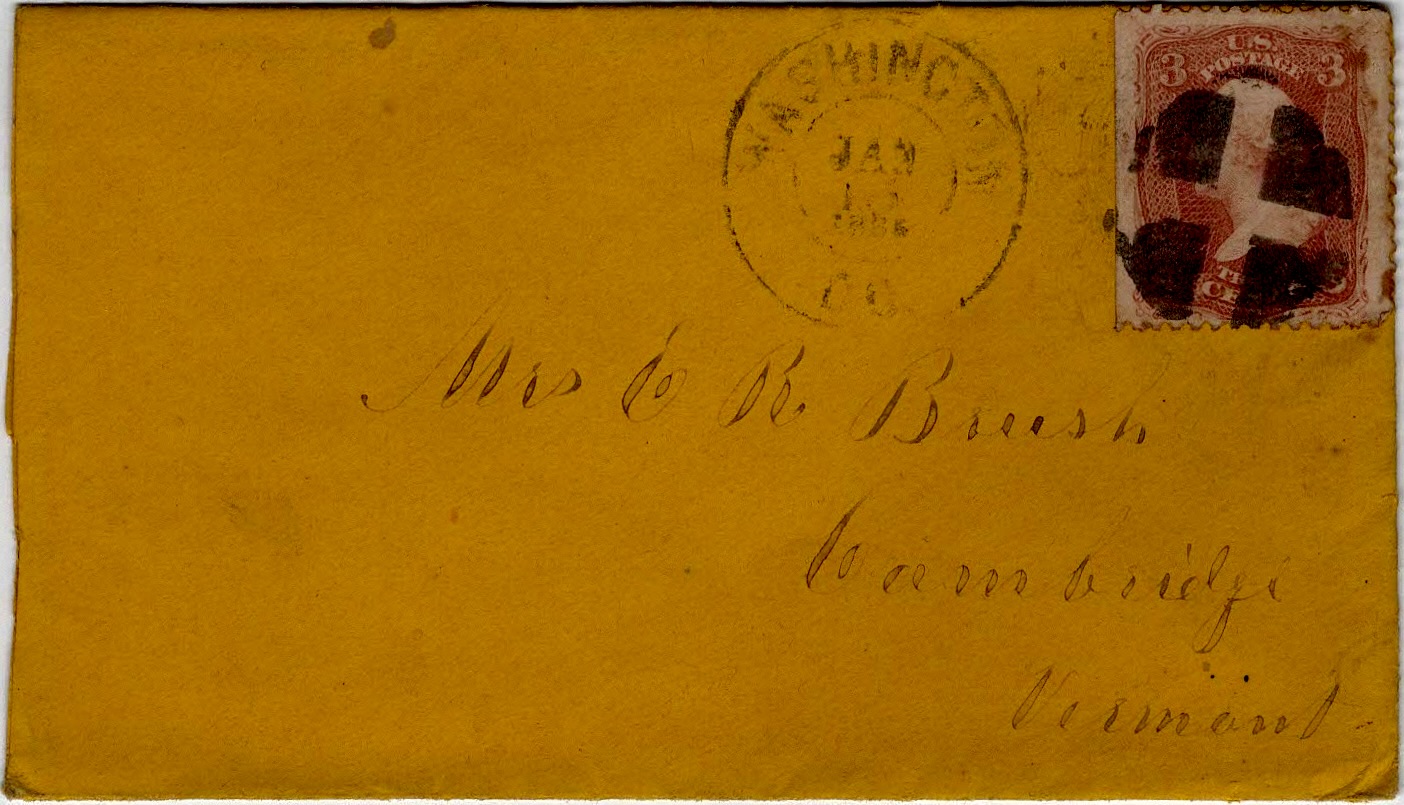
Near Petersburg, Virginia
March 4th 1865

Dear Amy,

Today I received yours of the 26th. I am on picket today. I have to go on only once in about four weeks. There are two very important things transpiring today. One is the inauguration of Old Abe [but] however important that event may be to the country, there is another that is full as important to the members of the regiment individually and that is that we are receiving four months pay. And for one, I can say that it comes in time of need.

News is very scarce here just at present. The rebels are not deserting quite as fast as they were a few days ago. It is said that there are a different set of men doing picket duty in our front from what there were a few days ago. It is either that or else the rebels are more particular about the men they send on picket. I am still doing duty at the 6th Regiment. How long I shall have to remain there, I do not know. I am glad that you had so good a visit with Lieut. Buck.

About my horse not carrying double, it is true. He did not propose to carry anything that was secesh and I do not blame him much either, do you? But that time I went two or three miles beyond our picket lines to dress a wounded rebel.

I have just been paid off and shall send a check for a hundred and fifty dollars which I hope will be acceptable to you. I hope you have not suffered for the want of it. I should liked to have sent more but I had to borrow some money to live on and shall have that to pay. I have two months pay now due me but we shall not get that now.

It has been very stormy here for the last week, it having rained almost every day. So I do not think we shall have to move just yet. My health continues good yet, and I hope yours is good also.

I have not heard from Mortimer since I left the Valley. I do not know why he does not write as I wrote him very soon after we got here. I should think he would answer it but perhaps he did not receive it. Give my regards to all enquiring friends. Yours affectionately, — Edwin R. Brush, Asst. Surgeon, 2d Vermont Vols. Washington D. C.
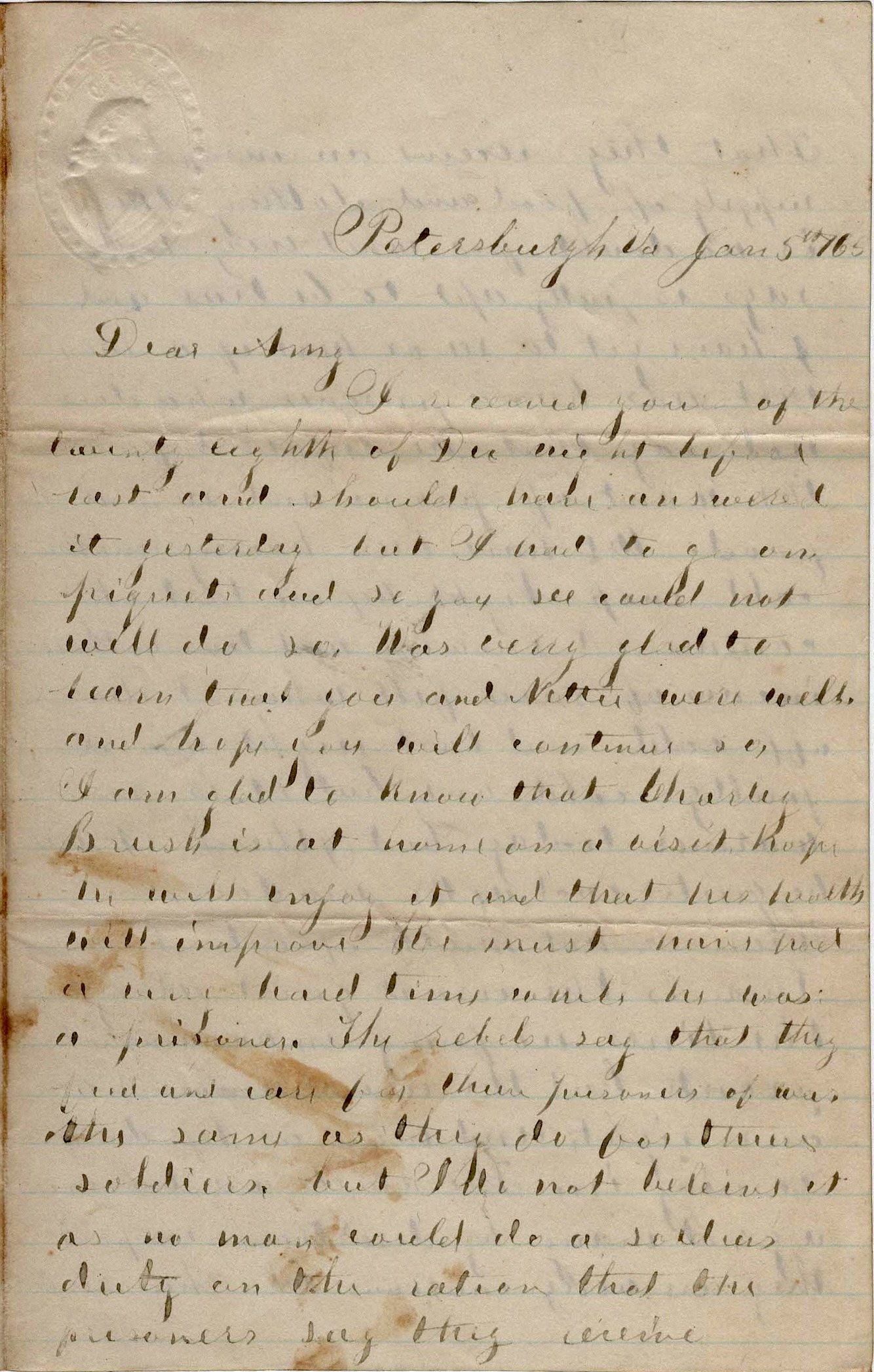
P. S. Please let me know as soon as you receive the check. — E. R. B.

Letter 2

[Note: This letter is from the private collection of Greg Herr and was transcribed and published on Spared & Shared by express consent.]

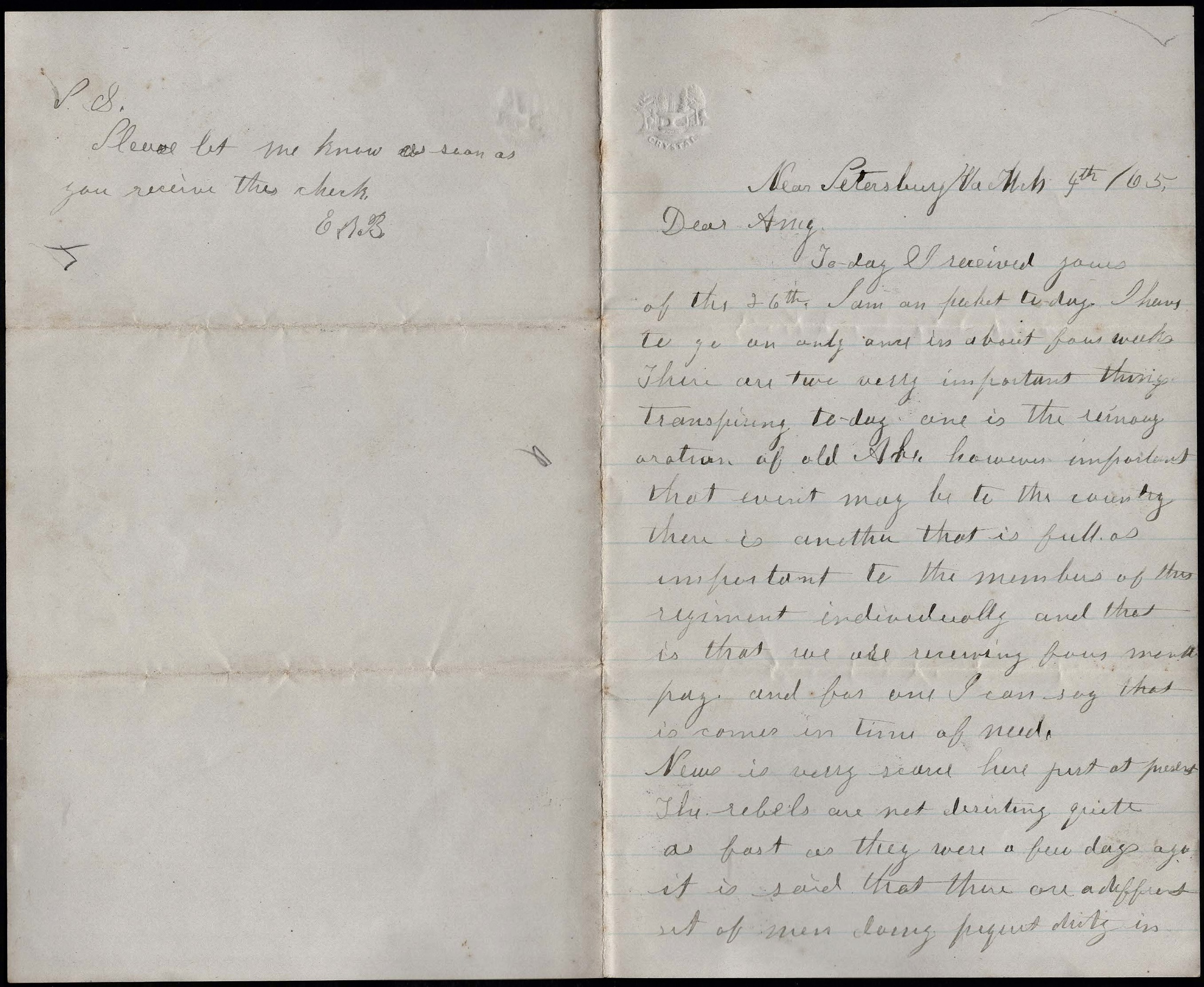
Burkville, Virginia
April 19th 1865

Dear Amy,

I was in hopes to get a letter from you tonight but have just learned that we are to have none tonight. Our mail is quite irregular at present but are in hopes soon to be where it will be more regular and perhaps we shall not be so anxious about it.

The army is feeling very sad and gloomy in consequence of President Lincoln’s death. We feel that we have lost a father and a friend and the country its head. The indignation of the men is great and general. The sadness is general throughout the whole army. Woe to his assassin if he should fall into the hands of our soldiers.

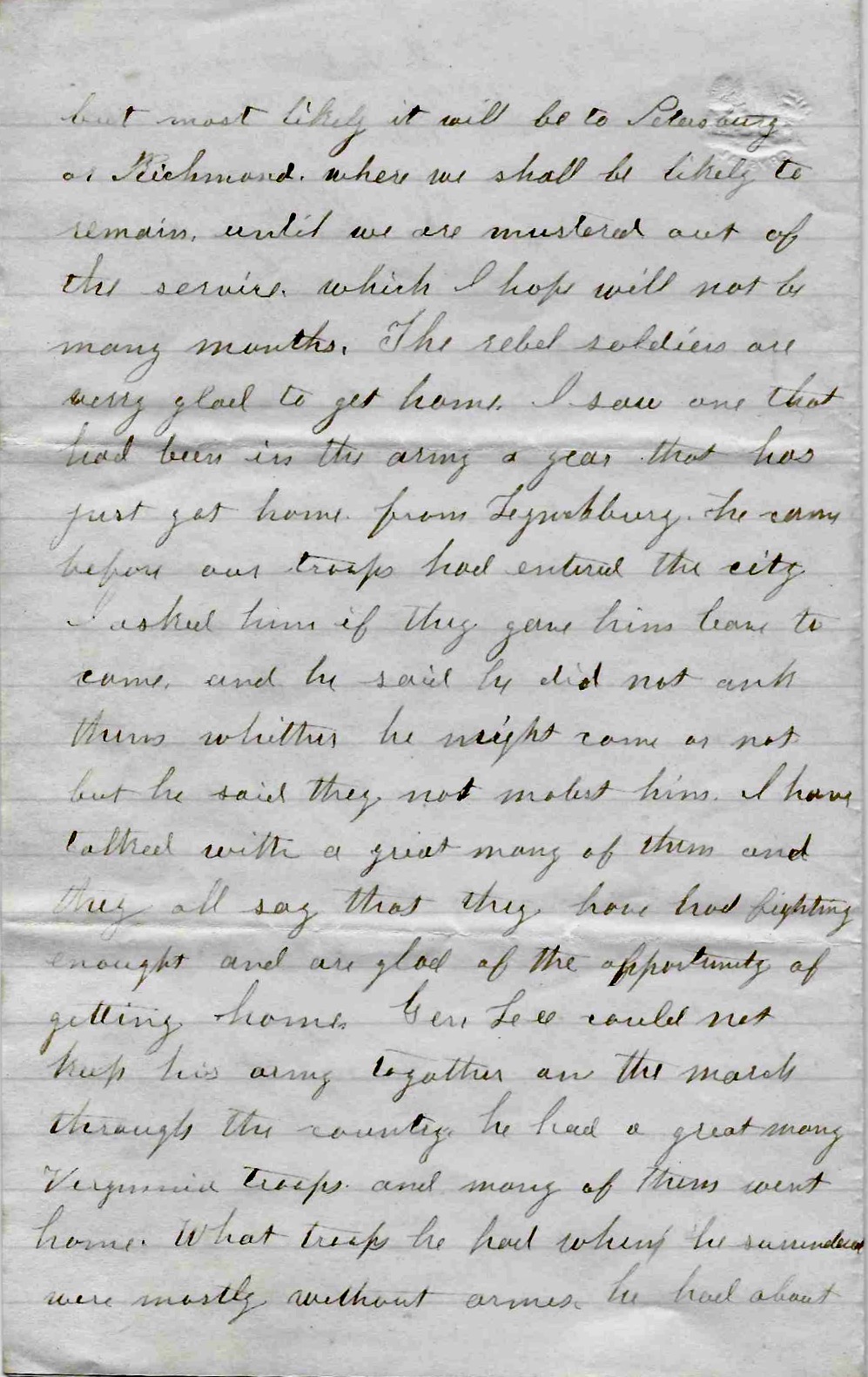
We are expecting to leave here before many days but where we are going is not yet known but most likely it will be to Petersburg or Richmond where we shall be likely to remain until we are mustered out of the service which I hope will not be many months. The rebel soldiers are very glad to get home. I saw one that had been in the army a year that has just got home from Lynchburg. He came before our troops had entered the city. I asked him if they gave him leave to come and he said he did not ask them whether he might come or not but he said they [did] not molest him. I have talked with a great many of them and they all say that they have had fighting enough and are glad of the opportunity of getting home.

“He [Lee] had about thirty thousand men with him when he surrendered and there were only ten thousand of them that were armed.”

Edwin R. Brush, Asst. Surgeon, 2nd Vermont Infantry

Gen. Lee could not keep his army together on the march through the country. He had a great many Virginia troops and many of them went home. What troops he had when he surrendered were mostly without arms. He had about thirty thousand men with him when he surrendered and there were only ten thousand of them that were armed. There were probably many that did not have arms when they left Richmond and Petersburg such as hospital attendants, teamsters, and &c. But taking those out and there must have been many that threw their arms away.

We have been amusing ourselves today in reading Jeff Davis’s last message written at Danville. I think his next will be of a different tune. I have been to the station today to look at some of the captured artillery. I do not know just how many pieces there were there today but yesterday there were one hundred and one and there were more to come. They are sending them North as fast as possible and I hope they will be sent so far that the South will never see them.

I am as well as usual. Affectionately, your husband, — Ed Brush, Asst. Surgeon, 2nd Vermont Vols.

You may tell George that Mr. Taylor was with us until just before we left Petersburg when the sutlers were ordered out of the army and I have not seen or heard of him since.
1865: Samuel Frank to Ruth A. Morgan

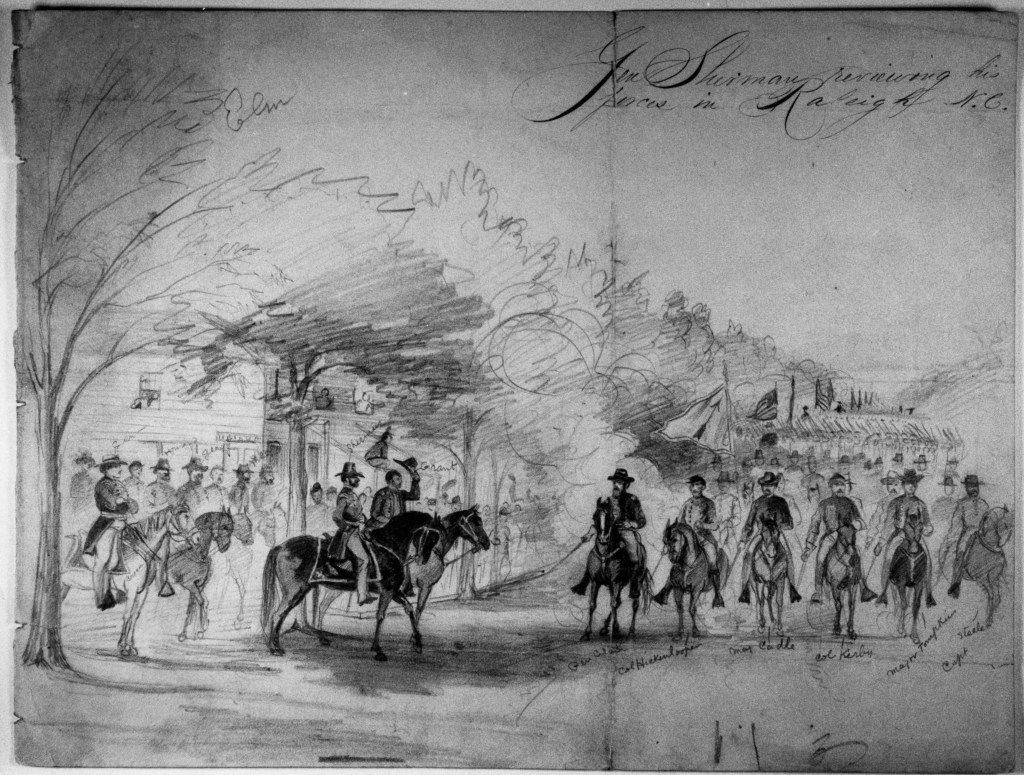
The following letter was written by Pvt. Samuel Frank of Co. B, 18th Missouri Infantry—a regiment formed early in the war and one that took part in most of the important engagements in the western theatre. It lost heavily at Shiloh. During the first two months of 1864m it was mounted and employed in scouting the country about Florence, Alabama. It then joined Gen. Sherman’s army and was assigned to the 17th Corps during the Atlanta Campaign and the March to the Sea. They then marched with Sherman to Raleigh, North Carolina, where this letter was written in April 1865 on the evening before Gen. Sherman reviewed his army in the streets of Raleigh

Gen. Sherman reviewing his troops as they march through the streets of Raleigh, 24 April 1865
The Becker Collection, Boston College Libraries

Samuel wrote the letter to 15 year-old Ruth A. Morgan (1849-1926) of St. John, Putnam county, Missouri. Ruth was married to Sidney Daniel Shattuck (1836-1918) in 1868 and lived her entire life in Putnam county, Missouri.

Transcription

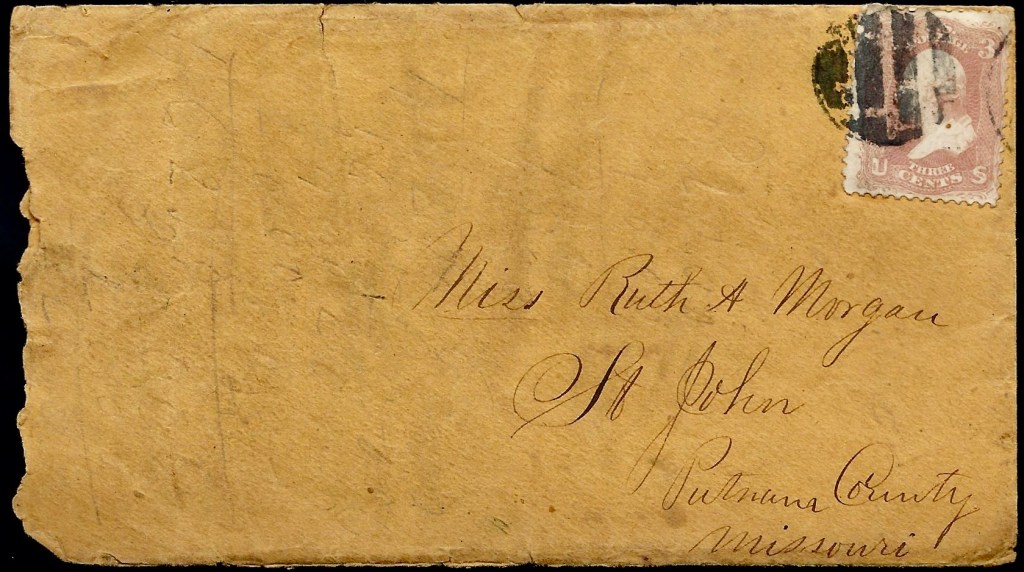
Addressed to Miss Ruth A. Morgan, St. John, Putnam county, Missouri

Camp near Raleigh, North Carolina
April 23rd 1865

Miss Ruth A. Morgan,

Dear friend, it is with pleasure that I take my pen in hand to answer your kind letter that came to hand a few days ago and was glad to hear from you and to learn you was well and to know that you haven’t forgot me. I am in good health and I truly hope when this comes to hand it will find you well and enjoying yourself.

Well, I haven’t much of importance to write, only I would like to see you once more and have the pleasure of talking to you. We have good news down here. Old General Lee has surrendered to General Grant and General Johnson has surrendered to General Sherman and lots of news about [the] place. It is the talk that we sill start in a few weeks on our way home and then all of the boys can come home and see the girls and have a good time with them. And then we can talk instead of writing and that will be much more pleasure to us.

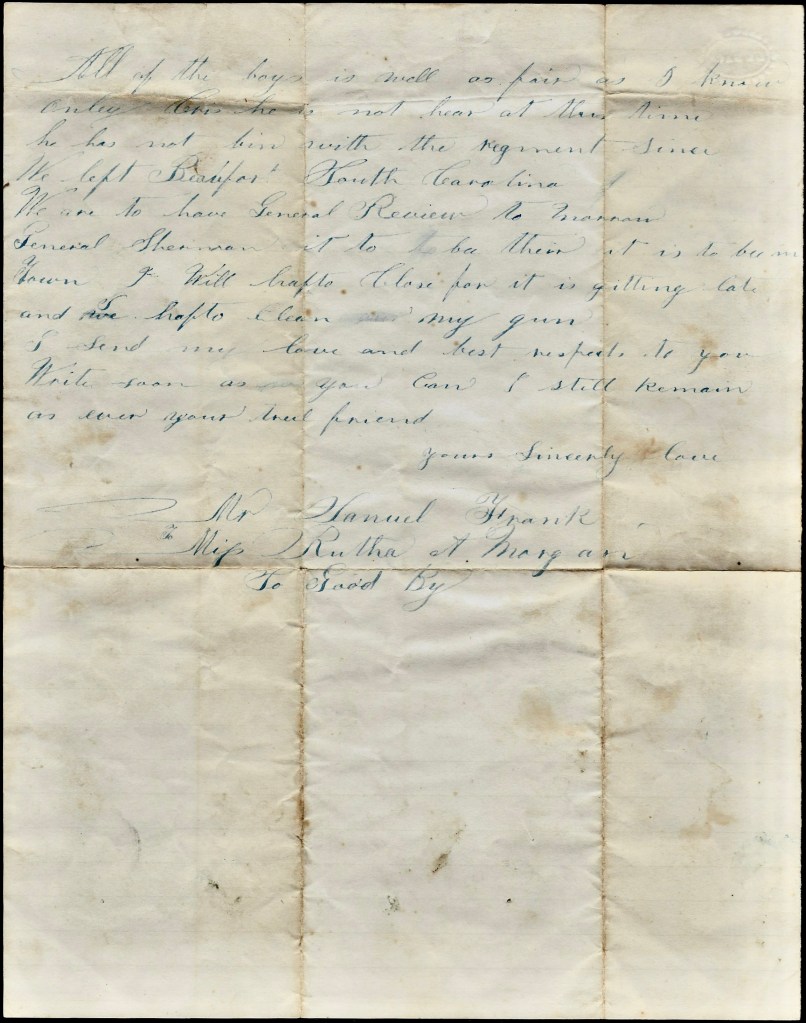
Thomas Good[e] has come and fetched the letter safe to me. It has been a long time since I heard from you. It done me lots of good to get a letter from you. All of the boys is well as far as I know. Only Chris—he is not here at this time. He has not been with the regiment since we left Beaufort, South Carolina.

We are to have a General Review tomorrow. General Sherman is to be there. It is to be in town. I will have to close for it is getting late and I have to clean my gun. I send my love and best respects to you. Write soon as you can. I still remain as ever your true friend. Yours sincerely [with] love, — Mr. Samuel Frank

to Miss Ruth A. Morgan

So goodbye

1862-5: Peter Bearl to Mary Ellen (Baker) Bearl

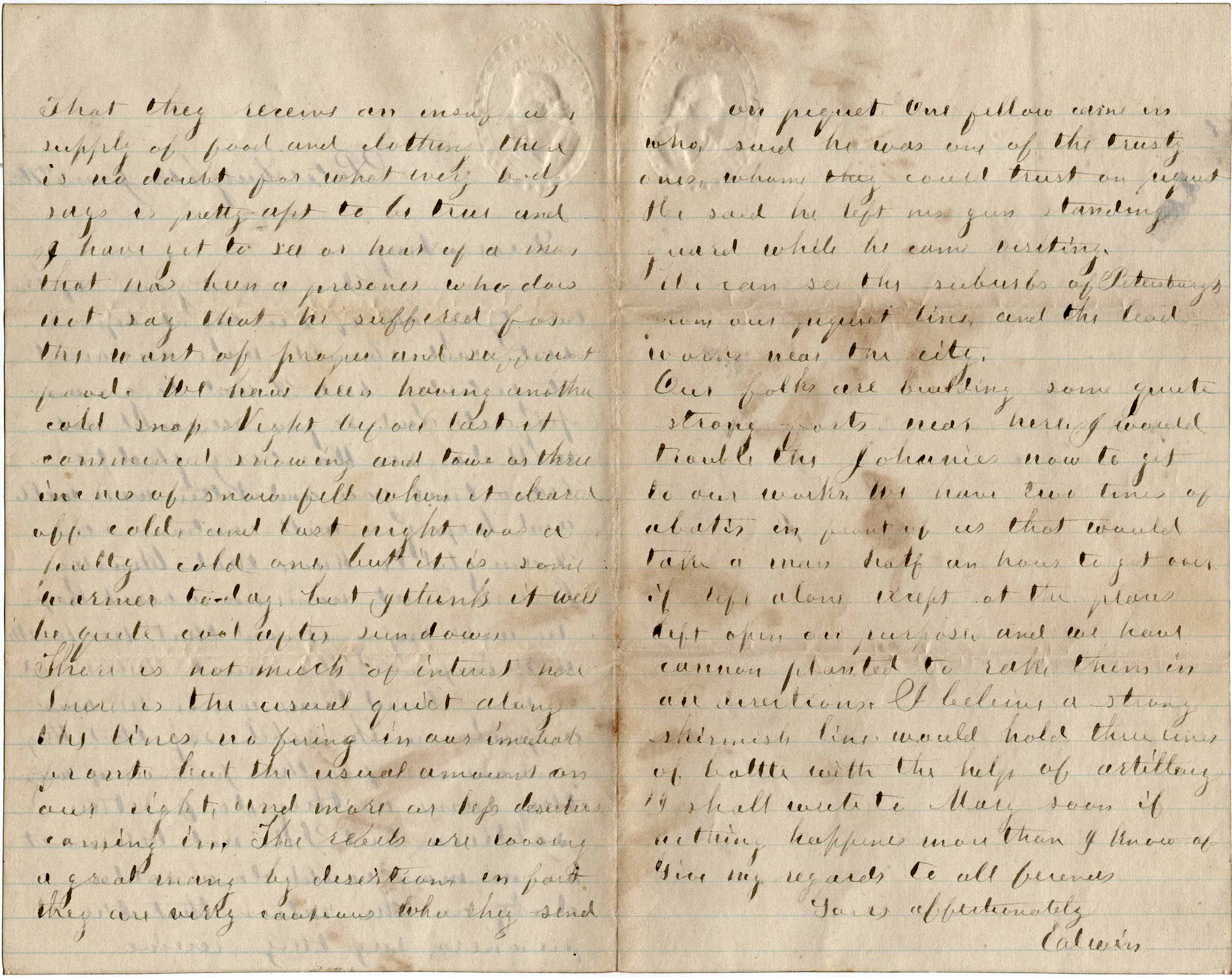
The following letters were written by Peter Bearl (1836-1896), a coal miner who enrolled Oct. 29, 1862 as a Private in Co. A, 10th Pa. Infantry, mustering in at Harrisburg, for 3 years. He transferred to Co. I, 191st Pennsylvania Infantry June 1, 1864. Mustered out with company June 28, 1865. He served from Oct. 29, 1862 to June 28, 1865—a total of 31 month and 29 days. He applied for Invalid Pension on May 8, 1879, for Heart Disease and Rheumatism. His wife, Mary Ellen Baker (1840-1914) applied for a Widow’s Pension after his death on Sept. 25, 1896.

I believe Peter’s parents names were Henry Bearl and Mary Knopschnider.

Letter 1

Camp Curtin
November 12, 1862

Dear Mary,

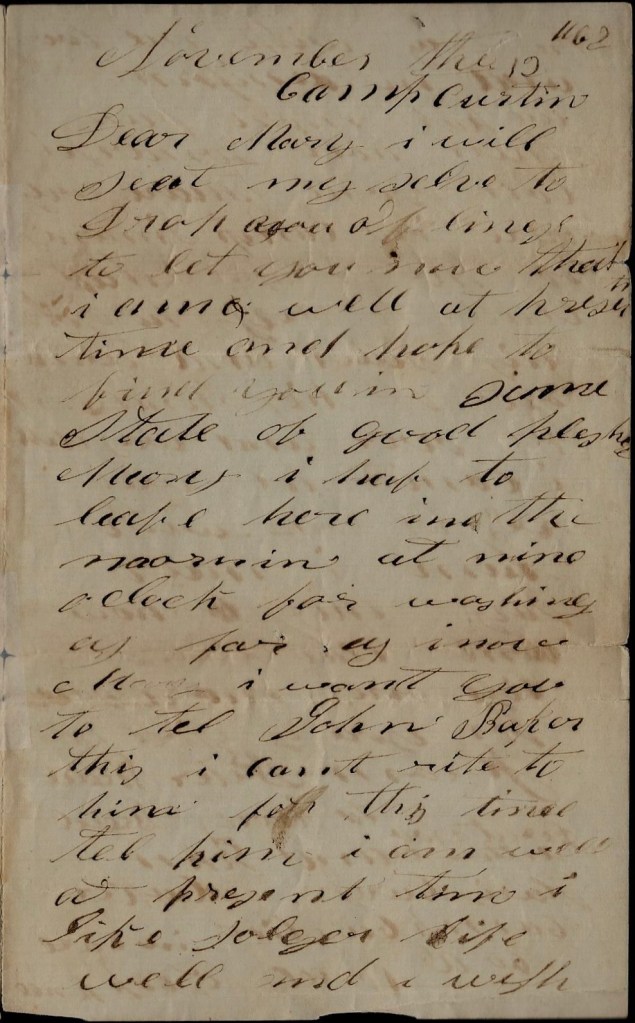
I will seat myself to drop you a line to let you know that I am well at the present time and hope to find you in the same state of good flesh. Mary, I have to leave here in the morning at nine o’clock for Washington as far as I know. Mary, I want you to tell John Baker this. I can’t write to him for this time. Tell him I am well at present time. I like soldier life well and I wish he was with me too and in uniform. We have more fun than old Somerset can afford. There was one in camp Simonds of the [ ] that died today. He got his cider and went out of his tent and fell over and was dead. I can’t tell what was wrong with him. I must say this. Now don’t like [ ] life. One more song for you—a good song [The Girl I Left Behind Me]

From Peter Bearl

to Mary Bearl and John Baker

Direct your letter to Camp Curtin, Harrisburg, In care of Capt. Knee, Co. A, 10th [Pennsylvania] Regiment


Letter 2

Camp of the 191st Regt. P. V.
March 10, 1865

Dear Wife,

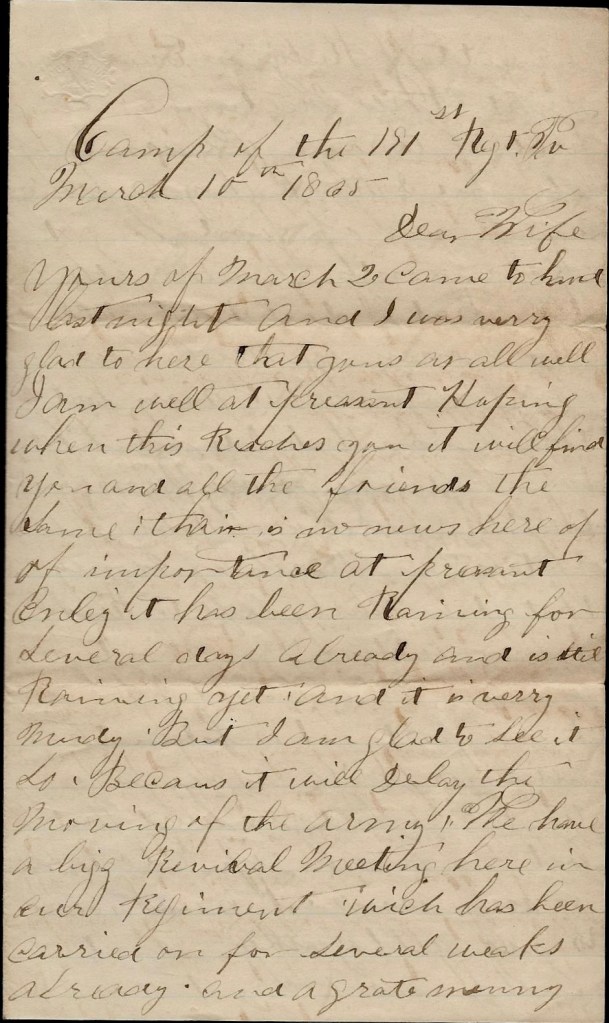
Yours of March 2 came to hand last night and I was very glad to hear that you are all well. I am well at present, hoping when this reaches you it will find you and all the friends the same. There is no news here of importance at present—only it has been raining for several days already and is still raining yet and it is very muddy. But I am glad to see it so because it will delay the moving of the army. We have a big revival meeting here in our regiment which has been carried on for several weeks already and a great many are getting religion every night. The meetings are held all through the army of late and I think they are doing a great deal of good.

We got our four months pay the other day but I do not like to send any money by mail now unless you need it very bad. The reason that I do not like to send my money is this—the mail is robbed so often it is hardly safe to risk it in a letter. You want to know how far Samuel and John and I are a part. It is between three and four miles as near as I can tell. You said you heard that I lost an arm. If I lost one of my arms, it is unknown to me altogether and I further more say it was a false report that I lost an arm.

I am sorry that my brother is in such bad health. I would like very much to come home to see my Mother but I can’t come till my time is up. I give my best respects to you all. I have no more to write this time. Write soon and give me all the news. From your husband, — Peter Bearl

To Mrs. Mary Bearl of Somerset county, Pa.


Letter 3

Camp of the 191st P. V. Vols.
March 16th 1865

My dear wife,

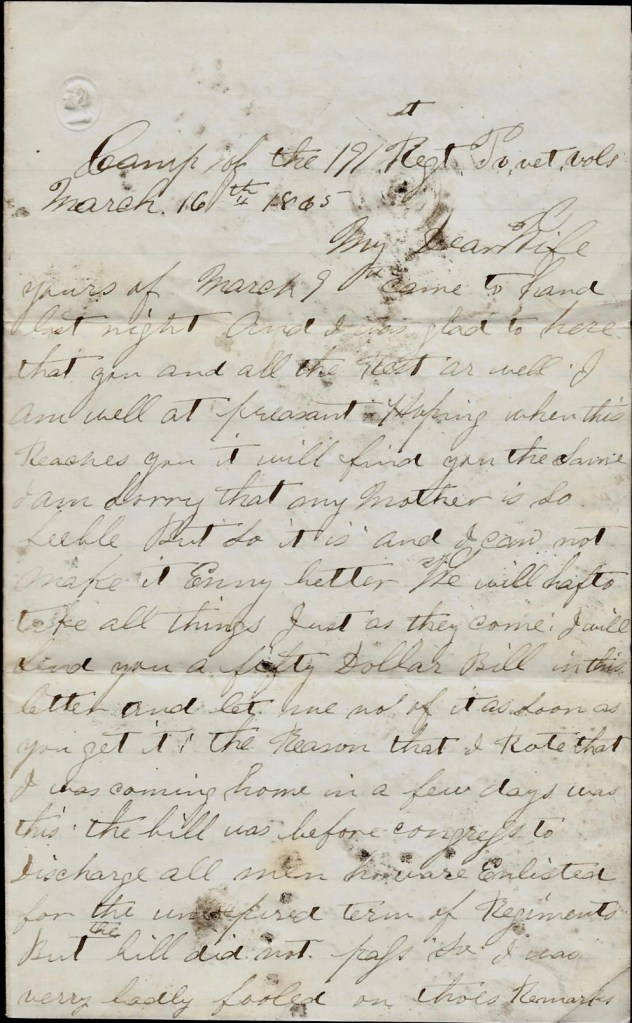
Yours of March 9th came to hand last night and I was glad to hear that you and all the rest is well. I am well at present. Hoping when this reaches you, it will find you the same. I am sorry that my Mother is so feeble but so it is and I cannot make it any better. We will have to take all things just as they come. I will send you a fifty dollar bill in this letter and let me know of it as soon as you get it. The reason that I wrote that I was coming home in a few days was this—the bill was before Congress to discharge all men who were enlisted for the unexpired term of regiments, but the bill did not pass so I was very badly fooled on those remarks. I have now answered your question in regard of coming home.

Now I want you to answer my question and that is this, you say you have so much trouble. I would like very much to know what makes you trouble? Explain this to me in your next letter.

I was up to see Sam Fisher and John last Money. They are both well and in good hopes of the war ending some day or other. I also saw the letter you sent to Sam Fisher. I also saw Dan Queer, Hen Deeds, and a good many others from our neighborhood and they were all well. You stated in your letter when I come home you will go with me anyplace. If that is so, how would you like to go with me to Minnesota. I have taken up a homestead of a hundred and sixty acres. It only cost me twenty dollars—the whole thing—and I guess I’ll have to go out and improve it as soon as I come home. You can now make up your mind to go and I think this will perhaps cease your troubles.

I think the [spring] campaign will now most anyway commence. The sutlers are all ordered back and we have orders to be ready to march in a moment’s notice. Send me some stamps in your next letter or else writing will be finished. That tobacco I have not yet received. No more. Write soon. Your husband, — Peter Bearl


Letter 4

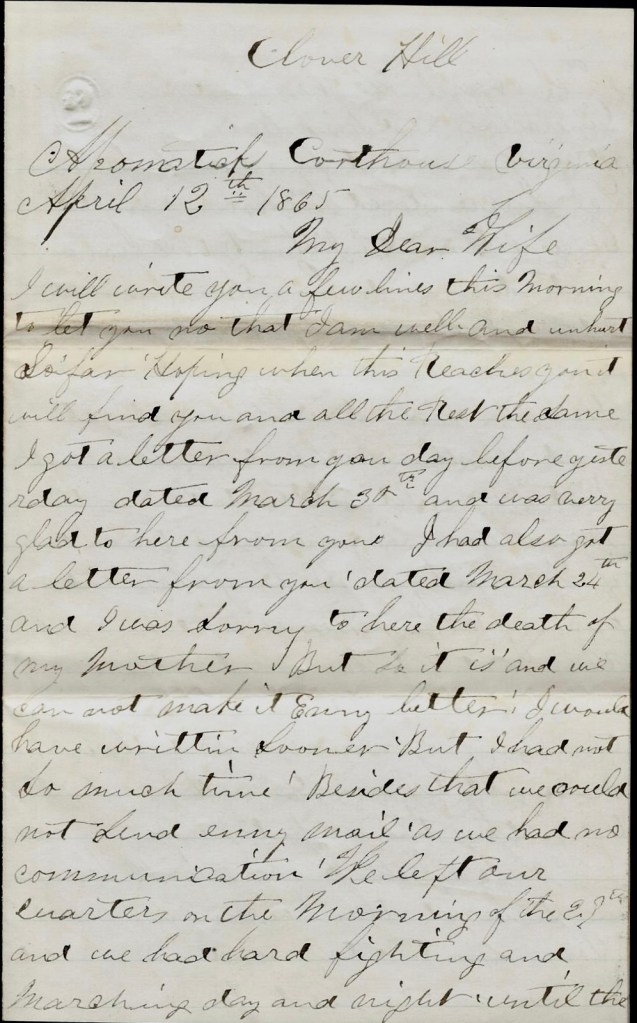
Appomattox Court House, Virginia
April 12th 1865

My dear wife,

I will write you a few lines this morning to let you know that I am well and unhurt so far. Hoping when this reaches you, it will find you and all the rest the same. I got a letter from you day before yesterday dated March 30th and was very glad to hear from you. A had also got a letter from you dated March 24th and I was sorry to hear the death of my Mother. But so it is and we cannot make it any better. But I had not so much time. Besides that we could not send any mail as we had no communication.

We left our quarters on the morning of the 29th and we had hard fighting and marching day and night until the 9th of April. We then had surrounded General Lee and his whole army on the 9th of April. About four o’clock, General Lee surrendered his whole army to General Grant. I think the war is about at an end. Gen. Lee has also advised General Johnston to surrender his army to General Sherman but we have not yet heard whether he has done so or not. But he would better do so for their main army is gone now.

The soldiers of Lee’s army are all being paroled and are going to their homes and they are all very glad that they are out of the army. I have not saw Sam [Fisher] or John [Baker] since this campaign commenced. Therefore I cannot tell you anything about them this time but I hope they are all safe. I think peace will soon be declared. Then we can all come home for to stay and we would all be very glad to go home.

Don’t trouble yourself anymore about me for I think we will all soon some home and the war at an end. Don’t send anything to me anymore for I will not get it anyhow, excepting letters. You can send [letters] as often as you wish. I have my mother’s likeness yet and I am going to keep it. But it is spoiled a good deal and the glass I have broken on it. Those things of my father’s estate, just let them do as they will and when I come home I’ll see to it myself.

I will close for this time hoping to hear from you soon. I give my best respects to all the friends. You can tell Adam Ridinger’s wife that he is well, safe and sound so far. From your affectionate husband, — Peter Bearl

to my wife Mary


General Grant’s Terms of Surrender

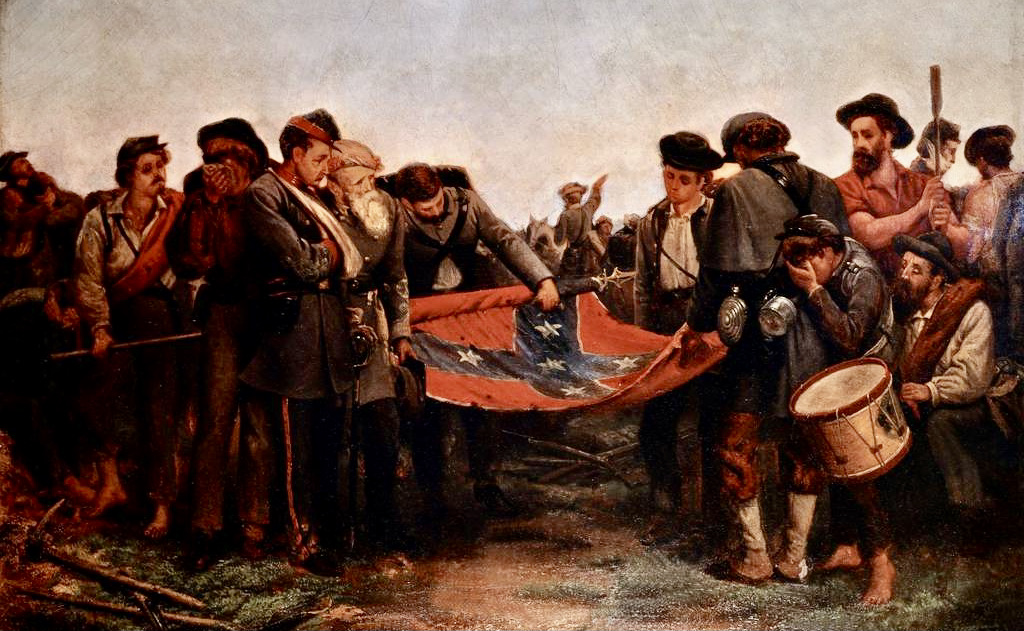
Confederate soldiers rolled up their flag after General Lee’s surrender at Appomattox

Among the personal papers of Lindsay Branch Walthall (1840-1912) of Prince Edward County, Virginia, were found the following handwritten terms of surrender of Gen. Lee’s Army of Northern Virginia to Gen. Grant on 9 April 1865. Lindsay served the entire war, entering initially in May 1861 with other boys of his county in the Old Dominion Rifles. The boys in this company were eventually consolidated into the 53rd Virginia Infantry. He was taken prisoner at the Battle of Gettysburg, captured in “Pickett’s Charge” on 3 July 1863—the 53rd Virginia serving as the color regiment of Armistead’s Brigade. He was transported from the battlefield and confined at Fort McHenry, at Fort Delaware, and at Point Lookout where he was finally exchanged from the Hammond General Hospital suffering from chronic diarrhea on 31 August 1864.

When he returned to his regiment following his exchange and recovery from illness, Lindsay was promoted on 1 November 1864 to a 2nd Lieutenant of Company C, 53rd Virginia Infantry. The 53rd Virginia was at the time brigaded with four other Virginia regiment under the command of Gen. George Hume Steuart in Maj. General George E. Pickett’s Division of Longstreet’s Corps. Moreover, at the time of the fall of Petersburg and Richmond in April 1865, Lindsay was acting as aide-de-camp to Gen. Steuart and would have been in his company as Longstreet’s Corps crossed over to the south side of the James river and struck out westward on the South Side Railroad hoping to rendezvous with the rest of Lee’s army at Amelia Court House on the Richmond and Danville Railroad. Their path would take them directly through the county where Lindsay grew up and immediately past the home of Suzie Overton, his future wife.

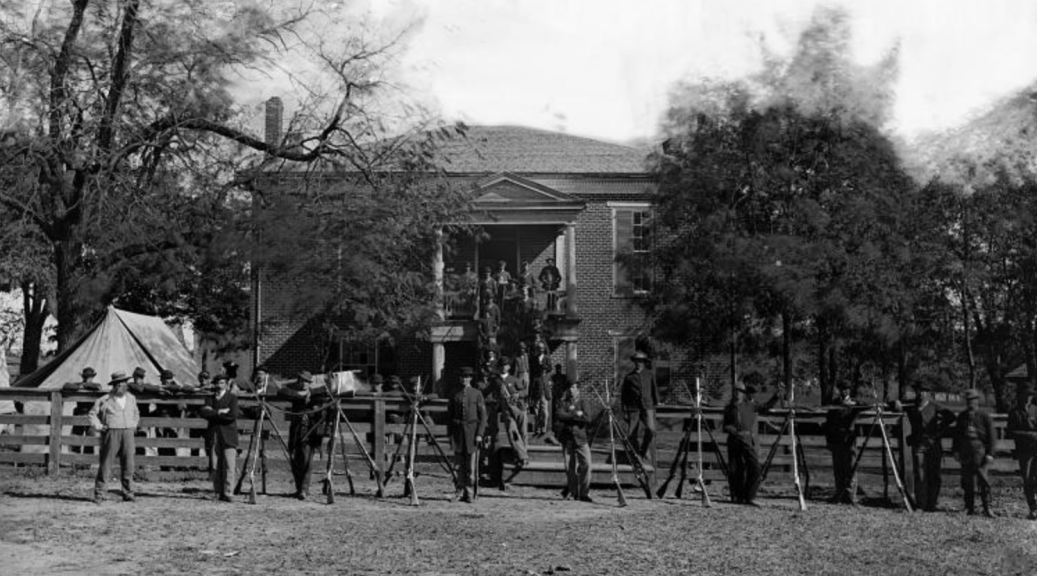
The surrender of Lee’s army in the days that followed is well known and the drafting of the terms of surrender in McLean’s farmhouse at Appomattox Court House has been immortalized in both words and pictures. Once the official copy of the terms were drafted, they needed to be disseminated to the officers of the various commands so it may be imagined that clerks were ordered to sit down and quickly make multiple handwritten copies for this purpose. It is my hunch that this copy was either one that Lindsay received, or wrote himself, as aide-de-camp to Gen. Steuart. Perhaps he used it to read the terms to the rank and file at the request of his commander.

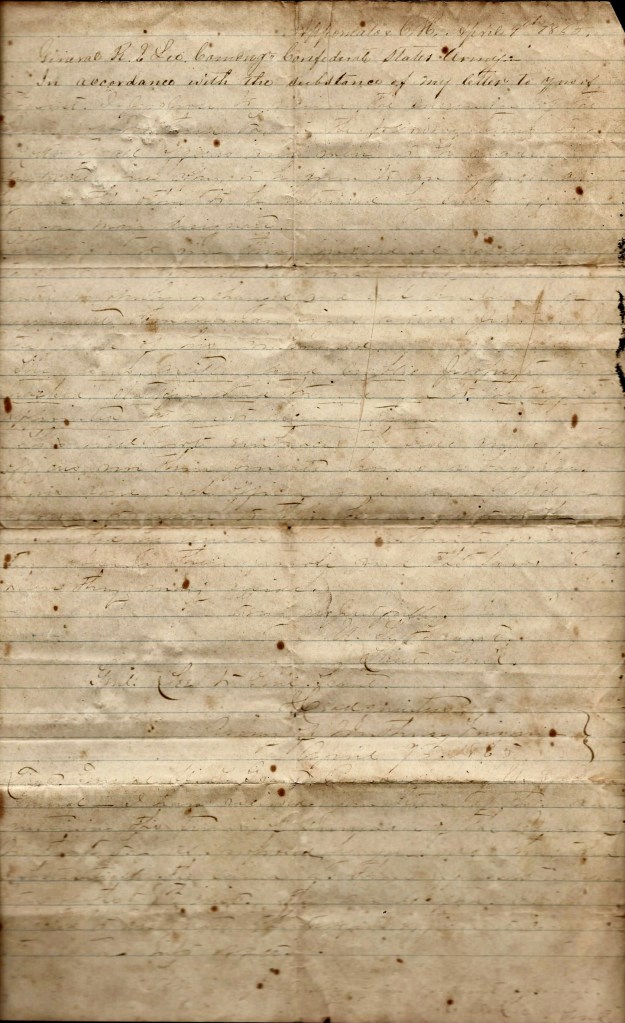
The top portion of the document is more legible than the bottom though this may be partially due to the quality of the scan that was proved to me.

Docketed on reverse side of sheet

Transcription

Appomattox Court House
April 9th 1865

General Robert E. Lee, Commanding, Confederate States Army:

In accordance with the substance of my letter to you of 8th inst., I propose to receive the surrender of the Army of Northern Va. on the following terms (to wit): Rolls of all the officers and men to be made in duplicate—one copy to be given to an officer to be designated by me; the  other to be retained by such officer as you may designate.

The officers to give their individual paroles not to take up arms against the Government of the United  States until properly exchanged, and each company or regimental commander to sign a like parole for the men of his command.

The arms, artillery, & public property to be parked, stacked & turned over to the Officer appointed by me to receive them. This will not include the side arms of the officers nor the private horses or baggages. This done, each officer and men will be allowed to return to their homes, not to be disturbed by the United States authorities as long as they observe their parole & the laws enforced where they may reside.

Very Respectfully, — US Grant, Lt General

General Lee to General Grant

Headquarters, Army of Northern Virginia
April 9th 1865

Lt. General U. S. Grant, commanding U. S.

General, I have received your letter of this date containing the terms of surrender of the Army of Northern Virginia, as proposed by you. As they are substantially the same as those expressed in your letter of the 8th inst., they are accepted. I will proceed to designate the proper officers to carry out the stipulations into effect.

Very respectfully, your obedient servant, — R. E. Lee, General