Category Archives: Little Rock, Arkansas

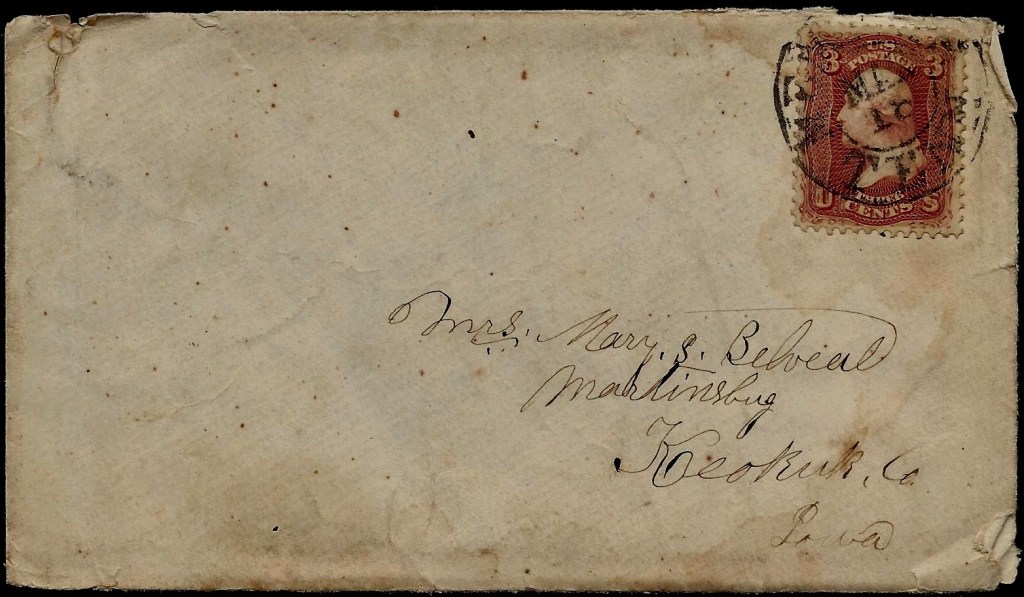
1863-65: Nicholas Belveal to Mary Susan (Miller) Belveal

The following letters were written by Private Nicholas (“Nick”) Belveal (1839-1926) of Co. F, 33rd Iowa Infantry. Nicholas was 22 years old when he enlisted on 13 August 1862 and he remained almost three years with the regiment, mustering out on 17 July 1865 at New Orleans, Louisiana.

Nicholas was the son of Louis Belveal (1815-1880) and Rachael Ann Nelson Kelly (1823-1918) of Jackson, Keokuk county, Iowa—formerly of Shelbyville, Indiana. Nicholas was married to Mary S. Miller (1841-1884) in 1862. Sometime after the war the couple moved to Oakland, Alameda county, California.

Adding a note to Nick’s 1st letter was Joseph T. Miller (b. 1836), Nick’s brother-in-law who served in the same company.

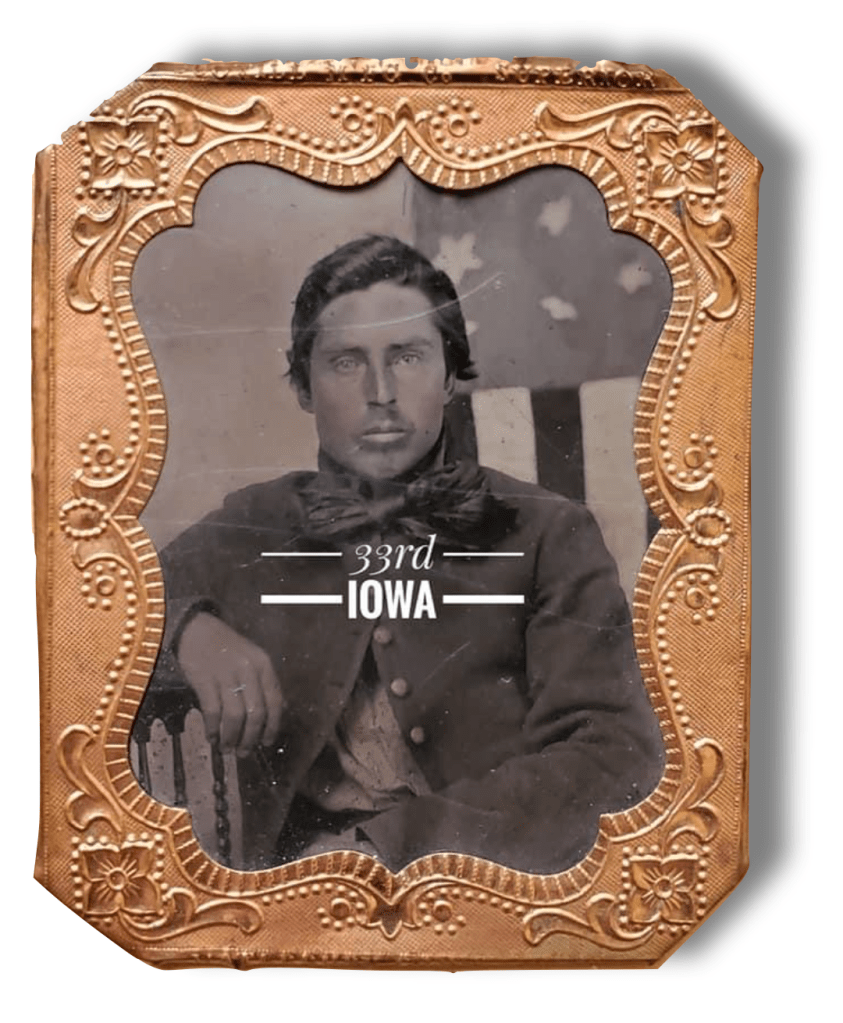
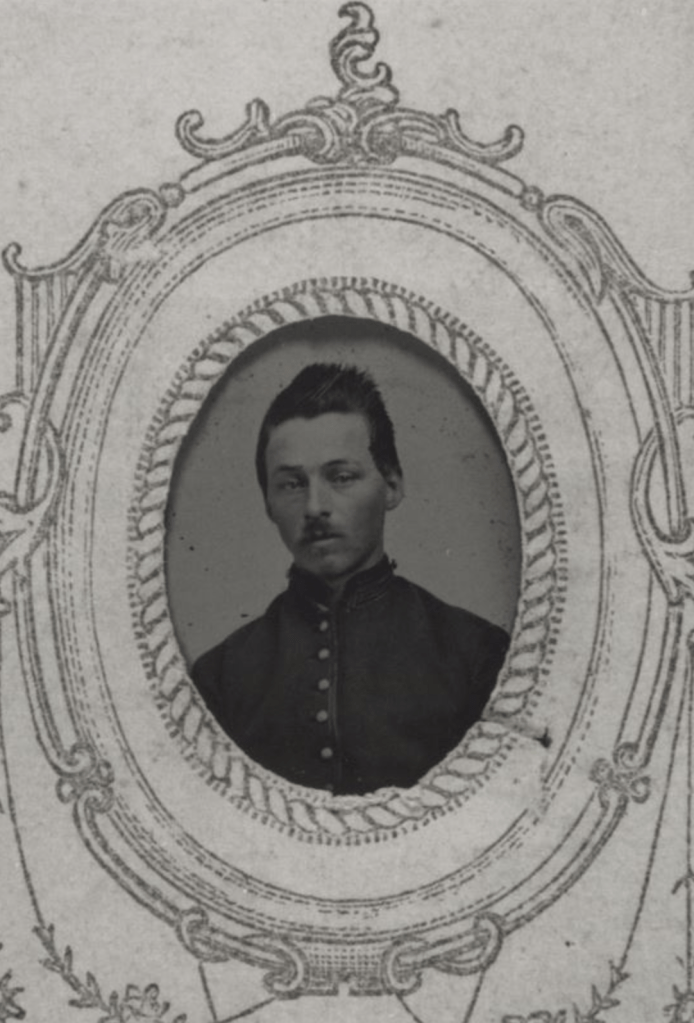
I could not find an image of Nick but here is one of Pvt. Stephen Stolzer of Co. E, 33rd Iowa Infantry. He died of disease at Helena, Arkansas on 26 July 1863. (Iowa Civil War Images)

Letter 1

Tallahatchie River
March 9th 1863
On board steamer Lebanon No. 2

Dearly beloved wife & friends,

It is with the greatest of pleasure that I take the opportunity of informing you that we are all well & in good spirits & I sincerely hope these few lines may find you all in good health.

Well, Mary, I just finished washing & would like to see you—“that’s whats the matter.” Jo. T. is writing father Miller a letter. Well, Mary, I have not seen any more rebs since them I told you about. The darkies says the Rebs is scared nearly to death. They all leave as we advance. This is 13 days we have been out on the expedition and have not seem a reb yet. Oh yes, the cavalry took 2 prisoners.

This Yazoo Pass that you have heard of is about 2/3 as big as Skunk [River]. It empties into Cold Water which is a little bigger. Cold Water empties into the Tallahatchie which is about as big as Skunk [River] and as crooked, but it is a heap deeper. The darkies told us that their masters said if the Yankees got through the Yazoo Pass, Vicksburg was gone certain. The general belief of the soldiers is that the war is about over.

I haven’t got a letter from any of you since the one dated February 19th and I am a getting very anxious to hear from you again. But I think when the mail comes, I will get one. That will be this evening, I think.

Well, Mother, you said you was glad to think that I had quit swearing, I have not swore any since I was at home, not neither do I low it. We had preaching in the Cabin [of the steamboat] yesterday & I was in to hear it. Well, Mother, I have begun to live a religious life & I low to stick to it. You all know that the army is a hard place for a Christian to live but it don’t make any difference with me what others do or say. I low to try to do but what is right.

Sammy says he has nothing of importance to write—only he is well and would like to ses you all if he could. Only he wants to know whether Father has got that money from I. Morgan yet or not.

Well, I believe I have wrote all I have to write. I must close and let Joseph write some. I would like to see you all & I hope I will soon. So no more. Write soon. From your affectionate husband, — N. Belveal

To Mary S. Belveal

Dear Sister, I thought I would write you a few lines. I have just finished a good long letter to Father and Mother. Those lines leave me well and I hope they may find you the same as health is the greatest blessing we can enjoy here on earth and especially while we are in the army.

Well, Mary, I will tell you that I sent Martha 5 dollars in your care. I sent it with Nicholas when he sent his to you. Please do me the favor to hand it to her. I write her a letter the 24th of February. Something else. I have not much new to write this time but we are surrounded with trials here in the army. But Mary, I try to live up to my calling and serve my Master as much as I ever did in my life. And if I ever return to my home and friends, I hope to return untarnished by vice or if I die, to die a faithful soldier for my country and my Lord. But I must close. My best respects to you. Ever your brother, — Joseph T. Miller

To M. S. Belveal


Letter 2

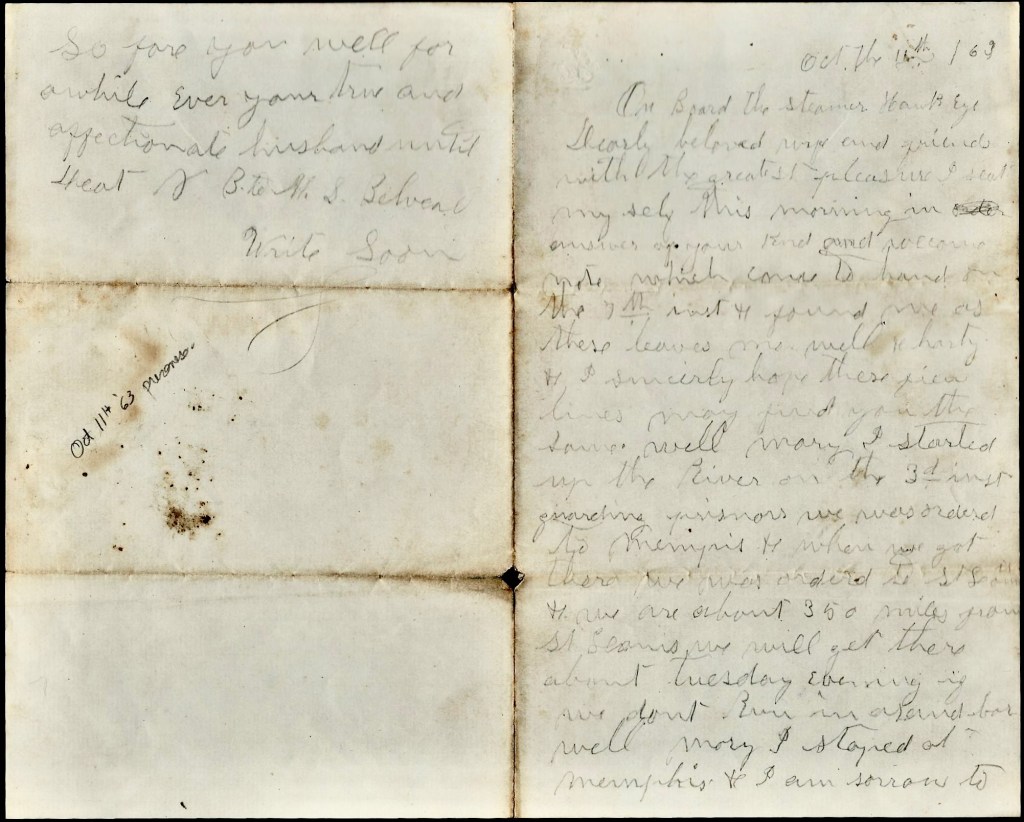
October 11, 1863
On Board the Steamer Hawkeye

Dearly beloved wife and friends,

With the greatest pleasure I seat myself this morning in answer of your kind and welcome note which came to hand on the 7th inst. & found me as these leaves me well & hearty. And I sincerely hope these few lines may find you the same.

Well, Mary, I started up the river on the 3rd inst. guarding prisoners. We was ordered to Memphis and when we got there, we was ordered to St. Louis. And we are about 350 miles from St. Louis. We will get there about Tuesday evening if we don’t run in a sand bar.

Well, Mary, I stayed at Memphis & I am sorry to tell you that our dear brother Joseph is dead. He died on the 8th of August. I could not do anything about his affairs. I wanted to send his things home but they said that would be attended to and all be fixed up right. Mother wanted to know what he said but I could not find out as he was among strangers. He was doing well & getting along fine until he took the gangrene in his wound. Tell Mother I done all I could to fulfill her request but I couldn’t do anything that would be of any satisfaction to her. If I could, I would have done it. But poor brother, he is gone & we can’t help it. I hope we will all meet him again where there will be no wars nor troubles.

I left the camp last Sunday one week ago today. The Boys were all well & in good spirits when I left. We have got 326 prisoners—taking them to St. Louis & there is about half of them swears that they won’t never go back to the army anymore.

Well, Mary, if I had a furlough now I could soon be with you at home but I haven’t got one—that’s what the matter! Well, I must close for the boat shakes so that I can’t write to do any good. I will write again as soon as I get to camp. I would like mighty well to see you if I could & hope it will not be long until I can have that pleasure. So I will close for the present. So fare you well for a while. Ever your true and affectionate husband until death, N. B. to M. S. Belveal

Write soon.

Letter 3

Little Rock, Arkansas
November 4th 1863

Dearly beloved wife & friends,

With the greatest pleasure I take my pen in hand in order to drop you a few lines to let you know how I am getting along. I am well and hearty and I sincerely hope these few lines may find you all in good health. Well, Mary, I got a letter from you dated October 11th and also a few lines from Mother. You said you understood that we was going to Memphis but we have no orders to go there as I know of. I went to see about brother Joseph’s affairs but I couldn’t do anything about it. They told me that they would be sent home—that is, his clothes.

Well, the Boys has all got back and none of them got hurt. They didn’t see any Rebs—only deserters that come in and give themselves up. They average between 18 & 25. Well, Mary, I was mighty glad to hear of you being well again. You wrote in your other letter that you was only tolerable well. It gives me great satisfaction when I can hear of your being well.

Well, Mary, I was detailed yesterday to go after brick and we had to go about 15 miles through the thin settled country and cane brakes to no end. But the worst of all, I found a dead hog lying in the cane brake and I brought it to camp and told the captain about it and said, “Did you bring it in?” Yes. “Have you any to spare?” Yes. “Well I would like to have a piece of it as I suppose it hasn’t been dead long enough to spoil.” So we divided it.

Well, Mary, I haven’t any news to write that would be new to you but if I could only just get to see you, I could find a plenty to tell you but I hope the time will soon come when I can have that pleasure again for I want to see you mighty bad. Well, Mary, I have got $40 & I expect we will draw again in a few days 26 more, and I wish you had it all. Well, I believe I have wrote about all for this time. I will write Mother a few lines in answer to her kind note so no more at present. Ever your companion until death, — N. Belveal to M. S. Belveal

Write soon.

November 4th 1863. Much respected father and mother. I this evening seat myself in order to drop you a few lines in answer to your kind note which I gladly received last mail and was truly glad to hear of your being well. These lines leave me well and I hope they may find you the same, Well, Mother, I went to see about brother Joseph but I could not find out what he said before he died. I done all that I could. I couldn’t find just the spot where he was buried. Well, mother, I couldn’t find out anything about him that would console you any. If I could, I would. It is hard to give him up but we must give him up as cheerful as possible. He died a true patriot to his country. I have nothing of my [ ] to write, only I would like mighy well to see you all if I could. S I will close by requesting you to write soon. Ever your son until death, — N. Belveal


Letter 4
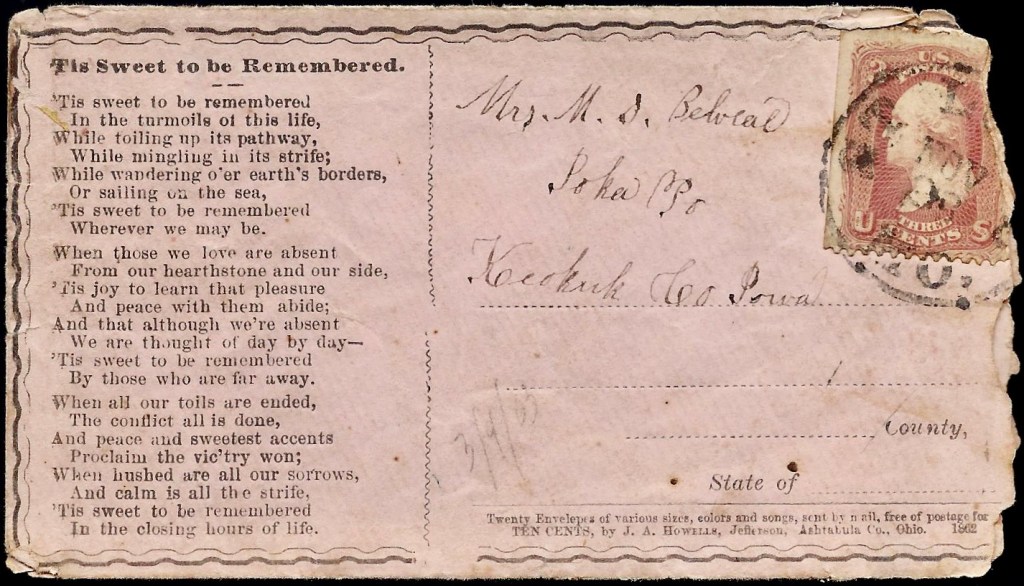
Little Rock, Arkansas
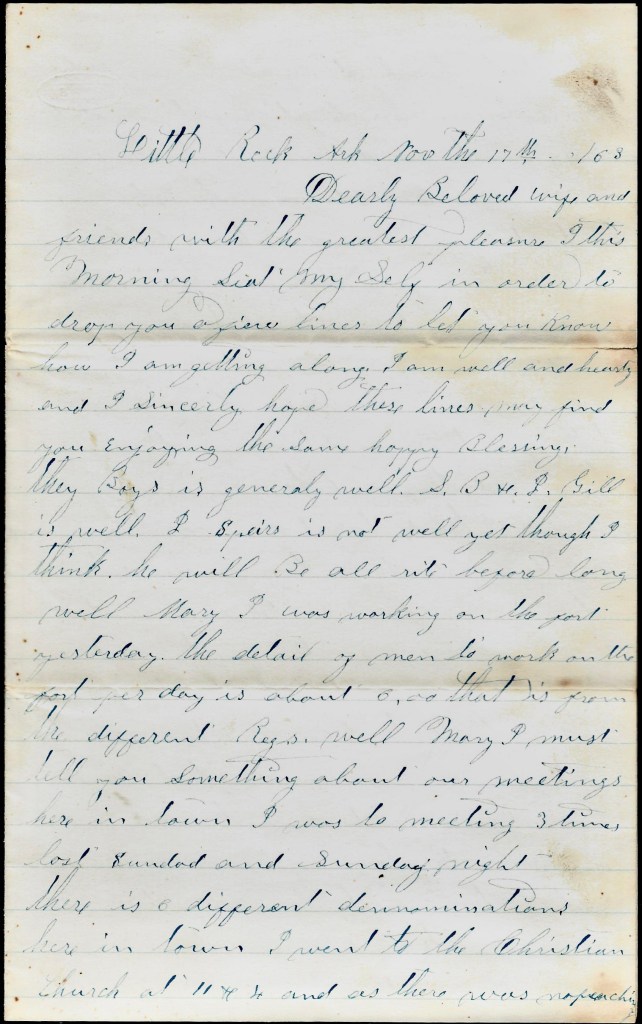
November 17th 1863

Dear Beloved Wife and friends,

With the greatest pleasure I this morning seat myself in order to drop you a few lines to let you know how I am getting along. I am well and hearty and I sincerely hope these lines may find you enjoying the same happy blessing. The boys is generally well. S. B. and J. Gill is well. J. Speirs is not well yet though I think he will be alright before long.

Well Mary, I was working on the fort yesterday. The detail of men to work on the fort per day is about 600—that is, from the different regiments. 1

Well Mary, I must tell you something about our meetings here in town. I was to meeting three times last Sunday and Sunday night. There is 6 different denominations here in town. I went to the Christian Church at 11 and 4 and as there was no preacher at that church at night we went to the Presbyterian Church at night. I got to hear a mighty good sermon in the forenoon and a tolerable good one in the afternoon, but at night it was rather a dry time.

Well Mary, you may guess how much satisfaction it was to get to hear some good preaching once more. It almost seems like I was free once more. I guess I must tell you there was lots of pretty girls there and they had to go home by theirselves. I tried to get some of the cowardly boys to go with them [but] they was afraid to venture.

Oh Mary, if I could only be at home where I could go with you to meeting, then it would be some satisfaction but I trust the time is not far distant when we can once more see that day. Prosperity and civility seems to once more reign over the town of Little Rock in which the inhabitants seem to be well pleased. As to produce, everything is very high. Pork is worth 15 cents per pound, mutton, beef 12.5, chickens 50 cents per head, potatoes 1.50 per bushel, corn meal 1.50, flour $10 and other things in proportion. What do you think of that?

Well Mary, Sergeant J. Bell is on his way home for the purpose of recruiting for Co. F and I send you $50 by him. I have no news of any importance to tell you this time I believe that would be new to you, but if I was only with you again I could talk you all to sleep. But I am in good spirits for I think the time will roll round some time when I will be again permitted to return to the one that I so dearly love. Well, Mary, tell brother J. F. Githen that I would like mighty well to hear from him if he has not forgotten me entirely though I don’t suppose he has time to write for nursing that boy. So I will bring my letter to a close by scbscribing myself your affectionate husband until death, — N. Belveal

To Mary S. Belveal. Write soon.

1 A month after occupying Little Rock, Gen. Steele ordered the start of construction of a new fort to defend the city from attack. It was a square redoubt with a network of batteries and rifle pits that was named Fort Steele.

Letter 5

Little Rock, Arkansas
June 21, 1864

Dearly beloved companion and friends,

With the greatest of pleasure I this morning seat myself for the purpose of dropping you a few lines in answer to your kind and welcome note of the 5th instant which came to hand in due time and found me as this leaves me—well and hearty. And I sincerely hope these lines may find you the same.

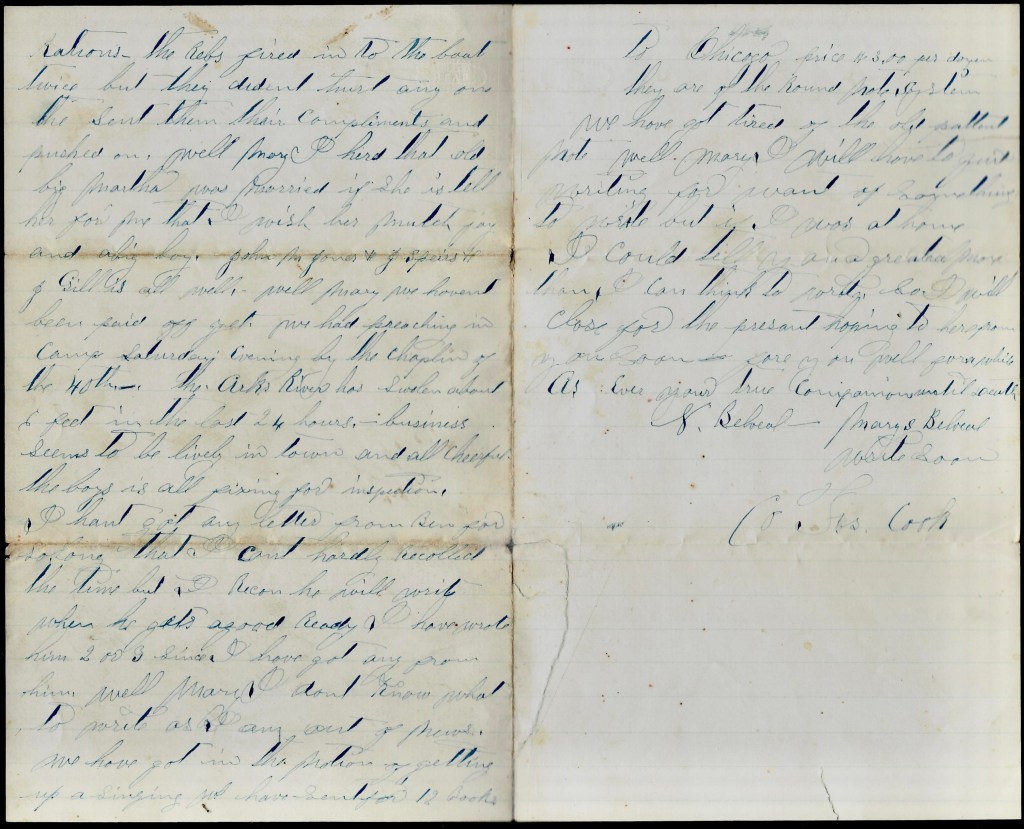
As to war news, I haven’t anything late. Times is quiet here and the weather extremely hot. And we had a General Review yesterday and today general inspection. They are spreading on the style rather thick to suit me. I hear that there was a fight at Brownsville yesterday between our cavalry forces and Old Shelby but I don’t know how true it is. But there was some infantry sent over there yesterday for some purpose. There was a detail from our regiment to go to Ft. Smith with a boat load of rations. The Rebs fired into the boat twice but they didn’t hurt anyone. They sent them their compliments and pushed on.

Well, Mary, I heard that Old Big Martha was married. If she is, tell her for me that I wish her much joy and a big boy. John M. Jones and J[ames R.] Speirs & J[ames] Gill is all well. Well, Mary, we haven’t been paid off yet. We had preaching in camp Saturday evening by the Chaplain of the 40th.

The Arkansas River has swollen about 6 feet in the last 24 hours. Business seems to be lively in town and all cheerful. The boys is all fixing for inspection.

I hant got any letter from Ben for so long that I can’t hardly recollect the time but I reckon he will write when he gets good and ready. I have wrote him two or three since I have got any from him. Well, Mary I don’t know what to write as I am out of news. We have got in the notion of getting up a singing. We have sent for 12 books to Chicago—price $3 per dozen. They are of the round note system. We have got tired of the old patent note.

Well, Mary, I will have to quite writing for want of something to write but if I was at home, I could tell you a great deal more than I can think to write. So I will close for the present hoping to hear from you soon. Fare you well for a while. As ever, your true companion until death. — N. Belveal

[to] Mary S. Belveal

Write soon. Co. F’s cook.


Letter 6

Little Rock, Arkansas
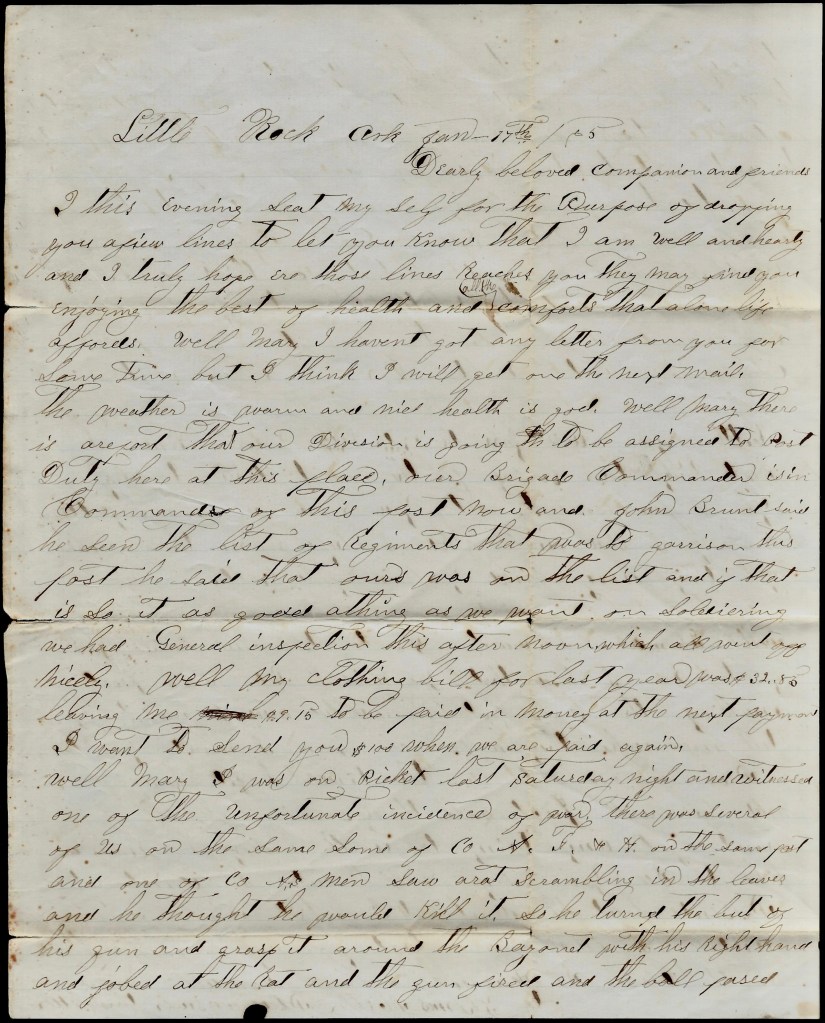
January 17th 1865

Dear beloved companion and friends,

I this evening seat myself for the purpose of dropping you a few lines to let you know that I am well and hearty and I truly hope re those lines reaches you they may find you enjoying the best of health and all the comforts that a lone life affords. Well Mary, I haven’t got any letter from you for some time but I think I will get one the next mail. The weather is warm and nice. Health is good.

Well Mary, there is a report that our Division is going to be assigned Post Duty here at this place. Our Brigade Commander is in command of this post now and John Brunt said he had seen the list of regiments that was to garrison this post. He said that ours was on the list and if that is so, it’s a good thing as we want our soldiering. We had General Inspection this afternoon which all went off nicely.

Well, my clothing bill for last year was $32.85 leaving me$9.15 to be paid in money at the next payment. I want to send you $1 when we are paid again.

Well, Mary, I was on picket last Saturday night and witnesses one of the unfortunate incidents of war. There was several of us —some of Co. A, F, and H—on the same post, and one of Co. A’s men saw a rat scrambling in the leaves and he thought he would kill it so he turned the butt of his gun and grasped it around the bayonet with his right hand and jabbed at the rat and the gun fired and the ball passed through his fingers, tearing them up badly. I brought him to camp. He was a recruit. He had only been on picket about four times—a dear initiation for him.

Well, Mary, I can’t think of much to write but the time is drawing nigh when I hope I will be permitted to bring my news instead of sending. The time seems to pass away very fast. Speirs & Gill and John Jones is well. Well, I believe I have wrote all that I can think of so I will close. Sam wants to write some to Thomas. So farewell for the present. As ever your companion until death, — N> B. to < S. B. Write soon.

Letter 7

Brazos Island, Texas
June 9, 1865

Dear beloved wife and parents,

I this morning seat myself for the purpose of dropping you a few lines to let you know that we are both well and hearty and I do sincerely hope this may find you the same. Well, Mary, instead of coming ome, we are now in Texas. We left Mobile on the 3rd day of June and sailed for this point which we reached on the 5th. We had a calm sea and a good ship which made the voyage pleasant. Our ship was 340 feet long and 1800 tons burthen. There is a current report here now that we are going to be relieved by an Army Corps of Colored Troops from New York. We are now at Point Isabela at the mouth of the Rio Grande River. It’s as any country. I haven’t had any letters for several days.

Our fleet and the French fleet is both laying out here in the Gulf. The French and Mexicans is still fussing and they can just fuss it out as far as I am concerned.

Sam has gone a fishing and I am going. We can catch lots of the best of salt water fish here. We have to use condensed water here altogether for the sea water is just as salty as brine.

Well, Maty, I haven’t got much to write and my hand shakes so bad that I can’t write what I want to. Well, I want to see you all mighty bad but I will have to wait until I can get home. The sun shines pretty hot here on this sand.

Well, I must quit for fear the mail goes off and leaves my letter. I have a poor place to write on. Keep in good faith for I feel pretty sure if we are releived here we will come home. So I will stop for the present, hoping to see you soon. As ever your true companion until death, — N. B. [to] M. S. B.

Write soon.


Letter 8

Encamped at the mouth of the Rio Grande, Texas
June 22, 1865

Dear Wife & parents & friends,

It’s with the greatest of pleasure that I this evening seat myself for the purpose of dropping you a few lines in answer to your kind, welcome note of the 11th ult. which just reached me and brought me the consoling news that you was all well. Those lines leaves us both well and I truly hope they may find you all the same.

Well, we are encamped on the boiling plains of Texas. The sun shines very hot but there is always a cool sea breeze as we are right on the beach. We can look for miles without seeing a tree or switch. We are on one side of the river and the French holds the other. Our boys get in a row with them once in a while and just clear them out. The Mexicans and French brings a heap of trade over.

As to when we will come home, I can’t tell. There is so many rumors that I can’t tell but the general opinion is that we will be relieved before long and sent home but don’t flatter yourselves for military power is uncertain, but dark has caught me and I will have to stop till morning.

This is the 23rd and finds us both well and I truly hope you are the same. O, Mary, you can’t imagine how bad I want to see you but the time is coming pretty close when they will have to let us out. But I can’t help but think we will get out before the 1st of October.

They try to make us drill two hours per day but we just fall in line and march off apiece and stack arms till the time is up and then come in. Our Colonel don’t care but it is the higher straps.

Well, Mary, you said you had not got any of them things yet. Some of the Boys sent things the same time & directed the same way that has gone to Washington, Iowa, and it might be that them things has gone there too. You could find out by writing a letter to the agent of Adams Express. John Jones & Wes Allen sent something at the same time and they have got home. I guess from the way you write, Mother don’t like Illinois very well. I haven’t got a word from them yet. I have wrote but don’t get any answer.

Well, Toad just come down here. There is horny toads here. This is a curious country. The wind blows nearly all the time from the same way. I don’t like this climate nor the country nor the people that lives here for they are such blockheads. Well, we have just went through the pretensions of drilling.

As to health, it is very good. We haven’t got any shade—only what we make out of our tents. Well, Mary, I can’t tell you when to look for me but I hope to be at home soon. Well, I believe I have wrote all that I can think of for the present so I will close hoping to see you soon. So fare you well for awhile. As ever your copanion until death, — N. B. [to] M. S. B.

Write soon.

Civil War Diary of William Joseph Mottern, Co. A, 33rd Iowa Infantry

William Joseph Mottern

The following Civil War diary was kept by William Joseph Mottern (1840-1905) who enlisted at the age of 22 on 15 August 1862 as a private in Co. A, 33rd Iowa Infantry. He was promoted to corporal in August 1863 and mustered out at New Orleans on 17 July 1865.

William’s grandparents were Nicholas Mottern and Elizabeth Hobough of Sullivan county, Tennessee. His father, Deadrick Mottern, was one of ten children born to the couple. Deadrick died at the age of 26 in 1846 but not before marrying and have a couple of children. Unfortunately we don’t know the name of William’s mother who apparently also died prior to the 1850 US Census for in that year, William was living with his Aunt Mary (Mottern) Jordan and her husband, John J. Mottern in Marion county, Iowa, who apparently raised him.

After the war was over, William returned to Iowa where he married Mary Margery Brown (1841-1937) in March 1868 and they had one son named Ellsworth Eugene Mottern (1871-1933).

Transcription

[Note: This diary is in the possession of Travis Core, Pleasantville, Iowa— a g-g-g grandson of William Joseph Mottern]

SEPTEMBER 1862

Camp Tuttle, Oskaloosa, Mahaska county, Iowa. September 9, 1862
Mess No. 6: W. L. Brown, foreman, S. A. Gose, W. J. Mottern, W. W. Cradick, P. Walter, Joe Hunter, J. Worth, Milton Miner, Hiram Miner, John J. McElroy< John Johnson. This composes our mess. They are all good Boys I think. We take it by days cooking.
On the 25th of September [1862], we was called out to be mustered into the US Service at Oskaloosa.

NOVEMBER 1862

November 15th 1862—Was very cold morning. This was the day that the 33rd Regiment received their orders to move for St. Louis.

DECEMBER 1862

Sunday morning, December 14, 1862—On board the steamer Rowena this morning.
December 25, 1862—Columbus, Kentucky. This day we was laying in camp waiting for an attack from the enemy but they had not attacked us by 3 o’clock in the evening but as to the reason why is unknown to me.
26th—Columbus, Kentucky. Still we are waiting for an attack of the rebels today. The ground is very wet and muddy here. Last night was the first time the 33rd lay in their tents and i got very wet but I feel very well today and at this time I am sitting on a stump listening at the cannons firing and the guns cracking.

JANUARY 1863

January 2nd 1863—Camped two miles south of Union City, Tennessee on the Columbus Railroad in a nice scope of timber such as beach and poplar. Here we taken our New Year’s dinner of fresh pork and crackers & coffee which went well to a hungry soldier.
January 8th 1863—We left Columbus, Kentucky for Memphis today. I am sitting at the wheelhouse [Steamer J. D. Perry] writing this about 45 miles above Memphis. It is very pleasant today and I feel good.

FEBRUARY 1863

February 1, 1863—Helena, Arkansas. February 1st find me still on the banks of the Old Mississippi River sitting in my little tent thinking how many dreary days we have to spend before this rebellion shall come to a close and we will have the privilege to return to our native homes and enjoy the pleasures of home, sweet home once more.
February 5, 1863—Today the ground is covered with snow and the snow is still falling here while I am sitting in my tent. The other boys are reading novels, some smoking, ad I myself am whiffing a cigar.
Friday, February 6th—Near Helena, Arkansas. At this time I am sitting on the root of an old beach tree guarding one of the roads leading from Helena to St. Francisville on White River. I am about one mile from Helena and I would like to be still further from such a place if I could but as I am governed by higher authority, I enjoy myself as best I can. I am placed in a large ravine. On either side of me is high hills and on those hills are very fine timber such as poplar, beech, white oak, and ash. The land here is very poor. this is a brief description of this place at present time.
February 17th 1863—[Took steamer Lebanon No. 2 on the Yazoo Pass.] Camped on the Yazoo Pass on Geneal Alcorn’s farm in the State of Mississippi. We are well quartered in the Negro houses here. We have had some trouble with the secesh scouts but have not had any man killed yet but we have had several skirmishes with them.

MARCH 1863

March 3rd 1863—Today we are lying in the Coldwater [river].
March 8th 1863—Still on board the Lebanon No. 2 on the Tallahatchie River. Sunday morning.
March 12th–Today we are waiting for orders to march on to the Rebels. It is now 9 o’clock in the morning.
March 20th—Today we are an hour way up the Tallahatchie River. we expect to have to fight our way back if we get back at all.

APRIL 1863

April 2nd 1863—Still finds me on the old camp ground on the Tallahatchie River. Nothing has been done yet to remove the Rebel fort but soon think we will give the another trial.
April 4, 1863—We started up the Tallahatchie today which is the 5th of the month. We are still an hour up the river. As to where we will stop, I cannot tell yet.
April 9th—Helena, Arkansas. On the 8th this month we arrived back to this place off of our expedition down the Tallahatchie River. We started February 24th and returned April the 8th. Today we are lying on the boat waiting further orders.

MAY 1863

May the 14th 1863—Helena, Arkansas. Today finds me on guard at General Prentice’s Headquarters on the Wharf Boat. The weather is fine this morning and things seem to be going off finely in regard to the war.
May 29th 1863—Just come in from picket and I feel very much worried from the walk I had to take before I could reach camp and worse than all, I could not sleep for the mosquitoes—they was so numerous. They stole a vast amount of my precious blood which I did not like to have spilled in such a manner. The weather is very hot at this time. Yours in haste.

JUNE 1863

June 1st—Today we received $26 which was our pay for the months of March & April.
June 14th—Sunday. Today we are all quiet in our tents. Some [are] reading, some sleeping. Today the weather is very warm. Today the 3rd Iowa Cavalry started to Vicksburg. They are a noble set of Boys and no doubt they will do good work if they have the chance to try their hand. They have been here at this place eleven months today.
June 29th—Still finds us at Helena. All is quiet here and has been for some time…I have gone to the timber to relieve the old picket…[illegible].

AUGUST 1863

August 16th 1863—Camped on White river in a nice shady grove. we left Helena on the 11th August. Arrived here on the 15th. had a very dusty trip. will lay here a few days and then cross the river and proceed to Little Rock.
August 18th—Still in camp on the white river though we expect to leave soon. Some of the troops are across the river. The weather is still hot here.
August 21st—Still on the White River.
August 22nd—In camp [illegible]
August 26th—In camp 30 miles up. We camped on the White River at DuVall’s Bluff on the railroad leading to Little Rock. This is a very nice place [location] for a town. Has all been burnt up by the enemy troops.
August 29th—Still in camp on the river. We are looking all the time to march.
31st—We leave the Bluff and go 7 miles and camp.

SEPTEMBER 1863

September 1st—We marched 22 miles to Brownsville. Here we are still on the 2nd.
September 9th 1863—In camp on Bayou Meto two miles from Arkansas River and six miles below Little Rock. But little fighting done yet. The [Rebels are] supposed to be in their fortifications about 4 miles from this point here. We have tolerable good water and plenty of the best of beef and pork.
September 10th—Little Rock fell to the Union troops.
September 11th—we are laying on the banks of the Arkansas river waiting for orders.
13th—Still on the bank of the river but we will cross today. The weather is pleasant at this time. Still the weather is pleasant on the 25th of September.

18 year-old John H. Anderson enlisted in Co. I, 33rd Iowa Infantry (Iowa Civil War Images)

OCTOBER 1863

October 9, 1864—On board steamer Sallie List 40 miles below Memphis. The weather is mild. I left Little Rock the 4th of October with 325 prisoners—one Major, four Captains, several Lieutenants. Leave Little Rock October 4th, arrive at St. Louis 13th. Leave 15th [and] arrive at Little Rock 29th, 1863. Weather pleasant on the river.
October11th—Still on the river on board steamer Hawk Eye State 3 miles below commerce on the night of 11th. We lie at New Madrid. Next Columbus. Next Cairo. Next Cape Girardeau.

NOVEMBER 1863

Nov 28th – The weather is cold and dreary today. 

DECEMBER 1863

December 3rd—Weather dry and pleasant today. I have been working on Fort Steele. Things are quiet here.
7th—Things all quiet. Plenty of rain today.
8th—Pleasant and warm.
9th—The weather lowery. Signs of more rain. Other things going briskly.
10th—Nothing very important going on.
11th—Still raining tonight. All things going on fine.
17th—Cold and very high winds. Other things all quiet.
28th—Weather still pleasant and rather cool. All quiet here at this time. Weather cool and pleasant at this time. I have just finished a letter to Frank H. Brown, Little Rock, Ark.
31st—Today it has snowed nearly all day which the first snow that has fell here this winter. This is New Years Eve. Sixty-three is nearly gone and Sixty-four will soon be here. All quiet here. Things going off smoothly. Duty light and plenty to eat which is all that we need. Little Rock, December 31st, 1863 — Wm. J. Mottern. So ends 63, State of Arkansas, U. S. of A.


JANUARY 1864

“Today a Rebel Spy by the name of David O. Dodd was hung at this place…”

January 1st, 1864—Things all quiet. Weather cold. The ground covered with snow. Today we Bury L. E. Collings in the Little Rock Cemetery east of town.
3rd—Nothing going on in camp more than usual.
4th—Still the ground is covered with snow and it is sleeting at this time.  Things are very dull here. Duty light. Nothing more than camp guard.
5th—Things all quiet. I am on camp guard today. The snow and ice is still on the ground. Things all slow.
6th—Things all quiet today.
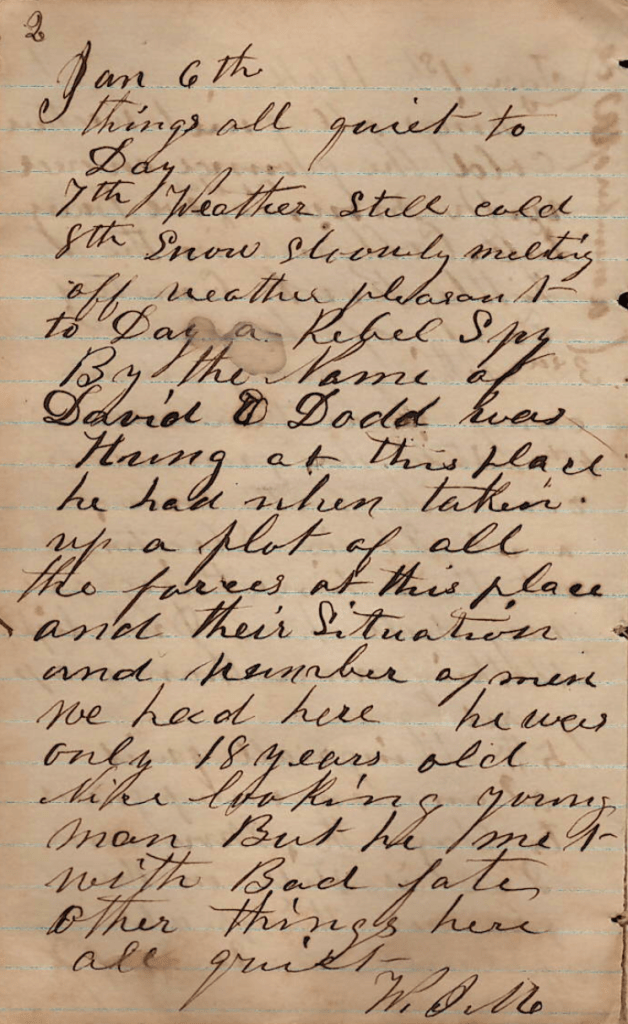
7th—Weather still cold.8th—Snow slowly melting off. Weather pleasant. Today a rebel spy by the name of David O. Dodd was hung at this place. He had when taken up a plot of all the forces at this place and their situation and number of men we had here. He was only 18 years old—nice looking young man. But he met with bad fate. Other things here all quiet.
9th—Weather pleasant. Things all quiet.

10th—Sabbath today.  The snow is fast melting away. I was at the Episcopalian Church at Eleven A.M. Also at three P.M. Nothing of any note passing.
11th—Still the weather is moderating and the snow is nearly all gone off the ground.
12th—Today the weather has been very pleasant.
13th—Still pleasant.
14th—Today the weather has been pleasant but this evening the wind is blowing and it is getting cold.
15th—Today I am in camp guard. Nothing of importance a stir.

16th—Sunday. Plenty of rain today. Things all quiet.
18th—Nothing of Importance transpired today.  Weather warm and pleasant. Today the boys—or a part of them—organized a society called the Soldiers Reform
.
19th—Company drill 10 till 11 A.M. Weather still pleasant. Army Regulations read to the company.
20th—Drill today. Weather pleasant.
January 21, 1864—Nothing more than company drill today. Weather pleasant.
22nd—Nothing more than company drill.
23rd—Weather pleasant today. Drilled in the bayonet exercise.

24th—Drill in the bayonet exercise.
25th—Weather pleasant. Drill has been the business of the day. The northern mail came in. I received one letter from F. Brown, Wheeling, Iowa. One from W. H. Brown, St. Louis, Mo. 
26th—Nothing of importance afloat.

27th—Today the regiment was inspected by the Inspector General. In the afternoon, I paid the 4th Iowa a visit. Did not stay long.
28th—Weather pleasant. Today the northern mail came In. Also the Pay Master came to pay the troops at Little Rock and other adjoining points.
29th—The weather still pleasant and warm.
30th—Today the 3rd Division had a grand review. The troops looked well and some good marching. Tonight it is raining and has the appearance of being bad weather for some time.
31st—Today I am on guard. Today it has rained most all day. This finished the month.

FEBRUARY 1864

February 1st—Nothing of importance going on today.
2nd—Weather pleasant. The wind high.
3rd—Today we had target shooting and it terminated in Osias Nichold being the best shot. Nothing new afloat at this time.
4th—Nothing more than company drill.
5th—Weather pleasant.
6th—Weather still nice but some colder. Company drill and from ten till eleven in the bayonet exercise.
7th—Nothing new today. Company inspection at nine a.m.
8th—On guard today. Nothing new going on today.
9th—Today I went to town and spent the afternoon. The weather is very pleasant at this time.
February 10, 1864—Today we received our pay for the months of November and December.
11th—Nothing new more than the northern mail came in. I received one written January 25th, other 27th same month.
12th—Nothing new going on today.
13th—Weather very pleasant today. Things all quiet here at this time.
14th—On guard today. It has rained nearly all day and tonight it is still raining.
15th—Nothing more than company drill.
16th—Nothing of importance.
17th—Today we had regiment inspection. The regiment was in fine trim. We was inspected by A. A. Inspector General Whipple.
February 18, 1864—On picket today on the Benton Road south of Little Rock. Weather very cool for the South.
19th—Weather cool today. Written one letter to Mrs. Mary Jordan.
20th—Nothing unusual going on today.
21st—Today we have company inspection. I also was at the Episcopal Church 11 a.m.  Weather pleasant. Tonight we had two new recruits to the camp.
22nd—On camp guard today. Nothing new going on here at present.
23rd—Nothing more than company drill and dress parade.
24th—Company drill from 10 a.m. till eleven.
25th—Company drill from 10 a.m. till eleven.
26th—Today the regiment is on Brigade Drill in the afternoon but I am on the sick list and am not taking any part with them.
27th—Nothing new today. On police duty today.
28th—Today is Sabbath. We have company inspection. Tonight it is raining very hard.
29th—Cold and sleeting all day. Today we was mustered for pay by C. H. Macke, Lieut.-Col. This finishes the month of February.

William Harris was 22 years old when he enlisted as a private in Co. C, 33rd Iowa Infantry (Iowa Civil War Images)

MARCH 1864

March 1, 1864—Company drill.
2nd—Company drill.
3rd—On picket guard today. Nothing new transpired.
4th—Company drill from 10 till 11 a.m. Taken a stroll to town in the afternoon.
5th—Received one letter from J. T. Jordan dated February 16th. The regiment on battalion drill today.
6th—Sabbath. Nothing more than company inspection. The mail came in from the North. Received one letter from J. T. Jordan; one from F. H. Brown.
7th—Company drill today. Nothing new. Nine recruits has come to camp in the last month.
8th—Company drill from 10 a.m. till 11. Battalion drill from 2 p.m. till four. Nothing more.
9th—On picket today on the Benton Road south of town. It has been very wet all day. Nothing unusual transpired during the day and night.
10th—Cold and windy. Company drill 10 till 11 a.m.
11th—Help to haul two loads of wood today. Tonight the news come that we are on marching orders—our destination not known.
12th—Weather cool. Nothing new.
13th—Sabbath. I went to the Episcopal Church. Today we are packed up ready to march.  Whether we will go or not is hard to tell. Time will prove.
14th—Still in camp on camp guard today. Weather cool with high winds. The 3rd Division passed review today.
20th—Sabbath. On camp guard today. Weather cool. Nothing new going on.
21st—Nothing new going on today.
22nd—Tonight we are trying to start on the march. We start tomorrow at 10 a.m. for parts not known to me.
23rd—Today we left Little Rock. Travel 10 miles. Go into camp on the Benton Road south of Little Rock. We are camped in an old field close to water.
March 24, 1864—Today we are the rear guards of our brigade.  [We] march 15 miles [and] go into camp 1 mile southwest of Benton, in Saline County. It has rained all afternoon. The roads are very bad.
25th—Today we march 8 miles and go into camp on a nice little stream of water.
26th—Today we march 16 miles. Go into camp at Rockport on the Ouachita River, Hot Springs County. The country over which we traveled today has been very broken and but little settlement.
27th—Cross the Ouachita River and travel 8 miles. Country very broken.
28th—Travel 10 miles. Country very Broken. Today we are rear guard of the whole division.
29th—Marched 8 miles to Arkadelphia. After supper we was ordered back 3 miles to guard supply train.
30th—Marched back to the division rear. We are living in camp close to town.
31st—Today we lie at Arkadelphia.

APRIL 1864

Elkin’s Ferry Battlefield, Civil War Trust

April 1st—Today we left the above named place and traveled 12 miles. We passed some of the nicest country that I have seen in Arkansas. Went into camp at a small town by the name of Spoonville.
2nd—Left Spoonville and traveled some 8 miles and was attacked by the rebels in our rear. They aimed to take our supplies. 29th Iowa and 50th Indiana was engaged in the fight. Halted at place by the name of Okabona for night.
3rd—Left the above named place and went four miles and camped close to river by the name of Little Missouri.

4th—Today we have been lying all day waiting for the enemy to attack us. This morning at 7 a.m., they attacked our front and had a pretty hard skirmish. Finally quit by the enemy. We had on our side 3 or four killed and 17 wounded. [See Engagement at Elkin’s Ferry]
5th—Still we are lying on the above named place. It is now near 7 a.m. and we expect they will attack the rear today some time. We are waiting for the rest of our forces to come up. The weather is very warm here all this time.
6th—Today our regiment moved to the front, crossed Little Missouri River, went some two miles and come to a small field [where we] formed in line of battle. Sent out skirmishers to find out [where] the enemy was placed, but they had all left but a few that was left to cover their retreat. The cavalry chased them some 6 miles and quit. We moved on some 3 miles and went into camp on the bluffs of the river.
April 7, 1864—The army has been here all day. There has been no force out—only the cavalry scouts. We are waiting for General Thayer’s forces to join us. They are still in our rear. We are camped on a nice ridge close to a nice little stream of water. We have plenty of pine knots to burn and branches of the same kind of timber to make tents to lie under.
8th—Still in camp. Expect to lie here all day. Last night we had a very hard rain. Things all quiet today.
9th—Still in camp. Today the Fort Smith troops are crossing the river. They will be up tonight. I am on picket tonight. The night is very cool and some little rain is falling. We are posted in a nice camp of oak, pine and dogwood [trees].
10th—Still on picket. This morning the army is moving out. We will soon be relieved. This Is a very pleasant morning. Leave camp and travel 4 mile and come up to the rebel force on D’Ane Prairie. We had some skirmishing with them and considerable cannonading. They fell back some two miles and night come on and we had to stop the chase. About 8 p.m., they commenced to shell us. You bet they raised us out of the grass. Finally they quit after our batteries shelled them awhile.
11th—Today we lie on the ground where we was yesterday till 3 p.m., then we advanced some 2 miles and had some heavy skirmishes with the enemy. We lie on the prairie till dark, then we fell back to the old camp. Then our company went out as skirmishers for the night. We got very wet during the night. It rained very hard.
12th—Up again this morning we are. Today we advance on the enemy and drive them out of their fortifications. Then we march 8 miles and go in camp for the night.
13th—Today we lie in camp till 1 a.m. Then we march 5 miles and camp for the night.

14th—Start at one p.m. and go some two miles and an order came to stack knapsacks and go to Camden—a distance of 28 miles. We started and traveled till ten at night. Then we halted for the remainder of the night.
15th—We started against daylight and had not gone more than five miles till we come to the rebel force. Again we had some very hard skirmishing for some 3 hours. Finally they pulled up and left. Then we moved on to Camden, we taking possession of the town about sundown. It is a very nice town what I have seen.
16th—Today we are lying In camp. We will move to another camp today.
17th—Yesterday we moved our camp to where we are at the present time. We have a very nice camp at this time. We have built rail pens for shanties so we are doing fine.
18th—Still in camp. Things going off finely so far. Some little skirmishing with the rebels but no serious damage done. The weather here is very pleasant at this time.
April 19, 1864—Today I am picket guard. Today we drawn four ears of corn for our days rations.
20th—Come off of picket guard today. Today we received mail from the North. Also we had seven recruits to come to the company.
21st—I am in camp. The weather is very pleasant. Things are going off lively here now.
22nd—In camp all day. Things all quiet.
23rd—Today I am on picket guard 1 p.m.  Today the rebels attacked one of our picket posts on the Shreveport Road. They brought three pieces of artillery to bear on our men, but they did not do any serious damage to us. They shelled awhile and then moved to the right. We expected an attack on the place the next day.
24th—This morning I come off picket. They have been expecting an attack today on this place but up to this time, things have gone off quiet. It is now 12 noon. I think they will not come.
26th—Today we lie in the line of battle all day and at night. The troops evacuated the town of Camden, went some 3 miles, and stopped till morning.
27th—Today we travel eighteen miles and camp for the night.
28th—Today we move out early and travel till 5 p.m. and stop for the night at a town by the name of Princeton.
29th—Leave Princeton. Travel some 12 miles and the rebels attacked our rear and skirmish with them till night come on and put a stop to the chase at night. Our regiment was called out to hold the enemy in check till morning. We lie all night without sleep or anything to eat.
30th—Morning come and we fell down under the hill and they began to fire on our skirmishers again. We held them in check till the 29th Iowa formed in line and then we fell back to make our coffee which was all we had. But before we could get that drank, the fight began. Then we was ordered up on the double quick. Our company and Co. B was thrown out on the left of the regiment as skirmishers. Then we went into them for good. The fight lasted from 7 till 1 p.m., during which time there was as heavy musketry and as fast as ever has been since this war broke out. Our regiment lost 129 men killed, wounded, and missing. In the [afternoon], we fell back and crossed the Saline River and went into camp for the night.
On the 30th of April 1864 on the Saline River, Thomas Canady and John Hunt, both belonging to Co. G, 40th Iowa was killed. The Battle on Saline river lasted from early in the morning till one o’clock. we had no artillery engaged. The enemy used three pieces until our men taken them from them. [See Battle of Jenkin’s Ferry]

The Battle of Jenkins’ Ferry

MAY 1864

May 1st—This morning we leave the Saline River and travel all day and night. Stop this morning and eat a bite.
2nd—Start again and travel till within 10 miles of Little Rock and go into camp for the night.
3rd—Today we arrive in Little Rock after a march of 40 days over the hills and valleys of Arkansas.
4th—Today we are in same old camp we used to occupy. Things are quiet here today.
5th—Nothing new going on here at the present.
6th—Still In camp. Weather pleasant and warm. All quiet today.
7th—On detail today at division headquarters. Drawing clothing for the brigade.
8th—Regimental inspection at 9 a.m. _____ at 11 AM.  Weather pleasant and warm. Things all quiet.
9th—Weather unpleasant today.  Some rain falling today. I drew one woolen blanket, one hat, one pair of shoes, [and] two pair of socks.
10th—Nothing new going on. Weather still rough and some rain falling.
11th—Weather pleasant today. Today I am detail to help load cannon on the cars to be taken to St. Louis for the [Mississippi Valley] Sanitary Fair [May 17-June 17, 1864].


12th—Nothing new going on at this time.  Today we have a detail working on fortification.

13th—Nothing of importance going on here. All quiet today.
14th—Saturday all quiet here. Weather pleasant.
15th—Sunday inspection today at nine a.m.  Today I attended M[ethodist] E[piscopalian] church at town.
16th—Nothing going on. Only the work on the fortifications. This is going on lively.
17th—This morning there fell a very heavy shower of rain at 4 p.m.  Today we have regimental inspection. Things all quiet today. No inspection on the account of rain.
18th—Today I am on picket. The regiment had Inspection at 4½ p.m. today.
19th—This morning I come off picket guard. All quiet at camp. Weather warm.
20th—All quiet here. Drill from nine to ten a.m. Weather pleasant.
May 21, 1864—Weather pleasant today. Captain Paris Totten of Co. I was buried at this place. He was wounded in the battle on the Saline River.

22nd—Sunday morning all quiet and pleasant here. Inspection at 9 nine a.m. today.
23rd—All quiet today. Duty heavy. We received mail today. I received one letter from J. T. Jordan dated May 14th.
24th—On camp guard today.  All quiet here.
25th—Weather pleasant here. Things all quiet at this time.
26th—All quiet here. Company drill 9 to 10. Other things all quiet today. Weather pleasant at this time.
27th—Weather pleasant at this time. Nothing new at present time.
28th—All quiet today. Weather pleasant.
29th—Weather very warm and sultry.
30th—Everything going on fine here at this time. Still continue to fortify here. Nothing else of importance going on.
31st—Nothing new going on today.

Stephen Stolzer was 19 years old when he enlisted as a private in Co. E, 33rd Iowa Infantry (Iowa Civil War Images)

JUNE 1864

June 1st— All quiet today. Weather pleasant.
2nd—All quiet today.
3rd—Nothing new going on today.
4th—Heavy raining today. Very cool.
5th—All quiet today. Weather clear and pleasant.
6th—Some rain today at four p.m. Today we had general inspection. General [Daniel Edgar] Sickles reviews the troops of this place.
7th—All quiet today. Weather pleasant with some signs of rain.
8th—Today I am on camp guard. Weather cloudy. Some rain falling. Today all quiet in camp.
9th—All quiet today. Nothing of importance going on.
June 10, 1864—Still all quiet today. Weather pleasant and nice. Some signs of rain.
11th—Saturday. In camp today. Today we was to have regimental inspection but the rain hindered that. It will come off tomorrow if the weather will admit.
12th—Sunday. Weather pleasant. Nothing new going on. Went to Presbyterian Church at night.
13th—Monday. On fatigue today chopping timber wood from six to ten, then from four to ½ past 6.
14th—Tuesday. In camp today not doing anything. Visit town in afternoon. Weather pleasant and nice. All very cool.
15th—Wednesday. All quiet today. Nothing unusual going on. Weather pleasant.
16th—Thursday. All quiet at this time. Northern mail come in today. One letter from J. T. Jordan.

17th—Friday. All quiet today. Weather pleasant today. Regiment was inspected by the Division Inspector General.
18th—On picket guard today. weather very warm. All quiet on picket.
19th—Sunday. Come off picket guard. Attend Presbyterian Church today. Weather very warm.
20th—Monday. Have brigade review today. Weather very warm. All quiet today.
21st—Tuesday. All quiet today. Expect to have inspection today but it is raining so it will not go off.
22nd—Wednesday. All quiet today. Six a.m. today we had regimental inspection. It has rained a goodly portion of the day.
23rd—Thursday. All quiet today. We have battalion drill today. Weather very warm at this time.

24th—Friday. On fatigue duty chopping timber. Rains in the afternoon. All quiet here now.
25th—Saturday. Today we have brigade drill from 5 to 7 p.m. Weather very warm. Nothing more at this time.
26th—Sunday. Company inspection today. Attend church at the Episcopal Church today. Have meeting in camp tonight.
27th—Monday. All quiet yet some talk of fight here now.
June 28, 1864—Tuesday. All quiet yet. Nothing new going on here now.
29th—Wednesday. On camp guard today. Battalion drill this evening.
30th—Thursday. All quiet today in camp. Weather warm.

John Richards was 18 years old when he enlisted as a private in Co. A, 33rd Iowa infantry (Iowa Civil War Images)

JULY 1864

July 1, 1864—All quiet today.
2nd—Brigade drill this morning from 5 to 7 a.m. today. Weather warm.
3rd—All quiet today. Weather very warm. On picket today.
4th—All quiet today. National salute fired today at twelve noon.
5th—Weather warm yet. Battalion drill.
6th—All quiet today. Weather warm.
7th—Weather still warm. All quiet today.
8th—On camp guard today. All quiet in camp. Weather very warm.
9th—All quiet today.
10th—All quiet today. Weather very warm.
11th—On prison guard today. All goes off quiet on guard.
12th—Come off prison guard this morning. Weather warm.
14th—Nothing new going on at present. All quiet.
15th—Regimental inspection today. Weather very warm.

16th—On camp guard today. All quiet here.
17th—All quiet today. Weather very warm.
18th—Company drill from 8 to 10 a.m. Weather warm.
19th—All quiet today. Weather warm.
20th—All quiet today. Received mail from North today. Weather warm at this time.
21st—All quiet today.
July 22, 1864—All quiet today. Weather pleasant.
23rd—Nothing new going on here. Weather rather cool. All quiet today.
24th—All quiet today. Weather pleasant.
25th—All quiet.
26th—On camp guard today. The northern mail come in this morning. All quiet here at this time.
27th—Boys raising thunder at present in my camp. All quiet here at this time. weather pleasant. Duty heavy at the present.
28th—All quiet today.
29th—All quiet.
30th—Start for Lewisburg on detail of six days. We take passage on board the steamer Carrie Jacobs.
31st—On board steamer. Weather pleasant.

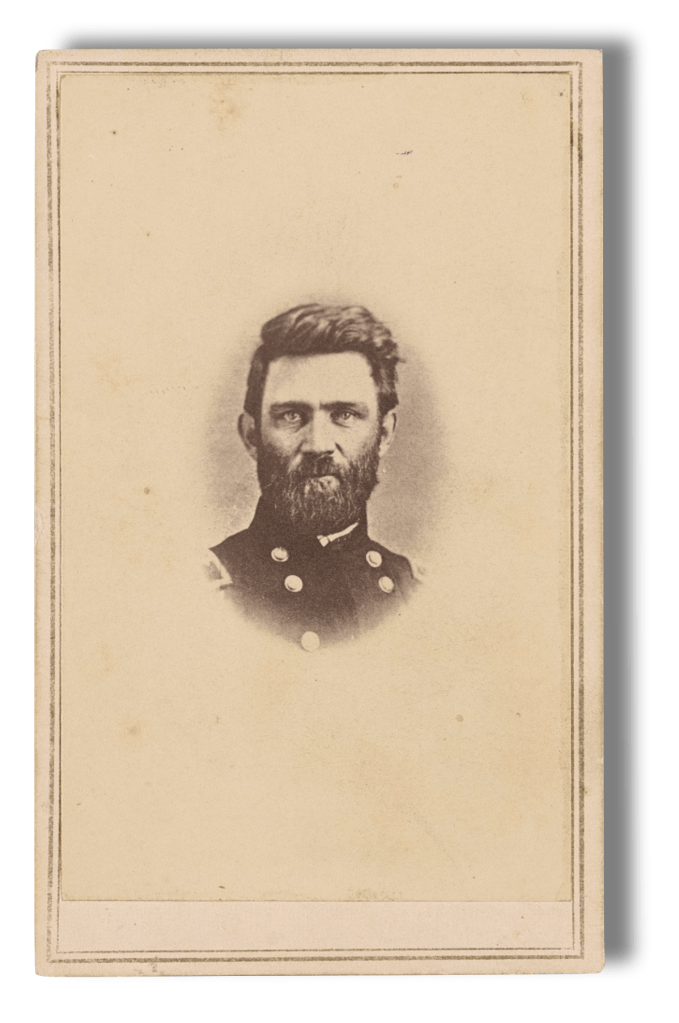
Samuel Allen Rice served as the Colonel of the 33rd Iowa Infantry (Iowa Civil War Images)

AUGUST 1864

August 1st—Still on board. Things pass off well. Arrive at Lewisburg late in evening.
2nd—Leave Lewisburg for Little Rock. Arrive at Little Rock three p.m. Find the boys in camp all lively when I return.
3rd—Nothing new going on here at this time.
4th—All quiet. I help haul one load of wood today.
5th—Go on picket today. Have a very nice time until night—then I suffer much from the mosquitos. Nothing unusual transpires while on duty.
6th—Come off picket this morning. Weather pleasant. Return to camp and wash and comb my head. Then lie down and take a nice sleep for a couple of hours.
7th—All quiet in camp today. Weather pleasant.
8th—Nothing new going on today.
9th—Today it has rained very hard. All quiet.
10th—Nothing new. Weather pleasant.
11th—Today it is raining. All quiet here. This day one year ago, we left Helena, Arkansas, for Little Rock. We arrived at Little Rock on the 10th of September.
12th—Weather cloudy and some rain falling. All quiet here at the present time.
13th—All quiet today. Some rain today. The mail arrived today from the North. At the time I am writing it is just half past eleven at night. All quiet and still at this time.
14th—All quiet here.
August 15, 1864—Today we received pay to the amount of $84 dollars.
16th—All quiet here. Weather cloudy.

17th—On fatigue today on Fort Steele. Things all quiet here at this time. It looks very much like rain to night.
18th—Rains nearly all day.
19th—Weather cool and plenty of rain. We received mail today.
20th—On picket today. All quiet where we are at this time.
21st—Sunday. All quiet in camp. Today we buried Robert Hicks of our company. He died in the night of the 20th of fever.
22nd—All quiet today.
23rd—On picket today.
24th—All quiet today.
25th—Weather very warm today.
26th—All quiet here today.
27th—On picket today on the Pine Bluff Road one mile and a ½ south of town.
28th—Sunday. Weather cloudy. Some rain today.
29th—Weather pleasant and clear today. All quiet here.
30th—On camp guard today. On second relief. It has rained all the forenoon nearly. All quiet here yet.
31st—Today was mustered for pay for the months of August and July.

Michael J. Clarahan was 23 years old when he enlisted in Co. B, 33rd Iowa Infantry (Iowa Civil War Images)

SEPTEMBER 1864

September 1st—Today it has been very warm.
2nd—On picket today west of Little Rock—close to State prison.
3rd—Come off picket this morning. Weather very warm here at present.
4th—All quiet today.
September 5, 1864—Last night we lie in the rifle pits all night expecting the rebels would give us a fight next morning but they did not come.
6th—Come to camp today and taken a little rest.
7th—On fatigue today all day. No fight yet.
8th—On picket today west of Little Rock. Things all quiet today.
9th—Come off picket today. Things all quiet in camp.
10th—All quiet today. On fatigue drawing rations for regiment.
11th—Sabbath. On camp guard today.
12th—Come off camp guard this morning. All quiet here at present.
13th—Slightly Sick.
14th—Same as above.
15th—One small pill at 3 pm. Fever accordingly.
16th—All quiet in camp.
17th—On fatigue today.
18th—Sabbath. All quiet today. Weather pleasant.
19th—Weather cool and pleasant. All quiet at camp.
20th—On picket today. All passed off quiet.
21st—Come off picket this morning. All quiet in camp.
22nd—In camp today. Weather cool and pleasant. All quiet around the Rock.
23rd—On camp guard today. All quiet here. Weather warm for September.
24th—Nothing going on in camp today.
25th—All quiet today. At church at 11. Went on fatigue at night at R. R. Depot. Worked till 2 a.m.
26th—In camp all day working on my cabin. All quiet.
September 27, 1864—On picket guard. Showery all day.
28th—Come off picket today. Weather lowery. All quiet in camp.
29th—All quiet in camp. Weather rather cool. Went to town today. Nothing new going on around Little Rock.
30th—Nothing new going on in camp.

OCTOBER 1864

October 1st—On picket today on Benton Road south of Little Rock.
2nd—Sunday morning come off picket. All quiet in camp.
3rd—Weather cool today.  Weather Showery. Things quiet. Northern mail today. One letter from home.
4th—All quiet. One hundred guns fired today in of honor of Sheridan’s Victory. Weather very muddy.
5th—On fatigue today [working] on fort. Weather cool and pleasant.
6th—In camp all day. All quiet. Weather pleasant.
7th—In camp all day. Things all quiet here.
8th—On camp picket today west of Rapley Road.
9th—Come off picket today. All quiet in camp.
10th—Weather pleasant. All quiet today.
11th—Weather pleasant. On fatigue today.
12th—All quiet in camp. Weather is pleasant.
13th—All quiet today.
14th—On camp guard today. Some rain falling in the evening.
15th—All quiet today. Weather pleasant.

16th—Weather pleasant. All quiet around camp.
17th—On camp guard today. Weather pleasant.
18th—Come off camp guard today. Went to town in the forenoon.
19th—Weather pleasant. I went to timber today.
20th—All quiet today. Weather pleasant.
21st—Nothing new going on today. weather pleasant. On fatigue at night unloading cars at depot.
22nd—Brigade drill today from 2 p.m. to 4. Weather cool and pleasant.
23rd—Sabbath. weather pleasant. work on kitchen today. Nothing new going.
24th—On picket guard today. weather pleasant.
25th—Come off picket today. Weather lowery. All quiet in camp.

26th—All quiet in camp today. Battalion drill from 2 p.m. to 4.
27th—All quiet today. Weather rather cool/ Work on cabin today.
28th—All quiet today.
29th—On picket today. Relieved at twelve.
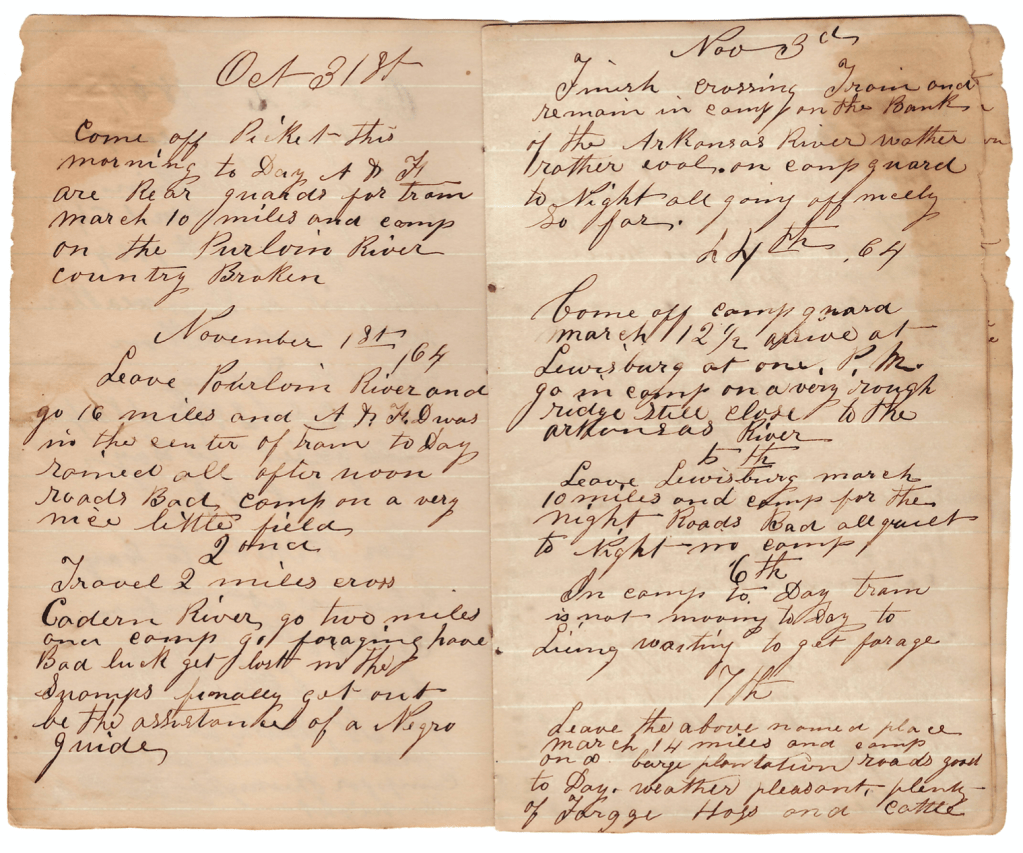
October 30th—Leave Little Rock [with forage train] for Ft. Smith [—a distance of 180 miles—] at one p.m. March 8 miles and camp for the night. On picket tonight.
31st—Came off picket this morning. Today [Companies] A & F are rear guards for train. March 10 miles and camp on the Purloin River. Country broken.

A sample of Mottern’s Handwriting in Diary

NOVEMBER 1864

November 1st 1864—Leave Purloin River and go 16 miles and [companies] A, F & D was in the center of train today. Rained all afternoon. Roads bad. Camp on a very nice little field.
2nd—Travel 2 miles, cross Cadron River. Go two miles and camp. Go foraging. Have bad luck. Get lost in the swamps. Finally get out by the assistance of a Negro guide.
3rd—Finish crossing train and remain in camp on the bank of the Arkansas River. Weather rather cool. On camp guard tonight. All going off nicely so far.
4th—Come off camp guard. March 12.5 [miles]. Arrive at Lewisburg at one p.m. Go in camp on a very rough ridge. Still close to the Arkansas river.
5th—Leave Lewisburg, march 10 miles and camp for the night. Roads bad. All quiet tonight. No camp.
6th—In camp today. train is not moving today. Lying, waiting to get forage.
7th—Leave the above-named place, march 14 miles, and camp on a large plantation. Roads good today. Weather pleasant. Plenty of forage, hogs and cattle.
November 8, 1864—March 11 miles. Fired on today by one bushwhacker but done no damage to us. All going off fine. Camp at one p.m. and hold election. Camp on a nice stream called Illinois Bayou. Pass Rushville today.
9th—Cross Illinois Bayou and march 15 miles and camp on Big Piney. Roads hilly today. All quiet today.
10th—March 18 miles and camp at Clarksville on Spadra Creek. Good roads today. All quiet. Clarksville—county seat of Johnson county. Town mostly burned.
11th—Lie by today to get forage to last through the 18th. Arkansas infantry and 54 U.S. Colored met us here today. Here we see the ranges of the Mulberry Mountains.
12th—March 15 miles. Cross Little Horse Head & Big Horse Head today—both small streams—and pass through Horse Head Gap in the mountains.
13th—March 16 miles. Cross White Oak Creek and camp on or close to the creek. Today we crossed the road from ozark to Huntsville, Arkansas.
14th—March 15 miles and camp. Cross Mulberry Creek today. Have to wade the creek. On guard tonight in train.
15th—March 14 miles. Arrive at Van Buren one p.m. Roads good today. Camped on the Arkansas river.
16th—Nothing new today. Lie in camp all day. Weather cool here.
17th—Leave Van Buren at 10 a.m. and march 14 miles. Cross Little Frog.
[Note: It appears that Mottern and the members of his regiment turned around at this point and began their return to Little Rock. Most likely it was at this location that the train was met by members of Maj. Thomas Derry (3rd Wisconsin Cavalry) who had preceded the supply train with dispatches to Fort Smith and on their return, met the supply train and escorted it safely back to Fort Smith. See Fort Smith Expedition.]
18th—March 16 miles. Cross Big Frog. Mulberry camp on the same ground we did as we we went up. Roads bad.
19th—Camp on same ground as we went up. Road bad today. Camp on Horse Head.
20th—March from Horse Head Gap to Clarksville 16 miles. Cross Spadra [Creek and] camp on old camp. Roads good today. Very cool.
21st—March 16 miles. Cross [Big] Piney. Roads good today. Weather very cool.
22nd—March 18 miles. Cross the Illinois Bayou and march to Pott’s Plantation.
23rd—March 17 miles. Roads good today. Weather pleasant. Camp on a nice stream, name not known to me.
24th—Pass Petit Jean Mountains. March from Pontramos to the Arkansas river. Pass Lewisburg.
25th—March 4 miles. Cross Cadron river. Roads bad today. Camp on same ground we did 3rd night.
26th—March 14 miles. Camp on Pauline Creek. Roads bad and very stoney.
27th—March 18 miles. Arrive at Little Rock at 4 p.m. March to old camp and go into quarters.
28th—All quiet in camp.
29th—On fatigue today. Weather pleasant.
30th—All quiet. No news today.

DECEMBER 1864

December 1, 1864—Nothing new today. All quiet.
2nd—Weather pleasant and warm.
3rd—Same as above.
4th—On picket today south of town. All pass off quietly.
5th—Came off picket today. Weather pleasant today. All quiet in camp.
6th—All quiet today. Weather pleasant. Go to town in afternoon.
7th—High winds today. Rather cool. All quiet in camp.
8th—On picket today. Weather very cool. Today we have four recruits to our company—H. Miner, Spurgeon, Strait, Metcalf.
9th—Came off picket today. Weather cool. All quiet in camp. No news today.
10th—All quiet in camp today. weather cool.
11th—No news today. Very cool.
[Pages missing]
20th—Weather cool today. All quiet in camp.
21st—Weather cool and high wind.
22nd—On fatigue today chopping wood for picket line. weather pleasant.
23rd—Weather pleasant today. Company drill today. All quiet in camp. No news today.
24th—On picket guard south of town on Rapley Road. Weather pleasant.
25th— Come off picket today. Weather pleasant. Some rain today. today I went to town [and] from there to 40th Iowa. Find the boys all right.
26th—In camp today. weather pleasant.
27th—On picket guard today south of town on Wright’s Farm. weather very cool.
28th—Came off picket this morning. weather still cool. all quiet in camp. no news of any importance.
29th—Nothing new going on here.
30th—On fatigue today on the fortification.
31st—Today we have muster for November and December. All quiet in camp. weather pleasant. Nothing new going on worth notice. This finishes ’64.

JANUARY 1865

On camp guard today. Weather pleasant. All quiet in camp.
2nd—Nothing new today. Company drill 2 hours. weather pleasant.
3rd—All quiet today.
4th—Nothing new going on in camp.
5th—On picket guard today. Rains all day.
6th—Come off picket guard today. It snowed considerable—the first that has fallen here this winter.
7th—All quiet in camp today. weather pleasant.
8th—Sabbath morning. Nothing new. In camp all day. Go to Presbyterian Church at night.
9th—On picket today. Rains all day and snows at night. All passed off quietly on guard.
10th—Came off picket today. weather clear and pleasant. Snow melting off swiftly. All quiet in camp.
11th—Weather pleasant. All quiet in camp today. Go to town in afternoon.
12th—weather pleasant and nice. All quiet in camp.
13th—On picket on Rapley Road south of town. Weather pleasant.
14th—Came off picket today. Weather still pleasant and nice.
15th—Inspection today. Attend Catholic Church at 11 a.m. Weather pleasant.
16th—All quiet in camp. Monthly inspection today. Inspected by Capt. Barnes of [General Edward S.] Salomon’s Staff.
17th—All quiet in camp.
18th—All quiet in camp. on fatigue today on fort.
19th—On picket guard today on Ripley Road.
20th—Came off picket guard today. We was reviewed by Major. Gen. Reynolds.

FEBRUARY 1865

February 14th—Leave Little Rock at 5 a.m. Arrived at DuVall’s Bluff at one p.m. Embark on steamer Paragon at 5 p.m.
15th—Arrive at mouth of white River at 2 p.m. Now lying in camp. weather pleasant.
16th—Embark on steamer [ ] at [ ] a.m. weather pleasant.
17th—Weather pleasant and warm. We are some 40 miles above Vicksburg. Arrive at Vicksburg at one p.m. Leave at 6 p.m.
18th—Travel all night. Arrive at Natchez at daylight. Stay there but a short time.
19th—Arrive at New Orleans at 2 p.m. Cross the river to Algiers on the opposite side from New Orleans.
20th—Still in camp. All passing quietly today. Have regimental inspection.
21st—Still at Algiers. all passing off quietly. The troops are passing down the river all day.
22nd—Very showery all day today. we sent our regiment teams around today. Today I paid a visit to the [ ].
23rd—Leave Orleans for Lakeport. Arrive there at 8 p.m. Go off the cars and go into an old house for the night.
24th—Move to another house and camp.
26th—Leave Lakeport for Dauphin Island on steamer Zephyr.
27th—Arrive at Ft. Gaines on Dauphin Island. Then we move to Navy Cove 4 miles.
28th—On detail today hunting wood. Mustered for pay today. Dauphin Island 140 miles from Lakeport.
In camp on the beach of the Gulf of Mexico in Alabama at Mobile Point.

MARCH 1865

March 1st 1865—Still in camp on Mobile Point. All quiet here.
2nd—Weather pleasant and nice. No news today of any importance.
3rd—All quiet today. William Brown and I went down on the bay and caught a fine mess of oysters.
4th thru 7th [No entries]
8th—Today our division was reviewed by Maj. General Osterhaus.
9th—On the 9th, the forts around Blakely fell into our hands.

11th—Leave Blakely on the night of the 11th and march to landing on the bay. Embark in boats on 12th and cross the bay and take possession of Mobile.
13th—Leave Mobile and march out on Mobile and Ohio Railroad some 5 miles to Whistler Station. We have a small skirmish with the enemy.
14th—Rained all day. Nothing new going on in camp today.

15th—On packet St. Stephens Road. All quiet for today. We are 11.5 miles from Whistler Station, Alabama, on Mobile & Ohio Railroad.
17th—Leave Mobile Point today. March 9 miles and camp. Advance guards today.
18th—March all day. Rear guards today. Some bad roads today.
19th—Marched all day. Roads very bad. Only move 6 miles. On picket at night.
20th thru 24th [No entries]
25th—Leave Fish River and march 5 miles. 16th Corps in advance. Roads good. All quiet today.
27th—Commence bombardment on Spanish Fort on the 27th.
28th—Still being in our works around the line.
31st—Commence at 8 a.m. with all the artillery on the rebel works. weather very pleasant here at this time.

APRIL 1865

April 1st—On skirmish line today. No one in the company hurt. we was very close to a rebel fort.
April 4th—Today things are quiet with the exception of the artillery firing that is kept up pretty lively.
April 8th—This evening our artillery opened all round the lines on the enemy.

April 23rd—Read the news today of the murder of Abraham Lincoln.
April 25, 1865—Today 5 companies of our regiment embarked on the gunboat and went up the Tombigbee River
.

1846: Lyman Redfield to Pardon Redfield

This incredible letter was written by Lyman Redfield (1821-1847), the son of Pardon Stevens Redfield (1779-1856) and Achsah Evans (1787-1862) of Bainbridge, Chenango county, New York. Lyman was a lawyer by profession and was 24 years old in April 1846 when the hostilities broke out on the US border with Mexico in a dispute over disputed territory. Lyman joined Co. H as a private in the 1st Kentucky Cavalry that served as Gen. Wool’s body guard in the war. He died at Metamoras on 16 January 1847, most likely from disease.

“The 1st Kentucky Mounted Volunteers traveled by steamboat from Louisville to Memphis, Tennessee, and then cross-country to San Antonio, Texas. Like many units, the regiment suffered various illnesses on its journey to the seat of war. Although the Kentuckians missed out on many of the early battles, they fought in what was probably the most dramatic battle of the war, Buena Vista. 

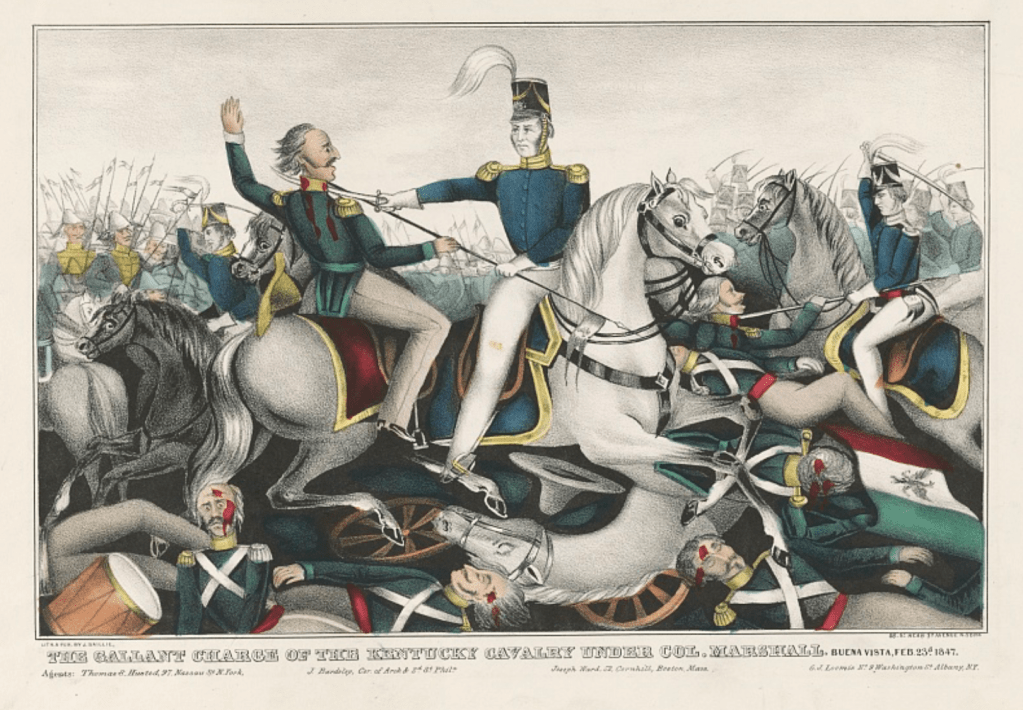
“During the second day of the Battle of Buena Vista, Mexican Gen. Santa Anna attacked, forcing U.S. troops to fall back in disorder. During the Mexican offensive, the 1st Kentucky Mounted Volunteers – fighting on foot – became isolated and was forced to retreat. During the withdrawal, John’s uncle, Alexander Morgan, was killed. The Kentuckians regrouped, mounted their horses, and charged the attacking Mexican force, and, with the support of infantry, drove the enemy back. During the battle the 1st Kentucky Mounted lost 27 dead and 34 wounded. Gen. Zachary Taylor extolled the regiment, noting that “The Kentucky Cavalry, under Colonel Marshall, rendered good service dismounted, acting as light troops on our left, and afterwards, with a portion of the Arkansas Regiment, in meeting and dispersing the column of cavalry at Buena Vista.”

“The 1st Kentucky Mounted Volunteers would not see combat again in the Mexican American War. Their year-long enlistment ended and they were mustered out in New Orleans in June 1847.” [John Hunt Morgan, by Tim Talbott]

In this letter to his older brother Pardon Redfield (b. 1816), a tinner by trade, Lyman shares his impressions of Little Rock, Arkansas, while enroute to San Antonio, Texas. “Horse thieves, robbers, gamblers, and loafers of every description form the majority of the inhabitants,” he believed.

The 1st Kentucky Cavalry in the Battle of Buena Vista, 23 February 1847

Transcription

Little Rock, Pulaski county [Arkansas]
July 28, 1846

Dear Brother,

While the sun is shining with a heat which you in New York can scarcely form an idea, I will try to give you a glimpse of myself and things around me. We are now encamped on an eminence back of the town 1 of Little Rock, Capitol of Arkansas, and 150 miles from Memphis where I wrote to you about two weeks ago. Our march from that place to this has been extremely slow. The country intervening is swampy, abounding in bear of the largest size, at least I should think so if their track, which were seen in great numbers on each side of the road, could at all indicate the size of the animal. We saw several hogs that bore evident marks of having narrowly escaped bruins pork barrel and the inhabitants complained that his bearship was making such havoc among their swine as to deprive them of pork.

The rattlesnake, cotton mouth, copperhead, viper, and others—the names of which I cannot remember—infest the country and render high topped boots quite convenient to the pedestrian.

Little Rock is a mean place for the capitol of a state. As I approached the town, I was astonished at the wildness of the country. Indeed, the wild beast howls up to the very steps of the State House. Business, education, and morals are in a low state. The villain holds up his head unabashed and lust and debauchery holds their revels unawed by law or publick opinion. The grog shop with its never failing attendants is found on every corner. Horse thieves, robbers, gamblers, and loafers of every description form the majority of the inhabitants.

“Little Rock is a mean place for the capitol of a state. As I approached the town, I was astonished at the wildness of the country. Indeed, the wild beast howls up to the very steps of the State House.”

—Lyman Redfield, 1st Kentucky Cavalry, 28 July 1846

We are now on the border of a wild country. Our march to San Antonio will occupy I suppose about six weeks. I shall not be able to write you another letter until we reach San Antonio. If you will write to San Antonio, I shall probably receive the letter on my arrival there.

I am in excellent health and my little war steed in good condition for fighting or traveling. Give my respects to all my friends. Tell Father and Mother that I am getting quite fat and rosy cheeked and that when I return next spring to see them, I suppose they will not know me. The southern climate agrees with my constitution.

With fraternal regards, I remain your brother, — L. Redfield


1 Most likely the troops were encamped on the ridge south of Little Rock where the Federal government had recently completed the construction of the Little Rock arsenal. The arsenal was constructed at the request of Governor James S. Conway in response to the perceived dangers of frontier life and fears of the many Native Americans who were passing through the state on their way to the newly established Indian Territory.