The identity of this soldier has not yet been revealed by an on-line search of records. The content suggests that he served in a Union regiment and was detailed to oversee the operations of a cane and cotton plantation known as the “Collin’s Plantation” early in 1864. He makes reference to a nearby bayou and since this is a term used most widely in the Gulf states, I’m going to presume that he was likely in Louisiana or Mississippi. He indicates that he belonged to Co. I, 12th Regt. USA but that has not enabled me to identify him. His signature looks like “Buber” or “Barber.”
We learn that even though many of his regiment are accepting bonuses and reenlisted for another three years, he has chosen not to do so.
T R A N S C R I P T I O N
Collins Plantation 13th Regt. Co. I, February 14th 1864
Dear Brother Herbert
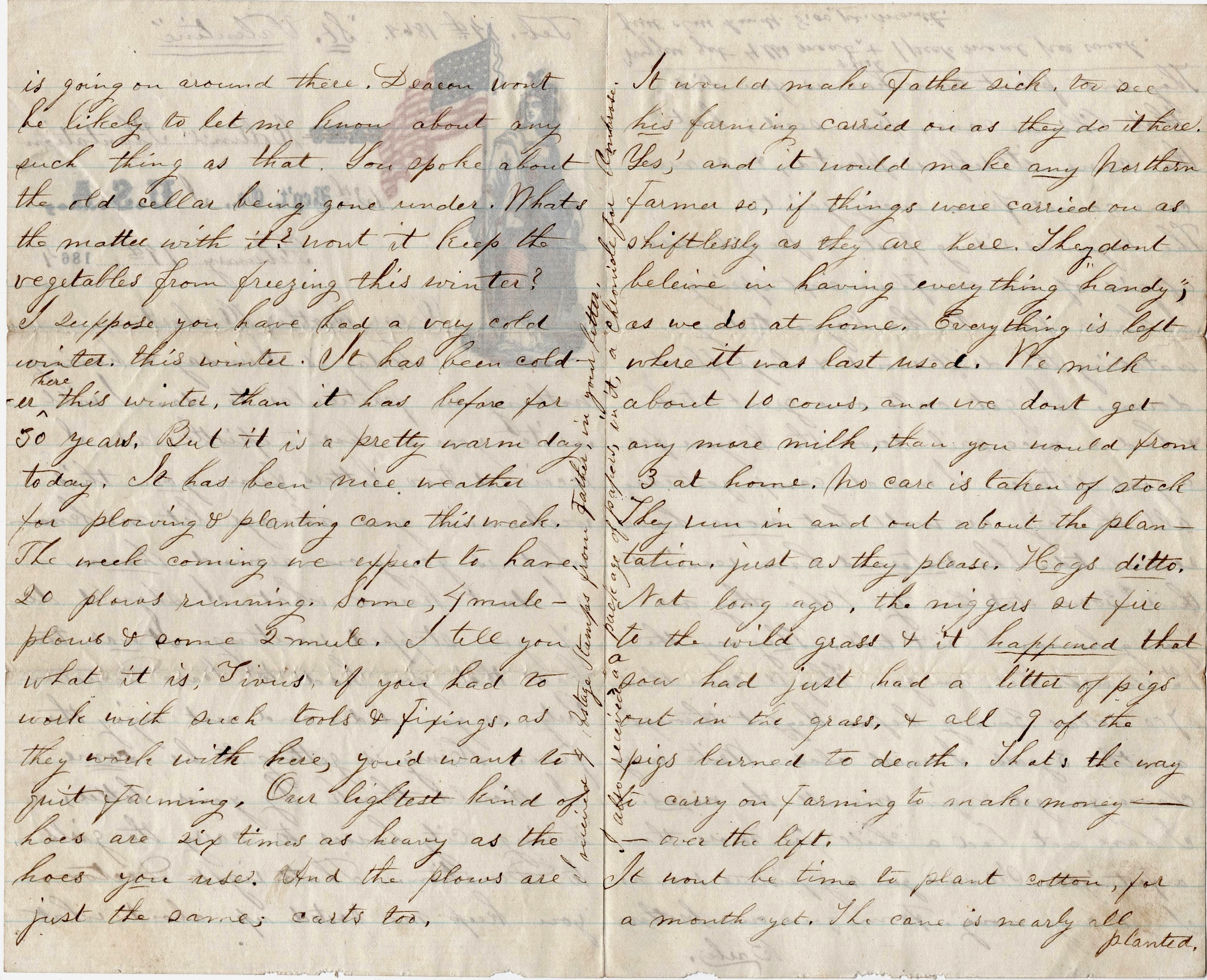
Today is Sunday & having nothing in particular to do, I will write you a short epistle as I received two letters from you this week and you always let me know what is going on around home. I don’t know what I should do if you stopped writing. It was too bad that you had to leave the Donation Party as you did and not enjoy the fun. Henry is getting to be some, I should think by your letter. hiring city horses to carry the girls to Donation. That’s right, Doctor, you keep me posted up about what is going on around there. Deacon won’t be likely to let me know about any such thing as that.
You spoke about the old cellar being gone under. What’s the matter with it? Won’t it keep the vegetables from freezing this winter? It has been colder here this winter than it has before for 50 years. But it is a pretty warm day today. It has been nice weather for plowing & planting cane this week. The week coming we expect to have 20 plows running. Some 4-mule plows and some 2-mule. I tell you what it is, Tivus, if you had to work with such tools and fixings as they work with here, you’d want to quit farming. Our lightest kind of hoes are six times as heavy as the hoes you use. And the plows are just the same; carts too. It would make Father sick to see his farming carried on as they do it here. Yes, and it would make any Northern farmer so, if things were carried on as shiftlessly as they are here. They don’t believe in having everything “handy” as we do at home. Everything is left where it was last used.
We milk about 10 cows and we don’t get any more milk than you would from three at home. No care is taken of stock. They run in and out about the plantation just as they please. Hogs ditto. Not long ago, the niggers set fire to the wild grass and it happened that a sow had just had a litter of pigs out in the grass & all 9 of the pigs burned to death. That’s the way to carry on farming to make money—-over the left.
It won’t be time to plant cotton for a month yet. The cane is nearly all planted. They don’t plant cane here as you did that Chinese cane from seed; but the cane itself is planted and a new cane comes from every joint.
The bayou is rising fast and people are afraid of an overflow next spring. I have been to the bayou today watching the drift wood & logs float down. I got onto one great stick & had a nice sail down the bayou for a good distance.
I was at camp yesterday. All the boys are well but none have reenlisted. The veterans have received their $300 State bounty. When they are going home. I can’t tell. They say the 1st of March. Let ’em go. They’ll earn their 700 dollars bounty before they get through another three years. I must close. Write every chance you get and give me all the news. I have not had a “chill” for more than a fortnight. I’ll send you my picture soon as I get any money. From your own brother, — Buber
Niggers get 4 lbs. meat & fish & 1 peck meal per week. First class hands $8 per month. I received 4 postage stamps from Father in your letter. I aso received a package of papers in it. A Chronicle from Ambrose.
The following letter was written by Silas Thompson Trowbridge (1826-1893) whose family printed his biography in 1872. The book has recently been reprinted and the following biographical sketch of Silas was written by John S. Haller, Jr. and Barbara Mason.
Major Silas T. Trowbridge—“a rough-whiskered, mustached man compelled to a regalia ‘a la militare'”
“Indiana-born Trowbridge moved to Illinois in his early twenties. A teacher by trade, he continued that career while he began the study of medicine, eventually starting a medical practice near New Castle, which he later moved to Decatur. Though respected by the community, Trowbridge lacked an authentic medical degree, so he enrolled in a four-month course of medical lectures at Rush Medical College in Chicago. Autobiography describes the atmosphere of the medical school and delineates Trowbridge’s opinions on the lack of quality control in medical colleges of the day.
Although three years of study and two annual terms of sixteen weeks were the actual requirements for the degree, Trowbridge was allowed to graduate after a single course of lectures and completion of a twenty-page thesis due to his previous experience. He then married a young widow [Emeline Rockwell (1831-1899)] and returned to Decatur, where he began a partnership with two local physicians and inaugurated a county medical society. In addition to practicing medicine, he was known and respected for regulating it, too, having supported legislation that would legalize dissection and prohibit incompetent persons from practicing medicine.
In 1861, Trowbridge began service as a surgeon of the 8th Illinois Volunteer Infantry commanded by Colonel Richard J. Oglesby. Autobiography describes his experiences beginning in Cairo, Illinois, where the infantry was involved in several expeditions and where Trowbridge made his “debut at the operating table.” Revealing a litany of surgical duties, replete with gruesome details, these war-time recollections provide a unique perspective on medical practices of the day. Likewise, his commentaries on political issues and his descriptions of combat serve to correct some of the early written histories of the war’s great battles.
After receiving an honorable discharge in 1864, Trowbridge returned to Decatur to resume his partnership with Dr. W. J. Chenoweth and devote himself to surgery. His reminiscences recount several difficult surgeries, his efforts to reorganize the county medical society (which had collapsed during the war), and his communications to the Illinois legislature to set higher qualifications for practicing physicians. He was later elected president of the Illinois State Medical Society and appointed by President Grant United States Consul to Vera Cruz on the eastern coast of Mexico, where he studied and challenged the treatment of yellow fever. The autobiography ends in 1874 with a six-day family vacation and the marriage of his daughter to a merchant of Vera Cruz.”
Transcription
Lake Providence, Louisiana March 11, 1863
Dear Cousin Emma,
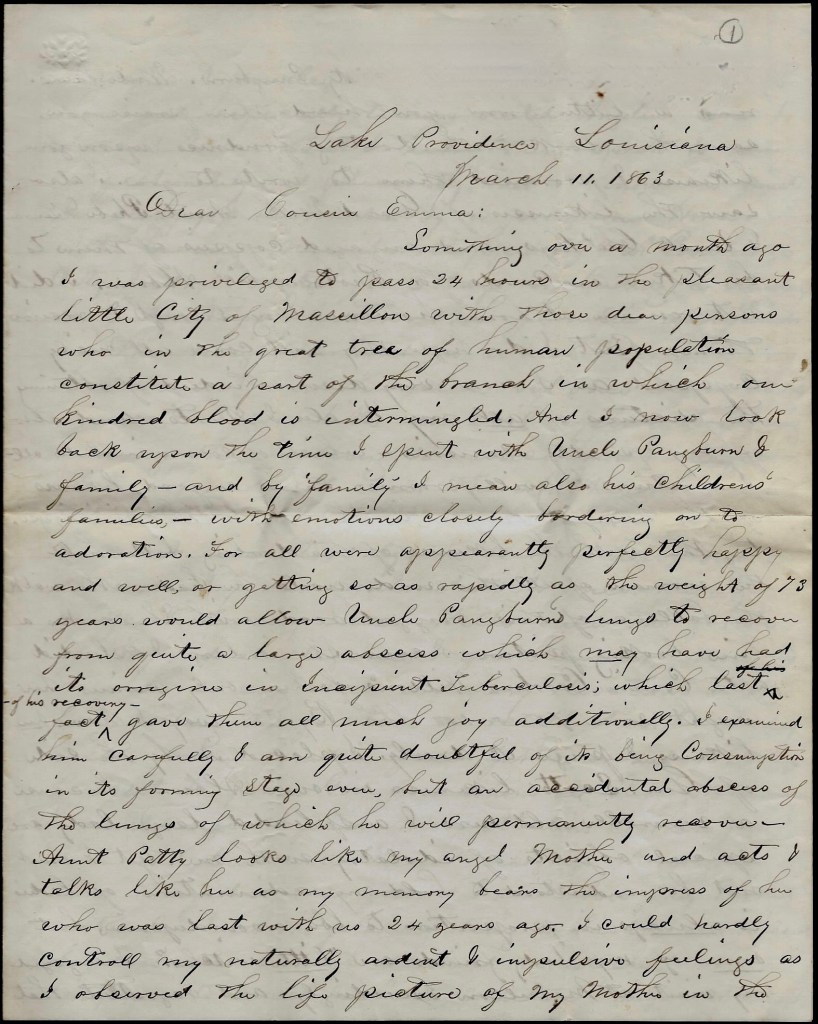
Something over a month ago I was privileged to pass 24 hours in the pleasant city of Massillon [Ohio] with those dear persons who in the great tree of human population constitute a part of the branch in which our kindred blood is intermingled. And I now look back upon the time I spent with Uncle Pangburn & family—and by “family” I mean also his children’s families—with emotions closely bordering on to adoration. For all were apparently perfectly happy and well, or getting so as rapidly as the weight of 73 years would allow Uncle Pangburn’s lungs to recover from quite a large abscess which may have had its origin in incipient tuberculosis; which last fact of his recover gave them all much joy additionally. I examined him carefully & am quite doubtful of its being consumption in its forming stage even, but an accidental abscess of the lungs of which he will permanently recover.
Aunt Patty looks like my angel Mother and acts & talks like her as my memory bears the impress of her who was last with us 24 years ago. I could hardly control my naturally ardent & impulsive feelings as I observed the life picture of my Mother in the person of our dear Aunt Patty Pangburn. While there, I read a letter from you, heard them praise you, saw them look with doting fondness upon your likeness. I promised them to write to you. I also saw the likenesses of Grandmother, Aunts Phebe & Laura & Uncle Charles Keys and engaged copies of them to be taken on cards for photographic album. I did not remain at home, however, long enough to receive them. But I do hope they will come all nicely copies as I am very desirous indeed of obtaining the pictures of all my Uncles and Aunts and also of my pretty cousins, which of course includes all. I return, I will promise them a good likeness of the hairiest Major in the Army of the Mississippi together with the likeness of his darling better half—the woman of all this wide world he had rather walk the balance of this rugged road with. She makes a fine looking picture because she is large & splendid after Cousin Caroline Wilson’s fashion only minus her weight some 75 or 100 pounds. By the way, I have her likeness & prize it dearly. I placed it by the side of Gen. Scott’s likeness in our album because a venerable old hero & a splendid large lady are special objects of idolatry with me. Yet I must not be understood to hold my admiration of ladies is always in proportion to lbs. avoirdupois, but some of my lady friends are “little witches.”
I enjoyed my visit at Massillon exceedingly and regretted that I was not privileged to have remained longer with them and especially to have visit Angeline who I failed to see. But I heard them speak so very affectionately and pleasantly of her that I know she must be happy & surrounded by a prosperous home. After leaving Massillon, stopped off at Cambridge City, Indiana & visited for three days including a Sunday with brothers and sisters, their families and friends in the neighborhood in which I was born. I have not seen this place but once before in 14 years & it was like an evil spirit dropping among them—being so uncommon & unexpected. But I found all well there (at Harrisburg, Indiana, their P. O. Address). That neighborhood looks like it used to, only the people have grown & the country has contracted its once mighty proportions very much. Hills, once the pride of my ideal elegance & grandeur are now to manhood’s eye but ordinary elevations and not filling the picture of recollection. On Sunday I saw many familiar faces gather around the village pulpit to “praise God from whom all blessings flow.” I must confess I paid more attention to those ‘faces’ than the discourse. I could recognize more of them than did me, for as I said above, they looked natural & I in the place of being a bashful smooth-faced boy was now a rough-whiskered, mustached man compelled to a regalia “a la militare” & therefore not known.
John Dermott Trowbridge (1816-1891) served in Co. G, 94th Illinois Infantry
I have one brother and three nephews in the service. Brother John D[emott] Trowbridge is in the 94th Illinois Infantry and now somewhere in Arkansas. William Thomas’s son Hubbard is 1st Lieutenant in a Battery company from Indiana & was at Springfield, Missouri, when last heard from. 1 Lester Ellis’s son, Chester, is 2nd Lieutenant in Co. G, 80th Regt. Illinois Infantry. 2 Robert Oldfield is a brother-in-law to Chester and a private or sergeant, I think, in the same company. William [H.] Pangburn is in the 76th Ohio [Co. I] and that is at or near Vicksburg which is 50 miles below us on an air line and 75 by river. We hear heavy firing of cannon in that direction every day or more particularly at night. I have not seen Mr. Pangburn since we were at the Battle of Pittsburg Landing but once & do not know anything from him save such as I learned while in Massillon. I heard there that he had been injured in some way & would be discharged on Surgeon’s Certificate of Disability.
As I now write, I again hear the heavy roar of cannon at Vicksburg & also learn by an unofficial source yet from headquarters of Gen. McPherson—our Corps Commander—that we will move from here soon; probably tomorrow. I shall regret to leave the soldier luxuries we are here enjoying—viz: a most beautiful place close by the banks of the beautiful Lake Providence. I made the acquaintance of Frank Leslie’s artist today & you may be favored by cuts and descriptions of this part of the world which I presume may come out sometime within a month.
Frank Leslie’s Artist drew the following sketch of McPherson’s Headquarters at Lake Providence, mentioned in the preceding paragraph.
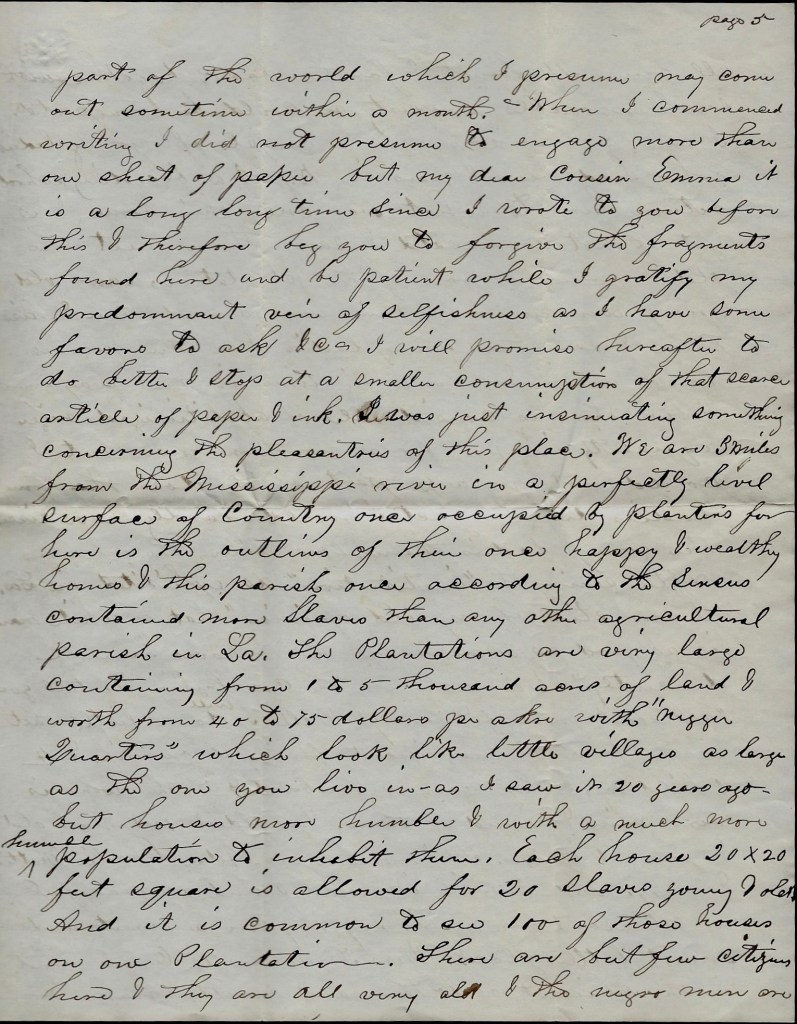
When I commenced writing, I did not presume to engage more than one sheet of paper but my dear cousin Emma, it is a long, long time since I wrote to you before this & therefore beg you to forgive the fragments found here and be patient while I gratify my predominant vein of selfishness as I have some favors to ask, &c. I will promise hereafter to do better & stop at a smaller consumption of that scarce article of paper & ink. I was just insinuating something concerning the pleasantries of this place.
We are 3 miles from the Mississippi river in a perfectly level surface of country once occupied by planters for here is the outlines of their once happy and wealthy homes & this parish once, according to the census, contained more slaves than any other agricultural parish in Louisiana. The plantations are very large containing from 1 to 5 thousand acres of land and worth from 40 to 75 dollars per acre with “nigger quarters” which look like little villages as large as the one you live in as I saw it 20 years ago. But house [are] more humble & with a much more humble population to inhabit them. Each house 20 x 20 feet square is allowed for 20 slaves, young and old. And it is common to see 100 of those houses on one plantation. There are but few citizens here and they are all very old & the negro men are all run off South & farther back together with such movable property as could be transported. I saw, a few days ago, a couple of young ladies who had been 8 years in Kentucky at a boarding school return here to what was once their home and is yet not confiscated & saw them meet the old and young negros of the plantation, saw old greasy wenches throw their arms around them and kiss them & saw the young ladies kiss the negroes back again & have a big time in that way generally.
Now there is considerable of abolitionized nigger equality in me for a northern man but I could not go a one/twentieth part of the dose the young ladies did. In fact, I would hardly have kissed the young ladies themselves after the nigger. After seeing the “institution” as exhibited in Louisiana, I am still of my opinion “that a white man is as good as a negro if he behaves himself decently.”
A post war image of Emma and Silas Trowbridge
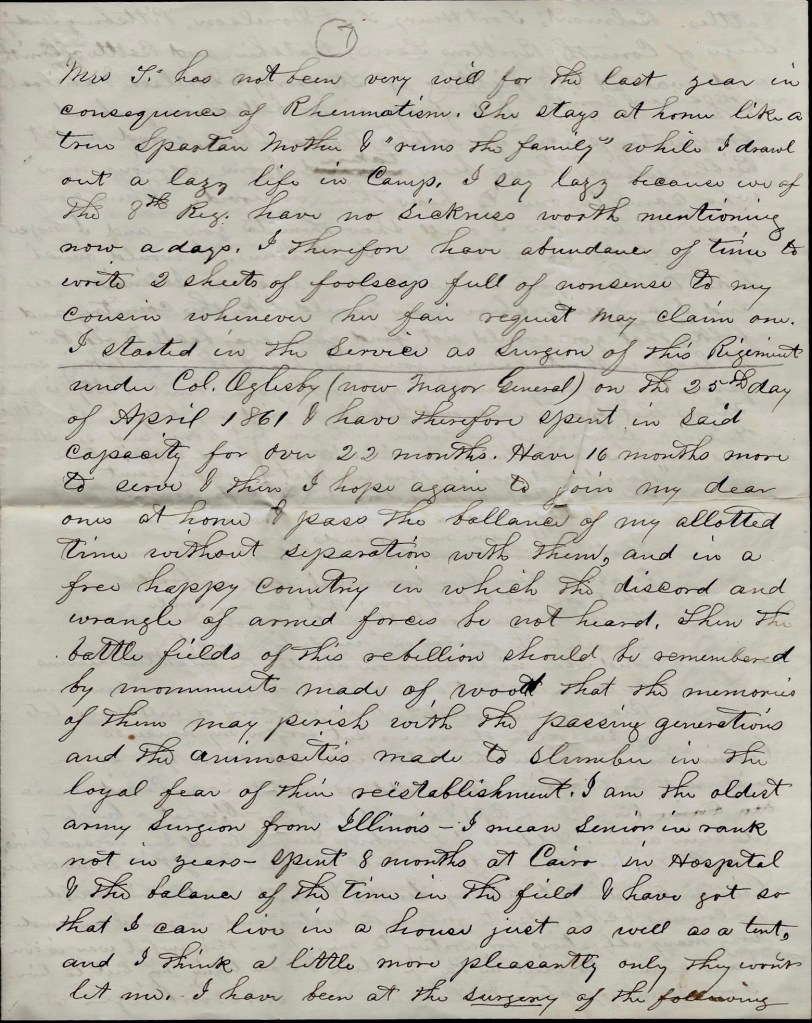
You ask in the conclusion to tell you “all about yourself and family.” Well, I will do a little that way. Have a magnificent family of one wife & four children, & they have a husband & father who is very vain & proud of them. My oldest is 9 years old & youngest is 2 and a half. Their names are Ada, Charlie, Mattie, & Mary. And I wish it would sound as graceful as pleasant for me to say they are a sweet and smart little flock. Mrs. T’s name is Emma and is the chiefest of 10 thousand pretty names. Mrs. T has not been very well for the last year in consequence of rheumatism. She stays at home like a true Spartan Mother & “runs the family” while I drawl out a lazy life in camp. I say lazy because we of the 8th Regiment have no sickness worth mentioning now-a-days. I therefore have abundance of time to write two sheets of foolscap full of nonsense to my cousin whenever her fair request may claim one.
I started in the service as Surgeon of this Regiment under Col. Oglesby (now Major General) on the 25th day of April 1861 & have therefore spent in said capacity for over 22 months. Have 16 months more to serve & then I hope again to join my dear ones at home & pass the balance of my allotted time without separation with them, and in a free, happy country in which the discord and wrangle of armed forces be not heard. Then the battlefields of this rebellion should be remembered by monuments made of wood that the memories of them may perish with the passing generations and the animosities made to slumber in the loyal fear of their reestablishment.
“….the battlefields of this rebellion should be remembered by monuments made of wood that the memories of them may perish with the passing generations and the animosities made to slumber in the loyal fear of their reestablishment.”
— S. T. Trowbridge, 11 March 1863
I am the oldest army surgeon from Illinois—I mean senior in rank, not in years—spent 8 months at Cairo in hospital & the balance of the time in the field & have got so that I can live in a house just as well as a tent, and I think a little more pleasantly only they won’t let me. I have been at the surgery of the following battles—Belmont, Fort Henry, Fort Donelson, Pittsburg Landing, Siege of Corinth, Britton’s Lane, Hatchie, and Battle of Corinth, and was at the fighting of Forts Henry & Donelson, & Shiloh, and the Siege of Corinth. I have a rare lot of specimen balls, knives, gunbarrel fragments, pieces of watches, coins, shell, wood, pocket bibles which have been taken from various men who came to me to have them removed.
When you come to see me, I will show them to you, and I hope you will do so as soon as I get home. I would much like to have you come as far West as Illinois once and I am quite sure you would like the country and folks so well that you would not “find your way back to Old Pennsylvania”—at least without leaving your own heart there or taking some promising young Suckers off with you. Aunt Patty is quite sure that you will not be able to find anybody in Pennsylvania fitted to “walk life’s rugged path” alone with you but come and see Illinois and some Sucker Claude again will say from inspiration—
“Nay, dearest, nay, if thou wouldst have me paint The home to which, if love fulfilled its prayers, This hand would lead thee, listen, We’ll have no friends That are not lovers; no ambition, save To excel them all in love; we’ll read no books That are not tales of love; that we may smile To think how poorly eloquent of words Translate the poetry of hearts, like ours! And when night come on amidst the breathless heavens We’ll guess what star shall be our home when love Becomes immortal. 3
Now we have, or will have, lots of such after the war. But forgive my nonsense.
Cousin Emma, I hope this letter will not scare you so you will not write again. Please address me at Lake Providence, La. (to follow the regiment) & should I not be—O! what a bungle. Let’s begin again. Address, S. T. Trowbridge, Surgeon, 8th Regt. Illinois Infantry, Logan’s Division, Lake Providence, La. (to follow the regiment) & I will be sure to get it somewhere. Give my compliments to all my uncles and aunts and their children., my cousins, &c. &c. Also to your brother, the doctor. And to you I am under very many obligations for writing to me. When this awful war is over, I am coming to visit in Pennsylvania if I live & I am trying my best to live.
From your affectionate cousin, — S. T. Trowbridge
1 Hubbard Trowbridge Thomas was a Second Lieutenant of the 3rd Battery Light Artillery (1861-1863) and Captain of the 26th Battery Light Artillery (1863-1865).
2 Chester Ellis was actually a sergeant in Co. H, 80th Illinois Infantry. He was killed at Lovejoy Station on 2 September 1864.
3 This poem seems to be a hodge podge of various poems; the first two lines are from the Claude Melnotte’s “Description of the Lake of Como.”
An early-war CDV of Surgeon TrowbridgeMajor S. T. Trowbridge Grave in Tulocay Cemetery, Napa, California









 Spared & Shared 23