Category Archives: Maryland Homefront

1864: Wealthy Ann (Winchester) Anthony to Emily (Seevey) Youngs

The following letter was written by Wealthy Ann (Winchester) Anthony (1819-1886), the wife of Pvt. Francis Preceptor Anthony (1809-1884) of Co. L, 8th New York Heavy Artillery. 53 year-old Preceptor was working as a carpenter in Attica, Wyoming county, New York at the time of the 1860 US Census. The family must have relocated to Baltimore early in the Civil War, however, as Emily datelined her letter from Baltimore and the couple were enumerated there in subsequent census records. Preceptor began his service in Co. A, 105th New York Infantry but was discharged in February 1863 for disability. The 8th New York Heavy Artillery manned the Baltimore defenses; companies L & M joining the regiment in February 1864. In May 1864, the regiment was ordered to join the Army of the Potomac in the Overland Campaign and my hunch is that many members of the company left clothing and other unnecessary articles at the Anthony residence in Baltimore for safekeeping before going to the front.

The letter was directed to Emily (Seevey) Youngs (1823-1883), the wife of Isaac Youngs (1817-1904), of Le Roy, Genesee county, New York. Emily’s oldest child, Charles J. Youngs (1844-1864) enlisted on 4 January 1864 as a private in Co. L, 8th New York Heavy Artillery, but became ill in before Petersburg and was sent to a Washington hospital where he died on 3 August 1864.

Transcription
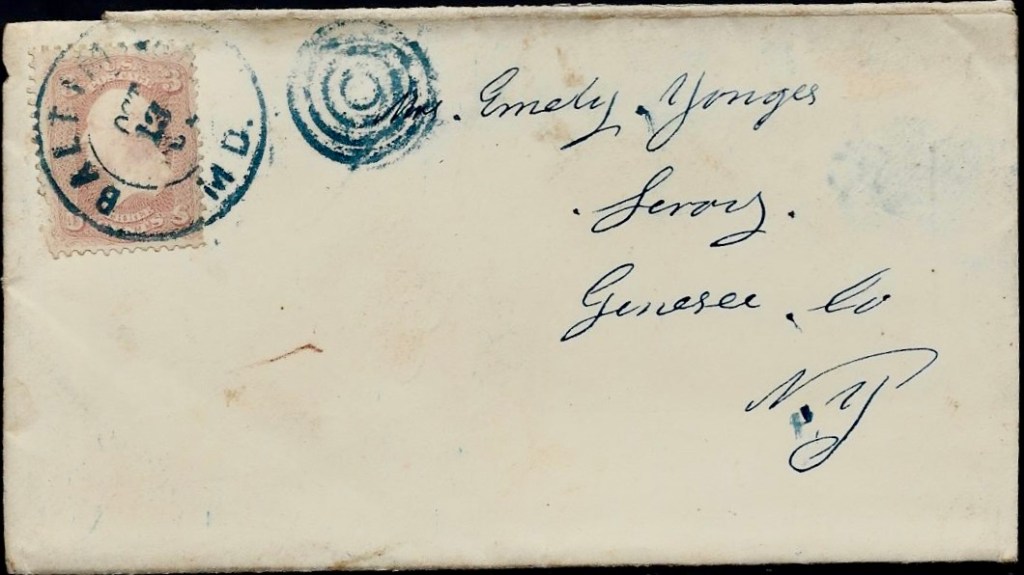
Addressed to Emily Yonges, Leroy, Genesee County, New York

Baltimore, Maryland
October 12, 1864

Dear Friend.

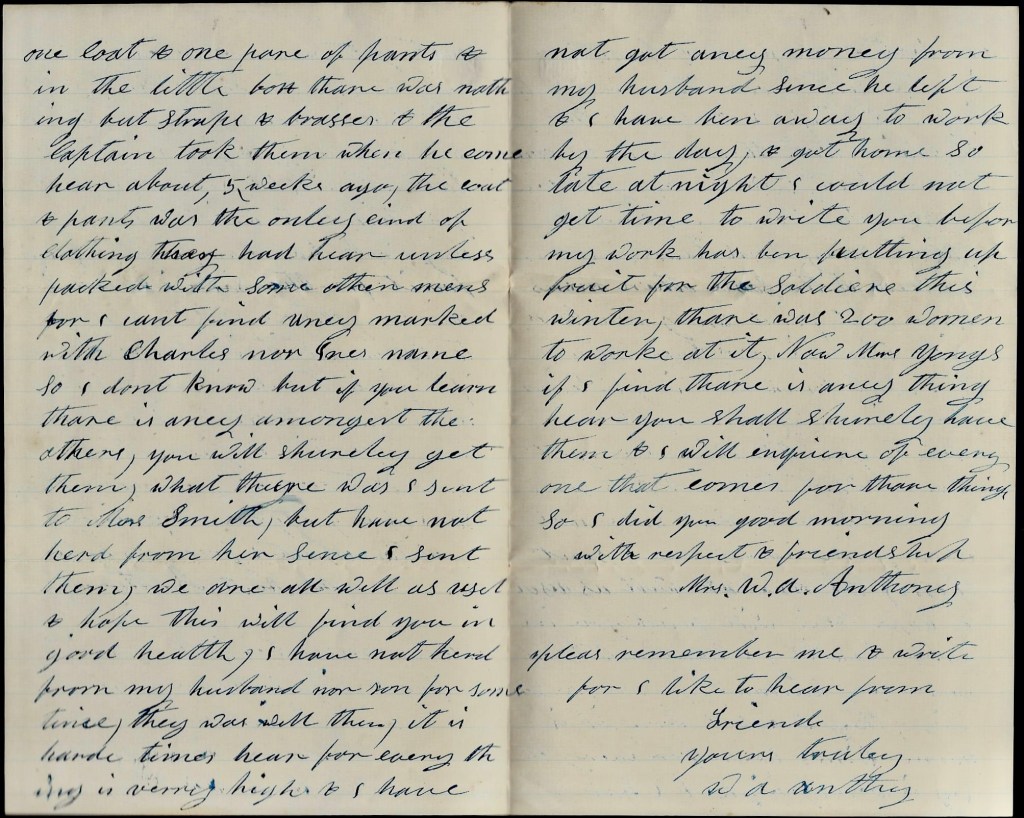
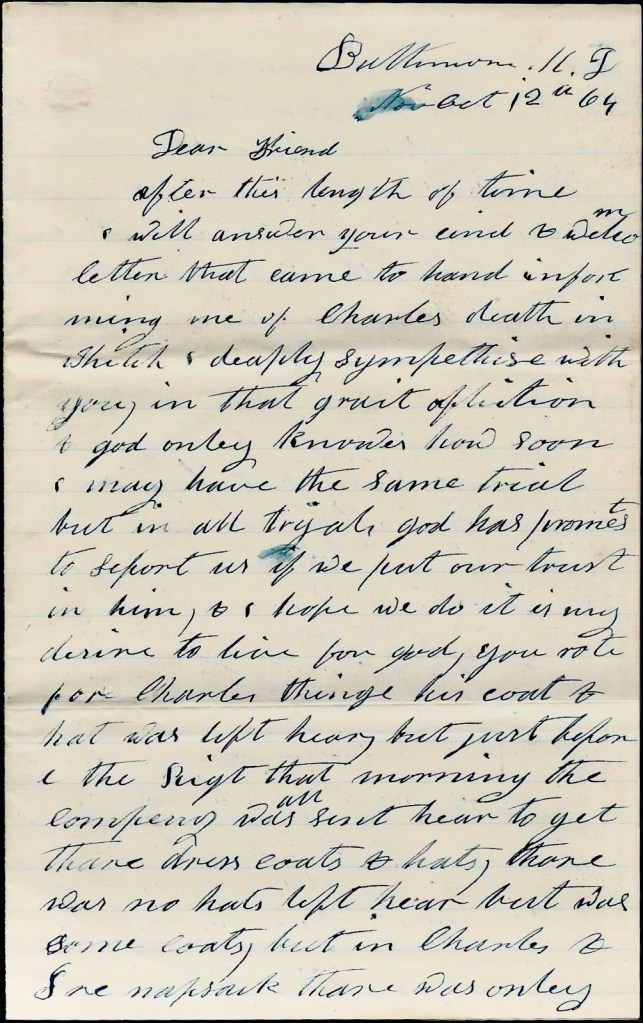
After this length of time, I will answer yours and Deliom’s letter that came to hand informing me of Charles’ death in which I deeply sympathize with you in that great affliction. God only knows how soon I may have the same trials. God has promised to support us if we put our trust in Him & I hope we do. It is my desire to live for God.

You wrote for Charles’ things—his coat that was left here, but just before the regiment [left] that morning, the company was sent here to get their dress coats & hats. There was no hats left here but was some coats. But in Charles’ knapsack there was only one coat and one pair of pants. And in the little box there was nothing but straps and brasses and the Captain took them when he come here about 5 weeks ago. The coat & pants was the only kind of clothing they had here unless packed with some other mens for I can’t find any marked with Charles’ nor other name so I don’t know. But if you learn there is any amongst the others, you will surely get them. What there was I sent to Mrs. Smith but have not heard from her since I sent them.

We are all well as usual & hope this will find you in good health. I have not heard from my husband nor son for some time. They was well then. It is hard times here for everything is very high & I have not got any money from my husband since he left. I have been away to work by the day & got home so late at night I could not get time to write you before. My work has been putting up fruit for the soldiers this winter. There was 200 women to work at it. Now, Mrs. Youngs, if I find there is anything here, you shall surely have them & I will enquire of everyone that comes for their things. So I bid you good morning with respect & friendship, — Mrs. W. A. Anthony

Please remember me & write for I like to hear from friends. yours truly, — W. A. Anthony
1861: Tabitha Duvall to John Goring

How Tabitha might have looked in 1861

I believe this letter was written by 22 year-old Tabitha Duvall (1838-1920), the daughter of slaveholders Tobias H. Duvall (1806-1856) and Rebecca C. Onions (1808-1875) of Collington, Prince George’s County, Maryland. Tabitha’s younger brother, Tobias Duvall (1841-1915) enlisted in Co. C, 2nd Battalion Maryland Infantry and fought for the Confederacy during the Civil War.

Tabitha wrote the letter to her “dear friend” John Goring (1839-who served early in the war as a private in the Co. A of the 1st Michigan Infantry for three months and then reenlisted as the Sergeant Major of Co. D (later a 2nd Lieutenant in Co. A) in the 1st Michigan Infantry (three year) regiment. During the Battle of Gaine’s Mill on 27 June 1862, Goring was wounded and taken prisoner. He was exchanged in August 1862 for Lewis S. Chitwood of the 5th Alabama Infantry, and was soon after transferred to the Veteran Reserve Corps (VRC), 2nd Regiment, City of Detroit.

Goring was born in England and came to the United States sometime after the death of his father in 1854. He did not marry until July 1865 when he took Mary Elizabeth Reiger (1845-1906) as his wife, and worked as a life insurance agent in Detroit.

Transcription

Addressed to Sergeant Major Goring, 1st Regiment Michigan Infantry, Camp at Annapolis, Md.

Collington
December 13 [1861]

Dear Friend,

Your very welcome letter has been duly received and I assure you it was perused with great pleasure. I had almost come to the conclusion that you had been ordered from good Old Maryland to the fiery land of South Carolina but am pleased to learn that you are not in such danger as you would there be exposed to as they have the black flag floating. I should think the Federals would not receive much mercy at their hands.

I have read a few extracts from the President’s Message and like them very much. I see a part of the Cabinet & Congress are trying for emancipating & arming the slaves. What do you think of it? As far as I am able to judge, they will not do their country any good by it. Enough of politics for I abominate them although I cannot help speaking on the subject sometimes. 1

I received a letter from Lizzie Duvall last week. She was very well & says they have had two regiments stationed on their farm since yours left but only remained a few days, burning all their fencing. Poor Uncle Duvall has had some heavy losses in his time & they seem to follow him up but I do not blame the soldiers. I expect I would do the same were I in their places encamped out & could not get fuel.

“The Soldier’s Return” (1848) song sheet dates to end of the Mexican War

I passed by the junction about two weeks ago on my way to Baltimore. I did not see anyone I knew except the Chaplain & Mrs. Wise. She went up to Baltimore on the same train I did. I kept a strict look out for a glimpse of you but looked in vain. Have you any relatives in Louisiana by the name of Goring. I am acquainted with a very elegant family there by that name. One of their daughters married Hon. Charles L. Scott who was a congressman from California & is now a private in the Rebel army. 2 I am not acquainted with any Duvalls at the Junction nor did not know any were living there but there are so many Duvalls in Prince George’s County that I think if you were to call every other person you meet here Duvall, you would not make a mistake.

We are having some charming weather now and I hope it will continue warm for the poor soldiers’ sake for I know they will suffer this winter. I am practicing a piece of music called the “Soldier’s Return” on the piano & I hope soon to have the pleasure of playing it for my friends who have gone to the war. I must now come to a close. Accept the best wishes from your sincere friend, — T. Duvall


1 The “war powers of the National government” to emancipate slaves were openly discussed in Northern newspapers as early as September 1861 but most editors cautioned against it for either one of two reasons (sometimes both) which were: doing so would only convince Southern states that it was Lincoln’s intent (as they claimed) to emancipate the slaves from the very outset of his administration. The second reason was probably the most widely adopted, which was to query the American public, “What is to become of the slaves supposing they are freed? Would it promote the welfare of the now struggling border States, if they were filled with roving bands of ignorant, untrained, partially irresponsible blacks? Who is to feed and clothe them, and educate their sluggish powers, and employ their reluctant services, and fit them gradually for self-dependence?” Arming the slaves did not become a topic for newspaper columns until a few months later when the “quarrel” between President Lincoln and Secretary of War Simeon Cameron was leaked to the media—Cameron taking the position that the former slaves ought to be armed and used against the Confederates.

2 Charles Lewis Scott (1827-1899) was born in Richmond, Virginia. He went to California in the gold rush of 1849 and the entered a law office in Sonoma. He served in the State Legislature in the mid 1850s and then was elected to the 35th US Congress, serving until 1861. When the American Civil War began, he resigned his seat in Congress and joined the Fourth Regiment, Alabama Volunteer Infantry, of the Confederate Army, serving as major. He never returned to California. In 1861 he suffered a serious leg wound at the First Battle of Bull Run. The severity of his leg pain caused him to resign his commission in 1862, after the Battle of Seven Pines. Charles was married to Anne Vivian Gorin (1836-1862) in Mobile, Alabama, in 1857. Anne Gorin (not Goring) never lived in Louisiana as far as I can learn. She seems to have grown up in Mobile, Alabama.

1862: Archer Hays Jarrett to John E. Wool

This letter was written by Archer Hays Jarrett (1825-1869) of Bel Air Harford county, Maryland. He was married to Martha Frances Shepherd (1833-1915) of Norfolk, Virginia. In the 1860 US Census, Archer was enumerated as the head of a household that he shared with his 73 year-old mother in Bel Air with two black servants. He was married to Martha on 11 February 1861 in Norfolk.

An article appearing in the Baltimore Sun (July 8, 2006) describing “Harford History” claims that in mid July 1861, “300 Union troops from the 12th Pennsylvania marched from White Hall to Bel Air to arrest certain secessionist sympathizers and seize the weapons of local militia units. The soldiers announced that they were in Bel Air at the request of Unionists who feared violence from secessionists. Capt. Archer H. Jarrett, leader of the Harford Light Dragoons, was arrested [on a charge of treason]. Having failed to elicit from Jarrett the location of the militia weapons, the troops searched several public buildings and then private homes, to no avail. In the evening, the troops departed empty-handed of the weapons. But they took Jarrett, who was detained until Sept. 22 because of his refusal to take an oath of loyalty to the federal government.”

It should be noted that this region of Maryland was filled with southern sympathizers. Junius Booth, older brother of John Wilkes Booth, built his home just north of Bel Air in 1847. In the days leading up to the outbreak of hostilities in 1861, local militias were formed primarily for the purpose of patrolling the region to prevent the runaway of slaves which was anticipated. In the election of Jarrett to the Captain’s position of the Harford Light Dragoons, Bel Air felt they had secured “a fearless and independent gentleman and Southerner.” Those joining the dragoons pledged themselves “ready to take the field in the defense of Southern rights and the honor of old Maryland.”

According to the Baltimore Sun (July 9, 1869), Jarrett died a tragic death. It was claimed to have been the result of an accident, but sounds questionable to me. “Intelligence reached this city yesterday, by telegraph from Cumberland, that Mr. Archer Jarrett, of Harford county, accidentally fell from an upper window of the City Hotel, in Cumberland, Maryland, on Wednesday night, and was instantly killed. The deceased was a lawyer by profession, and was at one time State’s attorney for Harford county. He was a relative of A. Lingan Jarrett, Esq., and also of Lefevre Jarrett, Esq., president of the police board. The remains are expected to reach this city today on their way to Bel Air, where the interment will take place.”

This letter is a request by Jarrett to Maj. Gen. Wool for permission to allow his wife to pass over from Fortress Monroe to Norfolk, Virginia, where his wife’s widowed mother and presumably other relatives were living. Norfolk was evacuated by the Rebels on 10 May 1862—just two weeks before this request. Prior to that date, it had been in possession of the Rebels who seized Fort Norfolk and the ordnance stored there in April 1861.

[This letter was transcribed by Annaliese Vonheerigen/edited by Griff]

Transcription

May 22d 1862

Major General John E. Wool, USA
Dear Sir,

I have just received permission from General Dix for my wife Martha F. Jarrett to pass to Fortress Monroe and he advises me that it will be necessary at that point to obtain a pass from you to visit her family in Norfolk. 

Will you oblige me by advising whether she can obtain your permission to pass over to Norfolk, without delay should she go down.

Very respectfully your obt. Servt., — A. H. Jarrett

Bel Air, Hartford Co., Md.


Docketed on the reverse: 

Belair Hartford Co. Md. 
May 22., ’62
A H Jarrett
In relation to pass to Norfolk for his wife 
Answered May 26th requesting Mrs. Jarrett to defer her visit for a few days.

1861: Mary E. King to Mary Denham

How Mary might have looked

This letter was penned in 1861 by a woman who signed her name, M. E. I. K.” and we quickly learn from the content of the letter that she was a teacher at the Baltimore Female College, the first institution of higher learning for women in Maryland, which operated out of a building on the lower part of St. Paul Street (No. 53) in Baltimore. The principal of the school was Nathan Covington Brooks (1809-1898).

I can’t be certain but I believe this letter may have been written by 18 year-old Mary E. King, a native Baltimorean who graduated from the college in 1859 and was probably hired on as a part-time instructor afterward.

What is significant about this letter is perhaps less who authored it as the evidence it offers of the excitement and division caused by the Baltimore citizens’ attack of the 6th Massachusetts Regiment as they attempted to pass through the city on 19 April 1861. Pummeled with bricks and clubs by pro-southern rowdies, the regiment had no alternative than to fire into the mob. The event apparently compelled many Northerners living in the city—especially women—to feel unsafe and they fled to their Northern homes. In this letter, the author tries to convince her friend in Philadelphia that the majority of Baltimoreans are Unionists despite their strong ties to the South.

Rowdy Baltimoreans attack the 6th Massachusetts Troops as they attempt to pass through the city on 19 April 1861

Transcription

Addressed to Miss Mary Denham, Philadelphia, Penna.

Baltimore [Maryland]
May 14, 1861

My Dear Miss Denham,

Long and anxiously I awaited the coming of your letter thinking sometimes that you had determined to strike all southern names from your list of friends. I presume I was rather impatient. but I very much desired to know of your whereabouts. You do not tell me how long you are to tarry in the Quaker City or how I shall address you; however, I suppose if the envelope has merely the word “Denham,” it will be sure to find an owner in yourself.

Nearly all the girls left the same week of your departure, most of them receiving the intelligence in the morning & departing in the afternoon. The Berry’s left on Monday of this week, leaving Miss Phillips solitary & alone. She will remain until the close of the session. On the morning of your departure, after the opening of the school, Mr. [Nathan Covington] Brooks divided the remaining scholars into three classes, taking the Seniors & Juniors himself, giving Miss Owens the classes from Sophomore, B. Downs and myself the Sophister & Sophomore A. There were no regular lessons during the remainder of the week as the scholars were too much excited to study & on Friday Mr. Brooks told me that he should not be able to pay me any more salary but offered me the hospitalities of his house as long as I chose to stay.

After balancing our account, it was evident that he owed me $64 but he kindly informed me it was impossible for him to pay me more than $5!!!!! Munificent. He gave me a due bill and an order on Mr. & Mrs. [M. A.] Hamilton [milliner] who, it appears to his account owes him $80. I immediately started out on a round of visits to my friends intending to recommend Mrs. Hamilton to them & hoping to get some money in that way but they had already made their purchases. I do not see that there is any possible means of getting money & I happen to need that more than bonnets & bon-bons which will not pay debts. If Mr. Brooks had given us the information sooner, you & Miss Lummis might have obtained your bonnets from Mrs. Hamilton & I might have had some money.

Miss Owens still continues to teach (the average attendance is about 20) & I visit a great deal, coming to the college about once a week. I had nearly forgotten to tell you that Emma Day took a bonnet from Mrs. Hamilton. Misses [Ellen C.] Gobright, Brookings, L. Lebore & Mr. [Jean] Schaeffer no longer visit us. All have departed but Miss Owens.

Mr. Brooks received a letter for you & I think two for Miss [Sarah E.] Lummis which I suppose he has forwarded as I heard him say he had a letter for Miss Lummis. I am sorry that Miss Lummis & you think that the rowdyism of the mob on that eventful Friday was an indication of he sentiment & manners of the Baltimoreans. You are aware that this city is famed for its rowdies & at times they delight in excitement of a disturbance, but do not take them as a sample of the citizens. Baltimore is decidedly for the Union. Almost everyone that I know is for the Union. I am for the Union and I know you are. Thus far we agree. If Union is impossible, I am for the South, and there, I suppose, we disagree. I do not think, however, that our politics will affect our friendship. I was very much surprised to receive a letter from Miss [Nancy Williams] Wright who, at the time of writing, was seated at her mother’s table in Gouverneur [New York]. She had gone home by the way of Hagerstown, taking a private conveyance to that place from Washington—a rather expensive journey. I envy you the sight of that whale very much as I have never seen one.

Mrs. Plowman, Miss Owen desires to be remembered to you both. I hope i shall hear from you very soon. Hoping you may have a pleasant visit, I remain your sincere friend, — M. E. I. K.

You remember I borrowed a stamp from you which I now repay.