

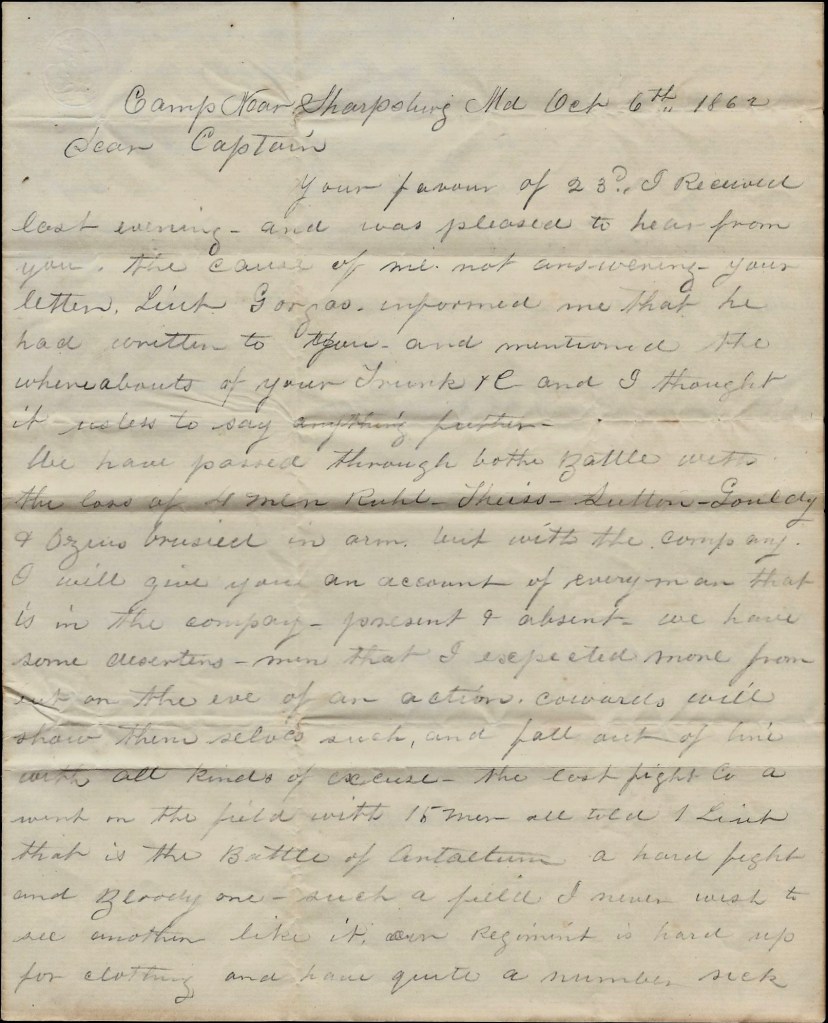
The following letter was written by 2nd Lt. Hillary Kinkade Beyer (1837-1907) of Co. A, 90th Pennsylvania Volunteers. Hillary wrote his letter from the regimental encampment near Sharpsburg some three weeks after the Battle of Antietam. His letter contains a synopsis of the casualties sustained by the company and his cryptic characterization of the battle—“a hard fight and bloody one—such a field I never wish to see another like it.”
For a great article describing the role played at Antietam by the 90th Pennsylvania, readers are referred to David Welker’s “The 90th Pennsylvania Infantry in the Cornfield: ‘Solitary and alone, we gave and took our medicine.'” For his bravery on the field at Antietam, Hillary was later (1896) decorated with the Medal of Honor. His citation read: “After his command had been forced to fall back, Second Lieutenant Beyer remained alone on the line of battle, caring for his wounded comrades and carrying one of them to a place of safety.” The wounded soldier carried to safety was James H. Gouldy—one of the men mentioned in this letter. Gouldy had lain severely wounded in an artillery swept field, and Lieutenant Beyer braved a hail of cannon and rifle fire from the Confederates to drag him to safety (Private Gouldey would survive the war and live for many years after).
Hillary was the son of Francis Taney Beyer (1817-1838) and Mary Kinkade (1819-Bef1850) of Montgomery county, Pennsylvania. Hillary first enlisted in May 1861 in Co. A, 19th Pennsylvania (3-month) and was at the Battle of Bull Run. He reenlisted in the 90th Pennsylvania and was commissioned a 2nd Lieutenant in September 1861. Hillary was wounded in May 1864 during the Battle of the Wilderness but recovered and mustered out of the service in late November 1864.
Hillary’s letter contains a marvelous handwritten muster roll of Co. A and the status of each member.
See also—1862: Edmund J. Gorgas to John T. Durang.
Transcription
Camp near Sharpsburg, Maryland
October 6th 1862
Dear Captain [John T. Durang],
Your favor of 23rd I received last evening and was pleased to hear from you. The cause of me not answering your letter, Lieut. [Edmund J.] Gorgas informed me that he had written to you and mentioned the whereabouts of your trunk &c. and I thought it useless to say anything further.
We have passed through both battles [S. Mountain & Antietam] with the loss of 4 men—[John] Ruhl, [Augustus M.] Theiss, [George W.] Sutton, and [James H.] Gouldy, & [Albert] Ozias bruised in arm but with the company. I will give you an account of every man that is in the company—present and absent. We have some deserters—men that I expected more from but on the eve of an action, cowards will show themselves such and fall out of line with all kinds of excuse. The last fight, Co. A went on the field with 15 men all told [and] 1 Lieutenant—that is, the Battle of Antietam. A hard fight and bloody one—such a field I never wish to see another like it.
Our regiment is hard up for clothing and have quite a number sick. This day we sent three to the hospital—Rood, Schwartz, & Rutner. None of the recruits have reported to the company except [Emile] Coblentz. If you come soon, bring nothing but what you can carry in a valise. Don’t forget a tin cup and plate. We have none but what are old and in use. Do not encumber yourself with too many clothing is my idea. The officers tell me that a valise is all they are allowed to carry. Gorgas sends his respects. Trunk he does not know where it is. Expect in Washington somewhere.
— Hillary Beyer
Corp. Paul is at home so I have been informed. Richard Sanders was taken prisoner on the way to hospital at Manassas with a number of others. Brinker & Major are accounted for as present. We had not received official notice of discharge. John Anderson deserted in August and reported as such on 31st.
The state of Company A, 30th September. Rendered to Adjutant of Regiment. [Handwritten Roster]


 Spared & Shared 23