
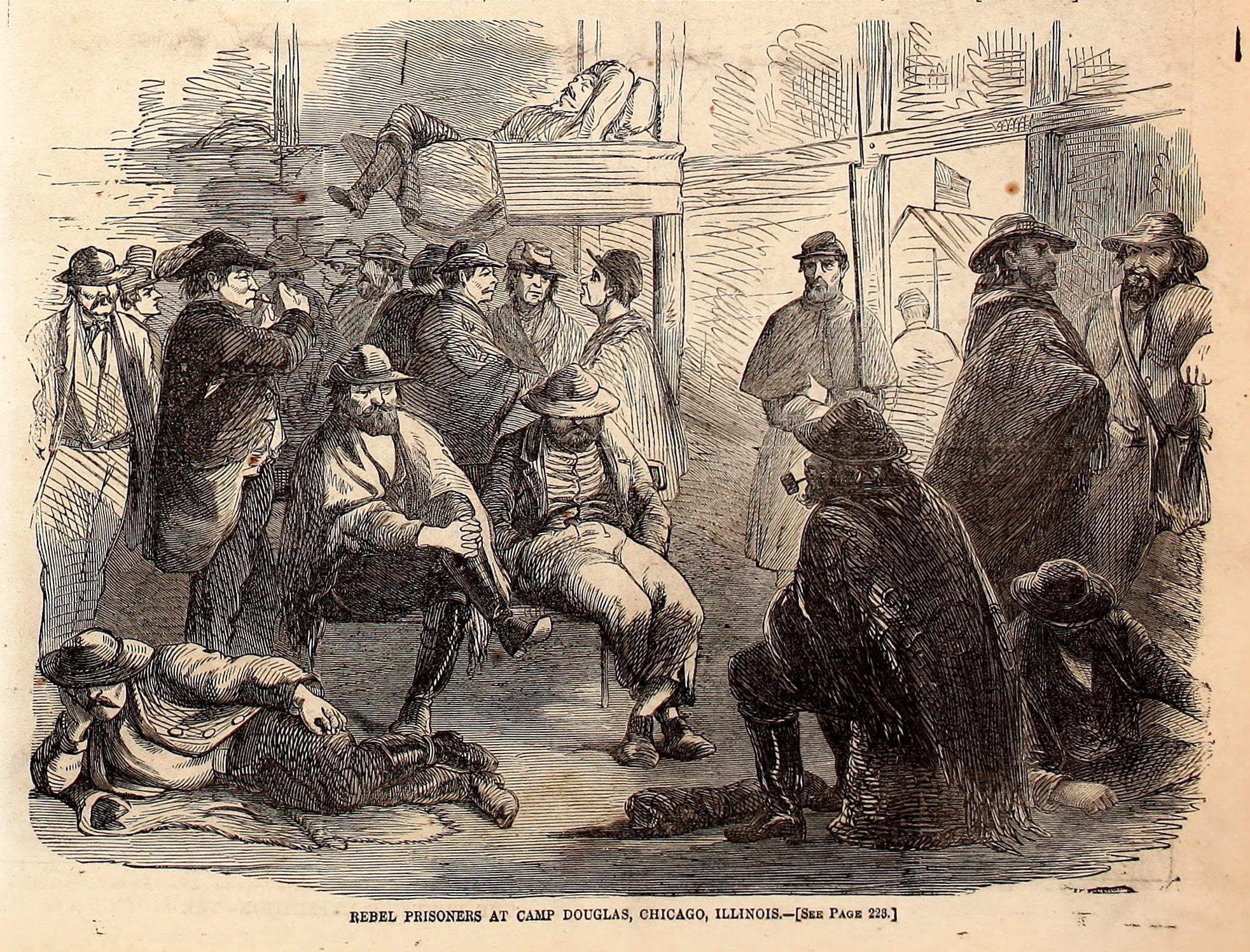
These letters were written by Truman (“True”) W. Williams (1839-1897) who grew up in Watertown, New York, the son of Asa and Louisa Keelar Williams. He was a self-taught illustrator and one of his earliest published works appeared in Harpers Weekly (April 1862) depicting rebel prisoners at Camp Douglas near Chicago (see below). In mid-December 1863, he enlisted in Co. E, 15th Illinois Infantry at Chicago. When he enlisted, he was described as standing 5′ 8″ tall, with hazel eyes, and dark hair. He was with the regiment until the spring of 1864 when he was attached to the topographical engineers. After mustering out of the service in October 1865, he pursued his career in illustrations and was best known for illustrating books for Mark Twain. [see Biographical Sketch]
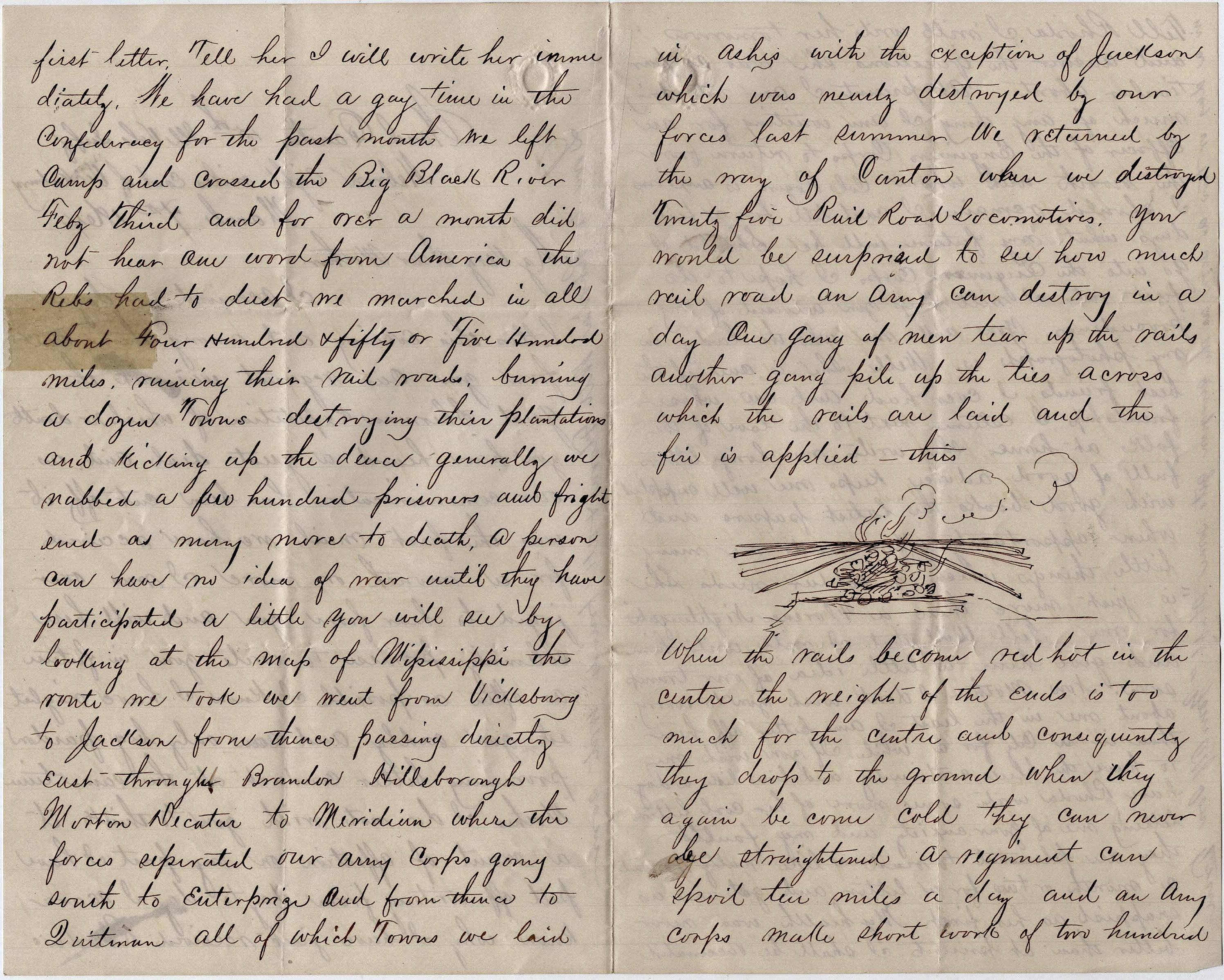
In one of the letters presented here, Truman gives us a sketch of the method used by Sherman’s army to bend the rails of the tracks torn up during his Meridian Expedition in the early spring of 1864. His sketch would have been made by direct observation. See Sherman’s Neckties.
Letter 1
Headquarters 15th Illinois Vols.
Camp near Vicksburg
February 1st 1864
My very dear mother,
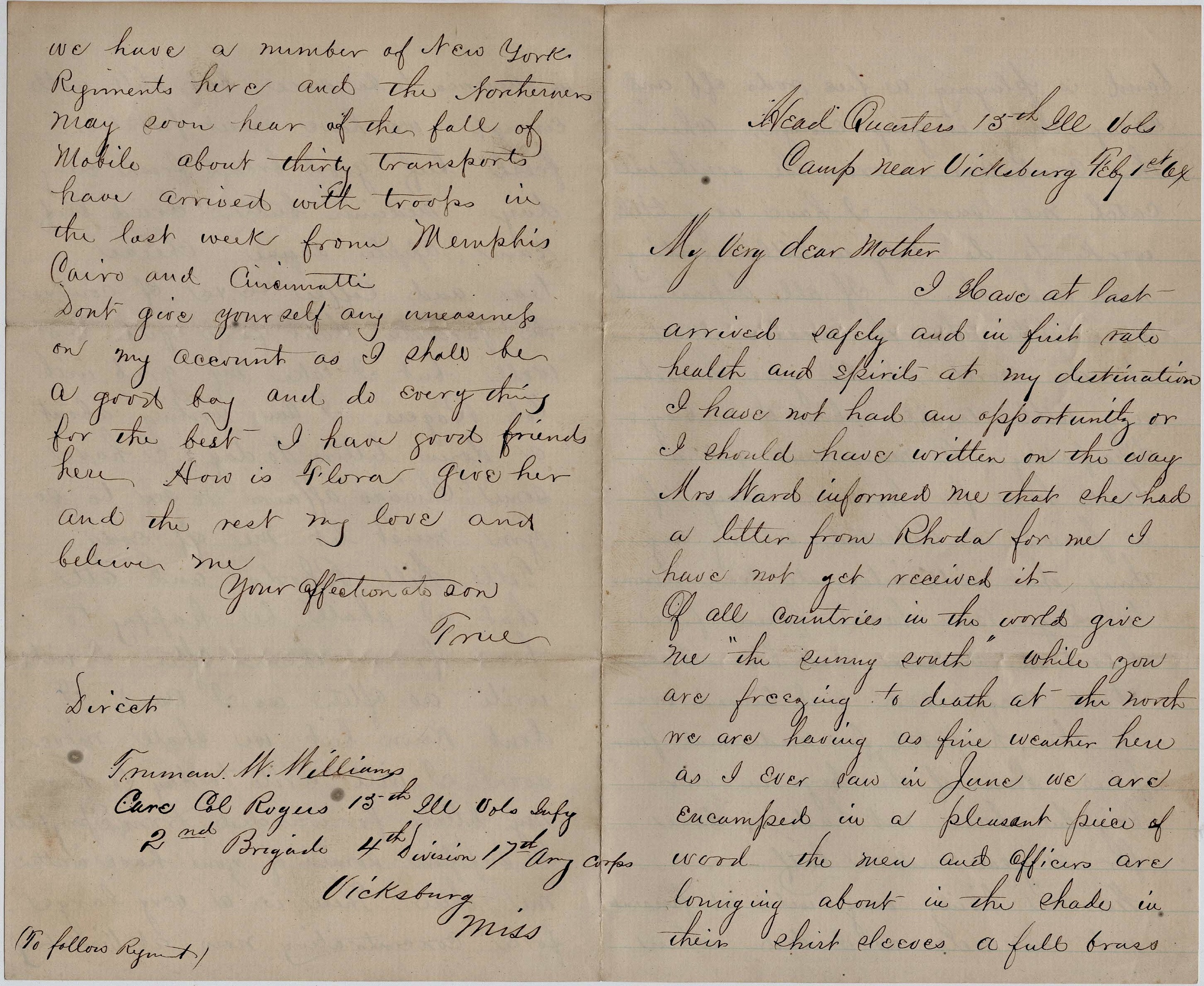
I have at last arrived safely and in first rate health and sprits at my destination. I have not had an opportunity or I should have written on the way, Mrs. Ward informed me that she had a letter from Rhoda for me. I have not yet received it.
Of all countries in the world, give me “the Sunny South.” While you are freezing to death at the North, we are having as fine weather here as I ever saw in June. We are encamped in a pleasant piece of wood. The men and officers are lounging about in their shirt sleeves, a full brass band is playing a few rods off, and everything is gay enough. When this cruel war is over the South will catch me sure.
I have very little work to do—only a little writing now and then. If all departments were like this, the anxious mothers at the North should give themselves very little trouble about their boy’s dissipating. A man can’t get a drink here for love or money. If a person is detected selling anything that will intoxicate even down to lager beer, he is fined five hundred dollars and his whole stock confiscated and turned over to the hospital for medicinal purposes. Some of the boys in our brigade have not had a dose for a year and a half.
We are living very well at present. Not as well as I did when in America to be sure, but still well enough. We have sweet potatoes, fresh beef, good bread fresh every day, medium butter, dried beef, ham, apple sauce, cheese, tea, and coffee, &c. &c. Of course the privates don’t fare quite as well but I take my grub with Col. Rogers. I am writing about a dozen letters today. I have some Chicago affairs to see to so you must let me off easy.
Tell Will, Rhoda, and all that I shall be happy to hear from them often. I wil write as often as I can. I don’t know but we shall move soon. I will write today to have my letters forwarded from Springfield. I suppose some of you have written me there.
There is a very large force concentrating now at Vicksburg. We have a number of New York Regiments here and the Northerners ,ay soon hear of the fall of Mobile. About 30 transports have arrived with troops in the last week from Memphis, Cairo and Cincinnati.
Don’t give yourself any uneasiness on my account as I shall be a good boy and do everything for the best. I have good friends here. How is Flora? Give her and the rest my love and believe me your affectionate son, — True
Direct to Truman W. Williams, Care of Col. Rogers, 15th Illinois Vols. Infantry, 2nd Brigade, 4th Division, 17th Army Corps, Vicksburg, Mississippi

Letter 2
Headquarters 15th Ill. Vols. Infantry
Hebron, eight miles east of Vicksburg
March 7, 1864
My very dear mother,
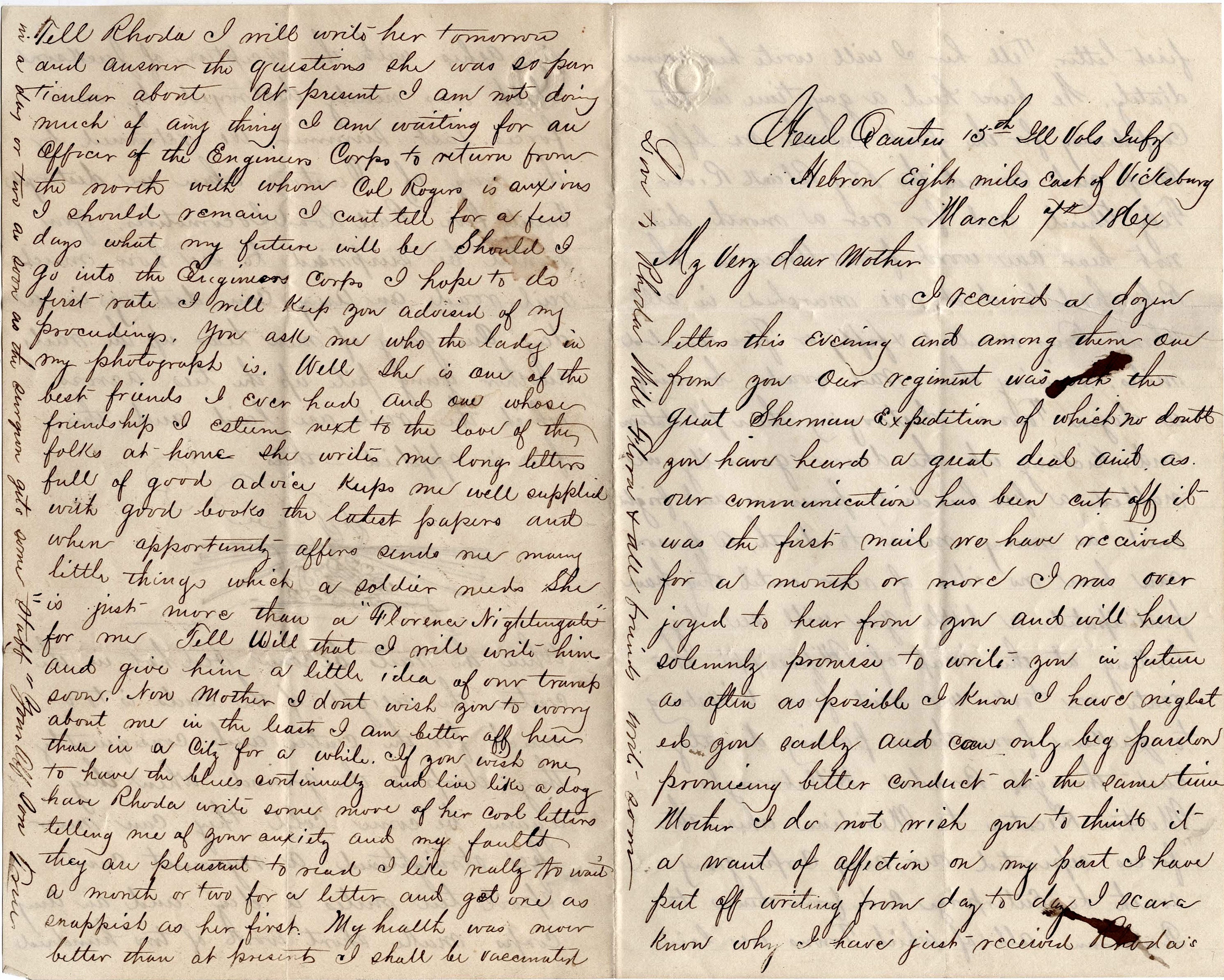
I received a dozen letters this evening and among them one from you. Our regiment was with the great Sherman [Meridian] Expedition of which no doubt you have heard a great deal, and as our communication has been cut off, it was the first mail we have received for a month or more. I was overjoyed to hear from you and will here solemnly promise to write you in future as often as possible. I know I have neglected you sadly and can only beg pardon promising better conduct at the same time. Mother I do not wish you to think it a want of affection on my part I have put off writing from day to day. I scarce know why. I have just received Rhoda first letter. Tell her I will write to her immediately.
We have had a gay time in the Confederacy for the past month. We left camp and crossed the Big Black River February 3rd and for over a month did not hear one word from America. The rebs had to dust. We marched in all about 450 or 500 miles, ruining their railroads, burning a dozen towns, destroying their plantations and kicking up the deuce generally. We nabbed a few hundred prisoners and frightened as many more to death. A person can have no idea of war until they have participated a little. You will see by looking at the map of Mississippi the route we took. We went from Vicksburg to Jackson, from thence passing directly east through Brandon, Hillsborough, Morton, Decatur, to Meridian where the forces separated, our Army Corps going south to Enterprise and from thence to Quitman, all of which towns we laid in ashes with the exception of Jackson which was nearly destroyed by our forces last summer.
We returned by the way of Canton where we destroyed 25 railroad locomotives. You would be surprised to see how much railroad an army can destroy in a day. Our gang of men tear up the rails, another gang pile up the ties across which the rails are laid and the fire is applied—thus [sketch]

When the railrs become red hot in the center, the weight of the ends is too much for the center and consequently they drop to the ground when they again become cold. They can never be straightened. A regiment can spoil ten miles a day and an ARmy Corps make short work of two hundred.
Tell Rhoda I will write her tomorrow and answer the questions she was so particular about. At present I am not doing much of anything. I am waiting for an officer of the Engineers Corps to return from the North with whom Col. Rogers is anxious I should remain. I can’t tell for a few days what my future will be. Should I got into the Engineers Corps, I hope to do first rate. I will keep you advised of my proceedings.
You ask me who the lady in my photograph is. Well she is one of the best friends I ever had and whose friendship I esteem next to the love of the folks at home. She writes me long letters full of good advice, keeps me well supplied with good books, the latest papers, and when opportunity offers, seds me many little things which a soldier needs. She is just more than a “Florence Nightingale” for me.
Tell Will that I will write him and give him a little idea of our tramp soon. Now mother, I don’t wish you to worry about me in the least. I am better off here than in a City for a while. If you wish me to have the blues continually and live like a dog, have Rhoda write some more of her cool letters telling me of your anxiety and my faults. They are pleasant to read. I like really to wait a month or two for a letter and get one as snappish as her first. My health was never better than at present. I shall be vaccinated in a day or two as soon as the surgeon gets some”stuff.” Your affectionate son, — True
Letter 3
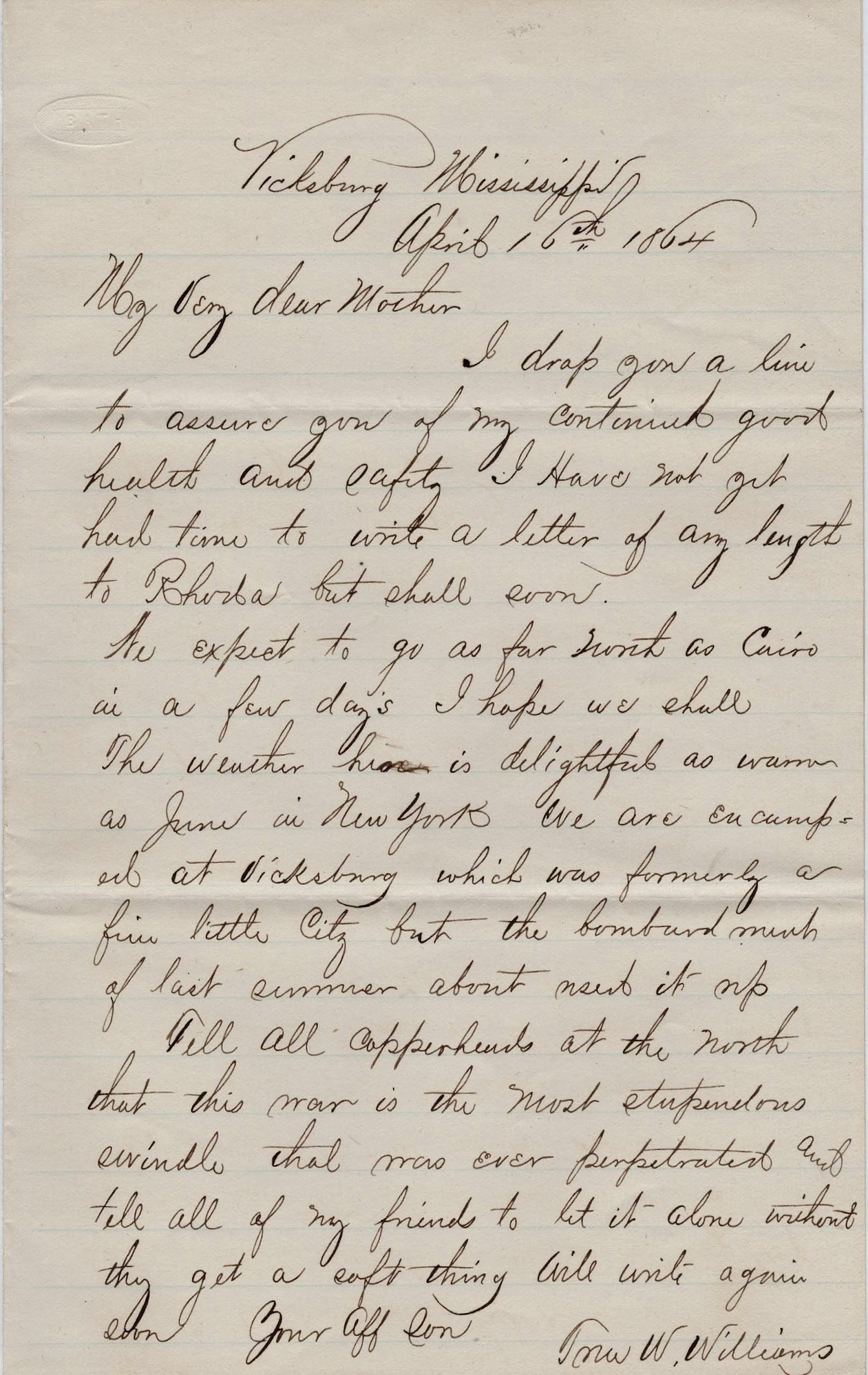
Vicksburg, Mississippi
April 16th 1864
My very dear mother,
I drop you a line to assure you of my continued good health and safety. I have not yet had time to write a letter of any length to Rhoda but shall soon.
We expect to go as far north as Cairo in a few days. I hope we shall. The weather is delightful—as warm as June in New York. We are encamped at Vicksburg which was formerly a fine little city but the bombardment of last summer about used it up.
Tell all Copperheads at the North that this war is the most stupendous swindle that was ever perpetrated and tell all of my friends to let it alone without they get a soft thing. Will write again soon. Your affectionate son, Tru W. Williams
Letter 4
Headquarters 4th Division 17th Army Corps
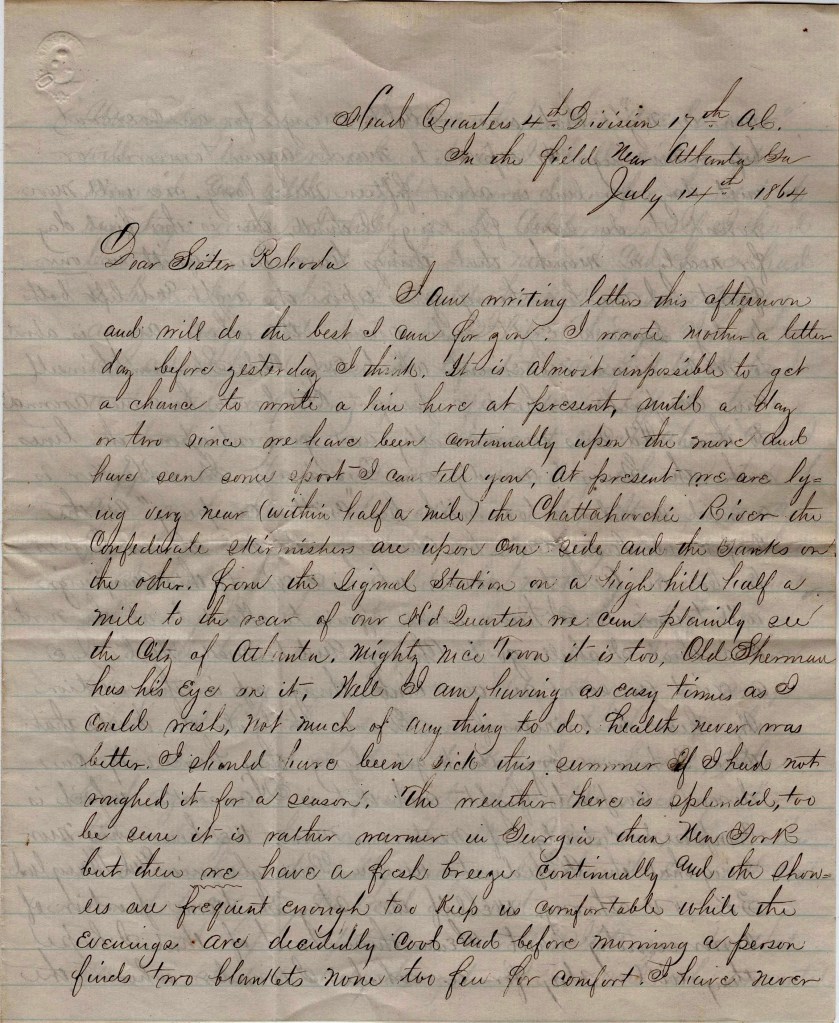
In the field near Atlanta, Ga.
July 14, 1864
Dear Sister Rhoda,
I am writing letters this afternoon and will do the best I can for you. I wrote Mother a letter day before yesterday I think. It is almost impossible to get a chance to write a line here at present. Until a day or two since, we have been continually upon the move and have seen some sport, I can tell you. At present we are lying very near (within half a mile) of the Chattahoochee River. The Confederate skirmishers are upon one side and the Yanks on the other. From the Signal Station on a high hill half a mile to the rear of our headquarters, we can plainly see the City of Atlanta. Mighty nice town it is too. Old Sherman has his eye on it.
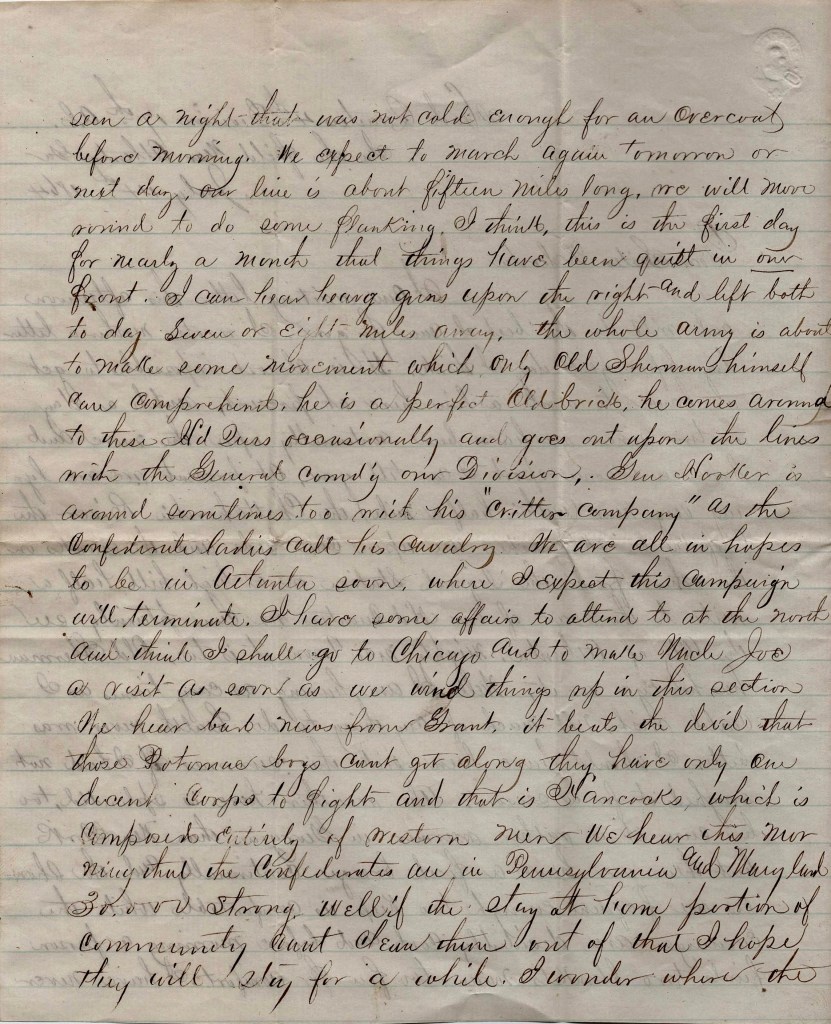
Well, I am having as easy times as I could wish. Not much of anything to do. Health never was better. I should have been sick this summer if I had not roughed it doe a season. The weather here is splendid to be sure. It is rather warmer in Georgia than New York but there we have a fresh breeze continually and the showers are frequent enough to keep us comfortable while the evenings are decidedly cool and before morning a person finds two blankets none to few for comfort. I have never seen a night that was not cold enough for an overcoat before morning.
We expect to march again tomorrow or next day. Our line is about fifteen miles long. We will move round to do some flanking, I think. This is the first day for nearly a month that things have been quiet in our front. I can hear heavy guns upon the right and left both today, seven or eight miles away. The whole army is about to make some movement which only Old Sherman himself can comprehend. He is a perfect old brick. He comes around to the headquarters occasionally and goes out upon the lines with the General commanding our Division. Gen. Hooker is around sometimes too with his “critter company” as the Confederate ladies call his cavalry.
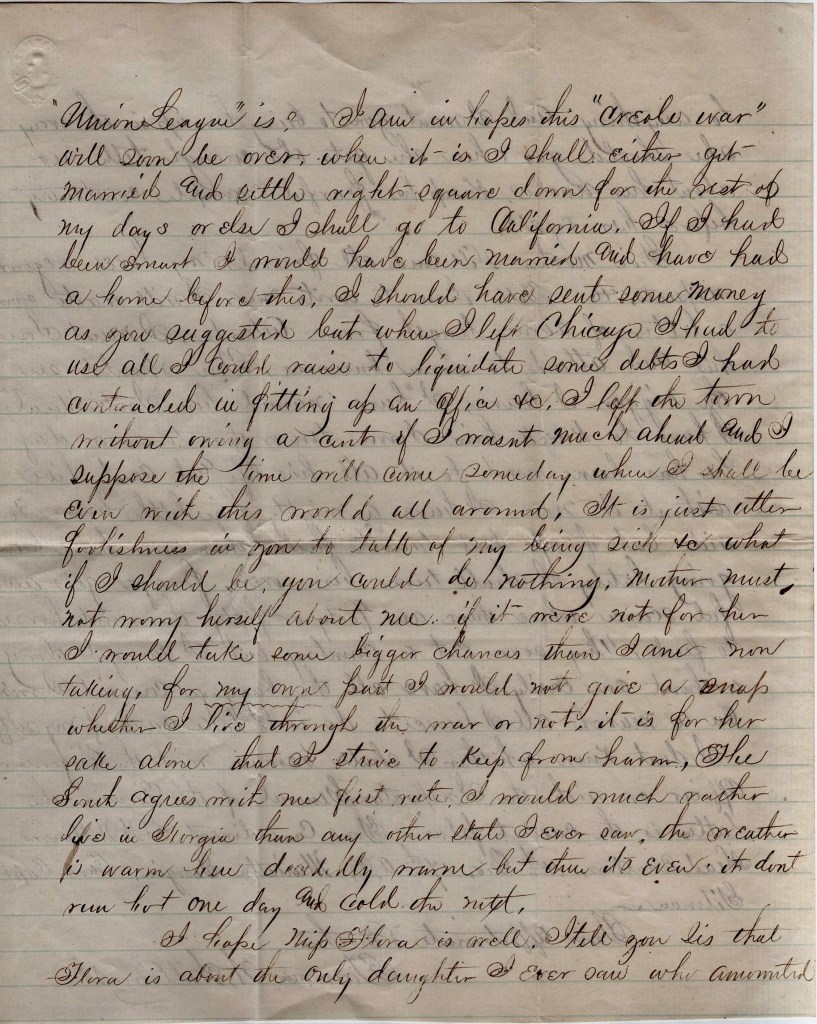
We are all in hopes to be in Atlanta soon where I expect this campaign will terminate. I have some affairs to attend to at the North and think I shall go to Chicago and to make Uncle Joe a visit as soon as we wind things up in this section. We hear bad news from Grant. It beats the devil that those Potomac boys can’t get along. They have only one decent Corps to fight and that is Hancock’s, which is composed entirely of western men. We hear this morning that the Confederates are in Pennsylvania and Maryland 30,000 strong. Well, if they stay at home portion of community can’t clear them out of that, I hope they will stay for a while. I wonder where the “Union League” is? I am in hopes this “creole war” [cruel war] will soon be over. When it is, I shall either get married and settle right square down for the rest of my days or else I shall go to California. If I had been smart, I would have been married and have had a home before this.
I should have sent some money as you suggested but when I left Chicago, I had to use all I could raise to liquidate some debts I had contracted in fitting up an office &c. I left the town without owing a cent if I wasn’t much ahead and I suppose the time will come someday when I shall be even with this world all around. It is just utter foolishness in you to talk of my being sick &c. What is I should be? You could do nothing. Mother must not worry herself about me. If it were not for her, I would take some bigger chances than I am now taking. For my own part, I would not give a snap whether I live through the war or not. It is for her sake alone that I strive to keep from harm. The South agrees with me first rate. I would much rather live in Georgia than any other state I ever saw. The weather is warm here—decidedly warm—but then it’s even. It don’t run hot one day and cold the next.
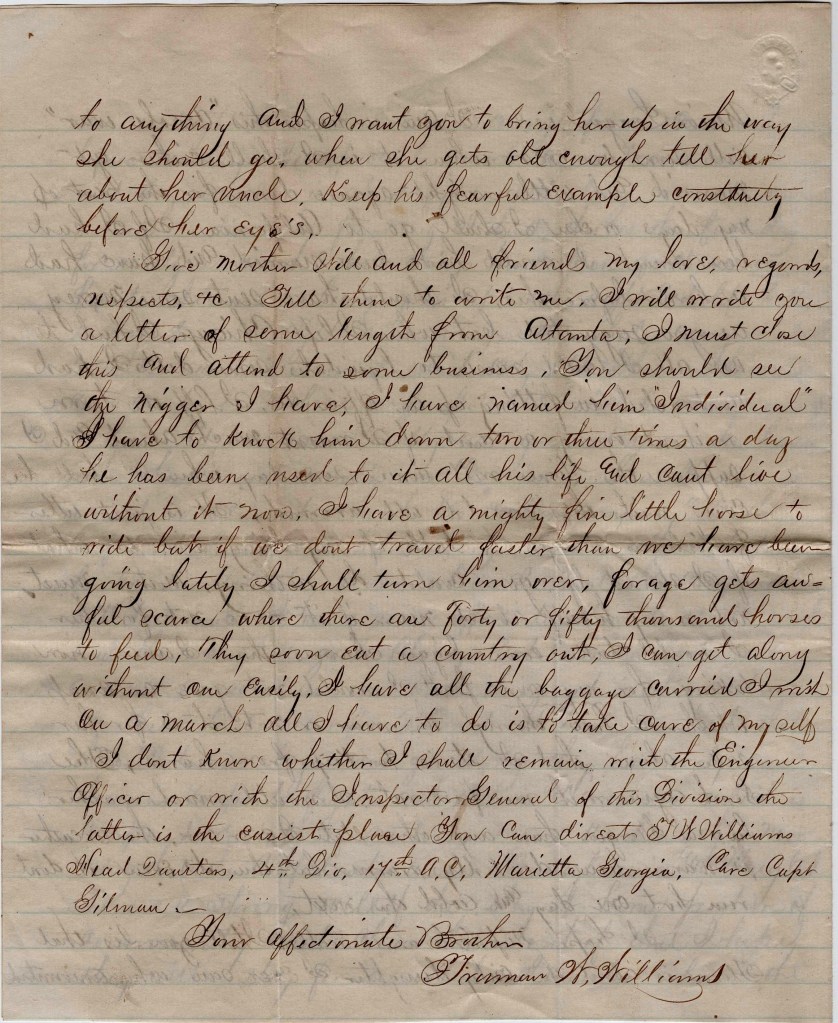
I hope Miss Flora is well. I tell you, sis, that Flora is about the only daughter I ever saw who amounted to anything and I want you to bring her up in the way she should go. When she gets old enough, tell her about her uncle. Keep his fearful enough example constantly before her eyes.
Give mother, Will, and all friends my love, regards, respects, &c. Tell them to write me. I will write you a letter of some length from Atlanta. I must close this and attend to some business. You should see the nigger I have. I have named him “Individual.” I have to knock him down two or three times a day. He has been used to it all his life and can’t live without it now. I have a mighy fine little horse to ride but if we don’t travel faster that we have been going lately, I shall turn him over. Forage gets awful scarce where there are 40 or 50,000 horses to feed. They soon eat a country out. I can get along without one easily. I have all the baggage carried I wish on a march. All I have to do is to take care of myself.
I don’t know whether I shall remain with the Engineer Officer or with the Inspector General of this Division. The latter is the easiest place. You can direct to T. W. Williams, Headquarters, 4th Division, 17th Army Corps, Marietta, Georgia. Care Capt. Gilman
Your affectionate brother, — Truman W. Williams
 Spared & Shared 23