Category Archives: Military Telegraph Service

1862: William Atwater to his Brother

The following letter was written by William Atwater (1837-1913), the son of Joshua D. Atwater (1807-1840) and Dorcas Bronson (1807-1903) of Massillon, Stark county, Ohio. From William’s letter it is clear that he worked as telegraph operator during the Civil War and was recently stationed at Nashville, Tennessee. I believe that William was employed as a civilian contractor for the military telegraphic service.

In the 1870 US Census, William was enumerated as an inmate, age 30, in the Northern Ohio Lunatic Asylum in Newburgh, Cuyahoga county, Ohio (his former occupation given as a telegraph operator; his condition “insane”). In 1880, he was still in the asylum, age 40, suffering from “mania.”

T R A N S C R I P T I O N

Nashville, Tennessee
May 6th 1862

Dear Brother,

Yours of the 2nd inst. was received. I had intended writing to Mother on Sunday to keep my promise good but was busy on the line all day, Morgan’s Cavalry having been around within 30 miles of here on the road & it made considerable stir, I can assure you. They sent some troops down to reinforce Col. Duffield at Murfreesboro. Gen. Dumont started in pursuit of Morgan & succeeded in catching or capturing 150 men, horses, and a large quantity of arms. This was at Lebanon about 40 miles from here. The Secesh do not say much this morning although “Gravevine Telegraph” worked tip top on Sunday.

Today is a splendid specimen of summer weather being warm and pleasant out. The 11th Michigan Regiment passed through here last evening en route for Columbia to join Gen. Negley at that point, I believe. I received a letter from Harry Allen from Pittsburg Landing a few days ago in which he says that Jesse Keel had gone home. Also says Jimmy Hunt had gone home having been unwell for a month past. I was much pleased upon hearing of Doct. Huxthal’s promotion. Immediately upon receiving your letter I went over & saw Dr. Hodge. He says he is glad to hear of Huxthal’s promotion and thinks him a worthy man to hold such a position. I also saw Hayden of Canal Dover. Also Henry Kaldenbaugh that was book keeper for Col. Webb while he was in New York. Old Kelly, the boat captain, is in the 51st Regt. as private. I saw him on the street about two weeks ago. I am sorry to hear that Jesse Keel is in such a bad situation adn hope that it is not as bad as you represent in your letter. Jesse is a fine fellow and I feel sorry for him. I was very much surprised upon hearing of Mrs. Allen’s death although I knew she was very low when I left home. How does Mr. Allen take it? Hard I presume as I have always thought that he thought a great deal of his wife.

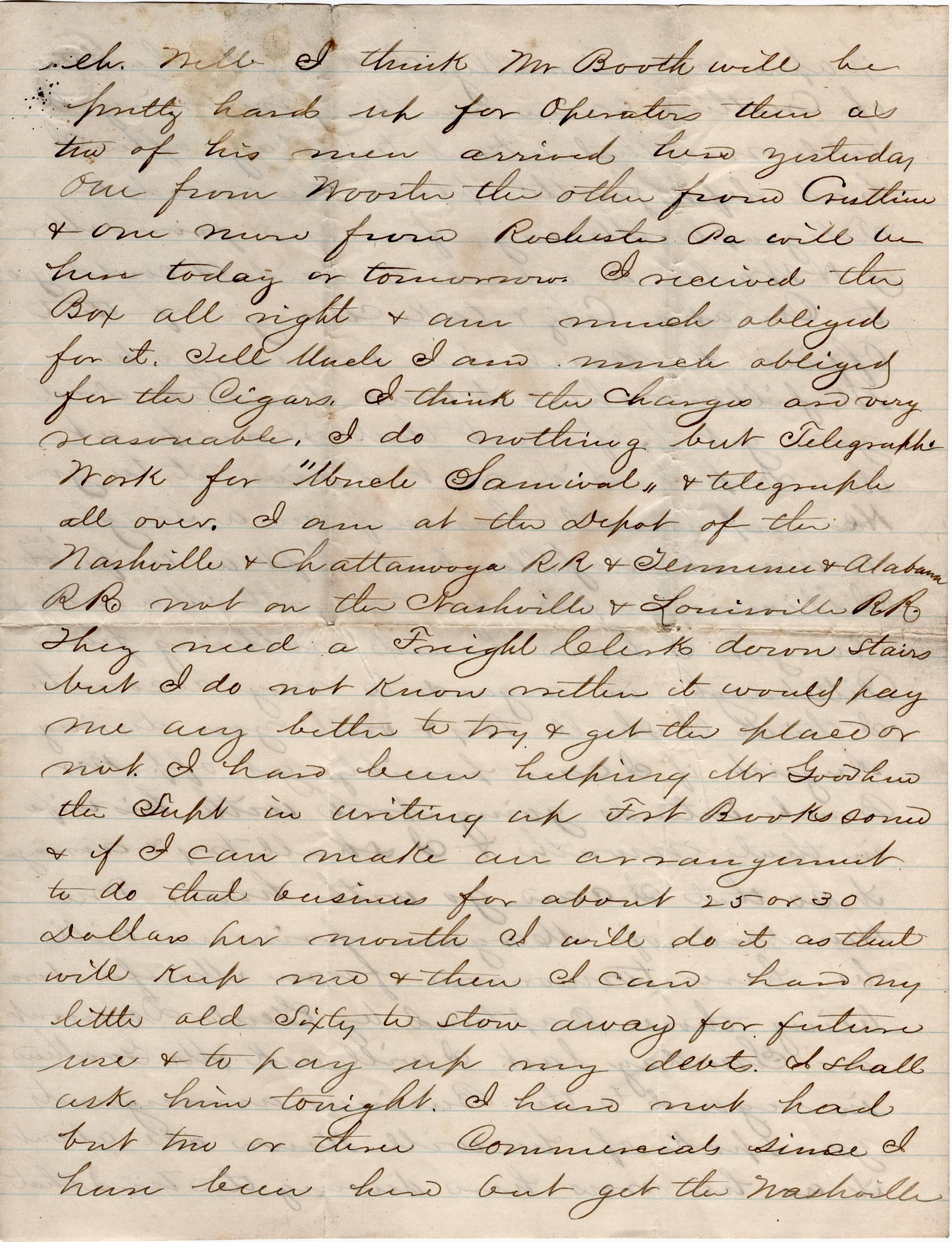
You must certainly have had a hard time of it when you wrote the letter being interrupted so much. You say the operator at the Depot has gone to Washington, eh? Well, I think Mr. Booth will be pretty hard up for operators then as two of his men arrived here yesterday—one from Wooster, the other from Crestline, and one more from Rochester, Pa. will be here today or tomorrow. I received the box all right & am much obliged for it. Tell Uncle I am much obliged for the cigars. I think the charges are very reasonable. I do nothing but telegraph work for “Uncle Samual” & telegraph all over. I an at the depot of the Nashville & Chattanooga Railroad & Louisville Railroad. They need a Freight Clerk down stairs but I do not know whether it would pay me any better to try and get the place or not. I have been helping Mr. Goodhew, the Superintendent, in writing up Freight books some and if I can make an arrangement to do that business for about 25 or 30 dollars per month, I will do it as that will keep me & then I can have my little old sixty to stow away for future use & to pay up my debts. I shall ask him tonight. I have not had but two or three [Cincinnati] Commercials since I have been here but get the Nashville papers occasionally.

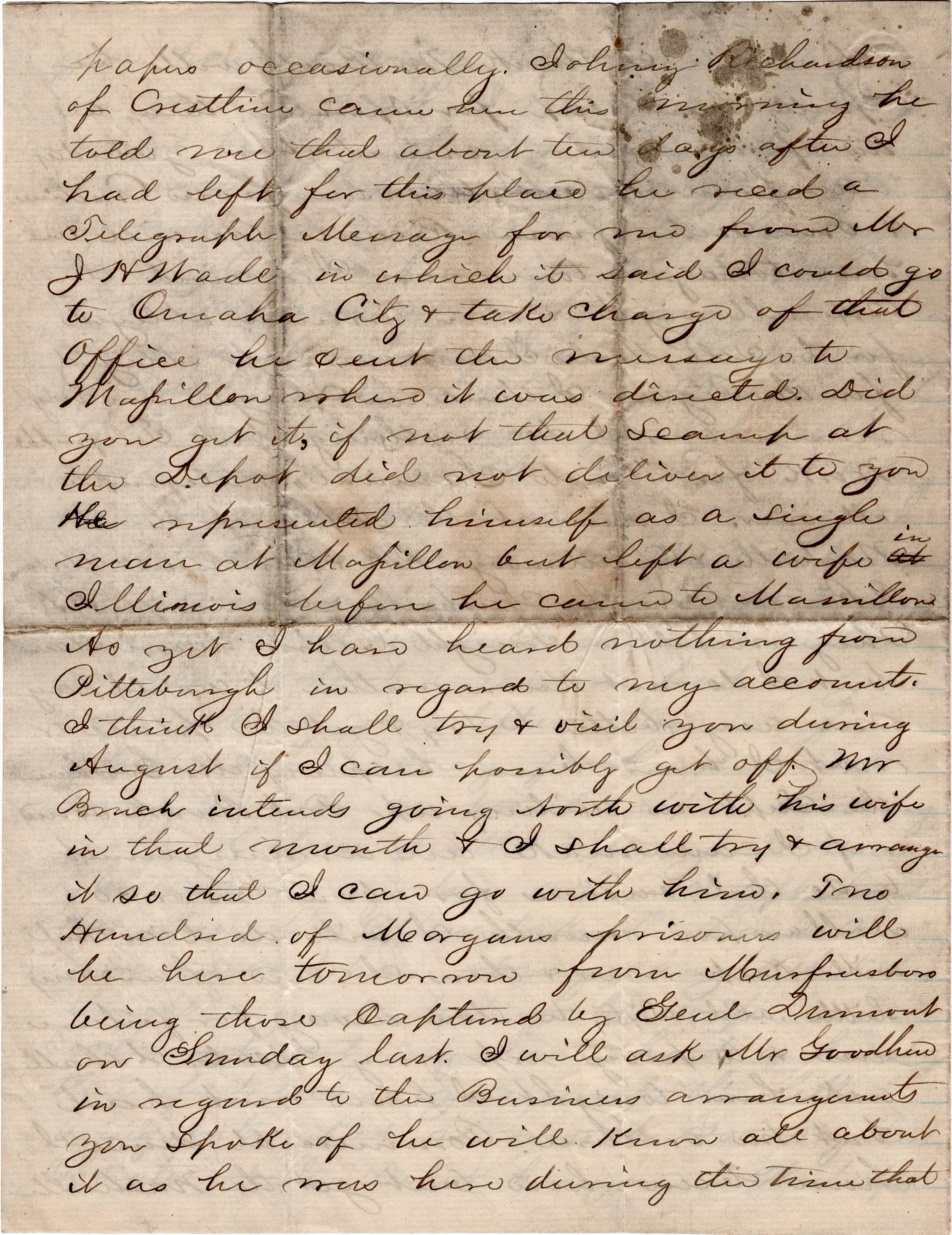
Johnny Richardson of Crestline came here this morning. He told me that about ten days after I had left for this place he received a telegraph message for me from Mr. J. H. Wade in which it said I could go to Omaha City & take charge of that office. He sent the message to Massillon where it was directed. Did you get it? If not, that scamp at the depot did not deliver it to you. He represented himself as a single man at Massillon but left a wife in Illinois before he came to Massillon. Asa yet, I have heard nothing from Pittsburgh in regard to my account. I think I shall try & visit you during August if I can possibly get off. Mr. Bruch intends going North with his wife in that month & I shall try and arrange it so that I can go with him.

Two hundred of Morgan’s prisoners will be here tomorrow from Murfreesboro, being those captured by Gen. Dumont on Sunday last. I will ask Mr. Goodhew in regard to the business arrangements you spoke of. He will know all about it as he was here during the time that the secesh were & can probably tell more about it than Mr. Hodge can. I got paid off today. Got $52 for last month’s pay, not being a full month. I do not get rations here. If I was in camp, then I would get them. I send you this time $25. Next month I will send you forty, probably $45. Do not know what my boarding is going to cost. I intend to send all I can…

When you write again, please let me know about what arrangements you make with the railroad folks, provided you see them. Tell Mother I will write Sunday again if nothing happens. I shall write Clem Russell in a day or two & will then let you know about what Mr. Goodhew says. The Christian Advocate was received. I will go down to supper now as the “Boy” has just informed me that it is ready. You can say to ward Cummings that I have not heard from him yet and would be glad to hear from him. Give my regards to all. Remember me to Auntie’s folks; Jacob’s also. Kove to all. I am as ever, your brother, — Will Atwater

P. S. I send you $30 instead of $25.

1885: William Henry Harrison Lancaster to Sophia E. Eastman

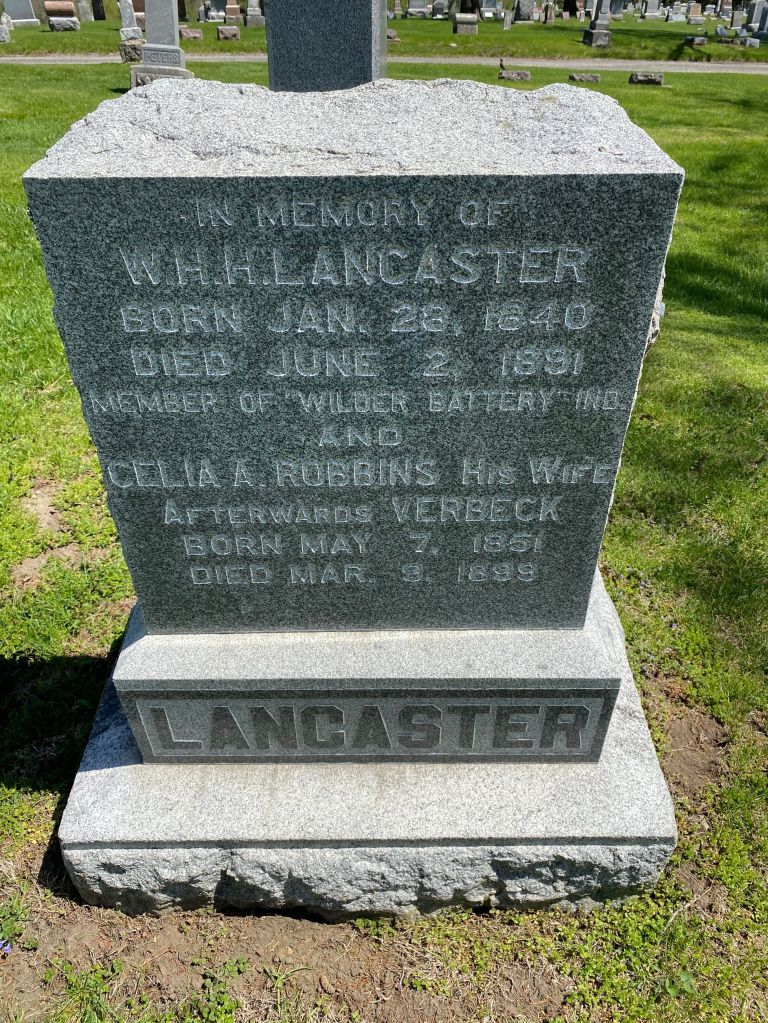
This letter was written in 1885 by William Henry Harrison Lancaster (1840-1891) who first entered the Civil War in June 1861 as a member of Co. A, 17th Indiana Infantry. The regiment first saw combat at Greenbrier, Virginia in October of that year, then transferred to Don Carlos Buell’s Army of the Ohio where they took part in the western theatre. Co. A, however, was retained in the Cheat Mountain District of West Virginia and used as artillerists in Wilder’s Battery, Co. G.

From William’s letter we learn that at some unspecified point in time he transferred out of Wilder’s Battery into the military’s telegraph service where he worked as a telegraph operator and repairer. While posted at the New Creek Station in November 1864, he and others connected with the telegraph office were robbed, taken prisoner by Confederates under Rosser’s command, and taken to Castle Thunder where he endured some 15 weeks of captivity and nearly starved to death. His letter chronicles that experience.

William wrote the letter to Miss Sophia E. Eastman, an 1864 graduate of Wheaton Female Seminary (Norton, Mass.), in response to a request for information pertaining to his captivity at Caste Thunder. Sophia wrote a number of children’s and religious books in the latter half of the 19th century but I have not been able to determine why she was collecting stories of this nature. The letter was sent to 8 Mason street in Cambridge which was a boarding house.

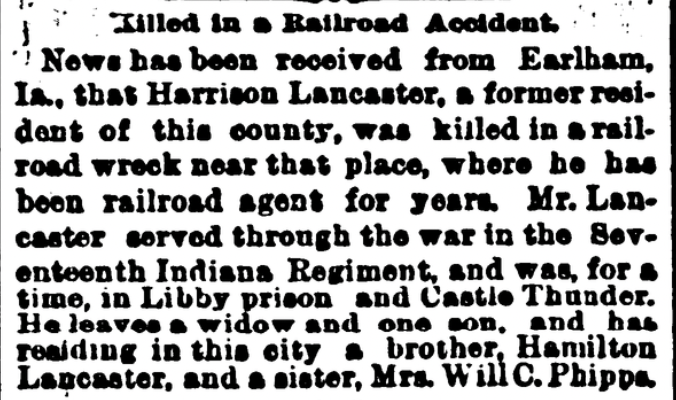
As he states in his letter, William lived out his days in Earlham, Madison county, Iowa, working for the railroad. Sadly, William was killed in a horrific railroad accident near Earlham on 2 June 1891 at the age of 51 (see clippings below).

A photograph of Caste Thunder taken after the fall of Richmond. The former tobacco warehouse was converted into a prison during the war. (LOC)

Transcription

Earlham, Iowa
September 15, 1885

Miss Sophia E. Eastman
8 Mason Street, Cambridge, Mass.

Yours received. Will be as brief as possible in writing you.

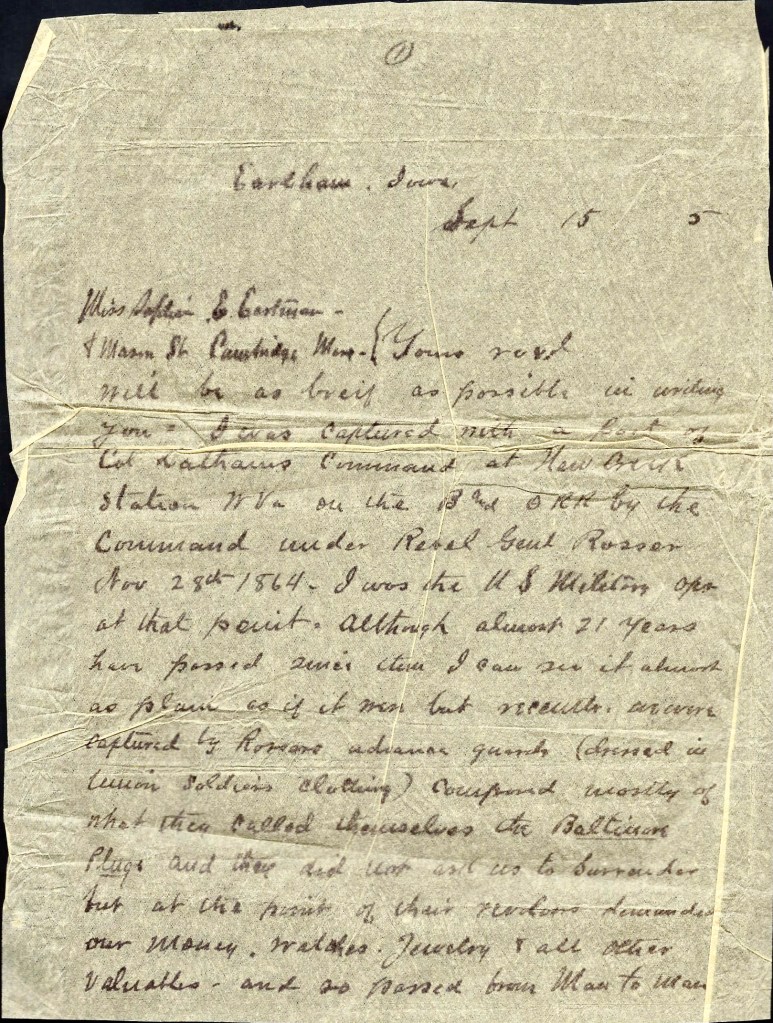
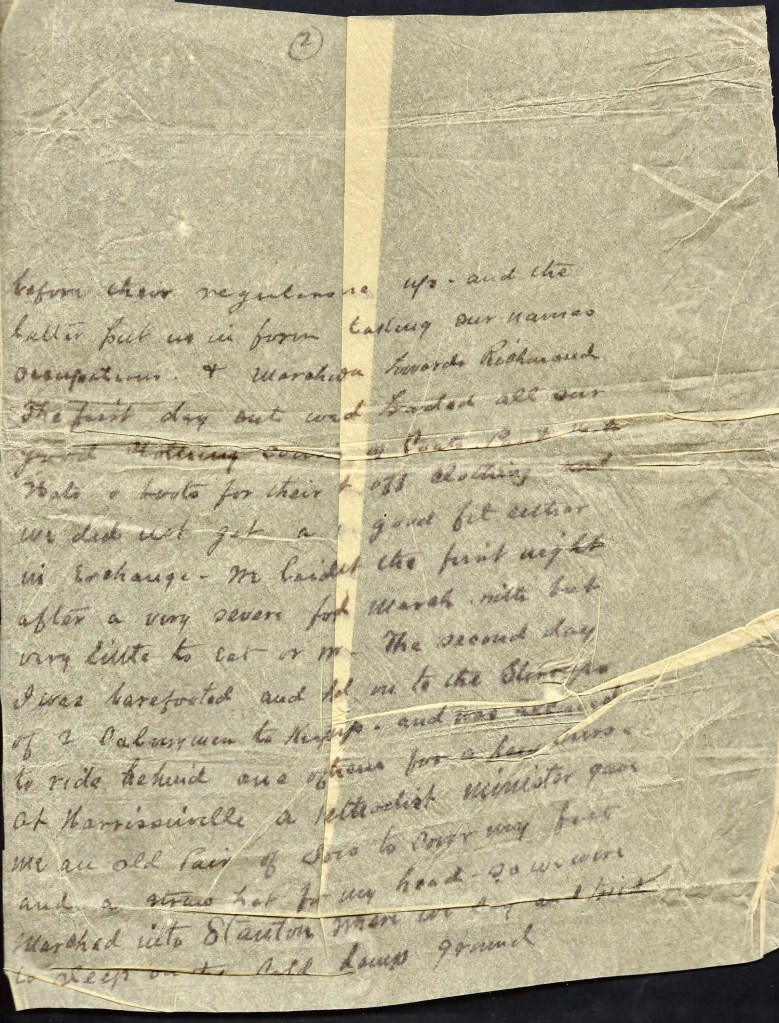
I was captured with a part of Col. Latham’s command at New Creek Station, W. Va. on the Baltimore & Ohio Railroad by the command under Rebel General Rosser November 28th 1864. I was the U. S. Miltary Operator at that point. Although almost 21 years have passed since then, I can see it almost as plain as if it were but recent. We were captured by Rosser’s advance guards (dressed in Union soldier’s clothing) composed mostly of what they called themselves the Baltimore Plugs and they did not ask us to surrender but at the point of their revolvers surrender our money, watches, jewelry, and all other valuables—and so passed from man to man before their regulars come up and the latter put us in form[ation] for taking our names and occupation & marching on  towards Richmond.

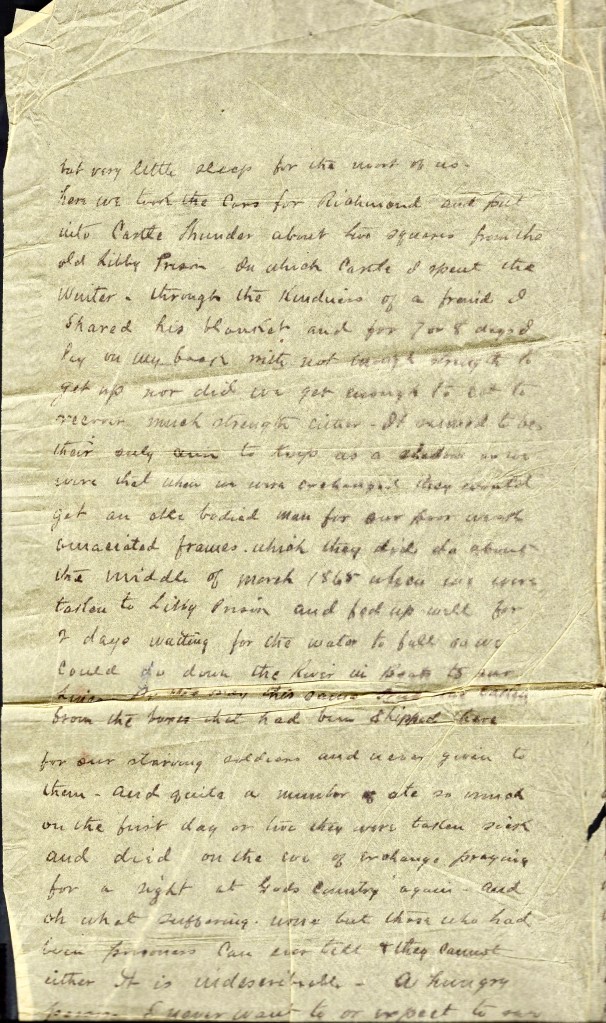
The first day out we had traded [probably forcefully] all our good clothing, consisting of coats, pants, vests, hats, and boots for their cast off clothing and we did not get a very good fit either in  exchange. We laid out the first night after a very severe forced march with but very little to eat or  wear. The second day I was barefooted and held on to the stirrups of two cavalrymen to keep up and was allowed to ride behind one of them for a few hours. At Harrisonville, a Methodist Minister gave me an old pair of shoes to cover my feet and a straw hat for my head. So we were marched into Staunton where we lay and tried to sleep on the cold damp ground, but very little sleep for the most of us. Here we took the cars for Richmond and put into Castle Thunder—about two squares from the old Libby Prison, in which castle I spent the winter.

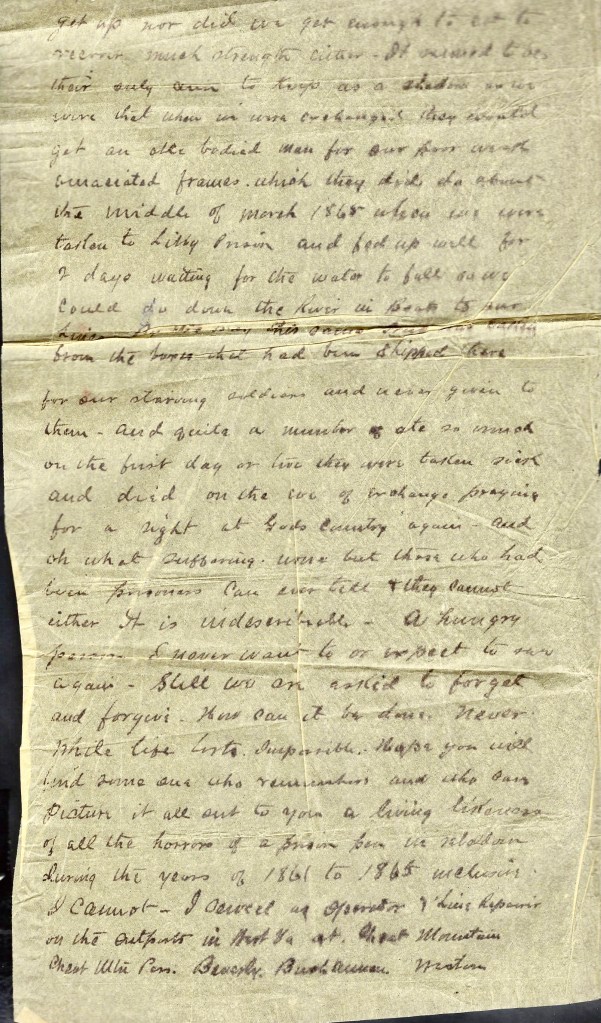
Through the kindness of a friend, I shared his blanket, and for 7 or 8 days I lay on my back with not enough strength to get up. Nor did we get enough to eat to recover much strength either. It seemed to be their only aim to keep us a shadow as we were—that when we were exchanged they would  get an able bodied man for our poor weak emaciated frames, which they [finally] did do about the middle of March 1865 when we were taken to Libby Prison and fed up well for two days waiting for the water to fall so we could go down the river in boats to our lines.

By the way, this same grub was taken from the boxes that had been shipped there for our starving soldiers and never given to them, and quite a number ate so much on the first day or two, they were taken sick and died on the eve of exchange praying for a sight at God’s country again. And Oh! what suffering. None but those who had been prisoners can ever tell—and they cannot  either. It is indescribable. A hungry person I never want to or expect to see again. Still we are asked to  forget and forgive. How can it be done? Never while life lasts. Impossible. Maybe you will find someone who remembers and who can picture it all out to you a living likeness of all the horrors of a prison pen in rebeldom during the years of 1861 to 1865 inclusive. I cannot.

I served as operator and line repairer in the outposts in West Virginia at Cheat Mountain, … Bull town, and Charleston. We did not have all the delicacies of the season at any place but fared about the same as our soldiers and we did not complain at that. I lost everything I had, unfitted for any service that would command good wages. I am making a living for myself, wife, and boy, and that is about all as agent or operator on the CRJ&PRR, and have been for the last 15 years. I never cared much  about a pension but there are but a few of us who would like in some honorable way to get back what we had made, saved, and lost by capture. I left out about 1000 dollars worse than nothing. No clothes. No work. No  money and in bad health and yet every Fall, Winter, Spring I suffer a great deal with neuralgia or rheumatism  contracted during captivity by hunger and exposure.

I believe you would get a good deal of information as regards the military operations by looking over Plumb’s  History of the U. S. Military Telegraph Company. It is too late in the day for a great many of us to remember much that should be written & remembered by the future generations of what we did do and suffer without  a complaint, as well as without a reward from the Government. I was in rebel prison but three and a half months—yet they  passed as so many years. I suppose after we are dead and gone a grateful people will kindly mention our names and likely give our children a tin medal as a reward for the services rendered by their Fathers. You will pardon me for not being able to write the information you desire. I do not know why you want the  information but hope whatever you do will be to the interest of all of us. I remain yours truly, — W. H. H. Lancaster.

[The second smaller note reads]

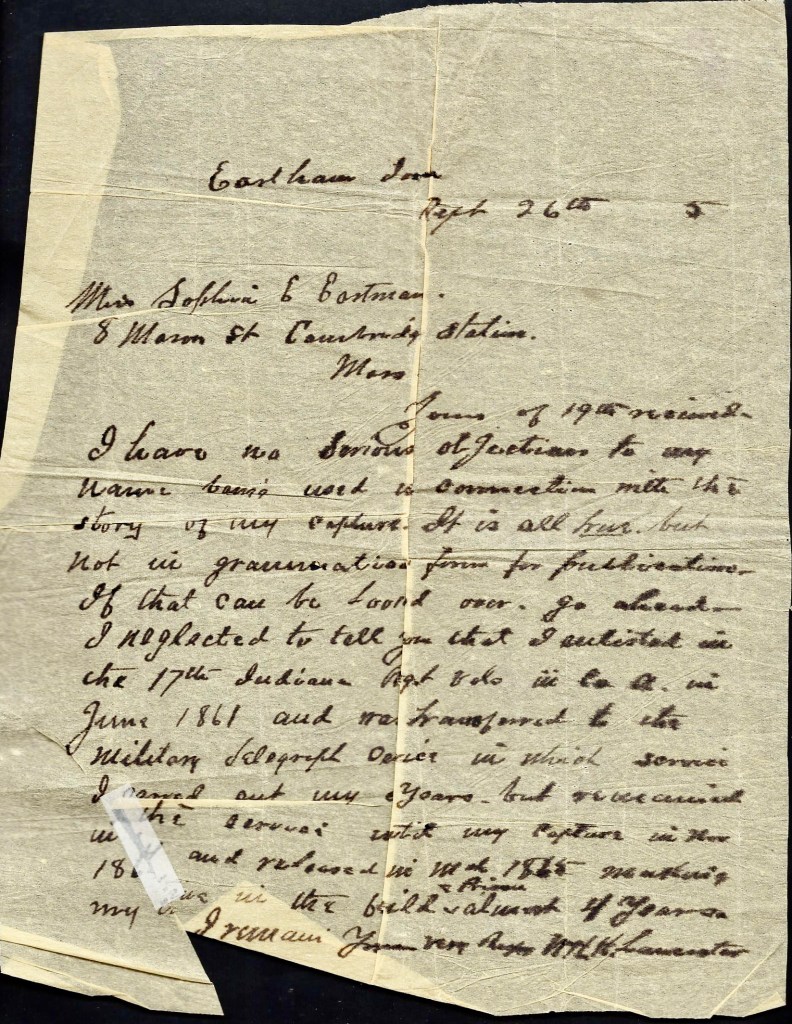
Earlham, Iowa
Sept 26th 1905

Yours of 19th received. I have no serious objections with [your use of] the story of my capture. It is all true, but not in grammatical form for publication. If that  can be looked over, go ahead. I neglected to tell you that I enlisted in the 17th Indiana Regt. Vols in Co. A. in June 1861 and was transferred to the military telegraph service in which service I served out my 3 years but remained in the service until my capture in Nov 1864 and released in March 1865, making my time in the field and as prisoner almost 4  years. I remain yours very respectfully, W. H. H. Lancaster.