Category Archives: Minnesota Territory

1850s: Timothy Sprague to Isabella Sprague

This letter was written by Timothy Sprague (1811-1862), the son of John Sprague (1775-1862) and Rhoda Crittenden (1776-1835) of Wyoming county, New York. Timothy’s first wife was Polly Bliss who died sometime after the birth of her second child, Walter Scott Sprague (1844-1916). Her first child was Isabella Sprague (1839-1904), the recipient of this letter. Timothy married a second time to a woman named Sarah but she seems to have died in the early 1850s, perhaps not long before he made the journey to Minnesota Territory described in this letter.

Isabella was born in China, New York and died in 1904 in Conneautville, Crawford county, Pennsylvania. Timothy’s letter mentions “Ethan.” I believe this was Ethan Lord Sprague (1835-1917), the son of Timothy’s brother, John Sprague, Jr. (1807-1888) and Harriet Lord (1810-1875) of Conneautville, PA.

Transcription

St. Paul [Minnesota Territory]
June 29, [1850s]

Miss Isabella Sprague,

I have been out today on a ramble. I started on a road that runs to the northeast. After rising the bluffs, it is just rolling enough to make it pleasant. There is a luxuriant growth of vegetation, wild flowers of all colors and forms. I saw a small lake with water clear as crystal filled with fish. Lucky for them I was not prepared for fishing. The soil is rather too sandy but the crops look very well here. they are ahead of anything in Pennsylvania or Ohio.

St. Paul is filled with foreign population of all kinds. 1 It would please you to see a Red River 2 train which is 600 miles distant from here. There is a train of 6 or 7 hundred carts on their way down loaded with furs and skins. Their carts are made of wheels about the size of hind wheels to a wagon on axles about 4 feet apart with rack about 4 feet long. they are made entirely of wood with fills and drawn with one horse or ox harnessed. If drawn by more than one, they are put one before the other. 3
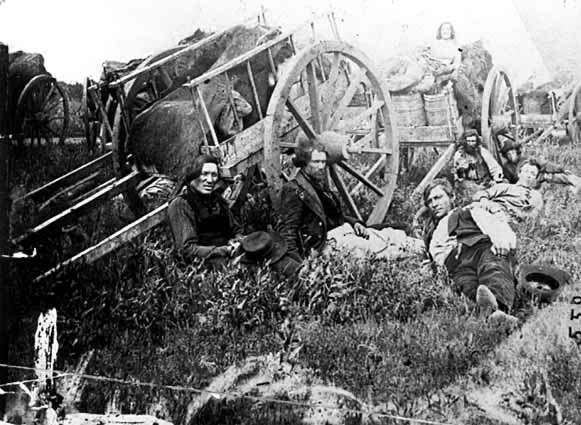
The wagons described by Sprague and some of the Métis people of Minnesota Territory.

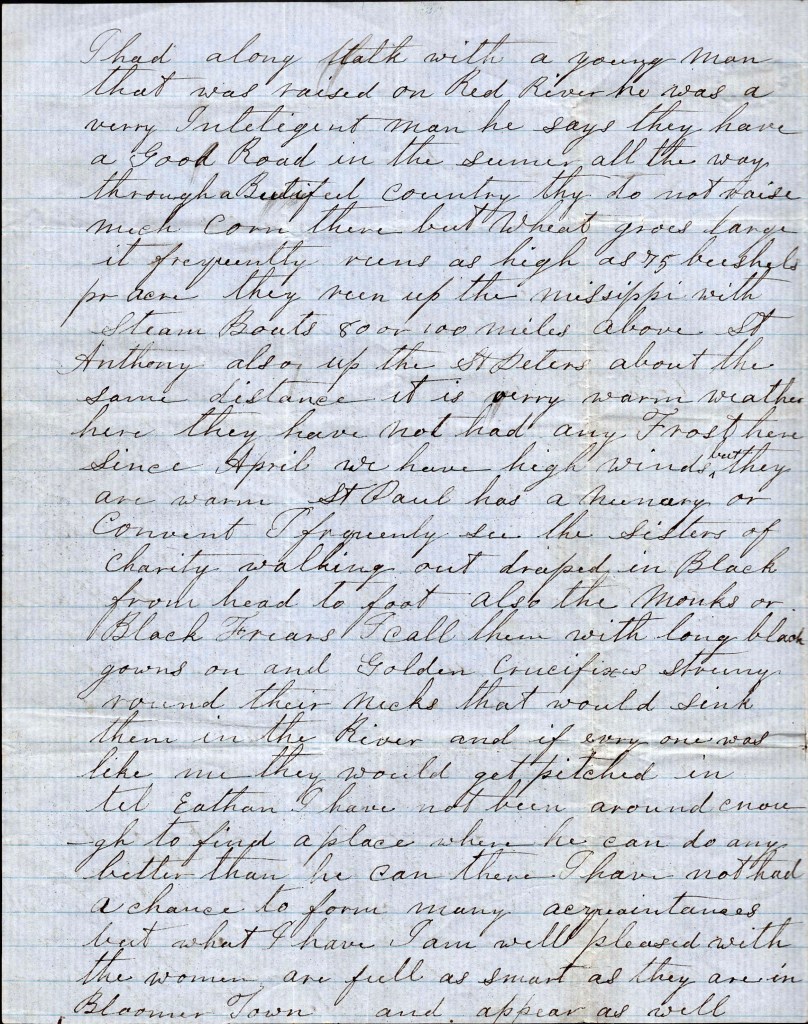
I had a long talk with a young man that was raised in Red River. He was a very intelligent man. He says they have a good road in the summer all the way through a beautiful country. They do not raise much corn there but wheat grows large. It frequently runs as high as 75 bushels per acre. They run up the Mississippi with steamboats 80 or 100 miles above St. Anthony. Also up the St. Peters about the same distance. It is very warm weather here. They have not had any frost here since April. We have high winds but they are warm.

St. Paul has a nunnary or convent. I frequently see the Sisters of Charity walking out draped in black from head to foot. Also the monks or Black Friars, I call them, with long black gowns on and golden crucifixes strung around heir necks that would sink them in the river and if every one was like me, they would get pitched in.

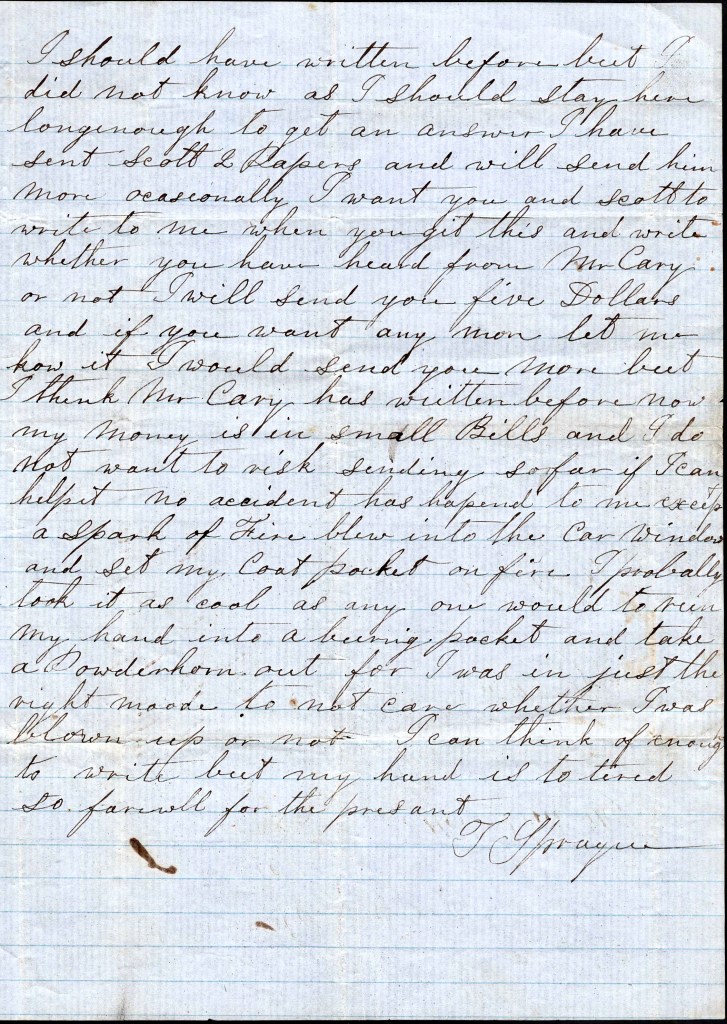
Tell [your cousin] Ethan I have not been around enough to find a place where he can do any better than he can there. I have not had a chance to form many acquaintances but what I have, I am well pleased with. The women are full as smart as they are in Bloomer Town and appear as well. I should have written before but I did not know as I should stay here long enough to get an answer.

I have sent Scott two papers and will send him more occasionally. I want you and scott to write to me when you get this and write whether you have heard from Mr. Cary or not. I will send you five dollars and if you want any more, let me know it. I would send you more but I think Mr. Cary has written before now. My money is in small bills and I do not want to rish sending so far if I can help it.

No accident has happened to me except a spark of fire blew in the car window and set my coat pocket on fire. I probably took it as cool as anyone would to run my hand into a burning pocket and take a powder horn out for I was in just the right mood to not care whether I was blown up or not. I can think of enough to write but my hand is too tired so farewell for the present. — T. Sprague


1 A correspondent for the Hartford Republican recorded his first impressions of St. Paul in a most unfavorable light when he visited the town city in 1855. “It was raining and the streets were covered with mud, black as tar, ” he wrote. “It is situated upon a bluff 60 feet above the river and is surrounded by a bluff still higher, from which you have magnificent views of the amphitheater below. St. Paul has about 6,000 inhabitants, sixty lawyers, six or eight churches, five daily papers (two Republican and three Democratic), and every man takes all papers and advertises in all, though the price is more than double that of our Eastern papers. Speculation is most rampant, and those who are the most reckless, make the most money, a fact which is owing to the rapid rise in land. The country is constantly being filled up with immigrants, hundreds and hundreds daily arriving in the boats, mostly from New England and New York, though every state in the Union is represented. All the best lands within 50 miles of here are taken up.” [Cayuga Chief, 20 November 1855, Auburn, NY]

2 The Red River originates at the confluence of the Bois de Sioux and Otter Trail rivers and flows northward through the Red River Valley, forming most of the border of Minnesota and North Dakota. It continues into Canada and empties into Lake Winnipeg. The watershed was a key trade route of the Hudson Bay Company, transporting furs and other commodities.

3 “In the 17th century a lucrative trade developed between Native Americans who trapped animals near the Great Lakes and traders who shipped the animal furs to Europe. For two centuries this trade network was the Métis people—a mixed race community descended from Native Americans and French traders, as well as other mixed race peoples. In particular, during the latter 18th century, numerous French and English traders in the Minnesota region purchased Sioux wives in order to establish kinship relationships with the Sioux so as to secure their supply of furs from the tribes.” (Wikipedia)
1854: Andrew Clarkson Dunn to Nathaniel Dunn

The following letter was written by Andrew Clarkson Dunn (1834-1918), the son of Nathaniel Dunn (1808-1889) and Charlotte Leonard Tillinghast (1798-1838). Andrew’s father was for forty years an eminent educator, being the first principal of the Wilbraham Academy of Massachusetts, and for many years Professor of Chemistry in Rutger Female College in New York city.

Andrew was educated by his father, and commenced reading law at an early age, under the instructions of Edward Sanford, Esq., and also Judge Campbell, of New York city, and for some time taught school at Fordham, New York. In April, 1854, he came to Minnesota, and was admitted to the bar in the autumn of that year, at a term of Territorial Supreme Court held at St. Paul. He practiced his profession for a few months at Sauk Rapids, and then located in St. Paul, where he was in practice for nearly two years.

In the 1860 US Census, Andrew was enumerated in Verona, Faribault county, Minnesota, making a living as a lawyer. He was married on 1 January 1859 to Diana Jane Smith (1836-1913) and they had an 8 months old daughter named Mary born in late 1859. He was living in Winnebago, Faribault county in 1900, enumerated as a 65 year-old lawyer. According to State history, Andrew is credited with having been the founder of the town of Winnebago. He served as Clerk in the House of Representatives (1864-1866) and as a State Representative (1881-1882. His home in Winnebago is on the National Register of Historic Places.

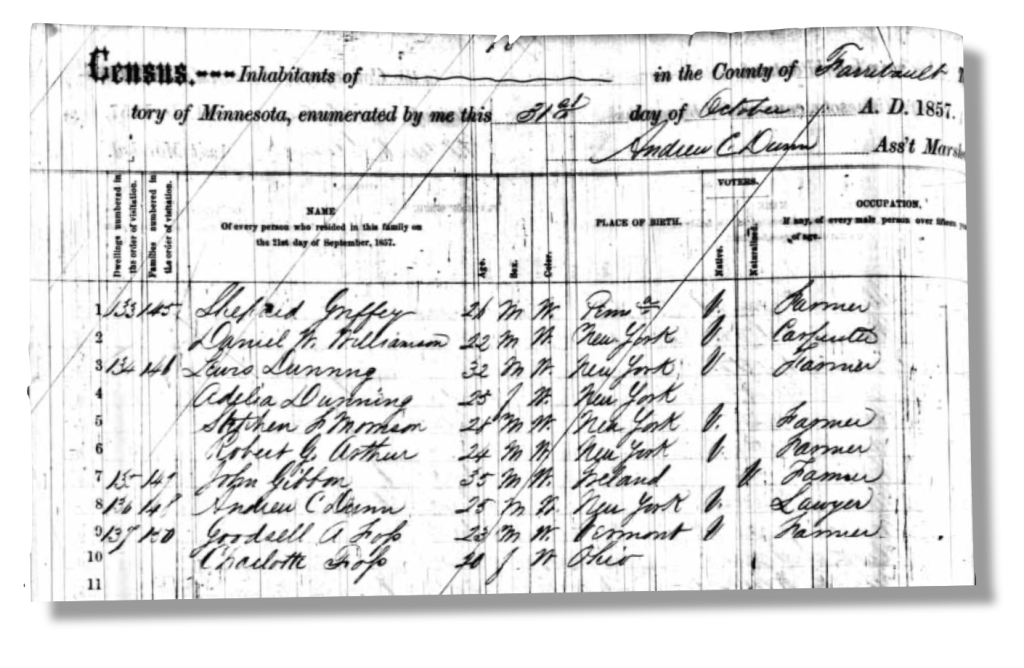
The 1857 Minnesota Territory Census for the County of Faribault. Andrew C. Dunn is enumerated as a 25 year-old White Male, born in New York, and a lawyer by profession. You’ll notice he was also identified as the Assistant Marshall at upper right.

Transcription

Addressed to Nathaniel Dunn, Esq., No. 74 East 23rd St., New York

Benton county, Sauk Rapids, M. T.
June 14th 1854

My Dear Father,

I was just lying down here on a lounge in this wild northwest country when the thought struck me that as the ail went out on Friday (day after tomorrow), that I would write you a few lines, thinking doubtless that you would be glad to hear from me. You will see by the above that I am in “Sauk Rapids” now. “S.R.” be it known to you is as yet merely a town in name—a few houses & few people, and the noble Mississippi flowing at our very feet. S. R. is about 100 miles above St. Paul and about 90 above the Falls of St. Anthony by the course of the river, but somewhat nearer by land as the river is very circuitous in its course.

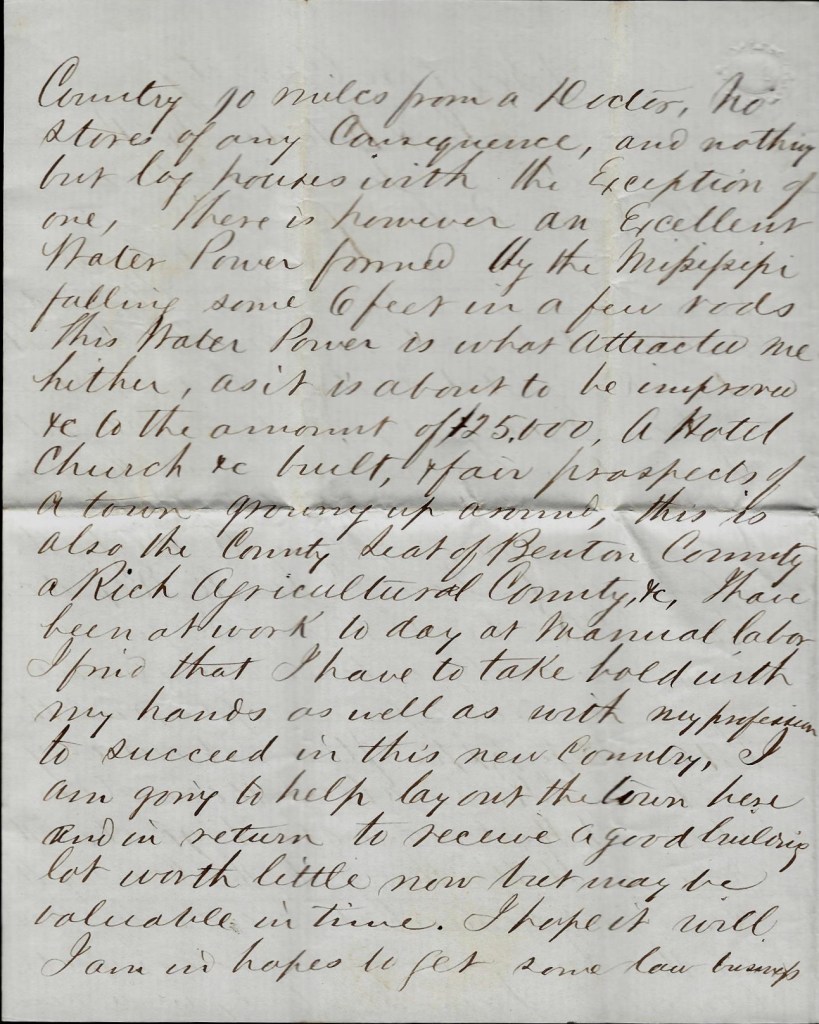
I am now truly in a new country, 90 miles from a doctor, no stores of any consequence, and nothing but log houses with the exception of one. There is, however, and excellent water power formed by the Mississippi falling some 6 feet in a few rods. This water power is what attracted me hither as it is about to be improved, &c. to the amount of $25,000. A hotel, church, &c. built, and fair prospects of a town growing up around. This is also the county seat of Benton county—a rich agricultural county, &c.

I have been at work today at manual labor. I find that I have to take hold with my hands as well as with my profession to succeed in this new country. I am going to help lay out the town here and in return to receive a good building lot worth little now but may be valuable in time. I hope it will. I am in hopes to get some law business to do here, however. Indeed, I have had one suit here already to [ ] before a county justice for which I will receive] 2 or 3 dollars—better than nothing however. I shall have to work here at all kinds of work—harvesting, building, carpenter’s work, &c. I am bound to make it go somehow.

Fort Ripley

I received a letter from Mary & write her by this mail. I wish you would get a late map of Minnesota and I will write you as I think that which will interest you about my trips over the country. The other day I went up to Fort Ripley, the last post on this frontier. It is about 60 miles further up the river than this place. It is built entirely of logs & only intended to awe the Indians. I am within 2 miles of Indian ground & see plenty of Indians of the Winnebago tribe. They disturb no one unless drunk.

While at Fort Ripley (which is in Chippewa country), I enquired about “Copway.” They say he is not a chief of the Chippewa tribe & they don’t acknowledge him as such. They all know him, however. A war party of 30 canoes & seventy warriors passed here in their canoes this a.m. to take “Sioux” scalps. They will not return without them, I know, as the “Sioux” took four of theirs last week.

There is to be a government payment to the Indians (Winnebagos) four miles above here in the course of a week or two. I shall attend it & will write you an account of the proceedings. I have seen 2,000 Indians together in their lodges at their villages 40 miles below here on the Elk River. They are a dirty, miserable race, take them together. The men won’t do a hand’s turn & make the squaws go after & cut wood & do all the labor. I have see the squaws loaded down with tent equipage &c. and the men with their guns or bows and arrows walking leisurely along & seeing them put to it. What a contrast between civilization and barbarism.

Court sits here next week. I may get something to do then. After I have been here six months, I can get some little offices which will help me o live. I want to get Charley out here as soon as I get well started. If I can afford it, I shall come to New York next summer to try and purchase a few law books. Ask Charley if he has done as I requested relative to law books for me. I need some very bad.

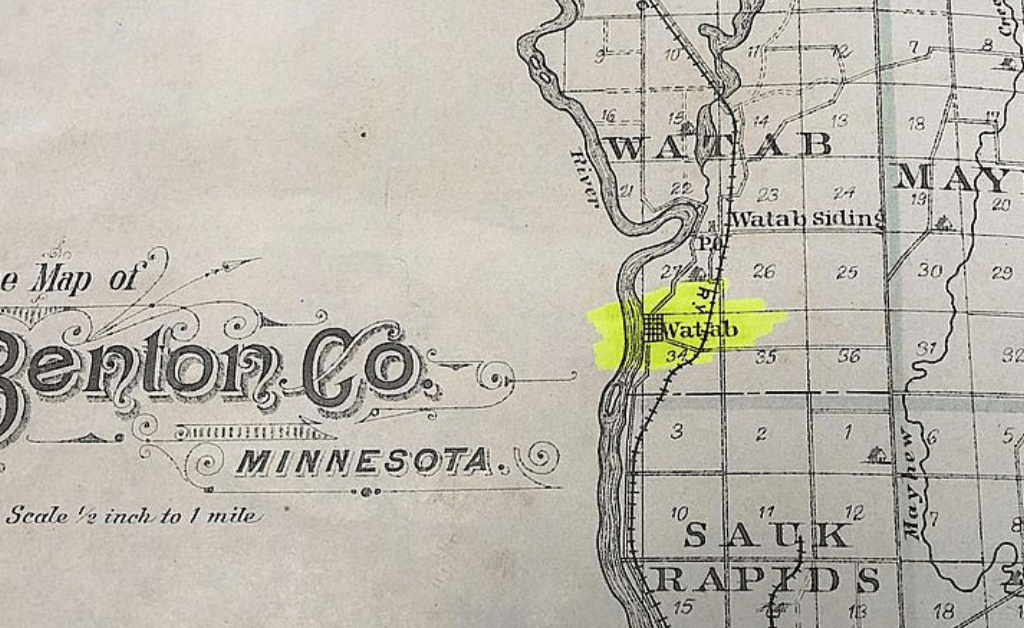
Early Benton County Maps gave the town’s name as “Watab” but it was later changed to Sauk Rapids.

Now father, do write me often as I take such pleasure in receiving letters from you. Make them as cheerful as you can as I want encouraging letters so far from home. Tell Mary to get the son, “Do they miss me at home?” & sing it for me. I sing it sometimes here and it makes me sad to think I am so far from home. But all young men that come here do well and I think I can. If you get the map, you will find on it instead of Sauk Rapids “Watab” but it is a late one. You may find Sauk Rapids laid down.

Direct me at Sauk Rapids, Benton county, M. T. Now goodnight, fear father. My love to mother, Lotty, Ginny, and all. Bless them and keep them for me. Write soon. I never have received the letter with the money in it as yet. I fear it is lost.

Your affectionate son, — Andrew C. Dunn

I’m broke to $1.50.