
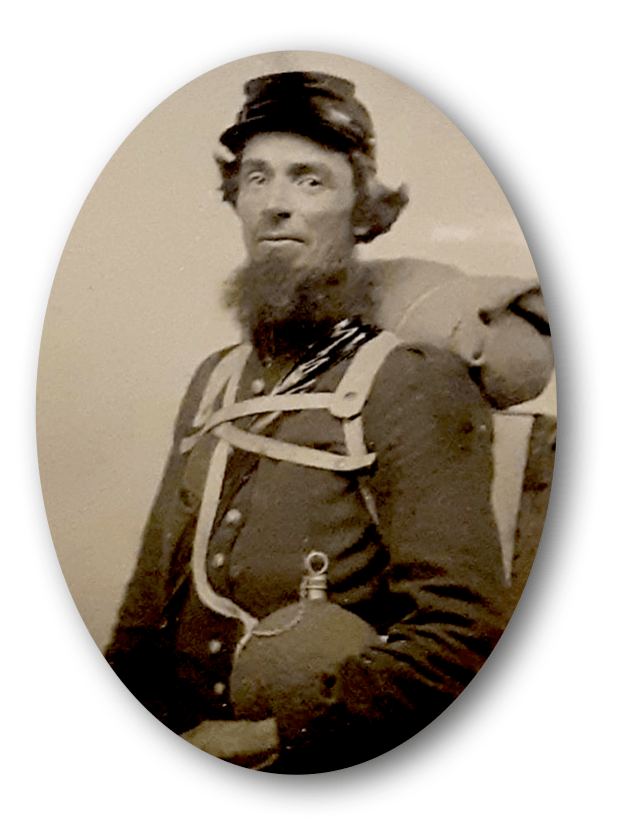
The following letters were written by Philip J. Crewell (1840-1917) who enlisted for two year’s service on 1 May 1861 and entered Co. F, 34th New York Infantry as a corporal. The 34th New York Infantry, a two years regiment, were known as “The Herkimer Regiment,” and they served in the 2nd Corps, Army of the Potomac. They saw action at Yorktown; at Fair Oaks, where they lost 97 men, killed, wounded and missing; they lost heavily in the 7 Days Battles; at Antietam, they lost 154 men, killed, wounded, and missing; and they also fought at Fredericksburg and Chancellorsville. Philip was discharged on 30 June 1863.
On May 1, 1863, the day prior to the Battle of Chancellorsville, six companies of the regiment mutinied and refused to fight on the grounds that their two year enlistment terms had expired, although in fact this was still almost two months away. Brig. Gen John Gibbon, who commanded the division that the 34th New York was in, brought up the 18th Massachusetts and gave them orders to shoot the men of the 34th New York if they wouldn’t fight. The regiment reformed and served dutifully during the Second Battle of Fredericksburg two days later. On June 30, the 34th New York mustered out and the two year men went home, the remaining companies, who had signed up for three years of service, being transferred to the 82nd New York Infantry.
Philip’s first letter also contains an account of a mutiny that occurred in the ranks of the 34th New York Infantry—this one taking place a year earlier. Philip’s version of events appear markedly different than the official newspaper accounts which don’t quite tell the whole story. Philip’s second letter describes in great detail the Battle of Antietam and his third letter was written approximately three weeks before the Battle of Chancellorsville.
Philip was the son of John Crewell and Alida Luke of German Flatts, Herkimer county, New York.
Letter 1
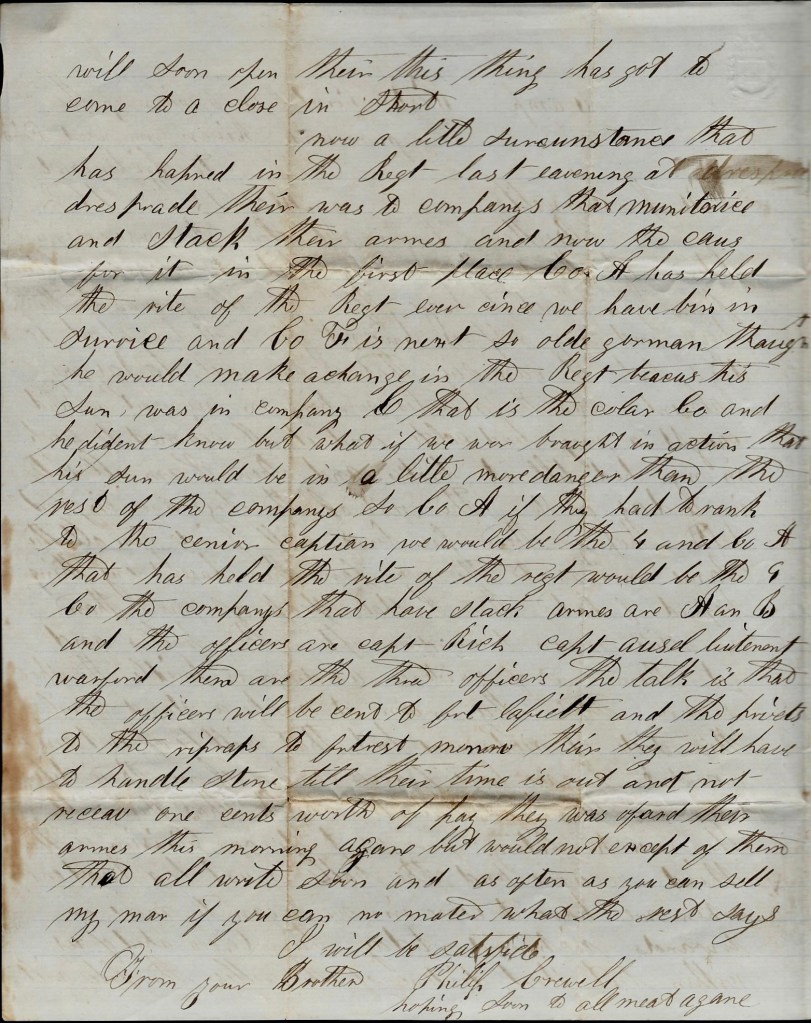
Camp West Point,
or 3 miles up the Pamunky River from West Point to Richmond
May 12th 1862
J. J. Crewell,
Brother, I now sit down to answer your letter of the 6th. I was very glad to receive a letter from you and to hear from you all, Now as to the boys and myself, I have not been well for about 10 days but I can say that I am well today. My ailment was the measles working in my head. I had caught a very bad cold and it all seemed to work in my head till it broke and then I am all right in a day or two. The rest of the boys are in good health, hoping these few lines will find you all the same.
Now as to the warfare, there hasn’t any happened of late that I shall speak of more than we still mean to invade on after the rebels and get them out of existence as soon as possible. The show is now that they mean to make a stand 3 miles this side of Richmond but that will be of not much account for we have fources coming from three different ways on them and I don’t think that there will be much fighting for us to do. Our division is the third reserve adn the battle must be a hard one when we have to come in.
We move on towards Richmond today. There’s 60,000 ahead of us within but short distance of the rebels. The fight will soon open there. This thing has got to come to a close in short.

Now a little circumstance that has happened in the regiment. Last evening at dress parade, there was two companies that mutinied and stacked their arms. And now [I will tell you] the cause for it. In the first place, Co. A has held the right of the regiment ever since we have been in the service and Co. F is next. So Old Gorman 1 thought he would make a change in the regiment because his son [Richard L. Gorman 2] was in Co. C—that is the color company and he didn’t know but what if we were brought into action that his son would be in a little more danger than the rest of the companies. So Co. A if they had to rank to the senior captain, we would be the 4th and Co. A that was held to the right of the regiment would be the 9th comany. The companies that have stacked arms are A and B and the officers are Capt. [Davis J.] Rich [of Co. D], Capt. [William L.] Oswald [of Co. A], Lieutenant [Benjamin H.] Warford. These are the three officers. The talk is that the officers will be sent to Fort Lafayette and the privates to the rip raps to Fortress Monroe. There they will have to handle stone till their time is out and not receive one cents worth of pay. They was offered their arms this morning again but would not accept of them.
That is all. Write soon and as often as you can. Sell my [ ] if you can no matter what the rest says. I will be satisfied. From your brother, — Philip Crewell
Hoping soon to all meet again.
1 Willis Arnold Gorman (1814-1876) served as a Major in Gen. Lane’s regiment of Indiana Volunteers in the Mexican War where he was severely wounded at the Battle of Buena Vista. He was appointed governor of the territory of Minnesota in 1853 and later served in the Minnesota legislature. In the Civil War he began his service as the Colonel of the 1st Minnesota but was promoted to Brigadier-General of volunteers in September 1861 and commanded a Division that included the 34th New York during the Peninsula Campaign. According to Philip’s letter, the mutiny in the 34th originated from Gen. Gorman’s desire to have his son’s company’s letter designation changed which upset the seniority hierarchy of the officers in the regiment.
2 Richard L. Gorman was 26 years old when he enlisted on 27 April 1861 at St. Paul, Minn., to serve as a private in the 1st Minnesota Infantry. On 1 January 1862 he received a commission as 1st Lieutenant of Co. C, 34th New York Infantry. Richard was promoted to Captain of Co. A on 24 June 1862. He resigned his commission on 2 March 1863.


Clipping from the Cincinnati Daily Commercial. Monday, 2 June 1862

Letter 2
[Note: The following letter is from the private collection of Keith Fleckner and was offered for transcription and publication on Spared & Shared by express consent.]
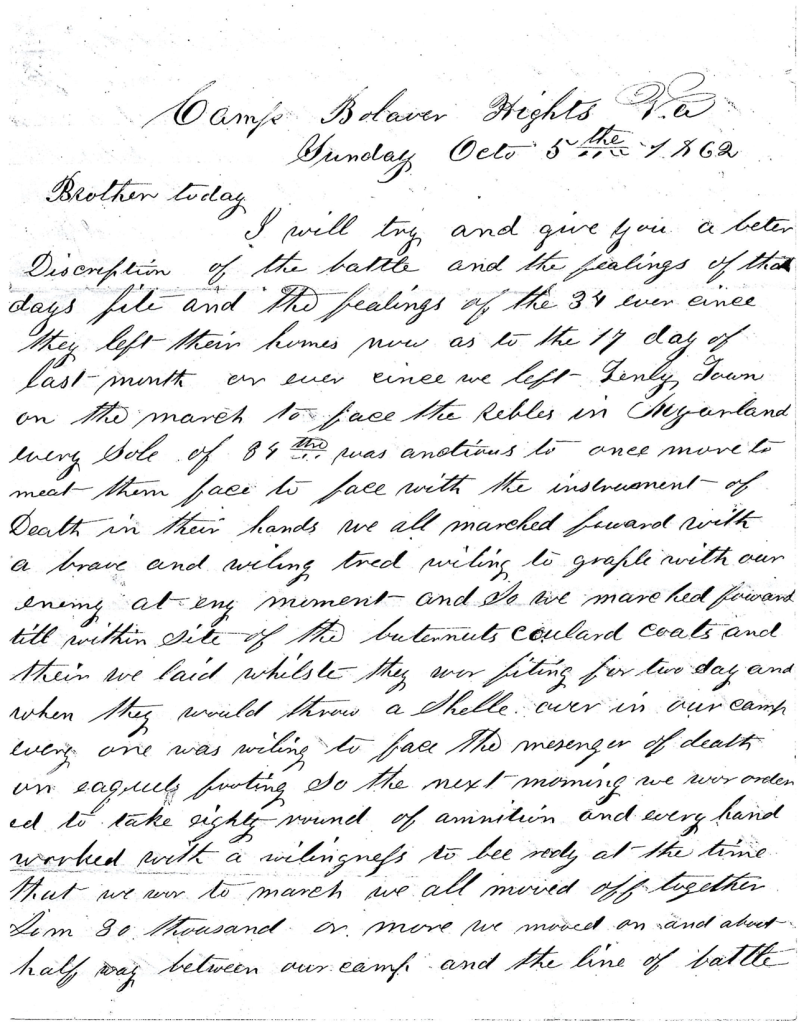
Camp Bolivar Heights, Virginia
Sunday, October 5th 1862
Brother,
Today I will try and give you a better description of the Battle [of Antietam] and the feelings of that day’s fight and the feelings of the 34th [New York Infantry] ever since they left their homes. Now as to the 17th day of last month, or ever since we left Tenleytown on the march to face the Rebels in Maryland, every soul of the 34th was anxious to once move to meet them face to face with the instrument of death in their hand. We all marched forward with a brave and willing tread, willing to grapple with our enemy at any moment. And so we marched forward till within sight of the butternut’s colored coats and there we laid whilst they were fighting for two days, and when they would throw a shell over in our camp, everyone was willing to face the messenger of death on equal footing.
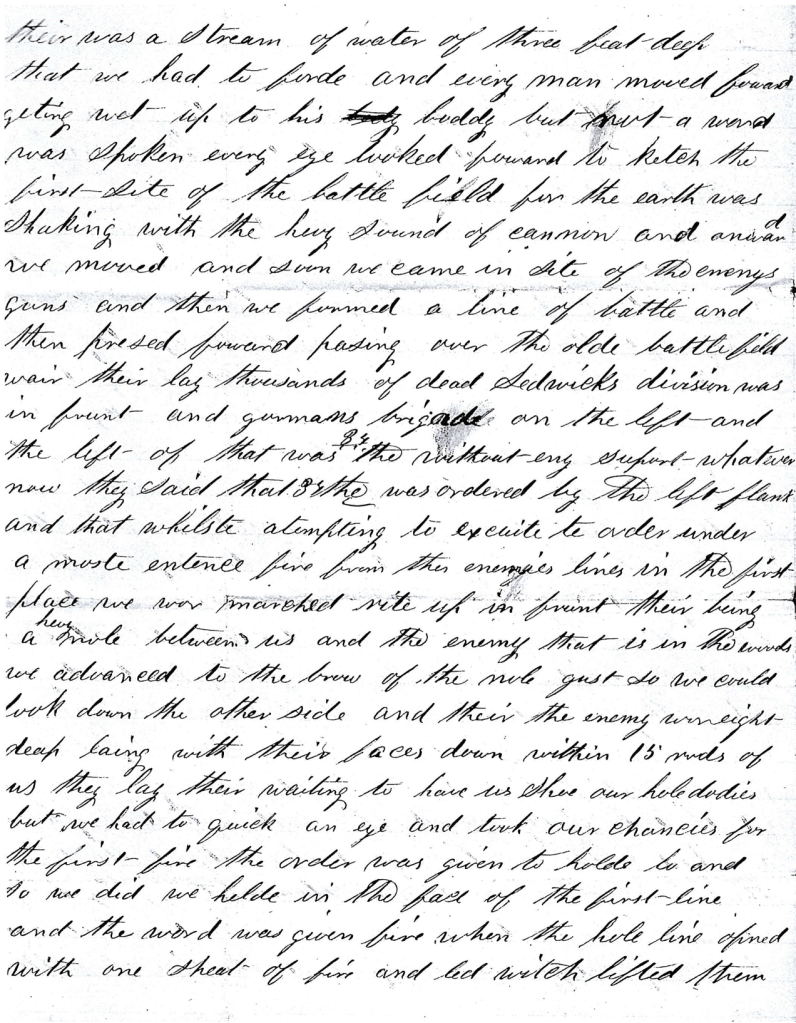
So the next morning we were ordered to take eighty rounds of ammunition and every hand worked with a willingness to be ready at the time that we were to march. We all moved off together—some 30 thousand or more. We moved on, and about halfway between our camp and the line of battle, there was a stream of water of three feet deep that we had to ford, and every man moved forward getting wet up to his body, but not a word was spoken. Every eye looked forward to catch the first sight of the battlefield, for the earth was shaking with the heavy sound of cannon. Onward we moved and soon we came in sight of the enemy’s guns, and then we formed a line of battle and then pressed forward, passing over the battlefield where there lay thousands of dead.
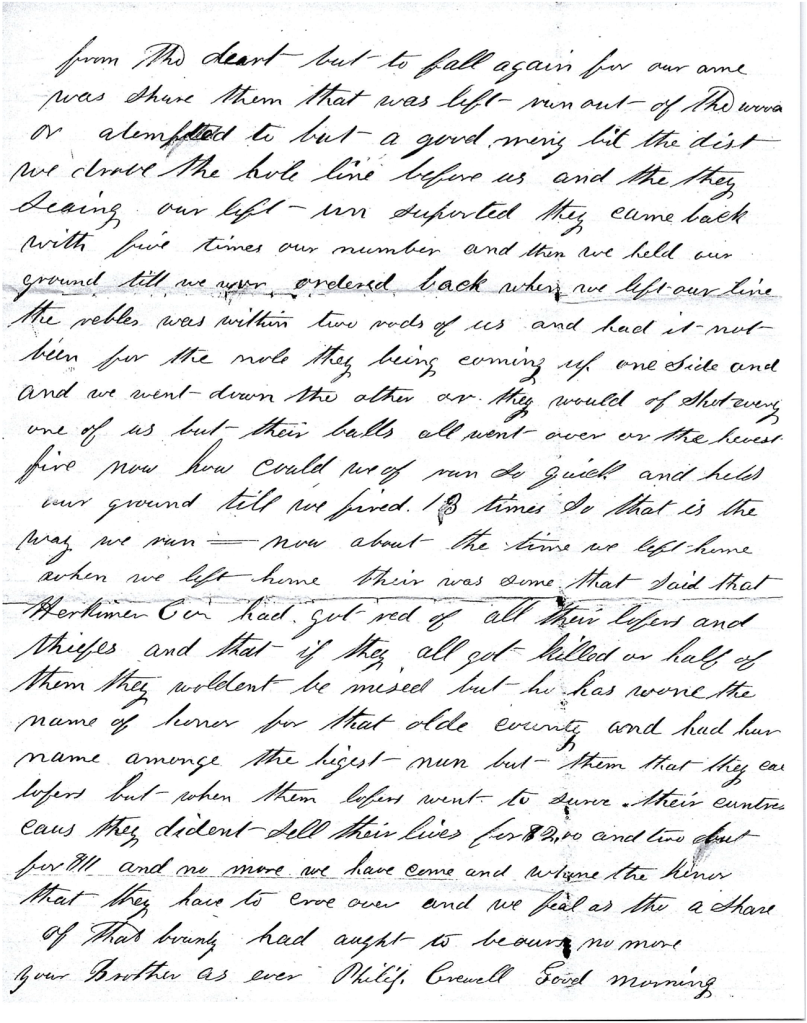
Sedgwick’s Division was in front and Gorman’s Brigade on the left, and the left of that was the 34th—without any support whatever. Now they said that 34th was ordered by the left flank and that whilst attempting to execute the order under a most intense fire from their enemy’s lines. In the first place, we were marched right up in front, there being a heavy knoll between us and the enemy that is in the woods. We advanced to the brow of the knoll just so we could look down the other side, and there the enemy were, eight deep, laying with their faces down, within 15 rods [80 yards] of us. They lay there waiting to have us show our whole bodies, but we had too quick an eye and took our chances for the first fire. The order was given to hold low and so we did. We held in the face of the first line and the word was given, “fire!” when the whole line opened with one sheet of fire and lead which lifted them from the dirt, but to fall again, for our aim was sure. Them that was left run out of the woods, or attempted to, but a good many bit the dust.
We drove the whole line before us and they, seeing our left unsupported, they came back with five times our number, and then we held our ground till we were ordered back. When we left our lines, the rebels was within two rods of us, and had it not been for the knoll, they being coming up one side and we went down the other, or they would have shot every one of us. But their balls all went over [our heads], or the heaviest fire. Now, how could we have run so quick and held our ground till we fired 13 times, so that is the way we run.
Now, about the time we left home. When we left home there was some that said that Herkimer Country had got rid of all their loafers and thieves and that if they all got killed, or half of them, they wouldn’t be missed. But who has won the name of honor for that old county, and had her name among the highest? None but them that they call loafers. But when them loafers went to serve their country’s cause, they didn’t sell their lives for $2.00 and two but for $11 and no more. We have come and won the honor that they have to crow over, and we feel as though a share of that bounty had out to be ours. No more.
Your Brother, as ever — Philip Crewell
Good morning
Letter 3
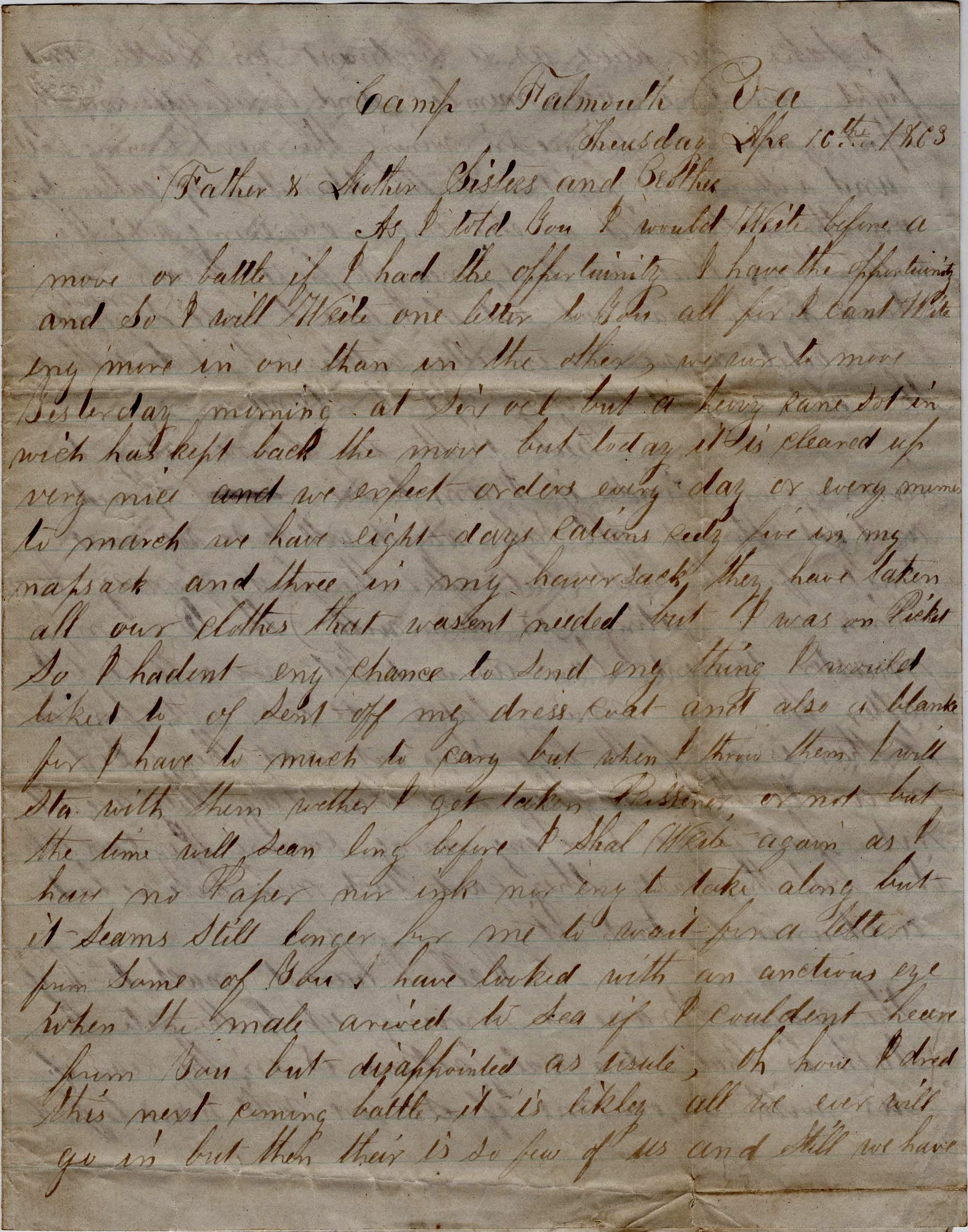
Camp Falmouth, Va.
Thursday, April 10, 1863
Father & Mother, sisters and brothers,
As I told you I would write before a move or battle if I had the opportunity and so I will write one letter to you all for I can’t write any more in one than in the others. We were to move yesterday morning at six o’clock but a heavy rain set in which has kept back the move. But today it is cleared up very nice. We expect orders every day or every moment to march. We have eight days rations ready. give in my knapsack and three in my haversack. They have taken all our clothes that wasn’t needed but I was on picket so I hadn’t any chance to send anything. I would liked to of sent off my dress coat and also a blanket for I have too much to carry but when I throw them I will stay with them whether I get taken prisoner or not.
But the time will seem long before I shall write again as I have no paper nor ink nor any to take along. But it seems still longer for me to wait for a letter from some of you. I have looked with an anxious eye when the mail arrived to see if I couldn’t hear from you but [I was] disappointed as usual.
Oh how I dread this next coming battle. It is likely all we ever will go in but then there is so few of us and still we have to take our place as a regiment in battle and fight five times our number, and by all appearance, they put great confidence in winning the next coming battle and without we fight with the determination of either dying on the battlefield or else conquer our enemy, why they will think that we don’t mean to fight because our time is so near out. But if I have to fight so much greater the odds as we have in other battles, why I don’t think the Old 34th will be very apt to stand.
But, [what] is the use of me writing to have your minds if I am to be spared and get through all safe. Why it will be so we must trust for the best. But after the firsts of May. I think my fighting is done with. The damn pay master hasn’t been around yet nor will he till after the next battle is over with for fear if there is any of the Boys skins out and they court martial them if they have their pay, they are all right. But if we have any money coming, they can take it. But the bounty they can’t touch nor have we had a chance to touch it.
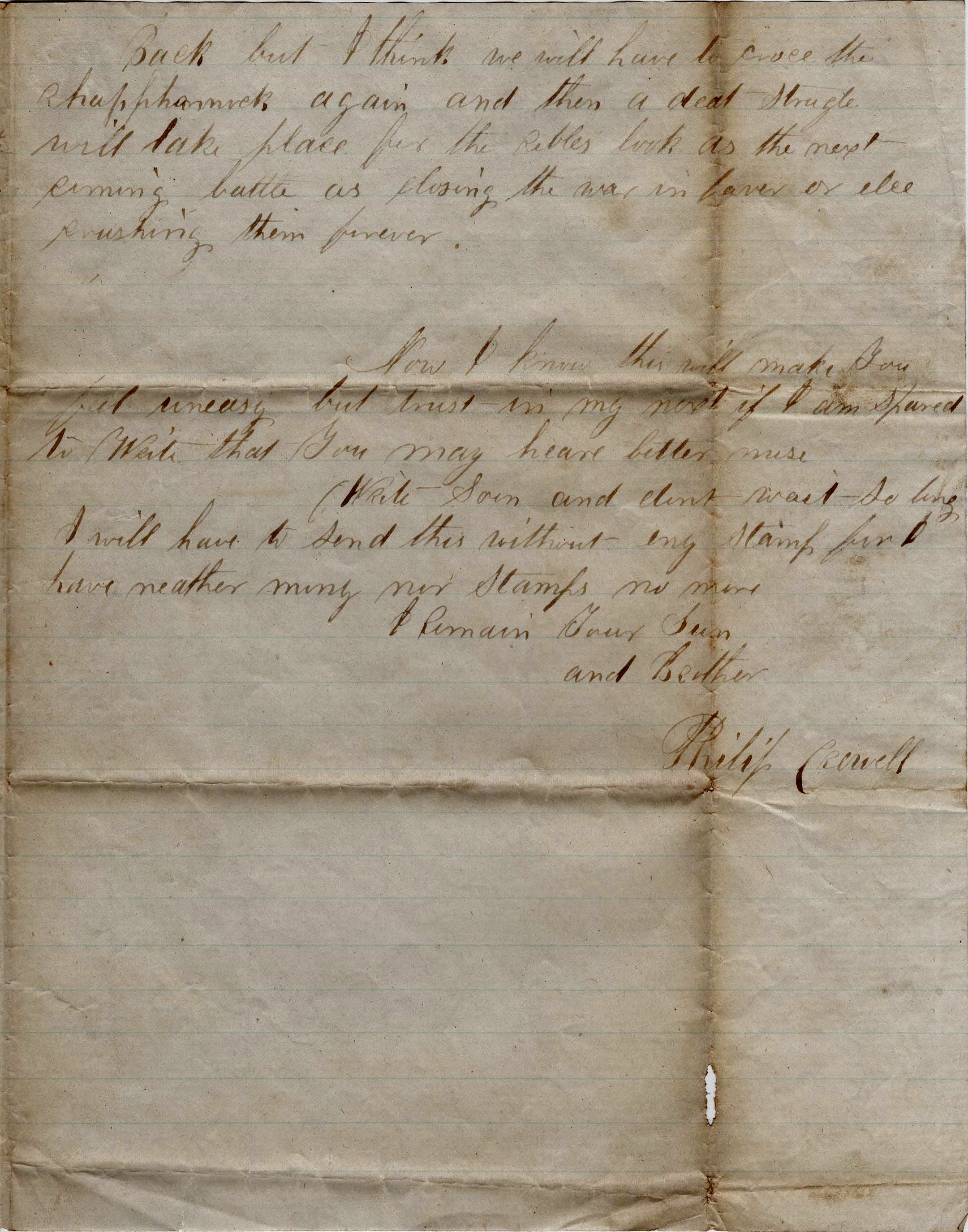
Well, I haven’t much to write. The wagon train is moving up to the right. The talk is that Stonewall Jackson is in the rear of us with 50,000 men. If so, we will have to fall back. But I think we will have to cross the Rappahannock again and then a death struggle will take place for the Rebels look at the next battle as closing the war in [their] favor or else [our] crushing them forever.
Now I know this will make you feel uneasy but trust in my next if I am spared to write that you may hear better news. Write soon and don’t wait so long. I will have to send this without my stamp for I have neither money nor stamps. No more. I remain your son and brother, — Philip Crewell

 Spared & Shared 23