Category Archives: New Orleans

1865: Robert Day Williams to Maggie Steere Williams

The following letter was written by Robert Day Williams (1844-1929), the 21 year-old son of William Hart Williams (1811-1896) and Margaret Parsons Foote (1814-1893). In his letter, Robert mentions his older brother Henry Smith Williams (1836-1868) and his younger sister Margaret (“Maggie”) Steere Williams (1846-1928, to whom he addressed his letter. Robert’s father moved his family from Madison county, New York, to Albany in the mid-1840s to open a jewelry business.

Robert’s reason for being in New Orleans isn’t known for certain but it appears that both he and his older brother Henry, who died in 1868, were engaged in the jewelry business with their father and may have been agents for the business in New Orleans at the time. I could find no record of his having been in the military. His 1929 obituary merely observes that he was a retired Albany jeweler and a life-long member of the Masons.

Transcription
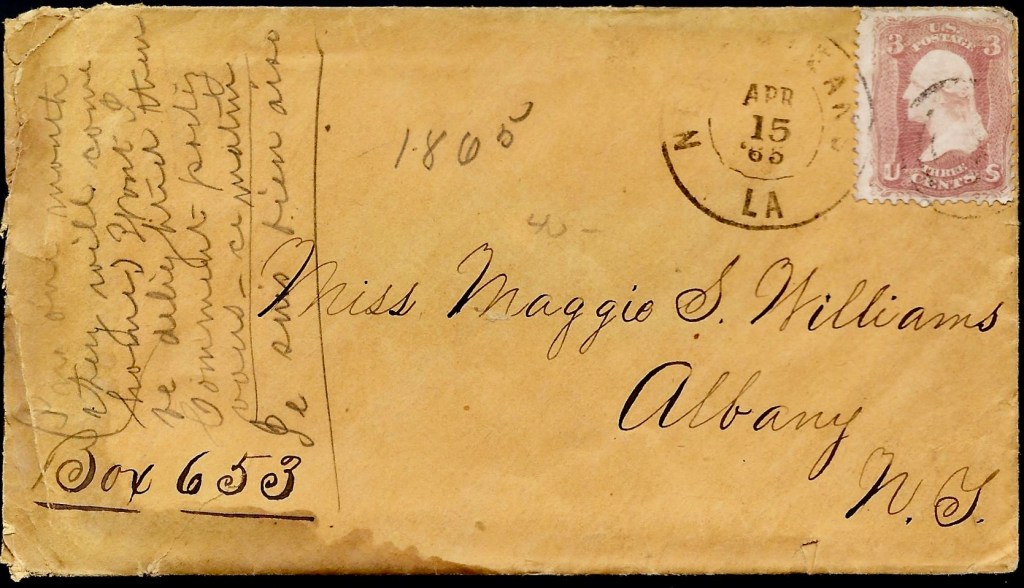
Addressed to Miss Maggie S. Williams, Albany, New York

New Orleans
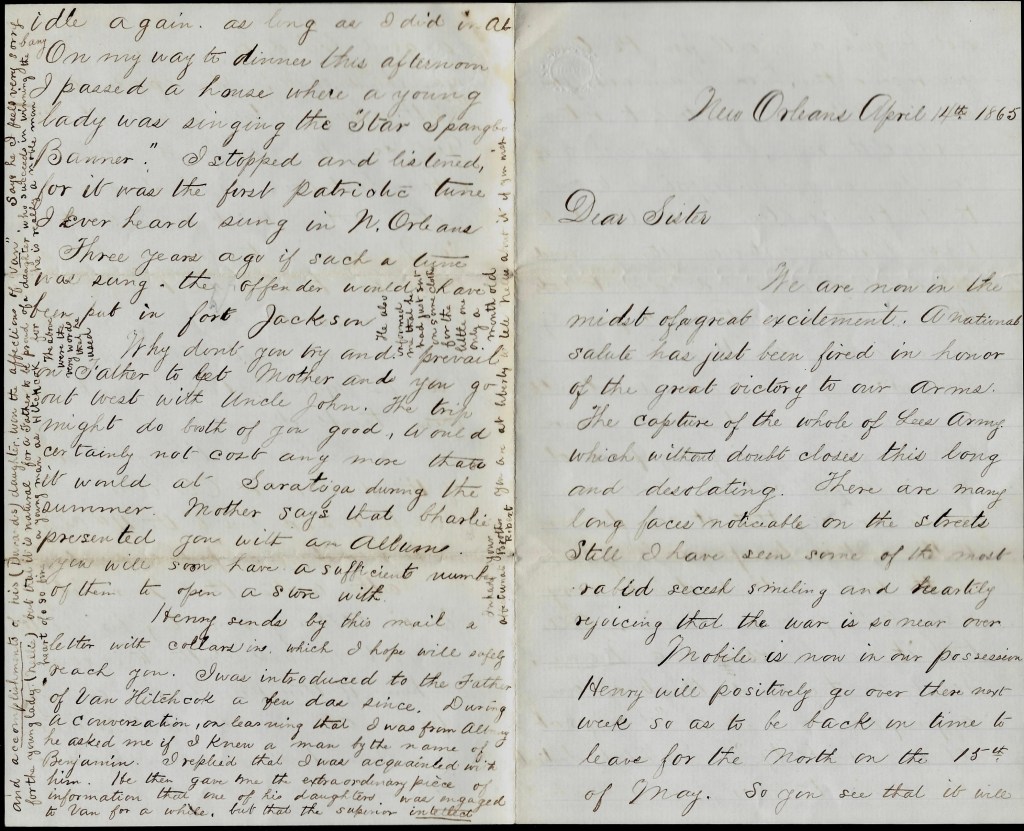
April 14th 1865

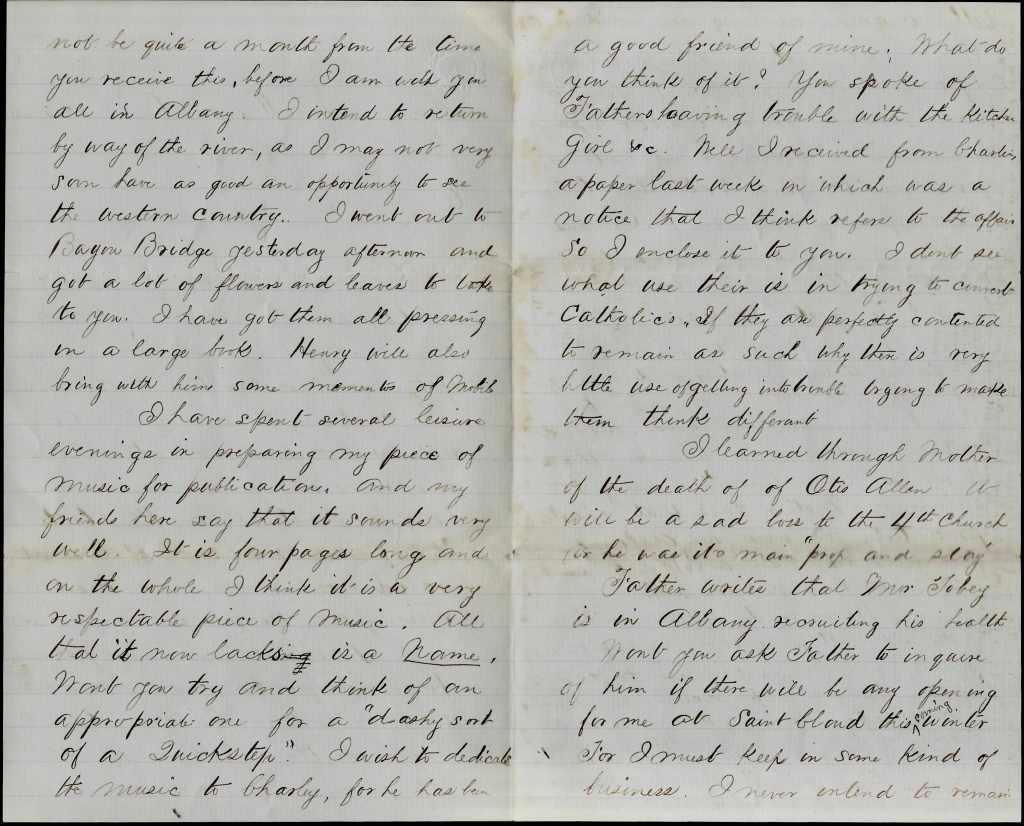
Dear Sister,

We are now in the midst of a great excitement. A National Salute has just been fired in honor of the great victory to our arms—the capture of the whole of Lee’s Army which without doubt closes this long and desolating [war]. There are many long faces noticeable on the streets. Still I have seen some of the most rabid secesh smiling and heartily rejoicing that the war is so near over.

Mobile is now in our possession, Henry will positively g over there next week so as to be back on time to leave for the North on the 15th of May. So you see that it will not be quite a month from the time you receive this before I am with you all in Albany. I intend to return by way of the river as I may not very soon have as good an opportunity to see the western country.

I went out to Bayou Bridge yesterday afternoon and got a lot of flowers and leaves to take to you. I have got them all pressing in a large book. Henry will also bring with him some mementos of Mobile.

I have spent several leisure evenings in preparing my piece of music for publication. And my friends here say that it sounds very well. It is four pages long and on the whole I think it is a very respectable piece of music. All that is now lacking is a name. Won’t you try and think of an appropriate one for a “dashy sort of a Quickstep.” I wish to dedicate the music to Charley for he has been a good friend of mine. What do you think of it?

You spoke of Fathers having trouble with the kitchen girl, &c. Well I received from Charles a paper last week in which was a notice that I think refers to the affair so I enclose it to you. I don’t see what use there is in trying to convert Catholics. If they are perfectly contented to remain as such, why there is very little use of getting into trouble trying to make them think different.

I learned through Mother of the death of Otis Allan. It will be a sad loss to the 4th Church for he was its main “prop and stay.” Father writes that Mr. Tobey is in Albany recruiting his health. Won’t you ask Father to inquire of him if there will be an opening for me at Saint Cloud this coming winter for I must keep in some kind of business. I never intend to remain idle again as long as I did in Albany.

On my way to dinner this afternooon, I passed a house where a young lady was singing the “Star Spangled Banner.” I stopped and listened for it was the first patriotic tune I ever heard sung in New Orleans. Three years ago, if such a tune was sung, the offender would have been put in Fort Jackson.

Why don’t you try and prevail on Father to let Mother and you go West with Uncle John. The trip might do both of you good. Would certainly not cost any more than it would at Saratoga during the summer. Mother says that Charlie presented you with an Album. You will soon have a sufficient number of them to open a store with.

Henry sends by this mail a letter with collars which I hope will safely reach you. I was introduced to the father of Van Hitchcock a few days since. During a conversation, on learning that I was from Albany, he asked me if I knew a man by the name of Benjamin. I replied that I was acquainted with him. He then gave me the extraordinary piece of information that one of his daughters was engaged to Van for awhile but that the superior intellect and accomplishments of his (Durand’s) daughter, won the affections of “Van.” Says he, “I feel very sorry for the young lady (Nellie) but that it is natural for a Father to be proud of a daughter who succeeds in winning the heart of so fine a young man as Hitchcock for he is really a noble man.” The above were the very words he used. He also informed me that he had just sent on some clothes for the little one only a month old. You are at liberty to tell Nellie about it if you wish.

In haste, your affectionate brother, — Robert
1840: Henry Owen to Henry Jessop

The New Orleans Fire Department

This letter was written in mid-March 1840 by Henry Owen from New Orleans, Louisiana, who we learn has just lost his inventory in a fire that took place at No. 24 Chartres Street where he had it stored. A newspaper advertisement placed by Henry Owen appearing in The Daily Picayune of Thursday, March 5, 1840—just 8 days before the fire started—indicates that he was an agent selling Joseph Gillott’s Patent Steel Pens. The advertisement states that he had “a large assortment of the well known pens for sale wholesale…at 24 Chartres street, upstairs.”

According to a newspaper article appearing in the New York Daily Express on Monday, 30 March 1840, the fire that “broke out on the night of the 13th inst., [was in] the bookstore and stationery warehouse of D. Felt & Co., No. 24 Chartres street. The flames rapidly extended to other houses on either sides; viz., to Armistead & Spring’s foreign & domestic dry goods store, No. 22, and to L. Chittenden’s importing silk and fancy store, No. 26. Notwithstanding the indefatigable exertions of the firemen, the flames took a northerly direction and rapidly consumed the clothing store of Paul Tulane & Co., No. 23, and the saddlery and harness warehouse of Smith, Cantzon, & Co., No. 30, corner of Chartres and Custom House streets.

It does not appear that Henry operated as an agent selling Gillott’s Patent Steel Pens for more than just a few months in the winter of 1839-40. From newspaper advertisements we learn that he was selling Gillott pens in New York City at 109 Beekman Street in the summer of 1837 and in 1838. He apparently returned to New York City following his loss (albeit insured) at New Orleans. There is a notice of his selling these same pens as the “sole agent” at 91 John Street in New York City in 1847 and even as late as 1864.

Henry wrote the letter to Henry Jessop (1808-1849), the son of William Jessop (1772-1835) and Rebecca Taylor (1770-1859). Henry took over his father’s firm William Jessop & Sons after his father’s death in 1835. The firm produced high quality steel in its Sheffield, England, factory, but shipped to agents in America.

Henry’s connection to the Jessop’s of Sheffield, England, convinces me he was the same Henry Owen who was born in Sheffield, England, on 10 May 1811 who was described as being 5’10” inches tall, with blue eyes and light brown hair, and 53 years old when he applied for a passport in 1864 giving 26 West 25th Street on NYC as his address.

Transcription

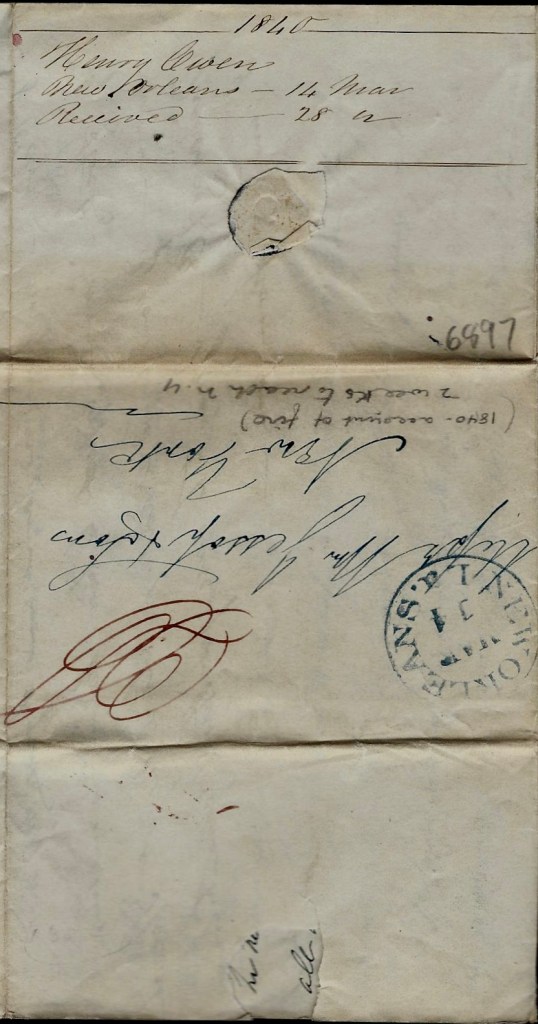
Stampless cover addressed to Messers. William Jessop & Sons, New York

New Orleans [ Louisiana]
3 a.m., March 14, 1840

Mr. Hy. Jessop
My dear sir,

Late as it is, I must write you, as were I to trust to writing early in the morning, I should probably fail. The fact is, I am burnt out, not as a rap saved, but fully insured, my book is burnt, for fortunately, I yesterday added up the sales, and can most unequivocally swear to the amount within a trifle.

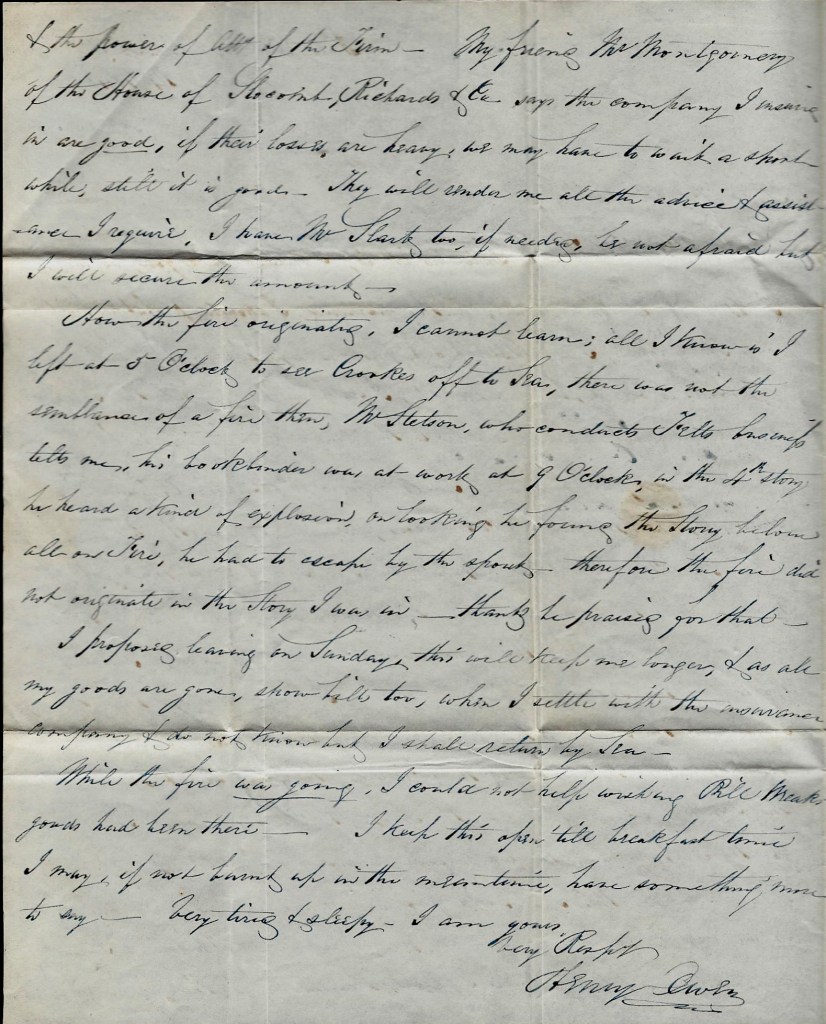
Now for particulars. I was engaged in conversation with a stationer, when the cry of “Fire” arose. We ran out of the verandah & learnt the fire was at No. 24 Chartres Street. I hurried to the spot and running into the lower store for the key, asked some gentleman to lend a hand. On opening the side door leading upstairs, I found the top of the stairs on fire. Of course I could not go through them. I got to the street and that moment every iron window shutter was burst open by the force of the flames. The fire burnt the store on the South and Four on fire on the North to Custom House St. Luckily for the neighboring [buildings], the walls fell almost as the fire reaching them. But for this, I should probably have been burned out of house as well, to make sure I did not pack up. Whiting & Stark, narrowly escaped. All I regret the loss of is the prices you sent & the power of attorney of he firm.

My friend, Mr. Montgomery of the House of Slocomb, Richards & Co., says the company I insured in are good. If their losses are heavy, we may have to wait a short while—still it is good. They will render me all the advice and assistance I require. I have Mr. Stark too, if needed. Be not afraid but I will secure the amount.

How the fire originated, I cannot learn. All I know is I left at 5 o’clock to see Crookes off to sea. There was not the semblance of a fire then. Mr. Stetson who conducts [David] Felt’s [stationery] business tells me his bookbinder was at work at 9 o’clock in the 4th story. He heard a kind of explosion [and] on looking, he found the story below all on fire. He had to escape by the spout. Therefore the fire did not originate in the story I was in—thanks be praised for that.

I proposed leaving on Sunday [but] this will keep me longer. And as all my goods are gone, show bills too, when I settle with the insurance, I do not know but I shall return by sea.

While the fire was going, I could not help wishing Phill Meaks’ [Weak’s?] goods had been there. I keep this open till breakfast time. I may, if not burnt up in the meantime, have something more to say. Very tired and sleepy, I am yours. Very respectfully, — Henry Owen

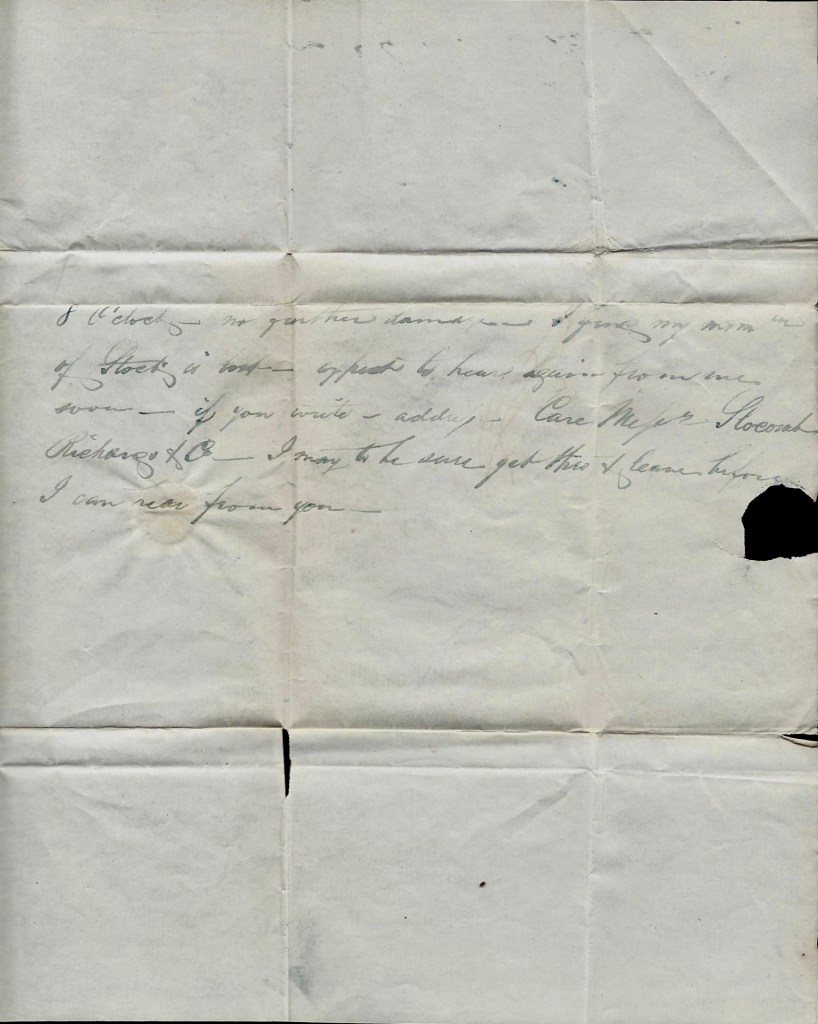
8 o’clock. No further damages. I find my [ ] of stock is lost. Expect to hear again from me soon. If you write. Address Care of Messer Slocomb, Richards, & Co. I may to be sure get this and leave before I can hear from you.

1839: Lyman Adams to Austin Adams

How Lyman might have looked in 1839

This letter was written by Lyman Adams (1815-1859), the son of Dr. Charles Adams and Sarah McAllister (17901868) of Oakham, Massachusetts. The letter was datelined from New Orleans in late December 1839, less than two weeks after his arrival in the Crescent City and captures his first impressions of the city and its inhabitants.

From the content of the letter we can deduce that he traveled to New Orleans to enter into employment with the firm Layton & Co. I cannot find that firm listed in New Orleans; it may have been a firm based in New England and Lyman was merely their New Orleans agent. Later he would establish his own business, partnering with Frederick Brand in the firm, Brand, Adams & Co., their ship chandlery and hardware store located at 53 Old Levee and No. 16 and 18 Conti Street. The partnership was dissolved in 1852 and Lyman died at the age of 1843 on 19 March 1849 in New Orleans but not before he married Sarah Brown and had a child named Urgust Lee Adams.

Lyman wrote the letter to his younger brother, Austin Adams (b. 1811).

New Orleans in the mid 1840s.

Transcription

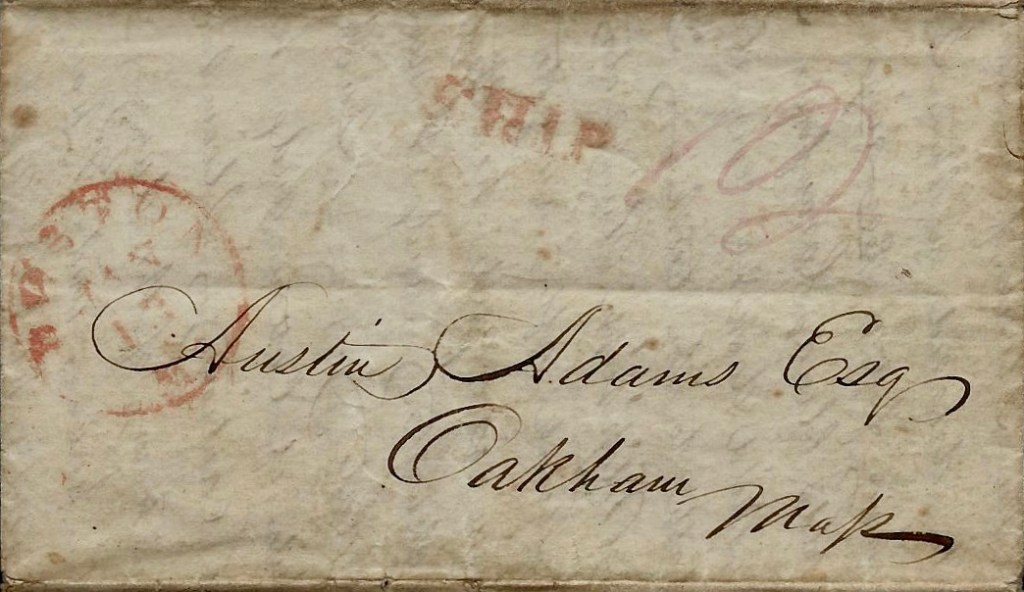
Addressed to Austin Adams, Esq., Oakham, Massachusetts

New Orleans [Louisiana]
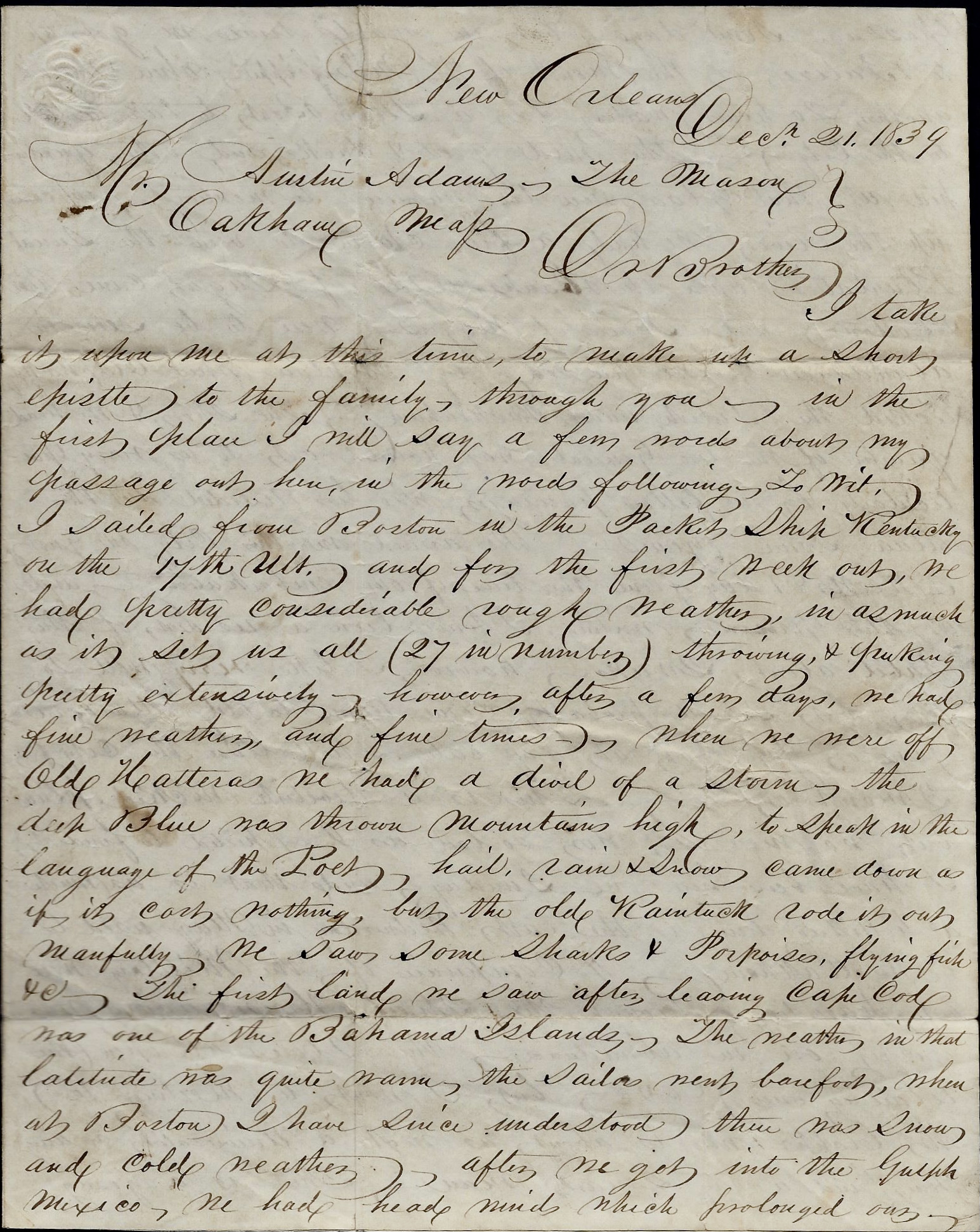
December 21, 1839

Mr. Austin Adams, the Mason
Oakham, Massachusetts

Dear Brother,

I take it upon me at this time to make up a short epistle to the family through you. In the first place I will say a few words about my passage out here, in the words following, to wit: I sailed from Boston in the Packet Ship Kentucky on the 17th ult. and for the final week out, we had pretty considerable rough weather, inasmuch as it set us all (27 in number) throwing & puking pretty extensively. However, after a few days, we had fine weather and fine times. When we were off Old Hatteras, we had a devil of a storm. The deep blue was thrown mountains high, to speak in the language of the poet, hail, rain & snow came down as if it cost nothing, but the Old Kaintuck rode it out manfully. We saw some sharks & porpoises, flying fish, &c. The first land we saw after leaving Cape Cod was one of the Bahama Islands. The weather in that latitude was quite warm. The sailors went barefoot, When at Boston I have since understood there was snow and cold weather.

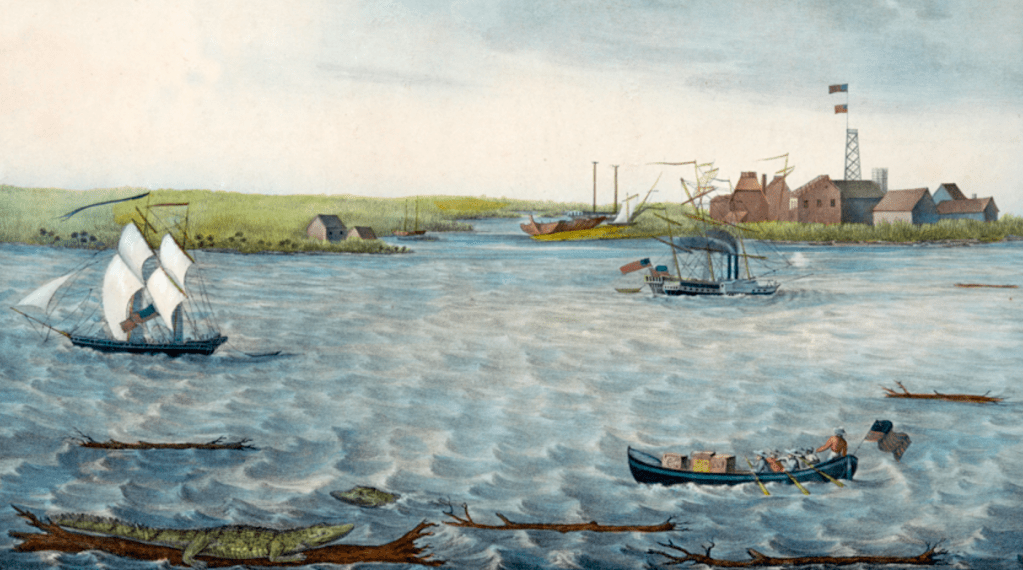
After we got into the Gulf of Mexico, we had head winds which prolonged our passage some days but in good time we got to [La] Balize or the mouth of the Mississippi where we laid another 20 hours waiting for a steamboat to take us up to the city. The wild geese and ducks and other quadrupeds at that place were too numerous to mention. In coming up the river, we had a fine chance to view the several plantations upon the banks, fields of sugar cane, rice and cotton, and scores of niggers were to be seen in abundance. We passed by the place where Old Hickory licked the British under Packenham. The spot and the headquarters of the two generals was pointed out to us very particularly by a fellow passenger who has resided in this place some years.

La Belize was a French fort and settlement near the mouth of the Mississippi. This painting is circa 1828.

We arrived in the city in just 3 weeks & 1 say from the time of our embarkation and at this present writing, I have been a resident of this Babel about 2 weeks. However, I like it very well so far, but shall probably come home to Old Mass. in June or July or at any rate shall leave the city for 3 months or so.

Parson Theodore Clapp

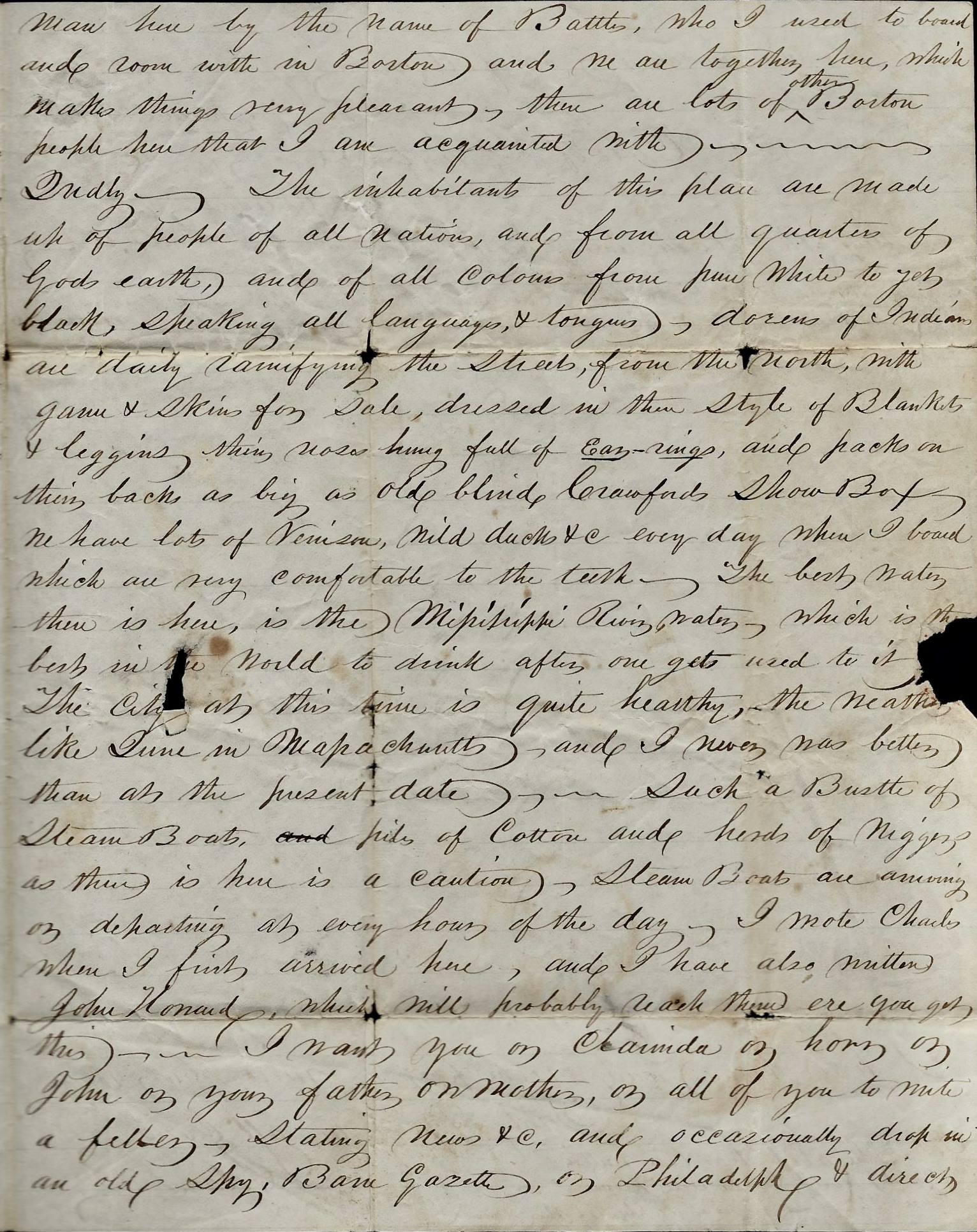
This is a devilish, wicked place but no more so nor so bad as I expected to find it. I have been here one Sunday and that is as much a holiday here as the last Wednesday in May used to be in Oakham. Four companies of the military were out parading through the streets, horse racing was going on in abundance, the stores [were] all open (the retailing ones), &c. &c. but I went to meeting to Mr. [Theodore] Clapp’s 1 who is about as nigh a Universalist as anything, and a very smart man. There is a young man here by the name of Battles who I used to board and room with in Boston and we are together here which makes things very pleasant. There are lots of other Boston people here that I am acquainted with.

Secondly, the inhabitants of this place are made up of people of all Nations, and from all quarters of God’s earth, and of all colours from White to jet black, speaking all languages & tongues, dozens of Indians are daily ramifying the streets from the north with game and skins for sale, dressed in the style of blankets & leggins, thin noses hung full of ear-rings, and packs on their backs as big as old blind Crawford’s Show Box. We have lots of venison, wild ducks &c. every day where I board which are very comfortable to the teeth. The best water there is here is the Mississippi River water which is the best in the world to drink after one gets used to it. The city at this time is quite healthy. The weather like June in Massachusetts and I never was better than at the present date.

Such a bustle of steamboats, piles of cotton and herds of niggers as there is here is a caution. Steamboats are arriving or departing at every hour of the day.

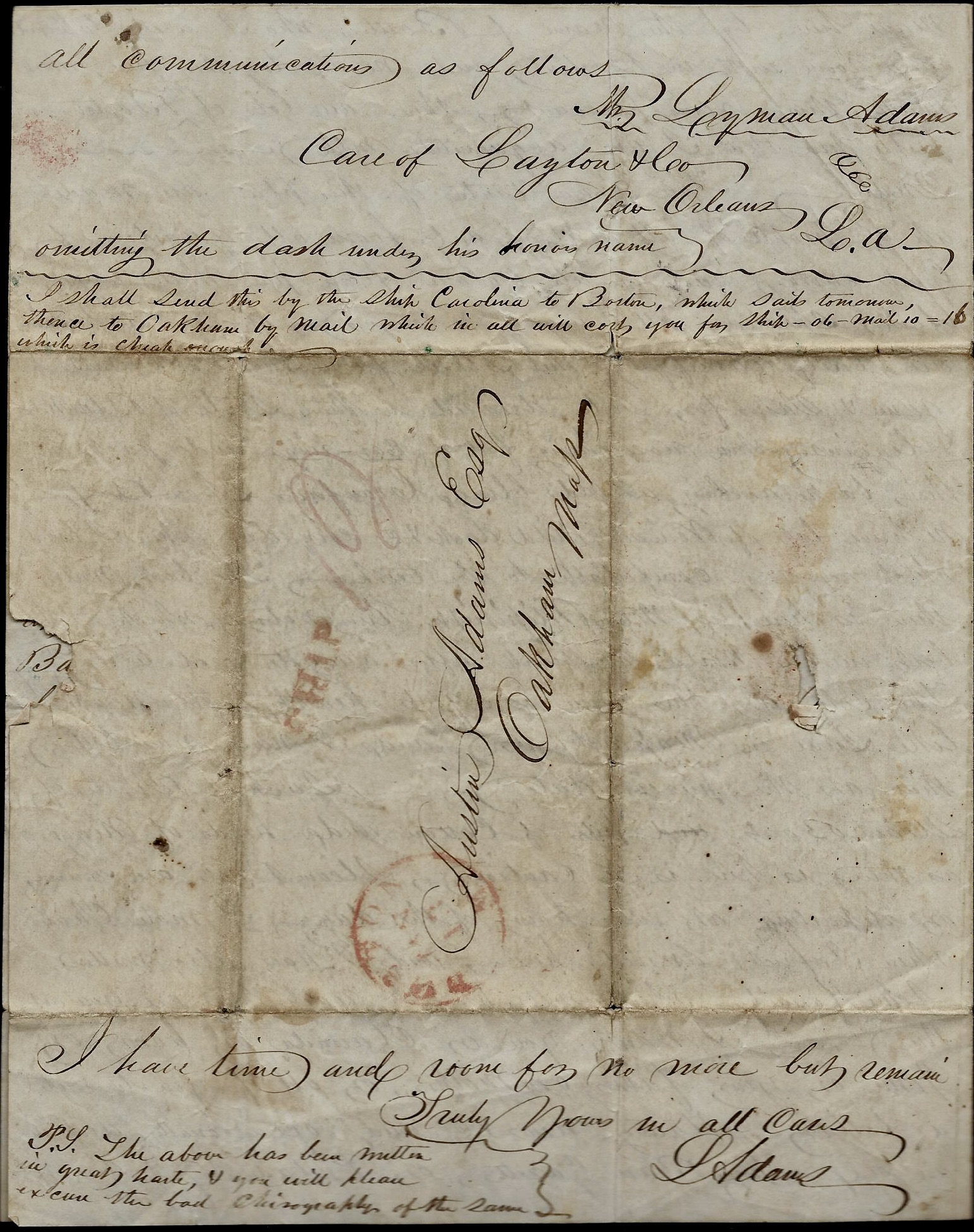
I wrote Charles when I first arrived here and I have also written John Howard which will probably reach them ere you get this. I want you or Clarinda or Horr or John or your father or mother or all of you to write a feller, stating news, &c., and occasionally drop in and Old Spy, Barre Gazette, or Philadelph & direct all communications as follows.

Mr. Lyman Adams, Care of Layton & Co., New Orleans, La.

Omitting the dash line under his honor’s name.

I shall send this by the ship Carolina to Boston, which sails tomorrow, thence to Oakham by mail which is all will cost you for ship 06, mail 10 = 16 which is cheap enough.

I have time and rom for no more but remain truly yours in all cases, — L. Adams

P. S. The above has been written in great haste and you will please excuse the bad chirography of the same.


1 “Unitarianism in antebellum New Orleans was among the most distinctive religious forces in the Old South. The church was founded and shepherded by parson Theodore Clapp, a New England native and former Presbyterian divine who continually challenged the sacred dictums of Christian orthodoxy. As New Orlean’s celebrated iconoclast, Clapp voiced strong opposition to revivalism, as well as theological concepts involving the Trinity, everlasting punishment, and predestination. His only concession to an overarching Southern culture was his quixotic defense of slavery.” [Parson Clapp of new Orleans: Antebellum Social Critic, Religious Radical, and Member of the Establishment, by Timothy F. Reilly]