Category Archives: New York Draft

1863: William T. Lewis to Peter Lewis

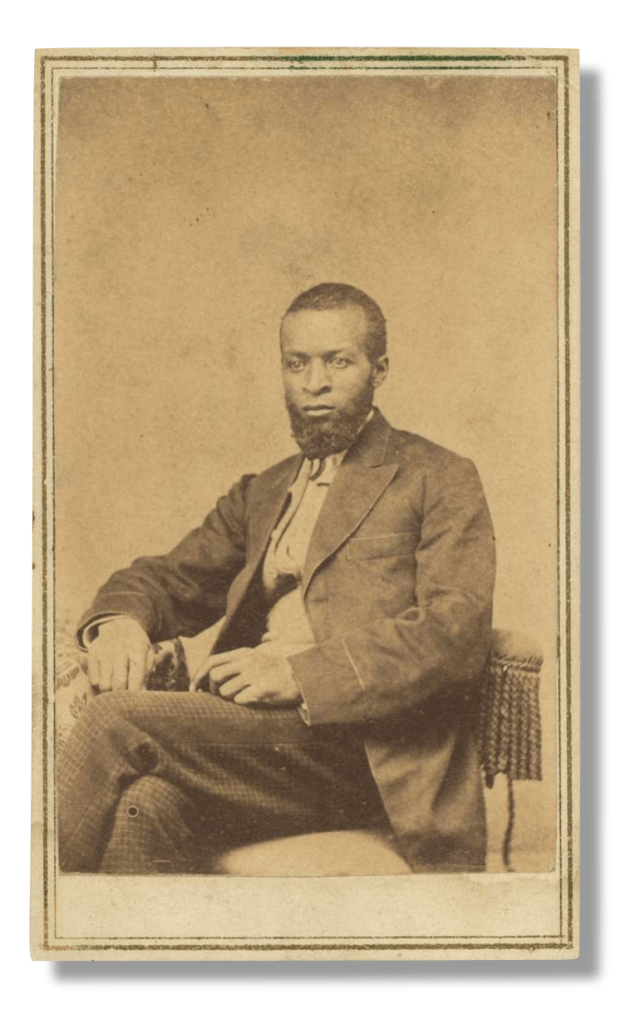
A young unidentified Black man (LOC)

The following letter was written by William T. Lewis (1839-Aft1865), the son of Peter Lewis (b. 1815) and Emeline E. Lewis (1817-1865), who grew up a free black man in Cayutaville—a small hamlet between Smith Valley and Catharine in the southeast corner of Hector Township in Schuyler county, New York. In the 1860 US Census, the Lewis family was enumerated in Odessa, William’s father in his mid-40’s and employed as a farm hand, and 21 year-old William the oldest of three children. According to the 1865 NY State Census, William’s father was born in New York City and his mother in Connecticut. William and siblings were born in Chemung county. The 1880 US Census informs us that William’s paternal grandmother was from the West Indies. The community that William’s parents lived in before and after the war was almost exclusively White.

Unfortunately I cannot find any record of William’s service during the war—if in fact he was drafted. He may not have been and William’s enrollment may have been an error as blacks were not considered citizens and therefore not subject to the draft. Hence the animosity borne against the black citizens of New York City and other urban centers that resulted in the draft riots of 1863. Some scholars have argued, however, that blacks were eligible because in the aftermath of the Emancipation Proclamation, the Second Confiscation Act, and Attorney General Bates’ opinion that free blacks were citizens and Dred Scott was not legally binding, Congress changed the definition of the militia from “free able-bodied white male citizens” to “Able-bodied male citizens.” There are reportedly few cases of blacks being called up by local draft boards under the act though.

We do know William lived beyond the war. He was enumerated in his parent’s home in July 1865, but I could not find him in census records beyond that date.
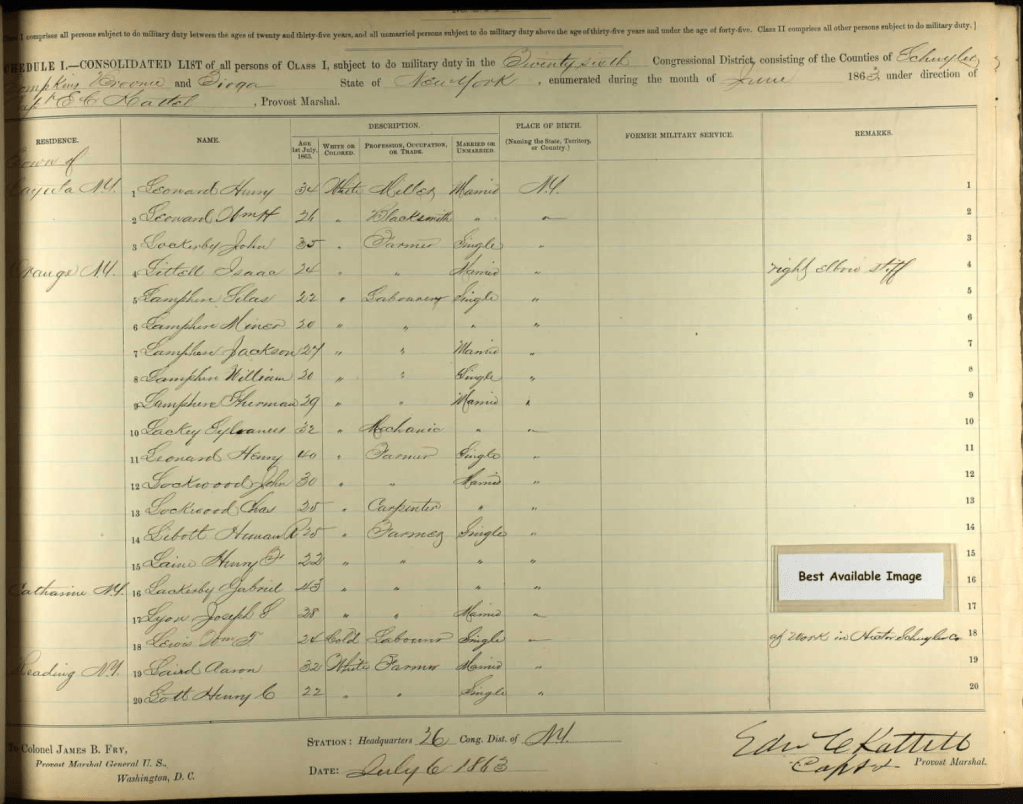
1863 Draft Registration, William T. Lewis identified as a 24 year-old “Col’d Laborer” who was “at work in Hector, Schuyler county, NY”

[Note: The following letter is from the personal collection of Richard Weiner and was transcribed and published on Spared & Shared by express consent.]

Transcription
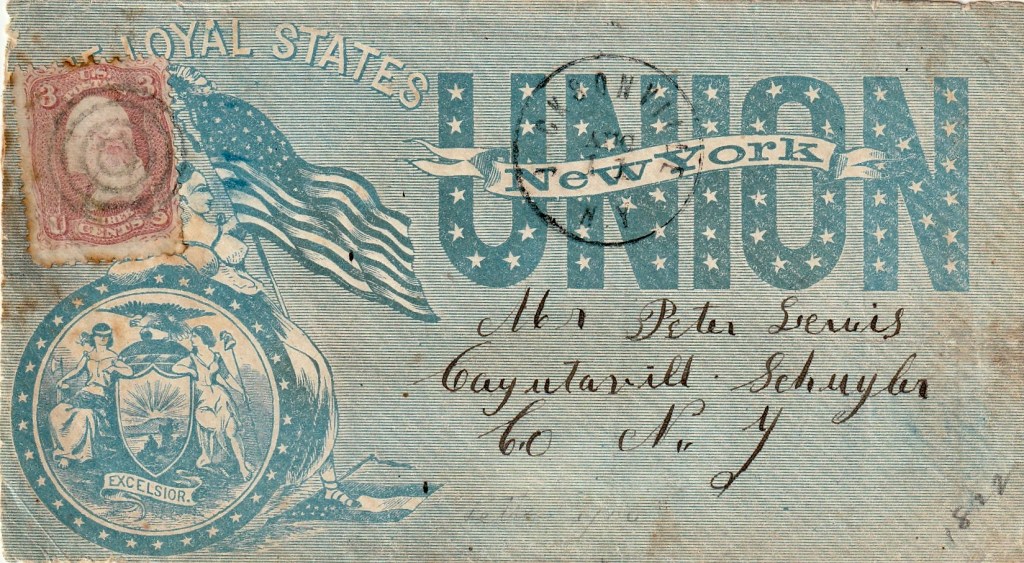
Addressed to Mr. Peter Lewis, Cayutaville, Schuyler county, New York

Jacksonville, Tompkins county, New York
Sunday, August 9, 1863

Dear parents,

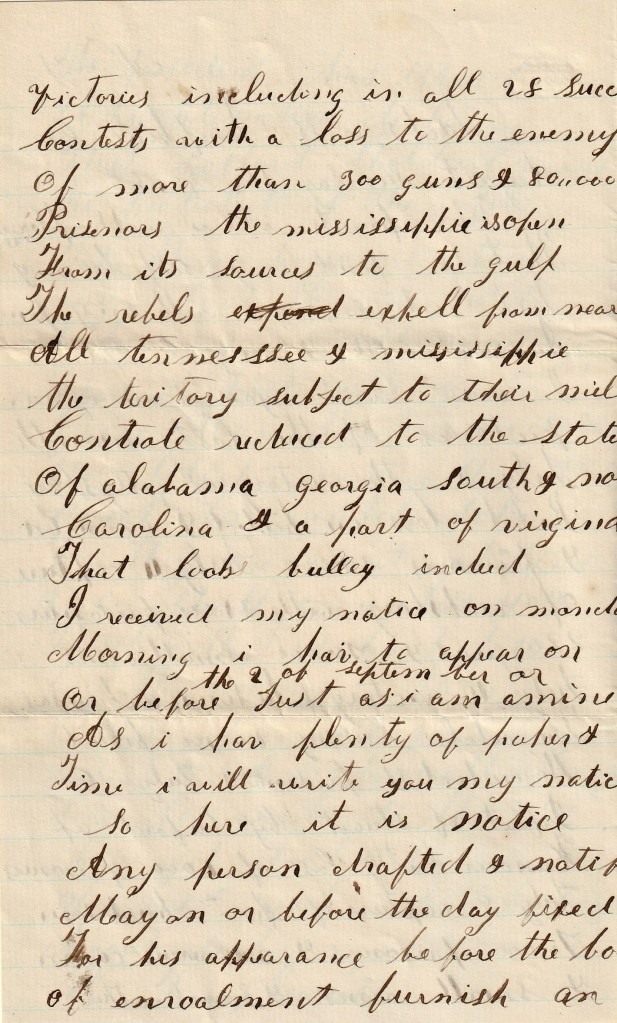
It is with pleasure that I find myself by my desk addressing you with my pen. I am well & in good spirits. I must write you some of our victories of the last month. July 3rd the victory of Gettysburg, rebel loss in killed & wounded & prisoners 33,000. July 4, capture of Vicksburg with 31,000 prisoners, 220 guns & 70,000 small arms. July 4, victory of Helena, Arkansas, the rebels losing 2,700 killed, wounded & prisoners. July 6, defeat of Stuart by Buford at Hanover with loss of 1,000 prisoners. July 8, capture of Port Hudson 7,000 prisoners & numerous cannon & small arms & several other victories including in all 28 successful contests with a loss to the enemy of more than 300 guns & 80,000 prisoners. The Mississippi is open from its sources to the gulf. The rebels expelled from nearly all Tennessee & Mississippi—the territory subject to their military control reduced to the states of Alabama, Georgia, South & North Carolina, & a part of Virginia. That looks bully indeed.

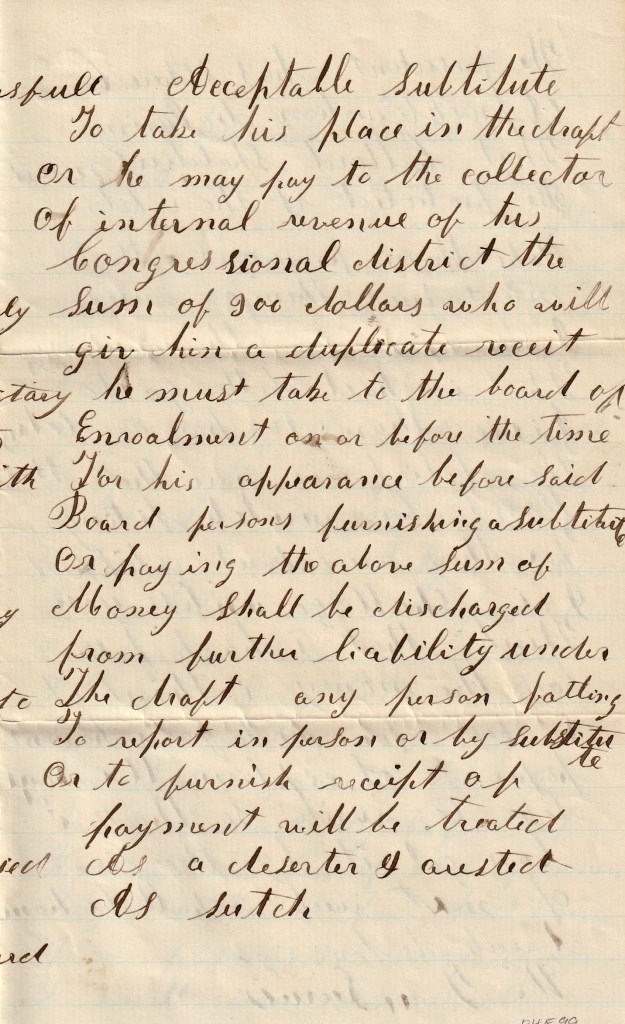
I received my notice on Monday morning. I have to appear on or before the 2nd of September or just as I am a mind to. As I have plenty of paper & time, I will write you my notice. So here it is.

Lincoln’s General Order No. 233; A rebel soldier shall be executed for every Black soldier killed instead of being treated as a POW.

Notice. Any person drafted & notified may on or before the day fixed for his appearance before the Board of Enrollment, furnish an acceptable substitute to take his place in the draft or he may pay to the Collector of Internal Revenue of his Congressional District the sum of 300 dollars who will give him a duplicate receipt. He must take to the Board of Enrollment on or before the time for his appearance before said Board persons furnishing a substitute or paying the above sum of money shall be discharged from further liability under the draft. Any person failing to report in person or by substitute or to furnish receipt of payment will be treated as a deserter and arrested as such.

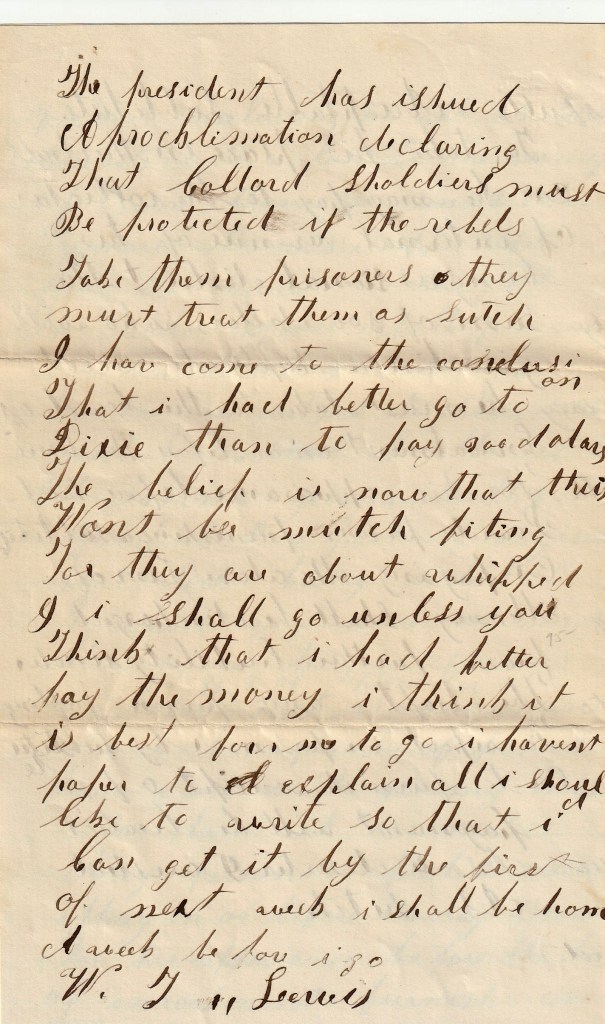
The President has issued a Proclamation [General Order] declaring that colored soldiers must be protected. If the rebels take them prisoners, they must treat them as such. I have come to the conclusion that I had better go to Dixie than to pay 300 dollars. The belief is now that there won’t be much fighting for they are about whipped & I shall go unless you think that I had better pay the money. I think it is best for me to go. I haven’t paper to explain all I should like to write so that I can get it by the first of next week. I shall be home a week before I go. — W. T. Lewis

1862: Alonzo Holland to Harriet Eliza Rice

I could not find an image of Alonzo in uniform but here is one of Matthew Marvin of Co. K, 1st Minnesota (Charles T. Joyce Collection)

These letters were written by Alonzo Holland (1838-1907) of Quincy, Minnesota, who enlisted on 18 November 1861 as a private in Co. K, 1st Minnesota Infantry.

He joined his cousin, Samuel Stebbins, who had enlisted at the beginning of the war and was also serving in Company K. On Dec 17, 1863, Stephen Martin wrote a letter to Mathew Marvin and mentioned that Alonzo was the company cook.
When the regiment was mustered out on May 5, 1864, at the end of their enlistment, he was transferred to its successor unit, Co. B, 1st Battalion, Minnesota Infantry, to finish his term. Alonzo was wounded at the fight at Jerusalem Plank Road on June 21, 1864. He was mustered out on Nov 18, 1864, at the completion of his three year term of enlistment.

On Nov 28, 1866, he married Ellen Kingsbury in Winona, Winona county, Minnesota.

Holland wrote the letters to Harriet (“Hattie”) Eliza Rice (1835-1909) of Barre, Worcester, Massachusetts, an 1856 graduate of the Lasell Female Seminary. In the 1860 US Census, 25 year-old Hattie was enumerated with her 76 year-old mother, Lucy. She was identified as a “Palm Leaf Hood Maker.” Her father, Charles Rice (1788-1854) passed away in January 1854. In the 1870’s, Hattie was still single and living in Worcester working as a seamstress. She never married.

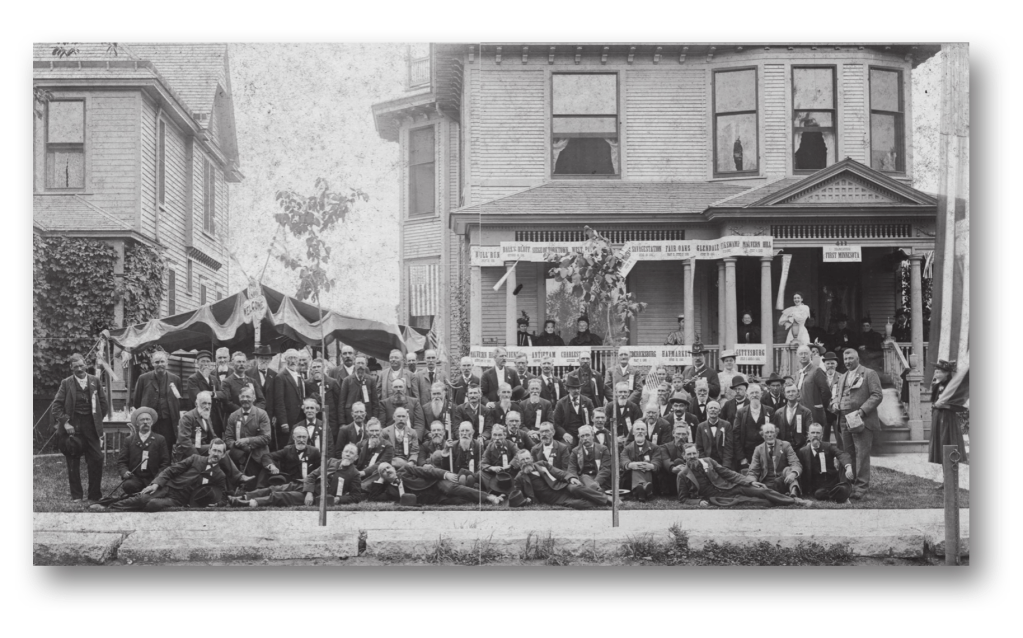
Veterans of Co. K, 1st Minnesota Infantry gather in front of Alonzo Holland’s home (411 West Sanborn Street) in Winona on 3 June 1896 (Winona, by Walter Bennick)

Letter 1

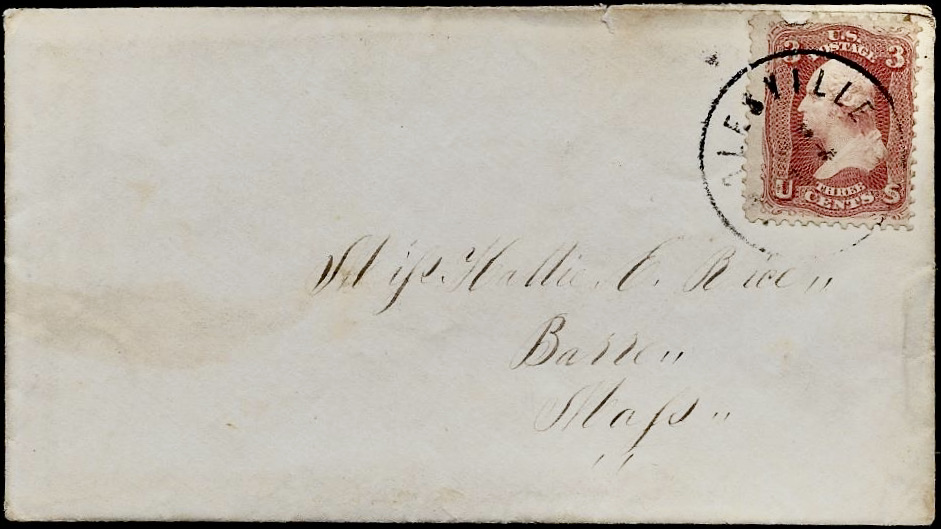
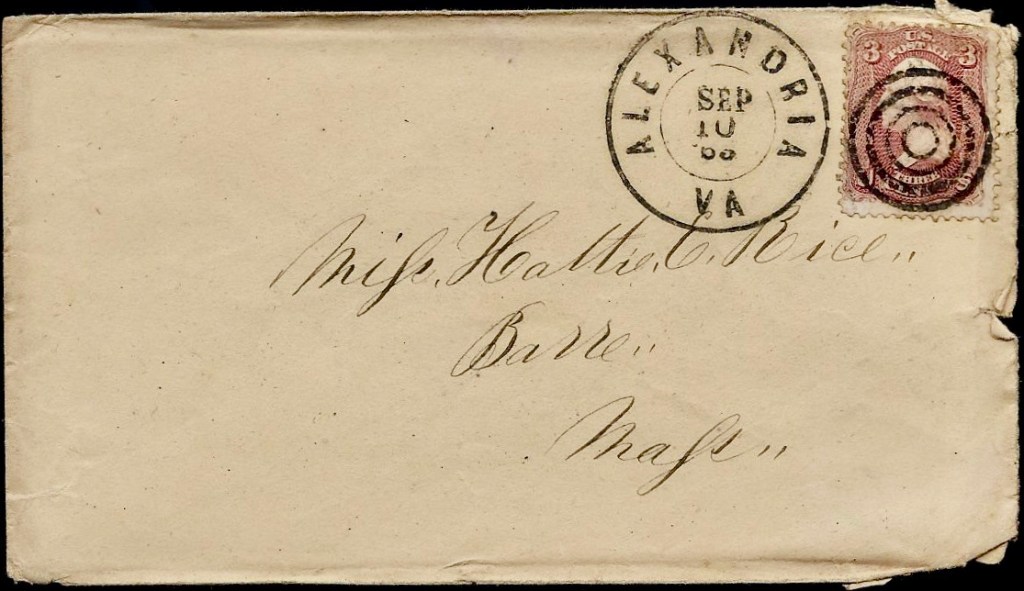
Addressed to Miss Hattie E. Rice, Barren, Massachusetts

Camp Stone near Poolesville, Maryland
February 12th 1862

Friend Hattie,

I presume you have come to the conclusion ere this that I did not care to answer your letter which come to hand some two months ago but such is not the case. But I thought I should like to hear from you again so I didn’t wish to write till I got to a stopping place so you would know where I was. You will see by the date of this that I am in the army of the United States. I enlisted as a recruit in the 1st Regiment Minnesota Volunteers the 18th of November at Minneapolis where I was when I received your letter and expected to go south immediately but various hindrances prevented until the 31st of January when 54 of us started for Washington. Arrived there the 7th of February and stopped there part of a day, then came up to the camp. So you will see that changed from one thing to another till I have got to be a soldier.

I said last winter that I should volunteer when I was needed and I concluded last fall that the country needed all the men that could be raised so off to the war I went. We are stationed on the Potomac about 55 miles from Washington. It is at Edward’s Ferry. I presume you have heard of the place. The Rebels are on the other side of the river. Our camp is two miles from the river. We go down there on picket guard.

It is dreadful muddy here. I suppose you think you know what mud is but you never saw any in New England. The mud sticks to my feet so I can hardly go. We shall not be likely to have a battle till the mud dries up. There is eight of us in our tent that I stop in so we are pretty thick. We all sleep together packed in like logs. The bed occupies half the tent and we have a fireplace at the other side and we have a table made of a board sat on some legs and some seats so that is is about full.

We don’t live first rate. It is bread and coffee for breakfast & supper, and soup and beans for dinner. No butter or milk or any such things. But I will close hoping you will accept the best wishes of your friend and write soon as they are all strangers to me far away from all friends. Our letters are sent to us from Washington wherever we are so you can direct to Alonzo Holland, Co. K, 1st Regt., Minnesota Vol., Washington D. C.


Letter 2

Alexandria, Virginia
September 10, 1863

Hattie,

You say I never answer my letters promptly but once so if I answer your last promptly it will be twice punctual to your negligences as I don’t know you have ever been over anxious to write soon after receiving. I remember of your waiting some six or eight months at one time but I guess you will do better hereafter and I will endeavor to write just as often as you will.

We went from Governor’s Island to Brooklyn City where we had one of the best times that ever came to soldiers as we was camped at York Green (one of the city parks) and the people (ladies in particular) were very glad to see the old veteran troops and visited us everyday in large numbers. One of the churches gave us a splendid supper of everything that was good, which we call good enough for soldiers. They also gave us a treat of melons and peaches &c. We were to have another supper by another church but were ordered back sooner than we expected so we lost it. We left N. Y. last Sunday and embarked on board the steamer Empire City bound for Alexandria where we arrived Tuesday.

We are laying here for a day or two waiting for the rest of the brigade to get here when we shall go to the front. So you see our good time is all gone and we are once more in the field to get more hard marching and fighting. We hated to come back as bad as anybody could for we have been at the front so long that we are pretty sick of it but we are tired of such foolery as we have been having as regards our officers. They told us we was to stay at New York this winter and kept us moving round all the time we was there. So we did not have a chance to go anywhere and now we have to go to march out to the Rappahannock 60 miles when we might go on the cars if they was a mind to let us.

The draft passed off all quietly at New York and vicinity but the men are not taken away yet. Will probably be some trouble in doing that. By today’s paper, it seems that Morris Island is evacuated. If so, it is a great step towards the fall of Charleston. The news from the West is very good and I can but hope that we may gain a victory here which would bring the rebels into difficult circumstances. But I don’t look for a speedy culmination of the war. In fact, it almost looks as though we was to have a war with France and England.

Write all about the fair that to come off soon. I should like to, as you advise me, but I have been going the wrong way for Barre but I trust the time will be sometime that I can go where I like more than at present. Meanwhile, be assured that you have a friend in the army. write soon.

— Alonzo [Holland]