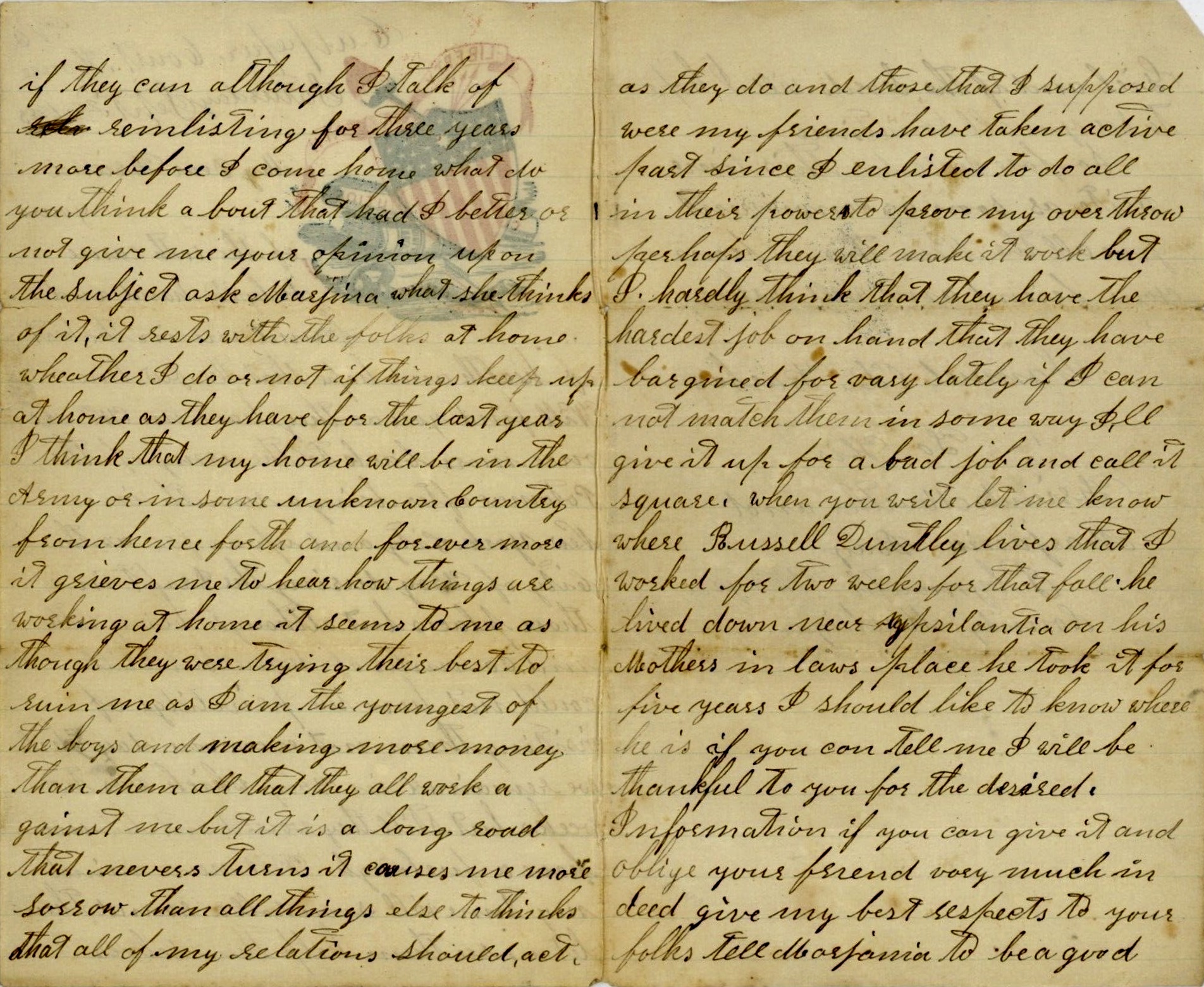
The following letter was written by Samuel Benjamin Barber (1838-1873). Samuel was born in Lewis, Essex county, New York but was living in Grand Rapids, Michigan in 1861 when he enlisted in Co. D, 3rd Michigan Infantry (1st Organization). He was wounded on 15 July 1864 and mustered out that same year. He died in 1873 and was buried in New Boston, Michigan.
Transcription
Culpeper Court House, Va. Saturday, September 26, 1863
My dear friend,
Yours of the 11th came duly to hand and found me in the best of health and hope that these few lines will find you as they leave me.
We are once more back to the Army of the Potomac after being a month inn New York City and up as far as the City of Troy during the draft in those places, but although being within 160 miles of home but still could not have the privilege of visiting them—not even one day while we remained in Troy which was two weeks, but still they would not let me have a furlough. Well never mind. My time will soon roll around. Then let us see them help themselves if they can although I talk of re-enlisting for three years more before I come home. What do you think about that? Had I better or not? Give me your opinion upon the subject. Ask Marjania what she thinks of it.
It rests with the folks at home whether I do or not. If things keep up at home as they have for the last year, I think that my home will be in the Army or in some unknown country from henceforth and forever more. It grieves me to hear how things are working at home. It seems to me as though they were trying their best to ruin me as I am the youngest of the boys and making more money that them all that they all work against me. But it is a long road that never turns. It causes me more sorrow than all things else to think that all of my relations should act as they do and those that I supposed were my friends have taken active part since I enlisted to do all in their power to prove my overthrow. Perhaps they will make it work, but I hardly think that they have the hardest job on hand that they have bargained, for very lately, if I cannot match them in some way, I’ll give it up for a bad job and call it square.
When you. write, let me know where Russell Duntley lives that I worked for two two weeks for that fall. He lived down near Ypsilanti on on his mother-in-law’s place. He took it for five years. I should like to know where he is. If you can tell me, I will be thankful to you for the desired information if you can give it and oblige your friend very much indeed.
Give my best respects to your folks. Tell Marjania to be a good girl and if the Lord’s will, I hope to see you all sometime. So farewell for this time. Write as soon as convenient. Give all the news. This is from your friend and well wisher, — Samuel B. Barber
To his friends Martha and Marjania Ray, Plymouth, Wayne county, Michigan
The following are from a collection of letters found in an antique store by Cianna Lee who made them available for transcription and publication on Spared & Shared by express consent. They were written by Will Johnston, Jr. of Fort Wayne, Indiana to his friend Burritt K. Lawlin of New York City, both written during the American Civil War. The main topics pertain to recruiting and the drafts—a frequent topic among civilian males of military age. The content suggests that Will and Burritt were warm friends and grew up together in New York City.
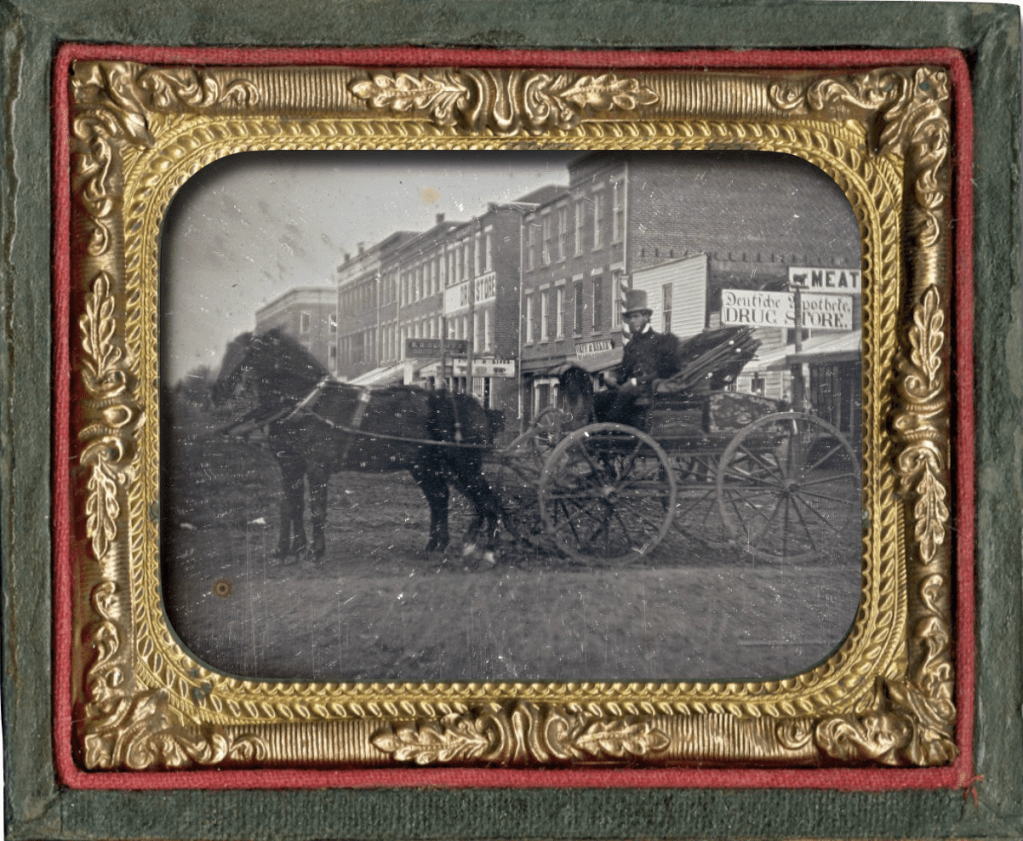
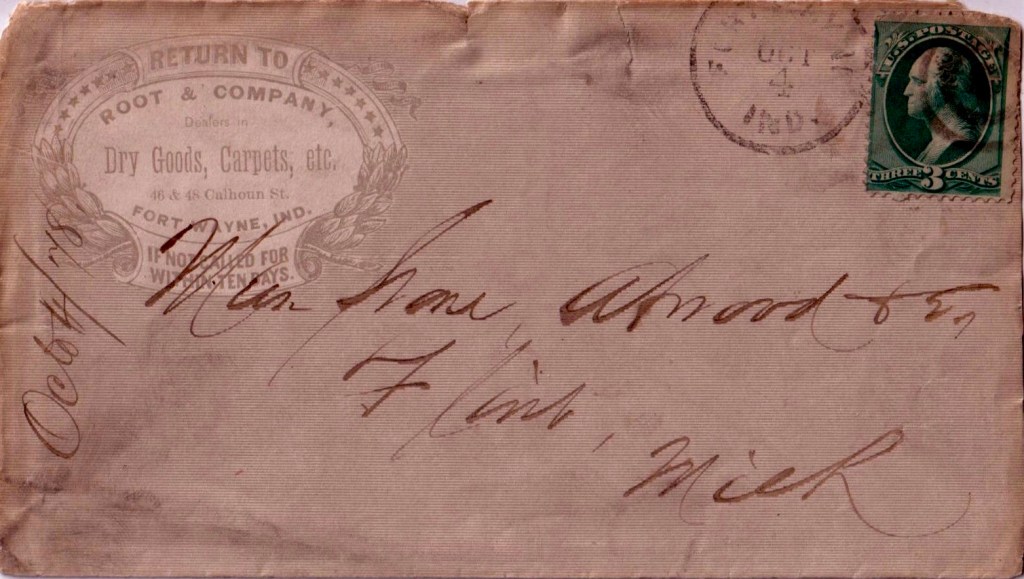
Root & Co. in Fort Wayne, Indiana
I could not confirm Will’s parentage but I did find evidence of him in Fort Wayne, Indiana, where he appears to have remained for some time. It appears that he was a junior partner in Root & Company—a wholesale and Retail Dealer in Dry Goods, Notions &c. located at 90 Columbia Street. In 1864, he was boarding at the Hamilton House. In 1866, he was boarding at the Aveline House. I also found a 28 year-old William Johnston, a native of New York, working as a clerk and insurance agent in Fort Wayne in the 1870 US Census.
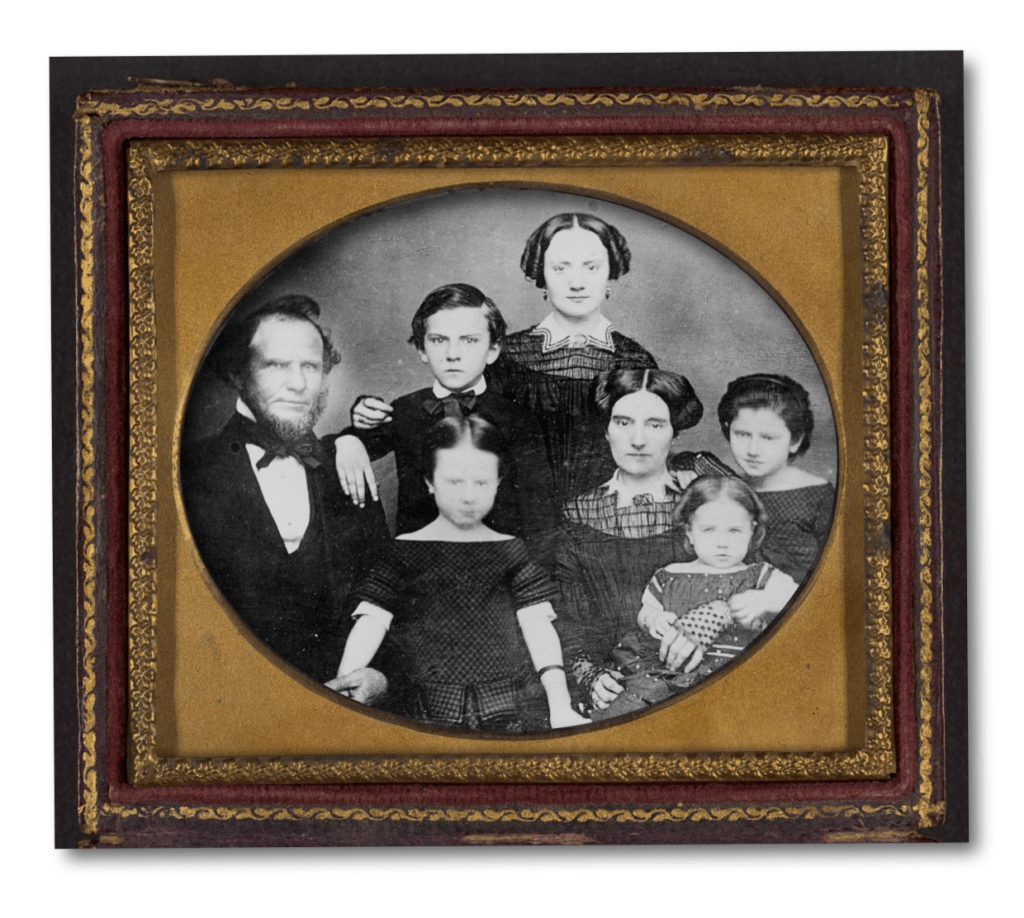
Will wrote the letters to his friend, Burritt Keeler Lawlin (1843-1916), the son of sea captain Richard Edmonston Lawlin (1808-1861) and Maria Keeler (1816-1896) of New York City. He graduated in 1858 from the New York City Free Academy. It appears that Burritt lived with his widowed mother at their home at 180 W. 21st Street in New York City at the time these letters were addressed to him. Burritt was married in January 1864 to Louise Johnson Orrell (1843-1931). In the 1880 US Census, Burritt was enumerated in Brooklyn where he superintended a chemical works.
A stern-faced Burritt Keeler Lawlin stands between his sitting father and mother surrounded by his younger and old sisters. Circa 1850.
Letter 1
Fort Wayne, Indiana July 25, 1862
Old friend Burritt,
Your very interesting & lengthy letter of the 19th inst. came to hand on the 23rd and although considerable time has elapsed since I wrote you (May 7) and as I had commenced to entertain the opinion pretty freely that you were a bad egg in the way of corresponding, yet your reasons for the delay are quite acceptable & I excuse you freely, and exonerate you entirely for I know that you must have suffered considerably by the accident that occurred to you in the way of smashing your finger & I can assure you that I sympathize with you deeply in the loss of part of your hand, but at the same time I congratulate you that the same thing did not happen to your right hand, which would have been considerably worse, for then I would not have received a letter, for an awful long time. I would have had to wait until you had become proficient in left hand writing which I think would have been quite some time. But I am very, very happy to receive one from you at this late hour and hope that by the time you write again your left hand will be entirely healed.
Your description of the dissolution of the partnership heretofore existing between Coutant & Lawlin is very graphic as is also the selling out of your remaining interest in the concern. But I suppose you made it pay or else you would not have sold out. But Burritt, I think the smoking arrangement was a pretty good joke on the person that was so generous as to buy you out. I suppose you told him all about the smoking arrangements & the defect in the flue previous to the purchase—ahem. Yes, I guess so. But Burritt, you done well I think by selling out if that was your fix. So both you and John T had withdrawn from business & returned to your Country seats? John T did sent me a paper & there was an article in it that stated the object of his withdrawal from the firm was in consequence of business in Europe that required his services but that while gone and on the other side of the water, he would bear in mind the happy hours he had spent in the business and would work while there in whatever way he could for the interest of the paper—ahem—when decidedly good. So he has retired. He has gone to Europe to engross his mind in business & lo and behold, he is rusticating in a sweet little town in the centre of the state—Tuthill, Ulster Co. by name. Why Europe must have been condensed to a considerable extent since I last heard it spoken of. But so the world goes & my best wishes for John T wherever he is or wherever he goes—Europe or Tuthill.
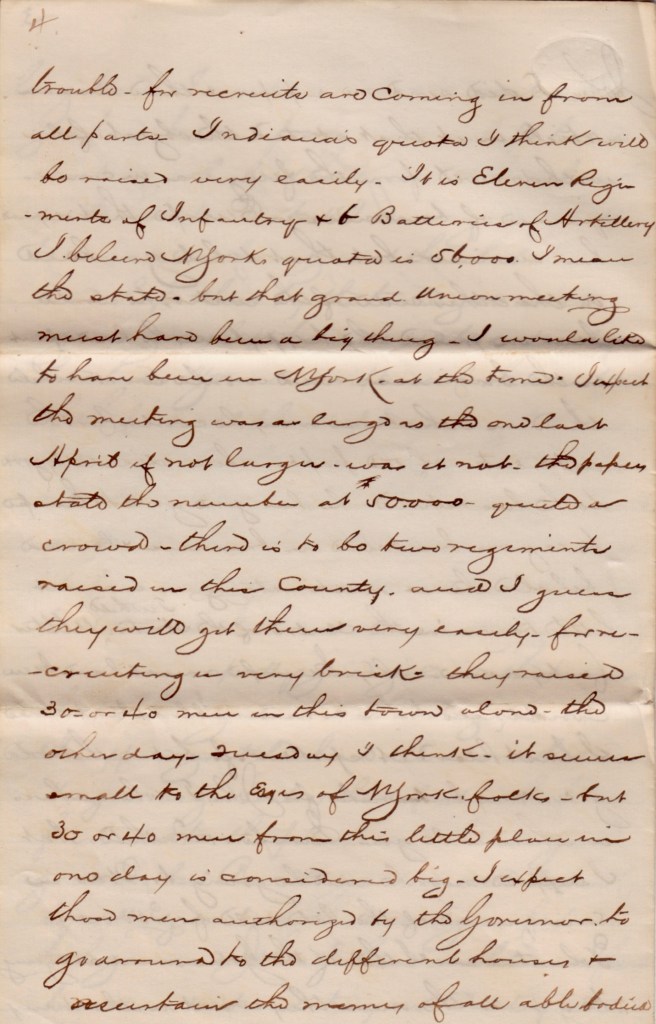
But I suppose now he will be going to war in consequence of the late call for 300,000 volunteers. I think the Government are going to get all the men they want without any trouble for recruits are coming in from all parts. Indiana’s quota I think will be raised very easily. It is eleven regiments of Infantry and 6 batteries of artillery. I believe the New York quota is 56,000—I mean the state. But that grand Union Meeting must have been a big thing. I would like to have been in New York at the time. I expect the meeting was as large as the one last April—if not larger, was it not? The papers state the number at 50,000. Quite a crowd.
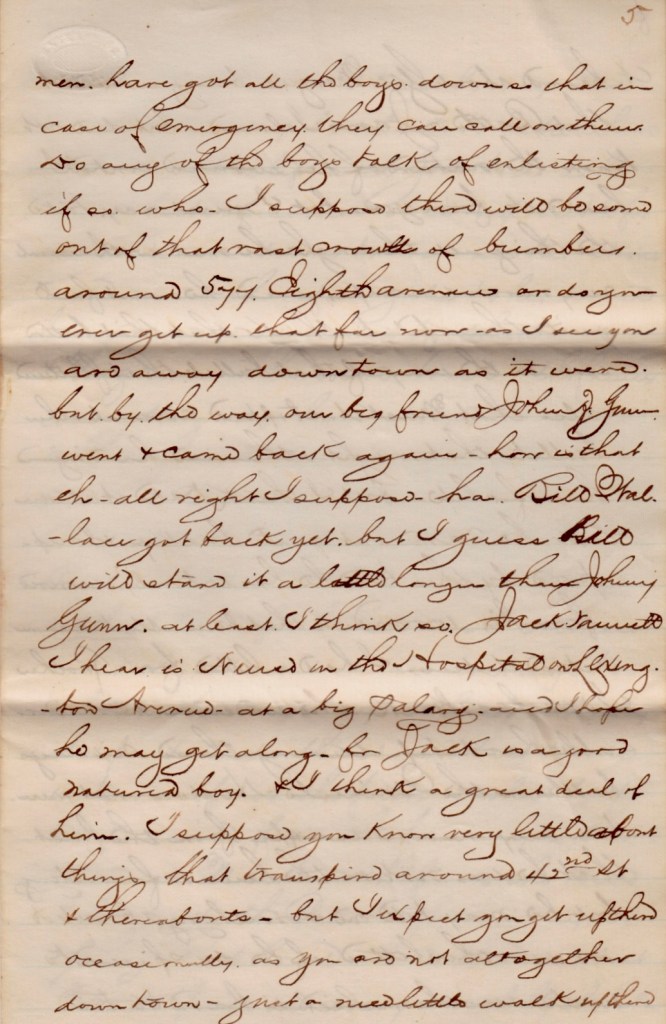
There is to be two regiments raised in the county and I guess they will get them very easily for recruiting is very brisk. They raised 30 or 40 men in this town alone the other day—Tuesday I think. It seems small to the eyes of New York folks but 30 or 40 men from this little place in one day is considered big. I expect those men authorized by the Governor to go around to the different houses and ascertain the names of all able bodied men have got all the boys down so that in case of emergency they can call on them.
Do any of the boys talk of enlisting? If so, who? I suppose there will be some out of that vast crowd of bummers around 577 Eighth Avenue or do you ever get up that far now as I see you are away downtown as it were. But by the way, our big friend John P. Gunn went and came back again. How is that, eh? All right I suppose. Has Bill Wallace got back yet? But I guess Bill will stand it a little longer than Johnny Gunn—at least I think so. Jack Yannett I hear is nurse in the hospital on Lexington Avenue at a big salary and I hope he may get along for Jack is a good-natured boy and I think a great deal of him. I suppose you know very little about things that transpired around 42nd Street and thereabouts, but I expect you get up there occasionally as you are not altogether down town. Just a nice little walk up there
I heard about Geo. Menzies being wounded at that Battle on James Island but did not know the nature of his wound until I heard it from you. But I must say, take the thing all through, he met with several very narrow escapes and he must feel quite thankful to think that that button was in the way of that bullet that flattened and also that musket stopped several other bullets that might otherwise have injured him for life. But I think, take it all in all, he came out quite lucky and I suppose by this time he has entirely recovered from his wound so that he is able to resume active duties.
I had a letter from brother Tom last week and he underwent considerable hardship during those six days battles on the Peninsula. He does not mention any narrow escapes from the fact that he was not in the humor for writing but he may tell me something about it in another letter—if he is spared to write another, which is hard to tell but I sincerely hope and trust he may and also that he may be spared to return home again. But it is left with God to do as He thinks best of course. It is impossible for us weak creatures to overrule His actions and must therefore yield to His kind Providence and abide by them.
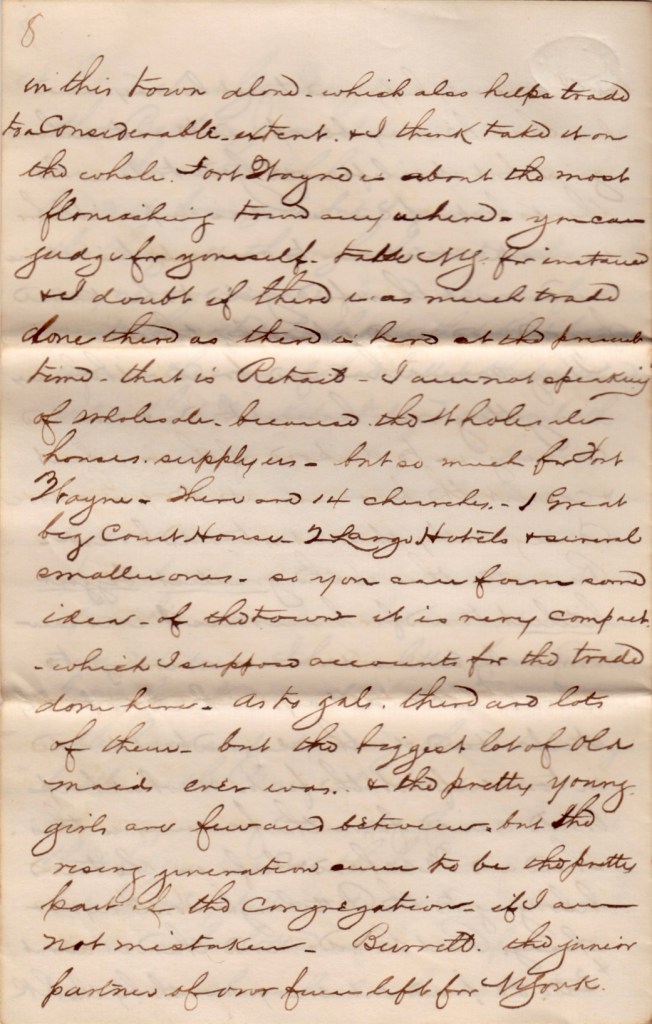
Things around here are brisk. The farms are getting over harvest time and now are coming in to dispose of their wheat and convert the proceeds into Dry Goods &c. Consequently it makes trade brisk. Burrett, this is the greatest, biggest, littlest town for business I ever saw. Our sales amount on an average to about $400 a day which is pretty steep and we do the second best trade in town—if not the first. And what helps trade, aside from the farmers, is this. There are machine shops in the town belonging to the Pittsburgh, Fort Wayne and Chicago Railroad and there is about $30,000 paid out every month by the R.R. in this town alone which also helps trade to a considerable extent. And I think, take it on the whole, Fort Wayne is about the most flourishing town anywhere. You can judge for yourself. Take New York for instance & I doubt if there was much trade done there as there is here at the present time—that is retail. I am not speaking of wholesale because the wholesale houses supply us.
But so much for Fort Wayne. There are 14 church, 1 great big court house, two large hotels, and several smaller ones. So you can form some idea of the town. It is very compact which I suppose accounts for the trade done here. As to gals, there are lots of them but the biggest lot of old maids ever was & the pretty young girls are few and between. But the rising generation seem to be the pretty part of the congregations, if I am not mistaken.
Burrett, the junior partner of our firm left for New York one week ago today to see the place & also his brother whom he has not seen since he left Germany eight years ago. He has become quite civilized since being out west and can talk very good English & puts on a good many airs for a German. But he left for New York & I gave him a letter of introduction to Alec. He said he would go there. Also one to Sam Houghton. But I suppose he has seen them both ‘ere this & made their acquaintance.
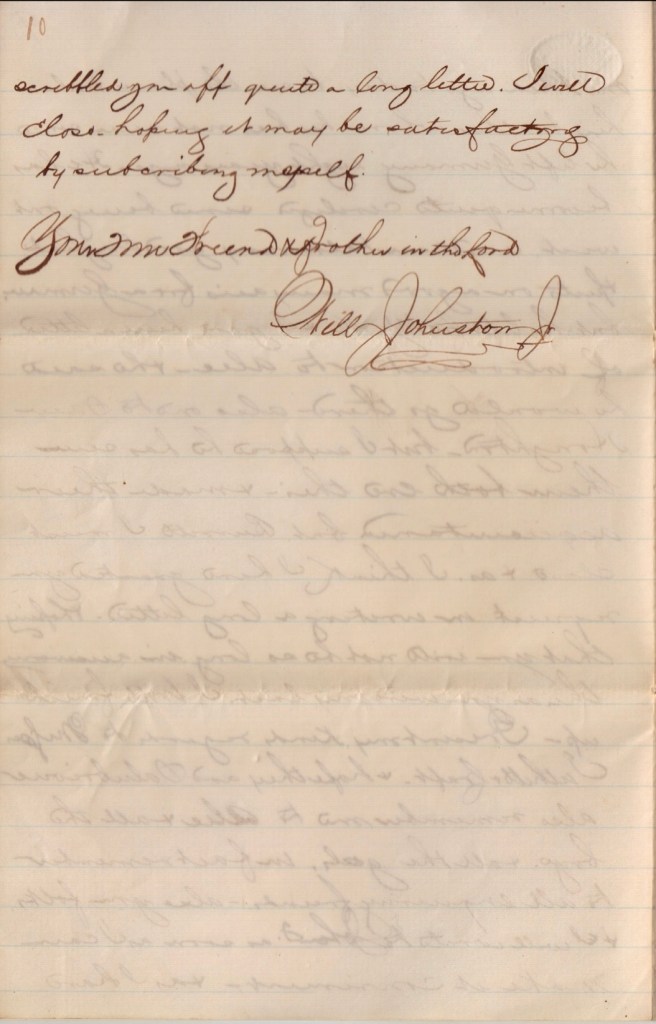
But Burritt, I must close & as I think I have granted your request in writing a long letter & hoping that you will not be so long in answering this as you were my last, II will finish up. Present my kind regards to Misses Tuthill & Craft & hope they are salubrious. Also remember me to Alec & all the boys & all the gals. In fact, remember [me] to all enquiring friends—also your folks, & I will write to John T as soon as I can make it convenient & as I have scribbled you off quite a long letter, I will close, hoping it may be satisfactory by subscribing myself your true friend & brother in the Lord, — Will Johnston Jr.
Letter 2
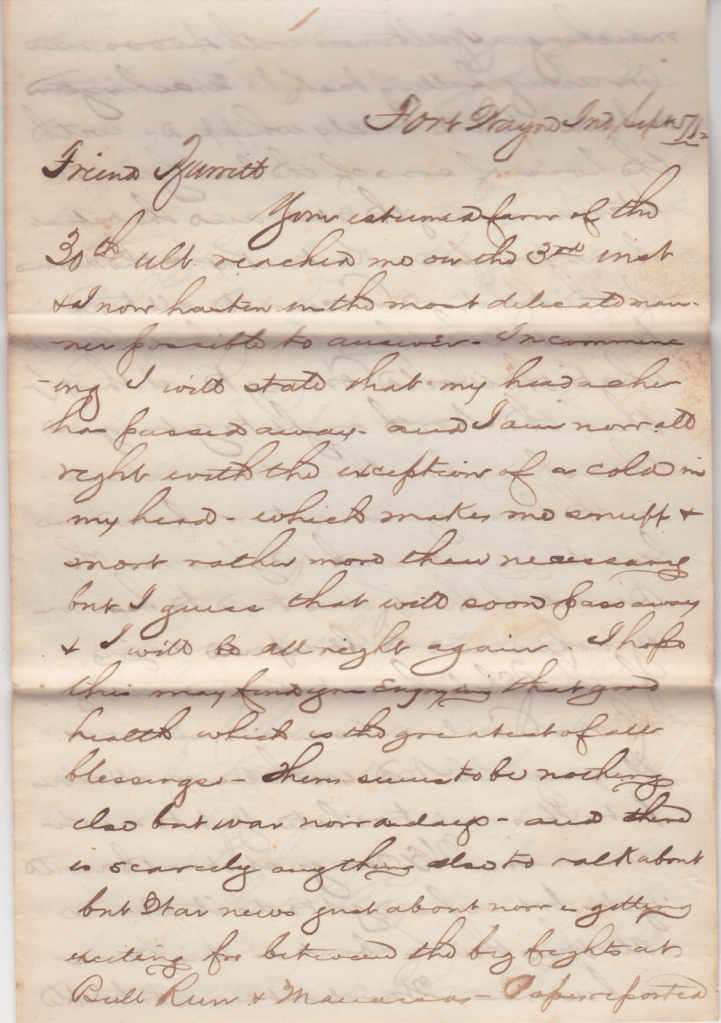
Fort Wayne, Indiana September 5, 1862
Friend Burritt,
Your esteemed favor of the 30th ult. reached me on the 3rd inst. & I now hasten in the most delicate manner possible to answer. In commencing, I will state that my headache has passed away and I am now all right with the exception of a cold in my head which makes me snuff and snort rather more than necessary but I guess that will soon pass away & I will be all right again. I hope this may find you enjoying that good health which is the greatest of all blessings.
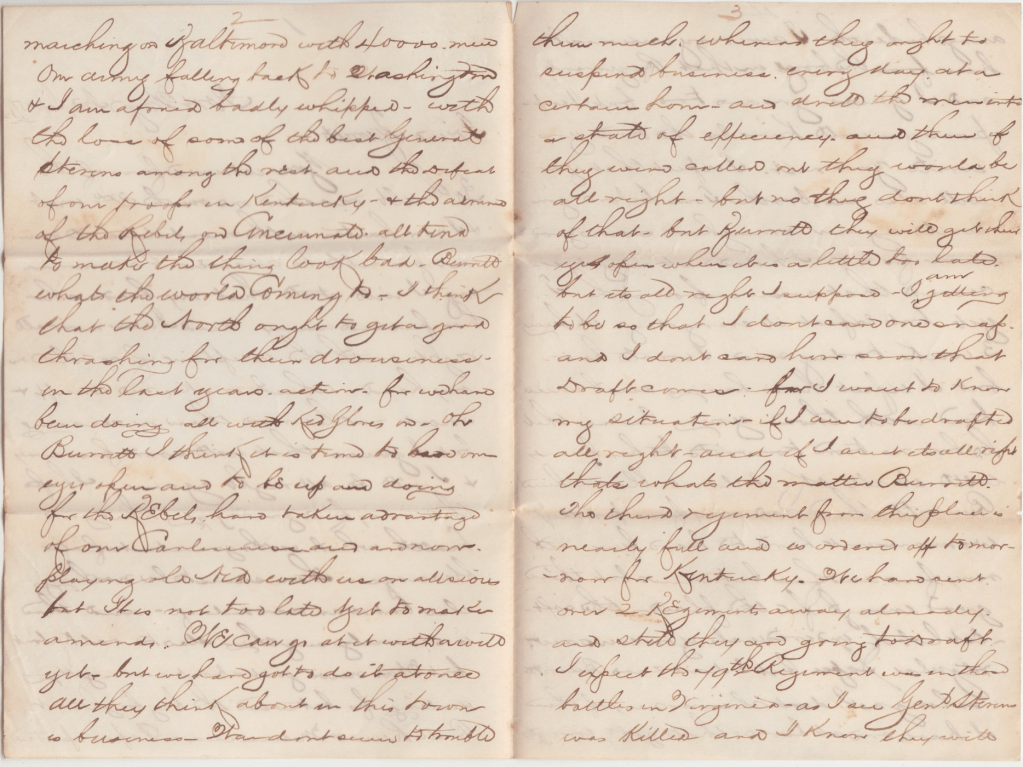
There seems to be nothing else but war now-a-days and there is scarcely anything else to talk about. But war news just about now is getting exciting for between the big fight at Bull Run & Manassas, papers reported marching on Baltimore with 40,000 men. Our army falling back to Washington and I am afraid badly whipped, with the loss of some of the best generals—Stevens among the rest—and the defeat of our troops in Kentucky & the arrival of the rebels on Cincinnati all tend to make the thing look bad. Burritt, what’s the world coming to? I think that the North ought to get a good thrashing for their drowsiness in the last year’s action for we have been doing all with gloves on. Oh Burritt, I think it is time to have our eyes open and to be up and doing for the Rebels have taken advantage of our carelessness and now playing Old Ned with us on all sides. But it is not too late yet to make amends. We can go at it with a will yet. But we have got to do it at once. All they think about in this town is business. War don’t seem to trouble them much whereas they ought to suspend business every day at a certain hour and drill the men into a state of efficiency and then if they were called out, the would be all right. But no, they don’t think of that. But Burritt, they will get their eyes opened when it’s a little too late. But it’s all right, I suppose. I am getting to be so that I don’t care one snap and I don’t care how soon that draft comes for I want to know my situation. If I am to be drafted, all right; and if I ain’t, it’s all right. That’s whats the matter.
Burritt, the third regiment from this place is nearly full and is ordered off tomorrow for Kentucky. We have sent over two regiments away already and still they are going to draft. I expect the 79th [New York] Regiment was in the battles in Virginia as I see Gen. Stevens was killed and I know they will avenge his death. I am very anxious to hear from the boys in that regiment and I guess you are too. But I suppose you will know by the time you write your next. I expect that you will also see brother Tom before you write again & may have some good news for me.
I have not as yet received that answer from John T. yet but I expect it every day—it being three weeks today since I wrote him. But I expect he is having suc a nice time with those young ladies that he has no time to write to his friends. Well, it’s all ok. I don’t blame him. Burritt, there are very few pretty women here to have fun with—very few and far between. But they’re good enough for the place. The softest lot of individuals you ever saw and regular saps. But I don’t care, Burritt, as long as I don’t claim any of them. I have one at home—that’s good enough.
Letter 3
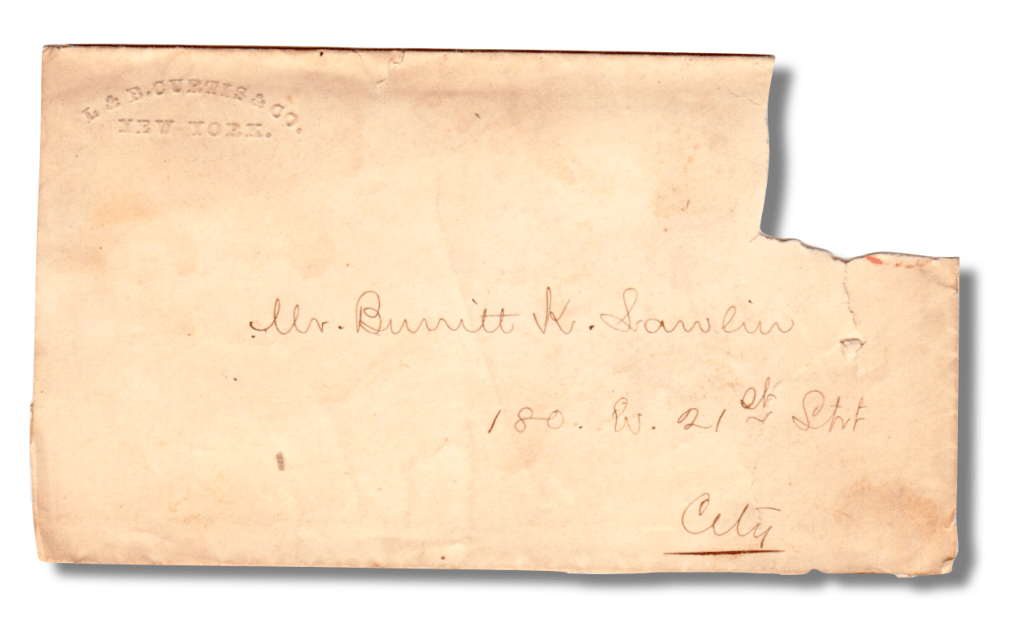
Addressed to Mr. Burritt K. Lawlin, 180 W. 21st Street, New York City
New York Store Fort Wayne, Indiana July 29, 1863
Friend B.K.,
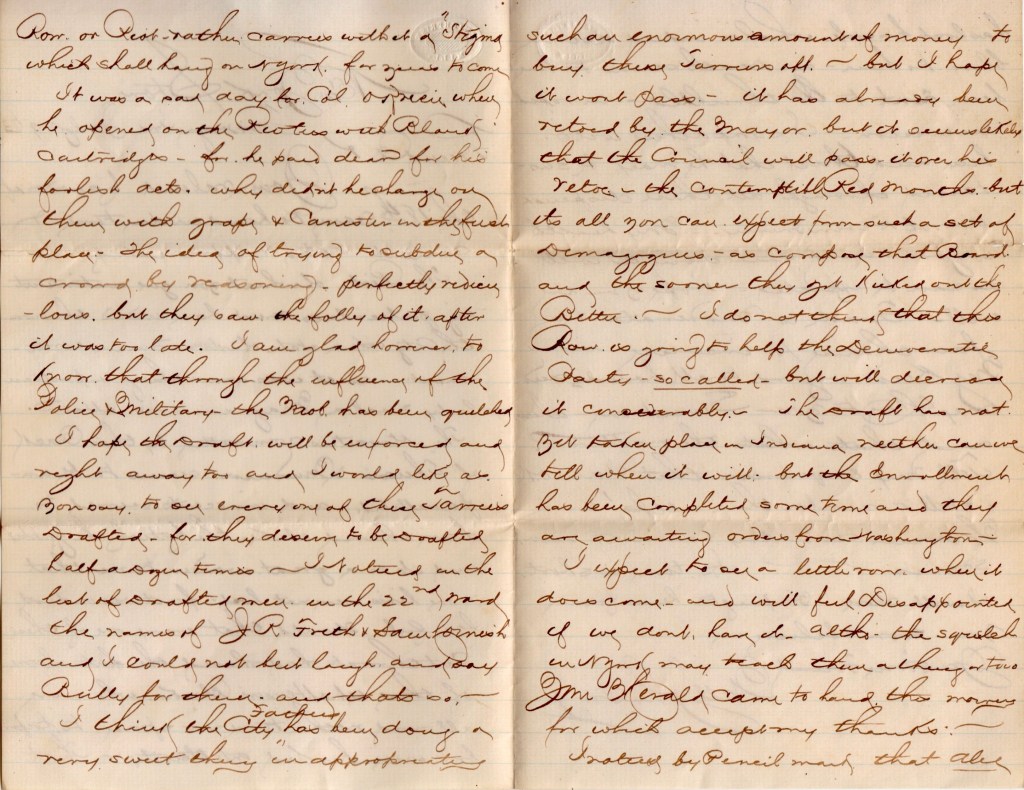
Your valued favor of the 18th came to hand in due time & contents noted & appreciated. The Riot of which you give such interesting particulars must have indeed thrown the City into a state of extraordinary excitement as it was a new thing & particularly such a magnanimous affair. The atrocities committed by this pack of thieves & murderers seems to be unparalleled and innocents seemed to have shared alike the fate of the guilty and it is a great wonder to me that more lives were not lost for it was indeed fearful. Would that every one of these cutthroats had shared the fate of some of those inoffensive Blacks who were allowed neither time nor space to prepare but were hurled into eternity. That row—or riot rather—carried with it a stigma which shall hang on New York for years to come.
It was a sad day for Col. [Henry F.] O’Brien 1 when he opened on the rioters with blank cartridges for he paid dear for his foolish acts. Why didn’t he charge on them with grape & canister in the first place? The idea of trying to subdue a crowd by reasoning—perfectly ridiculous. But they saw the folly of it after it was too late. I am glad however to know that through the influence of the police & military, the riot has been [s]quelched. I hope the Draft will be enforced and right away too and I would like as you say to see every one of these tarriers drafted for they deserve to be drafted half a dozen times.
I noticed on the list of drafted men in the 22nd Ward the names of J. R. Frith & Sam Cornish and I could not but laugh and say Bully for them and thats so. I think the City Fathers has been doing a very sweet thing in appropriating such an enormous amount of money to buy these tarriers off. But I hope it won’t pass. It has already been vetoed by the Mayor, but it seems likely that the council will pass it over his veto—the contemptible Red months. But it’s all you can expect from such a set of Demagogues as compose that Board and the sooner they get kicked out the better. I do not think that the row is going to help the Democratic Party—so called, but will decrease it considerably.
The Draft has not yet taken place in Indiana. Neither can we tell when it will but the enrollment has been completed some time and they are awaiting orders from Washington. I expect to see a little row when it does come and will feel disappointed if we don’t have it, altho the squelch in New York may teach them a thing or two.
Your [New York] Herald came to hand this morning for which accept my thanks. I noticed by pencil mark that Alec has lost his wife which is indeed a severe blow to him as death seems to have been sent to his thresh hold in rapid succession. I sympathize with him and trust that he may be sustained through all these dispensations of Divine mercy. My health is good and am doing as well as can be expected. Hope you are well. Trade is moderate & a fair chance for increase.
My Kind regards to all hands and my love to you, sweet one—ahem, and that’s whats the matter. Tell my enquirers that I am O.K. & still remember them altho’ in a Hoosier country & amidst new scenes. As time is short, I will close hoping to hear from you soon & believe me, your true friend— Will Johnston Jr.
1 As the Draft Riots in Manhattan spiraled into their second day of violence, Colonel Henry F O’Brien of the 11th New York Infantry, the Fire Zouaves, found himself in the sights of the rioters. O’Brien, an Irish immigrant, had been a captain in the 155th New York part of Corcoran’s Irish Legion. He had resigned in February of 1863 and at the time of the riot he and his family lived on Second Avenue between 33rd and 34th Streets. In the spring of 1863, O’Brien had been named colonel of the 11th and charged with rebuilding the decimated regiment by recruiting in Manhattan. Early in the day on the 14th, O’Brien’s home was targeted by the mob because of his support for the draft and recruiting efforts. After harassing the family, the rioters spared the house from being burned and moved on. In response, O’Brien led his truncated regiment to the relief of a group of NYPD officers who had been assailed and beaten by the mob on Second Avenue and 23rd Street. During the clash, a number of shots were fired and rioters and civilians killed including a child. After the mob ran away, O’Brien set off alone to find his family and ensure their safety. A group of rioters recognized the tall strong O’Brien in his army uniform and attacked him at 34th Street and Second Avenue. Initially able to drive several men away, he stumbled into a drug store just three doors down from his house. The mob returned in greater numbers clamoring to get at O’Brien. As the mob broke the store’s glass, the colonel strode out into the July sun and was pummeled by the mob. Beaten with clubs and kicked, he was burnt, dragged by his hair and feet over the cobblestones and half lynched. O’Brien, beaten and bloody, survived the mobs torture for hours. In the evening, someone summoned a priest to give the last rites. After they were concluded, the priest was chased off and O’Brien’s torture continued. At 8pm, having been dragged into his own backyard and stripped of his uniform, his torment came to an end as his body finally gave out. Two priests bore his broken body in a wheelbarrow to the morgue at Bellevue Hospital. Colonel O’Brien’s hours long torture was a testament to the fury of the mob. He was buried in a paupers grave and eventually moved to a plot in Cavalry Cemetery that remains unmarked to this day.
Brutal Murder of Col. Henry F. O’Brien
Letter 4
New York Store Fort Wayne, Indiana August 12, 1863
Friend B.K.,
I received your letter of Aug 3 in due time & as a few leisure moments present themselves, I thought I would seize the favored opportunity & make an attempt (at least) to answer your document of interested matter pertaining both to home & foreign relations.
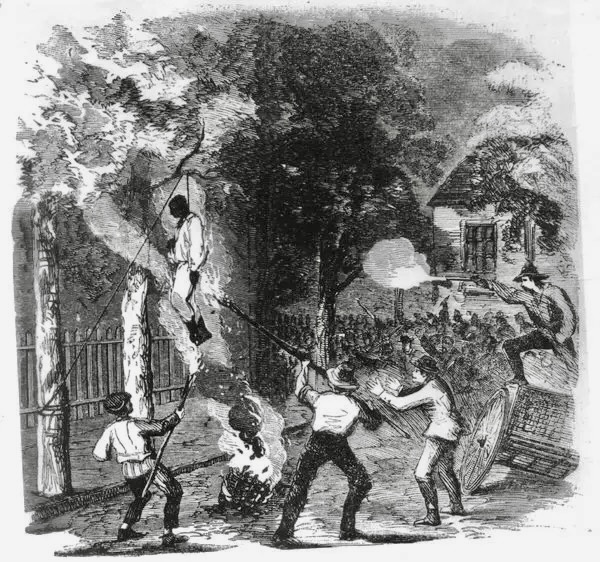
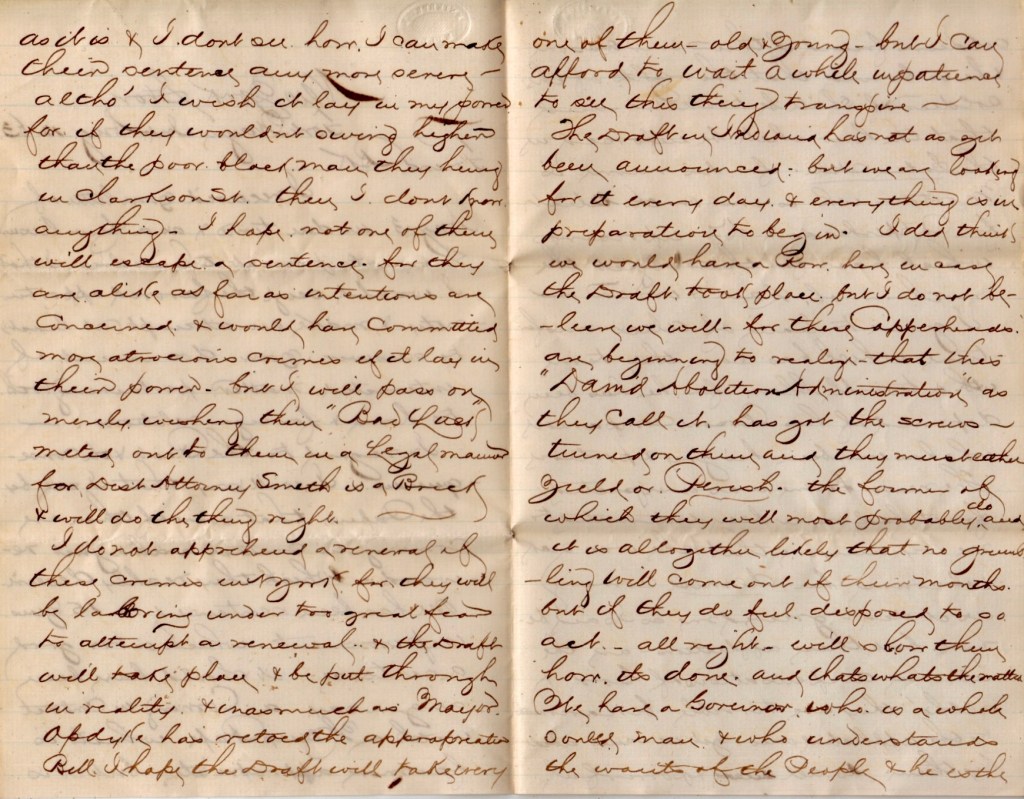
In regard to the [New York City Draft] Riot & the consequences, I will say that I see by the papers that some of them are coming in control with a just reward which they really deserve. One has been sentenced to 15 years imprisonment which is too good a sentence. It should have been, as you say, a coming in contact with a hemp rope which is far more appropriate, but it is as it is & I don’t see how I can make their sentence any more severe although I wish it lay in my power for if they wouldn’t swing higher than the poor black man they hung in Clarkson Street, then I don’t know anything. I hope not one of them will escape a sentence for they are alike as far as intentions are concerned & would have committed more atrocious crimes if it lay in their power. But I will pass on merely wishing them “Bad Luck” meted out to them in a legal manner for District Attorney Smith is a brick & will do the thing right.
One of the first victims to the insane fury of the rioters was a negro cartman residing in Carmine Street. A mob of men and boys seized this unfortunate man on Monday evening, and having beaten him until he was in a state of insensibility, dragged him to Clarkson Street, and hung him from a branch of one of the trees that shade the sidewalk by St. John’s Cemetery. The fiends did not stop here, however. Procuring long sticks, they tied rags and straw to the ends of them, and with these torches they danced round their victim, setting fire to his clothes, and burning him almost to a cinder. The remains of the wretched negro hung there till near daylight on Tuesday morning, when they were removed by the police. Harpers Weekly, 1 August 1863
I do not apprehend a renewal of these crimes in New York for they will be laboring under too great fear to attempt a renewal & the draft will take place & be put through in reality & inasmuch as Mayor [George] Opdyke has vetoed the Appropriation Bill, I hope the draft will take every one of them—old & young. But I can afford to wait a while in patience to see this thing transpire.
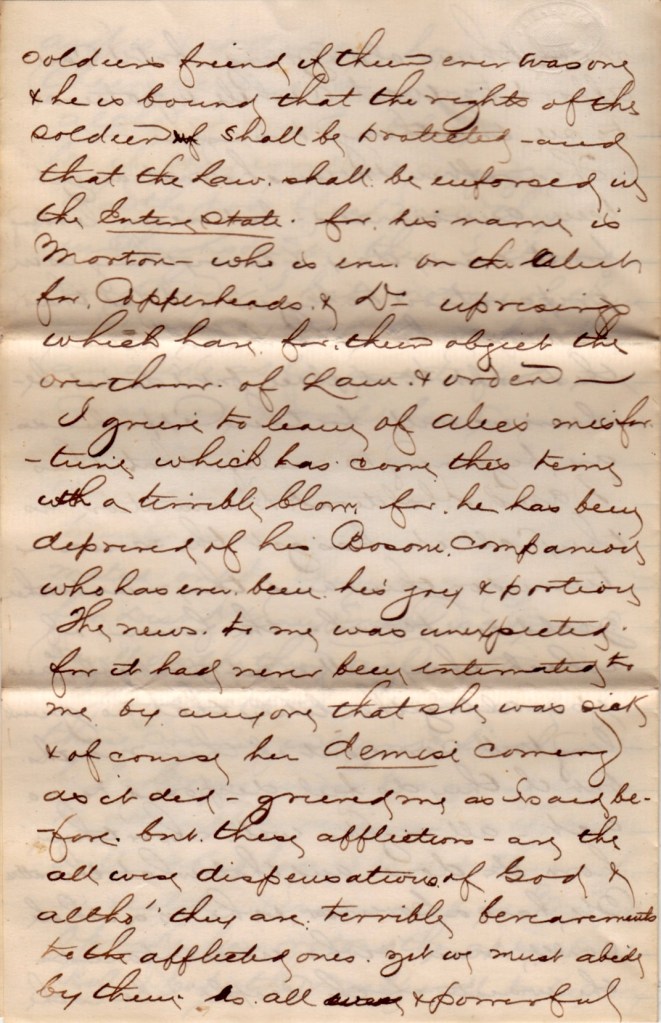
The draft in Indiana has not as yet been announced but we are looking for it every day & everything is in preparation to begin. I did think we would have a row here in case the draft took place, but I do not believe we will for these Copperheads are beginning to realize that this “Damned Abolition Administration”—as they call it—has got the screws turned on them and they must either yield or perish, the former of which they will most probably do and it is altogether likely that no grumbling will come out of their mouths. But if they do feel disposed to so act—all right. We’ll show them how it’s done and that’s whats the matter. We have a Governor who is a wholesome man & who understands the wants of the people & he is the soldiers friend if there ever was one & he is bound that the rights of the soldier shall be protected and that the law shall be enforced in the entire state for his name is [Oliver P.] Morton, who is ever on the alert for Copperheads & D[emocrat] uprisings which have for their object the overthrow of law & order.
I grieve to learn of Alec’s misfortune which has come this time with a terrible blow for he has been deprived of his bosom companion who has ever been his joy & portion. The news to me was unexpected for it had never been intimated to me by anyone that she was sick & of course her demise coming as it did grieved me as I said before but these afflictions are the all wise dispensations of God & although they are terrible bereavements to the afflicted ones, yet we must abide by them as all wise & powerful for we are not our own keepers. “The Lord gave & the Lord hath taken away.” Blessed be the name of the Lord.
One other thing troubles me and which you make the subject of your special remarks & that is Mr. Rankin’s intended departure from his congregation after a stay of a dozen years but my curiosity is excited as regards his destination for you say he would like to come West & I would like very well to have him too for he is one I would dearly long to see and hope if he does come West I may be thus privileged. I rather estimate that he is going to Illinois if at all but of course do not know for certain. Please ascertain if possible & report for I am anxious to know.
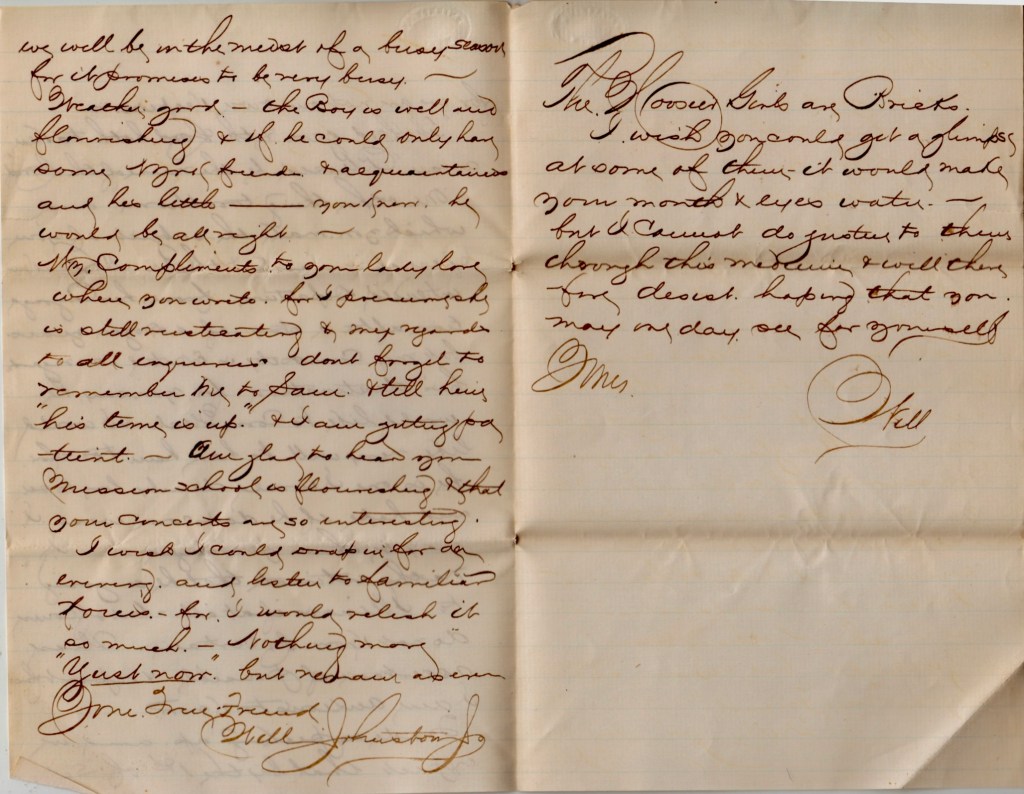
Trade is picking up and we expect that by the 1st of September we will be in the midst of a busy season for it promises to be very busy. Weather good. The boy is well and flourishing & if he could only have some New York friends & acquaintances and his little—-you know, he would be all right. My compliments to your lady love when you write for presume she is still rusticating & my regards to all enquirers. Don’t forget to remember me to Sam & tell him “his time is up” & I am getting [im]patient. Am glad to hear your Mission School is flourishing & that your concerts are so interesting. I wish I could drop in for an evening and listen to familiar voices for I would relish it so much. Nothing more “just now” but remain as ever your true friend, — Will Johnson, Jr.
The Hoosier girls are bricks. I wish you could get a glimpse at some of them. It would make your mouth & eyes water, but I cannot do justice to them through this medium & will therefore desist hoping that you may one day see for yourself. — Will
A later vintage envelope with the Root & Company emblem
This mother-to-daughter letter describes the fear of NYC citizens during the draft riots, which extended from July 12-17, 1863, beginning the day following the NYC draft lottery. The letter itself was written on July 19, and expresses the hope that the riots were indeed over. It also indicates the role of the Catholic clergy in calming the rioters, most of whom were poor Irish who vented their anger at the U.S. government, at people with means, and particularly at Black citizens. They were angry at the government for establishing what they considered to be an unfair draft. They were angry at the middle and upper classes of society for having been given the option of hiring “substitutes.” And they were angry at Blacks who they blamed for being the cause of the war, and, in their view, for taking jobs away from them.
How Joanna might have looked
The letter is only signed “J. Mills” and there is no envelope to aid in the identity of the correspondents but given the names mentioned in the letter, I’ve concluded it was written by 50 year-old Joanna Mills (1813-1902) of 251 Madison Street in Brooklyn, New York. Joanna’s maiden name was Frost and she and her husband, Scottish emigrant George Mills, Sr. (1796-1867), had several other children besides Emma Louisa Mills (1836-1916) to whom she addressed her letter. They included John Mills (1823-1861), Charles Mills (1832-1866), Joanna (“Josey”) Mills (1833-1908), George Mills, Jr. (1838-1887) and Isabelle (“Bell”) Terese Mills (1847-1905). Most of these family members were buried in Greenwood Cemetery in Brooklyn.
For those unfamiliar with the New York City Riots, I’ll state briefly that they were both the most violent and the most publicized. By the time the names of the first draftees were drawn in New York City on July 11, reports about the carnage of Gettysburg had been published in city papers. Lincoln’s call for 300,000 more young men to fight a seemingly endless war frightened even those who supported the Union cause. Moreover, the Enrollment Act contained several exemptions, including the payment of a “commutation fee” that allowed wealthier and more influential citizens to buy their way out of service.
“Perhaps no group was more resentful of these inequities than the Irish immigrants populating the slums of northeastern cities. Poor and more than a little prejudiced against blacks with whom they were both unfamiliar and forced to compete for the lowest paying jobs, the Irish in New York objected to fighting on their behalf.
On Sunday, July 12, the names of the draftees drawn the day before by the Provost Marshall were published in newspapers. Within hours, groups of irate citizens, many of them Irish immigrants, banded together across the city. Eventually numbering some 50,000 people, the mob terrorized neighborhoods on the East Side of New York for three days looting scores of stores. Blacks were the targets of most attacks on citizens; several lynchings and beatings occurred. In addition, a black church and orphanage were burned to the ground.
All in all, the mob caused more than $1.5 million of damage. The number killed or wounded during the riot is unknown, but estimates range from two dozen to nearly 100. Eventually, Lincoln deployed combat troops from the Federal Army of the Potomac to restore order; they remained encamped around the city for several weeks. In the end, the draft raised only about 150,000 troops throughout the North, about three quarters of them substitutes, amounting to just one fifth of the total Union force.”
Source: The Civil War Society’s “Encyclopedia of the Civil War”. See also B. L. Lee, Discontent in New York City, 1861–1865 (1943); I. Werstein, July, 1863 (1957, repr. 1971); J. McCague, Second Rebellion: The Story of the New York City Draft Riots (1968); A. Cook, The Armies of the Streets (1974); I. Bernstein, The New York City Draft Riots (1989).
The burning of the “Colored Orphan Asylum” in NYC during the 1863 Draft Riots
[Note: This letter is from the personal collection of Richard Weiner and was transcribed and published on Spared & Shared by express consent.]
Transcription
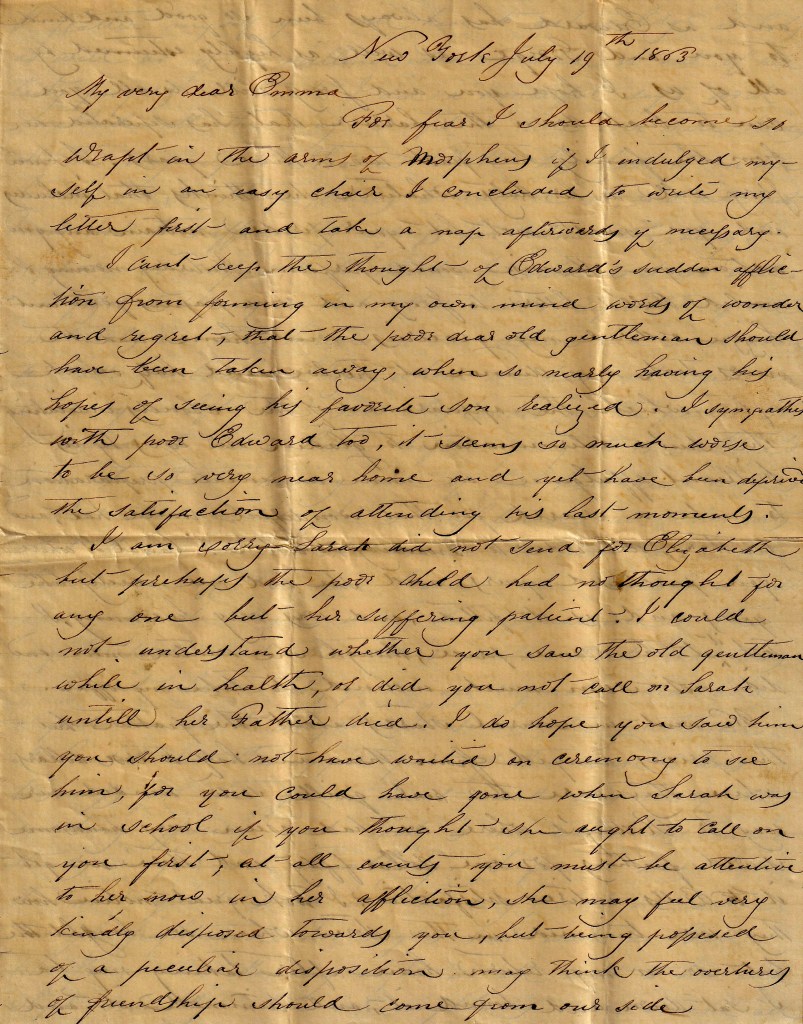
New York [City] July 19, 1863
My very dear Emma,
For fear I should become so wrapped in the arms of Morpheus if I indulged myself in an easy chair, I concluded to write my letter first and take a nap afterwards if necessary. I can’t keep the thought of Edward’s sudden affliction from forming in my own mind words of wonder and regret, that the poor old gentleman should have been taken away, when so nearly having his hopes of seeing his favorite son realized. I sympathize with poor Edward too, it seems so much worse to be so very near home and yet have been deprived the satisfaction of attending his last moments.
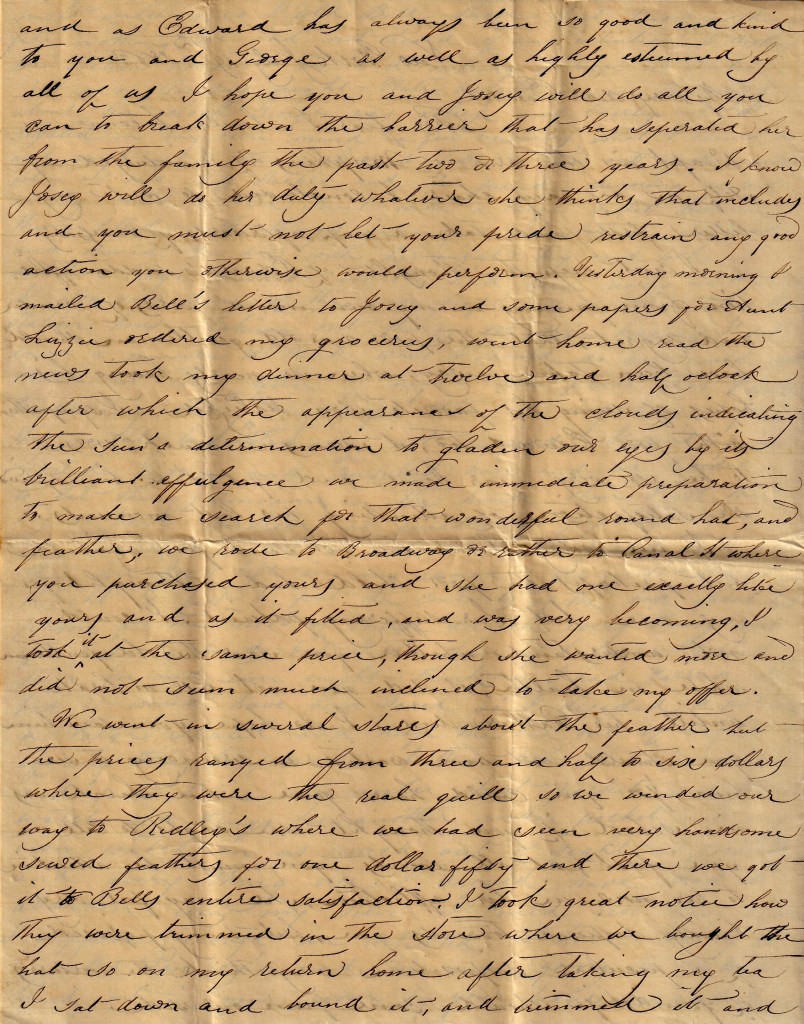
I am very sorry Sarah did not send for Elizabeth but perhaps the poor child had no thought for anyone but her suffering patient. I could not understand whether you saw the old gentleman while in health, or did you not call on Sarah until her father died? I do hope you saw him. You should not have waited on ceremony to see him for you could have gone when Sarah was in school if you thought she ought to call on you first. At all events, you must be attentive to her now in her affliction. She may feel kindly disposed towards you but being possessed of a peculiar disposition, may think the overtures of friendship should come from our side. And as Edward has always been so good and kind to you and George as well as highly esteemed by all of us, I hope you and Josey will do all you can to break down the barrier that has separated her from the family the past two or three years. I know Josey will do her duty whatever she may think that includes, and you must not let your pride restrain any good action you otherwise would perform.
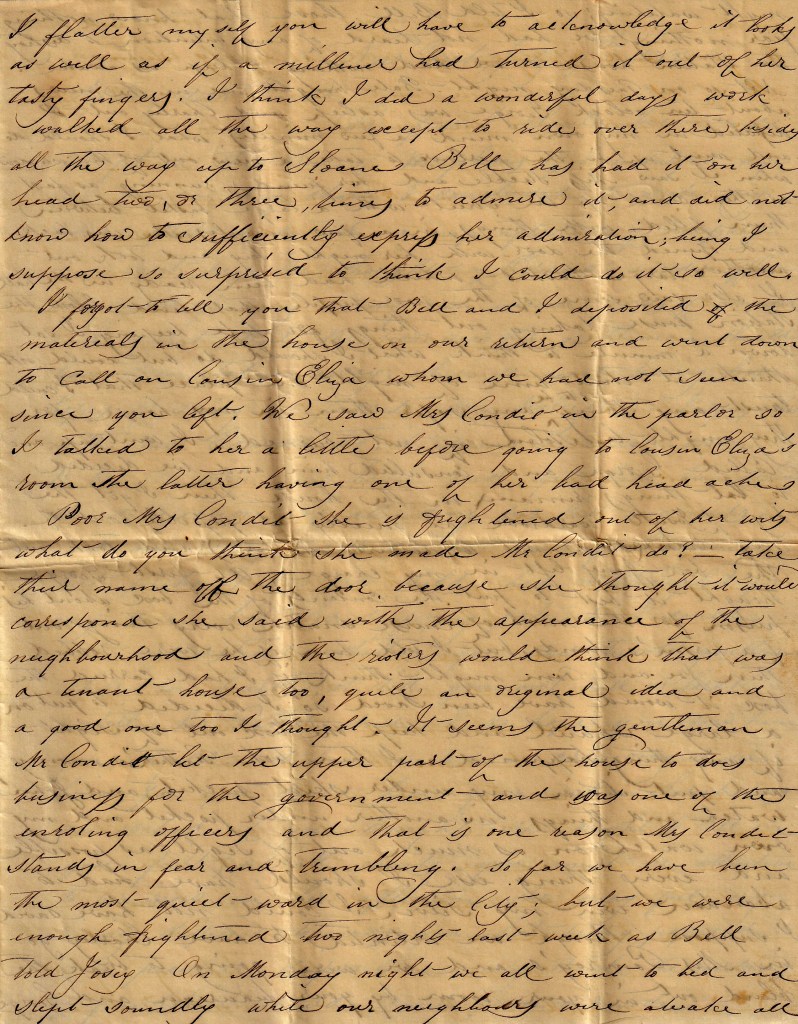
Yesterday morning I mailed Bell’s letter to Josey and some papers for Aunt Lizzie, ordered my groceries, went home, read the news, took my dinner at twelve and half o’clock, after which the appearances of the clouds indicating the suns determination to gladded our eyes by its brilliant effulgence. We made immediate preparation to make a search for that wonderful round hat and feather. We rode to Broadway, or rather to Canal Street where you purchased yours and she had one exactly like yours and as it fitted and was very becoming, I took it at the same price, though she wanted more and did not seem much inclined to take my offer. We went in several stores. About the feather hat, the prices ranged from three and a half to six dollars where they were the real quill so we winded our way to Ridley’s where we had seen very handsome sewed feathers for one dollar fifty and there we got it to Bell’s entire satisfaction. I took great notice how they were trimmed in the store where we bought the hat so on my return home, after taking my tea, I sat down and bound it, and trimmed it and I flatter myself, you will have to acknowledge it looks as well as if a milliner had turned it out of her tasty fingers. I think I did a wonderful day’s work. Walked all the way except to ride over there, besides all the way up to Sloane. Bell has had it on her head two or three times to admire it and did not know how to sufficiently express her admiration, being I suppose so surprised to think I could do it so well.
I forget to tell you that Bell and I deposited the materials in the house on our return and went down to call on Cousin Eliza whom we had not seen since you left. We saw Mrs. Condit in the parlor so I talked to her a little before going to Cousin Eliza’s room—the latter having one of her headaches.
Poor Mrs. Condit. She is frightened out of her wits. What do you think she made Mr. Condit do?—take their name off the door because she thought it would correspond, she said, with the appearance of the neighborhood and the rioters would think that was a tenant house too. Quite and original idea and a good one too, I thought. It seems the gentleman, Mr. Condit, let the upper part of the house to do business for the government and was one of the enrolling officers and that is one reason Mrs. Condit stands in fear and trembling. So far we have been the most quiet Ward in the City, but we were enough frightened two nights last week as Bell told Josey.
On Monday night we all went to bed and slept soundly while our neighbors were awake all night watching. So I told Bell those that know nothing fear nothing. We had not heard of any intention to destroy that Station house so we had nothing to keep us awake. Not so on Tuesday night. Kate brought me in the news about ten o’clock. George was asleep and Charley out. I debated in my own mind a few minutes what I should do and went up in the parlor to take a view out of the window when I saw Miss Steckle and her friend running as fast as they could up the street with a large basket between them filled with things. In a few minutes, she was back and opened the door with her night key and took out another large basket which had been ready in the hall. I also saw some of the poor people that lived below the Station house taking out things for safe keeping.
I sat down a minute to think what I should do but could not think at that time of night one place that I could trust anything to be any safer than in my own house for they might be stolen if not burned. I went up and called George and consulted him and we decided to let things remain in the house. Then I got the key of Joseph’s wardrobe as quietly as possible out of my drawer (so as not to disturb Father) and took out the box Josey left in my charge. At first George thought it best to put the contents of the box about his person for the mob of course snatch everything out of a person’s hands, but I told him if he were robbed, then Joe and Tom might think if I had carried the box, it would have been saved. So I decided to put on a large shawl and keep the box out of sight if anything happened. I then took Father’s money and put it in my under skirt pocket and [your brother] John’s watch and things in another under jacket and my own watch on as much out of sight as possible and everything else I should have had to abandon—even my silver I could not have saved. I suppose though we intended to have Charley go in Mrs. Pomroy’s and we were going to break the blind out in your room by your bureau and George was to hand him other valuables.
But nothing happed, thank God. For two night s I had my things placed in my pockets and Josey’s box done up in an old flannel ready for a start and Father knew nothing about it. On Wednesday and Thursday night, I was not alarmed because there were plenty to guard against the invaders but on Monday and Tuesday nights, all the policemen were in other parts of the City.
Last night Kate was out in Avenue B & C and many places up town shopping for clothes for her brother but everything was just as quiet as any night. Mr. Farmer, the gentleman in Charley’s office, went home on Wednesday afternoon and found he had lost every stitch of clothes he owned and one thousand dollars worth of silver that was in his trunk all burned up in the house in which he boarded. Mr. Bull’s brother’s house was sacked and the inmates had to leave. Charley stayed home on Wednesday evening and George has not been out in the evening during the week. I hope everything will remain quiet now as the rioters have been addressed today in the different Catholic churches, I expect. Kate said the priest talked to them in her church this morning and told them if there were any rioters or any who had been engaged in stealing property as he knew there were some present, to return it and desist from such a course of conduct as they nor their children would never prosper. He also read them several parables so I hope Bishop Hughes and the rest of his brethren will have some influence over them.
Tomorrow Cousin Eliza is coming to spend the day as I thought I had better set the time as Bell and I want to go to see Mary Ellen and Mr. Carlisle just as soon as a day offers that the clouds are not just ready to deluge us. I am so sorry you went in July since you are to have nothing but fogs. George says it was just so last year this time. When he was in Poughkeepsie, it rained or looked like it all the time. George has gone to see Lizzie Legget and Miss Everett. This morning he accompanied Bell and me to church. It was as thinly attended as usual. We had a very good sermon on the mediation of Christ. None of the Vauns were there excepting Mr. Vaun and in fact, I think most of the congregation were strangers. 1
I expect Alexander went to Craneville yesterday or he would have been here. I have hard work to get rid of my pies though they are excellent—the paste being rich enough suit even Josey. But you know Bell don’t eat pies and Father hast not tasted them so they are left to George, Kate, and myself. I have one for tomorrow so Cousin Eliza can help me eat it. I tell Bell I have had to eat one piece for her and one for myself sometimes twice a day rather than let them spoil.
Father went down to dinner today the first time in some days. He is so lame he thinks it don’t pay. Two nights we did without gas and I had to burn candles so I would light a whole one when I went to bed and it would last till daylight. Last night we had the gas again but when Father went to bed, he said, “Ma, what made you burn the candle last night the full blaze?” “Why,” said I, “how could you burn a candle any other way?” “Oh, I could show you,” said he. So for the fun of the thing, I got a candle and lighted it and took it to him while he was all undressed sitting on the side of the bed, but the minute he saw it, he shook with laughter and decided it must have been something else he meant. I suppose he had been thinking of lamps.
I did not tell you that I finished my white waist and washed and ironed it thinking I could go last Friday or yesterday to Miss Carlisle’s but the weather prevented. Now, for awhile, I will not be busy. I intend to go out and read some if everything remains quiet. I had nothing in the world in the way of news as Bell told all that happened but I think I kept awake pretty we;; and my hand aches. I am so sorry for poor dear Joe. She is particularly unfortunate with her things but I hope it will be restored to its original whiteness. Father sends his love to each of you. Tell Lib I send her a good hearty kiss and hope her good husband will come home in good health to her and all safe. Tell her not to let you plague her to death. She must call on Josey to take her part which I know she will do.
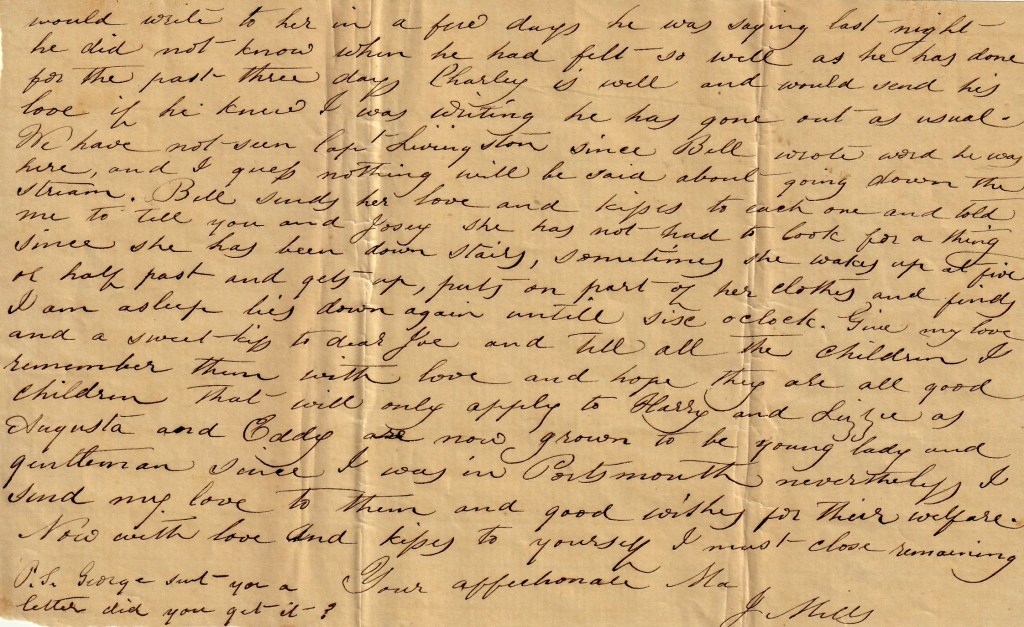
George [said he] would write to her in a few days….Charley is well and would send his love if he knew I was writing. He has gone out as usual. We have not seen Capt. Livingston since Bell wrote word he was here and I guess nothing will be said about going down the stream. Bell sends her love and kisses to each one and told me to tell you and Josey she has not had to wake up at five or half past and gets up, puts on part of her clothes, and finds I am asleep, lies down again until six o’clock. Give my love and a sweet kiss to dear Joe and tell all the children I remember them with love and hope they re all good children. That will only apply to Harry and Lizzy as Augusta and Eddy are now grown to be young lady and gentleman since I was in Portsmouth. Nevertheless I send my love to them and good wishes for their welfare.
Now with love and kisses to yourself, I must close remaining your affectionate Ma, — J. Mills
1 The Mills family attended the All Saints Church on the corner of Henry and Scammel streets.

















 Spared & Shared 23