

The following letters were written by James Champlin Worden (1818-1863), the son of Gideon Worden Sr. (1777-1858) and Phebe G. Gavet (17xx-1846) of Richmond, Rhode Island, later Plymouth, Chenango county, New York. Among James’ siblings mentioned in this letter are: Gideon Worden Jr. (b. 1811), Lucy (Worden) Harrington (1817-1879), Phebe Delina (Worden) Brown, and Elnora Esther Worden (1849-1883).

James may have served for a time in the US Army in the 1840s but by the mid-1850s he was serving tours of duty in the US Navy. He was finally discharged from the Navy suffering from rheumatism in late July 1861. At that time he was described as 5’8.5″ tall, with dark complexion, light hair and blue eyes. He served for a time on the US Congress.
Both of James’ letters were written while serving aboard the USS Hetzel, a side-wheel steamer built in 1861 at Baltimore, Maryland, for the United States Coast Survey and transferred to the Navy Department 21 August 1861 for duty in the North Atlantic Blockading Squadron. She arrived at Newport News, Virginia, 18 November 1861. Her first taste of action came 2 December, when Confederate steamer Patrick Henry stood out into Hampton Roads and engaged several Union gunboats, including Hetzel. The Federal ships succeeded in damaging Patrick Henry in a 2-hour engagement.
Letter 1
US Steamer Hetzel
Newport News, Va.
November 8, 1861
Dear Brothers & Sisters,
I received your letter on the 25th and I should [have] wrote sooner but I did not know that we should stay here so long as we have. but I expect we shall lay here all winter and so I have take this opportunity to write. I was very much pleased to hear so much news from all of my relations and friends. I was very happy to hear that Gideon attends meetings again.
We are now on picket duty at the mouth of the James river, Virginia, to keep the Rebels from coming down from Richmond and getting out to sea. We had an engagement the other morning which lasted about an hour betwixt the Hetzel (Union) and the Patrick Henry (Rebel) in which there was no lives lost on our side but they kept a long distance from us and their shots did not reach us.
I was glad to hear from Gardner but I don’t know why he should enlist if he is worth so much money. There are encamped at Newport News close where we lay about eight thousand volunteers. We expect soon to go to Norfolk with a strong fleet and storm the place.
We have plenty of oysters here which I believe you would like to have some too. My health is better this winter than it has been for some winters before. I must try to write to you more about the war.
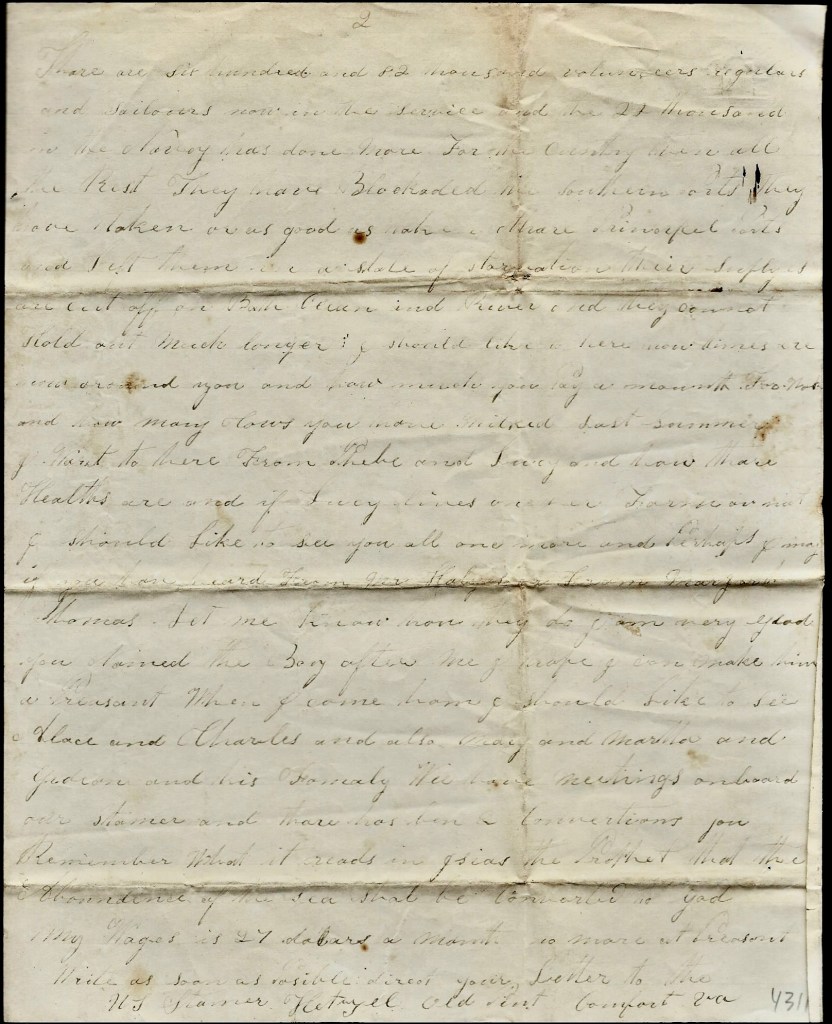
There are 682,000 volunteers, regulars, and sailors now in the service and the 22,000 in the Navy has done more for the country than all the rest. They have blockaded the Southern ports. They have taken—or as good as taken—more principal ports and left them in a state of starvation. Their supplies are cut off on both ocean and river and they cannot hold out much longer. I should like to hear how times are now around you and how much you pay a month for work and how many cows you have milked last summer. I want to hear from Phebe and Sary and how their healths are and of Licy lives on her farm or not. I should like to see you all once more and perhaps I may. If you have heard from Mr. Hal___ from New York, Thomas, let me know how they do. I am very glad you have named the boy after me. I hope I can make him a present when I come home. I should like to see Alice and Charles and also Mary and Martha and Gideon and his family. We have meetings on board our steamer and there has been 2 conversions. You remember what it reads in Isaiah the Prophet that the abundance of the sea that be converted to God. My wages is 27 dollars a month. No more at present. Write as soon as possible. Direct your letter to the US Seamer Hetzel, Old Point Comfort, Va.

Letter 2
Hatteras Inlet, North Carolina
January 17, 1862
Dear Brother,
Not having received any letter for a long while and getting tired of waiting, I thought I would write you a few lines to let you know where I am at present. We are now laying at or near Cape Hatteras in Potomac Sound and as lonesome barren place as ever I was in except Cape Horn. There is nothing but sand in sight as far as land is concerned. There are now from 30 to 40 gunboats waiting to go to Elizabeth City to attack the Rebels and sixteen thousand Union soldiers. We have just had a gale of wind and there has been 4 vessels lost besides 6 or 8 men drowned. The loss to the government could not been less than 200,000 dollars but that was nothing to mens lives when they are not prepared to die. 1
We still have meetings three times a week which makes the time pass quite cheerful. My situation is not a very pleasant one, notwithstanding I am very well contented. It is like a school teacher that has 70 or 100 large scholars to look out after. I have some very hard customers to deal with but I have plenty of handcuffs and shackles. Liquor is the cause of all the trouble and if there were no rum, it would be better times in the Navy and Army. I don’t know as you can read this writing. It’s quite dark in the night.
I should like well to receive a letter from you. I want to hear from Phebe and the children, from Lucy, Gideon, Thomas, Mary and Sary and all my dear relations and friends. If you have heard again from Gardner, let me know how he is getting along. I don’t get any news here and I don’t know how the war is going along. My mind is on things of more importance than warfare. If we were all good soldiers of the cross, our country would be at perfect unity. I wish you would direct me a letter as follows:
Mr. James C. Worden on board the US Steamer Hetzel, Hatteras Inlet, N. C.
If I had any news to write, I would write willingly. But as I han’t, I well close. I remain your friend and Brother, — James C. Worden
1 James description of the fleet of gunboats inside the bar at Hatteras Inlet is a reference to the Burnside Expedition which sailed from Hampton Roads on the 11th of January 1862. The gale occurred on the night of 12 January. Among the vessels lost or severely damaged were the Zouave, the City of New York, the Pocahontas, the Louisiana, and the New Brunswick.


 Spared & Shared 23