Category Archives: Nurse

The Angel Watchers—July 1863

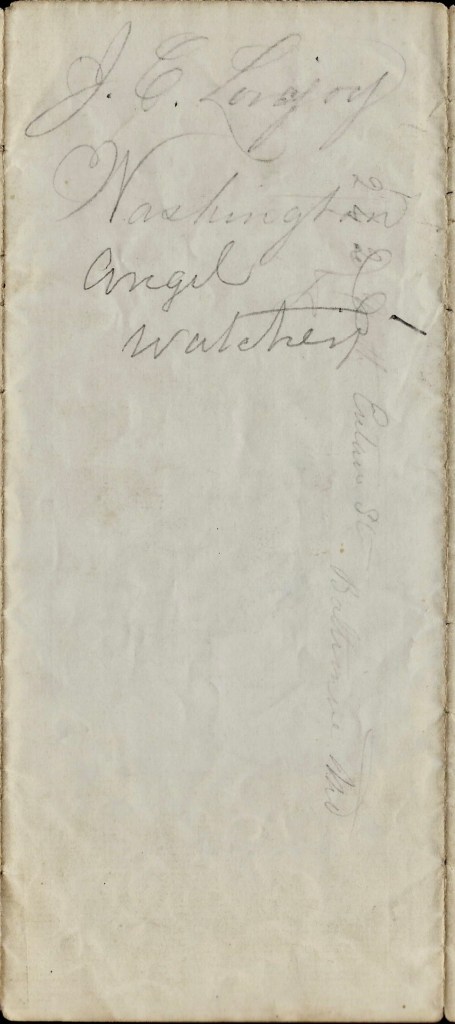
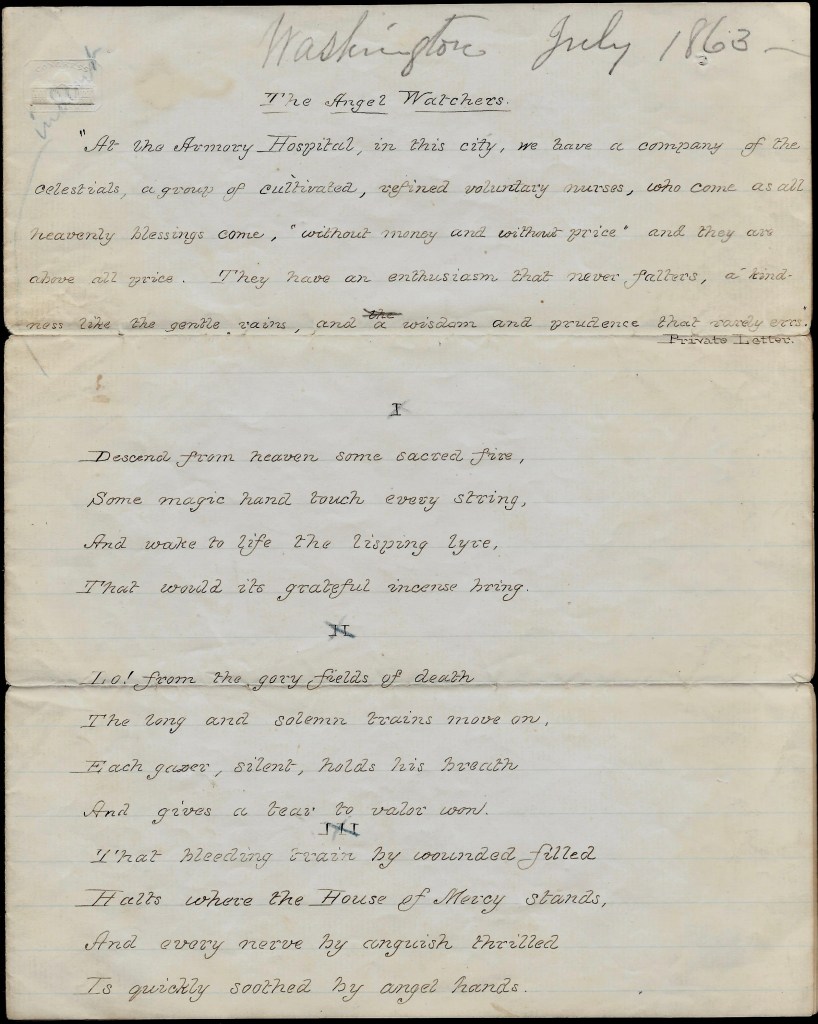
The poem titled “The Angel Watchers” comes from a private collection and is a precious piece of history. It was penned presumably in July of 1863, as indicated at the top of the page. On one of the pages, the name “J. C. Lovejoy” is inscribed, sparking curiosity about the author’s identity. Months after I posted this poem on Spared & Shared, I received a solid clue (see comments) from Eric Pominville who suggested the poem was written by Joseph Cammett Lovejoy (1805-1871), the older brother of Congressman Owen Lovejoy. According to Eric, who has been researching Armory Square General Hospital, he reports that Amanda Akin Stearns (1909) memoir, The Lady Nurse of Ward E, Mr. Lovejoy was a frequent visitor at Armory Square and was well known to the hospital staff. Writing under the date May 14, 1863: “A gallant old gentleman in Congress (brother of Owen Lovejoy, the noted Abolitionist) was introduced to us by Mrs. [Henrietta Crosby] Ingersoll. He says, “We can take care of the soldiers, and he will take care of us,” so he comes quite often to accompany us in a walk after supper through the Capitol grounds. He writes verses, and is a friend of Mrs. Sen. [Henry Smith] Lane. Tomorrow for diversion, he is to take a party of us to another hospital, where they have theatrical entertainments.” Akin, The Lady Nurse of Ward E, (1909), p. 27-28.

I have searched the internet extensively to look for evidence that this poem was published at some time but could not find it. That search included newspapers and “Google Books,” etc. The Armory Hospital was established in 1862. It was constructed on land adjacent to the Smithsonian Institution, approximately where the National Air and Space Museum is today. There was an anniversary celebration at the hospital in August 1863. Perhaps that is when this photograph was taken and was the occasion for the poem.
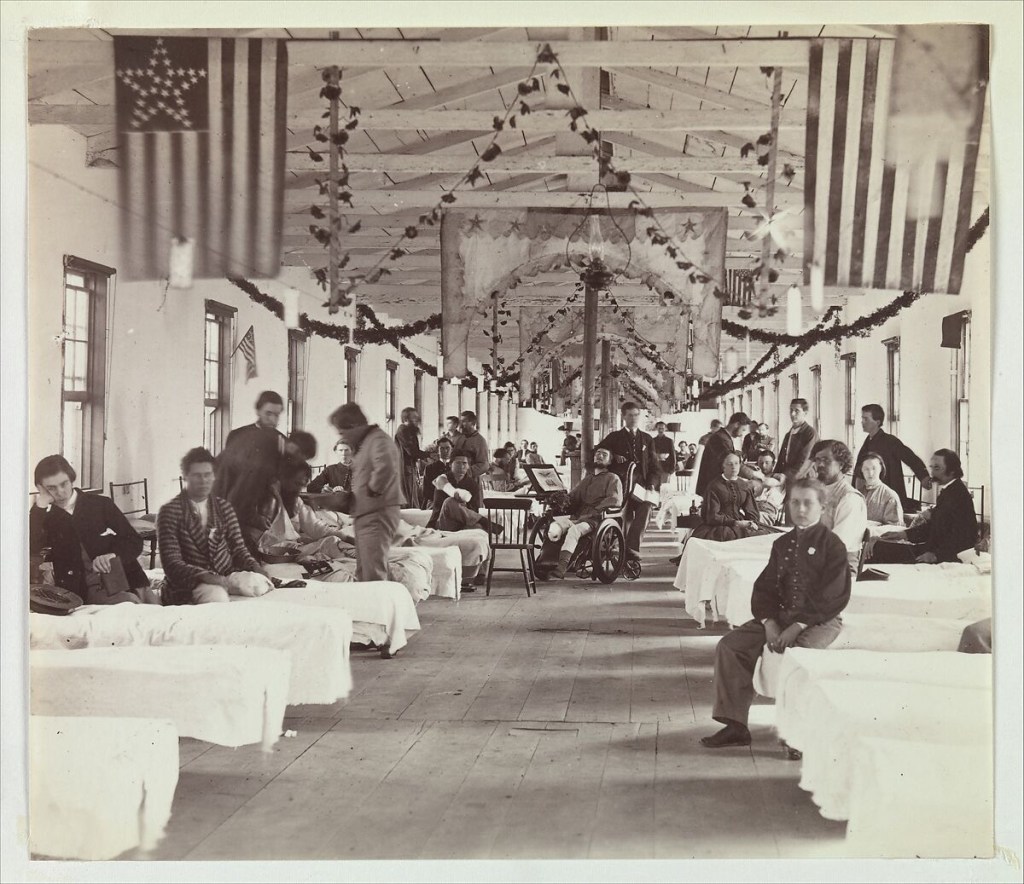
Armory Hospital in the District of Columbia

The Angel Watchers

At the Armory Hospital, in this city, we have a company of the celestials, a group of cultivated, refined voluntary nurses, who come as all heavenly blessings come, “without money and without price” and they are above all price. They have an enthusiasm that never falters, a kindness like the gentle rains, and a wisdom and prudence that rarely errs. Private Letter.

Descend from heaven some sacred fire,
some magic hand touch every string,
And wake to life the lisping lyre,
That would its grateful incense bring.

Lo! from the gory fields of death
The long and solemn trains move on,
Each gazer, silent, holds his breath
And gives a tear to valor won.

That bleeding train by wounded filled
Halts where the House of Mercy stands,
And ever nerve by anguish thrilled
Is quickly soothed by angel hands.

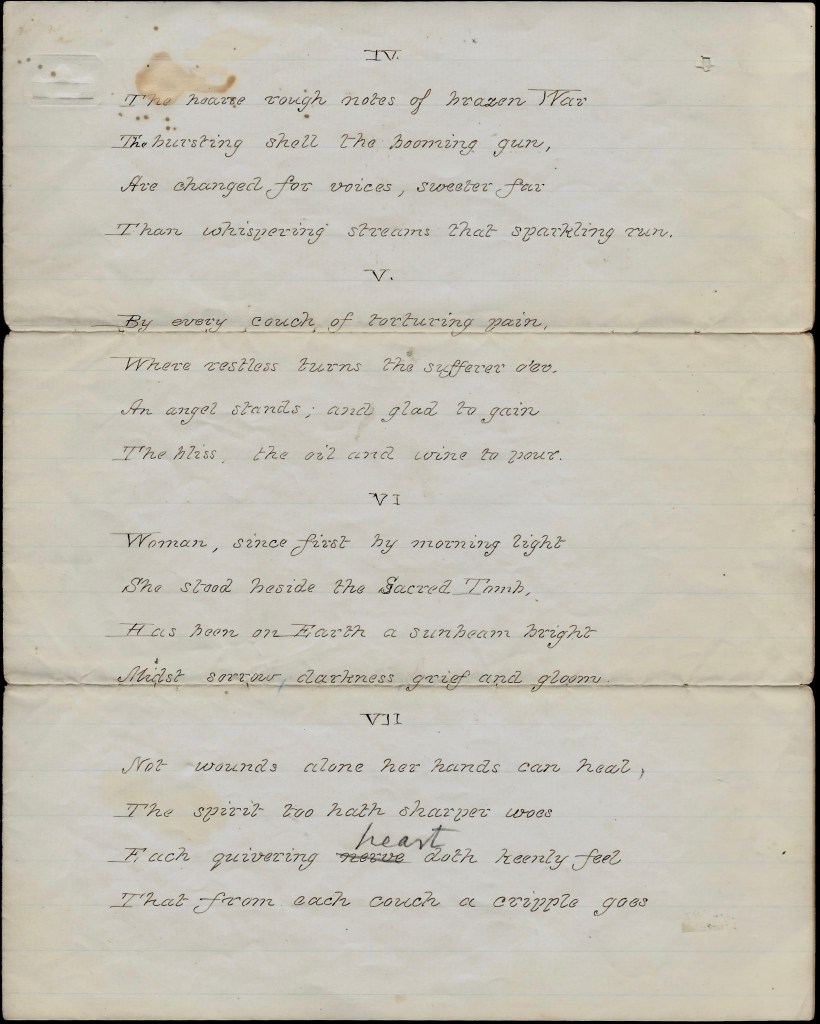
The hoarse rough notes of brazen war
The bursting shell the booming gun,
Are changed for voices, sweeter far
Than whispering streams that sparkling run.

By every couch of torturing pain,
Where restless turns the sufferer o’er,
An angel stands, and glad to gain
The bliss, the oil and wine to pour.

Woman, since first by morning light
She stood beside the Sacred Tomb,
Has born on Earth a sunbeam bright
Midst sorrow, darkness, grief and gloom.

Not wounds alone her hands can heal,
The spirit too hath sharper woes
Each quivering heart doth keenly feel
That from each couch a cripple goes.

Nancy Maria Hill, one of the nurses that worked at Armory Square Hospital (LOC)

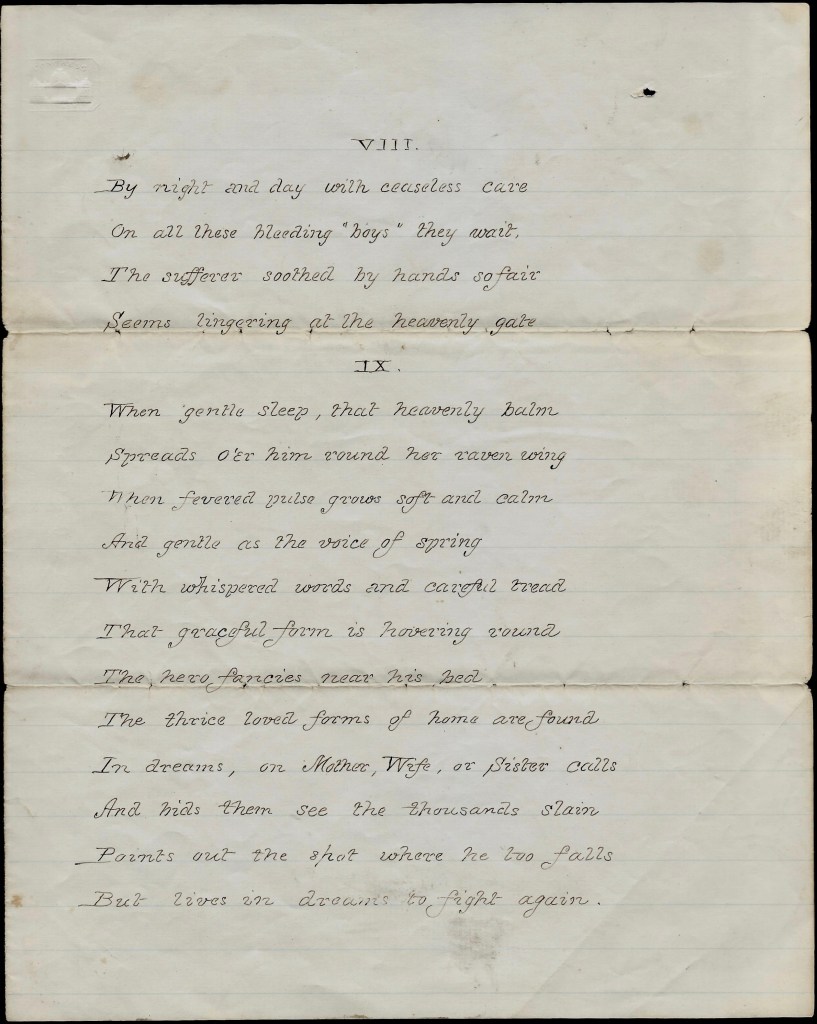
By night and day with ceaseless care
On all these bleeding “boys” they wait,
The sufferer soothed by hands so fair
Seems lingering at the heavenly gate.

When gentle sleep, that heavenly balm
Spreads o’er him round her raven wing
When fevered pulse grows soft and calm
And gentle as the voice of spring

With whispered words and careful tread
That graceful form is hovering round
The hero facies near his bed
The thrice loved forms of home are found

In dreams, on Mother, Wife, and Sister calls
And bids them see the thousands slain
Points out the spot where he too falls.
But lives in dreams to fight again.
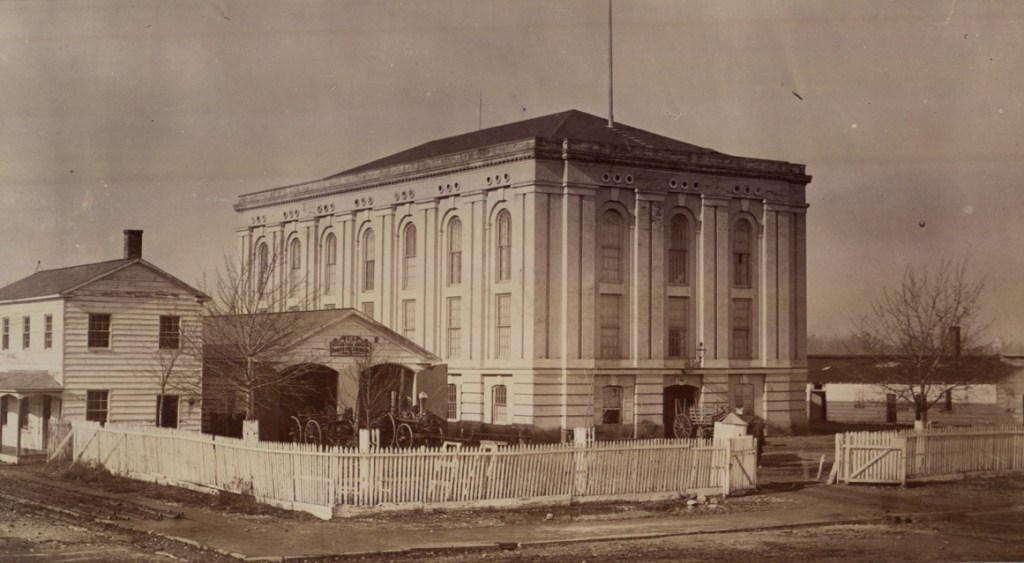
Exterior of Armory Square Hospital during the Civil War,

1861: Albert Hayes to George D. Demeritt

This letter was written by Albert Hayes (1839-1906), the son of James Hayes (1801-1871) and Juliana Berry (1808-1874) of Dover, Piscataquis county, Maine. Albert was enumerated in his father’s household at the time of the 1860 US Census and his employment was recorded as “blacksmith.” Albert would enter the service of his country in the Civil War but we learn from this letter that prior to his enlistment he had taken a situation as a nurse in a Portland military (unnamed) hospital where soldiers were being treated for typical camp diseases.

Military records indicate that 24 year-old Albert enlisted on 17 December 1863 as a private in Co. E, 1st Maine Heavy Artillery. He was wounded in the fighting at Cold Harbor on 4 June 1864 and again at Petersburg where the regiment—used as infantrymen—charged across an open field toward entrenched Confederate soldiers on 18 Jun 1864, resulting in the greatest single loss of life in a Union regiment in the war, with seven officers and 108 men killed, and another 25 officers and 464 men wounded. These casualties constituted 67% of the strength of the 900-man force. Somehow Albert survived the war and was discharged on 16 June 1865.

[Note: for a great documentary short film on the 1st Maine Heavy Artillery’s assault on the Confederate position at Petersburg, see “Forlorn Hope” on HistoryFix.]

Albert died in Stockton, California in 1906. More biographical material can be found on Find-A-Grave.

Albert wrote the letter to his friend, George D. Demeritt (1840-1881), the son of Daniel Chesley Demeritt (1800-1862) and Elizabeth G. Longfellow (1799-1853) of Dover, Piscataquis county, Maine. George later became a physician, married and settled in Sangerville, Maine.

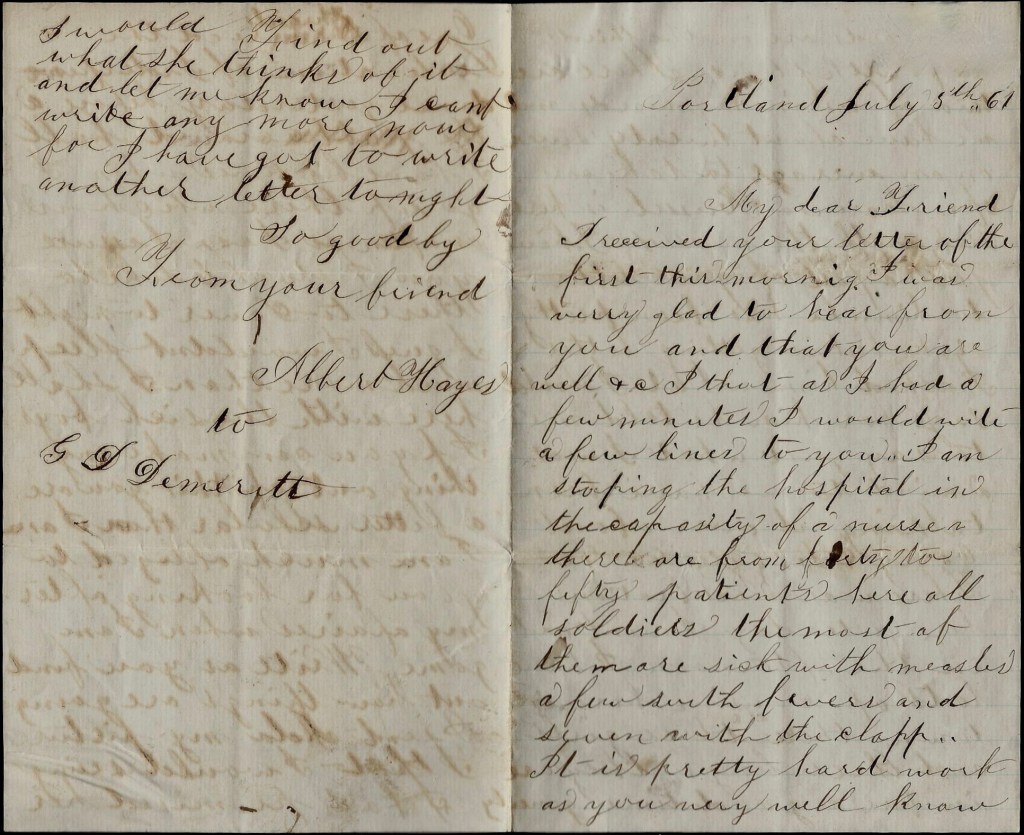
Transcription

Addressed to Mr. George D. Demeritt, West Dover, Maine

Portland [Maine]
July 5, 1861

My dear friend,

I received your letter of the first this morning. I was very glad to hear from you and that you are well &c. I thought as I had a few minutes I would write a few lines to you.

I am staffing the hospital in the capacity of a nurse. There are from forty to fifty patients here. All the soldiers—the most of them—are sick with measles, a few with fevers, and seven with the clap [gonorrhea]. It is pretty hard work as you very well know. My wards are on the third and fourth floors. There are two of us in my wards and we have about twenty-seven on an average to take care of.

The 4th of July Program at City Hall in Portland in 1861. Unfortunately the “Young Lady of this City” who read the Declaration of Independence isn’t identified. (Portland Daily Advertiser, 4 July 1861)

Lorenzo Russell is here sick with the measles. I have just read a part of your letter to him. He has been pretty sick but is getting better. I asked him what I should say for him. He told me to say just what I was a mind to. We have been talking it over about Cory and Lizzie, &c.

There was a celebration here yesterday. I went out in the afternoon. I have lots of cousins here in town—there are three girls and three boys. They are in for a good time generally. One of the girls read the Declaration of Independence yesterday before a crowded hall. I have big times when I go up there which is as often as I can, I assure you.

I should like to [be in ] Dover tonight. I guess I wouldn’t sleep much more than I shall here with the sick boys. If you can make anything out of this, you are a better scholar than I am. I am much obliged to you for looking after my affairs when I am gone. Write as you find out how things are going. I sent Ada my picture. I thought I would seeing I had promised her I would. Find out what she thinks of it and let me know.

I can’t write anymore now for I have got to write another letter tonight. So goodbye. From your friend, — Albert Hayes

to G. D. Demeritt