Category Archives: Overland Campaign

1864: William Eugene Ruggles to his Parents

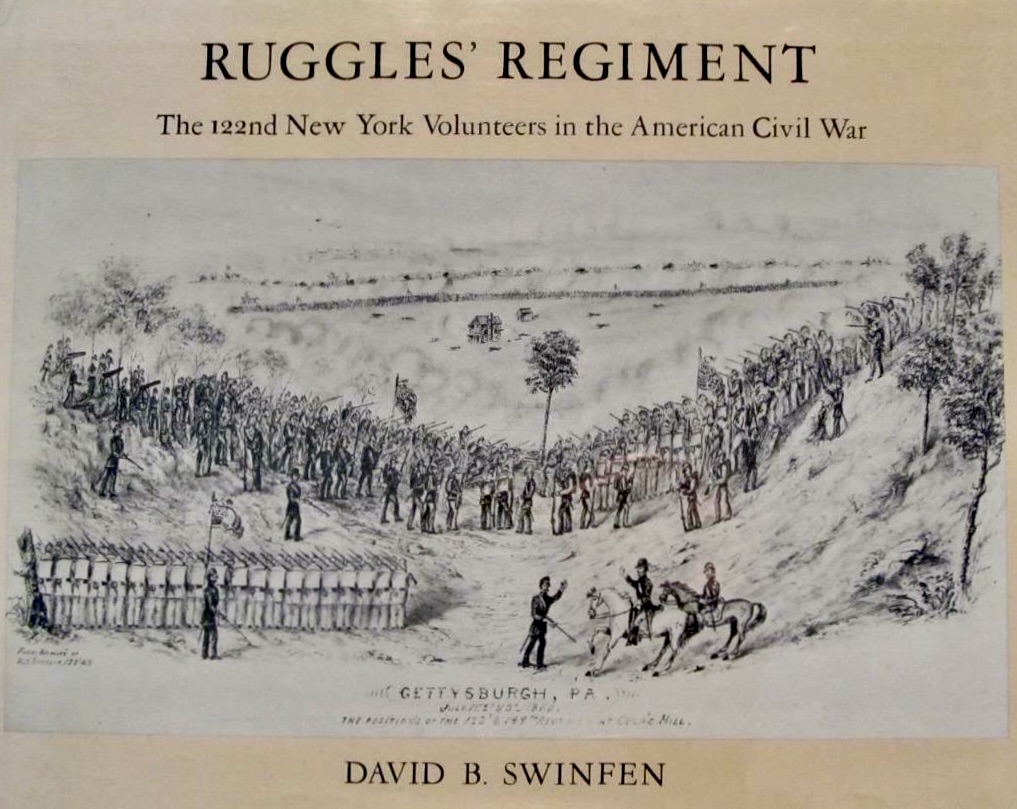
This letter was written by William Eugene Ruggles (1846-1907), the son of Noble O. Ruggles (1807-1892) and Sarah Shoens (1824-1890) of Syracuse, Onondaga county, New York. Nothing is known of William life until he enlisted with Co. B, 122 Regiment of New York Volunteers in 1862, at which time he described himself as a carpenter. He was clearly unhappy in the army, however, and deserted several times. In 1865, after one such desertion, he was court martialled and dishonourably discharged, after which he returned to Syracuse where he remained until his death. There he married Alida Alexander a year or two after his discharge, with whom he had one daughter, Reba. During his time in the army Ruggles had contracted chronic diarrhea which left him permanently weakened. After the war he worked in a meat market, and when this became too much for him, as a cigar maker. He died in 1907, after which his wife and daughter moved to Prescott Ontario. Some time after her mother’s death in 1927, Reba moved to Scotland. She died in Angus in 1958.

William is credited with a series of drawing depicting the regiment that were bequeathed to the University of Dundee in 1958 by Ruggles’ daughter. All the drawings, however, at some time appear to have had a different signature, in the right hand corner, which has been erased. This name in most cases is illegible apart from a few letters, but the drawings are in fact believed to be that of Phillip M. Ostrander, 149th Regiment. Several of the drawings, however, depict scenes at which Ostrander could not have been present. It is likely that the later and perhaps even all the drawings are based on original photographs or other pictures. [see Ruggles Bequest]
Transcription
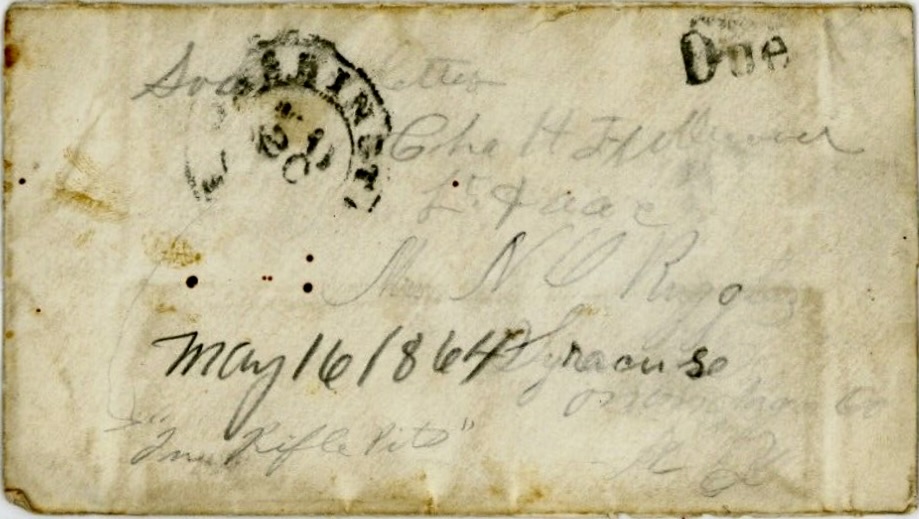
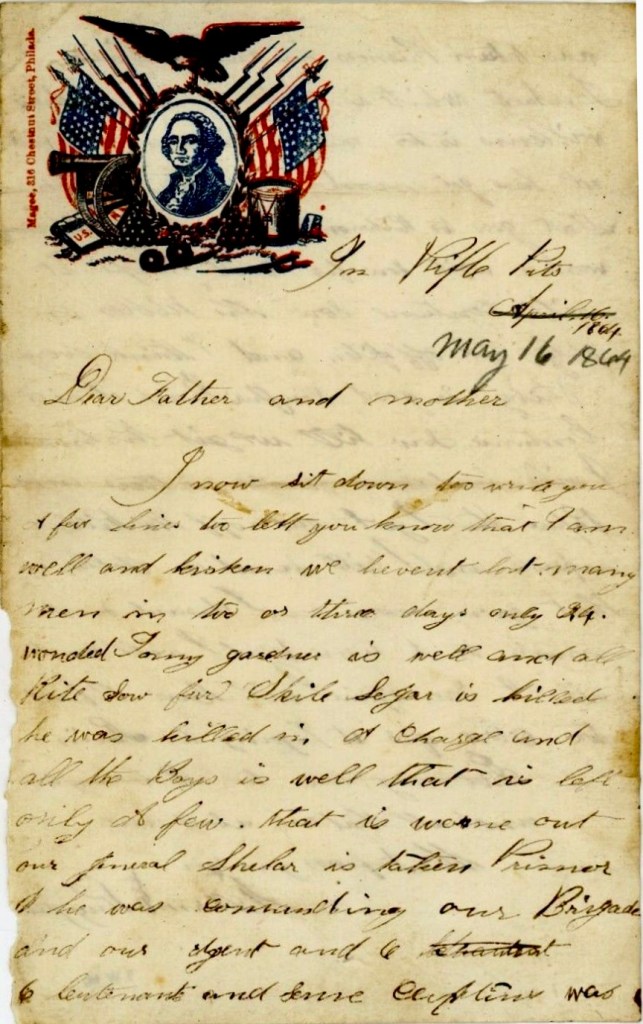
In rifle pits
May 16, 1864

Dear father and mother,

I now sit down to write you a few lines to let you know that I am well and kicking. We haven’t lost many men in two or three days—only 24 wounded. Tommy Gardner is well and all right so far. Skile Segor is killed. He was killed in a charge and all the boys is well that is left—only a few that worne out. Our [Brig.] General [Alexander[ Shaler is taken prisoner. He was commanding our Brigade and our adjutant and six lieutenants and some captains was taken prisoner in our Brigade. Lieutenant White is safe and Andrew Wilkins is too. And Lieut. Col. [Augustus W.] Dwight.

We have got most to the railroad that goes to Richmond. Many things is working right so far and I hope it will continue so. The Rebels is pretty sick of fighting and I think everything is good so far, I hope it will continue so till we get to Richmond.

I will send some more letters and papers that I got out of the Rebels knapsack and I will send a dollar that you may use. I doesn’t send much at a time but I will send you all I can spare. I have to close for it is going to rain. Give my love to all—Charley too, and all that ask about me.

From your son, — William E. Rugggles
1864: Henry French to Mary Amelia Smith

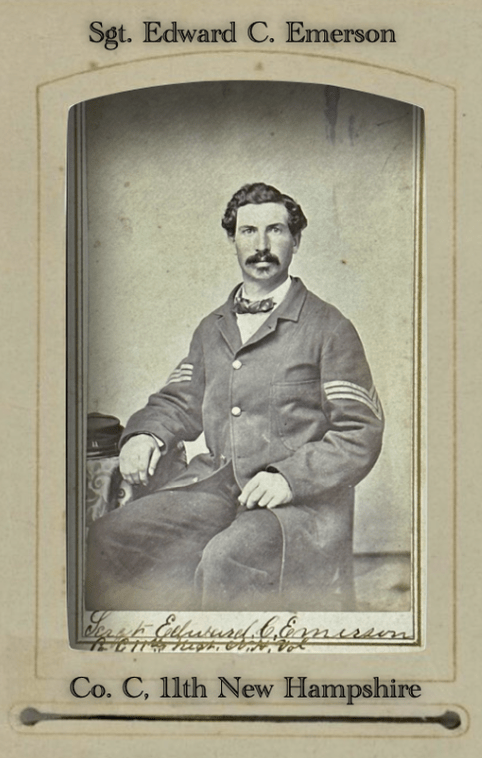
I could not find an image of Sgt. Henry French but here is Sgt. Edward Emerson of Co. C, 11th New Hampshire
(Al & Claudia Niemiec Collection)

The following letter was written by Sgt. Henry French (1834-of Co. H, 11th New Hampshire Infantry. Henry enlisted as on 20 August 1862 and was mustered in as the 1st Sergeant. He was wounded on 13 December 1862 at the Battle of Fredericksburg and was reduced in ranks to a private in May 1863 but a year later was wearing sergeant’s stripes again. He survived the war and mustered out of the service in June 1865.

In his letter, Henry describes the movements of his regiment from the Rapidan to the James River in May 1864.

Henry was the son of Jesse French (1795-1892) and Ann Chamberlain (1813-1897) of Plainfield, Sullivan County, New Hampshire. Henry’s brother, Elias French (1838-1933) also served in the same company. Henry was married to Emma Smith and working as a carpenter/joiner in Plainfield, Grafton county, New Hampshire, when he enlisted. He wrote the letter to his sister-in law, Mary Amelia Smith (b. 1839).

Transcription

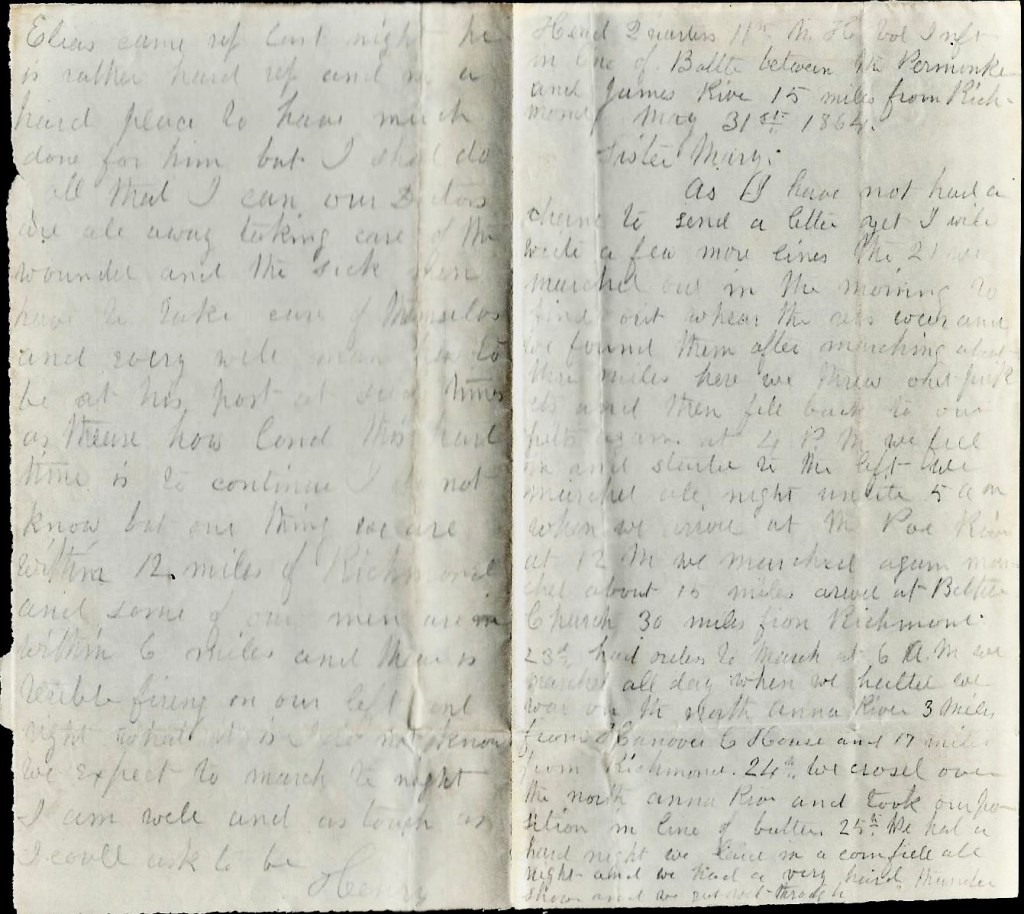
Headquarters 11th N. H. Vol. Infantry
In line of battle between the Pamunkey and James River
15 miles from Richmond [Virginia]
May 31st 1864

Sister Mary,

As I have not had a chance to send a letter yet, I will write a few more lines. The 21st we marched out in the morning to find out where the rebs were and we found them after marching bout three miles. Here we threw out pickets and then fell back to our pits again. At 4 p.m. we fell in and started to the left. We marched all night until 5 a.m. when we arrived at the Po River. At 12 M we marched again. Marched about 15 miles. Arrived at Bethel [?] Church, 30 miles from Richmond.

23rd, had orders to march at 6 a.m. We marched all day. When we halted, we was on the North Anna River 3 miles from Hanover Court House and 17 miles from Richmond.

24th, we crossed over the North Anna River and took our position in line of battle. 25th, we had a hard night. We laid in a cornfield all night and we had a very hard thundershower and we got wet through.

May 26th. Moved out of the cornfield and took our position between two lines of works. We laid here until 9 p.m. when we got orders to fall in. We fell in very still and started when the Rebs rose up and gave us a hard volley and our brigade went out in a hurry but we had no one hurt. When we had got most down to the river, we met Elias. He had just come up with 1100 other men. We marched this night until 2:30 a.m.

27th, today we marched all day until 2 a.m. 28th, file in at daybreak and marched until 11:30 marching 30 miles—the hardest march that our regiment ever had. We crossed the Pamunkey river and marched about 1.5 miles and went into camp. Elias did not come up. It was a very cold night. 29th, 6 a.m. fell in and marched about three miles and halted and commenced a line of rifle pits. Worked on them until about 12 M when we fell in and marched back about 1.5 miles and went into camp to await orders. We laid here all night and had a good time. Got a plenty of fresh meat to eat and had a good woods to sleep in. Have not seen Elias today. Do not know where he is.

30th, today we have laid in line of battle all day but have not been in but some some of the troops have been fighting some all day. Elias has not come up yet. Since I commenced writing this, we have moved to the front about one mile and now lay in the front and expect to go in soon. 31st, last night we had a good night.

May [June] 1st, last night we worked all night throwing up works. We lay about 30 rods from the Rebs works and are banging away at them all of the time. A lot of them are in a house in front of our regiment and we are trying to get them out. We shall give them a try tonight. We drove them one mile yesterday. Our regiment did not lose a man. The 9th lost a few.

Elias came up last night. He is rather hard up and in a hard place to have much done for him but I shall do all that I can. Our doctors are all away and the sick have to take care of themselves and every well man has to be at his post. At such times as these, how hard this hard time is. To continue, I do not know but one thing. We are within 12 miles of Richmond and some of our men are within 6 miles and there is terrible firing on our left and right. What it is, I do not know. We expect to march tonight. I am well and as tough as I could ask to be, — Henry

1864: John W. James to Sarah Arnow

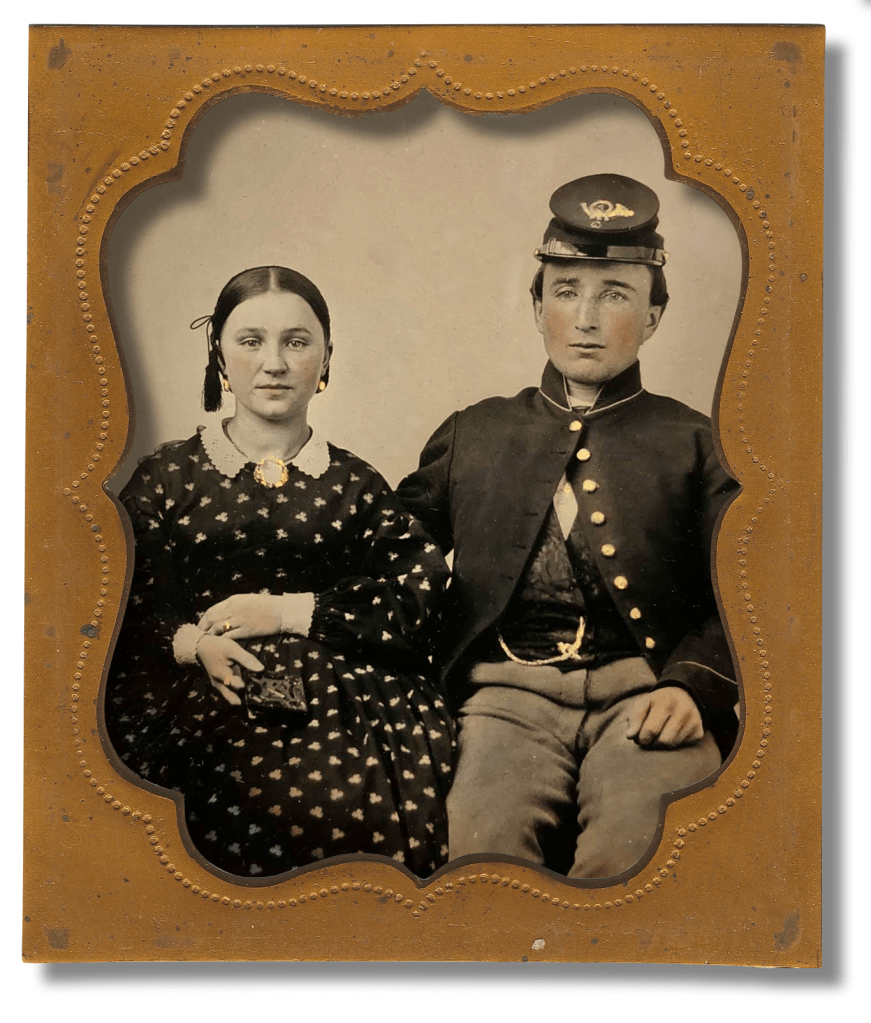
I could not find an image of Corp. James but here is a tintype of a member of the 8th Ohio Infantry with his lady. (Kevin Canberg Collection)

This letter was written by 28 year-old Corp. John W. James of Co. G, 8th Ohio Volunteer Infantry, a member of the Gibraltar Brigade of the Army of the Potomac. John enlisted on 7 June 1861 and was mustered out after three years service on 13 July 1864.

“Following President Lincoln’s call for regiments of 3 years’ duration, the 3 month regiment reenlisted on 22 June. It participated in the Shenandoah Valley Campaign against the forces of General “Stonewall” Jackson, and gained distinction at the Battle of Antietam with their fighting at the Sunken Road. They also served at the battles of Fredericksburg, Chancellorsville, and Gettysburg. The 8th became well-known after its service at Gettysburg, due to its repulse of Confederate troops during “Pickett’s Charge.”

After Gettysburg, the regiment was sent to quell the New York City draft riots. Following its return to the Army of the Potomac, the 8th participated in Grant’s Overland Campaign from the Wilderness to the siege of Petersburg. At Spotsylvania Court House, they were engaged in the fighting at the “Bloody Angle,” where hand-to-hand combat raged for 22 hours. Just 3 weeks before their enlistment expired, on 1 June 1864, they took part in the ill-fated attacks at the battle of Cold Harbor. This constant, intense fighting throughout the war gained the 8th a dubious honor: more of its men died from hostile action than of disease.

The regiment was officially mustered out of service on 13 July 1864. Veterans who wished to continue the fight, along with new recruits, formed two companies and were attached to the 4th Ohio Infantry Battalion on 25 June 1864. A total of 205 members of the 8th Ohio Regiment died during its term of service, including 8 officers and 124 enlisted men in battle and 1 officer and 72 enlisted men from disease.” [Encyclopedia of Cleveland History]

John wrote the letter to his aunt, Sarah R. Arnow (1811-1892), the wife of William H. Arnow (b. 1808), a carpenter in Westchester, New York.

Transcription

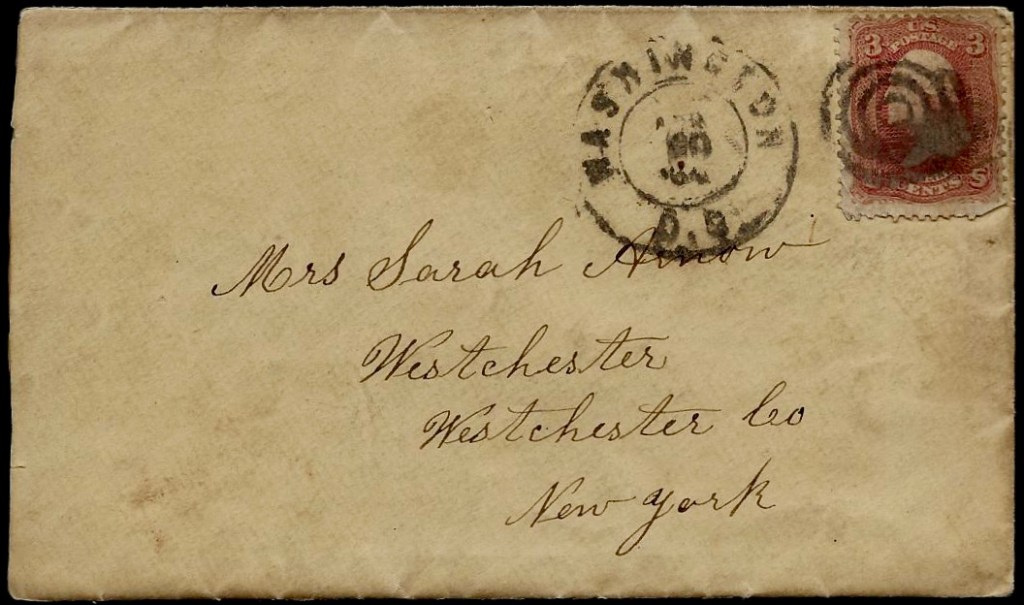
Addressed to Mrs. Sarah Arnow, Westchester, Westchester county, New York

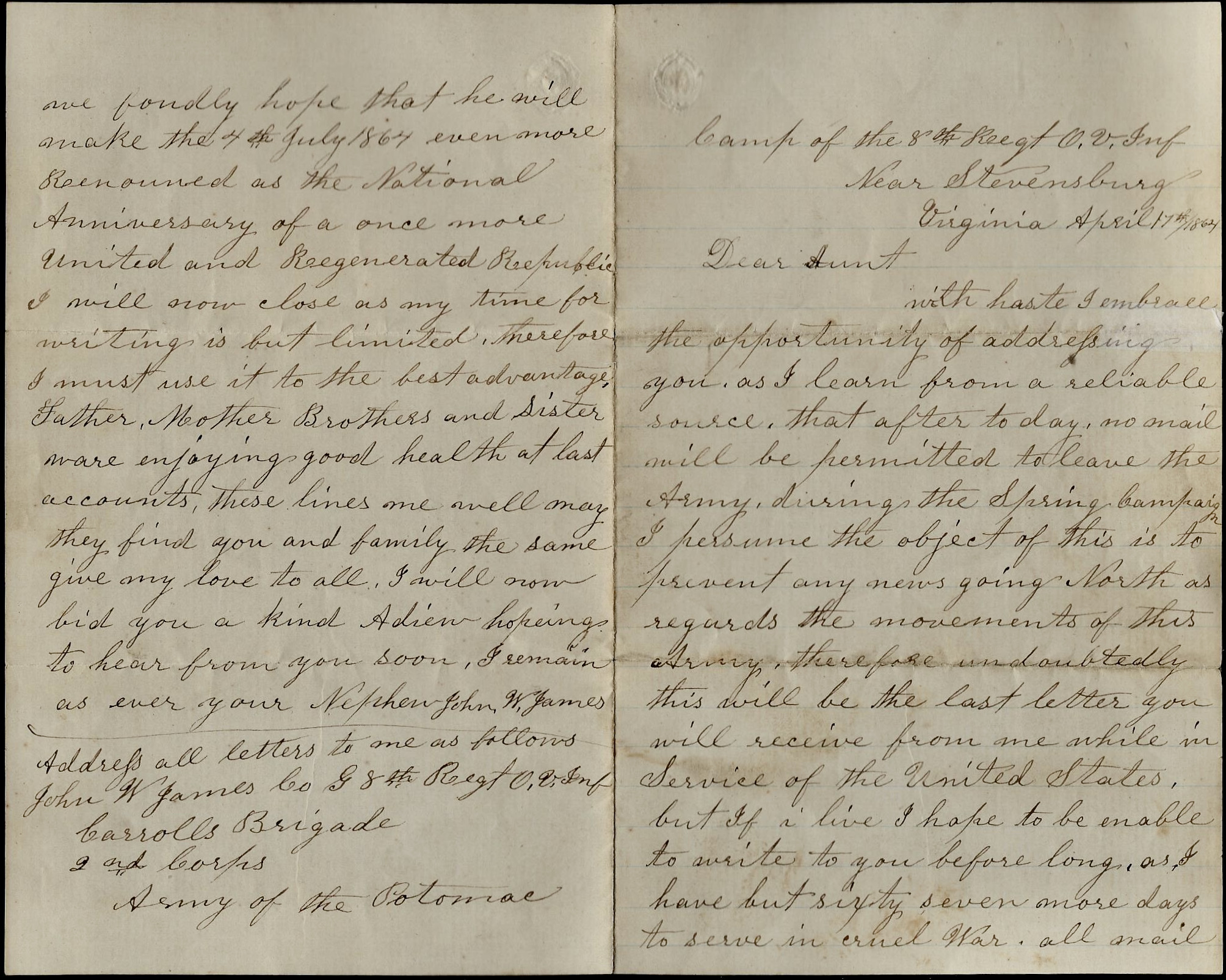
Camp of the 8th Regt. O. V. Infantry
Near Stevensburg, Virginia
April 17th, 1864

Dear Aunt,

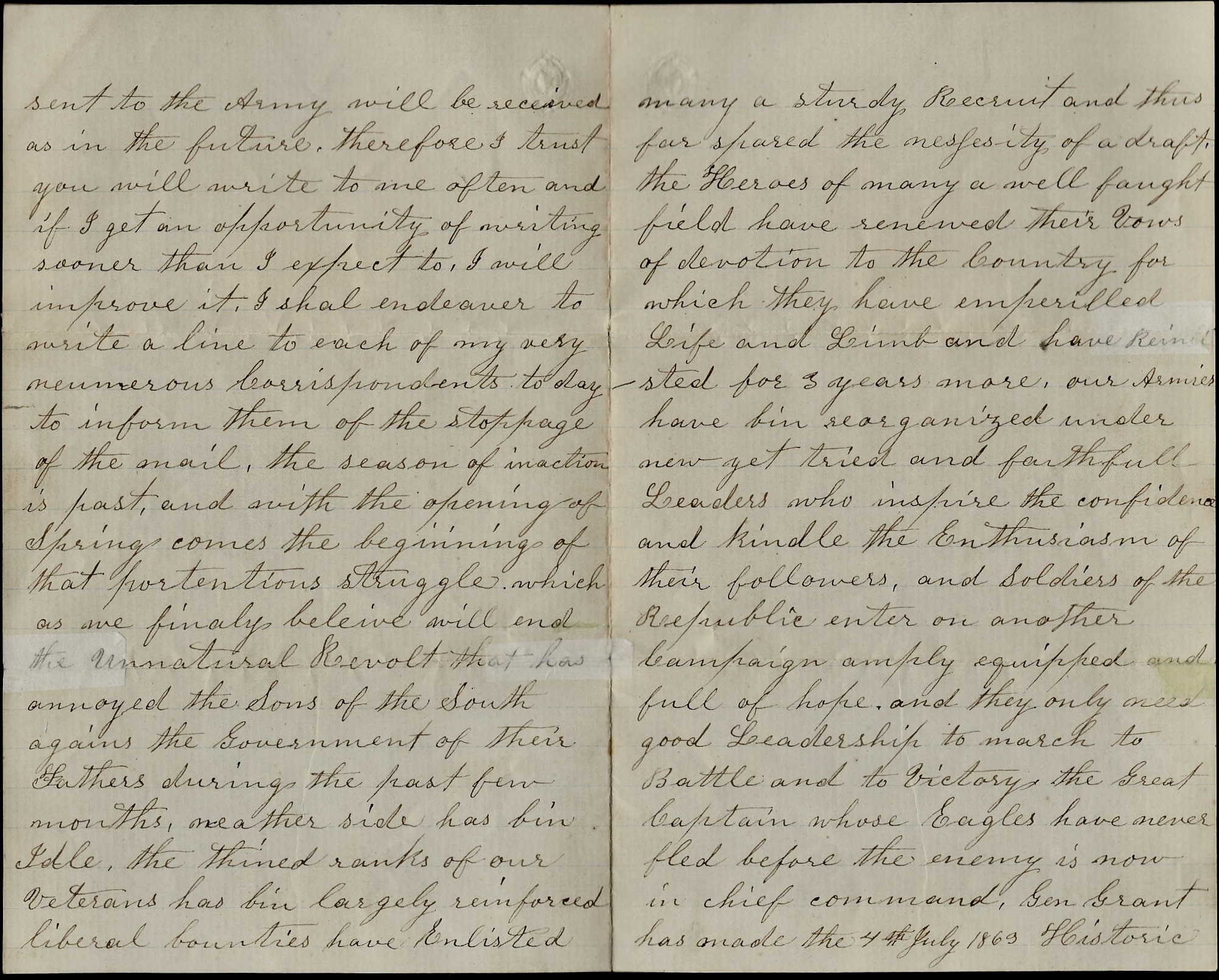
With haste I embrace the opportunity of addressing you as I learn from a reliable source that after today, no mail will be permitted to leave the army during the spring campaign. I presume the object of this is to prevent any news going North as regards the movements of this army. Therefore, undoubtedly this will be the last letter you will receive from me while in the service of the United States. But if I live, I hope to be enabled to write to you before long as I have but sixty-seven more days to serve in this cruel war. All mail sent to the army will be received as in the future. Therefore, I trust you will write to me often and if I get an opportunity of writing sooner than I expect to, I will improve it. I shall endeavor to write a line to each of my very numerous correspondents today to inform them of the stoppage of the mail.

“The season on inaction is past, and with the opening of Spring comes the beginning of that portentous struggle which as we finally believe will end this unnatural revolt…

—Corp. John James, 8th OVI, 17 April 1864

The season of inaction is past, and with the opening of Spring comes the beginning of that portentous struggle which as we finally believe will end this unnatural revolt that has annoyed the Sons of the South against the government of their fathers. During the past few months, neither side has been idle. The thinned ranks of our veterans has been largely reinforced. Liberal bounties have enlisted many a sturdy recruit and thus far spared the necessity of a draft. The heroes of many a well fought field have renewed their vows of devotion to the country for which they have imperiled life and limb and have reenlisted for 3 years more. Our armies have been reorganized under new, yet tired and faithful leaders who inspire the confidence and kindle the enthusiasm of their followers, and soldiers of the Republic enter on another campaign amply equipped and full of hope. And they only need good leadership to march to battle and to victory. The great captain who eagles have never fled before the enemy is now in chief command. Gen. Grant has made the 4th of July 1863 historic. We fondly hope that he will make the 4th of July 1864 even more renowned as the National Anniversary of a once more united and regenerated Republic.

I wil now close as my time for writing is but limited. Therefore, I must use it to the best advantage. Father, mother, brothers and sister were enjoying good health at last accounts. These lines [leave] me well. May htey find you and family the same. Give my love to all. I will now bid you a kind adieu, hoping to hear from you soon.

I remain as ever your nephew, — John W. James

Address all letters to me as follows: John W. James, Co. G, 8th Regt. O. V. Infantry, Carroll’s Brigade, 2nd Corps, Army of the Potomac