The lack of detail conveyed in this letter will forever make it impossible to know the author’s identity as anything other than “Henry” but we can make a few assumptions. Most likely he was a late war draftee who opted to enlist in the US Navy rather than be taken into the infantry where he would have no control over his assignment or duties. Though life at sea was potentially hazardous, the horrors of the battlefield probably seemed more frightening to this young man. The amount of the money he sent home informs us that he received a bounty for his enlistment. He was also most likely still on a “receiving ship” in Boston, Philadelphia, or New York where he was being drilled in his duties as a “landsman” and was not yet assigned to his permanent ship.
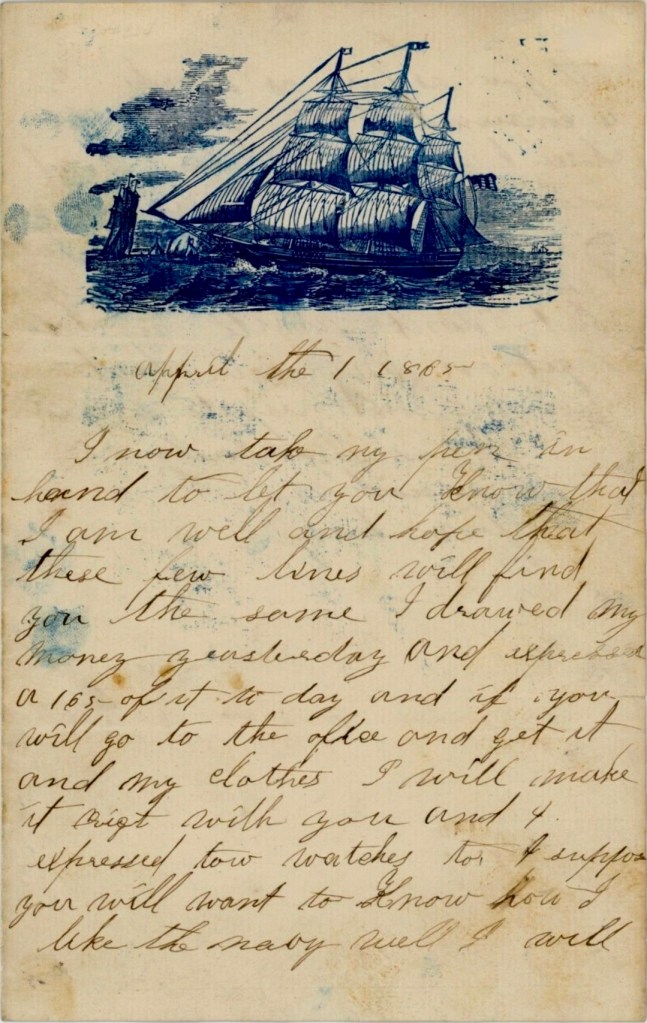
What interested me the most about this letter was the rare ink impression of a sailing ship on the letterhead. I have not seen it before on mass-printed stationery and the crudeness of the stamp and the smudges of ink with discernible fingerprints in the margins leaves me wondering if it was not a user applied stamp—particularly since there is no logo, caption, or printer’s mark combined with the fact that it was printed in only one ink color.
Unusual Letterhead
Transcription
April the 1st 1865
I now take my pen in hand to let you know that I am well and hope that these few lines will find you the same. I drawed my money yesterday and expressed 165 of it today and if you will go to the office and get it and my clothes, I will make it right with you—and I expressed two watches too.
I suppose you will want to know how I like the Navy. Well, I will tell you. As far as work is concerned, I like it, but for choice, I had rather have land forces. But one thing, they can’t force me into battle.
I would like to hear from you but don’t write until I get on my own boat. Give my best respects to all. Yours respectfully. From Henry
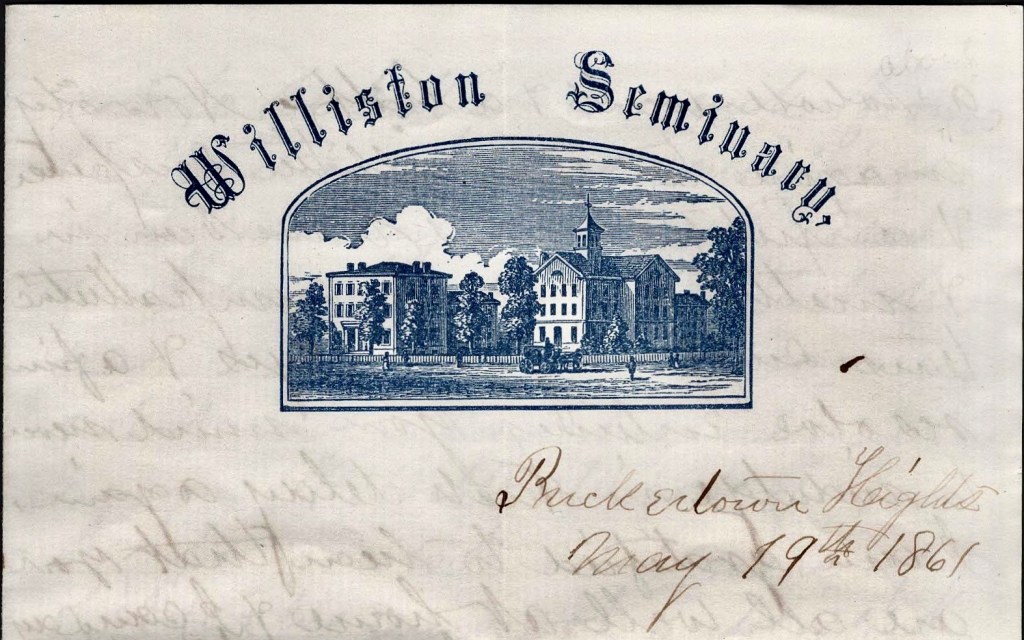
Letterhead of stationery used by Dibble with engraving of Williston Seminary
The following letter was written by Fitzhugh Ithamar Dibble (1840-1918), the son of George Dibble (1805-1881) and Betsy Whittlesey Underhill (1807-1902) of Old Saybrook, Middlesex county, Connecticut. Fitzhugh wrote the letter in May 1861 while attending Williston Seminary. He later attended and graduated (1863) with a law degree from Yale College. Fitzhugh had two older brothers who served in the Civil War. George Eugene Dibble (1830-1863) in Co. F, 12th Connecticut Infantry and died on a Mississippi transport on 24 May 1863. Also serving was Augustus Llewelyn Dibble (1831-1878) in Co. G, 14th Connecticut Infantry, who was wounded at Antietam and shot in the foot in a later engagement but recovered.
Curiously, census records in 1850 and 1860 reveal that Fitzhugh was born in 1839 or 1840; yet subsequent census records report his having been born in 1845 or even 1846, leading one to question whether he misreported his age in order to avoid the draft.
Fitzhugh wrote the letter to his older sister, Juline Josephine (“Jose”) Dibble (1834-1924) who was employed as a school teacher in the common schools of Old Saybrook. In 1867, she married Henry H. Buell (1837-1927).
Transcription
Addressed to Miss J. Josephine Dibble, Old Saybrook, Connecticut
Puckertown Heights May 19th 1861
Dear Sister Jose,
Yours of May 12th was received four days after date & of course read with extreme pleasure as all long anticipated epistles are. I nearly began to think that you had likely forgotten me or that in the fire of your patriotic ardor, had concluded that all minor objects must give way before that. Previous to receiving your letter I had not received one for a whole week & a half. Now only imagine to yourself the distress & anxiety I must have been in & methinks I see the sympathetic tears suffusing your eyes & a firm resolve entering your mind never to indulge in such delay again.
I am gratified to hear that you are all well at home & I can say that I fully approve the plan which you girls have adopted of planting “each one a hill of corn” & hope it will prove a successful crop & the beginning of a mighty harvest of heroic deeds performed by the Angels of America. I am glad to learn that S. & W. [Saybrook & Westbrook] are so enthusiastic in this war with the rebels & hope to hear that they have united and raised a company of volunteers. I am also extremely pleased to hear that Mr. [Salmon] McCall 1 came out with a Union sermon & had the pluck not to be bullied an inch from his position. It has considerably changed my opinion of him, for I had begun to think that he was a regular “dishwater concern”—not daring to say his soul was his own or the Bible the book of God. I hope you will send me a copy of it (i. e., his sermon) if published.
I have not delivered that oration yet as I got a substitute in my place for I found upon copying & arranging it that it covered more than 21 pages of foolscap & took me an hour to read it through in my room at a quick rate. But I have one to deliver this week Friday eve which I have not yet written. As to Flunks Fizzles, &c. they are about as frequent as ever & also about effectual. We have been obliged to give up our military drill as we could obtain no arms from the government unless we placed ourselves at its disposal & there were not enough in school who would enroll in a regular company in this way. This was a great disappointment to us. The Amherst students were disappointed in th same way—but it cannot be remedied.
The weather is very beautiful here now & nature is arranging herself in her best “bib & tucker” 2 —preparing to send out a rich harvest from red bosoms [?]. I am happy to hear that Evelyn’s health has improved enough to ensure his return home & hope his wife may derive all the satisfaction possible from all the stories she sees fit to fabricate & report—but I really don’t think they will do any serious injury only to those who frame them & moreover I don’t think that they or their [ ] are worth noticing. Let the jealous & [ ] rage and vent their discontentment, but they will never seriously injure those who are innocent of any misdemeanor.
Now I trust I shall not be compelled to wait so long again for an answer to this as before, but that you will write soon & also Adell & the rest, keeping me informed of all the news at home. Please remember me to all friends & all the family at home & God bless & protect you all. Very sincerely, your affectionate brother, — F. I. Dibble
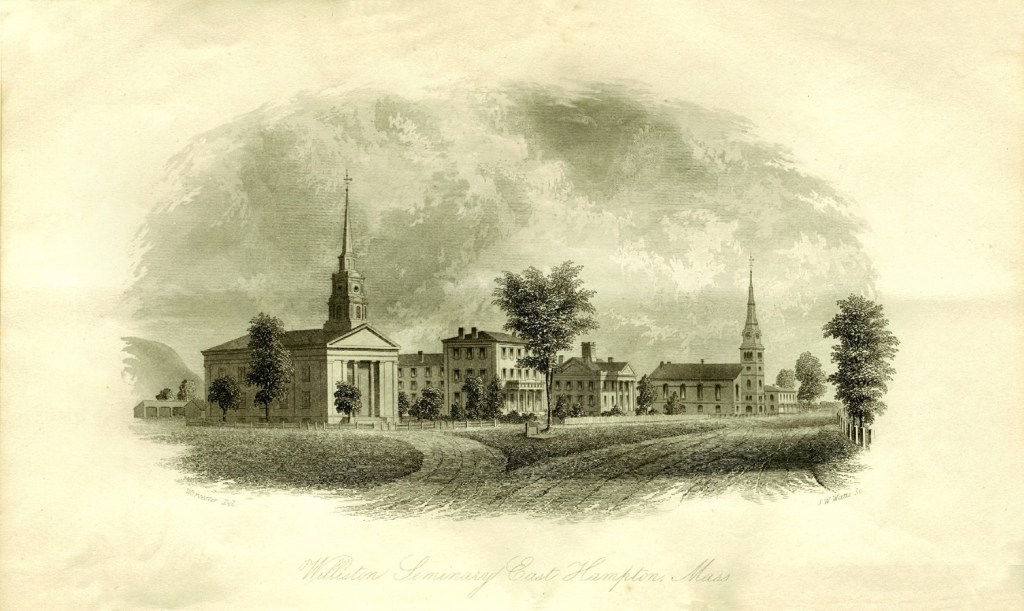
Williston Seminary, East Hampton, Massachusetts
1 Salmon McCall was the pastor of the First Church of Christ in Saybrook from 1853 to 1871. He was 27 years old when he first occupied the pulpit in Saybrook. He was described as “a studious and learned man.”He was an 1851 graduate of Yale College.
2 “bib and tucker” used to mean the most lavish attire a gentleman possessed.
The following letter was written by John Gaylord Wells (1821-1880), the son of William Wells (1786-1825) and Catharine Griswold (1792-1880) of Hartford county, Connecticut. He was married in 1847 to Emily A. Cornwall (1823-1900) and their daughter Gertrude Leland (“Lela”) Wells was born in 1851.
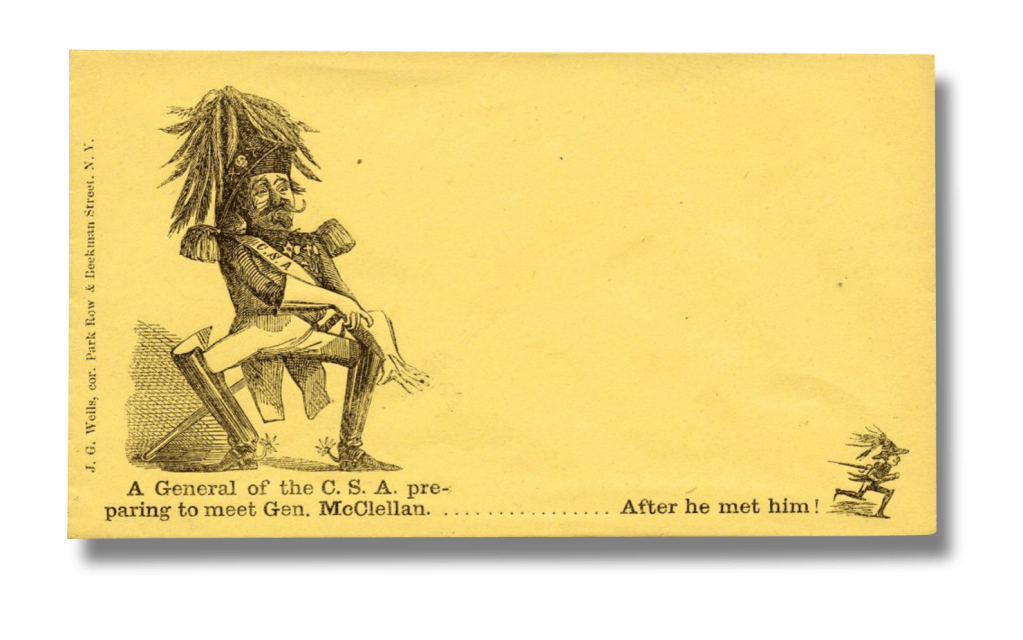
In his letter, written on Christmas day 1861, John confesses to his mother that he was a “slave” to his work. “I enjoy business, consequently enjoy life for business is my life,” he wrote. This single statement reveals much of John’s character. Not only did he not celebrate the holidays himself, we learn that he had not seen his wife and daughter in six months. The Civil War had begun which created opportunities for entrepreneurs like Wells. His obituary, published in New York and Connecticut papers, indicates that he was the originator of patriotic envelopes (and stationery such as the one he wrote this letter on) which became a robust business in the first year or two of the war.
An example of one of John G. Well’s patriotic envelopes from early in the Civil War.
Wells began his career learning the printer’s trade in Hartford, Connecticut. He is credited with inventing “elastic type for printing on hard substances” and several other “ingenious contrivances.” However, much of his time and earnings were spent in patenting and defending his patents. Following the Civil War, Wells published his own book entitled, “Every Man His Own Lawyer” and advertised it as a complete guide in all matters of law and business negotiations. It sold over 800,000 copies in the U. S.
In January 1878, he sprained his ankle in stepping from a curbstone causing an injury that eventually led to its amputation. He never fully recovered from that injury and he died in January 1880.
Transcription
New York [City, New York] December 25, 1861
My Dear Mother,
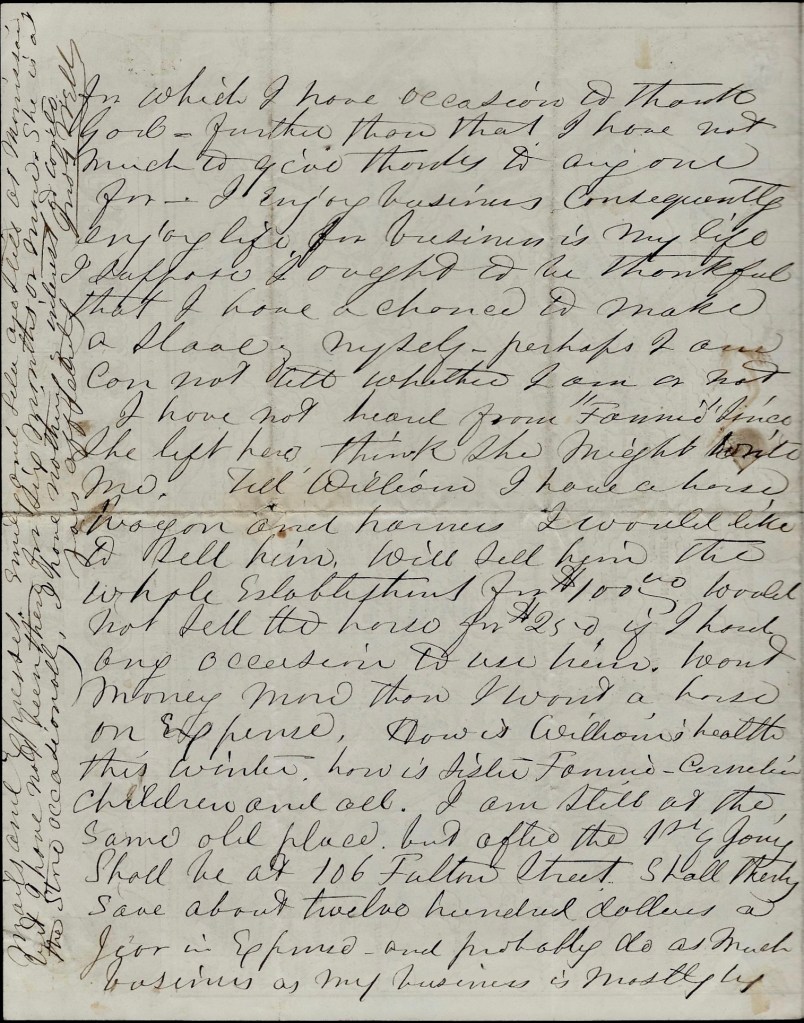
Your kind letter was duly received. I have been extremely busy or I should have written you before. Today is Christmas and of course a holiday for the people—all business is suspended for today except slaves like myself. I know no holidays. You ask where I dined Thanksgiving. I will tell you—in my office on pen and ink. I wrote all day until about 9 o’clock in the evening and then went and bought an oyster item for my Thanksgiving dinner. This is as good as you can expect a slave to receive. I have spent today in the same way and expect to dine in the same way.
I enjoy good health for which I have occasion to thank God. Further than that, I have not much to give thanks to anyone for. I enjoy business, consequently enjoy life for business is my life. I suppose I ought to be thankful that I have a chance to make a slave of myself—perhaps I cannot tell whether I am or not.
I have not heard from “Fannie” since she left here. Think she might write me. Tell William I have a horse, wagon & harness I would like to sell him. Will sell him the whole establishment for $100. Would not sell the horse for $250 if I had any occasion to use him. Want money more than I want a horse on expenses.
How is William’s health this winter? How is sister Fannie, Cornelia, children and all? I am still at the same old place but after the 1st of January, shall be at 106 Fulton Street. Shall thereby save about twelve hundred dollars a year in expenses and probably do as much business as my business is mostly by mails and expresses. Emily and Lela are still at Morrison but I have not been there for six months or more. She is at the store occasionally. I have nothing of interest to write. Yours affectionately, — Jno. G. Wells
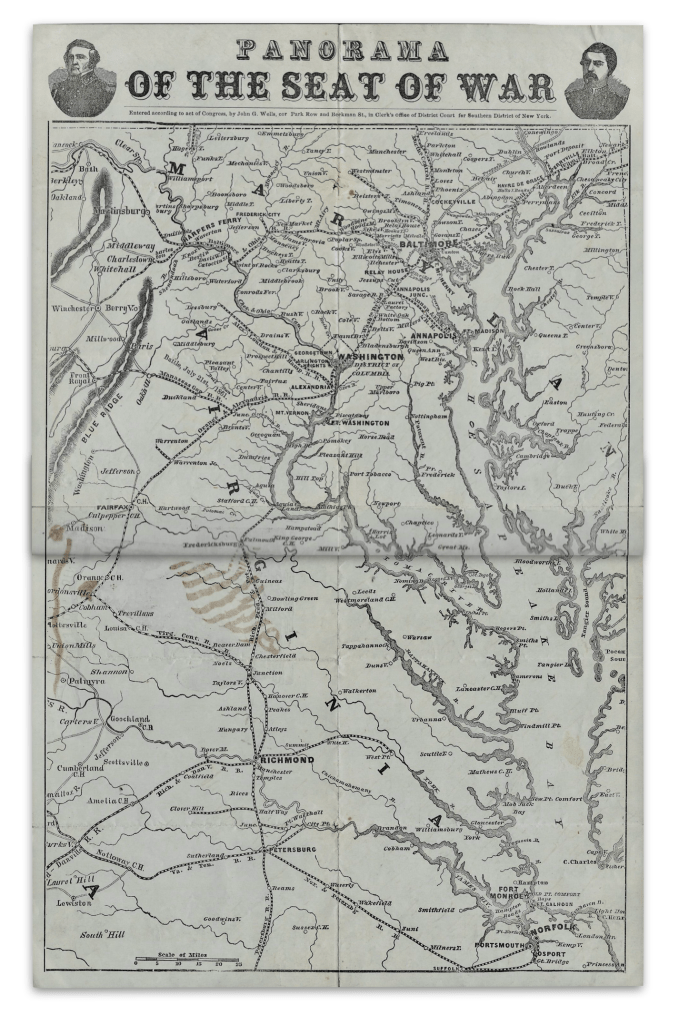
Wells’ letter was written on patriotic stationery that included this large “Panorama of the Seat of War” map printed on the inside of the folded sheet.Note that under the title it reads, “Entered according to act of Congress by John G. Wells, corner of Park Row and Beekman Street, in Clerk’s Office of District Court for Southern District of New York.”This same map was marketed by Wells in 1861 as a stand-alone folding map measuring 15″ x 9 ” although instead of portraits of Winfield Scott and George McClellan in the upper corners, it was sold with images of Commodores Silas H. Stringham and Andrew Hull Foote. See “Early Pocket Map.”This same stationery (without a letter written on it by the designer & marketer himself) is available for purchase at Gosen Rare Books for $750.
Lithograph of Maj. Gen. Henry Halleck on James Gates Co. Stationery
This letter was written by a barely literate soldier—most likely a private—named William R. Steel, if I have transcribed his name correctly. He wrote the letter to his father who I presume was “Mr. Solomon Steel” as was written near the bottom of the letter. Unfortunately I cannot find any soldier who fits the profile of this soldier with a father named Solomon.
The letter was penned in early August 1862 but no location was given. Again I’m going to presume it was written in the East by a soldier who participated on the Peninsula Campaign but I might be mistaken. The hand writing is actually more suggestive of an Indiana soldier but I cannot find any early war soldier from Indiana with that name. There was a William R. Steel who served as a private in the 1st Indiana Cavalry but he did join as a recruit until 1863.
The letter was written on stationery with a lithograph of Maj. Gen. Henry Halleck who was named Lincoln’s General in Chief after McClellan’s failed Peninsula Campaign. The stationery was produced by the James Gates company of Cincinnati, Ohio.
Transcription
The 6th of August 1862
Dear Father,
I sit down to let you [know] that I am well at present and hope that you are the same. I got your letter the 4th of this month. You wanted to know if I was wounded or not. I was in the right leg below the knee but it is well now.
I guess I will get my discharge. My arm is very lame now.








 Spared & Shared 23