Category Archives: Patriotism in the North

1861: Unidentified Civilian to her Sister

I initially endeavored to transcribe this letter in hopes of identifying its anonymous author, yet, regrettably, there are insufficient clues to arrive at a conclusive determination. My initial impression suggested a male author; however, the content, along with the handwriting and penmanship, compels me to surmise that it was a female addressing her sister. It is my assertion that she was the mother of the young boy referred to as “Willie” in this correspondence, who had the distinguished opportunity to shake President Buchanan’s hand during what was likely one of his final White House receptions prior to his departure from office, the last of which took place on 12 February 1861.

The author asserts that “Mr. Deming” was also present at the White House reception, and I am inclined to believe that he may have been her husband. During the mid-19th century, it was common for wives to refer to their spouses in such formal terms in correspondence. In my research for residents of Washington City in 1860 with the surname Deming, I identified a government clerk named Chester Deming (1814-1862), who had a son named William born in 1850; however, the extended family tree was not sufficiently detailed to establish a definitive connection.

I’ve published the letter on Spared & Shared regardless because I find the content interesting and hope you will too.

Patriotic fervor in 1861 among the children. (LOC)

T R A N S C R I P T I O N

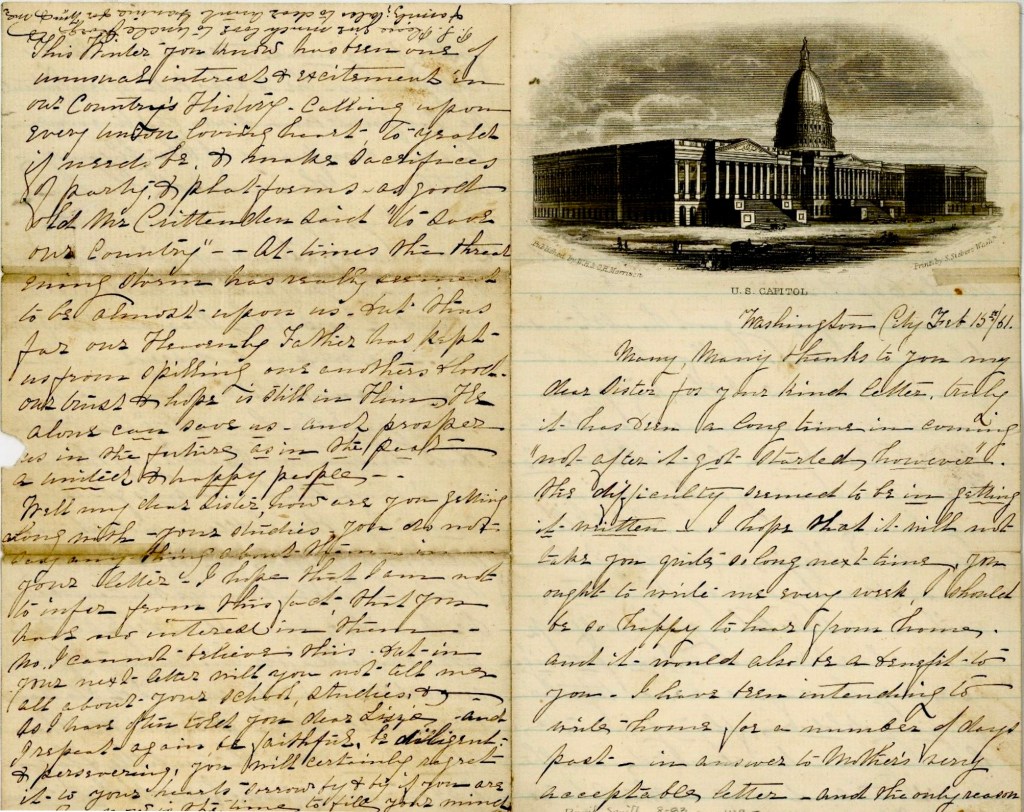
Washington City
[Friday] February 15, 1861

Many, many thinks to you my dear sister for your kind letter. Truly it has been a long time in coming “not after it got started, however.” This difficulty seemed to be in getting it written. I hope that it will not take you quite so long next time. You ought to write to me every week. I should be so happy to hear from home and it would also be a benefit to you. I have been intending to write home for a number of days past in answer to Mother’s very acceptable letter, and the only reason why I have not done so is, that I do not stay at home long enough to accomplish anything. you would really think that I was getting to be guide dissipated if I should tell you that the greater part of my time this winter had been spent at “the Capitol.”
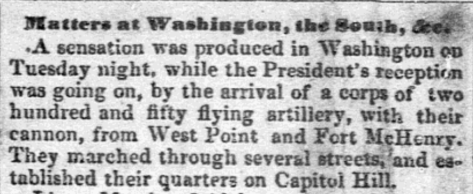
The Pittsfield Sun, 7 February 1861

We are all enjoying good health. Indeed, I have not been so well for the last five years as now. I think if you were to see me you would say, “that sister looked just like old times.” Little Willie too is very well and enjoying himself very much. I told him what Aunt Lizzie said—that he must be a big boy by this time. “Well,” he said, stretching himself up in his chair, “Mama, so I am pretty big.” He and Coszy have fine times together playing soldier, flying kite, &c. He is very much interested in the military and now as the City is full of regiments and artillery companies, he is also full of excitement. He has just been down the Arsenal to see a company of “flying artillery” that arrived here a few days ago from West Point.

Two weeks ago Tuesday evening [February 1, 1861], Mr. Deming, William, and the two Willies attended one of the President’s receptions. When we were introduced to Mr. Buchanan, I told him that Willie “was a great Buchanan boy.” He then took him very heartily by the hand and said that he was “glad to know it.” This little incident in Willie’s early life will be something that he will always remember. He has also formed a deep seated attachment for his country. You would be greatly amused to hear him talk about the Union—the whole Union & with his little flag of 34 stars and 13 stripes, show forth his patriotism.

This winter you know has been one of unusual interest & excitement in our Country’s history—calling upon every Union-loving heart to yield if needs be & make sacrifices of party & platforms as good old Mr. Crittenden said, “to save our Country.” At times the threatening storm has really seemed to be almost upon us, but htus far our Heavenly Father has kept us from spilling one another’s blood. Our trust and hope is still in Him. He alone can save us and prosper us in the future as in the past—a united and happy people.

Well, my dear sister, how are you getting along with your studies? You do not say anything about them in your letter. I hope that I. am not to infer from this fact that you have no interest in them. No. I cannot believe this. But in your next letter will you not tell me all about your school studies &c. As I have often told you, dear Lizzie, and I repeat again, be faithful, be diligent, and persevering. You will certainly regret it to your hearts sorrow by and by if you. are [ ] in the time to fill your mind.

P. S. Please give much love to Uncle George & family. Also to dear Aunt Fannie for William and me.
1861: Fitzhugh Ithamar Dibble to Julina Josephine Dibble

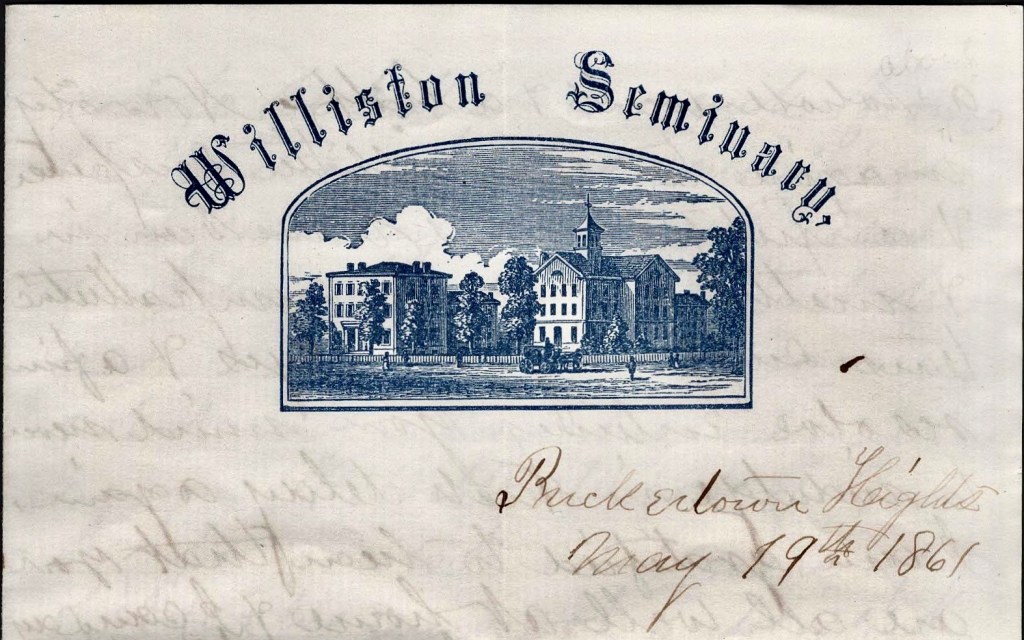
Letterhead of stationery used by Dibble with engraving of Williston Seminary

The following letter was written by Fitzhugh Ithamar Dibble (1840-1918), the son of George Dibble (1805-1881) and Betsy Whittlesey Underhill (1807-1902) of Old Saybrook, Middlesex county, Connecticut. Fitzhugh wrote the letter in May 1861 while attending Williston Seminary. He later attended and graduated (1863) with a law degree from Yale College. Fitzhugh had two older brothers who served in the Civil War. George Eugene Dibble (1830-1863) in Co. F, 12th Connecticut Infantry and died on a Mississippi transport on 24 May 1863. Also serving was Augustus Llewelyn Dibble (1831-1878) in Co. G, 14th Connecticut Infantry, who was wounded at Antietam and shot in the foot in a later engagement but recovered.

Curiously, census records in 1850 and 1860 reveal that Fitzhugh was born in 1839 or 1840; yet subsequent census records report his having been born in 1845 or even 1846, leading one to question whether he misreported his age in order to avoid the draft.

Fitzhugh wrote the letter to his older sister, Juline Josephine (“Jose”) Dibble (1834-1924) who was employed as a school teacher in the common schools of Old Saybrook. In 1867, she married Henry H. Buell (1837-1927).

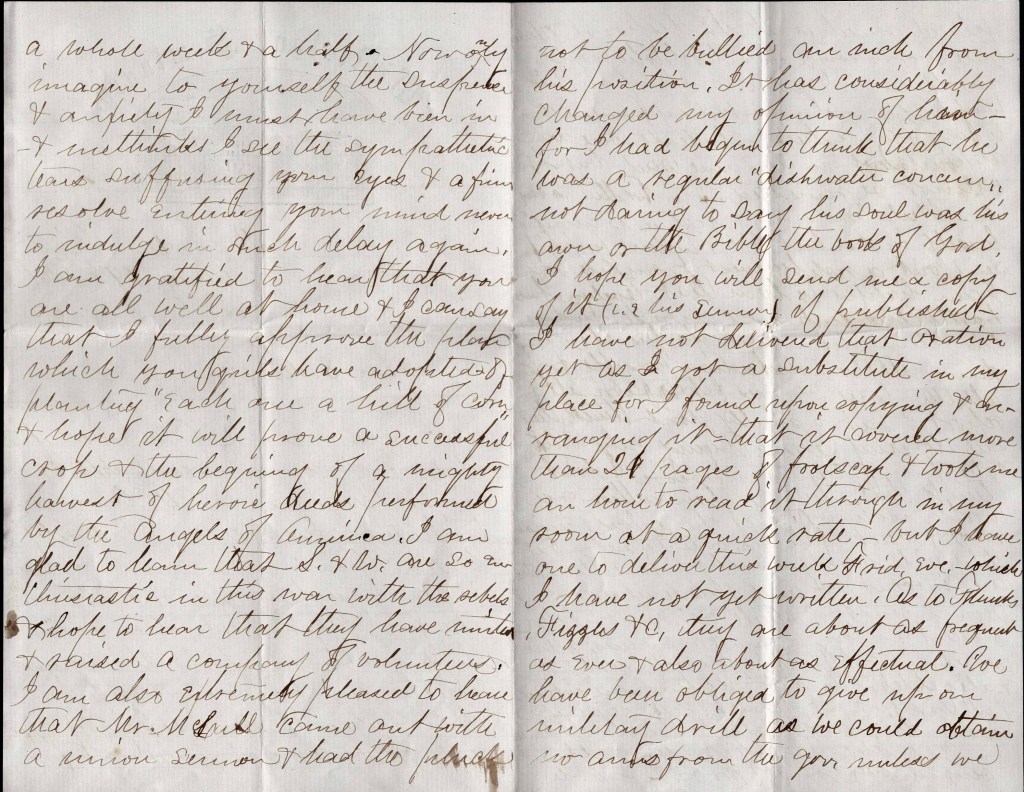
Transcription

Addressed to Miss J. Josephine Dibble, Old Saybrook, Connecticut

Puckertown Heights
May 19th 1861

Dear Sister Jose,

Yours of May 12th was received four days after date & of course read with extreme pleasure as all long anticipated epistles are. I nearly began to think that you had likely forgotten me or that in the fire of your patriotic ardor, had concluded that all minor objects must give way before that. Previous to receiving your letter I had not received one for a whole week & a half. Now only imagine to yourself the distress & anxiety I must have been in & methinks I see the sympathetic tears suffusing your eyes & a firm resolve entering your mind never to indulge in such delay again.

I am gratified to hear that you are all well at home & I can say that I fully approve the plan which you girls have adopted of planting “each one a hill of corn” & hope it will prove a successful crop & the beginning of a mighty harvest of heroic deeds performed by the Angels of America. I am glad to learn that S. & W. [Saybrook & Westbrook] are so enthusiastic in this war with the rebels & hope to hear that they have united and raised a company of volunteers. I am also extremely pleased to hear that Mr. [Salmon] McCall 1 came out with a Union sermon & had the pluck not to be bullied an inch from his position. It has considerably changed my opinion of him, for I had begun to think that he was a regular “dishwater concern”—not daring to say his soul was his own or the Bible the book of God. I hope you will send me a copy of it (i. e., his sermon) if published.

I have not delivered that oration yet as I got a substitute in my place for I found upon copying & arranging it that it covered more than 21 pages of foolscap & took me an hour to read it through in my room at a quick rate. But I have one to deliver this week Friday eve which I have not yet written. As to Flunks Fizzles, &c. they are about as frequent as ever & also about effectual. We have been obliged to give up our military drill as we could obtain no arms from the government unless we placed ourselves at its disposal & there were not enough in school who would enroll in a regular company in this way. This was a great disappointment to us. The Amherst students were disappointed in th same way—but it cannot be remedied.

The weather is very beautiful here now & nature is arranging herself in her best “bib & tucker” 2 —preparing to send out a rich harvest from red bosoms [?]. I am happy to hear that Evelyn’s health has improved enough to ensure his return home & hope his wife may derive all the satisfaction possible from all the stories she sees fit to fabricate & report—but I really don’t think they will do any serious injury only to those who frame them & moreover I don’t think that they or their [ ] are worth noticing. Let the jealous & [ ] rage and vent their discontentment, but they will never seriously injure those who are innocent of any misdemeanor.

Now I trust I shall not be compelled to wait so long again for an answer to this as before, but that you will write soon & also Adell & the rest, keeping me informed of all the news at home. Please remember me to all friends & all the family at home & God bless & protect you all. Very sincerely, your affectionate brother, — F. I. Dibble

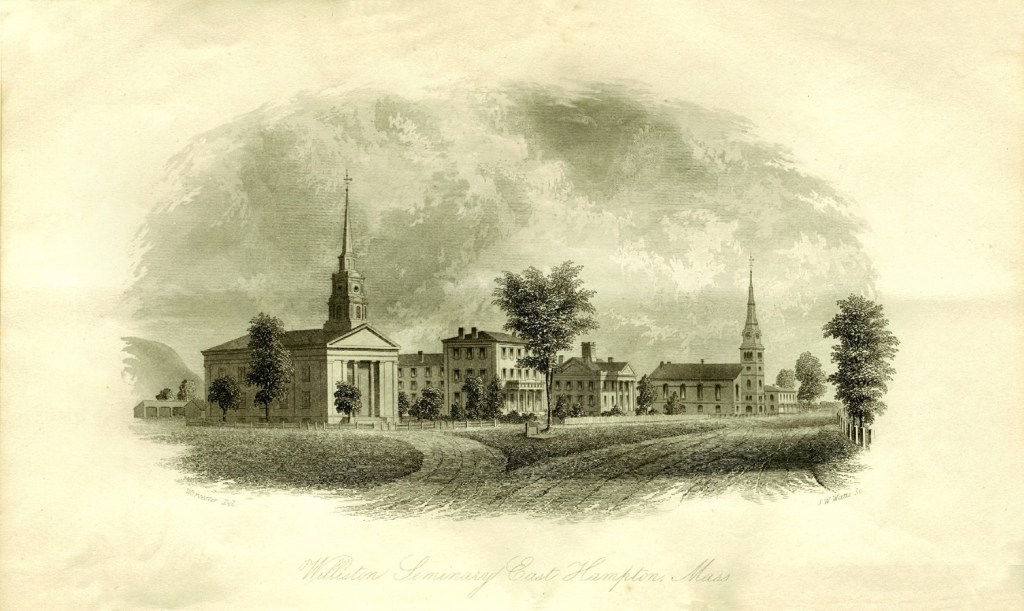
Williston Seminary, East Hampton, Massachusetts

1 Salmon McCall was the pastor of the First Church of Christ in Saybrook from 1853 to 1871. He was 27 years old when he first occupied the pulpit in Saybrook. He was described as “a studious and learned man.” He was an 1851 graduate of Yale College.

2 “bib and tucker” used to mean the most lavish attire a gentleman possessed.

1862-64: Dwight Whitney Marsh to his Family

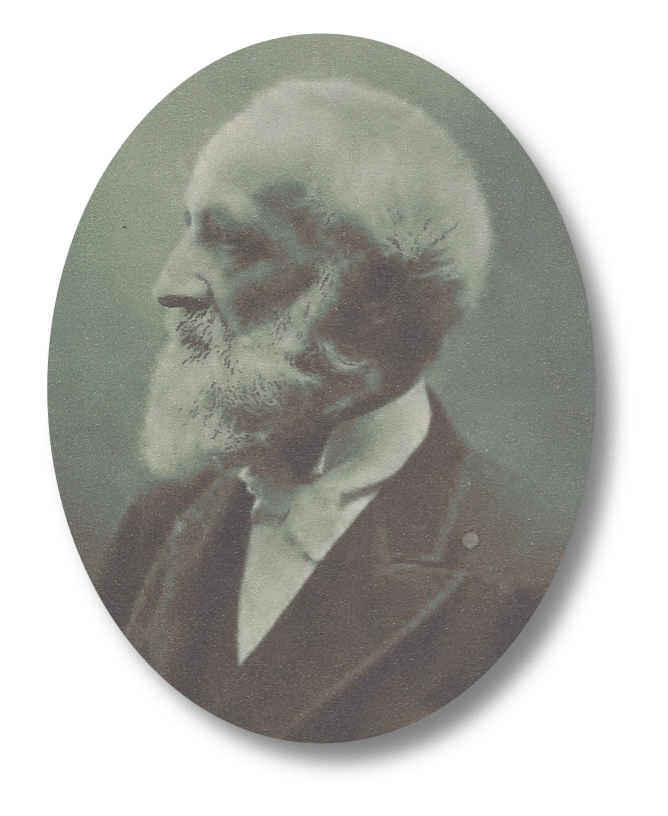
Rev. Dwight Whitney Marsh in later years

These two letters were written by Dwight Whitney Marsh (1823-1896), the son of Henry Marsh (1797-1852) and Sarah Whitney (1796-1883) of St. Louis, Missouri. Dwight had several siblings; those mentioned in these letters include, Calvin “Waldo” Marsh (1825-1873), Elizabeth (“Lizzie”) Willard Marsh (1829-1882), and Clarissa (“Clara”) Dwight Marsh (1834-1899) who married Samuel Watkins Eager, Jr. (1827-1903). Dwight’s father was an attorney in St. Louis at the time of his death in 1852 at the age of 53.

Dwight was born in Berkshire county, Massachusetts, and graduated from Williams College in 1842. He studied theology at Andover Theological Seminary in 1842-3, and then taught school in St. Louis, Mo., from 1843 to 1847. He continued his theological training at Union Theological Seminary and graduated in 1849, after which he was ordained and sailed in December 1849 from Boston to Mosul, Turkey, as a missionary for the A. B. C. F. M. In 1852 he returned to the U.S. and married 19 October 1852 to Julia White Peck of New York City. He then returned to Mosul where his wife died in August 1859. He finally returned to the U.S. in 1860 and began a lecture tour on missionary life. He was married on 21 August, 1862, to Elizabeth L. Barron in Rochester and then accepted charge of the Rochester Young Ladies’ Female Seminary where he remained five years. While there, he also preached for the Wester House of Refuge. He then went on to serve in the pulpit of various churches in the midwest before his death in 1896.

Letter 1

Osburn House
Rochester, New York
Thursday, August 21, 1862

My own ever dear sister Lizzie,

I am very sorry that our marriage comes off so suddenly that you & Mother could not be present. I think of you all much. It is now about noon & we are to be married at 3:30 & at 9 shall be at the [Niagara] Falls if all goes well. We have a charming day & I wish you were here to share in our delight. How often in this life our affairs move differently from our anticipations. I think we are about to be happy; but only our Maker knows what trials of sickness or partings are in store.

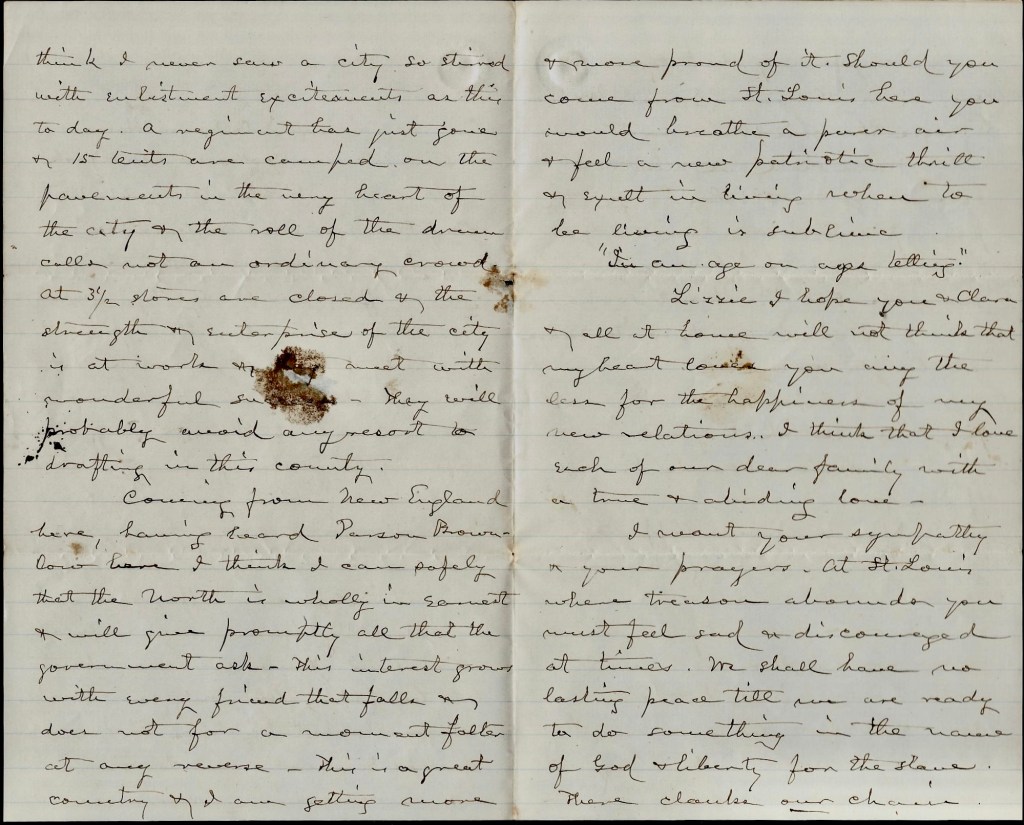
We are in war times. I think I never saw a city so stirred with enlistment excitements as this day. A regiment has just gone & 15 tents are camped on the pavements in the very heart of the city & the roll of the drum calls not an ordinary crowd. At 3:30 stores are closed & the strength & enterprise of the city is at work & will meet with wonderful success. They will probably avoid any resort to drafting in this county.

Coming from New England here, having heard Parson Brownlow 1 here, I think I can safely [say] that the North is wholly in earnest & will give promptly all that the government asks. This interest grows with every friend that falls & does not for a moment falter at any reverse. This is a great country & I am getting more & more proud of it. Should you come from St. Louis here, you would breathe a purer air & feel a new patriotic thrill & exult in living where to be living is sublime. “In an age on ages telling.”

“We shall have no lasting peace till we are ready to do something in the name of God & liberty for the slave. There clanks our chain.”

Rev. Dwight Whitney Marsh, 21 August 1862

Lizzie, I hope you & Clara all all at home will not think that my heart loved you any the less for the happiness of my new relations. I think that I love each of our dear family with a true & abiding love. I want your sympathy & your prayers. At St. Louis, where tiresome abounds, you must feel sad & discouraged at times. We shall have no lasting peace till we are ready to do something in the name of God & liberty for the slave. There clanks our chain.

Do give my best love to Anna & Clara & Sam & Waldo & kiss the children. When shall we meet? I cannot go to St. Louis for the present. I shall have to go look after Charlie again, as soon as October 1st, if not sooner. I shall try to write more at length soon. I hope Katy will not forget “Uncle Dwight.” Remembrance to all friends.

Your ever affectionate brother, — Dwight

1 William Gannaway Brownlow (1805-1877) was a preacher in the Methodist Church and a Tennessee newspaper editor. A Unionist despite owning slaves himself, Brownlow criticized the Confederacy even after Tennessee seceded. He was briefly imprisoned by the Confederacy at the beginning of the war. After leaving the state, he began a lucrative lecture tour in the North.


Letter 2

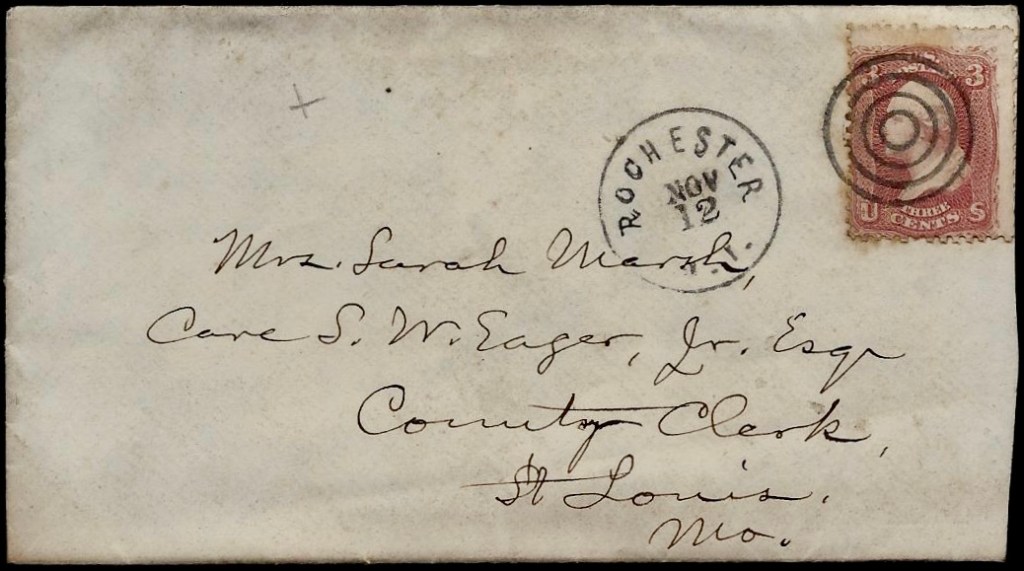
Addressed to Mrs. Sarah Marsh, Care of S. W. Eager, Jr., Esqr., County Clerk, St. Louis, Mo.

Rochester, New York
Saturday, November 12th 1864

My own dearest Mother,

Your kind letter written just before election came yesterday & now we can rejoice & thank God together. This state and Nation are safe. God has heard the prayer of thousands of His creatures. He has been very gracious & to Him be all glory & praise. The world does surely move on towards the glad day when truth shall no longer be trampled down in the streets. The Nation, by God’s inspiring decree & influence, has asserted the heaven given rights to live notwithstanding rebels in arms & traitors at the polls would have assassinated the nation.

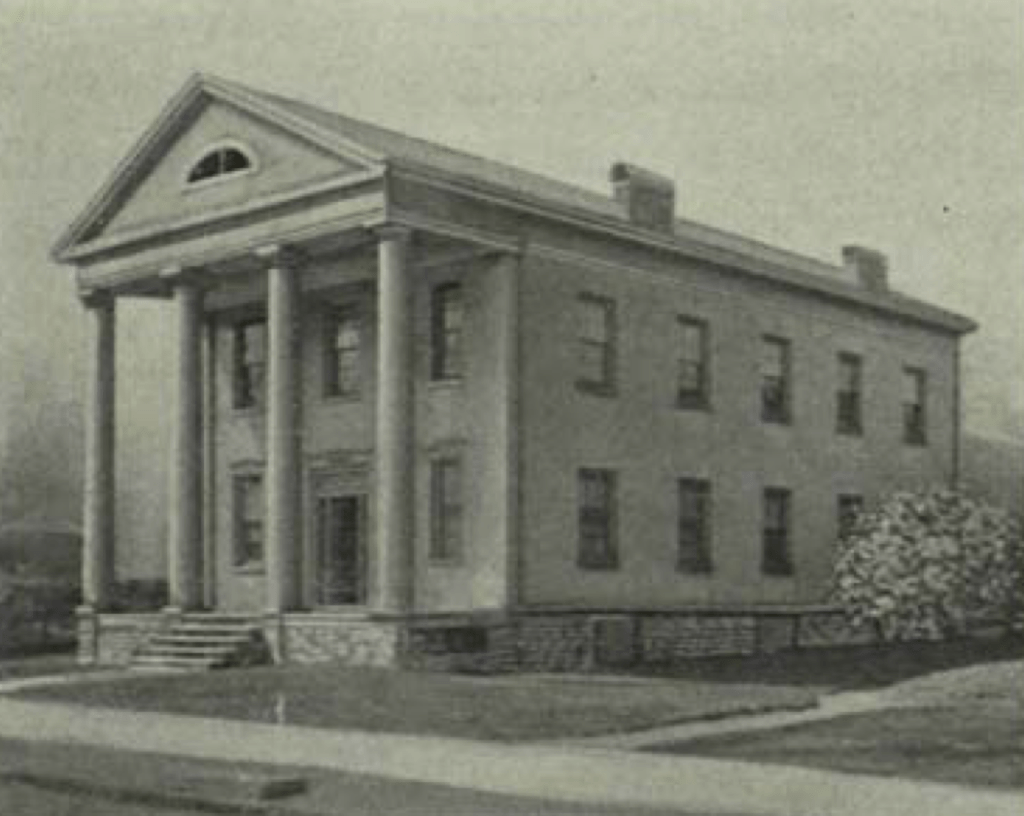
Rochester Female Seminary—pillars repaired in 1864

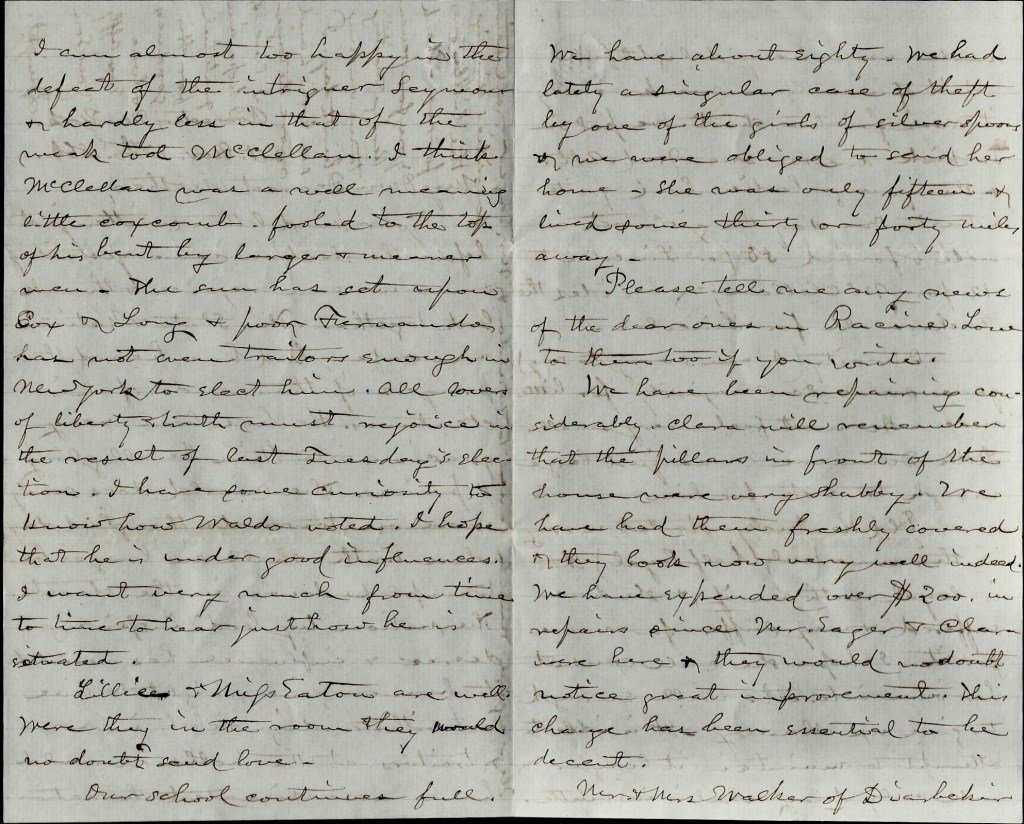
I am almost too happy in the defeat of the intriguer [Horatio] Seymour & hardly less in that of the weak tool McClellan. I think McClellan was a well-meaning little coxcomb—fooled to the top of his bent by larger and meaner men. The sun has set upon [Samuel S.] Cox & [Alexander] Long & poor Fernando [Wood] has not even traitors enough in New York [City] to elect him. All lovers of liberty & truth must rejoice in the result of last Tuesday’s election. I have some curiosity to know how [brother] Waldo voted. I hope that he is under good influences. I want very much from time to time to hear just how he is situated.

Lillie & Miss Eaton are well. Were they in the room, he would no doubt send love.

Our school continues full. We have about eighty. We had lately a singular case of theft by one of the girls of silver spoons & we were obliged to send her home. She was only fifteen & lived some thirty or forty miles away.

Please tell me any news of the dear ones in Racine. Love to them too if you write.

We have been repairing considerably. Clara will remember that the pillars in front of the house were very shabby. We have had them freshly covered and they look now very well indeed. We have expended over $200 in repairs since Mr. Eager & Clara were here & they would no doubt notice great improvement, This change has been essential to be decent.

Rev. Augustus Walker and his bride, Eliza Mercy Harding—Congregational missionaries to Turkey

Mr. & Mrs. [Augustus] Walker 1 of Diarbekir made us a very delightful visit of nearly a week—only it was too short. We put on Turkish dresses on Wednesday afternoon & the young ladies had quite a treat. One day the girls took a vote & found 58 for Lincoln to 12 for McClellan, & besides the teachers all for Lincoln.

Our city (I am sorry to say) gave some 80 majority for Little Mac. He must feel very small. Little Delaware was just large enough to vote for him.

Old Kentucky started wrong in this war (only half loyal)—that is, loyal with an if—and she has suffered & may suffer far more for it. I hope she will consult her own interests well enough to give up slavery. It is idle to attempt to maintain it longer & will only delay what is inevitable.

Please give much love to Waldo & Mr. Eager & all their families, kissing the little ones for me. Thank you for remembering & writing to me on my birthday. I see God’s hand more the longer I live & I hope am grateful for His goodness & love. Every affectionately your son, — Dwight

1 Rev. Augustus Walker and his wife, Eliza Mercy Harding, were missionaries to Diarbekir, Turkey, where they spent 13 years. They had six children, two of whom died in Turkey. Only one child, Harriet, was born in America during a furlough. In 1866 the Reverend Augustus Walker died of cholera in Turkey, and Mrs. Walker returned to America with their four children.