

The following letters were written by the Neal brothers in the spring of 1861 while attending Phillips Exeter Academy in Exeter, New Hampshire. All were datelined in April and May during the excitement of the impending Civil War.
One of the authors was George William Neal (1844-1884) who, at age 16, entered Phillips Exeter Academy in Exeter, New Hampshire. George afterwards attended Harvard and graduated in 1865. He then became a teacher in Boston and died in 1884 at the age of 40. He married Delia Annah Henderson (1843-1914) and had two sons.
The other author was Samuel Badger Neal, (1842-1901), who also attended the Phillips Exeter Academy and preceded George to Harvard. All of the letters were addressed to Alvina Cordelia Neal (1840-1905) whom they called “Allie.”
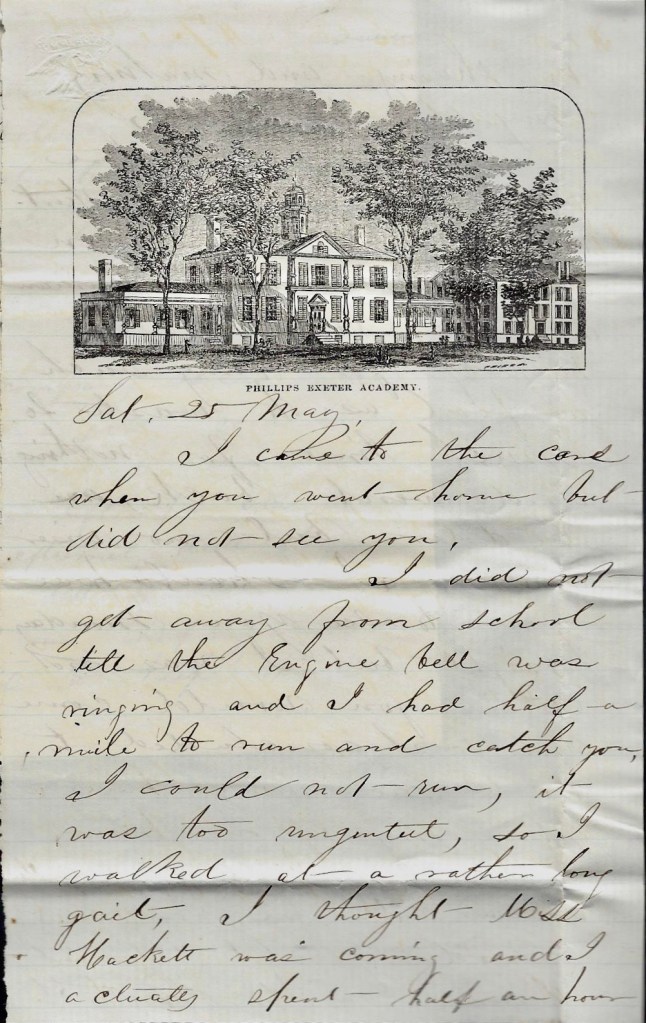
One of the letters was written on stationery with an incredible lithograph of the Academy Building which I have not found elsewhere on the internet or in the school’s archives so it must be very rare.
Letter 1

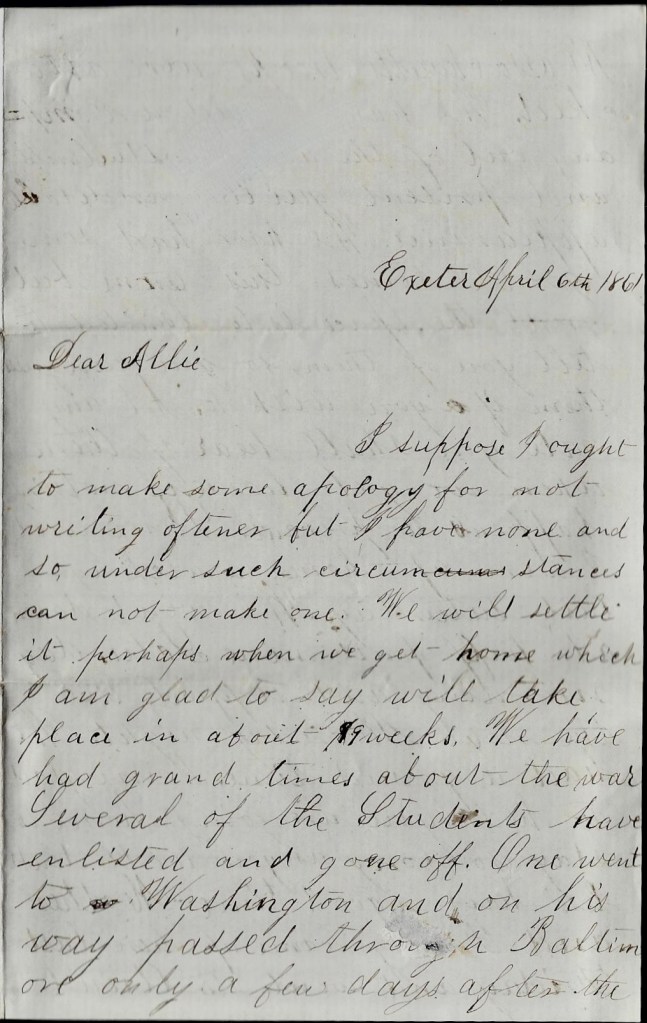
Exeter [New Hampshire]
April 6th 1861
Dear Allie,
I suppose I ought to make some apology for not writing oftener but I have none and so, under such circumstances can not make one. We will settle it perhaps when we get home which I am glad to say will take place in about 9 weeks.
We have had grand times about the war. Several of the students have enlisted and gone off. One went to Washington and on his way passed through Baltimore only a few days after the Massachusetts troops were attacked. We have formed a company out of the academy students and present quite a creditable appearance.
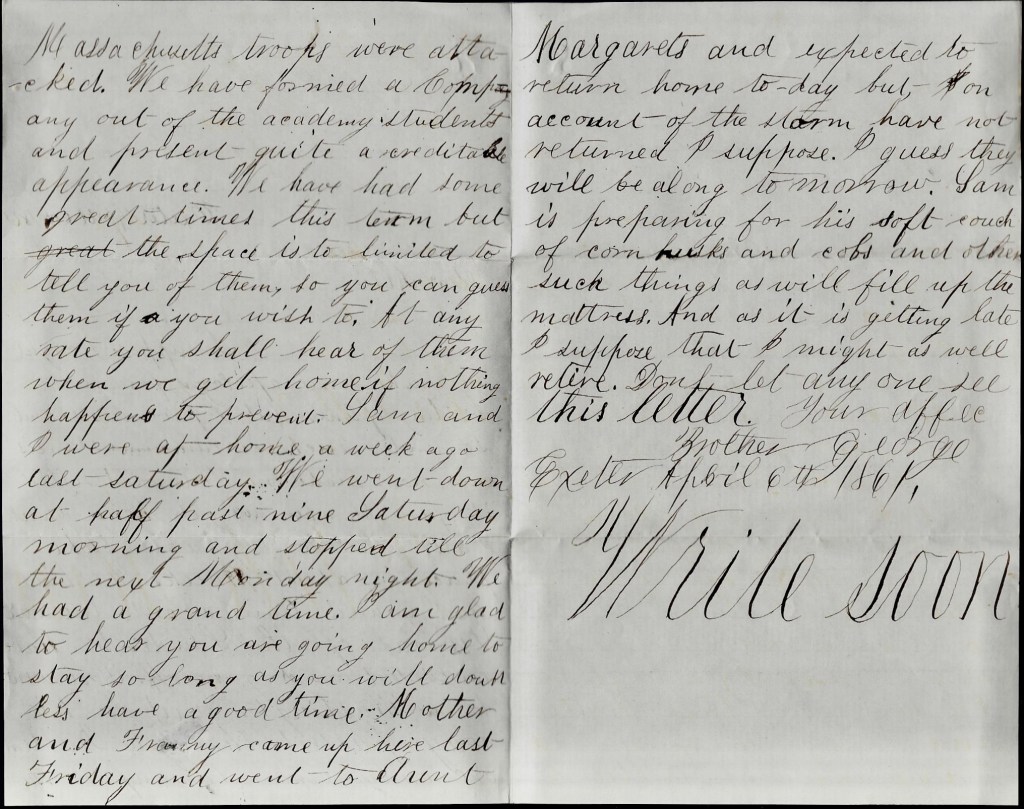
We have had some great times this term but the space is too limited to tell you of them so you can guess them if you wish to. At any rate, you shall hear of them when we get home if nothing happens to prevent. Sam and I were at home a week ago last Saturday. We went down at half past nine Saturday morning and stopped till the next Monday night. We had a grand time.
I am glad to hear you are going home to stay so long as you will doubtless have a good time. Mother and Franny came up here last Friday and went to Aunt Margaret’s and expected to return home today but on account of the storm, have not returned I suppose. I guess they will be along tomorrow.
Sam is preparing for his soft couch of corn husks and cobs and othe such things as will fill up the mattress. And as it is getting late, I suppose that I might as well retire. Don’t let anyone see this letter. Your affectionate brother, — George
Write soon.
Letter 2
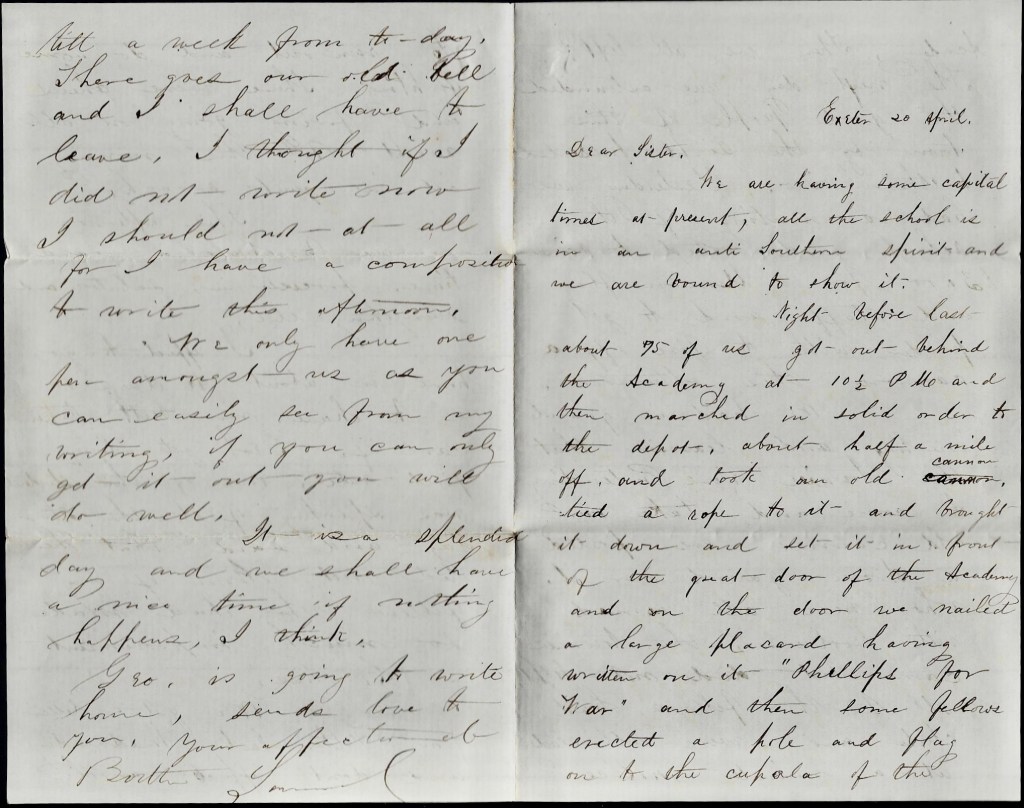
Exeter [New Hampshire]
20 April [1861]
Dear Sister,
We are having some capitol times at present. All the school is in anti-Southern spirits and we are bound to show it.
Night before last, about 75 of us got out behind the Academy at 10:30 p.m. and then marched in solid order to the depot, about half a mile off, and took our old cannon, tied a rope to it, and brought it down and sat it in front of the great door of the Academy and on the door we nailed a large placard having written on it, “Phillips for War,” and then some fellows erected a pole and flag on to the cupola of the Academy. Then we all left. The next day we astounded the good people of this town by the sight presented to their view. Yesterday we had a meeting of the school and voted to raise $30 for a Union flag and staff and to get powder with to fire off the cannon this afternoon. 1
We had a grand meeting and learning that the town were intending to come and take our old cannon, we posted a strong guard over it who were all armed with revolvers. The townies came but did not fight. All of the fellows had clubs and were all ready at a minutes notice to run out and do some fighting. There were cheers and firing going on all night, but this morning all is quiet enough.
This afternoon we are to have a grand time—processions, salutes, and everything else.
I expect to go home in about 10 days so as to have my teeth taken care of. George gets along first rate. One of the students was speaking of it the other day and said that he did not know of any fellow who had made so much improvement as George has.
We got a letter from Father last Wednesday ad don’t expect another till a week from today. There goes our old bell and I shall have to leave. I thought if I did not write now, I should not at all for I have a composition to write this afternoon.
We only have one pen amongst us as you can easily see from my writing. If you can only get it out, you will do well.
It is a splendid day and we shall have a nice time if nothing happens, I think. George is going to write home. Sends love to you. Your affectionate brother, — Samuel
1 Samuel’s version of these events varies slightly from an account that appears in a history of the school by Laurence M. Crosbie published in 1923 (page 255) which reads, “Moved by the spirit of war, some of the students one night filed silently out to Greenland, a village eight miles away, and dragged an ancient cannon, which they labeled, ‘Phillips for War!’ and planted it before the door of the recitation hall. The next morning Principal Soule eyed the gun narrowly and after formal exercises at the chapel showed his patriotism and his tact in dealing with a new problem by declaring that he was not displeased with the martial spirit of the boys, since it showed they were ready to answer the call of their country; but he added that he wondered where the engine came from, and if it was really safe to fire. His generous stand brought wild cheers from the students, whom he then directed to get permission to fire the ld brass cannon that stood near the town hall. A collection was taken to buy powder, and many rounds were fired. I that way the boys vented their enthusiasm for the cause that was to cost many of them their lives.”

Letter 3

[Phillips Exeter Academy, Exeter, New Hampshire]
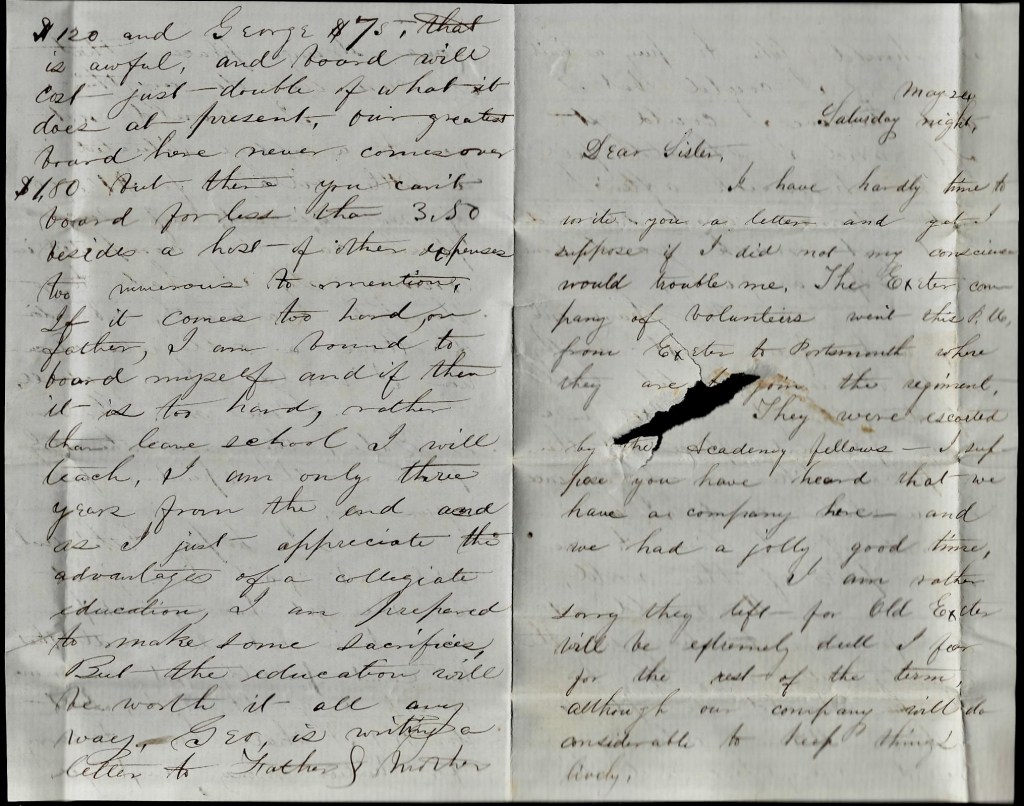
Saturday night, May 24 [May 25, 1861]
Dear Sister,
I have hardly time to write you a letter and yet I suppose if I did not, my conscience would trouble me. The Exeter Company of Volunteers went this p.m. from Exeter to Portsmouth where they are to form the regiment. They were escorted by the Academy fellows. I suppose you have heard that we have a company here—and we had a jolly good time.
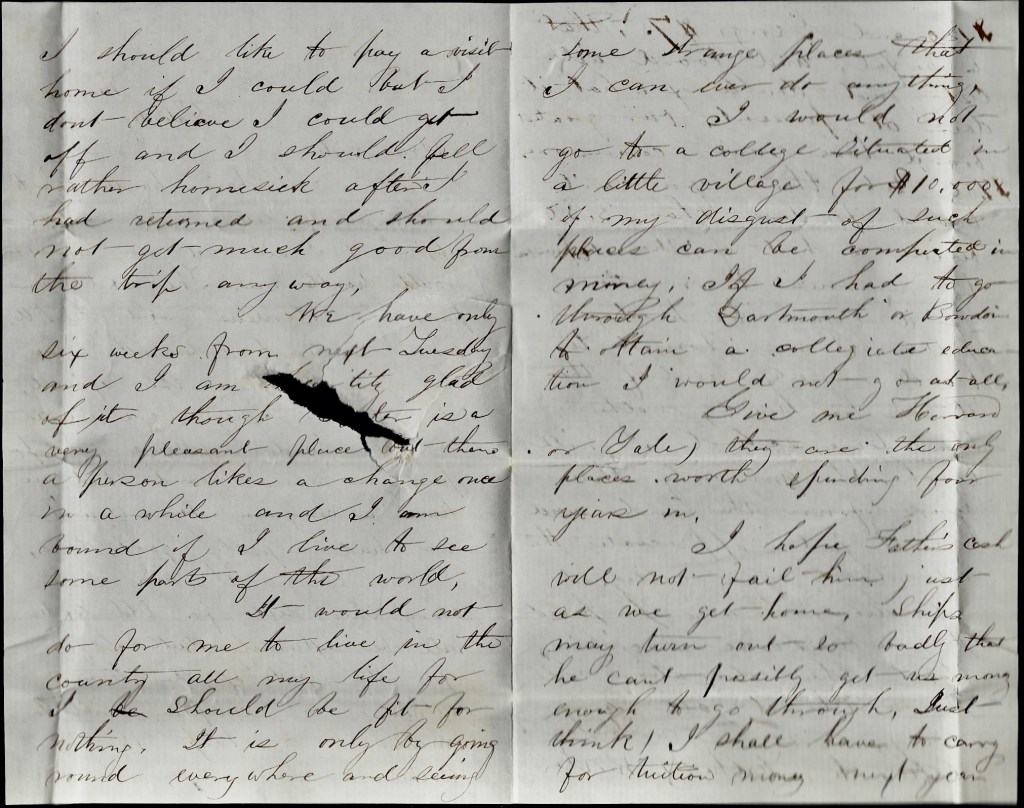
I am rather sorry they left for Old Exeter will be extremely dull for the rest of the term, although our company will do considerable to keep things lively. I should like to pay a visit home if I could but I don’t believe I could get off and I should feel rather homesick after I had returned and should not get much good from the trip anyway.
We have only six weeks from next Tuesday and I am heartily glad of it though Exeter is a very pleasant place but then a person likes a change once in a while and I am bound if I live to see some parts of the world.
It would not do for me to live in the country all my life for I should be fit for nothing. It is only by going round everywhere and seeing some strange places that I can ever do anything. I would not go to college situated in a little village for $10,000 if my disgust of such places can be computed in money. If I had to go through Dartmouth or Bowdoin to obtain a collegiate education, I would not go at all. Give me Harvard or Yale. They are the only places worth spending four years in.
I hope Father’s cash will not fail him just as we get home. Ships may turn out so badly that he can’t possibly get us money enough to go through. Just think, I shall have to carry for tuition money next year $120 and George $75. That is awful. And board will cost just double of what it does at present. Our greatest board here never comes over $1.80 but then you can’t board for less than 3.50 besides a host of other expenses too numerous to mention. If it comes too hard on Father, I am bound to board myself and if then it is too hard, rather than leave school. I will teach. I am only three years from the end and as I just appreciate the advantages of a collegiate education, I am prepared to make some sacrifices. But the education will be worth it all anyway.
George is writing a letter to Father & Mother.
Saturday, 25 May [1861]
I came to the cars when you went home but did not see you. I did not get away from school till the Engine bell was ringing and I had half a mile to run and catch you. [But] I could not run—it was too ungenteel—so I walked at a rather long gait. I thought Miss Hackett was coming and I actually spent half an hour in shaving and making myself presentable. And lo, I got there just as you were starting off. I mused on the mutability of human affairs, confounded myself for being such a fool as to waste so much time for nothing, and went back sadder but no wiser man. I should have gone to see you Monday night but I was not certain you would come and so I concluded to waste no more time in getting myself in trim.
Parker says he saw a gentleman with you. Who was it? Good night. Pleasant dreams. Your affectionate brother, — G

 Spared & Shared 23