
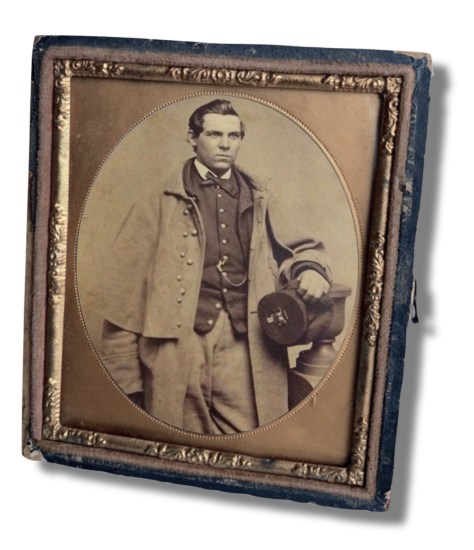
The following letters were written by Henry Thomas Fitts (1842-1919), the son of Daniel French Fitts (1805-1883) and Susan Fellows (1805-18xx) of Haverhill, Essex county, Massachusetts.
Henry was a 19 year-old shoe cutter from Haverhill when he enlisted in September 1861 as a private in Co. H, 22nd Massachusetts Infantry. He transferred to the 216th Company of the Veteran Reserve Corps, 1st Battalion, in April 1864 and mustered out of the service in October 1864. Muster rolls inform us that he was reported missing at the Battle of Gaines’ Mill on 27 June 1862.
Letter 1
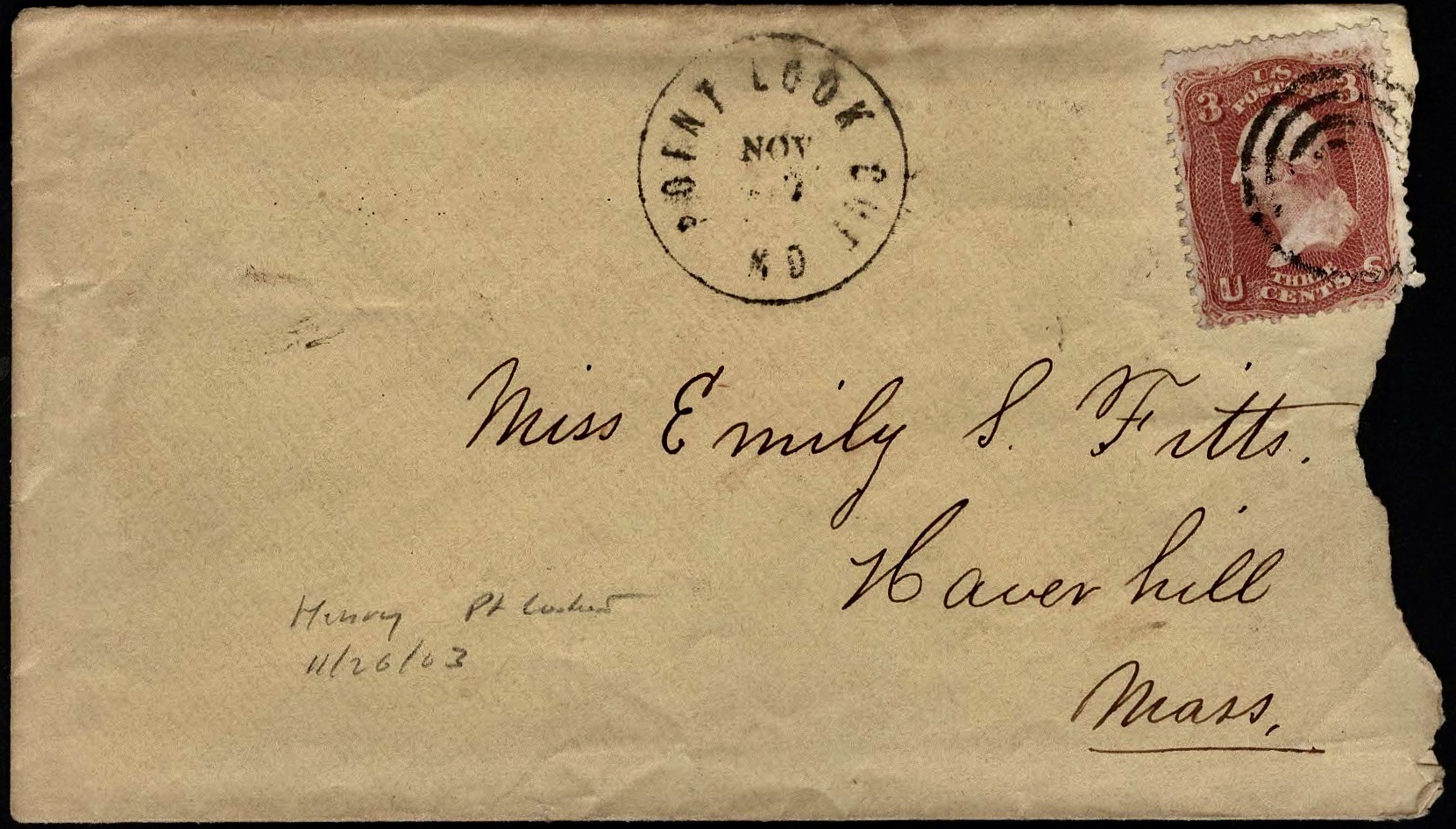
Point Lookout, Maryland
November 26th 1863
Thanksgiving Day
Dear Sister Em,
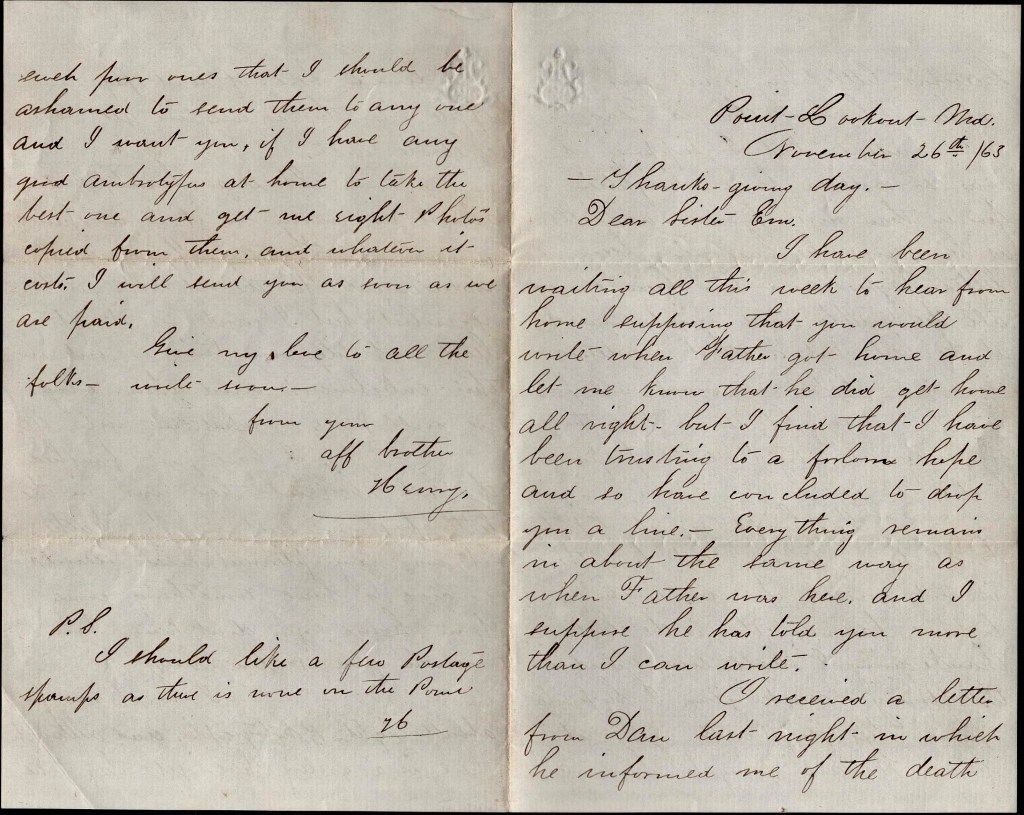
I have been waiting all this week to hear from home supposing that you would write when Father got home and let me know that he did get home all right, but I find that I have been trusting to a forlorn hope and so have concluded to drop you a line. Everything remains in about the same way as when Father was here and I suppose he has told you more than I can write.
I received a letter from Dan last night in which he informed me of the death of Laura’s little boy and my nephew Charley. This is sad news indeed but I suppose it was so ordered by a mightier power than ours, for our—as well as his good. He has only been lifted higher and has been spared all the troubles and misfortunes of at the best, but a short existence sooner or later we must all pass over the river. Let us so live that we may at any time be prepared to die.
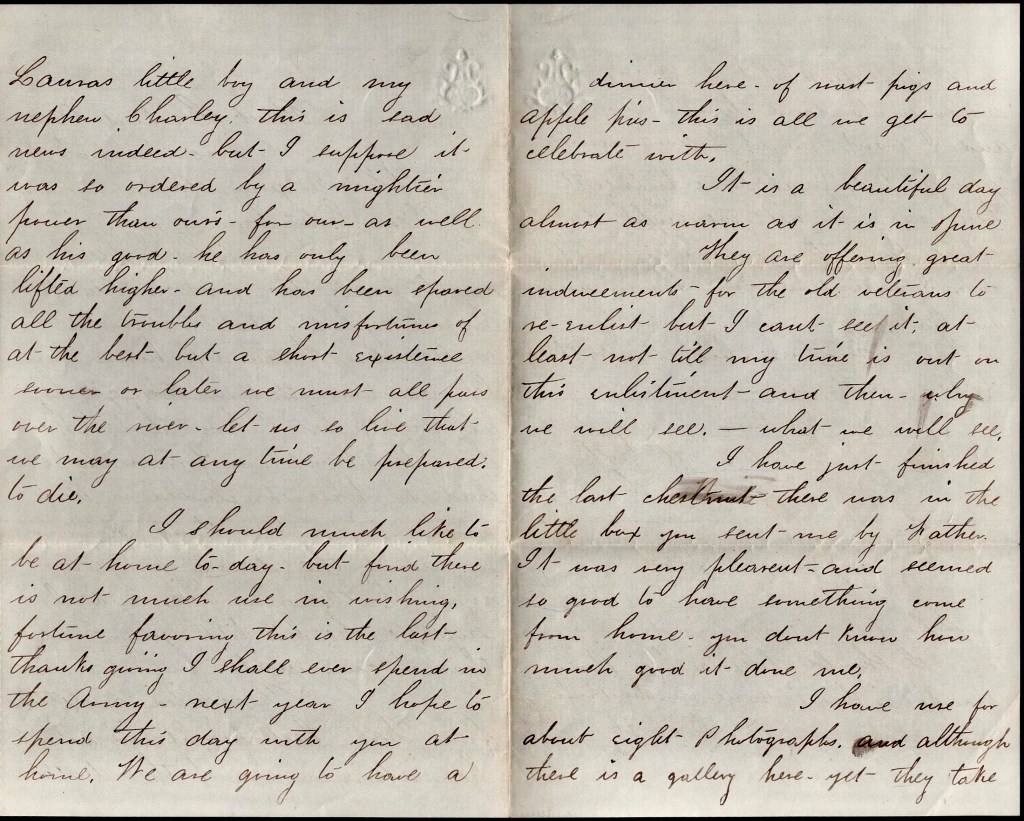
I should much like to be at home today but find there is not much use in wishing, fortune favoring this is the last Thanksgiving I shall ever spend in the Army. Next year I hope to spend this day with you at home. We are going to have a dinner here of roast pigs and apple pies. This is all we get to celebrate with,
It is a beautiful day—almost as warm as it is in June.
They are offering great inducements for the old veterans to re-enlist but I can’t see it—at least not till my time is out on this enlistment, and then—why, we will see, what we will see.
I have just finished the last chestnut there was in the little box you sent me by Father. It was very pleasant and seemed so good to have something come from home. You don’t know how much good it done me.
I have use for eight photographs and although there is a gallery here, yet they take such poor ones that I should be ashamed to send them to any one and I want you, if I have any good ambrotypes at home, to take the best one and get me eight photos copied from them, and whatever it costs I will send you as soon as we are paid.
Give my love to all the folks. Write soon. From your affectionate brother, — Henry
P. S. I should like a few postage stamps as there is none in the Point.
Letter 2
Point Lookout
January 15th 1864
My Dear Mother,
The reason I have not written home for so long, I have just returned from a trip to Washington where I was sent by the Dr. in charge of the hospital on business connected with the laundry. I was to have been gone four days but while there the cold snap came on (Which I see you have had at home) and froze up the river so we could not get back till yesterday although we started Tuesday—four days on the trip which is usually performed in 8 or 9 hours.

The first day we came 18 miles, then stopped for the night and in the morning we were froze in hard and fast. We layed at this place one day and two nights. It was just opposite Mount Vernon and all in board took advantage of the time and visited the historical place. I send you a piece of bark which I peeled from a tree just in front of Washington’s tomb.
I haven’t time to write much now, and the room is so awful cold that I can hardly hold my pen. Will write again tomorrow after I get settled. Till then, I am your affectionate son, — Henry
P. S. I haven’t got the box yet but expect it today.


Letter 3
Point Lookout, Maryland
June 1st 1864
My dear sister,
It is now some time since I have written to you but it has been however no fault of mine. We have had very busy times for the last three weeks receiving wounded from the late battles day and night which has kept us hard at work. The poor fellows suffer much this warm weather but you hardly hear a complaint from one of them. As many as five a day have been buried ever since their arrival which is a large percentage on so few—eighteen hundred.
The weather has been intensely hot for the last two days—the thermometer ranging as high as 90 degrees in the shade. It is some war, you may believe. If I was at home now, we would begin to think of going to the Bluff—that place of credit and renown so celebrated in the annals of Haverhill history. I am just writing this at a late hour, nearly eleven o’clock. “Taps” have log since sounded warning all good soldiers to put out their lights and go to bed. So you see I am trespassing on Uncle Sam’s time in writing this dull letter.
All the regiments which have been stationed here have left for the front and their places supplied by the Veteran Reserve Corps. We have also had many additions to our prisoners having 15,000 privates and 700 officers, making quite a small army in themselves.
I see by the Publishers which you sent me that old H[averhill] has again been “shaken by drafts alarms” and among the names I noticed, that of Seymour. I suppose that is the Rev. Gent of the Episcopal Church. I am glad to see it for Grant needs all the men he can get and that puts me in mind that the army has got back to McClellan’s old ground of the Peninsular—the same place which was the scene of the military exploits of your humble brother, that is, what few he performed. God speed him is my prayer.
My time is rapidly growing shorter. I am now a three months man and that will soon slip away. I sent you a package of specimens the other day. write if you get them all right. I enclose two in this letter. I did not suppose when I sat down that I should write on more than half of this sheet, but find that I have nearly filled the four sides. And as I am growing sleepy, had better stop. Give love to all friends. from your affectionate brother, — Henry
Good night.
Letter 4
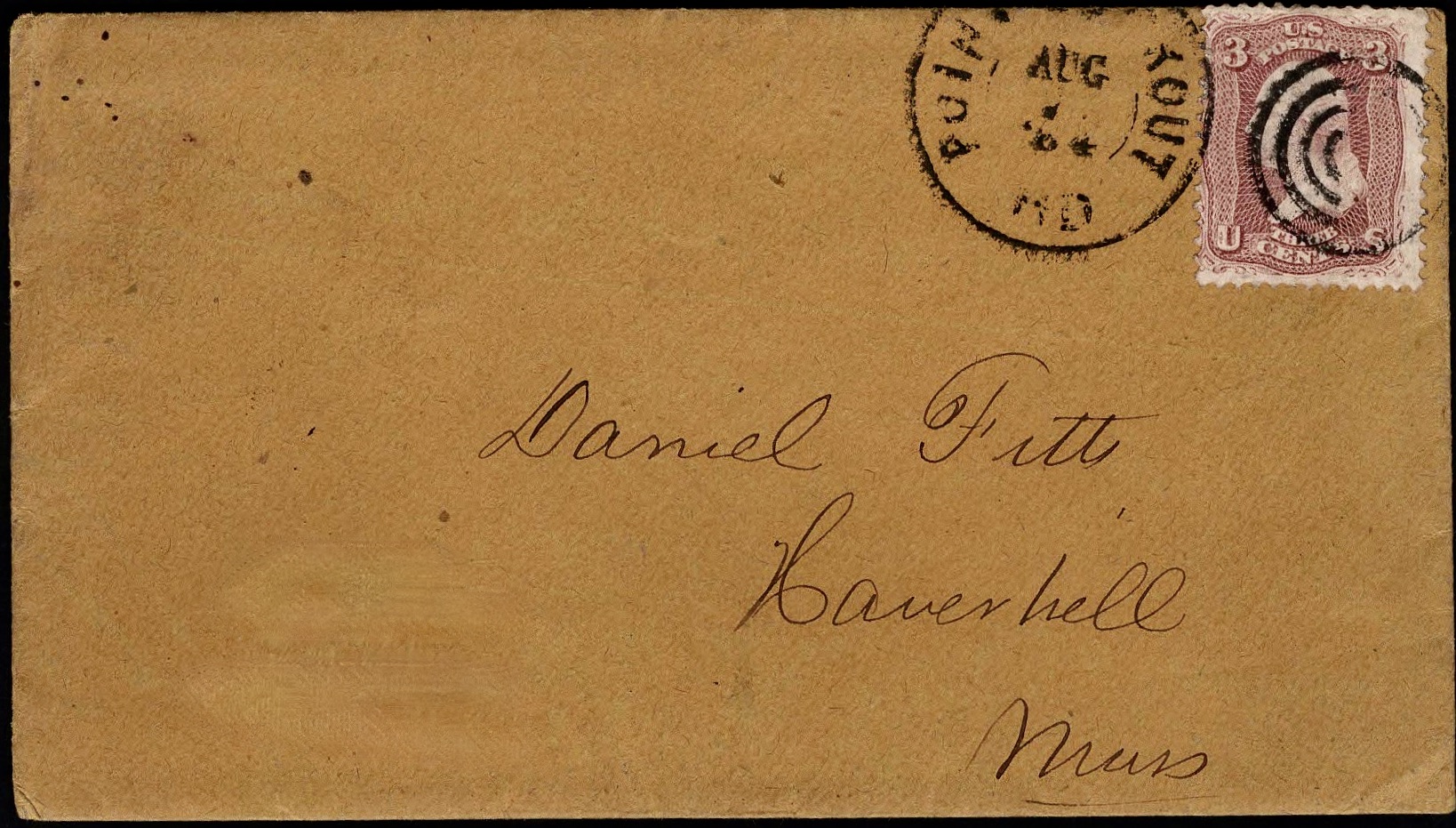
Point Lookout
August 7, 1864
Dear Brother,
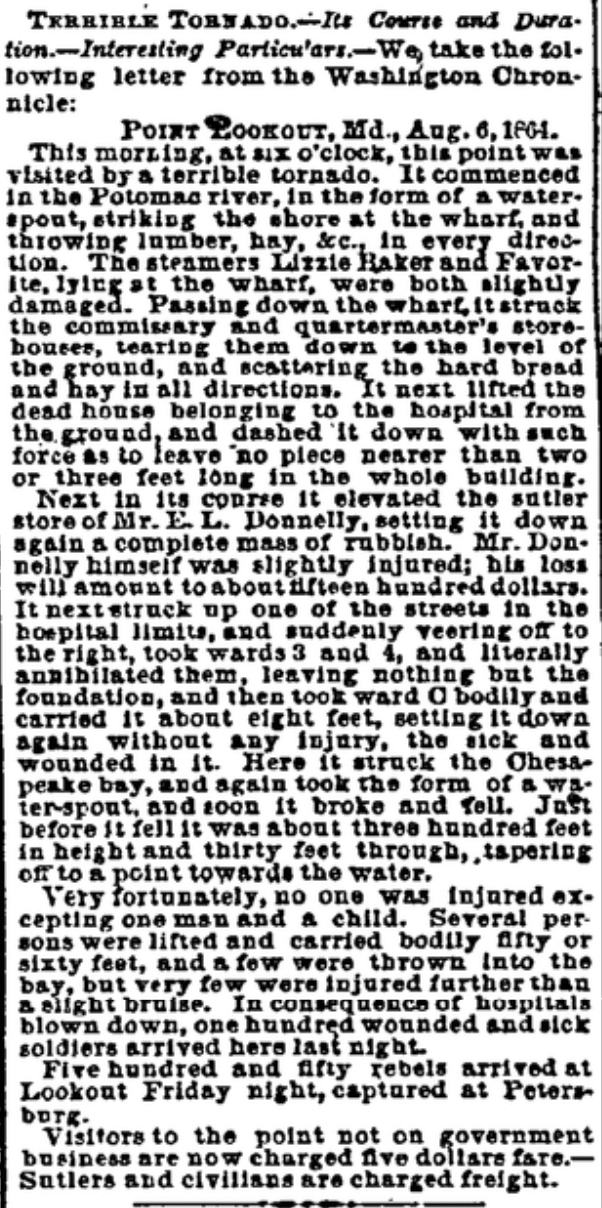
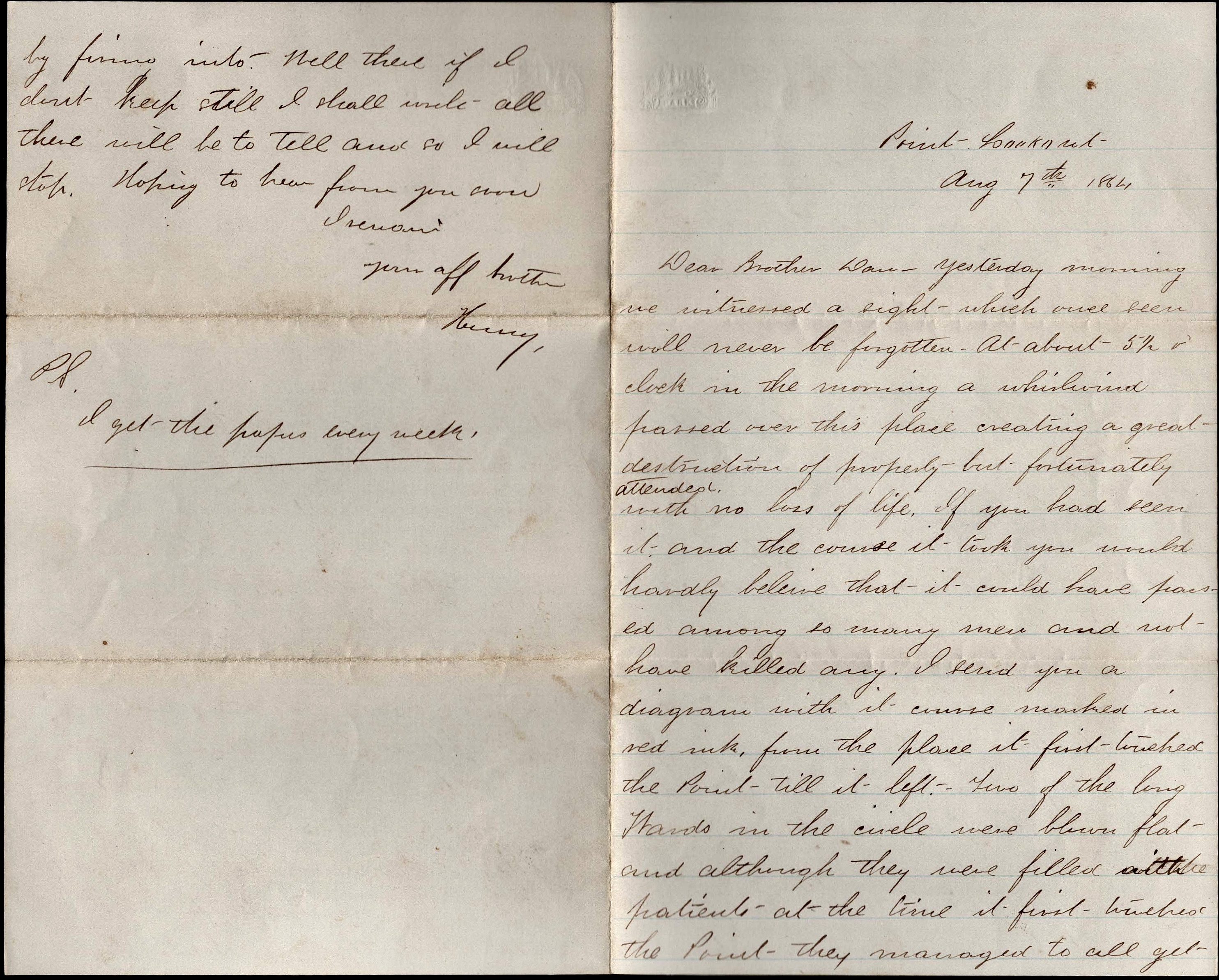
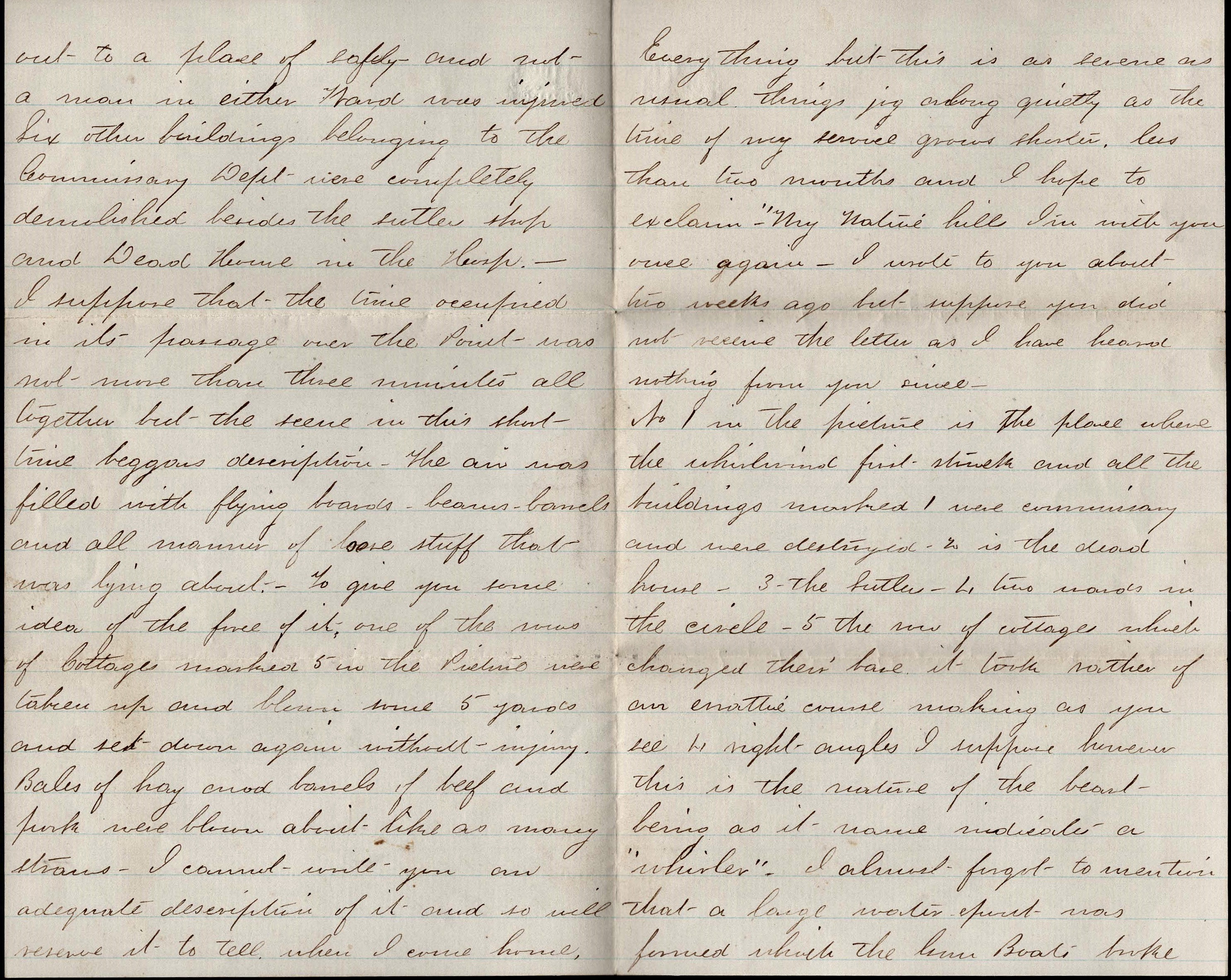
Yesterday morning, we witnessed a sight which, once seen, will never be forgotten. At about 5:30 o’clock in the morning, a whirlwind passed over this place creating a great destruction of property but fortunately attended with no loss of life. If you had seen it and the course it took, you would hardly believe that it could have passed among so many men and not have killed any. I send you a diagram with its course marked in red ink from the place it first touched the Point till it left. Two of the long Wards in the circle were blown flat and although they were filled with patients at the time it first touched the Point, they managed to all get out to a place of safety and not a man in either Ward was injured. Six other buildings belonging to the Commissary Department were completely demolished besides the sutler shop and Dead House in the Hospital.
I suppose that the time occupied in its passage over the Point was not more than three minutes all together but the scene in this short time beggars description. The air was filled with flying boards, beams, barrels, and all manner of loose stuff that was lying about. To give you some idea of the force of it, one of the rows of cottages marked 5 in the picture were taken up and blown some 5 yards and set down again without injury. Bales of hay and barrels of beef and pork were blown about like as many straws.
I cannot write you an adequate description of it and so will reserve it to tell when I come home. Everything but this is as serene as usual. Things jog along quietly as the time of my service grows shorter. Less than two months and I hope to exclaim, “My native hills, I’m with you once again.” I wrote to you about two weeks ago but suppose you did not receive the letter as I have heard nothing from you since.

No. 1 in the picture is the place where the whirlwind first struck and all the buildings marked 1 were commissary and were destroyed. 2 is the Dead House. 3 is the sutler’s. 4 is two Wards in the circle. 5 is the row of cottages which “changed their base.” It took rather of an erratic course making as you see four right angles. I suppose, however, this is the nature of the beast being as its name indicates—a “whirler.” I almost forgot to mention that a large water spout was formed which the gun boats broke by firing into.
Well there, if I don’t keep still, I shall write all there will be to tell and so I will stop. Hoping to. hear from you soon. I remain your affectionate brother, — Henry
P. S. I get the papers every week.



 Spared & Shared 23