Category Archives: Post War Mississippi

1868: David Hopkins to his Mother

The following letter was written by David Hopkins (1838-1895), the son of William Hopkins (1805-1863) and Emma Hopkins (1808-1868) of Richland county, South Carolina. David wrote the letter from his farm in Canton, Madison county, Mississippi, to his widowed mother in South Carolina. After her husband William Hopkins died in 1863, his wife struggled to get by and to take care of what was left of the plantation.  The Federal troops burned much of it but did not burn the main house when they saw a Masonic plaque on the wall.  The sons were kept busy trying to run the other family plantations, including those in Mississippi.

David was married in 1859 to Adeline (“Addie”) M. Rembert. David’s obituary reads: David Hopkins was born at the old family homestead near Hopkins, on November 11, 1836. When the war came on he went forth to fight for the beloved Southland in Capt. Meighan’s Company C, Second South Carolina Cavalry, commanded by Col. Thomas J. Lipscomb. He fought throughout the war, distinguishing himself for his bravery. Mr. Hopkins was always a planter. Just after the war he removed to Mississippi, where he remained for fourteen years and then returned to the old homestead, where he has since resided. He married early in life a Miss Rembert of Sumter county, who with his only surviving child, Dr. James Hopkins, the county auditor, remain to mourn the loss. His only other child, a son, died several years ago. 

This letter is from a private collection (RM) and was offered for transcription and publication on Spared & Shared by express consent. See also 1861: James Hopkins to William Hopkins from the same collection.

T R A N S C R I P T I O N

April 20, 1868

Dear Mother,

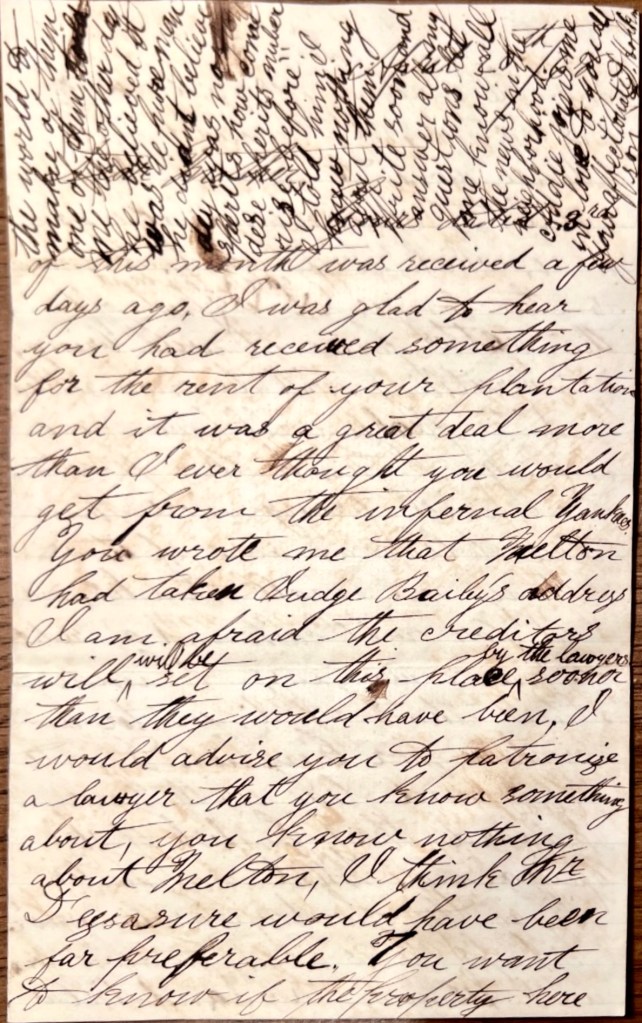
Yours dated 3rd of this month was received a few days ago. I was glad to hear you had received something for the rent of your plantation and it was a great deal more than I ever thought you would get from the infernal Yankees. You wrote me that Melton had taken Judge Bailey’s address. I am afraid the creditors will be set on this place by the lawyers sooner than they would have been. I would advise you to patronize a lawyer that you know something about. You know nothing about Melton. I think Mr. D’ysasure would have been far preferable.

You want to know if the property here has been administered on. It has not, and I would not advise you to have it done until the creditors make you do so which will be time enough as the longer the sale of this land is put off, the better the price will be more settled and the people will have more money. I think the plantation will bring more than three dollars an acre if it is cut up in small tracks and sold for part cash and a credit of one or two years.

I understand that Ned Gunter has written for [brother] English to go to Alabama and live with him. I heard that English [Hopkins] spoke of going. What is Gunter going to South Carolina for? Perhaps he is going to close down with his four thousand dollar bond. I would find out what that bond was for and see if father’s name is to it. Is Dr. Diseker living with you this year?

How many freedmen are you working? and how many brother I___? What negroes have you got? Is Glasgow with you yet? I hope you have got rid of Silvy and her mulatto set. Who cooks for you? What has become of Monday and my friend Josh? I expect Tom Robertson will have him for one of his aide-de-camps mounted on a long-eared Jack[mule]; wisdom personified.

“Said that he was thirsty as he had just risen from the grave and had not drank any water since the Battle of Corinth when he was killed.”

The days of miracle have come again in this country. The Confederate dead are rising from their graves and walking out of the graveyards from two or three to fifty in a band, and this happens all over the country. They are called the Klu Klux Klan and nobody knows who belongs to the Klan. They are over the whole country. One of them rode up to house and asked a negro for a cup of water. He drank it and several more. Finally he called for a bucket full. He dispatched that and several more buckets full. Said he was very thirsty as he had just risen from his grave and had not drank any water since the Battle of Corinth where he was killed. The negro run off as hard as he could, bellowing with all his might to save him.

I heard that a white man was killed about 7 or 8 miles from here two or three days ago. He was a notorious horse thief and had just stolen one. Nobody knows who killed him but it is thought the Klu Klux Klan did it. They have also ordered another man off that I knew. He lives about 6 miles from here. He had a negro wife and had perjured himself in court. He is going to leave as quick as possible. The negroes do not know what in the world to make of them. One of them told me the other day he believed it was “de foreman. He didn’t believe dey was no spirits. How come dese spirits nuber rise before.” I told him I knew nothing about them.

Write soon and answer all my questions. Let me know all the news in the neighborhood. Addie joins me in love to you all. Your affectionate son, — D. Hopkins
1866: Charles William Petrie to Eva Petrie

This letter was written by Charles (“Charlie”) William Petrie (1843-1913), the son of Lemuel Weeks Petrie (1813-1851) and Rosa Mahala Farrar (1824-1905) of Jackson, Mississippi. He wrote the letter to his older sister, Eva Petrie (1849-1911). After their father died in 1851, their mother remarried to Irish-born Rev. John Hunter (1824-1899), a Presbyterian clergyman, in 1858. During the Civil War, Charles served as a private in Co. A, 1st Mississippi Artillery.

Charlie’s father, Lemuel Petrie, was born in Maine but came to Rankin county, Mississippi, prior to 1840. In 1841 he reported that he owned 1,500 acres worth $4,500.  In 1842 Lemuel owned over 2,500 acres worth over $17, 500 plus a brick home worth $2,000.  In 1843 he reported that he owned 215 cattle and 49 slaves. In 1847 he owned various assets and 64 slaves in Rankin County, and 60 slaves in Hinds County. Lemuel became a large property owner in Hinds and Rankin county before his early death at age 37.  It appears that a substantial amount of his wealth was inherited, or “obtained” from his brothers. At the time of Lemuel’s death his property included two large plantations located a few miles from Edwards, Mississippi, and a smaller one in the same general area.  According to an estate inventory taken a few years after Lemuel’s death,  there were 76 slaves on the Downey Plantation,  77 slaves on the Baker’s Creek Plantation, and 25 slaves on the Elwood plantation.  The total appraised value of the slaves was approximately $134,000.  The total appraised value of the three plantations was a little over $143,000. 

In 1872, the Lemuel Petrie descendants filed a joint claim with the Commissioner of Claims regarding losses suffered during and after the Battle of Champion’s Hill (May 16, 1863) in Hinds County, Mississippi. A Calvary force of 60 to 70 men, which were part of Ulysses S. Grant’s army engaged in the siege of Vicksburg, camped and set up a hospital on the two plantations belonging to the children of Lemuel Petrie. The Battle of Champion’s Creek was fought partially on one of these plantations.

The initial claim was for approximately $30,000 for a variety of supplies taken by the Union Army. The claim was later reduced to $10,000. This claim represented three-fourths of the total property taken as one fourth belonged to another brother, Charles Petrie, who was not eligible for reimbursement as he was a soldier with the Confederate Army during the Civil War. The Petrie children had inherited the Baker’s Creek plantation and the Downey Plantation which were located near the site of the Civil War battle of Baker’s Creek that occurred on May 16, 1863. The largest claim item was for 56 workhorses and mules. Other large amounts included corn and cotton. A number of witnesses were called before the Commissioner of Claims to verify the amounts claimed by the Petrie children. Of these witnesses, one was the wife of the overseer of one of the plantations, and 8 others were slaves who had worked on the plantations for many years. The claim was substantially reduced by the Commissioner of Claims to approximately $1,300 due to many inconsistent statements regarding the amounts claimed, actions taken by Lemuel’s wife prior to the arrival of the Union Army, and the confederate loyalty of the Petrie’s. The Commissioner found that the workhorses and mules were of inferior quality and that there were fewer than claimed. The claim for cattle was disallowed as the Commissioner determined that the cattle were moved to another county to keep them from the North. All other items were also reduced substantially or eliminated totally. Only one-third ($1,300) of the Commisioner’s adjusted claim value was allowed as the Commissioner found that only Eva Petrie qualified. Eva qualified as she was “too young to entertain any responsible political opinions during the war”. [Compiled by Lawson S. Howland from Fold3 Archives.]

Charlie’s letter speaks of his efforts recruiting free Negroes from the vicinity of Vicksburg to work the family Mississippi plantations near Edward’s Station but does not appear to be sanguine about their productivity without “very close watching.”

See also—1836: Frederick Henry Petrie to John Elder published on Spared & Shared 2.

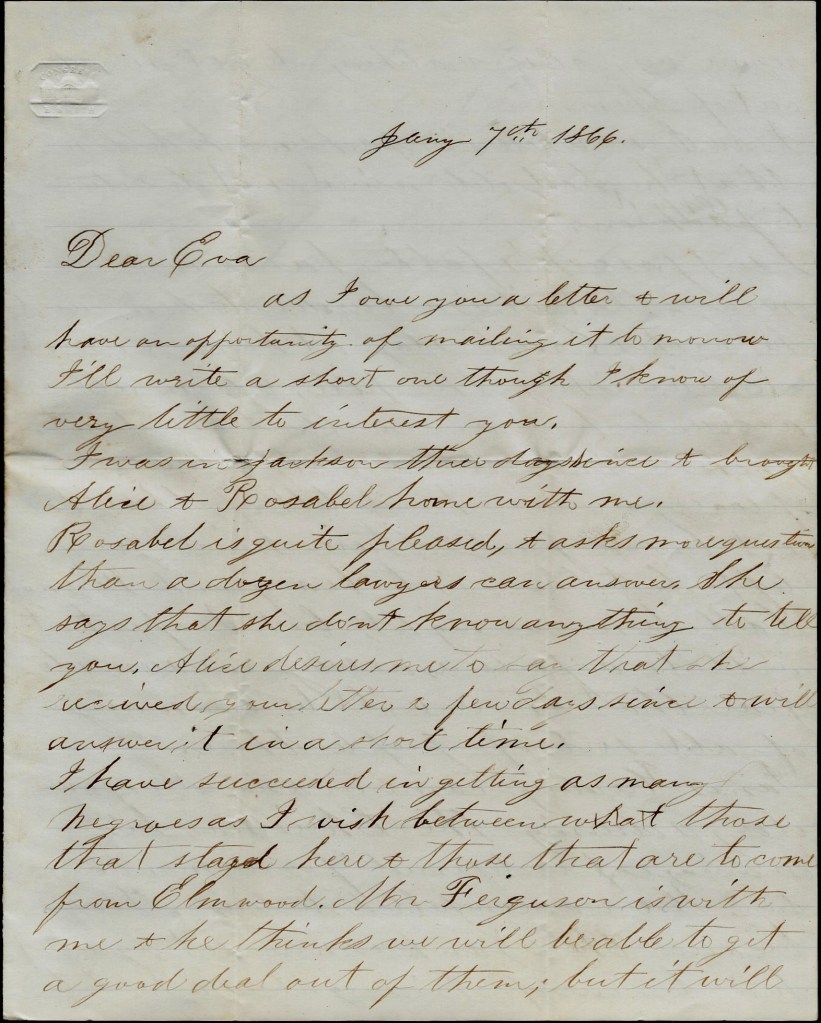
Transcription

Addressed to Miss Eva Petrie, Care of Dr. J. N. Waddell, Oxford, Mississippi

[Vicksburg, Mississippi]
January 7, 1866

Dear Eva,

As I owe you a letter & will have an opportunity of mailing it tomorrow, I’ll write a short one though I know of very little to interest you.

I was in Jackson three days since & brought Alice and Rosabel home with me. Rosabel is quite pleased & asks more questions that a dozen lawyers can answer. She says that she don’t know anything to tell you. Alice desires me to say that she received your letter a few days since & will answer it in a short time.

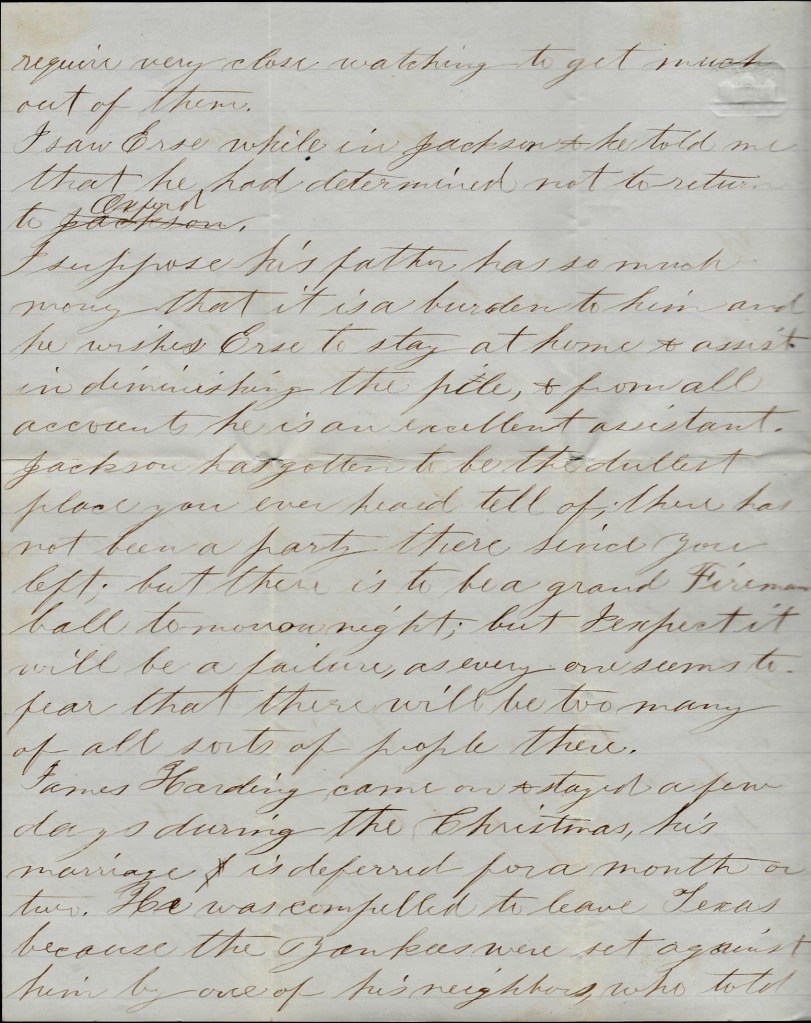
I have succeeded in getting as many Negroes as I wish between those that stayed here and those that are to come from Elmwood. Mr. Ferguson is with me & he thinks we will be able to get a good deal out of them; but it will require very close watching to get much out of them.

I saw Erse while in Jackson and he told me that he had determined not to return to Oxford. I suppose his father has so much money that it is a burden to him and he wishes Erse to stay at home & assist in diminishing the pile, & from all accounts, he is an excellent assistant. Jackson has gotten to be the dullest place you ever heard tell of. There has not been a party there since you left but there is to be a grand Fireman’s Ball tomorrow night. But I expect it will be a failure as everyone seems to fear that there will be too many of all sorts of people there.

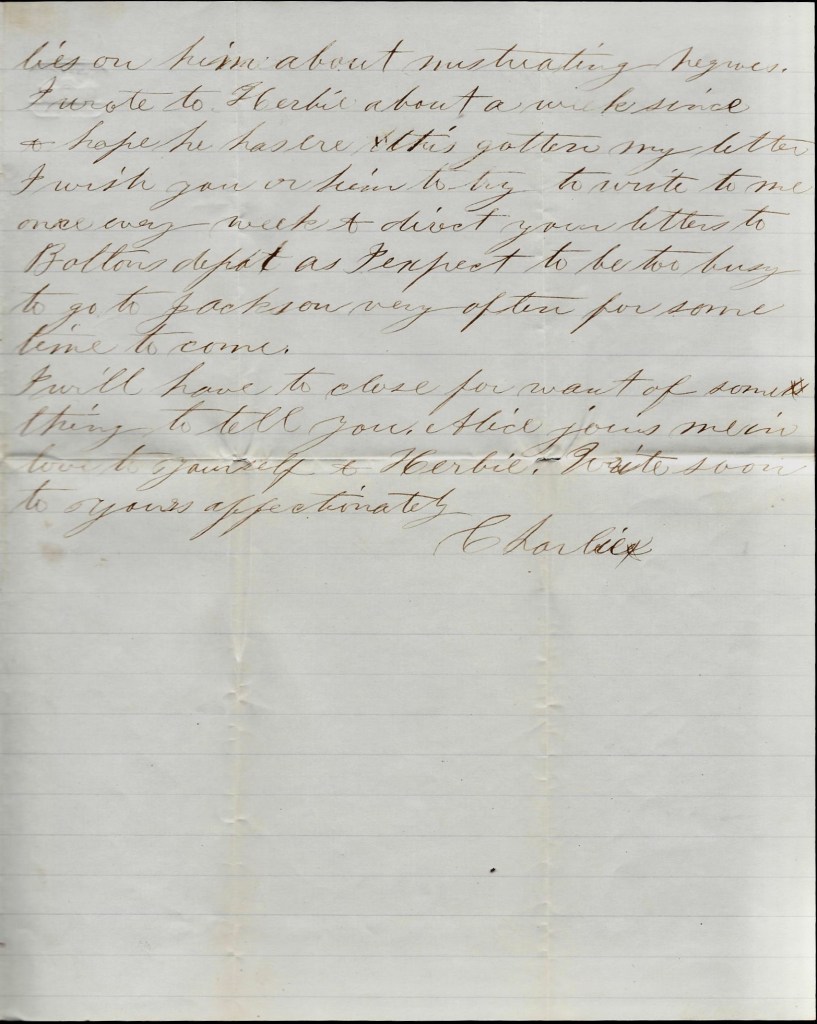
James Harding came on and stayed a few days during the Christmas [holiday]. His marriage is deferred for a month or two. He was compelled to leave Texas because the Yankees were set against him by one of his neighbors who told lies on him about mistreating Negroes. I wrote to Herbie about a week since and hope he has ‘ere this gotten my letter. I wish you or him to try to write to me once every week & direct your letters to Bolton’s Depot as I expect to be too busy to go to Jackson very often for some time to come.

I will have to close for want of something to tell you. Alice joins me in love to yourself & Herbie. Write soon to your affectionate, — Charlie

1865: Agnes E. Patteson to Cousin “Jim”

How Agnes might have looked

The following letter was written by 30 year-old Agnes E. Patteson (1835-18xx), the unmarried daughter of William Nichols Patteson and Sarah Ann Harding (1814-1880) of Buckingham county, Virginia. William N. Patteson was Captain of the Campbell Battery, Virginia Heavy Artillery which disbanded in 1862.

Agnes’s letter gives us a hint of the anguish White residents of Hinds county felt in the days shortly after the “downfall of the Confederacy.” Even as the “darkest shadows” shrouded their uncertain future, many former planters contemplated leaving the country to put down new roots in Brazil. For those who stayed, it would be three or more generations—nearly 80 years— before the White leadership of Hinds county would celebrate Independence Day. Residents still live with a statue in front of the Raymond Court House honoring the Confederate soldiers bearing an inscription that reads: “Erected by the people of Hinds County, in grateful memory of their men who in 1861-1865 gave or offered to give their lives in defense of constitutional government and to the heroic women whose devotion to our cause in its darkest hour sustained the strong and strengthened the weak.” [Source: Confederate Statue at Raymond Courthouse…by Kayode Crown, 7 July 2020]

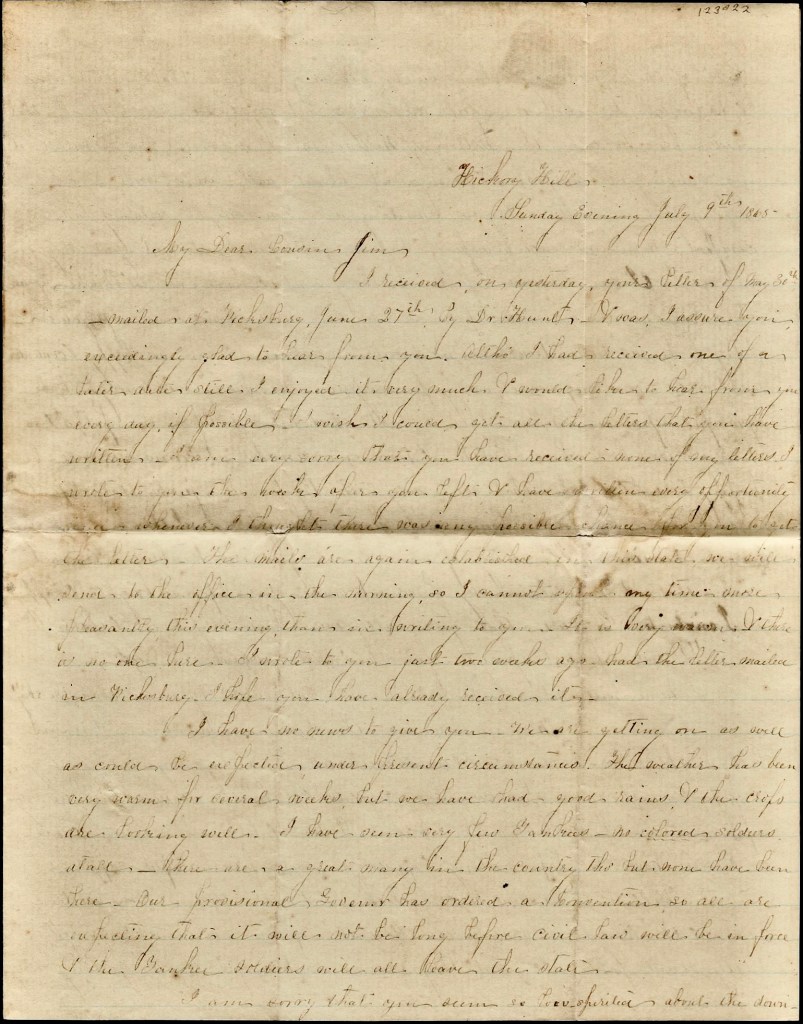
Transcription

Hickory Hill [Hinds county, Mississippi]
Sunday evening, July 9, 1865

My dear Cousin Jim,

I received on yesterday your letter of May 30th mailed at Vicksburg June 27th by Dr. Hunt & was, I assure you, exceedingly glad to hear from you. Altho’ I had received one of a later date, still I enjoyed it very much & would like to hear from you every day if possible. I wish I could get all the letters that you have written. I am very sorry that you have received none of my letters. I wrote to you the week after you left & have written every opportunity since—whenever I thought there was any possible chance for you to get the letter. The mails are again established in this state. We still send to the office in the morning so I cannot spend my time more pleasantly this evening than in writing to you. It is very warm & there is no one here. I wrote to you just two weeks ago. Had the letter mailed in Vicksburg. I hope you have already received it.

I have no news to give you. We are getting on as well as could be expected under present circumstances. The weather has been very warm for several weeks, but we have had good rains & the crops are looking well. I have seen very few Yankees—no colored soldiers at all. There are a great many in the country tho’ but none have been here. Our provisional governor has ordered a convention so all are expecting that it will not be long before civil law will be in force & the Yankee soldiers will all leave the state.

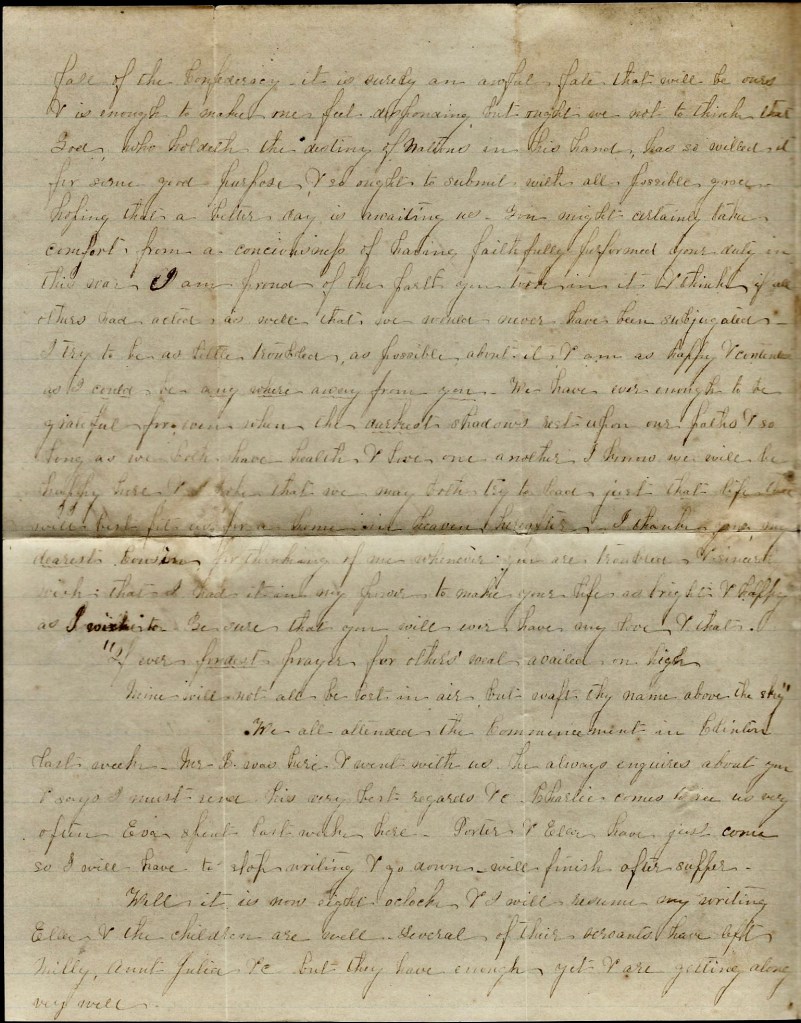
I am sorry that you seem so low-spirited about the downfall of the Confederacy. It is surely an awful fate that will be ours & is enough to make me feel desponding, but ought we not to think that God, who holdeth the destiny of Nations in His hand, has so willed it for some good purpose & so ought to submit with all possible good, hoping that a better day is awaiting us. You might certainly take comfort from a consciousness of having faithfully performed your duty in this war. I am proud of the part you took in it. I think if all others had acted as well that we would never have been subjugated. I try to be as little troubled as possible about it & am as happy & contented as I could be anywhere away from you. We have ever enough to be grateful for even when the darkest shadows rest upon our paths & so long as we both have health & love one another, I know we will be happy here & I hope that we may both try to lead just that life that will best fit us for a home in heaven hereafter. I thank you, my dearest cousin, for thinking of me whenever you are troubled & my sincerest wish is that I had it in my power to make your life as bright & happy as I wish it. Be sure that you will ever have my love & that,

“If ever fondest prayer for others weal availed on high
Mine will not all be lost in air but waft thy name above the sky.”

We all attended the commencement in Clinton this week. Mr. B. was here & went with us. He always enquires about you & says I must send his very best respects &c. Charlie comes to see us very often. Eva spent last week here. Porter & Ella 1 have just come so I will have to stop writing & go down. Will finish after supper.

Well, it is now eight o’clock & I will resume my writing. Ella & the children are well. Several of their servants have left—Milly, Aunt Julia, &c.—but they have enough yet & are getting along very well.

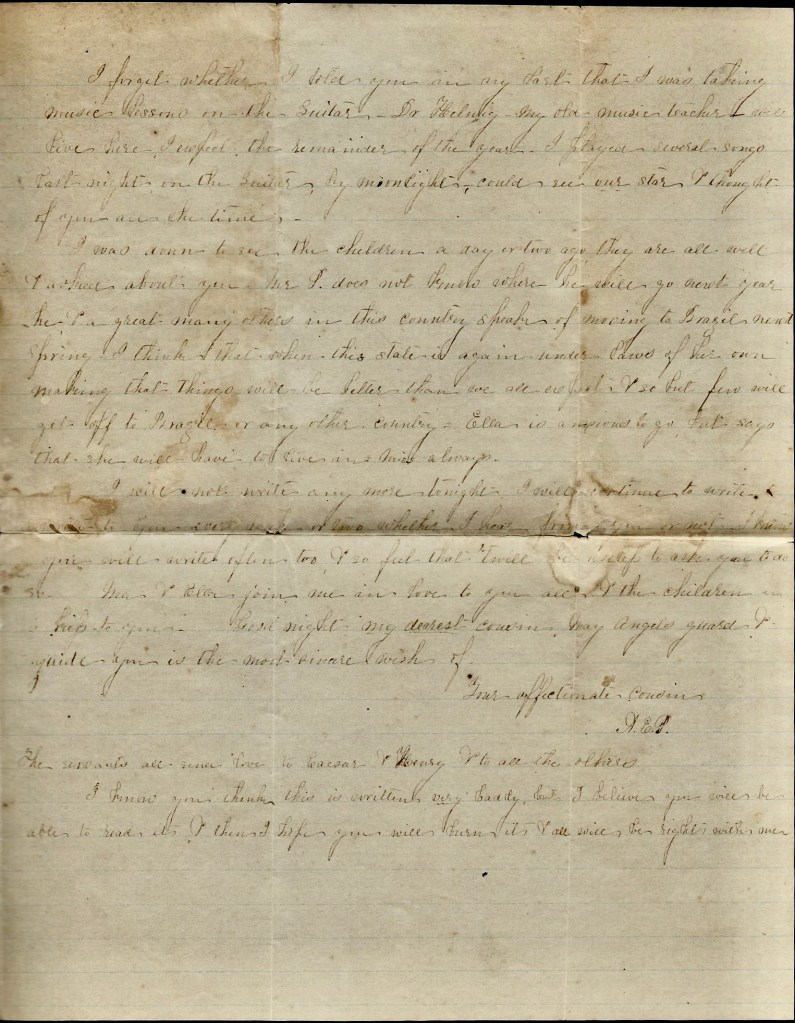
I forgot whether I told you in my last that I was taking music lessons on the guitar. Dr. Helwig, my old music teacher, will live here, I expect, the remainder of the year. 2 I played several songs last night on the guitar by moonlight. Could see our star & thought of you all the time.

I was down here to see the children a day or two ago. They are all well and asked about you. Mr. P[atteson] does not know where he will go next year. He & a great many others in the country speak of moving to Brazil next spring. I think that when this state is again under laws of her own making, that things will be better that we all expect & so but few will get off to Brazil or any other country. Ella is anxious to but says that she will have to live in Mississippi always.

I will not write any more tonight. I will continue to write you every week or two whether I hear from you or not. I know you will write often too & so feel that t’will be useless to ask you to do so. Good night, my dearest cousin. May Angels guard & guide you is the most sincere wish of your affectionate cousin, — A. E. P.

The servants all send love to Caesar & Henry & to all the others. I know you think this is written very badly, but I believe you will be able to read it & then I hope you will burn it & all will be right with me.


1 Nathaniel “Porter” Wells (1831-1903), a native of North Carolina, was married to Agnes’ sister, Ella Patteson (1832-1893) and had a plantation in Brownsville, Hinds county, Mississippi. Porter served from August 1862 to May 1865 as a private in the 4th Mississippi Cavalry.

2 The only Helwig appearing in the Hinds county, Mississippi, census of 1870 was Charles Helwig, born in Saxony in 1820. He was listed as a farmer in 1870.