The following letter was written by David Hopkins (1838-1895), the son of William Hopkins (1805-1863) and Emma Hopkins (1808-1868) of Richland county, South Carolina. David wrote the letter from his farm in Canton, Madison county, Mississippi, to his widowed mother in South Carolina. After her husband William Hopkins died in 1863, his wife struggled to get by and to take care of what was left of the plantation. The Federal troops burned much of it but did not burn the main house when they saw a Masonic plaque on the wall. The sons were kept busy trying to run the other family plantations, including those in Mississippi.
David was married in 1859 to Adeline (“Addie”) M. Rembert. David’s obituary reads: David Hopkins was born at the old family homestead near Hopkins, on November 11, 1836. When the war came on he went forth to fight for the beloved Southland in Capt. Meighan’s Company C, Second South Carolina Cavalry, commanded by Col. Thomas J. Lipscomb. He fought throughout the war, distinguishing himself for his bravery. Mr. Hopkins was always a planter. Just after the war he removed to Mississippi, where he remained for fourteen years and then returned to the old homestead, where he has since resided. He married early in life a Miss Rembert of Sumter county, who with his only surviving child, Dr. James Hopkins, the county auditor, remain to mourn the loss. His only other child, a son, died several years ago.
This letter is from a private collection (RM) and was offered for transcription and publication on Spared & Shared by express consent. See also 1861: James Hopkins to William Hopkins from the same collection.
T R A N S C R I P T I O N
April 20, 1868
Dear Mother,
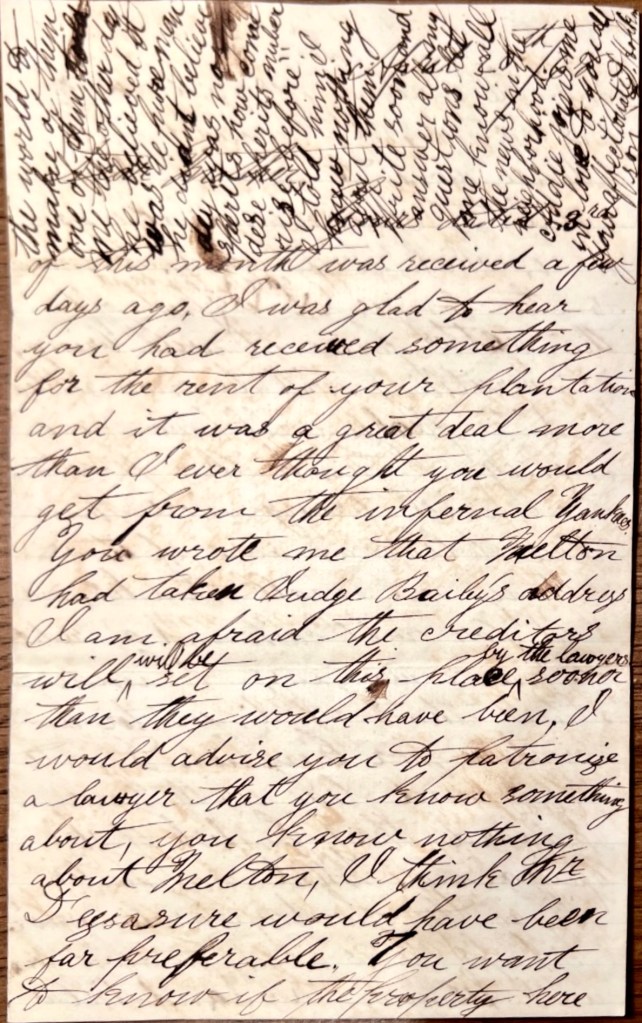
Yours dated 3rd of this month was received a few days ago. I was glad to hear you had received something for the rent of your plantation and it was a great deal more than I ever thought you would get from the infernal Yankees. You wrote me that Melton had taken Judge Bailey’s address. I am afraid the creditors will be set on this place by the lawyers sooner than they would have been. I would advise you to patronize a lawyer that you know something about. You know nothing about Melton. I think Mr. D’ysasure would have been far preferable.
You want to know if the property here has been administered on. It has not, and I would not advise you to have it done until the creditors make you do so which will be time enough as the longer the sale of this land is put off, the better the price will be more settled and the people will have more money. I think the plantation will bring more than three dollars an acre if it is cut up in small tracks and sold for part cash and a credit of one or two years.
I understand that Ned Gunter has written for [brother] English to go to Alabama and live with him. I heard that English [Hopkins] spoke of going. What is Gunter going to South Carolina for? Perhaps he is going to close down with his four thousand dollar bond. I would find out what that bond was for and see if father’s name is to it. Is Dr. Diseker living with you this year?
How many freedmen are you working? and how many brother I___? What negroes have you got? Is Glasgow with you yet? I hope you have got rid of Silvy and her mulatto set. Who cooks for you? What has become of Monday and my friend Josh? I expect Tom Robertson will have him for one of his aide-de-camps mounted on a long-eared Jack[mule]; wisdom personified.
“Said that he was thirsty as he had just risen from the grave and had not drank any water since the Battle of Corinth when he was killed.”
The days of miracle have come again in this country. The Confederate dead are rising from their graves and walking out of the graveyards from two or three to fifty in a band, and this happens all over the country. They are called the Klu Klux Klan and nobody knows who belongs to the Klan. They are over the whole country. One of them rode up to house and asked a negro for a cup of water. He drank it and several more. Finally he called for a bucket full. He dispatched that and several more buckets full. Said he was very thirsty as he had just risen from his grave and had not drank any water since the Battle of Corinth where he was killed. The negro run off as hard as he could, bellowing with all his might to save him.
I heard that a white man was killed about 7 or 8 miles from here two or three days ago. He was a notorious horse thief and had just stolen one. Nobody knows who killed him but it is thought the Klu Klux Klan did it. They have also ordered another man off that I knew. He lives about 6 miles from here. He had a negro wife and had perjured himself in court. He is going to leave as quick as possible. The negroes do not know what in the world to make of them. One of them told me the other day he believed it was “de foreman. He didn’t believe dey was no spirits. How come dese spirits nuber rise before.” I told him I knew nothing about them.
Write soon and answer all my questions. Let me know all the news in the neighborhood. Addie joins me in love to you all. Your affectionate son, — D. Hopkins
The following postwar letters were written by George M. Alverson (1847-1876), the son of William Alverson (1811-1898) and Rhoda Snow (1820-1888) of Beloit, Rock county, Wisconsin. Being too young to serve in the Civil War, George enlisted in the US Regular Army on 19 June 1866 when he was 19 years old. He served three years in the 1st Infantry and was mustered out of the service in June 1869 at Fort Wayne, Michigan.
George’s overtly racist remarks will be difficult for many Americans to read today but he merely expressed what was felt by an overwhelming majority of white Americans who had been raised with the widely held belief that blacks could not be anything but ignorant “mokes”—as George called them—and therefore incapable of assuming the roles of American citizenship. His letters remind us how wide the breach was between harmonious race relations in the post-war era.
After his stint in the army, George relocated to Eureka township, Greenwood county, Kansas, where he took up farming. There was one black family that lived in the same township as George in 1870 which is surprising given his vow to “go where I will never see another nig if I have to go to China or Iceland.” The racial diversity in Eureka township remains 100% white to this day (though there are only 264 inhabitants).
Letter 1
One of the many important rights that African Americans pursued after emancipation was voting, seen in this image during the 1867 election in New Orleans. The streets are filled with African American men of varying statuses as they utilize their new found freedoms at the ballot box. African American men maintained that their manhood and military service during the Civil War justified their rights as citizens, including and especially the right to vote. Even with the passage of the 14th and 15th amendments that secured African Americans’ status as citizens and black men’s right to vote, the post-Reconstruction era challenged and briefly negated the gains that has been made for black rights after the war.
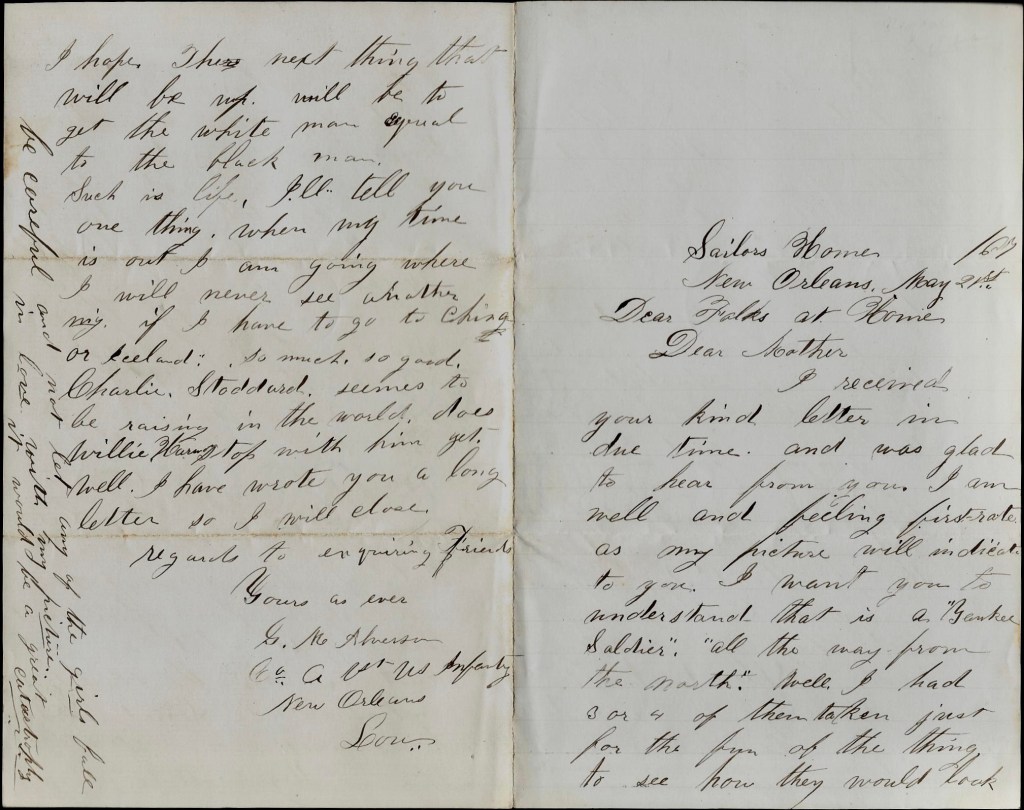
Sailors Home New Orleans May 21st 1867
Dear Folks at home, dear Mother,
I received your kind letter in due time and was glad to hear from you. I am well and feeling first rate as my picture will indicate to you. I want you to understand that is a “Yankee Soldier”—all the way from the North. Well, I had 3 or 4 of them taken just for the fun of the thing to see how they would look. I will have some taken in July with a different tog on altogether. Perhaps you will like them better, but then this one that I send you “is me all over.”
Since I last wrote you we have had a grand display of military. They got the 1st Regiment all together and G Co. of the 6th Cavalry and Battery K, 4 pieces of artillery, and then we marched through the City in full uniform—infantry in front, cavalry next, and then the artillery next. “Splendid display.”
Arthur Goss is well as usual & lazy, &c. like myself.
It is astonishing to a white man to see how things are carried on here in this city. They have erected a stand in the center of Lafayette Square where they have speaking by these nigger-loving pups from the North. They come here and get up there and tell them—the nigs—that they are just as good as a white man, Mr. [William D.] Kelley 1 of Pennsylvania told them if they was not white men enough for office, elect the colored white man, and so on—the “black louse.” And there is Senator [Henry] Wilson [too]. 2 He is another one of the speakers. There will be fun here yet, I hope. The next thing that will be up will be to get the white man equal to the black man. Such is life. I’ll tell you one thing, when my time is out, I am going where I will never see another nig if I have to go to China or Iceland. So much, so good.
Charlie Stoddard seems to be raising in the world. Does Willie Harner stop with him yet? Well, I have wrote you a long letter so I will close. Regards to enquiring friends. Yours as ever. — G. W. Alverson
Co. A, 1st US Infantry, New Orleans, La.
Be careful not to let any of the girls fall in love with my picture. It would be a great catastrophe.
Published in the Southwestern, Shreveport, Louisiana on Wednesday, 22 May 1867
1 William Darah Kelley (1814-1890) was an abolitionist, a friend of Abraham Lincoln and one of the founders of the Republican Party in 1854. He advocated for the recruitment of black troops in the American Civil War, and the extension of voting rights to them afterwards. He served as a Republican member of the US House of Representatives for Pennsylvania’s 4th Congressional District form 1861 to 1890.
2 Senator Henry Wilson’s opposition to slavery drove him to enter politics. “Freedom and slavery are now arrayed against each other,” he declared in 1844. “We must destroy slavery, or it will destroy liberty.” In 1855 the Massachusetts legislature elected Wilson to the Senate where he joined the new Republican Party. Wilson influenced Civil War legislation as chairman of the Military Affairs Committee and continued to call for the abolition of slavery. In April 1862 Congress passed and the president signed the DC Emancipation Act, originally written by Wilson, freeing slaves in the nation’s capital. Wilson introduced the first post war civil rights bill in 1865 and influenced Congress’s passage of constitutional amendments to guarantee citizenship rights to African Americans. Elected vice president in 1873, he became ill shortly after taking office and died on November 22, 1875.
Letter 2
Sailors Home New Orleans June 16, 1867
Dear Folks at Home,
Sunday! It is so quiet and raining, I thought I would scratch a few lines home. I am well as usual at present. I got those papers you sent me. The Beloit paper looked like home and to read over the advertisements it was very interesting to me. I would like to get some more of them when it comes convenient to you.
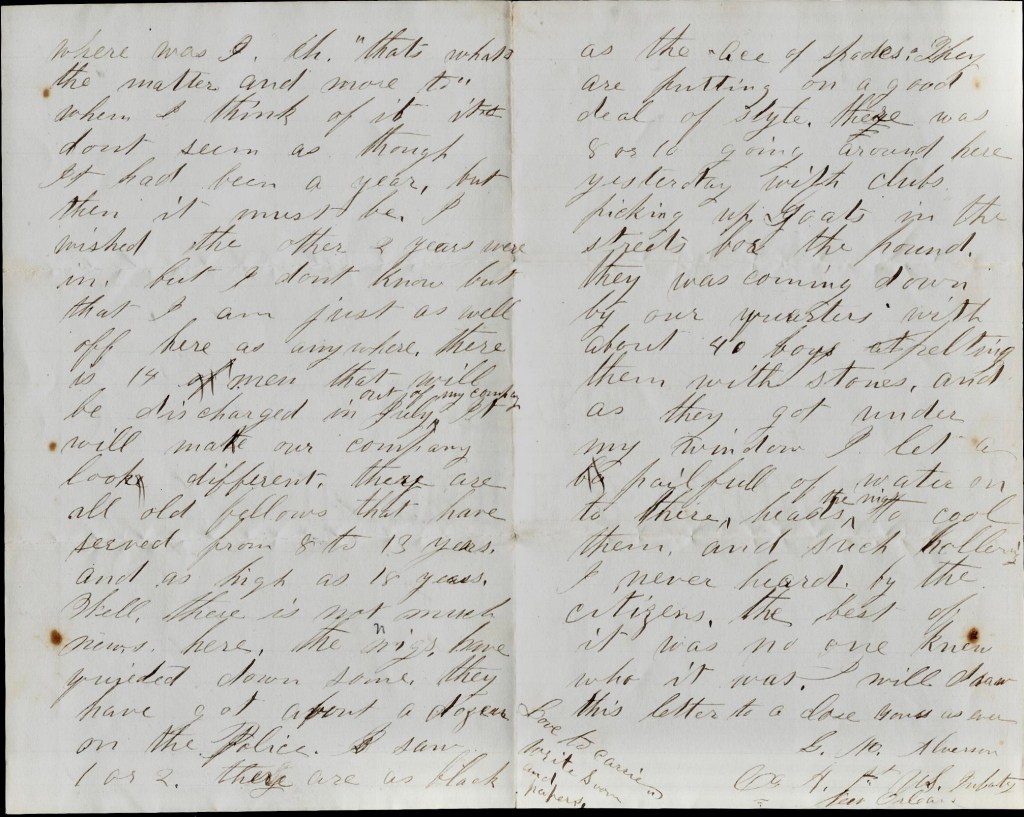
One year ago today, where was I? “That’s whats the matter—and more too.” When I think of it, it don’t seem as though it had been a year [since I enlisted] but then it must be. I wished the other two years were in but I don’t know but that I am just as well off here as anywhere. There is 14 men that will be discharged in July out of my company. It will make our company look different. They are all old fellows that have served 8 to 13 years and as high as 18 years.
Well, there is not much news here. The nigs have quieted down some. They have got about a dozen on the police. I saw one or two. They are as black as the “ace of spades.” They are putting on a good deal of style. There was 8 or 10 going around yesterday with clubs picking up goats in the streets for the pound. They was coming down by our quarters with about 40 boys a pelting them with stones and as they got under my window, I let a pailful of water on to their heads—the nigs—to cool them, and such hollering I never heard by the citizens. The best of it was no one knew who it was.
I will draw this letter to a close. Yours as ever, — G. M. Alverson
Co. A, 1st US Infantry, New Orleans
Love to Carrie. Write soon and papers.
Letter 3
Addressed to Mrs. R. Alverson, Beloit, Wisconsin
Sedgwick Barracks Greenville [Louisiana] July 6, 1868
Dear Mother,
I received your kind letter in due time and was glad to hear from you again. I am enjoying as good health as I ever did in my life. I think now that I would have just as good health here as anywhere in the world.
We have been on the stir for the last week all the time. We were called out to quell a riot (or would have been if’n we had not went down there) at the Mechanic’s Institute where the Legislature and Senate are sitting. They did not like the looks of the Lieut. Governor [Oscar Dunn] 1 of the State. He is as black as a pot. Half of the members are niggers. Just think of having an old moke that ought to be on a plantation over you.
We have to furnish two (2) companies of our US every day to guard them so they will not get disturbed by citizens while they—the mokes—are making laws for the state. Oh! it is awful. I never thought that I would ever see such things. I have heard Mr. Chreiton and Father talk of such things but I didn’t think it would happen.
The Fourth of July is over once more. We paraded the streets of New Orleans and were reviewed by Gen. Buchanan and returned home. Had a very good dinner. I think I shall have a better one next fourth if I have my health. I should think Mr. Potter was crazy of moving his family to California. By the way, I wish that I would get discharged there. I think I should stay there awhile.
You were speaking about Nathan Brazier’s being dissatisfied when he enlisted. I know that he was and so is every man in the service excepting those that have always been in the service and always expect to be in it. If father had used me right the winter before I left home, I would not be here—that is certain. But it is past now. It rains every day.
Your affectionate son, — G. M. Alverson
Co. A, 1st Infantry, Greenville, Louisiana
1 Oscar Dunn (1822-1871) was born into slavery in New Orleans. Though his father was freed by his owner in 1819, because his mother was a slave, so too were all of her children. Running for lieutenant governor, Oscar Dunn beat a white candidate for the nomination, W. Jasper Blackburn, the former mayor of Minden in Webster Parish, by a vote of fifty-four to twenty-seven. The Warmoth-Dunn Republican ticket was elected, 64,941 to 38,046. That was considered the rise of the Radical Republican influence in state politics. Dunn was inaugurated lieutenant governor on June 13, 1868. He was also the President pro tempore of the Louisiana State Senate. On November 22, 1871, Dunn died at home at age 49 after a brief and sudden illness. He had been campaigning for the upcoming state and presidential elections. There was speculation that he was poisoned by political enemies, but no evidence was found. According to Nick Weldon at the Historic New Orleans Collection, Dunn’s symptoms were consistent with arsenic poisoning: vomiting and shivering. Only four out of the seven doctors who examined Dunn signed off on the official cause of death, suspecting murder. No confirmation was made because Dunn’s family had refused an autopsy.
From an article published by Nick Weldon entitled “Political poisoning?”
Letter 4
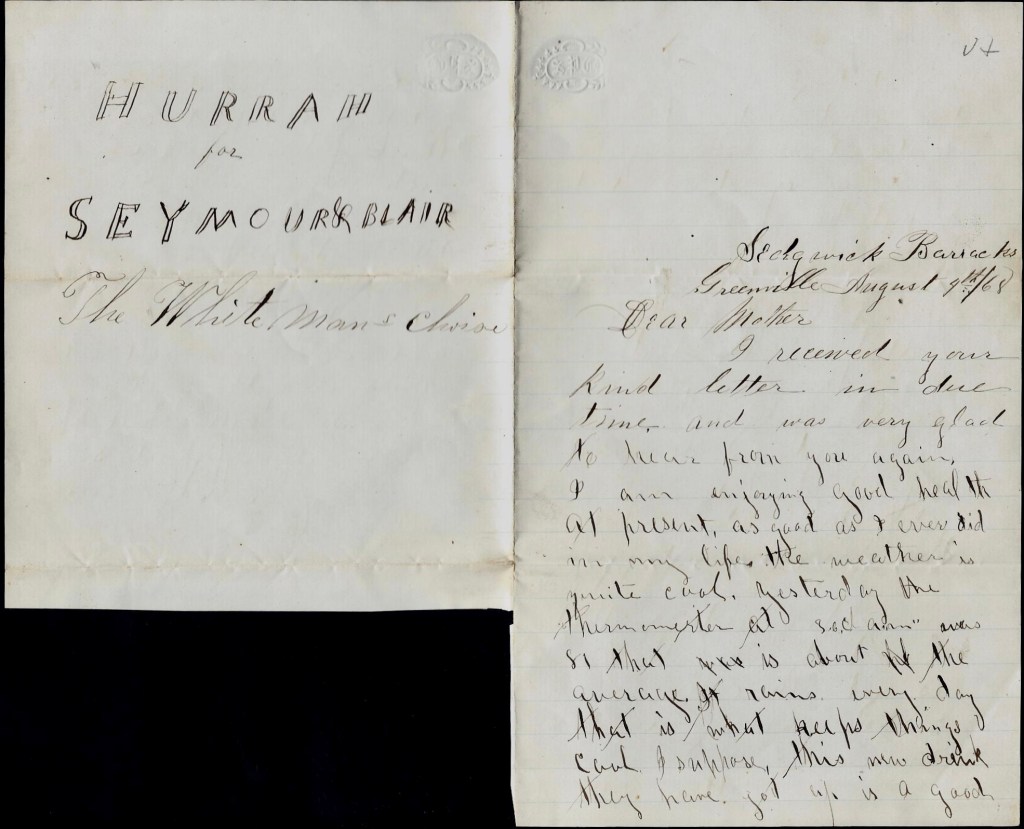
Sedgwick Barracks Greenville [Louisiana] August 4, 1868
Dear Mother,
I received your kind letter in due time and was very glad to hear from you again. I am enjoying good health at present—as good as I ever did in my life. The weather is quite cool. Yesterday the thermometer at 3 o’clock a.m. was 81. That is about the average. It rains every day and that is what keeps it cool I suppose.
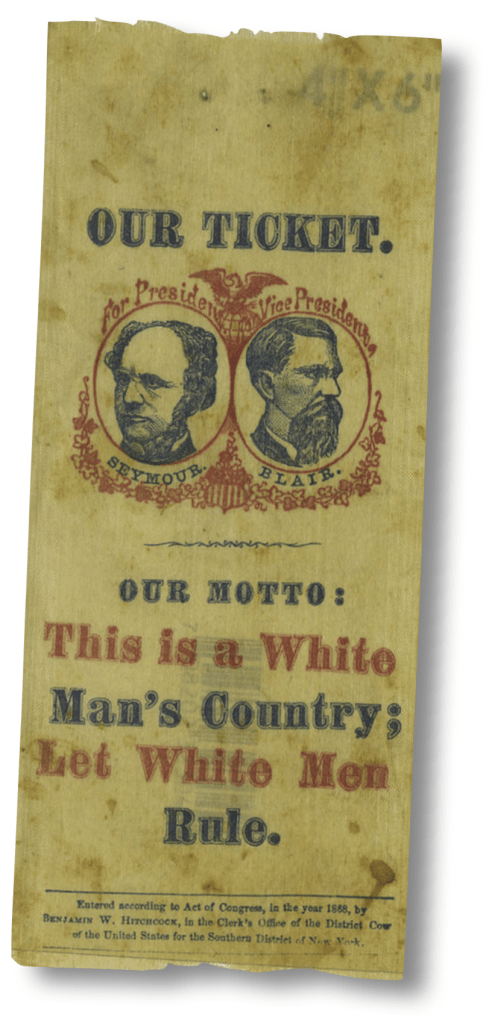
A Democratic Party Campaign Ribbon from the Presidential Election of 1868
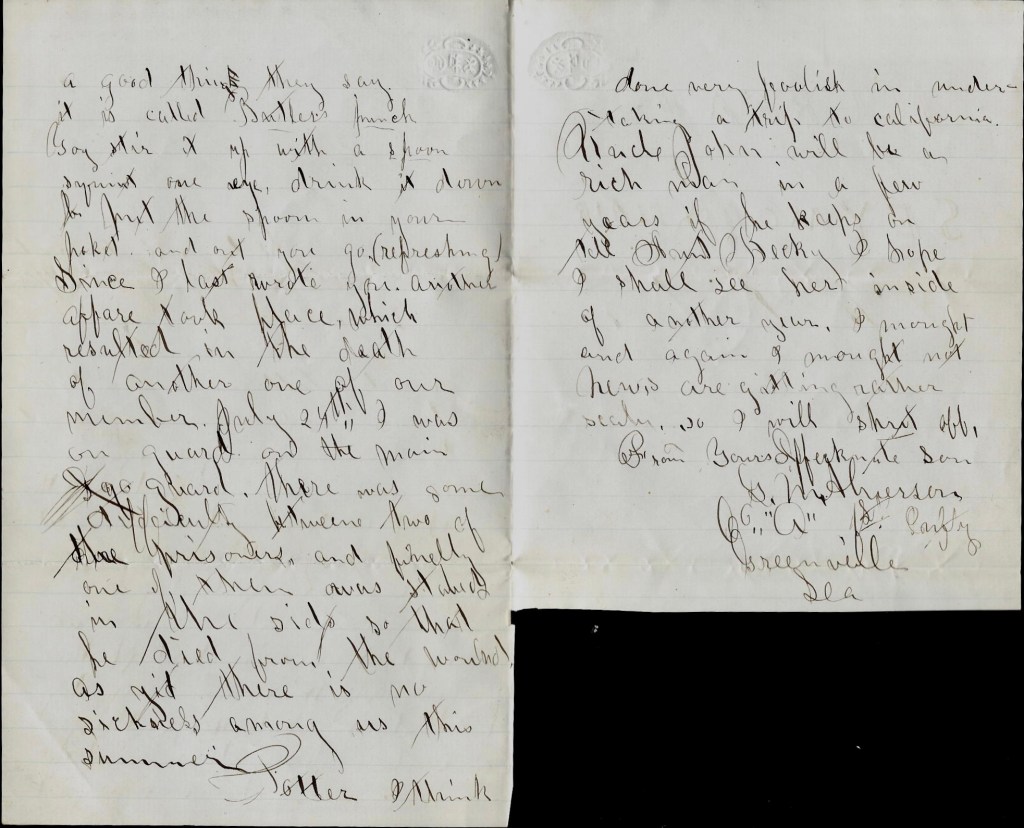
This new drink they have got up is a good thing they say. It is called “Butler’s Punch.” You stir it up with a spoon, squint one eye, drink it down, put the spoon in your pocket, and you go. Refreshing! 1
Since I wrote you, another affair took place which resulted in the death of another one of our number. July 24th I was on guard. On the main guard there was some difficulty between two of the prisoners and finally one of them was stabbed in the side so that he died from the wound. As yet there is no sickness among us this summer.
Potter, I think, done very foolish in undertaking a trip to California. Uncle John will be a rich man in a few years if he keeps on. Tell Aunt Becky I hope I shall see her inside of another year….
From your affectionate son, — G. M. Alverson
Co. A, 1st Infantry, Greenville, La.
Hurrah for Seymour & Blair—the White Man’s Choice!
1 More likely a popular New Orleans joke than a new drink. Those familiar with the cross-eyed “Spoons” Butler will appreciate the humor. Others will not.








 Spared & Shared 23