Category Archives: President James K. Polk

1844: James McMullin to Michael Engelbrecht

The following 1844 letter was written by James McMullin (1810-Aft1853)—a wood corder and local politician of Philadelphia, Pennsylvania. He wrote the letter to his sister Rebecca (McMullin) Engelbrecht (1802-1847) and her husband Michael Engelbrecht (1792-1886) in Frederick, Maryland. Rebecca and Michael were married in Philadelphia in August 1838.
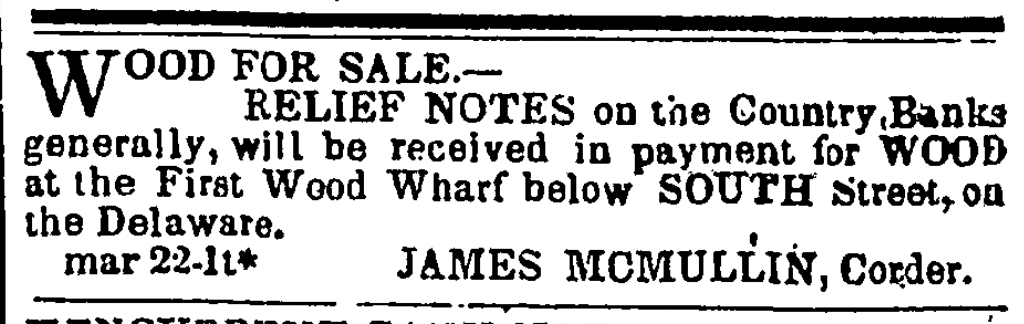
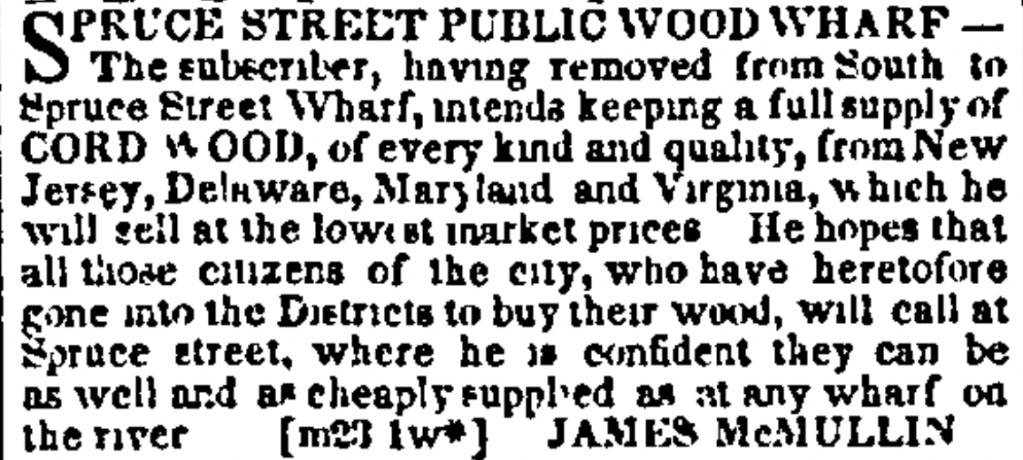
James’ advertisement for the sale of cordwood, The Daily Chronicle, 22 March 1842
James’ advertisement in the Public Ledger, 29 March 1844

This letter was written during the “Native American” Movement of 1844 which culminated in riots in Philadelphia. Those born in American, who referred to themselves as “Nativists” were generally opposed to foreign emigration, particular the Irish Catholics.

Transcription

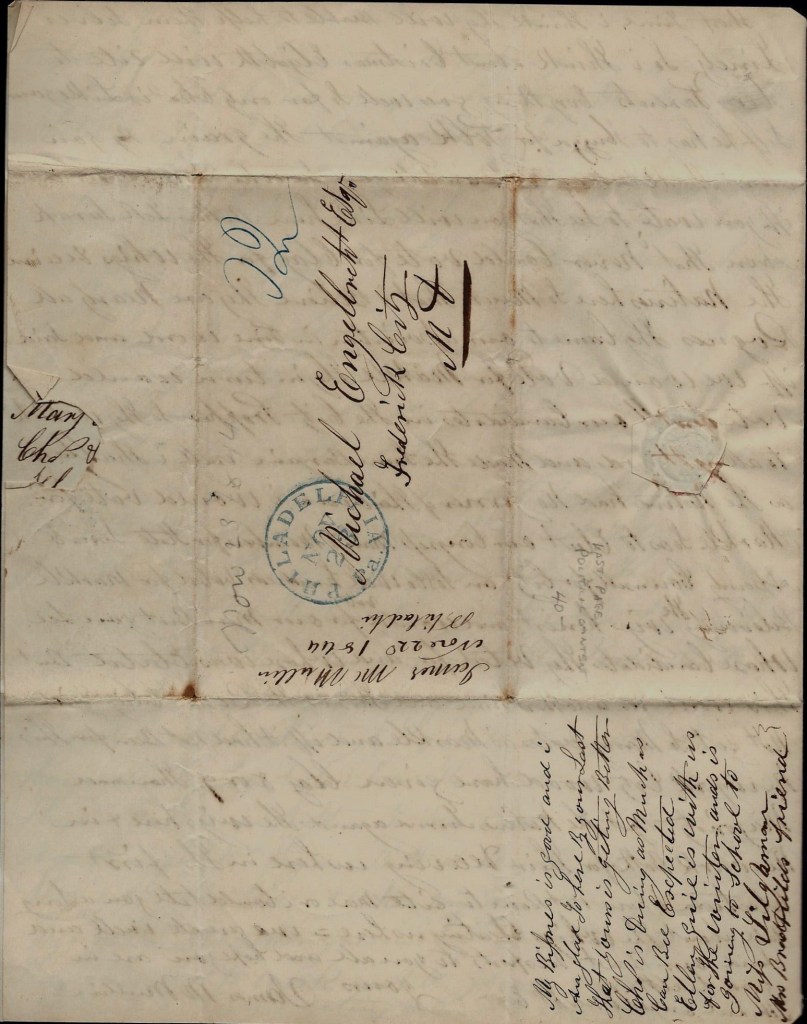
Stampless cover addressed to Michael Engelbrecht, Frederick City, Maryland
Postmarked Philadelphia, PA

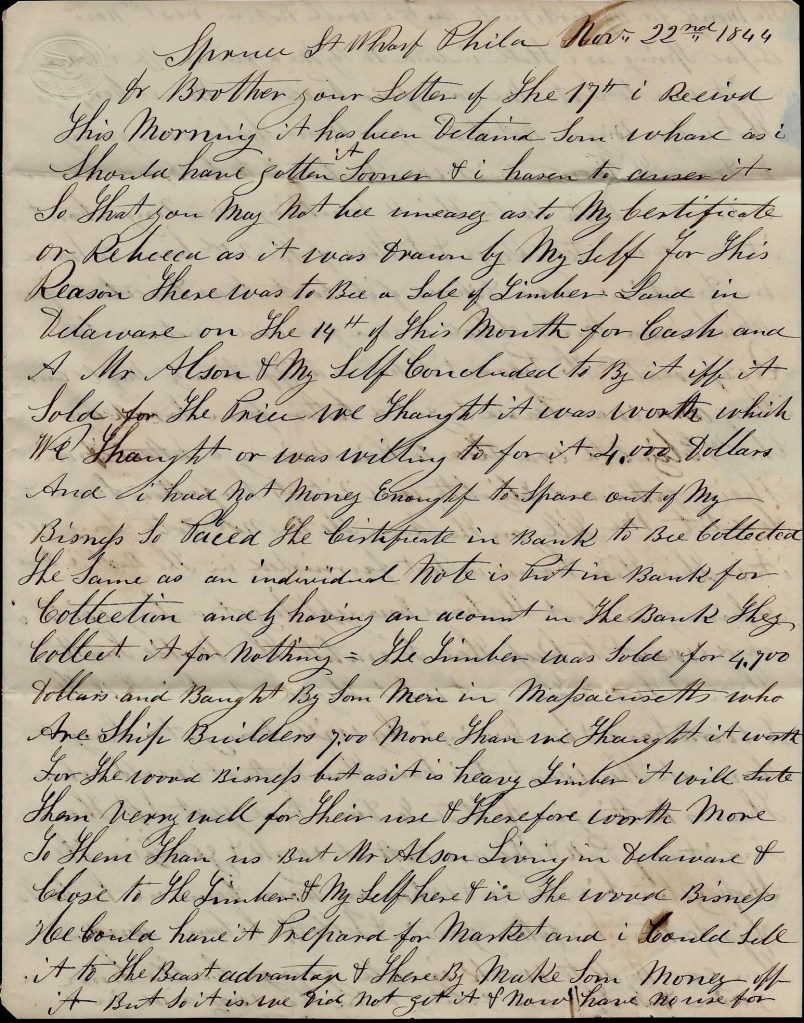
Spruce Street Wharf
Philadelphia, Pennsylvania
November 22nd 1844

Dear Brother,

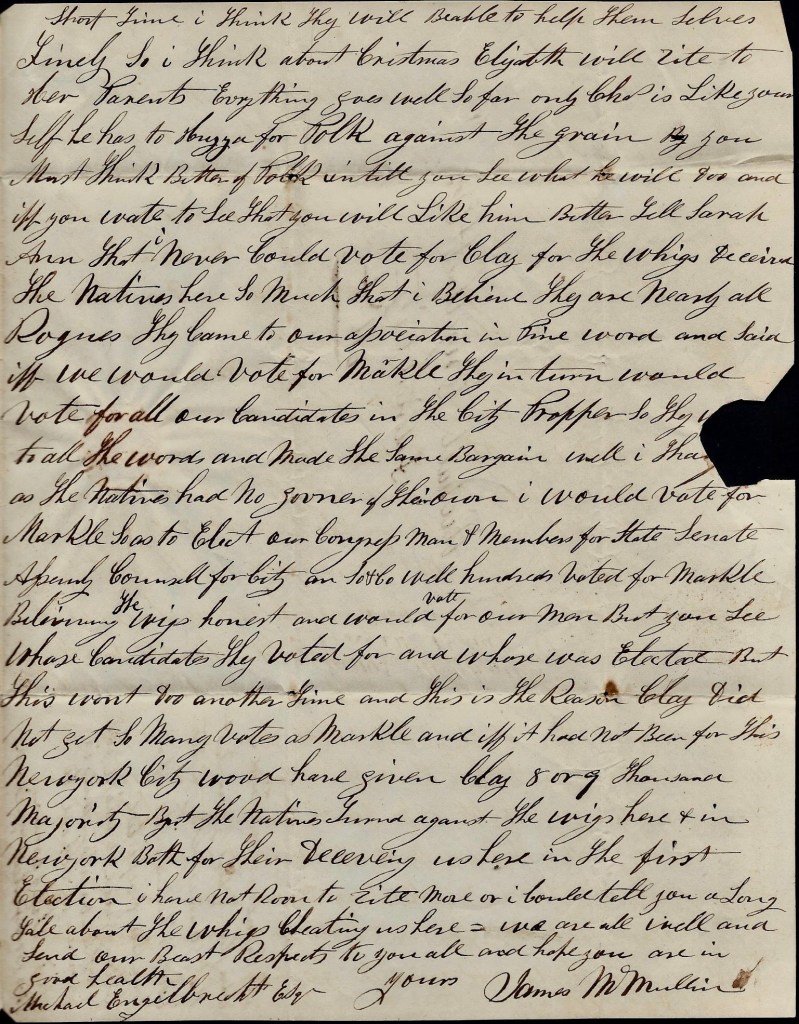
Your letter of the 17th I received this morning. It has been detained somewhere as I should have gotten it sooner & I have to answer it so that you may not be uneasy as to my Certificate or Rebecca as it was drawn by myself for this reason. There was to be a sale of timber land in Delaware on the 14th of this month for cash and a Mr. Alson & myself concluded to buy it if it sold for the price we thought it was worth which we thought, or was willing to [pay] for it 4000 dollars. And I had not money enough to spare out of my business so asked for the Certificate in Bank to be collected, the same that an individual Note is put in bank for collection, and I having an account in the bank, they collect it for nothing. The timber was sold for $4,700 dollars and bought by some men in Massachusetts who are ship builders—700 more than we thought it worth for the wood business, but as it is heavy timber, it will suit them very well for their use & therefore worth more to them than us.

But Mr. Alson, living in Delaware and close to the timber & myself here & in the wood business, he could have it prepared for market and I could sell it to the best advantage & thereby make some money off it. But so it is, we did not get it and now I have no use for the money for my Certificate, but I will not invest it now before spring as I still intend to buy me a farm if I can get one to suit me for a fair price. I must confess that I done wrong in not telling you that I was going to draw the money as it was natural to suppose you or Rebecca or both might think something was wrong about it. Your package and letter of the 3rd came to hand in due time and I disposed of its contents as directed for which I am much obliged to you for I intend to reciprocate the present so soon as an opportunity may occur. Mary Ann was pleased to get a letter from Sarah Ann. Charles & Elizabeth was pleased to their receiving a letter from their father and Elizabeth will write to her father soon. And here let me tell you the reason she has not wrote long ago. It is this. Their house is not furnished in the best, I do assure you, but they have enough to get along with and I want to keep them so until they make something themselves & then get what they want. So I tell them to work hard and be saving & they will soon get along & have all they want. So I have them both at work when there is nothing in the store to do. I have just left there and it is 7 p.m. and they are both at work & George is in the shop getting his lesson & when any person comes in, he calls his father, goes in and sells if he can. Then goes back to work until George calls him again & so they are getting along in this way and in a short time I think they will be able to help themselves finely. So I think about Christmas Elizabeth will write to her parents.

James’ name appears among those accused of being foreigners and Catholics, which he was not. “Nativists” at the time meant, those born in America. The Pennsylvanian, 11 October 1853

Everything goes well so far—only Charles is like yourself, he has to Huzza for Polk against the grain. You must think better of Polk until you see what he will do and if you wait to see that, you will like him better. Tell Sarah Ann that I never could vote for Clay for the Whigs deceived the Natives here so much that I believe they are nearly all rogues. They came to our association in Pine Wood and said if we would vote for Markle, they in turn would vote for all our candidates in the city proper. So they went to all the wards and made the same bargain. Well, I thought as the Natives had no Governor of their own, I would vote for Markle so as to elect our Congressman & members for State Senate Assembly Council for City and &c. Well hundreds voted for Markle believing the Whigs honest and would vote for our man but you see whose candidates they voted for and whose was elected. But this won’t do another time and this is the reason Clay did not get so many votes as Markle and if I had not been for this New York City, would have given Clay 8 or 9 thousand majority. But the Natives turned against the Whigs here and in New York both for their deceiving us here in the first election.

I have not room to write more or I could tell you a long tale about the Whigs cheating us here. We are all well and send our best respects to you all and hope you are in good health. Yours, — James McMullin

To Michael Englebrecht, Esq.
1849: John Wiley Gulick to John Taylor Coit

This letter was written by John “Wiley” Gulick (1829-1898), the son of John V. and Margaret Young (Wiley) Gulick. Wiley was residing with his father in Fayetteville, Cumberland county, North Carolina when he penned this letter in January 1849 (he erroneously datelined it 1848) during the height of Polk’s popularity as President and nearly a year after the close of the War with Mexico. He was married in 1858 to Margaret Jane Sutherland (1835-1879) and moved to Washington county, Texas, where he made a living as a physician. During the Civil War, he served as surgeon of the 18th Texas Infantry, reporting to General Bragg.

Gulick wrote the letter to his friend, John Taylor Coit (1829-1872), the son of John Caulkis and Ann Maria (Campbell) Coit of Cheraw, Chesterfield county, South Carolina. Coit graduated from Princeton University in 1850 and returned to Cheraw where he practiced law. In 1858 he married Catherine Malloy Bunting and relocated to a 320 acre farm straddling Dallas and Collin counties in Texas. During the Civil War, Coit raised a company of cavalry and he became captain of Co. E, 18th Texas Cavalry, later Lt. Col. of the regiment. He was take prisoner with the surrender at Arkansas post in January 1863 and after he was exchanged and returned to his regiment, he was wounded at the Battle of Chickamauga which ended his career as a field officer.

[Note: This letter is from the personal collection of Richard Weiner and is published on Spared & Shared by express consent.]

Transcription

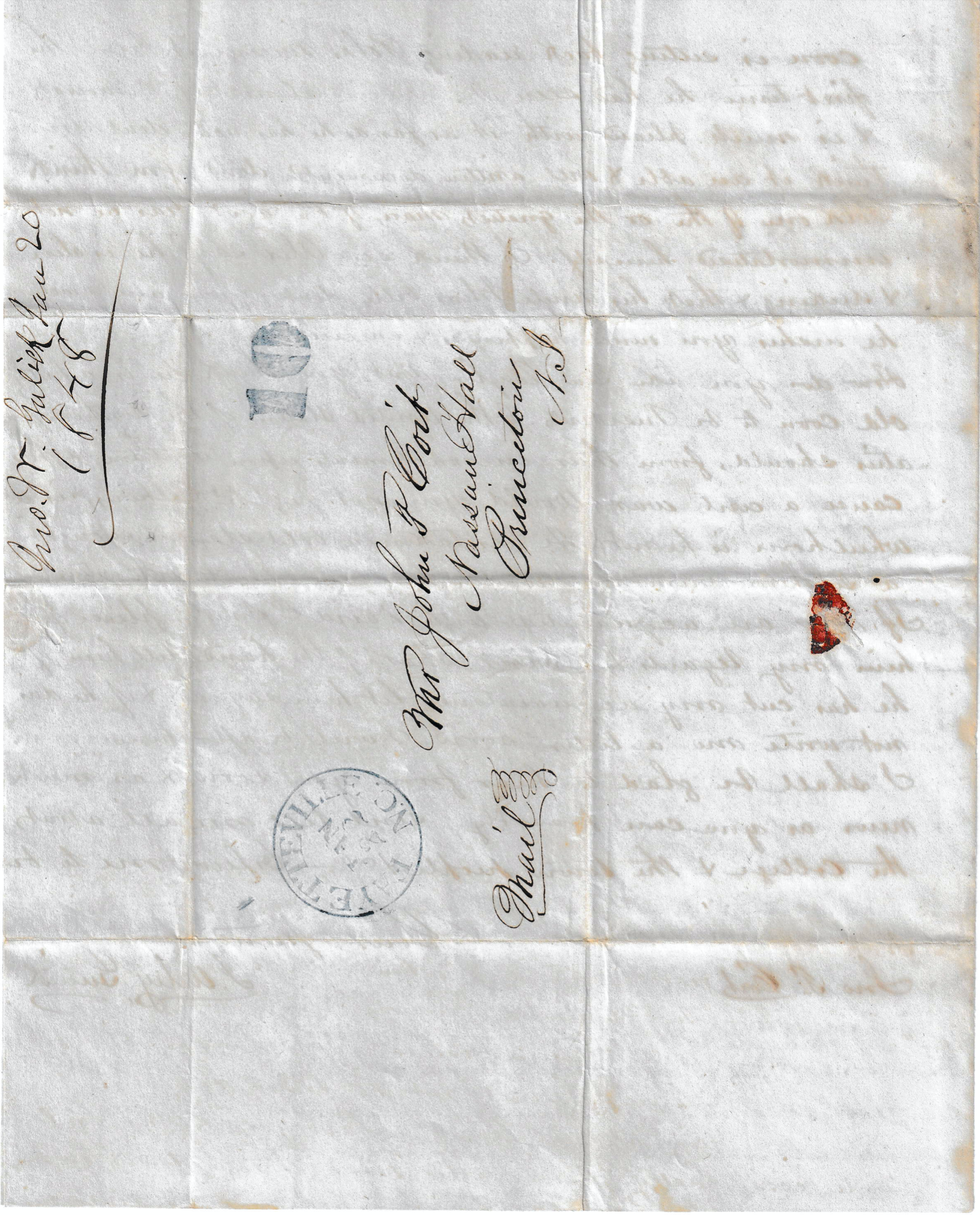
Fayetteville, North Carolina
January 20, 1848 [should be 1849]

Dear Friend,

You may be a little surprised on receiving this epistle from me, but when you consider the intimacy that has subsisted between us for some time, you may take it as a natural consequence. I hope that our intimacy may not be broken by miles but that we may at least think enough of each other as to write occasionally. Your father passed through town on his return from the North. He stayed a short time. I called on him at Mr. McIver’s. He said you had gone to P[rinceton]. Before then I had not heard & that he would like me to write you. So according to promise, as well as inclination, I will make the effort. Hoping that you will have patience in reading until you get through with the above exordium, I will proceed.

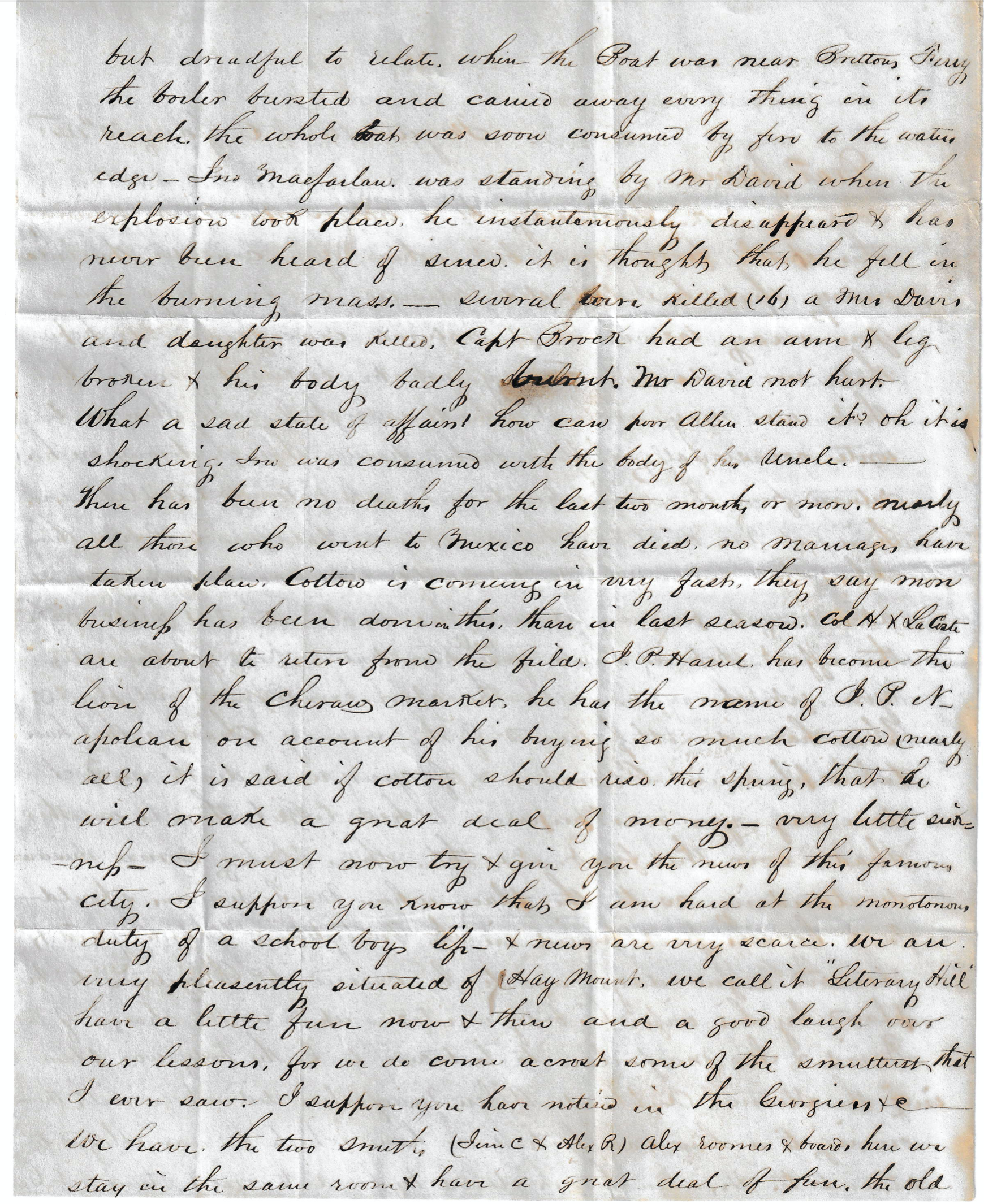
You have doubtless heard of the many changes that have taken place in Cheraw & of your uncle’s death. Such, I dare say, you was prepared to hear. But there is another shade over the first. It is this. There being some misunderstanding as to the place where Mr. [John] Taylor’s remains should rest. He was first buried in the Presbyterian Church yard & removed a few days ago to be carried to Georgetown to be placed by his wife [in the Episcopal Church yard]. His body was taken up & in the charge of [John Taylor’s nephews] Mr. David & John McFarlan to be taken to Georgetown. The body was placed in the steamer Richland. Allen McFarlan did not go with them owing to a law case he had on hand which he was obliged to attend to. He, when through, started by land to meet them at Georgetown, but dreadful to relate, when the boat was [descending the Pee dee River] near Britton’s Ferry, the boiler bursted and carried away everything in its reach. The whole was soon consumed by fire to the waters edge. 1

John McFarlan was standing by Mr. David when the explosion took place. He instantaneously disappeared and has never been heard of since. It is thought that he fell in the burning mass. Several were killed (16). A Mrs. [Henry] Davis and daughter [niece] was killed. Capt. Brock had an arm & leg broken and his body badly burnt. Mr. David not hurt. What a sad state of affairs! How can poor Allen stand it? Oh! it is shocking. John was consumed and the body of his uncle.

There has been no deaths for the last two months or more. Nearly all those who went to Mexico have died. No marriages have taken place. Cotton is coming in very fast. They say more business has been done in this than in last season. Col. H. & LaCoste are about to return from the field. James Presley Harrall has become the lion of the Cheraw market. He has the name of J. P. Napoleon on account of his buying so much cotton (nearly all). It is said if cotton shall rise this spring, that he will make a great deal of money. Very little sickness.

I must now try and give you the news of this famous city. I suppose you know that I am hard at the monotonous duty of a school boy’s life & news are very scarce. We are very pleasantly situated on Hay Mount—we call it “Literary Hill.” Have a little fun now and then and a good laugh over our lessons, for we do come across some of the smuttiest that I ever saw. I suppose you have noticed in the Georgian &c. we have the two Smiths (Jim C. and Alex R.) Alex rooms and boards here. We stay in the same room & have a great deal of fun. The old coon is sitting back reading Polk’s Message—it being the first time he had seen it. 2 He is almost a Democrat & is much pleased with it as far as he has read. Don’t you think it an able & well written document? Don’t you think Polk one of the, or the greatest man of the age? Has he not immortalized himself? I think so.

Alex says he is alive and kicking and that his Uncle John’s Billy don’t grow any smaller. He wishes you much happiness and success, &c.

How do you like General Taylor? Don’t you think he is a pretty Old Coon to be President of the United States? If the northern fanatics should, from their encroachments upon southern rights, cause a civil war, would you not fight? Calhoun is a wheelhorse, is he not? He has taken a bold stand & so ought a southern members. I watch his movements with interest. If you are acquainted with David E. Smith, please give him my regards & kindest shake of the hand. Tell him if he has cut my acquaintance, let him say so & if he does not write me a letter soon, I will be after him.

I shall be glad to hear from you soon & as much news as you can possibly sed. Tell me all about the college & the town people, &c. &c. Believe me to be your friend, — J. Wiley Gulick

To; John T. Coit

1 Lawsuit testimony taken long after the incident revealed that the Richland “left Cheraw for Charleston, taking in Cotton at the landings along the river. On Sunday morning, January 12, 1849, the steamer stopped about two hours at Woodberry’s landing to take in wood. Seven or eight miles below that place, at or near a bend in the river, while the boat was underway, the boiler burst. All the officers, and five or six deck hands, were killed or disabled. Some of the passengers were killed or blown overboard…The anchor was dropped by some person unknown, and the steamer lay about thirty yards from the shore. The boat took fire, which spread so rapidly as to prevent the rescue of several passengers who were not injured by the explosion. All the cotton [1,000 bales] aboard was burnt or destroyed. All the witnesses concurred that, after the explosion, by no efforts of the surviving crew could the cotton have been saved.”

2 Wiley is referring to Polk’s 4th Annual Message to Congress (equivalent to today’s State of the Union Address) which was published in the newspaper in early December 1848. In his message, Polk wrote: “In reviewing the great events of the past year and contrasting the agitated and disturbed state of other countries with our own tranquil and happy condition, we may congratulate ourselves that we are the most favored people on the face of the earth. While the people of other countries are struggling to establish free institutions, under which man may govern himself, we are in the actual enjoyment of them–a rich inheritance from our fathers. While enlightened nations of Europe are convulsed and distracted by civil war or intestine strife, we settle all our political controversies by the peaceful exercise of the rights of freemen at the ballot box.”