The following letter was written by Joseph Horace Eaton (1815-1896) who served as aiide-de-camp and military secretary to Ma. Gen. John C. Frémont in 1861. He was later stationed in Washington D. C. where he was assistant U. S. Paymaster. He wrote the letter to Sterling Price (1809-1867), the former congressman and Missouri Governor, who commanded the Confederate militia in Missouri in 1861.
The substance of this brief missive pertains to the exchange of prisoners. The Union officer held by Price’s Missouri Militia was Thomas A. Marshall, a graduate of the Transylvania University law school, and a practicing attorney soon after in Vicksburg, Mississippi. Two years later, Marshall moved to Coles County, Illinois, where he continued to practice law, and by 1841, he lived in the county seat of Charleston. As early as 1846, Marshall began a law partnership with Usher F. Linder. In 1853, Marshall became the cashier of a bank in Charleston, and he remained in the banking profession through 1860. He won election to the Illinois Senate, serving from 1858 to 1862. In 1861, he served as president pro tem of the Senate and as acting lieutenant governor. When the Civil War broke out, Marshall became colonel of the First Illinois Cavalry, serving from July 1861 until he mustered out in July 1862. [Source: Papers of Abraham Lincoln Digital Library] Col. Marshall was taken prisoner on 20 September 1861 when he and others in his command were surrendered at Lexington, Missouri, after a 52 hour siege. Most of the other officers in the command were not exchanged until December 1861.
The prisoner held by the Union army in St. Louis was Prince Lucien Hudgins (1810-1872)—a civilian lawyer and a Christian preacher from Savannah, Andrew county, Mo., who had been arrested for conspiring against the U.S. Government. (See the Pardon of Prince L. Hudgins)
T R A N S C R I P T I O N
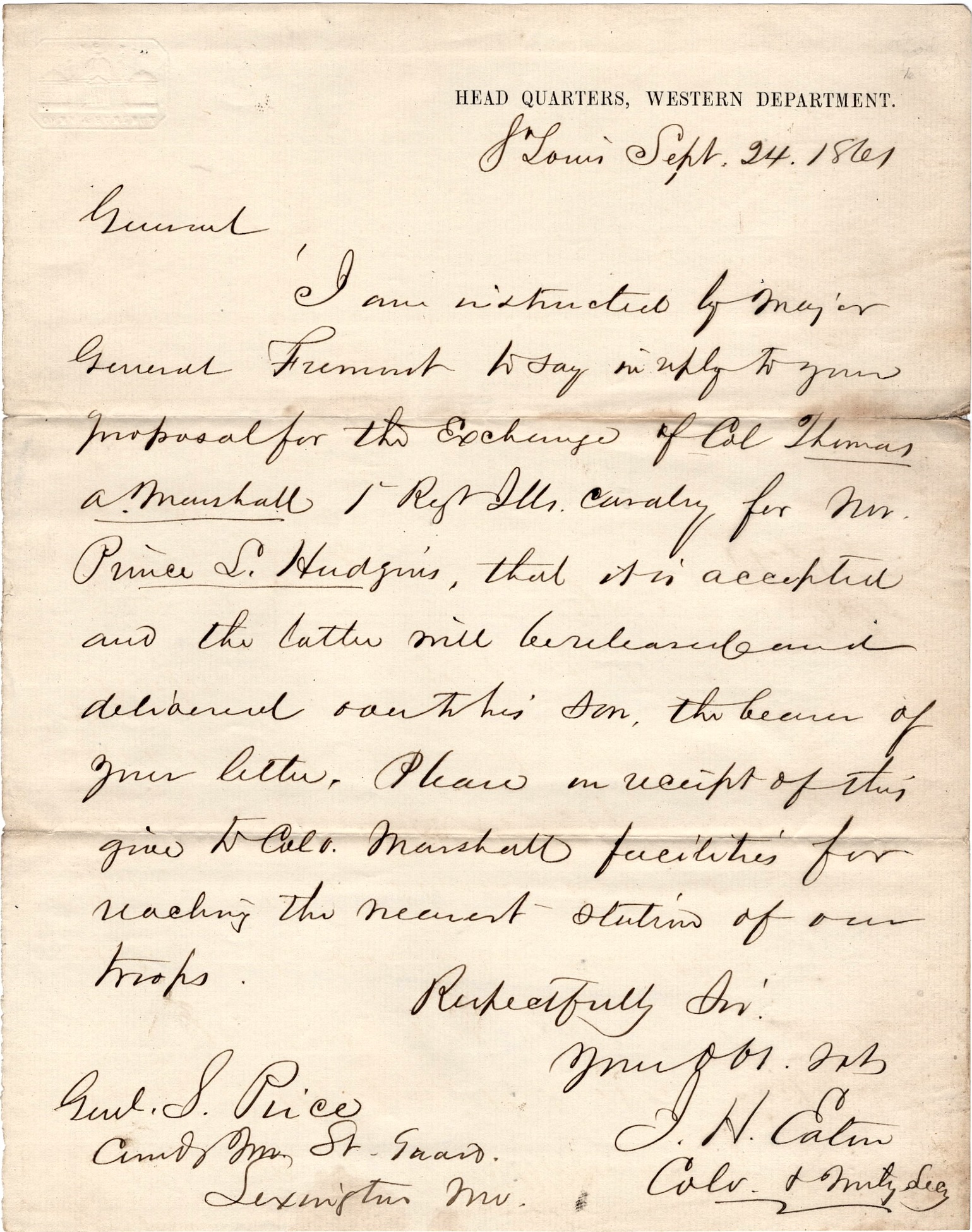
Headquarters, Western Department St. Louis [Missouri] September 24, 1861
General,
I am instructed by Major General Fremont to say in reply to your proposal for the exchange of Col. Thomas A Marshall, 1st Regt. Illinois Cavalry for Mr. Prince L. Hudgins, that it is accepted and the latter will be released and delivered over to his son, the bearer of your letter. Please on receipt of this, give to Col. Marshall facilities for reaching the nearest station of our troops. Respectfully Sir, your obedient servant, — J. H. Eaton, Col. & Military Secretary
[to] General S. Price, commanding Mo. State Guard, Lexington, Mo.
I have not been able to confirm an identity for the author of this letter who we learn was detailed away from his regiment as a clerk in the Quartermaster Department of the 2nd Brigade, 1st Division of the 25th Army Corps—a corps that was composed entirely of Black troops. He speaks of having a couple of close calls in avoiding capture while serving with his regiment and my hunch is that he was from the Army of the James under Butler’s command and was probably present in the Battle of Fair Oaks & Darbytown Road in late October 1864. There was a Black solder in the 26th USCT from New York State who would have been in the 25th Army Corps but the pay scales seem to rule out his being the author. The author mentions two towns—Bloomingdale and Keeseville—which are in Essex county so my presumption is that he came from that county but I have not found him in census records.
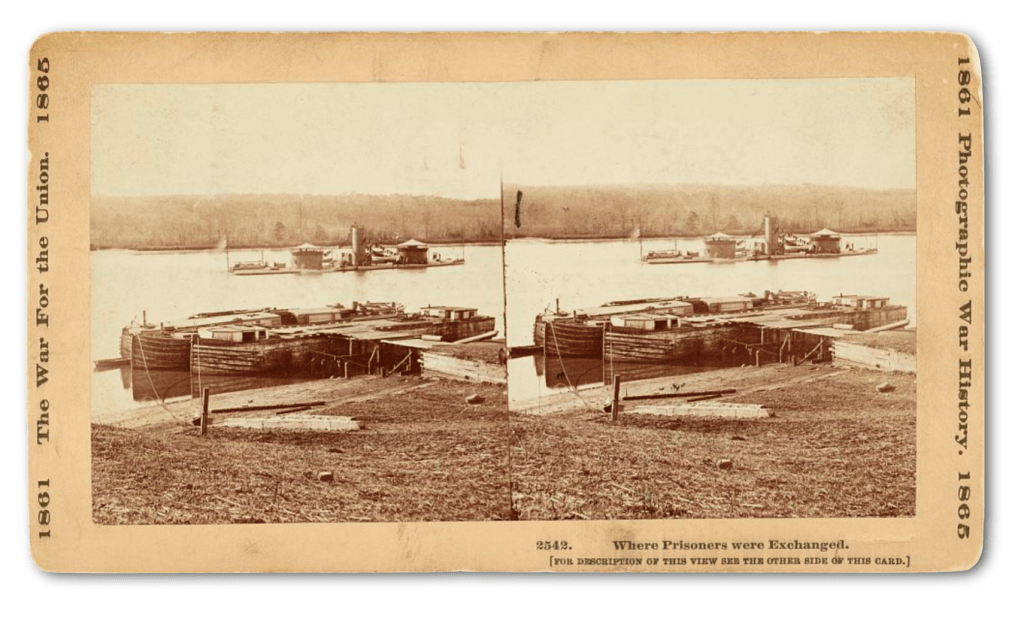
In any event, his letter provides us with a great description of a prisoner exchange that took place at Jones Landing on the James River. The date of the exchange is not given but it appears to have taken place on the same day that Union Batteries surrounding Petersburg fired a celebratory salute at the news of the surrender of Charleston which occurred on 18 February 1865.
Transcription
Quartermaster Dept., 2nd Brigade, 1st Division, 25th Army Corps February 20th 1865
My best loved ones at home,
I have once more been made glad by reading another very kind and welcome letter from my own dear home. Oh how precious those letters are coming from home & written by those that we love best on earth for who can we love more than wife, mother and children. If anyone knows of the sweet pleasure of home & home comforts & feels the need of them, it is the poor lonely soldier away from all he holds dear on earth. All the comforts that they have is the pleasure of hearing from his friends & in using his pen as a medium between himself and his friends—at least I have found it so in my own case. How little our friends at home surrounded by all the comforts of home know of the duties they owe the soldiers in the field in doing what little they can to beguile the tedious monotony of camp life.
Well, I was very glad to hear from you and to learn that you were as well as you are and doing well. May God prosper you all and also myself & keep us all safe to meet once more. So you think I meant to stay here after my present term is expired? Well things have gone so far now that I could not give it up without making myself appear ridiculous and offering an insult to those that have interested themselves in my behalf & have recommended me, but I had rather do that than to do any such thing contrary to your wishes if you have considered it cooly and candidly and made up your mind.
Evening & here I be. Well, there is no news of any importance. There is nothing going on here. It is the same old thing over & over but I expect it won’t be long before the spring campaign will open & then look out for breakers. I expect when that takes place that I will be sent to the regiment again. That was one reason that made me think of going into one of these regiments for I thought that if I had to be in the ranks at the front, that I might as well be drawing $105 per month as $15. But I see you are so very bitterly opposed to it that perhaps I had better give it up although I have gone too far now to retreat with honor. But perhaps it will be better so.
I saw Frank a few days ago. He came down and stayed all day with me. He is well & tough. He thinks we have a great time here and so we do. One of our number has left us and gone over the river along with the commissary that has been here but has been promoted to Division Commissary. That leaves now but three & we have some gay old times you had better believe. Oh dear, I don’t feel very much like writing tonight. I feel very downhearted. I think I will close for tonight. Good night. Pleasant dreams to you.
I have been away all day and when I got home I found another letter from home which I will have to answer in this, I was very glad to learn that you could enjoy yourself as well as you do on the sleigh rides, oyster suppers, &c. I should think you might get along without me you seem to fare very well without me as far as beaux are concerned so that I might as well stay here as not.
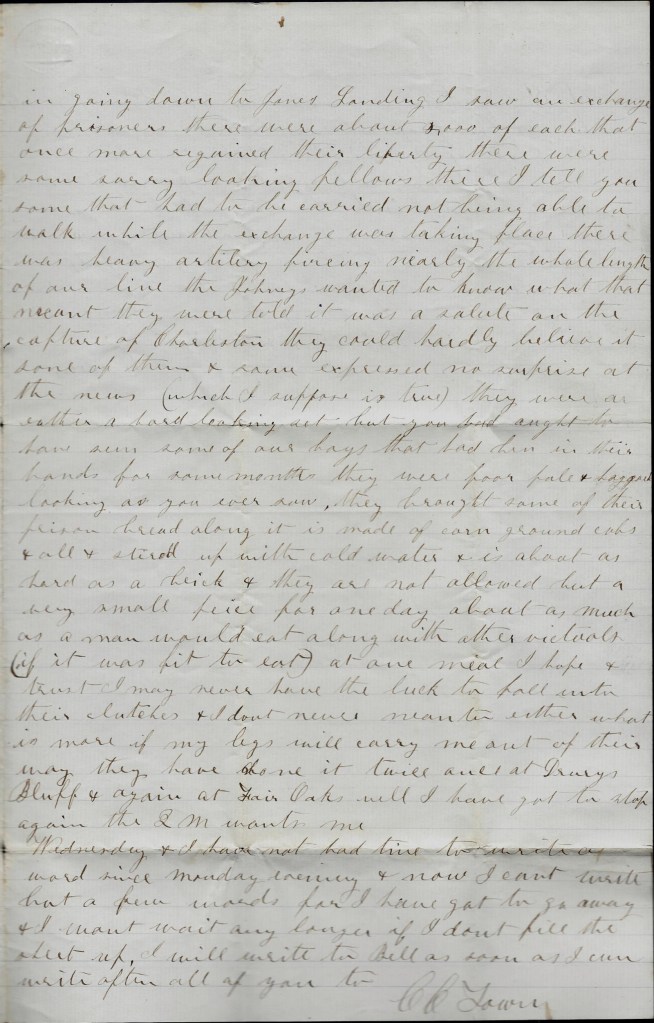
In going down to Jones Landing I saw an exchange of prisoners. There were about 2,000 of each that once more regained their liberty. There were some sorry-looking fellows there, I tell you—-some that had to be carried, not being able to walk. While the exchange was taking place, there was heavy artillery firing nearly the whole length of our line. The Johnnies wanted to know what that meant. They were told it was a salute on the capture of Charleston. They could hardly believe it some of them, and some expressed no surprise at the news (which I suppose is true). They were a rather hard-looking set but you had ought to have seen some of our boys that has been in their hands for some months. They were poor, pale, and haggard-looking as you ever saw. They brought some of their prison bread along. It is made of corn ground, cobs and all, and stirred up with cold water and is about as hard as a brick and they are not allowed but a very small piece for one day—about as much as a man would eat along with other victuals (if it was fit to eat) at one meal.
I hope and trust I may never have the luck to fall into their clutches & I don’t never mean to either. What is more, if my legs will carry me out of their way, they have done it twice—once at Drury’s Bluff and again at Fair Oaks. Well, I have got to stop again. The quartermaster wants me.
Wednesday and I have not had time to write a word since Monday evening & now I can’t write but a few words for I have got to go away & I won’t wait any longer. If I don’t fill the sheet up, I will write to Bill as soon as I can. Write often all of you to — C. C. Lowry
P. S. If there is any chance at Bloomingdale to get photographs taken, I want you to take the best of my pictures that I have sent home and get half a dozen taken from it & send me. I should think the one I had taken when we were in Maryland was about as natural looking as any but use your own judgement. I want the one that looks the most as I did when at home last. If there is no chance, then send to Keeseville & oblige. — Charley




 Spared & Shared 23