Category Archives: Racial Equality

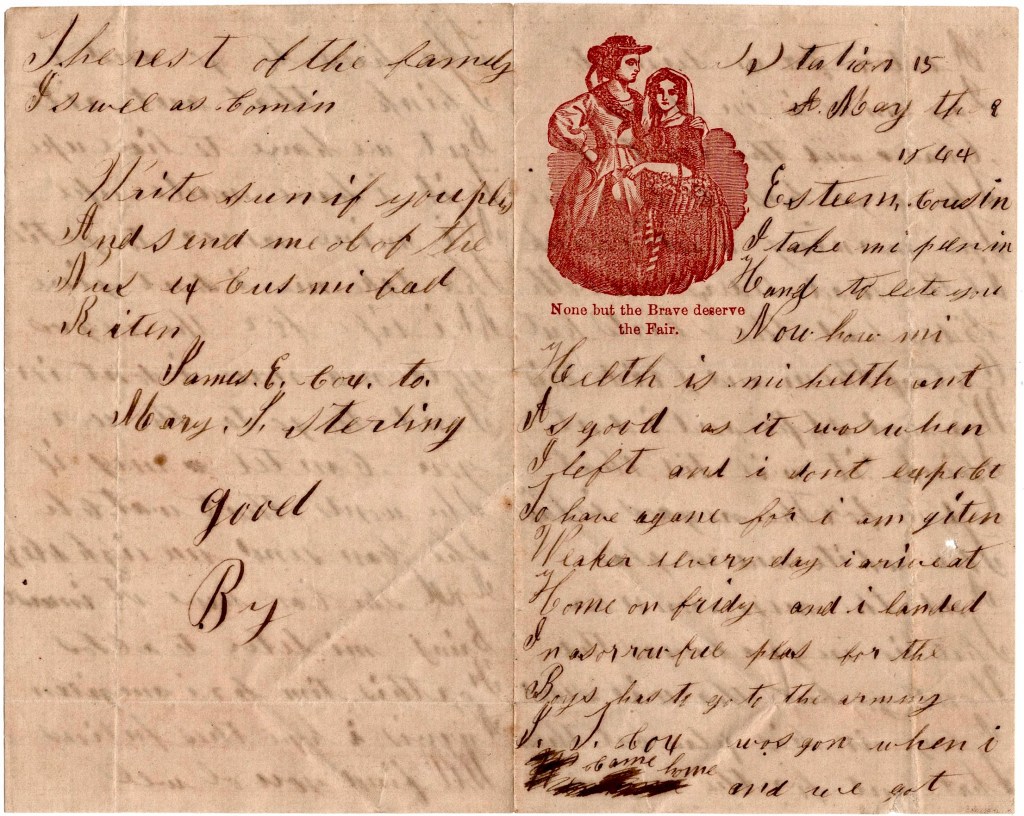
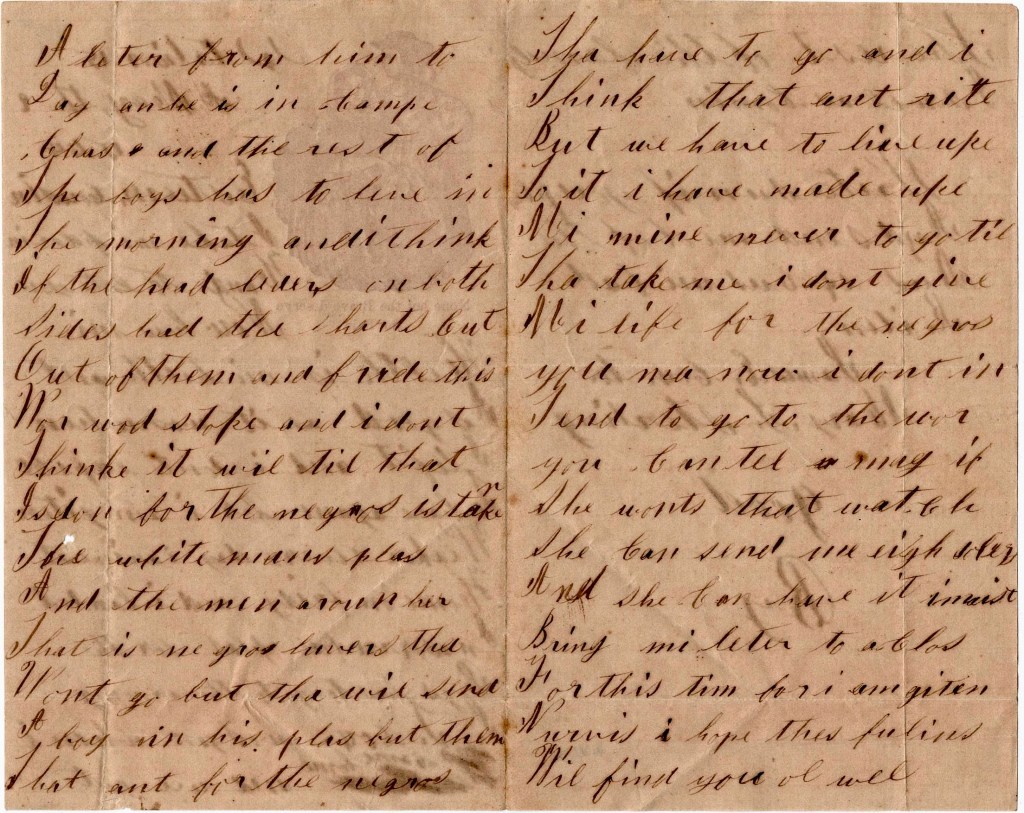
1864: James E. Cox to Mary J. Sterling

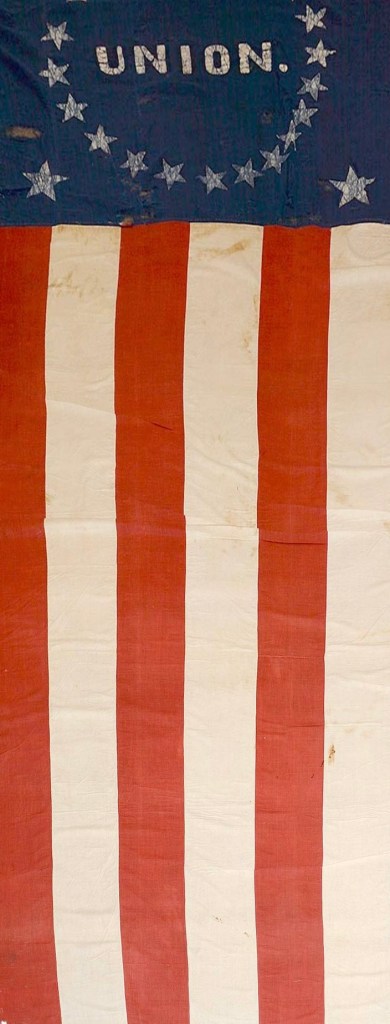
An Ohio Recruiting Flag from 1864

This letter was written by James E. Cox (b. 1843) whom I believe was the son of Amos H. Cox (b. 1813) and Mary Sterling (b. 1814) who were married in Tuscarawas county, Ohio in 1830. In the 1860’s the family lived in Franklin, Harrison county, Ohio.

During the Civil War, attitudes toward Black people in Harrison County, Ohio, were progressive for the time, largely shaped by the influence of abolitionist-leaning Quakers and Presbyterians. However, this local abolitionist sentiment existed within the context of Ohio’s statewide discriminatory “Black Laws,” which restricted the rights of African Americans. 

T R A N S C R I P T I O N

Station 15 [Harrison county, Ohio]
May 2, 1864

Esteemed cousin,

I take my pen in hand to let you know how my health is. My health ain’t as good as it was when I left and I don’t expect to have [it] again for I am getting weaker every day. I arrived at home on Friday and I landed in a sorrowful place for the Boys has to go to the army. J. T. Cox was gone when I came home and we got a letter from him today and he is in Camp Chase and the rest of the Boys has to leave in the morning. 1

I think if the head leaders on both sides had the hearts cut out of them and fried, this war would stop. And I don’t think it will till that is done for the negroes is taken the white man’s place. And the men around here that is negro lovers, they won’t go, but they will send a boy in his place. But them that ain’t for the negroes, they have to go, and I think that ain’t right. But we have to live up to it. I have made up my mind never to go till they take me. I don’t give my life for the negroes. You may know I don’t intend to go to the war.

You can tell Mag if she wants that watch, she can send me eight dollars and she can have it. I must bring my letter to a close for this time for I am getting nervous. I hope these feelings will find you all well. The rest of the family is well as common.

Write soon if you please and send me all of the news. Excuse my bad writing. — James E. Cox to Mary J. Sterling

Goodbye


1 Probably John T. Cox who served in the 162nd Ohio (National Guard). This regiment was mustered into service on 20 May 1864 at Camp Chase, Ohio.
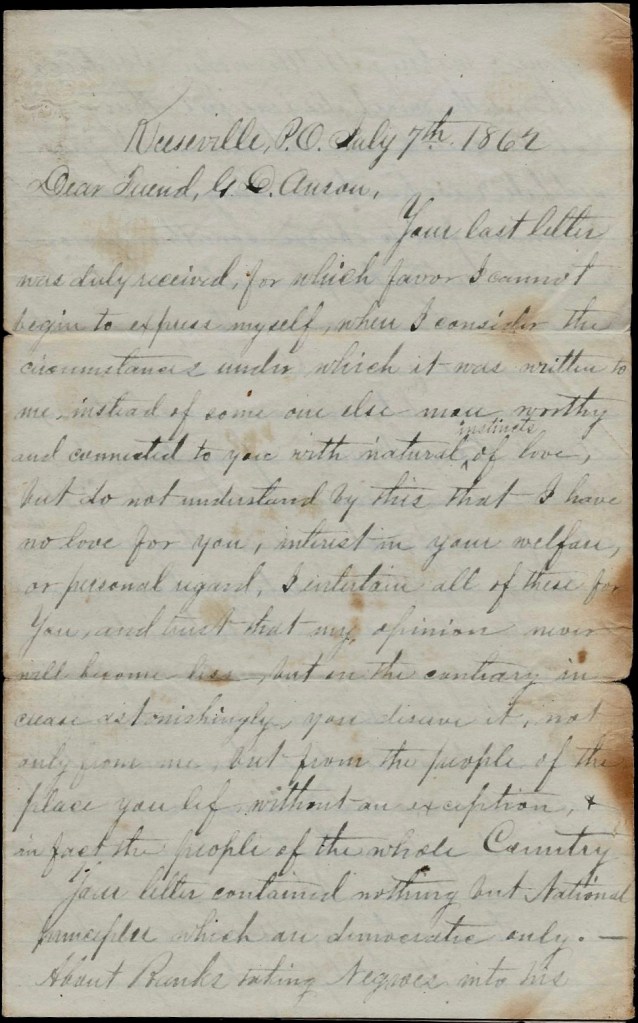
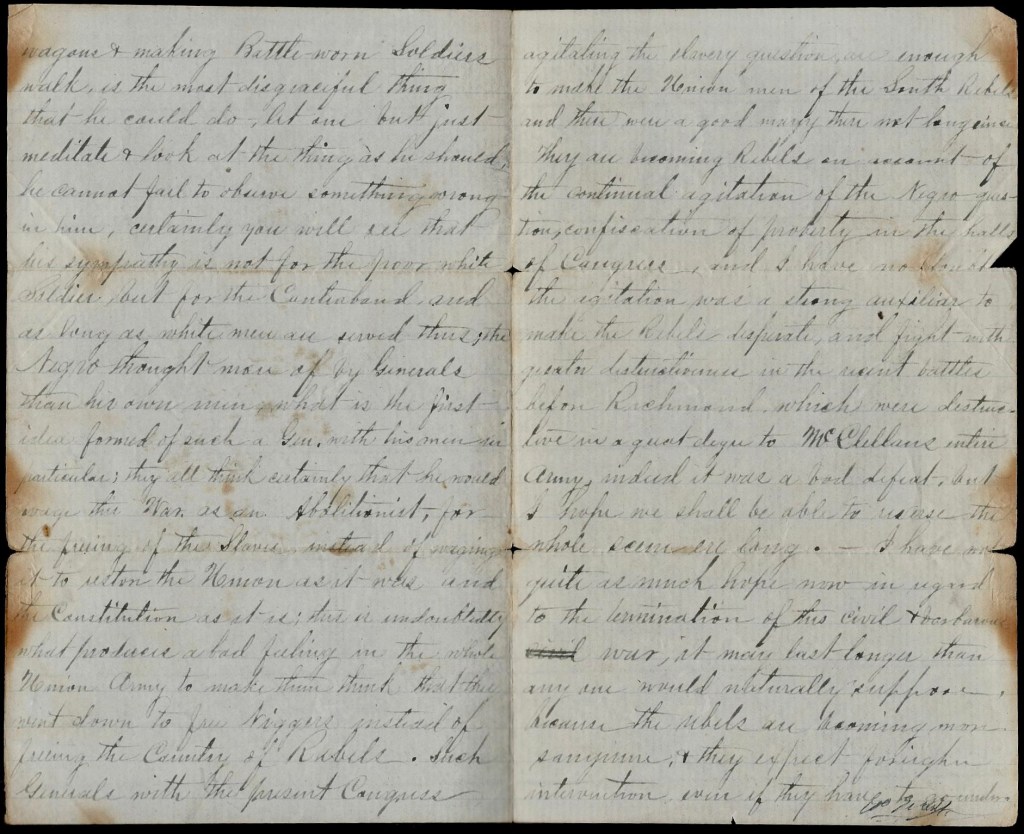
1862: Unidentified Author to George D. Anson

Unfortunately the author of this letter is lost to history but the content is worth preserving. The author captures a general sentiment held in the North that the Lincoln Administration was moving away from its original intent to preserve “the Union as it was and the Constitution as it is” to one in which slaves were to be liberated and made equals to the whites which many Federal soldiers and their families back home objected to.

The letter was addressed to George D. Anson who was a private in Co. A, 1st Vermont Cavalry from November 1861 to November 1864.

Transcription

Keeseville P. O. [Vermont]
July 7th 1862

Dear Friend G. D. Anson,

Your last letter was duly received for which favor I cannot begin to express myself when I consider the circumstances under which it was written to me, instead of someone else more worthy and connected to you with natural instincts of love, but do not understand by this that I have no love for you, interest in your welfare, or personal regard. I entertain all of these for you, and trust that my opinion never will become less, but in the contrary, increase astonishingly. You deserve it, not only from me but from the people of the place you left without an exception, & in fact the people of the whole country.

Your letter contained nothing but National principles which are democratic only. About Banks taking Negroes into his wagons and making battle-worn soldiers walk, is the most disgraceful thing that he could do, let one but just meditate & look at the thing as he should, he cannot fail to observe something wrong in him. Certainly you will see his sympathy is not for the poor white soldier but for the contraband and as long as white men are served thus, the Negro thought more of by Generals than his own men, what is the first idea formed of such a General with his men in particular. They all think certainly he would wage the war as an abolitionist for the freeing of the slaves instead of waging it to restore the Union as it was and the Constitution as it is. This is undoubtedly what produces a bad feeling in the whole Union army to make them think that they went down to free Niggers instead of freeing the country of rebels.

Such generals with the present Congress agitating the slavery question are enough to make the Union men of the South rebels and there were a good many there not long since. They are becoming rebels on account of the continual agitation of the Negro question, confiscation of property in the halls of Congress, and I have no doubt the agitation was a strong auxiliar to make the rebels desperate and fight with greater determination in the recent battles befre Richmond which were destructive in a great degree to McClellan’s entire army. Indeed, it was a bad defeat, but I hope we shall be able to reverse the whole scene ere long.

I have not quite as much hope now in regard to the termination of this civil & barbarous war. It may last longer than anyone would naturally suppose because the rebels are becoming more sanguine & they expect foreign intervention even if they have to go under… [rest of letter missing]