
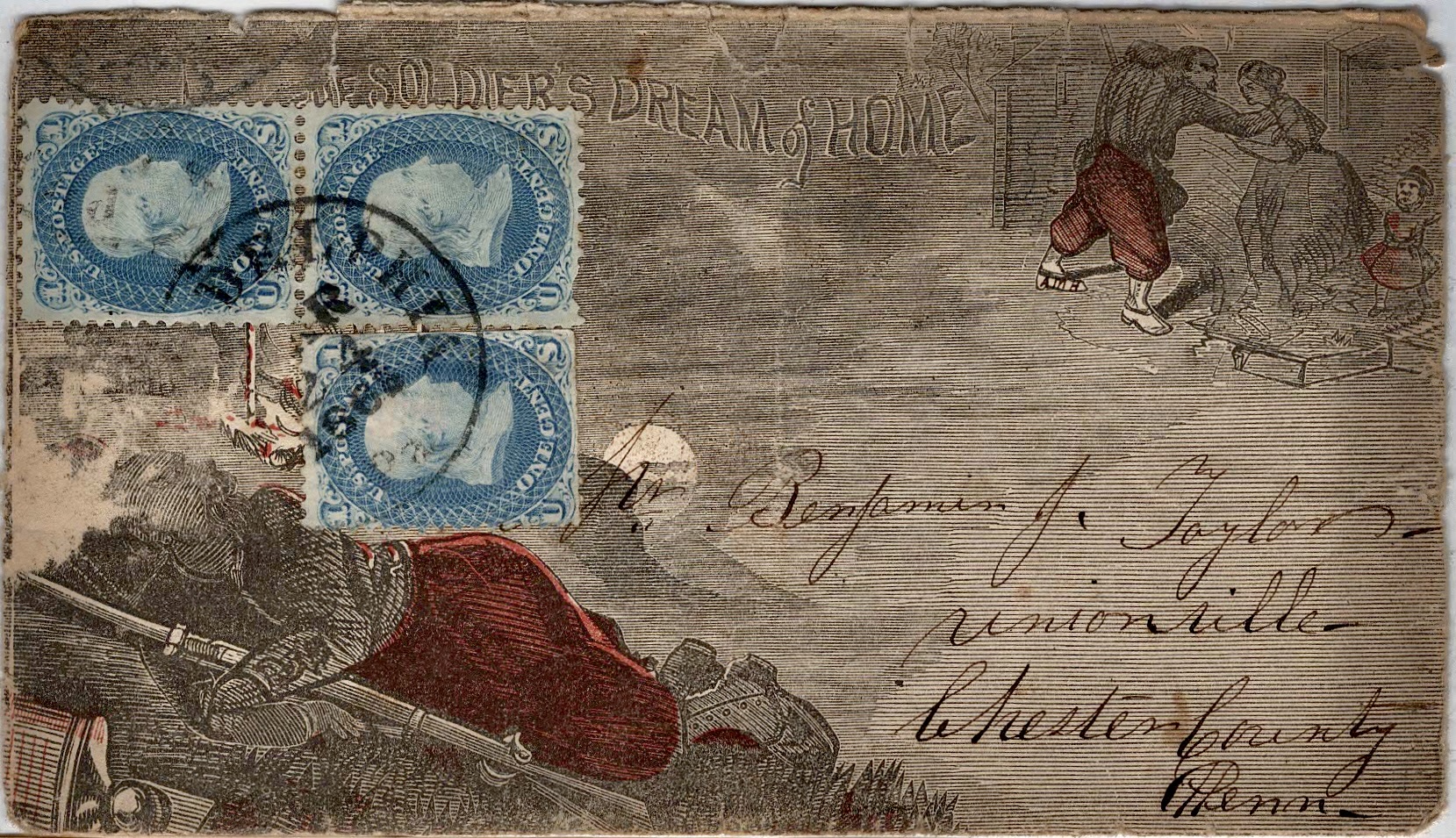
The following letter was written by William Taylor (b. 1807 in Penn.), the husband of Hannah (Price) Taylor (b. 1825 in Penn.)—both Mulattos—who were residents of Unionville, Chester county, Pennsylvania at the time of the 1860 US Census. William wrote the letter to his oldest son, Benjamin Jones Taylor (1842-1899) who was enumerated in the 1860 Census with his siblings, William (b. 1844), Hebert (b. 1848), Elizabeth (b. 1850), Mary A. (b. 1851), and Esther (b. 1856). I don’t know William penned the letter but since the postmark was Philadelphia, I’m going to assume he was working there at the time. I cannot find any record that his son Benjamin ever volunteered to serve in the U. S. Colored Troops (USCT).
Benjamin married Anna Frances Davis of Providence, Rhode Island, and in the 1870 US Census, he was enumerated in Providence working as a coachman. By 1880, Benjamin was working as a hosier, his home located at 379 Fountain Street. Benjamin’s son, Charles (1877-1942) served in Co. H, 9th US Cavalry—a Buffalo soldier.
It’s curious that William concluded his letter by writing, “It is very requisite that we as a combined body should make the best of everything from the fact that prejudice is raging rapidly.” This statement is further evidence of a noticeable rise in racial tensions and hostility towards Black Americans in certain areas—particularly in New York City where the military draft stoked fears and sparked racial violence.
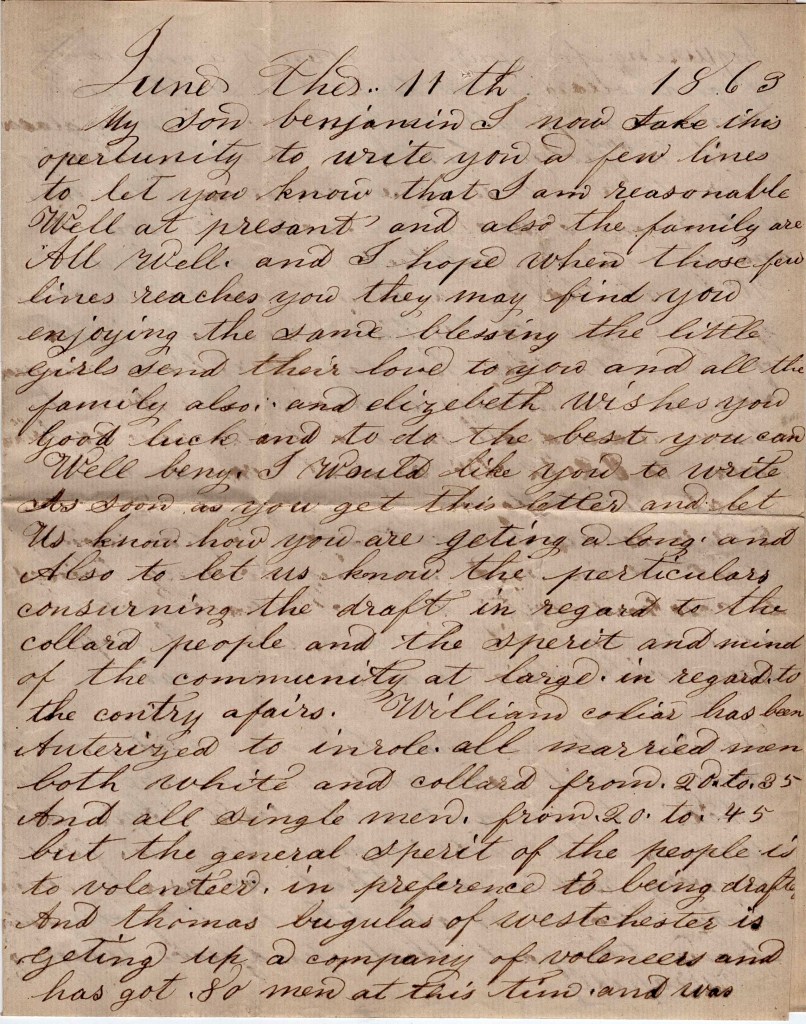
T R A N S C R I P T I O N
[Philadelphia, Pa.]
June 11, 1863
My son Benjamin,
I now take this opportunity to write you a few lines to let you know that I am reasonable well at present and also the family are all well and I hope when those few lines reaches you, they may find you enjoying the same blessing. The little girls send their love to you and all the family also. And Elizabeth wishes you good luck and to do the best you can.
Well, Benj, I would like you to write as soon as you get this letter and let us know how you are getting along and also to let us know the particulars concerning the draft, in regard to the colored people and the spirit and mind of the community at large, in regard to the country affairs. William Collier has been authorized to enroll all married men, both white and colored, from 20 to 35, and all single men from 20 to 45. But the general spirit of the people is to volunteer in preference to being drafted and Thomas Bugulas [?] of West Chester is getting up a company of volunteers and has got 80 men at this time and was inquiring for you. He wants a company of good colored men to march with him as soon as possible.
And Aunt Mary Glasco got a letter from her son London for he has not received neither wages nor bounty and is entirely destitute of money. He was well at that time and is now in South Carolina. 1
Give our love to William Green and enquire of him whether he saw William Shirley’s son for he wishes to know. Well, Benj., I have reduced all my old debts from 14 dollars down to $2.72 cents and it would be a great relief to me if you could send me 5 or 6 dollars. I must make a portion of rent soon and having so many things to contend with that I shall not be able to raise it in due time. I hope you will oblige me if you can.
Lovina Means and Tilman and family and David Carr and family are middling well at present and send their well wishes and best respects to you for it is very requisite that we as a combined body should make the best of everything from the fact that prejudice is raging rapidly.
I must now close by saying our respects to you all together. No more at present. From your father, — William Taylor
1 London Glasco (1841-1863), mulatto, was the son of Robert Glasco (1797-1877) and Mary (Taylor) Brown (1803-Aft1870) of Unionville, Chester county, Pennsylvania. London served in Co. B of the 54th Massachusetts Infantry and was killed in the assault on Fort Wagner on 18 July 1863. London was listed in the Company Descriptive Book record as single, 22 years of age, 5 feet 6 inches tall.


 Spared & Shared 23