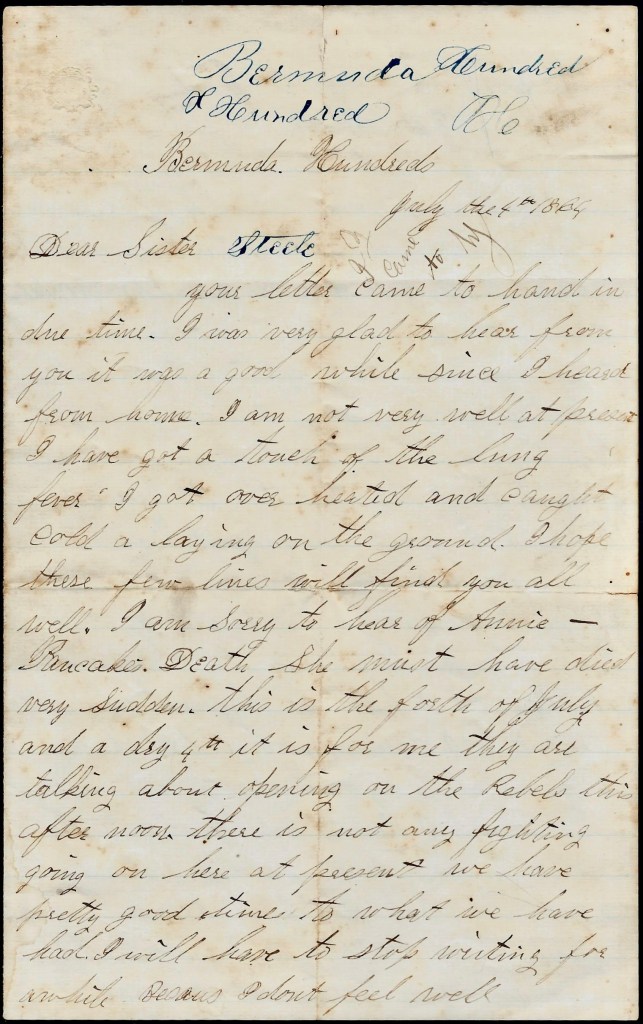
The following letter was written by John R. Heafer (1845-1864), the 19 year-old son of John Heafer (b. 1820) and Nancy (b. 1826) who moved with his family from Charleston, Jefferson county, Virginia, to a farm in Bloomington, McLean county, Illinois in the 1850s. John was serving as a private in Co. B, 39th Illinois Infantry when he wrote this letter from Bermuda Hundred in July 1864.
He was carried on the muster rolls as “Hafter” which may explain why he can’t be found under his given name. Unfortunately he did not survive the war. He was killed along with many other comrades in his regiment on 13 October 1864 in the Battle of Darbytown Road. The Union advance was repulsed with heavy casualties and John’s body was left on the field.
John wrote the letter to his sister, Sarah (“Sallie”) Heafer (b. 1844), the wife of William M. Steele, a former soldier in Co. A, 94th Illinois Infantry and a teamster working in Bloomington. He later became a minister.
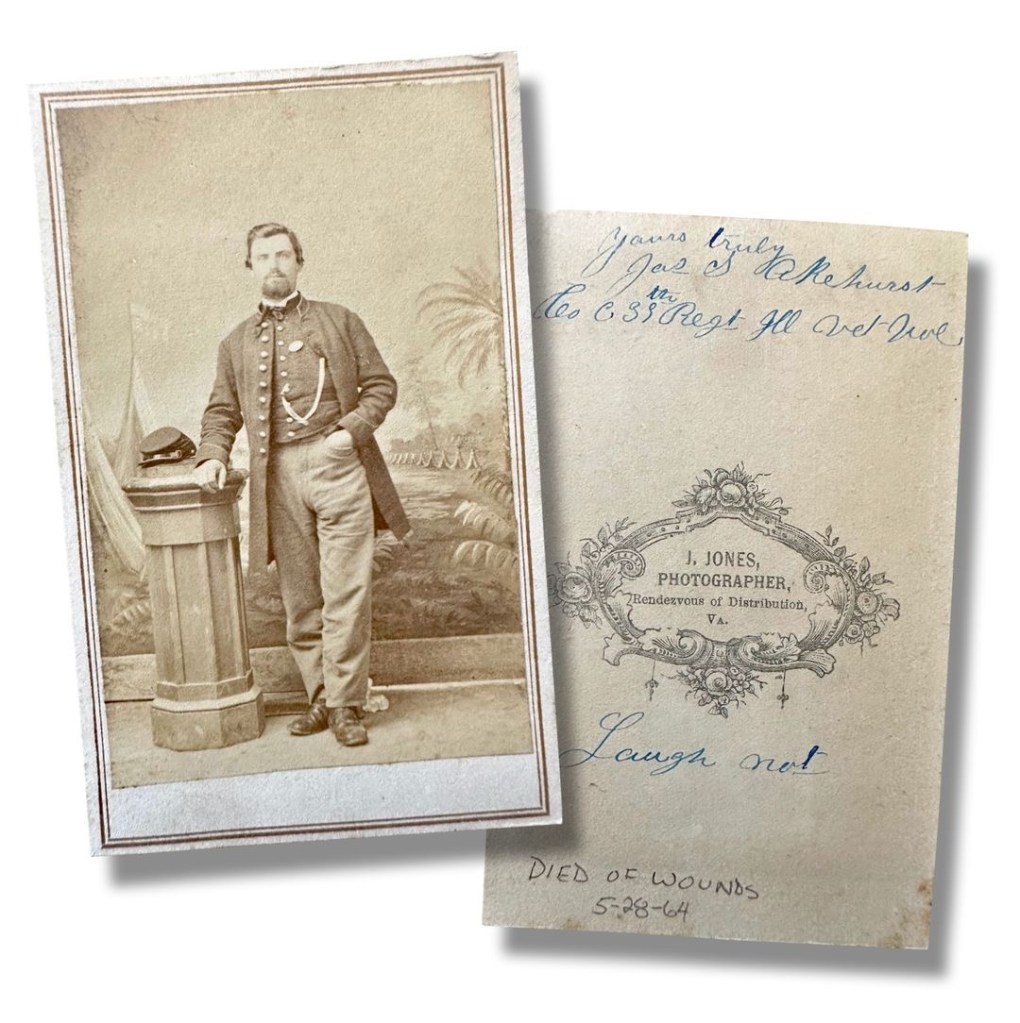
I could not find an image of Robert, but here is a cdv of James S. Akehurst (1843-1864) of Pontiac, Illinois, not previously published to my knowledge. James served as a private in Co. C, 39th Illinois Infantry. He enlisted in October 1861 and was wounded on 20 May 1864 at Drewry’s Bluff, Virginia. The wound to his left arm was so severe it required amputation but the procedure did not save him—he died on 28 May 1864 at Hampton, Virginia. The news must have come as quite a shock to his wife, Elizabeth, who had promised to love and respect James “till death do us part” only three months earlier. James’ image was taken in front of a backdrop that features tropical type vegetation suggesting the cdv was probably taken in 1863 while the regiment was on the South Carolina coast. (Courtesy of Claudia & Al Niemiec Collection)
Transcription
Bermuda Hundred [Virginia] July 4th 1864
Dear Sister,
You letter came to hand in due time. I was very glad to hear from you. It was a good while since I heard from home. I am not very well at present. I have got a touch of the lung fever. I got over heated and caught cold a laying on the ground. I hope these few lines will find you all well. I am sorry to hear of Annie Pancake’s death. 1 She must have died very sudden.
This is the Fourth of July and a dry 4th it is for me. They are talking about opening on the Rebels this afternoon. There is not any fighting going on here at present. We have pretty good times to what we have had. I will have to stop writing for a while because I don’t feel well.
July 7th, Thursday. Dear sister, I will commence and finish this letter and I am better. I was very sick for a few days in my quarters and was getting worse until the doctor came to see me and saw me to the Convalescent Hospital. I am better now. The doctor says I have not got the lung fever. I guess I have got the pleurisy. I think I will soon get over it.
The weather is very warm here but it is cool enough in the hospital tent. You will have to excuse this writing as I have to lay on my side to write. I commenced this letter a few days ago but could not finish it. I told Ed[win] Wolcott to write me a letter because I thought I would not be able to write for some time but I guess I can a little yet. But you need not expect many.
There is good news here now. They are fighting at Petersburg. But we can’t hear anything from Grant. The rebels are deserting by hundreds. I have seen a good many go by here today. I will have to come to a close. My love to all. — John R. Hafer
P. S. Be sure and send the photograph.
Mr. John R. Heafer, Co. B, 39th Regt. Illinois Vols., 1st Brigade, 1st Division, 10th A. C.
1 Ann Marie Pancake (1847-1864) died on 20 June 1864 when she was 17 years old. She is buried in Evergreen Memorial Cemetery in Bloomington.
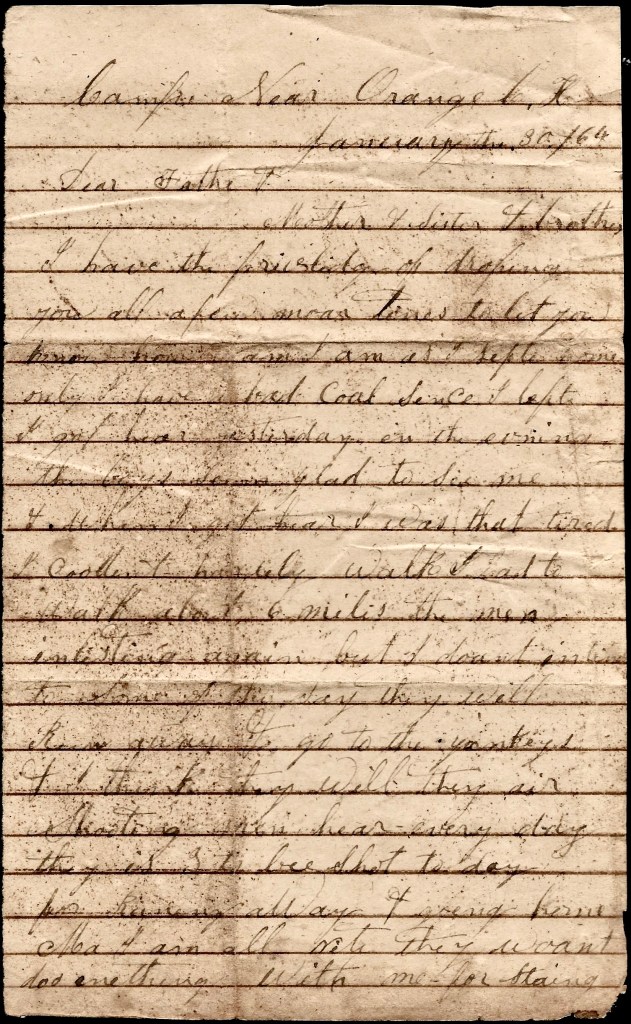
The following letter was written by Franklin L. Stuard (1839-1865), the oldest son of Mathaniel Thomas Stuard (1817-1897) and Caroline Jane Robeson (1816-1896) of Lincolnton, Lincoln county, North Carolina.
According to Muster rolls, Frank enlisted in May 1861 as a private in Co. B, 23rd North Carolina Infantry. He was severely wounded two years later in the Battle of Chancellorsville and treated at Winder Hospital in Richmond but returned to his regiment in January 1864 when this letter was penned. It was the 23rd North Carolina that took the lead in Stonewall Jackson’s immortal night march that fell upon the unsuspecting right flank of Hooker’s army. Frank’s military record does not inform us of his death but his grave marker stated that he was killed on 5 April 1865, most likely in the Battle of Amelia Springs.
Transcription
Addressed to Mr. N. T. Stuard, Lincolnton, North Carolina
Camp near Orange Court House January the 30th 1864
Dear Father & Mother & Sister & Brothers,
I have the privilege of dropping you all a few more lines to let you know how I am. I am as I left home only I have a bad cold since I left. I got here yesterday in the evening. The boys [were] some glad to see me & when I got here I was that tired, I couldn’t hardly walk. I had to walk about six miles. The men are enlisting again but I don’t intend to. Some of them say they will run away & go to the Yankees & I think they will. They are shooting men here every day. There is three to be shot today for running away & going home.
Ma, I am all right. They won’t do anything with me for staying at home without furlough but if I had of stayed any longer, they might of tried it. But as it is, they don’t say anything.
I haven’t any news to write that will interest you in the least. I [had] written to you all [the news] when I was at Richmond. I wrote on Thursday & I thought I would write a few lines today. Ma, I want you to write & tell me how Harriet is getting along. I want to see her mighty bad. I won’t say any more for the present—only I want you to write as soon as you get this & give me all of the news.
Direst your letters to Orange Court House, Va.
So I will stop for the present. So goodbye, — F. L. Stuard
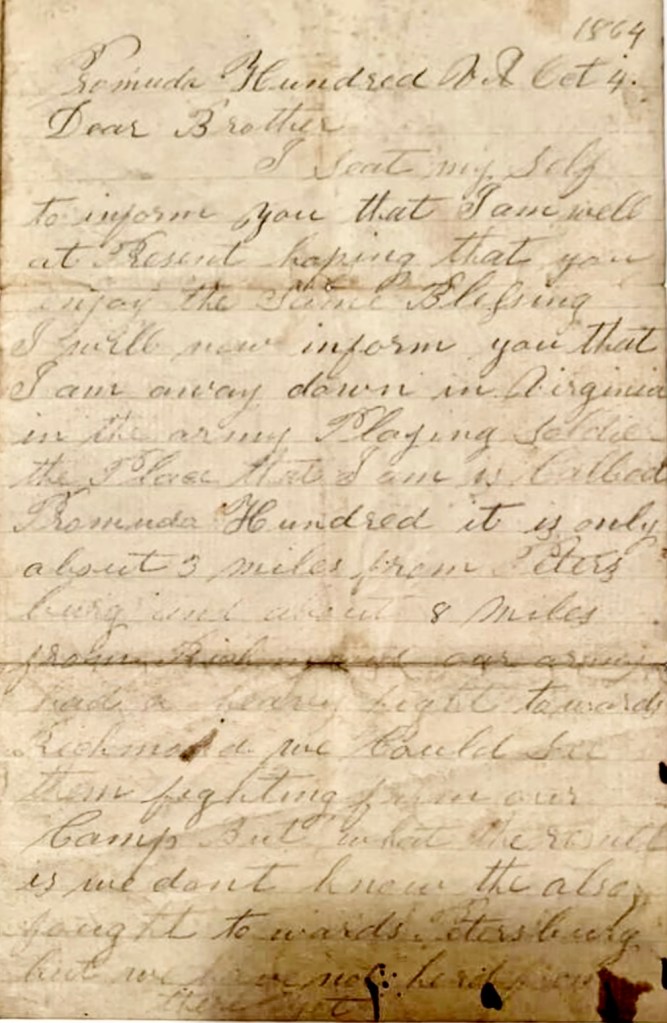
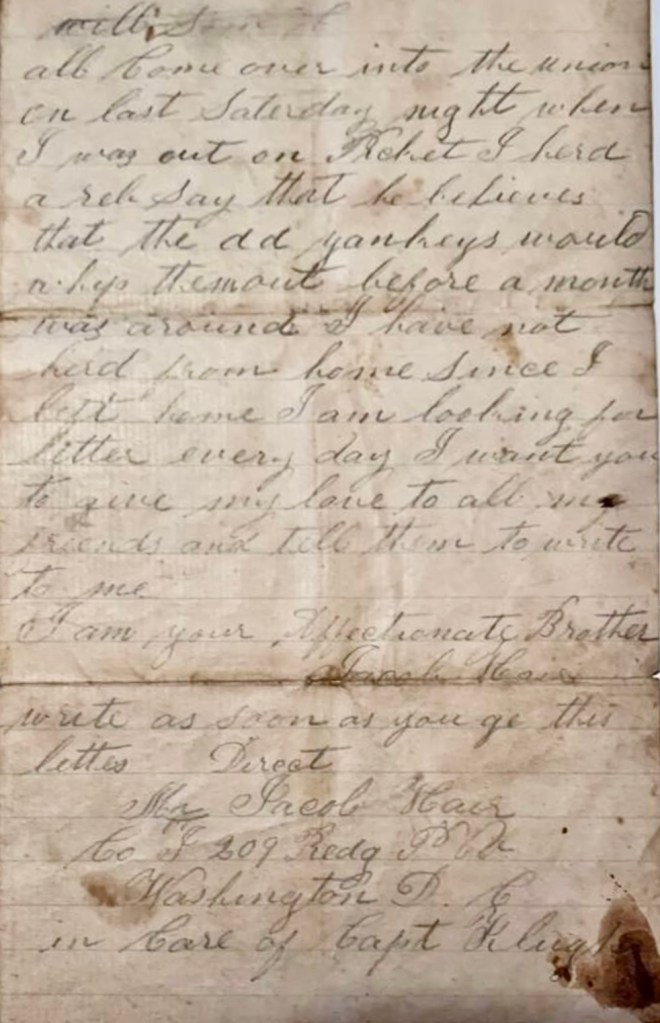
The following letter was written by Pvt. Jacob Hair who enlisted in Co. I, 209th Pennsylvania Infantry on 29 August 1864 and was discharged from the service on 11 July 1865. His name was sometimes recorded as Harr on the muster rolls. While at Bermuda Hundred, the regiment was attached to the Ninth Army Corps, 1st Brigade, Third Division.
[Note: Images of this letter were provided to me for transcription and publication on Spared & Shared by Jeff Hilsmeier who owns the original.]
Transcription
Bermuda Hundred, Va. October 4, 1864
Dear Brother,
I seat myself to inform you that I am well at present hoping that you enjoy the same blessing. I will now inform you that I am away down in Virginia in the army playing soldier. The place that I am is called Bermuda Hundred. It is only about three miles from Petersburg and about eight miles from Richmond and our army had a heavy fight towards Richmond. We could see them fighting from our camp but what the result is, we don’t know. 1 They also fought towards Petersburg but we have not heard from there yet [either].
Last Friday I was out on picket. I could see that the rebs retreated back toward Richmond. I was out on picket twice and took it well. We are well fortified here. We are only about 25 steps from our rifle pits and the rebs’ fortifications are only about half a mile from ours. Our pickets and the rebs’ pickets are only about 30 steps apart. We still invite the over. There are a great many that comes over every night—some nights as high as 6 to 8, and there would be a great deal more come if they darst but they are watched too close. I hope that the time will soon come that they would all come over into the Union.
On last Saturday night when I was out on picket, I heard a reb say that he believes that the damned Yankees would whip them out before a month was around.
I have not heard from home since I left home. I am looking for a letter every day. I want you to give my love to all my friends and tell them to write to me. I am your affectionate brother, — Jacob Hair
Write as soon as you get this letter. Direct to Mr. Jacob Hair, Co. I, 209th Regt. Penn. Vols. in care of Capt. [John] Klugh 2
1 The battle Jacob refers to was the Battle of Chaffin’s Farm fought on 29-30 September 1864 in which Butler’s Army of the James successfully assaulted and captured Fort Harrison which they later renamed Fort Burnham. The loss of this fort caused the Confederates to have to withdraw their lines of defense between Richmond and Petersburg.
2 Capt. John Klugh was wounded at Fort Steadman, Virginia, on 25 March 1865 and was discharged from the service on 10 May 1865.
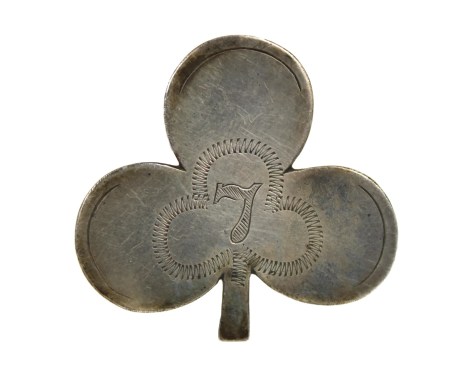
I could not find an image of either Jeheiel or Frederick but here is a tintype of Russell Towsley who served in Co. C, 7th Michigan Infantry wearing his early war uniform (Ancestry.com)
The following letters were written by Aaron “Jehiel” Rayner (1841-1919) of Co. B, 7th Michigan Infantry. The first letter includes a part written by Frederick R. Searl (1843-1874) of the same company.
Jehiel was the son of John Raynor (1804-1879) and Emily Meech (1817-1873) of Mason, Ingham county, Michigan. He enlisted in the 7th Michigan on 22 August 1861 and was discharged at Petersburg, Virginia, on 22 August 1864 after three years service. His 1919 obituary states that Jehiel saw “much active service, being engaged in a number of important battles such as Fair Oaks, Antietam, Gettysburg, and numerous smaller engagements. While in the service he had many close calls, but was never seriously wounded, although his horse was killed under him at Spotsylvania.” [Not sure why an infantryman would have been riding a horse unless he was on a special detail.]
Frederick R. Searl was the son of Elisha Randal Searl (1809-1879) and Martha Hurd (1815-1862) of Mason, Ingham county, Michigan. He enlisted with Jehiel in August 1862 in Co. B, 7th Michigan and was wounded on 31 May 1862 in the Battle of Fair Oaks, Virginia. The would was so severe that his right arm had to be amputated, necessitating his discharge for disability on 18 July 1862. He died twelve years later.
The letters were addressed to Jehiel’s older brother, William Henry Rayner (1836-1905) of Mason, Ingham county, Michigan.
To read another letter written from Camp Benton by Roger Noble of the 7th Michigan Infantry written on 28 October 1861, see Roger Noble Letter-October 28, 1861. MSU Libraries.
Letter 1
This letter was written from Camp Benton on the Maryland side of the Upper Potomac. The 7th Michigan was brigaded with several Massachusetts regiments known as Lander’s Brigade. It was penned just two weeks prior to the Battle of Ball’s Bluff. Fortuitously, the 7th Michigan did not participate in this federal disaster because it was deemed “unfair to put them into battle with the poor arms they had.” These “poor arms” were converted Belgian flintlocks that were very unreliable and inaccurate. Before the end of the year they were provided with Springfield rifled muskets.
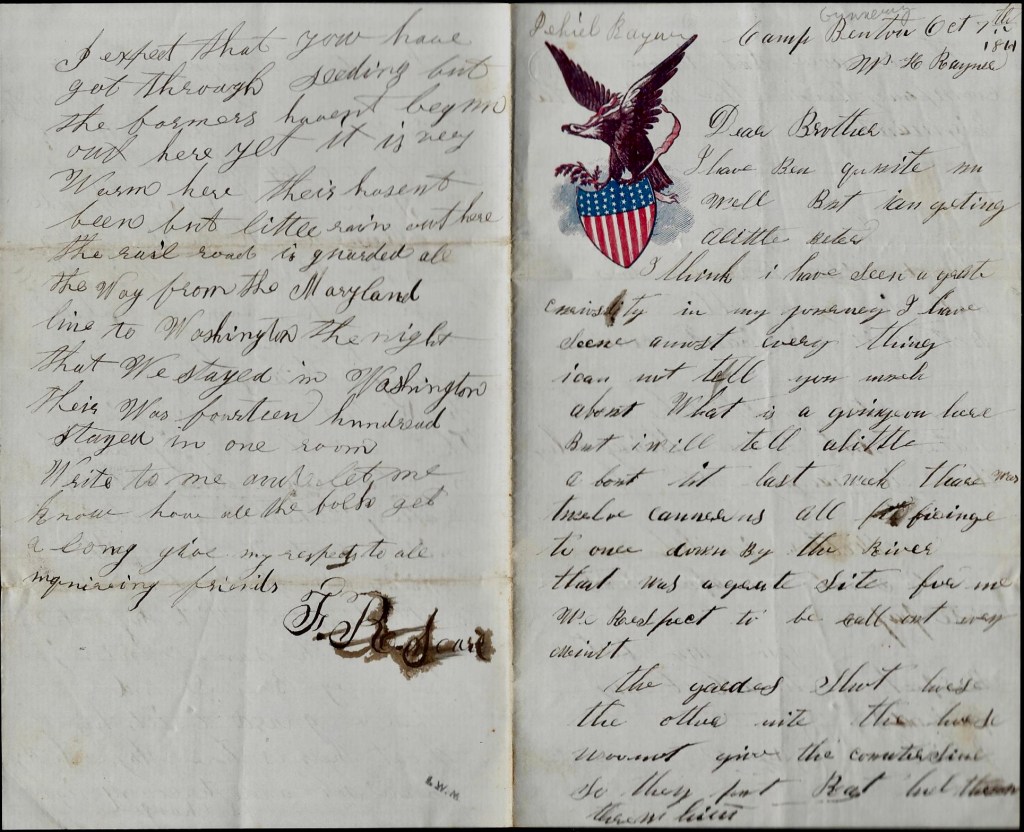
Camp Benton October 7, 1861
Dear Brother,
I have been quite unwell but I am getting a little better. I think I have seen a great curiosity in my journey. I have seen almost everything. I cannot tell you much about what is a going on here but I will tell a little about it. Last week there was twelve cannons all firing at once down by the river. That was a great sight for me. We expect to be called out every minute.
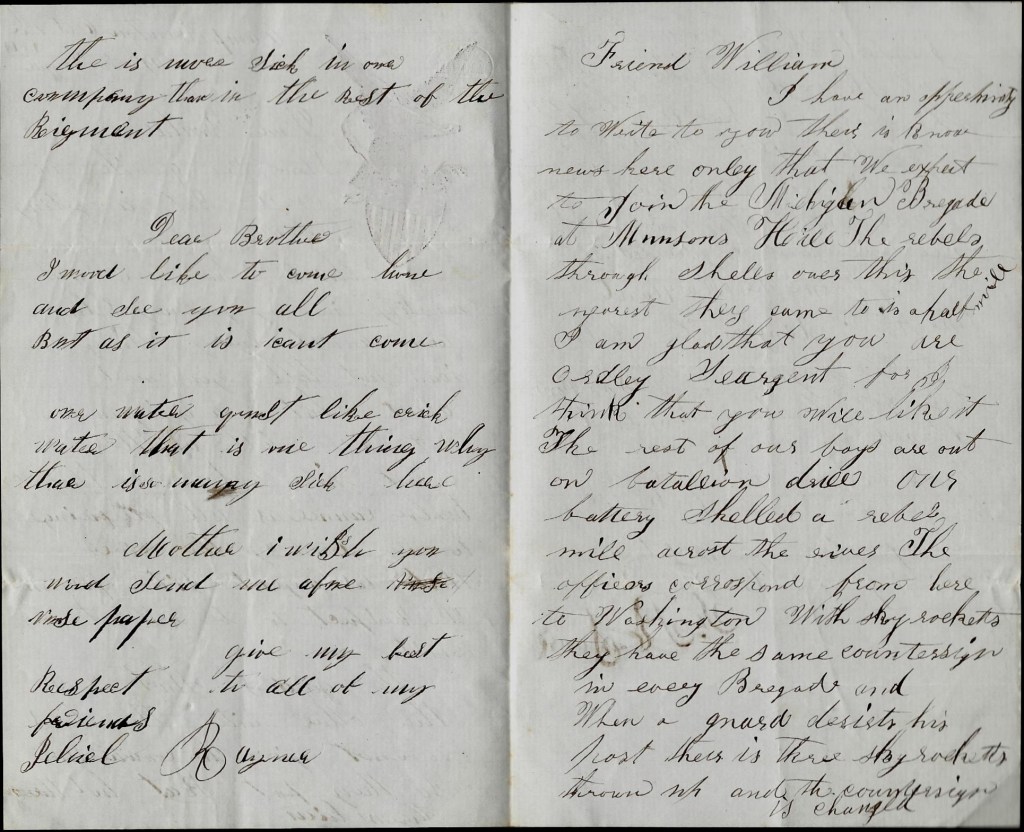
The guards shot twice the other night. The [ ] wouldn’t give the countersign so they shot but [did not get] him. There is more sick in our company than in the rest of the regiment.
Dear brother, I would like to come home and see you all but as it is, I can’t come.
Our water [is] just like crick water. That is one thing why there is so many sick here.
Mother, I wish you would send me a few newspapers. Give my best respects to all of my friends, — Jehiel Rayner
Friend William
I have an opportunity to write to you. There is no news here only that we expect to join the Michigan Brigade at Munson’s Hill. The rebels throw shells over this. The nearest they came to [us] is a half mile. I am glad that you are Orderly Sergeant for I think that you will like it. The rest of our boys are out on Battalion Drill. Our battery shelled a rebel mill across the river. The officers correspond from here to Washington with sky rockets. They have the same countersign in every brigade and when a guard deserts his post, there is three sky rockets thrown up and the countersign is changed.
I expect that you have got through seeding but the farmers haven’t begun out here yet. It is very warm here. There hasn’t been but little rain out here. The railroad is guarded all the way from the Maryland line to Washington. The night that we stayed in Washington there was fourteen hundred stayed in one room.
Write to me and let me know how all the folks get along. Give my respects to all enquiring friends. — F. R. Searl
The Corps Badge of the 7th Michigan Infantry from later in the war.
Letter 2
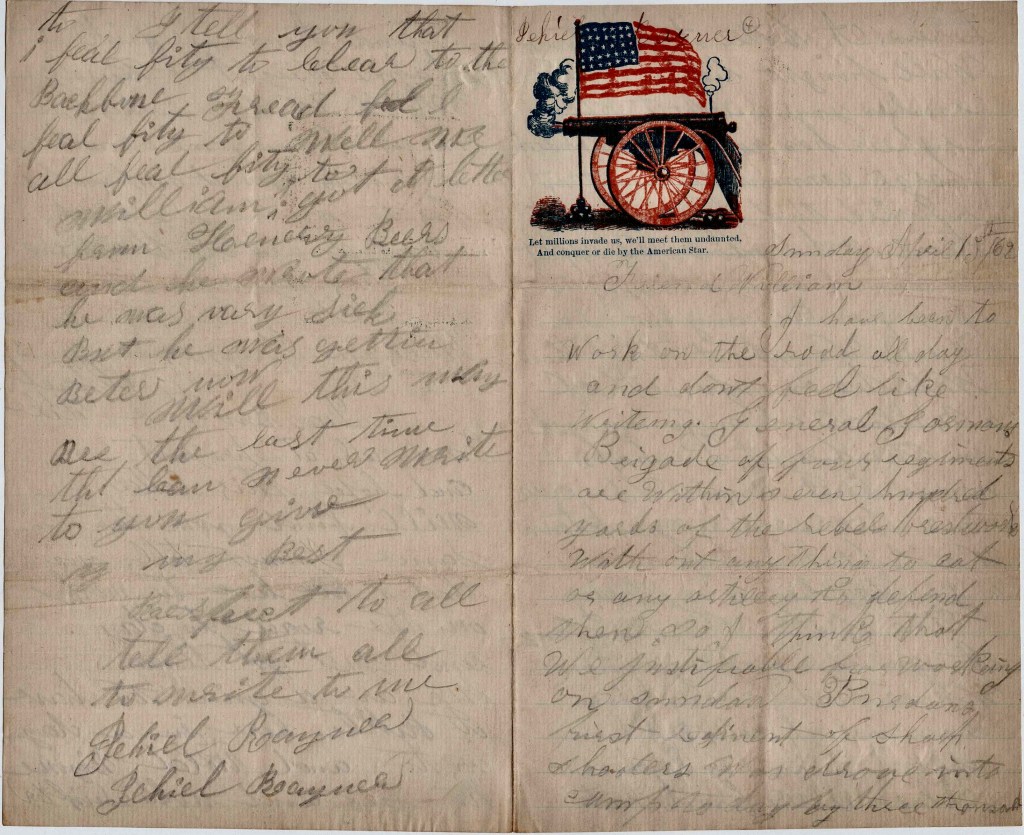
Sunday, April 13th 1862
Friend William.
I have been to work on the road all day and don’t feel like writing. General Gorman’s Brigade of four regiments are within seven hundred yards of the rebels’ breastworks without anything to eat or any artillery to defend them so I think that we [are] justifiable for working on Sunday. Berdan’s First Regiment of Sharpshooters was drove into camp by three thousand rebels. A battle at Yorktown will [be] fought before this reaches you, I expect. The rebels has got five hundred large cannons there. It is reported that Jeff Davis is there & Johns[t]on. We expect to march on Yorktown tomorrow [but] we may not in a week. We expect that there will be one-fourth of a million of men engaged in the fight.
Perhaps you don’t know where we are but we [are] near Yorktown. We left Fortress [Monroe] a week ago day before yesterday. The battle will be fought on the same ground where Lord Cornwallis surrendered in 1776. [should be 1781]
I have seen Charley Rhodes & Alva Welles & Frank Feits & Ambrose Irish & John Wright & Burdy Hill. Write whether you hear from me or not for it is almost impossible for to write. We sleep outdoors all the time. From your friend, — Fred [R. Searl]
To William Rayner
[In a different hand]
April 13th
Dear Brother,
I am well at present and hope this letter will find you the same. I must tell you that I have to work on the road today and just got through. We are a goin’ to have a battle here in a day or two and a big one too….
Well, this may be the last time that I can write to you. Give my best respects to all. Tell them all to write to me. — Jehiel Rayner
Letter 3
Camp near Culpeper [Va.] September 30, 1863
Dear Brother,
I now take the opportunity to write you a few lines to let you know that I am well at present and hope these few lines will find you the same. I must say that I hain’t had a letter from you in some time. I would like to know why you don’t write to me oftener. Now, Will, I wish you would try to write to me once a month if you please.
I can’t think of much to write to you this time but can say that the Rebels are a coming into our lines every day. they come one and two at a time. They was two come over last night and they give is some very important news. I must say that I like to see them come over. Why? Because when one comes over, that is one less to fight.
The report is this morning that they was seven hundred came over last night upon the right. I hope it is so. I guess Old Lee will lose the whole of his army if he don’t look out. Them that come over last night said that they had to keep double pickets on every night so as to keep them from running away. I guess that is so.
Mr. Wm. H. Rayner, I will send you in this letter twenty dollars. I wish you would write as soon as you get it so as to let me know if you get it or not. If you get it, I will send you twenty more right off. We got pay the other day and I have got forty dollars that I want to send home to you. This is all at present. Give my best respects to all. This is from A. J. Rayner
Will, I want you to give H. H. Beers three dollars for me that I owe him. I think that is all that I owe him. You ask him how much I owe him and then pay him and then let me know how much it is and then I will pay. Will, I want you to let me know how much I owe you and then I will send it home to you. You must know what I mean—the money that I borrowed from you. — Jehiel Rayner








 Spared & Shared 23