
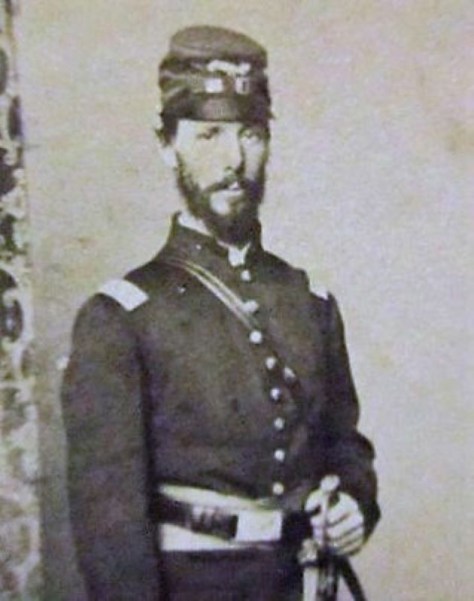
The following letters were written by Ralph Buckley (1830-1895), born in England on January 31, 1830. As a young man, Buckley immigrated to the United States. He married Sarah Bowden (1824-1884), and the couple lived in Media, Delaware County, Pennsylvania, where was the proprietor of his own iron and tin shop (see image below).
When the 124th Pennsylvania Infantry—a nine months regiment—was bring raised in the late summer of 1862, Ralph volunteered his services as a 2nd Lieutenant in Co. B. and was mustered into government service on August 8, 1862. On August 13, the regiment received uniforms and other equipment, and under command of Senior Captain Joseph W. Hawley embarked for Baltimore, Washington and Virginia. The regiment was organized in Virginia with Joseph W. Hawley as colonel, a native of West Chester, who was wounded in the battle of Antietam and upon recovery rejoined his regiment December 3, at Harper’s Ferry. Ralph was promoted to 1st Lieutenant before the regiment was discharged after nine months.
After returning to civil life, Governor Andrew G. Curtin called the regiment together as Volunteer Emergency Militia to repel General Lee’s advance into Pennsylvania which culminated in the battle of Gettysburg. This regiment numbered many members of the 124th in their ranks, including Ralph who joined Co. F, 29th Pennsylvania Volunteer Militia (Emergency) as first lieutenant on 27 June 1863. He joined Co. F, 29th Pennsylvania Volunteer Militia (Emergency) as first lieutenant.
On July 8, 1864, Buckley enrolled as captain of the 197th Pennsylvania Infantry, a 100-day regiment. This regiment, sometimes called the 3rd Coal Exchange Regiment—was assigned duty to serves as guards at the Rock Island Prison in Illinois, each member receiving a $50 bonus for enrolling. Ralph Buckley died on October 11, 1895, and was buried in Middletown Presbyterian Church Cemetery in Elwyn.

Letter 1
Camp Stanton
August 19, 1862
Dear Wife,
We have not changed our camp as the name above would imply but the name itself has been changed. It is not as likely that we shall move from here as it was when I last wrote to you but as change is the order of the day, we now not what order will come next.

We were all taken aback today on the arrival of the commissions for the field officers of our regiment as they were for men altogether different from what had been spoken of—namely Capt. [Joseph Williamson] Hawley of West Chester who is in command of a company here is to be Colonel, a Mr. Wadell of West Chester who had a company of home guards at Media last 4th of July a year ago & has been attending to his business at West Chester as a lawyer & has taken no part in organizing men for the war & strange to say after the arrangements had been made of which I wrote you, he is commissioned as Lt. Colonel, & Lieut. [Isaac Lawrence] Haldeman as Major. While we were surprised at Lawrence’s success, I myself am very much pleased. What he does not know, I feel and know he has the ability & disposition to learn & I earnestly hope he will make his mark as his office is the only sure thing for our country as the quartermaster is also from West Chester. The Adjutant [position] is still open & we are in hopes to secure it to our Captain who is accredited by common consent to be the most efficient officer in the regiment. But unfortunately for him he is by chance or choice lived in Delaware county & not in Chester county. I know these matters will. not interest you. much but as they are the uppermost with me, I hurriedly pen them for the benefit of our friends.
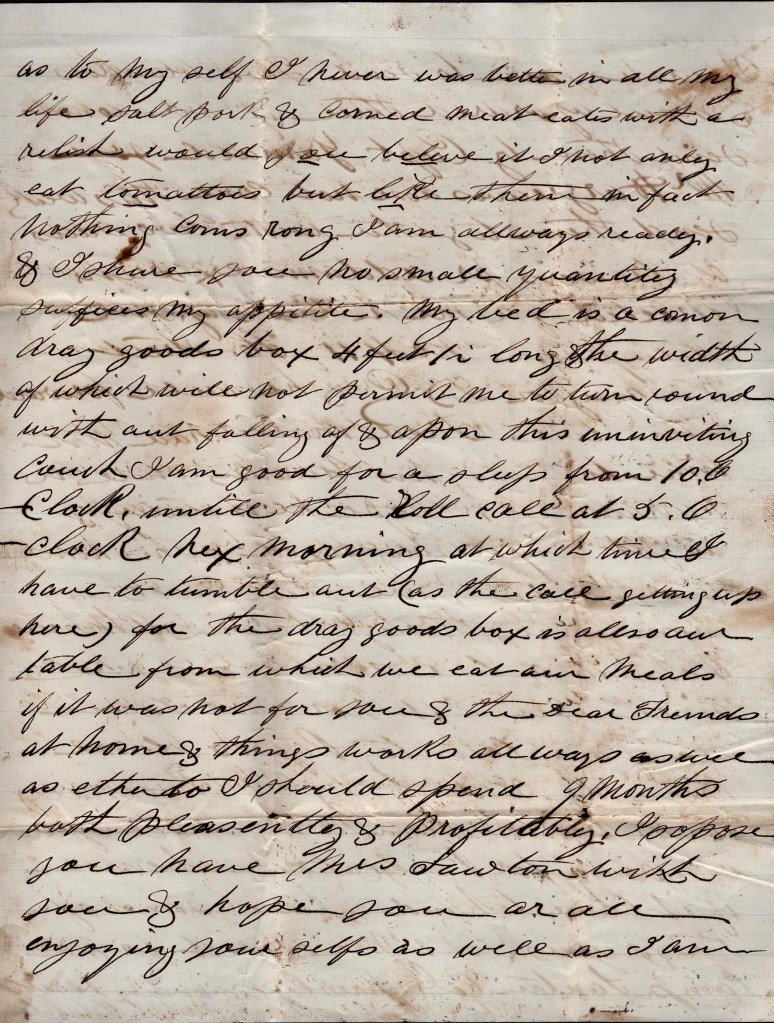
Our camp is about three and a half miles from the Long Bridge & the whole regiment doing well. Capt. [Norris Lewis] Yarnall [Co. D] has a few men an little unwell. Ours are all fine in health and all was ready for rations of which we have plenty. As to myself, I never was better in all my life. Salt pork and corned meat eats with a relish. Would you. believe it, I not only eat tomatoes but like them. In fact, nothing comes wrong. I am always ready & I assure you no small quantity suffices my appetite.
My bed is a common dry goods box four feet in length & the width of which will not permit me to turn round without falling off & upon the uninviting couch. I am good for a sleep from 10 o’clock until the roll call at 5 o’clock next morning at which time I have to tumble out (as they call getting up here) for the dry good box is also our table from which we eat our meals. If it was not for you & the dear friends at home & things works all ways as we intended to, I should spend 9 months both pleasantly & profitably. I suppose you have Mrs. Lawton with you and hope you are all enjoying yourself as well as I am.
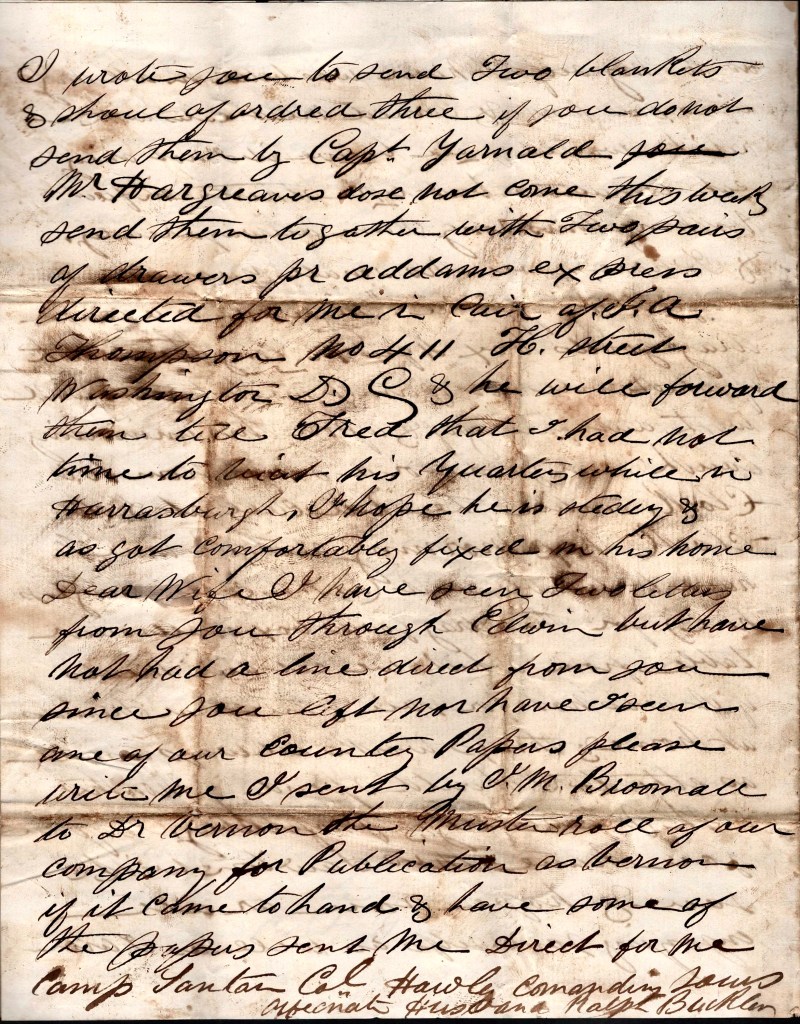
I wrote to you to send two blankets & should of ordered three. If you do not send them by Capt. Yarnall, Mr. Hargreaves does not come this week, send them together with two pairs of drawers per Adams Express directed for me in care of J. A. Thompson, No. 411 H. Street, Washington D. C. & he will forward them. Tell Fred that I had not time o visit his quarters while in Harrisburg. I hope he is steady & has got comfortably fixed in his home.
Dear wife, I have seen two letters from you through Edwin [Blakely] but have not had a line direct from you since you left nor I seen some of our county papers. Please write me. I sent by J. M. Broomall to Dr. Vernon the muster roll of our company for publication at Vernon. If it comes to hand and have some of the papers sent me direct for me, Camp Stanton, Col. Hawley commanding. Your affectionate husband, — Ralph Buckley


Letter 2
Camp Stanton
August 24, 1862
Dear, dear wife,
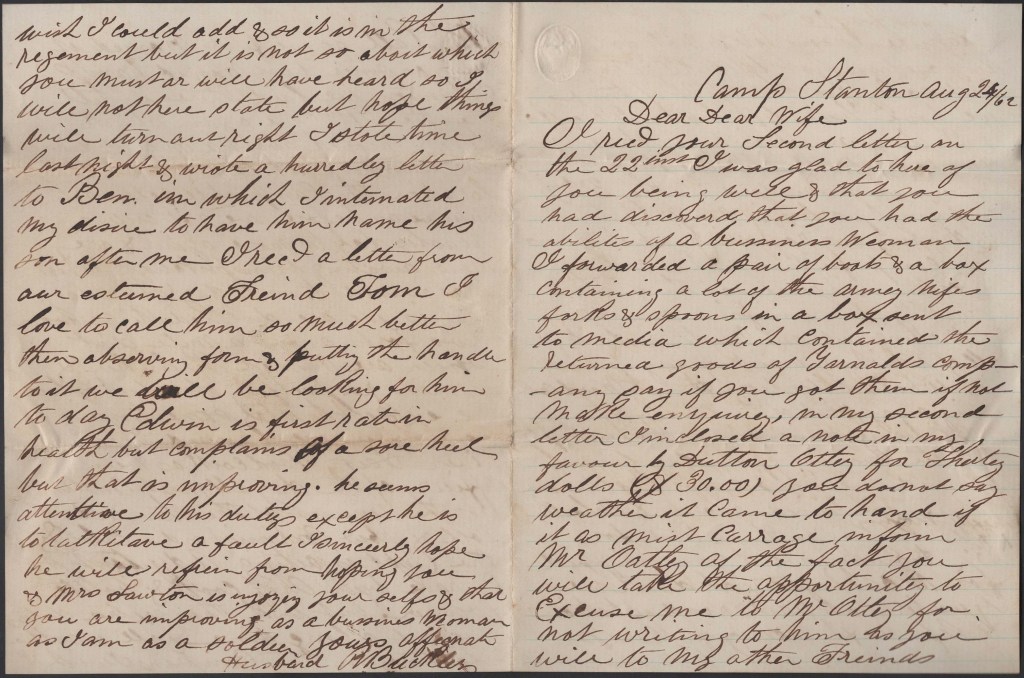
I received your second letter on the 22nd inst. I was glad to hear of you being well & that you. had discovered that you had the abilities of a business woman. I forwarded a pair of boots and a box containing a lot of the army knives, forks & spoons in a box sent to Media which contained the returned goods of Yarnall’s Company [D]. Say if you got them. If not, make enquiry. In my second letter I enclosed a note in my favor by Dutton Otley for thirty dollars. You do not say whether it came to hand. If it has miscarried, inform Mr. Otley of the fact. You will take the opportunity to excuse me to Mr. Otley for not writing to him as you will to my other friends and assure them it is not for the disposition not to write them but solely for the want of time.
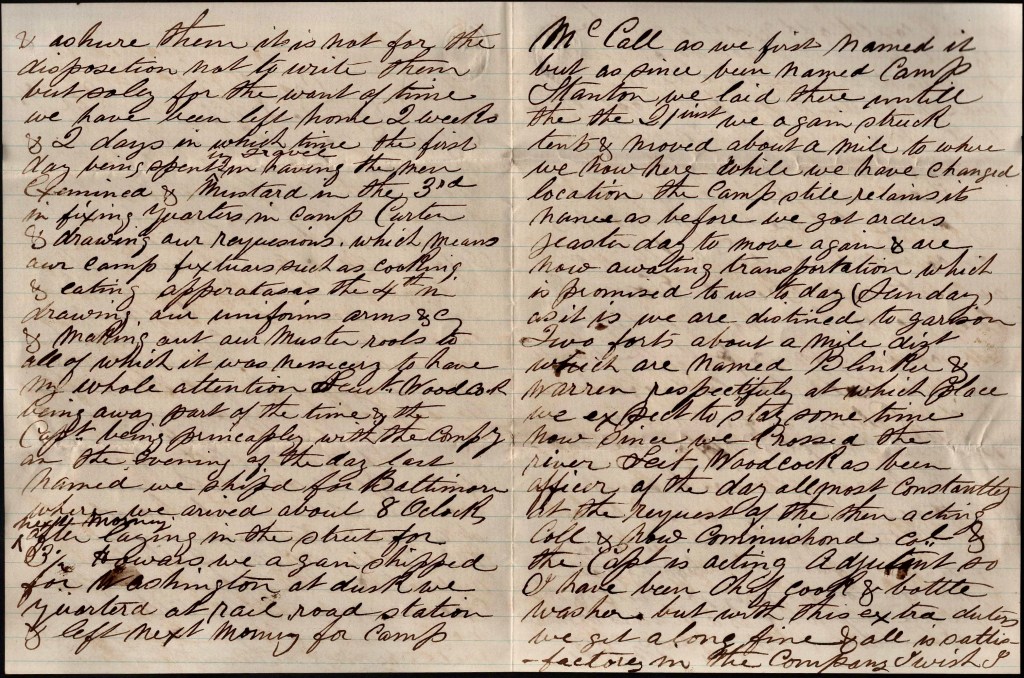
We have been left home two weeks and two days in which time the first day being spent in travel and in having the men examined and mustered in the 3rd, in fixing quarters in camp Curtin, & drawing our requisitions which means our camp fixtures such as cooking and eating apparatuses, the 4th in drawing our uniforms, arms, &c. & making out our muster rolls to all of which it was necessary to have my whole attention. [1st] Lieut. [John] Woodcock being away part of the time, and the Captain being principally with the company on the evening of the day last named, we shipped for Baltimore where we arrived about 8 o’clock next morning.
After laying in the street for 3.5 hours, we again shipped for Washington at dusk. We quartered at the railroad station and left next morning for camp McCall as we first named it, but as since named Camp Stanton. We layed there until the 21st inst. [when] we again struck tents and moved about a mile to where we are now. While we have changed location, the camp still retains its name as before.
We got orders yesterday to move again & are now awaiting transportation which is promised to us today (Sunday) as it is. We are destined to garrison two forts about a mile distant which are named Blenker & Warren, respectively, at which place we expect to stay some time now. Since we crossed the river, Lieut. [John] Woodcock has been Officer of the Day almost constantly at the request of the then Acting Colonel & now commissioned Colonel & the Captain is acting Adjutant so I have been chief cook and bottle washer. But with this extra duty, we get along fine and all is satisfactory in the company. I wish I could add & so it is in the regiment but it is not so, about which you. must or will have heard so I will not here state, but hope things will turn out right.
I stole time last night & wrote a hurriedly letter to Ben. in which I intimated my desire to have him name his son after me. I received a letter from our esteemed friend Tom. I love to call him so much better than observing form & putting the handle to it. We will be looking for him today. Edwin [Blakely’s] is first rate in health but complains of a sore heel but that is improving. He seems attentive to his duties except he is too talkative—a fault I sincerely hope he will refrain from. Hoping you & Mrs. Lawton is enjoying yourselves & that you are improving as a business woman as I am as a soldier. Your affectionate husband, — R. Buckley

Letter 3
Fort Blenker
August 28, 1862
Dear Wife,
Before this you will have seen our friends & will have heard precisely our situation, possibly much better than I can describe it. You will receive some photographs at the hands of mr. Thomson—some small ones & some large ones of myself & some of Mr. Hargreaves & myself. I have this day received a copy of Pach Friend. Tom for some reason seems as if he might have been how come you so, but I assure you, such an insinuation does him great injustice as he was as straight as judges ought to be & I can not account for his appearance unless it is in consequence of us having nothing to drink to give him as the gifts were all from the other side. The tobacco, you can assure him, is the theme of much regard.
Many a time in passing the tents when I have not been noticed by the men, I heard them exclaim Tom is a bully fellow—a fine man, &c. Our sutler has tobacco for sale precisely the same kind that he bought, but the men prefer a pipe of it than a pound of the camp stuff as they call it. At this instant, there are two growling in consequence of one having broke the other man’s (Media) pipe. To make amends, the offending party offers the sufferer a gum pipe for which he paid 50 cents for. His answer is, “Take your pipe to the Devil. I have one like it. Your damned carelessness broke my pipe. I would rather have it than all the pipes in the regiment & would rather take a licking than have it broken.” Poor fellow, He is holding in his hand attempting to put it together–a task which will be hard to accomplish.
The currant bread was exceptional. The catsup has not yet been opened. The blackberry syrup is first rate. I cannot compliment you for the wine you sent for it unfortunately got spilled, the bottles being broken and my drawers are much discolored with the wine, the appearance of which might indicate something disrespectable. However, our washer woman who is in the shape of an Irish lad about 18 years old says he can wash it out & will try his hand tomorrow.
I gather from Mr. Hargreaves that you feel cause of complaint because I have been performing extra duty in consequence of Capt. & Lieut. Woodcock having been on special duty. While it is true all my time has been occupied, it is not hard work either mentally or physically and as I perform it cheerfully, it of course is pleasant to me. We get along fine.
Edwin is in good health & spirits. He has just handed me a letter for Mother and one endorsed for a young lady, both of which will be forwarded with this tomorrow. I am very sorry to learn that Mrs. Lawton is indisposed & hope she is well by this time. We are all well & feel as safe here as in State Street in Media. Give my best respects to Messrs. Manley, Otley, Scholl, Haldeman’s and all enquiring friends & request all to write to me. Have a Media & a Chester paper sent me weekly. Tell Fred that I’m nit in jail yet. Your affectionate husband, — R. Butler


Letter 4
Fort Blenker
August 29, 1862
Dear Wife,
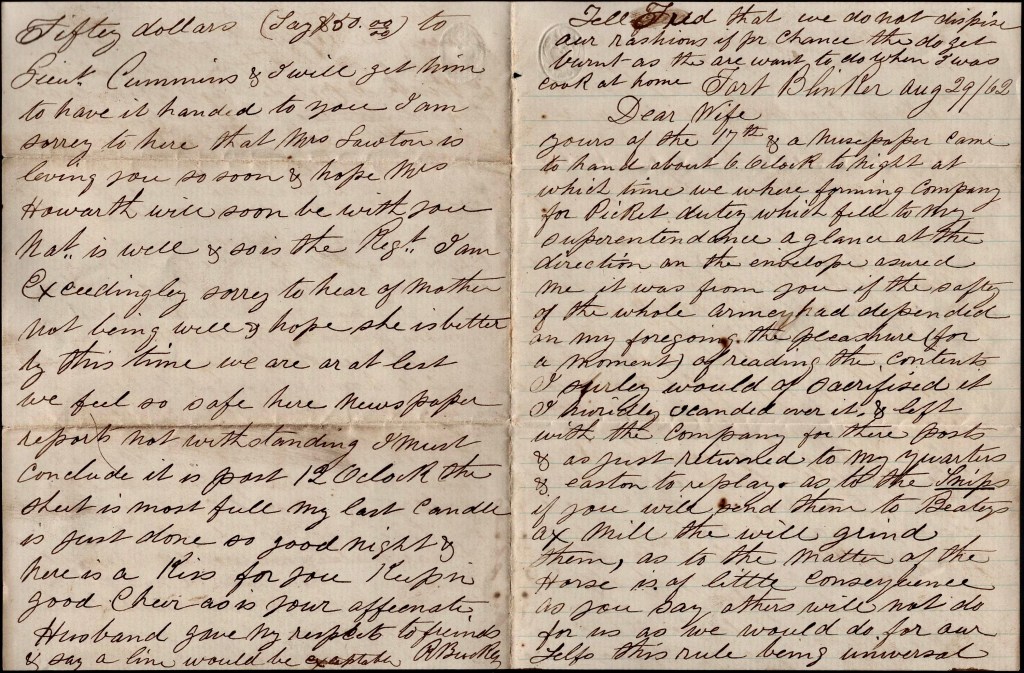
Yours of the 17th & newspaper came to hand about 6 o’clock tonight at which time we were forming commpany for picket duty which fell to my superintendence. A glance at the direction on the envelope assured me it was from you. If the safety of the whole army had depended on my foregoing the pleasure (for a moment) of reading the contents, I. surely would of sacrificed it. I hurriedly scanned over it and left with the company for their posts & have just returned to my quarters & seated myself to reply. As to the snips, if you. will send. them to Beatey’s Ax Mill, they will grind them. As to the matter of he horse is of little consequence as you say others will not do for us as we would do for ourselves. This rule being universal, we ought not to expect other results. Then we should not be disappointed. Indeed, we have both arrived at an age to know that to be helped, we must help ourselves. So do not let such matters perplex you. As to the unpaid bills, I will now instruct you…[business and financial matters]
Expecting that we would not receive any Bounty (Officers) and thinking that we might not get pair our salaries for months, I prudently brought it with me. The hurry with which we left home, I forgot to tell you of it….[more business discussion.
I am sorry to hear that Mrs. Lawton is leaving you so soon & hope Mrs. Howarth will soon be with you. Nat is well and so is the regiment. I am, exceedingly sorry to hear of mother not being well & hope she is better by this time. We are, or at least we feel so safe here, newspaper reports notwithstanding.
I must conclude. It is past 12 o’clock. The sheet is most full. My candle is just done so good night. Here is a kiss for you. Keep in good cheer as is your affectionate husband. Give my respects to friends & say a line would be acceptable. — R. Buckley


Letter 5
[Note: Near the close of this letter, Ralph mentions hearing the cannon fire from the 2nd Battle of Bull Run.]
Fort Blenker
August 31, 1862
Ever Dear Wife,
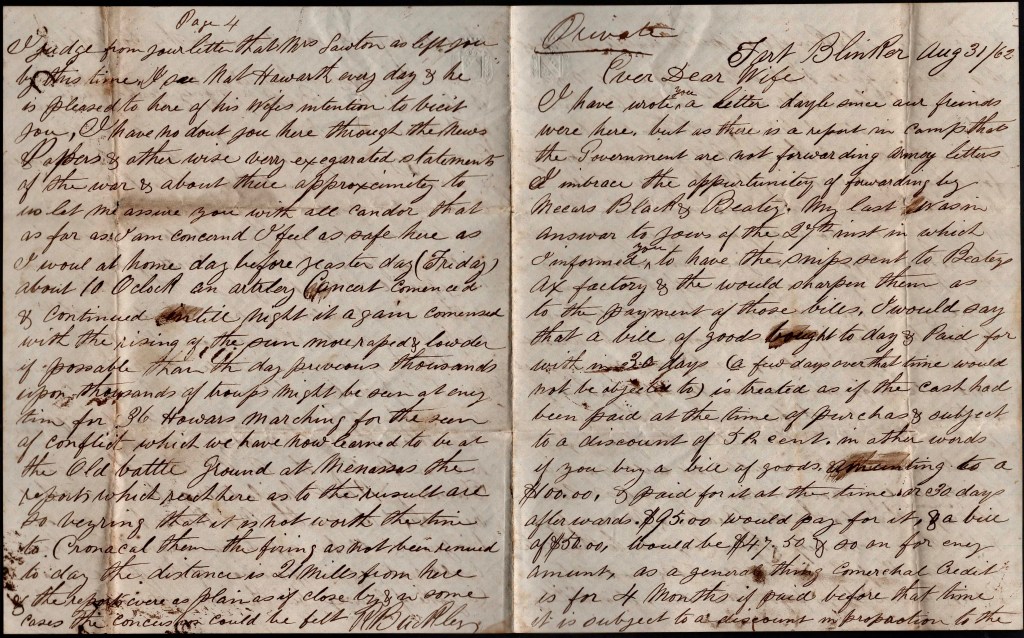
I have wrote you a letter daily since our friends were here but as there is a report in camp that the Government are not forwarding army letters, I embrace the opportunity of forwarding by Messrs. Black & Beatey….[business discussion].
I am exceedingly sorry to hear of mother’s not being well & hope she has recovered before this. Edwin [Blakely] is well & his foot having recovered, in fact, in a word, I could say the whole company is well & as far as I know are as satisfied as can be expected. I must say to you that I have one of those most endearing pets (boils) on the back of my neck & I assure you that I am a soldier anyhow. On one side the pain admonishes me to keep erect on that side.
We have not seen a secesh—that is, if we be allowed to, except mosquitoes. There are a goodly number of them here. In posting the pickets the other night, Tommy Kents hailed me to know what he would so as the mosquitoes had seized his gun and all his efforts was unavailing as he could not regain possession of his piece again (a joke of course). But they are a pest to [be sure] at night.
I judge from your letter tat Mrs. Lawton has left you by this time. I. see Nat Haworth every day & he is pleased to hear of his wife’s intention to visit you. I have no doubt you hear through the newspapers & otherwise very exaggerated statements of the war & about their proximity to us. Let me assure you with all. candor that as far as I am concerned, I feel as safe here and I would at home. Day before yesterday (Friday) about 10 o’clock, an artillery concert commenced and continued until night. It again commenced with the rising of the sun, more rapid and louder if possible than the day previous. Thousands upon thousands of troops might be seen at any time for 36 hours marching for the scene of the conflict which we have now learned to be at the old battle ground at Manassas. The reports which reach here as to the result are so varying that it is not worth the time to chronicle them. The firing has not been renewed today. The distance is 21 miles from here. The reports were as plain as if close by & in some cases the concussion could be felt. — R. Buckley

Letter 6
Camp Blenker
September 4, 1862
Dear Wife,
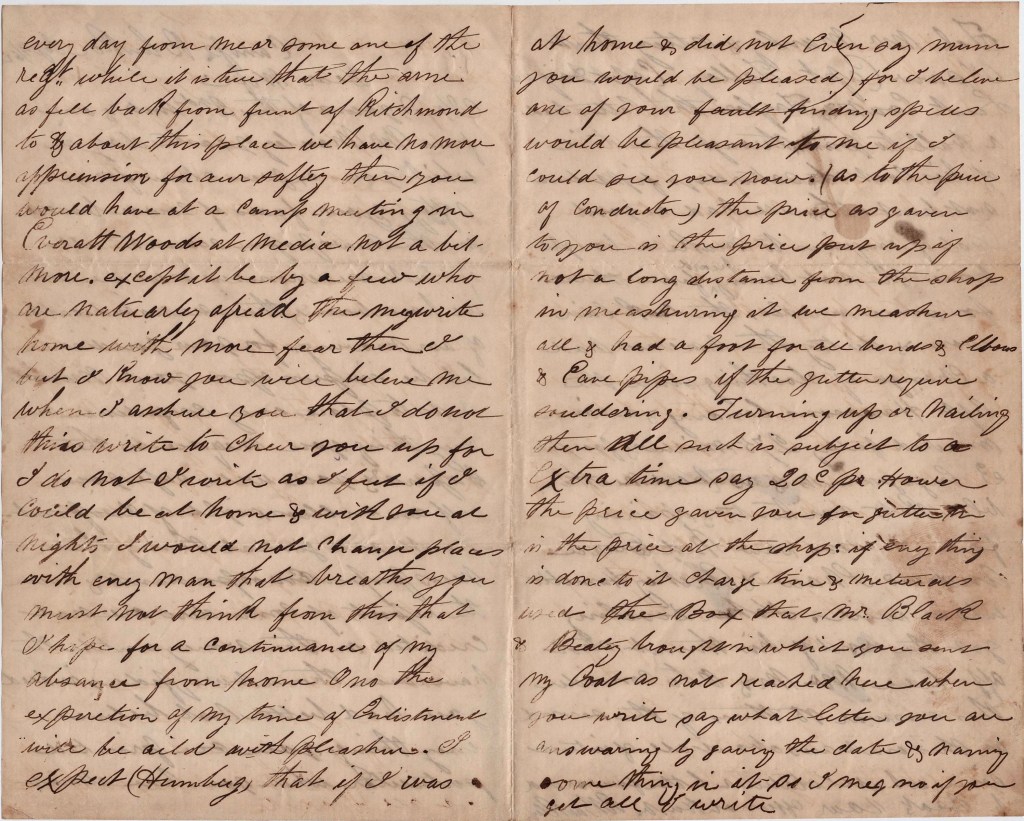
I received yours the 2nd inst. & one from Mr. Manley yesterday in which you express alarm for our safety, your fears of course based on the newspaper accounts, all of which are erroneous as we are where we have been & there are no indications of our moving. For your guidance, let me impress upon your mind not to place any confidence on anything you may see in the papers & you will save yourself an endless sight of disappointment. As a general thing, the newspaper correspondents & even the reports of commanders are not credited in the army until they have seen them verified. Indeed, you had better not believe anything you see printed, particularly when you hear almost every day from me or someone of the regiment. While it is true that the army has fell back from front of Richmond to about this place, we have no more apprehension for our safety than you would have at a camp meeting in Everett Woods at Media—not a bit more, except it be by a few who are naturally afraid. The men write home with more fear than I but I know you will believe me when I assure you that I do not thus write to cheer you up for I do not. I think as I feel. If I could be at home & with you at nights, I would not change places with any man that breathes. You must not think from this that I hope for a continuance of my absence from home. Oh no. The expiration of my time of enlistment will be hailed with pleasure. I expect (Humbug) that if I was at home & did not even say mum, you would be pleased for I believe one of your fault finding spells would be pleasant to me if I could see you now.
As to the price of conductors, the price was given to you is the price put up if not a long distance from the shop in measuring it. We measure all & had a foot for all bends & elbows & eve pipes if the gutter requires soldering. Turning up or nailing then all such is subject to extra time, say 20 cents per. However the price given you for gutters is the price at the shop. If anything is done to it, charge time and materials used.
The box that Mr. Black and Beaty brought in which you sent my coat has not reached here. When you write, say what letter you are answering by giving the date and naming something in it so I may know if you get all I write. Tell Mr. Manly & Ottey that I saw Capt. [William Cooper] Talley, Capt. [Samuel A.] Dyer, Lieut. [Joseph R. T.] Coates, & [John Hewes] Taylor [of the 1st Pennsylvania Reserves (30th Penn. Regiment)] The latter [John H. Taylor of Co. C] 1 had a ball to pass through the tail of his coat at Saturday’s fight but not hurt. They all had a good deal of enquiries to make about home, they not having heard from there for some weeks. They look careworn and dirty. They have not had a change of clothing since they left Harrison’s Landing and has since marched fully 275 miles & fought three engagements & has had neither blankets nor tents & sparing feed. I also saw Ned Farra, Andrew Shaw, and Archy Hamilton who are well. John Develing got the end of his thumb shot off. Tell Mr. Manly and Ottey to consider this answer to them of the second as this embraces about all of interest… Your affectionate husband, – R. Buckley
1 Days later, 2nd Lt. John Hewes Taylor of Co. C, 1st Pennsylvania Reserves (30th Pa. Regt.) was killed in action on 14 September at Turner’s Gap on South Mountain.

Letter 7
Camp near Fairfax Station [Virginia]
December 21, 1862
Dear Wife & Mother,
I was much pleased to receive a letter from you last night and was much gratified to learn that you was still well in health. Also that mother was the same. I can say for myself that I never was better nor stronger in all my life. If I can have a continuance of the same blessing until the expiration of our time, I shall return to you, I have no doubt, with more bodily vigor than I ever possessed before I left you and I might as well say that I think that I shall return to you perhaps stronger in affection. If so, the pleasure it will afford us to be if possible more happy in each other, will compensate us for our temporary separation.
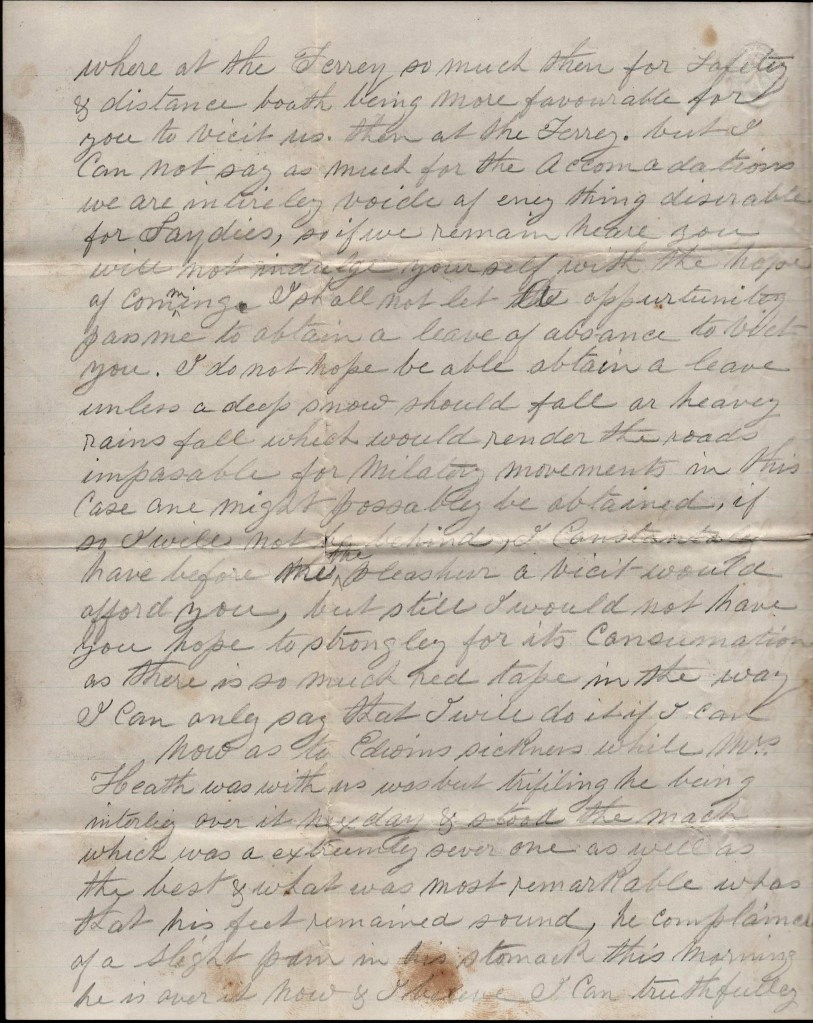
You say that you are grieved that we left Harpers Ferry. You need not have any uneasiness as to our safety. We are here located in a beautiful pine grove about three quarters of a mile in a southeast direction from Fairfax Station to which point the cars run daily with army supplies and passengers. We are but 18 miles from Washington so you see that we are really nearer to you. now than we were at the Ferry. So much then for safety & distance both being more favorable for you to visit us than at the Ferry. But I cannot say as much for the accommodations. We are in entirely void of anything desirable for ladies, so if we remain here, you will not indulge yourself with the hope of coming. I shall not let the opportunity pass me to obtain a leave unless a deep snow should fall or heavy rains fall which would render the roads impassable for military movements. In this case, one might possibly be obtained. If so, I will not be behind. I constantly have before me the pleasure a visit would afford you, but still I would not have you hope too strongly for its consummation as there is so much red tape in the way. I can only say that I will do it if I can.
Now as to Edwin’s sickness, while Mrs. Heath was with us, was but trifling, he being entirely over it next day & stood the march which was an extremely severe one as well as the best & what was most remarkable was that his feet remained sound. He complained of a slight pain in his stomach this morning. He is over it now & I believe I can truthfully say that he is apparently as well as ever he was. Of one fact, I am certain. That is that he can withstand more fatigue than I ever thought he could. The Boys are all generally well, We have more fit for duty now than we have had since we left Fort Blenker. [Sgt.] James Carreck & [Pvt.] William Henderson are in the hospital at the Ferry. [Pvt.] John Fildes in [ ] Alexandria. The above are all that you know that are sick in our company.
I learn tonight through a letter wrote by Hunter Brook that [musician] George Heath is dead. Say if it is so & whether he got his body. I am sorry to learn that. Hargreves baby has been indisposed & hope it is again strong & that he and his whole family will be blessed with good health. I again ask you to excuse me to him for not writing to him. You can say to him that this is wrote in the open. We are only only a few degrees below from upon my knees, a shingle for a desk, a pine fire in front of me blinding me with its clouds of smoke & my back freezing. Bear this as long as you can, then turn round, thaw your back, your front will in its turn become frozen & hands numb with pain at their ends again. Wheel to and fro in turn. In this way, you can write providing you are smoke proof. I confess I am not. My eyes are sore with rubbing them. I am in hopes we shall be able to get a stove in a day or two, then we can write in our tent when he can expect a letter. I shall not forget Fred neither. As to your giving him the extra wages is all right…. [business discussion]
So mother is going to be Kris Kringle’s agent to Christmas & then retire. well you know best. We cannot advise you not knowing the state of things about Media. Do what you think best. I must now conclude. I do not know that I shall be able to wash the smoke off my face again. The writing of this letter has burnt it in. Your very affectionate husband, — Ralph Buckley



Letter 8
Camp near Fairfax Station
December 29, 1862, Tuesday, 9 a.m.
Dear wife & mother,
I have no doubt the newspapers have told you that our Corps left this place on Sunday morning & as is usual I suppose they have led the public to anticipate some grand result favorable to the Union to grow out of said movement. Whatever may have been the paper’s version of the affair, I know not, as we have seen none for a few days but as it is the habit of publishers to exaggerate the most trifling thing into some great exploit, I suppose they have not diverged from their wonton course in this instance. The whole thing is soon told. We broke camp on Sunday morning about 8 a.m. with about 22,000 men with artillery and forage teams & everything in light marching order, the men with three days provision in their feed bags which they carry by means of a strap thrown over their shoulder. Off we went and reached Occuquon Creek about one o’clock p.m. on the same day.
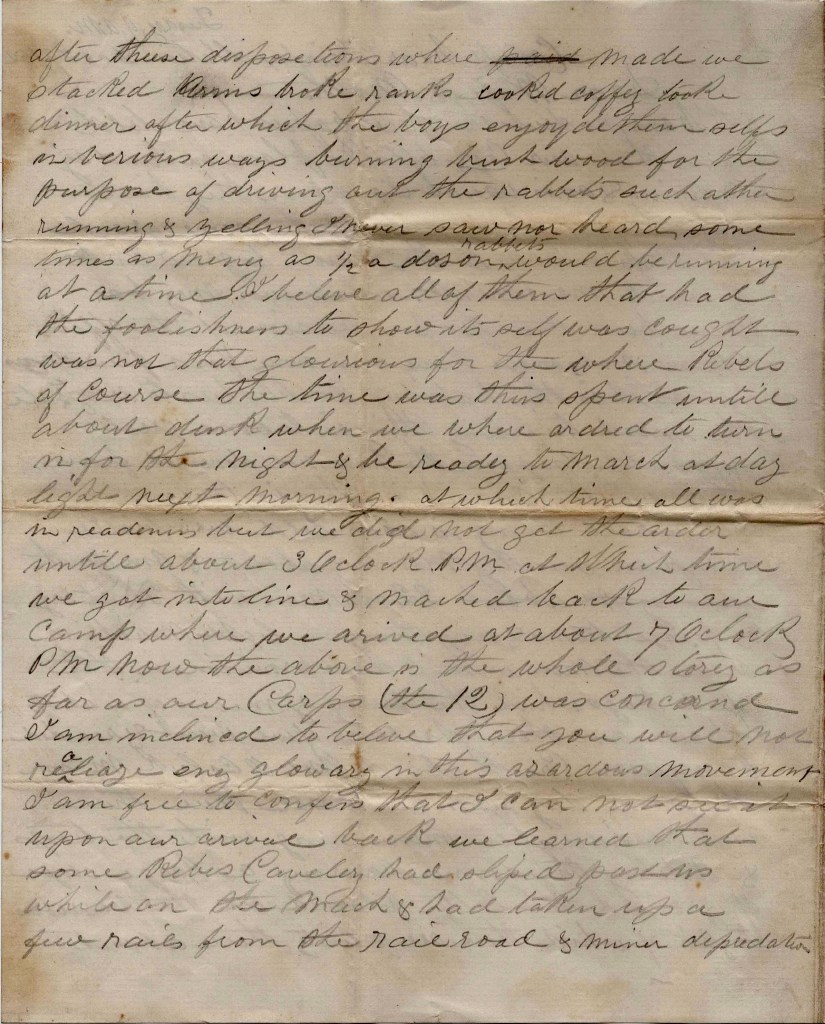
Upon our arrival, there was considerable maneuvering with the troops and artillery, the former covering a large scope of ground, the latter planted on the various heights of which there are plenty thereabouts. After these dispositions were made, we stacked arms, broke ranks, cooked coffee, took dinner, after which the boys enjoyed themselves in various ways, burning brush wood for the purpose of driving out the rabbits, such other runnings & yelling I never saw nor heard. Sometime as many as half a dozen rabbits would be running at a time. I believe all of them that had the foolishness to show itself was caught. Was not that glamorous? The time was thus spent until about dark when we were ordered to turn in for the night & be ready to march at daylight next morning at which time all was in readiness but we did not get the order until about 3 o’clock p.m. at which time we got into line & marched back to our camp where we arrived at about 7 o’clock p.m.
Now the above is the whole story as far as our Corps (the 12th) was concerned. I am inclined to believe that you will not realize any glory in this hazardous movement. I am free to confess that I cannot see it. Upon our arrival back we learned that some Rebel Cavalry had slipped past us while on the march and had taken up a few rails from the railroad & minor depredations but as we can not get two tales alike, I refrain from stating any of them. I will add that Edwin & myself are as well as ever & the boys do not seem to be any the worse for the tramp. This has been wrote in a great hurry…
This affair will serve to illustrate what I referred to in my last—namely, that moving did not often imply danger to us. Here is a case in point. I have already wrote more than I expected my time would admit of & I must now conclude hoping you and our friends a Happy New Years. Your affectionate husband, — R. Buckley
We have not had a mail here for 4 days.


Letter 9
Fairfax Station, Va.
January 2, 1863
Yours of the 31 ult. by politeness of Lieut. [Joseph G.] Cummins reached me last evening. Also the articles named therein which embraced all that I was particularly in need of. I was sorry to learn of mother’s ill health & hope she has recovered. I was surprised to hear that she entertained the notion of coming here. I seriously implore her not to do it. There could not be a more uninviting place for a woman than our present encampment & we have not the wherewithal to make it better & there is no house where accommodations can be had, besides the difficulties in the way of getting here. I will name some of them. In the first place, you need a voucher from some person who is well known at Washington. With this voucher you go to the Provost Marshal’s. If he is acquainted with the party who gave you your voucher, he may give you a pass to cross the river. If he should not be acquainted with the party, you will be subjected to have a voucher who is known. Now suppose you get passed across the river & reached Alexandria. You are 15 miles from us with two ways of getting to us.
If you should desire to come by rail, you must again obtain a pass to do so. you must understand that this railroad is exclusively for army supplies & runs only when they are ready to do so. They have no passenger cars attached so you have to ride in amongst the freight with a bale of hay, a bag of oats, a barrel of pork, or some other commodity that enters to the list of supplies for an army… The other way is…to hire a conveyance at Alexandria & drive out for which they will charge you 8 or 9 dollars. I know not indeed whether you can get a conveyance of this kind just now at any price as it is somewhat arduous owing to the Rebel cavalry hovering around here. So you see this course might give you a trip to Richmond or some other place of Rebeldom. I hope I have said enough to deter not only Mother but any lady from attempting to come here. Jane Shaw, Meeker Toomes, and Howarth I understand accompanied Cummings to Alexandria but owing to the dificulty in getting a pass on the cars, have not yet reached here and will not be likely to come today and may not get a pass at all.
I am & so in Edwin still well. I see the papers are full of the doings of the Rebs hereabouts. I can ably say that we have seen none of them nor none of their doings. This will satisfy you that we are at least not alarmed about them. We seem to be like little George & his playmates when they play hide & seek—that is to say that while our commanders & the commanders of the Rebels are as the papers would have us behave almost in the same woods, they must indeed be hid or they must in virtue of their closeness see each other. We have not seen them. Mr. James is stated. I hope. to catch him with this for you. — R. Buckley


Letter 10
Camp Fairfax Station, [Virginia]
January 9, 1863
Dear Wife & Mother,
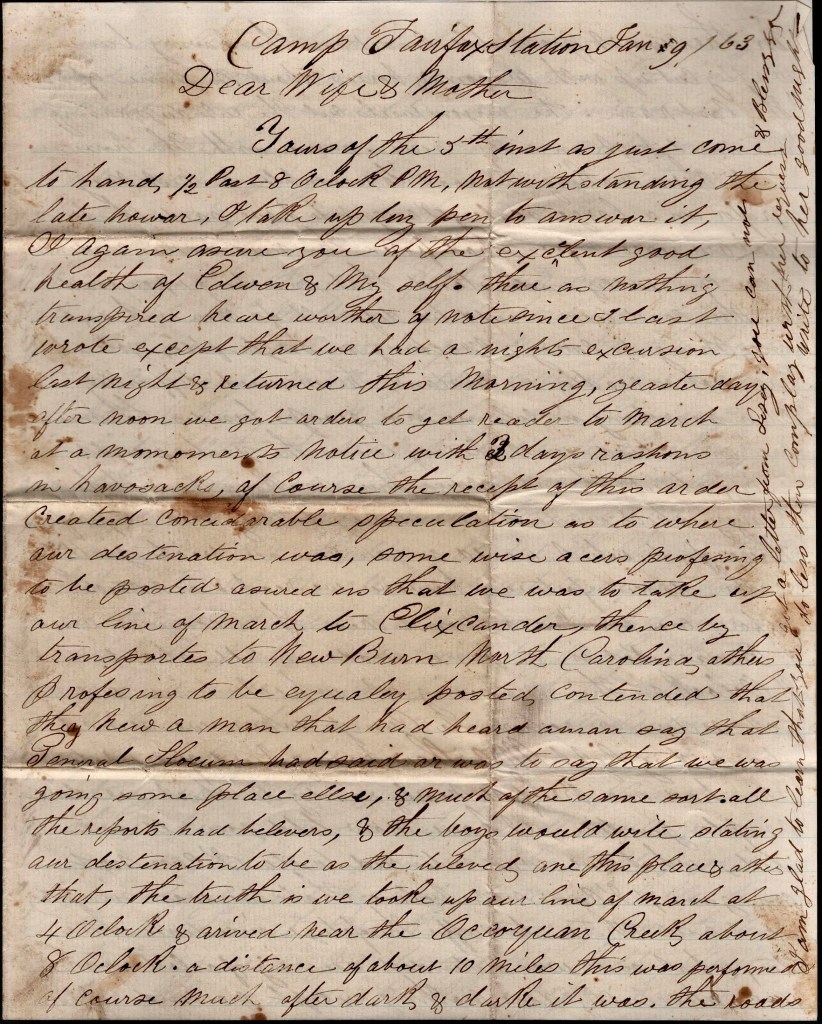
Yours of the 5th inst. has just come to hand, half past 8 o’clock p.m. Notwithstanding the late hour, I take up my pen to answer it. I again assure you of the excellent good health of Edwin & myself. There has nothing transpired here worthy of note since I last wrote except that we had a night’s excursion last night and returned this morning.
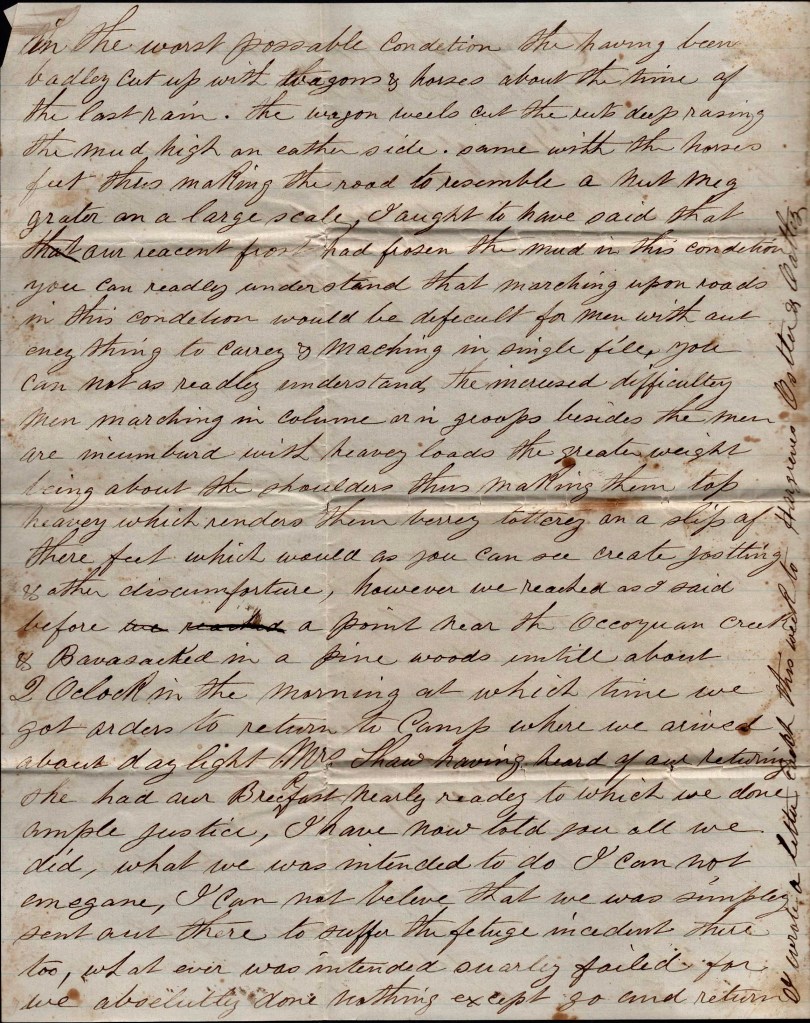
Yesterday afternoon we got orders to get ready to march at a moment’s notice with three days rations in haversacks. Of course the receipt of this order created considerable speculation as to where our destination was, some wiseacres professing to be posted assured us that we was to take up our line of march to Alexandria, then by transports to New Bern, North Carolina. Others professing to be equally posted, contended that they knew a man that had heard a man say that General Slocum had said or was to say that we was going some place else, & much of the same sort. All the reports had believers & the Boys would write stating our destination to be as they believed one of the places, and others that. The truth is we took up our line of march at 4 o’clock & arrived near the Occoquon Creek bout 8 o’clock—a distance of about 10 miles. This was performed. of course much after dark & dark it was.
The roads in the worst possible condition, they having been badly cut up with wagons and horses about the time of the last rain. The wagon wheels cut the ruts deep, raising the mud high on either side. Same with the horses feet, thus making the road to resemble a nutmeg grater on a large scale. I ought to have said that our recent frost had frozen the mud in this condition. You can readily understand that marching upon roads in this condition would be difficult for men without anything to carry & marching in single file. You cannot as readily understand the increased difficulty of men marching in column or in groups. Besides, the men are encumbered with heavy loads, the greater weight being about the shoulders, thus making them top heavy which renders them very tottery and a slip of their feet which would as you can see create jostling & other discomfiture. However, we reached as I said before a point near the Occoquan Creek & bivouacked in a pine woods until about 2 o’clock in the morning at which time we got orders to return to camp where we arrived about daylight.
Mrs. Shaw having just heard of our returning, she had our breakfast nearly ready to which we done ample justice. I have now told you. all we did. What we intended to do, I cannot imagine. I cannot believe that we was simply sent out there to suffer the fatigue incident thereto. Whatever was intended surely failed for we absolutely done nothing except go and return. So you see, those who wrote home about our moving caused their friends unnecessary uneasiness.
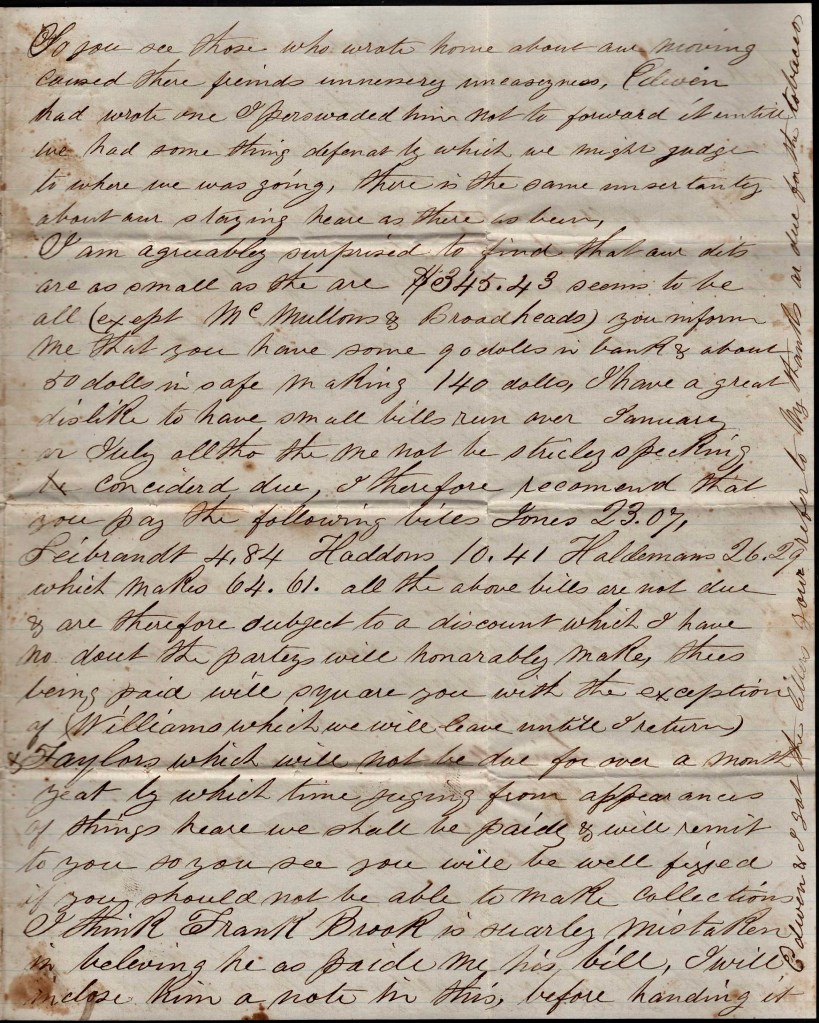
Edwin had wrote one [but] I persuaded him not to forward it until we had something definitely which we might judge to where we was going. There is the same uncertainty about our staying here as there has been.
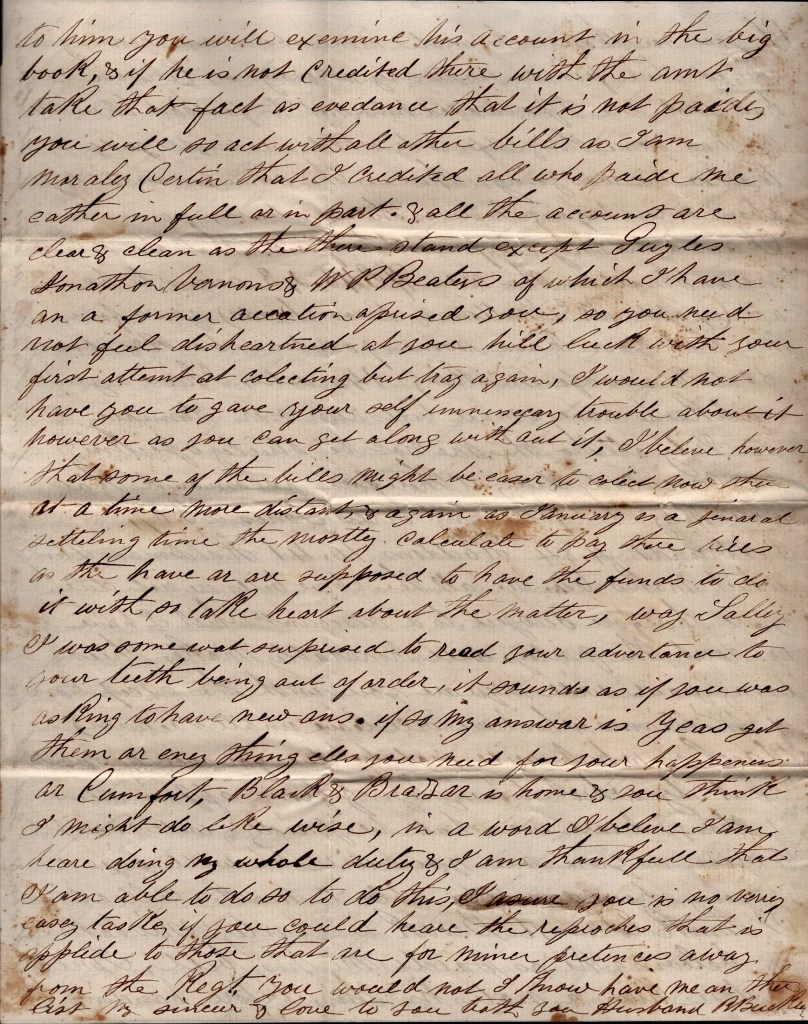
I am agreeably surprised to find that our debts are so small as they are. $345,43 seems to be all (except McMullins and Broadheads). You informe that you have some 90 dollars in the bank and about 50 dollars in safe making 140 dollars. I have a great dislike to have small bills run over January or July….[business discussion]
My sincere love to you both. Your husband, — R. Buckley
Letter 11
[Editors. Note: This letter was written to Thomas Franklin Beatty (1824-1883), the son of William and Deborah (Fell) Beatty of Delaware county. In the 1860 US Census he was enumerated in Springfield, Delaware county, PA. employed as an “Edge Tool Maker.” By 1870, he had relocated to Philadelphia and was employed as a machinist.]
Camp near Fairfax Station, Va.
January 13, 1863
To Mr. Thomas F[ranklin] Beatty
Dear Sir,
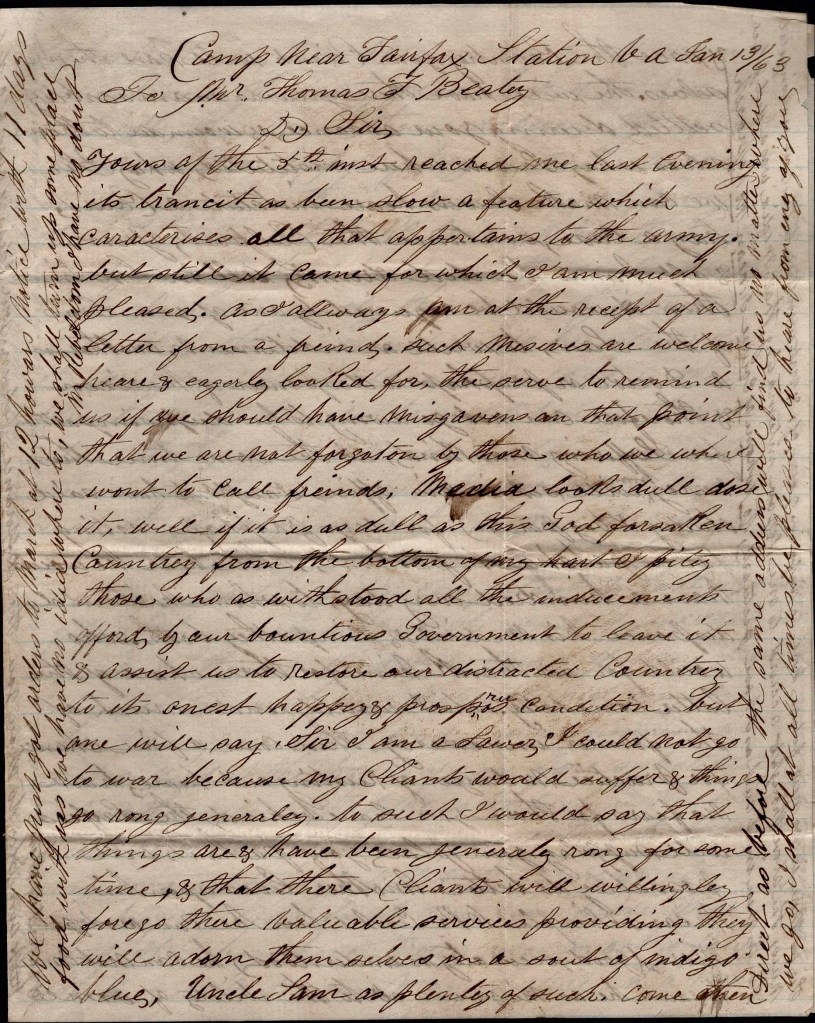
Yours of the 5th inst. reached me last evening. Its transit has been slow—a feature which characterizes all that appertains to the army, but still it came for which I am much pleased as I always am at the receipt of a letter from friend. Such missives are welcome here and eagerly looked for. They serve to remind us if we should have misgivings on that point that we are not forgotten by those who we were wont to call friends.
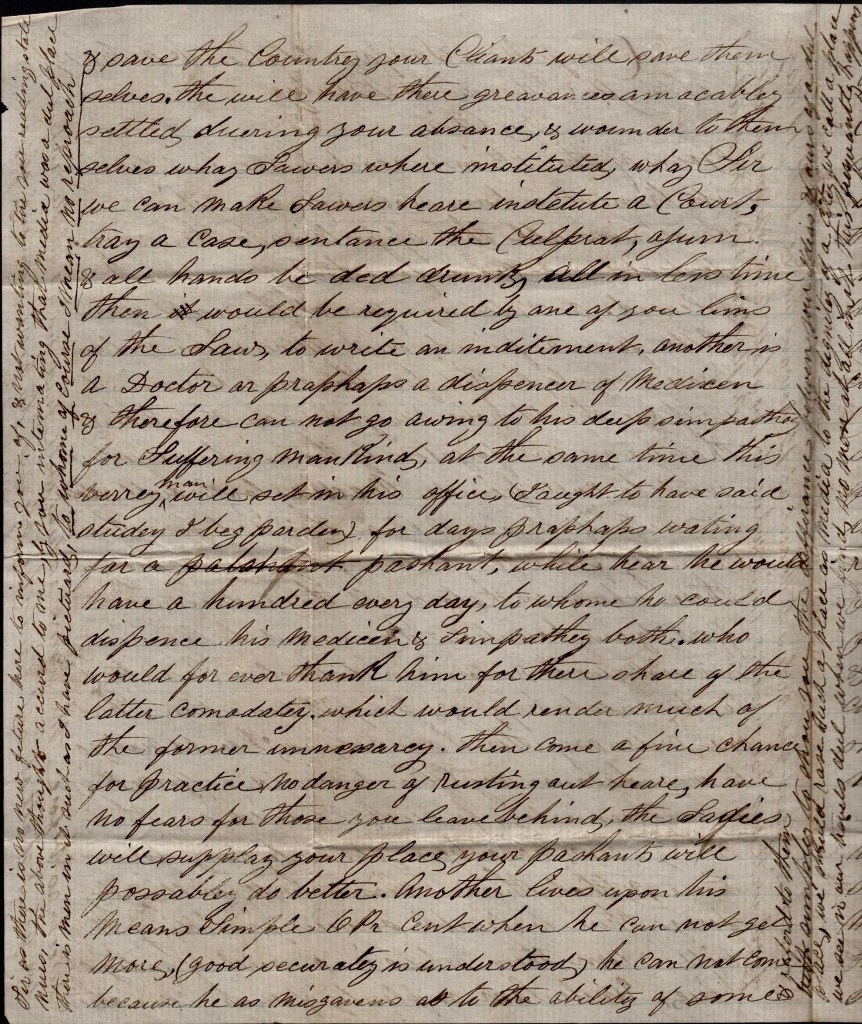
Media looks dull, does it? Well, if it is as dull as this God forsaken country from the bottom of my heart I pity those who has withstood all the inducements afforded by our bounteous Government to leave it and assist us to restore our distracted country to its once happy and prosperous condition. But one will say, “Sir, I am a lawyer. I could not go to war because my clients would suffer and things go wrong generally.” To such I would say that things are & have been generally wrong for some time & that their clients will willingly forego their valuable services providing they will adorn themselves in a suit of indigo blue. Uncle Sam has plenty of such. Come then and save the country. Your clients will save themselves. They will have their grievances amicably settled during your absence & wonder to themselves why lawyers were instituted. Why Sir, we can make lawyers here, institute a court, try a case, sentence the culprit, adjourn and all hands be dead drunk all in less time than would be required by one of you lions of the Law to write an indictment.
Another is a doctor or perhaps a dispenser of medicine & there cannot go owing to his deep sympathy for suffering mankind. At the same time this very man will sit in his office (I ought to have said study, I beg pardon) for days perhaps waiting for a patient while here he would have a hundred every day to whom he could dispense his medicine & sympathy both who would forever thank him for their share of the latter commodity, which would render much of the former unnecessary. Then come a fine chance for practice, no danger of rusting out here. Have no fears for those you leave behind. The ladies will supply your place. Your patients will probably do better.
Another lives upon his means simple 6 percent when he cannot get more (good security is understood). He cannot come because he has misgivings as to the ability of some of his customers. To such I would say, by all means come. Here is the very place. He need not have a cent idle, Our men and thousands besides them have not received a copper of pay since they came and in many cases there is consequent suffering. Then let these Shilocks come & relieve this suffering by loaning their treasure to the soldiers with Uncle Sam for security. This can be cooly done—no difficulty. The investment would be safe and how consoling such charitable acts would be to the conscience (if shavers can be said to have any).
I am a store keeper & must necessarily stay at home to provide for those who are notable to go to war. This, Sir, is praiseworthy in you, but please remember that you have sisters. If not, there are plenty of ladies fully competent to take your place. They will anticipate the wants of your customers & wait on them as kindly as yourself. If you should come and return with your valuable head on your shoulders, you will find your business has not suffered at the hands of your fair substitutes.
Another suggests that he is virtually in the service now—he is making blankets. Well, thanks to him. I say come on here & follow the army on its marches & my word for it, you can find more in one day that the boys have thrown away on account of fatigue that your mill can manufacture in a month with no trouble than simply picking them up & by this means you would be doing the country good service by keep the blankets out of the Rebels hands, who always follow in our wake to gather such pickings.
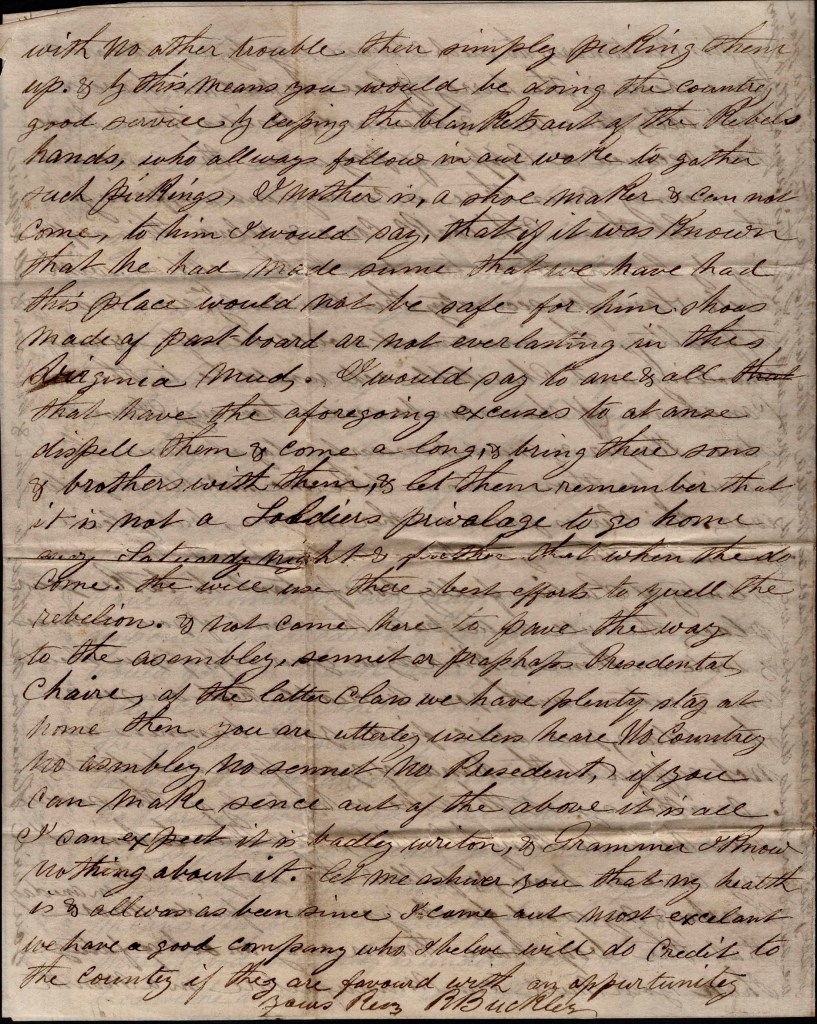
Another is a shoe maker & cannot come. To him I would say that if it was known that he had made some that we have had, this place would not be safe for him, Shoes made of paste board are not everlasting in this Virginia mud. I would say to one and all that have the foregoing excuses to at once dispel them and come along & bring their sons & brothers with them, and let them remember that it is not a soldier’s privilege to go home every Saturday night & further, that when they do come, they will use their best efforts to quell the rebellion & not come here to pave the way to the assembly, senate, or perhaps Presidential chair. Of the latter class, we have plenty. Stay at home then. you are utterly useless here. No country, no assemble, no senate, no President.
If you can make sense out of the above, it is all I can expect. It is badly written & grammar I know nothing about it. Let me answer you that my health is and always has been since I came out most excellent. We have a good company who I believe will do credit to the country if they are favored with an opportunity. Yours, — R. Buckley
We have just got orders to march at 12 hours notice with 11 days food with us, We have no idea where to. We shall turn up some place in Rebeldom I have no. doubt. Direct as before the same address will find us no. matter where we go. I shall at all times be pleased to hear from any of you.
Sir, as there is new feature here to inform you of, and not wanting to tire you reading state news, the above thought occurred to me by your intimating that Media was a dull place. There is men in it such as I have pictured to whom of course I mean no reproach and referred to them simply to show you the difference between your ideas and ours of a dull place. We should raise such a place as Media to the dignity of a city. We call a place we [come across] in our travels dull when we find no men at all in it. This frequently happens. You will remember me kindly to John & William & all enquirers.

Letter 12
Fairfax Station
January 13, 1863
Half past 9 o’clock evening
Dear Wife and Mother,
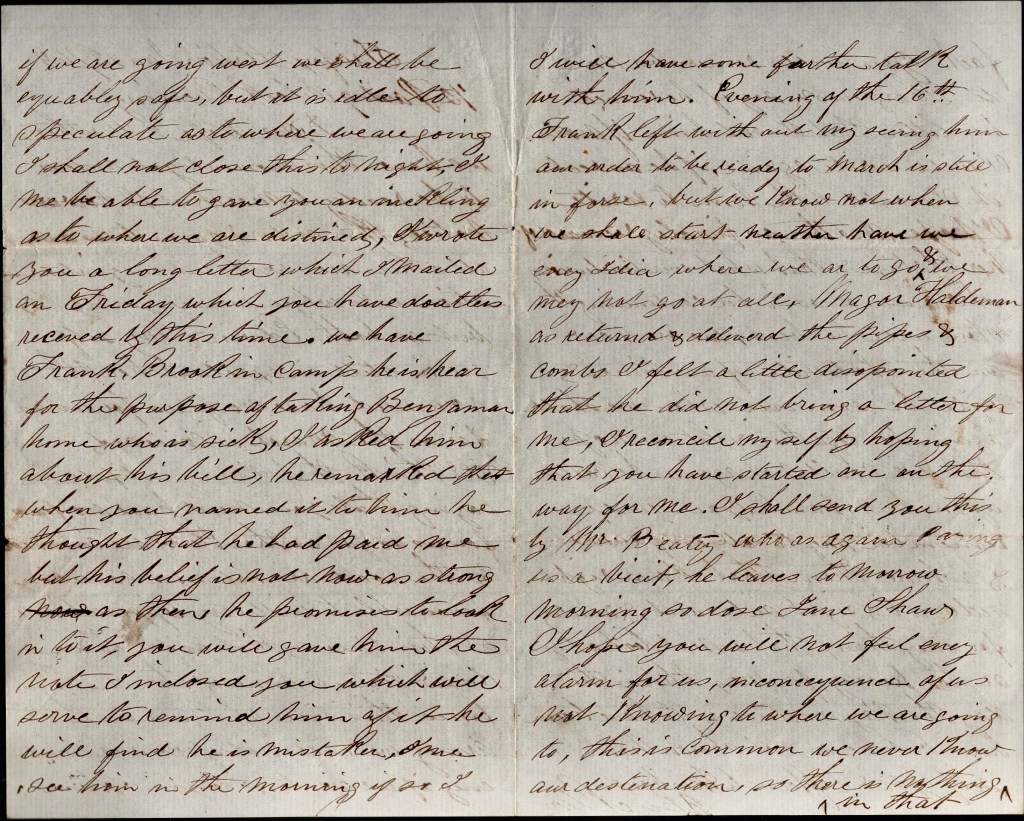
We have this moment got orders to be ready to march at 12 hours notice. This order is given to us as all others are, without any intimation as to where we are going to, but as both Edwin & myself are still in excellent health, you need have no fears for us as far as the march is concerned & I think that I am justified in saying that you need have no fears for us as far as the Rebs are concerned as the roads are not in a condition favorable to military operations at this time & that as far as we know, there is none of the enemy’s forces this side of Burnside’s Army. We will not of course meet any if we are to join him. If we are going out West, we shall be equally safe. But it is idle to speculate. as to where we are going. I shall not close this tonight. I may be able to give you an inkling as to where we are destined.
I wrote you a long letter which I mailed on Friday which you have doubtless received by this time. We have Frank Brook in camp. He is here for the purpose of taking Benjamin home who is sick. I asked him about his bill. He remarked that when you named it to him, he thought that he had paid me but his belief is not now as strong as then. He promises to look into it. You will give him the note I enclosed you which will serve to remind him of it. He will find he is mistaken. I may see him in the morning. If so, I will have some further talk with him.
Evening of the 16th. Frank left without my seeing him. Our order to be ready to march is still in force but we know not when we shall start. Neither have we any idea where we are to go and we may not go at all. Major [Lawrence] Haldeman has returned & delivered the pipes & combs. I felt a little disappointed that he did not bring a letter for me. I reconcile myself by hoping that you. have started one on the way for me. I shall send you this by Mr. Beatty who has again [been] paying us a visit. He leaves tomorrow morning. So does Jane Shaw. I hope you will not feel any alarm for us in consequence of us not knowing to where we are going to. This is common. We never know our destination so there is nothing in that fact.
You will remember me to Hargraves & say if he received his letter that I sent him. If not, I will write again. If he has received it, I would like him to write. I hope Mother has finally recovered her fatigue and that whatever conclusion she arrives at as to her continuing the store will be best.
We are now on the short side of our time & will be soon over when we shall again be together & let us hope that we shall not again be called upon to separate. You will remember me to an enquirers and assure them that I am right side up and right side out, and ready for anything that is not too hot or too heavy for me. This is the day the Paymaster was to have been here but he has not shown himself. Your affectionate husband, — R. Buckley

Letter 13
Fairfax Station
January 18, 1863
Dear Wife & Mother,
As you will see by the heading of this that we have not left as yet. We have been in readiness to do so for several days not knowing at what moment the command “Fall in!” would be sounded. Last night at 10 o’clock we were ordered to put down our tents & be ready to march at daylight this morning. The breaking up of a camp is usually the occasion of much merriment but owing to the late hour & the weather being bitterly cold, coupled with the fact that the men must of necessity lose the protection of their tents did not make the boys very jubilant but they went quietly to work and executed the order with as good grace as possible & doubled themselves up in their blankets hoping to have a little sleep before 3 o’clock, that being the time named that all hands was to be up & doing about.
At 2 o’clock, however, we received another order which countermanded the former order so far as it related to our leaving this morning but still to be ready to leave today or tomorrow morning. So you see we are virtually as far as leaving at this hour as we have been for the last week, I mailed you a long letter on Friday week & another sent by Mr. Beatty. I will forward this by Mr. Hibbarton. I have not got a letter from you this last week.
I and Edwin are still tip top. Our place of destination is still not known to us. If we leave, we will write you when we fetch up. Hoping that you are all well. I am your affectionate husband, — R. Buckley
In great haste. I am forwarding my watch by Mr. Hibbarton. It needs repairs and therefore useless to me, Here is a kiss good morning & God bless you. — R. B.


Letter 14
Dumfries Landing
January 20, 1863
Tuesday evening, 4 o’clock
Dear wife and mother.
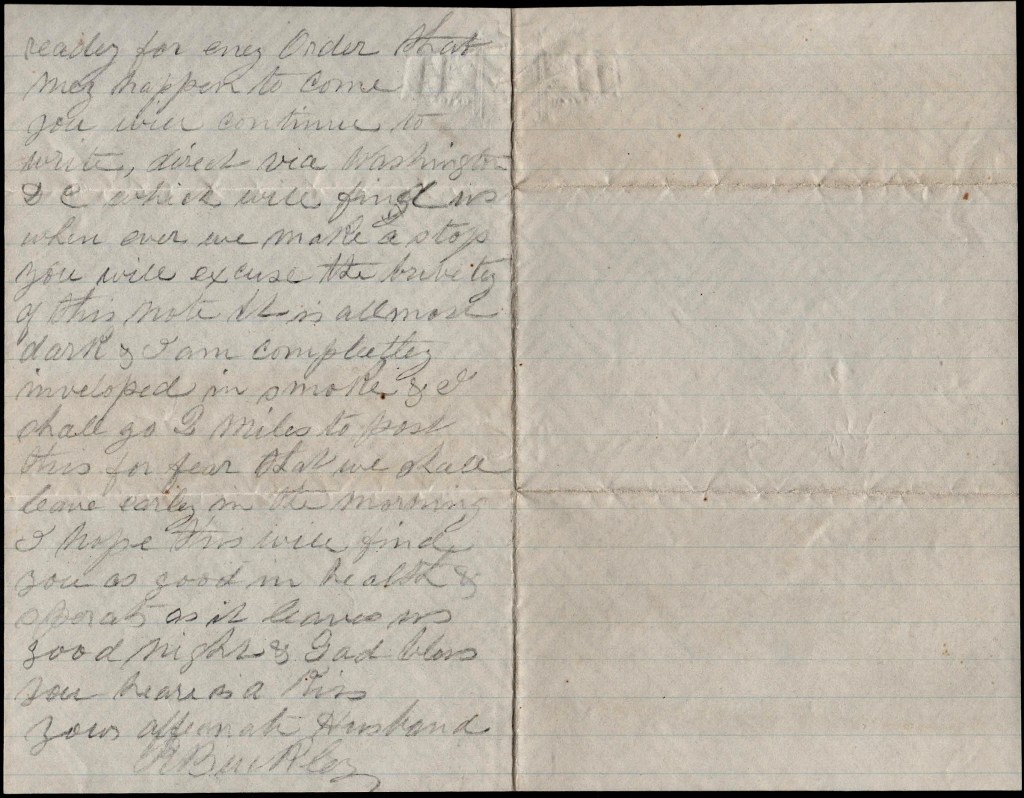
I have just arrived at this place which is on the Potomac River & about 25 miles below Washington. We left Fairfax Station about 10 o’clock on Monday & arrived here as above without any incident worthy of note. Our Corps was ordered here to await orders so we know not whether we shall leave tomorrow or not. We may do so or we might stay here for weeks. We are all right & ready for any order that may happen to come. You will continue to write. Direct via Washington D. C. which will find us whenever we make a stop.
You will excuse he brevity of this note. It is almost dark and I am completely enveloped in smoke & I shall go two miles to post this for fear that we shall leave early in the morning. I hope this will find you as good in health and spirits as it leaves us, Good night & God bless you. Here is a kiss. Your affectionate husband, — R. Buckley

Letter 15
Stafford Court House
January 25, 1863
Dear Wife,
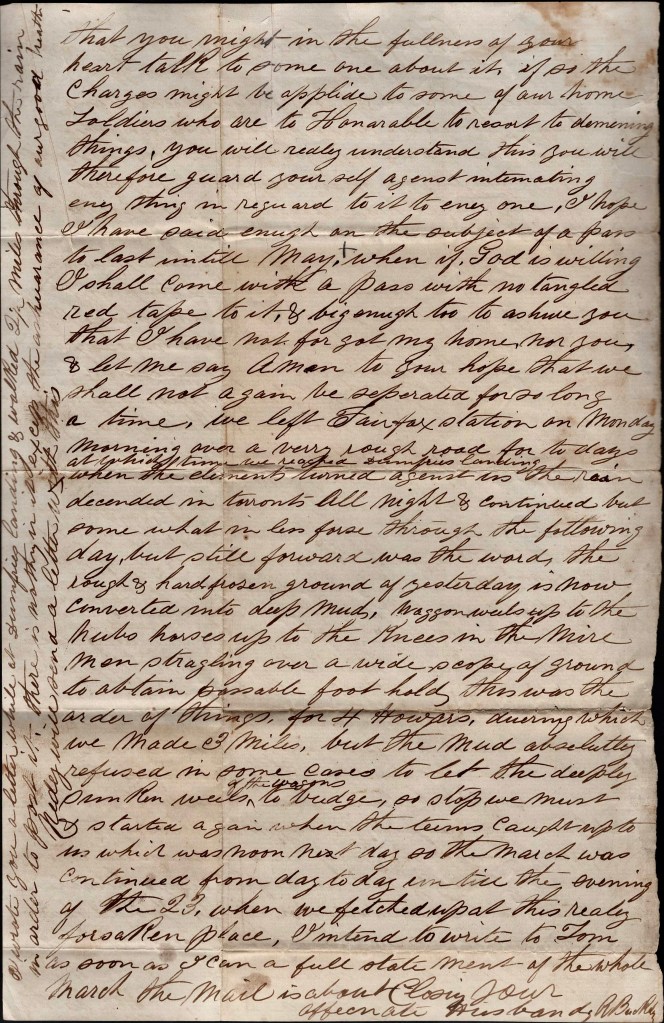
Yours of the 16th & post marked the 18th came to hand at dusk last night which is the only one I have received for over two weeks. I will not charge you with negligence or want of affection, as I have reason to know that neither exist in you. You think me hard at allowing as much time to pass from 2 to the 16th without writing to you. If such were the truth, your thoughts would be just. But it is not true. I wrote more frequent about that time than ever for the reason that preparations for a move were going on and being anxious to write you at the last moment. I sent one by Aaron James, then 4 or 5 by mail, one by Mr. Beatty, also one by Mr. Hibberton. The two last mentioned you could not have received at the time of your writing. I would like if I dared do so, to inform you of some of the means resorted to to obtain a leave of absence. I say I would if I dared. I will explain by saying bare faced and studded falsehoods, forgeries, sham telegraphs, dispatches and all manner of things, indeed nothing came to be too low than cannot be grasped & overcome if persisted in by some of our glorious soldiers in this glorious army of ours. I believe you, dear wife, to have too much respect for my manhood to have me plunge myself in every inequity which would only give us a few days pleasure than to be regretted for life. I would now have you understand what I mean when I say I dare not acquaint you of the means taken by some to get a pass which is this that you might in the fullness of your heart talk to someone about it. If so, the charges might be applied to some of our home soldiers who are too honorable to resort to demeaning things. You will readily understand this. You will therefore guard yourself against intimating anything in regard to it to anyone. I hope I have said enough on the subject of a pass to last until May, when, if God is willing, I shall come with a pass with no tangled red tape to it, & big enough too to assure you that I have not forgot my home, nor you. And let me say amen to your hope that we shall not again be separated for so long a time.
We left Fairfax Station on Monday morning over a very rough road for two days at which time we reached Dumfries Landing when the elements turned against us. The rain descended in torrents all night and continued but somewhat in less force through the following day, but still forward was the word. The rough and hard frozen ground of yesterday is now converted into. deep mud. Wagon wheels up to the hubs, horses up to the knees in the mire, men straggling over a wide scope of ground to obtain passable foot hold. This was the order of things for four hours during which we made three miles. But the mud absolutely refused in some cases to let the deeply sunken wheels of the wagons to budge, so stop we must and started again when the teams caught up to us which was noon next day. So the march was continued from day to day until the evening of the 23rd when we fetched up at this really forsaken place.
I intend to write to Tom as soon as I can a full statement of the whole march. The mail is about closing. Your affectionate husband, — R. Buckley


Letter 16
Stafford Court House
January 31, 1863
Dear Wife,
I have nothing to acquaint you of but as this is the anniversary of my birthday, it seems I should write to you if to do nothing more than to assure you that I have been permitted to live another year, one too in which many of our friends & acquaintances have passed from us, some from old age & otherwise, others prematurely whilst fighting (or under circumstances incident to) the enemies of our adopted country. Peace to the ashes & let us hope that they will be forever remembered by a grateful people. It is to be hoped that the exigencies of the year I have been permitted to enter into will not require the sacrifice of life which has made the last to be forever regretted. All mankind will respond “Amen” to this wish but none have the wisdom to divine the means by which the hope shall be realized. Both belligerents are blinded by bad passion & hatred towards each other & are too proud to listen to a friendly voice from afar. Continued suffering does not lessen the passions nor the many slaughters humble their pride. It may be that the divine Ruler has in his wisdom caused the roads here to be in the impassable condition, thus placing a barrier between the contending parties. That whilst this lull is taking place, their passions may be abated or their pride humbled & thereby come to some understanding which will avoid the further effusion of human blood. Such a result would occasion much rejoicing over the land & not the least to the soldiers who have already sacrificed their health but still hope to be permitted to return home in order that they can again see those they hold dear & that their last moments may be soothed with at least Christian feeling which circumstances denied them of here. No matter what caricature or conduct of the soldier—either Union or Rebel—there are those who hold them above price. God’s works are marvelous. Therefore, it may be as I have wrote. I would not have you think that I am either depressed in spirit or health because this letter is dictated out of my usual mode for there is not the least reason for such a belief. I am as strong as well as spiritful and as hopeful as ever.
I mailed a long letter yesterday to our friend Tom and one to Isaac Haldeman in which I described the incidents of our march, one of which you. will see. Time did not permit me to write three letters of such a length & being desirous for the parties named receive one, I therefore had one of the boys to write two copies. I hope Tom will. accept his as one as if my own pen had wrote it….
Your affectionate husband, — R. Buckley


Letter 17
Stafford Court House
February 5th 1863
Dear Wife,
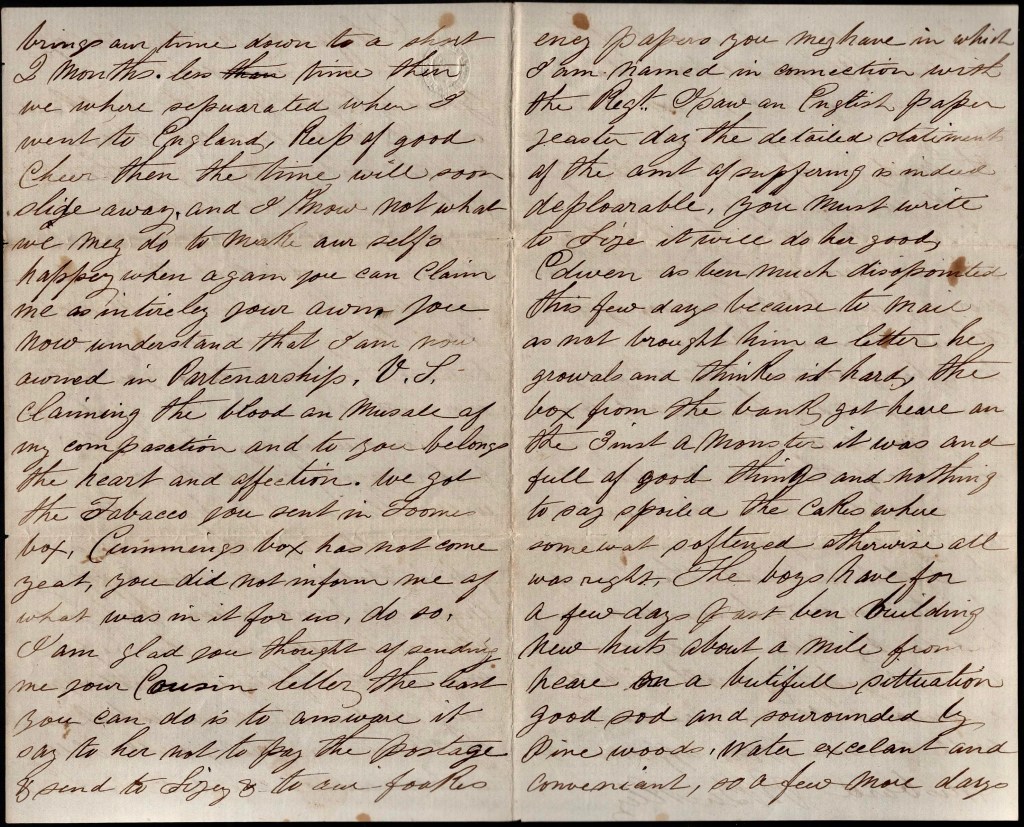
Yours by Capt. Yarnall is at hand and its contents noted. I am over the fatigue long ago. The Colonel and a private of our regiment was in company with me. We was in the storm you speak of. Perseverance and strong limbs took us through. Now Sally, do not become pettish because I did not cover you all over with praise for the affectionate manner during my absence. I prefer myself and I think you will also wish to have the praise all together instead of my installments. I am happy my visit home has done you good. That in itself more than repairs me for the fatigue. It also you say shortens the time which is so I have no doubt. Well, Sally, we have arrived at a date now which brings our time down to a short two months—less time than we were separated when I went to England. Keep of good cheer. Then the time will soon slide away and I know not what we mat do to make ourselves happy when again you can claim me as entirely your own. You now understand that I am now owned in partnership. The U. S. claiming the blood and muscle of my composition and to you belongs the heart and affection.
We got the tobacco you sent in Toomes’ box. Cummins’ box has not come yet. You did not inform me of what was in it for us. Do so. I am glad you thought of sending me your cousin’s letter. The least you can do is to answer it. Say to her not to pay the postage and send to Lizey and to our folks any papers you may have in which I am named in connection with the regiment.
I saw an English paper yesterday. The detailed statement of the amount of suffering is indeed deplorable. You must write to Lize. It will do her good.
Edwin has been much disappointed this few days because the mail has not brought him a letter. He growls and thinks it hard. The box from the bank got here on the 3rd inst. A monster it was and full of good things and nothing to say spoiled. The cakes were somewhat softened. Otherwise all was right. The Boys have for a few days past been building new huts about a mile from here in a beautiful situation—good sod and surrounded by pine woods; water excellent, and convenient. So a few more days we hope will find us out of this polluted camp. We have had 4 successive fine days which is having a wonderful influence on the mud. Such weather for two or three weeks and we shall be out of the mire. On the other hand, a days rain will render them as bad as ever again. I do not feel sorry for Lieut. Cummins. He seems in bad luck, being returned to his company. And to mend all, it now seems as if the order by which I was enabled to come home will be at once suspended and it was the Lieutenant’s turn to take the benefit of it tomorrow. He is indeed in bad luck. I have a little stomach ache today. Hoping mother is better and all our friends are well. I am your affectionate husband, — R. Buckley

Letter 18
Camp near Stafford C. H.
March 19, 1863
Dear Wife and Mother,
Yours of the 15th inst. has just come to hand, I am gratified to learn that Mother is still better & that you are well…. [business discussion]
Cummins’ box has not come here. It is very doubtful if it does come now. It is not worth you while to send me anything at present except tobacco. I am almost out. You need not trouble yourself about this even because I can get it here at a high price & not so good as Mother’s is. Our quarters are indeed comfortable. The roads are slowly drying up. The sun and wind is having a beneficial influence in this respect.
General Hooker and staff reviewed our division today which passed off creditable to us and to the entire satisfaction of the generals. I assure you such a sight is very imposing. I would dearly like you to see such a review. I must conclude hoping this will find you and all hands as well as Edwin and myself is at this time. Your affectionate husband, — Ralph Buckley

Letter 19
Camp near Aquia Creek Landing
April 1, 1863
To Thomas Hargreaves
Dear Friend,
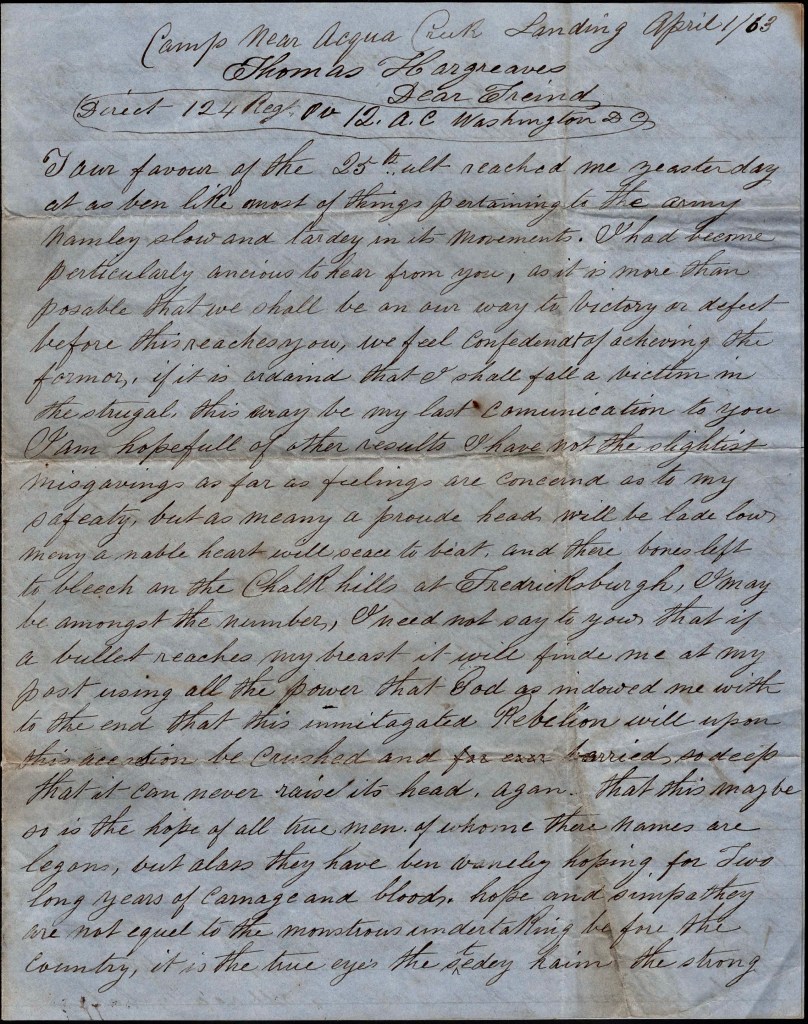
Your favor of the 25th ult. reached me yesterday. It has been like most things pertaining to the army—namely slow and tardy in its movement. I had become particularly anxious to hear from you as it is more than possible that we shall be on our way to victory or defeat before this reaches you. We feel confident of achieving the former. If it ordained that I shall fall a victim in the struggle, this may be my last communication to you. I am hopeful of other results. I have the slightest misgiving as far as feelings are concerned as to my safety, but as many a proud head will be laid low, many a noble heart will cease to beat, and their bones left to bleach on the chalk hills at Fredericksburg, I may be amongst the number. I need not say to you that if a bullet reaches my breast, it will find me at my post using all the power that God has endowed me with to the end that this unmitigated Rebellion will upon this action be crushed and buried so deep that it can never raise its head again. That this may be so is the hope of all true men of whom their names are legion, but alas they have been vainly hoping for two long years of carnage and blood. Hope and sympathy are not equal to the monstrous undertaking before the country. It is the true eyes, the steady aim, the strong arm and resolute courage of the soldiers that is to do this mighty work. I am inspired with an abridging faith that they will accomplish it. What rejoicing there will then be in this distracted land—the reunion of husband and wife, mothers and sons, sisters and brothers. And the best of all, the reunion of all the states, cemented together by blood, bound by a common interest, and one common destiny.
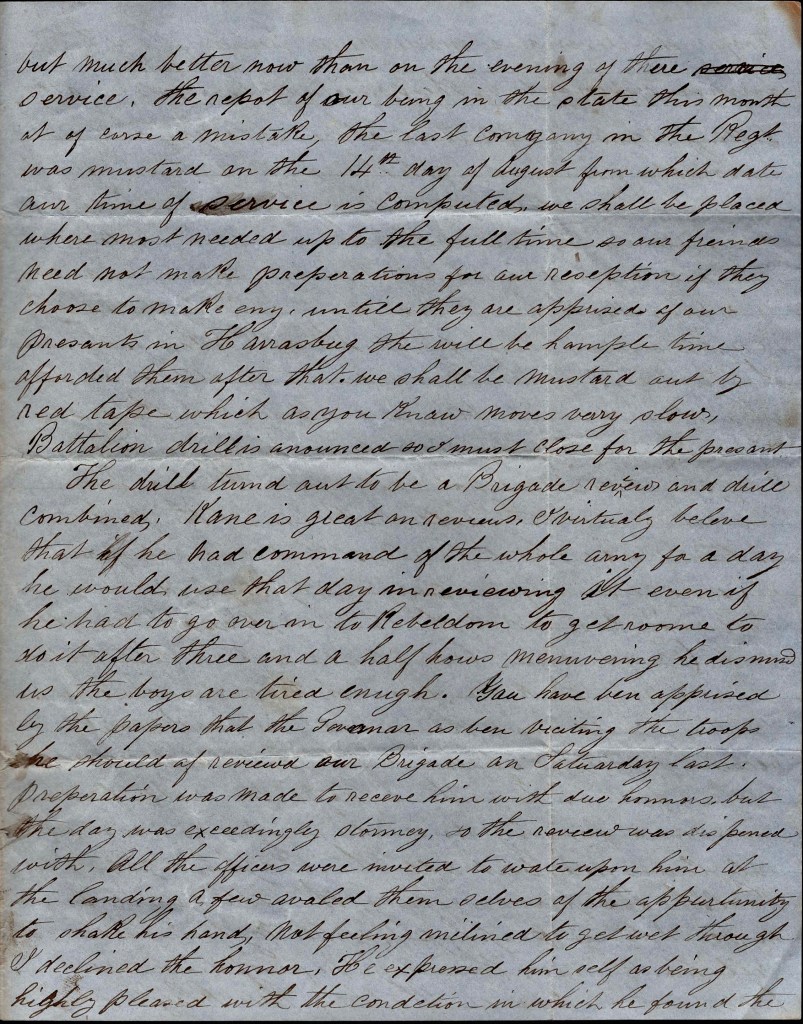
I mailed a letter to Mr. Bancroft yesterday before receiving yours. As our time for letter writing is limited, I requested him to let you read it. It shows what I believe to be the feeling and condition of this army. In a post script to the letter, I informed him of a snowfall which finally turned to rain which threatened us with those horrible roads again. I am glad to say the snow has left [and] high winds is having a good effect on the soil. The preparations are going on for the move and I believe it will go regardless of the condition of the roads. The corduroy roads—where they exist—are in traveling order and provisions will doubtlessly be made to prevent the troops from sticking in the mud. Every days delay now is a day lost in view of the term of enlistment of some 30,000 men will expire soon. These troops have cost the government a large sum of money to get them to their present state of efficiency. Now is the time if ever to get the return for this expenditure. This is the afternoon of their service, already late but much better now than on the evening of their service. The report of our being in the state this month is of course a mistake. The last company in the regiment was mustered on the 14th day of August from which date our time of service is computed. We shall be placed where most needed up to the full time so our friends need not make preparations for our reception if they choose to make any until they are apprised of our presence in Harrisburg. There will be ample time afforded them after that. We shall be mustered out by red tape whic as you know moves very slow.
Battalion drill is announced so I must close for the present.
The drill turned out to be a Brigade Review and drill combined. Kane is great on reviews. I virtually believe that if he had command of the whole army for a day, he would use that day in reviewing it even if he had to go over into Rebeldom to get room to do it. After three and a half hours maneuvering he dismissed us. The boys are tired enough.
You have been apprised by the papers that the Governor has been visiting the troops. He should of reviewed our Brigade on Saturday last. Preparation was made to receive him with due honors, but the day was exceedingly stormy so the review was dispensed with. All the officers were invited to wait upon him at the landing. A few availed themselves of the opportunity to shake his hand. Not feeling inclined to get wet through, I declined the honor. He expressed himself as being highly pleased with the condition in which he found the troops. The Governor has made many friends out of his former opponents by the solicitude he has manifested upon all fitting occasions for the soldiers.
So you and our venerable friend have got through with that unfinished job? If I understand your letter aright. time has beaten you. However, the material seems not to be wasted. It has only changed its name. It might go well as onions or cabbage. I will have it tried. I am not to be cheated that way. No. No. you must finish the undertaking…
I hope this will find you and family and all my friends as it not only leaves me but all. the regiment in good health. Keep on writing. The letters will find us some time perhaps. With my best wishes to all hands. May their days be prosperous and happy. Yours as ever, — Ralph Buckley


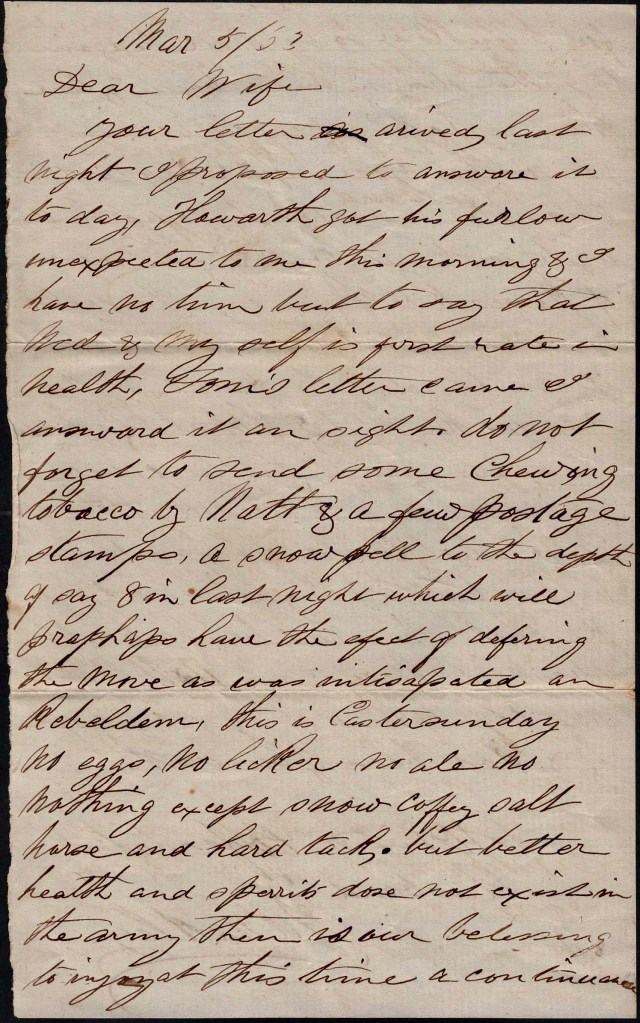
Letter 20
March 5, 1863 [should be April 5, 1863]
Dear Wife
Your letter arrived last night. I proposed to answer it today. Howarth got his furlough unexpected to me this morning & I have no time to say that Ned & myself is first rate in health. Tom’s letter came. I answered it in sight. Do not forget to send some chewing tobacco by Nat & a few postage stamps.
A snow fell to the depth of say 8 inches last night which will perhaps have the effect of deferring the move as was anticipated on Rebeldom. This is Easter Sunday. No eggs, no licker, no ale, no nothing except snow coffee, salt horse, and spirits does not exist in the army. There is one blessing to enjoy at this time—a continuance for five weeks or so we shall again to gather strong in mind, body and love. There is nothing new to acquaint you with, You will regard this note as answer to yours and write without waiting for me. If Ross’s brother has any charcoal, he will let you have some, and it can be got by the barrel at the gas works…[business discussion]
God bless you bother. Your affectionate husband, — R. Buckley

Letter 21
12th A. C. near Aquia Creek Landing
April 14, 1863
Dear Wife & Mother
I again set down to inform you that Edwin and myself are in health. I see by a letter Edwin received today that Mother is again unwell. This is not pleasant for us to hear. If hopes and desires will avail her, she will be well before this reaches you.
Preparations are fully completed to leave this place tomorrow morning with 8 days rations in knapsacks and haversacks. Although the preparations are made to leave, we may not go at all. We have had such orders before and got in readiness but have not moved, I hardly think this will be the case this time. Still I do not think we shall move tomorrow. If not, I am in hopes that the Major or Lieut. Cummns will be the bearer of a letter from you. I am anxious to have one & to hear of your good health and the recovery of Mother and Mrs. Howarth, and if Tom does not send me, I shall indeed be disappointed.

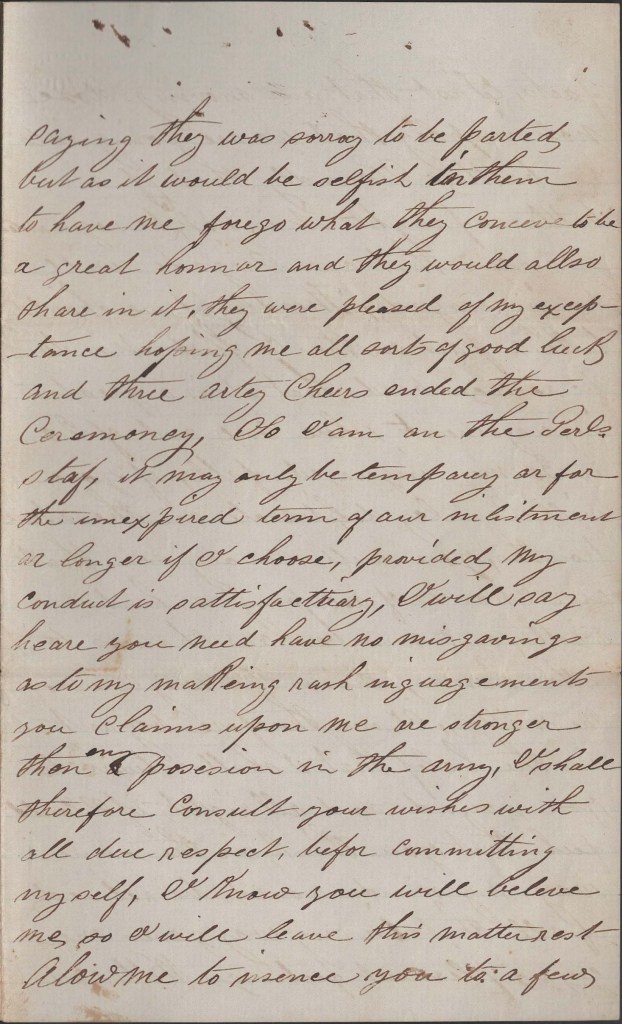
Gen. [Thomas L.] Kane formally tendered me a position on his staff this morning. This honor was not only unexpected, but undesired by me. I therefore thanked him gratefully for his marked kindness and respectively declined. At this he demurred, after flattering me and enjoining [?] on me to recall my refusal to his offers, he dismissed me and gave me an hour to make up my mind. He had consulted the Colonel who urged me in strong terms to accept. I consulted a number of the company. All of them was not only willing I should accept but desired I should do so as they not only regarded it as honorable to me (as it had been offered without solicitation) but as a mark of distinction for the company also. Notwithstanding all this persuasion, at the expiration of the limited hour, my mind was still steadfast to remain with the company, so I reported my intention of doing so to the General. He became very much out of humor and declared that such a post to go begging was seldom known in the army. “Lieutenant,” says he, “I think I am offering you your company, your Colonel, your Regiment, and your country a very marked favor, and you are standing in the way of your advancement by refusing to accept it.” I told him that my ambition did not run in that direction & persisted in stating my intention of staying with the company if my apparent stubbornness would not cause his displeasure. He answer was that however displeased he might be, “that feeling shall not be used, Lieutenant, to your disadvantage. I will give you another hour to make up your mind. I will not further persuade you in the matter believing that your own good sense will decide you to an acceptance.”
What to do in the matter? I [ ] the Colonel and all hands with whom I had consulted urged me to accept, whilst my own wish still being strongly in favor of not doing so. Another consultation with some of the boys determined me to accept and so I reported. The General expressed his pleasure on my conclusion. Whilst the boys was in line after dress parade tonight, I acquainted them with my act. They humored me by saying they was sorry to be parted but as it would be selfish in them to have me forego what they conceive to be a great honor and they would also share in it, they were pleased on my acceptance hoping me all sorts of good luck and three hearty cheers ended the ceremony. So I am on the General’s staff. It may only be temporary or for the unexpired term of our enlistment or long if I choose, provided my conduct is satisfactory, I will say here you need have no misgivings as to my making rash engagements. Your claims upon me are stronger than any possession in the army. I shall. therefore consult your wishes with all due respect before committing myself. I know you will believe me so I will leave this matter rest.
Allow me to insense [?] you to a few facts. First that our moving does not imply that we are going into battle. Secondly, that is a battle is fought, it is not to be regarded as certain that our Brigade will be engaged. Thirdly, if we should take a part in the conflict, it is to be remembered that it is a great engagement where one out of twenty or thirty men engaged falls. If you will calmly deliberate on the above truths, you. will easily see that our chances of escaping unhurt vastly outnumber our chances to take harm. This is the way I reason the matter. I am therefor buoyant in the belief that I shall return to you sound and all right. If I should feel that you think in the same way, my mind would be relieved of all that in any way gives mr any unpleasant feelings. Will you not try to reflect that your mind is foreboding evil, if of course more than unpleasant and somewhat unmans me. Encourage me then by assuring e that your mind is not affected by undue alarm for us. To know this, I should be strengthened and your constitution and weak nerves would be much saved. I desire you to be strong and on our return we shall yet enjoy many years together if God is willing. I will now close for the night with kind regards to all our friends, hoping they are all as well as I am. I remain theirs as ver, and your affectionate husband, — R. Buckley
Direct as before.
My not acceptance of the General’s offer was not because I was blind to the intended honor. My objection was based upon a desire not to do anything that would seem as if my own advancement was above my respect for the boys. To do this would be indeed ungrateful to them for they have always been respectful to me. They upon consultation, relieved my mind of this unpleasantness…I desire that you will not boast of my promotion. Regard it rather as a common place. thing. It is better for others to make it known that for you to do so. If I prove competent for the place, there is not the slightest danger of its not being known.
Morning 15th. This army seems to be fated. It has rained all night and is still doing so. We shall not certainly move today. If the rain continues, the move may be indefinitely postponed. — R. B.




Letter 22
Aquia Landing
April 24, 1863
Dear Wife & Mother,
Yours of the 19th is at hand. We are glad to learn that Mother is better and that you are well.
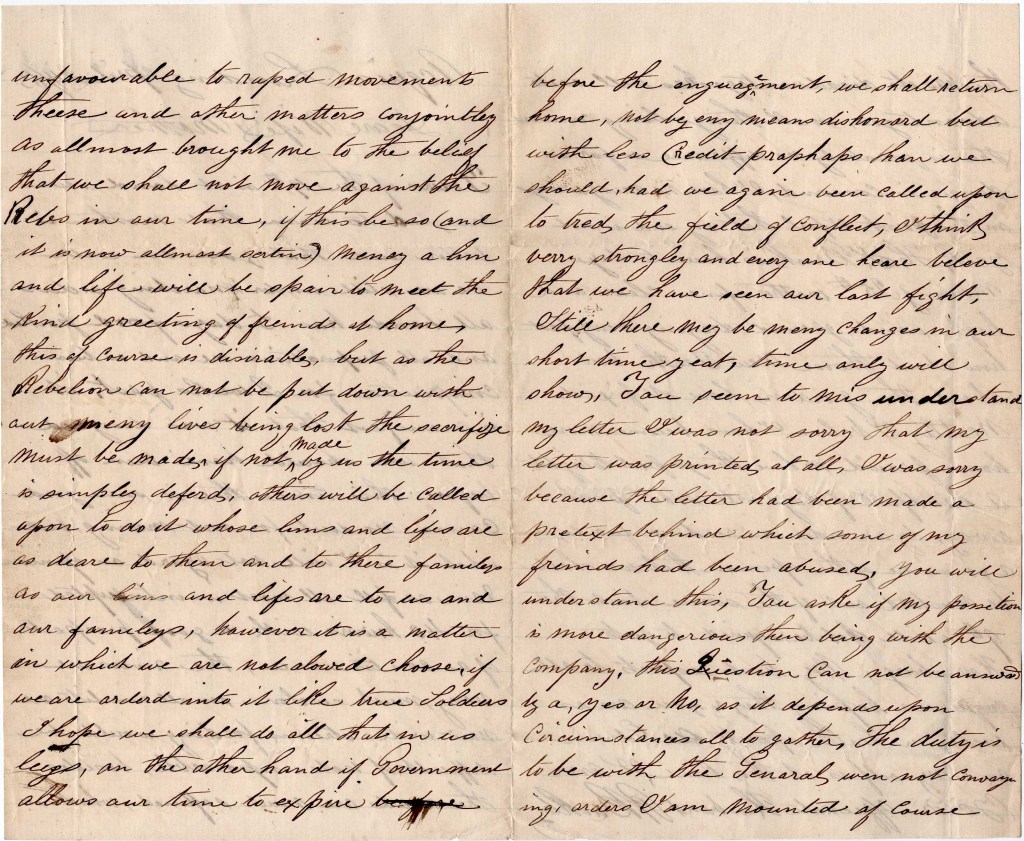
We are still under marching orders. All hands has five days food packed and all preparations are and has been completed for two weeks past. It is manifest that it was designed that we should have been off before this time. There is some good cause no doubt for not moving but what it is I will not hazards an opinion. Rain has fell almost uninterrupted for 40 hours with a good prospect of a continuance. The rivers are very much swollen. Small rivulets are now wide streams. Fording would be difficult if not impossible. Besides the roads are mud softened which is unfavorable to rapid movements. These and other matters conjointly has almost brought me to the belief that we shall not move against the Rebs in our time. If this be so (and it is now almost certain), many a limb and life will be spared to meet the kind greeting of friends at home. This of course is desirable, but as the Rebellion cannot be put down without many lives lost, the sacrifice must be made, if not by us. The time is simply deferred. Others will be called upon to do it whose limbs and lives are as dear to them and to their families as our limbs and lives are to us and our families. However, it is a matter in which we are not allowed to choose. If we are ordered into it, like true soldiers, I hope we shall do all that is in our power. On the other hand, if Government allows our time to expire before the engagement, we shall return home, but by any means dishonored but with less credit perhaps than we should, had we again been called upon to tred the field of conflict. I think. very strongly and everyone here believe that we have seen our last fight. Still there may be many changes in our short time yet. Time only will show.
You seem to misunderstand my letter. I was not sorry because the letter had been made a pretext behind which some of my friends had been abused. You will understand this. You asked if my position is more dangerous than being with the company. This question can not be answered by a yes or no as it depends upon circumstances altogether. The duty is to be with the General when not conveying orders. I am mounted of course [and] this has its disadvantages as well as its advantages so all things being considered, there is probably no difference as far as danger is concerned. I have no misgivings on this point. I feel that my end is not yet. H. F. Brooks is here today.
Morning 25th. Weather fine, clear and high wind. Ground drying very fast. How about those new teeth, How about the garden, Have it fixed neatly, I believe I have become more home proud so have things put to rights. A handful of days will soon pass away. By an order we received a few days ago we are of the opinion that we shall be mustered out of the service about the 9th & will not be required to go to Harrisburg. My best respects to all enquirers hoping they and you. are are well in health, spirits as Edwin and myself is at this time. I am your affectionate husband, — R. Buckley

Letter 23
Battlefield Chancellorsville
April 5 [should be May 5] 1863
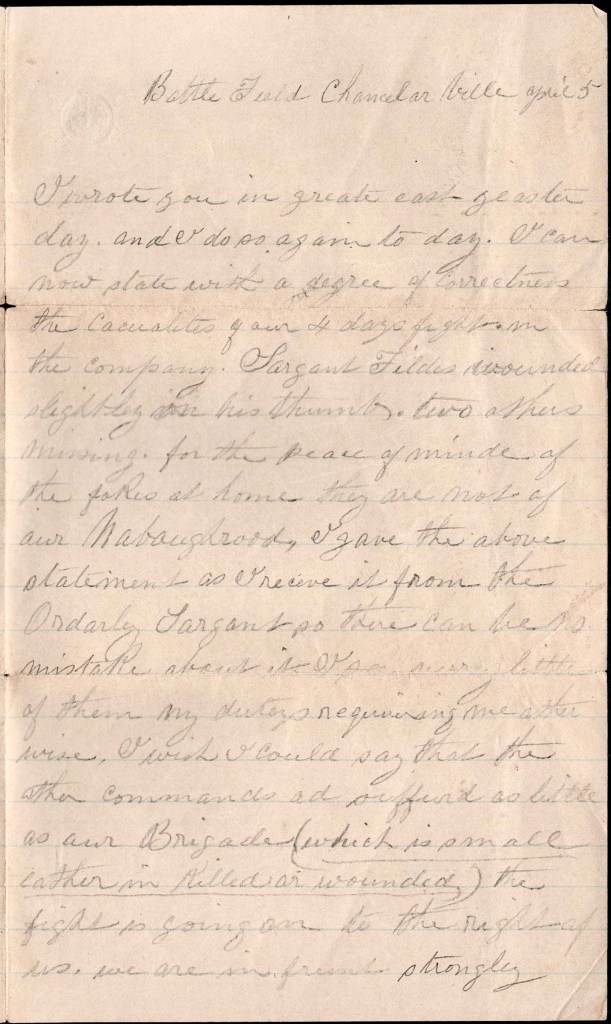
I wrote you in great haste yesterday and I do so again today. I can now state with a degree of correctness the casualties of our four days fight in the company. Sergt. [George] Fildes wounded slightly in his thumb. Two others missing. 1 For the peace of mind of the folks at home, they are not of our neighborhood. I give the above statement as I received it from the Orderly Sergeant so there can be no mistake about it. I see very little of them, my duties requiring me otherwise. I wish I could say that the other commands had suffered as little as our Brigade (which is small either in killed or wounded). The fight is [still] going on to the right of us. We are in front strongly entrenched. It is thought that we can hold it with little loss. I have not seen Edwin. He is still on the other side of the river so you need have no fears for him. I can say nothing more. I hope for a grand victory.
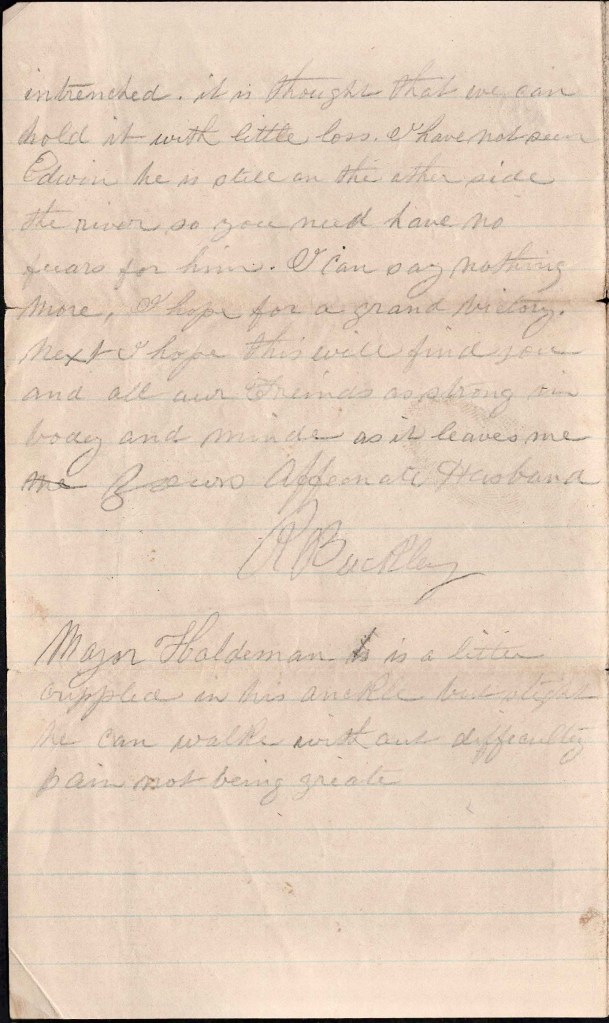
Next, I hope this will find you and all our friends as strong in body and minds as it leaves me. Your affectionate husband, — R. Buckley
Major Haldeman is a little crippled in his ankle but still he can walk without difficulty, pain not being great.
1 One of the missing in Co. B was Pvt. William H. Johnson. Not sure who the second soldier was.
Letter 24
Camp near Aquia Creek Landing
May 8, 1863
Dear wife,
After 7 days hard marching and 4 days fighting, I find myself as sound and as well in health as ever. I wrote you two letters on the battlefield and I telegraphed to you on our arrival yesterday. Edwin in first rate.
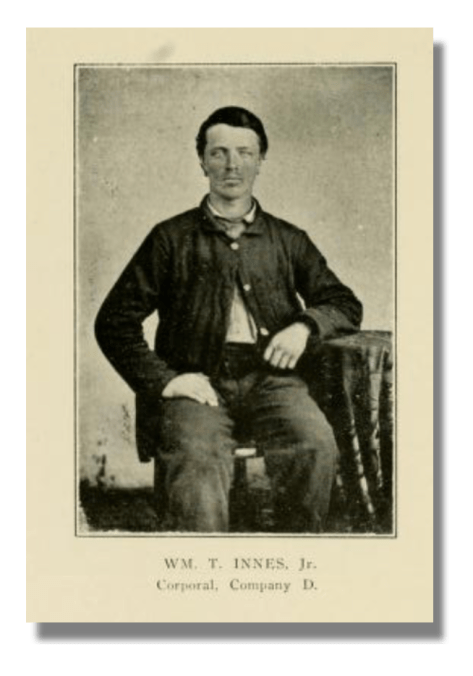
We got a very large mail here last night. I can assure you that I was much complexed when I found that amongst the hundreds of letters there was not a line for me. This, dear Sally, is worse to bear than the sound of Rebel bullets. It is now 12 days since I got a line from you. John C. Beatty and Thomas Haldeman are here. The Major’s ankle is most well. Sergeant Fildes thumb will be fully recovered in a few days. Jerome Boyer ofJenkins [?] Corner (and of our company) has a slight wound on his nose, He will be all right in a short time. William Innes and Phillip Johnson are slightly wounded. I do not know to what extent as they have been removed to Washington. I am told by those who saw them that their injuries are slight. Capt. Woodcock received a slight bayonet wound on the instep of his foot. It is slight, however. He can walk with but little pain. I believe the foregoing covers all that are wounded from about Media. The War Department have decided that our term of service expires on the 16th which is close at hand so we shall soon again be together. I am very busy and have not time to write more hoping this will find you, mother, and all our friends as well as I am.
Your affectionate husband, — R. Buckley


Letter 25
Harrisburg
June 23, 1863
Dear Wife,
We arrived here at 8 p.m. last night and found the boys mustered in (for the present Emergency to serve in this department). They were all cheerful, the dissatisfaction having subsided, all being satisfied with the pledge of Gov. Curtin, backed as it is by the War Department which is that all troops mustered as we are shall be returned to our homes at the earliest day consistent with the safety of state, having full faith that the above pledge will be honestly kept, together with the manifest desire of the boys to have me along, I have been mustered. I feel and believe as all others do here that the present Emergency will not long exist. It would seem by the manner in which the men are equipped that the authorities entertain an early discharge. All. this and other considerations have settled the fact of our soon being discharged as a sure thing so Sally, feel assured as I do. that we shall not be long separated and let us hope that we shall not again be called upon to sacrifice our domestic comforts. I think after serving this time I shall have done my share.
If Capt. Woodcock hands you this, you will forward by him my valise. If not, forward it by express to the Jones Hotel, Harrisburg. Put in a change only of clothing, overcoat, and blue coat I last bought, some tobacco, the blue book, and a green back book called U. S. Tactics, some writing paper, envelopes, and stamps, a needle book, powder flask, bullet mould, pistol wrench and bullets, gum leggins and boots. you will perhaps think of something else. Still I want nothing that is not necessary….
My love to all my friends hoping soon to join them again. I am your affectionate husband, — Ralph Buckley
Direct to Lieut. R. Buckley, 29th Regt. P. V. M. Good night & God bless you. I am sleepy. I suppose you are already asleep.


Letter 26
Near Mount Union
June 27, 1862 [1863]
My dear, dear wife,
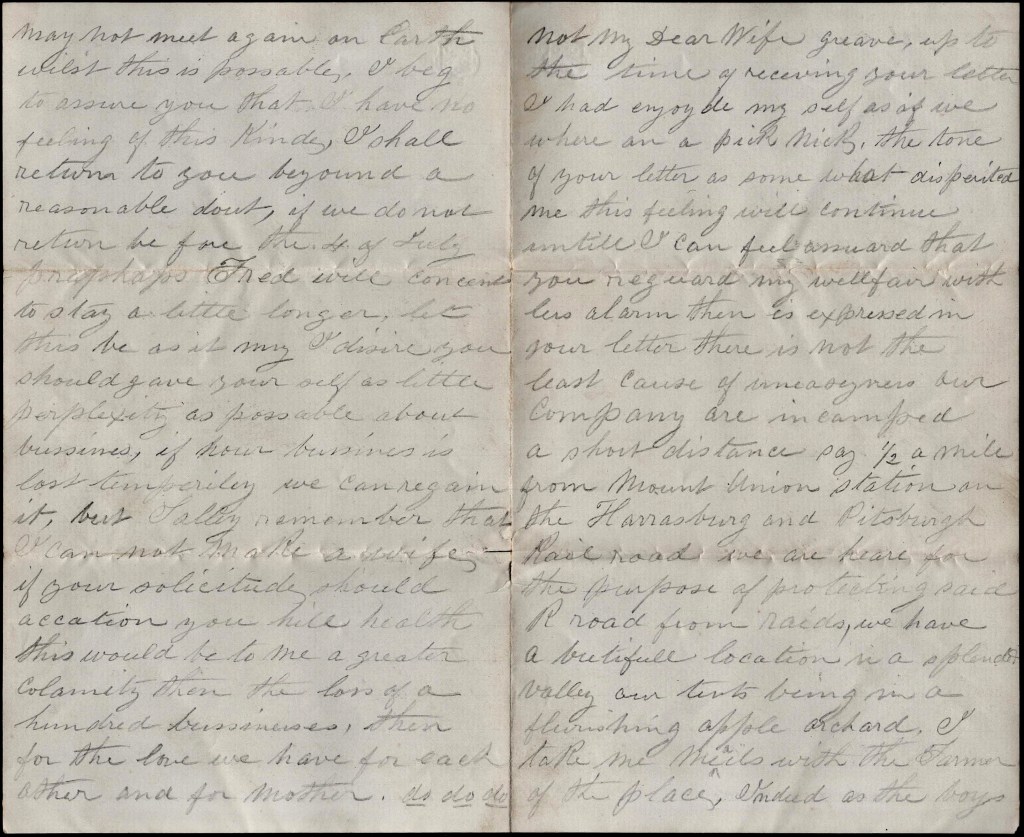
The tone of your letter by hands of Capt. Woodcock alarms me. You ask the question what have you done to cause me to be so ready to leave home. Nothing, nothing Sally. Your conduct has always been exemplary as a wife and I trust you will not charge yourself in any way for my enlistment. I done it from a conception of honor and duty, believing that the emergency will soon be over when we shall again be together when I think I can fairly claim that I have done my share to restore the country to its one happy condition. You say that we may not meet again on earth. Whilst this is possible, I beg to assure you that I have no feeling of this kind. I shall return to you beyond a reasonable doubt. If we do not return before the 4th of July, perhaps Fred will consent to stay a little longer. Let this be as it may, I desire you should give yourself as little perplexity as possible about business. If our business is lost temporarily, we can regain it. But Sally, remember that I cannot make a wife, if your solicitude should occasion you ill health, this would be to me a greater calamity than the loss of a hundred businesses. Then for the love we have said for each other and for mother, do do do not, my dear wife, grieve.
Up to the time of receiving your letter, I had enjoyed myself as if we were on a picnic. The tone of your letter has somewhat dispirited me. This feeling will continue until I can feel assured that you regard my welfare with less alarm than is expressed in your letter. There is not the least cause of uneasiness.
Our company are encamped a short distance—say half a mile—from Mount Vernon Station on the Harrisburg and Pittsburg Railroad. We are here for the purpose of protecting said railroad from raids. We have a beautiful location in a splendid valley, our tents being in a flourishing apple orchard. I take my meals with the farmer of the place. Indeed, as the boys say, this is gentlemen soldiering. Many say they desire the emergency will last a year or two provided we remain here. This is not so with me. I desire it soon over on your account. I only name the above to show you that there is no fears on the part of the boys.
Let me again impress upon your mind not to rely upon newspaper reports. We are some 50 miles from Harrisburg. The reading of your letter as rendered me nervous which accounts for the brevity of this letter. Direct for me, Mount Union, Huntingdon, Co. F, 29th Regt. P. V. M.
From your affectionate husband. — P. Buckley

Letter 27
Mt. Union
July 5, 1863
Dear Wife & Mother,
I telegraphed you the 3rd and wrote you yesterday. We are all first rate. If we could know that the dear ones at home was as well as we are, we should be perfectly happy. I simply have time to say that we start tonight at 5 o’clock to McConnellsburg. Knowing your sensitive temperament, I cannot forebear to again remind you that marching is not danger, &c. &. so have no fear. Keep up as we do. Direct for Lieut. Buckley, Co. F, 129th [29th] Regiment P. V. M., Harrisburg or elsewhere.
Your very affectionate husband, — Ralph Buckley
Our love to all enquirers.

Letter 28
Loudon [PA]
July 14, 1863
The long looked for has come at last by hands of Mr. Fell. I received last evening the first scratch of a pen from anyone since I left home & this morning two came to hand of the 2nd and 7th installments. I have wrote you every other day since I saw you in the present disturbed state of postal matters, it is scarcely likely you will get them all. However, I will write as often as I can. I sent an hurried letter a few days ago. I will not here state what we have been doing as you have D. Vernon with you now and of course will publish the whole affair…. [business discussion]
I want now to impress upon your mind my belief which is that I have seen the last Rebel foe. I honestly am of the opinion now that we shall son be home and an engagement with the enemy is not probable. As to your fears about comracting bad habots growing out of the temptations here as you say, I will say nothing. I will refer you to the past 20 years during which time we have been closely acquainted, over 11 years of which time we have been married. It is true during the time I have done and said things that have wounded your feelings. Upon all such occasions, it has not been intentional and of course have been sorry afterwards, with these exceptions. I think we have gone along as smooth as man and wife generally do, and this too always in the midst of temptation to do otherwise. Why then have any doubts of a continuance of the same conduct (if not better) through hte balance of our lives which I hope to be long. We have some friends here tonight [and] I owe a little time to them…
I am at present detached from the company and acting postmaster and several other offices so I have my hands full. It is a compliment to me to fill the post but I care nothing about that. I will conclude. From appearances it is very probable we shall soon be together again. Edwin is well. I was never better. Ly love to Hargraves, Hoestaters, and all enquiring friends. Mother and yourself will accept the same. Your affectionate husband, – R. Buckley

Letter 29
Harrisburg
July 17, 1863
Dear Wife and Mother,

Yesterday was my writing day but I was unable to do so owing to my being sent to Chambersburg from which place I telegraphed you stating that we were well. My mission could not be effected at Chambersburg, hence my trip here. I do not know at this writing whether I shall leave Loudon tomorrow or Monday. I had a personal interview yesterday with Gen. [Darius N.] Couch and Gov. Curtin at Chambersburg and also with some of their confidential subordinates today at this place, from all of whom I learn that the Emergency is by them considered over, so the time of our returning home only depends on the time necessary to make due arrangements for our pay muster out, transportation, &c., provided no trouble arises in consequence of the draft. If there is, it is possible we may be called upon.
Well, Sally, as the Rebs are beyond all doubt across the Potomac over which we are not expected to go, you must have settled your mind on the question of our getting into another fight. The invasion is past and we are right side up with care, and I will add that neither our moral habits or strength have suffered by coming out. On the contrary, the pure and invigorating mountain air will tend to recruit us up rather than otherwise. I wish it wrecked possible you could be with us. Loudon is at the foot of the mountains—quite an old town. No troops near it but our regiment so we have a good time of it. Indeed, it is not soldiering. It is simply a pleasant picnic at Uncle Sam’s expense. The old gentleman will soon discover the fact and break up the party. You will not be sorry, will you, Sally? For your sake, I shall not be so. So throw off the blues and rig yourself up as we shall have another wedding at our house soon. You will be the bride, you know. You can guess the name of the bridegroom.
I am glad to learn that Hargreaves & Hostulars are frequently with you. Say to them that I will return their good offices when their cows calves. I have not received a line from anyone since yours. You wrote on the 7th instead of. My respects to Fred Sildes, Hargreaves, Hustalers and their families. Kiss the children for me. Does Ralph ask for me? I hope this will find all of them & all my friends, yourself and Mother in as good a state of health and as cheerful as it leaves me. Your affectionate husband, — Ralph Buckley


Letter 30
Loudon [PA]
July 19, 1863
Dear Wife & Mother,
Yours of the 16th came to hand yesterday during my absence at Harrisburg (from which place I wrote you) so I did get yours until this moment. I am pained to learn that your mind is not at rest. You are lonesome, you say—worse than you were during my nine months absence. I say I am pained to know this is the case as it can only arise from one or two causes, one of which is the danger incident to a soldier in action. Your mind ought to be at rest on this point since the Rebs are beyond our reach. I am satisfied, therefore, that your own good sense will dictate to you that alarm for our safety is simply absurd.
The second cause seems to be judging from the tone of your letters that you are fearful of my morals or affection. In this, Sally, I feel that you do me great injustice as our 20 years acquaintance, 15 of which has been close and interested intimacy, & 12 years of the time we have been married. Id this all to go for naught in your deliberations. What have I done to gave you cause to doubt a continuance of the regard and affection that we have enjoyed for so long a time. My dear Sally, if all soldiers’ wives have conceived your ideas and they should prove realties, then indeed we will have a country beyond redemption.
My idea of the object of this war is to secure the rights of all. But if in securing this desirable object, our domestic happiness is sacrificed and thus end the balance of our lives, I shall be the most miserable of men. Rather than this, I would gladly welcome an enemy’s ball to enter my heart. Will you not try to shake off that despondent feeling that has taken possession of your mind? Am I to be punished by your shattered health and perhaps a shortened life because I deemed it my duty to use my humble endeavors to restore the country of our adoption in which we expect to die to its once happy condition? If this is to be my lot, it were better we had never saw it. Enough of this.
Your alarms are delusive. You are foreboding and when all id good. I have had all sorts of flattering positions offered me from different sources, all of which I have persistently declined. Out of respect to Col. Hawley, I have been filling several stations. He insists that I shall be at Headquarters. I am acting Quartermaster amongst other things. I have had a horse presented to me. You may state these facts to Tom and Jim but I desire that nothing should be said about it by you or them. I am entitled to some credit. It is recognized here by friends and enemies alike. My enemies at home will do so by & by. We were never better. Hoping you and all hands are as well. I am your affectionate husband, — R. B.


Letter 31
Two and a half miles from Baltimore
Mankins Woods
July 30th 1864
Dear Wife,
We have just arrived at this place—a fine location heavily wooded which renders abundance of shade. The men are at work like bees putting up their tents, &c. We left Camp Cadwalader at about 10 o’clock yesterday & arrived at Baltimore about 9 p.m. Supper was supplied at the Refreshment Saloon & we slept in the Camden Station. Breakfast was furnished at the saloon this morning after which we started for this really beautiful encampment. How long we shall stay here, of course we know not.
There is many thousand green troops here. I run up to Lawton’s last night for a minute only. Mrs. Lawton is worried of course about Lawton being drafted, but they believe he will be exempted for disability through the influence of Mr. Arthur. We are all hands as busy as possible but I knew a line from me would please you so here it is. Will write more as soon as I can. Ned is first rate. Indeed, all hands are first rate. These are all kisses. Your affectionate hunsand, — R. Buckley
Mother will join you with the kisses.

Letter 32
Camp Day
August 7, 1864
Dear Wife & Mother
Yours came duly to hand. I was glad to learn that you are all well & I do assure you that Ned & myself never were better. Ned paid Lawton’s a visit yesterday and found them well. I have not been out of the encampment since we came here. You say that I need not be surprised to see you out here. Well Sally, I will not be surprised if I do see you & will say further that a visit from you would be pleasant to me, & I know of nothing to prevent you from coming. You can call for Mrs. Lawton & have a carriage in Baltimore, If you do come, I desire you to come here in your best rig for the season, and hire the best carriage you can & seem as if you belonged to somebody (or rather than I belong to somebody). Appearances today are more favorable to our staying here than they have been, but still we have no assurance as to how long we shall stay.
We have no excitement here as to the movement of the Rebels. We hear a good seal about their doings by the papers but still we are as much undisturbed as a camp meeting in Everhart Grove under the supervision of your watchful townsman, Aaron James. So you seem you need not be alarmed about us.
We have a good company. There cannot be a better. All hands seem as cheerful as can be and are attentive to their duties & of course learn fast. We have but one man a little lame, and as far as I know, they are all satisfied. I am proud of them. You need not be jealous. My pride in them will not lessen my love for you. Remember me to all my friends, hoping this will find you all as well as it leaves us. I am your affectionate husband. Good night and God bless you all. — R. Buckley

Letter 33
Altoona [Pennsylvania]
August 12, 1864
Dear Wife & Mother
We did not leave Camp Day on the 10th as I telegraphed you. We left on the 11th, yesterday, about 10 o’clock & arrived here about 5 o’clock a.m. I write this whilst they are taking in wood and water so you will excuse its brevity. You will continue to write address, “Capt. Buckley, 197th Regt. P. V., Rock Island, Illinois, or elsewhere.” 1
This place is at the foot of the mountains so we shall have daylight in which we shall pass over them. It will doubtless be a pleasant trip. We are expected to reach Pittsburgh this evening & will possibly lay over night there. We shall be say 6 or 8 days in reaching our destination. We shall pass Fildes place on our route about 30 miles wide of them. If I can determine when we shall arrive at that point, I will telegraph, hoping he will come to see us. All hands is well.
Ned & myself were never better. Hoping this will find you the same. I am your affectionate husband, — R. Buckley
Kiss Kiss Kiss Kiss
1 The 197th Regiment Pennsylvania Volunteer Infantry, alternately the 3rd Coal Exchange Regiment, was an infantry regiment raised in Philadelphia in mid-1864, the regiment was made up of Hundred Days Men in an effort to augment existing manpower for an all-out push to end the war within 100 days, and spent most of its service guarding Confederate prisoners of war at Rock Island, Illinois.

Letter 34
Chicago [Illinois]
Sunday morning, August 14, 1864
Dear Wife & Mother,
We have just arrived here. The regiment is at rest on the banks of Lake Michigan waiting to be fed by the Volunteer Refreshment Society preparatory to taking cars for our destination Rock Island, a distance of 185 miles. We have had a long ride but in all a very pleasant one & I am pleased to say without the slightest accident. I did not telegraph to Fildes as I intended as we passed the office in the night without stopping. I am writing this in the middle of the street, dust blowing in torrents. You may judge that it is not a desirable place in which to write a pleasing letter, even if I had the time to do so. You will, therefore, excuse this scribble & take the will for the deed.
I will again assure you that Ned & myself were never better. Indeed, all hands are the same. Your affectionate husband, — R. Buckley


Letter 35
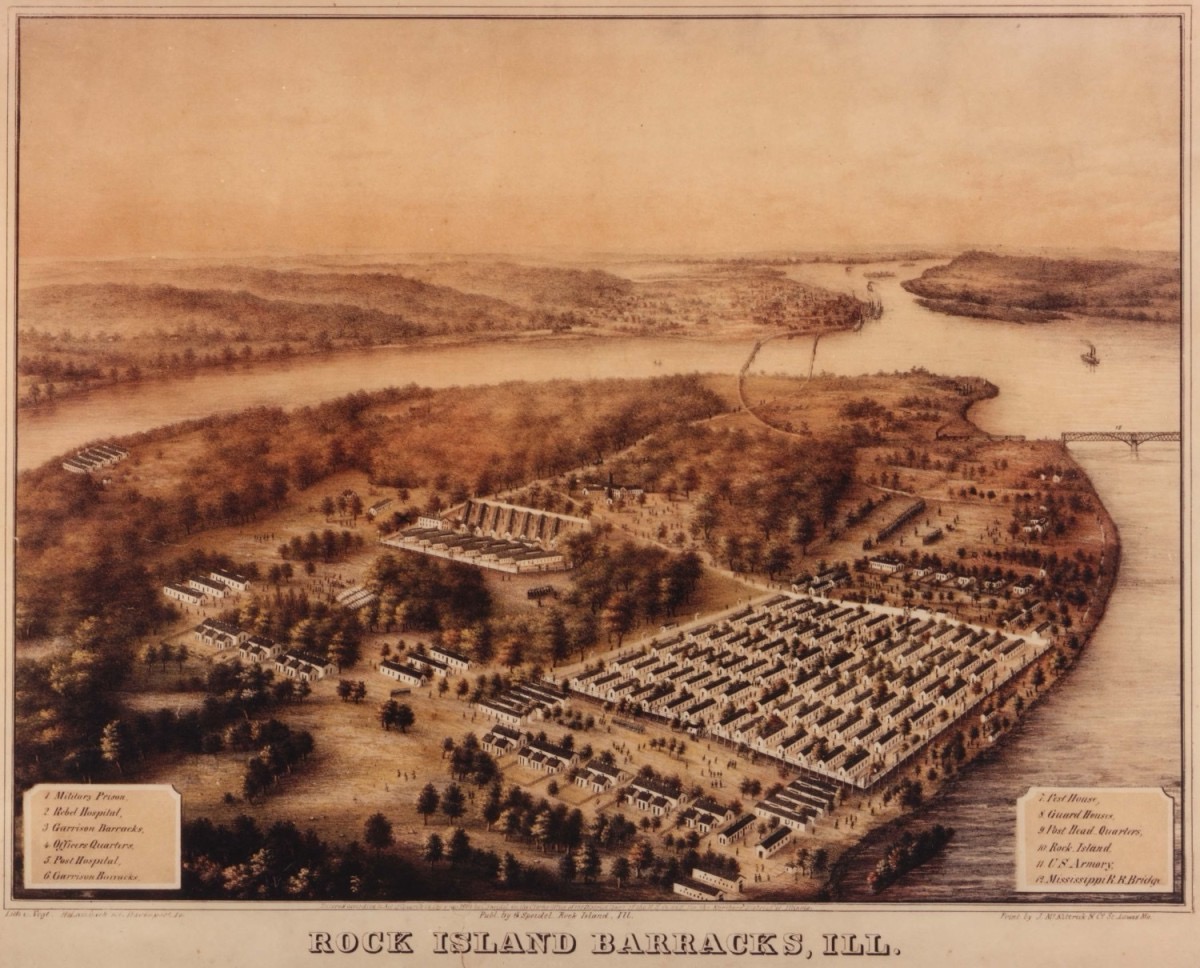
Rock Island, Illinois
Monday evening, August 15, 1864
Dear Wife & Mother,
We arrived here at about 9 o’clock this morning. I am pleased to be able to assure you that it is a most delightful place. It is as its name indicates—an island, made so by the Mississippi river branching at this poiny & flowing on all sides of it. Its extent is perhaps 3 or 4 miles long, about 2 miles in width. It is heavily wooded rendering the whole surface abundantly shaded. The U.S. Government purchased the island & has erected thereon large and extensive barracks for our troops & most elegant quarters for the officers (we have not got possession of them as yet but will in a few days). We are well fixed, having large tents. When we get in the quarters, I shall have four rooms to myself—each being nearly as large as our room. The buildings are substantially built of frame, lathed and plastered & are in all respects as clean and comfortable as any house could be. A large number of the officers have a woman with them—their wives, I suppose.
Upon arriving here the first man I met that I knew was the Rev. Mr. Gracey. He has been assigned here as he believes permanently. He and his wife with him. He pressed upon us to take dinner with him which we did & I tell you, Mrs. Gracey fixed up a good & a home-like dinner. It seemed to do both of them so much good to see us, and to see them apparently so comfortable. I almost made up my mind to induce you to come here yourself but the distance is so great & as it is almost beyond a doubt that we shall remain here the balance of our time, I can scarcely hope to have an opportunity to see you until we return home, which will soon pass away.
We are sent here to guard some 11 thousand prisoners. They are in barracks (separate from our troops) with [a] strong and high fence around them. Even those who guard them are not with them. They are placed on a parapet which is a walk, elevated so as to overlook the inside of the enclosure. This camp has been instituted over 12 months & there has not been the slightest trouble with them. 1
I wrote you from Altoona & at Chicago. Whilst the regiment got a mail today, I did not get one. Do not neglect to write. All hands are well & in good spirits. Remember me to all hands. From your affectionate husband, — Ralph Buckley

1 During the summer of 1863, prison camps in the North were overflowing with Confederate soldiers captured in battle. As a result, Union troops began construction of a new prison camp on an island in the Mississippi River then known as Rock Island, now called Arsenal Island. The camp opened in December 1863 with the arrival of the first prisoners captured at the Battle of Lookout Mountain. The Rock Island Prison Camp was designed to hold more than 10,000 inmates at any one time, and over the final 18 months of the war, more than 12,000 Confederate prisoners passed through its gates. The deplorable conditions at the camp led some to call it the “Andersonville of the North,” a reference to the infamous prison in Georgia. Disease, including smallpox and pneumonia, ran rampant through the prison claiming many lives, while others died from exposure to the elements and the unsanitary conditions of the camp. During the first four months alone, more than 950 Confederate soldiers died. Initially, the dead were buried in a plot located 400 yards south of the prison, but on advice from the prison surgeon, a new cemetery, one that would become Rock Island Confederate Cemetery, was established in 1864, located 1,000 yards southeast of the prison. In March 1864, the remains of 671 Confederate dead were reinterred in the new burial grounds. In all, approximately 1,950 Confederate prisoners were buried in the cemetery, with the last burial occurring on July 11, 1865. All structures related to the prison were transferred to the Rock Island Arsenal and were subsequently demolished, leaving the Confederate Cemetery as the camp’s only remaining feature. [NPS].

Letter 36
Rock Island, Illinois
August 22, 1863
Dear Wife & Mother,
I again write you to assure you of our good health with the hope this will find you enjoying the same blessing. I have wrote you on every other day since we left Philadelphia as yet as I have had opportunities to do so. It may happen that this cannot be done at times for the want of time, materials, or conveniences. You will not, therefore, feel any alarm in consequence of not having letters as frequent & as regular as you have hitherto done.
All hands seem happy—that is, for soldiers. Things has such a home like aspect. The orders are so lenient as to the men roaming about when not on duty & other privileges which would not be the case if we were actually in the field before the enemy. It is true we have plenty of them here. They outnumber us about 12 to 1 but they are in a strong enclosure & under strict surveillance & excellent discipline. This state of things renders it more like a free & easy duty that I can scarcely realize that we are really soldiers.
Last night the officers were invited by a number of young ladies to be present at what they call a shoable [does he mean sociable?] party. A number of us accepted their invitation. Singing & instrumental music was excellent, commencing at 8 o’clock to about 10 o’clock. Then a game or play called Copenhagen. A long rope with the ends tied is held by the ladies and gents, holding the rope tight & forming a circle. To commence the game, a few ladies and gents go inside the ring which the rope forms. They walk casually along until the gent sees a lady he desires to kiss. He strikes her hand. If he does so whilst she holds the rope. He is entitled to a kiss provided he can do so before she can get under the rope. The ladies inside do the same thing so the amusement goes on. I enjoyed myself very much. The ladies present was of the best families of the place so there was nothing of a vulgar or low order. 1
Now Sally, you must not think that this little temporary pleasure caused me for a moment to forget my home or you. On the contrary, I often hoped you could just see us, knowing if you could, you would understand that you had a no occasion to have the least alarm as to our safety in any way, growing out of our duty here. I have not had a letter for four days. What is the matter? I can think of nothing to inform you of. I have wrote to our friend Hargreaves. Fildes have not heard from them yet. Remember me to John & his family & all enquiring friends. Your affectionate husband, — R. Buckley
I have not a sick man in my company.
1 The parlor game Ralph refers to may have been some variation on the “Danish Clapping Game,” sometimes called the Copenhagen Game Collective or Mitt Rowdy.”
Letter 37
Rock Island, [Illinois]
August 23, 1864
Dear Wife & Mother,
Yours of blank date came to hand tonight in which you say it was reported that we had been in a fight & that Ned was killed, &c. Now Sally, I have many times cautioned you against listening to reports. All sorts of things will be reported. I say to you again to pay no attention to them. I hope you will have fortitude sufficient to do so & you will thereby save yourself unnecessary uneasiness. Edwin is complaining a little today of some pain in his stomach. He has been attending to his duty. I think he will be alright in the morning. I assure you that you need not be alarmed at his being unwell at all.
I wrote you a letter of instructions….[business discussion]
You say you wish you could come here & that other captains have their wives with them which is true and very comfortable they are too. I can assure you I should be glad to have you with me but as you say the business interferes with such an arrangement. Otherwise I would have you come at once. Our time is sliding along. It will soon expire. Then we shall soon be together, as dear to each other, perhaps more than ever. Col. [Adolphus J.] Johnson, the commander of this post, gives it as his advised opinion that we shall remain here to the end of our service.
Ned has wrote every other day with one or two exceptions. I have wrote three times to our fried Hargreaves. Have had no answer as yet. I got a letter from W. Fildes tonight. They are all well. [More business discussion]
I have not received a newspaper from home since we left. You will send the old ones and have Vernon to send them regular. You will send word to Walters at Chester to mail his paper to me. Tell Innis that his son is all right. Indeed, we have so little sickness, the entire regiment may be said to be all right. My respect to everybody. Hope you are as well as I am & that Mother is better. Your husband, — R. Buckley
Do not forget to date your letters good night or morning.


Letter 38
Rock Island [Illinois]
August 28, 1864
Dear Wife & Mother,
Tim’s letter and your few lines is at hand. I am grieved to learn that Mother is unwell & hope she is better before this time. You can scarcely be in earnest when you talk of sending her to Hargreaves. The distance is so great that at requires a strong, vigorous person to with stand the fatigue. As to boarding Mr. Woodcock, you can suit yourself, but I should say you have work enough without any additional. I have wrote you several times as to what I desired you do with Detterer in relations to the Newtown jobs & still you ask what you must do. I suppose from this my letters do not reach you but I can tell this from your writing….[business discussion]
The Colonel, Major, Adjutant, and myself took a long ride in the country today &enjoyed it very much. I hope this will find you as it leaves us enjoying good health & spirits. Ned will write tomorrow. From your affectionate husband, — R. Buckley

Letter 39
Rock Island [Illinois]
September 12, 1864
Dear Wife & Mother,
Yours of the 8th inst. is at hand. I am pleased to learn that your interview with Mr. Calley was pleasant. You also said he asked if you wanted some money. If so, he would give you some. But you do not say what your answer was or whether he did or dodged not give you any. You must always want money & never refuse it. It is better to have money in hand than any as promise to pay. You will pay my Revenue Tax whenever the collector calls for it. That of the partnership you need pay no attention to. I have no fault with the conductor being made of 1X tin.
You are in error in supposing that I have lost a man. He did not belong to my company. My last letter to you will fully explain the matter. He belonged to Co. E but was known at home by some of our boys. I enclosed you receipts for the purpose of handing them over to his Father. No Sally, I am grateful to say we have no fever nor any disease in camp that is in any way contagious. Indeed, the regiment is in a remarkably good state of health. I have but 2 that are in any way indisposed & they but slightly arising from colds. I do hope, Sally, that you will not fret for our health or have doubts of our safe return. Do not, I beg of you. There is not the slightest reason for so doing.
Have you wrote to Lizzy & your cousin. Does brother John write to Ned, or sister, & do they write to you or him? If so, how are they? Let me know all about it.
Sally, this is a bad place to write letters from because there is nothing new transpires. It is the same thing all the time so it is difficult to write a letter three times each week. I have six Rebels cleaning house today. When done, I shall have as clean a house as anyone need have at home & room enough for a reasonable sized family. If it could be at all convenient for you to be here, we could be as comfortable as possible. But as it is not possible, we must wait for a short time only before we are together once more, hoping the exigencies of the war will not again call me out in the service.
I wrote a letter to John Rowland fully explaining our duties here & describing the island & part of our trip. It may interest you. I have no doubt he will allow you to read it. Tell John I should be pleased to hear from him. Say the same to Cal Hawley & all my friends. Assure them of my very god health. Hoping it will find them and you as well as I am. From your affectionate husband, — R. Buckley


Letter 40
Rock Island
September 18, 1864
Dear Wife & Mother,
I again sit down to inform you of our continued good health, it being of the best order, which is true. Also of the entire company with three exceptions & they are but slightly indisposed & will doubtless soon recover. We have our barracks cleaned, whitewashed, scrubbed, &c. &c. & in really good order & will move into them tomorrow. We have up to this time occupied shelter tents.
The mornings and nights are now quite cold, making shelter tents a little uncomfortable. Being without the means of artificial heat, we shall be very comfortable in the barracks. Large stoves will be in use with plenty of coal. Mrs. Woodcock arrived all safe & is comfortably fixed I have no doubt in her soldier’s home. She delivered a piece of blue trimming & a box of gum buttons for Ned. But you forgot me all together as I had nothing. It is true you requested me to name anything I wanted but as I dis not need anything in particular, I refrained from doing so for the simple reason that I knew you would be anxious to supply t at once & this not being practical, would render you uneasy. I know of nothing I want not will be likely to want but what I can get here, But still, Sally, I have my soft places as other people have, and to have received something from your hands would not have diminished my affection. Now Sally, you must not construe this intimation into displeasure because I cannot say I am displeased at all. But am about as a child would be when its parents had been away & returned home without something it had been expecting, a little disappointed you know. I will make it up when we get home. I think I hear you ask what will thee do? I will answer, I will fix thee by giving thee one less kiss for neglecting me on this occasion. I know thee can stand this punishment though it be a little unpleasant.
Our time is sliding along rapidly. We shall soon embrace each other again & it is to be hoped the exigencies of the country will not require me to leave you again. Hoping you and all our friends are as well as we are at this time, I am your affectionate husband, — R. Buckley
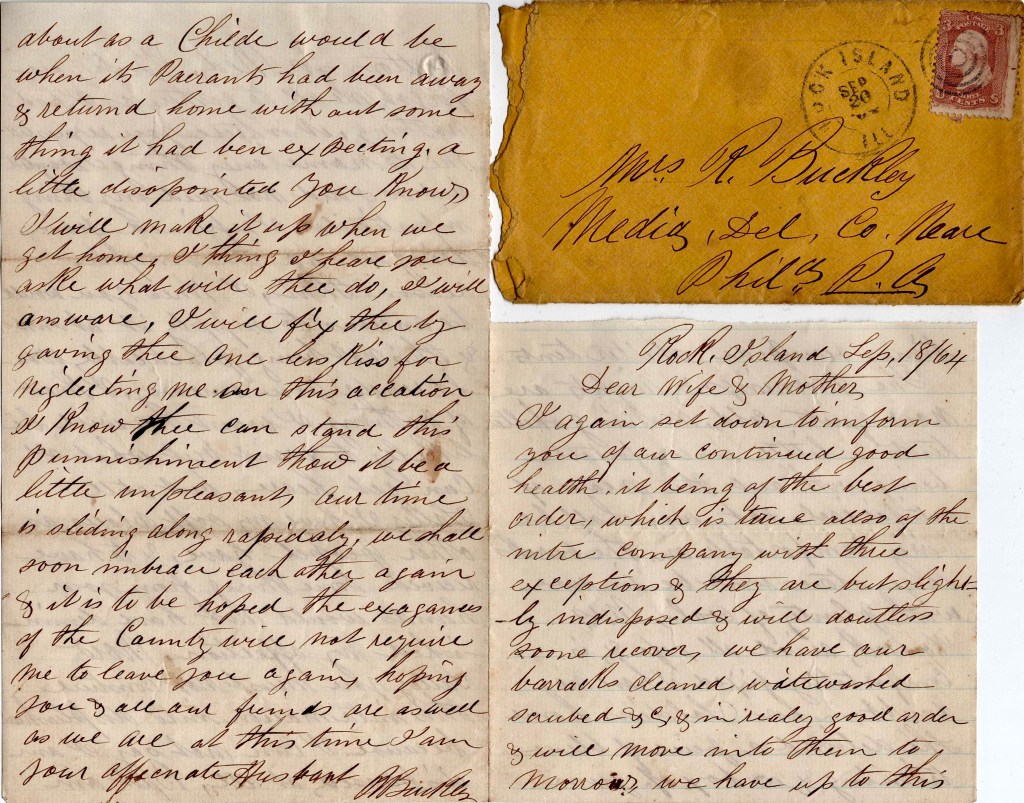

Letter 41
Rock Island
September 30, 1864
Dear Wife & Mother,
Yours of the 27th has just reached me. I am thankful to learn that you are well & am happy to be able to assure you that Ned & myself were never better in our lives. you say you are glad that we are in barracks & that you hope that our comfort here will not lead e to forget that I have a wife at home. Nor Sally, [to] forget you would be impossible. At morning, noon & at nights, you are in my thoughts. There is almost hourly something transpires which my mind connects you with it. To forget you Sally, would be indeed ungrateful. Notwithstanding, we are very comfortably fixed for soldiers. It is not home comfort. It would be more pleasant to have you along, Sally, even if you do find fault sometimes.
You wish for the time to welcome me home. Well, I do not doubt it. But your anxiety will not shorten the time any. Do not fret about the time. It will come of itself. It is sliding along very smoothly. We are now in our last month. One short monly separates us. We shall again be united. I can annticipate your fond embrace and the affectionate kiss such as only a fond wife can give. I suppose I shall get the buttons tomorrow. You say you have had some thoughts of getting William Pluse. This leads me to suppose that Fred is absolutely left, but still you do not say so whether he has or not. I desire you not to fret yourself about it. We shall get along some way or other. I enclose a telegram I received from our friend Hargreaves who apprises me that he has arranged his draft satisfactorily for which I feel much pleased.
You say to Brother John that he is doing very wrong by not writing home. It is absolutely wicked in him. I feel provoked at him about it. If he has any respect for them or for me, or for himself, I absure [?] him to write. It is criminal in him to neglect writing for so long. Ne plain with him. Tell him what I say. I am glad to hear his family is well. You have Lizzy to write to her Aunt May or to Ned. I got a letter from our friend Husttar. He has been unwell but still he has attended to his work all the time. He is dissatisfied with his place. He does not think he will stay long if a better place does not present itself.
From your affectionate husband, — R. Buckley
Good night and God bless you both. Kiss. Kiss. Kiss.


Letter 42
Rock Island
October 2, 1864
Dear Wife & Mother,
Yours of the 24th instead. is at hand. I am glad on many accounts to communicate what will be to many very grateful intelligence. Now Sally, open your eyes and mouth wide, open and look and listen whilst I relate what it is. We shall leave here, if nothing happens, tomorrow (Friday) evening for home so we may hope to be in Philadelphia on Tuesday next. I will telegraph you if possible at some point before arriving there. Your desire to see me will, I have no doubt, lead you to meet us in Philadelphia. If so, I have no objections. If you do so, I desire you to come dressed in your very best. You say you have become proud of your husband & I want to feel proud of my wife—particularly on this occasion as there will [be] doubtless wives of other officers there. You will understand I do not say you must come. I only say if you do come that I desire you to look as if you belonged to someone. I beg pardon, I should have said I desired that you should look as if I belonged to somebody. If you do not come, you can depend that I shall come out to see you at the earliest possible moment. It is quite likely that we shall be a week in the process of being mustered out of service after which you can claim me all to your own dear self. I suppose, however, that my absence has accustomed you to your own course of management—that you can get along just as pleasantly without me. How is this, Sally? Is it not so? For my part, I can only say that I cannot do so well without you as I can with you.
I am glad to learn that our friends Heathcoats has remembered you during my absence. Lib will perhaps stay until my return. I know of nothing that either Ned or myself will need before we get home so give yourself no concern about us. We are well & right side up. Your husband, — R. Buckley

Letter 43
Rock Island
October 3, 1864
Dear wife & mother,
I am again privileged to address you. I thought I should have got a letter from you tonight but am disappointed. Perhaps I may have one tomorrow. It commenced raining last evening & has continued to do so up to this time and is still doing so, making it disagreeable for outdoors duty. As it happens, my duties are indoors and have had plenty of it to do these few days past and will have for a few days to come. I have nothing new to inform you of. Our health continues to be excellent & everything is moving smoothly with us.
Before leaving home, I directed Clayton Smith to fix up our big wagon. If he has not done so, say to him that I should like to find it done on my return home. Inform me how the potatoes are doing & how Mr. Woodcock is making out with the thistles &c. I expect Miss Lewis left Davenport this morning. I gave her some breast pins made to imitate bibles and some birds made of shell, all of Reb manufacture which she will deliver to you with the rings, &c. I have not heard from our friends Hargreaves since I got the telegram which I forwarded to you. The buttons have not arrived.
Now Sally, our time is so far advanced that you may count days now instead of weeks. It will soon slip away. I hope to meet you at least as well as you were when I left you. We will have I hope a happy reunion. It will seem like a new wedding to us. I think I hear you remark we have had several weddings of that kind but you do not like them—that is, you like the weddings well but you do not like the action of them, the separations. Well, let us hope this will be the last. Woodcock & family are well. We never better. Hoping you and all our friends are the same. I am your affectionate husband, — R. Buckley
Letter 44
Rock Island
October 10, 1864
Dear Wife & Mother,
I again steal a few moments in which I will write in order to assure you of our continued good health. We are busy today preparing the books and papers for the election for tomorrow & I have but a few moments in which to write. I expected a letter from you this morning but none came. Perhaps I shall have one tonight. I hope so for it does me good to get one from my humbug, notwithstanding as she says she makes so many blunders. I hope Mother is better and that you all are as well as your affectionate husband & your brother [Edwin], — Ralph Buckley
Letter 45
Chicago
Sunday morning, October 16, 1864
Dear Wife & Mother,
Yours of the 17th reached me in readiness to start for Louisville last on the night of the 11th inst. Indeed, I waited so long for it that [ ] to make the train. I arrived at Louisville early on Thursday morning & reached Hargreaves just as they were getting up. I will not attempt to describe the scene that took place—only to say that at first they were dumbfounded as they knew nothing of my coming. Indeed, I thought they would scarcely have done looking at me. They were all well. Mrs. Hargeaves had manifest discomfort in her looks in spite of the pleasure she evinced at my coming. I soon learned the cause of it. Her brother Abraham had been drafted & had started to camp for duty the evening before my arrival. The children were almost wild with delight. They had an endless number of questions to ask of you both—how were you? when are you coming? how do you look? do they miss us? &c. &c. Tom is certainly doing very well making money rapidly. They live in a retired part of the city in a good house which is oddly and inconveniently built.
We took breakfast and started over the river to see our friend Husttar. We found him at work, but I a sorry to say in a low state of health and spirits. He is affected with what seems to me to be dumb ague and home sickness. He is almost destitute of spirit. He secludes himself from all society except at weekends he visits Hargreaves. He boards near the mill—that is, he eats there but he sleeps in the mill office & thus he goes to his meals & to the mill from one week’s end to another. He has conceived that the West is no place for him. He has told his employer of his intentions to leave but he will not listen to it. He is much reduced in strength & weight. Indeed, he looks decidedly bad. I advised him very strongly to either leave at once or send for Nancy for I believe if he had home comforts, he would soon get over his present ailments and eventually do very well in the Wesat. This is the working man’s country. He quit his work and went over he river where we spent the day together talking & listening to the girls sing & play the melodion.
I left next morning for Fildes where I arrived early yesterday morning. Found them all well. Left them last evening believing I could go through to Rock Island last night but on my arrival here I found that I must spend a tedious 24 hours before leaving. I will write you more in full when I get to camp. Your affectionate husband, — R. Buckley

Letter 46
Rock Island
October 18, 1864
Dear Wife & Mother,
I wrote you at Chicago on Sunday on my return trip from our friends. I arrived here safe & sound in all respects yesterday morning & as I expected, found an accumulated amount of business which required my immediate attention. As I am most through with it & got a good night’s rest last night, I will endeavor to write you a long letter tonight. I will first answer your letters, one of which I received the night I left. I waited for it until I had to hurry to catch the train. It is dated October 7th in which you inform me of the anniversary of the birth of youngest son, and that your only hope is that we shall meet them in their heavenly home. Why Sally, I will venture to say that is not your only hope. I know you have many more hopes, one of which is to meet me pretty soon, not in heaven but in Media. And you further hope to find me the same old humbug as you sometimes called me. And you further hope that I shall return to you without the evil habits which are by some contracted in camp life to which end my best judgment has been directed.
You remind me that I have said that I hoped to find you on my return as well as I left you. In answer you say that I cannot tell what your state of mind was when I did leave you, for tears you had none. Sally, I trust that I was not insensible to your feelings. But to the contrary, the fact of my knowing your state of mind led me to fear that if you did not shake off your discomfort, not only your mind would be ill at ease but your bodily health would thereby be affected. It was this that I had reference to when I said I hoped to find you as well as I left you….
You will remember the last morning I spent with you at home. It was a struggle between the heart and the head. The former admonished me to stay with you. Do not think that it was through the want of affection for you because my head directed me to leave you. My word had then been given and I trust your affection for me will be none the less because my words bound me to keep it. Sally, as you had no tears upon my leaving, you will perhaps have some on my return, but they will be tears of joy and thanksgiving to which I do not object.
Yours of the 11th inst. acknowledges the receipt of the trinkets sent by <rs. Lewis. I am pleased to learn that you think them pretty. I thought you would. I will try to get the articles you name but I am fearful of success as the prisoners are not allowed outside of the prison as they used to be so we have no opportunity to get things. As to finding the whereabouts of Jane Taylor, our time being so short and having no data with which to start the search, I think the enquiry would be useless.
Yours of the 12th inst. now comes under notice. [business discussion]. I am not surprised to learn that you have not been well since I left you because in all your letters up to now, you have assured me of your good health. This should not have been so. I can readily understand your object in keeping me in ignorance of your state of health. But it is wrong nevertheless. If I had known it, you would have had my sympathy. Your state of health demanded at my hands. I fear now that my letters must have read cold to you because I believed you to be well and wrote you with that feeling. But you say now that you’re better for which I am thankful and hope to God for a continuance of yours and Mother’s improvement…
Now I turn to yours of the 15th. Our sick are improving. Ned and myself were never better in our lives. Thurlow was taken sick the day after he wrote to you and has not done any duty since. He seems better tonight. I have 4 men in the hospital but are thought to be improving. It is impossible to say when we shall reach home. I am glad you have thought of preparing for us. Amongst your preparations, you must have a half barrel of ale. Do not neglect this. I am truly grateful to learn that Mother is better and hope her trip to Philadelphia will not hurt her… Well, Sally, my absence has been the occasion of my not writing for several days but here is a long one and have no room to say anything about my trip or our friends. I told you in my letter on Sunday how I found them &c. I attended an officer’s meeting tonight which held until quite late. It is almost morning now and General Hooker will review us tomorrow and as I have said all my paper will admit if, I will go to bed hoping this will find you both & all our friends as well as we are. Your affectionate husband, — R. Buckley
P. S. The men that are sick are strangers to you. Good night and God bless you & Mother.



Letter 47
Rock Island
October 20, 1864
Dear Wife & Mother,
I again take pleasure in answering your letter. Ned’s health and my own are of the very best order. I wrote you quite a long letter on the 18th. Yesterday the troops on the Island were reviewed by General Hooker & today we had General Inspection. Upon both occasions, the officers conducting the ceremonies had the goodness to give me credit in flattering terms which of course is pleasing alike to me and the boys. I have been long conversant that I had a good company & it is most gratifying to know that others realize the fact. I am expecting the mail momentarily. I hope for a letter from you. I an anxious to learn how Mother & you are.
Well there is no mail for me. I will not complain, however. I can only hope the absence of a letter is not occasioned by ill health. As our time will have expired in 9 days tomorrow, you need not write after you answer this one & if you can not answer it the day of its receipt, I shall have to forego its answer. I have said our time will be out in 9 days but still we have no intimation when we shall leave here. We may do so in a few days or may not before the end of our time. Indeed, it may happen that we shall be required to remain here a few days after our time is out. This will happen if the Government does not have troops at hand with which to relieve us. This contingency will be provoking to the boys and disappointing to their friends but still you can readily understand that it would not do for the Government to order us home and thereby rendering the escape of the prisoners probably in consequence of not having a sufficient force to guard them. I mention this in order to have your mind prepared for such a contingency. Still I have no reason to believe that such will likely be the case. I have no doubt that the authorities will keep faith with us and will have us mustered out as soon as practicable for the good of the service demands such an action on their part.
John Hargreaves promises to write to his Mother tomorrow. He gives as a reason for not writing that he was anxious that his Mother should not know he was in the service, believing that such a course would save her unhappy feelings. I have said that Ned and myself were never better than now. I can scarcely hope this is the case with you. But I do hope you both are better. A few more days at the further will find us together. Then I have no doubt your recovery will be rapid. Your affectionate husband, — R. Buckley
Letter 48
Rock Island
October 24, 1864
Dear Wife & Mother,
We are now fairly in the last week of our service & are expecting to start for home today week. Still we have nothing definite on this point as I informed you in a former letter. We may start before the time named, or we may be required to remain a few days past the time. I name this so that you will not be uneasy about us if we should be detained. I am exceedingly envious to have a letter from not being blessed with the sight of one for several days. I fully expected one this morning but to be disappointed. I hope for one tonight since our time is so near and I am now counting the time as the boys have been for some time. I am exceedingly anxious to see you. I wonder how you are looking, what you are doing, how bad you miss me, & a hundred and one other things. S few more days & I shall see and you will see also, won’t you Sally. I do assure you that I am all right up to this time. If I find the time has used you as well as me, I think neither of us will complain.
I got a letter yesterday from Hargreaves. Sarah had gone to visit her father. All said to be well. Our friend Husttar about the same. He expects to leave soon for home, so says Tom’s letter. I think such a course on his part decidedly the best, as he has made up his mind that the west does not nor will not do for him. I have no doubt of his speedy recovery with Nancy’s good nursing.
I have nothing new to apprise you of. Everything is moving here smoothly but it has so much sameness about it, making it very monotonous and therefore tiresome. We have splendid weather today. It’s like midsummer. Indeed, the weather could not be more pleasant. Our sick are improving. I have five in the hospital but I am pleased to say they are better and are likely to get well. Capt. Barton buried one of his men today. He lived in Chester. I forget his name. You did not know him however. Thurlow is quite recovered and has resumed duty. I suppose you received his letter informing you of my going away. I know of nothing further to say at this time. Hoping his will find you and all our friends as well as Ned & myself are at this time is the desire of your affectionate husband, — Ralph Buckley
Here is a double row of you know what, don’t you Sally?

Letter 49

Rock Island
October 26, 1864
Dear Wife & Mother
Yours of the 22nd is at hand in which you assure me that yourself & Mother are better. This is most gratifying intelligence to us. I hope for a continuance of your improvement. You say you have become proud. Well, Sally, a little more of that sort of feeling will not altogether disagree with us & will perhaps help us provided the pride is in each other & not vain pride, which is hateful to me. So you thought we were in Chicago, did you? I can readily imagine your feelings as this thought occurred to you and I can as easily understand your sensation when you discovered your mistake. It can only be a few more days at the longest, although we have nothing definite as to the time of our leaving. But of one thing I feel sure of myself, although there are some officers who do not agree with me on this point, which is that we shall not leave here before Monday, and perhaps not before Tuesday or Wednesday. I come to this conclusion partly because I know of no preparations being made. Since our time is so near out, I feel an anxiousness growing within me to see you as soon as possible. But no matter how such a feeling may be, of of itself will not bring us together one moment sooner.
But on the other hand, if we get too anxious, it will tend to make unhappy. You will therefore not anticipate our coming and save yourself all the uneasiness possible. We will be at home at the earliest moment possible, I do assure you.
So you have sold your last cook stoves. Well we can begin anew when I return. So we shall be in new business, new in marriage, new in affection, & there is [no] knowing what may happen….Your most affectionate husband, — R. Buckley







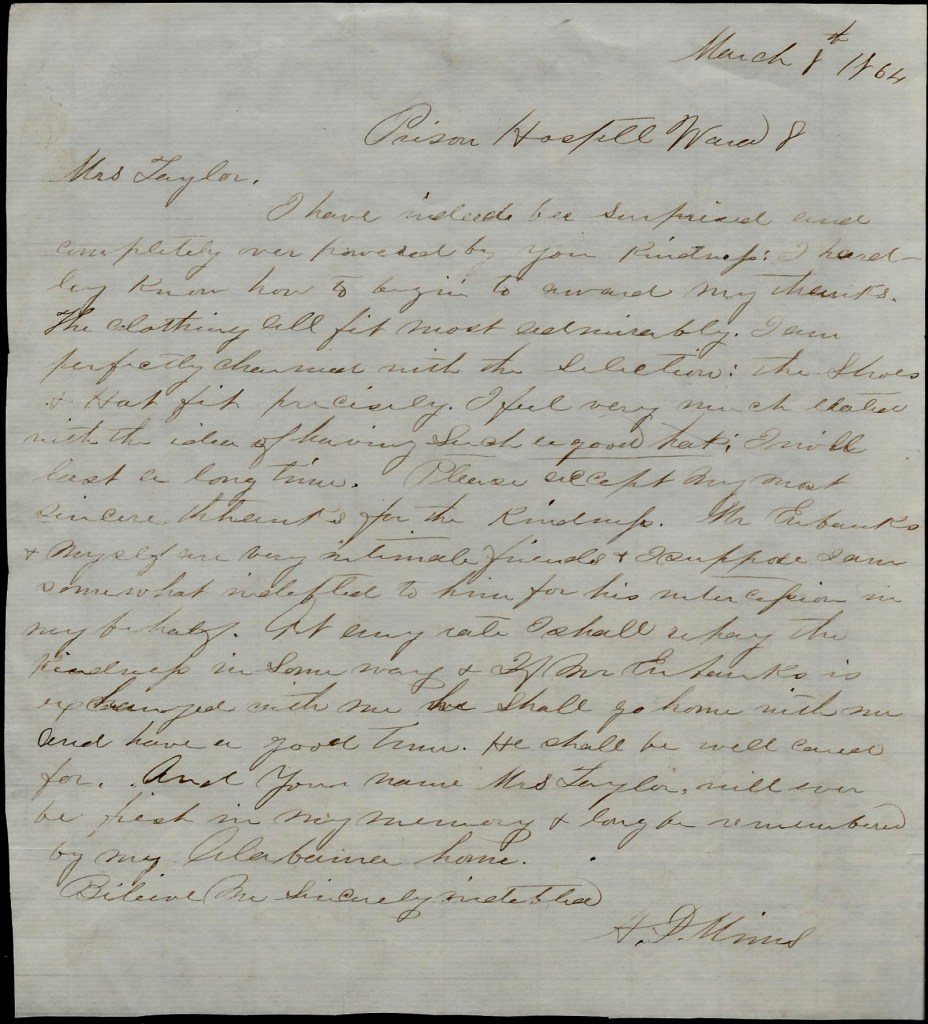
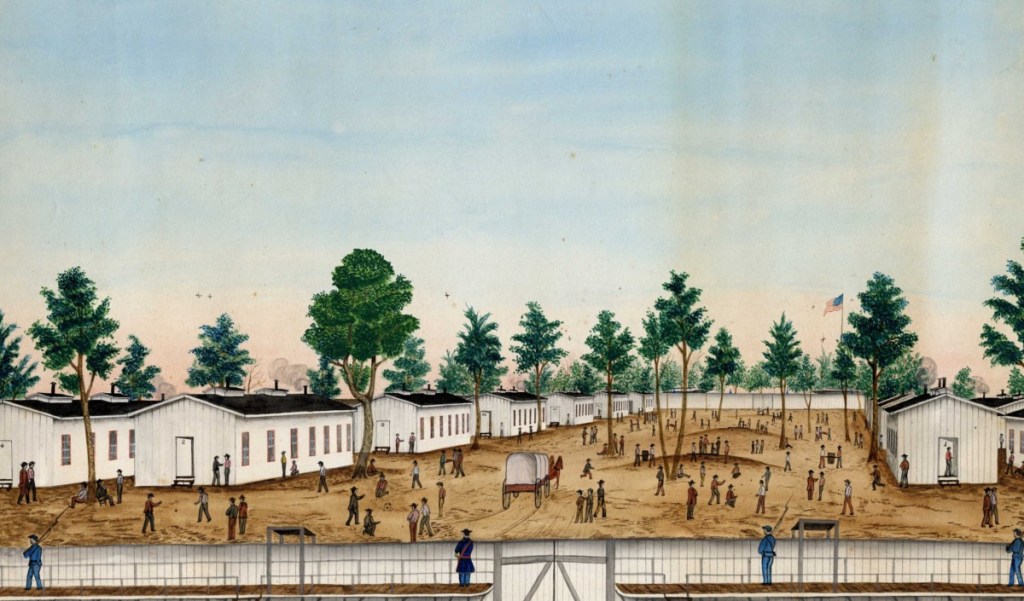
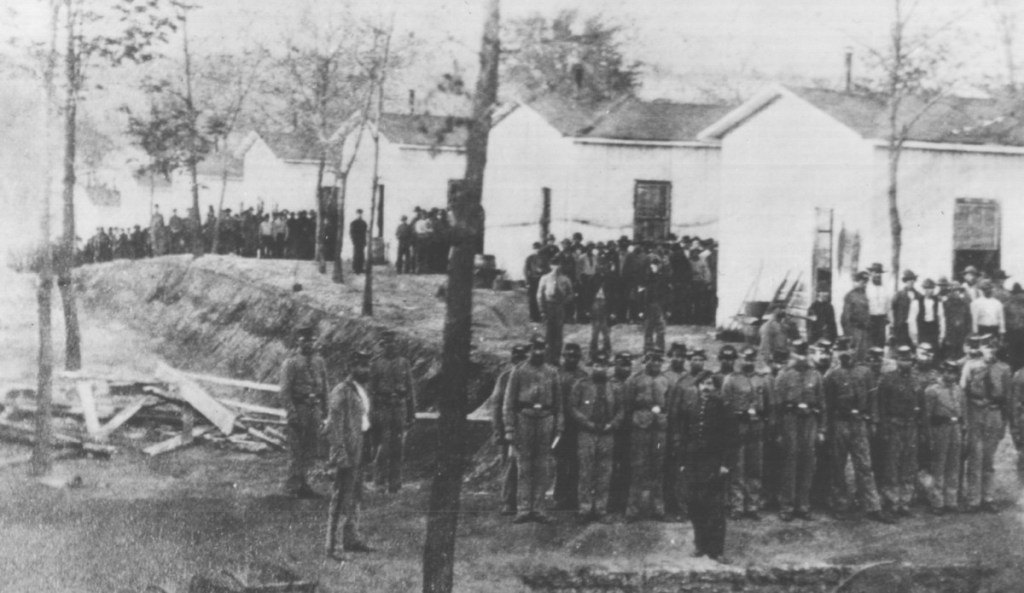
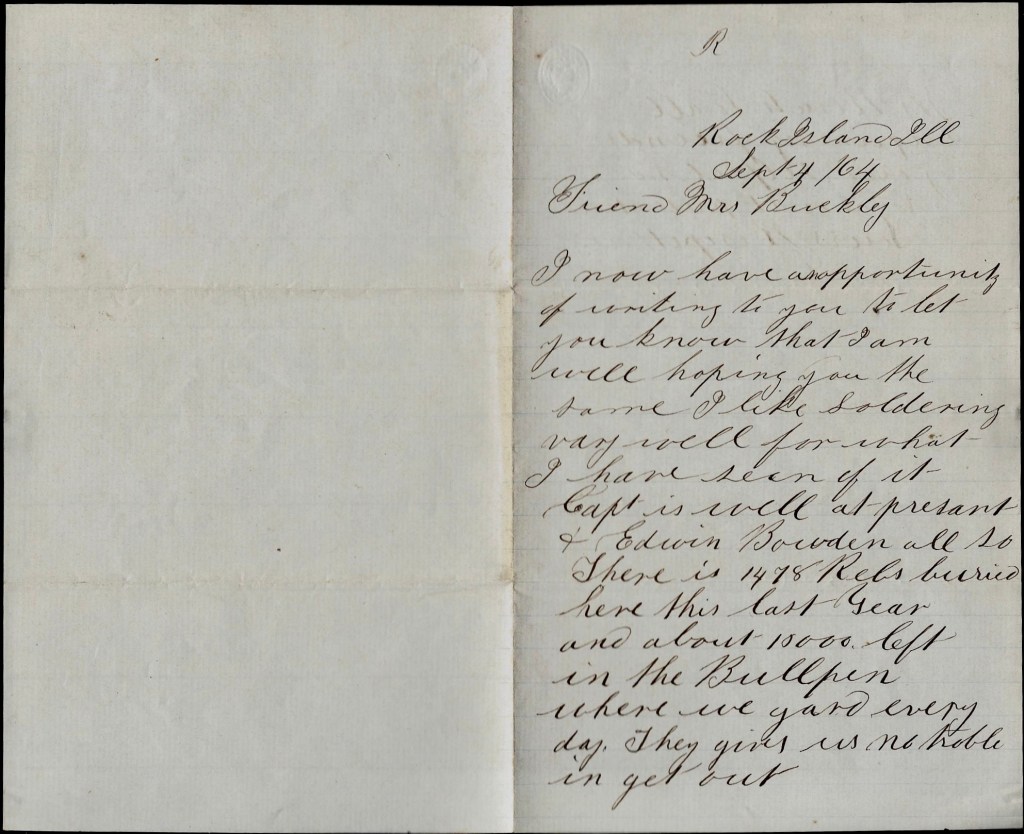

 Spared & Shared 23