
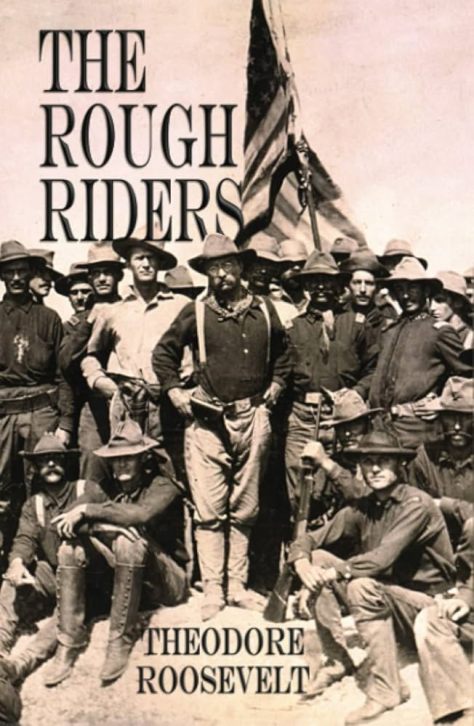
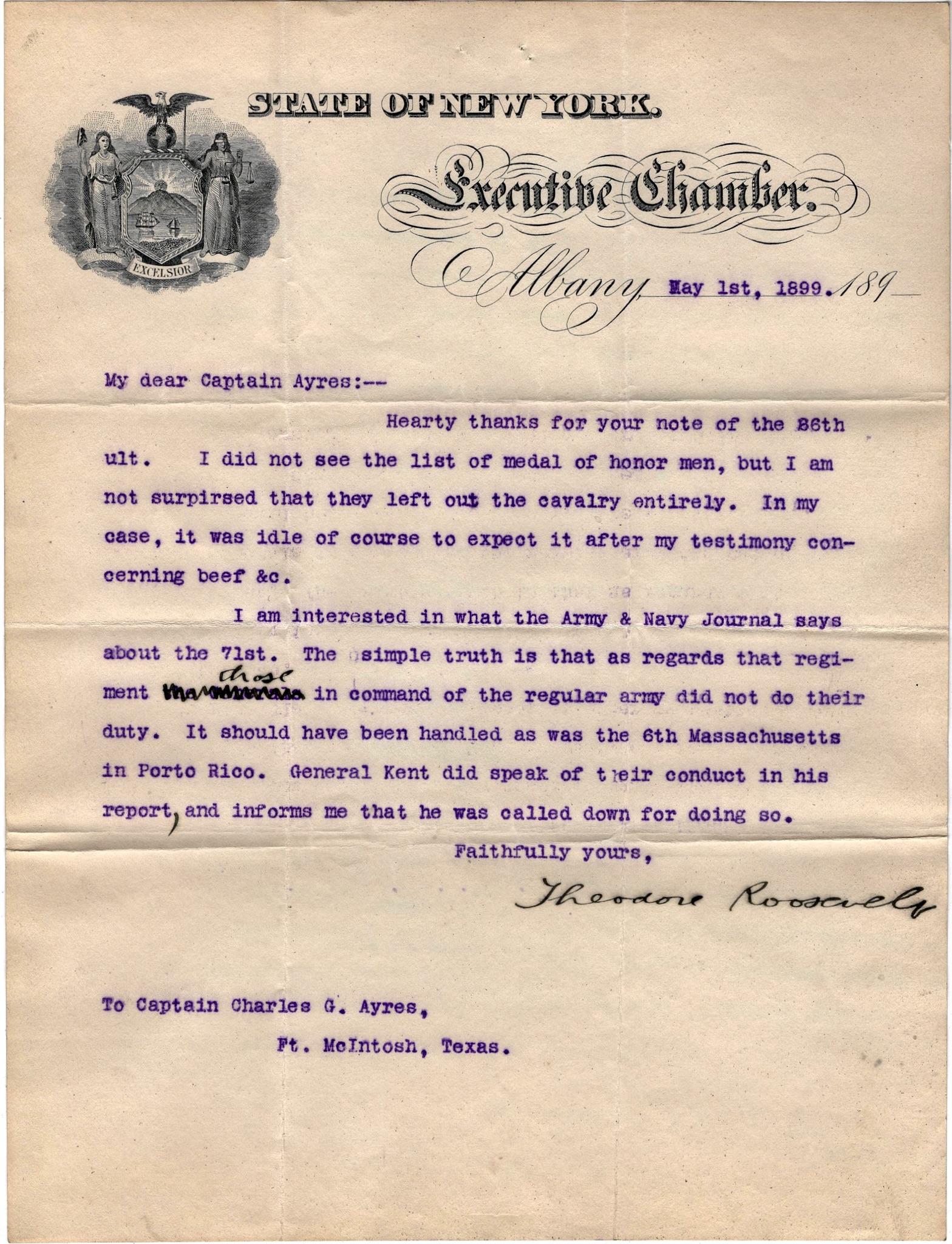
The following typed letter, dated 1 May 1899, was signed by Teddy Roosevelt while he was serving as the Governor of New York State, having been elected the previous November. He had just recently delivered his “Strenuous Life” speech outlining his belief that Americans should embrace hardship and effort for the good of the nation—principles that would later shape his presidency. It had been less than a year since his famous charge up San Juan Hill with his “rough riders” in the Spanish American War which propelled him to everlasting fame, and his first edition of the book “The Rough Riders” was published later that same month.
Roosevelt wrote the letter to Capt. Charles Greenlief Ayers (b. 1854) who served with the 10th US Cavalry in Cuba—an African American unit. In the Santiago engagement, Sgt. William Payne of Troop E, 10th US Cavalry, wrote: “About 6 A.M., July 1st the battle started. We remained at San Juan River about three hours. Then came the advance for the bloody charge up San Juan Hill, which we did in good order. This was the second time we came to the rescue of the Rough Riders. After we drove the enemy from their stronghold we deployed our skirmish line on the hill and awaited orders to commence firing. During this time our brave commander, Captain Charles G. Ayers, had to be begged and finally ordered to kneel or lie down out of danger, for shot and shell were falling all around him. He is the coolest man I ever saw in action.”
In the immediate aftermath of the 1898 Santiago engagement, Teddy Roosevelt praised the black soldiers of the 9th and 10th US Cavalry unites who came to the Rough Riders’ aid on San Juan Hill where they were pinned down. But in his book published the following year, with political ambitions in mind, Roosevelt not only downplayed their role but wrote disparagingly that “Negro troops were shirkers in their duties and would only go as far as they were led by white officers.”

T R A N S C R I P T I O N
Executive Chamber, State of New York
Albany
May 1, 1899
My dear Captain Ayres,
Hearty thanks for your note of the 26th ult. I did not see the list of medal of honor men, but I am not surprised that they left out the cavalry entirely. In my case, it was idle of course to expect it after my testimony concerning beef, &c. 1
I am interested in what the Army & Navy Journal says about the 71st [New York Vol. Infantry]. The simple truth is that as regards that regiment, those in command of the regular army did not do their duty. It should have been handled as was the 6th Massachusetts in Puerto Rico. General [Jacob Ford] Kent did speak of their conduct in his report, and informs me that he was called down for doing so.
Faithfully yours, — Theodore Roosevelt
To Captain Charles G. Ayres, Ft. McIntosh, Texas
1 Theodore Roosevelt testified to a government inquiry that the canned beef, nicknamed “embalmed beef,” supplied to soldiers in the Spanish-American War was unfit for consumption. He stated he would “as soon eat his old hat as the canned goods shipped under government contract to the soldiers in Cuba”. His controversial report was a response to reports of troops falling ill after eating the beef, which was preserved with boric acid to mask the smell of rotten meat. [Source: Meat Inspection Act of 1906, Britannica]
 Spared & Shared 23