

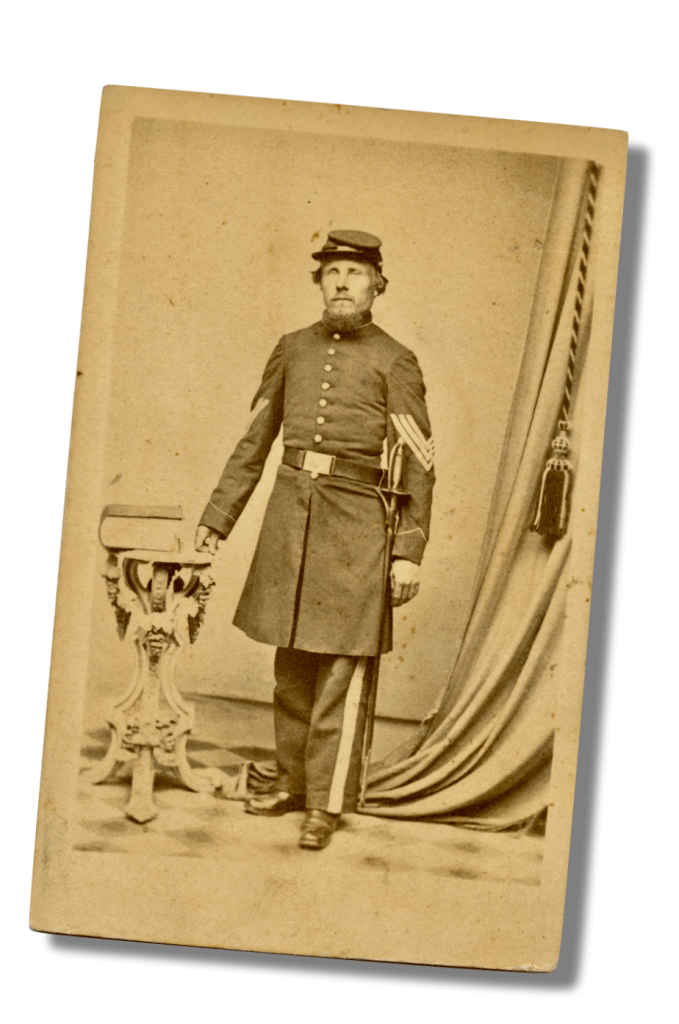
(Paul Rusinoff Collection)
The following letters were written by James L. Sutton (1825-1895) who enlisted on 12 September 1862 when he was 37 years old at Poughkeepsie to serve as a sergeant in Co. G, 150th New York Volunteers. He was promoted to 1st Sergeant on 10 November 1864 and mustered out with his company on 8 June 1865.
The 150th New York participated in Sherman’s Atlanta campaign about the beginning of May and took an important and honorable part in many of the great battles of that memorable campaign, including Resaca, Cassville, Dallas, Kennesaw mountain, Peachtree creek and the siege of Atlanta. The casualties of the regiment aggregated 100 killed and wounded during the 4 months’ fighting from Tunnel Hill to Atlanta. On Nov. 15, 1864, the regiment started on the march to the sea with Sherman, and in December was actively engaged in the siege of Savannah, losing 20 killed, wounded and missing. The following year it embarked on the campaign through the Carolinas, being sharply engaged at the battle of Averasboro and losing a few men at Bentonville. On the close of this campaign it marched on to Washington, where it took part in the grand review, and was mustered out there on June 8, 1865.
These four letters take us from the trenches before Atlanta, to the occupancy of Atlanta, the occupancy of Savannah, to the surrender of Johnston’s army and President Lincoln’s assassination. They are from the private collection of Paul Russinoff and were made available for transcription and publication on Spared & Shared by express consent.
See also—1864: Edgar Nicholas Sheldon to Rebecca Lowry Hitchcock, Spared & Shared 13.
Letter 1
In the trench near Atlanta
Thursday, July 28th, 1864
Dear Sister and Brother,
Yours of the 12th was received the 21st. I was very happy to hear from you. It seemed a very long time since your last. Dear sister, it is pleasant to know, situated as we are in the army, that kind friends at home feel an interest in us, and often think about and pray for our safety.
We have had a very long and tedious campaign. We have been moving about since April 25th—over three months. We are dirty and weary, but there is rest ahead. We are within 2 miles of Atlanta and some of our lines nearer than that. We are drawing the lines tighter every day. If they leave the city, I think we shall remain there some time for rest.
We have had some hard fighting since I last wrote you, and very many have fallen. Our Corps and Division have lost quite heavy. Yet in the kind Providence of God! I am still preserved and in good health. We are but a short distance from a Rebel fort. They have a very good range of our works. They shell us quite often, doing a good deal of damage, killing some and wounding others. We have batteries just above us which replies to theirs, and sometimes we have quite an artillery fight—all shot and shell going over our heads, making us keep our heads low, as some of them burst very near us, the pieces flying all around us. Add to this, the Reb sharp shooters just in good shooting distance keep firing at us day and night, much to our annoyance. The skirmishers of both armies are in sight of where we lie. There was two dwellings and barn a short distance from us. The Johnnies were in there shooting at us. We could not get them away. Our batteries tried to fire the buildings with shell. They would pass through them making boards and shingles fly, but could not fire them.
Yesterday Morning the 13th [New] Jersey went up there, driving the skirmishers back and firing the buildings. It was a grand sight as we could see the whole of it where we lie. They brought in some 30 prisoners. One little fellow came along with a great, long-legged Johnnie by the neck, pushing him along. The 13th lost 2 killed and about 7 wounded. They accomplished a great deal as they found out the position of the Rebs. Just now a ball passed just over our heads, making us dodge down and lie low. I will be glad when we get out of this. We have been under fire most of the time now for about two weeks.
I received a letter from Charlie a few days ago. They were well. You think us better off than the Army of the Potomac. In many respects we are, and in some we are not. We have considerable rain and as a general thing, plenty of water. Yet it is more difficult to get food and clothing. As for vegetables, we get no sight at them, and if a man is wounded here, he cannot get the care he can in Virginia as it is so far from the hospital. Then if one is killed, he has to be buried as we cannot get him away.
We have two batteries here in our breastworks. The Rebs are throwing up works in sight of us. Our battery just opened and knocked it—as the printer would say—into pie. You talk about flies. If you could see what we have here, you would think we had just a few. Please write often. I will let you know when we get into Atlanta. My love to all. Yours affectionately, — James L. Sutton


Letter 2
Atlanta [Georgia]
September 29th 1864
Dear Brother & Sister,
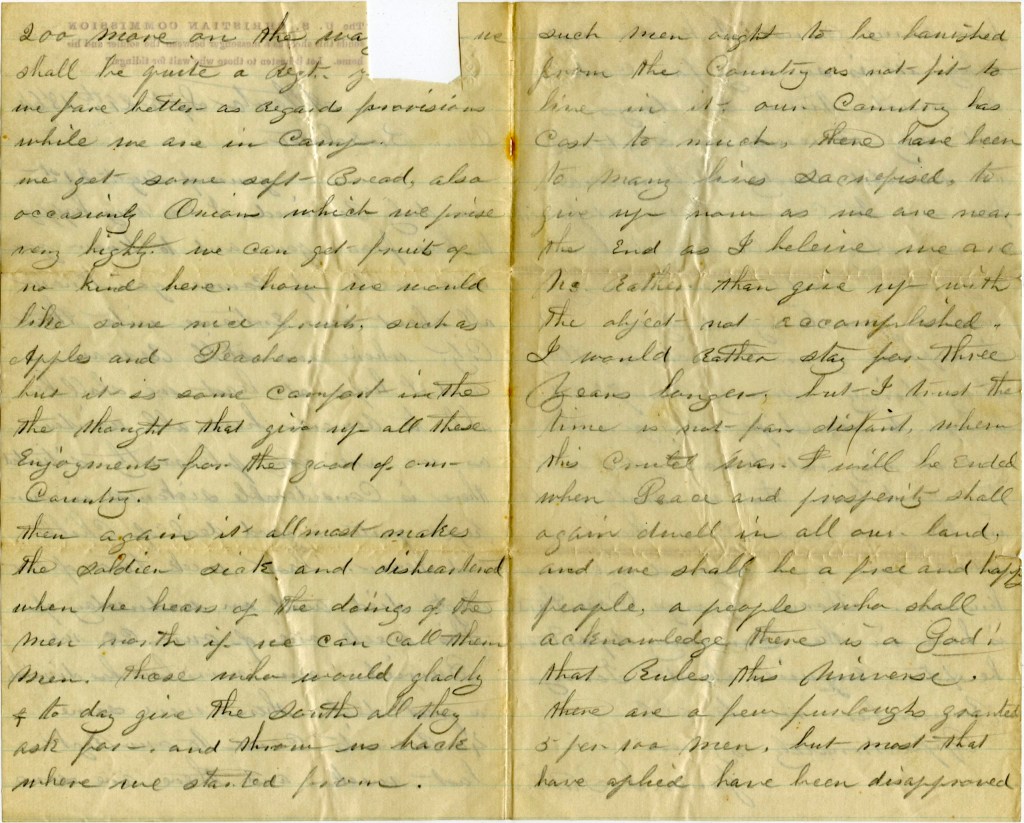
Yours of August 21st was duly received. I was very happy to hear from you and to know you were well. Of course you know all about our entrance into the city where we still remain and I hope at least we shall be able to remain here all winter as we are very pleasantly situated. There is considerable sickness in our regiment. Quite a good deal of chills and fever. Last week two of our regiment died and on Wednesday of this week one of our company we buried. Our numbers has diminished a great deal. There were some 40 recruits came to our regiment last week and there are some 200 more on the way. We shall be quite a regiment yet.
We fare better as regards provisions while we are in camp. We get some soft bread. Also occasionally onions which we prize very highly. We can get fruit of no kind here. How we would like some nice fruits such as apples and peaches. But it is some comfort in the thought that [we] give up all these enjoyments for the good of our country. Then again it almost makes the soldier sick and disheartened when he hears of the doings of the men [in the] North—if we can call them men. Those who would gladly today give the South all they ask for and throw us back where we started from. Such men ought to be banished from the country as not fit to live in it. Our country has cost too much. There has been too many lives sacrificed to give up now as we are near the end as I believe we are. Rather than give up with the object not accomplished, I would rather stay for three years longer. But I trust the time is not far distant when this cruel war will be ended—when peace and prosperity shall again dwell in all our land and when we shall be a free and happy people—a people who shall acknowledge there is a God that rules this universe.
There are a few furloughs granted—5 per 100 men—but most that have applied have been disapproved for some cause, I know not why. It is so very far, costs so much time 20 days, and my friends so scattered it would hardly be beneficial for me to come home at present as my stay would be short I could hardly have time to say how do you do and goodbye. I suppose your church is getting along finely, nearly completed. I hope to worship with you there yet. It ay not be so yet I will try so to live that we shall meet in the great assemblage of the just, where war and discord are never known.
Thomas George Courtland is here in the Commissary Department. He often enquires about Fanny. Remember me to all. Affectionately yours, — James L. Sutton

Letter 3
Savannah, Georgia
January 13th 1865
Dear Brother & Sister,
I have been waiting since lying here to receive a mail from some of my friends but as yet have waited in vain. I received yours while lying in front of Savannah and also a pair of woolen gloves for which I thank you. They came in good time as the day after was quite cold. We were then on A____ Island.
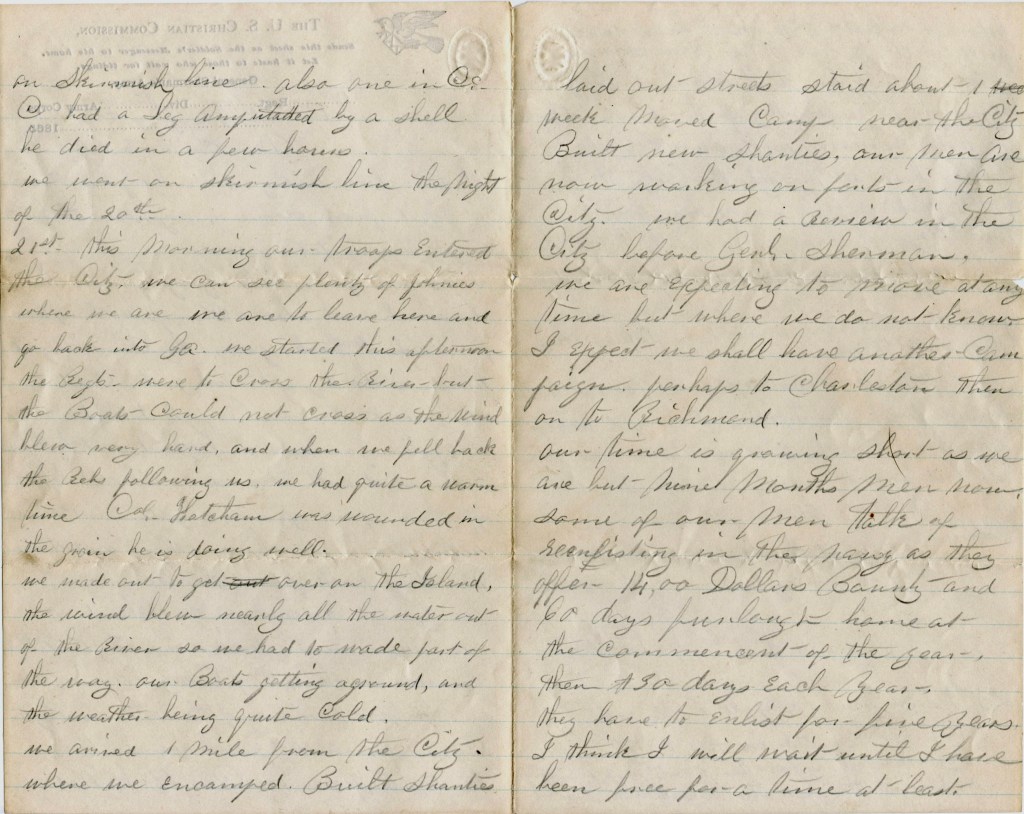
I suppose you saw the letter I sent to Hannah Bush so I will commence where I left off there. Part of our Brigade went over on the South Carolina shore and drove the rebs back from the river. We be in reserve on the island. One man in 3d Wisconsin Regiment [was] killed. This was on the 19th of December. On the morning of the 20th, our regiment crossed on South Carolina soil. Today a man in Co. H [was] killed on the skirmish line. Also one in Co. C had a leg amputated by a shell. He died in a few hours. We went on the skirmish line the night of the 20th.
21st—This morning our troops entered the city. We can see plenty of Johnnies where we are. We are to leave here and go back into Georgia. We started this afternoon. The regiments were to cross the river but the boats could not cross as the wind blew very hard and when we fell back, the Rebs following us, we had quite a warm time. Col. Ketcham was wounded in the groin. He is doing well.
We made out to get over on the island. The wind blew nearly all the water out of the river so we had to wade part of the way, our boats getting aground and the weather being quite cold. We arrived 1 mile from the city where we encamped, built shanties, laid out streets, stayed about 1 week, moved camp near the city, built new shanties. Our men are now working in forts in the city. We had a review in the city before Gen. Sherman. We are expecting to move at any time but where, we do not know. I expect we shall have another campaign—perhaps to Charleston. Then on to Richmond.
Our time is growing short as we are but nine months men now. Some of our men talk of reenlisting in the Navy as they offer 1400 dollars bounty and 60 days furlough home at the commencement of the year, then 30 days each year. They have to enlist for five years. I think I will wait until I have been free for a time at least before I enlist. I think I have done pretty well to give three years service.
I hear Col. John H. Ketcham is Brigadier General. He is worthy of the place. I hope he will remain with our brigade. I have been all through the city. It is quite a large city. Some very nice buildings. I tried all over to get a few notions such as a handkerchief and a few other things but there is nothing we can get. The rebels must have taken everything with them.
My health remains very good for which I am truly thankful. I should like very much to come and see you all but must wait patiently till the time arrives. Please write soon. Remember me to all enquiring friends. I remain as ever yours, — James L. Sutton
P. S. I send you a couple of papers that are printed in this city. They are selling for ten cents here in camp. We have another just started called The Herald.

Letter 4
Raleigh, [North Carolina]
April 20th, 1865
Dear Brother & Sister,
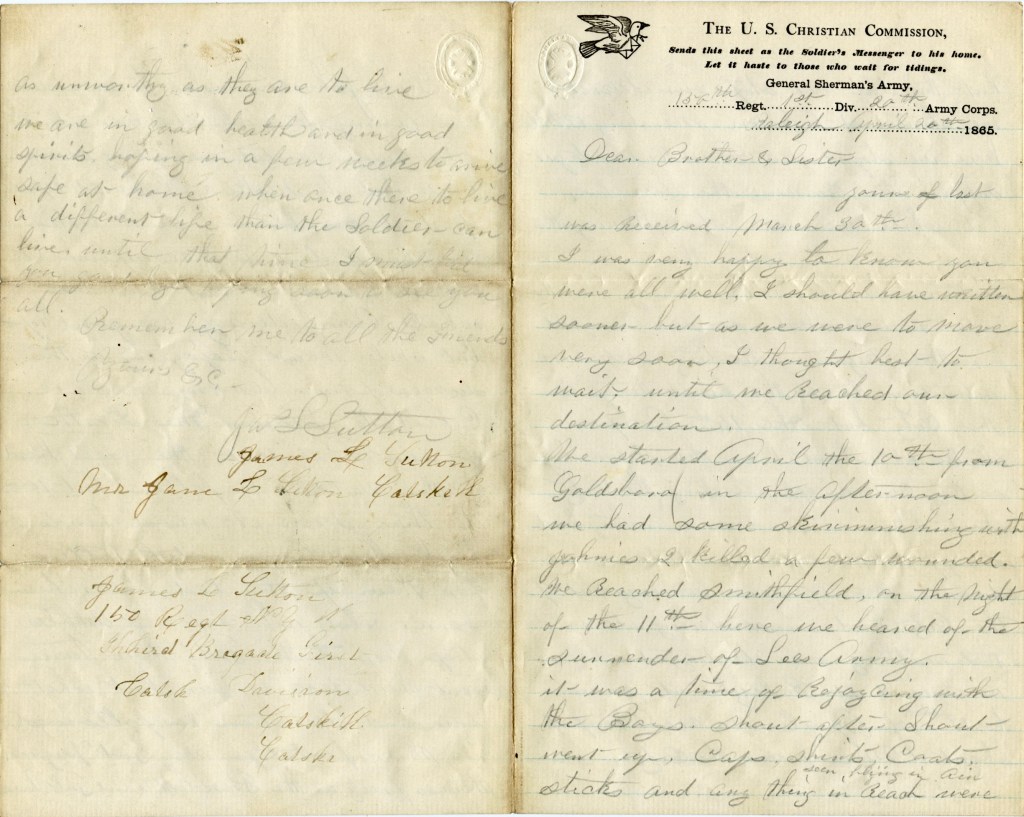
Your last was received March 30th. I was very happy to know you were all well. I should have written sooner but as we were to move very soon, I thought best to wait until we reached our destination.
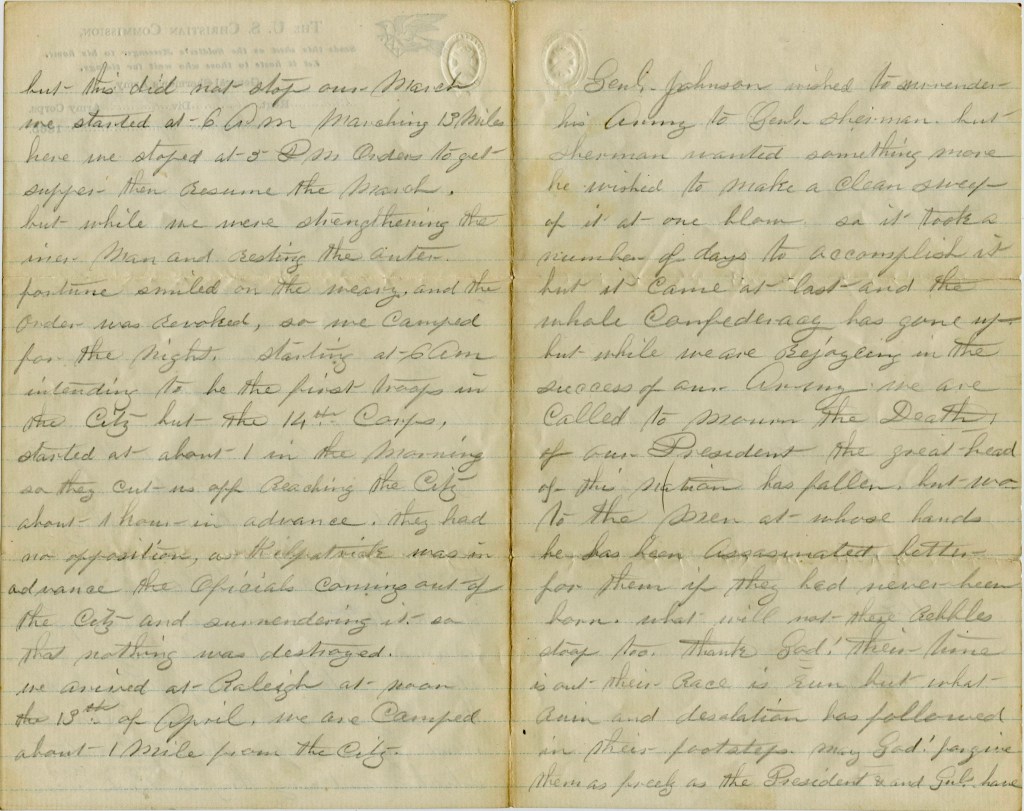
We started April the10th from Goldsboro (in the afternoon). We had some skirmishing with Johnnies, two killed [and] a few wounded. We reached Smithfield on the night of the 11th. Here we heard of the surrender of Lee’s army. It was a time of rejoicing with the boys. Shout after shout went up. Caps, shirts, coats, sticks, and anything in reach were seen flying in air. But this did not stop our march. We started at 6 a.m., marching 13 miles. Here we stopped at 5 p.m. Orders to get supper, then resume the march. But while we were strengthening the inner man and resting the outer, fortune smiled on the weary and the order was revoked so we camped for the night. Starting at 6 a.m. intending to be the first troops in the city, but the 14th Corps started at about 1 in the morning so they cut us off, reaching the city about 1 hour in advance. They had no opposition as Kilpatrick was in advance. The officials coming out of the city and surrendering it so that nothing was destroyed.
We arrived at Raleigh at noon, the 13th of April. We are camped about 1 mile from the city.
Gen. Johns[t]on wished to surrender his army to Gen. Sherman but Sherman wanted something more. He wished to make a clean sweep of it at one blow so it took a number of days to accomplish it but it came at last and the whole Confederacy has gone up. But while we are rejoicing in the success of our army, we are called to mourn the death of our President—the great head of the Nation has fallen. But woe to the men at whose hands he has been assassinated. Better for them if they had never been born. What will not these rebels stoop to? Thank God their time is out—their race is run. But what ruin and desolation has followed in their footsteps. May God forgive them freely as the President & Generals have, as unworthy as they are to live.
We are in good health and in good spirits, hoping in a few weeks to arrive safe at home when once there to live a different life than the soldier can live. Until that time, I must bid you goodbye, hoping soon to see you all. Remember me to all the friends. Yours, &c. — James L. Sutton


 Spared & Shared 23