
This letter was written by 48 year-old John Atherton III (1769-1824), the son of John Atherton II (1747-1825) and Mary Adams (1751-1843)—the 2nd cousin of President John Adams— of Stoughton, Norfolk county, Massachusetts. John Atherton III was married to Sally Bird (1778-1818) and the couple had at least eight children, two of which are mentioned in this letter as having accompanies John to Savannah, Georgia. They include his sons John Atherton IV (1799-1826) and Lemuel Bird Atherton (1804-1860).
John’s letter briefly describes Savannah, Georgia, in 1817 and speaks of the enormous cotton trade already dominating the city business. We gather from John’s letter that he has relocated to Savannah on account of his health, looking for a warmer climate. He also speaks of the militia being called out to fight Indians—probably a reference to the Seminole Wars.
Transcription

Savannah [Georgia]
December 29th 1817
Honored Father,
I take this opportunity to inform you that we are well & hope you and yours are so. I left home the first of November—the wind being southerly. Did not start from Newport till the 21st & got to this place on the 1st of December about 2 o’clock in the morning. I hired a room and chamber & moved into it the 3rd of December. I have hired a stall in the market & buy hogs that are brought to market dressed and cut them up & sell & what is unsold at 9 o’clock, I bring home & salt & then go to making cigars. I have five boarders at $4 per week. Lemuel cooks while John and I go to market. Then John cooks & Lemuel & I makes cigars. So we go on.
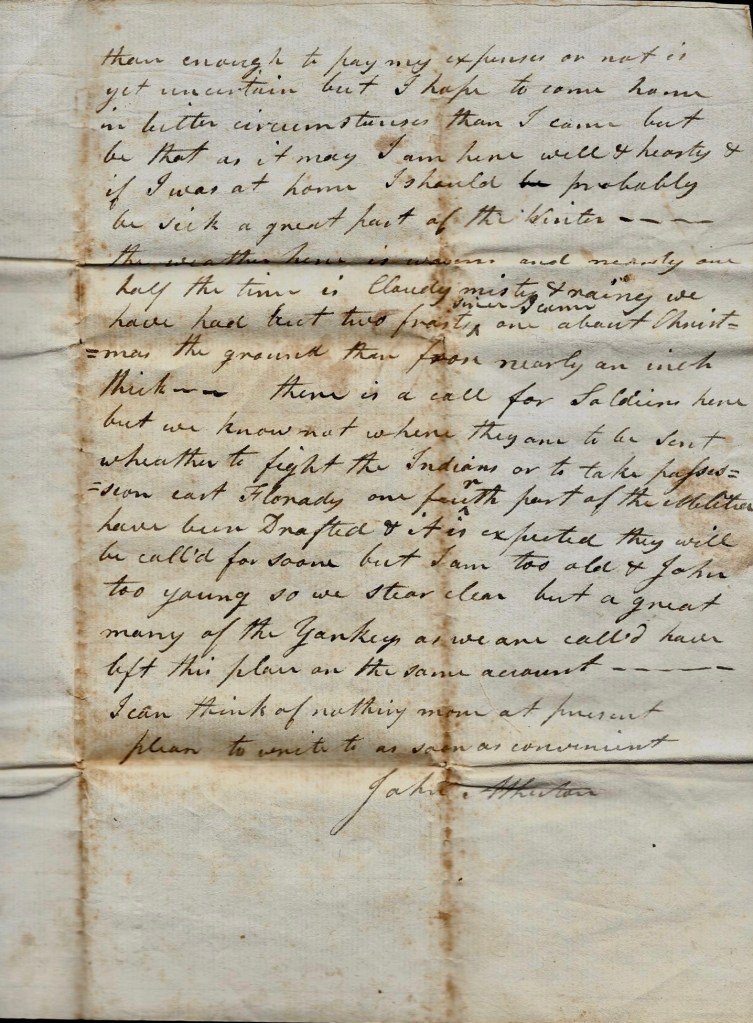
Savannah is a small place and the buildings in general are very poor. You house & Mr. Osgood’s, were they here, would be quite elegant. But there is a great deal of business done here. You have no idea of the quantity of cotton brought here for sale. I believe I have seen bags enough to cover your farm. The whole business of the State centers here. Consequently labor and provision is very high. Whether I shall earn more than enough to pay my expenses or not is yet uncertain but I hope to come home in better circumstances than I came. But be that as it may, I am here well & hearty & if I was at home, I should probably be sick a great part of the winter.
The weather here is warm and nearly one half of the time is cloudy, misty and rainy. We have had but two frosts since I came—one about Christmas. The ground then was froze nearly an inch thick.
There is a call for soldiers here but we know not where they are to be sent—whether to fight the Indians or to take possession of East Florida. One fourth part of the militia have been drafted and it is expected they will be called for soon but I am too old and John too young so we steer clear. But a great many of the Yankees—as we are called—have left this place on the same account. I can think of nothing more at present, Please to write as soon as convenient. — John Atherton

 Spared & Shared 23