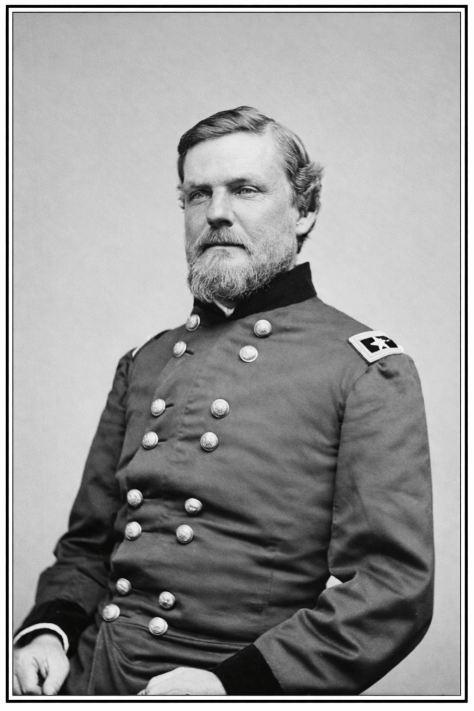
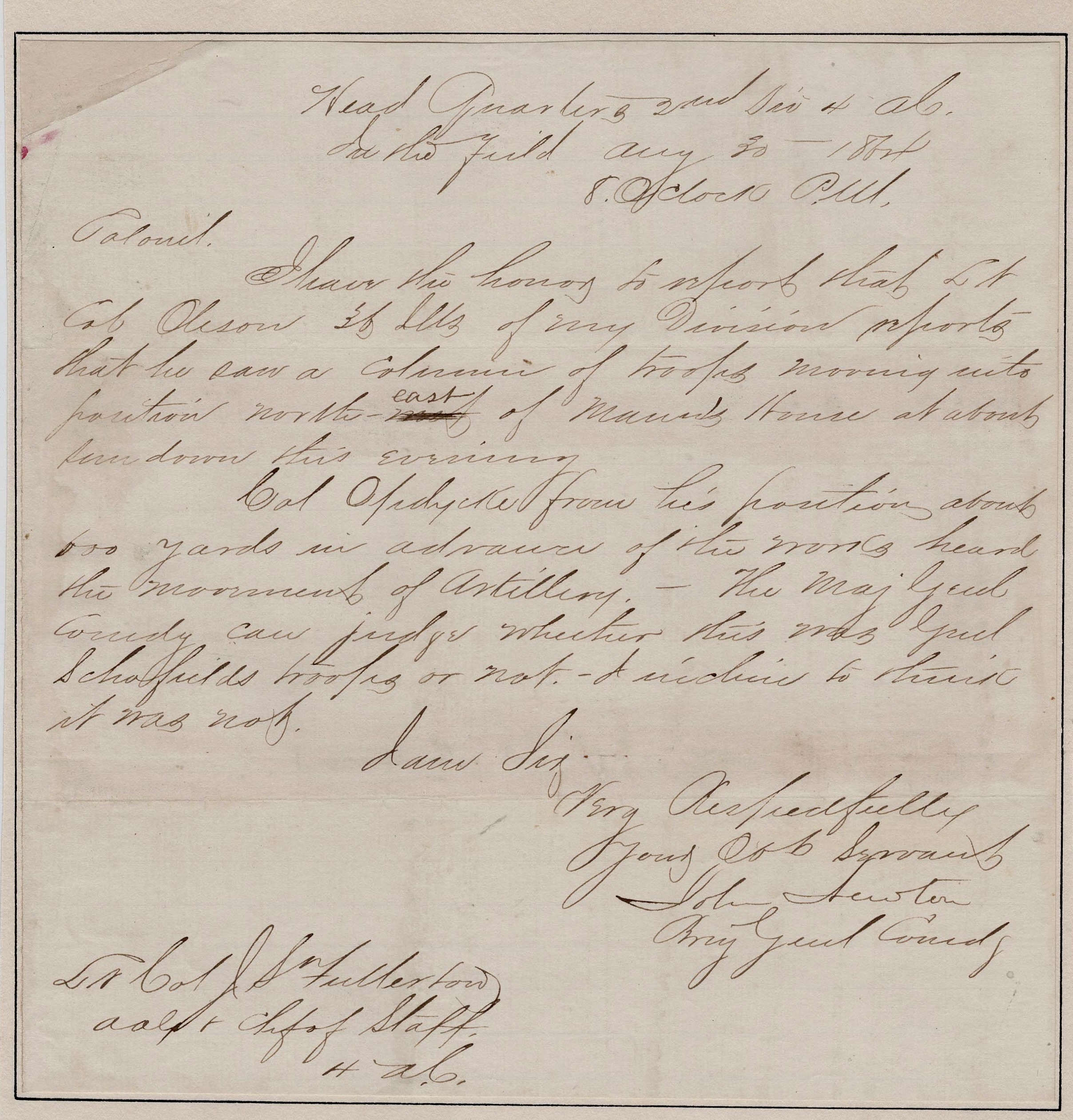
The following note was penned entirely in his own hand by Major General John Newton (1823-1895) in the closing days of the Atlanta Campaign. At the time, Newton commanded the 2nd Division, IV Army Corps in Maj. Gen. George H. Thomas’s command. Newton enjoyed the confidence of Sherman and was respected for having successfully commanded the 1st Army Corps after Reynolds was killed at Gettysburg. A few weeks earlier he was credited with helping to win the critical battle of Peachtree Creek. A highly competent engineer, Newton was cautious but not so that he risked his career in late December 1862 by meeting with President Lincoln to voice his lack of confidence in Burnside as the commander of the Army of the Potomac.
Newton composed the note to Lt. Col. Joseph Scott Fullerton (1835-1897), who held the position of Aide-de-Camp and Chief of Staff for Thomas’s IV Army Corps. The note was intended to inform Maj. Gen. Thomas of observed troop and artillery movements in the area and to inquire, essentially, whether they were allies or adversaries. Schofield’s maneuvers seemed to be unknown to Newton, who was in the process of preparing to disrupt the Macon & Western Railroad to the south of Atlanta, becoming involved in the Battle of Jonesborough from August 31 to September 1, 1864.
[Note: This letter is from the collection of Jim Doncaster who made it available for transcription and publication on Spared & Shared by express consent.]
T R A N S C R I P T I O N
Headquarters 2nd Division, 4th Army Corps In the Field, August 30, 1864 8 o’clock p.m.
Colonel,
I have the honor to report that Lt. Col. [Porter] Olson, 36th Illinois [Infantry], of my Division reports that he saw a column of troops moving into position north-east of [John A.] Mann’s House at about sundown this evening. 1
Col. Opdycke from his position about 600 yards in advance of the works heard the movement of artillery. The Maj. General Commanding can judge whether this was Gen. Schofield’s troops or not. I incline to think it was not. I am sir, very respectfully your obedient servant, — John Newton, Brig. General Commanding
Lt. Col. J. S. Fullerton, AAG & Chief of staff, 4th A. C.
1 The John A, Mann farmhouse is mentioned in several official dispatches in describing the movements of the 4th Army Corps from Red Oak to the Macon Railroad at Rough & Ready on 30 August 1864. See Marker: The Mann House.
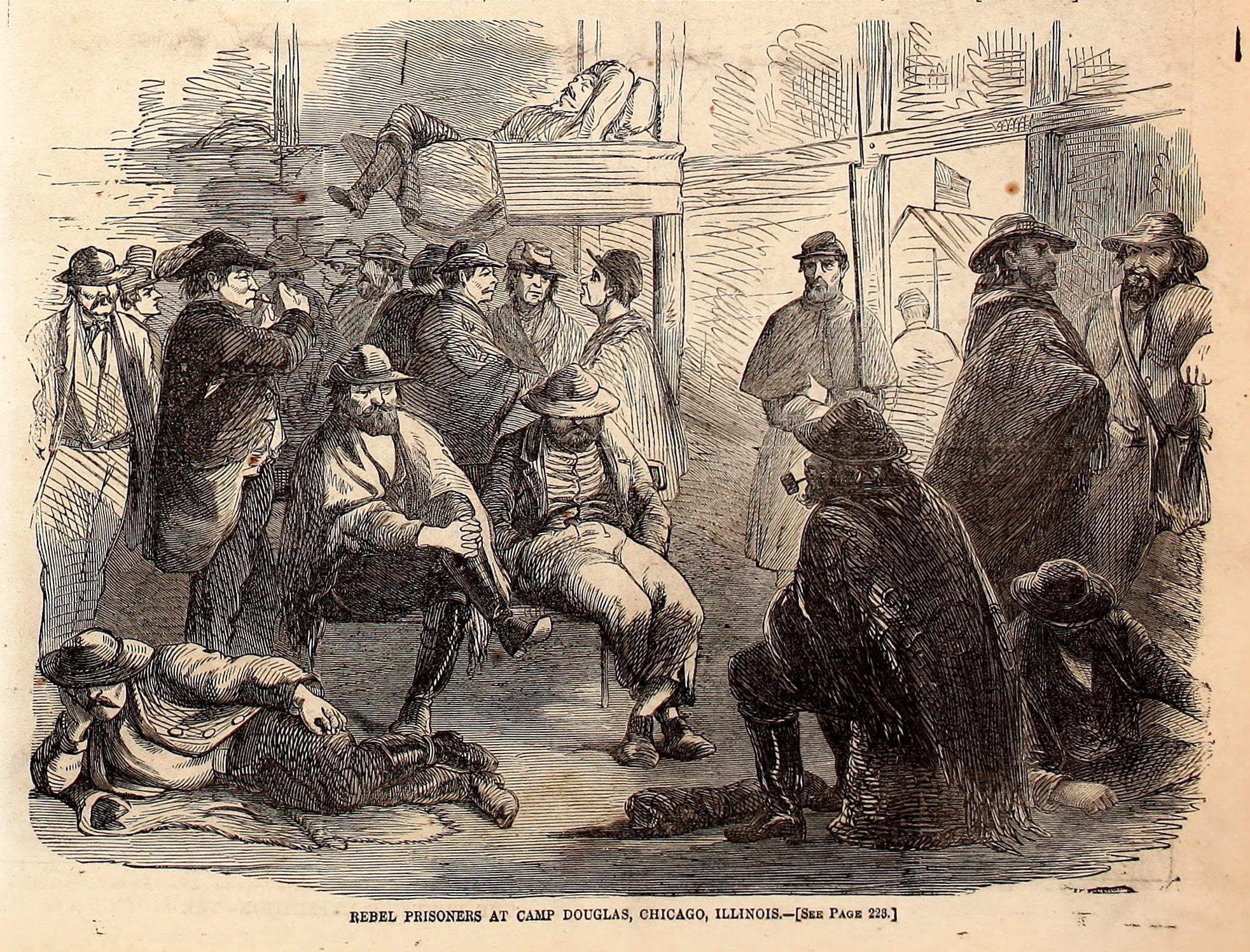
These letters were written by Truman (“True”) W. Williams (1839-1897) who grew up in Watertown, New York, the son of Asa and Louisa Keelar Williams. He was a self-taught illustrator and one of his earliest published works appeared in Harpers Weekly (April 1862) depicting rebel prisoners at Camp Douglas near Chicago (see below). In mid-December 1863, he enlisted in Co. E, 15th Illinois Infantry at Chicago. When he enlisted, he was described as standing 5′ 8″ tall, with hazel eyes, and dark hair. He was with the regiment until the spring of 1864 when he was attached to the topographical engineers. After mustering out of the service in October 1865, he pursued his career in illustrations and was best known for illustrating books for Mark Twain. [see Biographical Sketch]
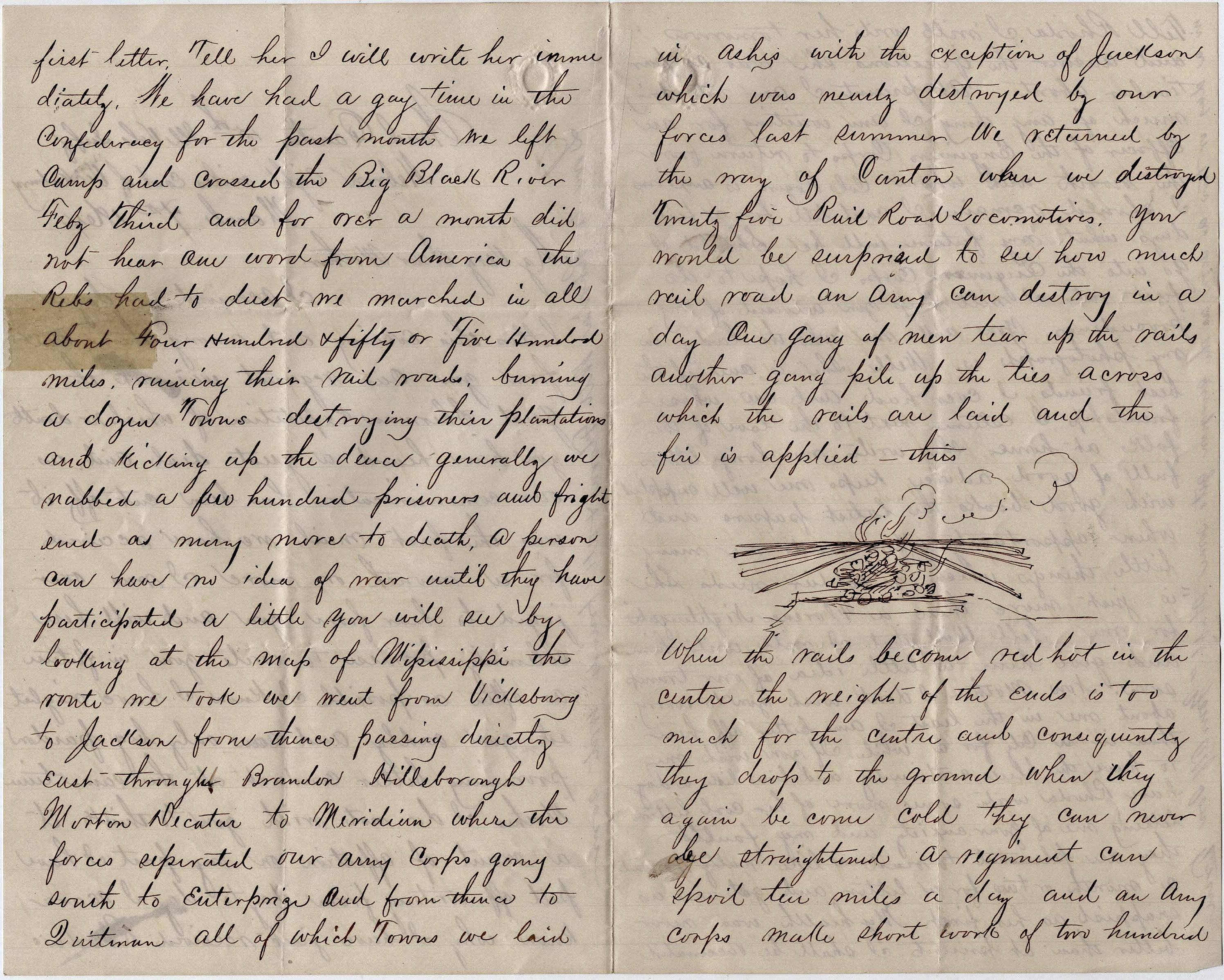
In one of the letters presented here, Truman gives us a sketch of the method used by Sherman’s army to bend the rails of the tracks torn up during his Meridian Expedition in the early spring of 1864. His sketch would have been made by direct observation. See Sherman’s Neckties.
Letter 1
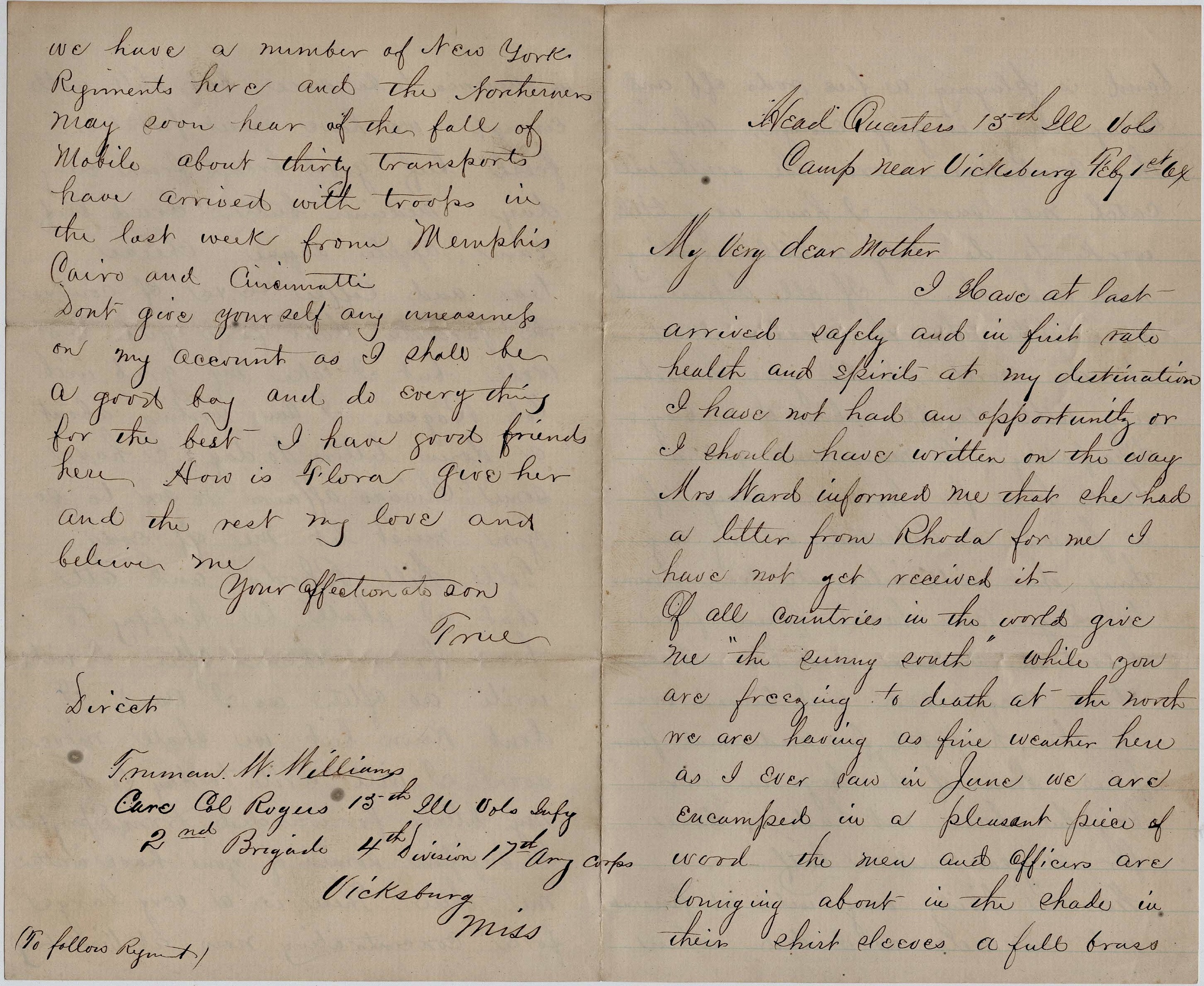
Headquarters 15th Illinois Vols. Camp near Vicksburg February 1st 1864
My very dear mother,
I have at last arrived safely and in first rate health and sprits at my destination. I have not had an opportunity or I should have written on the way, Mrs. Ward informed me that she had a letter from Rhoda for me. I have not yet received it.
Of all countries in the world, give me “the Sunny South.” While you are freezing to death at the North, we are having as fine weather here as I ever saw in June. We are encamped in a pleasant piece of wood. The men and officers are lounging about in their shirt sleeves, a full brass band is playing a few rods off, and everything is gay enough. When this cruel war is over the South will catch me sure.
I have very little work to do—only a little writing now and then. If all departments were like this, the anxious mothers at the North should give themselves very little trouble about their boy’s dissipating. A man can’t get a drink here for love or money. If a person is detected selling anything that will intoxicate even down to lager beer, he is fined five hundred dollars and his whole stock confiscated and turned over to the hospital for medicinal purposes. Some of the boys in our brigade have not had a dose for a year and a half.
We are living very well at present. Not as well as I did when in America to be sure, but still well enough. We have sweet potatoes, fresh beef, good bread fresh every day, medium butter, dried beef, ham, apple sauce, cheese, tea, and coffee, &c. &c. Of course the privates don’t fare quite as well but I take my grub with Col. Rogers. I am writing about a dozen letters today. I have some Chicago affairs to see to so you must let me off easy.
Tell Will, Rhoda, and all that I shall be happy to hear from them often. I wil write as often as I can. I don’t know but we shall move soon. I will write today to have my letters forwarded from Springfield. I suppose some of you have written me there.
There is a very large force concentrating now at Vicksburg. We have a number of New York Regiments here and the Northerners ,ay soon hear of the fall of Mobile. About 30 transports have arrived with troops in the last week from Memphis, Cairo and Cincinnati.
Don’t give yourself any uneasiness on my account as I shall be a good boy and do everything for the best. I have good friends here. How is Flora? Give her and the rest my love and believe me your affectionate son, — True
Direct to Truman W. Williams, Care of Col. Rogers, 15th Illinois Vols. Infantry, 2nd Brigade, 4th Division, 17th Army Corps, Vicksburg, Mississippi
Letter 2
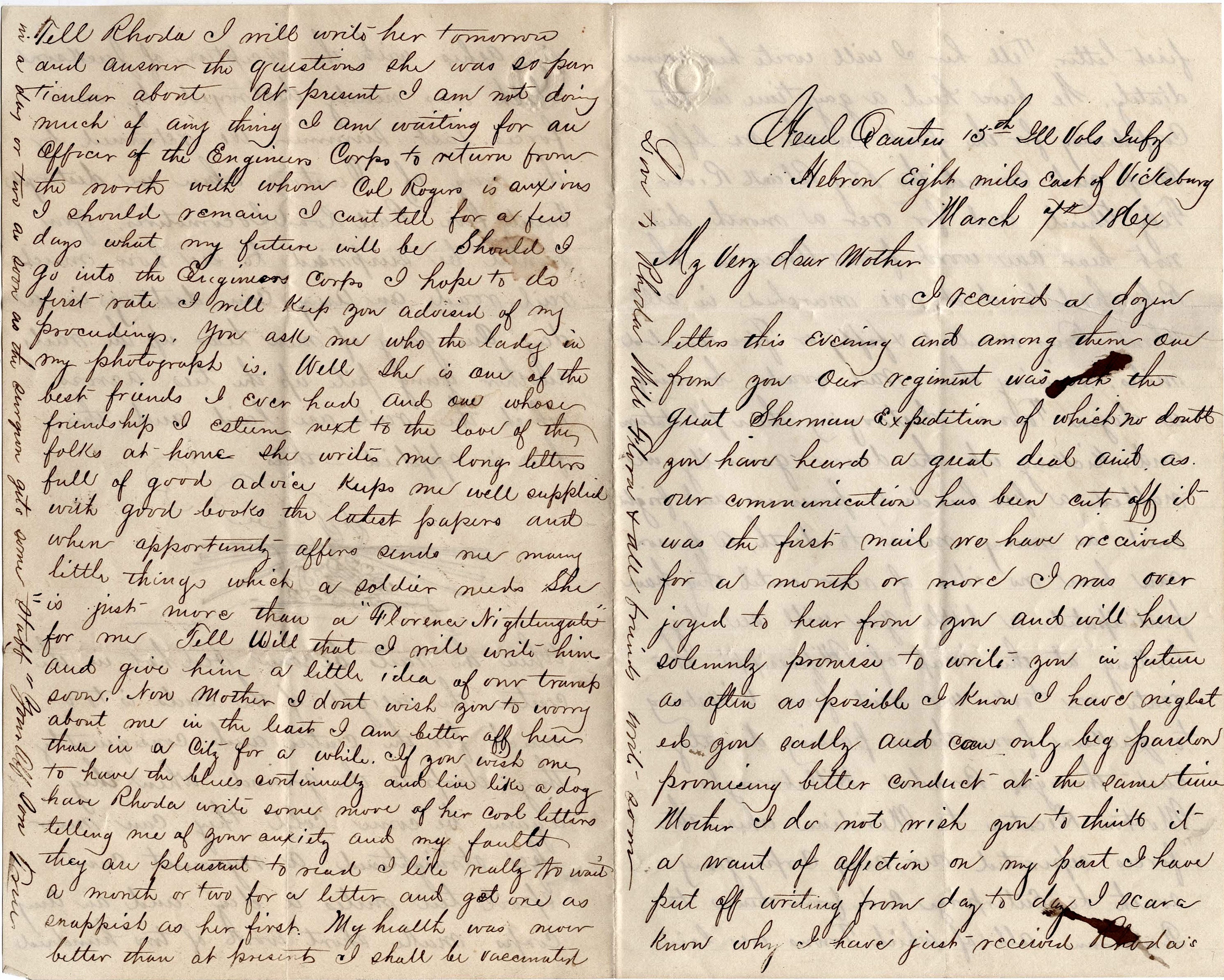
Headquarters 15th Ill. Vols. Infantry Hebron, eight miles east of Vicksburg March 7, 1864
My very dear mother,
I received a dozen letters this evening and among them one from you. Our regiment was with the great Sherman [Meridian] Expedition of which no doubt you have heard a great deal, and as our communication has been cut off, it was the first mail we have received for a month or more. I was overjoyed to hear from you and will here solemnly promise to write you in future as often as possible. I know I have neglected you sadly and can only beg pardon promising better conduct at the same time. Mother I do not wish you to think it a want of affection on my part I have put off writing from day to day. I scarce know why. I have just received Rhoda first letter. Tell her I will write to her immediately.
We have had a gay time in the Confederacy for the past month. We left camp and crossed the Big Black River February 3rd and for over a month did not hear one word from America. The rebs had to dust. We marched in all about 450 or 500 miles, ruining their railroads, burning a dozen towns, destroying their plantations and kicking up the deuce generally. We nabbed a few hundred prisoners and frightened as many more to death. A person can have no idea of war until they have participated a little. You will see by looking at the map of Mississippi the route we took. We went from Vicksburg to Jackson, from thence passing directly east through Brandon, Hillsborough, Morton, Decatur, to Meridian where the forces separated, our Army Corps going south to Enterprise and from thence to Quitman, all of which towns we laid in ashes with the exception of Jackson which was nearly destroyed by our forces last summer.
We returned by the way of Canton where we destroyed 25 railroad locomotives. You would be surprised to see how much railroad an army can destroy in a day. Our gang of men tear up the rails, another gang pile up the ties across which the rails are laid and the fire is applied—thus [sketch]
Sketch of method used by Sherman’s army to bend the track rails by heating them over a fire.
When the railrs become red hot in the center, the weight of the ends is too much for the center and consequently they drop to the ground when they again become cold. They can never be straightened. A regiment can spoil ten miles a day and an ARmy Corps make short work of two hundred.
Tell Rhoda I will write her tomorrow and answer the questions she was so particular about. At present I am not doing much of anything. I am waiting for an officer of the Engineers Corps to return from the North with whom Col. Rogers is anxious I should remain. I can’t tell for a few days what my future will be. Should I got into the Engineers Corps, I hope to do first rate. I will keep you advised of my proceedings.
You ask me who the lady in my photograph is. Well she is one of the best friends I ever had and whose friendship I esteem next to the love of the folks at home. She writes me long letters full of good advice, keeps me well supplied with good books, the latest papers, and when opportunity offers, seds me many little things which a soldier needs. She is just more than a “Florence Nightingale” for me.
Tell Will that I will write him and give him a little idea of our tramp soon. Now mother, I don’t wish you to worry about me in the least. I am better off here than in a City for a while. If you wish me to have the blues continually and live like a dog, have Rhoda write some more of her cool letters telling me of your anxiety and my faults. They are pleasant to read. I like really to wait a month or two for a letter and get one as snappish as her first. My health was never better than at present. I shall be vaccinated in a day or two as soon as the surgeon gets some”stuff.” Your affectionate son, — True
Letter 3
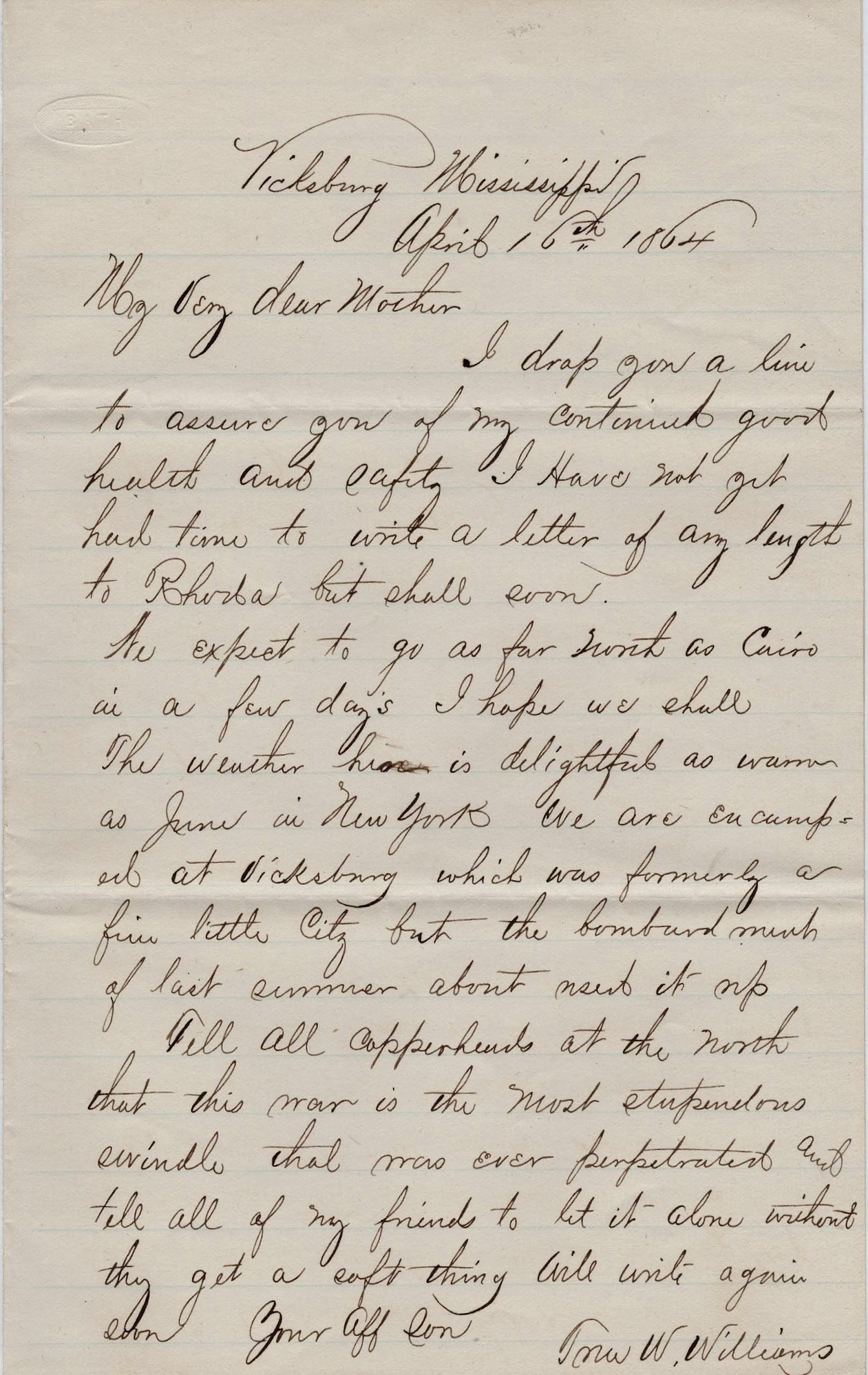
Vicksburg, Mississippi April 16th 1864
My very dear mother,
I drop you a line to assure you of my continued good health and safety. I have not yet had time to write a letter of any length to Rhoda but shall soon.
We expect to go as far north as Cairo in a few days. I hope we shall. The weather is delightful—as warm as June in New York. We are encamped at Vicksburg which was formerly a fine little city but the bombardment of last summer about used it up.
Tell all Copperheads at the North that this war is the most stupendous swindle that was ever perpetrated and tell all of my friends to let it alone without they get a soft thing. Will write again soon. Your affectionate son, Tru W. Williams
Letter 4
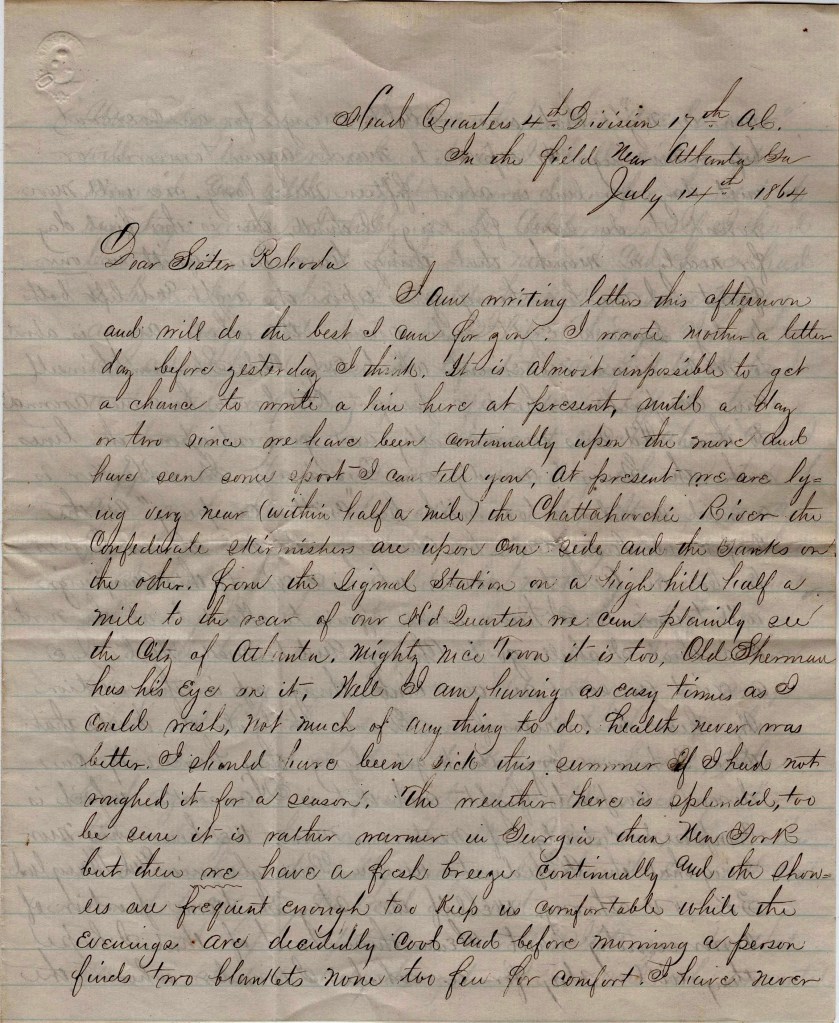
Headquarters 4th Division 17th Army Corps In the field near Atlanta, Ga. July 14, 1864
Dear Sister Rhoda,
I am writing letters this afternoon and will do the best I can for you. I wrote Mother a letter day before yesterday I think. It is almost impossible to get a chance to write a line here at present. Until a day or two since, we have been continually upon the move and have seen some sport, I can tell you. At present we are lying very near (within half a mile) of the Chattahoochee River. The Confederate skirmishers are upon one side and the Yanks on the other. From the Signal Station on a high hill half a mile to the rear of our headquarters, we can plainly see the City of Atlanta. Mighty nice town it is too. Old Sherman has his eye on it.
Well, I am having as easy times as I could wish. Not much of anything to do. Health never was better. I should have been sick this summer if I had not roughed it doe a season. The weather here is splendid to be sure. It is rather warmer in Georgia than New York but there we have a fresh breeze continually and the showers are frequent enough to keep us comfortable while the evenings are decidedly cool and before morning a person finds two blankets none to few for comfort. I have never seen a night that was not cold enough for an overcoat before morning.
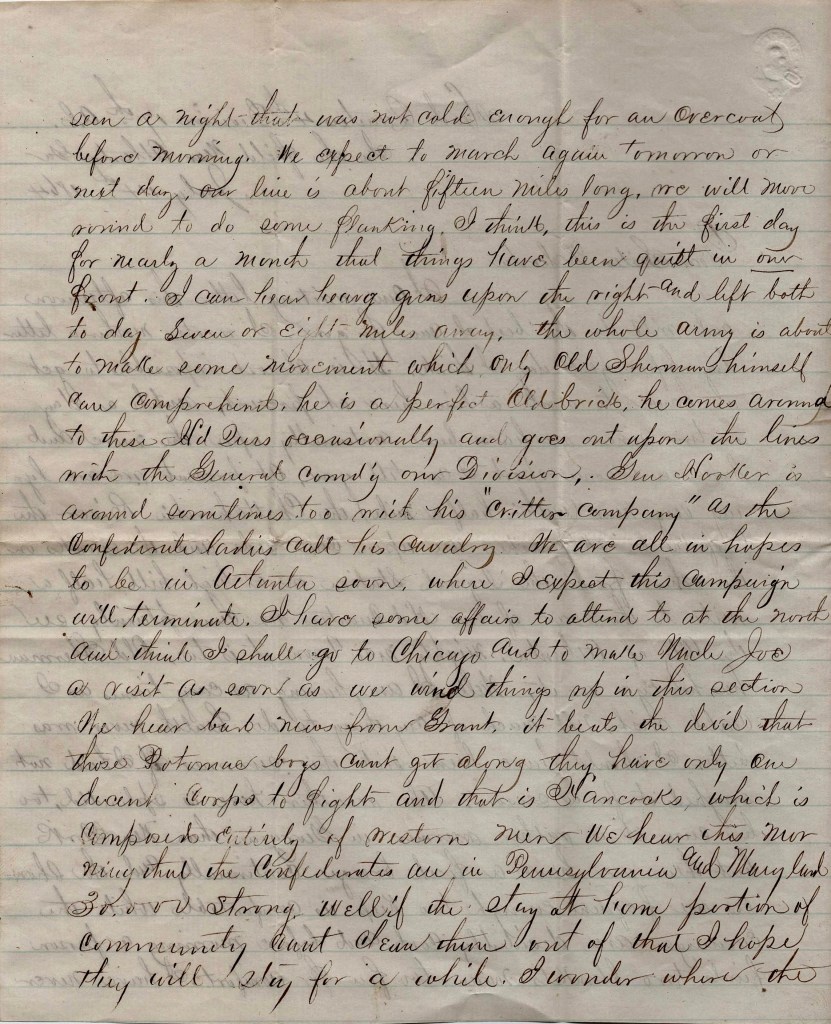
We expect to march again tomorrow or next day. Our line is about fifteen miles long. We will move round to do some flanking, I think. This is the first day for nearly a month that things have been quiet in our front. I can hear heavy guns upon the right and left both today, seven or eight miles away. The whole army is about to make some movement which only Old Sherman himself can comprehend. He is a perfect old brick. He comes around to the headquarters occasionally and goes out upon the lines with the General commanding our Division. Gen. Hooker is around sometimes too with his “critter company” as the Confederate ladies call his cavalry.
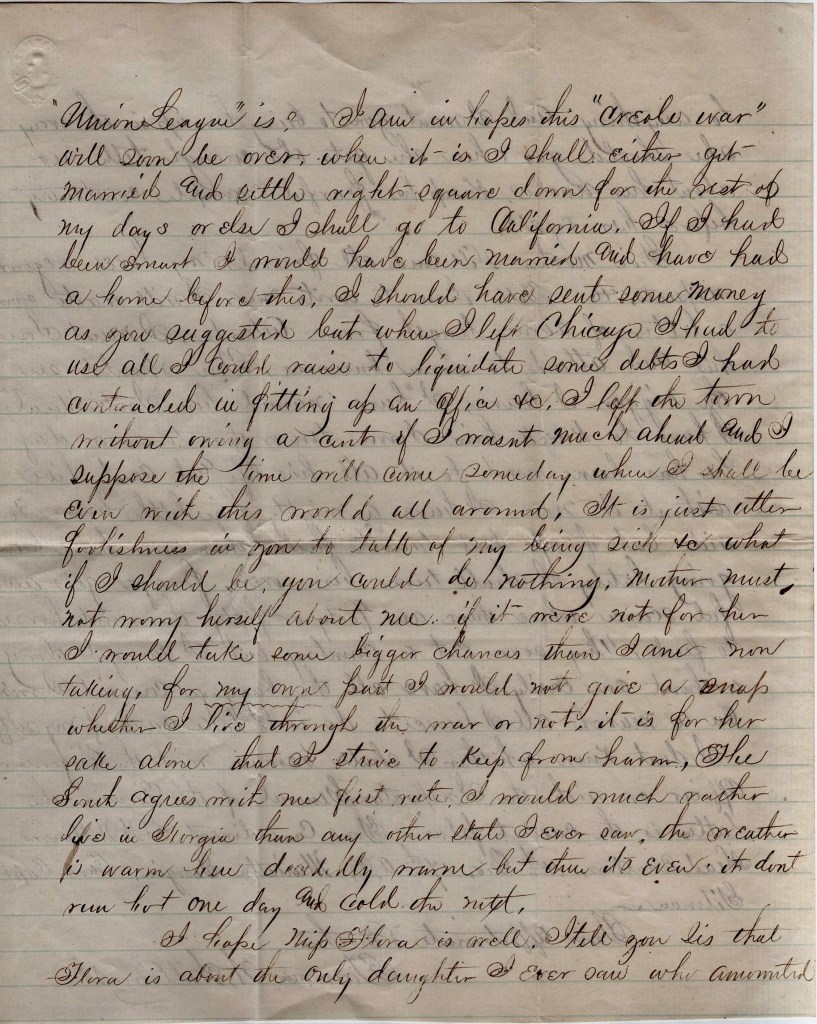
We are all in hopes to be in Atlanta soon where I expect this campaign will terminate. I have some affairs to attend to at the North and think I shall go to Chicago and to make Uncle Joe a visit as soon as we wind things up in this section. We hear bad news from Grant. It beats the devil that those Potomac boys can’t get along. They have only one decent Corps to fight and that is Hancock’s, which is composed entirely of western men. We hear this morning that the Confederates are in Pennsylvania and Maryland 30,000 strong. Well, if they stay at home portion of community can’t clear them out of that, I hope they will stay for a while. I wonder where the “Union League” is? I am in hopes this “creole war” [cruel war] will soon be over. When it is, I shall either get married and settle right square down for the rest of my days or else I shall go to California. If I had been smart, I would have been married and have had a home before this.
I should have sent some money as you suggested but when I left Chicago, I had to use all I could raise to liquidate some debts I had contracted in fitting up an office &c. I left the town without owing a cent if I wasn’t much ahead and I suppose the time will come someday when I shall be even with this world all around. It is just utter foolishness in you to talk of my being sick &c. What is I should be? You could do nothing. Mother must not worry herself about me. If it were not for her, I would take some bigger chances than I am now taking. For my own part, I would not give a snap whether I live through the war or not. It is for her sake alone that I strive to keep from harm. The South agrees with me first rate. I would much rather live in Georgia than any other state I ever saw. The weather is warm here—decidedly warm—but then it’s even. It don’t run hot one day and cold the next.
I hope Miss Flora is well. I tell you, sis, that Flora is about the only daughter I ever saw who amounted to anything and I want you to bring her up in the way she should go. When she gets old enough, tell her about her uncle. Keep his fearful enough example constantly before her eyes.
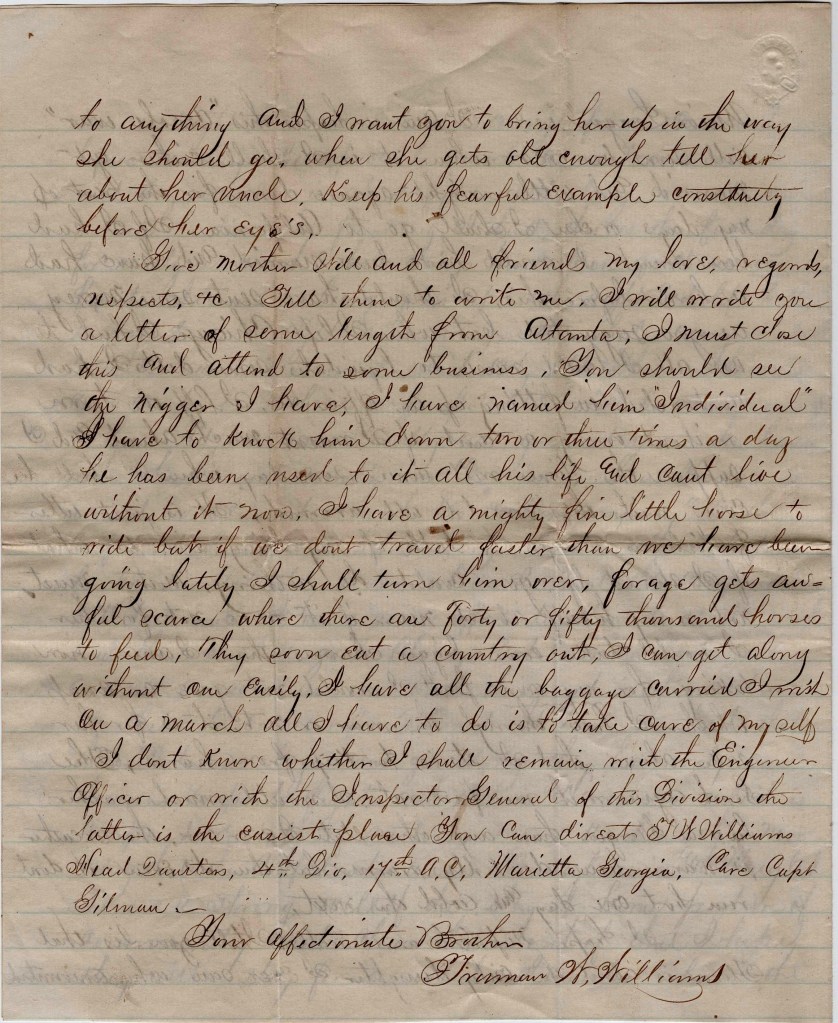
Give mother, Will, and all friends my love, regards, respects, &c. Tell them to write me. I will write you a letter of some length from Atlanta. I must close this and attend to some business. You should see the nigger I have. I have named him “Individual.” I have to knock him down two or three times a day. He has been used to it all his life and can’t live without it now. I have a mighy fine little horse to ride but if we don’t travel faster that we have been going lately, I shall turn him over. Forage gets awful scarce where there are 40 or 50,000 horses to feed. They soon eat a country out. I can get along without one easily. I have all the baggage carried I wish on a march. All I have to do is to take care of myself.
I don’t know whether I shall remain with the Engineer Officer or with the Inspector General of this Division. The latter is the easiest place. You can direct to T. W. Williams, Headquarters, 4th Division, 17th Army Corps, Marietta, Georgia. Care Capt. Gilman
The following letters were written by August Rost (1833-1864), principal musician in the 17th Alabama Infantry. August wrote the letter to his wife, Margaret Steele (1846-1934) with whom he married in January 1863. Margaret—called “Molly” in these letters—was the daughter of German immigrant Michael Steele.
August Rost (1833-1864)
Rost led a popular brass band in Mobile before the Civil War. On June 10, 1861, there is notice that he provided music for Gov. A. B. Moore’s excursion to Fort Morgan aboard the steamer Crescent. In that same month Rost’s band led the German Fusiliers (Co. G, 8th Alabama) and their escort to the train station as the company left for Virginia to participate in the Battle of Bull Run. By the end of July the band became the official garrison band at Fort Morgan at the entrance to Mobile Bay. A member of the 2nd Alabama Regiment stated that Rost’s Band “entertained the garrison after the duties of the day were over.” By mid-September, 1861, the band was back in Mobile.
Sometime in 1863, Rost’s Band became the band of the 17th Alabama Infantry and early in 1864, the regiment joined the Army of Tennessee, serving under General Cantey, and active in the Atlanta Campaign and Hood’s expedition into Tennessee. Rost, however, died on 11 November 1864.
Several years ago I transcribed six letters by August Rost and published them on Spared & Shared 10. See—1863-64: August Rost to Mary Rost.
Advertisement for the Mobile Military Brass Band, Mobile Register, 2 June 1860
Southern Republic Polka March as performed by Rost’s Military Brass Band, Mobile, Alabama
Letter 1
No. 1
Marietta, Georgia June 21st 1864
Dear Wife,
I received your kind letters on the 10th and 17th the 21st of June and was very sorry to see that [ ] was sick and [ ] again. Molly, you tell me very…kind letter. I received that tobacco bag and I can [ ] think of you whenever I do smoke…you did write for me to come home but it is not possible till after this fight, if I live to get home. But I would not go. But as soon as this fight is over I do come and stay about 10 days with you.
Dear wife, when I was eating my dinner today, Peter Von Alber came to me to tell me that he was looking for me the last month. He is well and was as glad to find me as a lost child finds his Pa. He told me he never had a happy day in ten years like today.
Darling, I have to close. My time is [ ]. Give my love to Pa, Ma, and sisters and brothers and tell Pa to write soon to me and if he wants me to write in English to let me know. Darling, take care of yourself and be happy if you can. You will see me soon if I am spared. — August Rost
Margaret (“Molly”) Rost
No. 2
Marietta, Georgia June 21st 1864
Dear Molly,
Tell me in your next letter how you are getting [on] and if that made you sick to lay in the bed of if was only unwell. Molly, you must not work much if you ain’t well, and neither work in the house. If you keep still, you soon will get over it, and if you think you are getting better, go out to that milk woman on Government Street and stay there about 9 or 10 days. That will do more good than all. Do not eat anything than milk and rice and flour bread, and let me know how you [are] getting on.
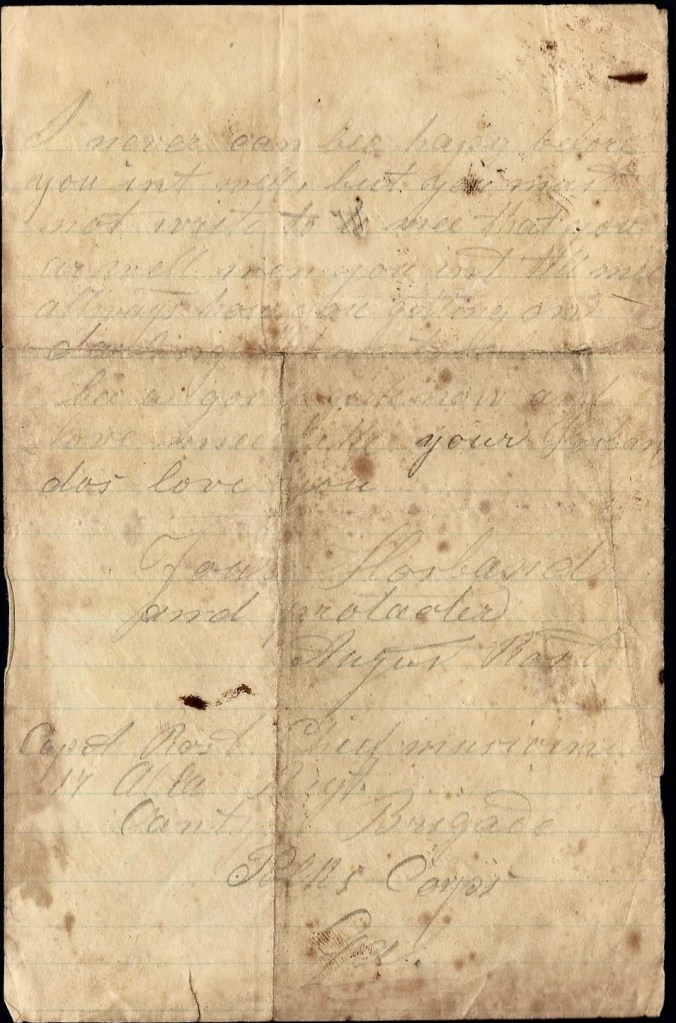
Dear wife, I am glad you get money yet. I will not get any before this fight is over. Dear Molly, try to get well till I do come home. I never can be happy before you are well, but you must not write to me that you are well when you ain’t. Tell me always how you are getting on. Darling….be a good wife now and love me like your husband does love you. Your husband and protector, — August Rost
I am still in Marietta yet and fighting is going on from day to day. We lost about 1,500 men on Thursday the 23rd 1 and I think the Yankees lost more. I think we will fall back about four miles and give the Yanks a general fight. If they do not fight us, we will have to fight them.
Dear Molly, I am well and I hope that you’re getting better. If not, let me know all about it. Darling, I think of you day and night. I never did know how dear you are to me before till now. [ ] only be one day with you. I have a lot of little things to tell you but I hope that day will come soon, and [I will] tell you all I know. And I know you have many things to tell me. …
[ ] wanted me to start a band for him and the 17th Brigade was bound to let me go of Gen. Polk says he wanted me. They sent a note to Col. [Virgil S.] Murphey that I should report to him the [ ] to let me go and he would have done so if he didn’t live me day…..
I will write more as soon as I receive a letter from you. Tell Pa to write to me and let me know [ ] and give my love to Ma and sisters and brothers. Darling, do not forget your true husband till dead. — August Rost
Capt. A. Rost, Chief Musician. 17th Ala. Regt., Cantey’s Brigade, Polk’s Corps.
1 August is probably referring to the Battle of Kolb’s Farm which took place on 22 June 1864. Polk was killed at Pine Mountain on June 14 and temporarily replaced by Major General William Wing Loring. Historian Albert E. Castel estimated that Hood’s attack cost his corps 1,500 killed, wounded, and missing, two-thirds of which were from Stevenson’s division.
Letter 3
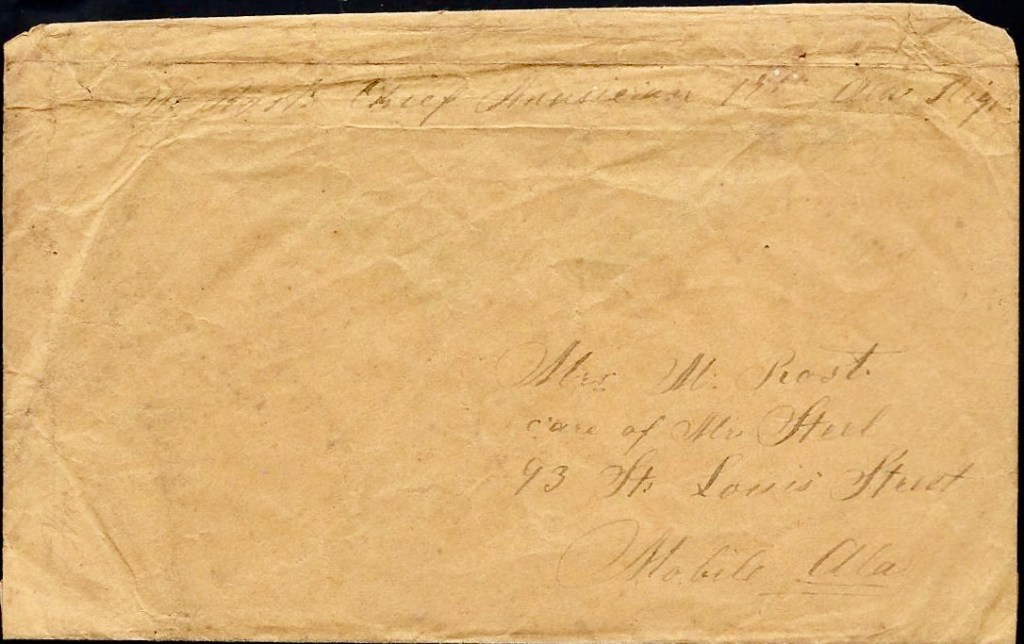
Addressed to Mrs. M. Rost, care of Mr. Steele, 93 St. Louis Street, Mobile, Alabama
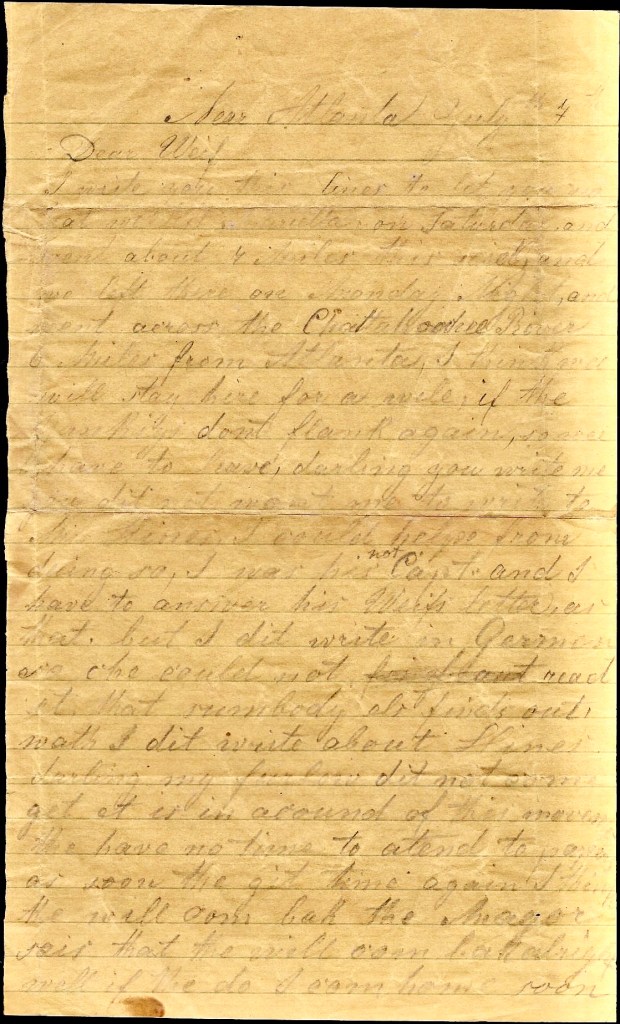
Near Atlanta [Georgia] July 7, [1864]
Dear Wife,
I write you this time to let you know that we left Marietta on Saturday and went back about 7 miles this [ ] and we left there on Monday night and went across the Chattahoochee River 6 miles from Atlanta. I think we will stay here for a while if the Yankees don’t flank again so we have to leave.
Darling, you write me you did not want me to write to Mrs. Hines. I could [not] help from doing so. I was his captain and I have to answer his wife’s letter at that, but I did write in German so she could not read it, that somebody else finds out what I did write about [Jacob] Hines. 1
Darling, my furlough did not come yet. It is in account of this move. We have no time to attend to papers. As soon as they get time again, I think they will come back. The Major says that they will come back alright. Well, if they do, I [will] come home soon, but I have no hope that I come before this fighting is over. I will come then or I come before I play again with my band. I give you my word.
Dear wife, I am in very good health and I hope that you are the same. And I think of you from hour to hour. Darling, you do not know how a true man does love his wife, yet he loves her better than himself. Oh, I did see 50 men at least wounded and nearly dead. All they pray for is, “Oh God, bless my dear wife.” They do not think about themselves. It does me good to see it. There is nothing in the world that is so dear to me than my little wife. Darling, goodbye. I have to close. Write soon and I hope we will meet soon again.
Your husband till dead, — August Rost, Capt. of Band, Chief Musician, 17th Alabama Infantry, Cantey’s Brigade, Polk’s Corps.
1 Jacob Hines was a musician in the band of the 17th Alabama. He was taken prisoner at Cassville, Georgia, on 20 May 1864 and sent to Louisville, Kentucky, and then forwarded to Rock Island, Illinois.
Letter 4
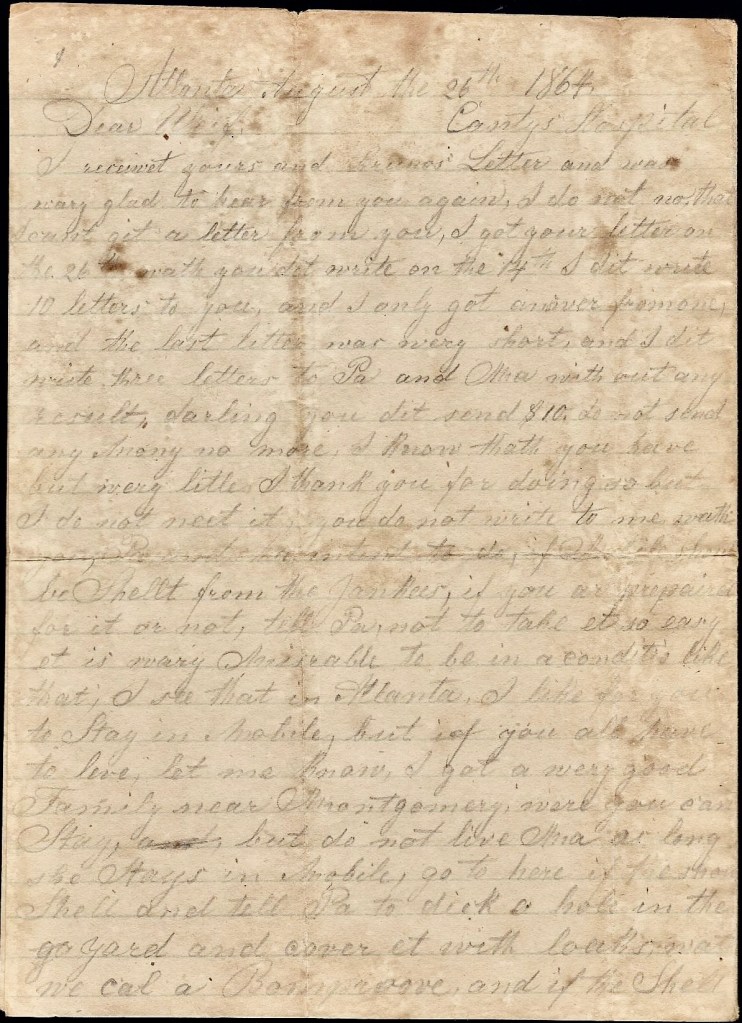
Atlanta, [Georgia] August 26th 1864 Cantey’s Hospital
Dear Wife,
I received yours and [Edward] Bruno’s letter and was very glad to hear from you again. I do not know that I can’t get a letter from you. I got your letter on the 26th that you did write on the 14th. I did write 10 letters to you and I only got answer from one and the last letter was very short. And I did write three letters to Pa and Ma without any result. Darling, you did send $10. Do not send any money no more. I know that you have but very little. I thank you for doing so but I do not need it. You do not write to me whether your Pa wrote as he intended to do. If Mobile should be shelled from the Yankees, if you are prepared for it or not. Tell Pa not to take it so easy. It is very miserable to be in a condition like that. I see that in Atlanta. I like for you to stay in Mobile but if you all have to leave, let me know. I got a very good family near Montgomery where you can stay, but do not leave Ma as long she stay in Mobile. Go to her if they should shell and tell Pa to dig a hole in the yard and cover it with logs—what we call a bomb proof—and if the shells go in there, tell them to stay down.
Molly, tell me if you did get any money from me and if you got any, do not be without. Let me know and I [will] send you some. Darling, do not forget your true husband who thinks of you day and night and cannot help you in your present condition. If it were in my power, I would be on your side and protect you to the last but we are parted and left to ourselves so I have to call on Pa and Ma to protect you and I know they will do so until I return.
My dear wife, if Mobile should fall [illegible] come soon and take care of my darling and send me letters by Flag of Truce and I will do the same and think of the happy hours we had when met the last time. Darling, I got good times. I stay in the hospital and have nothing to do than write music and practice with my band. I went last night serenading to our Gen. [Alexander Peter] Stewart and thank for improving my band so fast and he told me to go in that way, that he would protect me, and if I want for anything to let him know.
Darling, I have to close…Give my love to Pa & Ma and to all. write soon again and tell Pa to write me. From your true husband, — August Rost
Letter 5
Cantey’s Brigade Hospital Atlanta, [Georgia] August 30th 1864
Dear Wife,
I received your kind letter sent by that young man on the 29th of August, and was very glad to hear that you are in good health and I thank God that I can tell you the same. Darling, I live in hopes we will be soon together again. This war must close soon. It is going to the end and if it don’t, I will try to finish it myself. I will try very hard to get my discharge on the 17th of September. If I get it, I will come home. It may be that we come back to Mobile as soon as this campaign is over, if the Yankees don’t take Atlanta.
Darling, Mr. Junger is coming to Mobile. I told him to come and see you and tell you all about how I get along. He told me he would go in Tuesday and I went to Atlanta on Monday to our Brigade General to get $200. A note was promised to me on Monday and when I came to Atlanta, our Brigade was moved from there and till I come home, Junger [Yunger?] was gone, and I could send no letter with money, after I walked about ten miles in the hot sun. He will tell you all about it.
Dear Molly, let me know if you did get them $200 paid. I do not pay the bill here until I hear from you. I will send you money as soon as I can get it to Mobile. It is very hard to send money at the present time from here. I did not get any pay yet from the regiment, neither from the government, but I did buy an instrument for $400 and I get $500 and I bought an old instrument for $10 and made a bugle from it today. I will sell that to the brigade for $100. As soon as I get that money together, I will send it to you and you will be alright again. I think I will get it together in about 10 days and I have got plenty left when I get paid off from the regiment, and the government. I will write to Montgomery again and if the sutler don’t pay you, I will write to Col. Murphey and be will tend to it. Dear Molly, you shall not suffer as long as I live and if I have to work day and night, it is all the pleasure I have got to work for you.
Darling, leave [Edward] Bruno’s trunk at Miss Fuceliting till I come home again. I don’t want you to have anything to do with it. I got clothes enough till I get clothes from the government. Molly, do not think hard of Pa because he is cross. He has a good deal of trouble, I believe, at the present time. He is a good old fellow. Let him have his way, darling.
I have to close. Write soon again and think you have a true husband far from you but he never will forget you. It never does pass an hour that he don’t think of you, I believe. — I remain your true husband, — August Rost
Molly, do not write no more with a pencil. That letter I got from you was most out. Your true Augusta
Capt. Jacob F. Mader, Co. H, 61st OVI (L. M. Strayer Collection)
The following letter was written by Jacob Frederick Mader, Jr. (1840-1922), the son of German emigrants J. F. Mader (1808-1888) and Johanna Sterr. Jacob was born in Chillicothe, Ohio, but came to Circleville when he was only 12 to learn the carriage painting trade. He then relocated to Zanesville where he partnered with brothers in the carriage making business.
In mid-February 1862, Jacob enlisted at Circleville in Co. H, 61st Ohio Volunteer Infantry and was mustered in as fourth duty sergeant. He was commissioned 2nd Lieutenant on 9 October 1862, and on 28 October 1863, he was transferred to Co. B which he commanded in the absence of its captain until 29 April 1864 when he was promoted to captain of the company and served as such until he was mustered out of service at Goldsboro North Carolina. He was slightly wounded at the second battle of Bull Run and also at Peach Tree Creek. He was engaged in the battles of Cedar Mountain, Freeman’s Ford, White Sulphur Springs, Waterloo Bridge, second Bull Run, Chancelorsville, Gettysburg, Hagerstown, Wauhatchie, Lookout Mountain, Missionary Ridge, Ringgold, Knoxville, those of his regiment were in the Atlanta campaign, March to the Sea, and the Campaign of the Carolinas.
On his way home, he stopped at Washington D.C. and was in Ford’s theater on the night of April 14, 1865 when President Lincoln was assassinated.
Though he addressed the letter to “Mary,” most likely Jacob wrote his letter to his future wife, Maria L. Hartmeyer of Circleville, Ohio.
Transcription
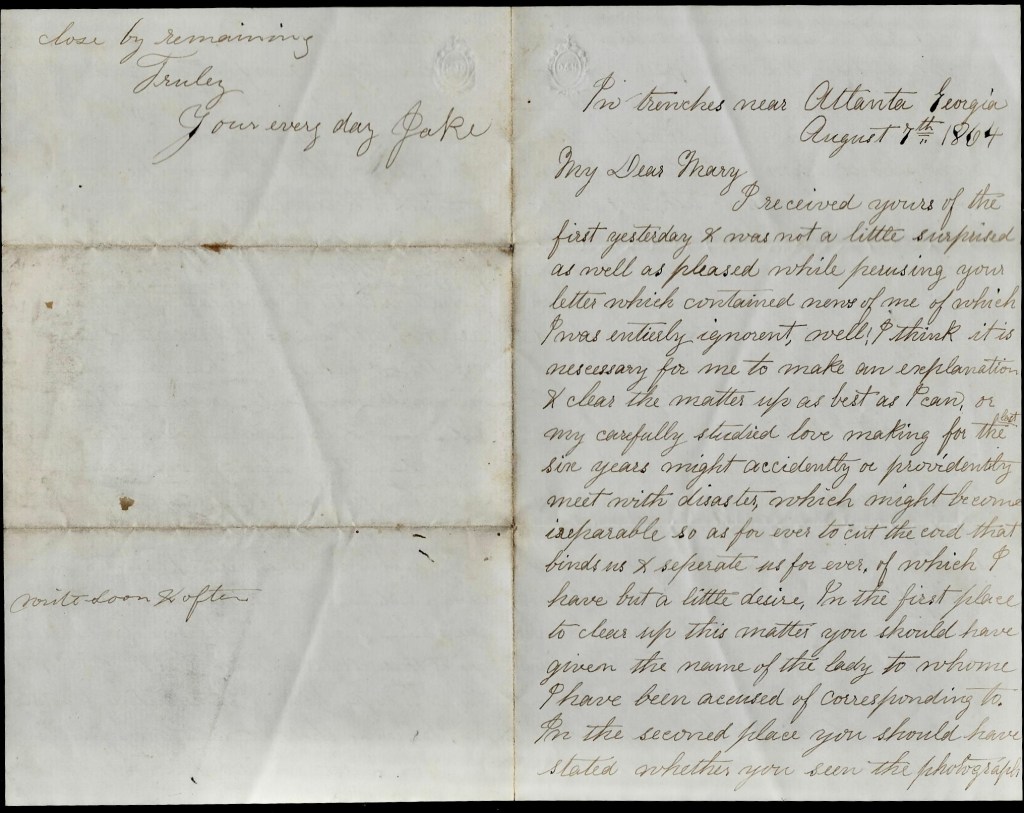
In trenches near Atlanta, Georgia August 7th 1864
My Dear Mary,
I received yours of the 1st yesterday & was not a little surprised as well as pleased while perusing your letter which contained news of me of which I was entirely ignorant. Well! I think it is necessary for me to make an explanation & clear the matter up as best as I can, or my carefully studied love making for the last six years might accidentally or providentially meet with disaster, which might become irreparable so as forever to cut the cord that binds us and separate us for ever, of which I have but little desire.
In the first place, to clear up this matter you should have given the name of the lady to whom I have been accused of corresponding to. In the second place, you should have stated whether you seen the photograph or not & if it was mine, for as it is now, you only have the sensationist’s word for it & neither you or I are convinced that the photograph is mine. So as the thing now stands, I am not the guilty one & have no forgiveness to ask. But when it is proven that I have deceived, or tried to deceive you, then I will most sorrowfully ask your pardon.
I am very grateful for praising me so highly to my correspondent in Lebanon, Ohio, & will try at any future time to reciprocate in a like manner but I hope more & I know more deserving than I am of the compliment bestowed on me. You say that your confidence in me is shaken—that it had been laboring in a great mistake. Now I don’t think that you have as yet any reason to make such a remark. You have had no substantial evidence that I am corresponding with a lady in Lebanon, Ohio, & have sent her my photograph with the intention of making love to her. You say that you should like to hear from me soon again if it is consistent to the happiness of my lady love & correspondent in Lebanon, Ohio. As for that, I know she would not think any the less of me. So you can depend on hearing from me often without giving her any trouble whatever. I will now halt for the present and commence on some other subject.
I see by your last letter that you are not yet aware of the death of Paul but ere this reaches you I have no doubt that you will know all. We are shelled by the enemy & in return shell the enemy every day. They throw over sometimes sixty-four pounder shells about the size of a gallon jug thirteen inches long, six inches in diameter 18 inches in circumference. It has powder in them the grains of which is the size of a hazel nut. One of these shells exploded near the trenches of the 14th Corps killing & wounding fourteen men.
Hoping that this letter may find you in good health, I will bring it to a close by remaining truly, your every day, — Jake
I could not find an image of William but here is one of Ezra Joseph Davy of Co. D, 121st OVI
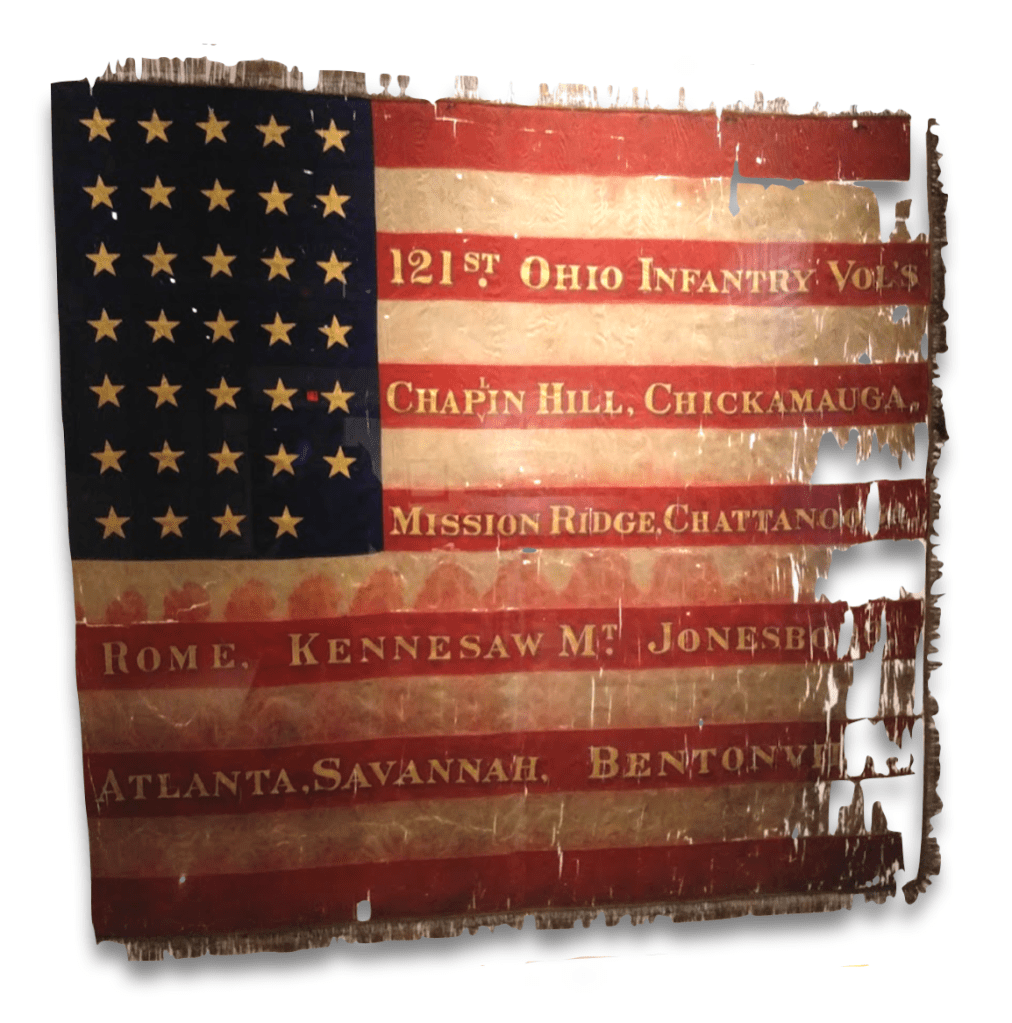
The following letters were written by William Y. Joslin (1836-1923), the son of Jonas Joslin (1807-1886) and Lucy Butterfield (1807-1886) of Liberty, Delaware county, Ohio. William was married to Rachel S. Case (1837-1905) in 1855 and they had two children, Jenette (“Netty”) and Irvin by the time William enlisted in August 1862 as a private in Co. C, 121st Ohio Volunteers (OVI). In the 1860 US Census, the Joslin’s were enumerated in Dublin, Delaware county, Ohio.
The 121st OVI participated in the battle of Perryville in October 1862. Then, in January, 1863, it moved into Tennessee, joined Rosecrans, and was actively employed until September, when it participated in the hard fought battle of Chickamauga, with a loss of 87 men. The Regiment took part in the battles of Lookout Mountain and Mission Ridge, and in May, started on Sherman’s Atlanta campaign, taking part in all of the battles along the way. In the fall of 1864, it operated against Hood in Alabama and then joined Sherman’s march to the Sea and through the Carolinas. After Johnston’s surrender it marched via Richmond to Washington, participated in the Grand Review, and was mustered out at Columbus, Ohio, June 12, 1865. William mustered out with his company as a corporal at war’s end.
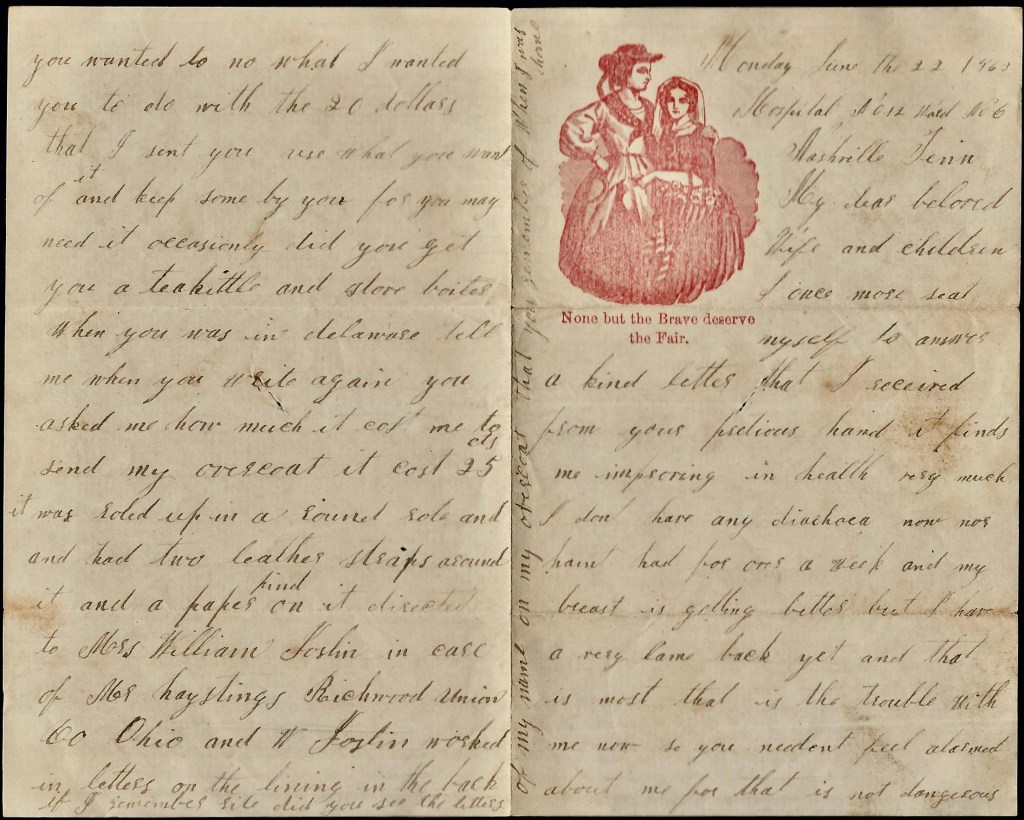
I once more seat myself to answer a kind letter that I received from your precious hand. It finds me improving in health very much. I don’t have any diarrhea now nor have had for over a week and my breast is getting better but I have a very lame back yet and that is most that is the trouble with me now so you needn’t feel alarmed about me for that is not dangerous.
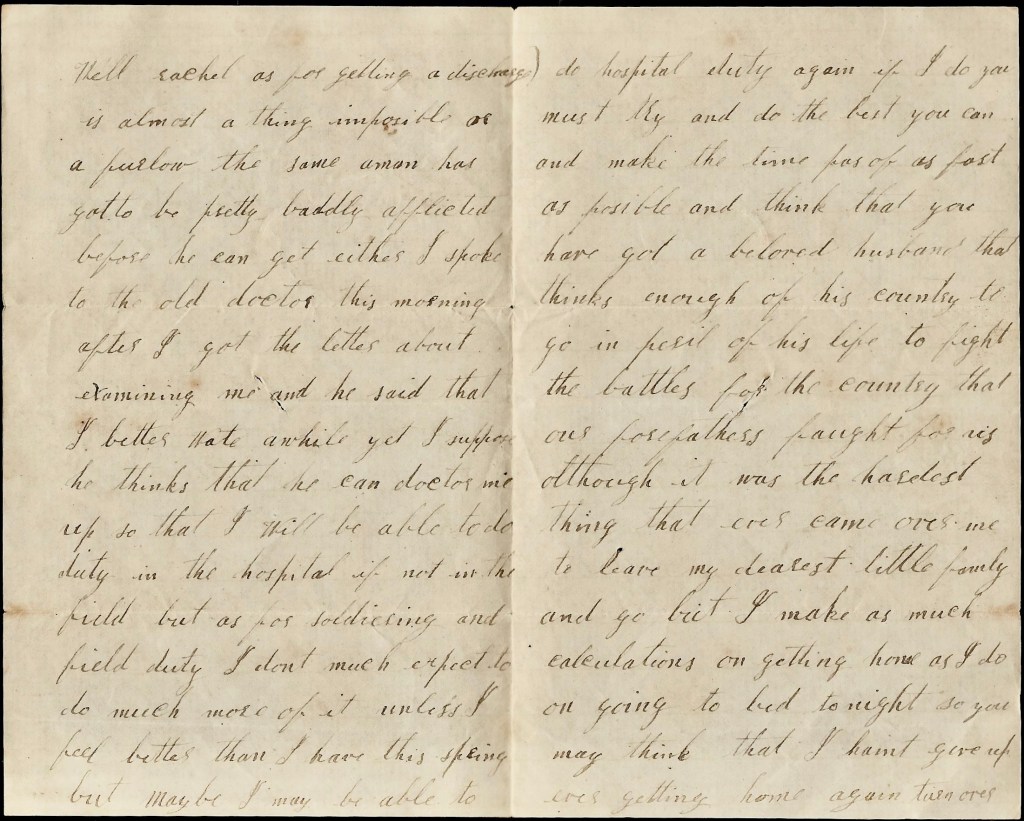
Well, Rachel, as for getting a discharge is almost a thing impossible or a furlough the same. A man has got to be pretty badly afflicted before he can get either. I spoke to the old doctor this morning after I got the letter about examining me and he said that I better wait a while yet. I suppose he thinks that he can doctor me up so that I will be able to do duty in the hospital, if not in the field. But as for soldiering and field duty, I don’t much expect to do much more of it unless I feel better than I have this spring. But maybe I may be able to do hospital duty again. If I do, you must try and do the best you can and make the time pass off as fast as possible and think that you have got a beloved husband that thinks enough of his country to go in peril of his life to fight the battles for the country that our forefathers fought for us, although it was the hardest thing that ever came over me to leave my dearest little family and go. But I make as much calculations on getting home as I do on going to bed at night. So you may think that I hain’t give up ever getting home again.
You wanted to know what I wanted you to do with the 20 dollars that I sent you. Use what you want of it and keep some by you for you may need it occasionally. Did you get you a tea kettle and stove boiler when you was in Delaware? Tell me when you write again. You asked me how much it cost me to send my overcoat. It cost 25 cents. It was rolled up in a round roll and had two leather straps around it and a paper pinned onit directed to Mrs. William Joslin in care of Mr. Hastings, Richwood, Union county, Ohio. And W. Joslin worked in letters on the lining in the back of it if I remember right. Did you see the letters of my name on my overcoat that you remember of when I was home?
Letter 2
Camp of the 121st OVI near the Chattahoochie river July the 14th, 1864
My dear wife & children.
I seat myself this morning to write a few lines in answer to yours of the 5th of July. It came to hand last evening and found me quite unwell. I have had the headache and a lame back and the diarrhea for the last two days but I have been taking some medicine and feel some better this morning. I have received that letter that Lucretia sent to me but I haven’t answered it yet. But I think I must today. You spoke about sending me some envelopes. I would be very glad if you would send about two or three packages of envelopes and a whole ream of the best kind of letter paper and let me hear what it cost you there so if I want to sell any of it that I will know what to ask a quire for it. You can send it by mail and it won’t cost more than ten or fifteen cents.
Well, Rachel, we have been in this camp about three days but I don’t know how long we will stay here—maybe a week or two and maybe not longer than today. We drawed some new clothes yesterday and there is some talk of getting our pay before we leave here but there ain’t nothing certain about it. If we do, I don’t expect to get more than four months pay this time.
Well, Rachel, you said that you wanted to know what I thought about you taking in some boarders. I don’t know anything about the folks in Lewisburg but I expect they are like they are in all other little towns. There would be some that would have something to say about it so I would not advise you to keep any for I don’t want anyone to have a chance to start any of their lies on you. But as for renting a part of the house, I have no objections to that if you think the family would be company for you and if he is good for the rent. You can do what you think best about it. What can you rent a part of it for? Let me know when you write to me again.
You asked me if I was with my cousin when he was shot. I was not. I was about a half a mile from him. He only lived about 5 or 6 minutes after he was shot and his messmate was with him and he said that he was sensible and talked as rational as a well person and he said that he wanted to be buried decent and where his folks could find him.
Well, I believe I have wrote all the news for the present and as for the news of the fight, you can see that in the papers plainer than I can tell you. So now, I will close hoping to hear from you once a week anyhow. Direct as before to Co. C, 121st OVI, Chattanooga, Tenn. Goodbye for now, — William Joslin
to Rachel S. Joslin
Letter 3
[Before Atlanta] August 16th 1864 Mrs. Rachel S. Joslin
My kind and affectionate wife,
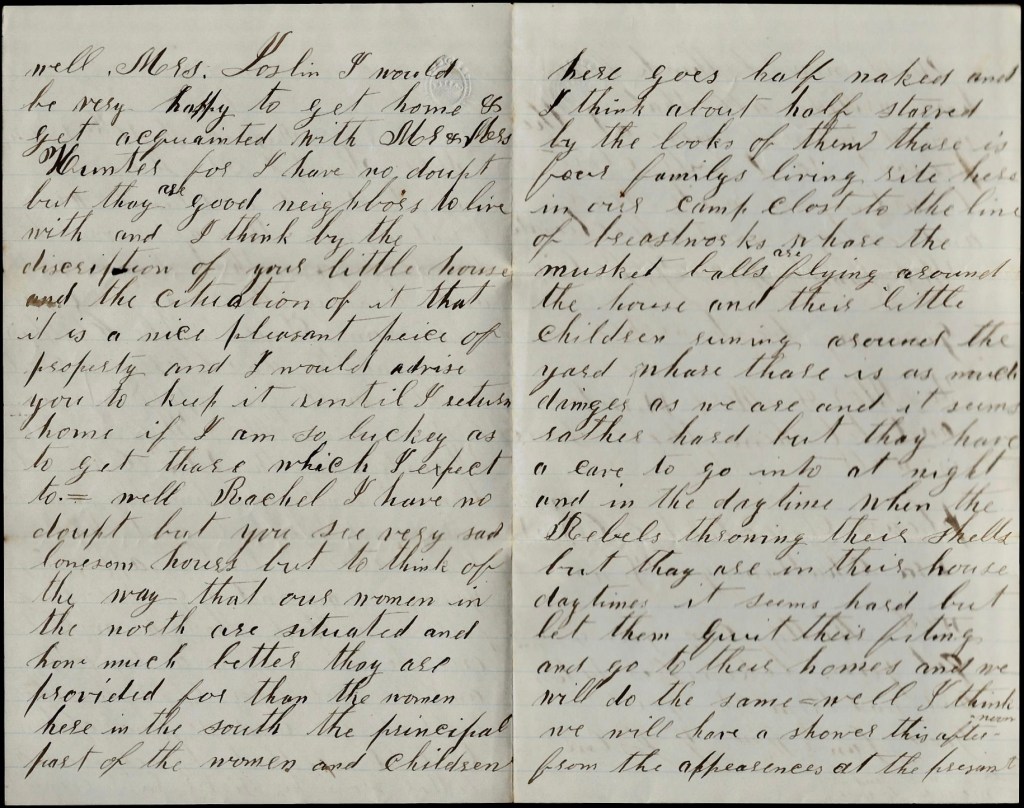
I seat myself this afternoon to inform you that I am well and hoping this may find you and the dear little children enjoying the same blessing—good health. Well, you spoke in your letter about Mr. William Hunter in the 17th Ohio Vols. I went and saw him this forenoon and found him well and hearty. He is a very genteel appearing young man and a good-looking fellow. I think that he will be over to see me in a day or two and if we stay close together, I shall go and see him often. He told me that he received a letter from his sister last evening.
Well, Mrs. Joslin, I would be very happy to get home & get acquainted with Mr. and Mrs. Hunter for I have no doubt but they are good neighbors to live with and I think by the description of your little house and the situation of it, that it is a nice, pleasant piece of property and I would advise you to keep it until I return home, if I am so lucky as to get there, which I expect to.
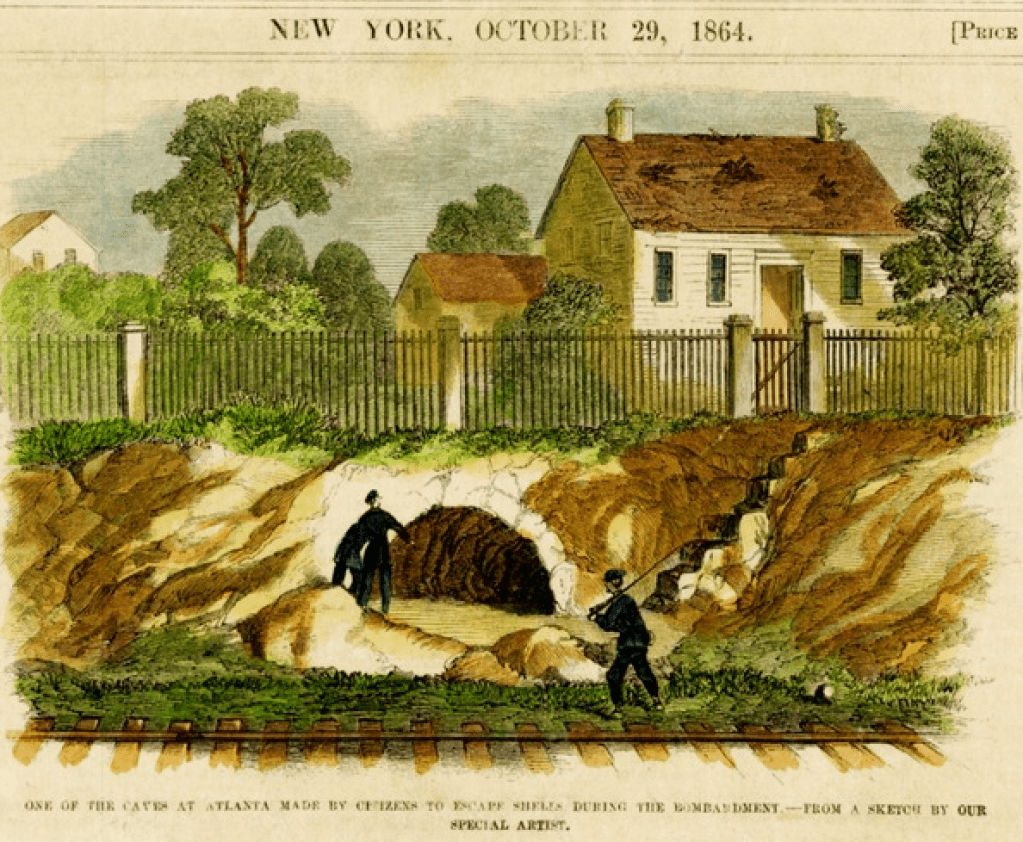
Well, Rachel, I have no doubt but you see very sad, lonesome houses but to think of the way that our women in the North are situated and how much better they are provided for than the women here in the South—the principal part of the women and children here goes half naked and I think about half starved by the looks of them. There is four families living right here in our camp close to the line of breastworks where the musket balls are flying around the house and their little children running around the yard where there is as much danger as [where] we are and it seems rather hard. But they have a cave to go into at night and in the daytime when the Rebels [are] throwing their shells. But they are [mostly] in their house daytimes. It seems hard. But let them quit this fighting and go to their homes and we will do the same.
“One of the caves at Atlanta made by citizens to escape shells during the bombardment—from a sketch by our special artist”
Well, I think we will have a shower this afternoon from the appearances at the present. Well now, I think I have written all that would interest you at the present so I will close by asking to write soon and oblige your affectionate husband, — William Y. Joslin
Give my best wishes to Mr. and Mrs. Hunter and tell them their son is well. Please direct to Co. C, 121st OVI via Chattanooga, Tennessee
Well, Netty, can you and Irvin get your likenesses taken and send them to your good pa if he will send the money to you? — Wm. Y. Joslin















 Spared & Shared 23