An unidentified private believed to be from the 2nd Michigan Infantry (Dale Niesen Collection)
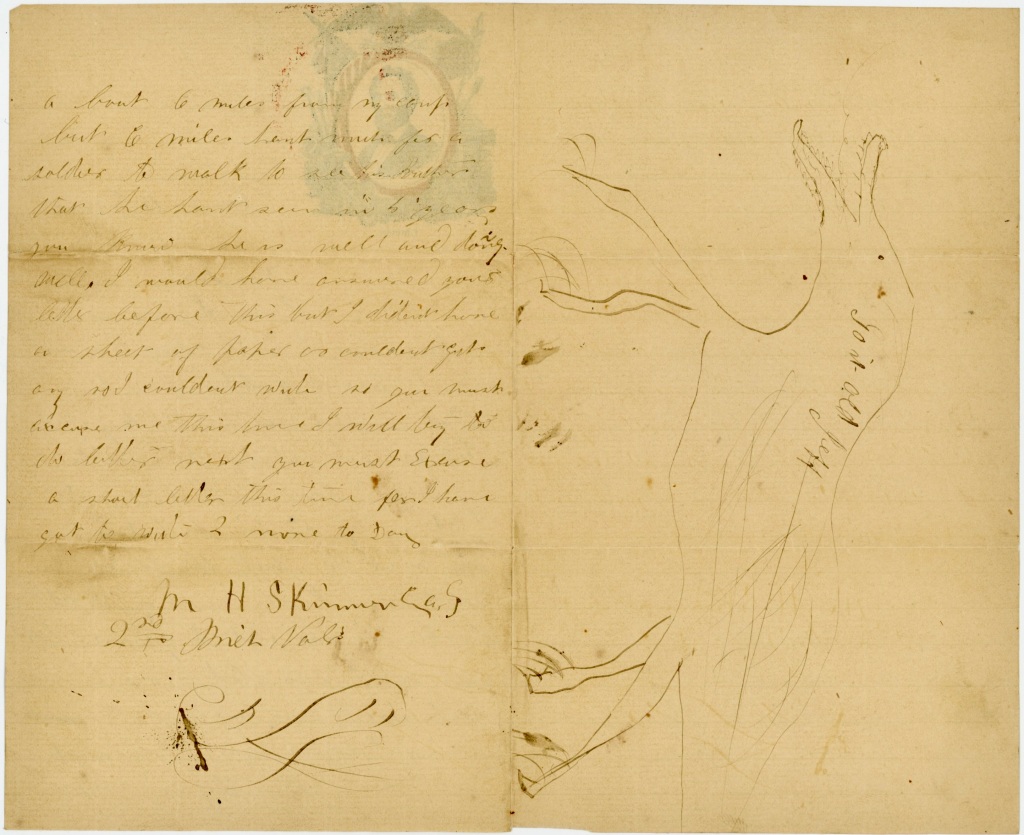
This letter was written by Myron Harvey Skinner (1842-1904), the son of Adolphus Harvey Skinner (1811-1892) and Mary Angeline Fuller (1811-1893) of Walled Lake, Oakland county, Michigan. Myron enlisted on 25 May 1861 in Co. G (“Constantine Union Guards”), 2nd Michigan Infantry. He was transferred out of the regiment on 21 January 1863 into Battery H, 1st US Light Artillery. Myron datelined his letter on 19 December 1862, just days after the Battle of Fredericksburg when the regiment was encamped near Falmouth, Virginia
Myron wrote of visiting the encampment of his older brother, Dolphus Skinner (1835-1903) who had been serving as a private in Co. F, 10th US Regular Infantry since March 1858 and had only recently been attached to the Army of the Potomac. Previous to, and in the early part of the war, Co. F of the US Regulars had seen duty in the far west but in late November they were sent to Aquia Creek, Virginia, and were attached to Sykes Division of Butterfield’s 5th Corps during the Battle of Fredericksburg. During the battle, Sykes’ regulars moved up after darkness on the 13th and spent the night on the field. The Regulars were significantly engaged during the day of the 14th, with fighting around the Tannery on the northern end of the line.
Myron addressed the letter to “Jule” whom I’m guessing was his cousin—Juliann Hubbel Skinner (1831-1922), a daughter of Hiram and Elizabeth (Otto) Skinner of Oakland county, Michigan.
[Note: This letter is from the private collection of Dale Niesen and was transcribed and published on Spared & Shared by express consent.]
Transcription
[Camp near Falmouth, Virginia] December 19th 1862
Dear Jule,
I received yours some days since. I will endeavor to answer it. I learned by letters from home that Dolphus was in the Army of the Potomac and yesterday he came to my camp. I knew him just the minute I set my eyes on him. He don’t look as he used to but the longer I am with him, I see more of his old looks. He was glad to see me, I tell you, and I was glad to see him as he was to see me and this morning I came over to his camp and seen him. They are camped about 6 miles from my camp. But 6 miles hant much for a soldier to walk to see his brother that he hant seen in 5 years. You know he is well and doing well.
I would have answered your letter before this but I didn’t have a sheet of paper or couldn’t get any so I couldn’t write. So you must excuse me this time. I will try to do better next. You must excuse a short letter this time for I have got to write two more today.
The following letter was written by Albert Doty (1841-1873), the son of Leonard Doty (1812-1882) and Lydia Louise Gardner (1810-1892) of Hancock, Berkshire county, Massachusetts. Albert first enlisted with the 34th New York Infantry in May 1861 to serve two years. He rose in rank from private to 1st Sergeant by December 1861 and then was commissioned a 1st Lieutenant in March 1862 and Adjutant in January 1863. He was discharged for disability from the regiment in May 1863. He returned to the service in March 1864, and was a Sergeant Major in Co. I, 57th Massachusetts Infantry when this letter was written. He was then promoted to a 1st Lieutenant of Co. K by late July, and brevetted a captain in August 1864 for gallant service in the engagements on the Weldon Railroad. He mustered out of the service in late July 1865.
Doty’s letter speaks of the mortar shelling their regiment endured in front of Petersburg that pre-dated the following incident:
“On July 24, 1864, Doty and some of the men were at a Bomb-Proof just behind the trenches. This bomb-proof was small about twelve feet square, and was hot inside so the men had built a arbor out side the bomb-proof. It was covered with branches and old canvas for protection from the sun. Earlier they were shelling the enemy and now the Confederates were returning the favor. The men paid no mind as they were use to it. Some were laying on the ground and some were sitting on an old cracker box writing letters home, when without warning or sound the bomb-proof exploded. It was found that the enemy artillery gunners aim was off and a ten-inch mortar shell fell in the middle of the “Bomb-proof.” Some of the men were either wounded or killed; some would die later from their wounds. Doty, who was a Sergeant Major at the time, came out of it only slightly bruised.” [Source:Civil War Days and Those Surnames]
Doty does not explain his use of the pseudoname “Oliver Ditson” to sign his letter so he must have used it regularly or at least occasionally when corresponding with his younger sister Elizabeth Gardner Doty (1845-1917). The real Oliver Ditson (1811-1888) was “the pioneer of music publishing in American, having published a number of popular songs, including “Battle Hymn of the Republic” and “Tenting on the Old Camp Ground.” Ditson also marketed drums under his company name though they did not manufacture them.
Sadly, though Doty survived the war, he was counted among the large number of veterans who committed suicide in the post-war years. He was 32 years old at the time of his death.
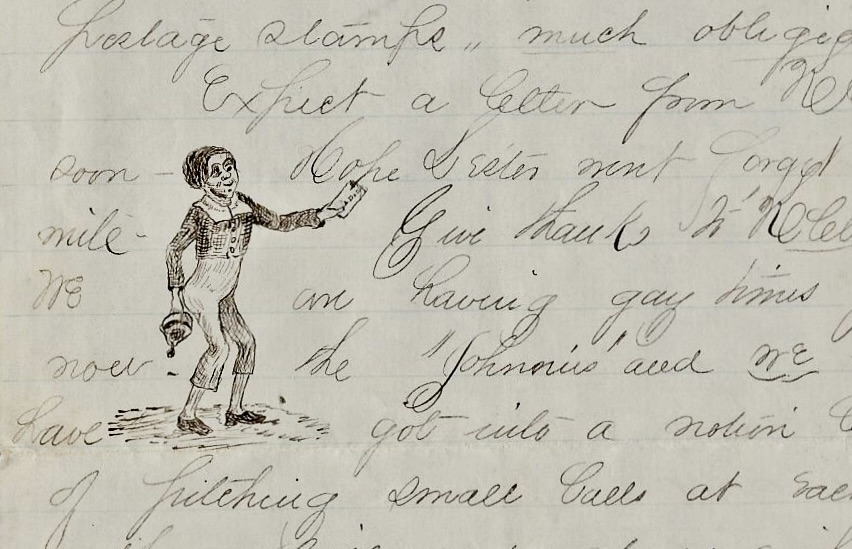
Doty’s letter incorporates a sketch of a boy delivering the mail. He was most likely a runaway Negro boy (“contraband”) who attached himself to the regiment, performing services in return for shelter, food and clothing. He holds his hat in hand while extending a letter in the other.
Transcription
Headquarters 57th Massachusetts Infantry Near Petersburg, Virginia July 12th 1864
Lib,
Received today a letter from your headquarters dated July 6th. Have now in my clutches 1 vignette of “Laura Clark” for the same. Am much obliged. Have heard of my death from two different (both reliable) sources—presume it must be so. Shows the advantages we have over the ancients now-a-days. You can read your own obituary and attend your own funeral. Nice, ain’t it? Please tell me the origin of the rumor. Charles Daniels received a letter yesterday in which his mother expressed fear that he might be “lonely, now Albert Doty was killed” and wished him to write the circumstances upon my departure. I ask forgiveness of the good people of the land of my nativity and wish to assure them that it’s none of my fault that they are this time disappointed. Will do better next time, &c. I didn’t mean to!
I received a lead pencil and some postage tamps. Much obliged. Expect a letter from N. E. G. soon. Hope Lester won’t forget to write. Give thanks to “Kleber.”
We are having gay times just now. The “Johnnies” and we have got into a notion lately of pitching small balls at each other—little mortar shells eight inches in diameter. Can’t tell when they are coming—they go so slow. They have a way of “dropping in” quietly now and then just for a short chat. They travel as unostentatiously as a Quaker deacon. Keep losing men. Have on this morning’s report 157 enlisted men present. Rather a mournful record. Don’t see how we can have many more “big funerals” in case is should be required of us. Will be obliged to send home for more stock.
Please to write to me about the Hancock boys in the 34th Massachusetts. 1 Any news in good condition will be gladly received. Please send me a box of Gillott’s Steel Pens. Have lately lost my pen holder pencil pen and the whole “consarn” gone to grass.
Very respectfully, your obedient servant, — Oliver Ditson
1 A number of men from Berkshire county served in Co. K of the 34th Massachusetts—particularly Hancock and Pittsfield.
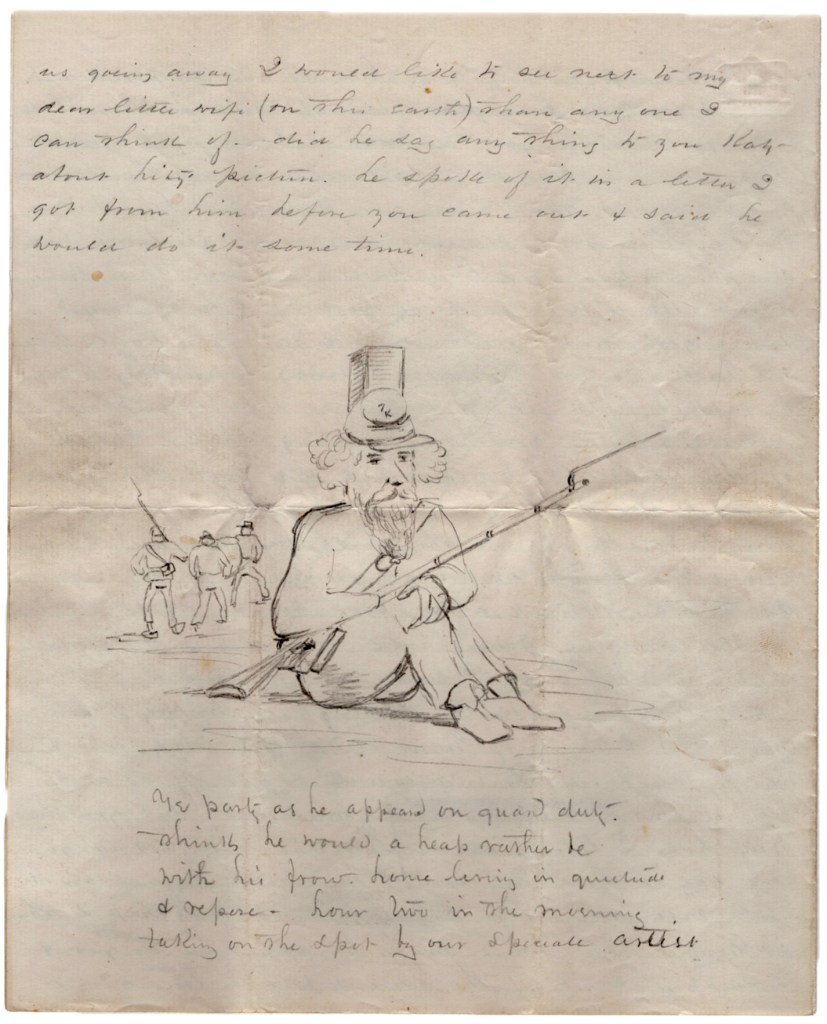
A self portrait of the author, Augustus B. Frazer. He has captioned it: “Ye party as he appeared on guard duty. Thinks he would a heap rather be with his frow [at] home living in quietude & repose. Hour two in the morning taken on the spot by our Special Artist.”
The following letter was written by a soldier named “Gus” from Cincinnati whom we learn was a member of the “Hundred Days Men” of Ohio. Who were these men? The following excerpt from an excellent article by Kyle Nappi explains:
By the Spring of 1864, the United States had suffered considerable strain in its effort to preserve the union and defeat the Confederacy. “There was scarcely a family in the North who did not suffer sorrow that cannot be described,” one Yankee veteran recalled in his twilight years. “Hardly a fireside that did not mourn for a husband or lover, brother or friend, who went forth with pride, never to return.” Ohio had already sent a tenth of its total population off to war. Nonetheless, Buckeye Governor John Brough drafted a bold proposal to encourage the recruitment of short-term soldiers from the Midwestern states in attempt to mount additional pressure upon the Confederacy.
On April 21, 1864, Governor Brough submitted the ambitious gambit to Secretary of War Edwin Stanton and President Abraham Lincoln. “The term of service to be one hundred days, reckoning from the date of muster into the service of the United States.”
“The foregoing proposition,” the President promptly replied, “is accepted…the Secretary of War is directed to carry it into execution. Thus, the Hundred Days Men were born. Ohio would furnish thirty thousand new recruits, Indiana and Illinois would enlist twenty thousand apiece, Iowa ten thousand, and Wisconsin five thousand. “The call was intended as a herald to the last great Union thrust that would topple the Confederacy like a sudden wind against a weakened tree.” In the span of two weeks, the Buckeye state recruited 35,982 volunteers and organized them into forty-one regiments. “This prompt and energetic action,” Secretary Stanton relayed to Governor Brough, “exhibit an unmatched effort of devoted patriotism and stern determination to spare no sacrifice to maintain the National Government and overthrow the rebellion.” [See When Johnny Comes Marching Home.]
Gus’s father, Hiram Frazer (1805-1891)
Among the Ohio units raised during the summer of 1864 was the 137th Ohio Vol. Infantry (OVI). They were mustered into the service on 6 May and mustered out on 21 August, 1864. It was designated under the militia law of Ohio as the 7th Ohio National Guard, composed of citizens of Cincinnati, and was organized for the 100 days’ service as the 137th Ohio volunteer infantry. A sketch in Gus’s letter depicting himself sitting on the ground with a rifle across his lap has the insignia “7 K” on the cap so searching the 70 man roster of that company turns up Augustus (“Gus”) B. Frazer (1834-1914) who was married to Kate (Katz”) R. Coates (1837-1905) on 10 September 1860 in Cincinnati, Hamilton county, Ohio. Though his name appears as Frazier in military and census records, his death certificate gives his name as Frazer and lists his parents names as Hiram Frazer (1805-1891) and Isabella Palmer. The Frazer’s made their home in Cincinnati in the 1860s at 117 John Street where Hiram earned his living in the insurance business and was an active, proud member of the Odd Fellows.
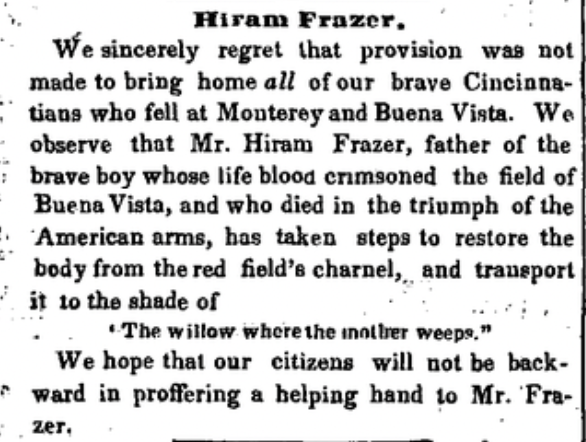
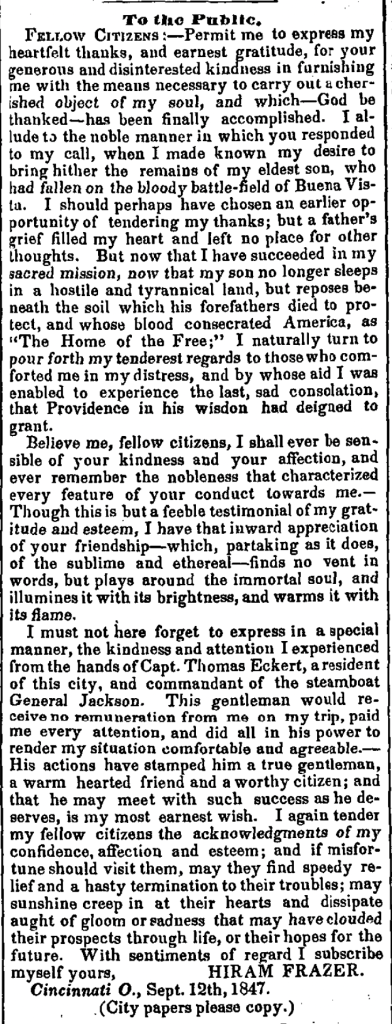
Gus was not the first member of the family to put on a military uniform. He had an older brother named Hiram who enlisted during the War with Mexico, serving in Co. E (the “Kenton Rangers”), 2nd Kentucky Infantry under the command of Capt. Cutter. Details of his service, his death on the battlefield at Buena Vista, and of his father’s traveling to Mexico to recover his son’s body are described in various newspaper clippings below.
Transcription
Fort McHenry [Baltimore, Maryland] Friday, July 22, 1864
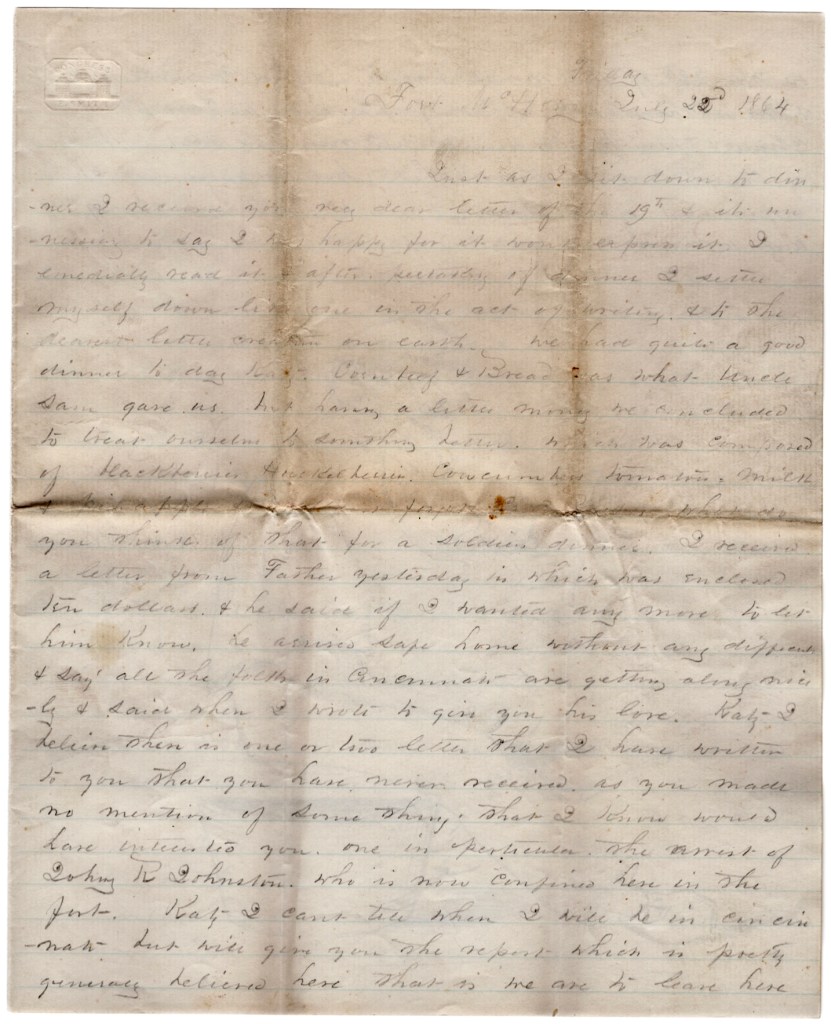
Just as I sit down to dinner I received your very dear letter of the 19th. It’s unnecessary to say I was happy for it was [ ] express it. I immediately read it and after partaking of dinner, I settle myself down like one in the act of writing & to the dearest little creature on earth.
We had quite a good dinner today—kraut, corn beef, and bread was what Uncle Sam gave us but having a little money we concluded to treat ourselves to something better which was composed of blackberries, huckleberries, cucumbers, tomatoes, milk & pitted apples [illegible due to paper crease]. What do you think of that for soldier dinner.
I received a letter from Father yesterday in which was enclosed ten dollars & he said if I wanted any more to let him know. He arrived safe home without any difficulty & says all the folks in Cincinnati are getting along nicely & said when I wrote to give you his love. Katz, I believe there is one or two letters that I have written to you that you have never received as you made no mention of some things that I know would have interested you. One in particular—the arrest of Johnny R. Johnston who is now confined here in the fort. 1
Katz, I can’t tell when I will be in Cincinnati but will give you the report which is pretty generally believed here—that is, we are to leave here on the 28th of this month & go to Fortress Monroe & from there take a lot of prisoners to Camp Chase and then to remain until mustered out which of course I don’t know when but suppose at the expiration of our time which will be about the 19th of August, making our hundred days.
A self portrait of Gus with the caption: “Ye boy making preparation for to write, or in other words, a write boy.”
There is nothing new here of any importance. I gave you full particulars of the raid on this place. Did you get the letter? I came off guard this morning. Was on the provost [guard] and had the pleasure of promenading that fence you saw while here. But the day being quite pleasant, I had a nice time in comparison to what I had while [you were] here.
“There was about 100 Rebs taken away yesterday to be exchanged but a good many wouldn’t go and said they would take the oath and go into the navy (Union) before they would go back and fight for the South as that was played out with them.”
Pvt. Gus Frazer, Co. K, 7th ONG, Ft. McHenry, 22 July 1864
There was about 100 Rebs taken away yesterday to be exchanged but a good many wouldn’t go and said they would take the oath and go into the navy (Union) before they would go back and fight for the South as that was played out with them.
You ask me, Katz, what I think of the war. My opinion is it will last some time to come but the North eventually will conquer. But I am sorry to say, Katz, if all the North was like me, I am afraid that it would go under in short order as I am, I think, a very poor soldier—more particular in the position I now hold, but believe I could stand it better if I was colonel or even a captain. But a common solder is too much of a nobody to suit my style.
I think if Grant don’t take Richmond & has to fall back, the end will be as far off as at the beginning. But I hope I may be mistaken. But you know Katz, hoe I believe. It’s all for the best. Let it go one way or the other—there is one looking down on it that will bring it to a proper end, let that be which it will.
Eph 2 hasn’t made his appearance as yet & I suppose won’t if the above report is true about us going away. I would like to see [him], next to my dear little wife (on this earth), than anyone I can think of. Did he say anything to you, Katz, about his picture. He spoke of it in a letter I got from him before you came out and said he would do it some time.
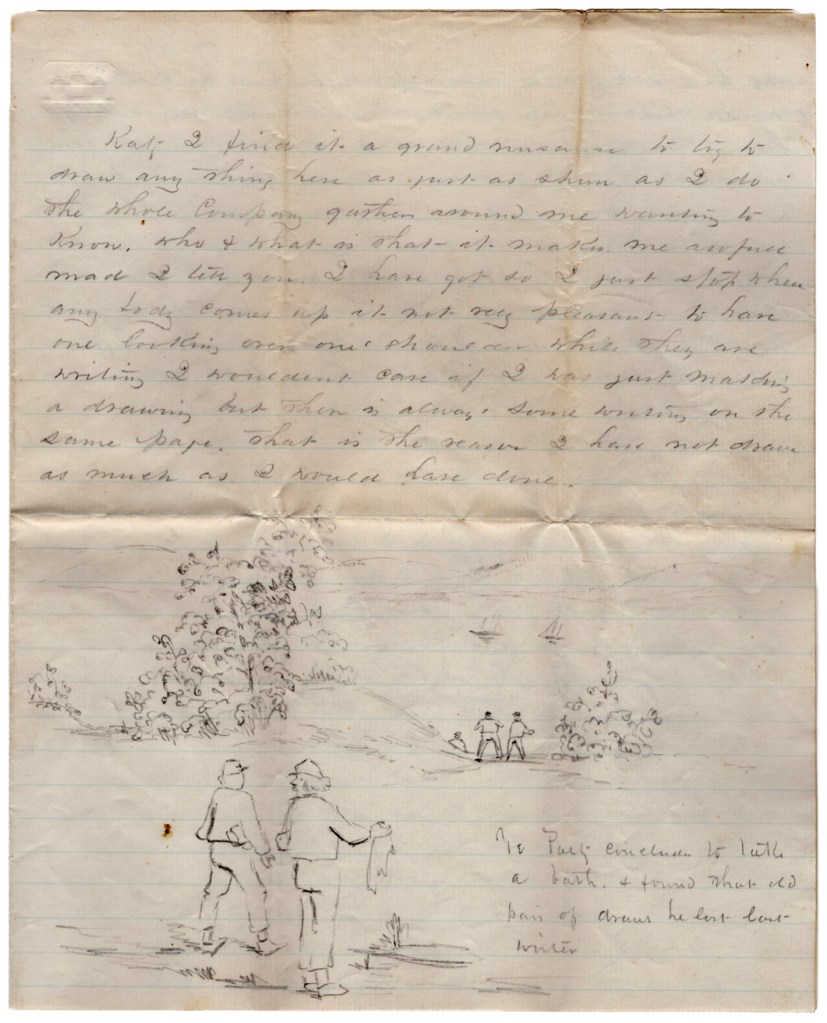
Katz, I find it a grand nuisance to try to draw anything here as just as sure as I do, the whole company gather around me wanting to know who and what is that. It makes me awful made, I tell you. I have got so I just stop when anybody comes up. It’s not very pleasant to have one looking over one’s shoulder while they are writing. I wouldn’t care if I was just making a drawing, but there is always some writing on the same paper. That is the reason I have not drawn as much as I would have done.
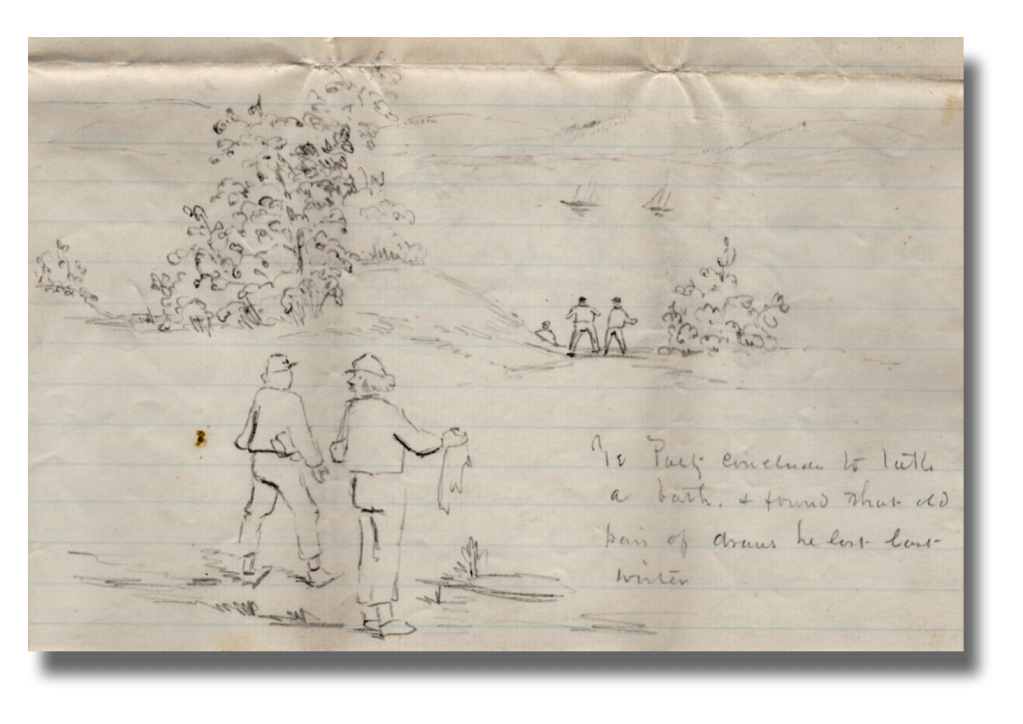
Gus’s caption reads: “Ye Party concludes to take a bath & found that old pair of drawers he lost last winter.”
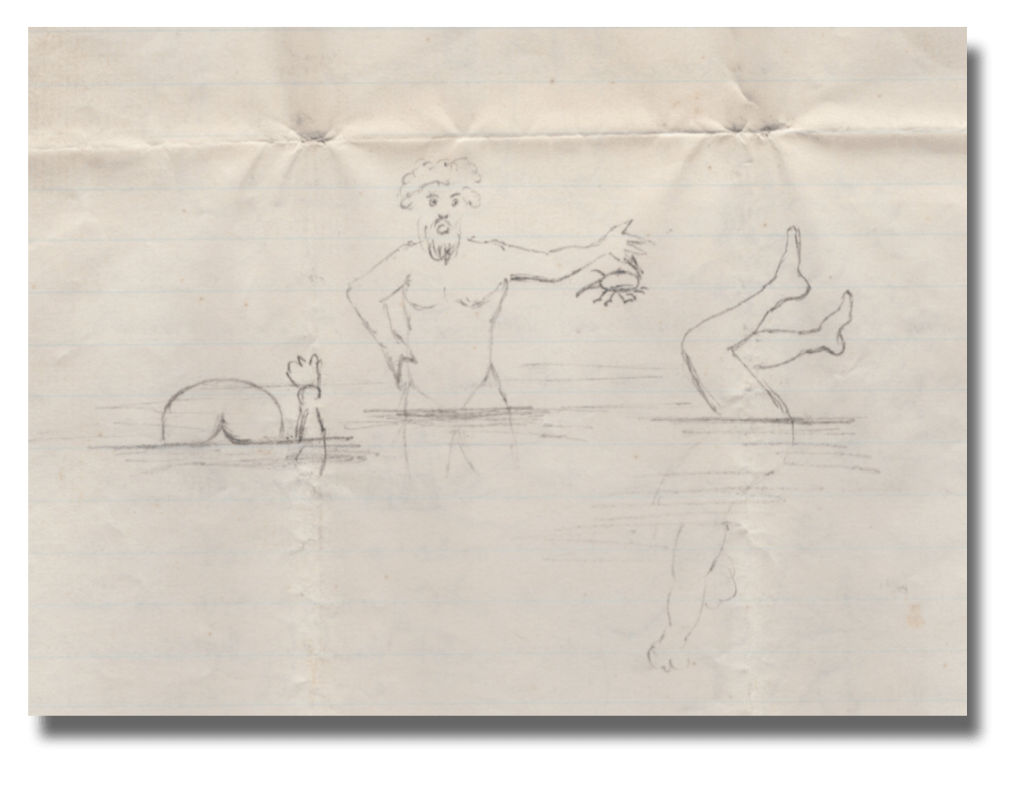
We have a very nice place to bathe here as you would think if here. About seven o’clock most any evening, men of all sizes, shapes, and colors go tumbling around in the water like so many porpoises. I was in one night & a crab, I suppose, caught me by the toe. You better believe I did some tall kicking. If he had caught me by someplace else (John-H), I don’t know what I would have done. It would have been pretty hard on it, wouldn’t it. I don’t know which. I don’t mind it being pinched but object to the claws.
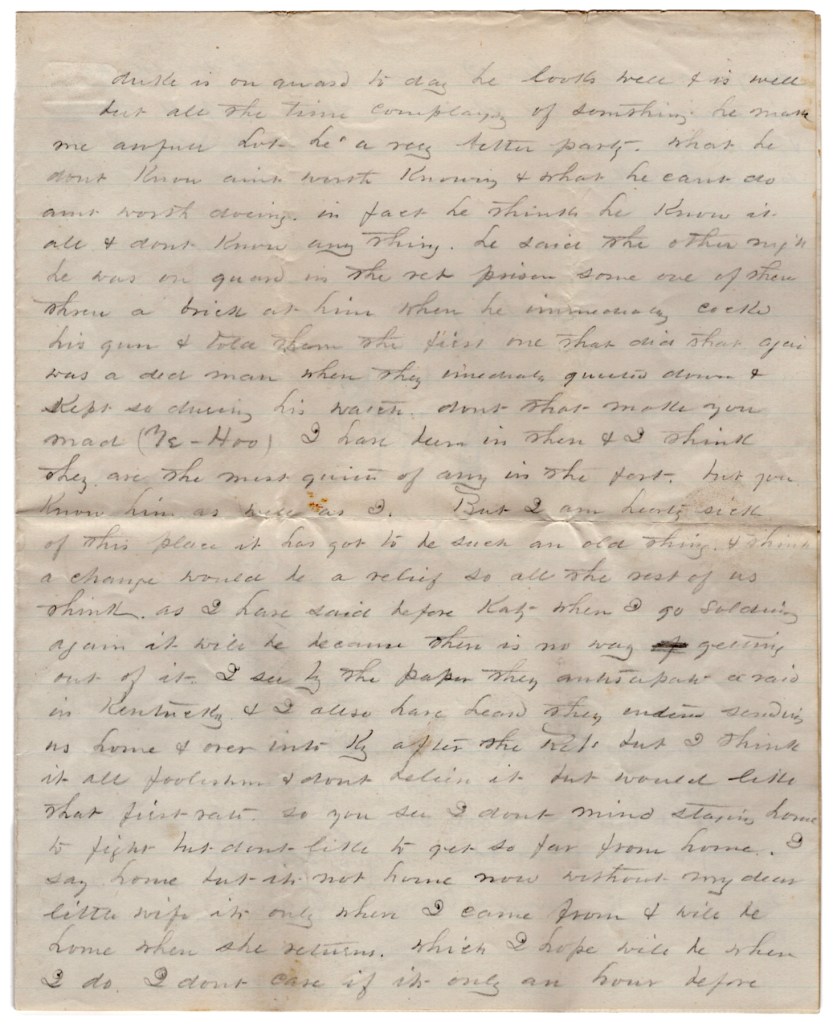
Duke 3 is on guard today. He looks well & is well but all the time complains of something. What he don’t know ain’t worth knowing & what he can’t do ain’t worth doing. In fact, he thinks he knows it all & don’t know anything. He said the other night he was on guard in the reb prison someone of them threw a brick at him when he immediately cocked his gun & told them the first one that did that again was a dead man when they immediately quieted down & kept so during his watch. Don’t that make you mad (Ye-hoo). I have been in there and I think they are the most quiet of any in the fort. But you know him as well as I.
But I am hearty sick of this place. It has got to be such an old thing & think a change would be a relief [and] so all the rest of us think. As I said before, Katz, when I go soldiering again, it will be because there is no way of getting out of it.
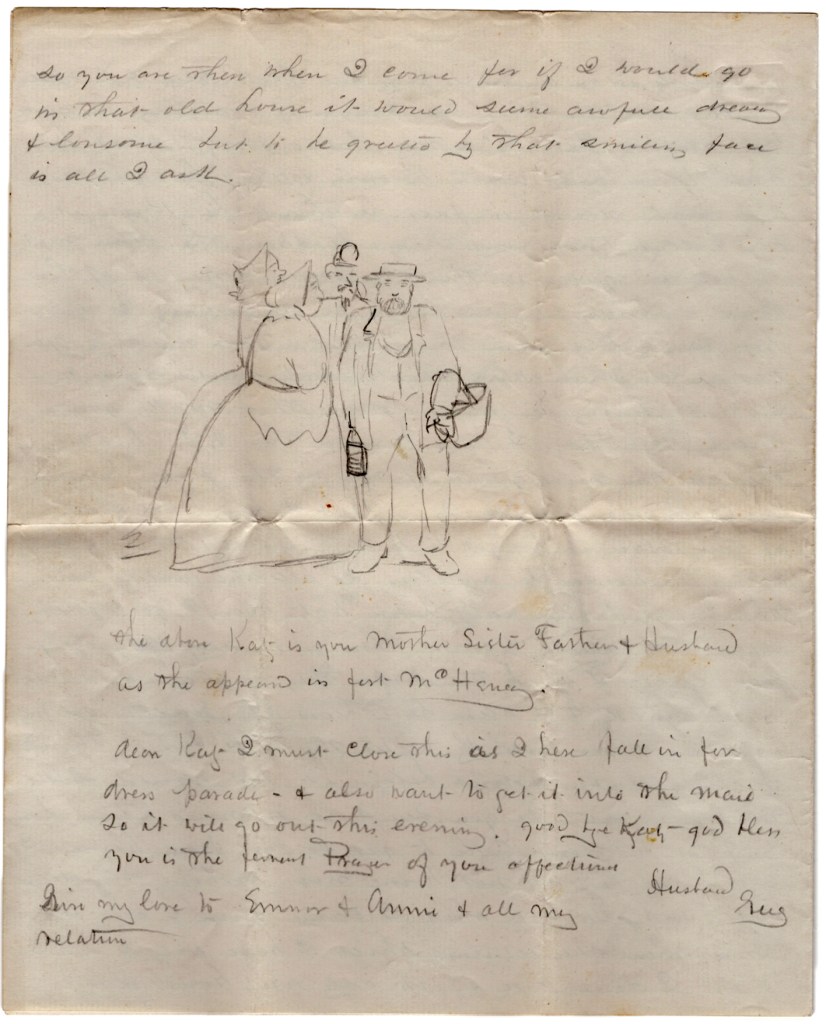
I see by the paper they intend sending us home & over into Kentucky after the rebs but I think it all foolishness & don’t believe it but would like that first rate. So you see I don’t mind staying home to fight but don’t like to get so far from home. I say home but its not home how without my dear little wife. It’s only when I come from [here] and will be home when she returns which I hope will be when I do. I don’t care if its only an hour before [just] so you are there when I come for if I would go in that old house, it would seem awful dreary & lonesome. But to be greeted by that smiling face is all I ask.
Gus’s caption on this sketch reads: “The above Katz, is you, Mother, Sister, Father, and Husband as they appeared in Fort McHenry.”
Dear Katz, I must close this as I here fall in for dress parade and also want to get it into the mail so it will go out this evening. Goodbye Katz. God bless you in the fervent prayer of your affectionate husband, — Gus
Give my love to Elenor and Annie & all my relation.
1 Johnny R. Johnston (1826-1895) was an American portrait and landscape painter influenced by the Hudson River School. He moved to Baltimore in 1856 and early in the Civil War served as the Colonel of the 1st Maryland Regiment. He was arrested at the time that Gen. Early’s men threatened the city and charged with “endeavoring to persuade persons to join the Southern army.” He was kept in Fort McHenry until 1 August when he was made to take the Oath of Allegiance, post $10,000 bond, and (curiously) to cut his extremely long hair, which he complied with.
2 Ephram Frazer (1830-1869) was Gus’s older brother. In the 1860 US Census he was enumerated in his parents home in Cincinnati’s 6th Ward and was employed as an “engraver of wood.”
3 “Duke” was surely 28 year-old Marmaduke Shannon Anderson (1836-1894) who also served as a private in Co. K, 7th ONH (137th OVI). Marmaduke was the son of William Anderson (1801-1867) and Eliza Shannon (1807-18xx) of Cincinnati.
Clippings related to Gus’s older brother Hiram Frazer who was killed at the Battle of Buena Vista during the War with Mexico.
These letters were written by George Josiah Sager (1840-1914) who served with the 149th New York Volunteers. George first enlisted in August 1862 as a sergeant in Co. D. He later received a commission as 2nd Lieutenant in Co. I. He mustered out of the service in June 1865.
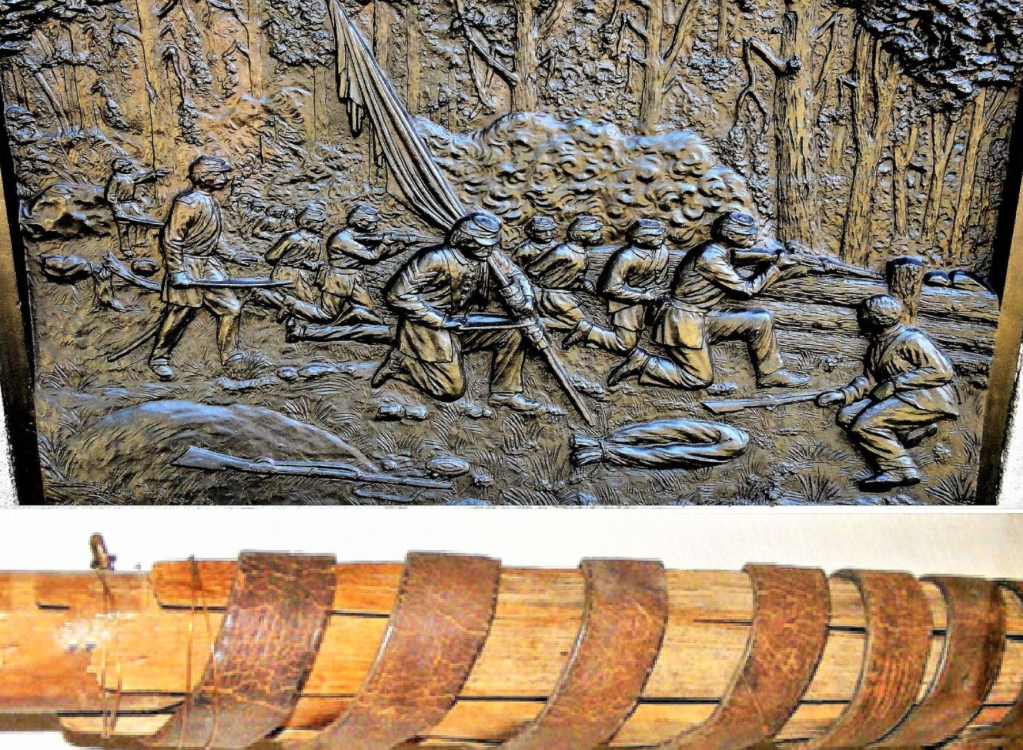
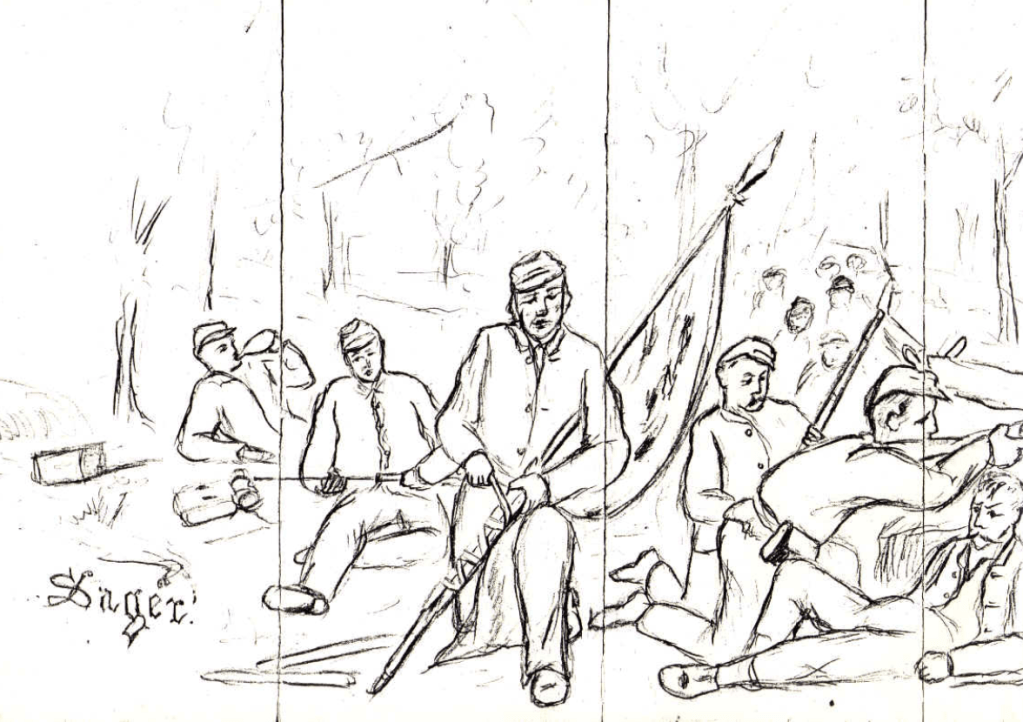
George’s parents were Jacob Sager (b. 1807), and Rebecca Smith Groot (b. 1812) of Syracuse, New York. Many of George’s letters have been published on the internet which may be found at 149th monument at Gettysburg. George apparently often included sketches in his letters to his family. He is credited for having originated the idea for a bronze statue on the regimental monument on Culp’s Hill at Gettysburg (and also at Syracuse) which depicts Sergt. Lilly of the 149th New York “Mending the Flag.”
The brass relief depiction of Sgt. Lilly mending the flag on Culp’s Hill and the actual flagstaff, still bound together with ammo box slats and Lilly’s knapsack strap.
George’s original sketch, “Mending the Flag.”
Letter 1
[Note: This letter is from the personal collection of Don Andrew and was made available for transcription and publication on Spared & Shared by express consent.]
Aquia Creek Landing January 28, 1863
Dear Mother,
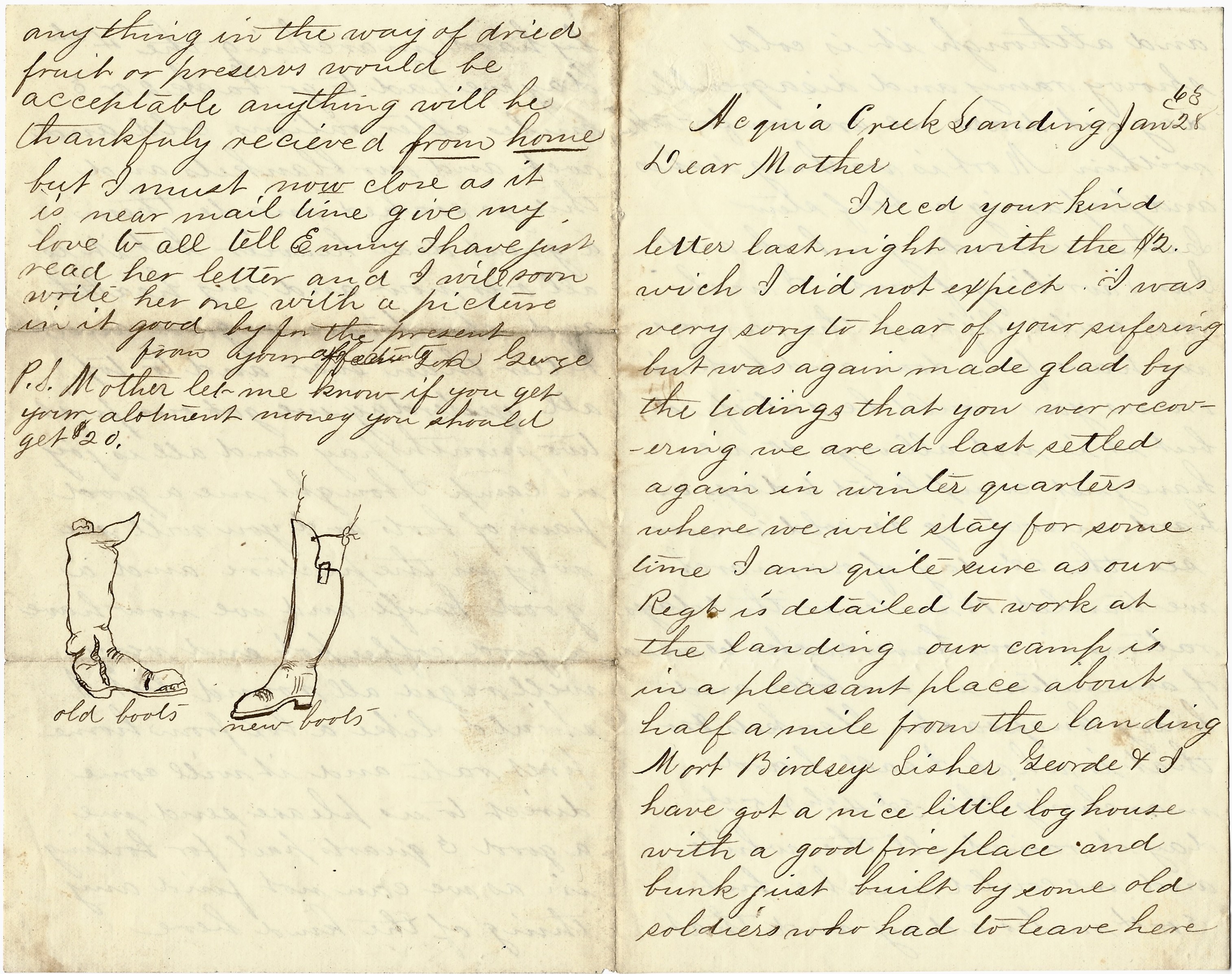
I received your kind letter last night with the $2 which I did not expect. I was very sorry to hear of your suffering but was again made glad by the tidings that you were recovering. We are at last settled again in winter quarters where we will stay for some time I am quite sure as our regiment is detailed to work at the landing. Our camp is in a pleasant place about half a mile from the landing.
Mort [Mortimer] Birdseye, Lisher [Elisha] George & I have got a nice little log house with a good fireplace and bunkhouse just built by some old soldiers who had to leave here and although it is a cold, snowy, rainy, and disagreeable day out doors, we are comfortable within. Mort is washing dishes and preparing a beef stew. Lisher is reading a book and I am writing of course. I wish you could lift up the canvas we have for a door and look in on us. You would be satisfied.
But is not always so. We have just completed six days as hard marching as soldiers ever see. The 2nd day of our march we traveled 18 miles with three days rations in our haversacks, 60 rounds of ammunition in our [cartridge] boxes and heavy blankets & so that is what I call hard marching. The 3rd, 4th, & 5th day it rained all the while and we could make but 3 or 4 miles a day and that by hard marching. The 4th day we had to go back two or three miles after rations cold and wet and our blankets and things soaked made them a great deal heavier. But it is all over now and my health and spirits are as good and better than ever.
George’s sketch of his old boots and his new boots.
And to top all, yesterday we got our first two months pay and all is joy in camp. I bought me a good pair of boots and you will see why in the picture, and a good knife. And we now have a good coffee pot and [are] very well rigged all round. But I should like a box from home first rate and it will come direct to us. Please send me a good 3 quarts pail for boiling in as we cannot find anything of the kind here. Anything in the way of dried fruit or preserves would be acceptable. Anything will be thankfully received from home.
But I must now close as it is near mail time. Give my love to all. Tell Emmy I have just read her letter and I will soon write her one with a picture in it. Goodbye for the present. From your affectionate son, — George
P. S. Mother, let me know if you get your allotment money. You should get $20. [sketch of boots]
Letter 2
[Note: This letter is from the personal collection of Don Andrew and was made available for transcription and publication on Spared & Shared by express consent.]
Aquia Landing, Virginia January 29th 1863
Dear Sister,
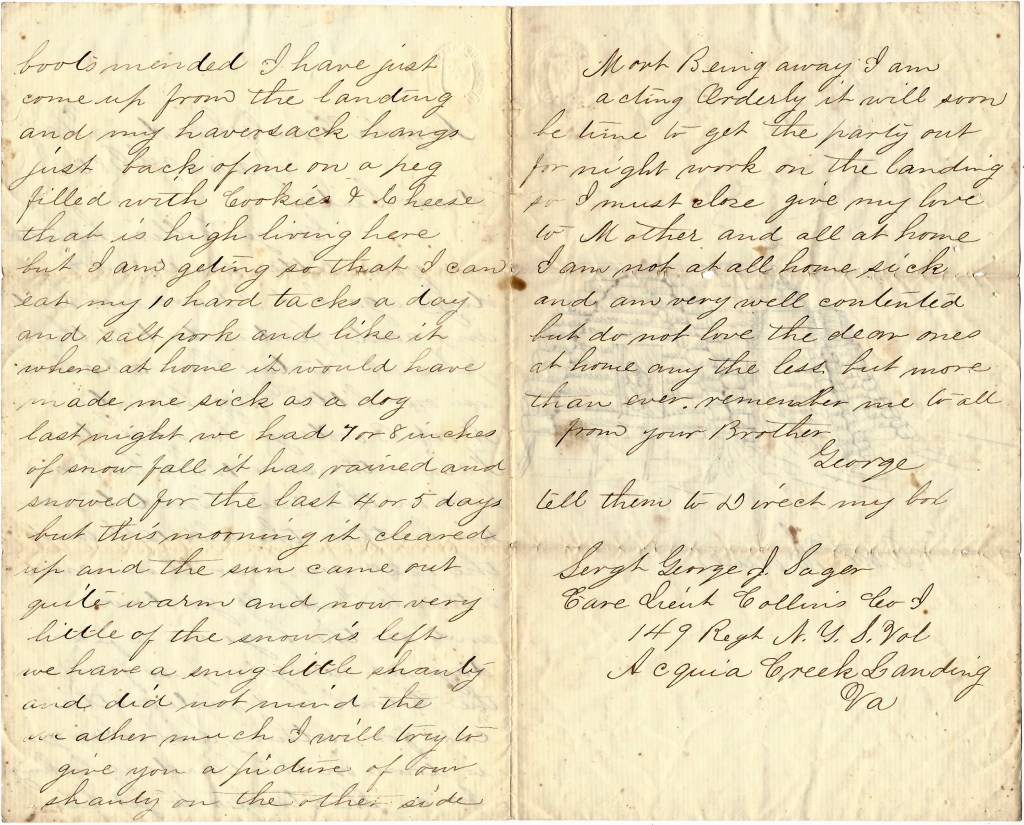
George Collins handed me your letter some three or four days ago but I have not had any good opportunity till the present. Today I am all alone in our little log shanty. Mort Birdseye has gone to Falmouth some 10 miles from here on the railroad to see his brother. The old 12th and the 122nd are near them and I think I shall go down and the boys in a few days. We can get a pass from the Colonel and ride on the cars for nothing. Lisher George is down on the landing looking for a “shoe tinker” to get his boots mended. I have just come up from the landing and my haversack hangs just back of me on a peg filled with cookies & cheese. That is high living here but I am getting so that I can eat my 10 hard tacks a day and salt pork and like it where at home it would have made me sick as a dog.
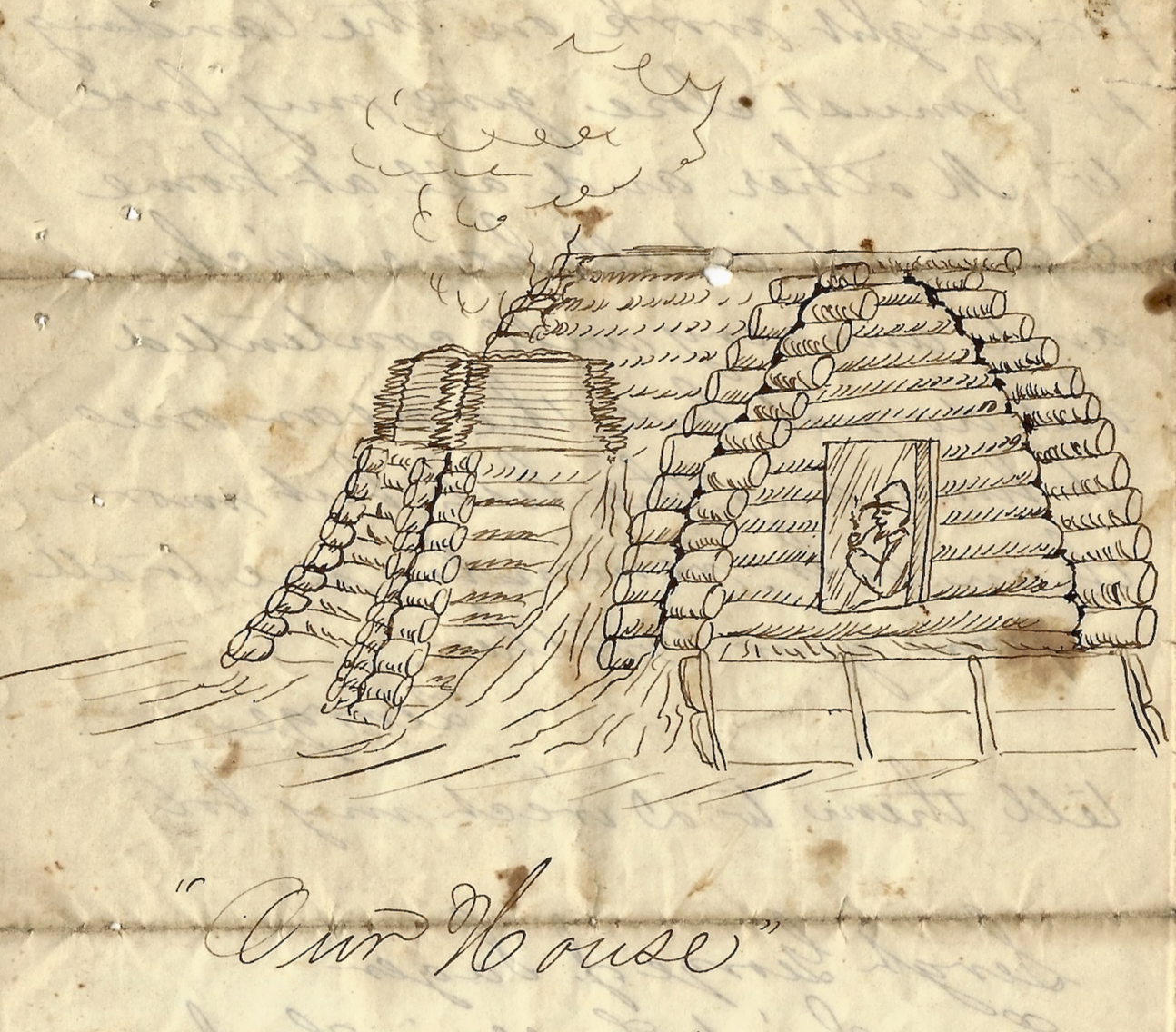
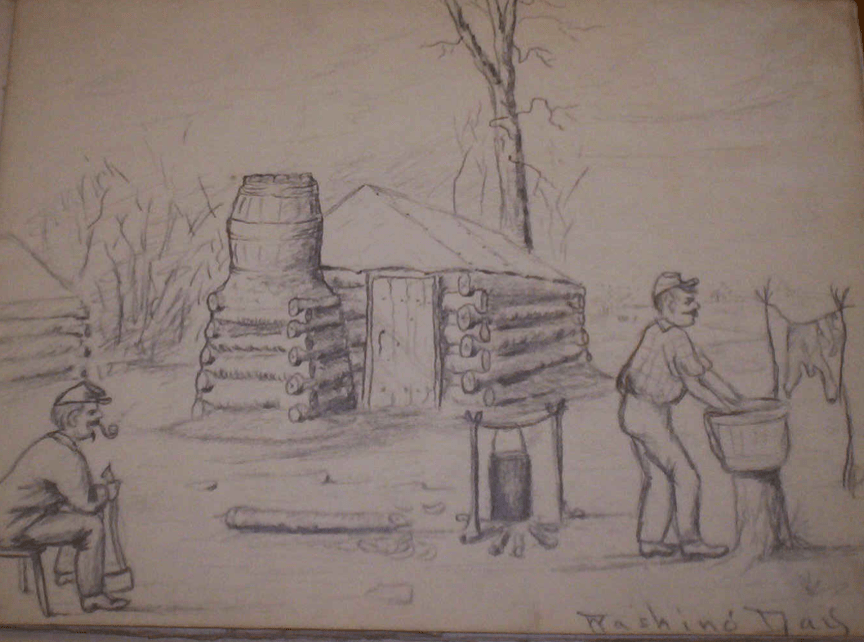
Last night we had 7 or 8 inches of snow fall. It has rained and snowed for the last four or five days but this morning it cleared up and the sun came out quite warm and now very little of the snow is left. We have a snug little shanty and did not mind the weather much. I will try to give you a picture of our shanty on the other side.
Mort being away, I am acting Orderly. It will soon be time to get the party out for night work on the landing so I must close. Give my love to Mother and all at home. I am not at all home sick and am very well contented but do not love the dear ones at home any the less but more than ever. Remember me to all. From your brother, — George
Tell them to direct my box to Sergt. George J. Sager, Care of Lieut. Collins, Co. I, 149 Regt. N. Y. S. Vols., Aquia Creek Landing, Va.
Letter 3
[Editor’s note: The date and location of this letter is not identified but my hunch is that it was written when Sager was a lieutenant and had the freedom to ride around.]
Dear Sister,
I received your kind letter last night about your visit and Aunt Amy. I am very glad to hear you enjoyed yourself so well. Am always glad to hear from you and shall feel it no bother to answer all the letters you may write.
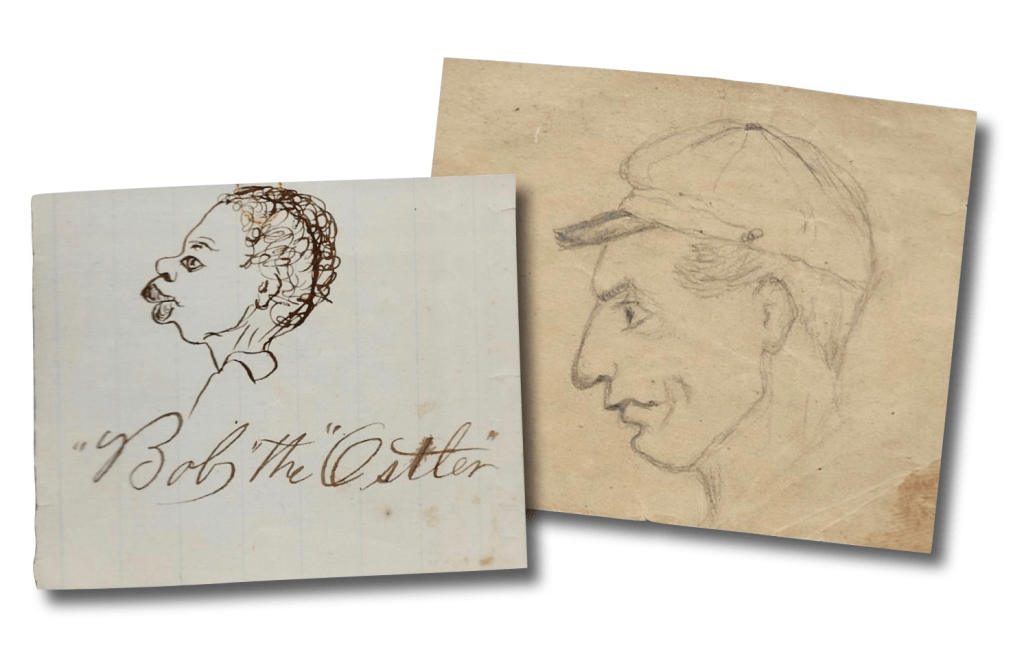
Enclosed find a ring which I made myself. I shall feel quite proud to hear that you wear it. There are a great many made here by the boys and sent home. You will also find enclosed two pictures—one of “Bob,” a genuine “niger,” and one of our cook “Nat,” a good-looking mulatto. He made a dumpling for us today of raisins. Of course it was good but nothing like “Mother’s.”
I have not seen a little girl nor a big one either for as much as three months. They are quite a curiosity about here. Once in a while in my riding about I come across a nest of “nigers.” The other day I saw a lot of “Red Headed” little darkies. They were very black with sandy wool—quite red. They looked very cunning. I have some very good times riding about.
But it is near mail time and I shall have to close. Goodbye for the present. Write soon.




















 Spared & Shared 23