
The following letter was written by John Caldwell Cahoun (1843-1918), the son of Andrew Pickens Calhoun (1811-1865) and Margaret M. Green (1816-1891). John was born near Demopolis, Marengo County, Alabama, on his father’s plantation, July 9, 1843. He is the grandson of the distinguished South Carolina statesman John C. Calhoun, whose wife was Floride, daughter of John Ewing Calhoun, United States Senator for South Carolina, in the 7th Congress, and who died in 1802. His eldest son, Andrew Pickens Calhoun, was the father of Captain Calhoun, and one of the largest cotton planters in the South, before the Civil War, who devoted himself entirely to agricultural pursuits.
In the fall of 1860, at the age of seventeen years, young Calhoun entered the South Carolina College at Columbia as a sophomore. In the subsequent spring of 1861 the Civil War broke out, and he immediately volunteered for the Confederate Army in a company of cadets, which hastened to Charlestown, where they arrived at the time of the bombardment of Fort Sumter. After the cadets were disbanded he proceeded to Columbia and joined Capt. Tom Taylor’s company, which formed a part of the Hampton Legion Cavalry, of which he was appointed Color Sergeant. He was, however, discharged on account of his extreme youth. Hastily returning to his home, he organized a fine cavalry troop of 160 men and was on his way to the front within one month of his discharge. His company was assigned to Adams Battalion, commanded by Major James P. Adams, and afterward merged into the Fourth Regiment, South Carolina Cavalry, under command of Col. B. H. Rutledge, which was one of the regiments composing Gen. M. C. Butler’s Brigade, and it was under this commander Captain Calhoun continued to serve until the end of the war. When Lee surrendered he returned to Fort Hill, only to find his ancestral home devastated, and the entire fortune of the family swept away, in addition to which was the recent death of his father, that imposed upon him the immediate care and support of his widowed mother, together with provision for and the education of his young brothers, Andrew, James, and Patrick, and sisters, Margaret, and Lucrecia.
Transcription
Camp near Grahamville
July 3rd 1862
My Dear Father,
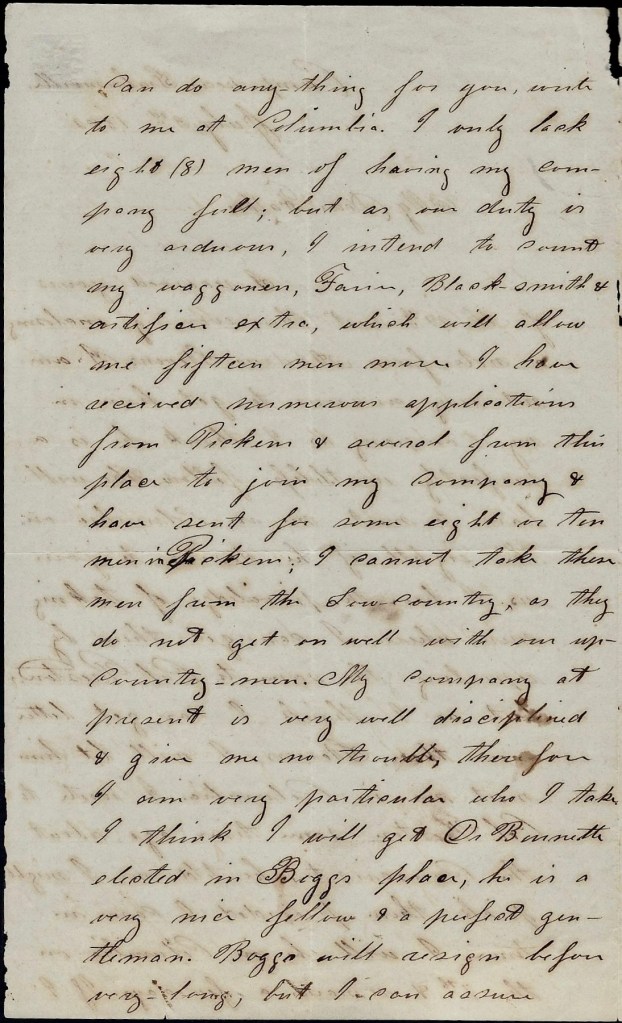
I received yours of the 29th inst. this evening enclosing a note from Andrew Stevens. I am not very anxious to get him in my company as I think he is a perfectly worthless fellow. He will have to meet me in Columbia on the eighth if he desires to join us. I have the privilege men where I can get them by reporting the same to Col. Preston, but as I think I can get better men than Stevens, I will let him meet me in Columbia. I wrote to Col. Preston some time ago about the conscripts. He told me I might pick them provided I came in time. I will be in Columbia on the 7th and remain a few days. If I can do anything for you, write to me at Columbia.
I only last eight (8) men of having my company full; but as our duty is very arduous, I intend to count my wagoner, farrier, blacksmith, and artificer, &c. which will allow me fifteen men more. I have received numerous application from Pickens and several from this place to join my company & have sent for some eight or ten men in Pickens. I cannot take these men from the Low-country as they do not get on well with our Up-country men. My company at present is very well disciplined & give me no trouble. Therefore, I am very particular who I take. I think I will get Dr. Bennett elected in Boggs place. He is a very nice fellow & a perfect gentleman. Boggs will resign before very long but I can assure you it is not from sickness. It is from pure cowardice. He is the most errant coward I ever saw.
I went to McPhersonville a few days ago to see [Colonel W. S.] Walker 1 as I like to be well acquainted with my commanding officer. He paid my company quite a compliment (he was here on a review during my visit home). He told me I had one of the best drilled and finest looking companies on the coast. He is a very nice man but very stern.
The news from Virginia has been very good but I am sorry to see by this evening’s paper that the enemy are holding their ground. It will really be bad if the enemy are not completely routed after the glorious beginning. Stonewall Jackson deserves immortal praise for getting in the rear of the enemy so quickly. I regret very much to see the death of Howell Tsarvant and Oscar Leiber; also that John Haskel has his right arm shot off.
There is great complaint in our portion of the army against General Pemberton & I hear that the people of Charleston are petitioning for his removal. He treated Generals [Nathan G.] Evans and [William D.] Smith very badly (which I suppose you have heard of) & it is believed by some that he is delirious. We are all enjoying fine health at present & doing well. Love to all.
Your affectionate son, — John C. Calhoun
To Col. A. P. Calhoun
1 Col. William Stephen Walker (1822-1899) commanded the Third Military District at McPhersonville, South Carolina, during the summer of 1862.



 Spared & Shared 23