Category Archives: South Carolina Home Front

1862: Archibald Whyte to a Friend

Following is a letter by 61 year-old Archibald Whyte (1800-1865) who was born in Argyle, New York, to Rev. Archibald Whyte, Sr. and Margaret Kerr Whyte. He graduated from Union College and studied at the Associate Presbyterian Seminary in Philadelphia, being licensed to preach by Cambridge Presbytery in 1826. After preaching in North and South Carolina in 1827, he chose to work with a new church in Baltimore from 1827 to 1833. He married Susan Grier from Steele Creek Associate Church around 1829, likely during his mission work.

In 1833, Whyte became the minister at Steele Creek and Back Creek Associate churches in Mecklenburg County and remained there for the rest of his life. He had a daughter named Margaret, born in 1833, but his wife, Susan Grier Whyte, died on December 8, 1834, leaving him to raise their infant daughter alone. During his ministry, his churches grew, but tensions over slavery arose in the late 1830s, as the cotton economy expanded and many began to see slavery as crucial. Those who disagreed often moved to free states. The Associate Presbyterians in the Carolinas faced difficulties since most of their members were in the North, where rules included freeing their slaves. In 1840, Rev. Whyte was suspended from the ministry, and many Associate churches in the Carolinas eventually faded away or joined the Associate Reformed Presbyterian Church.

It is intriguing to consider why Archibald Whyte, a New Yorker, became a strong supporter of slavery, dedicating his life to defending the landed gentry. After fourteen years as a minister, at 40, he opted for a career change, not seeking a new position in another denomination like most Southern ministers. Instead, he moved to York County, bought a farm near the Catawba River, and became a successful community member. After his first wife died around 1838 or 1839, he married Mrs. Elizabeth Hart Campbell, likely influenced by her ties to the Campbell family.

Rev. Whyte’s farm covered 317 acres along Saluda Road, between the river and Steele’s Crossing. Today, this area includes parts of I-77, the Manchester Village shopping area, and the Manchester Meadows Soccer Complex. His home was near the southern edge of his property, where Dave Lyle Boulevard meets Springsteen Road. When Rev. Whyte arrived in eastern York County, SC, the region was called “Indian Land,” part of the Catawba Indian Nation’s territory, mostly leased to white settlers.

Archibald Whyte began a new life as a planter in a two-story Piedmont I-house with a front porch and chimneys at both ends, though it’s unclear if he built or bought it; local histories suggest construction was between the 1830s and 1840s. In addition to being a planter and Postmaster, Rev. Whyte preached and ran an inn at his home, teaching young men who came for lessons. By 1850, 50-year-old Whyte from New York lived with his daughter Margaret (17) and sons Thomas (10) and William (8). The Slave Census indicated he owned 12 slaves and his real estate was valued at $3,000, equivalent to about $82,000 today. He owned 200 acres of improved land and 114 acres unimproved, along with two horses, two mules, four milk cows, fourteen oxen, and other livestock, growing wheat, corn, and oats.

In 1856, Whyte began his political career, being nominated and winning a seat in the South Carolina Legislature to represent Indian Land. He served as one of four representatives from York District during sessions in late 1856 and late 1857. That year, he participated in planning the relocation of settlers to Kansas to support slavery and helped establish a voting precinct in Rock Hill, known for his skillful speaking.

The 1860 Census showed that Rev. Archibald Whyte was doing well as a planter, with real estate valued at $9,850 (about $248,000 today) and personal property worth $9,605. He owned eleven slaves, six of whom were over 18, and his address was “Coats Tavern,” located between Lesslie and Catawba, south of his home.

With the coming of the Civil War, Whyte supported the southern cause. In early 1861, A. E. Hutchison organized the first military unit in Rock Hill, named the Whyte Guards in honor of Archibald Whyte. They assembled on April 15, shortly after the firing on Fort Sumter, and Whyte accompanied them to Columbia. In August 1861, he was appointed as an agent for Rock Hill to solicit donations for the Confederate cause. [Source: Rev. Archibald Whyte, by Paul Gettys]

T R A N S C R I P T I O N

At home [York county, South Carolina]
Saturday night, January 4, 1862

My dear Friend,

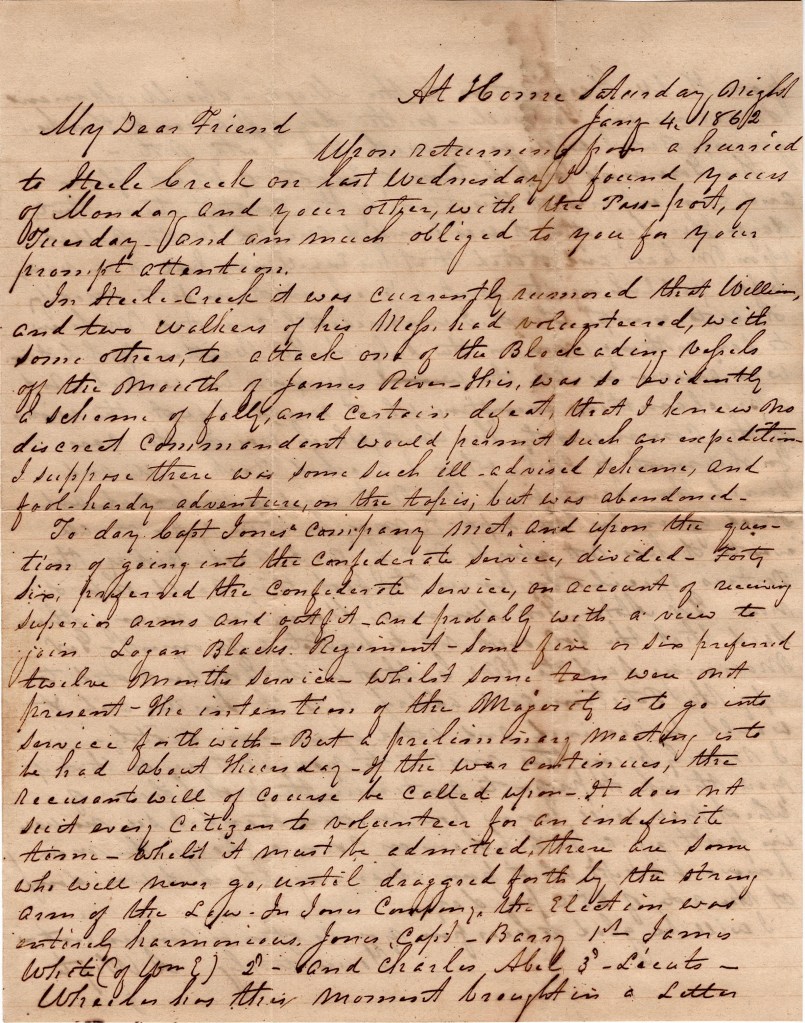
Upon returning from a hurried [trip] to Steele Creek on last Wednesday, I found yours of Monday and your other, with the passport, of Tuesday, and am much obliged to you for your prompt attention.

In Steele Creek, it was currently rumored that William and two Walkers of his mess had volunteered with some others to attack one of the blockading vessels off the mouth of James river. This was so evidently a scheme of folly and certain defeat that I knew no discreet commandant would permit such an expedition. I suppose there was some such ill-advised scheme, and fool-hardy adventure on the [ ]; but was abandoned.

Today Capt. Jones’s company met and upon the question of going into the Confederate service, divided. Forty-six preferred the Confederate service of account of receiving superior arms and outfit—and probably with a view to join Logan Black’s Regiment [1st S. C. Cavalry]. Some five or six preferred twelve months service whilst some ten were not present. The intention of the majority is to go into service forthwith, but a preliminary meeting is to be had about Thursday. If the war continues, the [ ] will of course be called upon. It does not suit every citizen to volunteer for an indefinite time. Whilst it must be admitted there are some who will never go until dragged forth by the strong arm of the law. In Jones’ company, 1 the election was entirely harmonious. [Robin C.] Jones, captain. [James H.] Barry, 1st. James White (of Wm E) 2nd. and Charles Abel, 3rd Lieutenants.

Wheeler has this moment brought in a letter from N. W. Garlington to the Major. Also [John T.] Wightman’s discourse in Yorkville [S. Carolina] on the day of National Thanksgiving. But I will go on with this hasty note.

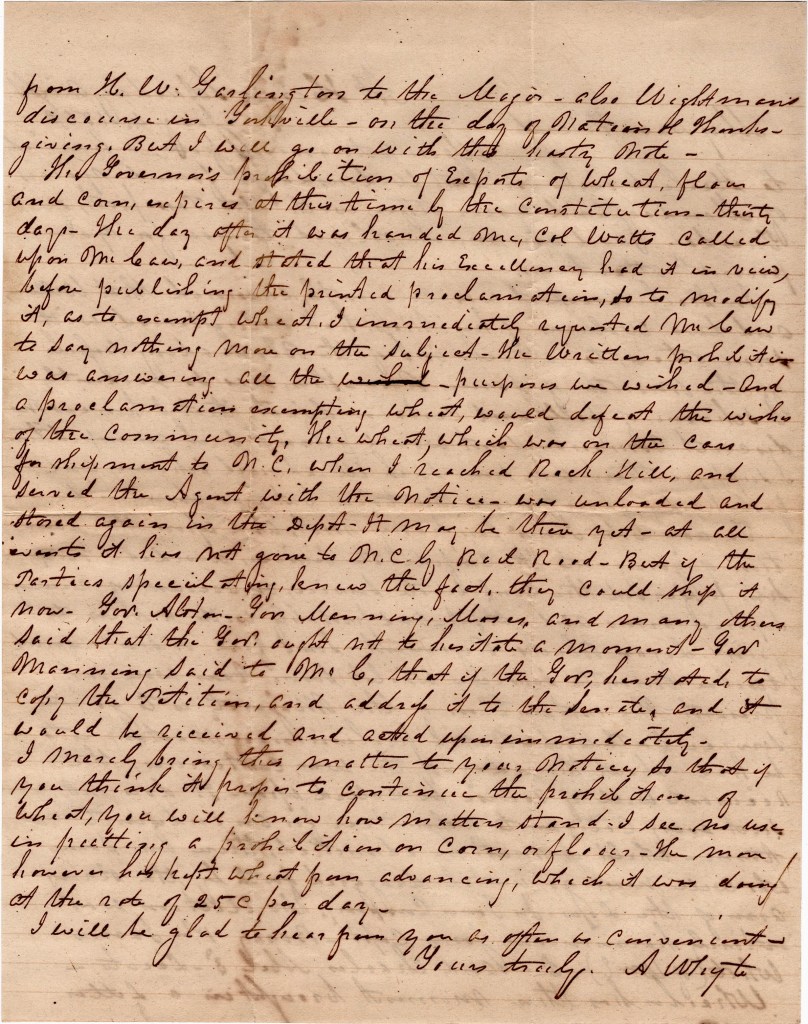
The Governor’s prohibition of exports of wheat, flour and corn expires at this time by the Constitution—thirty days. The day after it was handed me, Col. Watts called upon McCaw and stated that his excellency had it in view, before publishing the printed proclamation so to modify it, as to exempt wheat. I immediately requested McCaw to say nothing more on the subject. The written prohibition was answering all the purposes we wished, and a proclamation exempting wheat would defeat the wishes of the community. The wheat, which was on the cars for shipment to North Carolina when I reached Rock Hill, and served the Agent with the notice, was unloaded and stored again in the depot. It may be there yet. At all events, it has not gone to North Carolina by railroad. But if the parties speculating knew the fact, they could ship it now. Gov. [Robert F. W.] Alston, Gov. [John Lawrence] Manning, [Franklin J.] Moses, and any others said that the Governor would not hesitate a moment. Gov. Manning said to McC. that if the governor hesitated, to copy the petition and address it to the Senate, and it would be received and acted upon immediately.

I merely bring this matter to your notice so that if you think it proper to continue the prohibition of wheat, you will know how matters stand. I see no use in putting a prohibition on corn or flour. The move however has kept wheat from advancing, which it was doing at the rate of 25 cents per day.

I will be glad to hear from you as often as convenient. Yours truly, — A. Whyte


1 This is a reference to Robin Jones’s Cavalry, which became Co. H of the 1st S. Carolina Cavalry, a.k.a, Black’s Regiment. Co. H. was composed of men from Rock Hill, SC in York District. According to the Yorkville Enquirer of February 13, 1862, the Company was organized the week before, on February 9, 1862, and left Rock Hill on February 12th. Capt. Robin Cadwallader Jones raised the Company and commanded it until he was killed on June 9, 1863 at the 1st Battle of Brandy Station, VA. One version asserted that he had captured several Union troopers, was collecting their weapons, and one of them shot him. Another version asserted that he attacked a dismounted trooper and cut off his thumb, but the wounded soldier managed to get off a fatal shot from his revolver as Capt. Jones rode past. James H. Barry succeeded him as Captain in September of 1863. He was wounded in the right foot on August 7, 1863 (incident not named) and part of his foot had to be amputated. He resigned on January 27, 1865 due to age and the fact that his three-year enlistment had expired on January 9, 1865. He then enrolled in the SC Reserves. It is not known who took over the company at that time.
1863: Mary W. Milling to James Smythe Milling

The following letter was written by Mary W. (Milling) Milling (1828-1910), the cousin and wife of Dr. James Smythe Milling (1831-1895), and the daughter of Dr. John N. Milling (1790-1864) and Mary Elizabeth Whitaker (1801-1861) of Camden, Kershaw county, South Carolina. Mary’s husband was a physician and planter in Fairfield District, S.C. In 1859, Milling moved his slaves to a plantation in Bossier Parish, La., where he spent much of his time while his wife (and cousin) Mary W. Milling and their children remained with her family near Camden, S.C. In 1866, Mary and the children moved to Louisiana. The children were Minnie (b. 1857), Jane (b. 1859), John (b. 1860), and James (b. 1862).

Find-A-Grave indicates that Milling served the Confederacy in Co. B, 28th Louisiana Infantry (Gray’s), or “Mark’s Guards.” However, this letter in March 1863 does not suggest that he was in the service at the time.

See also—The James S. Milling papers, 1852-1883 at the University of North Carolina at Chapel Hill.

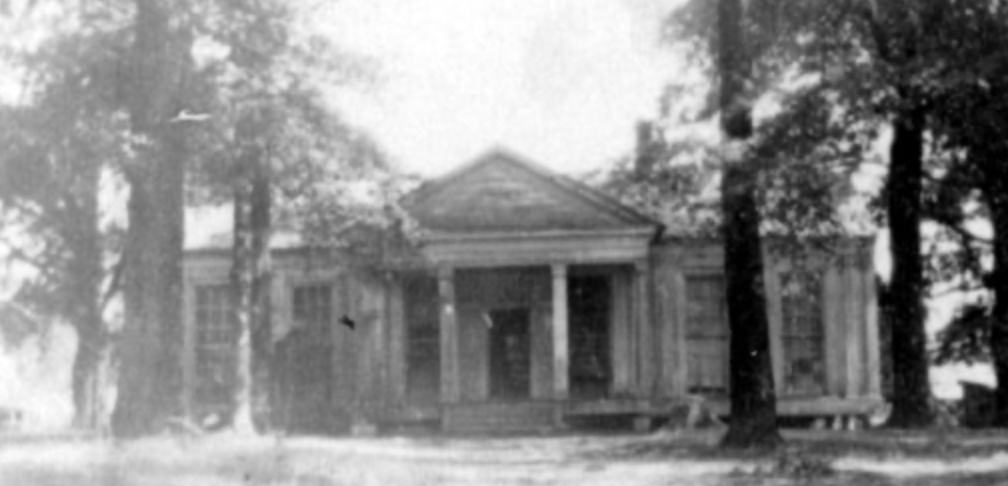
Dr. James S. Milling house in Bossier Parish, Louisiana (Bossier Parish Library Historical Center)

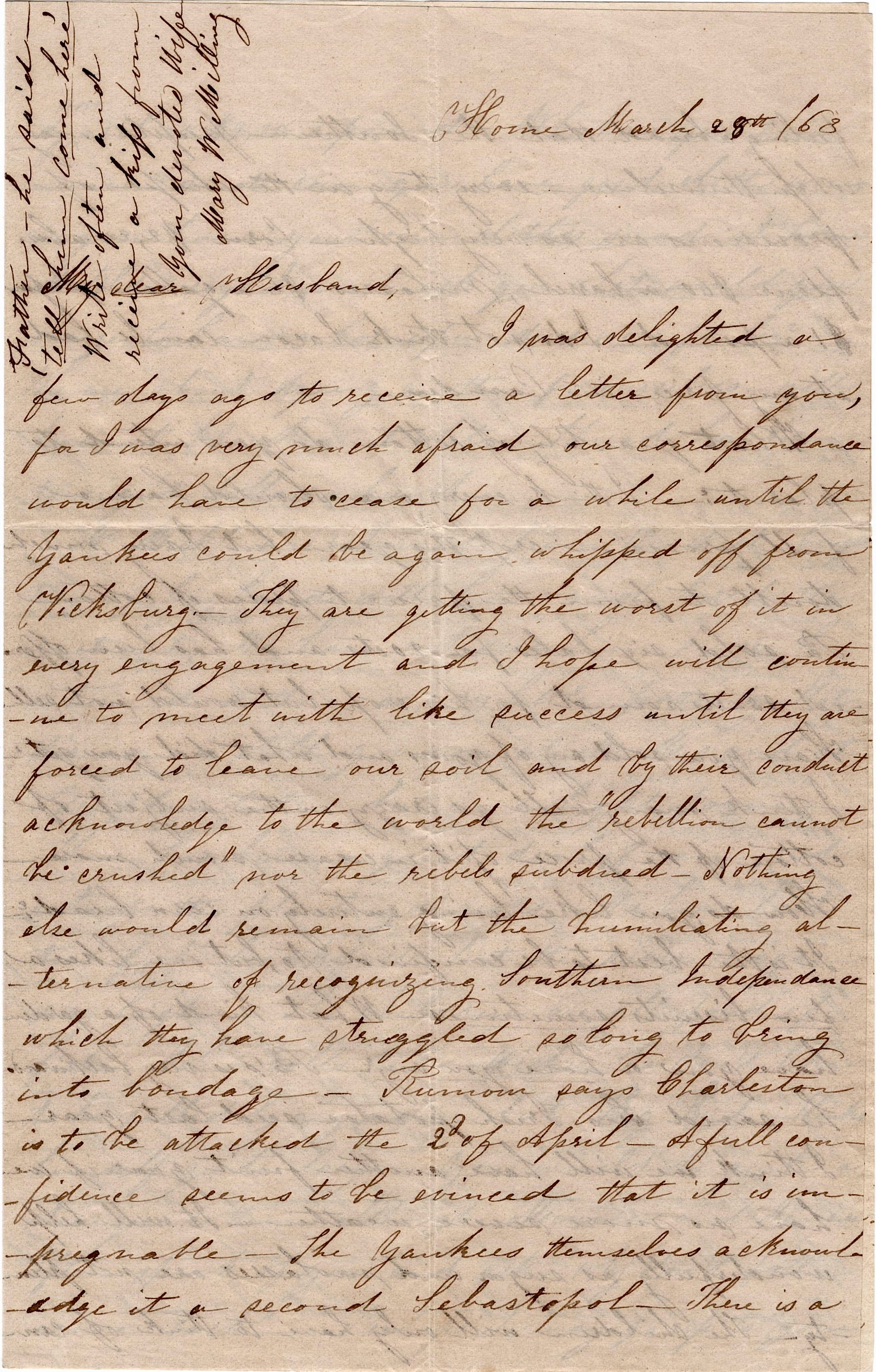
T R A N S C R I P T I O N

Home [Camden, South Carolina]
March 28th 1863

My dear husband,

I was delighted a few days ago to receive a letter from you, for I was very much afraid our correspondence would have to cease for a while until the Yankees could be again whipped off from Vicksburg. They are getting the worst of it in every engagement and I hope will continue to meet with like success until they are forced to leave our soil and by their conduct acknowledge to the world the “rebellion cannot be crushed” nor the rebels subdued. Nothing else would remain but the humiliating alternative of recognizing Southern Independence which they have struggled so long to bring into bondage. Rumor says Charleston is to be attacked the 2nd of April. A full confidence seems to be evinced that it is impregnable. The Yankees themselves acknowledge it a second Sebastopol. There is a feeling abroad that the Southern people may whip themselves.

Everything in the shape of provisions are so very high—corn $2.25 a bushel, flour $60 a barrel, molasses $6 a gallon, sugar $1 a pound. I do not think bacon can be had at any price in Camden.

What quantity of cotton do you intend to plant? I think everyone should have a full provision crop this year but I very much doubt it from the present prices of cotton. Pa sold six bales for 20 cents and has been offered 25 cents round for his crop but would not sell. Have you sold any of yours and what did you get? I think many will go crazy on the subject of cotton if the price of it increases much more.

How do you like living entirely on corn bread? It is the best to be confined to, but one likes a few biscuits sometimes. What kind of a garden have you, or have you any? Pa’s is very backward. He saved his Irish potatoes seed last year, I think we will have another fruit year if we have no more severe weather. It will help wonderfully as sugar and molasses are not plenty. The children will only have to think of candy now as it is $2.25 a pound.

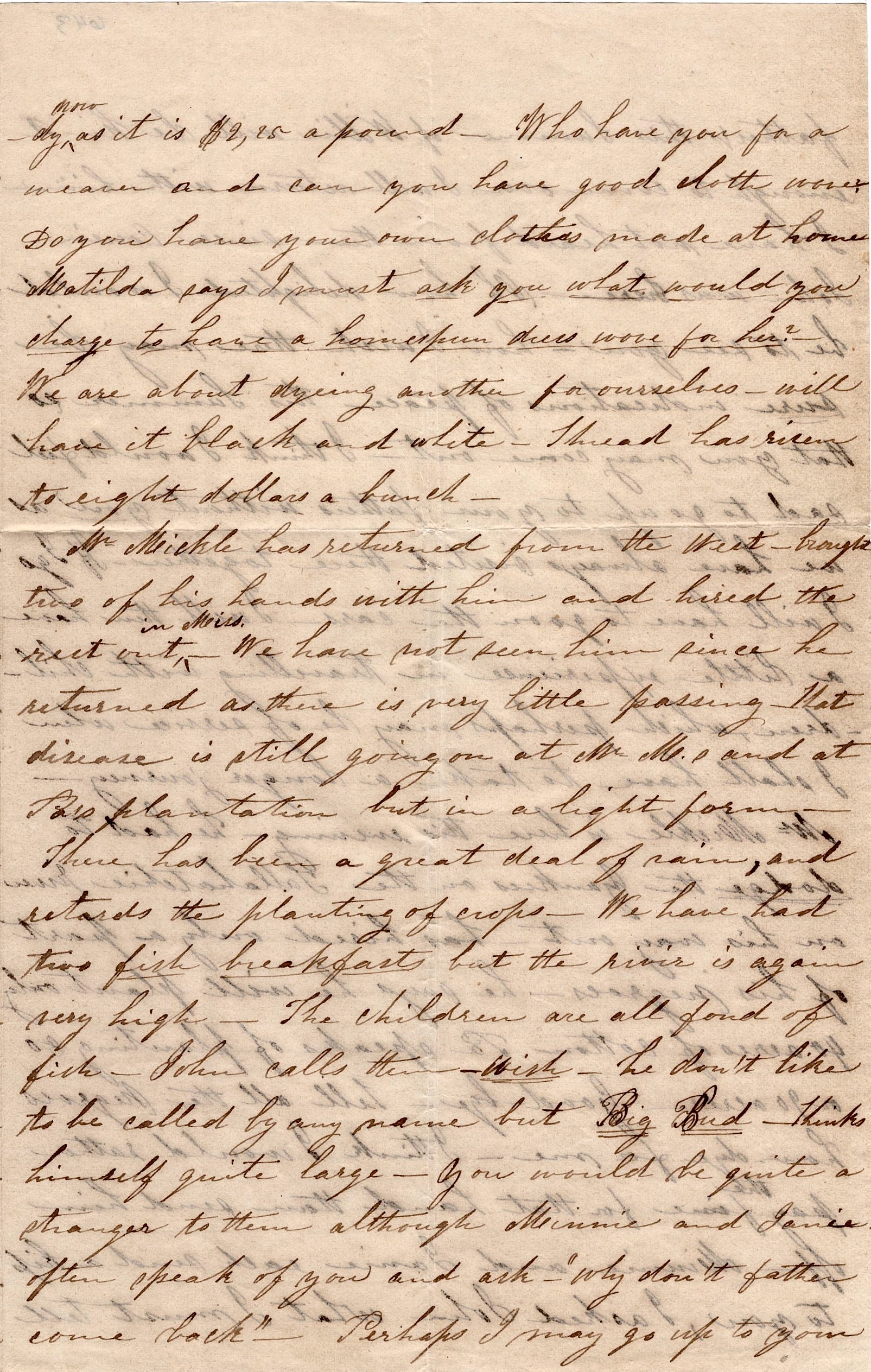
Who have you for a weaver and can you have good cloth woven? Do you have your own clothes made at home. Matilda says I must as you what would you charge to have a homespun dress wover for her? We are about dyeing another for ourselves. Will have it black and white. Thread has risen to eight dollars a buch.

Mr. [John Belton] Mickle has returned from the West. Brought two of his hands with him and hired the rest out in Mississippi. We have not seen him since he returned as there is very little passing. That disease is still going on at Mr. Mickle’s and at Pa’s plantation but in a light form. There has been a great deal of rain, and retards the planting of crops. We have had two fish breakfasts but the river is again very high. The children are all fond of fish. John calls them wish. He don’t like to be called by any name but “Big Bud. Thinks himself quite large. You would be quite a stranger to them although Minnie and Janie often speak of you and ask, “Why don’t father come back.”

Perhaps I may go up to your father’s this summer. If Willie will be kind enough to come over, I will return with him. I have not heard from them since cousin John was here. Oh how delighted I would be to see you. How I wish there may be sure indications of peace this summer so that you may come out. I think I would feel sad to go up to your father’s without you as we have always visited there together. If I go, I will have to go on the cars. I will then have a little experience in traveling with children, which perhaps may be of service when I shall have to take a longer journey.

Mr. Mickle is here this evening. He had to dodge the Yankees on the Tallatchie river on his way out. Has hired only a part of his negroes. He says he will plant only 40 acres of cotton. Pa speaks of planting 80 or 90 acres.

Goodbye. Tell all the negroes how-dye for me, I think I would rather pay the fine for that hand than send him off. Minnie and Janie each send a kiss to you. I asked John what I must tell Father. He said tell him come here. Write often and receive a kiss from your devoted wife, — Mary W. Milling

1864: Stephen S. Roberts to William Birnie

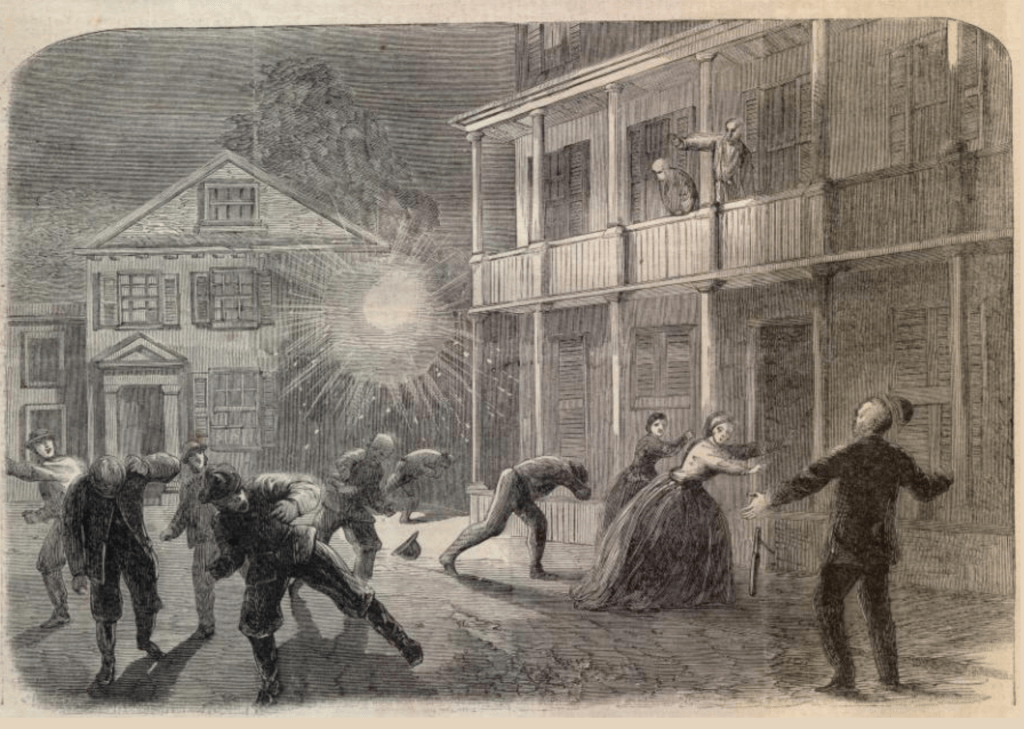
After several unsuccessful attempts to take Charleston by water, the Union launched a different tactic—shelling Charleston civilians from James and Morris Islands. Gillmore set twenty-two thousand men to work erecting gun batteries in the island marshes facing the Charleston peninsula and Fort Sumter. The batteries were five miles from the city, too distant for conventional ordnance to reach, so residents were at first unconcerned. However, recent weapon developments and rifling technology actually put the city in range, and on the night of August 22, 1863, the “Swamp Angel” gun opened fire on Charleston.

The first shell hit Hayne Street near the Market, narrowly missing the Charleston Hotel. A British visitor recalled, “At first I thought a meteor had fallen, but another awful rush and whir right over the hotel and another explosion beyond, settled any doubts that the city was being shelled.” Beauregard admonished Gillmore: “It would appear sir, that despairing of reducing our works, you now resort to the novel measure of turning your guns against old men, the women and children, and the hospitals of a sleeping city, an act of inexcusable barbarity.” Church steeples became targets for Union artillery, so many closed during the siege for the safety of their parishioners. Newspapers reported that many residents had made a “Grand Skedaddle,” leaving as quickly as they could pack their belongings.

Those who stayed became used to the daily explosions. Fitz Ross, a visiting journalist, wrote, “Nine out of ten shells fall harmless—the hope of the Yankees to set fire to the city or batter it down have hitherto proved disappointing.” The shelling continued with varying degrees of intensity for 587 consecutive days. In January 1864 the Charleston Mercury did report a frightening near miss: “One of the enemy’s large shells, after penetrating the roof of a dwelling, overturned a bed in which three young children were sleeping, throwing them rudely on the floor, but then strange to say, it passed without bursting, and buried itself in the foundation of the house.”

The worst bout of shelling occurred during a nine-day stretch in 1864, when over fifteen hundred shells rained down on the city. Volunteer fireman Charles Rogers wrote to his wife in June 1864 that “there was a fire downtown last week, and the Yanks dropped their shells in town like peas…I have experienced a remarkable change since my return. In fact it is a matter of much congratulation in the Starvation times. I don’t eat half as much now.” [Source: Christina Rae Butler, Legends Magazine]

I can’t be certain of the identity of the “S. S. Roberts” who wrote this letter but I believe it to have been 30 year-old Stephen S. Roberts (b. 1834) who worked as a clerk in Charleston and whose widowed mother Mary Roberts lived on Spring Street east of King Street in the City. Though he called himself “Old Woman,” I think this was in jest. The letter was datelined from Summerville where many residents fled to avoid the shelling.

The letter was written to William Birnie (1782-1865), a Charleston, S.C., merchant and president of the Bank of South Carolina. It may have been that Roberts clerked for Birnie. William Birnie was an immigrant from Aberdeen, Scotland, who had settled in Charleston in the 1850s. Birnie refugeed to Greenville during the Civil War, and in October 1863 purchased 96 acres and a home on the Augusta Road for $30,000 that became his home.

Charleston remained under intermittent bombardment from August 1863 until it was evacuated in February 1865. Though only five individuals would be killed by the cannonade, Charlestonians moved north of Calhoun Street and along the Ashley River. The downtown area became known as the “Shell District.” The historic churches, houses, and graveyards were damaged and some destroyed by Union shells.

Shelling of Charleston, South Carolina

Transcription

Summerville, [South Carolina]
17th January 1864

Wm. Birnie, Esq.

Respected sir, it has been some time since I wrote you last and there has been many changes in our good old city since then. I removed Mr. Ogilvie’s 1 stock up Meeting Street after I found Broad Street had been completely deserted by everybody else. A great many removed to the south of Calhoun Street which I remarked at the time was very foolish of them. Friday’s shelling will tell them that they will be compelled to make another move higher up.

Last Friday the Yanks threw a shell into Charlotte Street & another in John Street east of Meeting Street. What a stampede these two devils have caused amongst the people. The Banks & portions of the Government departments removed by daylight Saturday morning. The Bank of Charleston had pulled up stakes & gone—where to? deponent knoweth not. Sub Treasury & most of the other banks were removing yesterday afternoon.

I do hope that the Yanks may never reach my new quarters. On Thursday last the enemy put a shell through the shed of our old store which did not stop until he reached the second floor. There the gentleman belched out all his venom & made sad havoc all around. The lower story not injured farther than the contraction of the doors attached to the large safe, or in other words—vault. Not many panes of glasses to be seen over the building. To my astonishment, there is not one piece of the shell to be found in the rooms. I notice several holes in the walls so I suppose the fragments have hid themselves in them. The building is not as badly damaged as I expected to find it.

The Southwestern Railroad Bank was also struck and received much more injury than your building. Yesterday when I was down in Broad Street, the shells came whistling over my head like so many Mock Birds. Any number struck around the neighborhood. When leaving the old establishment, I took a farewell look at the old place & said to myself, “Old woman, this will be the last visit I will pay you until our esteemed friends shall stop sending so many black pills to yourself & neighbors, as I have no relish for those sort of plums.”

I have heard heavy firing all last night & this morning. My health & my mother’s not of the best. I hope this will find yourself & family well. Please accept for yourself & Mrs. B. our best respects. I remain, dear sir, truly — S. S. Roberts


1 William Matthew Ogilvie (1810-1872), a native of Scotland, married Margaret Murdock Walker in Charleston in 1840 and was a merchant in Charleston at the time of the Civil War.

1864-65: George Manly Norris to his Brother

I can’t be absolutely certain of the identity of these correspondents but am reasonably confident that the letter was written by George “Manly” Norris (184801934), the son of George Norris (1812-1862) and Amelia Avinger (1812-1883) of Vance’s Ferry (near Santee), Orangeburg county, South Carolina.

Manly wrote the letter to a brother whom he calls “Budder.” This may have been Daniel Keating Norris (1846-1905) who served in the 2nd South Carolina Artillery. Apparently with Budder or encamped nearby was another brother, Joseph (“Joe”) Furman Norris (1849-1923) who enlisted in 1864 at the age of 17 in Co. D, 19th Battalion, South Carolina Cavalry.

In his letter, Manly mentions his brother Thomas P. Norris (1842-1865) who served as a 1st Sergeant in Co. F, 2nd South Carolina Artillery. Thomas was wounded at the Battle of Bentonville N.C. March 19th 1865, from the effects of which he died three days after.

[The following letter is from the personal collection of Greg Herr and was transcribed and published on Spared & Shared by express consent.]

Transcription

March 3rd [1864/5]

Dear Budder,

Ma received a letter from you and Joe last week and was very glad to hear that you and Joe was well. We are all well and I hope these lines will find you and Joe enjoying the same health,

Gabe and Emer [Emma] Avinger, I and Harrison Dorsan went up to the cave up to the old Chapel yesterday. We enjoyed ourselves finely. We went in the cave about 20 feet. We would have went through it if there was no so much water in it. There are hundreds of names in it. I seen some there ever since 1780. We all wrote our names in there. I seen Brother Edward’s name in one of the part of the old Chapel.

I got an introduction to Harrison’s sister yesterday. She is not very pretty. I expect Harrison will start today for camps. Mr. Dorson’s school will commence next week. I expect he will have a pretty good school. I am going to town next week. I haven’t heard from Tom in a week or more. The last time I heard from him he was well.

Budder, I have sent the books you wrote for by Mr. Dorson. I expect you have got them before now. Sam Preacher went to Columbia but did not succeed in getting his exemption signed. He wants too much waiting on. He made Nelly sash for him all day last Saturday.

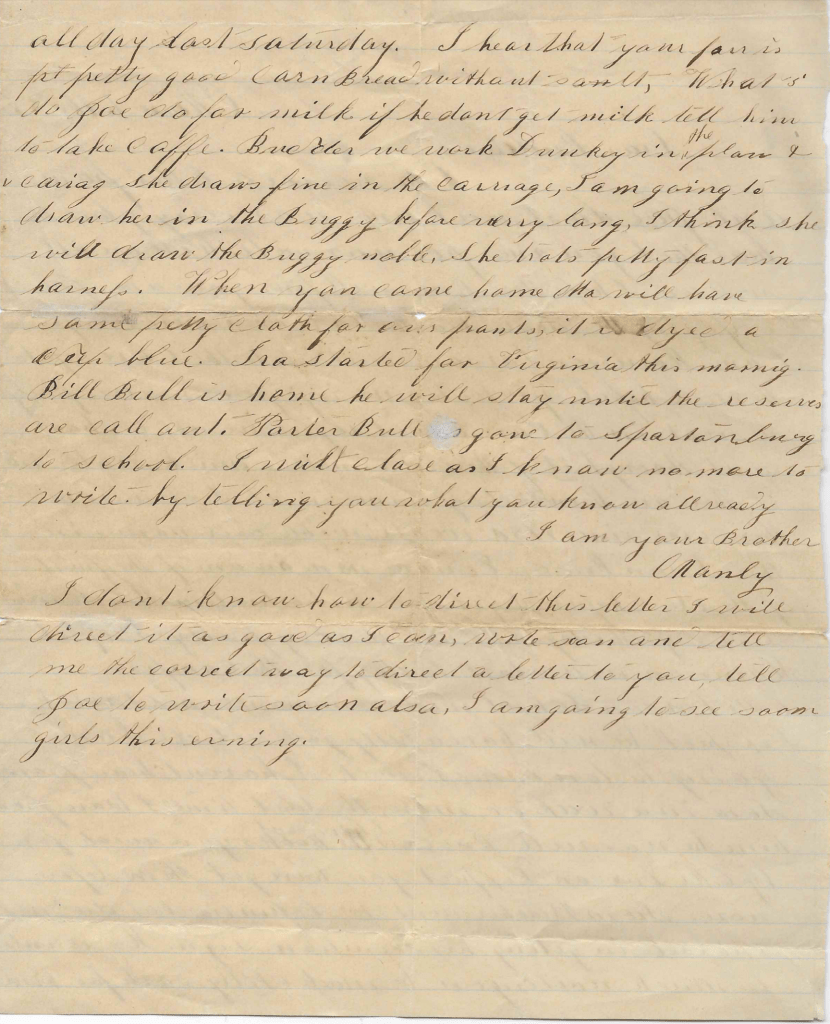
I hear that your fare is pretty good—cornbread without salt. What’s Joe do for milk? If he don’t get milk, tell him to take coffee. Budder, we work Dunkey in the plow and carriage. She draws fine in the carriage. I am going to draw her in the buggy before very long. I think she will draw the buggy noble. She trots pretty fast in harness.

When you come home, Ma will have some pretty cloth for our pants. It is dyed a deep blue. Ira started for Virginia this morning. Bill Bull is home. He will stay until the reserves are called out. [Ira] Porter Bull is gone to Spartanburg to school. I will close as I know no more to write by telling you what you know already.

I am your brother, — Manly.

I don’t know how to direct this letter. I will direct it as good as I can. Write soon and tell me the correct way to direct a letter to you. Tell Joe to write soon also. I am going to see some girls this evening.

1862: Susan Gibbs (Boone) DeSaussure to Sarah Gibbes (DeSaussure) Elliott

Susan Gibbs (Boone) DeSaussure’s Monument in the Circular Congregational Church Burying Ground in Charleston, SC

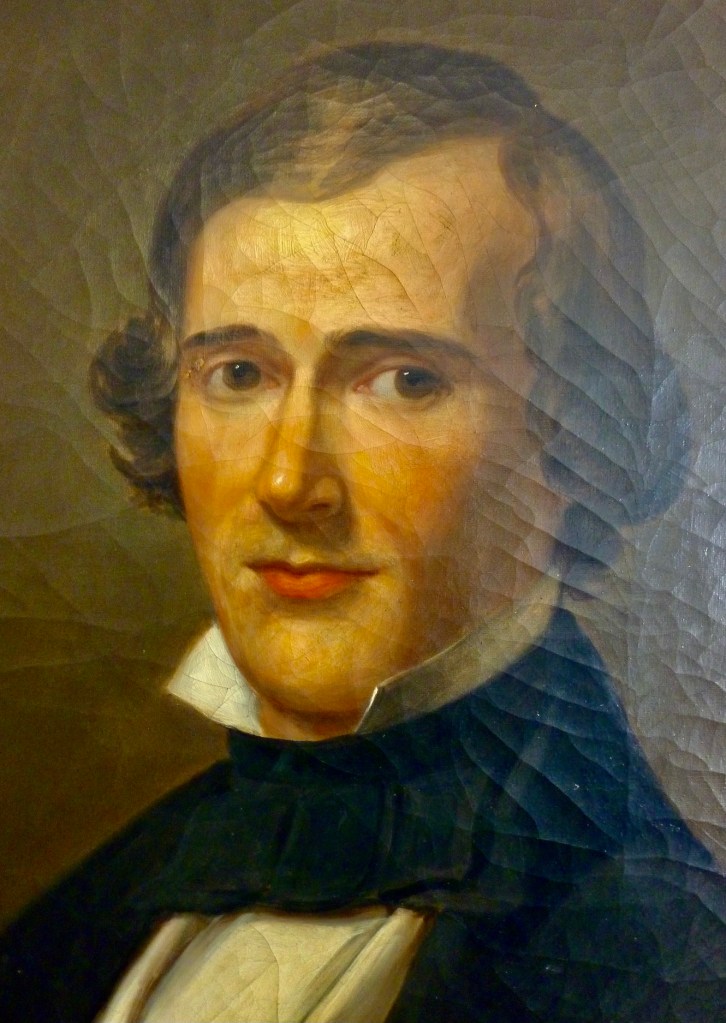
The following letter was written by 73 year-old Susan Gibbes (Boone) DeSaussure (1789-1864), the wife of Henry Alexander DeSaussure (1788-1865)—a prominent attorney in Charleston, South Carolina. She wrote the letter to her daughter Sarah Gibbes (DeSaussure) Elliott (1811-1891) who was married to her second husband, Stephen Elliott (1804-1866). Stephen Elliott was an 1824 graduate of Harvard. He was a planter for awhile and then turned to the ministry. He was ordained an Episcopal priest in 1836 and was the rector at St. Peter’s in Charleston for a time. He devoted himself to missionary work among the Negroes and built a church for them on the Combahee River called Christ Chapel. 

Several of Stephen Elliott’s sons served in the Confederate army during the Civil War: Stephen Elliott, Jr. (1830-1866), was Captain of the Beaufort Volunteer Artillery. In 1863, he was promoted Major, then Colonel and was chosen by General Beauregard to command Fort Sumter in Charleston Harbor. Transferred to Petersburg, Virginia, he was promoted Brigadier General in 1864. He was severely wounded in the Battle of the Crater and after his recovering he participated in actions at Averysboro and Bentonville, in which he was again badly wounded. William Elliott (1838-1907), joined the Confederate Army and served the entire war, attaining the rank of Lieutenant Colonel. Middleton Stuart Elliott (1841-1921) was an 1862 graduate of the Citadel. Finally, Henry (“Hal”) DeSaussure Elliott (1848-1907) must have served at war’s end.

Transcription

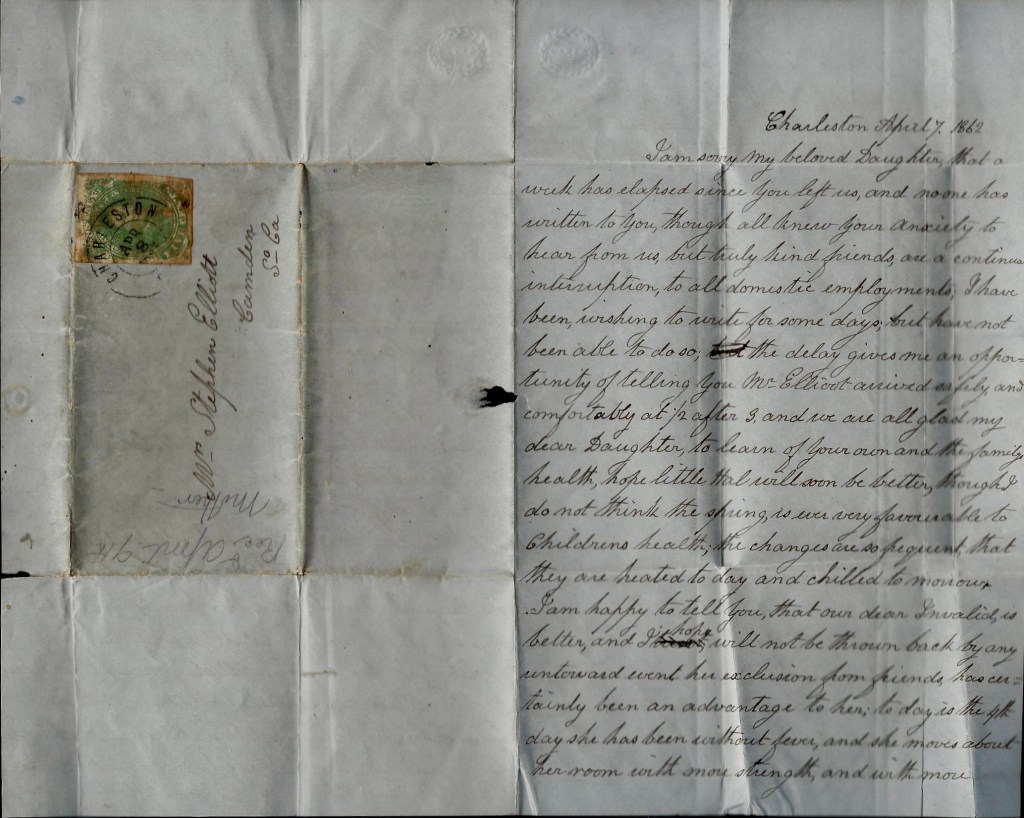
Addressed to Mrs. Stephen Elliott, Camden, South Carolina

Charleston [South Carolina]
April 7, 1862

I am sorry, my beloved daughter, that a week has elapsed since you left us and no one has written to you, though all knew your anxiety to hear from us. But truly kind friends are a continuous interruption to all domestic employments. I have been wishing to write for some days but have not been able to do so. The delay gives me an opportunity of tell you Mr. Elliott arrived safely and comfortably at half past 3 and we are all glad, my dear daughter, to learn of your own and the family’s health. Hope little Hal will soon be better though I do not think the spring is ever very favorable to children’s health—the changes are so frequent that they are heated today and chilled tomorrow.

I am happy to tell you that our dear invalid is better and I hope will not be thrown back by any untoward event. Her exclusion from friends has certainly been an advantage to her. Today is the 4th day she has been without fever and she moves about her room with more strength and with more interest in her employments but with no increase of appetite. Your fresh eggs will be a treat to her for I have just run out.

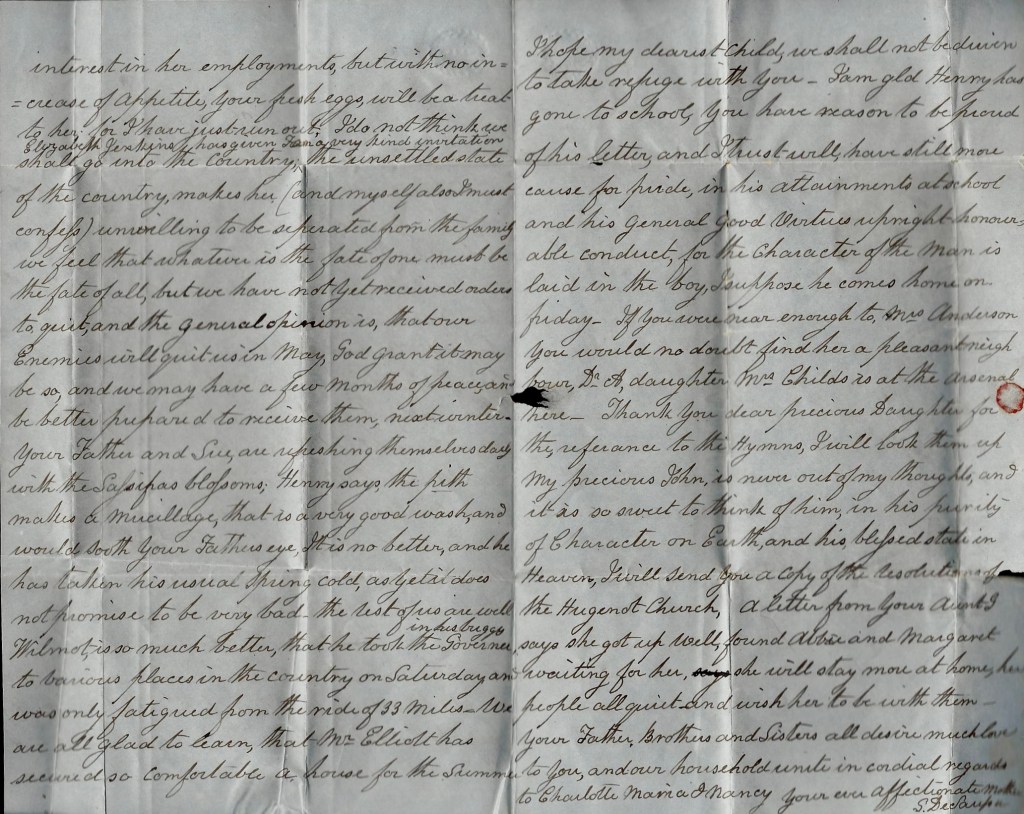
The unsettled state of the country makes her (and myself also, I must confess) unwilling to be separated from the family. We feel that whatever is the fate of one, must be the fate of all.

— Susan Gibbs (Boone) DeSaussure, Charleston, 7 April 1862

Elizabeth Jenkins has given Fan a very kind invitation [but] I do not think we shall go into the country. The unsettled state of the country makes her (and myself also, I must confess) unwilling to be separated from the family. We feel that whatever is the fate of one, must be the fate of all. But we have not yet received orders to quit and the general opinion is that our enemies will quit us in May. God grant it may be so and we may have a few months of peace and be better prepared to receive them next winter.

Your father and Sue are refreshing themselves daily with the sassafras blossoms. Henry say the pith makes a mucillage that is a very good wash and wood sooth your father’s eye. It is no better and he has taken his usual spring cold. As yet it does not promise to be very bad. The rest of us are well. Wilmot 1 is so much better that he took the Governor [Francis Pickens] in his buggy to various places in the country on Saturday and was only fatigued from the ride of 33 miles.

Wilmot Gibbes DeSaussure (1822-1886)

We are all glad to learn that Mr. Elliott has secured so comfortable a house for the summer. I hope, my dearest child, we shall not be driven to take refuge with you. I am glad Henry has gone to school. You have reason to be proud of his letter and I trust will have still more cause for pride in his attainments at school and his general good virtues upright honorable conduct, for the character of the man is laid in the boy. I suppose he comes on Friday.

If you were near enough to Mrs. Anderson, you would no doubt find her a pleasant neighbor. Dr. Anderson’s daughter, Mrs. Childs, is at the arsenal here.

Thank you dear precious daughter for the reference to the Hymns. I will look them up. My precious John is never out of my thoughts and it is so sweet to think of him in his purity of character on earth and his blessed state in Heaven. I will send you a copy of the resolutions of the Hugenot Church. A letter from your aunt G. says she got up well, [and] found Abbie and Margaret waiting for her. She will stay more at home. Her people all quiet and wish her to be with them.

Your Father, brothers and sisters all desire much love to you, and our household unite in cordial regards to Charlotte, Maria & Nancy.

Your ever affectionate mother, — S. DeSaussure


1 Susan’s son, Wilmot Gibbes DeSaussure, was the Secretary of the South Carolina Treasury and as a Representative to the State Assembly. Appointed to Brigadier General of State Militia in 1861, De Saussure led the 4th Brigade throughout the Civil War. He served on South Carolina Governor Francis Pickens cabinet as Secretary of the Treasury. In 1862, he was elected State Adjutant General and Inspector General of Militia. Post Civil War saw De Saussure resuming his profession as a lawyer and becoming the President of the Huguenot Society and the Sons of Cincinnati. The General died in Ocala, Florida on February 1, 1886.

1864: Martha Rebecca Elizabeth McElwee to Jonathan Newman McElwee

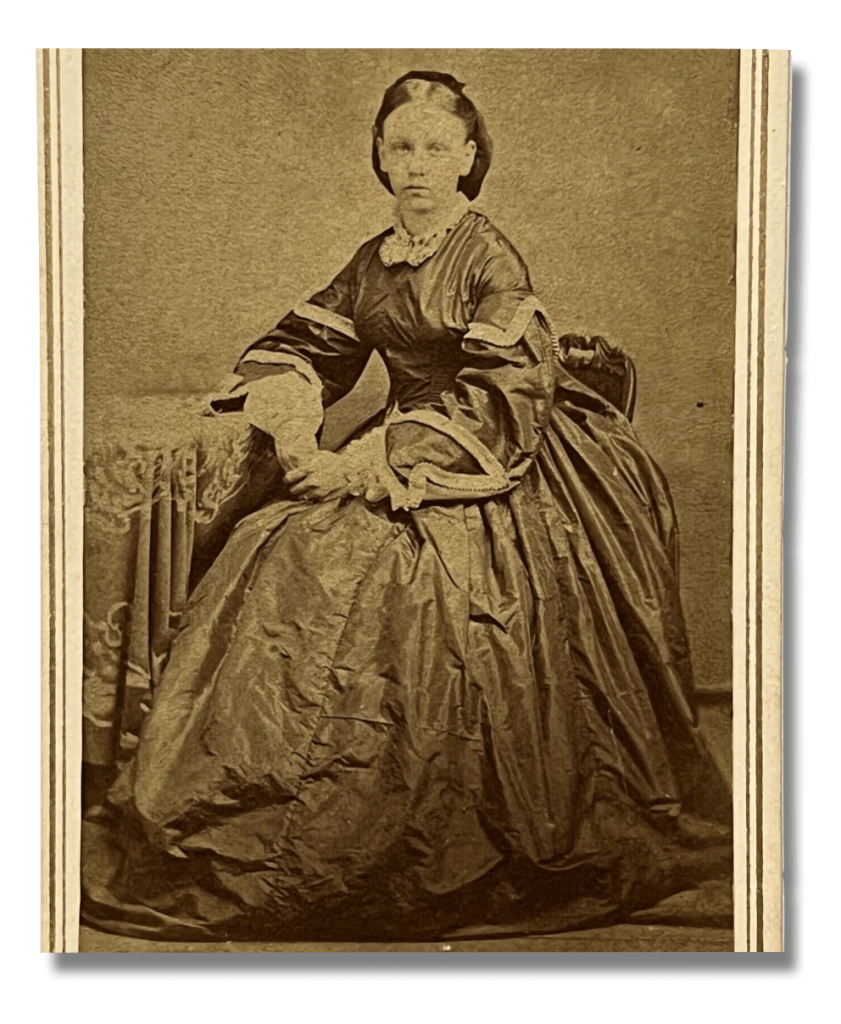
How Lizzie might have looked in 1864

This letter was written by 16 year-old Martha Rebecca Elizabeth (“Lizzie”) McElwee, the daughter of Jonathan Newman McElwee (1809-1892) and Martha Amelia Orr (1810-1873) of Rock Hill, York county, South Carolina. Lizzy was married in 1870 to J. W. O. Riley.

Lizzie’s father served in the Confederate army early in the war and her two brothers, Jonathan Lewis and Manlius Jerome were still serving in the 1st South Carolina Cavalry late in 1864.

Lizzie may have been attending the Yorkville Female College in Yorkville when she wrote this letter in December 1864.

Transcription

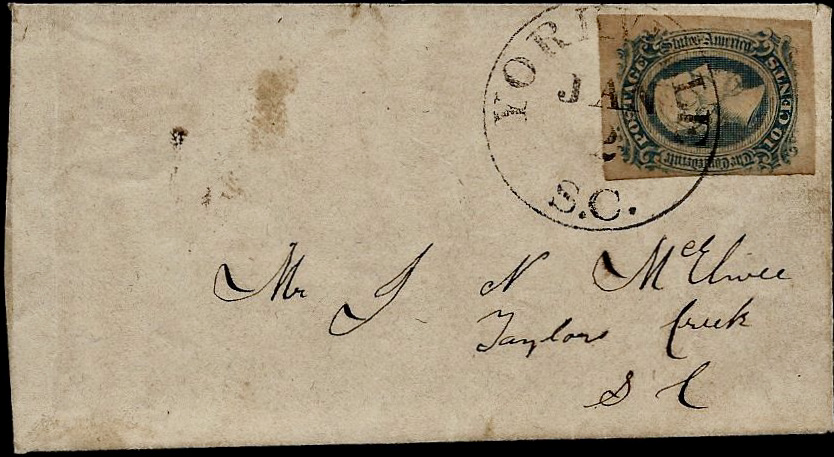
Addressed to Mr. J. N. McElwee, Taylor’s Creek, South Carolina
Postmarked Yorkville, S. C.

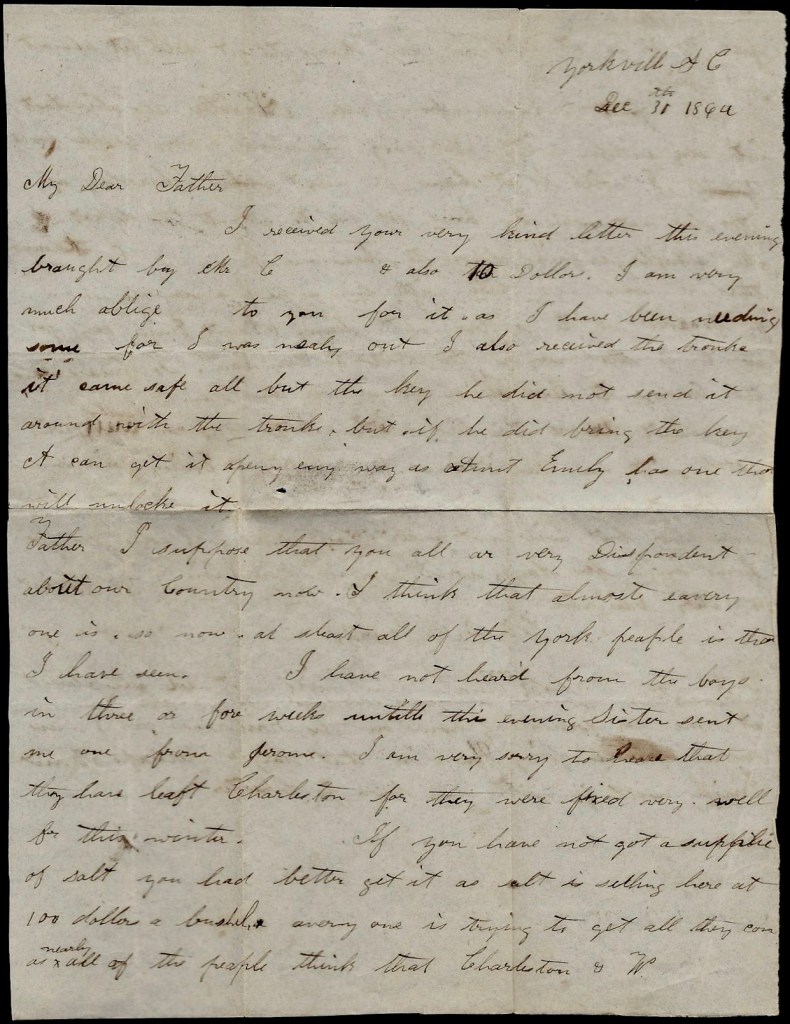
Yorkville, South Carolina
December 31, 1864

My Dear Father,

I received your very kind letter this evening brought by Mr. C. and also 10 dollars. I am very much obliged to you for it as I have been needing some for I was nearly out. I also received the trunk. It came safe—all but the key. He did not send it around with the trunk but if he didn’t bring the key, I can get it open anyway as Aunt Emily has one that will unlock it.

Father, I suppose that you all are very despondent about our country now. I think that almost everyone is so now—at least all of the York people is that I have seen. I have not heard from the boys in three or four weeks until this evening [when] sister sent me one from [brother] Jerome. I am very sorry to hear that they have left Charleston for they were fixed very well for this winter.

If you have not got a supply of salt, you had better get it as salt is selling here at 100 dollars a bushel. Everyone is trying to get all they can as nearly all of the people think that Charleston & W[ilmington] will fall & if so, it will be very hard to get salt at almost any price.

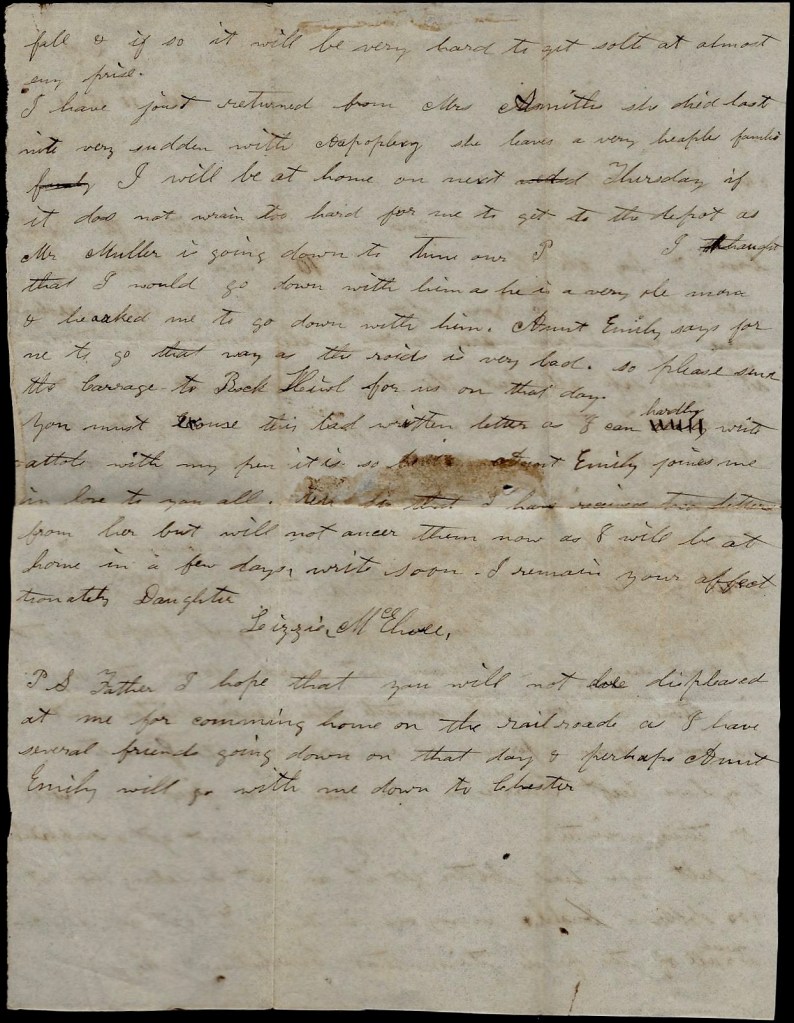
I have just returned from Mrs. Smith’s. She died last night very sudden with apoplexy. She leaves a very helpless family. I will be at home on next Thursday if it does not rain too hard for me to get to the depot as Mr. Muller is going down to tune our piano. I thought I would go down with him as he is a very old man & he asked me to go down with him. Aunt Emily says for me to go that way as the raids is very bad so please send the carriage to Rock Hill for us on that day.

You must excuse this bad written letter as I can hardly write at all with my pen, it is so dull. Aunt Emily joins me in love to you all. Tell sis that I have received two letters from her but will not answer them now as I will be at home in a few days. Write soon. I remain your affectionate daughter, — Lizzie McElwee

P. S. Father, I hope that you will not be displeased at me for coming home on the railroads as I have several friends going down on that day and perhaps Aunt Emily will go with me down to Chester.