Category Archives: Steamboat Accident

1853: Clarissa Dwight Marsh to Sarah (Whitney) Marsh

This letter was written by Clarissa (“Clara”) Dwight Marsh (1834-1899), the daughter of Henry Marsh, Jr. (1797-1852) and Sarah Whitney (1796-1883). Clara’s father was an 1815 graduate of Williams College and lived in Dalton, Massachusetts from 1821 to 1840 where he was a lawyer, a merchant, a farmer and wool grower, and a wool dealer and manufacturer. In 1840 he moved with his family to Pittsfield, Massachusetts, where he lost his savings with the failure of the Ashuelot Manufacturing Company. In 1843 he went to Racine, Wisconsin, in 1846 to Sandusky City, Ohio, and in 1850 to St. Louis, Missouri, engaging in the mercantile and produce business. He died of cholera in June 1852 but had managed to put three sons through Williams College and afforded his daughters, Clara, and Elizabeth (“Lizzie”) Willard Marsh (1829-1882), some outstanding educational advantages as well. 
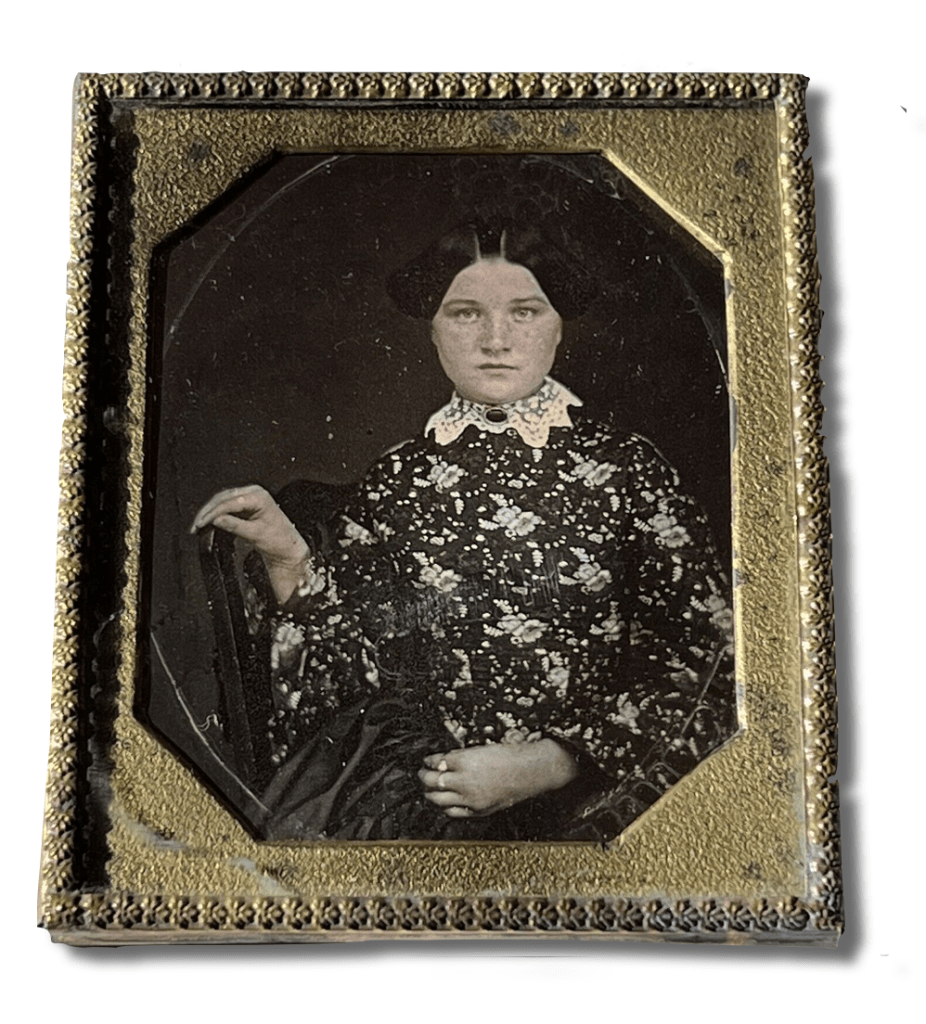
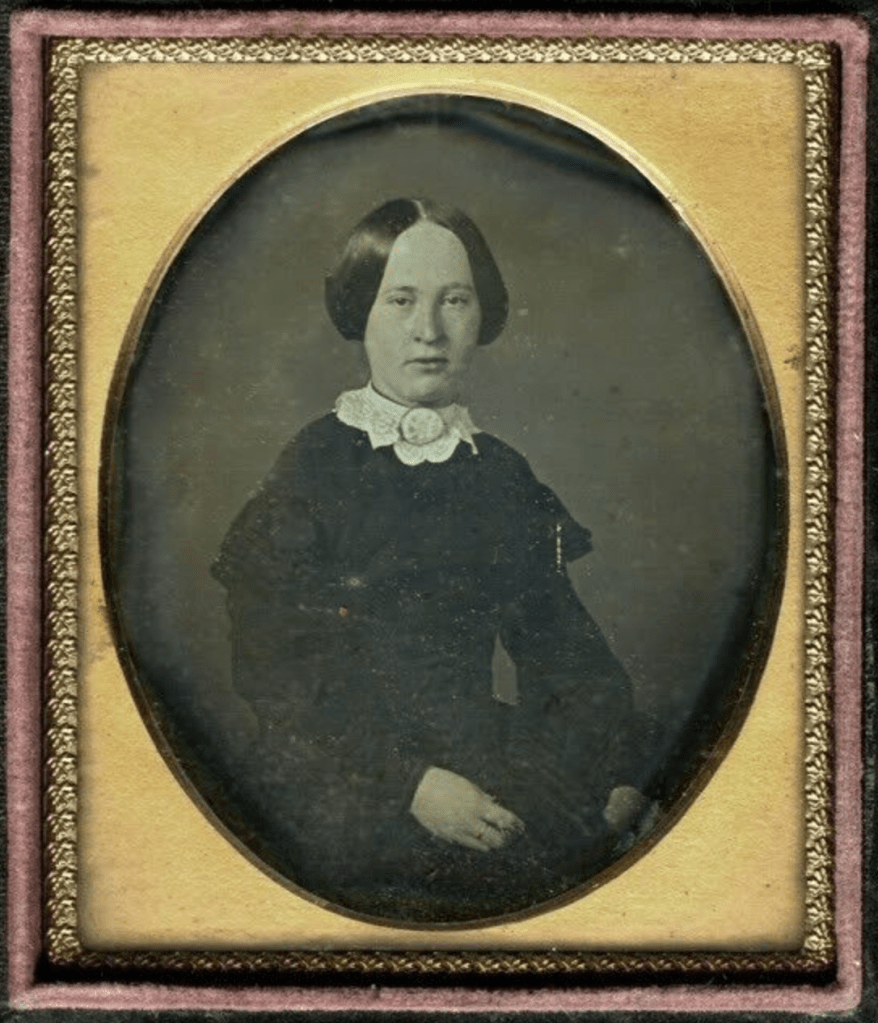
How Clara might have looked

Lizzie “was educated at Maplewood, Pittsfield, Mt. Holyoke and Bradford Seminaries, and spent her life in teaching. She had a school in St. Louis and at Batavia, Illinois, and afterwards taught in private families in Pittsfield, Mass., Batavia, N. Y., and Hudson, Wisconsin. At the latter place on Lake St. Croix she made her home with her life-long friend, Susan (“Sue”) Ellen Lockwood (1830-1915), the wife Charles Wendell Porter and the daughter of Judge [Samuel Drake] Lockwood of Batavia, Illinois. She died at Hudson, Wisconsin, on 23 April 1882.”

Clara attended the Cooper Female Academy in Dayton, Ohio, in the early 1850s. She married Samuel Watkins Eager, Jr. of St. Louis, Missouri, in May 1857.

Clara does not state her destination in this letter but she was clearly heading east—or up-river—on the Illinois river on her way from St. Louis to LaSalle, Illinois, where we learn she expected to catch the Illinois Central railroad to Chicago and from there to points East. Most likely she was going east to the Cooper Female Academy in Dayton, Ohio. In those days, young ladies did not travel alone so she was probably being escorted by the “Mr. Rice” who is mentioned in the letter.

Transcription

Steamer Belle Gould 1
Illinois River
July 13th 1853

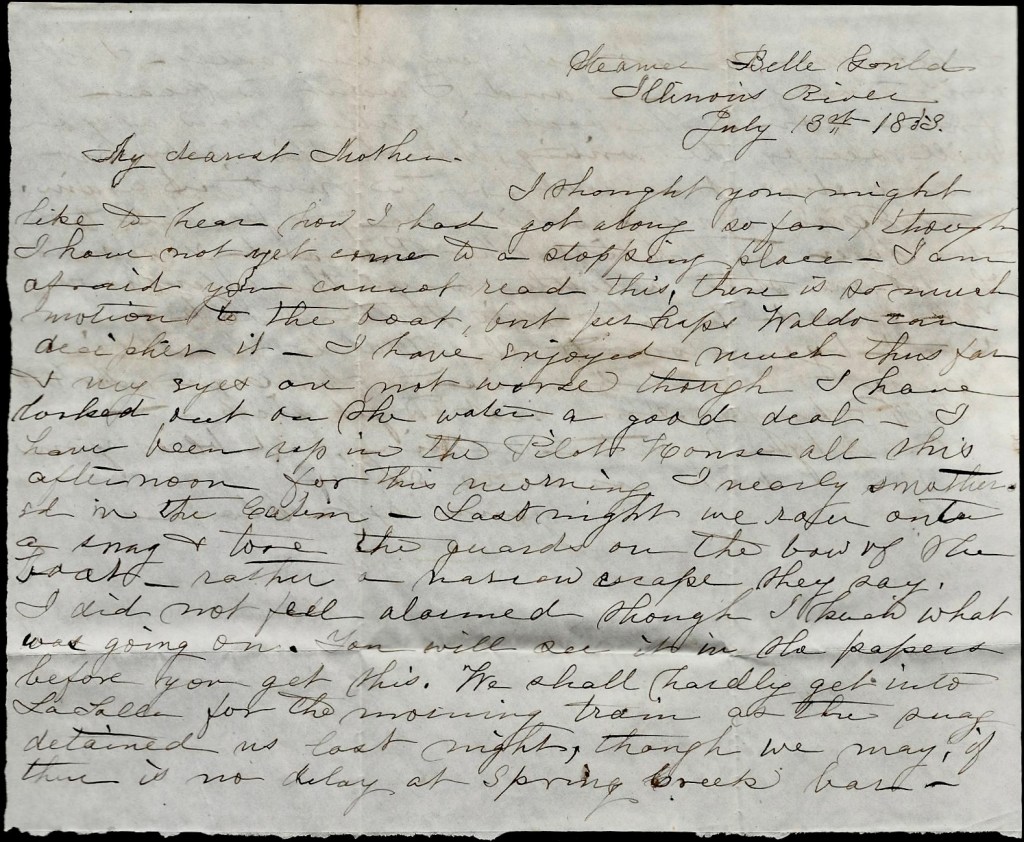
My dearest Mother,

I thought you might like to hear how I had got along so far though I have not yet come to a stopping place. I am afraid you cannot read this, there is so much motion to the boat, but perhaps [brother] Waldo can decipher it. I have enjoyed much thus far & my eyes are not worse though I have looked out on the water a good deal. I have been up in the pilot house all this afternoon for this morning I nearly smothered in the cabin.

Last night we ran onto a snag & tore the guards on the bow of the boat—rather a narrow escape they say. I did not feel alarmed though I knew what was going on. You will see it in the papers before you get this. We shall hardly get into LaSalle for the morning train as the snag detained us last night, though we may if there is no delay at Spring Creek bar.

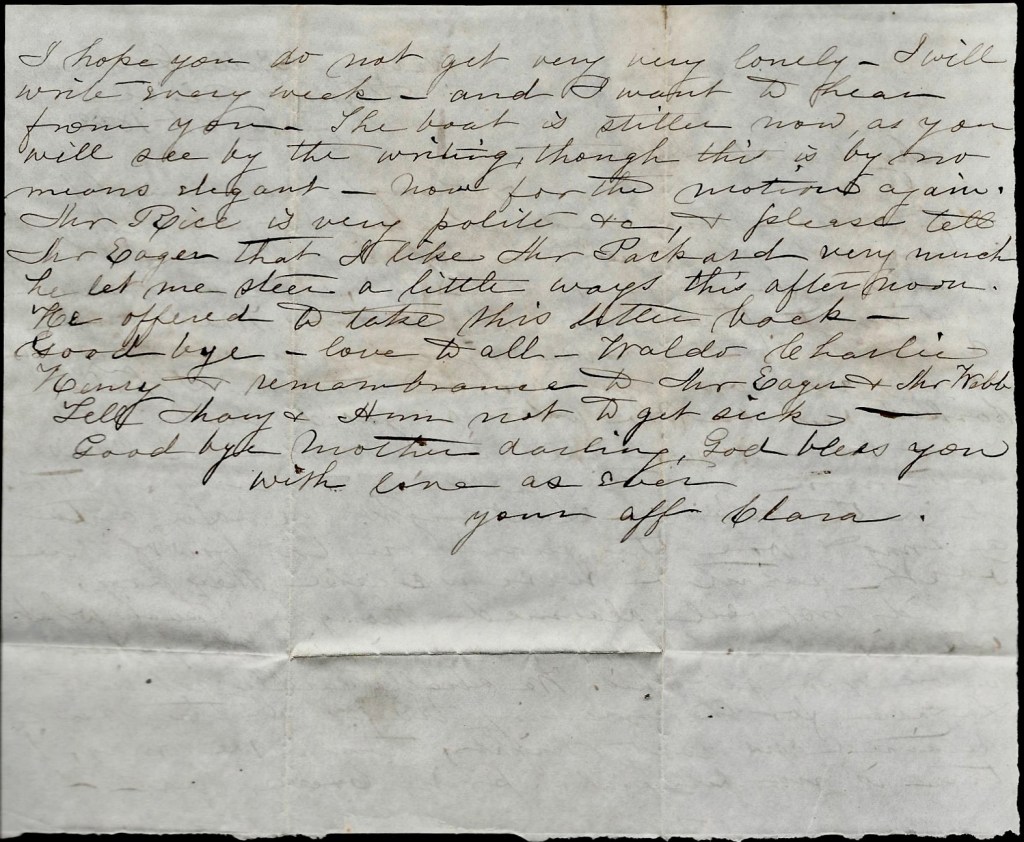
I hope you do not get very very lonely. I will write every week and I want to hear from you. The boat is stiller now, as you will see by the writing though this is by no means elegant. Now for the motion again.

Mr. Rice is very polite &c., and please tell Mr. Eager that I like Mr. Packard 2 very much. He let me steer a little ways this afternoon. He offered to take this letter back. Goodbye. Love to all—Waldo, Charlie, Henry, & remembrance to Mr. Eager and Mr. Webb. Tell Mary and Ann not to get sick. Goodbye Mother darling. God bless you. With lover as ever, your affectionate Clara


1 The Belle Gould was a side-wheel steamboat built in New Albany, Indiana, in 1852 for the St. Louis-Keokuk trade. She ran the Illinois River in 1853 and was the first steamboat to arrive in Peoria. She was snagged and sank at Island 25 below Cairo, Illinois on 3 March 1854.

2 I believe “Mr. Packard” may have been Capt. Bryant Rogers Packard (1821-1869) who was a steamboat captain residing at 1409 Papin Street in St. Louis, Missouri. He named his daughter “Belle Gertrude Packard (1858-1864).”
1848: Cornelia (Smith) Butler to Susan Bricker

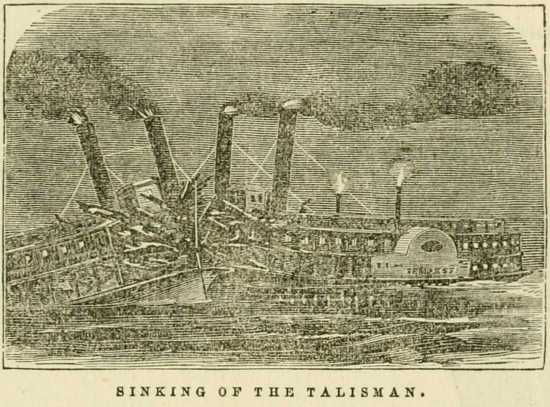
In this January 1848 letter, 30 year-old Cornelia (Smith) Butler (1817-1907) relates in detail the accidental death of her husband James Thomas Butler, when the steamboat Tempest collided with the steamboat Talisman on the Mississippi river a half mile below Cape Giradeau on 19 November 1847.

How Cornelia might have looked in 1848

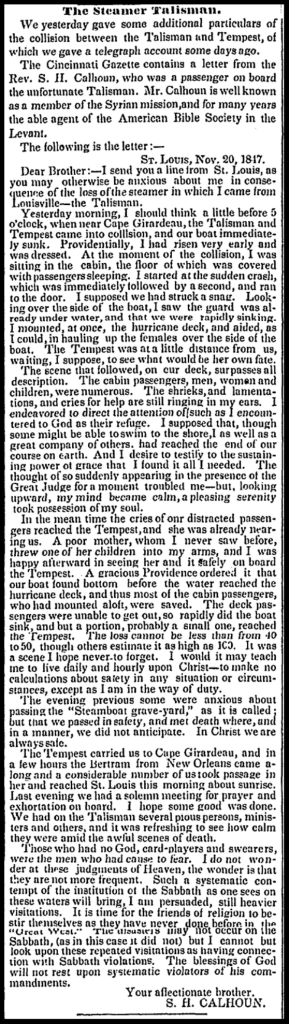
James Butler was the chief engineer on the Talisman. According to newspaper accounts, the Talisman was struck forward of the boilers and sunk within ten minutes. The Tempest was only slightly damaged and managed to come to the relief of the Talisman‘s crew and passengers. However, several of the crew and many of the deck passengers were drowned. Two or three families of German emigrants numbering about 25 persons were among the passengers. “The fate of Mr. Butler, the engineer, was particularly distressing. He was on watch and although he sasw at once and was told that the boat was sinking, he refused to leave his post until the water was up to his waist. It was then too late to save himself, and being unable to withstand the rush of water, he was borne back among the machinery and drowned.” His body was later recovered by the use of a diving bell.

Sadly there were some unidentified people who saw the wreckage and came into the river in small boats but instead of assisting the accident victims, seized the opportunity to plunder and recover the floating baggage. It was estimated that at least 100 persons—men, women and children—were drowned though no final number was ever published.

A 1907 obituary notice for “Mrs. Cornelia Butler” claims that she was born in 1817 in Carlisle, Pennsylvania, the daughter of Capt. George Smith, a prominent merchant of Carlisle and a veteran of the War of 1812. She was married to James T. Butler on 5 July 1843. He was the chief engineer on the steamboat Talisman and saved his sister-in-law and two small nieces before returning to his post and drowned. His body was never recovered. The Pittsburgh Press, 28 June 1907.

Transcription

Pittsburgh [Pennsylvania]
January 27th 1848

My Dear Sister,

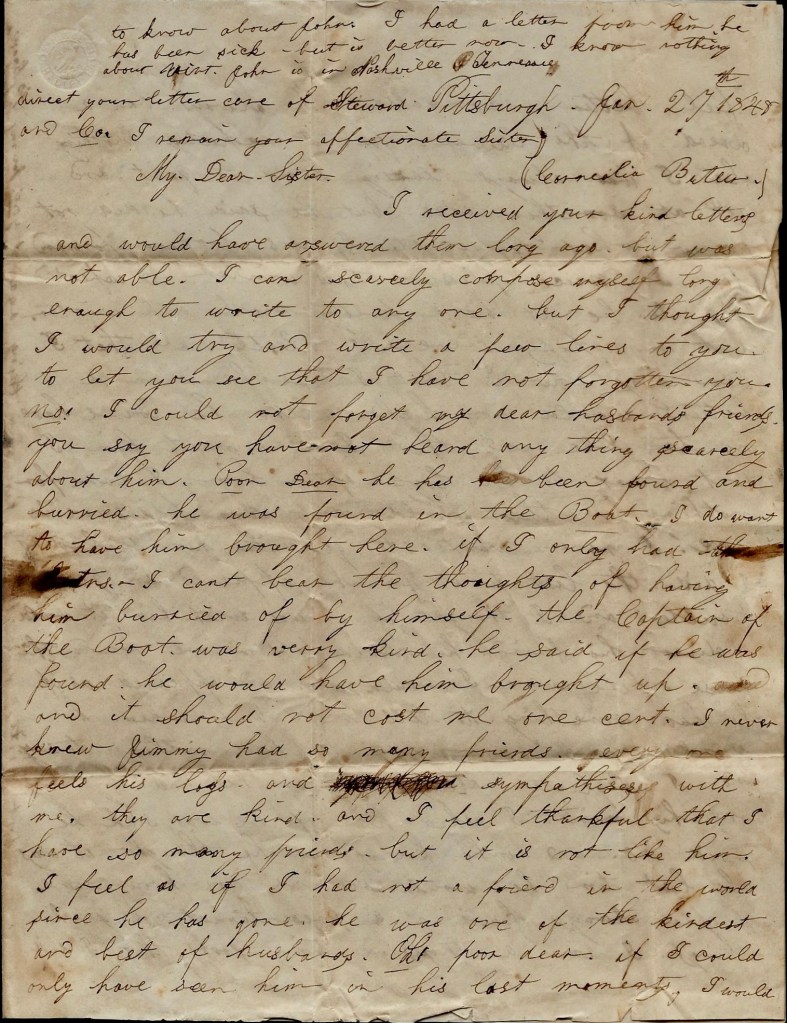
I received your kind letters and would have answered them long ago but was not able. I can scarcely compose myself long enough to write to anyone but I thought I would try and write a few lines to you to let you see that I have not forgotten you. No! I could not forget my dear husband’s friends. You say you have not heard anything scarcely about him. Poor Dear, he has been found and buried. He was found in the boat. I do not want to have him brought here. If I only had the [ trs]—I can’t bear the thought of having him buried off by himself. The Captain of the boat was very kind. He said if he was found, he would have him brought up and it should not cost me one cent.

New York Spectator, 4 December 1847

I never knew Jimmy had so many friends. Everyone feels his loss, and sympathizes with me. They are kind and I feel thankful that I have so many friends, but it is not like him. I feel as if I had not a friend in the world since he has gone. He was one of the kindest and best of husbands. Oh! poor dear, if I could only have seen him in his last moments, I would feel better reconciled. I always had a dread of the river for I expected nothing else. I was always teasing him to quit and get at something else, but he said he did not know what to get at. I was looking forward so so much pleasure this winter. I expected him to be at home pretty much all winter but my hopes were all blasted. All that I can say now is that I hope he is in a better world on high where he will have no trouble and that I can meet him. I don’t want to be long after him. I care for nothing in this world. All my pleasure is done.

I never wanted to go with him so bad as I did the last time for he appeared in so much trouble and I thought if I was with him, it would divert his mind. He would follow me round the house wherever I would go and appeared as if he had something to tell me. But when he would come near me, he had nothing to say and I neglected asking him if he had anything on his mind. I asked him if he was sick. He said no. And who knows but he thought it was the last time he would see me. You know some people always have a presentiment of such things. I am a thousand times sorry that I did not go for I never wanted to go so bad in my life. It appeared to me that I must go and I think if I had of been there, it would of saved him because he would have seen to me or I would to him. I must stop for it is too painful to talk about it.

I would love dearly to see you and talk about him for I could talk better than I can write. My eyes are so bad I can scarcely see. The last words he ever said to me was, “Now really, don’t fret.” If I was to write all day, I could not tell you the half about him. But I am in hopes to see you some day and then we can talk over everything. Nothing would delight me more than to see you. I shall always feel the same towards you as a nearer and kind sister. I have left the house and am at cousin Full’s. He says I shall have a home as long as he has one. All I have to depend on is my own industry. I am taking in sewing. My health is not at all good. I have a miserable cough and my eyes are so bad I can scarcely see. But whenever I am able, I will sew and when I am not, I will have to get along the best way I can.

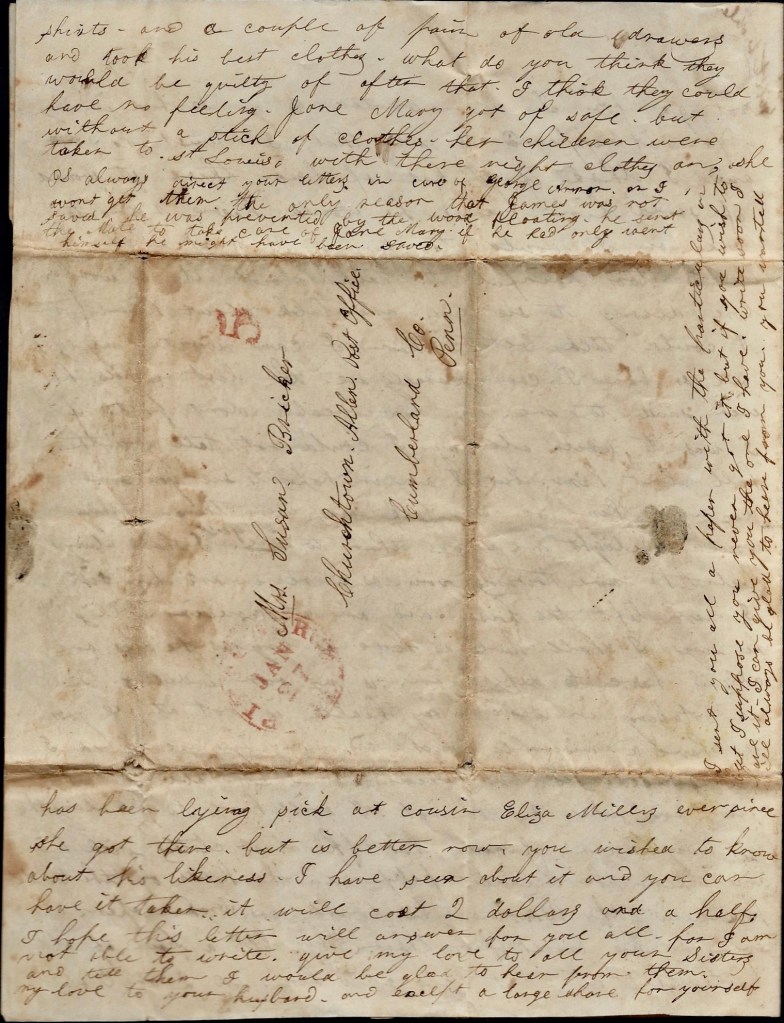
Jimmy had his best clothes with him and when the accident happened, the hands of the tempest plundered the boat, and his trunk was broken open and even to his breast pin taken. They left a pair of old pants that did not belong to him and 2 or 3 old shirts and a couple of pair of old drawers and took his best clothes. What do you think they would be guilty of after that? I think they could have no feeling. Jane Mary got off safe but without a stitch of clothes. Her children were taken to St. Louis with their night clothes on. She has been lying sick at cousin Eliza Mills ever since she got there but is better now.

You wished to know about his likeness. I have seen about it and you can have it taken. It will cost two dollars and a half. I hope this letter will answer for you all for I am not able to write. Give my love to all your sisters and tell them I would be glad to hear from them. My love to your husband and accept a large share for yourself. I sent you all a paper with the particulars in but I suppose you never got it but if you wish to have it, I can give you the one I have. Write soon. I will always be glad to hear from you. You wanted to know about John. I had a letter from him. He has been sick but is better now. I know nothing about Vint. John is in Nashville, Tennessee.

Direct your letter care of Steward & Co. I remain your affectionate sister, — Cornelia Butler