
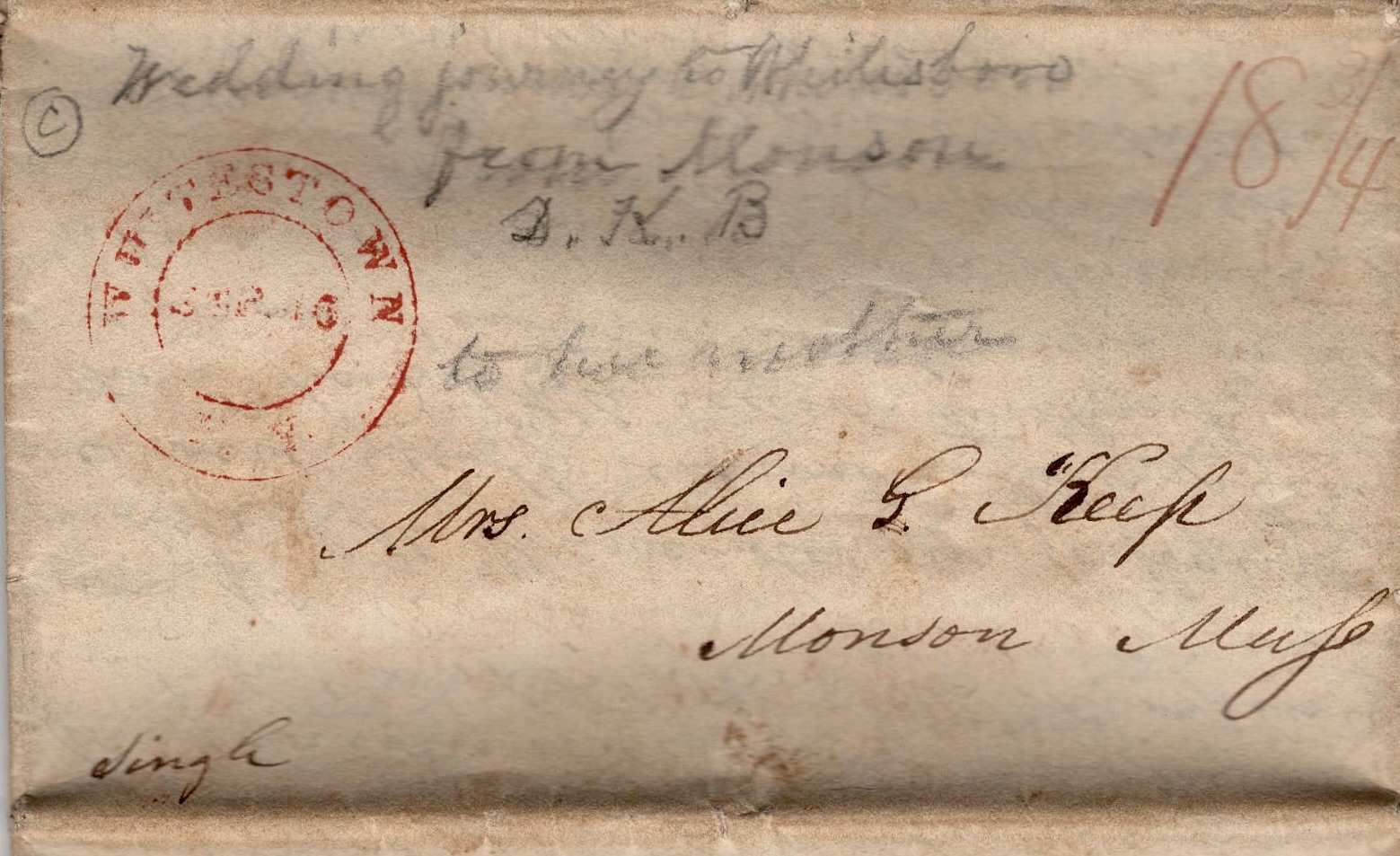
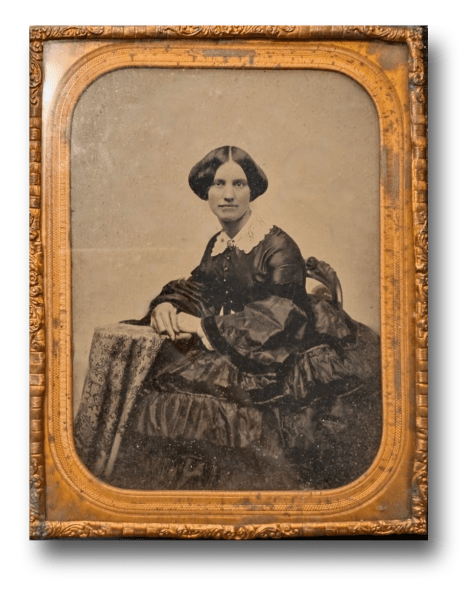
Diantha (Keep) Blodgett (1807-1884) was 22 years old and just two weeks married when she wrote this letter to her mother, Alice (Goodall) Keep, wife of Simeon Keep of Monson, Massachusetts. Her new husband, Harvey Blodgett (1802-1850), was an 1829 graduate of Amherst College and we learn he was employed teaching school at Whitesboro. He may have been teaching at the Oneida Institute which was a short-lived Presbyterian school in that village, and the first to accept both Black and White students in the United States. His first appointment to the ministry in the Presbytery was at Euclid (East Cleveland, OH) in 1837. After a few years he left the ministry and returned to teaching at Newton Falls, Ohio, and later at Jackson, Illinois, where he died of typhoid fever in 1850. The couple had several children, one of who was James Harvey Blodgett (1832-1916) who was Captain of Co. E, 75th Illinois Infantry during the Civil War.
Diantha’s letter gives us a glimpse of what travel was like in 1830 in New England. Her journey from her birthplace in Monson, Massachusetts, to her new home in Whitesboro, New York, takes us on two stage rides, two steamboats, and two boats on the Erie Canal—a journey she claimed was 450 miles.
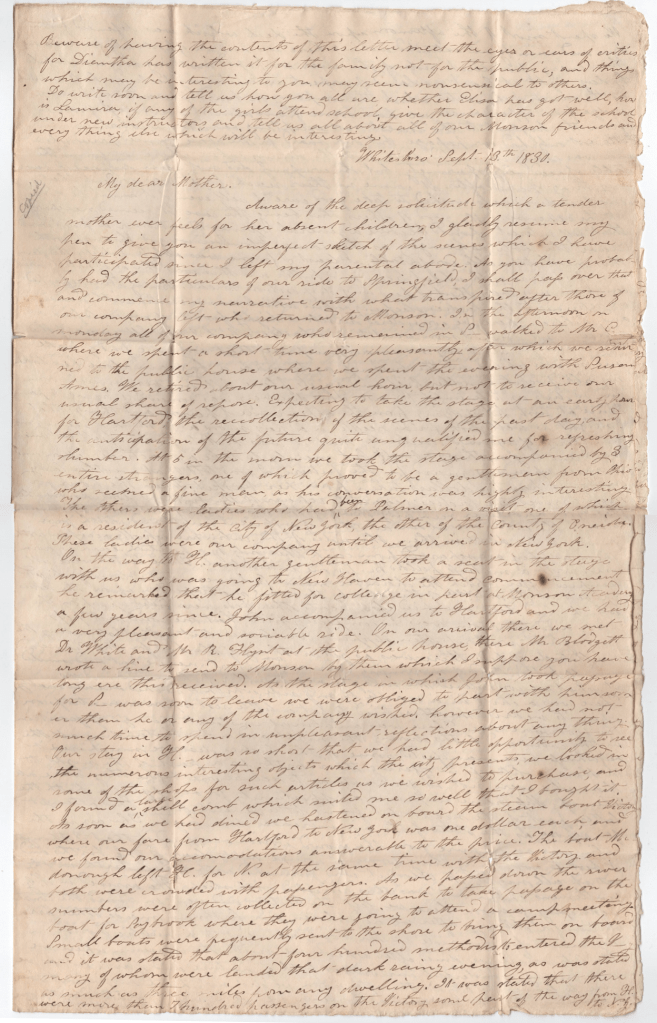
T R A N S C R I P T I O N
Whitesboro [New York]
September 13th 1830
My dear mother,
Aware of the deep solicitude which a tender mother ever feels for her absent children, I gladly resume my pen to give you an imperfect sketch of the scenes which I have participated since I left my parental abode. As you have probably had the particulars of our ride to Springfield, I shall pass over that and commence my narrative with what transpired after those of our company left who returned to Monson.
In the afternoon on Monday all of our company who remained in P___ walked to Mr. C where we spent a short time very pleasantly after which we scurried to the public house where we spent the evening with Parson Ames. We retired about the usual hour but not to receive our usual share of repose. Expecting to take the stage at an early hour for Hartford the recollection of the scenes of the past day and the anticipation of the future quite unqualified me for refreshing slumber. At 5 in the morn we took the stage accompanied by three entire strangers, one of which proved to be a gentleman from Ohio who seemed a fine man as his conversation was highly interesting. The others were ladies who had been to Palmer on a visit, one of which is a resident of the City of New York, the other of the county of Oneida. These ladies were our company until we arrived in New York.
On the way to Hartford, another gentleman took a seat in the stage with us who was going to New Haven to attend commencement. He remarked that he fitted for college in part at Monson Academy a few years since. John accompanied us to Hartford and we had had a very pleasant and sociable ride. On our arrival there, we met Dr. White and Mr. R. Flynt at the public house. There Mr. Blodgett wrote a line to send to Monson by them which I suppose you have long ere this received. As the stage in which John took passage for P___ was soon to leave, we were obliged to part with him sooner than he or any of the company wished. However, we had not much time to spend in unpleasant reflections about anything.
Our stay in Hartford was so short that we had little opportunity to see the numerous interesting objects which the city presents. We looked in some of the shops for such articles as we wished to purchase, and I found a large shell comb which smited me so well that I bought it. As soon as we had dined, we hastened on board the steamboat Victory where our fare from Hartford to New York was one dollar each and we found our accommodations answerable to the price. The boat McDonough left Hartford for New York at the same time with the Victory and both were crowded with passengers. As we passed down the river, numbers were often collected on the bank to take passage on the boat for Saybrook where they were going to attend a camp meeting. Small boats were frequently sent to the shore to bring them on board and it was stated that about four hundred Methodists entered the Victory, many of whom were landed that dark, rainy evening as was stated as much as three miles from any dwelling. It was stated that there were more than 7 hundred passengers on the Victory, some part of the way from Hartford to New York.
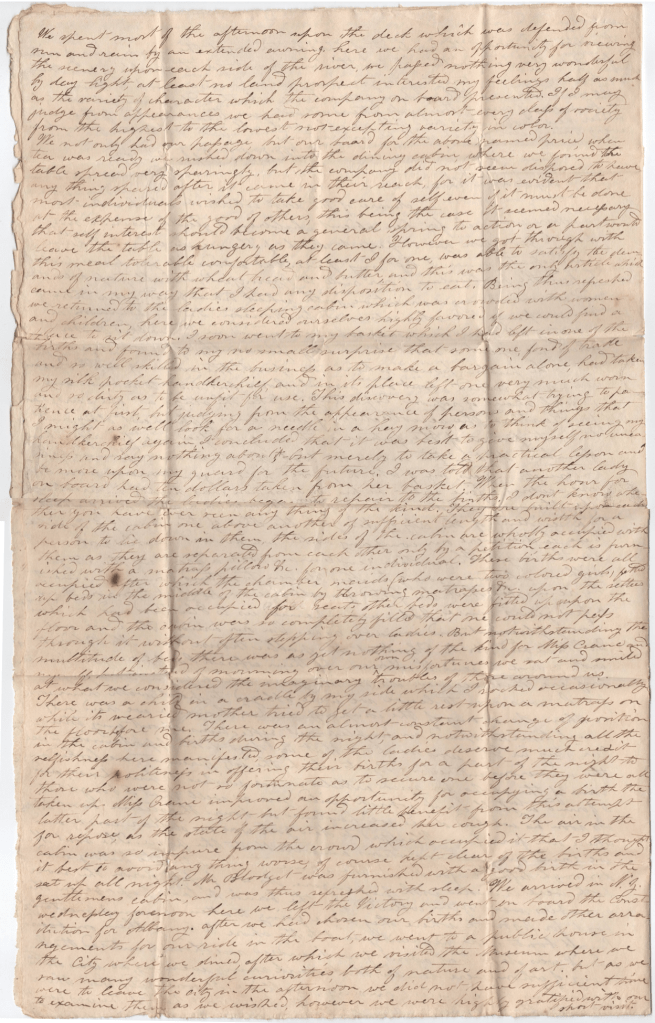
We spent most of the afternoon upon the deck which was defended from sun and rain by an extended awning. Here we had an opportunity for viewing the scenery upon each side of the river. We passed nothing very wonderful by daylight, at least no land prospect interested my feelings half as much as the variety of character which the company on board presented, If I may judge from appearances, we had some from almost every class of society, from the highest to the lowest, not excepting variety in color.
We not only had our passage but our board for the above named price. When tea was ready, we rushed down into the dining room where we found the table spread very sparingly, but the company did not seem disposed to have anything spared after it came in their reach, for it was evident that most individuals wished to take good care of self even if it must be done at the expense of the good of others. This being the case, it seemed necessary that self interest should become a general spring to action or a part would leave the table as hungry as they came. However, we got through with this meal tolerable comfortable, at least for one was able to satisfy the demands of nature with weather bread and butter, and this was the only article which came in my way that I had any disposition to eat. Being this refreshed, we returned to the ladies sleeping cabin which was crowded with women and children. Here we considered ourselves highly favored if we could find a place to sit down. I soon went to my basket which I had left in one of the berths and found to my no small surprise that someone fond of trade and so well skilled in the business as to make a bargain alone had taken my silk pocket handkerchief and it its place left one very much worn and so dirty as to be unfit for use. This discovery was somewhat trying to patience at first, but judging from the appearance of persons and things that I might as well look for a needle in a hay mow as to think of seeing my handkerchief again. I concluded that it was best to give myself no uneasiness and say nothing about it, but merely to take a practical lesson and be more upon my guard for the future. I was told that another lady on board had ten dollars taken from her basket.
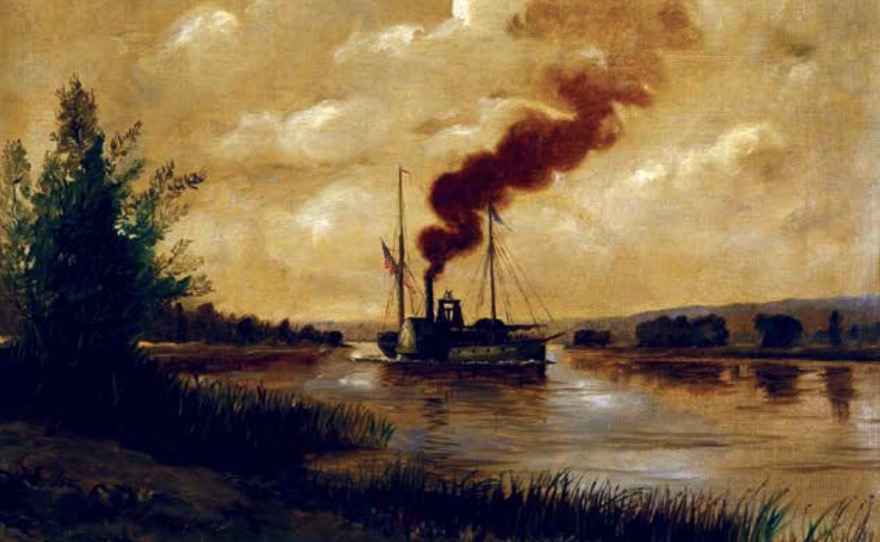
When the hour for sleep arrived, the ladies began to repair to the berths. I don’t know whether you have ever seen anything of the kind. They are built upon each side of the cabin, one above another of sufficient length and width for a person to lie down on them. The sides of the cabin are wholly occupied with them as they are separated from each other only by a petition [partition?]. Each is furnished with a mattress, pillow, &c. for one individual. These berths were all occupied after which the chamber maids (who were two colored girls) fitted up beds in the middle of the cabin by throwing mattresses &c. upon the settees which had been occupied for seats. These beds were fitted up upon the floor and the cabin was so completely filled that we could not pass through it without often stepping over ladies. But notwithstanding the multitude of beds, there was as yet nothing of the kind for Miss Crane and myself. But instead of mourning over our own misfortune, we sat and smiled at what we considered the imaginary troubles of those around us.
There was a child in a cradle by my side which I rocked occasionally while its wearied mother tried to get a little rest upon a mattress on the floor before me. There was an almost constant change of position in the cabin and berths during the night, and notwithstanding all the selfishness here manifested, some of the ladies deserve much credit for their politeness in offering their berths for a part of the night to those who were not so fortunate as to secure one before they were all taken up. Miss Crane improved an opportunity for occupying a berth the latter part of the night but found little benefit from this attempt for repose as the state of the air increased her cough. The air in the cabin was so impure from the crowd which occupied it that I thought it best to avoid anything worse, of course kept clear of the berths and sat up all night. Mr. Blodgett was furnished with a good berth in the gentleman’s cabin and was thus refreshed with sleep.
We arrived in New York [City] Wednesday forenoon. Here we left the Victory and went on board the Constitution for Albany. After we had chosen our berths and made pther arrangements for our ride in the boat, we went to a public house in the City where we dined, after which we visited the [Peale’s New York] Museum where we saw many wonderful curiosities, both of nature and of art. But as we were to leave the city in the afternoon, we did not have sufficient time to examine them as we wished. However, we were highly gratified with our short visit. We called at some of the shops in New York in one of which I purchased a white Moreno shawl about the size of Miss Crane’s but much cheaper. In another a half mourning fancy handkerchief.
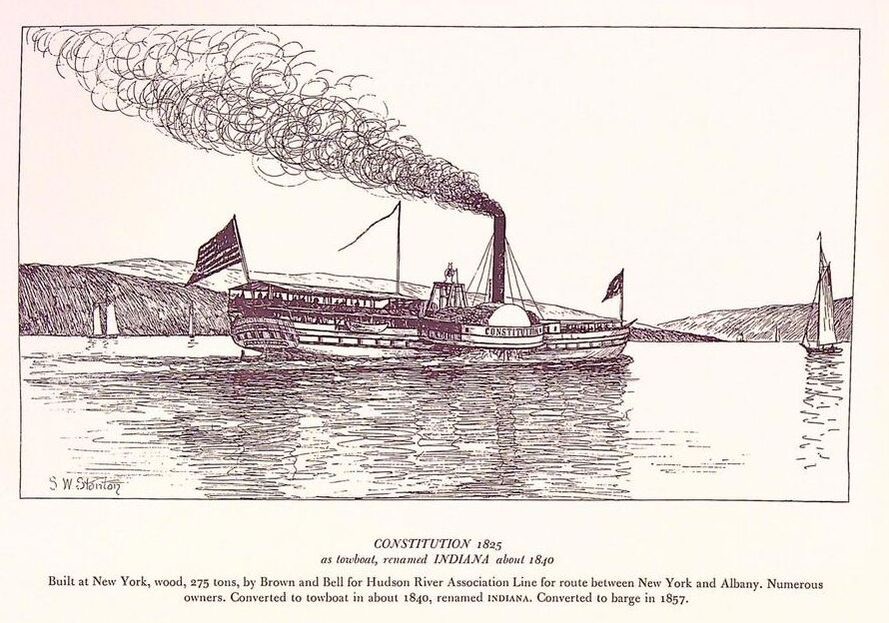
After this we found ourselves pleasantly situated compared with what we were in the Victory. The boat [Constitution] itself was pleasanter, was less crowded with passengers, and furnished with a better chamber maid. Here we paid for meals exclusive of way bills and had things in decent order. I was furnished with a good berth and succeeded in getting some sleep, but the mode of sleeping was so novel to me that I did not get near my usual share of repose. We arrived in Albany Thursday morning. Here we made no stay but took the stage immediately after leaving the boat which carried us to Schenectady. A minister with his wife and daughter from New Jersey took seats in the stage with us and accompanied us to Utica where the daughter anticipated spending considerable time at school. By this time Miss Crane and myself suffered much from a loss of sleep and fatigue both in our feelings and looks. From the first of our experiencing these evils we thought it not best to make any delay with the hope of being relieved from them but rather to pursue our journey as expeditiously as possible.
We arrived in Schenectady a little past noon. Here we left the stage and took a canal boat. Here our situation was in some respects pleasanter than on board the steam boats as there was no clatter of machinery and much less motion of the boat. We had good company tables, well furnished, and in general everything was calculated to render the situation of passengers agreeable as fair as they themselves were in a right state to enjoy a ride. We had some pleasant views of the Mohawk and of neighboring natural scenery. At length, night came on and we again sought repose in berths and to my agreeable surprise, I slept more than I had any preceding night since I commenced the journey.

In the morning the passengers arose early to avail themselves of a view of an interesting place called the Little Falls. By keeping a good look out at the bridges, we could stay up on deck with frequent low stooping. Here we had a much better opportunity of seeing the surrounding country than from the cabin windows. While the above named minister and wife were in this situation, the boat approached a bridge which they discovered and for which they stooped as they suppose sufficiently low to avoid a blow from it, but to her surprise the bridge took her Navarino [bonnet with a large crown] from her head and folded it tolerably closely, throwing so much dirt between the folds as to nearly ruin the bonnet. After it was restored to its former perch, the lady perceived no personal injury but seemed rather to lament the loss of her bonnet. Her husband seemed disposed to take a different view of the subject. Never mind for the bonnet, says he, we all need to learn to stoop low for we have frequent occasion for this exercise in the various concerns of life.
We arrived in Utica a little before noon. We spent but a short time in this place, took passage on a packet boat bound for Rochester which stopped and landed us safe in Whitesboro on Friday p.m. Thus ended our fatiguing though pleasant journey of 450 miles and we were gladly received into a pleasant family in a pleasant village though I had little reason to think it a pleasant village from what I saw of it as I entered, as the road by which we came from the canal seemed like a lane leading to a distant part of a farm or something of the kind, and the buildings which we passed were of a very inferior order.

On seating myself in my new habitation, I was ready to enquirer, where us that famous Whitesboro of which I have heard so much. However, I concluded that it was best to say nothing about present appearances but to wait until I had been favored with a better opportunity for seeing the village before I questioned the truth of former reports. And indeed, I was so glad to find a resting place after such a tour that I did not feel much disposed to find fault with its location even if it did not answer my expectations. Our things came without any material injury except my ban box which was pretty thoroughly jammed and the lid badly broken without its contents being injured. Since our arrival, agreeable to the wishes of the family, we have purchased one dozen chairs, one pair of glass lamps, some curtains for our chamber, and we’ll be purchasing a looking glass when we find one whose size, price and quality suits us. We purchased the above named articles at Utica. Mr. Blodgett paid one dollar 25 cents a piece for the chairs. They are very pretty, cane bottomed chairs and considered very cheap indeed for the quality.
Mr. Blodgett and myself went to Utica this afternoon.m. in a private carriage. During this ride I had a better opportunity to see our village than I had before enjoyed. It is indeed a very pleasant place. I have seen some Whitesboro people. Several have called to see their new inhabitant and I am much pleased with them from so short an acquaintance. And now, going to Whitesboro to live is no longer an anticipation but a reality. Yes, I am actually here, far from the friends of my childhood and upper years and I can assure my dear mother that the reality is far pleasanter than the anticipation.
We were so much affected by the motion of the boats that after we came on land and had seated ourselves in the house, we seemed to ourselves as though we were still riding upon the water. We suffered so much from this imaginary motion of the water and the fatigue of the journey that we found ourselves ill prepared for any business the next day after we arrived. We now have less of such unnatural feelings and trust we shall soon be wholly freed from them. We think that when Miss Crane has recovered from her fatigue, she will find that her journey has benefitted her health. Her society, by the way, was a favor for which I feel that I cannot be sufficiently grateful. From what I have learned of journeying during this tour, I think that I should have more fortitude to commence out without any female acquaintance to accompany me than before.
Since I left Monson, I have though much of the inmates of the parental abode and wished that they might have an opportunity to see the different parts of the country and numerous other objects upon which I have had an opportunity to cast a momentary gaze. Should our lives be spared, I trust that the period is not far distant when some of your number will visit this region. I hope that I have not given so dark a coloring to the journey as to discourage others from attempting it. Let me assure you that with equal prosperity on the way to what we have enjoyed, you will find that the greatest difficulties respecting such a journey are those which lie in the way of commencing it. I have written this letter all under the same date but have been writing it at different times. It is now Thursday. Mr. Blodgett commenced his school this morn under flattering prospects for the term. Miss Crane sends love to the whole family. Please to accept the same from Mr. Blodgett and myself, and remember us affectionately to all others who feel sufficiently interested in our welfare to enquire after us. Do not let us be disappointed by expecting a letter from Monson soon, but be sure and have some of the family write without delay, — Diantha H. Blodgett





 Spared & Shared 23