Category Archives: Tennessee Homefront

1864: Nannie Margaret Bolton to her Uncle

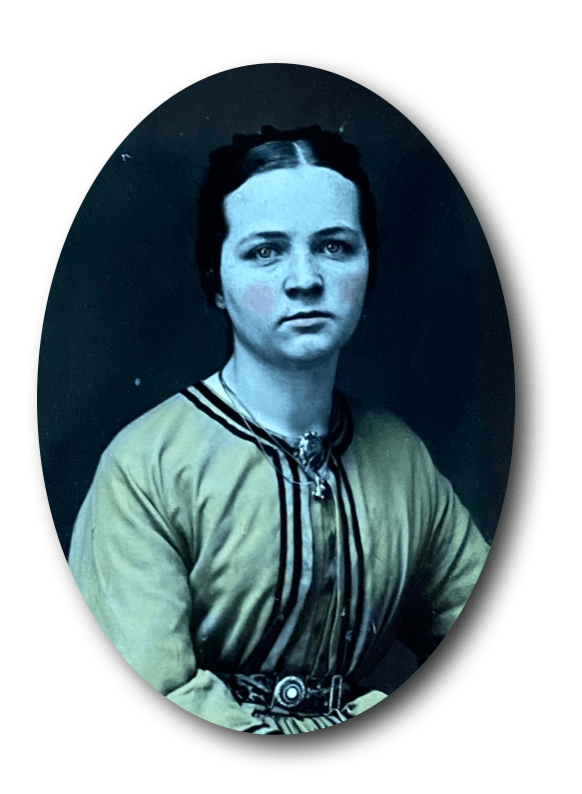
How Nannie might have looked (Bob Celli Collection)

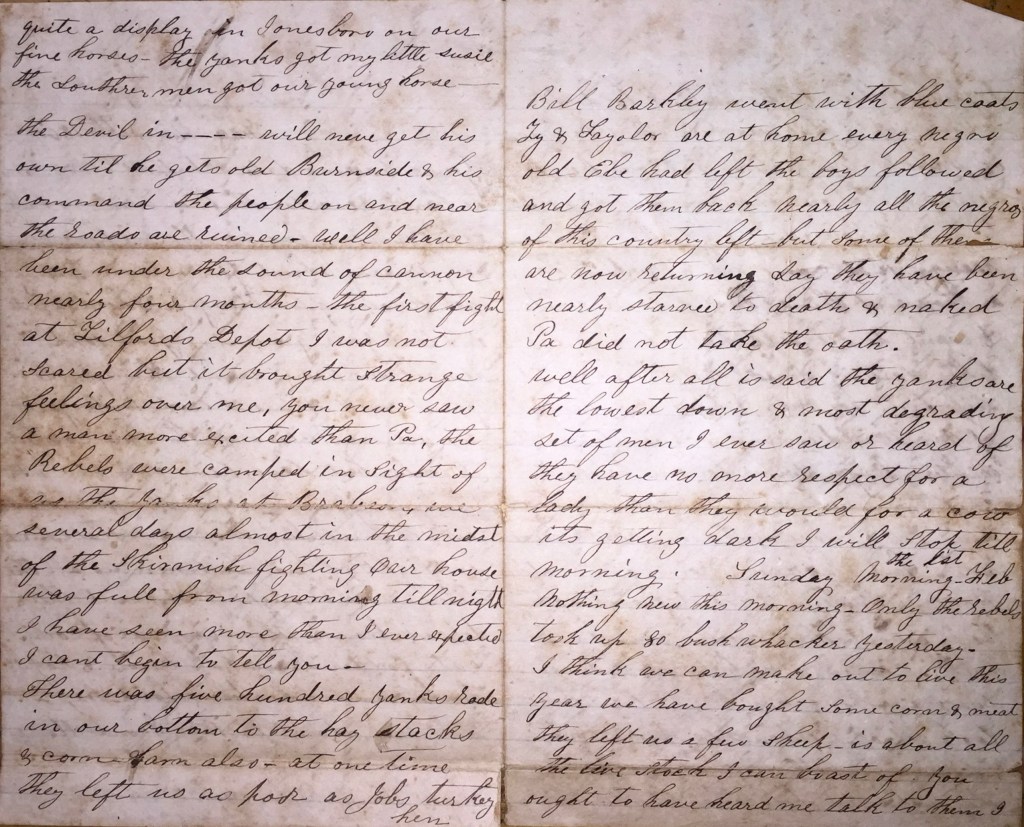
The following letter was written, I believe, by 16 year-old Nannie Margaret Bolton (b. 1847), the daughter of John Bolton (1817-1887) and Elizabeth Preston Smith (1821-1904). It was only signed “Nannie” but she is the only Nancy living in the vicinity of the neighbors mentioned in her letter; she was also referred to as “Nannie” or “Maggie.” In 1880, Nannie was still single and enumerated in her parents’ residence in Washington County, Tennessee. Sometime after 1880, the Bolton family moved to Randolph County, Missouri.

Nannie’s letter speaks of the 8 September 1863 fight at Telford’s Depot and Limestone Station near the family’s residence near Limestone, Washington county, Tennessee. [See Brisk Fight with the Johnnies: The 100th Ohio at Limestone Station by my friend Dan Masters, published on 16 August 2020.]

It should be noted the letter was certainly written in early 1864 but the dates are not correct.

[This letter is from the private collection of Steve Blume and was transcribed and published on Spared & Shared by express consent.]

Transcription

Limestone, [Washington county] Tennessee
February 30th 1864

Yours bearing date October the 10th 1863 came to hand yesterday—the first mail we have had for near five months. We have been very uneasy about you and Uncle Jimmy, not knowing whether you skedaddled or stood your ground. Good Lord, Uncle, we have went through the flint mill since I last wrote you.

“The Devil in [Hell] will never get his own til he gets old Burnside & his command. The people on or near the roads are ruined.”

—Nannie M. Bolton, citizen, Limestone, Tenn., 30 February 1864

We are now clear of the blue coated Devils but have been over run with them for four long months. They treat us shamefully. They were stationed in sight of us and near us all the time—near enough to commit their depredations. They [took] every ear of corn, oats, fodder, bran, hay, bacon & hogs, turkey and chickens, lard soap, and even down to Pa’s grind stone. Our horses also. We have two old broke down rips. Aunt Alses, if you was here, I think we could make quite a display in Jonesboro on our fine horses. The Yanks got my little Susie. The Southern men got our young horse. The Devil in [Hell] will never get his own til he gets old Burnside & his command. The people on or near the roads are ruined.

Well, I have been under the sound of cannon nearly four months. The first fight at Telford’s Depot 1 I was not scared but it brought strange feelings over me. You never saw a man more excited than Pa. The Rebels were camped in sight of us; the Yanks at Brabson’s & we several days almost in the midst of the skirmish fighting. Our house was full from morning till night. I have seen more than I ever expected. I can’t begin to tell you. There was five hundred Yanks rode in our bottom to the hay stacks and corn [ ] also—at one time they left us as poor as Job’s turkey hen.

Bill Barkley went with blue coats. Ty & Taylor are at home. Every negro old Ebe had left the boys, followed and got them back. Nearly all the negroes of this country left but some of them are now returning. Say they have been nearly starved to death & naked. Pa did not take the oath.

Well, after all I said, the Yanks are the lowest down & most degrading set of men I ever saw or heard of. They have no more respect for a lady than they would for a cow. It’s getting dark. I will stop till morning.

Sunday morning, February 1st. Nothing new this morning—only the rebels took up 80 bushwhacker yesterday. I think we can make out to live this year. We have bought some corn & meat. They left us a few sheep is about all the livestock I can boast of. You ought to have heard me talk to them. I jawed them to the last. I told a Lieutenant that was here that he was of much less notice than our free negroes & that our free negroes was a credit to him. I poured it on to them pretty heavy. Just come up & I will tell you a thousand things that I can’t write.

I want to see Jeff so bad. Bless his little darling soul. I know he is sweet. Kiss him for me.

I have seen several of my Middle Tennessee acquaintances this winter. Major [John] Minor 2 for one. He spent a couple of weeks with us. I had like to have fell in love with him. He is a nice man.

Gen. [Alfred Eugene] Jackson’s 3 command is at Rogersville, Tenn. I heard from Capt. Berry about three weeks ago. He was well. Cousin Josiah Conley did not lose anything much but his horses. Took all of Ellison Thompson’s grain & horses and then ribbed his house. They just used Loflands up. They left & went to Virginia. Jennie [Lofland] is married to Jim [Horace] Baldwin. They used our good old Union friend Uncle Jerry Gibson about up. They was camped at the old place about ten days on the knob hill. The place is ruined, rail burned up, and timber cut down. Scarcely a tree left standing on the knobs.

Seven of Mr. Morrow’s negroes gone, his fencing nearly all burned up, and some of ours all next the road. Dr. [Alexander] Brabson 4 ruined. They day our folks retreated from Blue Springs, I never heard such shooting in my life. Our folks made a master retreat, crossed the long bridge just at dark. I never want to hear the like again. I got so used to cannons and guns that I did not mind it much. Five southern men run a thousand Yanks. They owned themselves that the rebs were the best fighters. I could write you a week of our troubles here but have not got space and paper is scarce in these diggings.

Mr. Miller says tell you he wants all the damned Yankees killed. We are all well and doing the best we can. William Henry Russell & his cousin has been spending the winter among the kin. Leesburg is dried up. Old Mrs. Sweet is still kicking. Old Jennie Cowan is dead. Bob Cowan out bushwhacking. Manuel Klepper gone with the Yanks.

I have not heard from my old spark since the middle of September. I hope he is still able for duty. You & Aunt Alses write to us soon and often. Pa says you must consider this letter [from] him and me both. It is such a task for him to write. As ever, your nice, — Nannie

Private Abraham Hoofnagle, Co. K, 100th Ohio Infantry. Captured at Limestone Station and survived imprisonment only to perish in the explosion of the Sultana April 27, 1865

1 Tilford [Telford] is a small station on the railroad between Limestone and Jonesboro. The community was first called Brabsontown, later Millwood, and continued so for many years. It was not until 1855, when Colonel George Whitfield Telford, a state senator who operated the Telford Manufacturing Company, donated about four acres of land to support local operations of the East Tennessee and Virginia Railroad, that the name Millwood was changed to Telford Depot. During the Civil War, citizens of this part of Washington County voted to secede from the Confederacy, but they were unsuccessful in persuading others to do so. The independent nation called “Bricker’s Republic” soon fell into relative obscurity. A Civil War battle took place in Telford on September 8, 1863, when the 100th Ohio Infantry clashed with the Confederate-aligned Thomas’ Legion just east of the depot. The Confederate force was supported by 4-Howitzer artillery unit commanded by General Alfred “Mudwall” Jackson. In the fight at Telford Station and Limestone, the 100th Ohio Infantry was overwhelmed by a much large force while guarding the railroad there and after a couple of hours of fighting, the Captain of Co. B, told his boys to make a break for it, but 240 men were captured.

2 Probably Major John Minor of Co. E, 10th Tennessee Cavalry (DeMoss’).

3 “Unlike most generals of the conflict, Brig. Gen. Alfred E. Jackson lacked any formal military training and had never donned a uniform, but was a farmer who owned 20 slaves prior to the Civil War. Jackson received his disparaging nom de guerre, the moniker “Old Mudwall,” by troops under his authority. Some men under the Tennessean’s leadership routinely complained to headquarters with statements accusing Jackson of being unfit for command to pointing out how the farmer turned brigadier had only commanded 20 slaves prior to the war. For much of the war, Alfred Jackson did little to gain the confidence of his men. He was known to discipline officers in the presence of enlisted men — chastening actions that a slaveholder would openly practice — but such harmful conduct toward military personnel was crippling to morale and esprit de corps of the entire unit, and it was shunned by veteran soldiers and grads of West Point and VMI.” [Civil War Talk]

4 Dr. Alexander Brabson (1805-1888) lived in the Limestone area of Washington County, Tennessee. After attending medical school in Kentucky, he returned to his home to open a general practice. In addition to his duties as a physician, Brabson owned and operated a flour mill. He was married to Emily Maria Stephens (1817-1885). The 1860 Slave Schedule shows he owned 6 slaves.
1862: John Reid to Maria Frances (Thompson) Reid

John Reid, Nashville Lawyer

The following letter was written by 46 year-old John Reid, Jr. (1816-1885) to his second wife, Maria Frances (Thompson) Reid (1832-1875). John was the son of Maj. John Reid and Elizabeth Branch Maury. Maj. Reid was aide-de-camp and military secretary to Gen. Andrew Jackson during the British and Indiana War and was with him in New Orleans. John Reid, Jr. was born on the Major’s farm (called “Tree Lawn”) near Franklin, Williamson county, Tennessee.

In 1860, John Jr. was enumerated as a lawyer in Nashville, Davidson county, Tennessee. Adding a note to his letter was Frank T. Reid (1845-1923), John’s son by his first marriage to Margaret Louise Trimble (1821-1849). Frank indicates in his note that he had not yet enlisted in the Confederate service. According to muster rolls, Frank enlisted on 13 February 1863 at Columbia, Tennessee, as a sergeant in Capt. John W. Morton Jr.’s Company, Tennessee Artillery. He was later transferred to Co. F, 4th Tennessee Cavalry as orderly sergeant.

John wrote the letter while visiting with his brother William Steptoe Reid, a large slaveholder in Williamson county, Tennessee. We learn that William had recently sold out and intended to relocate to Georgia. William was married at the time to his second wife, Sarah Claiborne Maury (1829-1912). In the letter, we learn that John Jr. and his son Frank intended to go to Murfreesboro on 31 December 1862. If they did, they would have ridden right into the Battle of Stones River.

I can’t find any evidence that John Reid ever served in the Confederate army. I did find him mentioned in an article published on 6 February 1864 in the National Aegis under the title, “The Amnesty Proclamation in Tennessee” which may or may not be propaganda: “The Union says also that Hon. John Reid, formerly a senator from Davidson County in the state legislature, and an able lawyer, has returned from Dixie, and accepted the President’s amnesty proclamation. He advises all others to follow his example as the Confederacy must go to the dogs. If John Bell doesn’t want to be conscripted, notwithstanding his age, Mr. Reid says he will be compelled also to come in.”

Transcription

Addressed to Mrs. Maria F. Reid, Gallatin, Tennessee, to care of Wm. B. Bayless, Nashville, TN

Warren county [Tennessee]
December 29th 1862

My dear wife,

I am at my brothers & as Mr. Stovall goes to Sumner tomorrow, I avail myself of the opportunity to write you again. I wrote to you about two weeks ago & gave my letter to Mr. Charles Cantrill to send it to you. Did you get it? I have not heard a word from you since I left except through Mr. Gill. The letter you wrote by Mrs. Bond did not reach me. She was overhauled by the Yankees and destroyed your letter.

In my letter to you I stated in substance that you must be the judge whether you remained longer in Gallatin or come south; that if you were not molested nor likely to be by the Yankees, it would be probably more prudent to remain longer where you were. Otherwise you ought to come by the first opportunity that presented itself, if God in His mercy gave you the chance. Of course I would rather have you with me, if I consulted only my desires, but I do not know how long the Southern army will or can remain in Murfreesboro.

My brother has sold his place here and will love his family as soon as he can to Georgia. Frank & I are both well and expect to leave here for Murfreesboro day after tomorrow. I think of you & the baby constantly. I am all the time uneasy & unhappy about you. I pray God this state of things will not continue long. Write me the first & every opportunity that presents itself. I hope I will get a letter from you when I reach Murfreesboro. I write this letter on my cap & must close. I send you my best and warmest love & pray that I may be permitted before long to see you.

Kiss George for me and tell him not to forget his Pa. Love to all the family, — Jno. Reid

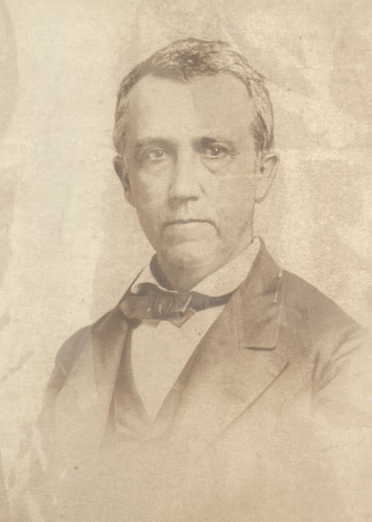
A post war image of Frank Reid

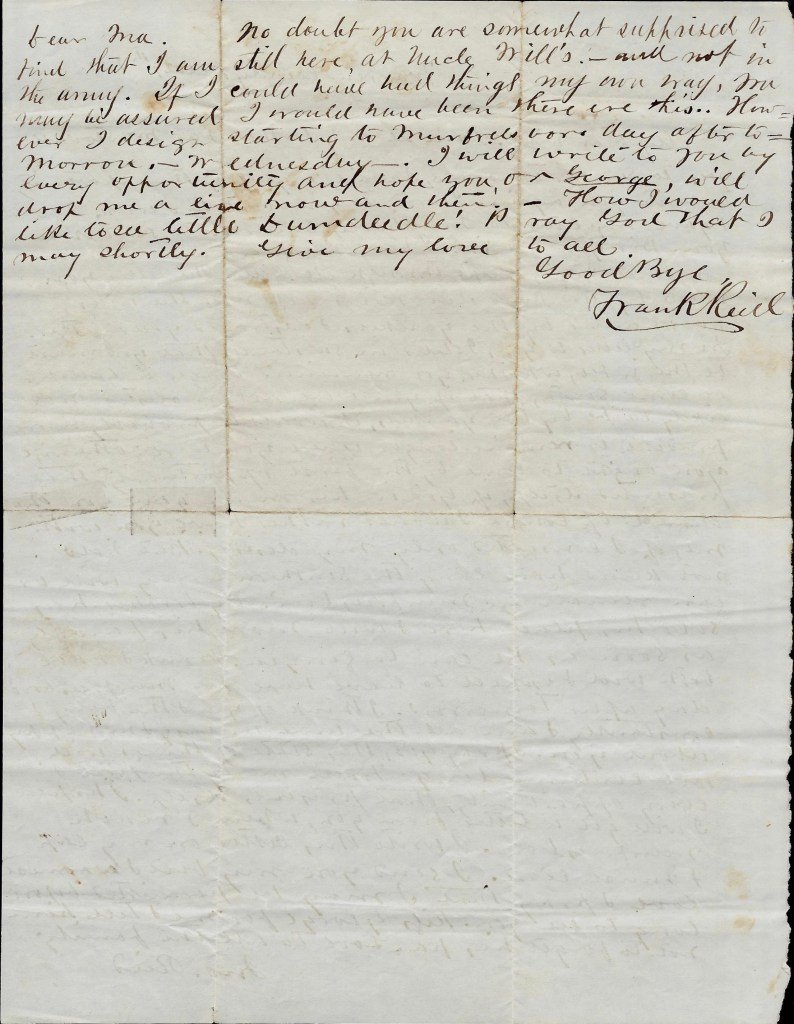
Dear Ma, No doubt you are somewhat surprised to find that I am still here at Uncle Will’s—and not in the army. If I could have had things my own way, you may be assured I would have been there ere this. However, I design starting to Murfreesboro day after tomorrow—Wednesday. I will write to you by every opportunity and hope you or George will drop me a line now and then. How I would like to see little Dumdoodle. I pray God that I may shortly. Give my love to all. Goodbye, — Frank Reid

1865: Caroline Crane Faxen to John Wellington Faxon

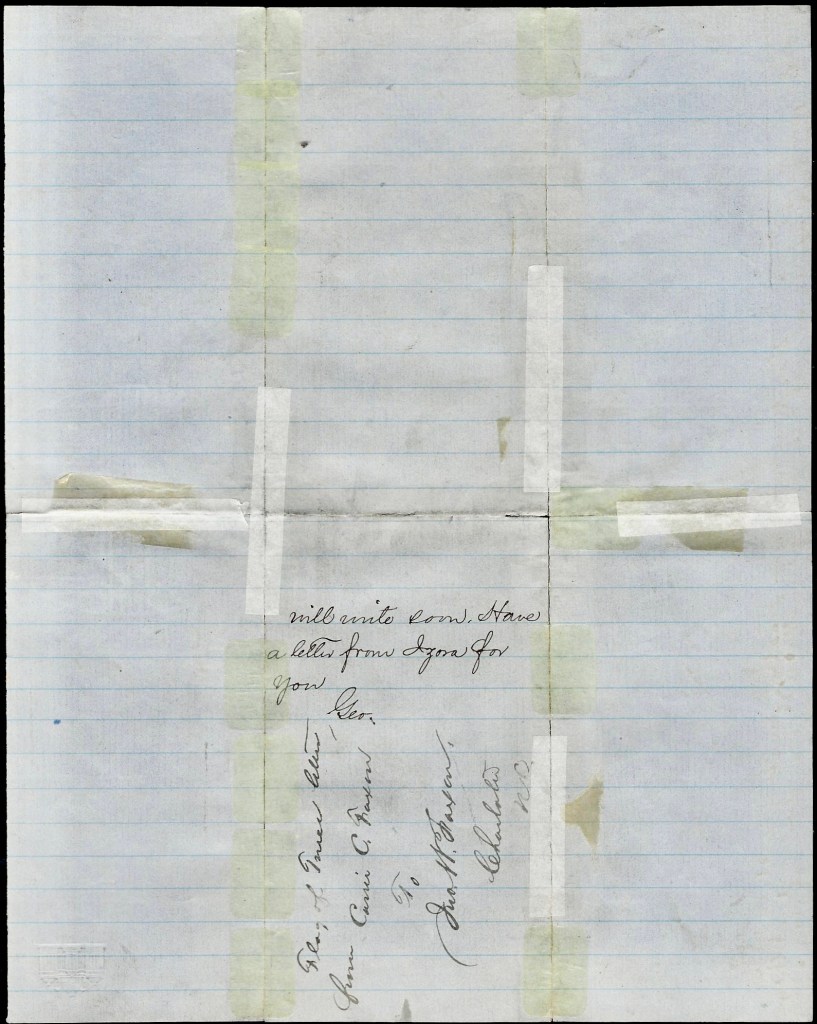
This letter was written by Caroline (“Carrie”) Crane Faxon (1848-19xx), the daughter of Charles Faxon (1799-1867) and Lucy Ann Steele (1804-1874). Charles Faxon was a printer, bookseller, and editor who hailed from Connecticut. In the 1820s he relocated to Catskill, New York, where he edited the Catskill Recorder. He then moved to Buffalo, New York, where he started the Daily Star. In 1843, he moved to Clarksville, Tennesee, where he commenced the publication of the Primitive Standard, an Episcopal Journal, with Rev. James Hervey Otey, afterwards Bishop of Tennessee. He also started the Clarksville Jeffersonian. Carrie married Robert Warner Thomas in December 1868.

Carrie wrote her letter to her older brother, John Wellington Faxon (1840-1917). John married Florence Herring in February 1866. John joined the 14th Tennessee Infantry and served until 1863 when, on account of disability, he was transferred to the CSA Treasury where he clerked until war’s end.

Carrie’s older brother, Henry W. Faxon (1826-1864), enlisted on 15 January 1864 at Buffalo, New York, as a private in the 24th New York Cavalry. He died of disease at Harewood Hospital in Washington D. C. on 11 September 1864.

Carrie’s letter mentions several Clarksville hometown boys who fought in Co. A, 49th Tennessee Infantry. This hat was work by Sergt. William McKeage of Co. A who finally deserted after the Battle of Nashville in mid-December 1864.

Transcription

Clarksville, Tennessee
February 3rd 1865

My Darling Brother,

I suppose you will be quite surprised to find that I am in Clarksville, Tennessee, instead of Buffalo, New York. I received your letter a week ago last night and can assure you was highly delighted that you had at last condescended to write to you little sister, I have been thinking of you ever since I came home—especially all this week before Christmas when all the girls nearly in town, and all the young men that are left, assembled at our church for the purpose of decorating it. Lou Ellen Anderson was there, also Julliet, Nannie H., Jane Ward, Hattie Elliott, & all the other pretty girls in town. All sent their love and spoke of the Christmas that Lewis clark, Willie Kerr & yourself were with us and what a nice time we all had down to the church.

I have a great deal of news to tell you but some is what you will not like to hear. In the first place, Sallie McKoin was married today to Quint Atkinson 1, & Mr. [Hugh] Dunlop 2 is to be next week to Miss Mattie Williams. The next thing, the small pox is in town. Dr. McMullen & his wife both died of it. Also old Ely Lockhart. Old R. Beaumont has died since I came home but not of small pox. Old grandmother Shackelford, brother John’s little Marietta, & others.

Mont. Ghoram [Gorham] was shot across the river and his remains brought home. Also Lem House 3 whose remains will be brought home tomorrow. Bob Bringhurst 4 & young Willie Munford 5 were both killed at Nashville & brought home. Polk W[ilcox] 6 has had his left arm cut off and is a prisoner. The whole family are in town. Miss Sallie has the typhoid fever and is quite sick. Little Georgie sends his love to you. He has been very sick but is well now. Dixie, or little Emmy, & Sallie say, “Tell Uncle John I kiss him.” Goodbye. Write soon. With much love, — Carrie

Emma Derring, Dr. McMullen’s niece, has the small pox. I tell you this so if you see any of her relations in Mississippi, you can tell them of it. — Carrie


1 Quintus C. Atkinson (1840-1894) served as a private in Co. A, 49th (Confederate) Tennessee Infantry. He was discharged for disability following a year’s service. He was married to Sarah (“Sally”) Elizabeth McKoin on 3 February 1865 at Clarksville, Tennessee.

2 Mr. Hugh Dunlop (1811-1879) was an elderly farmer who loved near Clarksville, an emigrant from Scotland. He married Miss Mattie Williams on the 17 May 1865.

3 Lemuel F. House served as a private in Co. A, 14th Tennessee Infantry. After he was wounded at the Battle of Sharpsburg in September 1862, he left the regiment to join Forrest’s Cavalry.

4 Robert Bringhurst was a sergeant in Co. A, 49th Tennessee Infantry. He was among the garrison at Fort Donelson that were captured in February 1862 and sent to Camp Douglas in Chicago. He was exchanged in September 1862. Nothing more appears in his muster rolls but we learn from this letter that he was killed at the Battle of Franklin. It is believed that the remnants of the 49th and 55th Tennessee were consolidated with the 7th Texas to form “Bailey’s Consolidated Regiment of Infantry.”

5 William B. Munford also served in Co. A, 49th Tennessee Infantry. He was taken prisoner at Fort Donelson and later exchanged. Elevated in rank to a Lieutenant, Munford was later placed on detached service as a clerk on Gen. Quarles staff as A.A.A.G. He was killed at the Battle of Franklin according to the Military Annals of Tennessee.

6 James Polk Wilcox also served in Co. A, 49th Tennessee Infantry. He was wounded and taken prisoner at Franklin, Tennessee. He was sent to Louisville, Kentucky, and then to Camp Chase in Ohio. He died of pneumonia on 5 March 1865 according to muster rolls. His left arm was amputated on 1 December 1864 in an attempt to save his life.