Category Archives: The Republic of Texas

1839: Samuel Merry to Ebenezer Merry

The following letter was written by 27 year old Samuel Merry (1811-1883), the son of Ebenezer Merry (1773-1846) and Charlotte Adams (1780-1879) of Milan, Erie county, Ohio. Adding a second brief letter on the same sheet was James Bradford Pier (1813-1888) who was married to Lucy Merry (1814-1897)—the younger sister of Samuel.

James Bradford Pier was the son of Dr. Ira and Sarah A. (Bradford) Pier of Circleville, Ohio. He came to Texas in 1835 with his wife Lucy (Merry) and settled near the site of the early Texas town of Travis, in Austin County. James B. Pier was a merchant and druggist in Velasco, Texas, prior to moving to Travis. Pier served as a member of the Texas Army during the war for independence. He was detailed as a rear guard at the camp opposite Harrisburg during the Battle of San Jacinto. In later years, he was a farmer, stock raiser, teacher, and merchant. He served as Justice of the Peace of Austin County and was the first postmaster of the Travis community. The State of Texas erected a monument to his memory at the intersection of Travis Street or old SH 36 and Nelsonville Road, in Austin County.
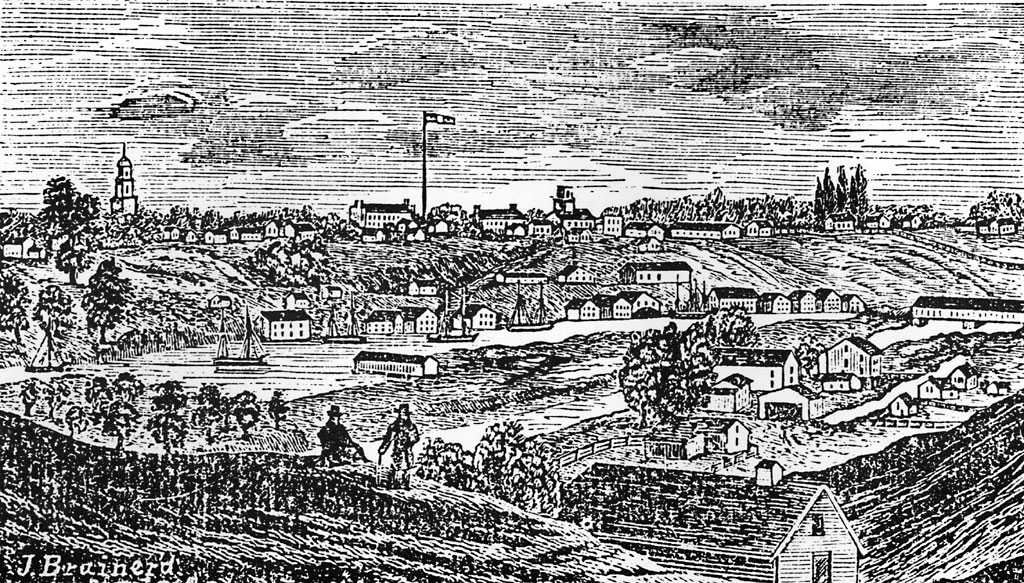
Samuel’s hometown, Milan, Ohio (1846)

Transcription

Caddo Parish, Louisiana
January 11, 1839

Dear Parents,

It is little more than a month since I wrote home. That was at this place. We heard such bad news about the Indians we left our wagon here at Old Mr. Blount’s and one horse as we traded horses, as I mentioned in my last letter, and Robert & myself took the two gray horses and rode them into Texas. We stopped to Nacogdoches at Doct. [James Harper] Starr’s 1—a brother of Hiram Starr that went to the Seminary in Milan last winter with R. O. Pier. He invited us to stay with him all night. We accepted of the invitation. We was treated very kindly & we got information of him for the rest of our rout. We had a first rate time in getting there and you must guess at the times we had when we arrived. We stayed there long enough to keep Christmas with them. Then J. B. P[ier] & myself started for our wagons.

We arrived here last Saturday. I had some business up to Cross Lake with our old friend McAlister about 25 miles from here & from there I went to Shreveport. I had some cash to collect from our horse trade & I had the pleasure of staying with our Mr. Poulice—that youngster who kept the Eagle Tavern in Milan. He is at that business in Shreveport. He sent his compliments to you all.

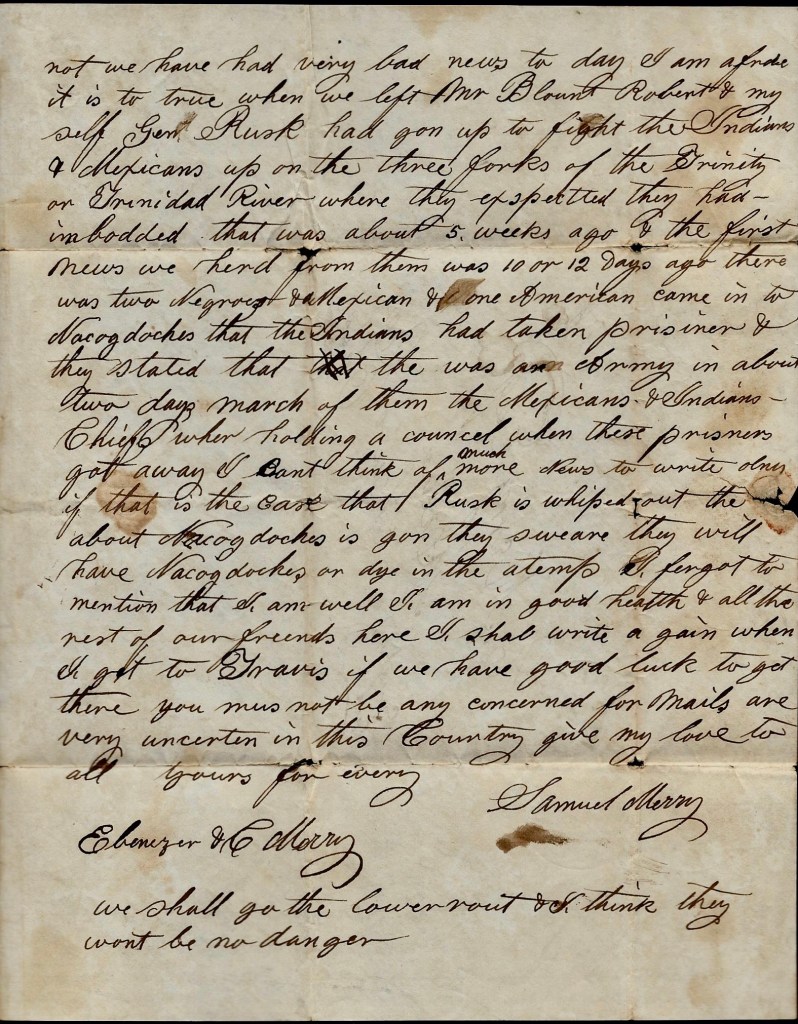
Tomorrow morning we calculate to start again for Travis. I don’t know whether we shall get through or not. We have had very bad news today. I am afraid it is too true. When we left Mr. Blount’s—Robert & myself, Gen. [Thomas Jefferson] Rusk 2 had gone up to fight the Indians & Mexicans up on the three forks of the Trinity or Trinidad River where they expected they had imbedded. That was about 5 weeks ago & the first news we heard from them was 10 or 12 days ago. There was two Negroes & a Mexican & one American came in to Nacogdoches that the Indians had taken prisoner & they stated that there was an Army [with]in about two days march of them. The Mexicans & Indian Chiefs were holding a council when these prisoners got away. I can’t think of much more news to write—only if that is the case, that Rusk is wiped out [and] the [area] about Nacogdoches is gone. They swear they will have Nacogdoches or die in the attempt.

I forgot to mention that I am in good health and all the rest of the friends here. I shall write again when I get to Travis if we have good luck to get there. You must not be any concerned for mails are very uncertain in this country. Give my love to all. Yours for ever, — Samuel Merry

[to] Ebenezer & C. Merry

We shall go the lower rout & I think there won’t be no danger.

[another hand]

James Bradford Pier, ca. 1875

Caddo Parish
January 12th 1838 [1839]

Dear Parents & friends,

After so long a time we had the pleasure of seeing Brother Samuel & Robert at my house in [Travis] Texas. We was happy to hear of your good health & doing well & further our pleasure at seeing our long expected friends. The boys Robert & Samuel got this far with their wagon & heard such bad news concerning the Indians, they left the wagon here and rode two of the horses to Texas where I live 300 miles from here. Samuel & me came back after the wagon. We calculate to start in the morning for home.

We have just heard that our Texas Army commanded by General Rusk has been cut off by the Indians. If so, we will see the devil. We have 300 miles of Indian country to go through. I merely write a few lines to get Samuel [free postage. I will give you a full detail when I get home, if we are lucky enough to get there.

My love to you all, my friends that I can spare, from my wife & child who God, I hope, will protect. Yours forever, — J. B. Pier

[to] Alexander & Mary McClure

You are remembered by your friends as well as others.

1 James Harper Starr (1809-1890), physician, Republic of Texas treasurer, land agent, banker, and Confederate official, son of James and Persia (Shaw) Starr, was born at New Hartford, Connecticut, on December 18, 1809. The Starr family originally migrated from England in the early seventeenth century. Starr’s immediate family moved to Franklin County, Ohio, in 1815, and the elder Starr died in 1824. At fifteen, J. H. Starr permanently injured his knee. He attended an academy in Worthington, Ohio, taught school near Columbus, taught himself medicine, and in 1830 became a member of the first class of the Reformed Medical Society of the United States of America, located in Worthington. He moved to Georgia in 1832 and practiced medicine at McDonough and later at Pleasant Grove. He and his wife, the former Harriet J. Johnson (daughter of Samuel Johnson), moved to Nacogdoches, Texas, on January 17, 1837, with other Georgians.

2 Thomas Jefferson Rusk (1803-1857) was an early political and military leader of the Republic of Texas, serving as its first Secretary of War as well as a general at the Battle of San Jacinto. He was later a U. S. Politician and served as a Senator from Texas from 1846 until his suicide in 1857.

1838-39: Alexander Hamilton Phillips to his Family

A Map of the Republic of Texas published in 1837

These letters were written by Alexander Hamilton Phillips (1804-1880), a native of Montgomery county, New York, who graduated from Union College in 1826, studied law until 1830, and then taught in the Lawrenceville, New Jersey, prep school for boys. He came to Texas in 1837, was admitted to the Texas Bar the following year and practiced law in Houston and Galveston. From 1839 to 1841 he was in partnership with Milford Phillips Norton. After both men visited Refugio County in the interests of a client, Phillips settled in Lamar, where he married Susan B. MacRae. He represented Refugio County in the Eighth Congress of the Republic of Texas, in 1843–44. He moved to Victoria and served the district after annexation as a senator in the first three state legislatures, 1846–50. From 1852 to 1861 Phillips practiced law in partnership with John McClanahan. The 1860 census listed him as owning $35,000 in real and personal property, including seven slaves. After the Civil War he served as a delegate to the Constitutional Convention of 1866. He was an incorporator of the Central Transit Company Railroad, chartered in November 1866 and intended to connect Texas with the Pacific coast but never built. He formed a partnership with Samuel A. Neville in 1868 and in 1870 joined the firm of Samuel C. Lackey and future Texas Supreme Court chief justice John William Stayton; the firm was renamed Phillips, Lackey, and Stayton. In the 1870s Phillips was senior member of the Victoria bar, whose members claimed that “his was a name to conjure by.” Phillips was an elder of the Presbyterian church at Victoria for thirty years and was one of the founders and incorporators of Aranama College. He died in Victoria on June 24, 1880. 

Two sons, Alexander H. Phillips, Jr., and William Phillips, both served the Confederacy as officers in the Sixth Texas Infantry. Alexander served as major of that unit until his death in Montgomery, Alabama, on June 4, 1863. William was captured at Arkansas Post in 1863 and taken to the notorious Camp Chase, Ohio, where he died. [Source Handbook of Texas]

Letter 1

Addressed to Master A. H. & Wm W. Phillips, Lawrenceville, New Jersey

[The Republic of Texas]
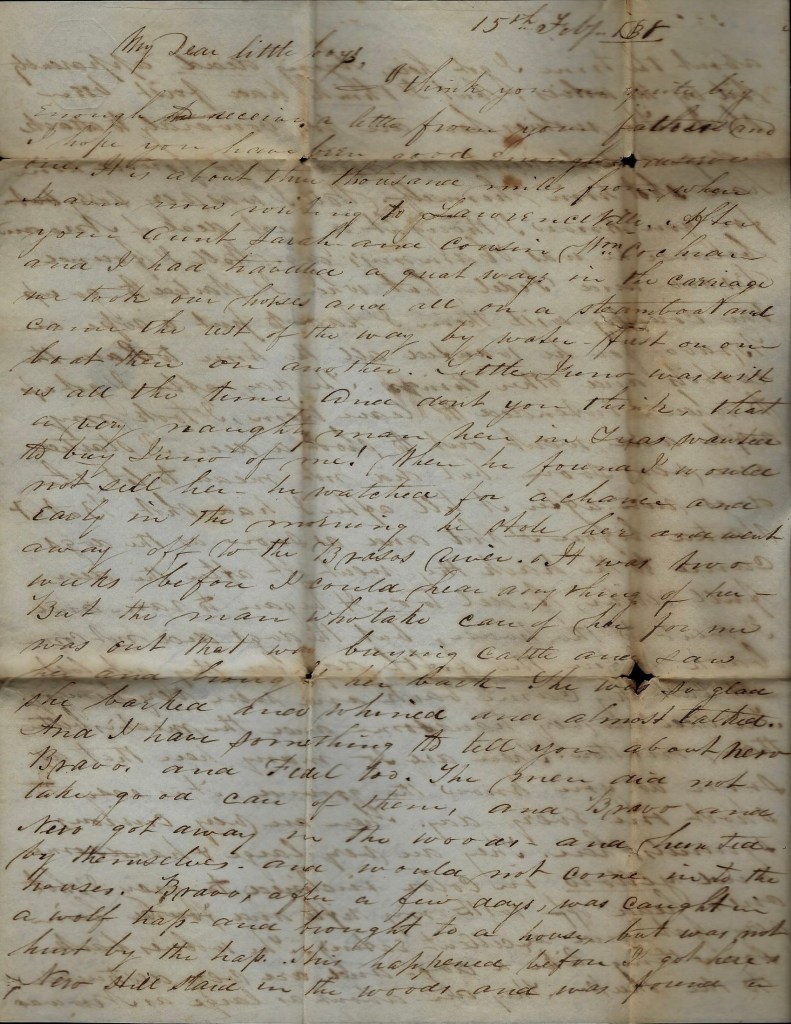
15th February 1838

My dear little boys,

I think you are quite big enough to receive a letter from your father. It is about three thousand miles from where I am now writing to Lawrenceville. After your Aunt Sarah and cousin William Cochran and I had traveled a great ways in the carriage, we took our horses and all on a steamboat and came the rest of the way by water, first on one boat, then on another. Little Juno was with us all the time and don’t you think that a very naughty man here in Texas wanted to buy Juno of me! When he found I would not sell her, he watched for a chance and early in the morning he stole here and went away off to the Brazos River. It was two weeks before I could hear anything of her. But the man who take care of her for me was out that way buying cattle and saw her and brought her back. She was so glad she barked and whined and almost talked.

And I have something to tell you about Nero, Bravo, and Fidel too. The men did not take good care of them and Bravo and Nero got away in the woods and hunted by themselves and would not come into the houses. Bravo, after a few days, was caught in a wolf trap and brought to a house but was not hurt by the trap. This happened before I got here. And Nero still stayed in the woods and was found in about the time I got here, lying dead, apparently bit by the wolves. But I think had just been short. The wolves here are too coward to attack a dog and I think the man who found him had shot him himself. Well, I was very sorry for you know I thought a great deal of Nero and because he was Hammy’s dog. Well, I found Bravo and Fidel but when I started to go up the country with them, I had to put a rope on Bravo for he wanted all the time to chase the rabbits and other things.

The day after I got up to where I intended to leave them, I took my rifle and went out to shhot a deer. I started one very soon but did not mean to let the dogs run after it till after I had shot. But they started before I shot and as soon as the dogs came to the track, they went off after the deer full drive—Fidel too.

It began to rain and I went to the house but the dogs did not come back before the fifth day for they got lost. At last they came back and were very hungry. The deer are very handsome and the meat is better than mutton. There are so many here that as soon as you know the grounds, it is easy to shoot one every day. There are very curious squirrels here. They are very large & handsome and yellow in color, inclined to grey. I shot one’s head off with my rifle and found him very fat and excellent eating. The wolves bark something like a dog and are very destructive to the sheep. They are about as large as Nero was. Some black like Don and some are grey. I chased one in the prairie with my horse and got quite near him but the ground became too soft for the horse, and so the wolf got away.

Elias shot a raccoon that was very fat. The raccoons and bears and squirrels often destroy the corn very much so that the people have to watch the fields and keep a great many dogs to keep them off. Many people lost their dogs during the War [of Texas Independence] and good ones now are very scarce. A man offered me fifty dollars for Little Juno but I knew you would not want me to sell her. I told him he could not have her.

The people here travel altogether on horseback in the winter because the roads are bad and there are no bridges yet to cross the creeks, In the summer, they ride in wagons and some have carriages. They have no schools and churches yet but by next fall they will have schools. And now they have preaching in private houses. In cold weather, many people cut a hole in a blanket big enough to put their heads through and so keep warm. Some of them are Mexican blankets and are very handsome. The Indians here shoot deer, turkeys, and squirrels for the white people but they spend most of their money for whiskey and get drunk.

You might let your little sister read this letter too and when she gets one, she must let you and Willy read hers too. You must let Cousin Emily keep your letter for you. Remember and be very good children and then when I come home, I will tell you a great many more things about Texas. You must tell Mr. Johnes Boerly that I mean to write to him after I return from San Antonio.

Adieu, — A. H. Phillips

I have sent by this mail the necessary payment to H. Green for the making of his deed and given directions about the money….There are a variety of sleeping apartments in this country. I have observed one man with a hogstand sheltered from winter and rain. Those behind logs are not so well off as the wind changes sometimes before morning. This morning it was very cold—the first of any note that pinched me.

The steamer Constitution (between N. O. and Galveston) has been wrecked. No lives lost She was at N. O. when I left was then considered unseaworthy. Much property lost by her.

On Monday I start on a tour of about 600 miles. Elias run 100 balls for the expedition beside some pistol balls. Don’t be alarmed. I shall take good care to keep out of shooting distance. I have written to Dr. Breckinridge by this mail of matters in general. What has become of the large sheet so warmly promised? Your last letter will probably remain at N. O. till the next boat as they have commanded to go over but I have been disobeyed. — A. H. P.


Letter 2

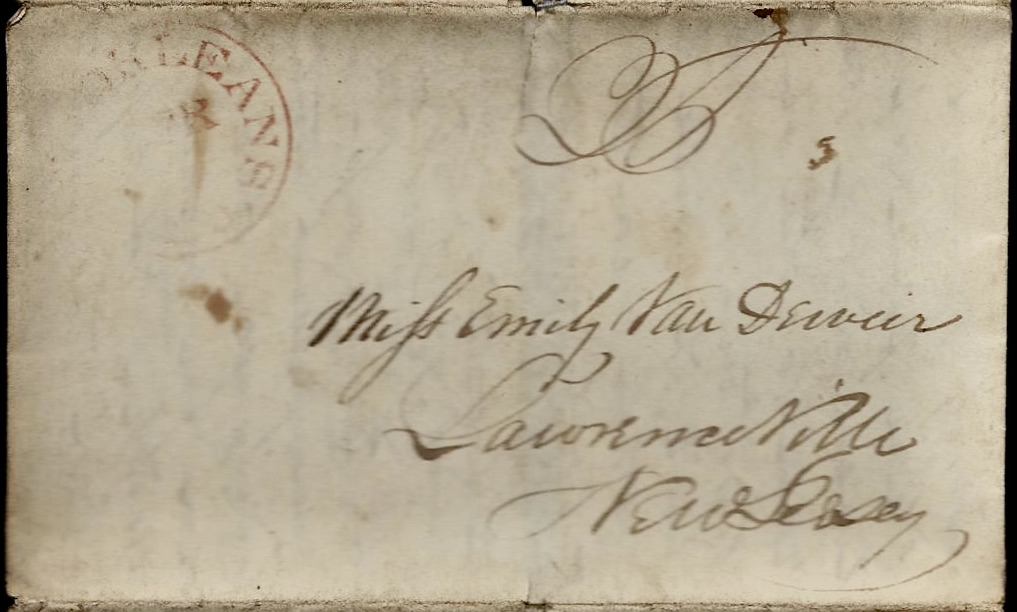
Addressed to Miss Emily Van Dervier, Lawrenceville, New Jersey

Bexar [Republic of Texas]
March 8, 1839

My Dear Emily,

Before I left Houston two months ago, I wrote to Cochran to detain your letters at New Orleans till I apprised him of my return to Houston. This accounts for my not having heard from you in a long time as well as for your not receiving letters from me lately with as much regularity as usual. At this place, the population is mostly Mexican. I have been much amused here in learning the manners and customs of the people. I have devoted all my leisure hours to the Spanish grammar and have advanced so far in the acquisition of the language that I can understand the run of their conversation generally and can so far speak it as to make myself understood with regard to anything I wish to communicate. Some few of them understand a little English or American as they universally call our language. The Spanish is the easiest language I ever undertook to learn. The greatest difficulty is the pronunciation though when you hear it hourly this may be mastered in a very short time. The vowels have one invariable sound, whatever their position with regard to other letters. The consonants are altogether different in pronunciation from any and vary according to their position. The vowels are sounded differently from ours but having always the same sound are easily mastered.

I will not occupy my paper in details about the people. This will answer us when we have nothing else to talk of during the summer.

I have about completed the several objects of my coming here and have some idea of leaving for Houston in the course of two weeks. I have two surveys to make before I can go. As the excitement of speculation begins to wear off by the completion of my business, I begin to feel the first movings of the excitement so natural and unavoidable to one who has so long been absent and is about making preparations to meet all that is dear to him on earth/ I don’t know yet how soon I shall be able to leave for the States but we have limited ourselves to the 1st of May—if circumstances will permit.

Swett writes me that our notes are not paid punctually but that business is very good. I don’t wish to start home with less than four thousand dollars, This will be of but little account of the loan obtained by Texas does not help to enhance the values of Texas money. If it does not, I shall not sacrifice it at the value it has had in the States during the winter. I am satisfied that the time is not far distant when there will be more silver & gold in circulation in Texas for the population it contains, than in any other country. Here are the mines and these have only to be opened and worked to enrich the country and to furnish a source of currency.

An expedition is now getting up against the Indians and as soon as they are thoroughly whipped, capital will be inverted to develop the resources of these tremendous mountains. The Mexicans were at one time exclusively engaged in these operations as is clear from report not only but from actual remains of their labor. Our plan, we have located on, still had a ladder in it. Another has been worked to an extent which it would take our men a whole year to effect the work. Copper & Coal mines are also so abundant & Lead, that they are not considered worth locating.

If we leave the first of May, we shall probably be at Philadelphia about the 3rd week to rig up. You would be amused to see our present style of living. Sometimes we live well and at others we have parched corn for bread & meat, and corn coffee for drink. It depends on where we are. For the last two months I have twice undressed and went to bed. we sleep in our blankets. I have, however, had all along clean under clothes and shirts, but my stockings sometimes are rather sorry, showing more toe than is altogether “agabable” as the Mexicans say. Make me a few shirts with ruffles.

Kiss the children for me. There is a little boy here (American father & Mexican mother) whom looks so much like Hammy that the first time I saw him, I followed him about the streets for an hour. I could not leave him. Adieu “Señorita” — A. H. P.