
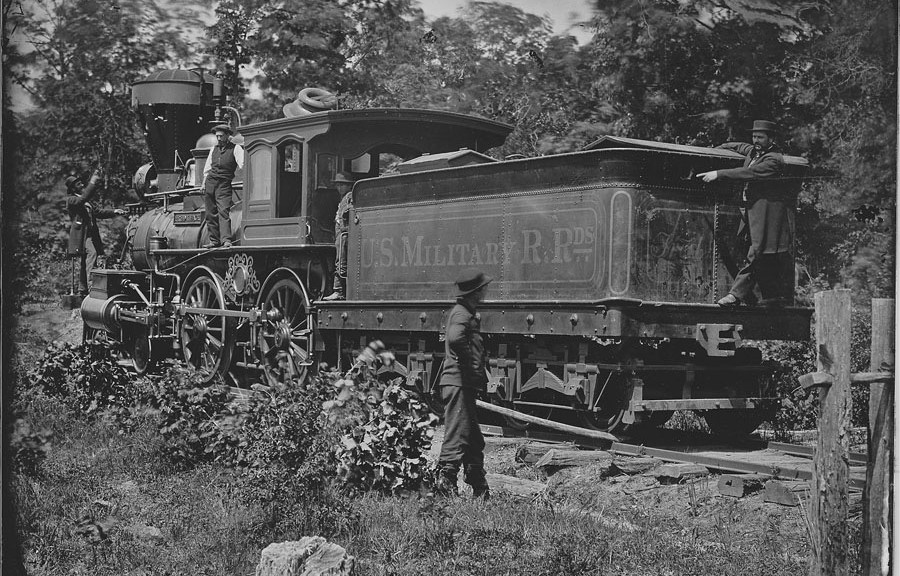
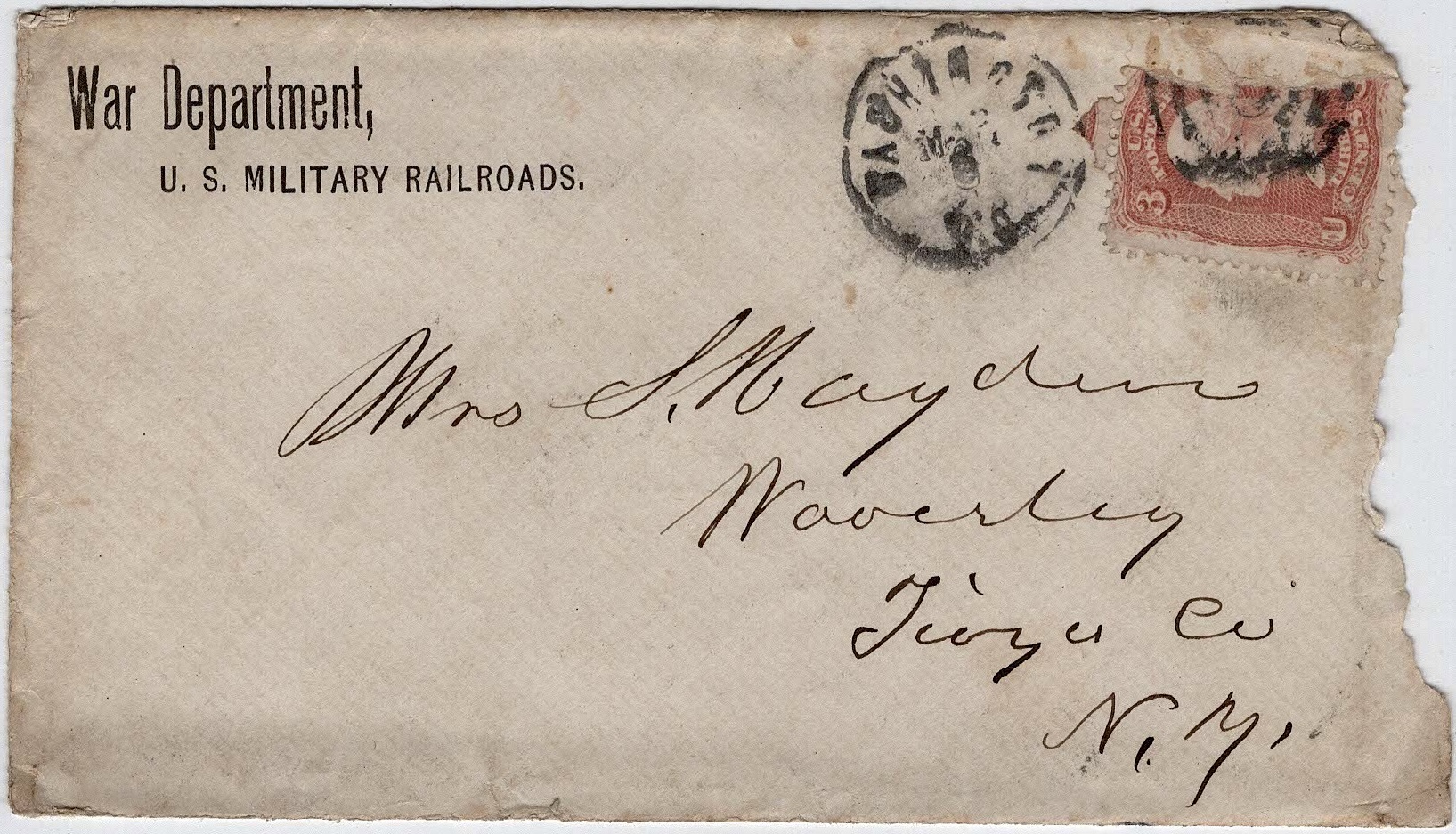
An archive comprising 10 letters, including 4 authored by Sidney Humphrey Hayden (1813-1890), spanning 2 October 1864 – 3 March 1865, written from Alexandria, VA at the US Military Railroad station and Harper’s Ferry, Virginia. His son, Albert “Bert” Hayden (1844-1918) authors the other 6 letters in the archive, each of which are written from the same railroad depot in Alexandria, where he was employed, spanning 21 February 1865 to 11 April 1865. Most letters in the archive bear a cancel stamp from the US Military Railroad, which was created after the federal government captured and occupied the Orange & Alexandria Railroad depot in 1861. It acted as the main Union Army supply depot during the first half of the Civil War.
Sidney and Bert’s letters, most written to (Sidney’s) wife and (Bert’s) mother, Florilla E. Miller (1814-1868), contain many details about the goings-on at the railroad station, thoughts on politics, and war updates.
The archive’s earliest letter is authored by Sidney, Sr., dated 2 October 1864, and addressed to his youngest son, Sidney (“Sid”) Hayden (1857-1907). He offers a trove of details about the depot and soldiers traveling nearby. He describes the stockade surrounding the railroad depot and offices, purposed to protect the building and their inhabitants from Confederate soldiers. He seems disturbed by the idea of being “shut up in such a pen,” therefore he and an acquaintance rent a room in a private house a short distance away to sleep in.
He then describes the young African Americans that pass by the office door every day with pails of water and baskets they carry on their heads “without touching them with their hands. They seem to stick to the wool.” He also describes the way both black and white soldiers are outfitted, each with a knapsack, blanket, canteen, and “a big ugly gun and bayonet on their shoulder.” Many of them look rough even with blue clothes and brass buttons.”
Hayden’s observations continue, as he describes the mule teams that pull wagons for the soldiers as they travel: “Then again we see long lines of army wagons each with about 6 mules driving it, and a nigger riding one of the hind mules and driving the others with but a single line. These wagons carry things that the soldiers cannot carry on their backs. Soldiers and mules have to do most of the hard work in the army.”
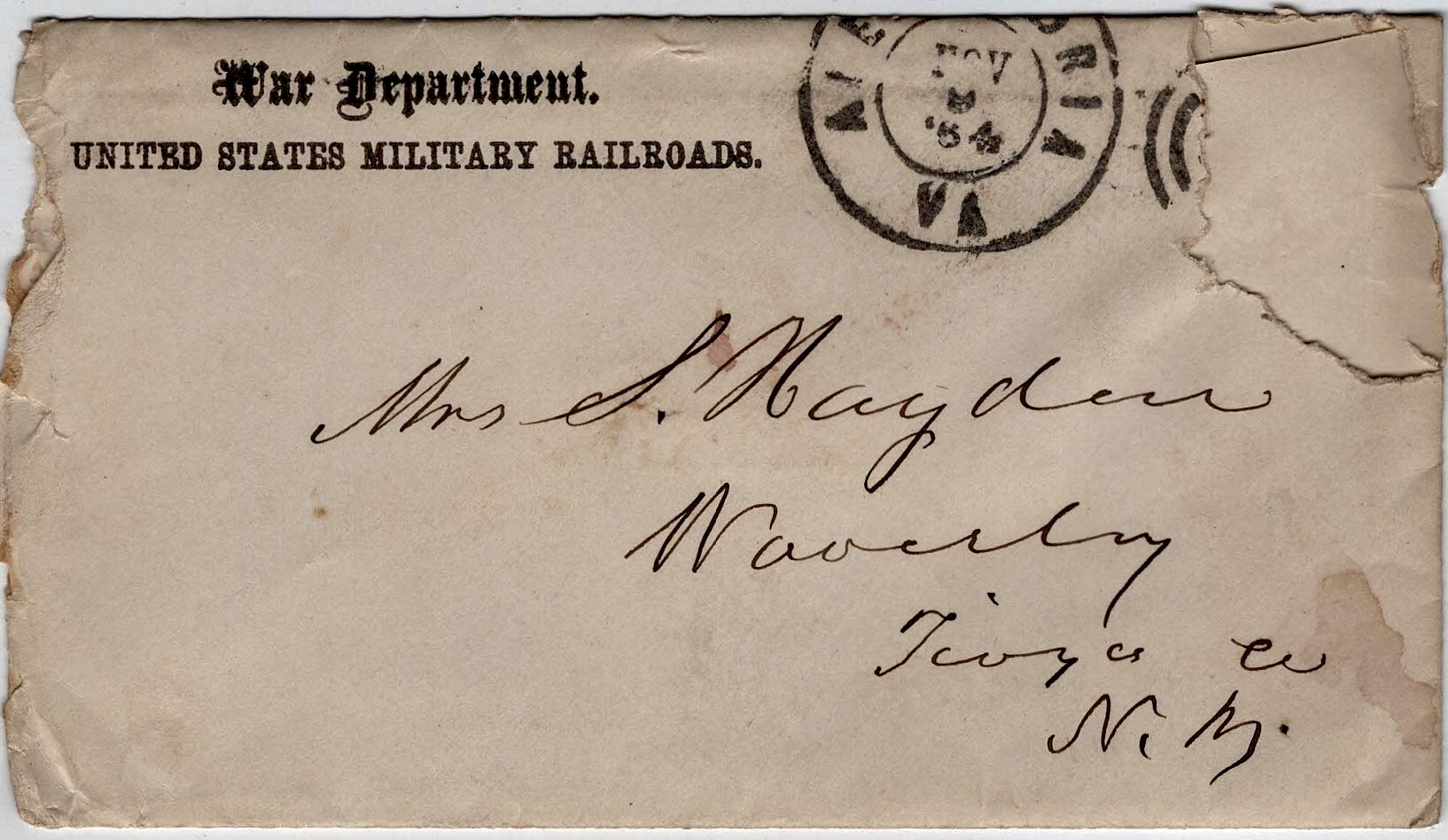
We get a glimpse into Hayden and his family’s politics as he uses a reference to a satirical political pamphlet produced by Copperheads depicting Abraham Lincoln as Abraham Africanus, a character who makes a pact with the devil to secure monarchical rule over the United States, in another letter to his wife. The letter is dated 9 November, the day after the presidential election. He writes, “Well the 8th has passed and this morning the streets of our city are full of rumors as to the results. The general opinion is that the dynasty of A.A. – (Abrahamus Africanus) is to be perpetuated. If it be the will of heaven, we must submit…”
In his only letter written from Harper’s Ferry, 3 March 1865, Sidney writes of having visited the “the termination of our road,” and of a trip to see Sheridan’s headquarters at Winchester, “before he [Sheridan] started on his late raid.” He was taken to the headquarters by an ambulance and military guard, as “The whole of that section is one infested with guerrillas that it was thought unsafe to send one ambulance alone.” When he reached Winchester, he found a Masonic Lodge, and was invited to address its members as a Mason himself. Reviewing his trip, he writes, “I should not fancy a life on the borders. It is rough and dangerous. Neither would I like to be stationed here. Alexandria is a paradise to this place.”
Also from Harper’s Ferry, Sidney writes of a military execution of a “young man shot for desertion. I did not go out to see it for I am sick of the thought of bloodshed.”
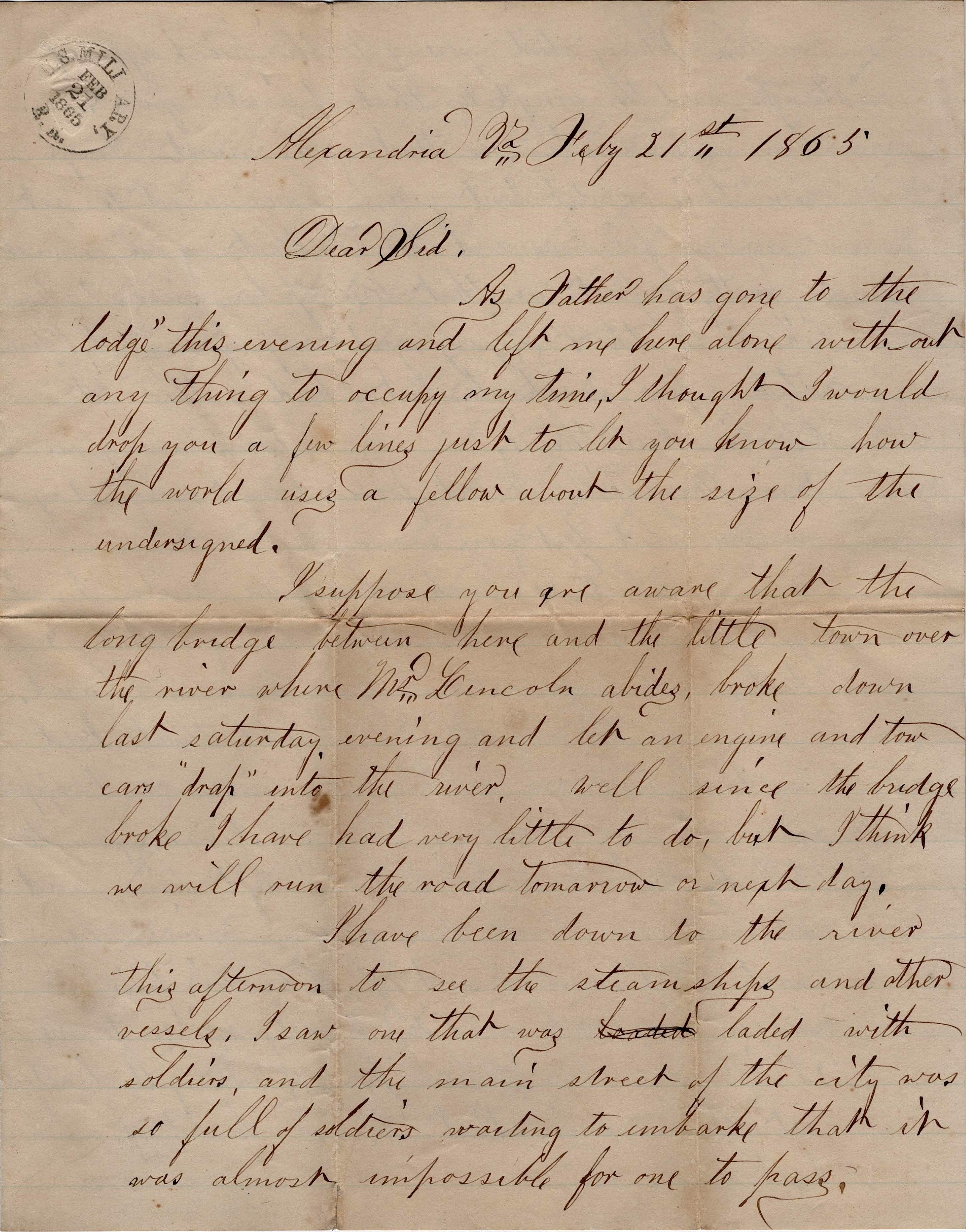
Albert Hayden’s first letter featured in this archive is addressed to his younger brother Sidney (“Sid”) Hayden (1857-1907), dated 21 February 1865. He reports that the “long bridge between here [Alexandria, VA] and the little town over the river where Mr. Lincoln abides, broke down last Saturday evening and let an engine and two cars drop into the river.”
In a letter to his mother dated 4 April 1865, Bert reports felicitations over the capture of Richmond, with astonishment at the way some white folks were interacting with Black people. “There were great times here and in Washington over the capture of Richmond; and some of the people made cursed fools of themselves, for over on the steps of the Metropolitan Hotel in Washington they would stand and hug some great black beastly niggers; but everyone to their liking.”
In his next letter to his mother, dated 2 days later on 6 April, Bert notes that he “was over to see the illumination a few nights ago, and I never saw such crowds of niggers as there were in the streets.” In this racist remark, he refers to the illumination of the capital city to celebrate the news of the fall of Richmond and Robert E. Lee’s surrender. The public buildings along with participating businesses and homes were lit up in a unified display of elation.
Bert’s remaining letters include a few scattered details about soldiers, including the unloading of wounded soldiers at the wharves, including a soldier who “had both arms and legs shot off.”
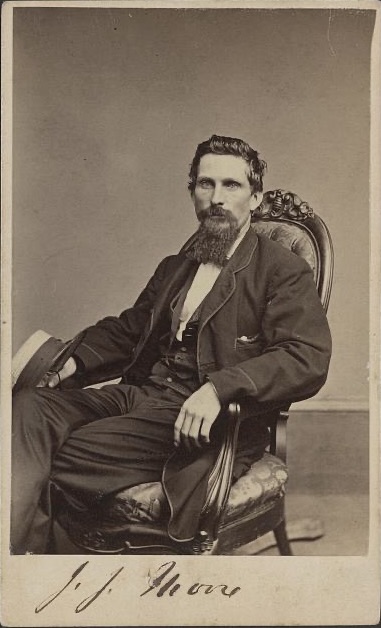
Sidney Humphrey Hayden was a prominent Mason, businessman, and family man, who was remembered in an obituary in the Athens, Pennsylvania Daily News as “one of the most conspicuous figures in Northern Pennsylvania.” His surviving sons are listed in the article, including Bert, who is a “freight agent of this division of the Lehigh Valley road…” Sidney served as a master mason at the Rural Amity Lodge of Free and Accepted Masons, being very involved in the affairs of the lodge, attending encampments, contributing to masonic publications, and even producing his own work in 1866, George Washington and his Masonic Compeers.
Letter 1
Alexandria, Virginia
[2 October 1864]
Dear Sidney,
You can see that my letter is written on the 2nd of October without my dating if you are right smart. You can also see that it is written from the ticket of the United States Military Railroads if you look sharp.
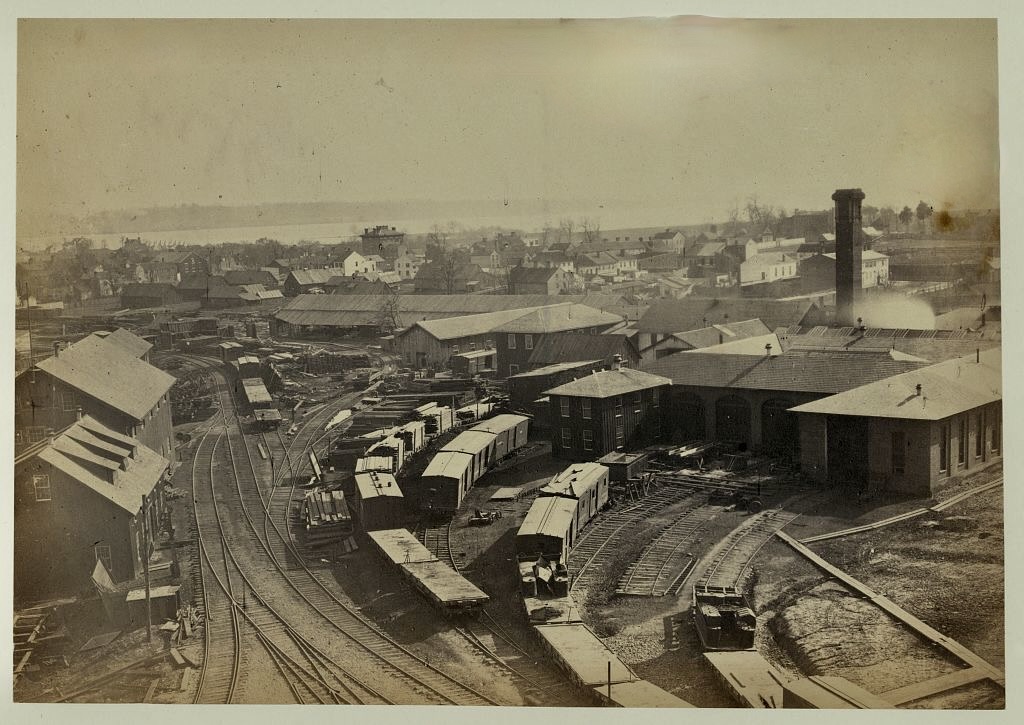
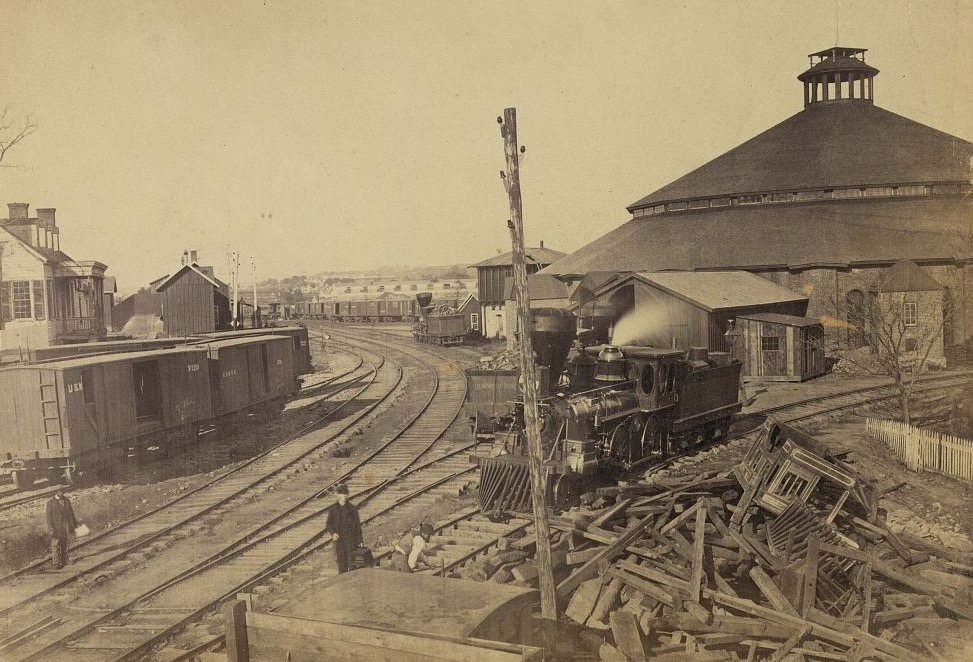
Well how do you think it looks about here? I can hardly tell you, I fear, so that you will understand it. Our depot is at the west end of the city about three quarters of a mile back from the river. The cars from Washington come and go four times in a day and pass right by the door of the office. All round the railroad ground and railroad offices and buildings, is a high, straight fence about ten feet high called a stockade. It is made by first digging a deep, narrow ditch, and then cutting trees 6 or 8 inches through and 14 or 15 feet long and setting them in rows on end in the ditch, and then filling up the ditch with dirt pounded down. This makes what is called a stockade fort. It is made to keep out the rebs and has holes made to shoot rifles through. There are large gates to go out and in at. How would you like to be shut up in such a pen as this? Well as big a piece of land as John Mills brought of Spring is here surrounded with such a stockade and our office is in it. Jule and I do not sleep in it nights though many do, but we go to a private house a short distance out and have a good room and bed there.
You would laugh to see the little nigger cubs we see here. They pass by the office door every day with pails of water and baskets of truck on their heads which they carry without touching them with their hands. They seem to stick to the wool.
Another thing we see is soldiers—both black and white—with a knapsack and blanket strapped on their backs and a canteen of water by their side, and a big ugly gun and bayonet on their shoulder. Many of them look rough even with blue clothes and brass buttons.
Then again we see long lines of army wagons each with about 6 mules driving it, and a nigger riding one of the hind mules and driving the others with but a single line. These wagons carry things that the soldiers cannot carry on their backs. Soldiers and mules have to do most of the hard work in the army.
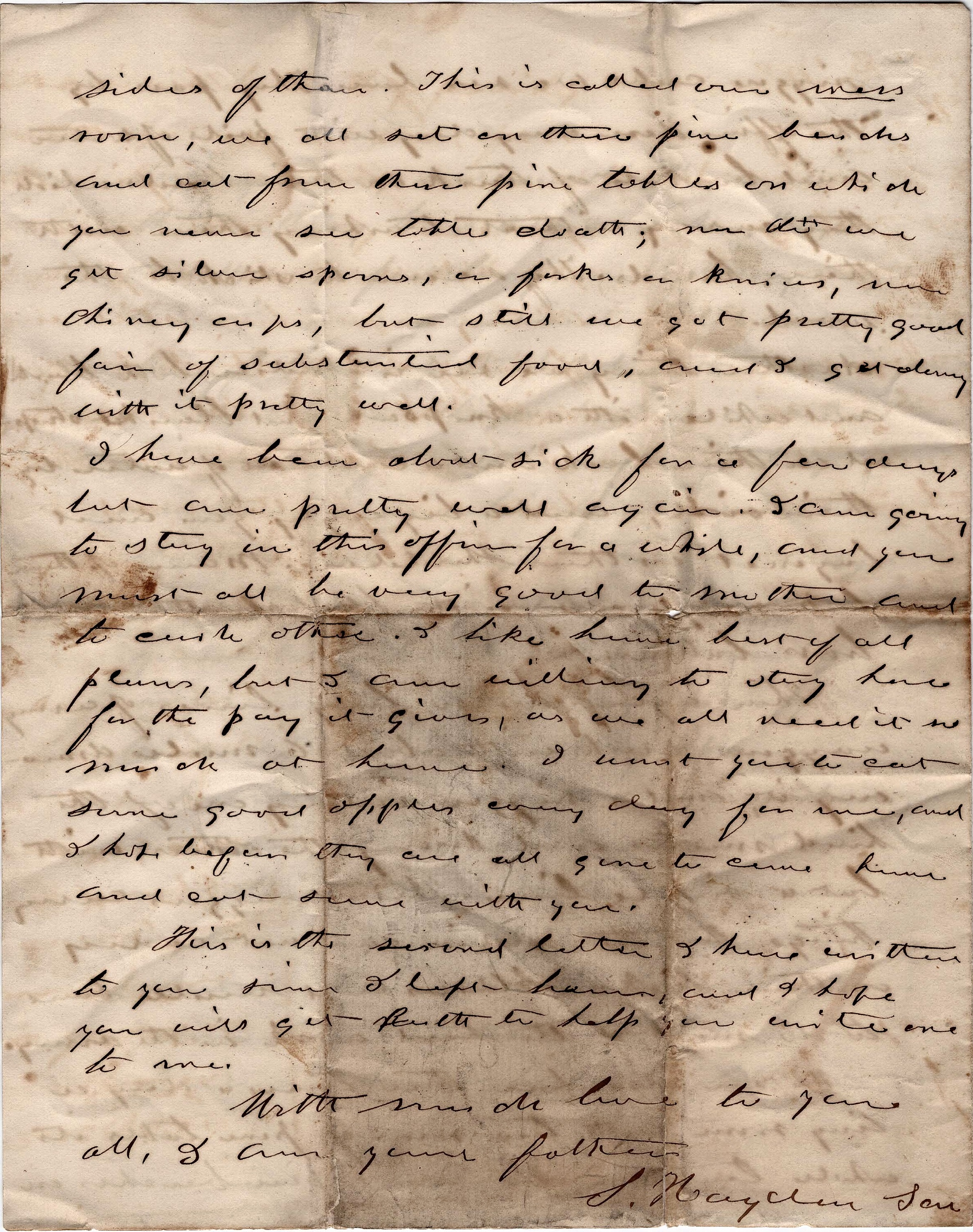
We see also here three times a day a long room with two rows of pine tables it whole length and a row of pine benches on sides of them. This is called our mess room. We all sit on these pine benches and eat from these pine tables on which you never see table cloths, nor do we get silver spoons or forks or knives, nor dining cups. but still we get pretty good fare of substantial food and I get along with it pretty well.
I have been about sick for a few days but am pretty well again. I am going to stay in this office for a while and you must all be very good to me there and to each other. I like home best of all plans but I am willing to stay here for the pay it gives, as we all need it so much at home. I want you to eat some good apples every day for me, and I hope before they are all gone to come home and eat some with you.
This is the second letter I have written to you since I left home and I hope you will get Ruth to help you write one to me. With much love to you all, I am your father, — S. Hayden, Sr.


Letter 2
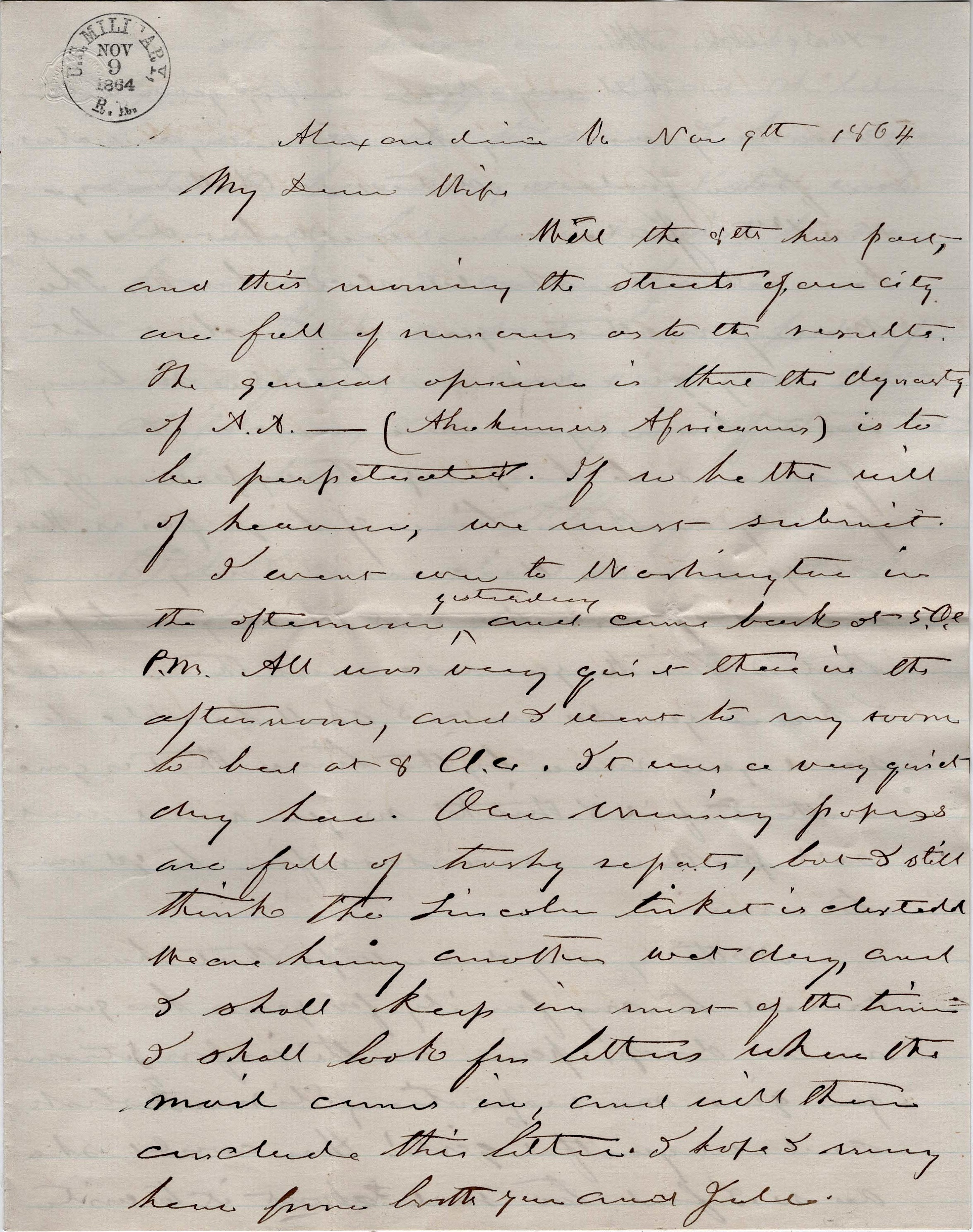
Alexandria, Virginia
November 9th 1864
My dear Wife,

Well the 8th has passed and this morning the streets of our city are full of rumors as to the results [of the election]. The general opinion is that the dynasty of A. A. (Abrahamus Africanus) is to be perpetuated. If so be the will of heaven, we must submit.
I went over to Washington in the afternoon yesterday and came back at 5 o’clock p.m. All was very quiet there in the afternoon and I went to my room to bed at 8 o’clock. It was a very quiet day here. Our morning papers are full of trashy reports but I still think the Lincoln ticket is elected.
We are having another wet day and I shall keep in most of the time. I shall look for letters when the mail comes in and will then conclude this letter. I hope I may have [one] from both you and Jule.
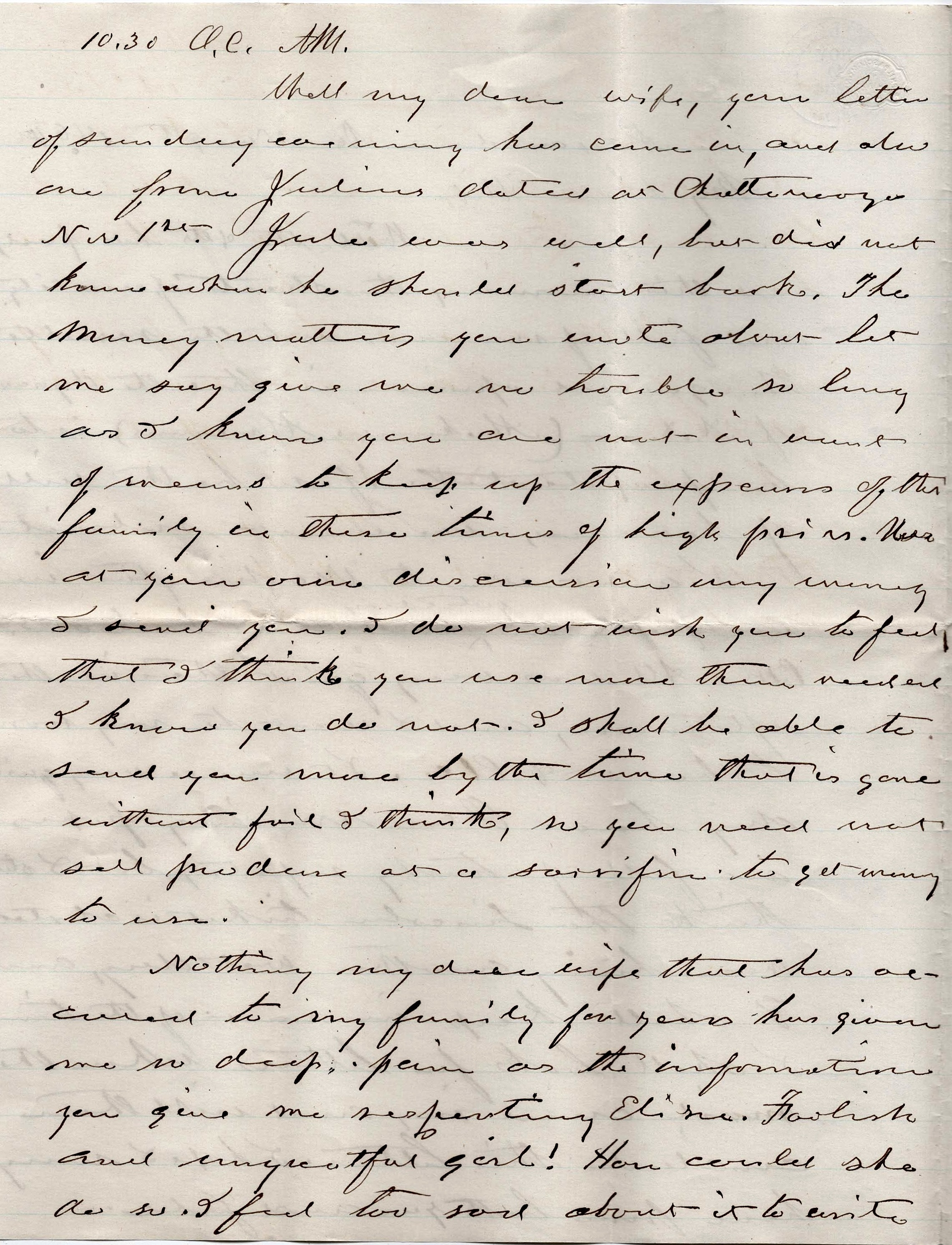
10.30 o’clock a.m. Well, my dear wife, your letter of Sunday evening has come in and also one from Julius dated at Chattanooga, November 1st. Jule was well but did not know when he should start back. The money matters you wrote about let me say give me no trouble so long as I know you are not in want of means to keep up the expenses of the family in these times of high prices. Use at your own discretion any money I send you. I do not wish you to feel that I think you use more than needed. I know you do not. I shall be able to send you more by the time that is gone without fail, I think, so you need not sell produce at a sacrifice to get money to use.
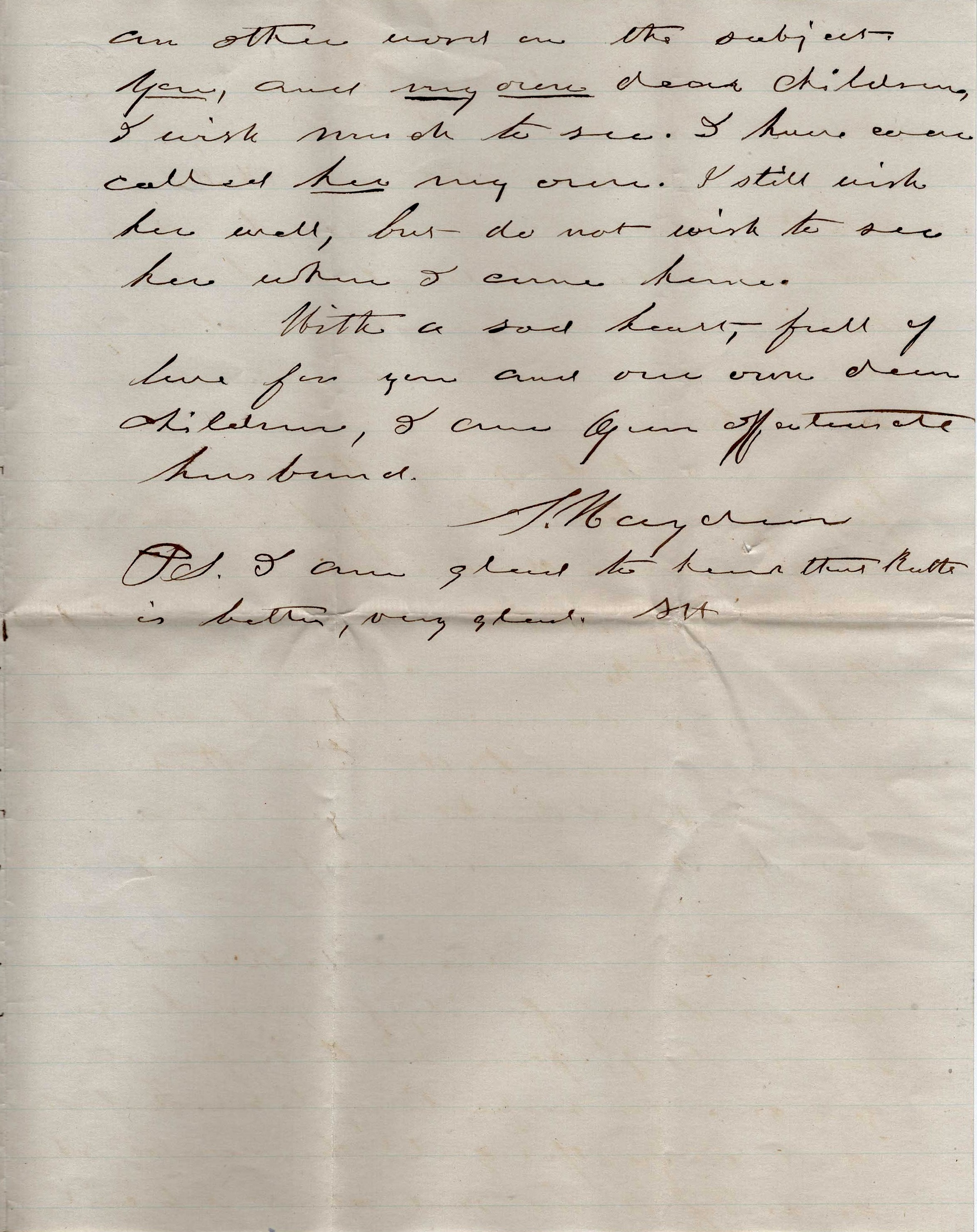
Nothing, my dear wife, that has occurred to my family for years has given me so deep pain as the information you give me respecting Elise [?]. Foolish and ungrateful girl! How could she do so? I feel too sad about it to write another word on the subject. You, and my own dear children I wish much to see. I have ever called her my own. I still wish her well, but do not wish to see her when I come home.
With a sad heart, full of love for you and our own dear children, I am your affectionate husband, — S. Hayden
P. S. I am glad to hear that Ruth is better, very glad. — S. H.
Letter 3
Alexandria, Virginia
January 21, 1865
My dear Wife,
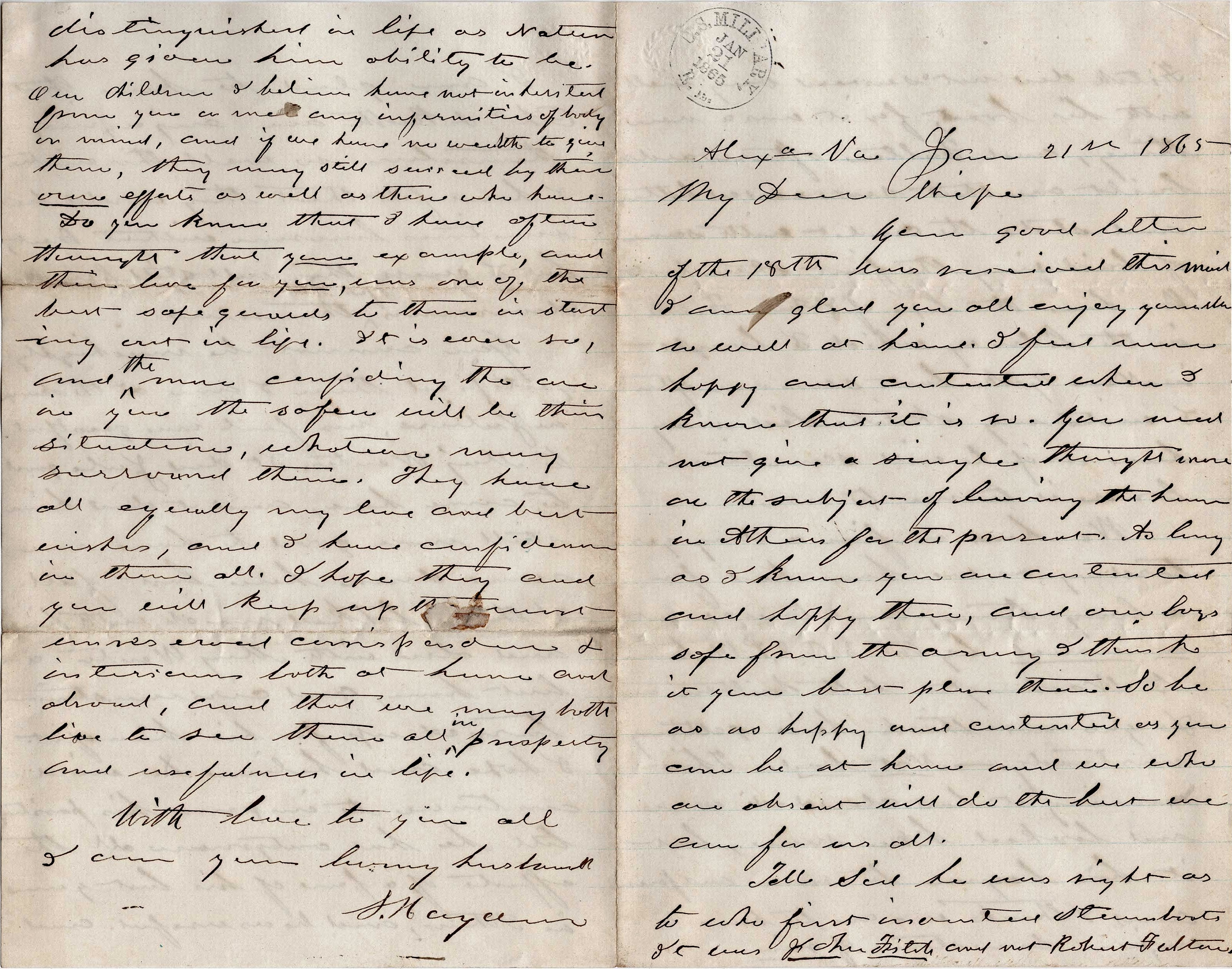
Your good letter of the 18th was received this morn and I am glad you all enjoy yourselves so well at home. I feel more happy and contented when I know that it is so. You need not give a single thought more on the subject of leaving the house in Athens for the present as long as I know you are contented and happy there, and our boys safe from the army. I think it your best place there. So be as happy and contented as you can be at home and we who are absent will do the best we can for us all.
Tell Sid he was right as to who first invented steamboats. It was John Fitch and not Robert Fulton. Fitch did not succeed very well with his boat for it was a new thing, and Fulton afterwards built one that succeeded better and stole the credit with some of building the first steamboat. We have the Life of John Fitch in the library which I bought in New York last summer after I wrote my sketch. Sid may have it if he will sometimes loan it to me to use.
We had as fine a day yesterday as we have had for a long time, and Bert went as usual by the 3 o’clock p.m. train to Washington to the Smithsonian. Do you not think he is getting unsteady? Not bad. This morning it had clouded over and looked like snow, but it has begun to rain and [ ] and I think we are to have a Virginia snowstorm of rain.
I am glad to hear that Charles & Ruth are enjoying themselves so well this winter. I have felt that they would be sometimes lonesome without Bert but I guess they will still find diversions for themselves.
You cannot be more highly gratified than I am at the change in Julien. We feel more gratified to Maj. [Erasmus Livingston] Wentz. It did Jule good to come here and it did him still more good to have me come down here last fall. I then talked much with him and also with Maj. Wentz about him, and circumstances turned up for his benefit. I hope and believe he will continue to improve his position till he has [ ] all the efforts of a few of his last years in Athens, and be as useful ad distinguished in life as Nature has given him ability to be. Our children, I believe, have not inherited from you or me any infirmities of body or mind, and if we have no wealth to give them, they may still succeed by their own efforts as well as them who have.
Do you know that I have often thought that your example and their love for you was one of the best safeguards to them in starting out in life. It is even so, and the more confiding they are in you, the safer will be their situation, whatever may surround them. They have all equally my love and best wishes, and I have confidence in them all. I hope they and you will keep up the most unreserved correspondence & intercourse both at home and abroad, and that we may both live to see them all in prosperity and usefulness in life.
With love to you all, I am your loving husband, — S. Hayden

Letter 4
Alexandria, Virginia
February 21, 1865
Dear Sid,
As father has gone to the “Lodge” this evening and left me here alone without anything to occupy my time, I thought I would drop you a few lines to let you know how the world uses a fellow about the size of the undersigned.
I suppose you are aware that the Long Bridge between here and the little town over the river where Mr. Lincoln abides broke down last Saturday evening and let an engine and two cars “drop” into the river. Well since the bridge broke, I have had very little to do but I think we will run the road tomorrow or next day.

I have been down to the river this afternoon to see the steamships and other vessels. I saw one that was loaded with soldiers and the main street of the city was so full of soldiers waiting to embark that it was almost impossible for one to pass.
Mr. Wherry, did you get the package of stamps and the song &c. that I sent you? Seems to me that you must trap some this winter, don’t you? you used to set so many for hens and mice that you must be pretty expert in that line of business. I should like to be three myself and help you and Charlie catch a few muskrats, but I had rather let Charlie skin them. I reckon you draw Mary Mills to and from school every day on your sled, don’t you?
Now Mr. Sppok when you write, I want you should tell me how many lambs & turkeys and pigs and girls you have on hand. By the way, Sid, I believe that Fred and Luther are visiting you now, so I suppose you all have some gay times. I want you to tell Luther to have Charlie lift him and see how much he has grown since he went to Candor and if Charlie tries to plague him (as he used to) to just write to me & I will give him (Charlie) one of the goll beastedest slaruxings that he ever heard of when I get home.
Jackson, you and Fred spend some of these long evenings in company with Miss Mary Mills or Miss Ruth Knapp or some other young lady of your acquaintance but I know that Luther would not do any such thing as that for he and I don’t care anything about the girls.
I guess that Protagorous must have quite a nice lot of kittens by this time, hasn’t he? You must keep good watch and not let Charlie get hold of them for if he does, he will cut their tails off surer than thunder.
Sid, I want you should remember me when you have any apples and eat about one peck a day for me. Please give my love to Mother, Ruth, Charlie, Aunt Martha, Fred, Luther, and to remember me to Miss Mary & Mr. Lew Mills. You must excuse all mistakes in this poor epistle and answer it as soon as your business will admit. Yours affectionately, — Bert Hayden


Letter 5
Harper’s Ferry, Virginia
March 3d 1865
My dear wife,
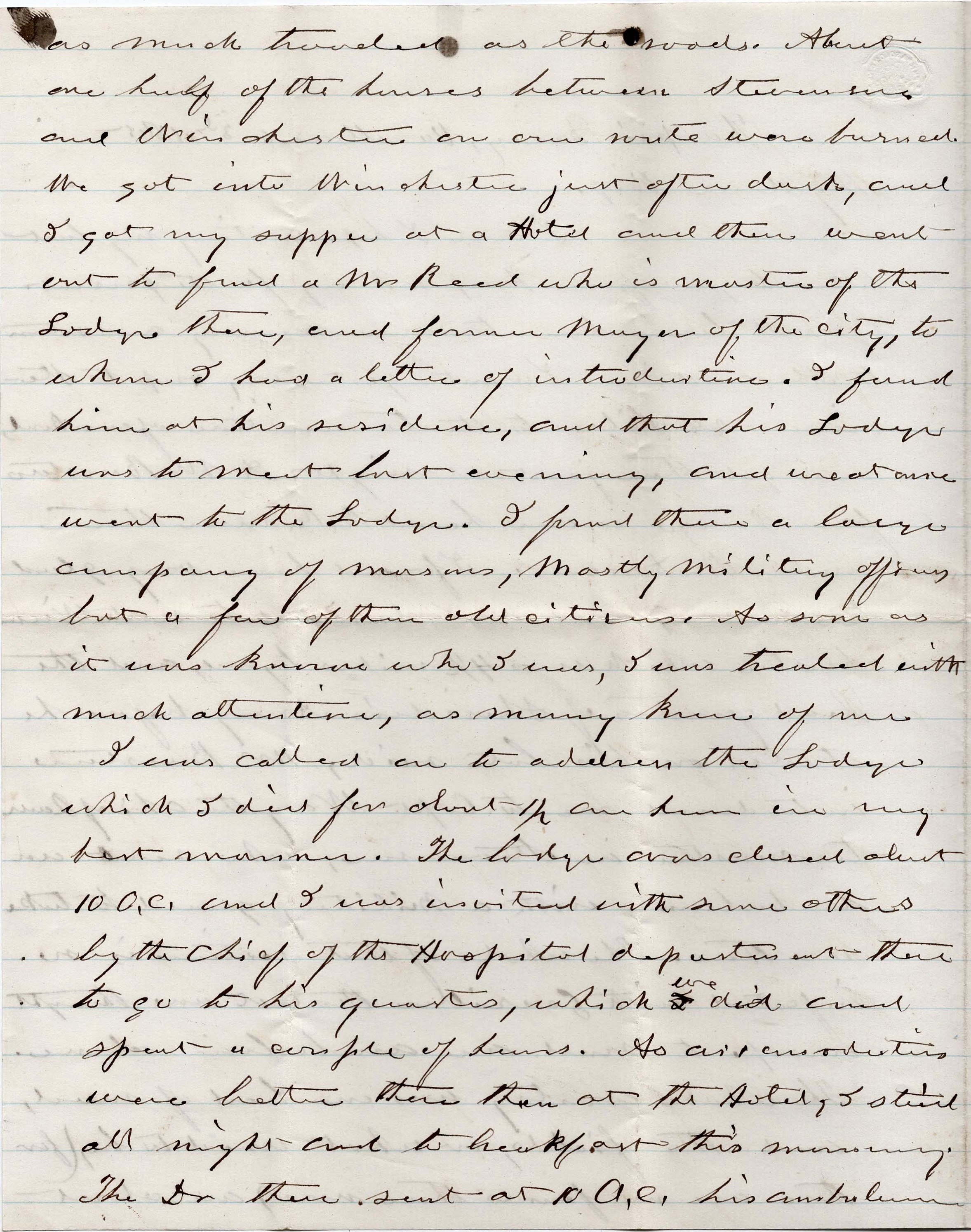
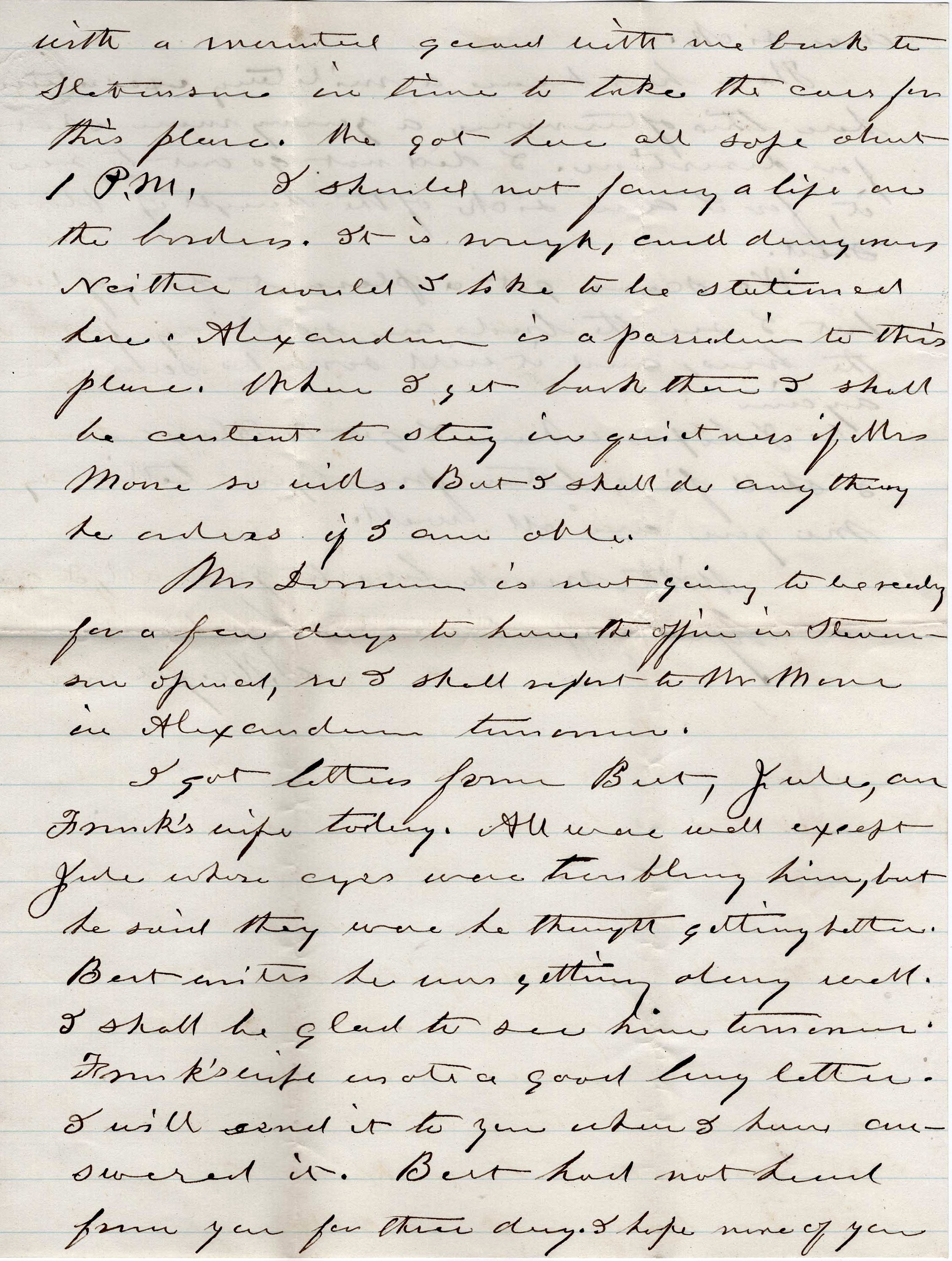
I am I hope writing my last letter to you from Harper’s Ferry for the present. I shall leave here tomorrow morning and return to Alexandria. I went yesterday up to Stevenson 28 miles to the termination of our road and got there just at night. A Mr. Barstow from Owego is our head railroad man there under Mr. Devereux. I found him very glad to see me and as I desired to visit Winchester which was 4.5 miles beyond, and the headquarters of Sheridan’s Army before he started on his late raid, Mr. Barstow introduced me to Capt. Way, the Chief Quartermaster in Stevenson who sent an ambulance with a military guard to take me there. The whole of that section is one infested with guerrillas that it was thought unsafe to send one ambulance alone. The whole country was one bed of mud and the fields—or what used to be (for there are no fences there now)—are about as much traveled as the roads. About one half of the houses between Stevenson and Winchester on our route were burned.
We got into Winchester just after dark and I got my supper at a Hotel and then went out to find a Mr. [John Bell Tildon] Reed who is master of the [Mason’s] Lodge there and former Mayor of the city to whom I had a letter of introduction. I found him at his residence and that his Lodge was to meet last evening and we at once went to the Lodge. I found there a large company of Masons, mostly military officers but a few of them old citizens. As soon as it was known who I was, I was treated with much attention, as many knew of me. I was called on to address the Lodge which I did for about half an hour in my best manner.
The Lodge was closed about 10 o’clock and I was invited with some others by the Chief of the Hospital Department there to go to his quarters which we did and spent a couple of hours. As accommodations were better there than at the Hotel, I stayed all night and to breakfast this morning. The Dr. there sent at 10 o’clock his ambulance with a mounted guard with me back to Stevenson in time to take the cars for this place. I should not fancy a life on the borders. It is rough and dangerous. Neither would I like to be stationed here. Alexandria is a paradise to this place. When I get back there, I shall be content to stay in quietness if Mr. [James J.] Moore so wishes. But I shall do anything he orders if I am able.
Mr. Devereaux is not going to be ready for a few days to have the office in Stevenson opened so I shall report to Mr. More in Alexandria tomorrow.
I got letters from Bert, Jule, and Frank’s wife today. All were well except Jule whose eyes were troubling him, but he said they were he thought getting better. Bert writes he was getting along well. I shall be glad to see him tomorrow. Frank’s wife wrote a good long letter. I will send it to you when I have answered it. Bert had not heard from you for three days. I hope none of you are sick.
There has been a military execution here this afternoon. A young man shot for desertion. I did not go out to see it for I am sick of the thought of bloodshed.
We scarce get a pleasant day of late but I see the birds are swelling forth in the trees and it will soon be summer again. I hope when I get to Alexandria I shall find letters from you telling me you are all well. With much love to you all, I am your affectionate husband, — S. Hayden


Letter 6

Alexandria
March 18, 1865
Dear Mother,
Your welcome letter of the 13th was received yesterday and I was right glad to hear from you. Those flowers that you sent looked as if they had been poorly used on their way here, but they were nonetheless welcome for all that. I reckon the reason is a little farther advanced here than it is in Athens for many of the people here have made garden and in some of the yards the flowers are in full bloom and they were not raised in a hot house either.
I believe Father wrote to you yesterday what time he thought it best for you to come on here. I hope nothing will occur between now and then that will hinder your coming at the appointed time.
I think Charlie did first rate of he gets twenty shillings for the beans, but i would hurry and get shut of them and the potatoes if I could get any kind of a price for them for I think all such things will be very cheap before they bring more.
Charlie Hull is stationed in Alexandria now and he has been in our office and I have been up to see him. I tell you, he looks rather sickly but he says that he is better now than he has been for a long time.
I reckon George Edminster is not coming down here; if he had, or does come, I think we could get him in as a carpenter at $2.40 per day, but there are a few tools that he would need that he could get here. But I don’t think I will write anything to him about it for perhaps he could not get the place after all. But I have been told that he could have it.
I went to the theatre the other night with Hen Parks and had a jolly good time.
My health has been splendid since I came here. I haven’t been troubled with those beastly sore throats that I used to have at home. Tell Father he must keep watch of Fred and Sid and not let them go over to see Miss Mary Mills nor than 10000000001 times a day as they used to. I don’t think I will try to go home with you this spring but will send my clerk for my business is such that I don’t think I can leave. But my clerk is not of much use to me anyway and I can spare him just as well as not.
Ask Charlie if Miss Mary Turner could not spare him just long enough to write a few lines to me. I don’t want to ask anything of her that is unreasonable but I think she requires more of his attention than is for his health. I wonder if she didn’t go up to Owego with him to sell his beans.
With much love to all at home, I remain ever your affectionate son, — Bert Hayden


Letter 7

Alexandria [Virginia]
April 4, 1865
Dear Mother,
I believe that I have received a letter from you which I have never answered but I have written so many letters lately that I can’t hardly tell which I have answered and which I have not. There were great times here and in Washington over the capture of Richmond and some of the people made cursed fools of themselves for over on the steps of the Metropolitan Hotel in Washington they would stand and hug some great black beastly niggers—but everyone to their liking.
I think I shall be able to send home some money when I get my next month’s pay and if I do, you may take it and anymore I send home afterward to buy a horse and such other things as you like. I don’t think it was a very great loss when Old Jim died for he was not fit to drive in the streets. Neither was he able to do the work of the farm. If I were in your place, I would not buy Lozer’s Old Fan for although she has been a first rate horse, I don’t think she is worth over 75 dollars now and I should buy a better and a younger horse.
I am very healthy indeed this Spring and think I can stand the heat of the summer first rate. I suppose Jule will be here sometime this month and I presume Father will go North with him when he goes. Our duties are very light here now and we can leave anytime after 3.05 p.m. which we would think was pretty early to quit work at the North. I generally get on the evening train and go over to Washington and get back at five o’clock which is just half an hour before supper time.
One of the laboring men was run over and killed yesterday morning. It seems they were moving some cars and he went to jump on while they were in motion but fell in front of them and they run over him, killing him instantly. J[ames] J. More has gone to City Point so I reckon our places will not be changed for a while to come.
Well, Mother, I am about run out of news so I will close with love to all and hoping to hear from you often. Yours affectionately, — Bert Harden


Letter 8
Alexandria [Virginia]
April 6th 1865
Dear Mother,
Your welcome letter of the 2nd has just been received and I was glas (as I always am) to hear from you. I am sorry to learn that you are having trouble about that lane fence and I hope she will see that she is in the wrong and that you will settle it peaceably. I presume that Father will go home the latter part of this month or the first of the next, but I don’t think I will leave until sometime next summer when it is hot and disagreeable here and pleasant in the country. I should like very much to be home when they have their public and examination at the Institute.
Charlie Hull is stationed in the City and I see him every few days. I have not seen Ben Eglin since I came here. Don’t you think it queer?
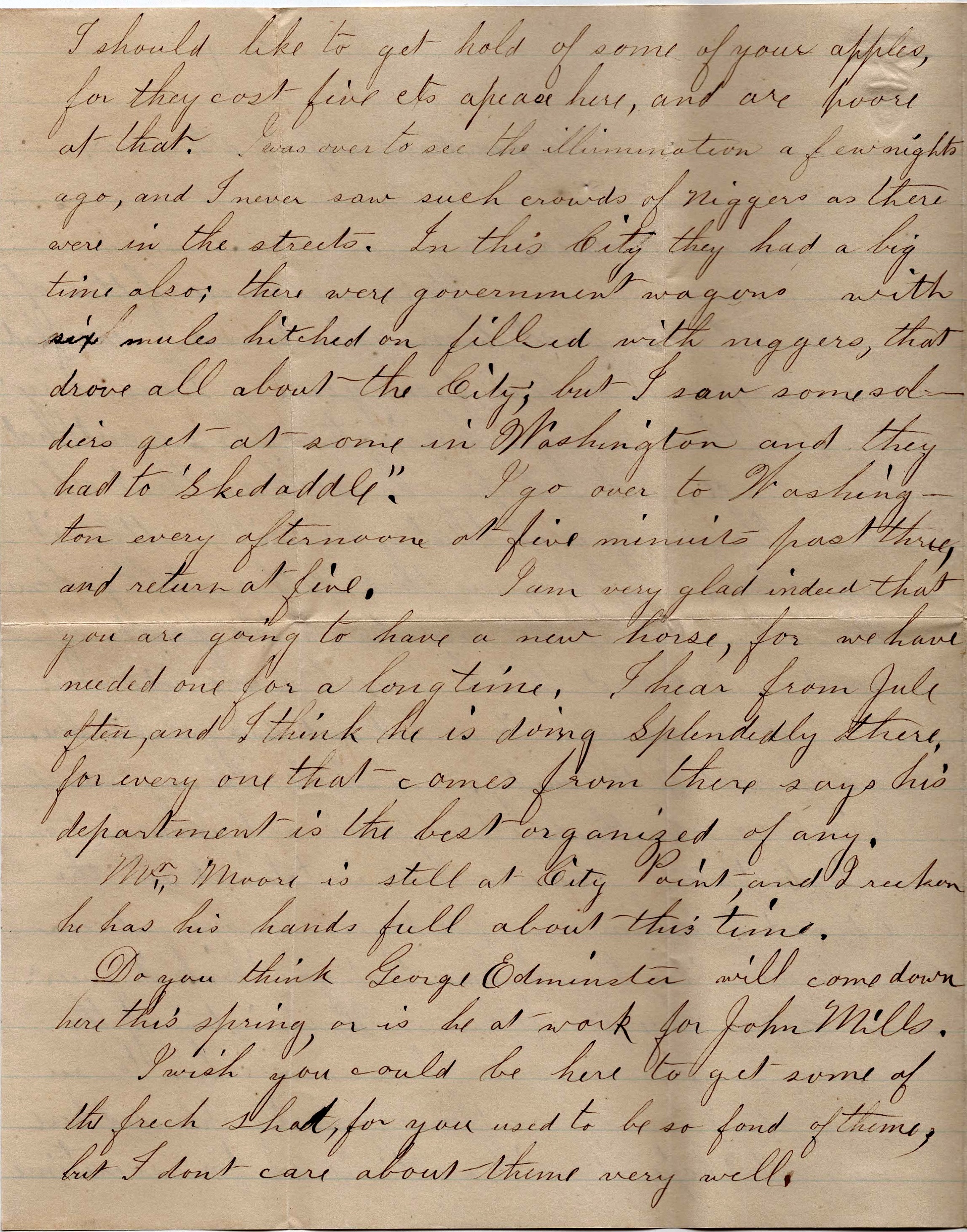
I reckon there is a fellow in Washington by the name of Jessie Turner but I have never been to see him yet. The weather is perfectly splendid here now and I hope it will continue so for some time. I should like to get some of your apples for they cost five cents apiece here and are poor at that.
I was over to see the illumination a few nights ago and I never saw such crowds of niggers as there were in the streets. In this city, they had a big time also. There were government wagons with six mules hitched on filled with niggers that drove all about the city, but I saw some soldiers get at some in Washington and they had to “skedaddle.” I go over to Washington every afternoon at five minutes past three and return at five.
I am very glad indeed that you are going to have a new horse for we have needed one for a long time. I hear from Jule often and I think he is doing splendidly there for everyone that comes from there says his department is the best organized of any.
Mr. [James J.] Moore is still at City Point and I reckon he has his hands full about this time.
Do you think George Edminster will come down here this spring or is he at work for John Mills? I wish you could be here to get some of the fresh shad for you used to be so fond of them. But I don’t care about them very well.
Tell Charlie not to let the old widow whip him when they have their battle. By the bye, why don’t Charlie ever answer any of my letters nowadays? I think Miss Cuyler must occupy a great deal of his time.
I was up in the Capitol yesterday but didn’t see anything new except that the grounds are covered with violets.
I reckon Sid must be a pretty big boy by this time and I wish he could be here about a week or so. Tell him that I took a little boy over to Washington with me the other day by the name of Mr. Pendleton Bruin, 1 Esq., but I think Sid could handle him.
Well, I have written about enough of my nonsense for one day. Please remember me to all at home and write soon. Direct to Bert Hayden, Alexandria, Va., Box 130.
Ever your affectionate son, — Bert Hayden
1 Ryland Pendleton Bruin (1859-1925) would have been almost six years old when Bert accompanied him to Washington City. Pendleton was the son of the widow Sallie Rebecca Rose (1838-1922). Sallie’s husband, Cola Bruin, died in Alexandria in 1860. He was most likely a relative of Joseph Bruin, the slave trader and keeper of the notorious slave pen on Duke Street in Alexandria. The building was the inspiration for Harriet Beecher’s Stowe’s Uncle Tom’s Cabin.


Letter 9
Alexandria [Virginia]
April 8th 1865
Dear Sid,
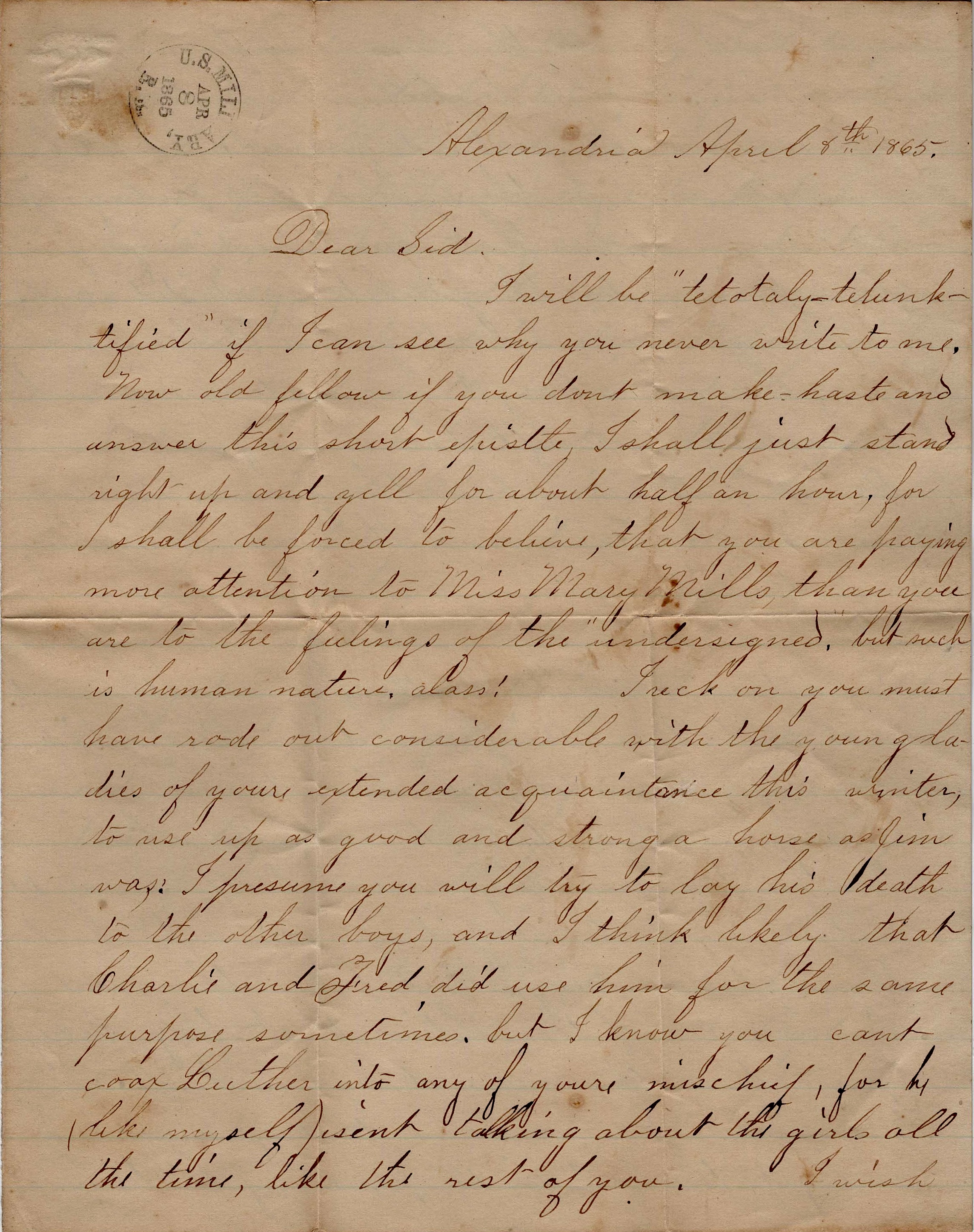
I will be “teetotally telunktified” if I can see why you never write to me. Now old fellow, if you don’t make haste and answer this short epistle, I shall just stand right up and yell for about half an hour, for I shall be forced to believe that you are paying more attention to Miss Mary Mills than you are to the feelings of the undersigned—but such is human nature, alas!
I reckon you must have rode out considerable with the young ladies of your extended acquaintance this winter, to use up as good and strong a horse as Jim was. I presume you will try to lay his death to the other boys, and I think likely that Charlie and Fred did use him for the same purpose sometimes. But I know you can’t coax Luther into any of your mischief for he (like myself) isn’t talking about the girls all the time like the rest of you.
I wish you could be here this summer to help me sell tick; though to tel you the truth, I am not over worked just at present. Of course you went to the Public last Friday night, but I am in hopes that the music did not give you a pain under the jacket as it did once.
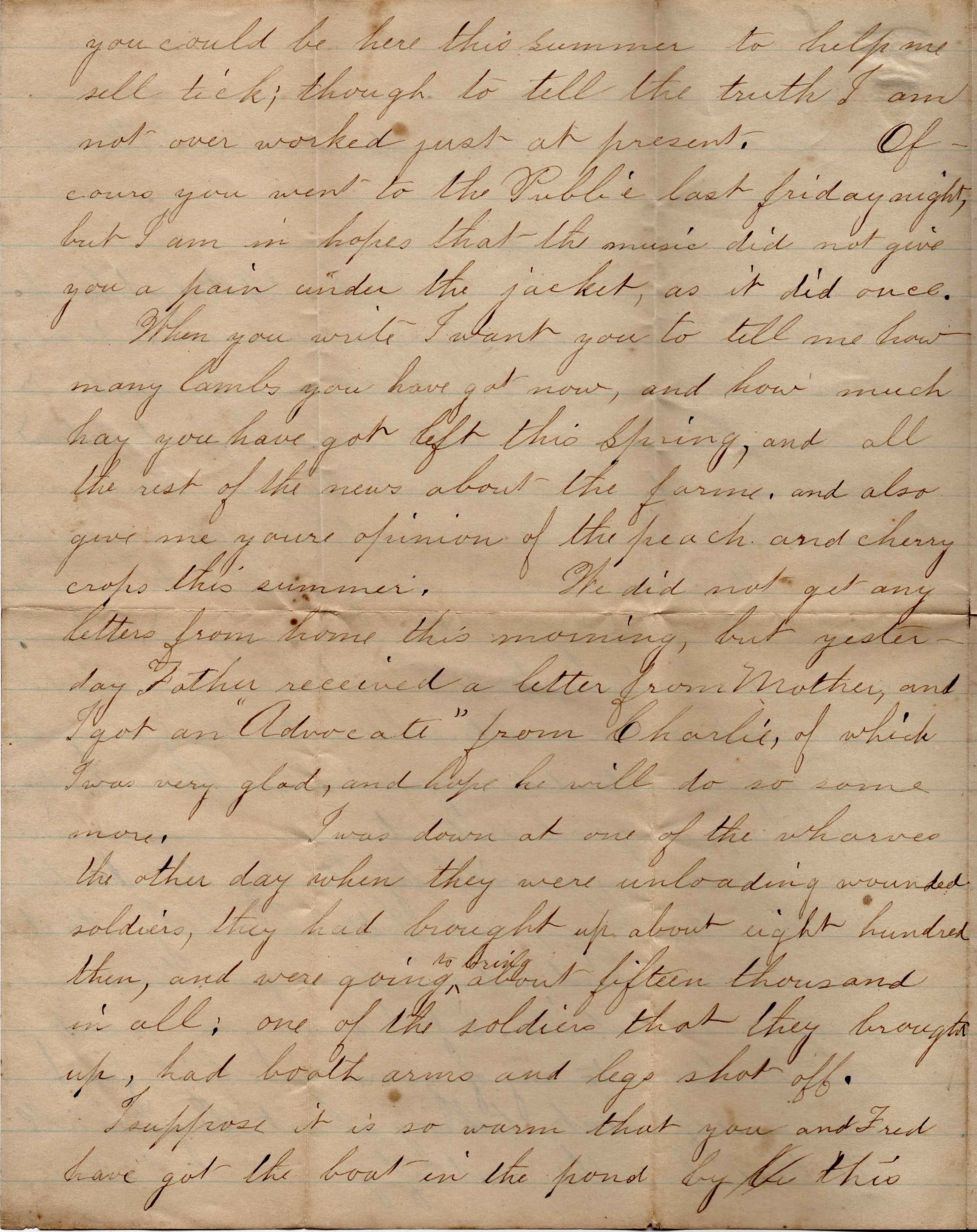
When you write, I want you to tell me how many lambs you have got now, and how much hay you have got left this Spring, and all the rest of the news about the farm. And also give me your opinion of the peach and cherry crops this summer. We did not get any letters from home his morning, but yesterday Father received a letter from Mother and I got an “Advocate” from Charlie of which I was very glad, and hope he will do so some more.
I was down at one of the wharves the other day when they were unloading wounded soldiers. They had brought up about eight hundred then and were going to bring about fifteen thousand in all. One of the soldiers that they brought up had both arms and legs shot off.
I suppose it is so warm that you and Fred have got the boat in the pond by this time, haven’t you? By the way, Sid, do you ever shoot any ducks this Spring? How does Lew Mill florish? Tell George Edminster if he don’t answer my letter, thast I will have to report him to Becky and she won’t let him go to Waverly for a month.
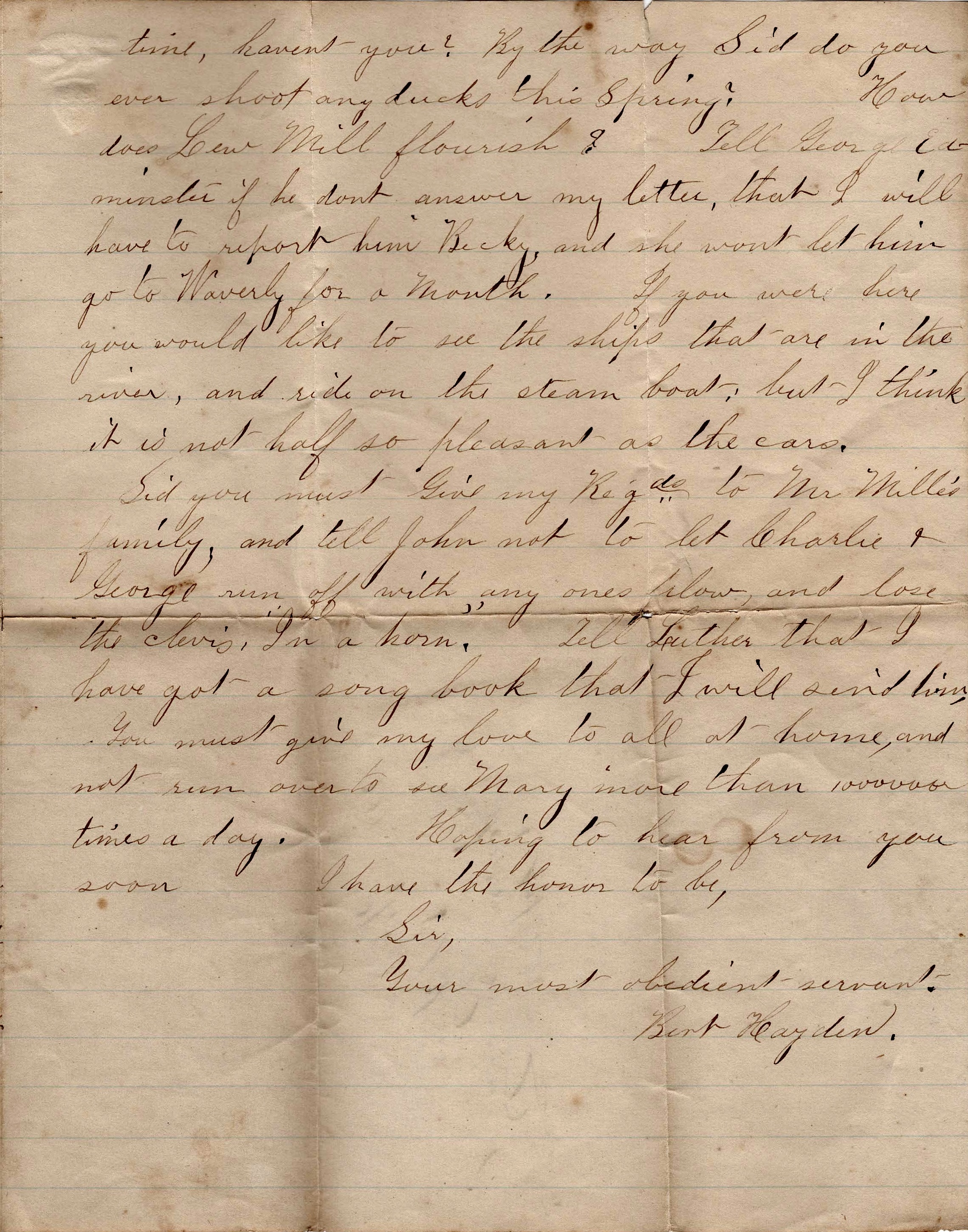
If you were here, you would like to see the ships that are in the river and ride on the steamboats. But I think it is not half so pleasant as the cars.
Sid, you must give mt regards to Mr. Mills’ family and tell John not to let Charlie & George run off with anyone’s plow and lose the clevis in a horn.
Tell Luther that I have got a song book that I will send him. You must give my love to all at home and not run over to see Mary more than 10000000 times a day. Hoping to hear from you soon. I have the honor to be, sir, your most obedient servant, — Bert Hayden
Letter 10
Alexandria [Virginia]
April 11, 1865
Dear Mother,
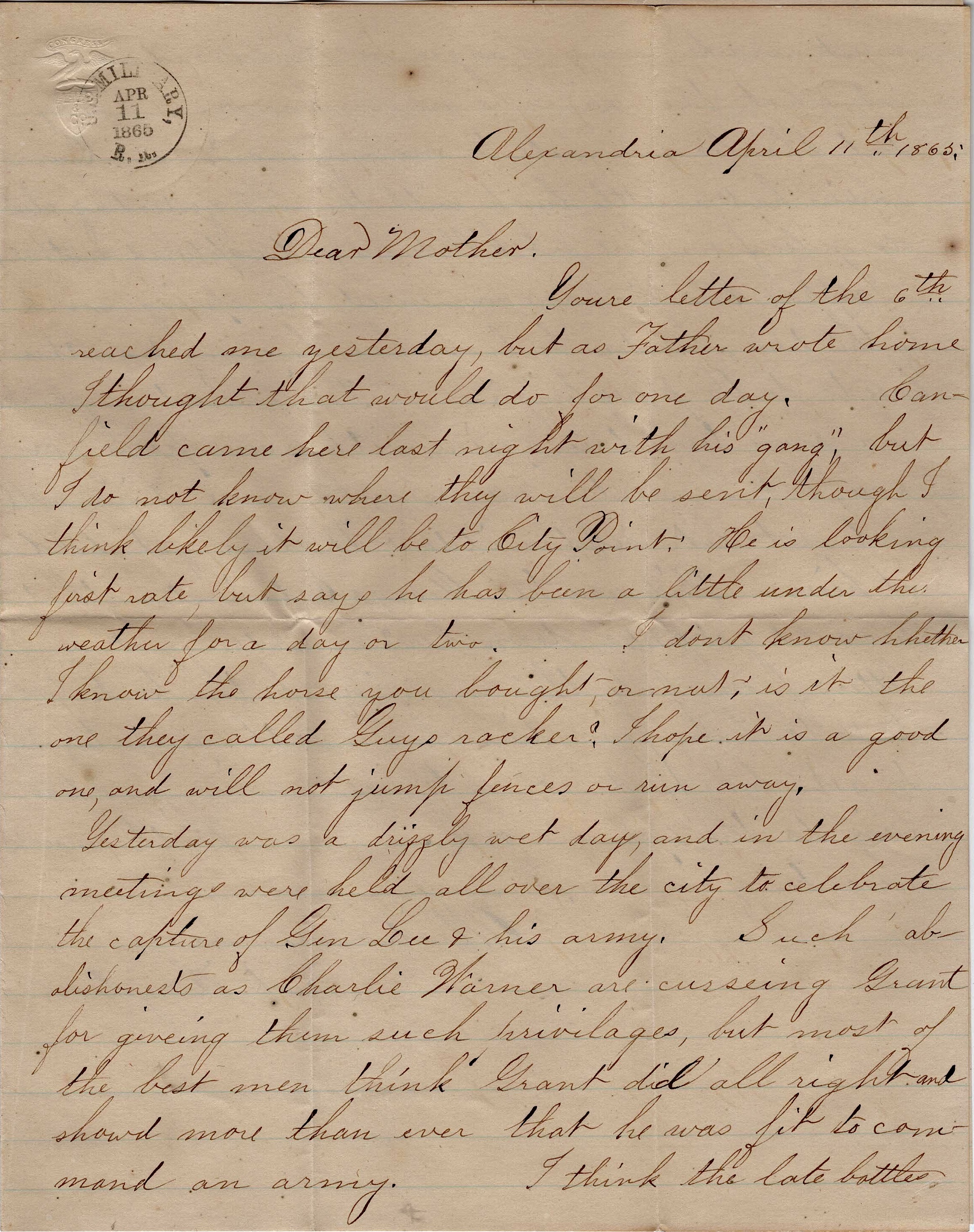
Your letter of the 6th reached me yesterday but as Father wrote home, I thought that would do for one day. Canfield came here last night with his “gang” but I do not know where they will be sent, though I think likely iy will be to City Point. He is looking first rate, but says he has been a little under the weather for a day or two.
I don’t know whether I know the horse you bought or not. Is it the one they called Guys Rocker? I hope it is a good one, and will not jump fences or run away.
Yesterday was a drizzly wet day and in the evening meetings were held all over the city to celebrate the capture of Gen. Lee and his army. Such abolitionists as Charlie Warner are cursing Grant for giving them such privileges but most of the best men think Grant did all right and showed more than ever that he was fit to command an army.
I think the late battles must make some changes in railroad matters but what they will be, no one knows.
Why don’t Charlie ever write to me anymore?
Our soldiers had a little brush with the “rebs” yesterday about six miles from here and killed one and captured another.
I suppose Charlie has commenced his spring work by this time, but does he know where we can get another horse to do the plowing? I will send my clerk home some time this spring with some pens for you, but I want you should use him well and not let old widow Miller get hold of him. Did you tell George Edminster that he could get $240 down here? Father got a letter from Jule this morning. He thinks it too bad to have Jim die when Father was trying to get him fat so as to sell him and have him to do the spring work.
With much love to you all, I remain your affectionate son, — Bert Hayden

 Spared & Shared 23