I have not yet learned the identity of this soldier who appears to have served in Co. K, Ohio Infantry, but what regiment? There are several names mentioned but I can’t place them and I can’t be certain of the signature either. Likewise, I can’t place the Camp location mentioned except possibly the one mile from the Soldier’s Home near Washington. Perhaps a Spared & Shared follower can look at this with more time than I have available.
T R A N S C R I P T I O N
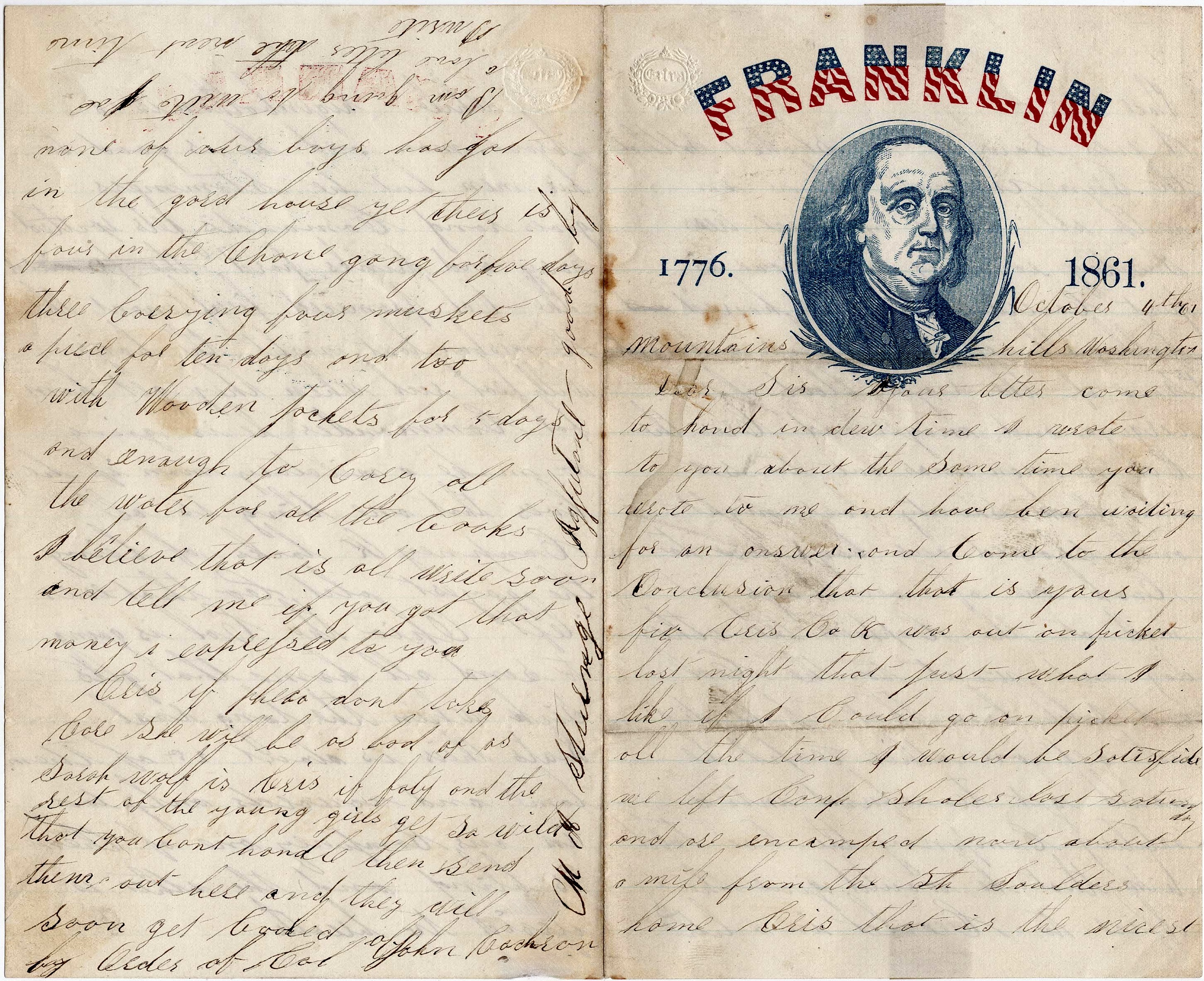
Mountains Hills, Washington October 4, 1861
Dear Sir,
Your letter came to hand in due time. I wrote to you about the same time you wrote to me and have been waiting for an answer and come to the conclusion that that is your fix. Chris, Co. K was out on picket last night. That’s just what I like. If I could go on picket all the time, I would be satisfied.
We left Camp Sholes last Saturday and are encamped now about a mile from the Soldier’s Home. Chris, that is the nicest place I ever saw. It is shaded so that the sun cannot shine in with all kinds of nice trees. Sunday evening the grove is just covered with fine haired folks. All of them have a waiter. It is some of the royal blood if Virginia and Maryland.
Chris, the colored woman out to see our cook shanty last night and showed our boys how to cook.
One of our boys got mad at the Captain the other day and went to the Colonel and told him that if he did not get another captain, he would get transferred into an artillery company. The Colonel told him that he would give the office to Crocket in a little while. Higginbottom is a brave man and he is good to his men, but he stammers, gives wrong commands, gets excited easy, and drinks hard. The Colonel promised Lieutenant the commission last night. The boys will feel rich when they get him for commander. He is going to make a military man if he lives. That one thing is all Company K lacks of being the gayest old company that ever left Ohio. The Colonel is going to send all home that gets sick when the long roll beats. There is about 25 of them lame and cowards. Only two in our company. One of them is blind and the other is afraid to breathe.
None of our boys has got in the guard house yet. There is four in the chain gang for five days, three carrying four muskets apiece for ten days, and two with wooden pockets for five days and enough to carry all the water for all the cooks.
I believe that is all. Write soon and tell me if you got that money I expressed to you. Chris, if Phebe don’t take Cole, she will be as bad off as Sarah Wolf is. Chris, if Foty and the rest of the girls get so wild that you can’t handle them, send them out here and they will soon get cooled off by order of Col. John Cochran.
The following letter was written by Alfred Wanamaker (1832-1909) from his regiment’s encampment near Robert E. Lee’s Arlington House in Virginia in late October 1861. It was addressed to him wife, Melissa A. Webster (1840-1901). At the time of the 1860 US Census, Alfred and Melissa were residing in Flemington, Hunterdon county, New Jersey where he was employed as a blacksmith.
A veteran’s card indicates that in September 1862, at the time of Lee’s Maryland Invasion, Alfred served for a couple weeks in the 17th Pennsylvania Militia, Co. C, reporting from Bucks County, Pennsylvania.
It isn’t clear what regiment Alfred was serving in when he wrote this letter since the 17th Pennsylvania Militia was not activated at the time. His service record at Fold 3 and Find-A-Grave obituary yields no additional information but it must certainly be the same individual.
T R A N S C R I P T I O N
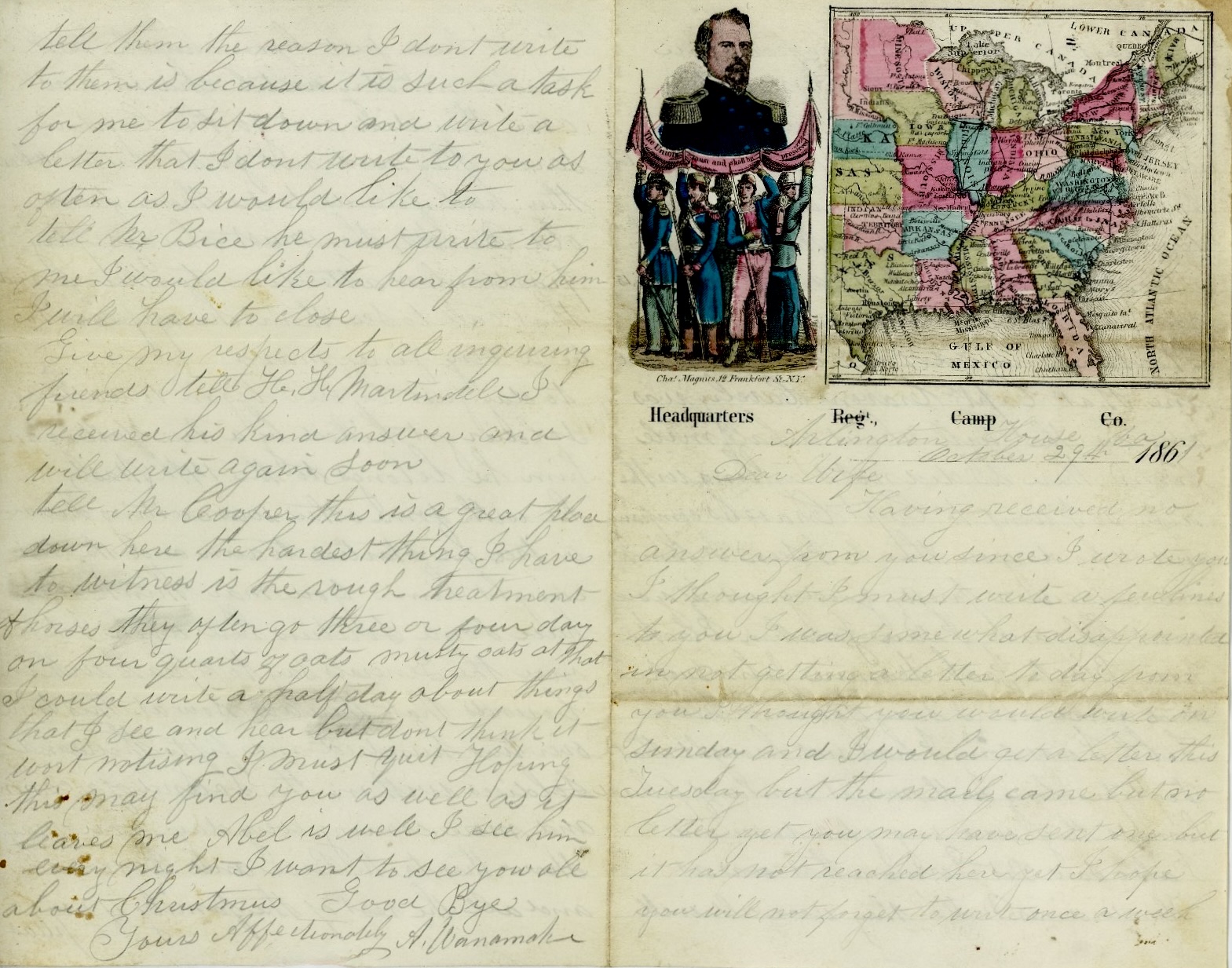
Arlington House, Virginia October 29th 1861
Dear Wife
Having received no answer from you since I wrote you, I thought I must write a few lines to you. I was somewhat disappointed in not getting a letter today from you. I thought you would write on Sunday and I would get a letter this Tuesday but the mail came but no letter yet. You may have sent one but it has not reached here yet. I hope you will not forget to write once a week at least for if I can hear from you all once a week I will try not to complain as long as you all keep well.
Last Sunday I thought I would take a trip over to Washington and two or three miles the other side to [where] the New Jersey 5th, 6th, 7th, & 8th regiments are encamped and I saw Gardiner Stockton and Ed Forker and Ed told me that Capt. [Andrew] Craven’s Cavalry was over on the hill about a half mile from there so I did not stay long with him. So I went to Capt. Craven’s company [M] and who do you think I seen? I think you can give a pretty good guess. If you can’t, Lib can. I saw Jonathan Black, Jesse Black, Jack Fesmire, John Duck, and above all I saw Simon. Tell Libby I was sorry I had not brought that dogtype [daguerreotype] along with me. It would of pleased him so. They were very glad to see me. I also saw Pat Garman that was at Kenderdine’s Mills. They were all well. I got there just before lunch as I could not stay until church was over. They did not go. The Captain said they need not go to church when they had friends to see them from old Bucks [county]. They must always pay particular attention to their friends that call to see them. He appears to be a very fine man.
Today just before I began to write, a soldier got killed by a tree falling on him. He belongs to the 14th Massachusetts. He with some others was cutting down a tree. He started to run and the tree caught him.
You may think we have some soldiers here when I tell you the Generals say to speak within bounds that there are now at this time over two hundred and fifty thousand soldiers within the sound of a cannon and more coming every day. You may show this to Mr. Rice and Barson and all the rest of the family if you please. Tell them the reason I don’t write to them is because it is such a task for me to sit down and write a letter that I don’t write to you as often as I would like to. Tell Mr. Bice he must write to me. I would like to hear from him. I will have to close.
Give my respects to all enquiring friends. Tell H. H. Martindell I received his kind answer and will write again soon. Tell Mr. Cooper this a great place down here. The hardest thing I have to witness is the rough treatment of horses. They often go three or four days on four quarts of oats—musty oats at that. I could write a half day about things that I see and hear but don’t think it worth writing. I must quit. Hoping this may find you as well as it leaves me. Abel is well. I see him every night. I want to see you all about Christmas. Goodbye. Yours affectionately, A. Wanamaker
The identity of this soldier may be lost to history, but the essence of their message resonates powerfully among countless Union soldiers witnessing the war’s end—an end that promises the restoration of the Union, yet carries a seismic shift: the abolishment of slavery on a national scale.
T R A N S CR I P T I O N
Mother, I want you be patient with me a few moments longer. There are some events taking place at the Capitol that proves that our bleeding has not been in vain. On Tuesday, the last day of January, Congress did at the City of Washington then and there sitting, by a two-third vote of both houses, pass a resolution amending the Constitution, so as to abolish the institution Slavery that has come so near to destroy us as a nation. It is wiped off we hope forever. Since this war commenced Maryland [and] Missouri have by the volunteer act of their own legislatures become free states. Washington, the National Capitol, instead of being a mart for the sale of human chattel has become free & now forever our dear old flag floats to the wind. It floats over freeman. It has cost oceans of blood to wash out the stain from our nation’s character, but mother, we will be thankful that it is done at last. It is worth something to have lived and acted in this great revolution. It is worth more to have been on the right side. The consciousness that in this life struggle we wrestle for our country, not against her. It is worth something to remember that when our country was fighting for existence, we were not “copperheads.” We have given dear loved ones in our country’s cause. They have fallen with their harness on; although we may mourn their loss, we are not ashamed of their memory.
Mother, don’t think me altogether a coward when I say that I wish that the efforts now being made may end in peace. I don’t want the government to abate any just demands nor stop until the old sore is cut completely out by the roots and the Johnnie’s acknowledge that Uncle Samuel is the only Boss that can be tolerated in this country, but I would be glad if peace came soon.
I learn that you have been very sick ever since I came away. Hope that this may find you on the gain. I want you to make up your mind to live until I come home again. One can’t always live as long as they are a mind to, but the will has a good deal to do with it. I think if I live to come home again, that my duty will be at home the rest of my days. Don’t think that they will get me in the army again. Think that I can afford to stay home.
If you get well enough to write, won’t you write me a letter. If not, have Mary write for you. I think Dad might write if he is a mind to. Tell me if any of you have heard from Bud since the Battle of Nashville. I wrote a letter to Tinan [?] some 3 or 4 weeks ago. Got no answer. Wrote our brother Cyrus some 1 week ago. Got no answer. How bad I feel.
I must close this. Remember me in your prayers. Pray that I may do my duty. If I ever come back, no one can say that we run away from the foe. Goodbye. God grant we may see each other in peace. Five my love to dad, Mary, and the little folks, — Con
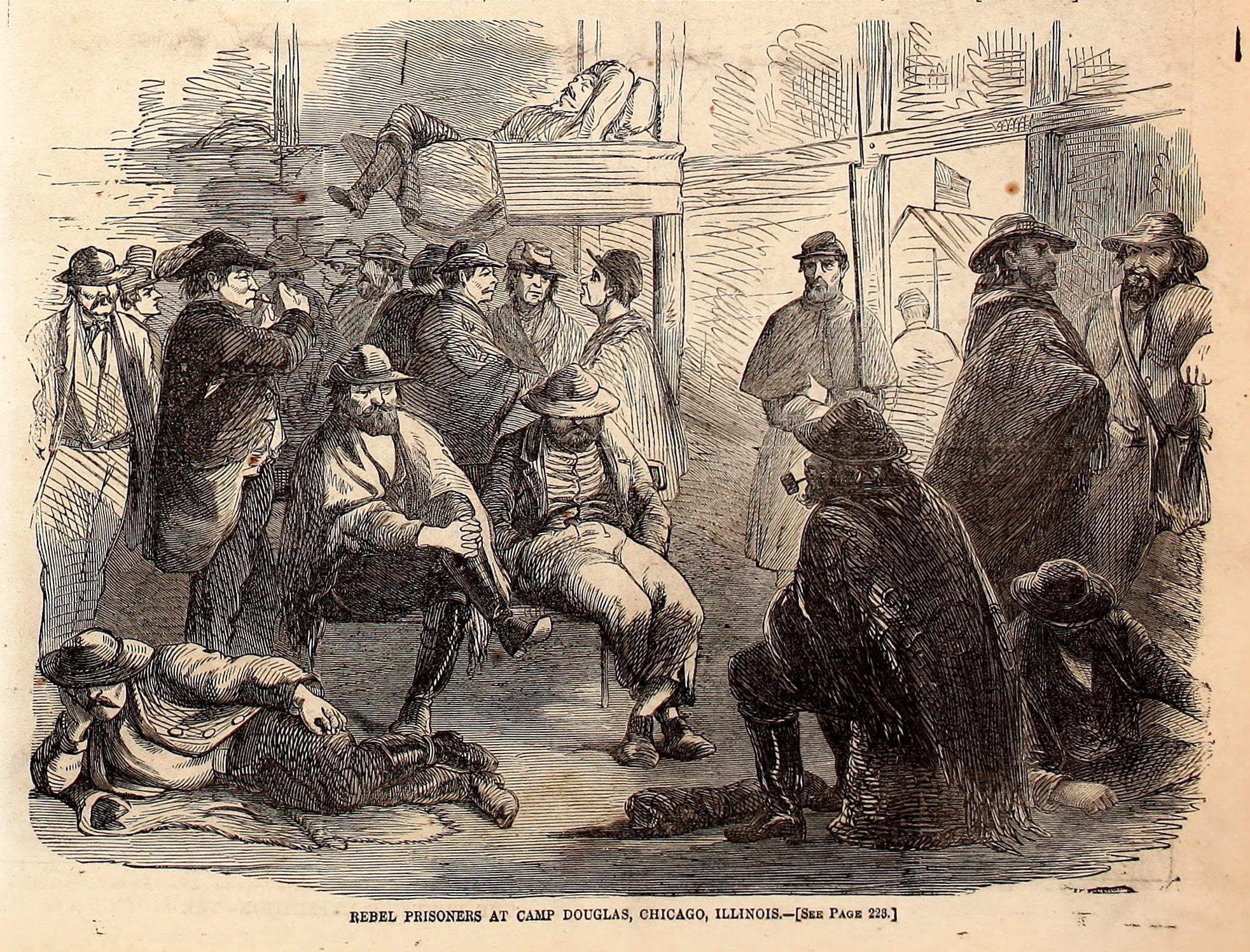
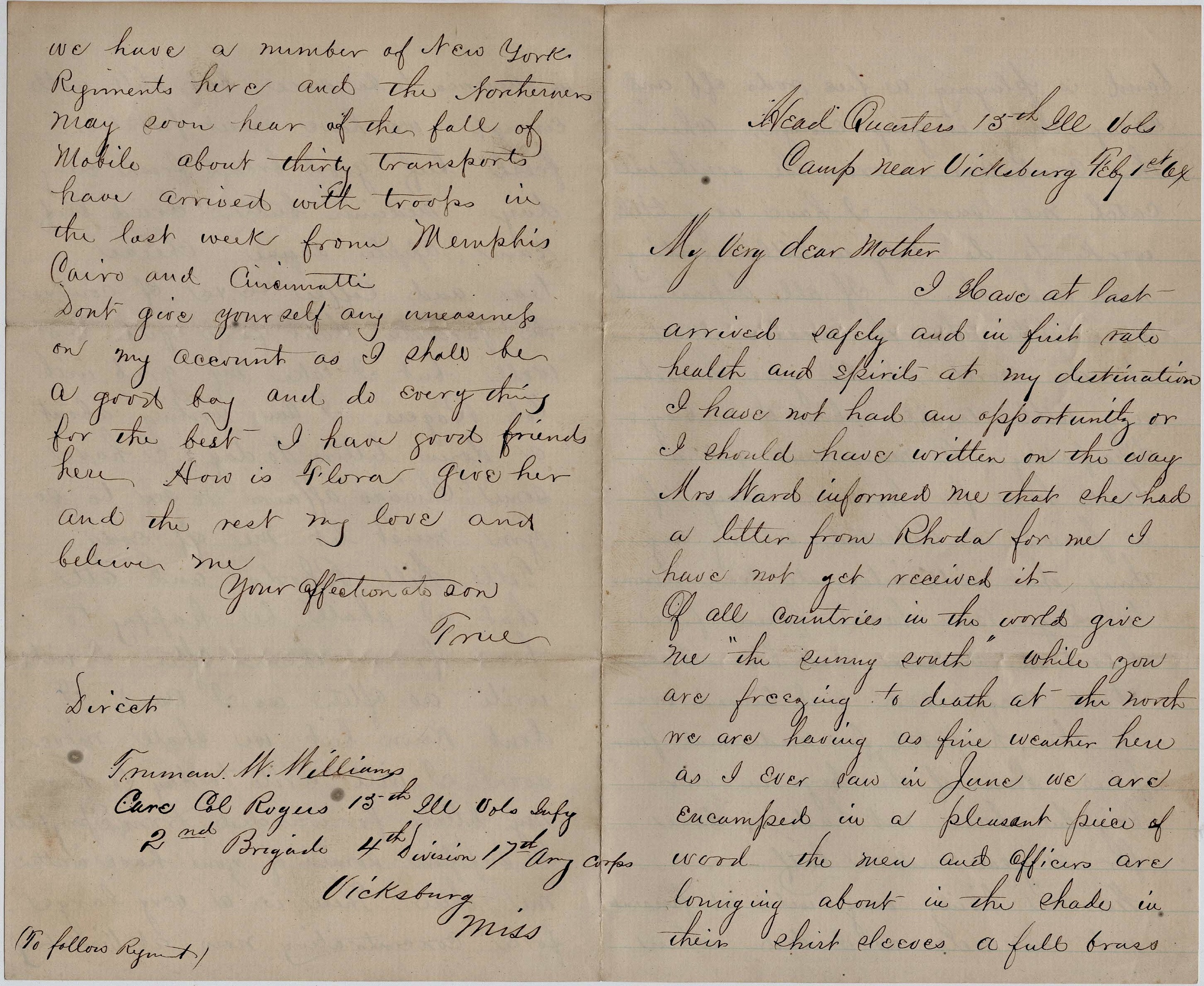
These letters were written by Truman (“True”) W. Williams (1839-1897) who grew up in Watertown, New York, the son of Asa and Louisa Keelar Williams. He was a self-taught illustrator and one of his earliest published works appeared in Harpers Weekly (April 1862) depicting rebel prisoners at Camp Douglas near Chicago (see below). In mid-December 1863, he enlisted in Co. E, 15th Illinois Infantry at Chicago. When he enlisted, he was described as standing 5′ 8″ tall, with hazel eyes, and dark hair. He was with the regiment until the spring of 1864 when he was attached to the topographical engineers. After mustering out of the service in October 1865, he pursued his career in illustrations and was best known for illustrating books for Mark Twain. [see Biographical Sketch]
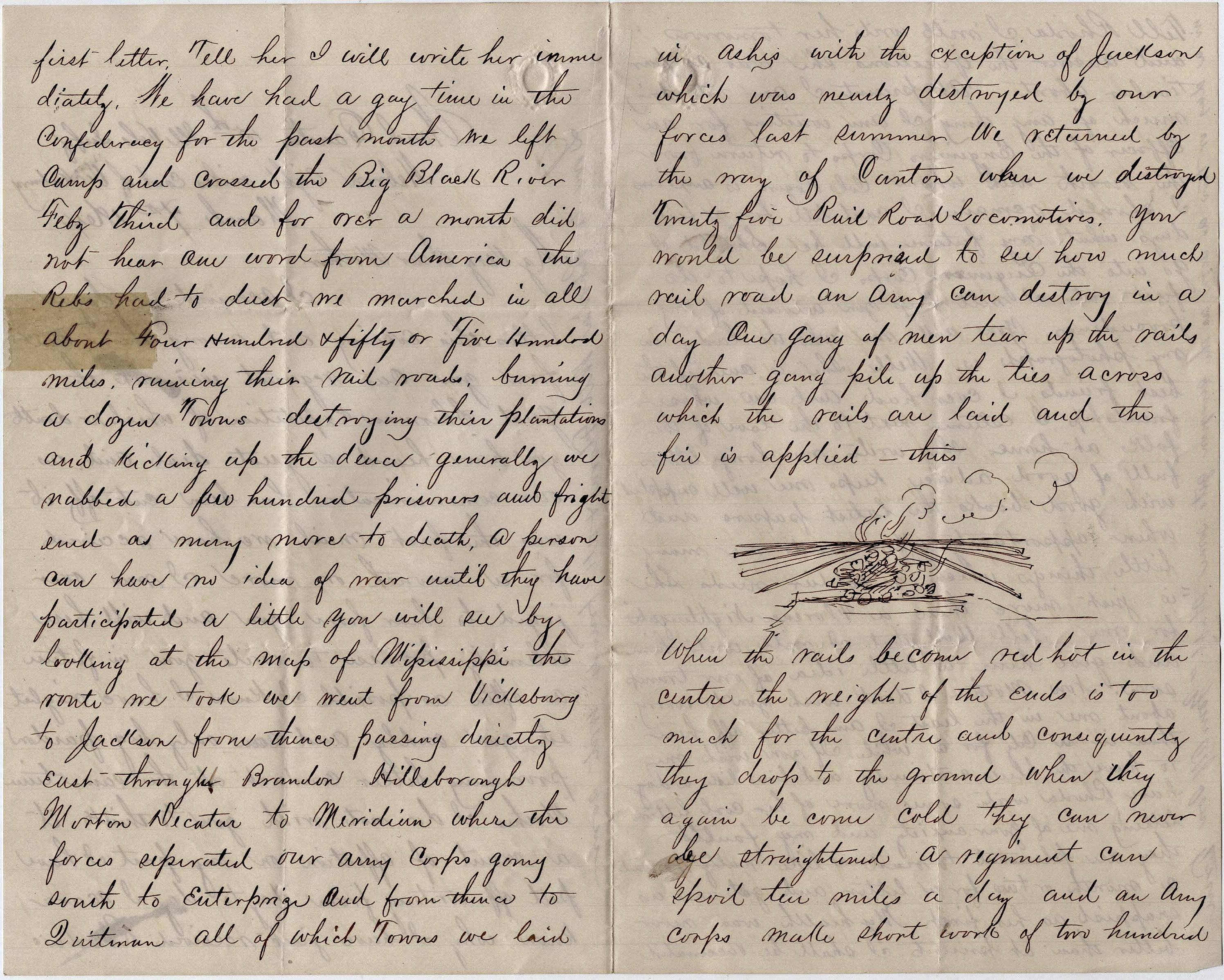
In one of the letters presented here, Truman gives us a sketch of the method used by Sherman’s army to bend the rails of the tracks torn up during his Meridian Expedition in the early spring of 1864. His sketch would have been made by direct observation. See Sherman’s Neckties.
Letter 1
Headquarters 15th Illinois Vols. Camp near Vicksburg February 1st 1864
My very dear mother,
I have at last arrived safely and in first rate health and sprits at my destination. I have not had an opportunity or I should have written on the way, Mrs. Ward informed me that she had a letter from Rhoda for me. I have not yet received it.
Of all countries in the world, give me “the Sunny South.” While you are freezing to death at the North, we are having as fine weather here as I ever saw in June. We are encamped in a pleasant piece of wood. The men and officers are lounging about in their shirt sleeves, a full brass band is playing a few rods off, and everything is gay enough. When this cruel war is over the South will catch me sure.
I have very little work to do—only a little writing now and then. If all departments were like this, the anxious mothers at the North should give themselves very little trouble about their boy’s dissipating. A man can’t get a drink here for love or money. If a person is detected selling anything that will intoxicate even down to lager beer, he is fined five hundred dollars and his whole stock confiscated and turned over to the hospital for medicinal purposes. Some of the boys in our brigade have not had a dose for a year and a half.
We are living very well at present. Not as well as I did when in America to be sure, but still well enough. We have sweet potatoes, fresh beef, good bread fresh every day, medium butter, dried beef, ham, apple sauce, cheese, tea, and coffee, &c. &c. Of course the privates don’t fare quite as well but I take my grub with Col. Rogers. I am writing about a dozen letters today. I have some Chicago affairs to see to so you must let me off easy.
Tell Will, Rhoda, and all that I shall be happy to hear from them often. I wil write as often as I can. I don’t know but we shall move soon. I will write today to have my letters forwarded from Springfield. I suppose some of you have written me there.
There is a very large force concentrating now at Vicksburg. We have a number of New York Regiments here and the Northerners ,ay soon hear of the fall of Mobile. About 30 transports have arrived with troops in the last week from Memphis, Cairo and Cincinnati.
Don’t give yourself any uneasiness on my account as I shall be a good boy and do everything for the best. I have good friends here. How is Flora? Give her and the rest my love and believe me your affectionate son, — True
Direct to Truman W. Williams, Care of Col. Rogers, 15th Illinois Vols. Infantry, 2nd Brigade, 4th Division, 17th Army Corps, Vicksburg, Mississippi
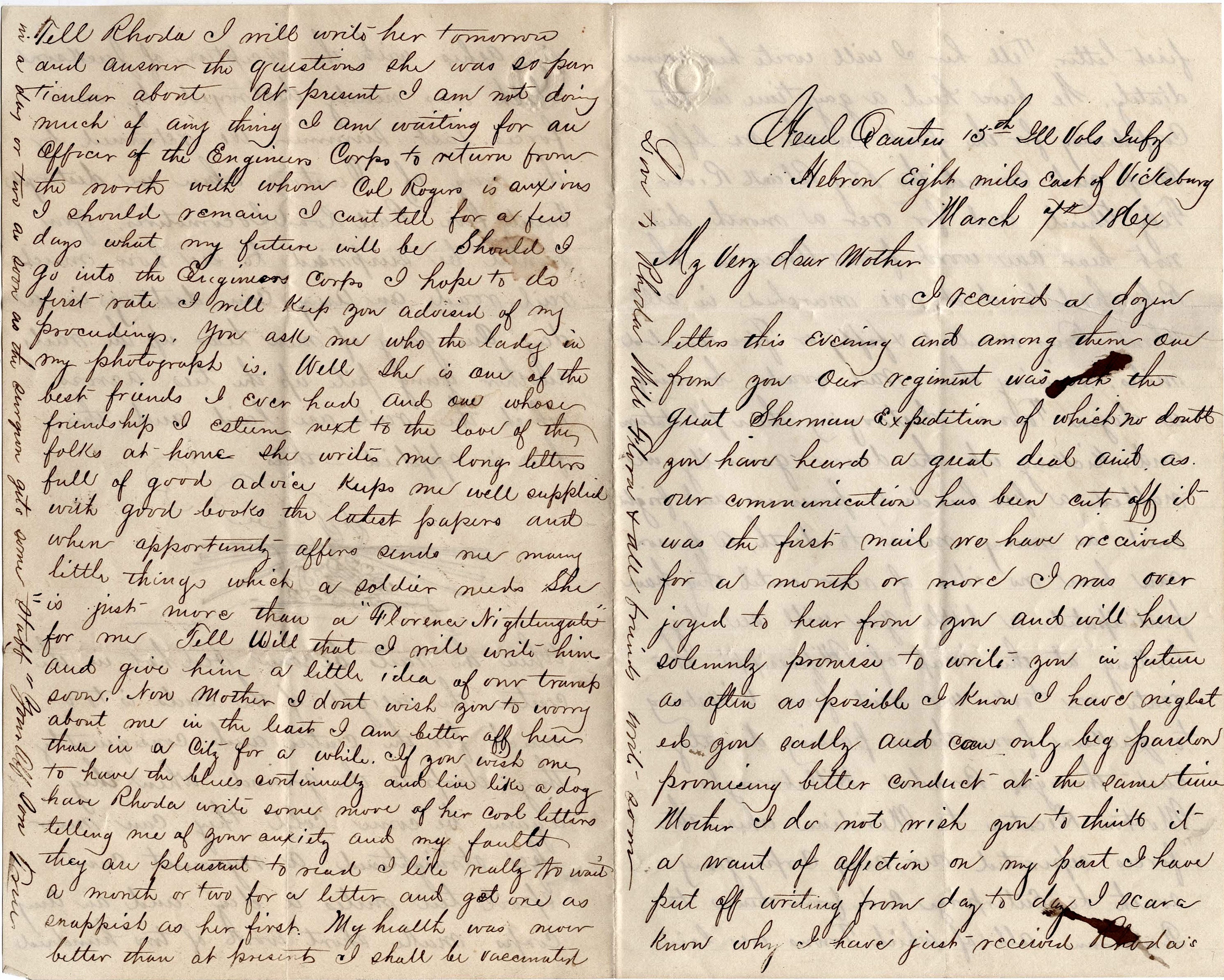
Letter 2
Headquarters 15th Ill. Vols. Infantry Hebron, eight miles east of Vicksburg March 7, 1864
My very dear mother,
I received a dozen letters this evening and among them one from you. Our regiment was with the great Sherman [Meridian] Expedition of which no doubt you have heard a great deal, and as our communication has been cut off, it was the first mail we have received for a month or more. I was overjoyed to hear from you and will here solemnly promise to write you in future as often as possible. I know I have neglected you sadly and can only beg pardon promising better conduct at the same time. Mother I do not wish you to think it a want of affection on my part I have put off writing from day to day. I scarce know why. I have just received Rhoda first letter. Tell her I will write to her immediately.
We have had a gay time in the Confederacy for the past month. We left camp and crossed the Big Black River February 3rd and for over a month did not hear one word from America. The rebs had to dust. We marched in all about 450 or 500 miles, ruining their railroads, burning a dozen towns, destroying their plantations and kicking up the deuce generally. We nabbed a few hundred prisoners and frightened as many more to death. A person can have no idea of war until they have participated a little. You will see by looking at the map of Mississippi the route we took. We went from Vicksburg to Jackson, from thence passing directly east through Brandon, Hillsborough, Morton, Decatur, to Meridian where the forces separated, our Army Corps going south to Enterprise and from thence to Quitman, all of which towns we laid in ashes with the exception of Jackson which was nearly destroyed by our forces last summer.
We returned by the way of Canton where we destroyed 25 railroad locomotives. You would be surprised to see how much railroad an army can destroy in a day. Our gang of men tear up the rails, another gang pile up the ties across which the rails are laid and the fire is applied—thus [sketch]
Sketch of method used by Sherman’s army to bend the track rails by heating them over a fire.
When the railrs become red hot in the center, the weight of the ends is too much for the center and consequently they drop to the ground when they again become cold. They can never be straightened. A regiment can spoil ten miles a day and an ARmy Corps make short work of two hundred.
Tell Rhoda I will write her tomorrow and answer the questions she was so particular about. At present I am not doing much of anything. I am waiting for an officer of the Engineers Corps to return from the North with whom Col. Rogers is anxious I should remain. I can’t tell for a few days what my future will be. Should I got into the Engineers Corps, I hope to do first rate. I will keep you advised of my proceedings.
You ask me who the lady in my photograph is. Well she is one of the best friends I ever had and whose friendship I esteem next to the love of the folks at home. She writes me long letters full of good advice, keeps me well supplied with good books, the latest papers, and when opportunity offers, seds me many little things which a soldier needs. She is just more than a “Florence Nightingale” for me.
Tell Will that I will write him and give him a little idea of our tramp soon. Now mother, I don’t wish you to worry about me in the least. I am better off here than in a City for a while. If you wish me to have the blues continually and live like a dog, have Rhoda write some more of her cool letters telling me of your anxiety and my faults. They are pleasant to read. I like really to wait a month or two for a letter and get one as snappish as her first. My health was never better than at present. I shall be vaccinated in a day or two as soon as the surgeon gets some”stuff.” Your affectionate son, — True
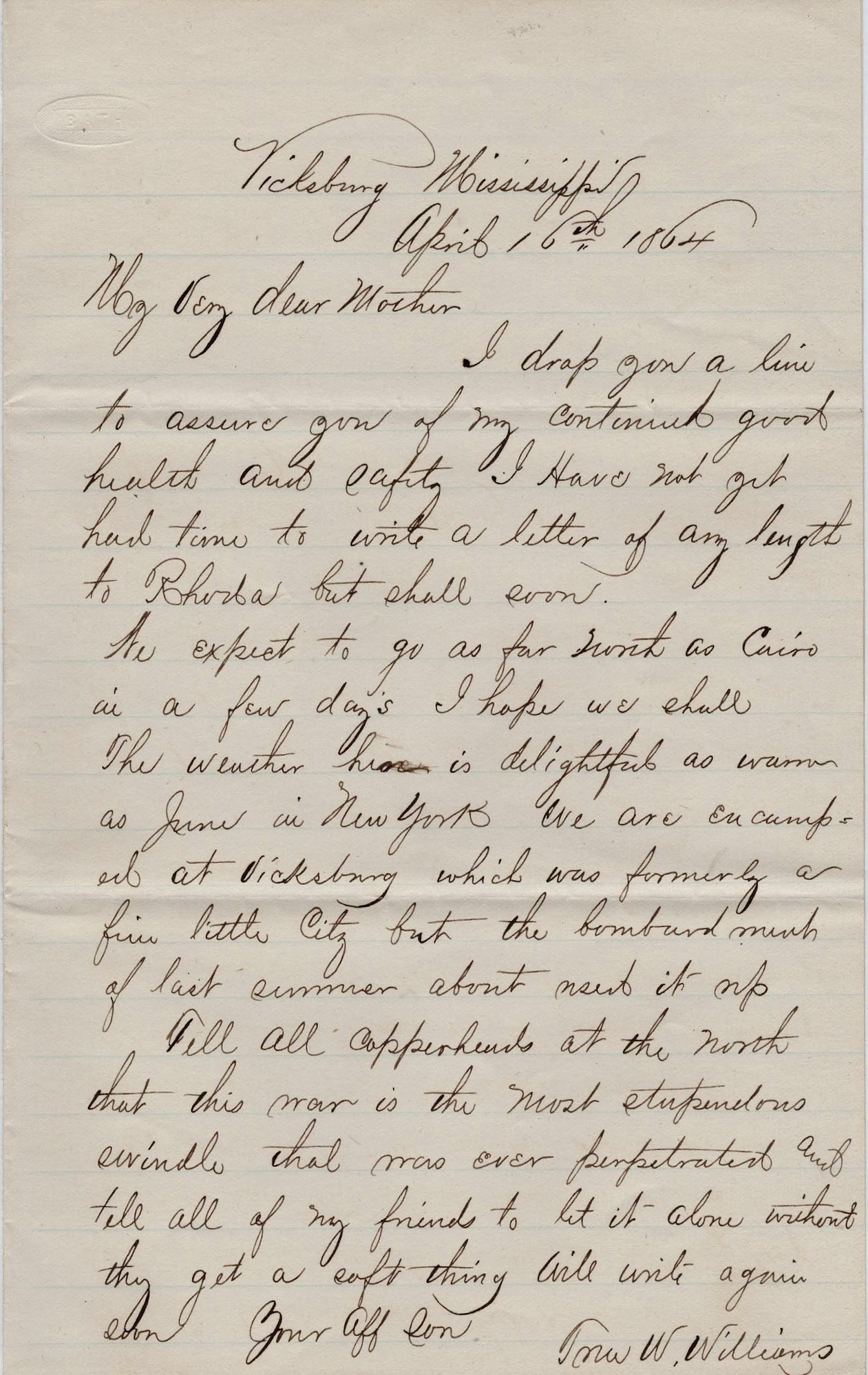
Letter 3
Vicksburg, Mississippi April 16th 1864
My very dear mother,
I drop you a line to assure you of my continued good health and safety. I have not yet had time to write a letter of any length to Rhoda but shall soon.
We expect to go as far north as Cairo in a few days. I hope we shall. The weather is delightful—as warm as June in New York. We are encamped at Vicksburg which was formerly a fine little city but the bombardment of last summer about used it up.
Tell all Copperheads at the North that this war is the most stupendous swindle that was ever perpetrated and tell all of my friends to let it alone without they get a soft thing. Will write again soon. Your affectionate son, Tru W. Williams
Letter 4
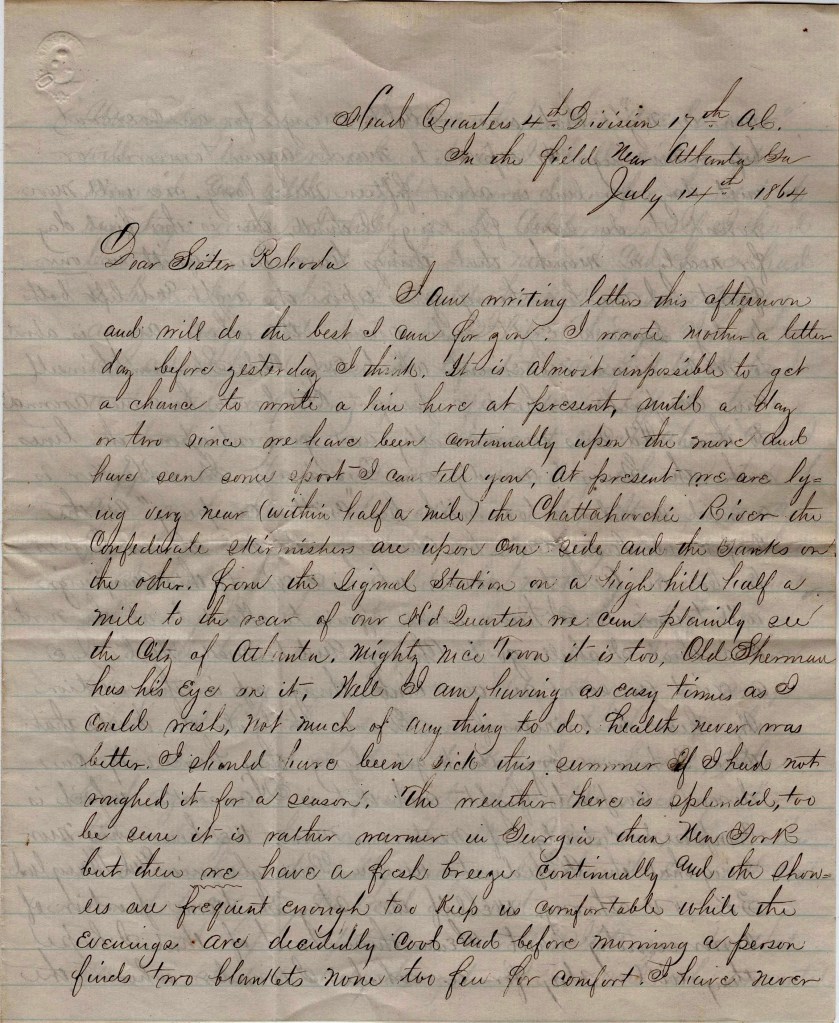
Headquarters 4th Division 17th Army Corps In the field near Atlanta, Ga. July 14, 1864
Dear Sister Rhoda,
I am writing letters this afternoon and will do the best I can for you. I wrote Mother a letter day before yesterday I think. It is almost impossible to get a chance to write a line here at present. Until a day or two since, we have been continually upon the move and have seen some sport, I can tell you. At present we are lying very near (within half a mile) of the Chattahoochee River. The Confederate skirmishers are upon one side and the Yanks on the other. From the Signal Station on a high hill half a mile to the rear of our headquarters, we can plainly see the City of Atlanta. Mighty nice town it is too. Old Sherman has his eye on it.
Well, I am having as easy times as I could wish. Not much of anything to do. Health never was better. I should have been sick this summer if I had not roughed it doe a season. The weather here is splendid to be sure. It is rather warmer in Georgia than New York but there we have a fresh breeze continually and the showers are frequent enough to keep us comfortable while the evenings are decidedly cool and before morning a person finds two blankets none to few for comfort. I have never seen a night that was not cold enough for an overcoat before morning.
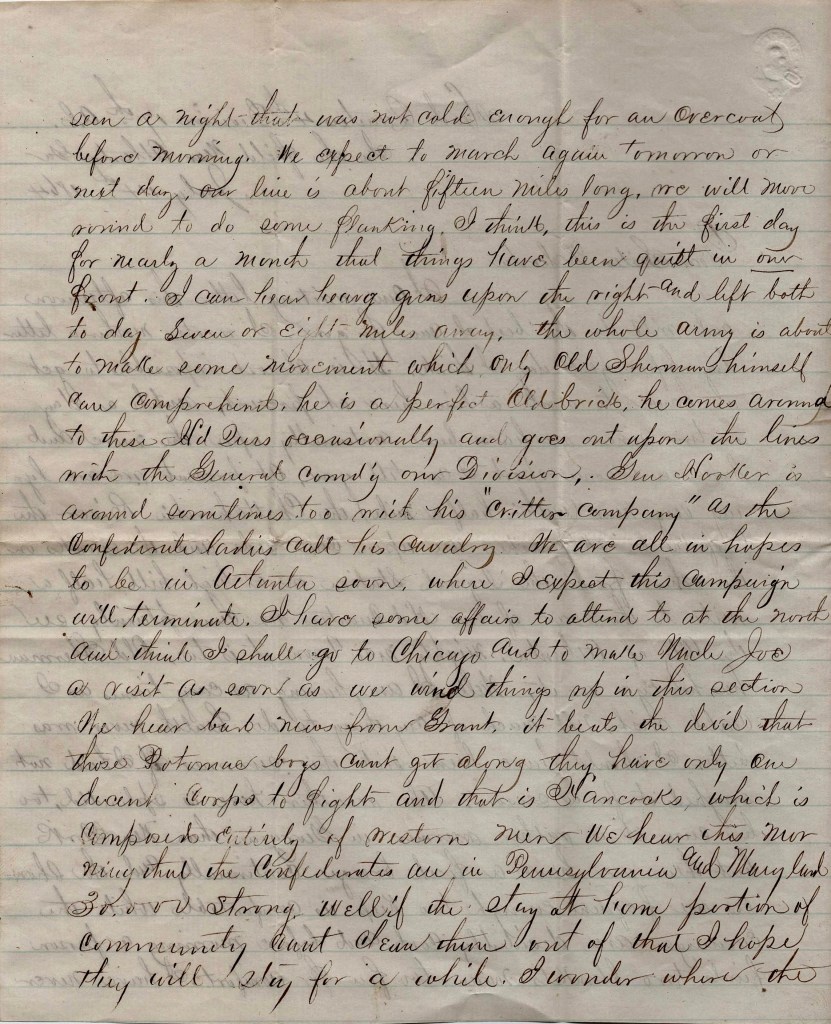
We expect to march again tomorrow or next day. Our line is about fifteen miles long. We will move round to do some flanking, I think. This is the first day for nearly a month that things have been quiet in our front. I can hear heavy guns upon the right and left both today, seven or eight miles away. The whole army is about to make some movement which only Old Sherman himself can comprehend. He is a perfect old brick. He comes around to the headquarters occasionally and goes out upon the lines with the General commanding our Division. Gen. Hooker is around sometimes too with his “critter company” as the Confederate ladies call his cavalry.
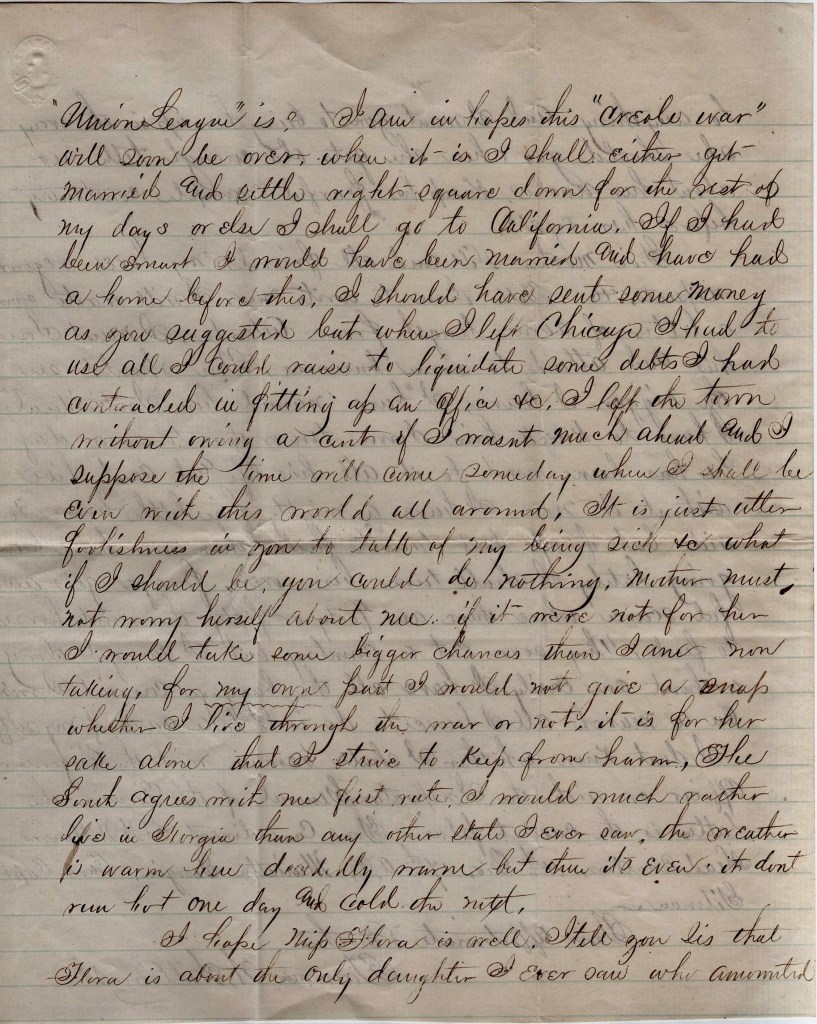
We are all in hopes to be in Atlanta soon where I expect this campaign will terminate. I have some affairs to attend to at the North and think I shall go to Chicago and to make Uncle Joe a visit as soon as we wind things up in this section. We hear bad news from Grant. It beats the devil that those Potomac boys can’t get along. They have only one decent Corps to fight and that is Hancock’s, which is composed entirely of western men. We hear this morning that the Confederates are in Pennsylvania and Maryland 30,000 strong. Well, if they stay at home portion of community can’t clear them out of that, I hope they will stay for a while. I wonder where the “Union League” is? I am in hopes this “creole war” [cruel war] will soon be over. When it is, I shall either get married and settle right square down for the rest of my days or else I shall go to California. If I had been smart, I would have been married and have had a home before this.
I should have sent some money as you suggested but when I left Chicago, I had to use all I could raise to liquidate some debts I had contracted in fitting up an office &c. I left the town without owing a cent if I wasn’t much ahead and I suppose the time will come someday when I shall be even with this world all around. It is just utter foolishness in you to talk of my being sick &c. What is I should be? You could do nothing. Mother must not worry herself about me. If it were not for her, I would take some bigger chances than I am now taking. For my own part, I would not give a snap whether I live through the war or not. It is for her sake alone that I strive to keep from harm. The South agrees with me first rate. I would much rather live in Georgia than any other state I ever saw. The weather is warm here—decidedly warm—but then it’s even. It don’t run hot one day and cold the next.
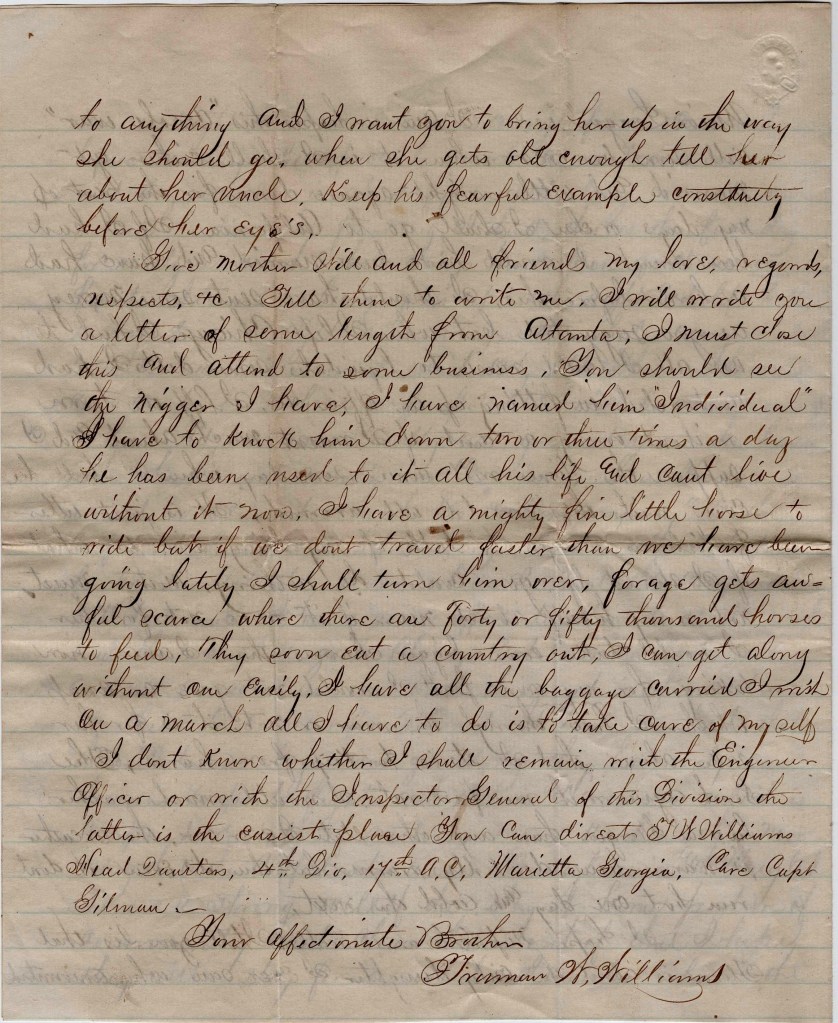
I hope Miss Flora is well. I tell you, sis, that Flora is about the only daughter I ever saw who amounted to anything and I want you to bring her up in the way she should go. When she gets old enough, tell her about her uncle. Keep his fearful enough example constantly before her eyes.
Give mother, Will, and all friends my love, regards, respects, &c. Tell them to write me. I will write you a letter of some length from Atlanta. I must close this and attend to some business. You should see the nigger I have. I have named him “Individual.” I have to knock him down two or three times a day. He has been used to it all his life and can’t live without it now. I have a mighy fine little horse to ride but if we don’t travel faster that we have been going lately, I shall turn him over. Forage gets awful scarce where there are 40 or 50,000 horses to feed. They soon eat a country out. I can get along without one easily. I have all the baggage carried I wish on a march. All I have to do is to take care of myself.
I don’t know whether I shall remain with the Engineer Officer or with the Inspector General of this Division. The latter is the easiest place. You can direct to T. W. Williams, Headquarters, 4th Division, 17th Army Corps, Marietta, Georgia. Care Capt. Gilman
I initially endeavored to transcribe this letter in hopes of identifying its anonymous author, yet, regrettably, there are insufficient clues to arrive at a conclusive determination. My initial impression suggested a male author; however, the content, along with the handwriting and penmanship, compels me to surmise that it was a female addressing her sister. It is my assertion that she was the mother of the young boy referred to as “Willie” in this correspondence, who had the distinguished opportunity to shake President Buchanan’s hand during what was likely one of his final White House receptions prior to his departure from office, the last of which took place on 12 February 1861.
The author asserts that “Mr. Deming” was also present at the White House reception, and I am inclined to believe that he may have been her husband. During the mid-19th century, it was common for wives to refer to their spouses in such formal terms in correspondence. In my research for residents of Washington City in 1860 with the surname Deming, I identified a government clerk named Chester Deming (1814-1862), who had a son named William born in 1850; however, the extended family tree was not sufficiently detailed to establish a definitive connection.
I’ve published the letter on Spared & Shared regardless because I find the content interesting and hope you will too.
Patriotic fervor in 1861 among the children. (LOC)
T R A N S C R I P T I O N
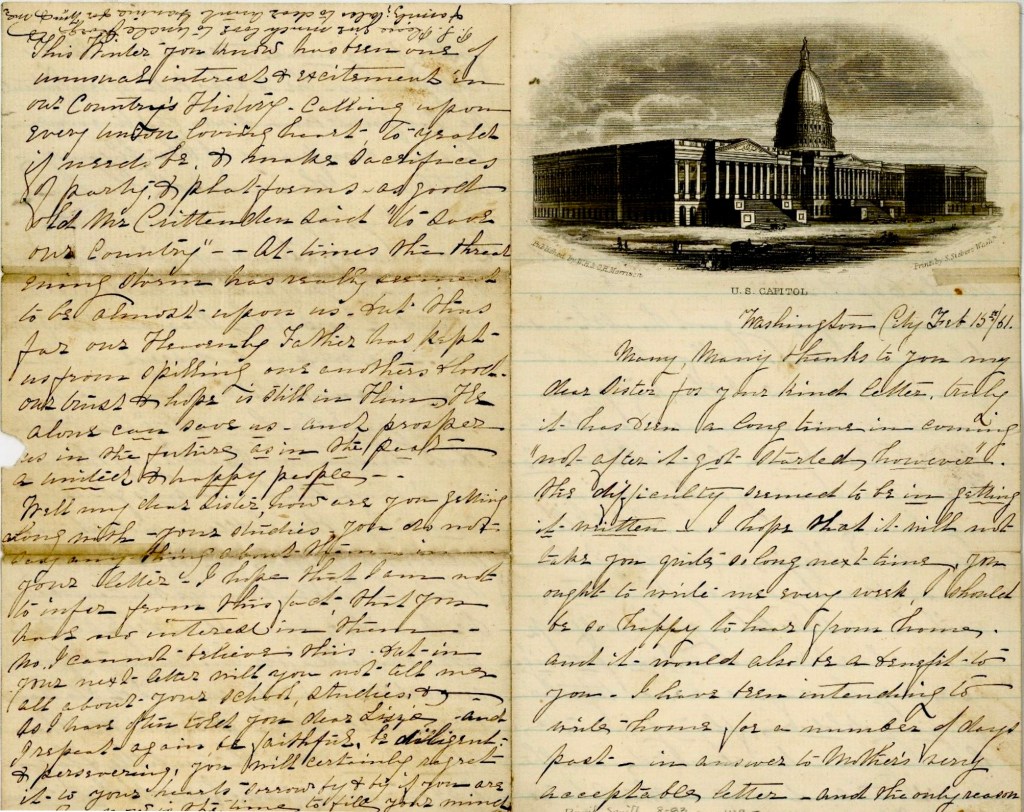
Washington City [Friday] February 15, 1861
Many, many thinks to you my dear sister for your kind letter. Truly it has been a long time in coming “not after it got started, however.” This difficulty seemed to be in getting it written. I hope that it will not take you quite so long next time. You ought to write to me every week. I should be so happy to hear from home and it would also be a benefit to you. I have been intending to write home for a number of days past in answer to Mother’s very acceptable letter, and the only reason why I have not done so is, that I do not stay at home long enough to accomplish anything. you would really think that I was getting to be guide dissipated if I should tell you that the greater part of my time this winter had been spent at “the Capitol.”
The Pittsfield Sun, 7 February 1861
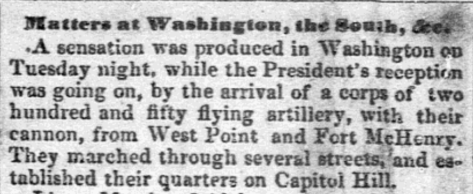
We are all enjoying good health. Indeed, I have not been so well for the last five years as now. I think if you were to see me you would say, “that sister looked just like old times.” Little Willie too is very well and enjoying himself very much. I told him what Aunt Lizzie said—that he must be a big boy by this time. “Well,” he said, stretching himself up in his chair, “Mama, so I am pretty big.” He and Coszy have fine times together playing soldier, flying kite, &c. He is very much interested in the military and now as the City is full of regiments and artillery companies, he is also full of excitement. He has just been down the Arsenal to see a company of “flying artillery” that arrived here a few days ago from West Point.
Two weeks ago Tuesday evening [February 1, 1861], Mr. Deming, William, and the two Willies attended one of the President’s receptions. When we were introduced to Mr. Buchanan, I told him that Willie “was a great Buchanan boy.” He then took him very heartily by the hand and said that he was “glad to know it.” This little incident in Willie’s early life will be something that he will always remember. He has also formed a deep seated attachment for his country. You would be greatly amused to hear him talk about the Union—the whole Union & with his little flag of 34 stars and 13 stripes, show forth his patriotism.
This winter you know has been one of unusual interest & excitement in our Country’s history—calling upon every Union-loving heart to yield if needs be & make sacrifices of party & platforms as good old Mr. Crittenden said, “to save our Country.” At times the threatening storm has really seemed to be almost upon us, but htus far our Heavenly Father has kept us from spilling one another’s blood. Our trust and hope is still in Him. He alone can save us and prosper us in the future as in the past—a united and happy people.
Well, my dear sister, how are you getting along with your studies? You do not say anything about them in your letter. I hope that I. am not to infer from this fact that you have no interest in them. No. I cannot believe this. But in your next letter will you not tell me all about your school studies &c. As I have often told you, dear Lizzie, and I repeat again, be faithful, be diligent, and persevering. You will certainly regret it to your hearts sorrow by and by if you. are [ ] in the time to fill your mind.
P. S. Please give much love to Uncle George & family. Also to dear Aunt Fannie for William and me.
Frederick Lang to William Skeen in 1861 in which he alludes to the ongoing crisis of the Union that was unfolding amidst the secession of southern states following Abraham Lincoln’s election.
T R A N S C R I P T I O N
Solitude, February 17th, 1861
Dear William,
Your scarcity of the 18th ultra came to hand and created quite a surprise. It was indeed a wonder that you wrote again. Do you know when you wrote to us last? I suppose not. But my letter records mention only one of January 12, 1858. That was the last, excepting the few lines you wrote to me of brother Charles’ letters. Well! no odds! it has come at last and so allow me before everything else to congratulate you on the happy increase of your family. You have as good fortune as we had—a boy first to keep up the name, then a gal to please the mother. I hope you are enjoying as good health as we are. My girl begins to talk quite smartly and is as lively as a cricket. I often wish you could come out to see where & how we live. Can you not make it come around to pay us as a visit before the family increases again??
The news of the death of so many persons known to us has been communicated by our Water Cure correspondents, but your information about Charles Steubgen has been welcome & painful—welcome because I heard nothing of him for a long time in spite of my endeavors to find out his whereabouts; painful because it shows a great lack of friendship, which I am nearly forced to call professed friendship, as nothing but death could excuse Charley’s long inexplicable silence. I wrote to Dr. Held, his brother-in-law in Saxon C. If he is a gentleman, he will answer my letter. What the result will be remains to be seen.
I hope you are at work again, although times have not revived much yet [and] I doubt their getting much better before the crisis is over! We are getting along very well. Farmers generally have the least to suffer in such matters—that is, independent farmers, but I cannot call myself quite that yet, although it goes as well as can be expected. We have enough of everything except money. If we had had enough of that, we could have come in to see you.
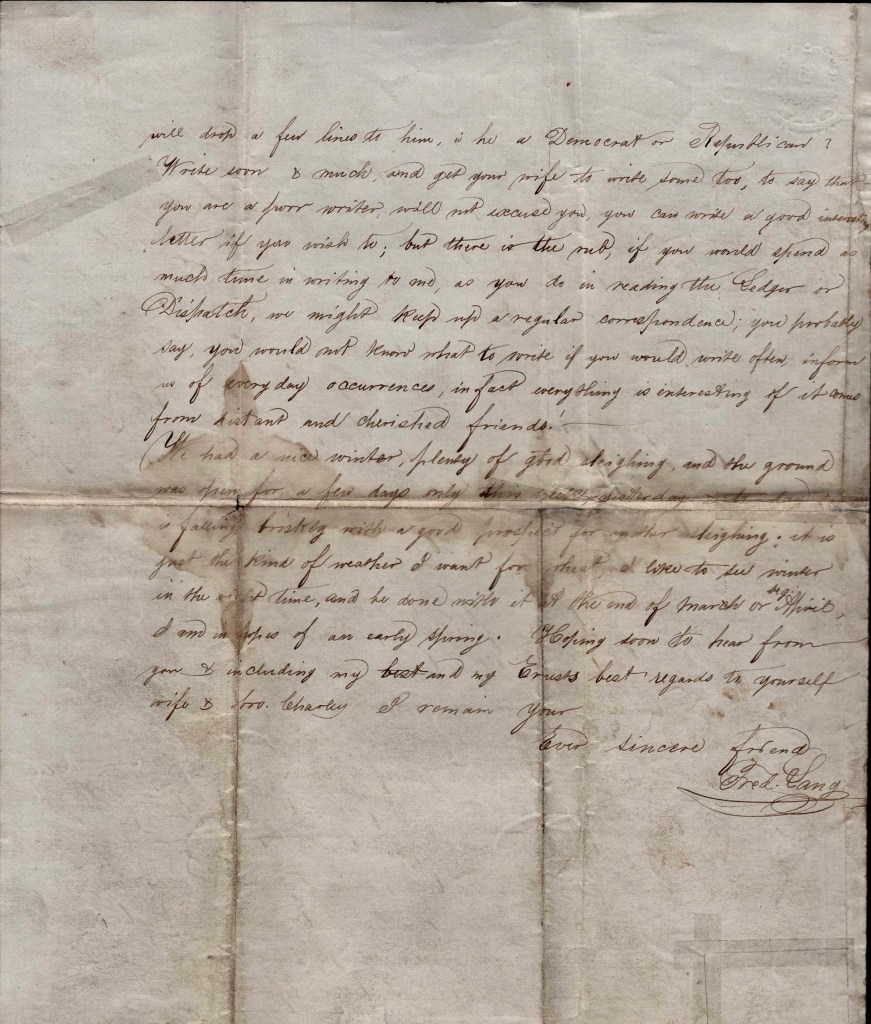
Where do you work at present? Out in Bayard town’s shovel factory yet? How do you prosper? Do you intend to spend all your life in the city, or have you a distant wish of becoming a farmer? Is brother Charles in the bakery yet, & boarding with you? Give him my regards and get him to write when you write again. Ernest will drop a few lines to him. Is he a Democrat or Republican? Write soon & much and get your wife to write some too. To say that you are a poor writer will not excuse you. You can write a good interesting letter if you wish to. But there is the rub; if you would spend as much time in writing to me as you do in reading the Ledger or Dispatch, we might keep up a regular correspondence. You probably say you would not know what to write if you would write often informing me of everyday occurrences. In fact, everything is interesting if it comes from distant & cherished friends!
We had a nice winter—plenty of good sleighing, and the ground was open for only a few days this week. Yesterday & today it is falling briskly with a good prospect for another sleighing. It is just the kind of weather I want for wheat. I like to see winter in the right time and be done with it at the end of March or beginning of April. I am in hopes of an early Spring. Hoping soon to hear from you & including my best and my earnest best regards to yourself, wife and brother Charley, I remain your ever sincere friend, — Fred. Lang
This letter was signed by a soldier named “Wellington” and addressed to his father but beyond that, I’ve not been able to identify him. He appears to have been in temporary duty with his squadron in Iuka while the remainder of his regiment was stationed in Tuscumbia. He also informs us that he anticipated being issued revolving rifles soon which led me to believe he might be with the 2nd Iowa Cavalry but I could not find a member by that name.
Transcription
Iuka [Mississippi] August 30, 1862
My Dear Father,
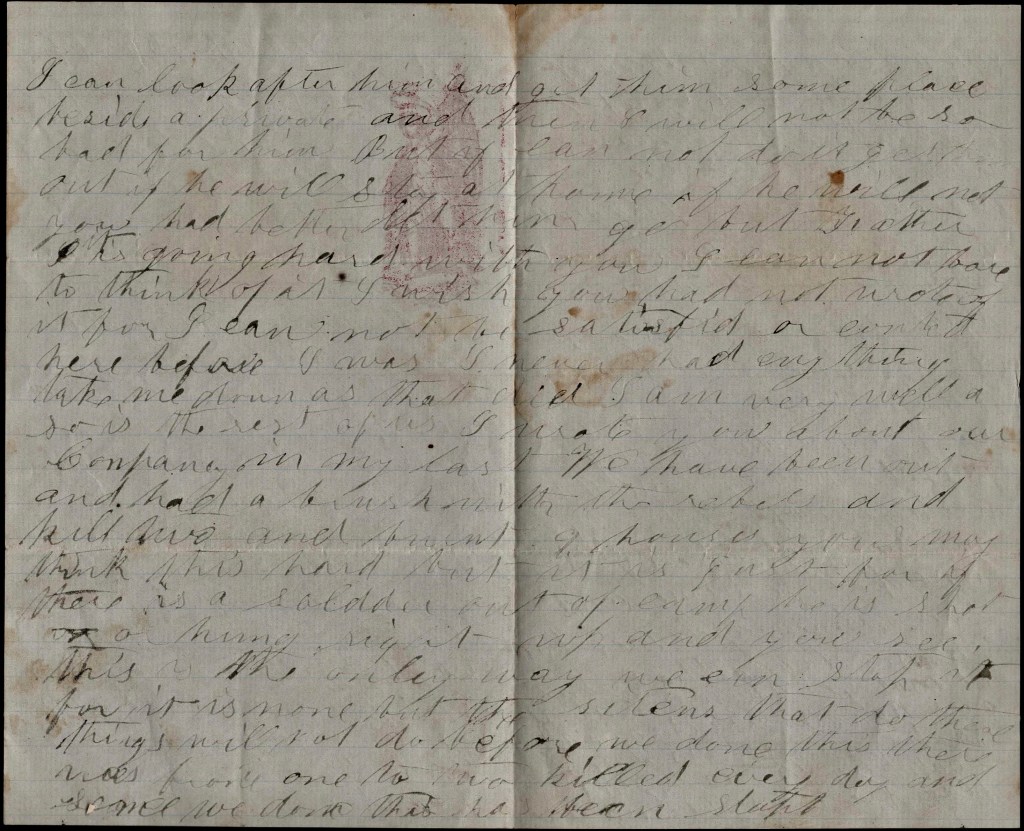
I have just received your letter of 24th and I never was so surprised to think that Cap has enlisted. Now Father, do get him home. I wrote you for a commission. Get it in that regiment if you can. If [not], let it alone. But Father, get him home. He may stand it. There is barely a chance. You know that you thought that I could not stand it but I have stood it as well as any man. But if I can get a place in that regiment, I can look after him and get him some place beside a private and then it will not be so bad for him. But if you can not do it, get him out if he will stay at home. If he will not, you had better let him go but Father, it is going hard with you. I cannot bare to think of it. I wish you had not wrote of it for I cannot be satisfied or content here. Before I was. I never had anything take me down as that did.
I am very well and so is the rest of us. I wrote you about our company in my last. We have been out and had a brush with the rebels and killed two and burnt nine houses. You may think this hard but it is just for if there is a soldier out of camp, he is shot or hung right up and you see this is the only way we can stop it for it is none but the citizens that do these things. Before we done this, there was from one to two killed every day and since we done this, it has been stopped.
We have a good deal of scouting to do but I like it for we have a chance to see a good deal of country. I do not know how long we will stay here but think we will go to our regiment at Tuscumbia but do not know when. We expect to get revolving rifles pretty soon. I have wrote you three letters. I write every time I get one from home and sometimes oftener but I am afraid that you do not get them. All of our teams are drove by darkeys. It is a good help. From Wellington
The following two letters were sent to me from a private collection with the hope that I might be able to identify the author but I have failed to do so. I publish it here, however, on the outside chance that I might be able to link it to some other correspondence in the future.
[Note these letters are the property of Greg Herr and were sent to me for publication on Spared & Shared by express consent.]
Letter 1
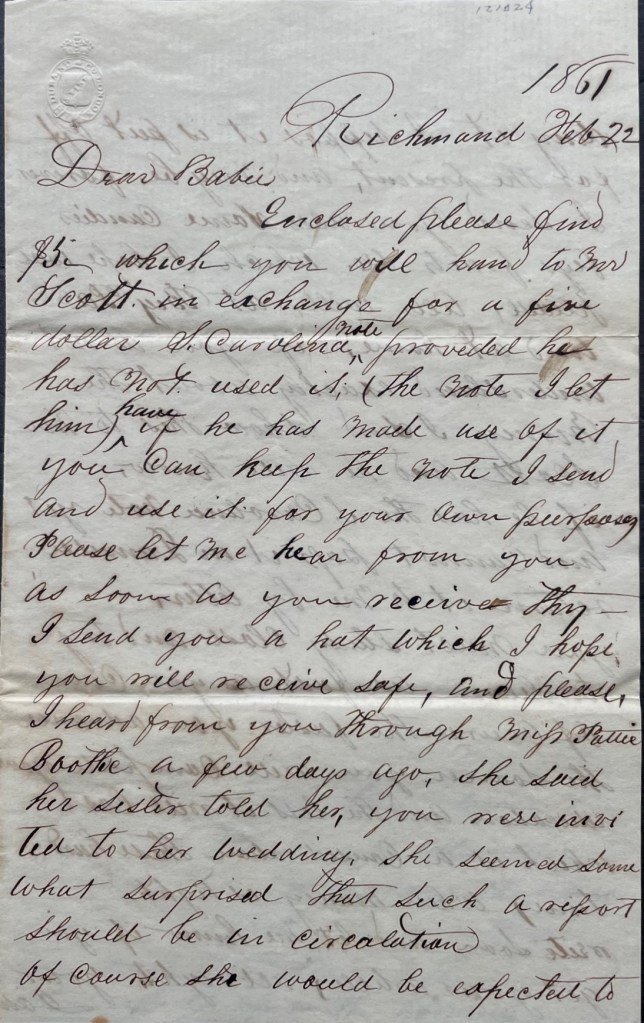
Richmond [Virginia] February 22, 1861
Dear Babie,
Enclosed please fid $5 which you will hand to Mr. Scott in exchange for a five dollar S. Carolina Note provided he has not used it (the note I let him have). If he has made use of it, you can keep the note I send and use it for your own purposes. Please let me hear from you as soon as you receive this.
I send you a hat which I hope you will receive safe, and please, I heard from you through Miss Pattie Boothe a few days ago. She said her sister told her you were invited to her wedding. She seemed somewhat surprised that such a report should be in circulation. Of course she would be expected to deny it. I suppose it is put off for the present, and may be forever. I send you also some candies, figs, fruits, &c. which I hope will please.
All’s well at Big Pa’s and at home. If you do not understand exactly about the money I send, show this to Mr. Scott and he will know if he has the S. Carolina Note yet and cannot pass it in Danville return it to me by letter.
You must study close and try to learn as fast as you can. Of course the faster you advance, the sooner you will complete your education and the less it will cost which is a consideration these hard times when money is tight.
Write soon and let me know if you get your articles all right. Your little Pa. — John J. Barnes
I have been down to Richmond attending the Convention. 1 The Convention is likely to do nothing satisfactory to the people. I go up in the morning.
1 The Virginia Convention of 1861, also called the Secession Convention, met on February 13, 1861, before the American Civil War to decide if Virginia should secede from the United States. It had 152 delegates, mostly Unionists, who were elected by the Virginia General Assembly, and their decision needed to be confirmed by a statewide vote. Several Southern states had already seceded after Abraham Lincoln was elected president in November 1860. Virginia was hesitant, and debates lasted for months. On April 4, secessionists lost a vote but still prepared for war. Former governor Henry A. Wise tried to secure the federal arsenal at Harpers Ferry by military means, which upset Unionist delegate John Baldwin. After Fort Sumter fell on April 13 and Lincoln called for volunteers on April 15, support for secession grew, leading the convention to vote on April 17 to leave the Union. Virginians showed their support in a vote on May 23, and the state joined the Confederacy.
Letter 2
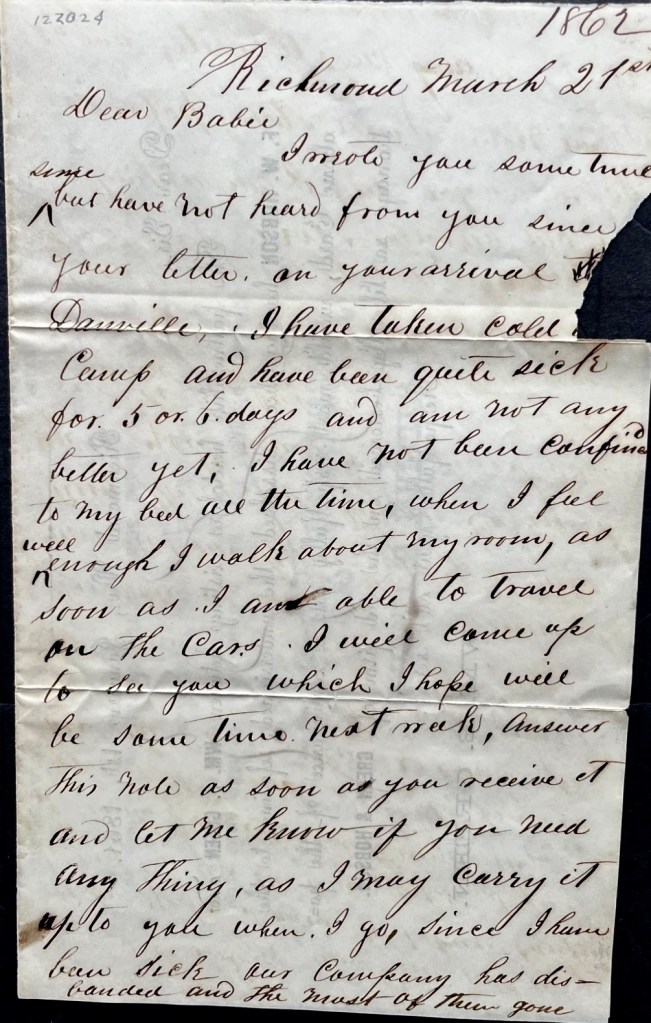
Richmond [Virginia] March 21st 1862
Dear Babie,
I wrote you some time since but have not heard from you since your letter on your arrival at Danville. I have taken cold in camp and have been quite sick for 5 or 6 days and am not any better yet. I have not been confined to my bed all the time. When I feel well enough, I walk about my room. assoon as I am able to travel on the cars, I will come up to see you which I hope will be sometime next week. Answer this note as soon as you receive it and let me know if you need anything as I may carry it up to you when I go. Since I have been sick, our company has disbanded and the most of them gone home. I was sorry but could not help it so many of them getting exempt on account of being a widow’s overseer and about 20 sick ones in camp.
I left camp and came to town as soon as I was taken sick. Ned is very sick also, but hope he is some better today. The doctor thinks Ned better. I have had Morris here but got Tom to take him home this morning. I do not feel much like writing this evening [even] if I had anything to write, and as I have none, I will stop. Paper is scarce. As you see I am writing on an old circular. Write soon as you get this. Direct to Richmond. — J. J. Barnes
The following letter was written by Sergt. Major John Arthur Johnston (1828-1899) who was a wholesale grocer in Petersburg, Virginia, before the American Civil War. The partnership was called, “Donnan and Johnston.” At the breaking out of the war, Johnston volunteered to become the post quartermaster of the CSA at Norfolk. When Norfolk was evacuated, he was placed in charge of the quartermaster’s department of Mahone’s Brigade. He was subsequently made quartermaster of Anderson’s Division which place he held until the end of the war.
Returning to Petersburg after the war, he was elected sheriff and served 14 years in that capacity, He was also at one time a director in the Atlantic, Mississippi & Ohio Railroad Company.
This letter was written to Alexander Donnan, his former partner in the grocery business.
[Note: This letter is from the personal collection of Greg Herr and was made available for transcription and publication on Spared & Shared by express consent.]
Transcription
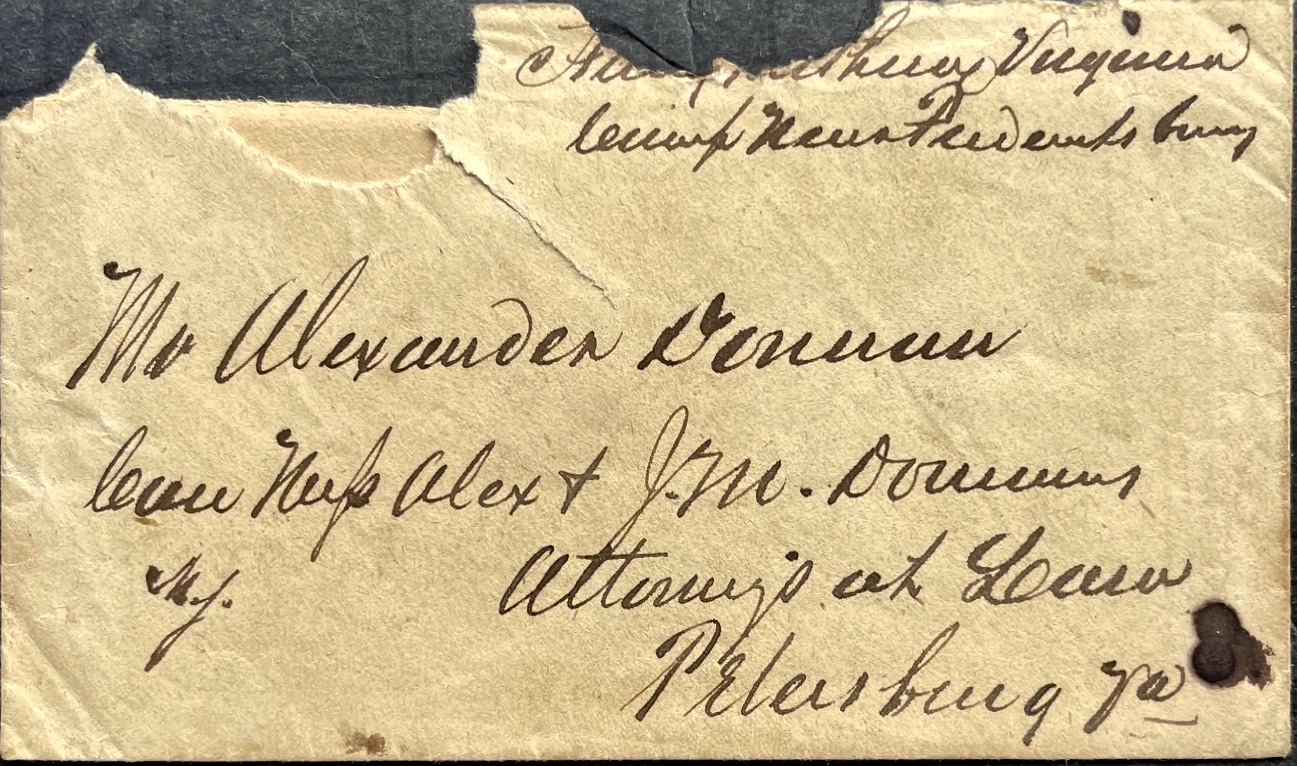
Addressed to Mr. Alexander Donnan, Care of Messrs. Alex & J. M. Donnans. Attorneys at Law, Petersburg, Virginia
Army of Northern Virginia Camp near Fredericksburg, Va. March 28, 1863
Mr. Alexander Donnan, dear friend,
Your valued letter of the 18th inst. reached me a few days ago. Pease accept my thanks for the prompt attention given and your prompt reply.
You can arrange the necessary papers to revise the decree at your convenience and send then to me by mail and I will have them executed and returned when the decree is secured. We can [ ] the date of sale terms, &c.
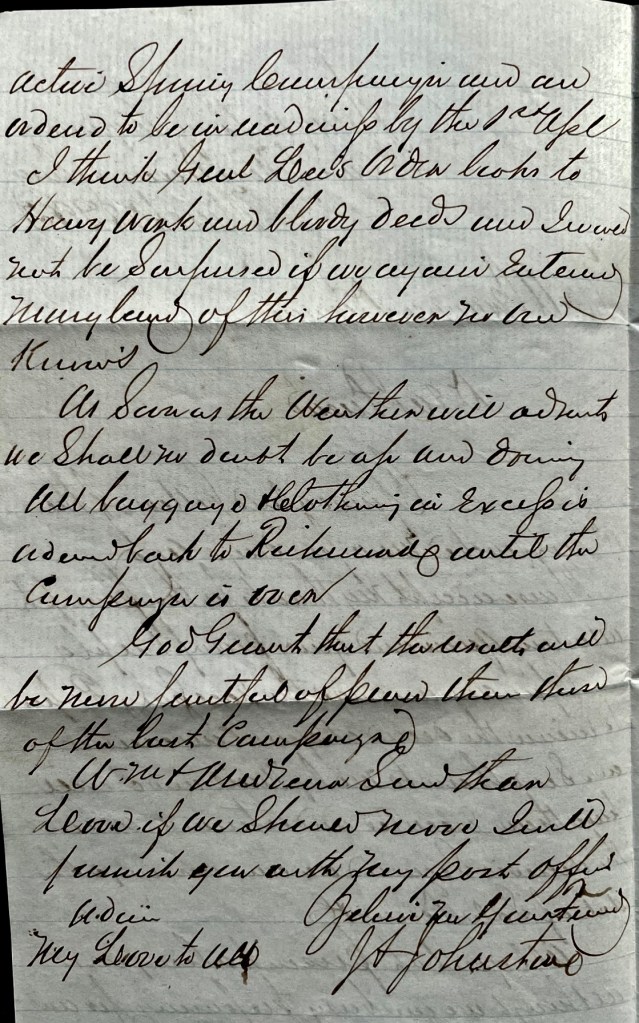
All quiet at present along our [front] although we are busy preparing for an active Spring Campaign and are ordered to be in readiness by the 1st of April. I think Gen. Lee’s Order looks to heavy work and bloody deeds and I would not be surprised if we again entered Maryland. Of this, however, no one knows. As soon as the weather will allow, we shall no doubt be up and doing. All baggage and clothing in excess is ordered back to Richmond until the campaign is over. God grant that the result will be more fruitful of peace than those of the last campaign.
William and Andrew send their love. If we should move, I shall furnish you with the post office. Adieu. My love to all. Believe me your friend, — J. A. Johnston
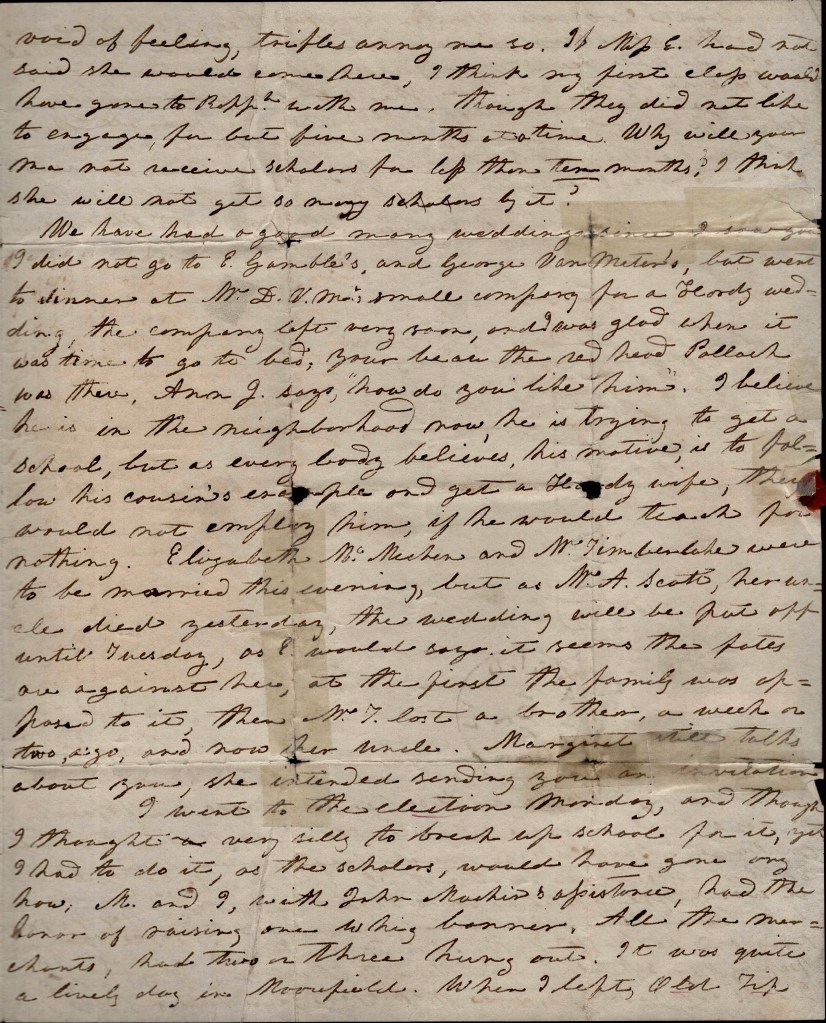
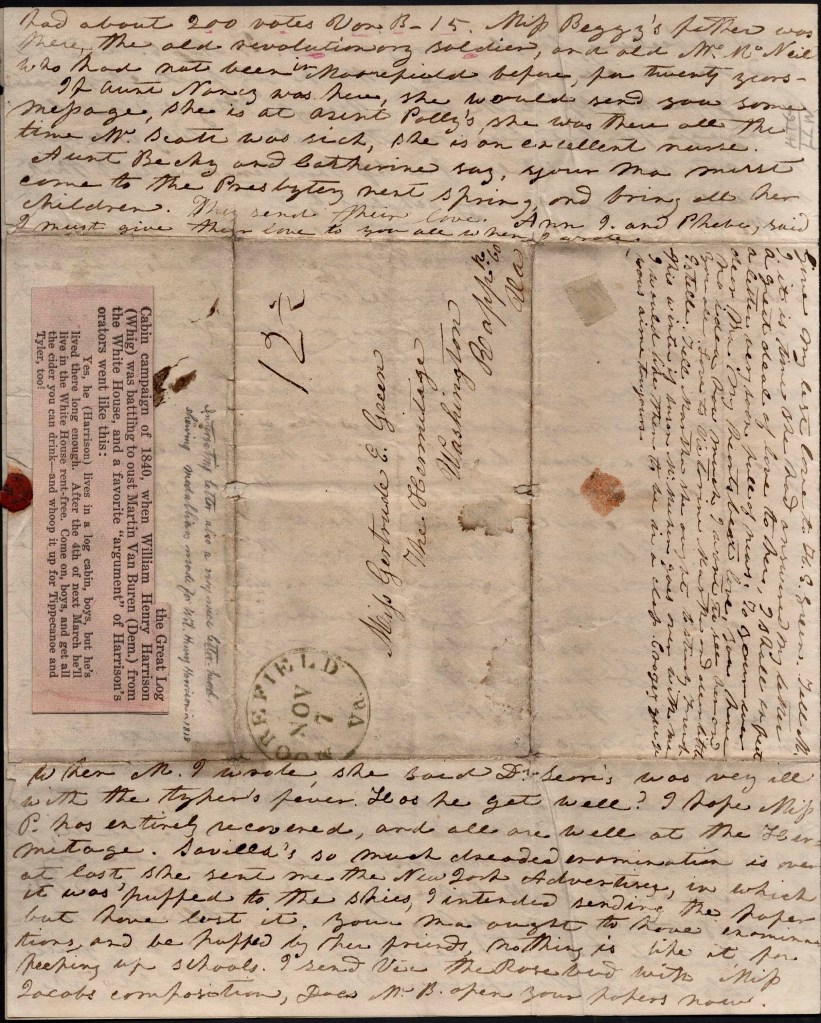
The following unsigned letter was penned in November 1840 from near Moorefield, Hardy county, Virginia [now West Virginia] which the author—a female—describes as the “wild woods.” The content of the letter informs us that the author was from Rappahannock county, Virginia, but was temporarily residing in Hardy county while working as a teacher. She wrote the letter to Miss Gertrude E. Green in Washington—the county seat of Rappahannock county in the heart of the Shenandoah Valley south of Front Royal. It was a major hub for trading and commerce in the area. I was unable to find much of anything on-line for Miss Green except for the mention of a letter that was addressed to her in Washington in 1842 by the Rev. Peter Leo Johnson, D. D. appearing in the Salesianum.
Moorefield, Hardy county, West Virginia, ca. 1886 (West Virginia History OnView)
Transcription
Addressed to Miss Gertrude E. Green, The Hermitage, Washington, Rappahannock county, Va.
Near Moorefield [Hardy county, Virginia] November 5, 1840
Thank you a thousand times dearest Gertrude for your last letter; indeed it does my very soul good to receive such affectionate letters alone here in these wild woods. May you never know from experience how I prize them.
I have been very lonesome since I came from the Spring. Miss Nancy has been at home very little and Aunt Becky ges to bed almost as soon as it is dark. When not engaged with my books, my mind generally wanders to my absent friends, and amuses itself in speculating upon their various employments.
I hope you all had a pleasant time at Synod. Miss Nancy was very much pleased, particularly with the Radd’n company. In returning, they upset about 5 or 6 miles from Moorefield. Phebe was hurt very much. Her eyes were very black for a few days. She is well now—apropos of Phebe. What message was that John sent me? Something about its being reported here that I was engaged to be married to him, and he, “supposed I carried the joke on.” Now please, dear Gertrude, tell him to suppose no such thing; so far from carrying the joke on, I had never heard it before. I cannot imagine how he heard it for I do assure you. there has been no such report in Hardy [county]. Phebe told J. she had heard it, but she told me the only person she ever heard say anything like it was Aunt Betsy who she thought was vexed with me for not being willing to stay here, and in talking about my returning to Rappahannock, Aunt Betsy said she believed that was the reason. Poor Aunt Betsy is a very narrow-minded woman and when out of sorts, does not mind much what she says. All the girls know her so well, they do not regard her words at such times.
Uncle George had promised me to let Catherine go over with me as he would not employ Miss Gregory (of Rahway) but Miss Ewing does employ her without letting me know before spring. I told him and her to tell people that I would stay until spring, but as there was no written contract, their interest alone will be consulted. “Tis a selfish world we live in.”
I wish I had something intersting to write, my dear Gertrude, for I know you weary reading my little grievances. I almost wish I had a heart void of feeling, trifles annoy me so. If Miss E. had not said she would come here, I think my first class would have gone to Rappahannock with me though they did not like to engage for but five months at a time. Why will your ma not receive scholars for less than ten months? I think she will not get so many by it?
We have had a good many weddings since I saw you. I did not go to E[lizabeth] Gamble’s and George [E.] VanMeter’s [wedding] 1 , but went to dinner at W. D. VanMeters small company for a Hardy wedding. The company left very soon and I was glad when it was time to go to bed. Your beau, the red head Pollock, was there. Ann J. says, “How do you like him?” I believe he is in the neighborhood now. He is trying to get a school but as everybody believes his motive is to follow his cousin’s example and get a Hardy wife, they would not employ him, if he would teach for nothing.
Elizabeth McMechen and Mr. Timberlake 2 were to be married this evening but as Mr. A. Scott, her uncle, died yesterday, the wedding wil be put off until Tuesday. As [ ] would say, it seems the fates are against her. At the first, the family was opposed to it. Then Mr. Timberlake lost a brother a week or two ago. And now her uncle. Margaret still talks about you. She intended sending you an invitation.
I went to the election Monday and though I thought very silly to break up the school for it, yet I had to do it as the scholars would have gone anyhow. M. and I, with John Machin & assistance, had the honor of raising one Whig banner. All the merchants had two or three hung out. It was quite a lively day in Moorefield. When I left, Old Tip had about 200 votes, Van Buren 15. Miss Beggz’s father was there, the old Revolutionary soldier, and old Mr. McNeil who had not been in Moorefield before for twenty years.
If Aunt Nancy was here she would send you some message [but] she is at Aunt Polly’s. She was there all the time Mr. Scott was sick. She is an excellent nurse. Aunt Becky and Catherine say your Ma must come to the Presbytery next spring and bring all her children. They send their love. Ann J. and Phene said I must give their love to you all when I wrote.
When M. J. wrote, she said Dr. Leon’s was very ill with the typhoid fever. Has he got well? I hope Miss P. has entirely recovered and all are well at the Hermitage. Savilla’s so much dreaded nomination is over at last. She sent me the New York Advertiser in which it was puffed to the skies. I intended sending the paper but that lost it. Your Ma ought to have examinations and be puffed by the friends. Nothing is like it for keeping up schools. I send Vic the Rosebud with Miss Jacobs’ composition. Does Mr. B open your papers now?
Give my best love to H. S. Green. Tell M. J. it is time she had answered my letter. A great deal of love to her. I shall expect a letter very soon, full of news. To your ever dear Ma, my heart’s best love. You have no idea how much I want to see her and you all. Love to Victorine, Martha, and dear little Estelle. Tell Martha she ought to study French this winter of Susan McMuhen goes over with me. I would like them to be in a class.
Savilla spent the vacation with Miss Hunter of Delaware County, Pa. She thinks the Pennsylvanians very much like the Hardians, but more unpolished. The beaus think themselves very smart. She says they have that air. She was delegated with Philadelphians the short time she was there. The school commenced yesterday. I suppose she has returned. The examination lasted three days. A great many were there. She read Miss Lew’s composition. Her reading was very much praised. And Mr. Phelps told Miss Brown the Mathematical teacher that she had the art of making her propositions plain in demonstrating, which showed she understood what she was about which he thinks is the most essential thing in Geometry, I sent you an account of the examination I cut out of the Rayway paper but it is no so flattering as the one in the New York. Write soon, dear Gertrude. I shall be so happy to hear from you.
I saw your Uncle and Aunt Green in Moorehead a few days ago. your Uncle says he has heard Jack is taken wonderfully with Miss Ann J. C. Your Aunt was complaining of E’s not writing. They made many inquiries after you. They were at E[lizabeth] Gamble’s wedding.
1 George E. VanMetter (1818-1855) and Elizabeth Williams Gamble (1822-1891) were married on 15 October 1840 in Moorefield, Hard county, Virginia.
2 Ann Elizabeth McMechen (1819-1854) was married to Ambrose Cramer Timberlake (1819-1874) in November 1840. He was a merchant in Moorefield, Hardy county, Virginia [now W. Va.]















 Spared & Shared 23