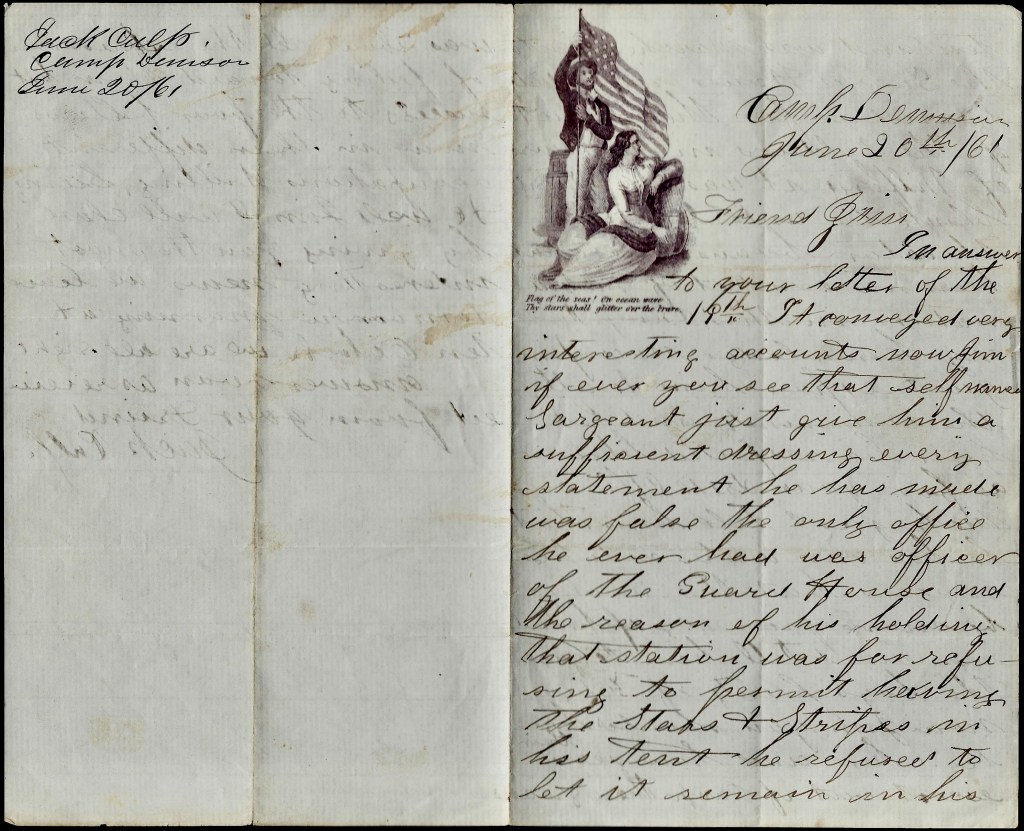
I believe this letter was written by Andrew Jackson (“Jack”) Culp of Co. F, 8th Ohio Infantry (3 months). Theregiment was organized 29 April through 2 May 1861 at Camp Taylor near Cleveland (and was mustered into service for 3 months on 2 May. Its nine companies were composed of men from northern Ohio, with Co. B representing the Hibernian Guards. The 8th Ohio was transferred on 3 May to Camp Dennison, near Cincinnati where they remained until June 22, 1861. Many of the soldiers in the regiment reenlisted for three years but it doesn’t look like Jack did.
Transcription
Camp Dennison June 20th 1861
In answer to your letter of the 19th, it conveyed very interesting accounts. Now Jim if ever you see that self named sergeant, just give him a sufficient dressing. Every statement he has made was false. The only office he ever had was Officer of the Guard House and the reason of his holding that station was refusing to permit having the Stars & Stripes in his tent. He refused to let it remain in his tent and was marched into the Guard House immediately. And as for the conduct of the soldiers in the town of Milford, it was all a point blank lie unless he was actor because there has been no conduct of such a nature in this camp to my knowledge. Now Jim, just expose him to all the community and let him be respected likewise.
As for your drill officer Mok, just tell him that he has our wishes as to his success but they would be more friendly if he had remained. Tell him to give the boys plenty of fatigue. Now Jim, you should have been here and have seen their escort out of camp. Three groans was about all the expression of feeling toward them. But success to the four fellows now in their different occupations—drilling, lying, &c.
Well Jim, I will close by giving you the most interesting news. We leave tomorrow morning at ten o’clock. We are all right. Answer soon as received. From your friend, — Jack Culp
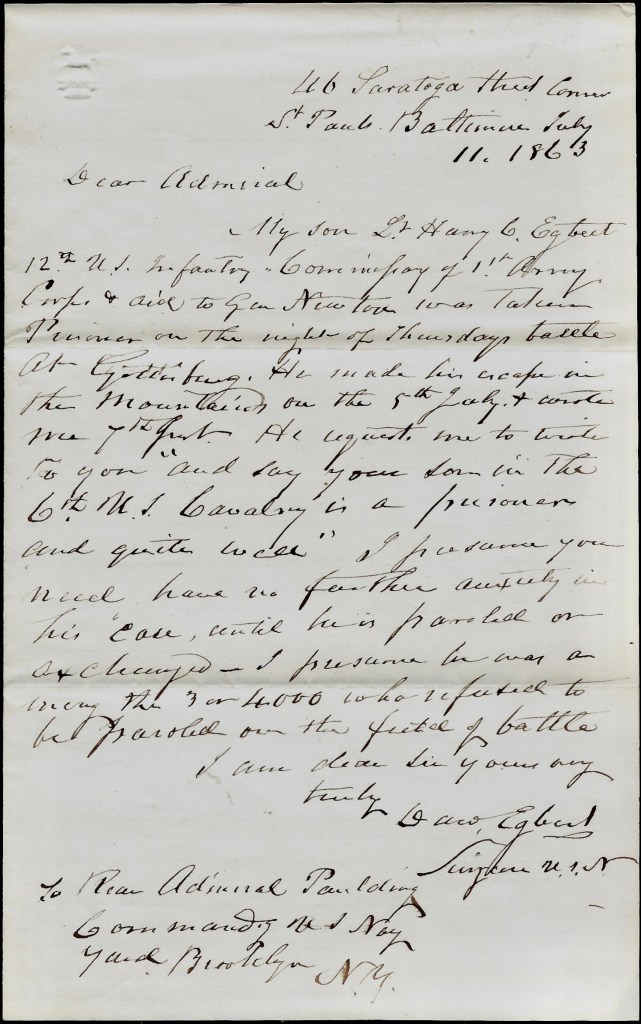
The following brief letter was written by Daniel Egbert, Surgeon, USN, to Rear Admiral Hiram Paulding respecting the capture of his son, Lt. Tattnall Paulding (1840-1907) during the Gettysburg Campaign and spent time in Libby Prison. [See—1863: Tattnall Paulding to Hiram Paulding].
Transcription
46 Saratoga Street, Corner St. Pauls Baltimore [Maryland] July 11, 1863
Dear Admiral,
My son, Dr. Harry C. Egbert, 12th U.S. Infantry, Commissary of 1st Army Corps & aide to Gen. Newton, was taken prisoner on the night of Thursday’s battle at Gettysburg. He made his escape in the mountains on the 5th July & wrote me 7th Inst.
He requests me to write to you “and say your son [Lt. Tattnall Paulding] in the 6th U.S. Cavalry is a prisoner and quite well.” I presume you need have no further anxiety in his case, until he is paroled or exchanged. I presume he was among the 3 or 4,000 who refused to be paroled on the field of battle.
I am, dear Sir, yours very truly, — Dan. Egbert, Surgeon U. S. N.
To Rear Admiral Paulding, Commanding US Navy Yard, Brooklyn, New York
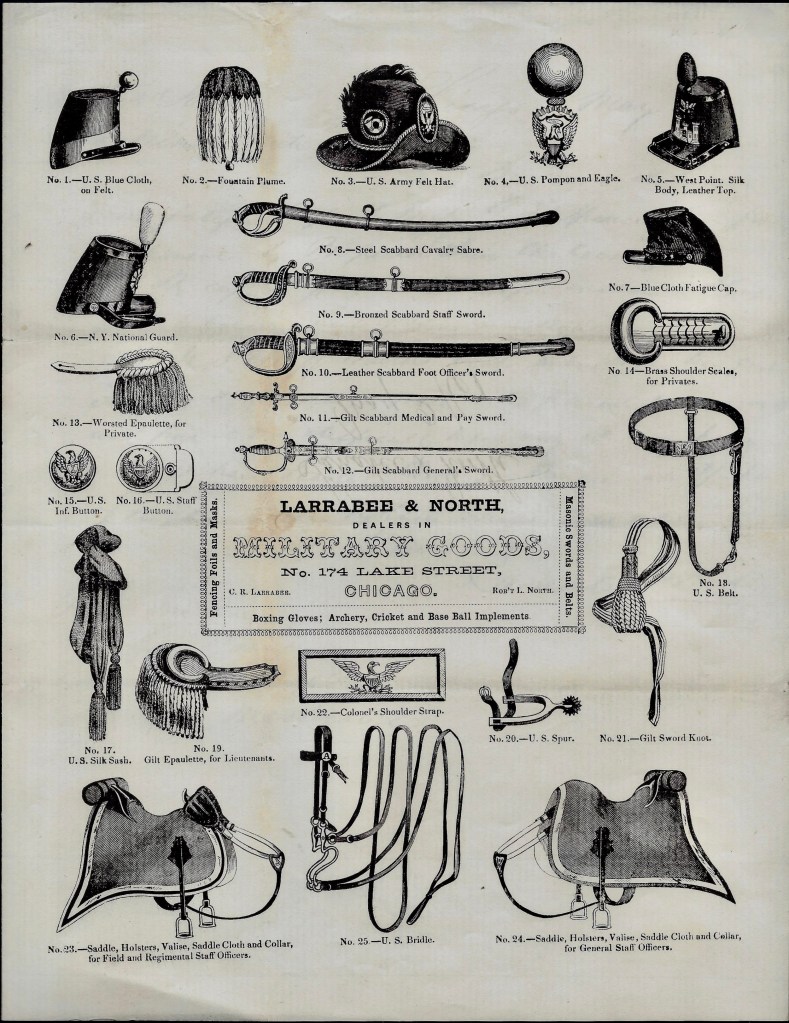
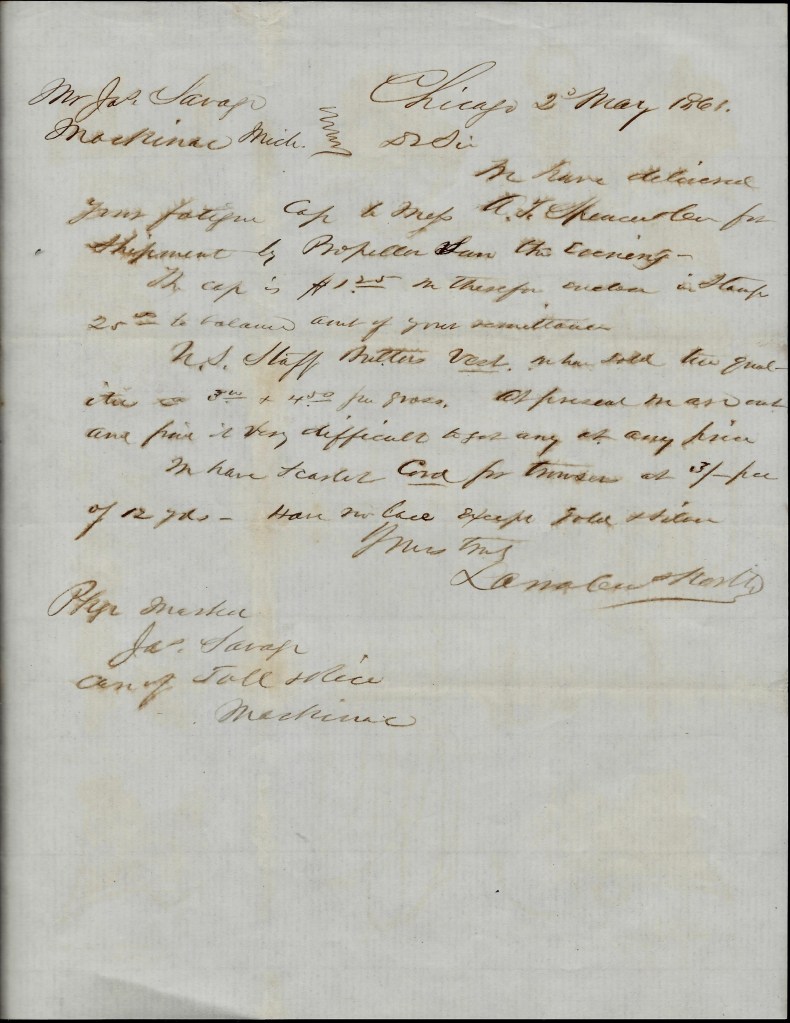
The following 1861 letter was written by a clerk in the Larrabee & North Military Goods store located at No. 174 Lake Street in Chicago. The 4-page lettersheet displays printed illustrations of military goods for sale on the first page and includes a hand written letter to 24 year-old James Savage, a British-born member of the U. S. garrison at Fort Mackinac, Michigan. This most interesting promotional lettersheet has cuts of 25 different items, including officer’s swords, epaulettes, saddles, hats, and other items to outfit officers in the newly expanding Union army.
Transcription
Chicago, [Illinois] 2nd May 1861
Mr. James Savage Mackinac, Michigan
Dear Sir,
We have delivered your fatigue cap to Messr. A. T. Spence & Co. for shipment to Propeller Sun this evening.
The cap is $1.25. We therefore enclose in stamp 25.00 to balance amount of your remittance.
U. S. Staff button vest we have sold two qualities at 3.00 & 4.50 per gross. At present we are out and find it very difficult to get at any price. We have scarlet cord for trousers at 3/– per of 12 yards. Have no lace except gold & silver.
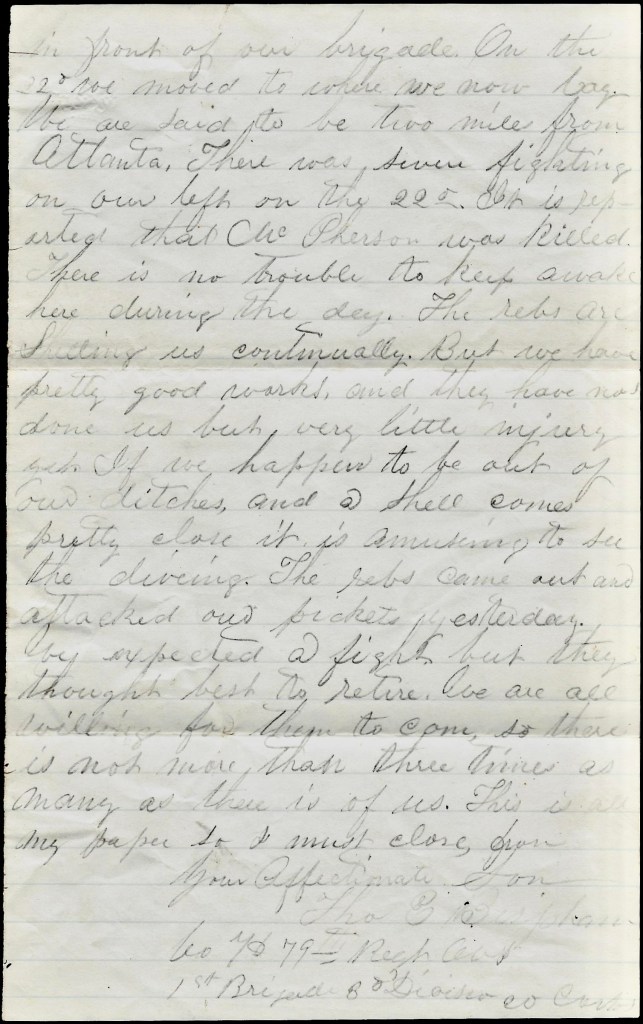
The following letter was written by Thomas E. Bispham (1835-1865), the son of Thomas Bispham (1797-1879) and Elizabeth Jennings (1795-1878) of Wayne township, Warren county, Ohio. Thomas was married to Sarah Frances Likins (1840-1902) in March 1857 and the couple had two children at the time that Thomas enlisted as a private in Co. H, 79th Ohio Volunteer Infantry (OVI) in August 1862.
Thomas was promoted to a corporal in February 1863 and made it through the Atlanta campaign without injury but was wounded at Averysboro, North Carolina on 16 March 1865. He died of his wounds at David’s Island (N.Y. harbor) hospital on 25 May 1865.
In this letter, Thomas describes the Battle of 20 July 1864 at Peachtree Creek in the Atlanta Campaign.
There is a striking similarity in Thomas’s handwriting with that of a diary fragment that I transcribed back in January 2021 which I was able to attribute to the 79th OVI but not to any particular soldier. I suspect, however, the mystery soldier served in Co. I.
Transcription
Addressed to Thomas Bispham, Esq., Waynesville, Warren county, Ohio
Camp 79th OVI Sunday, July 24th 1863
My Dear Father & Mother,
I thought as Sallie was from home, maybe you would not hear from me, and perhaps you might wish to. Therefore, I will write.
On the 20th we got into quite a battle. The rebs attacked our lines. We (our brigade) was laying in the rear of a gap, and when the attack was made we had to move up to get on the line. We had a fair, open fight and defeated them. I had some very fine shots. Our regiment lost 58—ten killed and forty-eight wounded. Co. H had George Brinker & Corp. I[saac] F. Stump killed. Joseph H. Wolfe, Asa Chandler, John Prater, Wm. Watkinson and Martin Lansey wounded. I have heard they are all doing very well but Wolfe. It is estimated from the number we have in our possession that the Rebels lost from ten to fifteen hundred in front of our brigade.
On the 22d, we moved to where we now lay. We are said to be two miles from Atlanta. There was severe fighting on our left on the 22d. It is reported that [James B.] McPherson was killed. There is no trouble to keep awake here during the day. The rebs are shelling us continually. But we have pretty good works and they have not done us but very little injury yet. If we happen to be out of our ditches, and a shell comes pretty close, it is amusing to see the diving. The rebs came out and attacked our pickets yesterday. We expected a fight but they thought best to retire. We are all willing for them to come, so there is not more than three times as many as there is of us. This is all my paper so I must close.
From your Affectionate Son — Thos. E. Bispham
Co. H, 79th OVI, 1st Brigade, 3d Division, 20 [Army] Corps
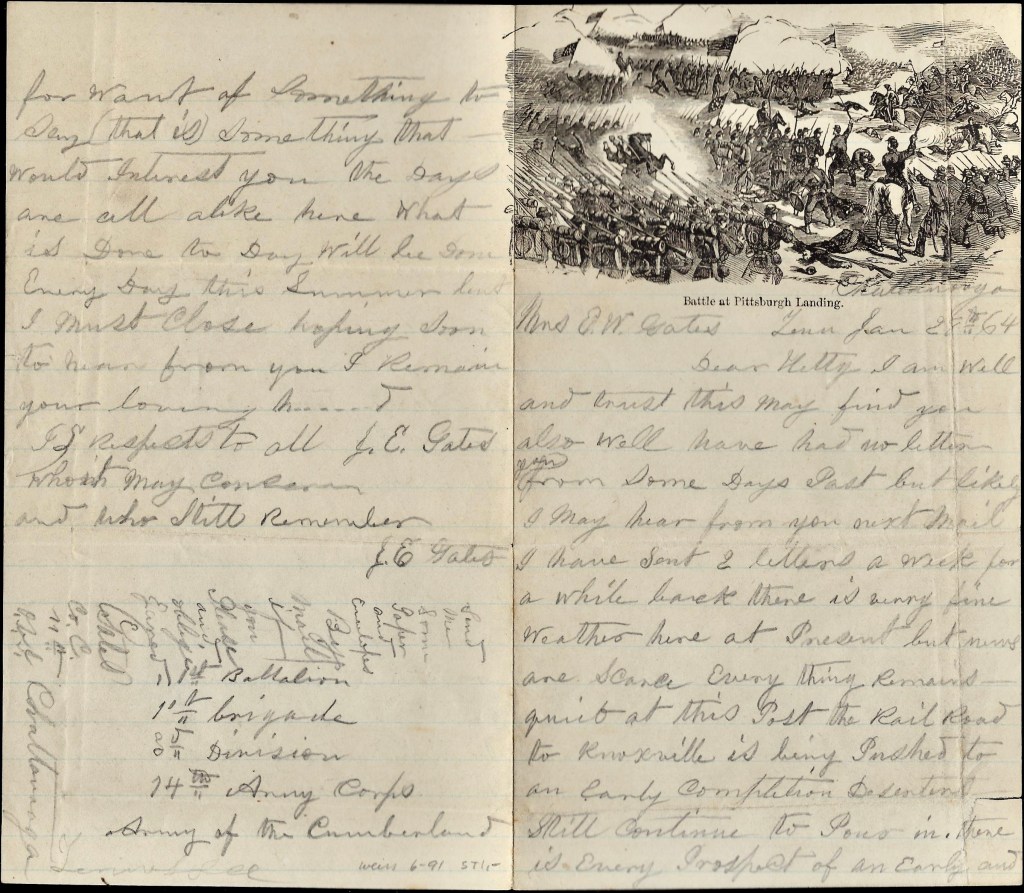
The following letter was written by Jared E. Gates (1832-1911) of Salem, Columbiana county, Ohio. In the 1860 US Census, 28 year-old Jared was the oldest of several siblings by that name living in the Salem household of 48 year-old Lydia Minsor. Ohio Marriage records inform us that Lydia Gates married, William Henry Minsor in 1845—presumably her second marriage. At that time, Jared was employed as a “confectioner.”
Jared was one of the first to join Co. C, 11th Ohio Volunteer Infantry (OVI) and was mustered in on 1 July 1861. He mustered out three years later on 21 June 1864. Jared must have been home on furlough in January 1863 for it was on 9 January 1863 that he and Esther (“Hetty”) W. Hart (1834-1915) were married in Columbiana county. Jared lived his last thirty years in McKean county, Pennsylvania.
Transcription
Chattanooga Tennessee January 27th 1864
Mrs. E. W. Gates,
Dear Hetty, I am well and trust this may find you also well. Have had no letter from you [for] some days past but likely I may hear from you next mail. I have sent 2 letters a week for a while back. There is very fine weather here at present but news are scarce. Everything remains quiet at this post. The railroad to Knoxville is being pushed to an early completion. Deserters still continue to pour in. There is every prospect of an early and vigorous campaign in front of this line—that is, I mean the line of the Tennessee. It may be that the storm will burst forth at Knoxville. The Rebels are evidently about to make a desperate effort to retrieve their fortunes in this section of the country and Uncle Sam is making preparations to receive them in a style becoming their chivalry and prestige.
The weather is very warm—so warm today that a blouse feels uncomfortable. I am in hopes that before it gets very hot we shall be on our way north. Our time is said to be out April 20th. If so, we shall be just in time to escape the hot season. Will finish this tomorrow. In the meantime, there might arrive a letter (for the undersigned) with news from home.
Well the night has passed pleasantly away. The train from Nashville came in just after retreat but it brought no letter for J. E. G. There is no news. Some ladies (southward bound) were searched at the Provost Marshal’s the other day. Various contraband articles were brought to light among which were some 30 revolvers nicely concealed in a bed tick. These ladies were sent on their way to Dixie with a lighter load than they had intended to take. They were the hardest set of women I ever saw.
Well, I will have to close this important letter for want of something to say—that is, something that would interest you. The days are all alike here. What is done today, will be done every day this summer. But I must close hoping soon to hear from you. I remain your loving husband.
Respects to all, — J. E. Gates
Who it may concern and who still remember—J. E. Gates
Send some paper and envelopes by mail if you please and I oblige, Jared E. Gates, Co. C, 11th O. V. I., Chattanooga, Tennessee
1st Battalion, 1st Brigade, 3rd Division, 14th Army Corps, Army of the Cumberland
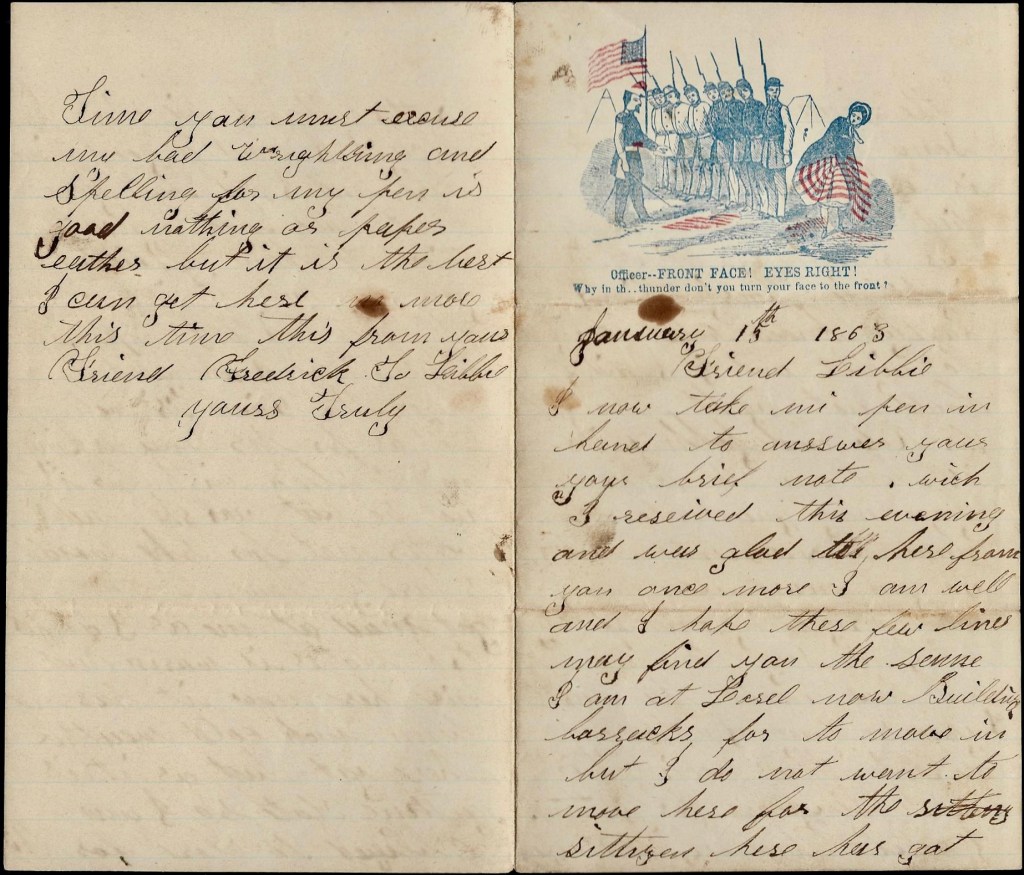
I can’t be certain of the identity of the author of this letter. Only because I recently transcribed a letter by Robert Hill of Osweatchie, New York, who served in the 106th New York do I have a hunch that it may have been written by:
MILLS, FREDERICK H.—Age, 21 years. Enlisted, August 7, 1862, at Oswegatchie, to serve three years; mustered in as corporal, Co. C, August 27, 1S62; mustered out with company, June 22, 1865, near Washington, D. C.
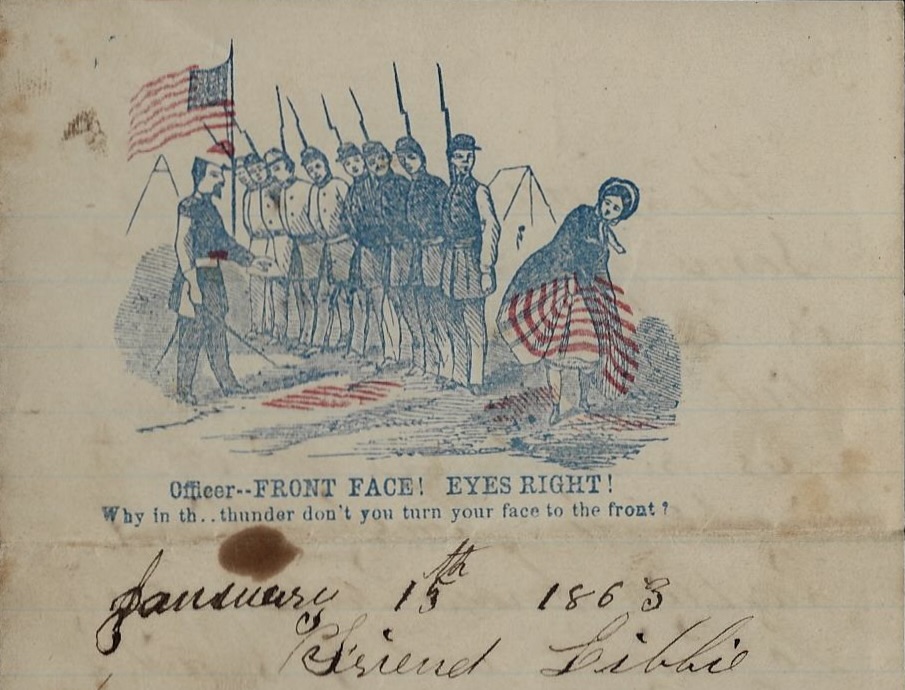
Transcription
January 15, 1863
Friend Libbie.
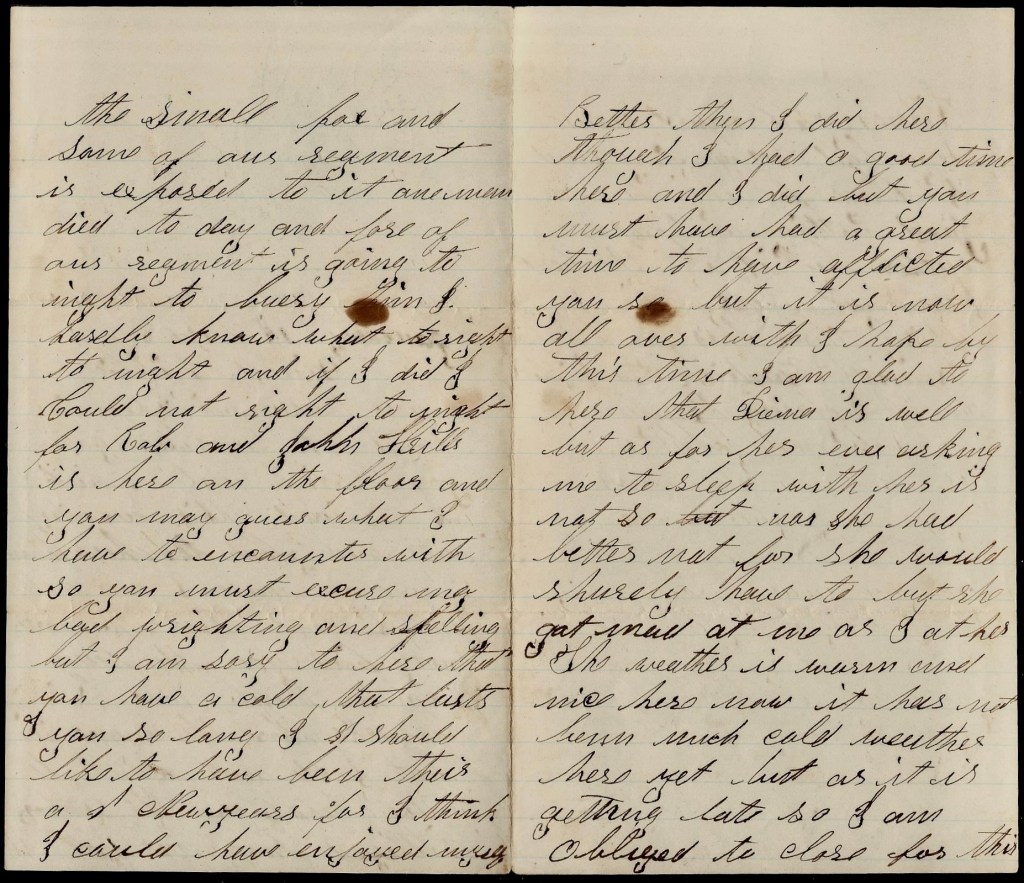
I now take my pen in hand to answer your brief note which I received this evening and was glad to hear from you once more. I am well and I hope these few lines may find you the same. I am at Larel [?] now building barracks for to move in but I do not want to move here for the citizens here has got the small pox and some of our regiment is exposed to it. One man died today and four of our regiment is going tonight to bury him.
I hardly know what to write tonight and if I did, I could not write tonight for Rob and John Hills is here on the floor and you may guess what I have to encounter with so you must excuse my bad spelling. But I am sorry to hear that you have a cold that lasts you so long.
I should like to have been there at New Years for I think I could have enjoyed myself better than I did here though I had a good time here, but you must have had a great time to have afflicted you so. But it is now all over with I hope by this time. I am glad to hear that Diana is well but as for her ever asking me to sleep with her, it’s not so. nor she had better not for she would surely have to. But she got mad at me as I got at her.
The weather is warm and nice here now. It has not been much cold weather here yet but as it is getting late, so I am obliged to close for the time. You must excuse my bad writing and spelling for my pen is good [for] nothing or paper either, but it is the best I can get here.
No more this time. This from your friend Frederick
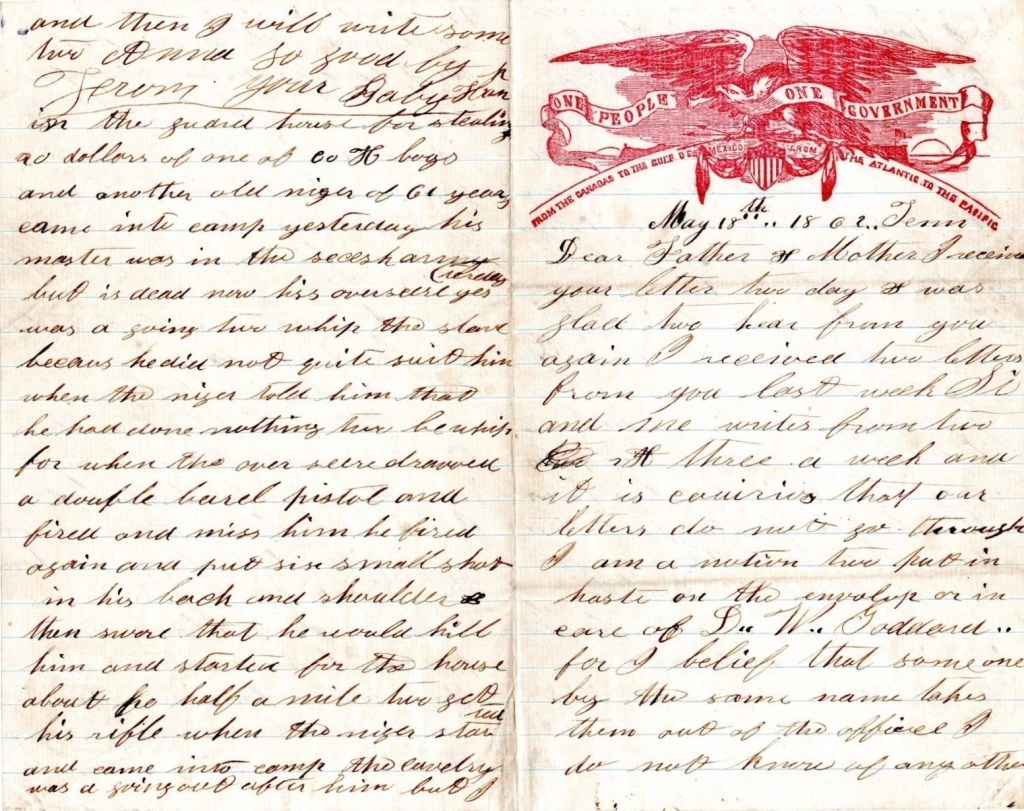
The following letter was written by a soldier who signed his name “Han” (I think), which might have been short for Hanson or Hanley. He may have had a brother serving with him named “Si” which could be short for Simon or Josiah. In any event, there are too few clues in the letter to give us an clear path forward to their identity.
Transcription
Tennessee May 18, 1862
Dear Father & Mother,
I received your letter today and was glad to hear from you again. I received two letters from you last week. Si[mon] and me writes from two to three [letters] a week and it is curious that our letters do not go through. I am a notion to put in haste on the envelope or in care of D. W. Goddard for I believe that someone by the same name takes them out of the [post] office, I do not know of any other cause and if you get a letter with these directions, you need not not be alarmed till you open it.
I have been having the ague for the past three days but I think that I have got over it now. So is Si and the rest of the boys with the exception of Chris and Eck & Jonah, but Jonah is getting better now, but Eck is bothered with piles very bad. Chris has been having the fever for the past three days but it is better now. Well, all of them, in fact.
The weather here is very beautiful. It is warm and pleasant and the fruit is so forward that it seems to me as though it was July. Strawberries are all gone most. Cherries are ripe and peaches are half grown. Wheat is in bloom and corn has been howed once and peas is big enough to eat but things grow so slow here. I never want to love here for I should get out of patience for it to grow. Corn that was planted the first day of April is not over three inches high but I do not know the reason why without it is because when the niggers go anywhere near it, a black cloud passes between that the sun. As for niggers, there is no end to them in camp. They keep coming and one is in the guard house for stealing 20 dollars off of one of Co. H boys and another old nigger of 61 years came into camp yesterday. His master was in the secesh army but is dead now. His overseer yesterday was a going to whip the slave because he did not quite suit him when the nigger told him that he had done nothing to be whipped for when the overseer drawed a double barrel pistol and fired and missed him. He fired again and put six small shot in his back and shoulder, then swore that he would kill him and started for the house about half a mile to get his rifle when the nigger started and came into camp. The cavalry was going out after him but I have not heard with what success as I have not been out of my tent but very little today. But I have seen enough of slavery and could have shot his overseer if I could have seen him.
Well, I must close for I have got to eat supper and then go on dress parade and then I will write some to Anna. So goodbye. From yours Baby, — Han
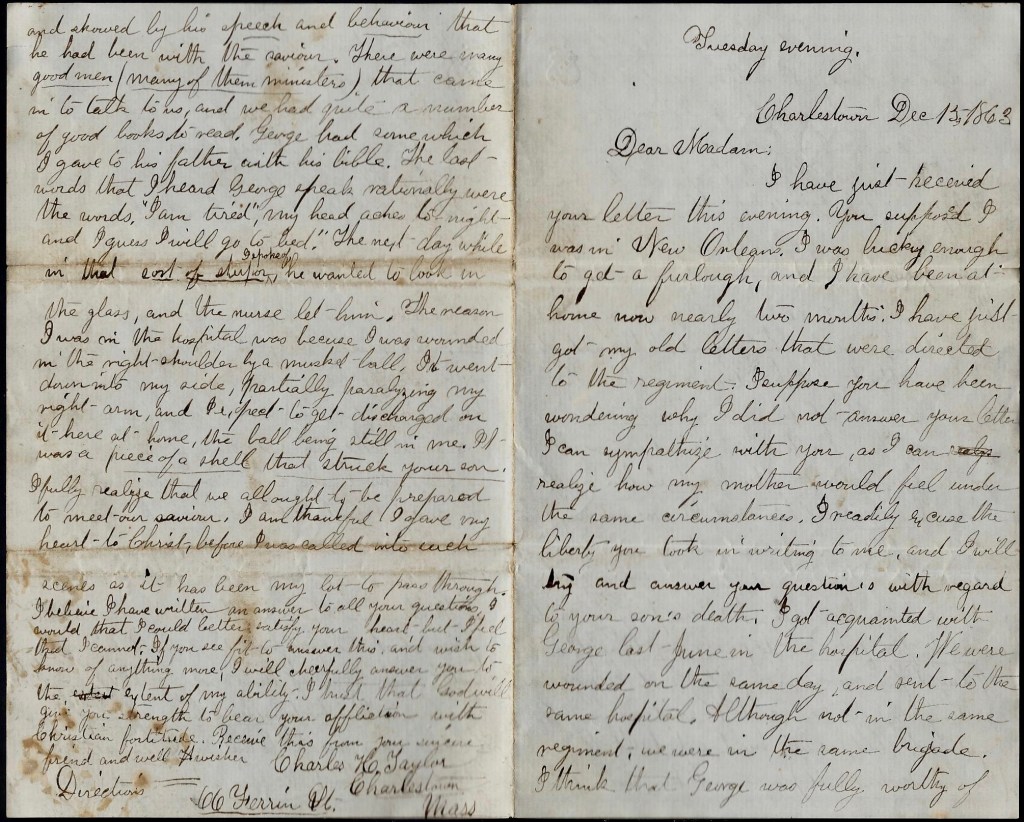
The following letter was written by Charles Henry Taylor (1846-1921) of Co. F, 38th Massachusetts Infantry who was wounded in the 14 June 1863 (2nd) assault on Port Hudson. In that assault, the 38th was brigaded with the 31st and 53rd Massachusetts, as well as the 156th New York under the command of Col. Oliver P. Gooding in Brig. Gen. Halbert Paine’s 3rd Division of the 19th Army Corps.
The regimental history of the 38th informs us that the regiment along with the 53rd, were exposed “to a severe fire” in the assault on Port Hudson and the men fell “thick and fast…the nature of the ground rendered it impossible to keep a line and the four advance regiments (which included the 8th Wisconsin and the 8th New Hampshire) soon became completely mixed up.” Hand-grenades that had been distributed to some of the men to throw into the enemies works proved “a complete failure and had been thrown back by the enemy to make sad havoc” in [the Union] ranks. “More than one third of the 38th and one quarter of the 53rd lay wounded and dying on the hills and ravines” pinned down until darkness when the scattered survivors finally withdrew from the field.
From this letter we learn that Charles was among the wounded of the 38th Massachusetts and we also learn the details of the death of a private named George Armstrong, a 19 year-old private from Gardiner, Ulster county, New York, who served as a private in Co. E, 156th New York Infantry. The company roster records George as having been wounded in the assault on Port Hudson on 14 June 1863 but attributes his death on 18 September 1863 to “disease” rather than due to his battle wound—a shell fragment to the forehead. The letter to George’s mother, in response to one received asking for the particulars of her son’s death, was penned by Charles from his home in Charlestown, Massachusetts, where he was recovering from his wound and awaiting a discharge from the service.
Charles was born in Boston in 1846 and was employed as a compositor on the Boston Traveler when he enlisted in the 38th Massachusetts. After his discharge, he studied shorthand and became a reporter for the same newspaper. He later became secretary to Gov. Claflin and a member of the Massachusetts legislature. In 1873 he became the editor of the Boston Globe and was the first Vice President of the Associated Press in 1905.
George (1846-1863) was the son of Joshua Armstrong (1811-1895) and Eliza Dingee (1826-1916) of Gardiner, Ulster county, New York. It should be noted that George’s father, Joshua, served with him in the same company and survived the war. In the following letter, Charles indicates that he gave to Joshua the bible that George carried with him. No doubt it was Joshua who informed his wife that more particulars of their son’s death might be obtained by writing to Charles.
Charlestown [Massachusetts] December 15, 1863, Tuesday evening
Dear Madam,
I have just received your letter this evening. You supposed I was in New Orleans. I was lucky enough to get a furlough and I have been at home now nearly two months. I have just got my old letters that were directed to the regiment. I suppose you have been wondering why I did not answer your letter. I can sympathize with you as I can realize how my mother would feel under the same circumstances. I readily excuse the liberty you took in writing to mem and I will try and answer your questions with regard to your son’s death.
I got acquainted with George last June in the hospital. We were wounded on the same day and sent to the same hospital. Although not in the same regiment, we were in the same brigade. I think that George was fully worthy of the esteem in which he was held by his friends at home. No mother need feel ashamed of George Armstrong as far as I have known him. He was always very conscientious and was in my belief fully prepared to die. I hope and trust that when I come to die, I shall be as well prepared as I think your son was.
We all thought as you did with regard to his getting well of his wound. I thought it strange that his head never ached. He appeared well up to within twenty-eight hours of his death. He wound was right on his forehead, not under his hair, but on the right hand side of his head. It was not any larger than a five-cent piece and he never complained of his head until the night preceding his death. We were playing cards merely for pleasure to pass away time (I never played for money in my life) and George was sitting on my bed and he said he would go to bed as his head ached (this was at about eight). At ten he was taken with fits up to the time he died. I do not think he was conscious of anything happening around him. He seemed to be in a sort of stupor and once on about six hours he has a sort of a fit. His brain was affected inside of his wound. It was called by the doctor an abscess on the brain.
You wanted to know if he died in a fit. He did not. He passed away as sweetly and calmly as though he had been sleeping. We hardly knew when he was dead—he looked so peaceful and sweet. We did not know it in fact until we found his limbs cold and stiffening. He was the sweetest and best-looking corpse I ever beheld and I have seen a great many. I was about the same age that he was and that made us think more of each other. He seemed quite pleased at the prospect of a furlough or a discharge and I know he would have been glad to have come home. His discharge had been applied for. He never said much to me on the subject of Christianity. I think he was a true and devoted Christian. He was constantly reading his Bible and showed by his speech and behavior that he had been with the Savior. There were many good men (many of them ministers) that came in to talk to us and we had quite a number of good books to read. George had some which I gave to his father with his Bible. The last words that I heard George speak rationally were the words, “I am tired, my head aches tonight and I guess I will go to bed,” The next day while in that sort of stupor I spoke of, he wanted to look in the glass and the nurse let him.
The reason I was in the hospital was because I was wounded in the right shoulder by a musket ball. It went down into my side, partially paralyzing my right arm and I expect to get discharged on it here at home, the ball being still in me. It was a piece of a shell that struck your son. I am thankful I gave my heart to Christ before I was called into such scenes as it has been my lot to pass through. 1
I believe I have written an answer to all your questions. I would that I could better satisfy your heart, but I feel that I cannot. If you see fit to answer this and wish to know of anything more, I will cheerfully answer you to the extent of my ability. I trust that God will give you strength to bear your affliction with Christian fortitude. Receive this from your sincere friend and well wisher, — Charles H. Taylor, Charlestown, Mass.
Directions 66 Ferrin Street.
1 Lewis Josselyn also served in the 38th Massachusetts and wrote the following in a letter addressed to his parents the day after the June 14th assault on Port Hudson. “The ground that lay between us was all hills and gullies or ravines as we call them , and trees were fell in all directions over the whole space, excepting in one place where there was a kind of road, the road we afterwards learned the rebels had got a cannon mounted so as to rake it, so up the road we went at the double quick the rebs pouring a perfect torrent of bullets upon us. They saw it was no use for us to go up, for every one of us would be killed so they ordered us to lay down, it was here that our Colonel was killed as you probably have heard, he had just got an order from the General when he was shot and died almost instantly. There were many others killed but it was a wonder that there was not more, for there was bullets flying by the bushel, we got in the best place we could until dark and then retreated…”See: Civil War Talk 7 August 2018.
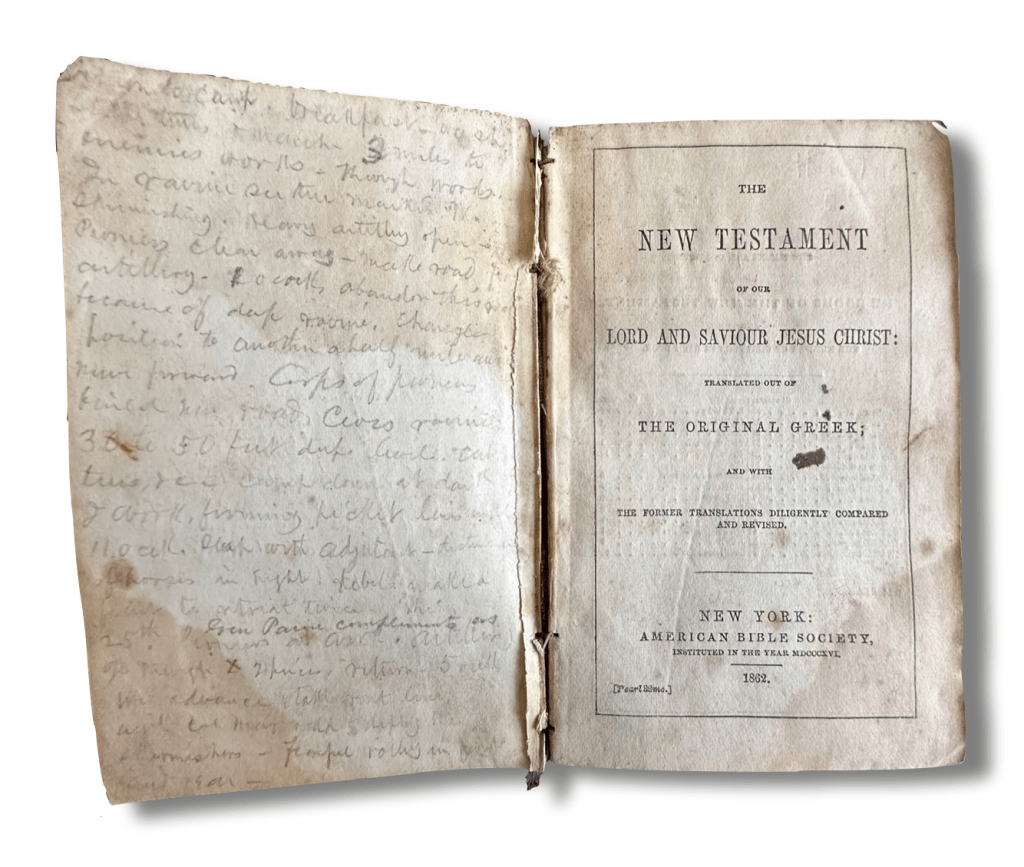
The following handwritten notes were found in an 1862 New Testament that was carried by Levi Lewis Jaquith (1829-1913) while serving as a sergeant in Co. B, 53rd Massachusetts Infantry.
Levi was the son of Seth Jaquith (1804-1866) and Ann Robbins (1805-1878) of Cheshire county, New Hampshire. Levi was first married in 1850 to Sarah Louisa Kingsbury (1833-1892) and later, in 1894 to Orvilla Wilson (1842-1918). At the time of the Civil War, Levi was living in Fitchburg, Worcester county, Massachusetts. Levi was 33 years old when he enlisted on 25 August 1862, giving his occupation as a “chair maker.”
After it was organized in the fall of 1862, the regiment was assigned to the expedition to go to Louisiana and once there, in January 1863, it was assigned to Gooding’s 3rd Brigade, Paine’s 3rd Division, 19th Army Corps. After participating on some expeditions into Louisiana, the 53rd found itself in May 1863 at Bayou Sara, bearing down on Port Hudson from the north. It was here that Levi began taking notes on the flyleaf of the New Testament, distributed by the American Bible Society.
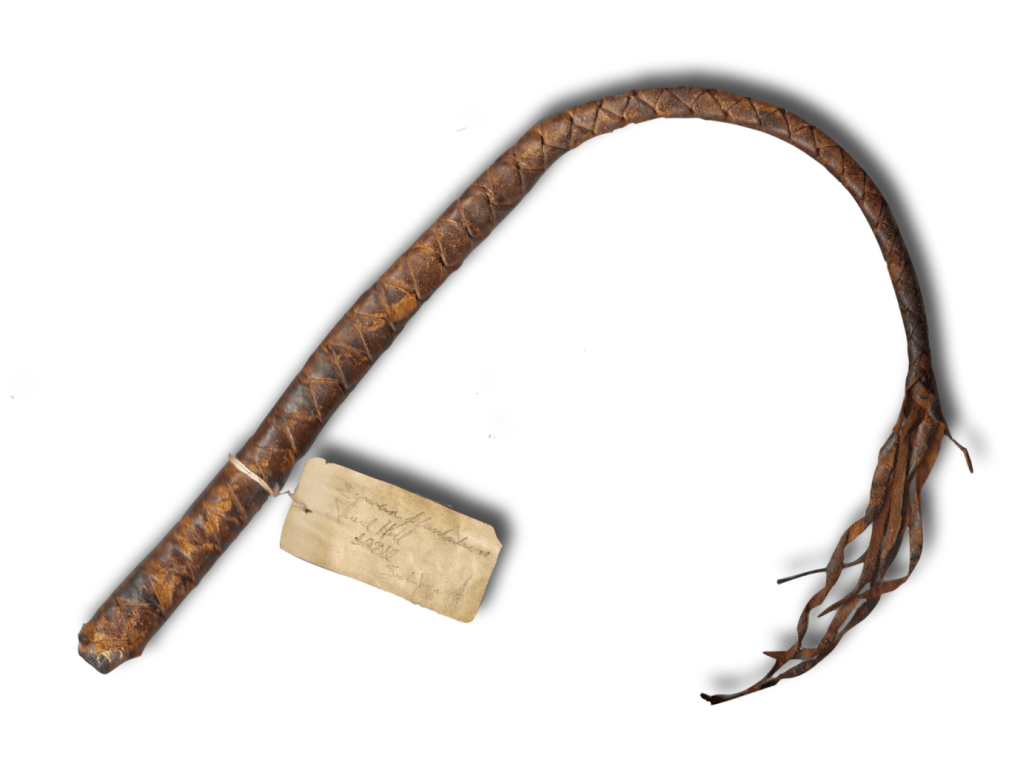
In addition to preserving the New Testament that he carried with him in the service, Levi collected and kept a rather unusual relic of his sojourn into Dixie—a lash that he picked up from a Louisiana plantation. The braided leather lash measures approximately 21 inches in length and bears a contemporary tag, barely discernible, but appears to read, “Lyman Plantation, Laurel Hill, Lash,” and includes Levi’s signature. There was a village named Laurel Hill in West Feliciana Parish through which the troops passed, though I cannot find any mention of a plantation owned by the Lyman family.
Transcription
Arrived at St. Francisville
Handheld New Testamentdistributed by the American Bible Society
Saturday morn 23rd [May]. Midnight on Mississippi river. Moved from Alexandria to Simsport. Start May 22nd. March 75 miles. 3 days. Morning of 26th, go into city from river. Camp near Lyman Plantation in magnolia grove and cape jasmine. Cross in Laurel Hill [packet sidewheeler]. Change camp. Nearly all the troops gone up river towards Port Hudson. Embark on Laurel Hill. Don’t start up river.
Store houses on the river burned by Butler. Ammunition train. Stop at St. Francisville. No flour, cloth, meal, servants nearly starved. Fine court house and church (new). Most luxuriant country…
March three miles to enemy’s works through woods. In ravine, see the [ ] skirmishing. Heavy artillery open. Pioneers clear away—make road for artillery. 1 o’clock, abandon this road because of deep ravine. Change position to another a half mile away near forward. Corps of Pioneers build new road. Cross ravine 30 to 50 feet deep, cut trees &c. Camp down at dark. I work forming picket lines until 11 o’clock. Sleep with adjutant. Distant sound of horses in night. Rebels make a feint to retreat twice. Fearful volley in front and rear. A few fall back. They volley, take old position. Three or four wounded. One finger shot off (self shot) Capt. [George H.] Bailey. 1
Work until 11 deploying skirmishers. Return to headquarters with reserve. Co. I and F did from 12 to 3. Major waked me and we count on the whole line, examining the position. Adjutant struck with spent ball. One volley at daylight. Rebs retire. Two persons come in Tuesday noon. I retire to rear. [Gen.] Paine with them. Order of Col.—remain all quiet. Returned at 9 o’clock. Retire half a mile to cook and sleep. Remain all day resting. Negro regiments. 22 guns. Bouquet of magnolias.
No firing. A strange calm before the storm. Quiet walk in the evening alone. Sat down but no sleep. Restless, nervous, weary and sleepy. But no sleep. I feel the weight of our position. The awful solemnity. Col. came in at 11. I notify all commander that the grand attack will commence in the morning by the central force. Order that men have two day’s rations, breakfast eaten, blankets rolled, and left under guard, and start at 4:20.
Brig. General William Dwight
Move at 4:30 through the woods. Gen. [William] Dwight leads, having command of us infantry. In one to two hours the rebs are all driven through the woods to a clearing and the artillery comes up. Open a terrible fire. Rebs respond. An awful artilllery duel. 30 lb. fused shells strikes within 2 feet of our line [but] did not explode. Men did not move. The 30 lb. shells strike all about us. Several battery trains cut down. Tree cut entirely in two, falls upon a caisson and 6 horses, crushing them all. Men go by in crowds wounded—officers also. Lots of skedaddlers. “All cut up.”
Gen. Paine comes up and says our forces have taken two rifle pits but are badly cut to pieces. Needs us there. Had regiment [start] for the place he wants but we must support the battery and hold the hill. [ ] the 91st New York and 2nd Louisiana &c. welcomed with “bully for you” over and over. The men have driven the rebs out of a ravine for three-quarter mile. Our regiment sprang to the edge of a cliff and opened fire. The enemy are behind rifle pits 150 yards in front. From 10 till dark our men fire continuously. Reb’s big Columbiad……4 men wounded on our side.
On Thursday, 28th, firing with rifles stopped. We lay all day resting with a watch, ordered to cease firing. After noon the artillery opened and in a few moments dismounted the enemy guns. Flag of truce to bury dead till 7 evening.
1 Capt. Bailey was mortally wounded on May 25th and died on the 27th.
The following letter was written by James King of New York City who wrote the letter to his aunt, Janet Sheppard (1798-Af1865), also of New York City. In the 1855 State Census, I can see that a 20 year-old young woman named Johanna King was enumerated in the household of her Aunt Janet Sheppard of No. 8, 22nd Street in NYC. Johanna was undoubtedly James’ sister. Beyond that, I have not been able to confirm King’s record of service. Neither have I been able to confirm the location of Alexander Bridge which must have been located somewhere near the Cumberland river based on the content of this letter.
Transcription
Addressed to Miss J. Sheppard, No. 8 East 22 Street, New York City
Alexander Bridge March 7, 1865
My dear Aunt,
I have just received a bunch of Tribunes and I see by my note book that it is time I was writing you. The Tribunes are dated down to the 28th of February. They are full of the good news. I hope it will continue to tell the end of the Rebels and the war. I had a letter from home the other day. They were all well and I had a newspaper from Father and he told me in his letter that when I got a paper, I was to consider them all well.
We have been having a rainy time of it lately but it has been good weather the past two days. We have not been set to work on the new stockade yet. We expect the Major here today to say where it is to be put and where we are to get the timber. It is to be built strong enough so a shell can’t get inside. The boys do not like the idea of going to work but it will not hurt them. Our duty is light but the stockade will not go on fast as we will have our duty to do as before. But as long as we have our health, we ought not to grumble.
I hope this will find you all in good health as it leaves me at present. The grass is beginning to grow and cattle are out feeding. The planters are very slow about their work. It rains so much here that the ground is not in a fit condition to plough. The men are ploughing today for it has been dry for two days now and the wind has dried up the ground. The Cumberland river is very high. The back water comes up to our bridge and some of the fields are covered with water. The troops are going south at the rate of two or three regiments a day. I do not see how they feed so many men when it takes so much to feed our small squad. I think the Rebels will soon have a hard time to get their rations for when the railroad on our line of communications is cut, the soldiers are put on short rations and I do not see how the Rebels can feed their men except they have a different way of doing than our government has.
Well, I must close for this time. I am expecting a letter so I will wait as the mail has gone for today. I have just received your kind letter of February 28 and was glad to get it. I also received one from Tebeta of the same date as yours. They were all well.
Dear Aunt, I will try and put my letters in as good language as I can. I never did get a thorough course of instruction in grammar and if I do not make a mistake, it is in some part in not taking pains to mind what I wrote. Aunt, would it not be a good idea for you to write about 3 or 4 days after you send the papers? But I do not wish to put you to any more trouble if you have a good ways from the post office [in which case] you had better send both together as heretofore.
I have wrote all the news I can think of just now. Kind love to Aunt Elizabeth and Joan. Kindest love to yourself and I remain your affectionate nephew, — James L. King
This will go out by tomorrow’s post. I received the newspapers on Monday the 6th of March and the letter the 7th.