Category Archives: Uncategorized

1864: Esther (Warner) Calkins to Phebe (Calkins) Hager

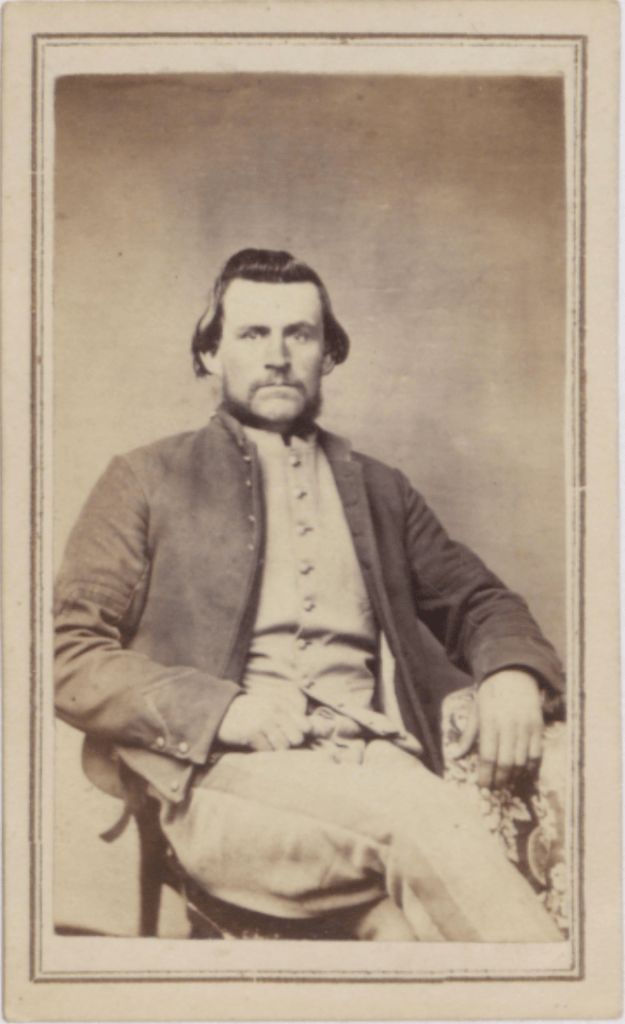
I could not find an image of Peter in uniform but here is Daniel H. Frazier who served in the 11th Kansas Cavalry

The following two letters were written by Esther (Warner) Calkins (1834-1880), the wife of Peter Berdic Calkins (1833-1897). The couple were married in Richland, Oswego county, New York and were living in Elm Creek Township. Saline county, Kansas, during the Civil War.

Esther wrote the letter to her sisters-in-law, Jane (Calkins) Alexander, the wife of Samuel Alexander, and Phebe (Calkins) Hager (1831-1898), the wife of John Hager (1829-1897) of Altmont, Michigan.

Esther’s letter indicates that her husband Peter had recently become a soldier. Peter enlisted in Co. L, 11th Kansas Cavalry on 31 March 1864. He was discharged for disability on 14 June 1865 at Fort Riley. Both letters were written while Esther was home alone in Saline county with her two little girls—Mary (b. 1856) and Jane (b. 1863).

Letter 1

Salina [Kansas]
June 11, 1864

Ever dear Brother and Sister,

I improve the time this morning in answering your kind and affectionate letter which came to hand in due time. I was very glad to hear from you. I and my little children are well. It has been 3 weeks since I have seen Peter. He says he likes a soldier’s life first rate. His health is much better since he enlisted, but it has been very lonely for me since he has gone. He has been at Fort Riley all the spring, until within a few days he has gone to Fort Scott.

It has been a very cold backward spring. The winter wheat is an entire failure. How I wish I could come and spend the summer with you and Phebe. I think I should enjoy myself better than I shall here.

The Indians have been trying to be troublesome this spring. Four weeks ago, news came to us; the Indians was just above town killing everybody they came to. We thought if they were that near to us it was time for us to be leaving. The man that I live with got his team and we started and went 15 miles before we stopped but to find out the truth of it, there was one white man and three Indians killed [and] that was about 70 miles from us. We were all very badly scared but I think that we are safe now. The soldiers came and drove them back. The men in Salina have built a fort so they will be ready for the rebels if they ever come to make war with the whites. I hope we won’t have any more trouble with the Indians.

I hope this cruel war will come to a close this year. It is enough to make one’s heart ache to think how many homes it has made desolate. Good of all kinds re very high. Calico is 35 cents a yard. Coffee 55 cents a pound and everything according. I have 7 cows with me and five yearlings and 2 horses. Peter has bought nine head of cattle since he has been in the war. I have not got them home yet.

I can’t think of much to write since Hattie died and Peter has gone in the war, I ain’t myself any more. Tell Phebe that I will write to her soon. Peter’s post office: Fort Riley, Company L, Kansas 11th, in care of Capt. Henry Booth. If I could see you I could tell you more then. I can write no more at this time but ever remain your sister until death. Let us try and meet in heaven where we never shall take the parting hand. — Esther

Goodbye.


Letter 2

Salina [Kansas]
July 10, 1864

My dear sister Phebe,

I take my pen in hand to let you know that I have not forgotten you. I am well today and I hope when this reaches you it will find you enjoying the same blessing. Dear Phebe, I can sympathize with you in your loneliness. I got a letter from Peter today. He was well and seems to enjoy himself first rate. He is about 75 miles from home.

The Indians are quite troublesome this summer. They have killed two white men this summer. The soldiers are out all the time keeping them back. Whether they will come into this place I cannot tell.

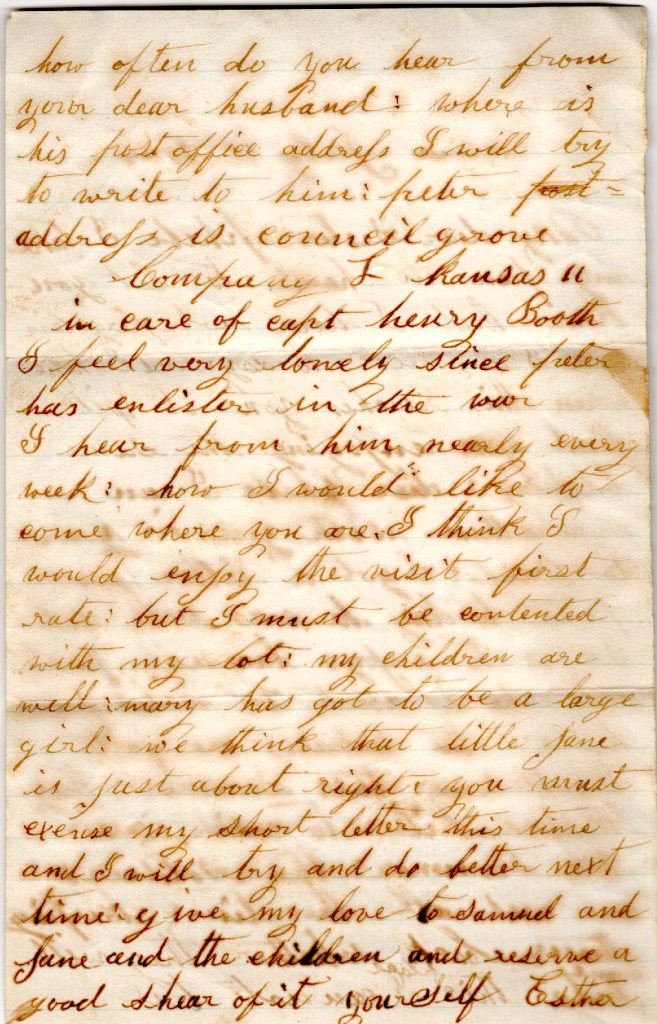
How often do you hear from your dear husband? Where is his post office address. I will try to write to him. Peter’s address is Council Grove, Company L, Kansas 11th, in care of Captain Henry Booth.

I feel very lonely since Peter has enlisted in the war. I hear from him nearly every week. How I would like to come where you are. I think I would enjoy the visit first rate. But I must be contented with my lot. My children are well. Mary has got to be a large girl. We think that little Jane is just about right.

And you must excuse my short letter this time and I will try and do better next time. Give my love to Samuel and Jane and the children and reserve a good I share of it yourself, — Esther

1862: Charles Jessup to William Castle

The following letter was written on 5 March 1862 from an encampment on Meridian Hill in Washington D. C. The soldier’s name appears to be Charles Jessup but I have not been able to identify his regiment. He must have only just arrived in Washington having passed through Pittsburg and across Pennsylvania to Baltimore before arriving in Washington. He was, therefore, likely to be from a “western” state like Ohio, Illinois, Indiana or Michigan. My hunch would be the latter.

Transcription

Washington [D. C.]
March 5, [1862]

William Castle,

It is with much pleasure that I take my pen in hand to let you know that I am well. I should like to see you and all of the rest of the folks that I used to be with around there. Although I am now far from you all, I haven’t forgotten about you all that I used to see when I was there. Do you remember the meeting they had at the log school house the night before I started for the rapids. Ask Enoly is she has forgotten that she has. Tell her to put on her thinking cap. The rest of the folks that I used to know when I was there—tell them that I would like to see them and be there to go to the [ ] with them and you.

I have seen the large mountains that are in Pennsylvania. I have seen where they dug through rocks from one to two hundred feet. I have rode from a quarter of a mile to a mile and a quarter under ground. I have seen some pretty nice cities since I left there and some that weren’t so nice. Pittsburg was the worst looking place that I saw since I left there and Baltimore was the nicest place I did see.

I should like to live in Baltimore. I was in the fort in Baltimore when I was there. I tell you that the large guns looked pretty saucy to point at a man. Our men had to keep the town guarded for fear of the rebels breaking onto them. We stopped in Baltimore one day so I had a good chance to see the city. Miles Filey and myself went downtown while I was here and the lieutenant of our company and we had a pretty nice view of the city.

We are on Meridian Hill. We have a pretty good sight for to look out on the Potomac river and see what’s on there. The Sixth is within the half a mile of us. I am down to the Sixth now. I do like this part of the country very well.

As I find my sheet pretty near full, I will bring my letter to a close. You must excuse my bad writing for I haven’t no place to write but to take my pen and paper on my lap and write. So goodbye to you, — Charles H. Jessup

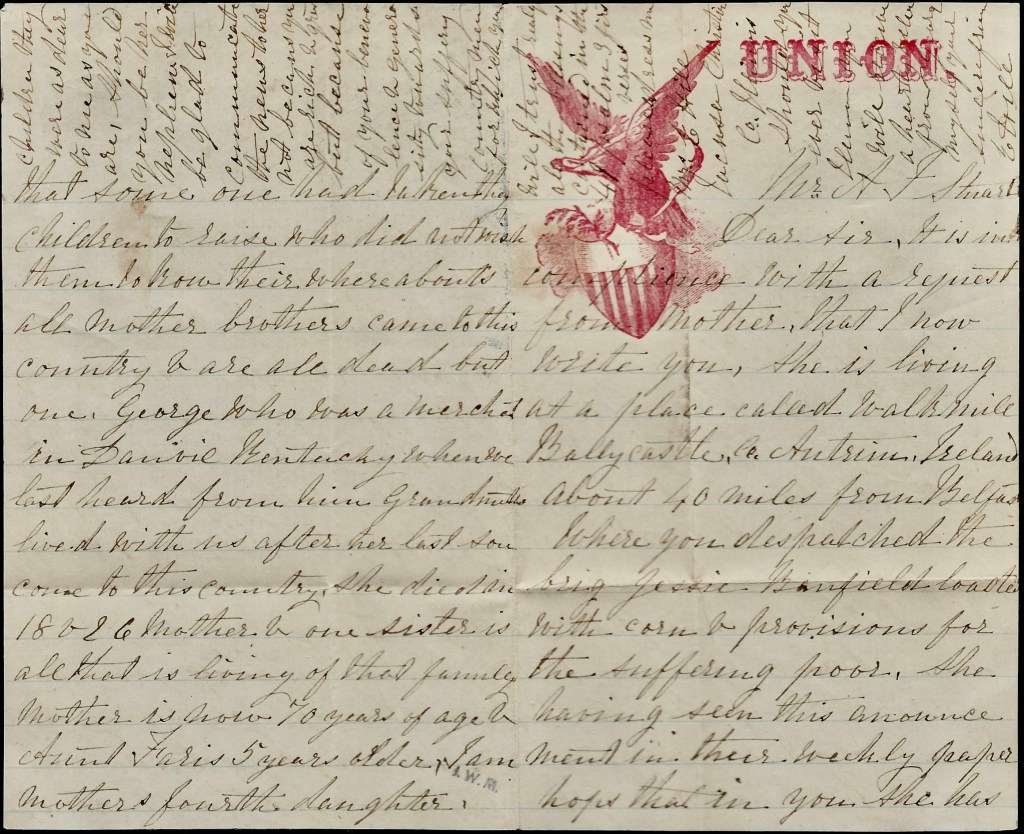
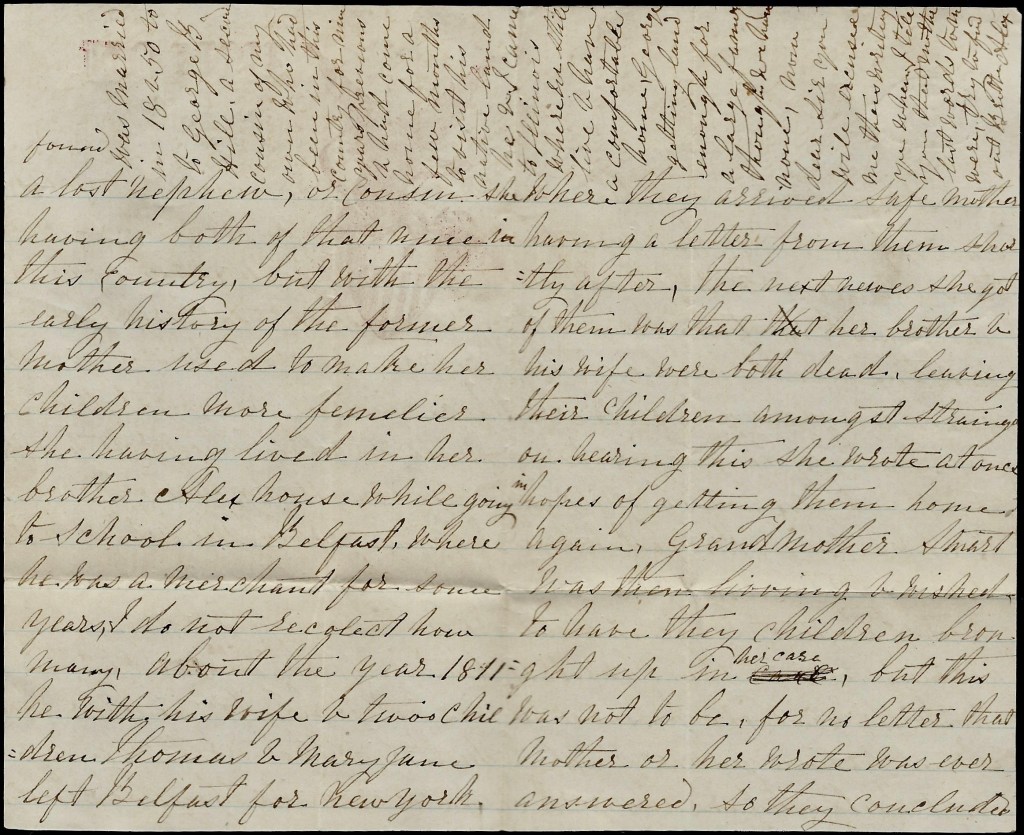
1863: Elizabeth (Fullerton) Hill to Alexander Turney Stuart

This letter was written by Elizabeth Fullerton (1822-1899), a native of Country Antrim, Ireland, who married George B. Hill (1818-1895) on 29 May 1850 at Ballycastle, Ireland, and came to the United States shortly afterward. Elizabeth was the daughter of James Fullerton (1790-1841) and Marcella Stewart (1790-1864).

Elizabeth wrote the letter to Alexander Turney Stewart (1803-1876), an Irishman who moved to New York and made his multimillion-dollar fortune in the most extensive and lucrative dry goods store in the world. Stewart was born in Lisburn, Ulster, Ireland, and abandoned his original aspirations of becoming a Presbyterian minister to go to New York City in 1823. He spent a short time teaching before returning to Ireland to receive the money his grandfather had left him, purchase some Belfast linens and laces, and return to New York to open a store.

Stewart had extraordinary skill in business, and by 1848 he had built a large marble-fronted store on Broadway between Chambers Street and Reade Street, which was devoted to the wholesale branch of his business. In 1862 he built a new store covering an entire city block between Broadway and Fourth Avenue and between 9th and 10th streets. It was eight stories tall and attracted the wonder and business of upscale New York. Trainloads of wealthy customers from outlying cities came to shop. Stewart made most of his money through wholesaling and especially New York City real estate. He opened branches of the company in other parts of the world and owned several mills and factories. He had an annual income of US $1,843,637 in 1863 (equivalent to $35.8 million in 2023). His business success is estimated to have made him one of the twenty wealthiest people in history as of 2007, with a fortune equivalent to approximately US$90 billion in 2012.

Transcription

Mr. A. T. Stuart,

Dear sir—it is in compliance with a request from Mother that I now write you. She is living at a place called Walkmile Bally Castle, County Antrim, Ireland, about 40 miles from Belfast where you dispatched the brig Jessie Banfield loaded with corn & provisions for the suffering poor. She having seen this announcement in their weekly paper hopes that in you she has a lost nephew, or cousin, she having both of that name in this country, but with the early history of the former. Mother used to make her children more familiar, she having lived in her brother Alex’s house while going to school in Belfast where he was a merchant for some years, I do not recollect how many.

About the year 1811 he with his wife & two children Thomas and Mary Jane left Belfast for New York where they arrived safe, Mother having a letter from them shortly after. The next news she got of them was that her brother & his wife were both deadm leaving their children amongst strangers, On hearing this she wrote at once in hopes of getting them home again. Grandmother Stuart was then living & wished to have the children brought up in her care, but this was not to be for no letter that Mother or her wrote was ever answered so they concluded that someone had taken the children to raise who did not wish them to know their whereabouts.

All Mother’s brothers came to this country and are all dead but one. George who was a merchant in Danville, Kentucky, when we last heard from him. Grandmother lived with us after her last son came to this country. She died in 1826. Mother & one sister is all that is living of that family. Mother is now 70 years of age & Aunt Faris 5 years older. I am Mother’s fourth daughter. Was married in 1850 to George B. Hill, a second cousin of my own who had been in this country for nine years previous & had come home for a few months to visit his native land. He & I came to Illinois where we still live & have a comfortable home. George getting land enough for a large farm though we have none.

Now dear sir, you will excuse me this writing you when I tell you that Mother’s last words to me were “try to find out brother Alex’s children, They were as dear to me as you are.” Should you be her nephew, I will be glad to communicate the news to her not because you are rich & great but because of your benevolence & generosity towards your suffering countrymen for which you will, I trust, realize all the blessings contained in the 49 Psalm, 3 first verses. Please address me, Mrs. E. Hill, Iacusa, Christian county, Illinois. Should you ever visit Illinois, you will receive a hearty welcome from myself, your sincere friend, — E. Hill

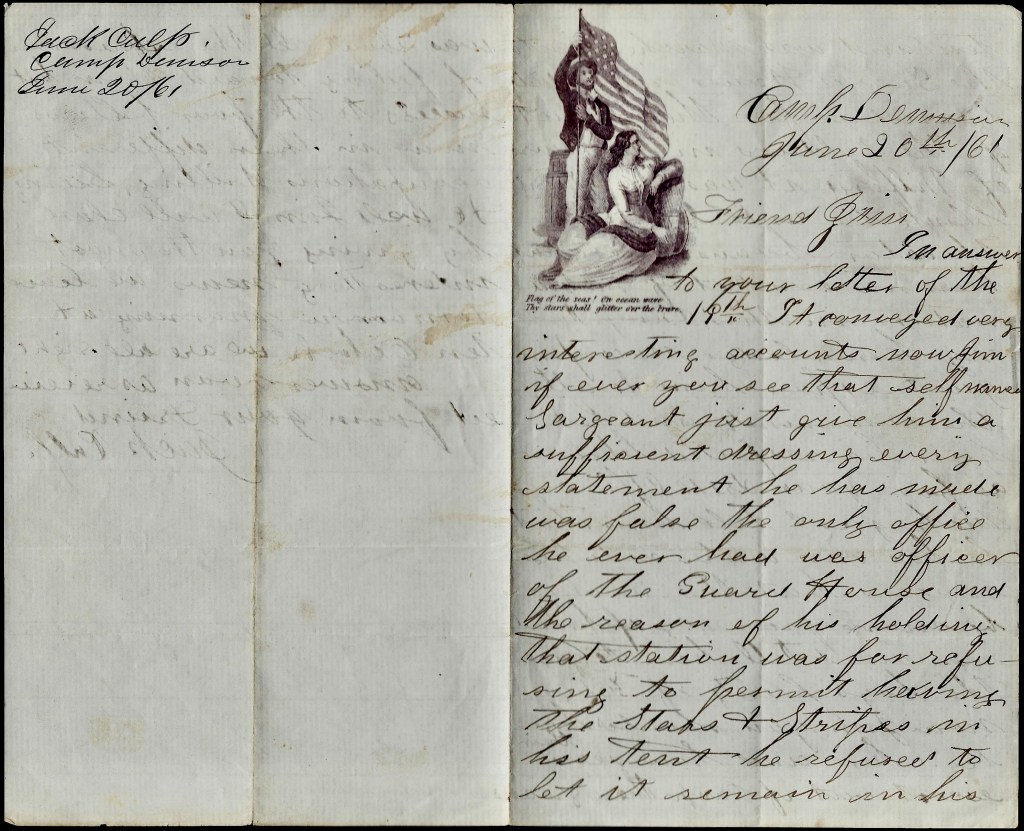
1861: Jack Culp to a Friend

I believe this letter was written by Andrew Jackson (“Jack”) Culp of Co. F, 8th Ohio Infantry (3 months). The regiment was organized 29 April through 2 May 1861 at Camp Taylor near Cleveland (and was mustered into service for 3 months on 2 May. Its nine companies were composed of men from northern Ohio, with Co. B representing the Hibernian Guards. The 8th Ohio was transferred on 3 May to Camp Dennison, near Cincinnati where they remained until June 22, 1861. Many of the soldiers in the regiment reenlisted for three years but it doesn’t look like Jack did.

Transcription

Camp Dennison
June 20th 1861

In answer to your letter of the 19th, it conveyed very interesting accounts. Now Jim if ever you see that self named sergeant, just give him a sufficient dressing. Every statement he has made was false. The only office he ever had was Officer of the Guard House and the reason of his holding that station was refusing to permit having the Stars & Stripes in his tent. He refused to let it remain in his tent and was marched into the Guard House immediately. And as for the conduct of the soldiers in the town of Milford, it was all a point blank lie unless he was actor because there has been no conduct of such a nature in this camp to my knowledge. Now Jim, just expose him to all the community and let him be respected likewise.

As for your drill officer Mok, just tell him that he has our wishes as to his success but they would be more friendly if he had remained. Tell him to give the boys plenty of fatigue. Now Jim, you should have been here and have seen their escort out of camp. Three groans was about all the expression of feeling toward them. But success to the four fellows now in their different occupations—drilling, lying, &c.

Well Jim, I will close by giving you the most interesting news. We leave tomorrow morning at ten o’clock. We are all right. Answer soon as received. From your friend, — Jack Culp

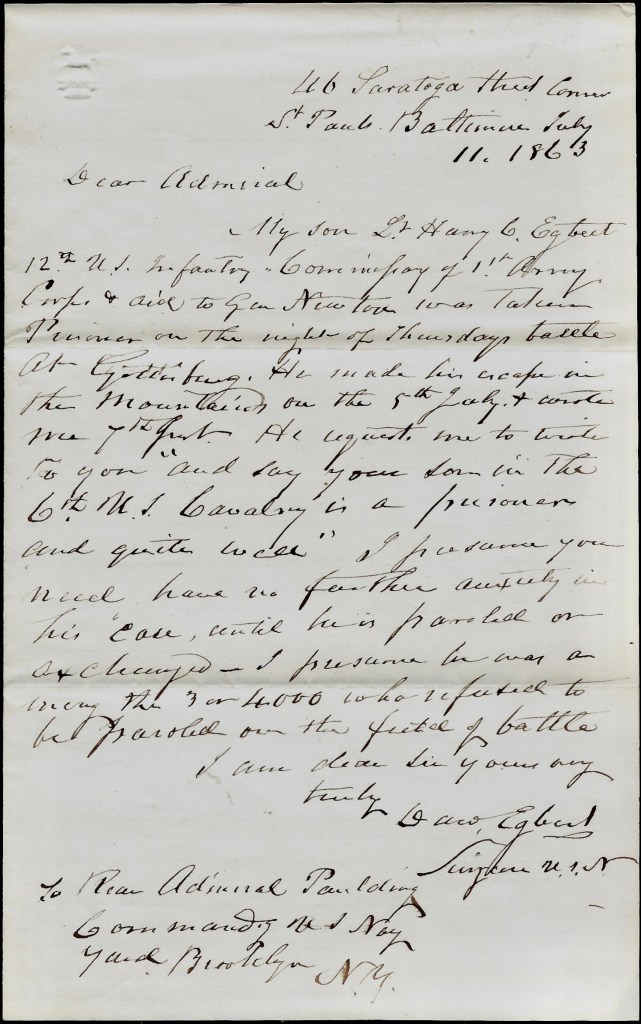
1863: Daniel Egbert to Hiram Paulding

The following brief letter was written by Daniel Egbert, Surgeon, USN, to Rear Admiral Hiram Paulding respecting the capture of his son, Lt. Tattnall Paulding (1840-1907) during the Gettysburg Campaign and spent time in Libby Prison. [See—1863: Tattnall Paulding to Hiram Paulding].

Transcription

46 Saratoga Street, Corner St. Pauls
Baltimore [Maryland]
July 11, 1863

Dear Admiral,

My son, Dr. Harry C. Egbert, 12th U.S. Infantry, Commissary of 1st Army Corps & aide to Gen. Newton, was taken prisoner on the night of Thursday’s battle at Gettysburg. He made his escape in the mountains on the 5th July & wrote me 7th Inst.

He requests me to write to you “and say your son [Lt. Tattnall Paulding] in the 6th U.S. Cavalry is a prisoner and quite well.” I presume you need have no further anxiety in his case, until he is paroled or exchanged. I presume he was among the 3 or 4,000 who refused to be paroled on the field of battle.

I am, dear Sir, yours very truly, — Dan. Egbert, Surgeon U. S. N.

To Rear Admiral Paulding, Commanding US Navy Yard, Brooklyn, New York

1861: Larrabee & North Military Goods to James Savage

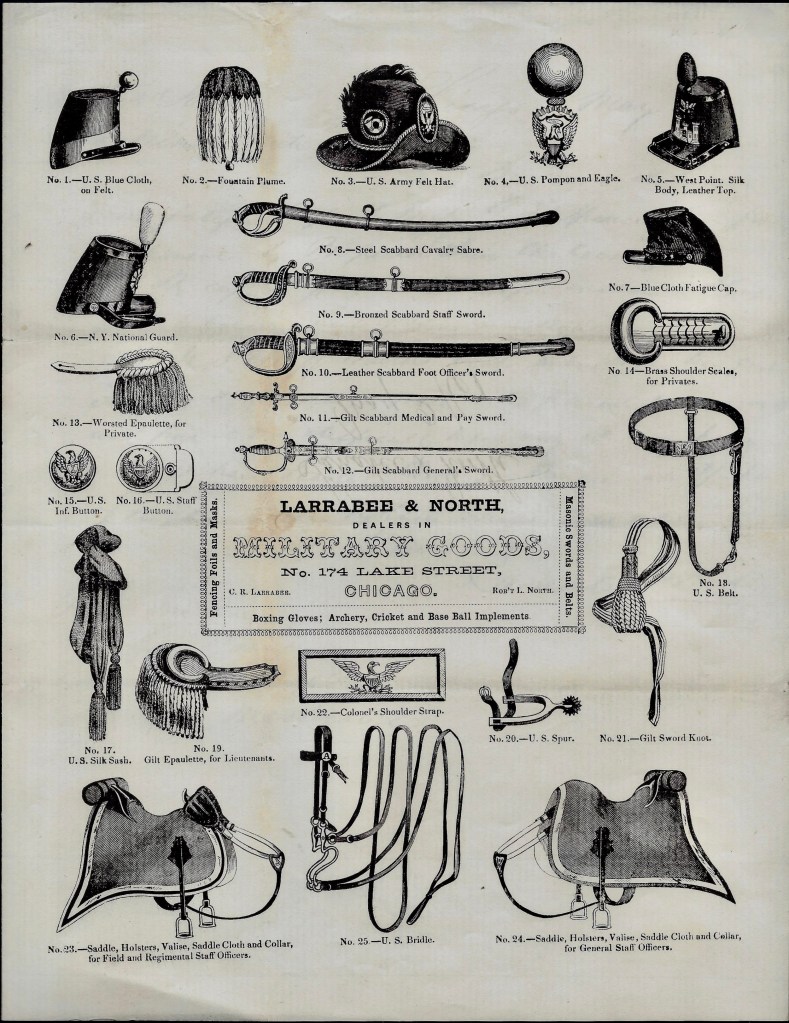
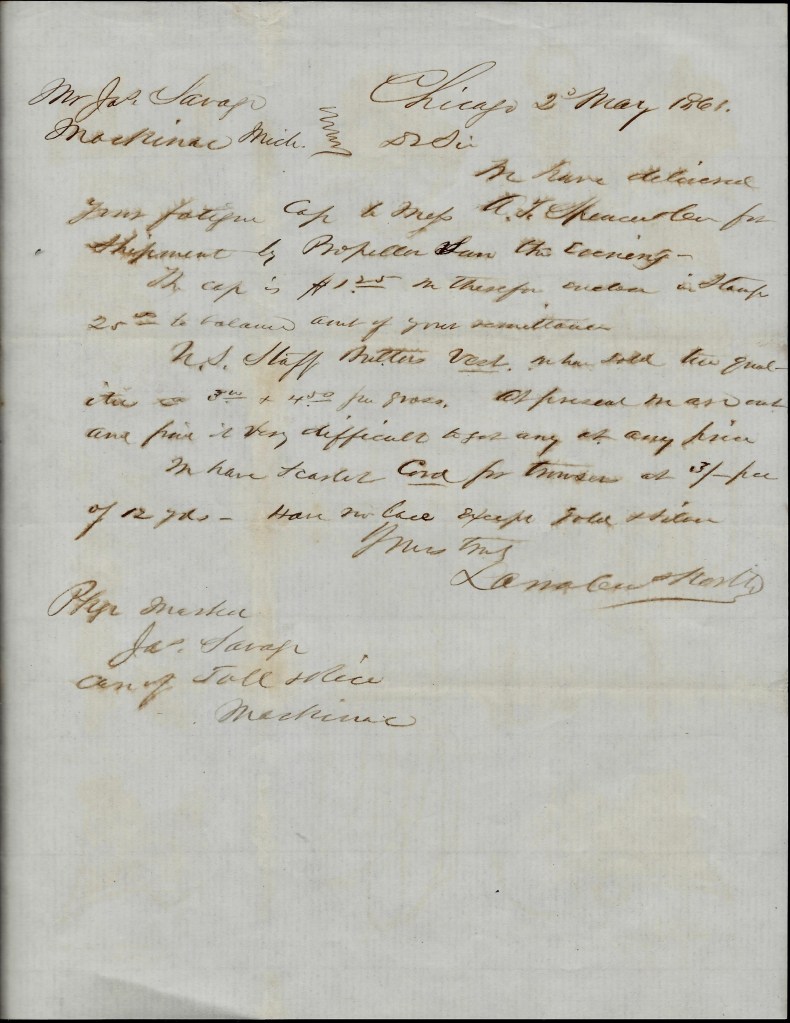
The following 1861 letter was written by a clerk in the Larrabee & North Military Goods store located at No. 174 Lake Street in Chicago. The 4-page lettersheet displays printed illustrations of military goods for sale on the first page and includes a hand written letter to 24 year-old James Savage, a British-born member of the U. S. garrison at Fort Mackinac, Michigan. This most interesting promotional lettersheet has cuts of 25 different items, including officer’s swords, epaulettes, saddles, hats, and other items to outfit officers in the newly expanding Union army.

Transcription

Chicago, [Illinois]
2nd May 1861

Mr. James Savage
Mackinac, Michigan

Dear Sir,

We have delivered your fatigue cap to Messr. A. T. Spence & Co. for shipment to Propeller Sun this evening.

The cap is $1.25. We therefore enclose in stamp 25.00 to balance amount of your remittance.

U. S. Staff button vest we have sold two qualities at 3.00 & 4.50 per gross. At present we are out and find it very difficult to get at any price. We have scarlet cord for trousers at 3/– per of 12 yards. Have no lace except gold & silver.

Yours truly, — Larrabee & North

[ ]
Jas. Savage, care of Toll & Rice, Mackinac

1864: Thomas E. Bispham to his Parents

The following letter was written by Thomas E. Bispham (1835-1865), the son of Thomas Bispham (1797-1879) and Elizabeth Jennings (1795-1878) of Wayne township, Warren county, Ohio. Thomas was married to Sarah Frances Likins (1840-1902) in March 1857 and the couple had two children at the time that Thomas enlisted as a private in Co. H, 79th Ohio Volunteer Infantry (OVI) in August 1862.

Thomas was promoted to a corporal in February 1863 and made it through the Atlanta campaign without injury but was wounded at Averysboro, North Carolina on 16 March 1865. He died of his wounds at David’s Island (N.Y. harbor) hospital on 25 May 1865.

In this letter, Thomas describes the Battle of 20 July 1864 at Peachtree Creek in the Atlanta Campaign.

There is a striking similarity in Thomas’s handwriting with that of a diary fragment that I transcribed back in January 2021 which I was able to attribute to the 79th OVI but not to any particular soldier. I suspect, however, the mystery soldier served in Co. I.

Transcription

Addressed to Thomas Bispham, Esq., Waynesville, Warren county, Ohio

Camp 79th OVI
Sunday, July 24th 1863

My Dear Father & Mother,

I thought as Sallie was from home, maybe you would not hear from me, and perhaps you might wish to. Therefore, I will write.

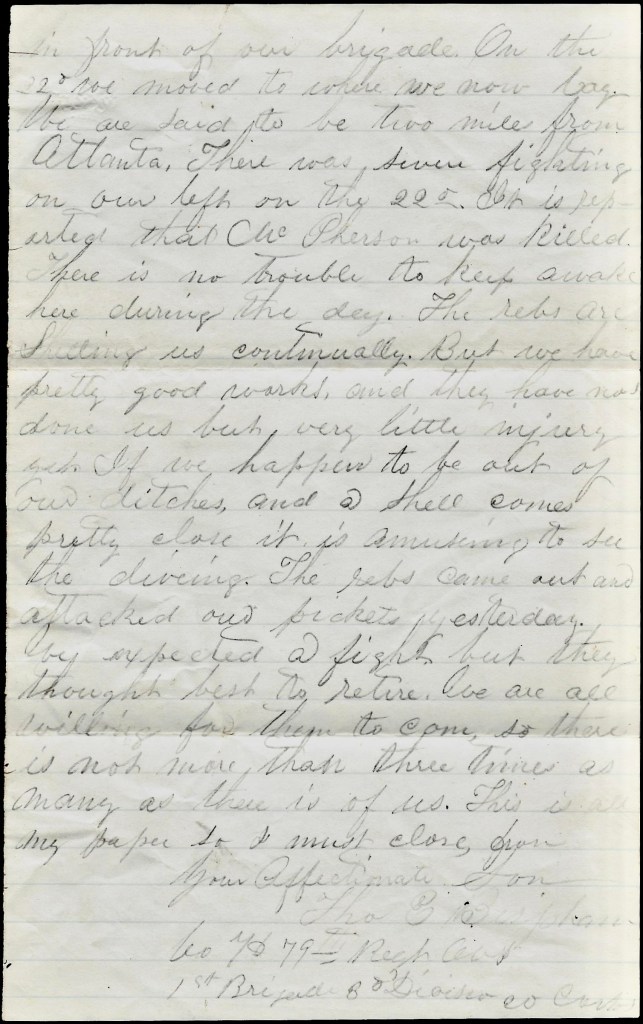
On the 20th we got into quite a battle. The rebs attacked our lines. We (our brigade) was laying in the rear of a gap, and when the attack was made we had to move up to get on the line. We had a fair, open fight and defeated them. I had some very fine shots. Our regiment lost 58—ten killed and forty-eight wounded. Co. H had George Brinker & Corp. I[saac] F. Stump killed. Joseph H. Wolfe, Asa Chandler, John Prater, Wm. Watkinson and Martin Lansey wounded. I have heard they are all doing very well but Wolfe. It is estimated from the number we have in our possession that the Rebels lost from ten to fifteen hundred in front of our brigade.

On the 22d, we moved to where we now lay. We are said to be two miles from Atlanta. There was severe fighting on our left on the 22d. It is reported that [James B.] McPherson was killed. There is no trouble to keep awake here during the day. The rebs are shelling us continually. But we have pretty good works and they have not done us but very little injury yet. If we happen to be out of our ditches, and a shell comes pretty close, it is amusing to see the diving. The rebs came out and attacked our pickets yesterday. We expected a fight but they thought best to retire. We are all willing for them to come, so there is not more than three times as many as there is of us. This is all my paper so I must close.

From your Affectionate Son — Thos. E. Bispham

Co. H, 79th OVI, 1st Brigade, 3d Division, 20 [Army] Corps

1864: Jared E. Gates to Esther (Hart) Gates

The following letter was written by Jared E. Gates (1832-1911) of Salem, Columbiana county, Ohio. In the 1860 US Census, 28 year-old Jared was the oldest of several siblings by that name living in the Salem household of 48 year-old Lydia Minsor. Ohio Marriage records inform us that Lydia Gates married, William Henry Minsor in 1845—presumably her second marriage. At that time, Jared was employed as a “confectioner.”

Jared was one of the first to join Co. C, 11th Ohio Volunteer Infantry (OVI) and was mustered in on 1 July 1861. He mustered out three years later on 21 June 1864. Jared must have been home on furlough in January 1863 for it was on 9 January 1863 that he and Esther (“Hetty”) W. Hart (1834-1915) were married in Columbiana county. Jared lived his last thirty years in McKean county, Pennsylvania.

Transcription

Chattanooga Tennessee
January 27th 1864

Mrs. E. W. Gates,

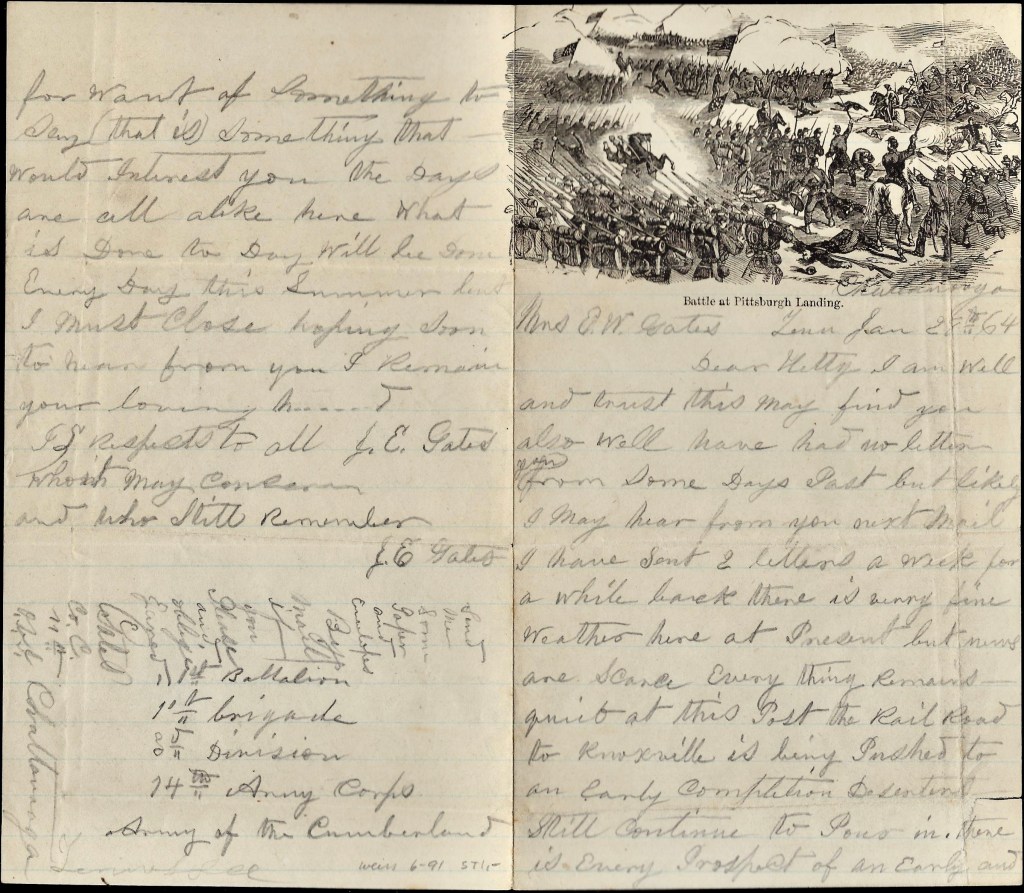
Dear Hetty, I am well and trust this may find you also well. Have had no letter from you [for] some days past but likely I may hear from you next mail. I have sent 2 letters a week for a while back. There is very fine weather here at present but news are scarce. Everything remains quiet at this post. The railroad to Knoxville is being pushed to an early completion. Deserters still continue to pour in. There is every prospect of an early and vigorous campaign in front of this line—that is, I mean the line of the Tennessee. It may be that the storm will burst forth at Knoxville. The Rebels are evidently about to make a desperate effort to retrieve their fortunes in this section of the country and Uncle Sam is making preparations to receive them in a style becoming their chivalry and prestige.

The weather is very warm—so warm today that a blouse feels uncomfortable. I am in hopes that before it gets very hot we shall be on our way north. Our time is said to be out April 20th. If so, we shall be just in time to escape the hot season. Will finish this tomorrow. In the meantime, there might arrive a letter (for the undersigned) with news from home.

Well the night has passed pleasantly away. The train from Nashville came in just after retreat but it brought no letter for J. E. G. There is no news. Some ladies (southward bound) were searched at the Provost Marshal’s the other day. Various contraband articles were brought to light among which were some 30 revolvers nicely concealed in a bed tick. These ladies were sent on their way to Dixie with a lighter load than they had intended to take. They were the hardest set of women I ever saw.

Well, I will have to close this important letter for want of something to say—that is, something that would interest you. The days are all alike here. What is done today, will be done every day this summer. But I must close hoping soon to hear from you. I remain your loving husband.

Respects to all, — J. E. Gates

Who it may concern and who still remember—J. E. Gates

Send some paper and envelopes by mail if you please and I oblige, Jared E. Gates, Co. C, 11th O. V. I., Chattanooga, Tennessee

1st Battalion, 1st Brigade, 3rd Division, 14th Army Corps, Army of the Cumberland

1863: “Fredrick” to “Libbie”

I can’t be certain of the identity of the author of this letter. Only because I recently transcribed a letter by Robert Hill of Osweatchie, New York, who served in the 106th New York do I have a hunch that it may have been written by:

MILLS, FREDERICK H.—Age, 21 years. Enlisted, August 7, 1862, at Oswegatchie, to serve three years; mustered in as corporal, Co. C, August 27, 1S62; mustered out with company, June 22, 1865, near Washington, D. C.

Transcription

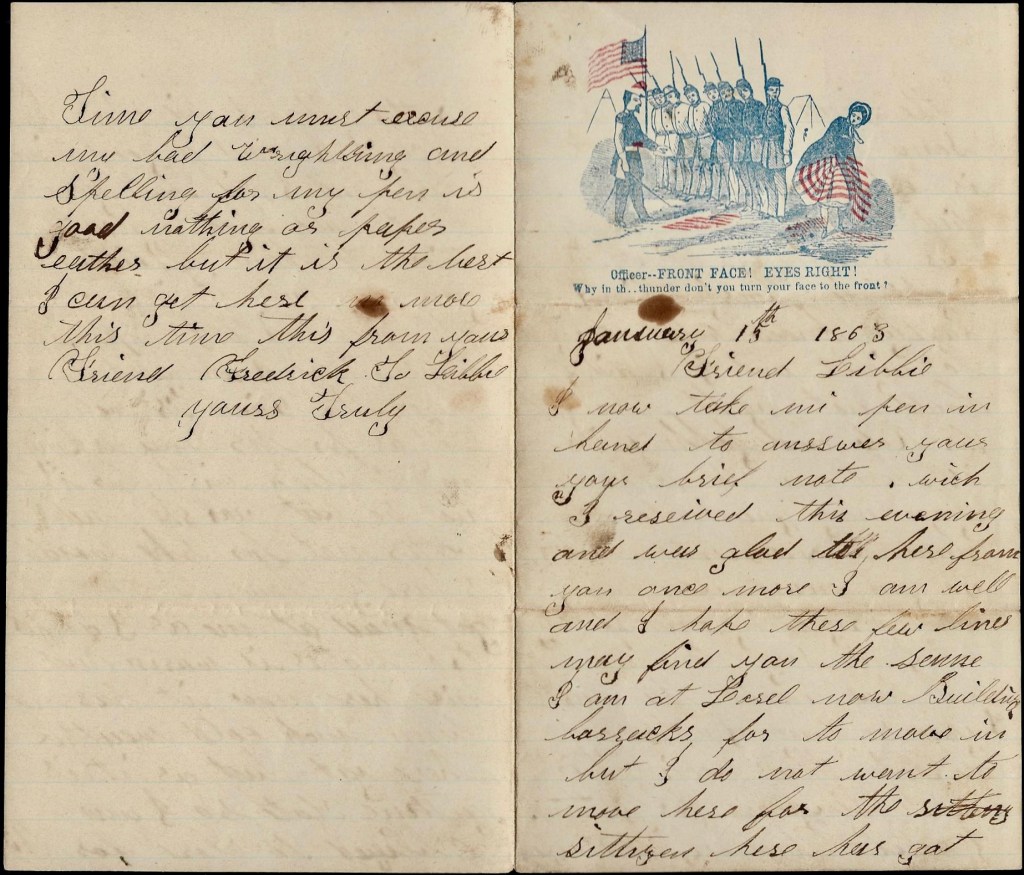
January 15, 1863

Friend Libbie.

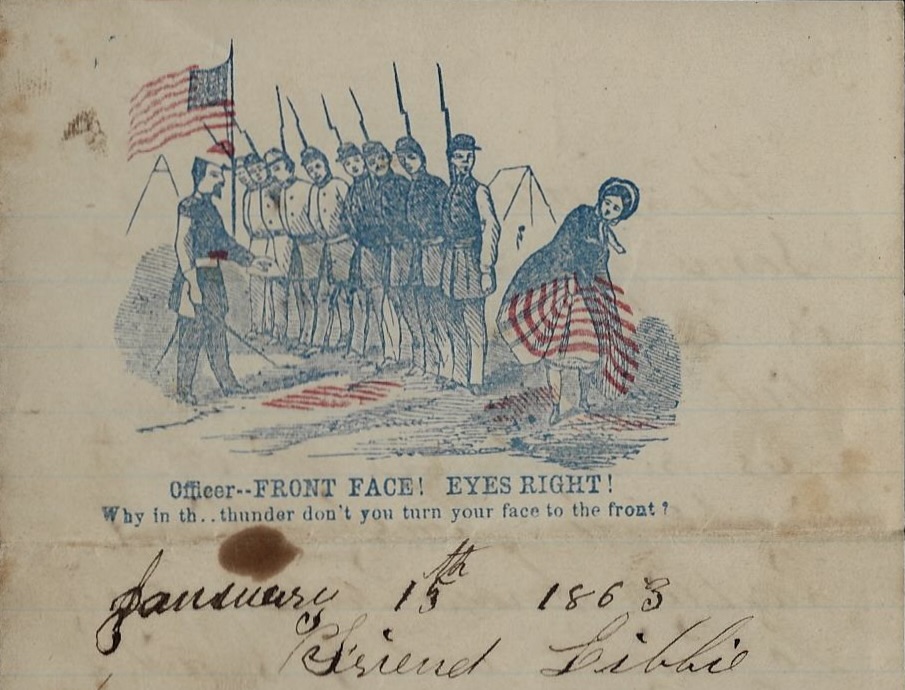
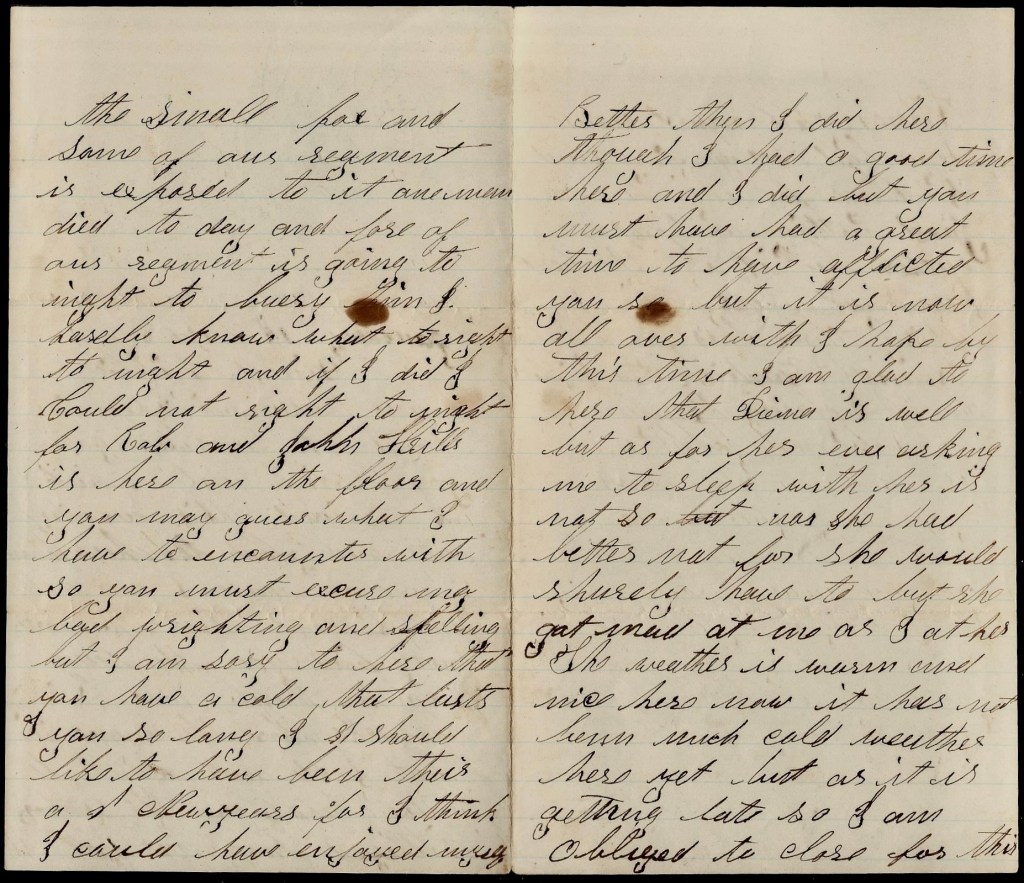
I now take my pen in hand to answer your brief note which I received this evening and was glad to hear from you once more. I am well and I hope these few lines may find you the same. I am at Larel [?] now building barracks for to move in but I do not want to move here for the citizens here has got the small pox and some of our regiment is exposed to it. One man died today and four of our regiment is going tonight to bury him.

I hardly know what to write tonight and if I did, I could not write tonight for Rob and John Hills is here on the floor and you may guess what I have to encounter with so you must excuse my bad spelling. But I am sorry to hear that you have a cold that lasts you so long.

I should like to have been there at New Years for I think I could have enjoyed myself better than I did here though I had a good time here, but you must have had a great time to have afflicted you so. But it is now all over with I hope by this time. I am glad to hear that Diana is well but as for her ever asking me to sleep with her, it’s not so. nor she had better not for she would surely have to. But she got mad at me as I got at her.

The weather is warm and nice here now. It has not been much cold weather here yet but as it is getting late, so I am obliged to close for the time. You must excuse my bad writing and spelling for my pen is good [for] nothing or paper either, but it is the best I can get here.

No more this time. This from your friend Frederick

To Libbie

1862: Unidentifed Soldier to his Parents

The following letter was written by a soldier who signed his name “Han” (I think), which might have been short for Hanson or Hanley. He may have had a brother serving with him named “Si” which could be short for Simon or Josiah. In any event, there are too few clues in the letter to give us an clear path forward to their identity.

Transcription

Tennessee
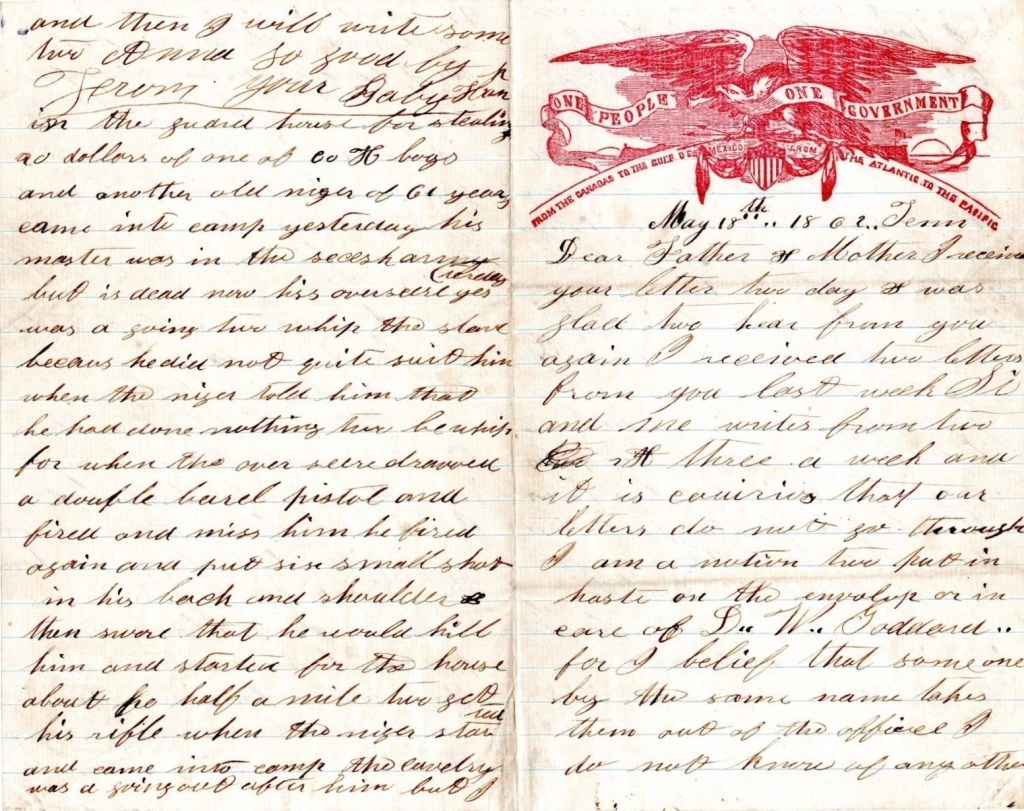
May 18, 1862

Dear Father & Mother,

I received your letter today and was glad to hear from you again. I received two letters from you last week. Si[mon] and me writes from two to three [letters] a week and it is curious that our letters do not go through. I am a notion to put in haste on the envelope or in care of D. W. Goddard for I believe that someone by the same name takes them out of the [post] office, I do not know of any other cause and if you get a letter with these directions, you need not not be alarmed till you open it.

I have been having the ague for the past three days but I think that I have got over it now. So is Si and the rest of the boys with the exception of Chris and Eck & Jonah, but Jonah is getting better now, but Eck is bothered with piles very bad. Chris has been having the fever for the past three days but it is better now. Well, all of them, in fact.

The weather here is very beautiful. It is warm and pleasant and the fruit is so forward that it seems to me as though it was July. Strawberries are all gone most. Cherries are ripe and peaches are half grown. Wheat is in bloom and corn has been howed once and peas is big enough to eat but things grow so slow here. I never want to love here for I should get out of patience for it to grow. Corn that was planted the first day of April is not over three inches high but I do not know the reason why without it is because when the niggers go anywhere near it, a black cloud passes between that the sun. As for niggers, there is no end to them in camp. They keep coming and one is in the guard house for stealing 20 dollars off of one of Co. H boys and another old nigger of 61 years came into camp yesterday. His master was in the secesh army but is dead now. His overseer yesterday was a going to whip the slave because he did not quite suit him when the nigger told him that he had done nothing to be whipped for when the overseer drawed a double barrel pistol and fired and missed him. He fired again and put six small shot in his back and shoulder, then swore that he would kill him and started for the house about half a mile to get his rifle when the nigger started and came into camp. The cavalry was going out after him but I have not heard with what success as I have not been out of my tent but very little today. But I have seen enough of slavery and could have shot his overseer if I could have seen him.

Well, I must close for I have got to eat supper and then go on dress parade and then I will write some to Anna. So goodbye. From yours Baby, — Han