Category Archives: USS Monitor

1862: Jacob Howard Asher to his Cousin George

The following letter was written by Jacob Howard Asher (1840-1917) who was twenty-one years old when he enrolled at Hudson to serve three years in Co. C, 128th New York Infantry. He was mustered in as a sergeant and was promoted to first sergeant in November 1863, and commissioned a 2nd Lieutenant in January 1865. He mustered out of the regiment on 12 July 1865 at Savannah, Georgia.

“Howard” was the son of Jacob Asher (1802-1860) and Ellen Ostrom (1809-1879) of Rhinebeck, Dutchess county, New York. He was working as a teamster prior to his enlistment, at which time he was described as standing 5′ 10″ tall, with dark gray eyes and black hair. After the war, when he returned to Dutchess county, he resumed his career as a teamster.

In his letter, Howard describes the journey from Camp Millington near Baltimore, Maryland, to Fortress Monroe aboard the US Mail steamer Arago in early November 1862. He appears to have been informed that the regiment was to be included in an expedition to New Orleans to join Gen. Nathaniel Banks’ Department of the Gulf. The regimental history informs us that sickness and disease infested the ranks while aboard the Arago though Howard does not acknowledge it. He does mention seeing and describing the USS ironclad Monitor, however, which was reported by others in the regiment.
T R A N S C R I P T I O N

Steamship Arago near Fortress Monroe
Monday, November 10, 1862

Dear Cousin George,

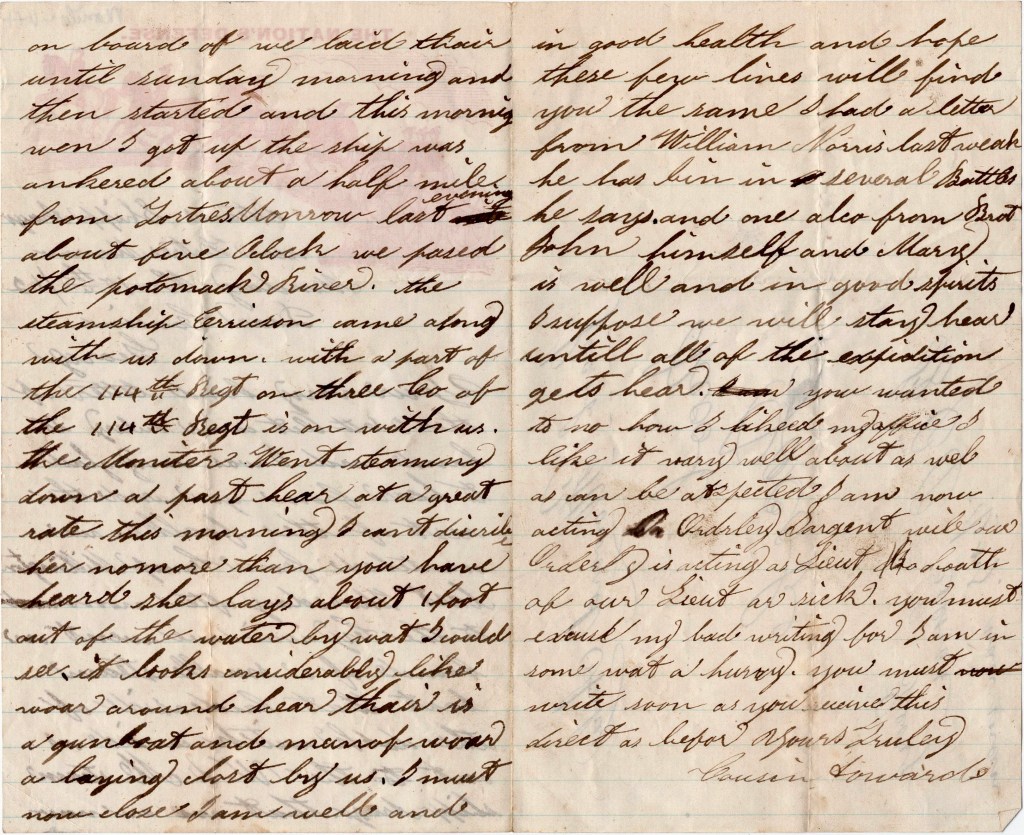
Your very kind letter of the 26th October came duly to hand and I was very glad to hear from you and the rest of the folks. We marched from Camp Millington [in Baltimore, Md.] last Thursday afternoon to the city where we went onboard of a small steamboat that laid aside of the dock which carried us out to the U. S. M[ail] Steamship Arago that we are now on board of. We laid there until Sunday morning and then started and this morning when we got up the ship was anchored about a half mile from Fortress Monroe.

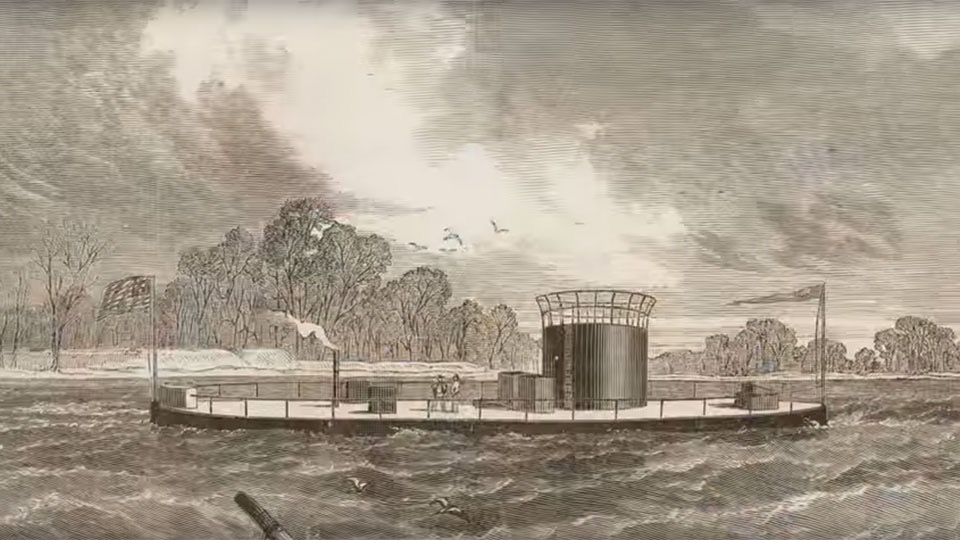
Last evening about five o’clock we passed the Potomac River. The steamship Ericsson came along with us down with a part of the 144th Regiment on [it]. Three companies of the 114th Regiment is on with us. The Monitor went steaming down past here at a great rate this morning. I can’t describe her no more than you have heard. She lays about one foot out of the water by what I could see.

It looks considerably like war around here. There is a gunboat and man-of-war a laying close by us. I must now close. I am well and in good health and hope these few lines will find you the same. I had a letter from William Norris last week. He has been in several battles, he says. And one also from Brother John. Himself and Mary is well and in good spirits.

I suppose we will stay here until all of the expedition gets here. you wanted to know how I liked my office. I like it very well—about as well as can be expected. I am now acting Orderly Sergeant while our Orderly is acting as Lieutenant. Both of our lieutenants are sick. You must excuse my bad writing for I am in somewhat of a hurry. You must write soon as you receive this. Direct as before. Yours truly, — Cousin Howard

1862: Samuel Royer to his Family

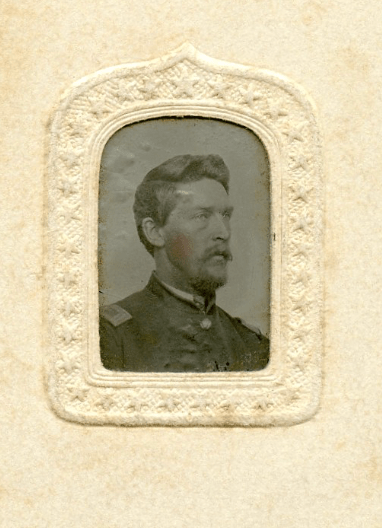
I could not find an image of Sam, but here is one of Lt. Jay Cushing of Co. G, 53rd Penn. Vols. (Photo Sleuth)

The following letter was written by 2nd Lieutenant Samuel (“Sam”) M. Royer (1838-1921) who mustered into Co. C, 53rd Pennsylvania Infantry on 17 October 1861. Samuel was the son of Samuel Royer (1792-1856) and Martha Patton (1802-1881) of Springfield Furnace, Blair county, Pennsylvania.

Sam was promoted to 1st Lieutenant on 9 May 1862 and he resigned his commission on 1 December 1862 to return home and pursue a career in medicine. By the time of the 1870 Census, he was practicing as a physician in Martinsburg, Pennsylvania.

In March 1862, the 53rd Pennsylvania joined in McDowell’s advance toward Manassas Junction where they passed through the battlefield of 1st Bull Run. They were then transferred into Gen. Israel B. Richardson’s Division in the II Corps and sent to the Peninsula to take part in McClellan’s drive on Richmond which began with the siege of Yorktown. Royer penned this letter shortly after landing at Ship Point but not before he had a good look at the celebrated ironclad Monitor at Hampton Roads which he describes in detail.

USS Monitor engaged at Hampton Roads with CSS Virginia

[Note: This letter is from the private collection of Greg Herr and was transcribed and published on Spared & Shared by express consent.]

Transcription

Addressed to Mrs. Martha Royer, Springfield Furnace, Blair county, Pennsylvania

Camp near Ship Point
Sunday, April 13th 1862

Dear Mother and all,

I wrote you while on board the steamer Robert Morris but felt doubtful as to your receiving the letter though I hope you have read it ere this. We were four days on the water and to me it is altogether the preferable mode of traveling. On the afternoon of the 7th we reached Fortress Monroe and right sorry was I when we were ordered to put back. At the fortress is all life and activity and more. The place is beautiful. Here we had a fine look at the wonders of the world—the Monitor and Steven’s Battery. The Rebels said well when the Monitor was called “A cheesebox on a raft.” It looks very like a raft. The deck is flat and only about two feet of the vessel can be seen above the water, but I was told it draws thirty feet. On the deck is a round iron-plated kind of a coop about five feet high and large enough to contain four guns. This is the only armament on board. The two boiler smoke stack, whistle, and pilot house are merely seen above the deck so that it is impossible for balls to strike anything but the iron-plated coop and in the fight with Rebels, it was struck [ ] times, but was hurt none. Received a slight ding on the eight. It does seem impossible for such a machine to be hurt. There are no sails or any other fixins about it except what I have mentioned.

On the evening of the 7th, we headed up the bay and when about fifteen miles up, the bay grew rather boisterous and we anchored for the night. Early in the morning we again weighed anchor and moved on the Ship Point a short distance below the York River. Here we landed and moved across the country to our present camp, two miles from Ship Point.

The country here is altogether different from any I have yet seen—all one level begins—no mountains or hills. Yet there is an abundance of timber—all of one kind, pitch pine. The soil is sand and you may imagine the condition of the roads. I have seen the teams drawing their wagons along very smoothly when in an instant they would go down to the hub and when left, would go over the wheels. The principal agriculture productions of this region are corn and sweet potatoes.

I have written you heretofore of the many troops I have seen, but now I might say I have not seen many troops till [ ] from Ship Point to Crockett’s Mill three miles in the direction of Yorktown and as great a space north and south is one mass of infantry, cavalry, and artillery. There are a few inhabitants yet remaining in the region, all bitter secesh. They are awfully frightened at our forces. They cannot be made to believe that all the troops are from the north but really believe some are foreign. What can be the idea of concentrating such a force here is altogether a mystery. The supposition is that Yorktown is to be besieged and all the troops made prisoner. This it is reported can [ ] moving up as the road is being made and no doubt ere a week, the advance will be [ ] the rebels. The secesh here think their forces will evacuate and burn the town. What the effect of the news from the defeat in the West will have upon Yorktown is yet to be seen. It is to be hoped that a surrender equal to days of yore will be expected of the enemies of our country at Yorktown.

Monday morning, 14th

Today we are having the usual beautiful weather. Part of the artillery was moved yesterday in the direction of Yorktown. We will, I hope, hear in a short time of the end of the rebellion, no doubt yet. I am anxiously looking for the captain. The [ ] been called in and will certainly report this week. I am sending a root and some seeds of a beautiful evergreen. They should be planted in a box filled with moist sand. If the root does not grow, perhaps the seeds will. I am also sending a ring for Dot. It is made of a button which I found at Manassas on a coat belonging to Sergt. Finch of the 12th Alabama. 1 The shells I send also [which] I picked up yesterday on the shore of the York River. Also a piece of pine I have just picked from a little tree at my tent door.

We get oysters in superabundance. The boys are in the river all hours of the day and bring any bushels. We also get an abundance of sweet potatoes. Did you get your [ ]. Write me all the news. Tell [ ] to write. Yours, &c., — Sam

We are sending our letters by chance but hope they will reach you. Direct to Ship Point, Co. C, 53rd Penn. Vols., Richardson’s Division


1 I believe Sam has written the 12th Alabama but if he did, then Fitch did not die from wounds received from the Battle of First Manassas because they didn’t participate in that engagement. They did spend the fall and winter encamped near Manassas, however, and so may have died from sickness. Searching for soldiers named Finch in the 12th Alabama has not revealed the button owner, however. Only one John W. Finch appears in the muster rolls and he was a musician who did not die at Manassas. It’s also possible that the button was taken from a garment that did not belong to a dead soldier, found on the site.

1862: John Sterling Bird to friend “Herb”

The following letter was written by John Sterling Bird (1836-1900), the son of David Bird (1804-1863) and Eunice A. Phelps (1805-1882) of Winchester, Litchfield county, Connecticut. He wrote the letter while attending the Columbia University College of Physicians and Surgeons in 1862. He was still identified as being a member of the “medical class” in the session of 1863-64. It appears that he practiced medicine in Dutchess county, New York, in the 1870s and 1880s. He was married to Alice Emma Jones (1854-19180 in the early 1870s.

Bird wrote the letter to his friend “Herb” who remains otherwise unidentified but probably a childhood friend from Litchfield. We learn that Herb was serving in the Union army but his regiment is unknown. Herb may have been serving in an Indiana regiment such as the 14th, 19th, or 27th as he adds the statement, “If the Indiana men in Virginia do as well as in Tennessee, I think they will have their reputation made.” This comment makes little sense otherwise.

Bird’s letter refers to the recent Union victories in Tennessee and in North Carolina but also mentions the latest news from Hampton Roads announcing the destruction of two Union wooden-hulled ships (USS Congress and USS Cumberland) by the ironclad CSS Virginia (Merrimack) on 8 March 1862. On the very day that Bird wrote this letter—the 9th of March—the ironclad USS Monitor would duel with the CSS Virginia for three hours, neither vessel able to inflict any significant damage on the other.

The College of Physicians & Surgeons at the corner of 23rd Street and 4th Avenue in NYC

Transcription

New York City
March 9th 1862

Friend “Herb,”

I received yours of Jan. in due time for which please accept my most hearty thanks. But perhaps you say that I had better have answered it at once, if I was so mighty thankful. Well, I suppose I had, but please recollect that civilians have to keep busy, as well as soldiers.

Just because few of these ‘risque” images survive today doesn’t mean they didn’t exist. Many were probably discarded into campfires along with playing cards as soldiers prepared to march into battle.

It seems that “sweethearts” are so scarce down your way that you are obliged to make the most of such pictures as you sent me in your letter. Well, in want of the genuine article, I suppose that you will be justified in exercising your imagination to a certain extent. But I should suppose that you might convert some of those Virginia misses from the error of their ways and in doing so, make love to them at the same time. Suppose you try the experiment. You know that a handsome young man like yourself—in uniform—can accomplish wonders with the fair sex.

Unless I should forget it, I will give you an article of news which I have at once. Leroy Wetmore is married to Fred Hills’s daughter (Lucy, I believe) of Torrington—first cousins I believe. Think they must have been rather hard up, don’t you? 1

So you see that most all our old friends have got into the entanglements of matrimony. If they are satisfied, I am. When you and I get ready, when you have immortalized your name by killing people, and I by curing them, then perhaps we’ll try it.

Since I wrote you last, there has been stirring times among the national armies. Victory upon victory has been achieved. You cannot have sent terror to rebel hearts, and joy unbounded to all loyal northern homes. I can’t believe that you can conceive of the thrill of joy which shot like lightning through all the North at the news of Henry, Donelson, and Roanoke. People fairly cried for joy. Army operations seem to be progressing well at this time and if this is kept up, something will be accomplished. But it is not to be all smooth sailing yet for as I write there is an extra out with news from Fortress Monroe that the Rebels have destroyed some of our ships and are shelling our camp at Newport News.

I suppose that you are in Virginia now and whether you will get this, I know not. I expect to stay in the city for some time yet. I don’t see as I can write much more this time. Keep you courage up. If the Indiana men in Virginia so as well as in Tennessee, I think they will have their reputation made.

Now answer this as soon as you can directing to College of Physicians and Surgeons, 23rd Street and 4th Avenue, New York.

This from your friend, — J. S. Bird

1 Leroy Whiting Wetmore (1836-1872), the son of Abel Samuel Wetmore (1802-1879) and Lucy Amira Hills (1810-1881), was married on 12 February 1862 at Torrington, Litchfield county, CT, to Lucy Ann Hills (1841-1871).

1862: George W. Arnold to Friend

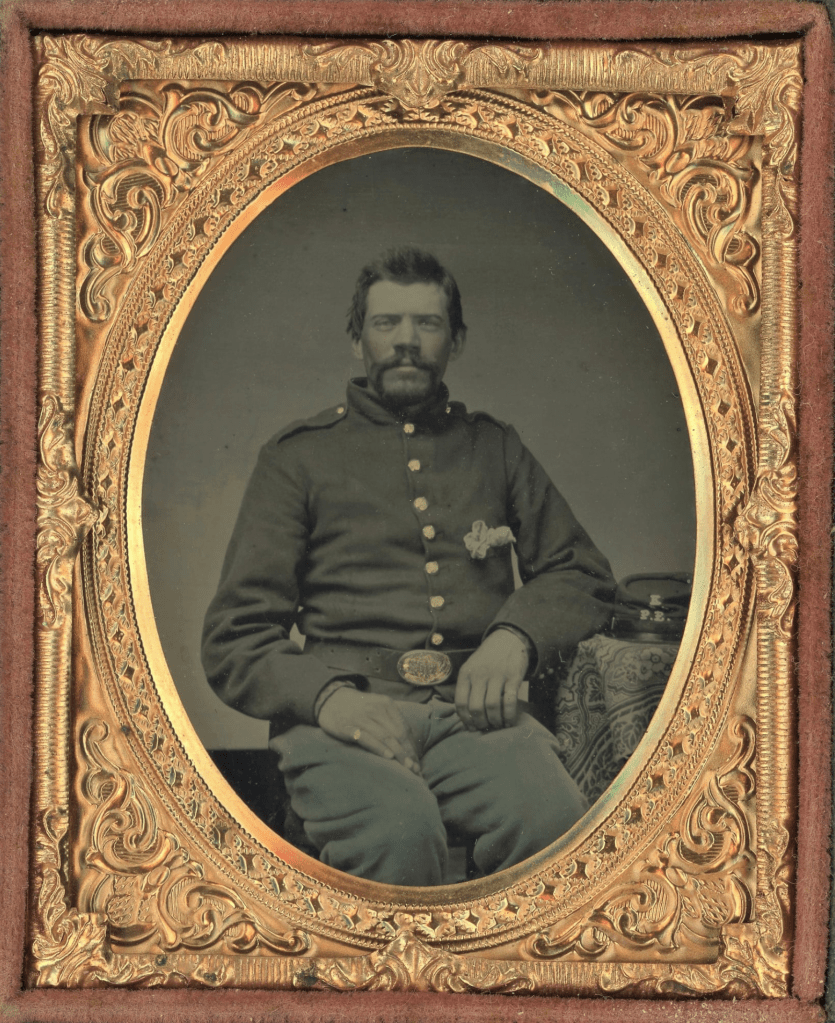
I could not find an image of George but here is an unidentified member from the same unit—Co. K, 44th New York (“People’s Ellsworth Zouaves”). He wears a large 1839-Pattern SNY waist belt plate. (Dan Binder Collection)

This letter was written by George W. Arnold who enlisted at the age of 22 as a private on 8 August 1861 in Co. K, 44th New York Infantry. He was promoted to wagoner shortly after his enlistment and remained with the regiment until 11 October 1864 when he was discharged after three years service. At the time of his enlistment, George was described as standing 5′ 11″ tall, with blue eyes and brown hair. He was a painter when he enlisted.

George was the son of Benjamin Franklin Arnold (1806-1874) and Emma J. Slocum (1807-1908) of Pawling, Dutchess county, New York. After the war, George married Charlotte B. Hubbell (1840-1896).

To read other letters by member of the 44th New York Infantry that I have transcribed and published on Spared & Shared, see:
John Gurnsy Vanderzee, Co. A, 44th New York (1 Letter)
John T. Johnson, Co. C, 44th New York (2 Letters)
John H. Lewis, Co. D, 44th New York (1 Letter)
Peter Mersereau, Co. E, 44th New York (1 Letter)
Charles Robinson French, Co. E, 44th New York (1 Letter)
Anthony G. Graves, Co. F, G, H, 44th New York (38 Letters)
Isaac Bevier, Co. E., 44th New York (2 Letters)
Albert Nathaniel Husted, Co. E, 44th New York (1 Letter)

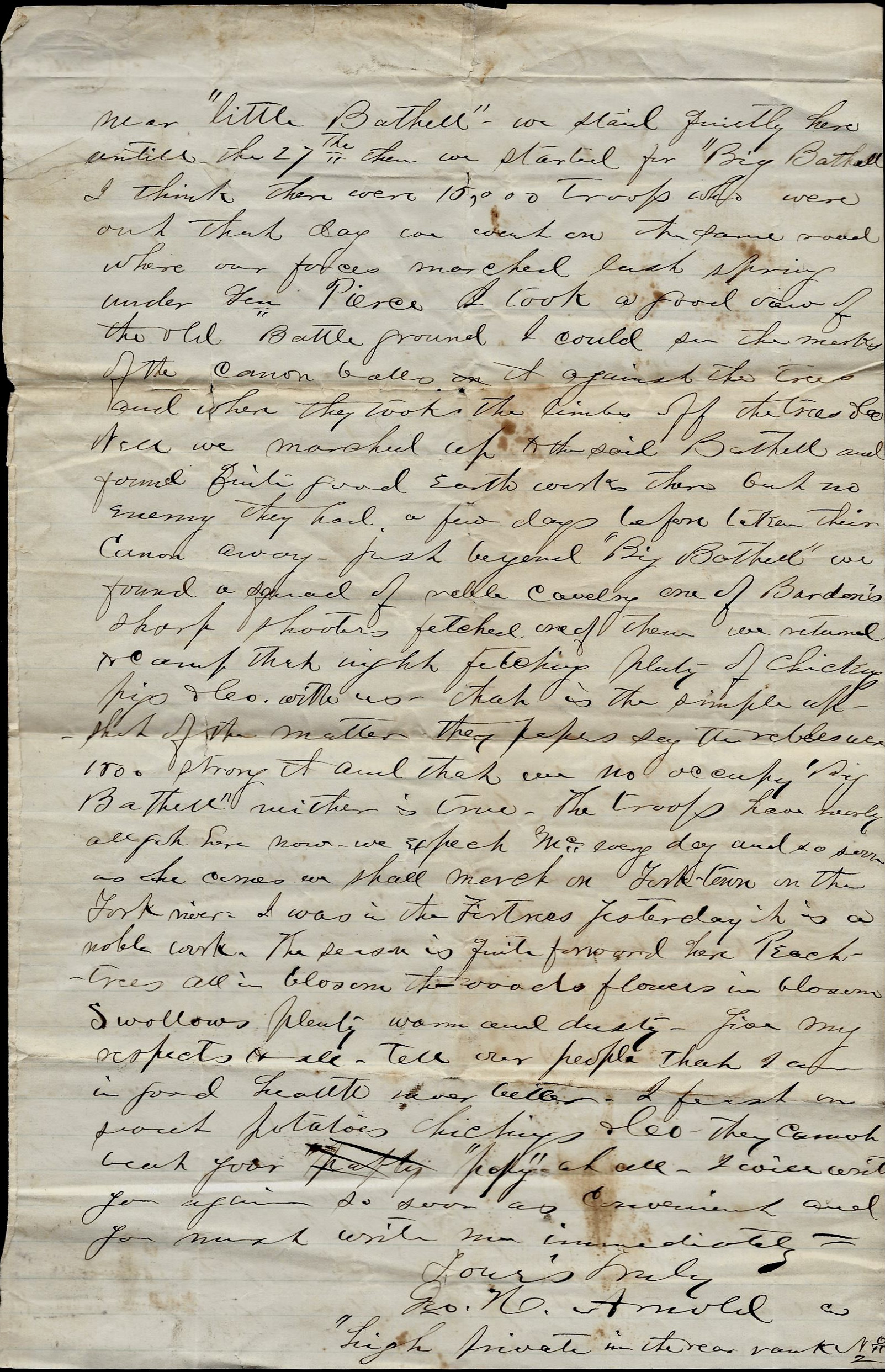
Transcription

Headquarters 44th Regiment N. Y. S. V.
Virginia
March 31, 1862

Friend Jed
Dear Sir,

I received yours of the 27th. I was quite pleased to hear from you as you will readily see. I agree with you at once relative to Mc[Clellan] as a general in the field. I received yours this morning. I have entirely forgotten when I last wrote you but I am thinking that I wrote you when at Alexandria bu I will give you a little detail of our march. We with the whole Army of the Potomac left Hall’s Hill March 10th, went to Fairfax, from thence to Centreville, stayed there the night of the 10th. The rebels left 12 hours before our arrival. The had noble works there but no guns mounted.

The 11th we returned to Fairfax where we stayed several days, then went to Alexandria where we stayed several days and embarked on board of boats the 21st. Arrived at Fortress Monroe the 24th all safe and sound. We sailed within 50 feet of the “Monitor.” I had a fair view of her. She looks like a large iron platform with a hogs head at one end. That is the most I or any man can say relative to her. Even when he goes aboard of her. I could see the marks on her quite plainly where the Merrimack hit the cheese box. It looked like the marks on an old piece of iron after being hit with a hammer merely started to rust a little.

“I could see the marks on her quite plainly where the Merrimack hit the cheese box.”

Well the night of the 24th we encamped near Hampton—or where Hampton was. This was quite a pretty little place, originally claimed 25,000 inhabitance. The 26th we came up near “Little Bethel.” We stated quietly here until the 27th. Then we started for “Big Bethel.” I think there were 15,000 troops were out that day. We went on the same road where our forces marched last spring under Gen. [Ebenezer] Pierce. I took a good view of the old battle ground. I could see the marks of the cannon balls against the trees and where they took the limbs off the trees &c.

Well we marched up to the said Bethel and found quite good earthworks there but no enemy. They had a few days before taken their cannon away. Just beyond “Big Bethel” we found a squad of rebel cavalry. One of Berdens’s Sharpshooters fetched one of them. We returned to camp that night fetching plenty of chicken, pigs, &c. with us. That is the simple [ ] of the matter. The papers say the rebels were 1500 strong and that we did not occupy Big Bethel. Neither is true. The troops have nearly all got here now. We expect Mc[Clellan] every day and so soon as he comes, we shall march on Yorktown on the York River. I was in the Fortress yesterday. It is a noble work. The season is quite forward. The peach trees are all in blossom. The woods, flowers in blossom, swallows plenty, warm and dusty.

Give my respects to all. Tell our people that I am in good health. Never better. I feast on sweet potatoes, chickens &c. They cannot beat your pappy at all. I will write you again so soon as convenient and you must write me immediately.

Yours truly, — Geo. W. Arnold, high private in the rear rank.