The following letter was written by Levi Fletcher (1842-1898), the son of Nathan Fletcher (1798-1863) and Louise [ ] of Monticello, Wright county, Minnesota—formerly of Maine. In 1860, Levi was enumerated in his parent’s household in Monticello, identified as a 17 year-old mail carrier. When the Civil War began, Levi enlisted in May 1861 as a private in Co. B, 1st Minnesota Infantry. Fighting at the First Battle of Bull Run on Henry House Hill while supporting Rickett’s Battery, the 1st Minnesota suffered severe casualties with 49 killed, 107 wounded, and 34 missing. Levi was one of the wounded severely enough to warrant a discharge for disability, granted in October 1861. He filed for a pension as an invalid in 1863.
The year of this October 11th letter is not given but it had to be either 1863 or 1864; after the fall of Vicksburg and before the end of the war. Unfortunately, nothing in the letter gives us a clue as to which year it might have been. We learn that Levi has opened a store in Vicksburg where he believed there was “a great chance to make money.” But he found the town people hard to deal with. “They would not hesitate in taking a man’s life for a dollar. That is the kind of men that we have to deal with down here,” he told his cousin. Apparently this was not just so much hyperbole as there was a notice in the Vicksburg Daily Times of 28 November 1871 referring to the examination of Frank Newman “for the alleged shooting of Levi Fletcher.”
Levi lived out his days in Vicksburg and died there in 1898.
T R A N S C R I P T I O N
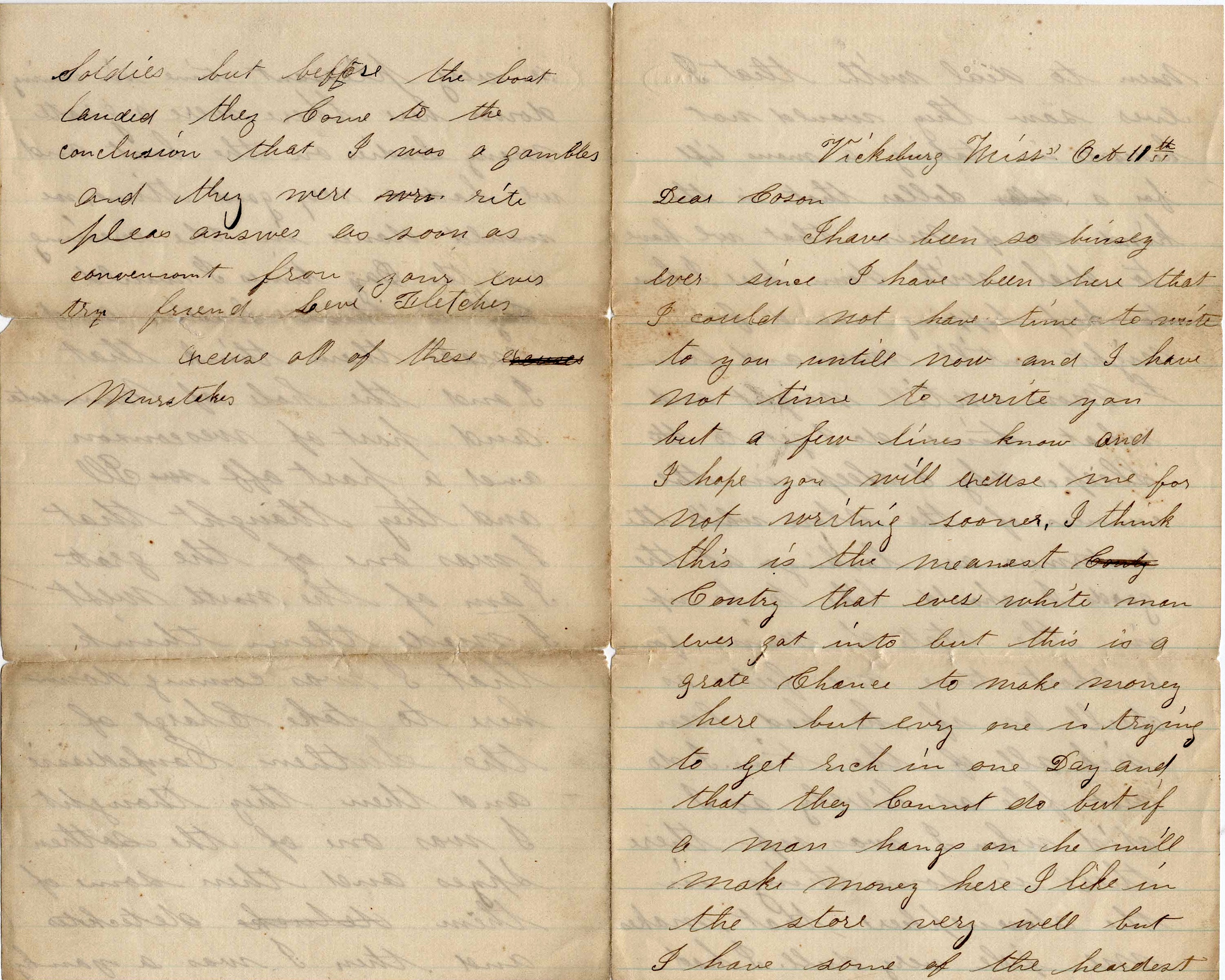
Vicksburg, Mississippi October 11 [1863]
Dear Cousin,
I have been so busy ever since I have been here that I could not have time to write to you until now and I have not time to write you but a few lines now. And I hope you will excuse me for not writing sooner. I think this is the meanest country that ever white man ever got into but this is a great chance to make money here. But everyone is trying to get rich in one day and that they cannot do. But if a man hangs on, he will make money here.
I like [being] in the store very well but I have some of the hardest men to deal with that I ever saw. They would not hesitate in taking a man’s life for a dollar. That is the kind of men that we have to deal with down here. I have to keep hopping around from night until morn and from morn until night and what time so I get to sleep? Why I sleep in the corner of the store while the customers are looking at the goods.
I should like to be up in the State of Minnesota for a short time. One feels as dull as if he had been sick all of the time. I do not feel as lively as I did when I was up there. There is something in the atmosphere that makes me feel very dull.
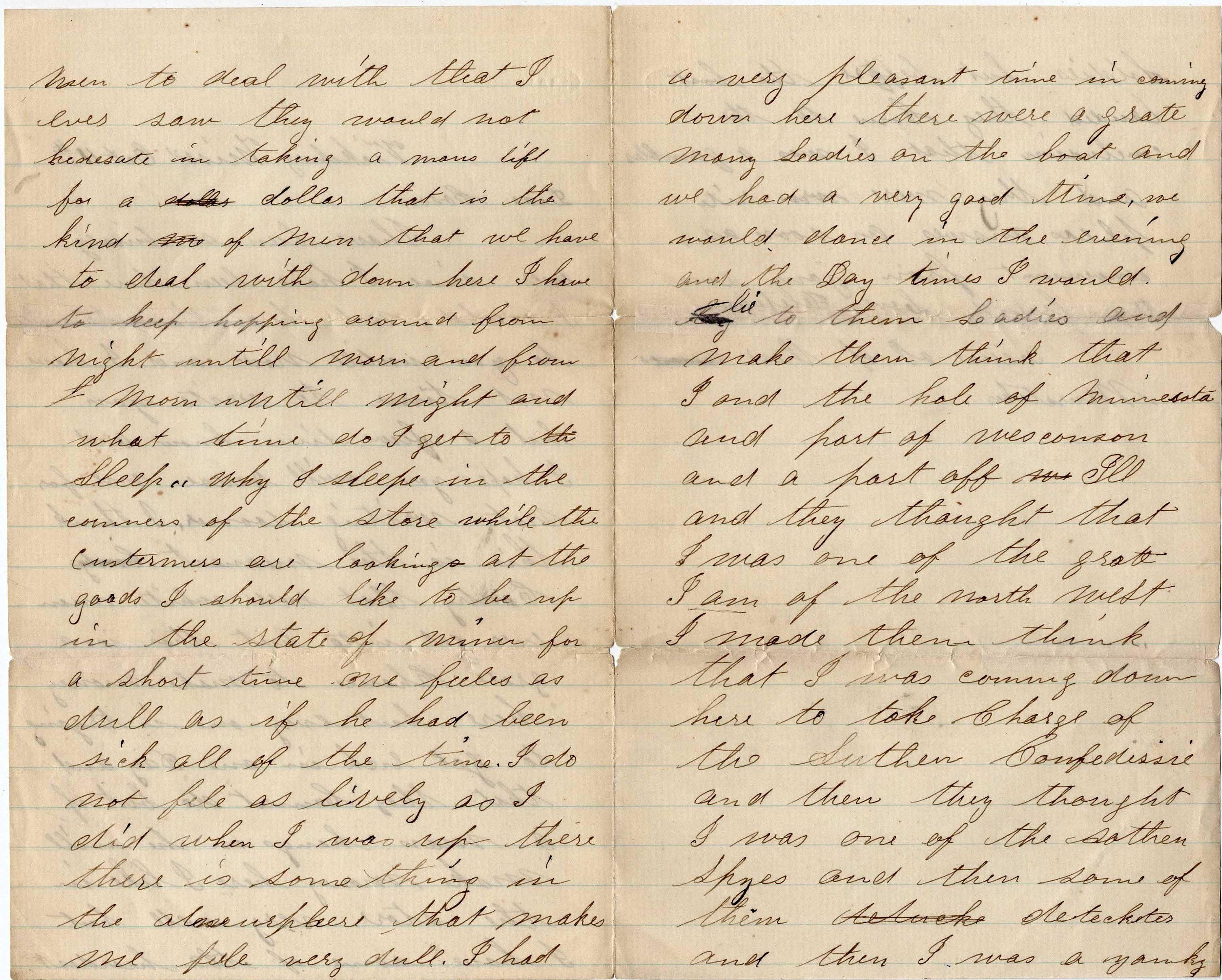
I had a very pleasant time in coming down here. There were a great many ladies on the boat and we had a very good time. We would dance in the evening and the day times. I would lie to them ladies and make them think that I and the whole of Minnesota and part of Wisconsin and a part of Illinois and they thought that I was one of the great. I am of the northwest. I made them think that I was coming down here to take charge of the Southern Confederacy and then they thought I was one of the southern spies and then some of them detectives and then I was a Yankey soldier. But before the boat landed, they come to the conclusion that I was a gambler and they were right.
Please answer as soon as convenient. From your ever true friend, — Levi Fletcher
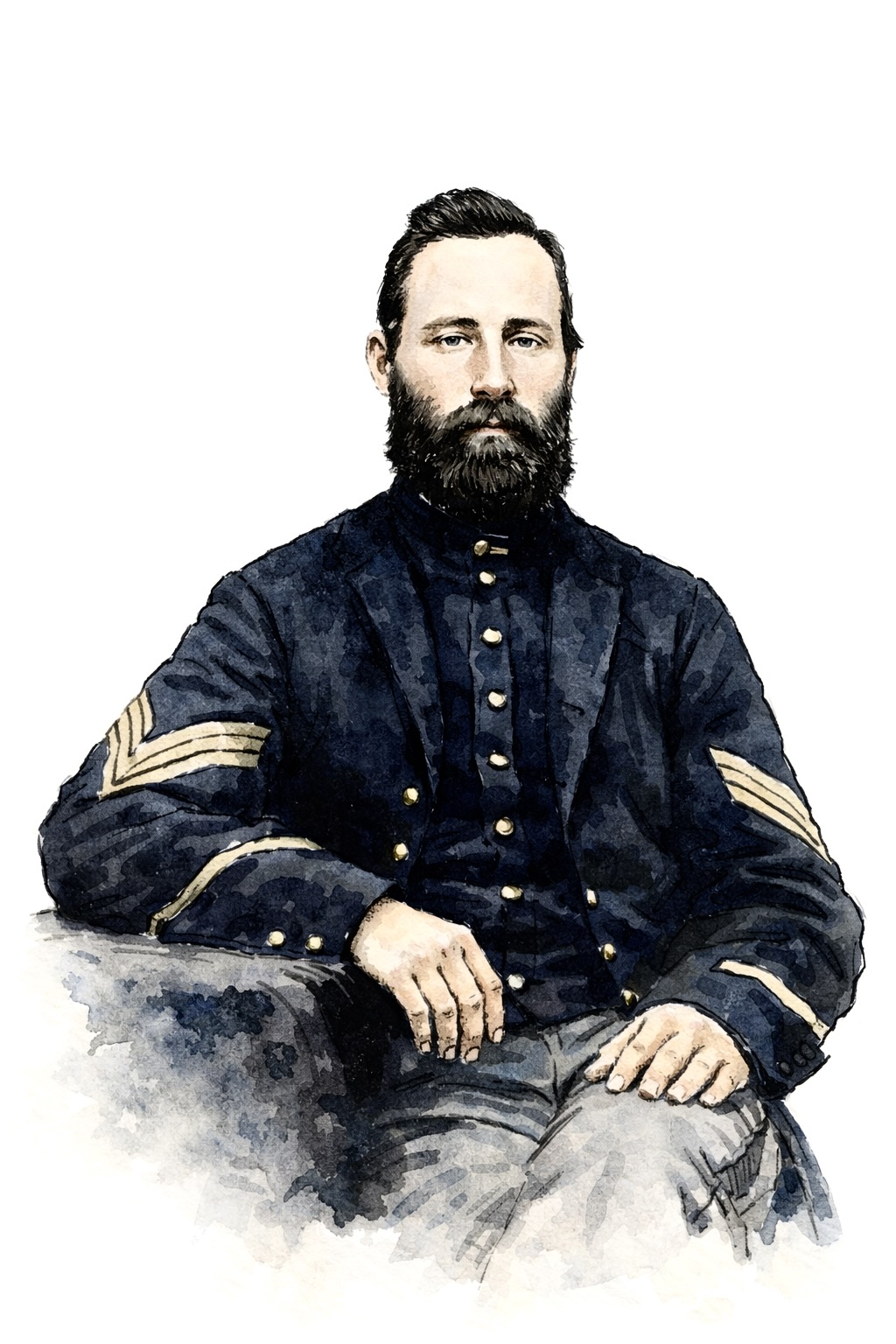
I could not find an image of Wellington but here is a pen and watercolor rendering of Sgt. William T. Lambert who served in the same company.
The following letters were written by Wellington S. Cates (1836-1863), the son of Mark L. Cates (1797-1844) and Mary Palmer (1799-1861) of Washington county, Maine. Wellington was residing in St. Cloud, Minnesota when he enlisted in Co. D, 4th Minnesota Infantry. He did not survive the war, however. He was killed in the massive Union assault on the Confederate works at Vicksburg on 22 May 1863. There were 12 killed and 42 wounded in the 4th Minnesota during that assault which failed, though the regiment pressed right up to and on the enemy’s works.
Wellington wrote the letters to his sister, Sarah E. Cates (1834-1897). He often refers to his brothers, Calvin, Mark, and William Cates. Calvin served in Co. K, 1st Maine Heavy Artillery. Mark was married and living in Kingston, Meeker county, Minnesota at the time of the 1860 US Census. William (1841-1901) served in Co. H, 28th Maine Infantry, enlisting in October 1862.
There are 12 letters posted here that were written by Wellington; a 13th letter is included that was written by a comrade, William Henry Hall (1841-1932), announcing the death of Wellington. He was a native of Buckfield, Oxford county, Maine.
Letter 1
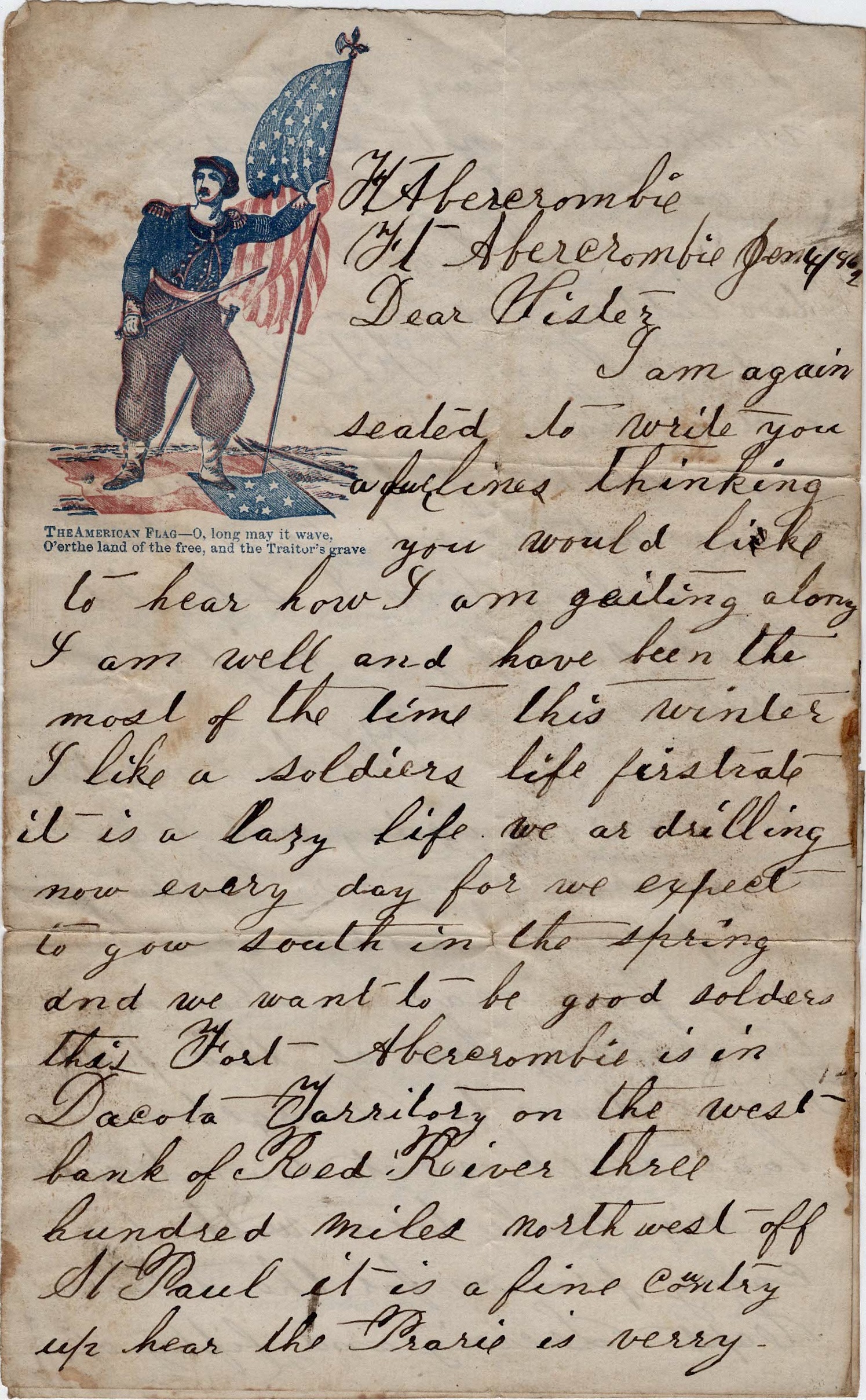
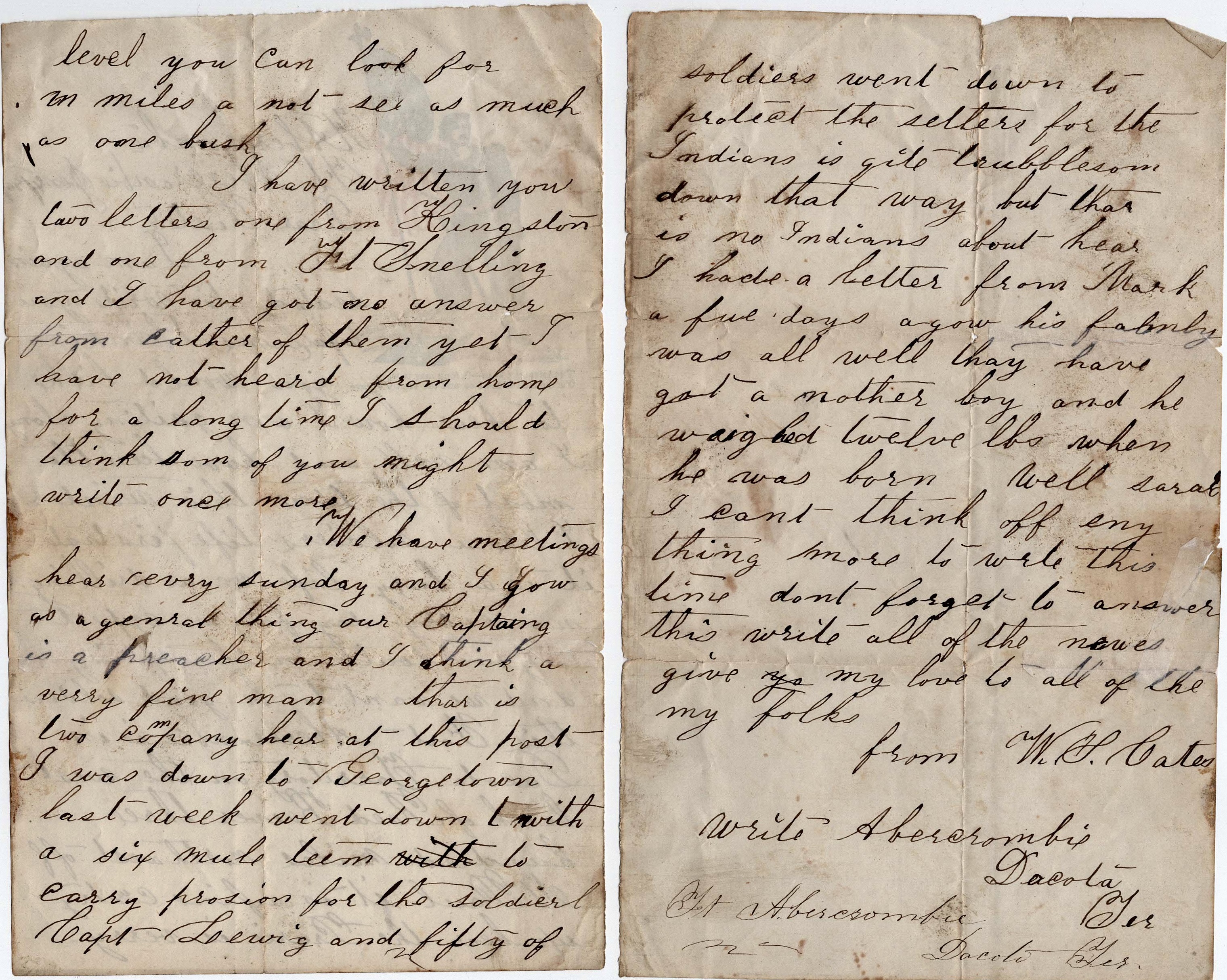
Ft. Abercrombie January 4, 1862
Dear Sister,
I am once again seated to write you a few lines thinking you would like to hear how I am getting along. I am well and have been the most of the time this winter. I like a soldier’s life first rate. It is a lazy life. We are drilling now every day for we expect to go south in the spring and we want to be good soldiers.
This Fort Abercrombie is in Dakota Territory on the west bank of Red River three hundred miles northwest of St. Paul. It is a fine country up here. The prairie is very level. You can look for miles and not see as much as one bush.
I have written you two letters—one from Kingston and one from Ft. Snelling, and I have got no answer from either of them yet. I have not heard from home for a long time. I should think some of you might write once more.
We have meetings here every Sunday and I go as a general thing. Our captain is a preacher and I think a very fine man. There is two companies here at this post. I was down to Georgetown last week. Went down with a six mule team to carry provision for the soldiers. Captain Lewig [?] and fifty soldiers went down to protect the settlers for the Indians is quite troublesome down that way. But there is no Indians about here.
I had a letter from Mark a few days ago. His family was all well. They have got another boy and he weighed twelve lbs. when he was born. Well, Sarah, I can’t think of anything more to write this time. Don’t forget to answer this. Write all of the news. Give my love to all of my folks. From W. S. Cater
Write Abercrombie, Dakota, Territory
Letter 2
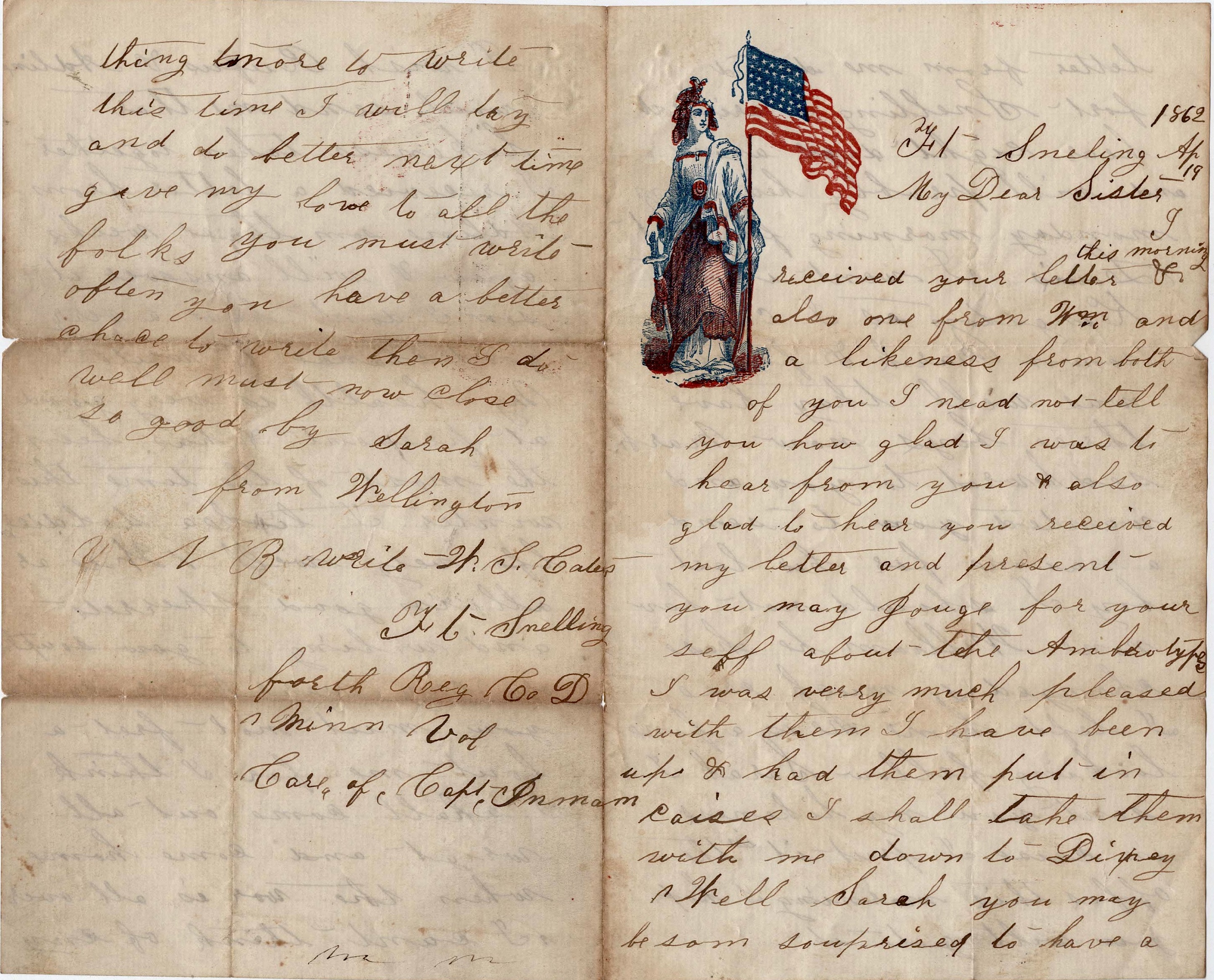
Fort Snelling April 19, 1862
My Dear Sister,
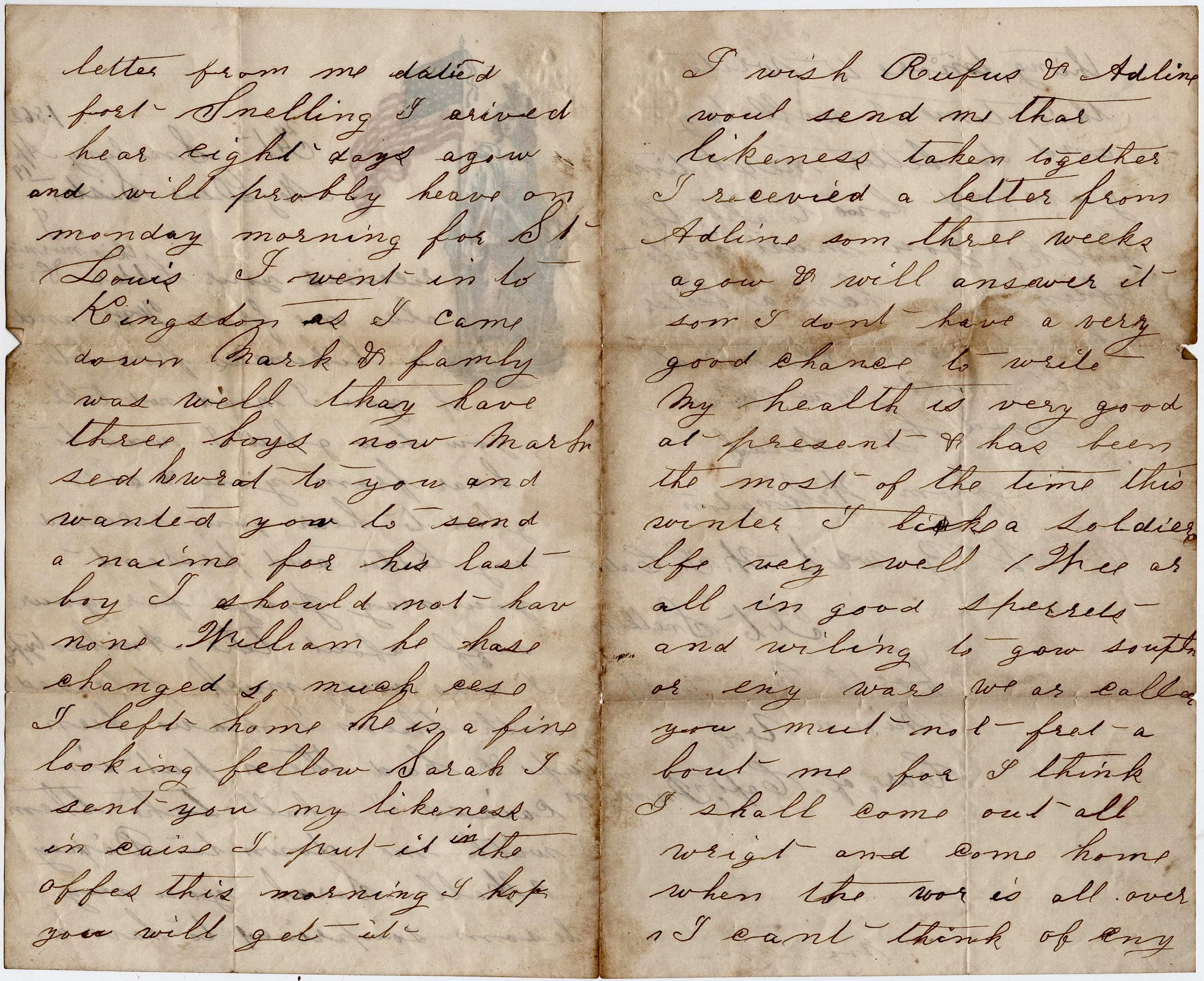
I received your letter this morning & also one from William and a likeness from both of you. I need not tell you how glad I was to hear from you & also glad to hear you received my letter and present. You may judge for yourself about the Ambrotype. I was very much pleased with them. I have been up & had them put in cases. I shall take them wit me down to Dixie.
Well, Sarah, you may be some surprised to have a letter from me dated Fort Snelling. I arrived here eight days ago and will probably leave on Monday morning for St. Louis. I went into Kingsley as I came down. Mark and family was well. They have three boys now. Mark said he wrote to you and wanted you to send a make for his last boy. I should not have known William—he has changed so much since I left home. He is a fine looking fellow.
Sarah, I sent you my likeness in case. It put it in the office this morning. I hope you will get it. I wish Rufus & Adeline would send me that likeness together. I received a letter from Adeline some three weeks ago and will answer it soon. I don’t have a very good chance to write.
My health is very good at present & has been most of the time this winter. I like a soldier’s life very well. They are all in good spirits and willing to go south or anywhere we are called. You must not fret about me for I think I shall come out all right and come home when the war is all over. I can’t think of anything to write this time. I will try and do better next time.
Give my love to all the folks. You must write often. you have a better chance to write than i do. Well, I must now close. So goodbye Sarah. From Wellington
N. B. Write W. S. Cates, Ft. Snelling, 4th Regt. Co. D, Minnesota Vols., Care of Capt. Inman
Letter 3
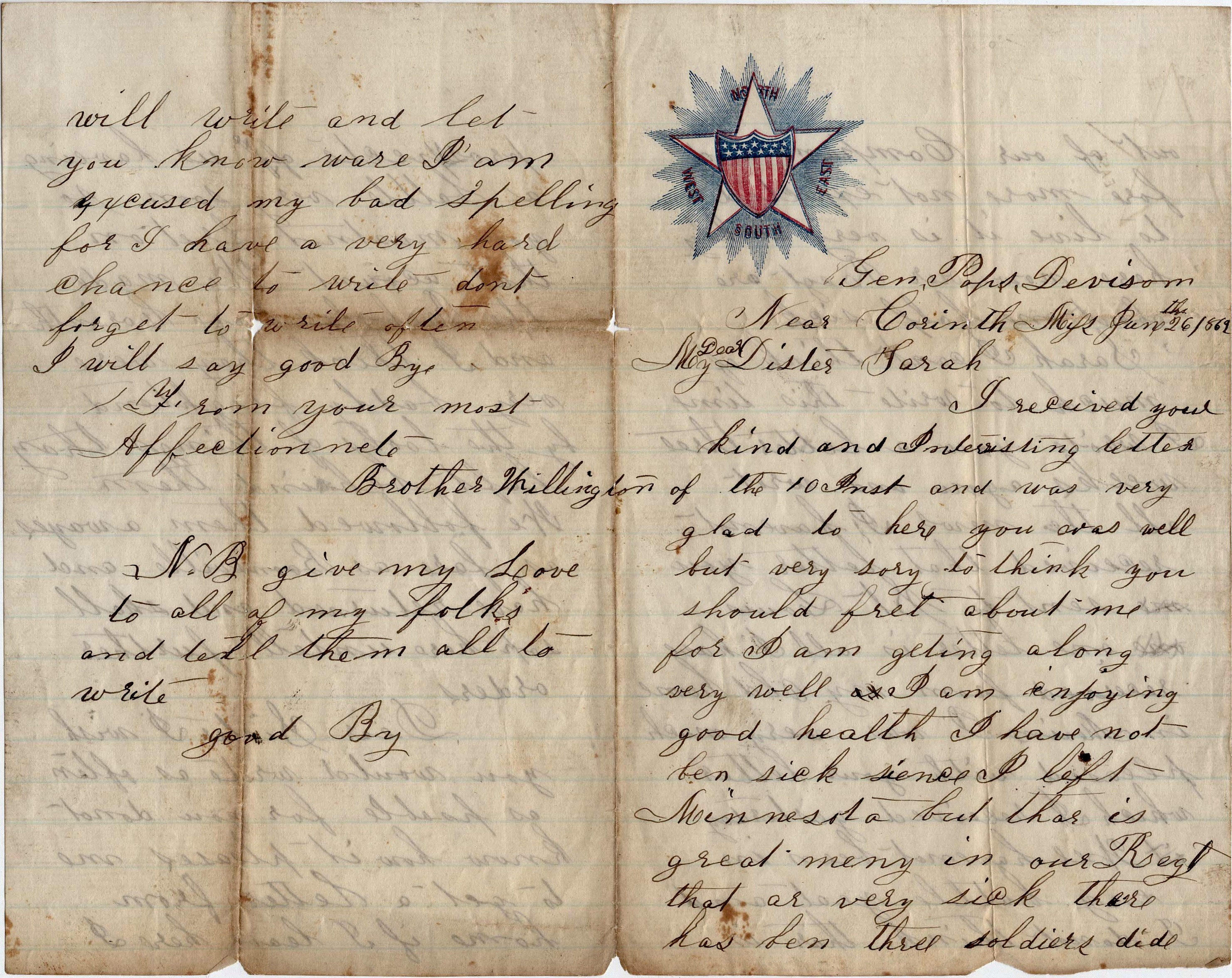
Gen. Pope’s Division Near Corinth, Mississippi June 26, 1862
My dear sister Sarah,
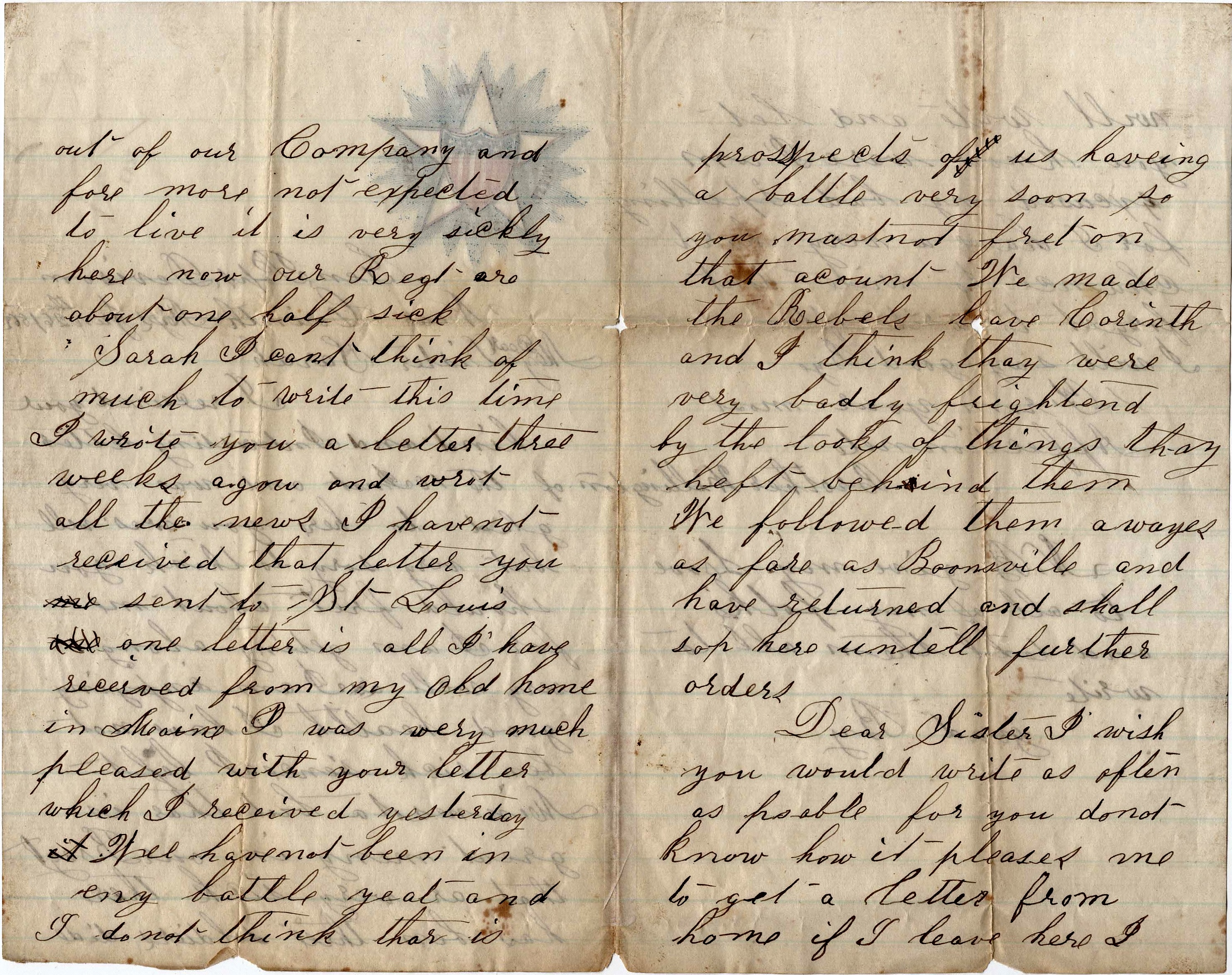
I received your kind and interesting letter of the 10th instant adn was very glad to hear you was well but very sorry to think you should fret about me for I am getting along very well. I am enjoying good health. I have not been sick since I left Minnesota but there is a great many in our regiment that are very sick. There has been three soldiers died out of our company and four more not expected to live. It is very sickly here now. Our regiment are about half sick.
Sarah, I can’t think of much to write this time. I wrote you a letter three weeks ago and wrote all the news. I have not received that letter you sent to St. Louis. One letter is all I have received from my old home in Maine. I was very much pleased with your letter which I received yesterday.
We have not been in any battle yet and I do not think there is prospects of us having a battle very soon so you must not fret on that account. We made the rebels leave Corinth and I think they were badly frightened by the looks of things they left behind them. We followed them a ways as far as Booneville and have returned and shall stop here until further orders.
Dear sister, I wish you would write as often as possible for you don’t know how it pleases me to get a letter from home. If I leave here, I will write and let you know where I am, Excuse my bad spelling for I have a very hard chance to write. Don’t forget to write often. I will say goodbye. From your most affectionate brother, — Wellington
N. B. Give my love to all of my folks and tell them all to write. Goodbye.
Letter 4
Jacinto, Mississippi August 25, 1862
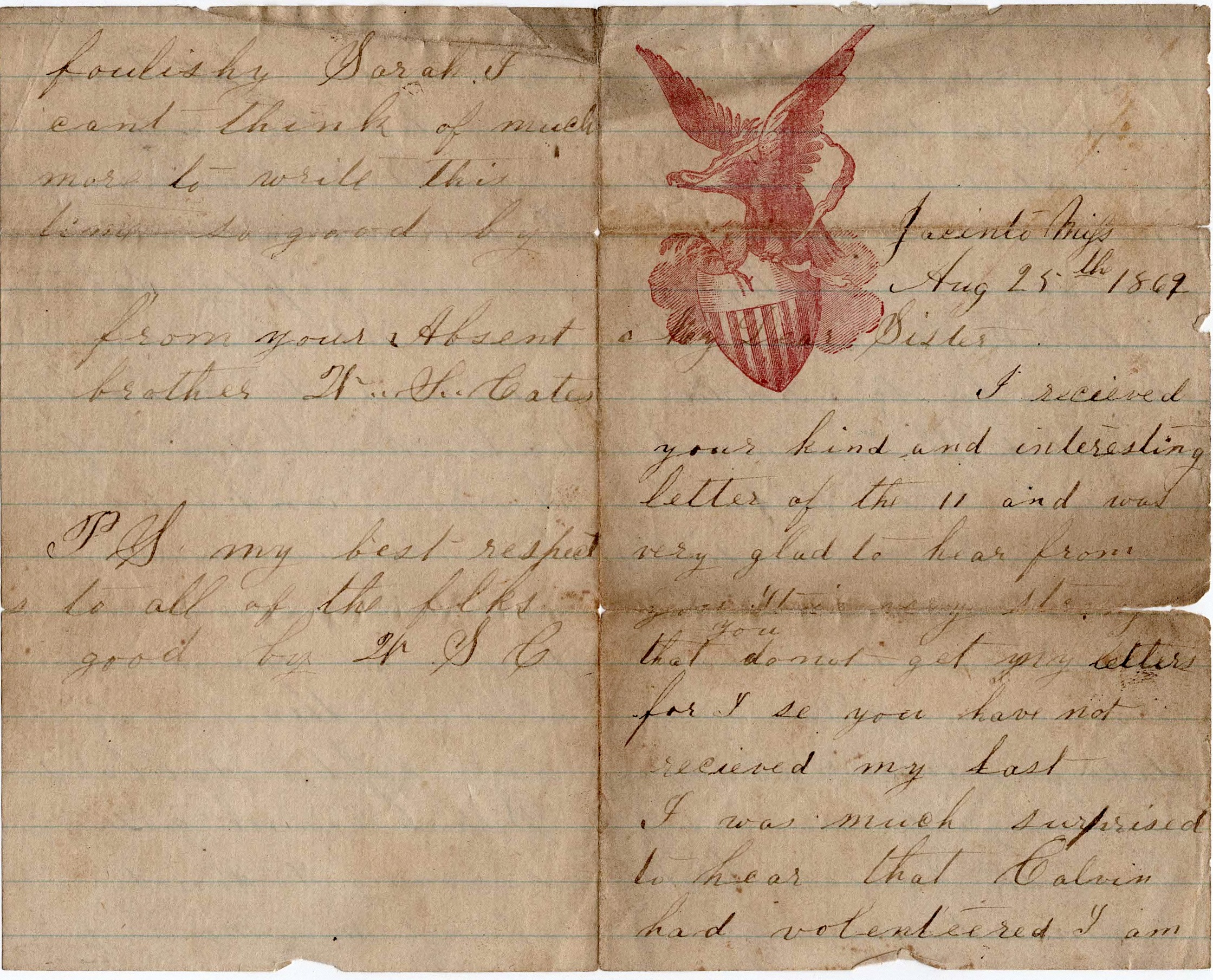
My dear sister,
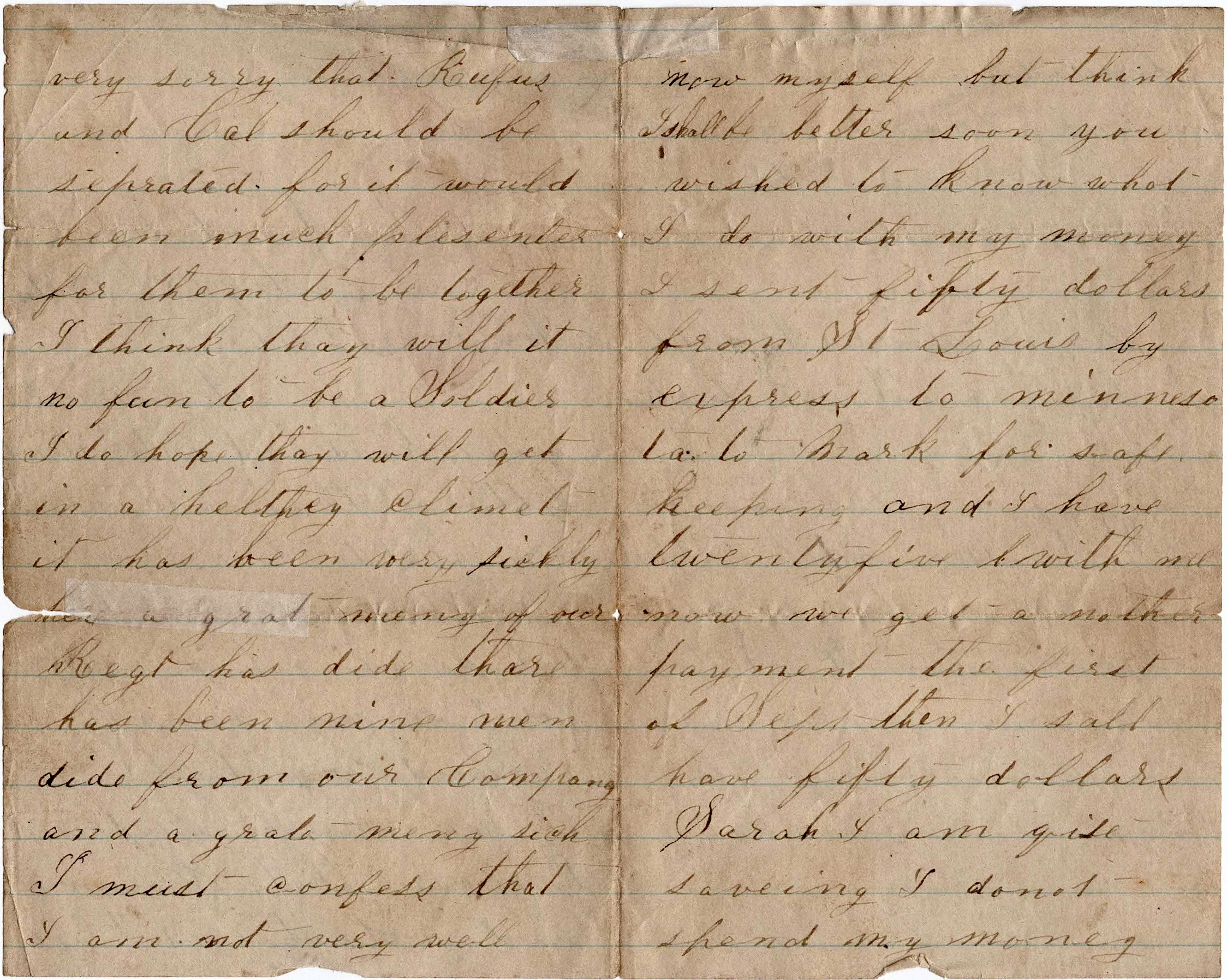
I received your kind and interesting letter of the 11th and was very glad to hear from you. It is very strange that you do not get my letters for I see you have not received my last. I was much surprised to hear that Calvin had volunteered. I am very sorry that Rufus and Cal should be separated for it would benefit much pleasanter for them to be together. I think they will [find it is] no fun to be a soldier. I do hope they will get in a healthy climate. It has been very sickly here. A great many of our regiment has died. There has been nine men died from our company and a great many sick. I must confess that I am not very well now myself but think I shall be better soon.
You wished to know what I do with my money. I sent fifty dollars from St, Louis by Express to Minnesota. Mark for safe keeping. And I have 25 with me now. Get another payment the first of September. Then I shall have 50 dollars. Sarah, I am quite saving. I do not spend my money foolishly. Sarah, I can’t think of much more to write this time so goodbye.
From your absent brother, — W. S. Cates
P. S. My best respects to all of the folks. Goodbye, — W. S. C.
Letter 5
In Camp near Jacinto. Mississippi September 13, 1862
Dear Sister,
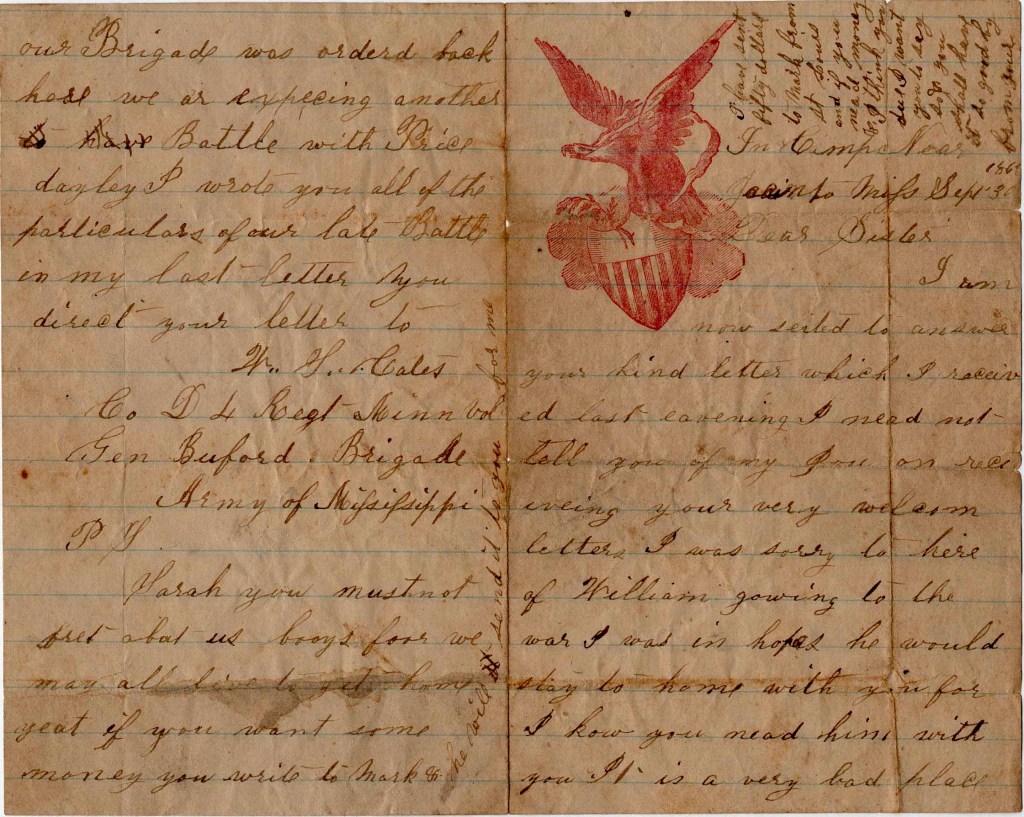
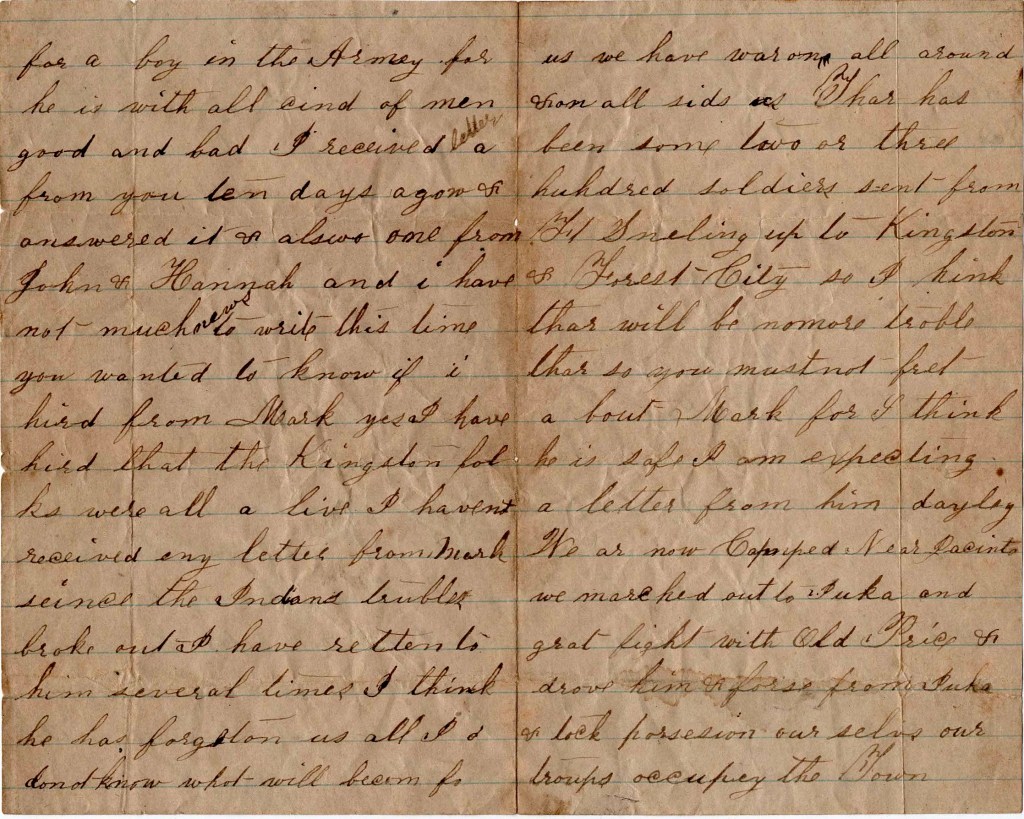
I am now seated to answer your kind letter which I received last evening. I need not tell you of my joy on receiving your very welcome letter. I was sorry to hear of William going to the war. I was in hopes he would stay to home with you for I know you need him with you. It is a very bad place for a boy in the army for he is with all kind of men—good and bad.
I received a letter from you ten days ago and answered it and also one from John & Hannah and I have not much news to write this time.
You wanted to know if I heard from Mark. Yes, I have heard that the Kingston folks were all alive. I haven’t received any letter from Mark since the Indian troubles broke out and I have written to him several times. I think he has forgotten us all. I don’t know what will become of us. We have war all around and on all sides.
There has been some two or three hundred soldiers sent from Ft. Snelling up to Kingston & Forest City so I think there will be no more trouble there so you must not fret about Mark for I thin khe is safe. I am expecting a letter from him daily.
We are now camped near Jacinto. We marched out to Iuka and [had a] great fight with Old Price & drove him & [his] forces from Iuka & took possession ourselves. Our troops occupy the town. Our Brigade was ordered back here. We are expecting another battle with Price daily. I wrote you all of the particulars of our late battle in my last letter.
You [should] direct your letter to W. S. Cates, Co. D, 4th Regiment Minnesota Vols., Gen. Buford’s Brigade, Army of Mississippi.
P. S. Sarah, you must not fret about us boys for we may all live to get home yet. If you want some money, you write to Mark and he will send it to you for me. I have sent 50 dollars to Mark from St. Louis and if you need money and I think you do, I want you to say so & you shall have it. So goodbye from your brother.
Letter 6
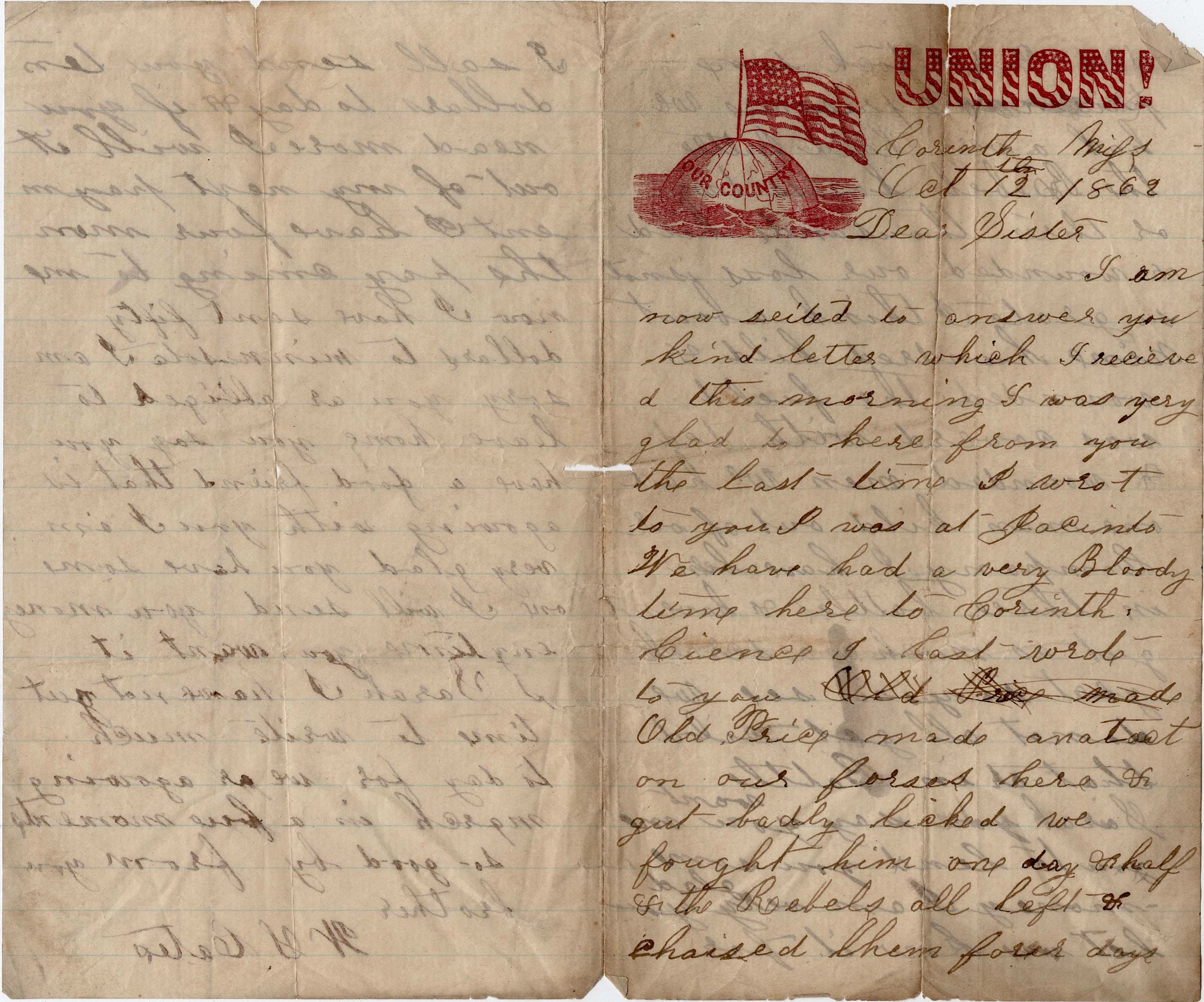
Corinth, Mississippi October 12th 1862
Dear Sister,
I am now seated to answer your kind letter which I received this morning. I was very glad to hear from you. The last time I wrote to you I was at Jacinto.
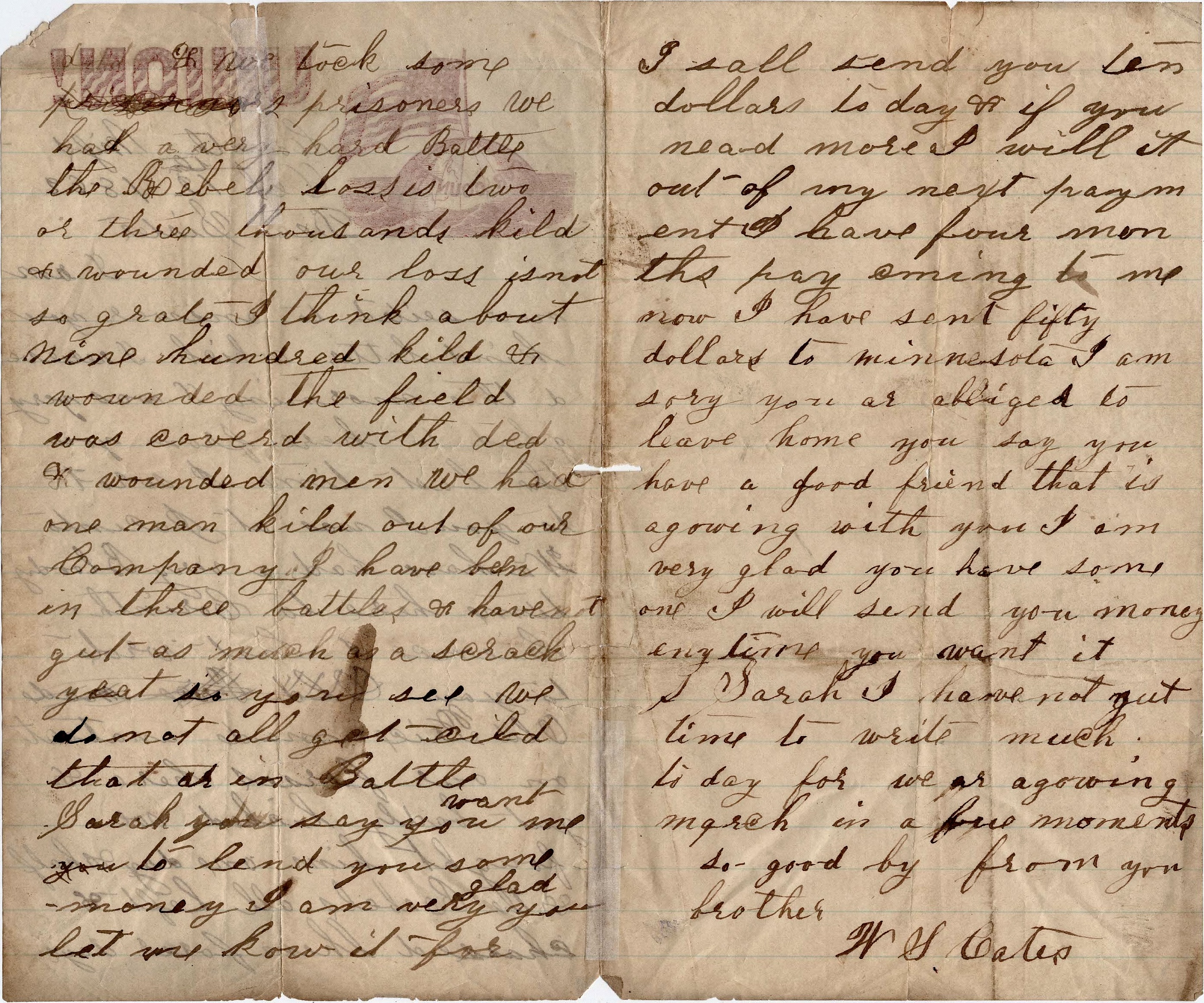
We have had a very bloody time here to Corinth since I last wrote to you. Old Price made an attack on our forces here and got badly licked. We fought him one day and a half & the Rebels all left & [we] chased hem four days. We took some prisoners. We had a very hard battle. The Rebels’ loss is two or three thousand killed & wounded. Our loss is not so great—I think about nine hundred killed & wounded. The field was covered with dead and wounded men. We had one man killed out of our company. I have been in three battles & have not got as much as a scratch yet so you see we do not all get killed—that is, in battle.
Sarah, you say you want me to lend you some money. I am very glad you let me know it for I shall send you ten dollars today & if you need more, I will [send] it out of my next payment. I have four month’s pay coming to me now. I have sent fifty dollars to Minnesota.
I am sorry you are obliged to leave home. You say you have a good friend that is going with you. I am very glad you have someone. I will send you money any time you want it.
Sarah I have not got time to write much today for we are a going to march in a few moments. So goodbye from your brother, — W. S. Cates
Letter 7
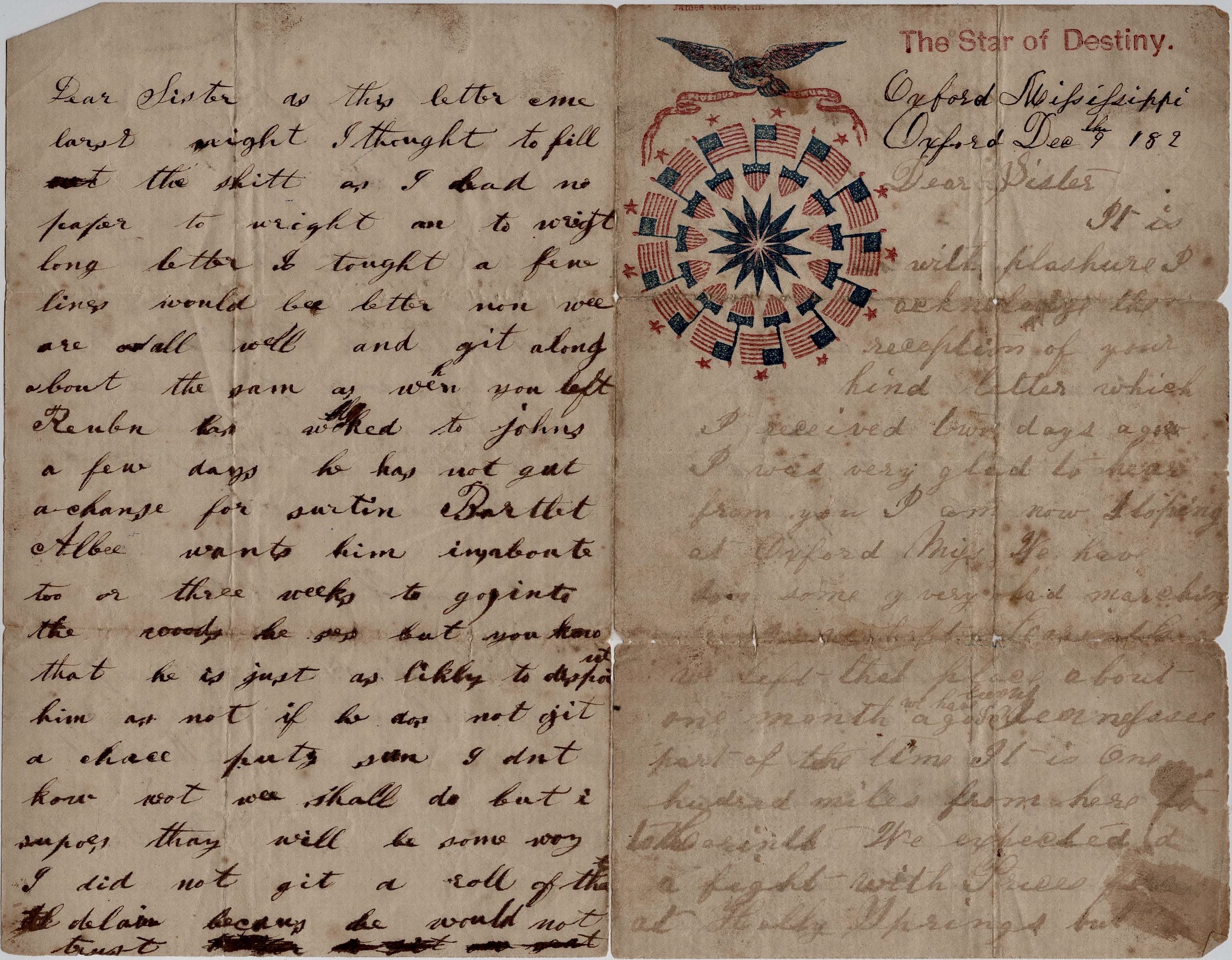
Oxford, Mississippi December 9, 1862
Dear Sister,
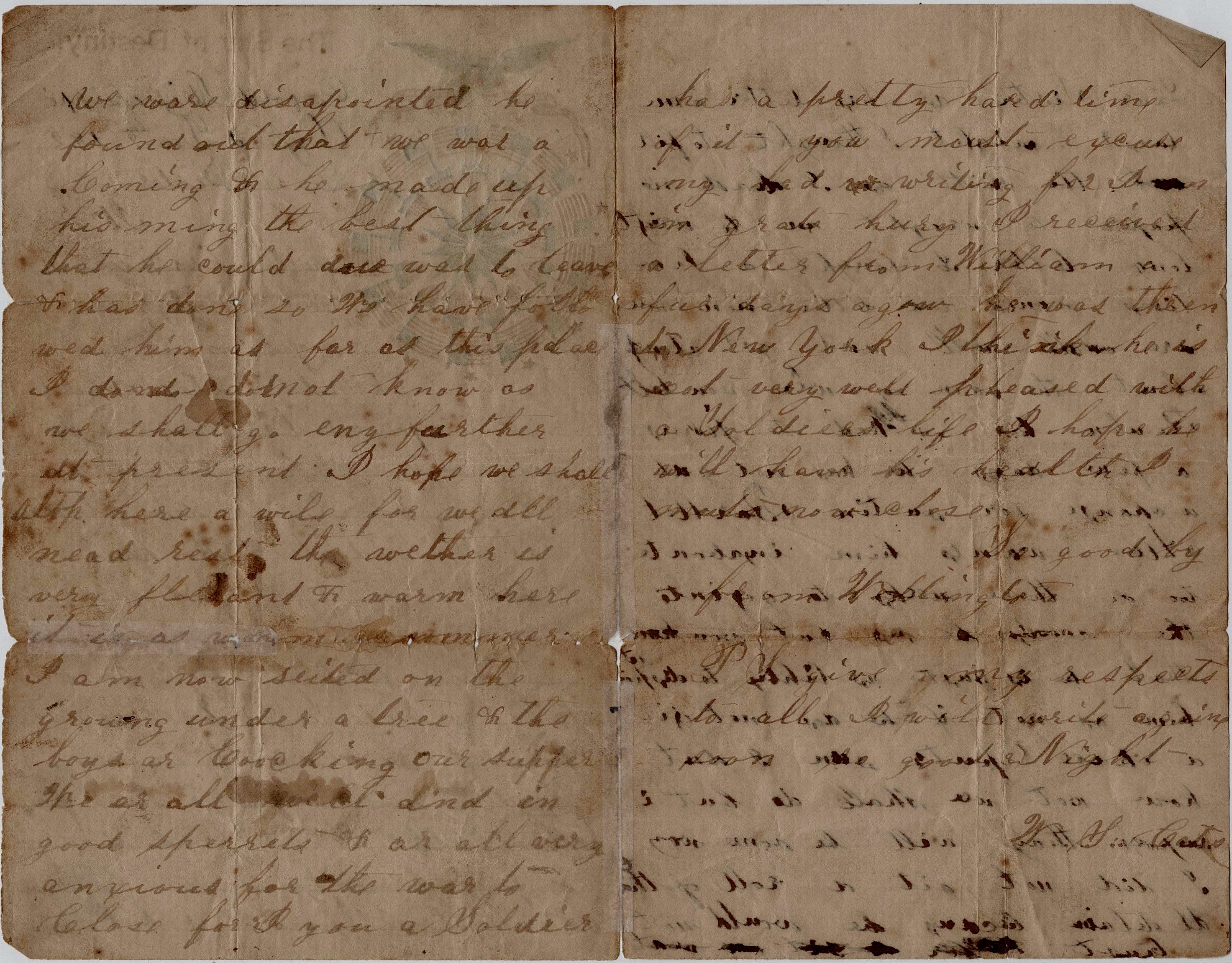
It is with pleasure I acknowledge the reception of your kind letter which I received two days ago. I was very glad to hear from you. I am now stopping in Oxford, Mississippi. We have seen some very hard marching since we left Corinth. We left that place about one month ago. We have been in Tennessee part of the time. It is one hundred miles from here to Corinth. We expected a fight with Price’s forces at Holly Springs but we were disappointed. He found that we was a coming and he made up his mind the best thing he could do was to leave & has done so. We have followed him as far as this place. I don’t know as we shall go any further at present. I hope we shall stop here a while for we all need rest.
The weather is very pleasant & war, here. It is as warm as summer. I am now seated on the ground under a tree & the boys are cooking our supper. We are all well and good spirits & all very anxious for the war to close for I [assure] you, a soldier has a pretty hard time of it.
You must excuse my bad writing for I am in a great hurry. I received a letter from William a few days ago. He was then to New York. I think he is not very well pleased with a soldier’s life. I hope he will have his health. I must now close, so goodbye. From Wellington
P. S. Give my respects to all. I will write again soon, so good night. — W. S. Cates
Letter 8
White’s Station, Tennessee January 22, 1863
My dear sister,
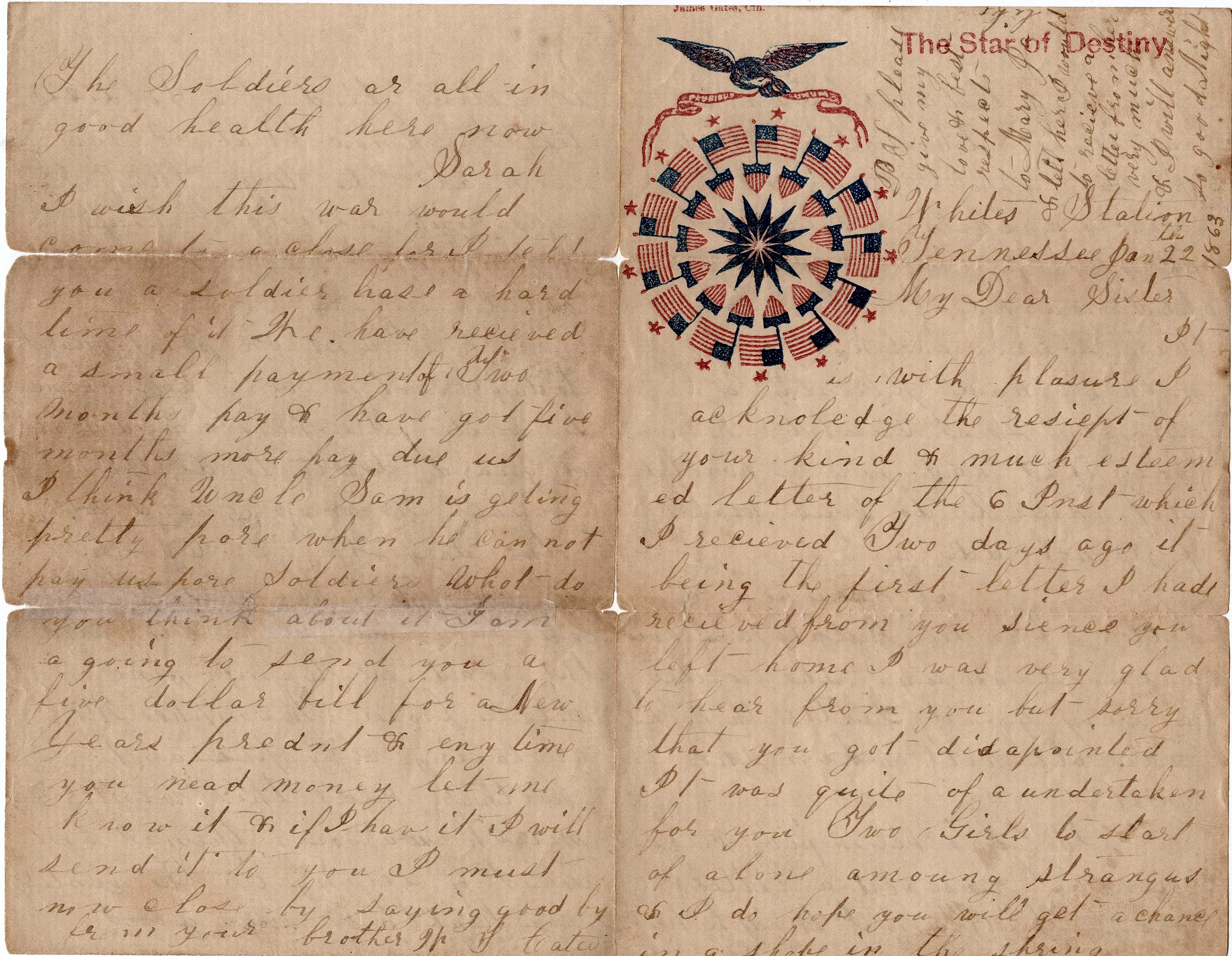
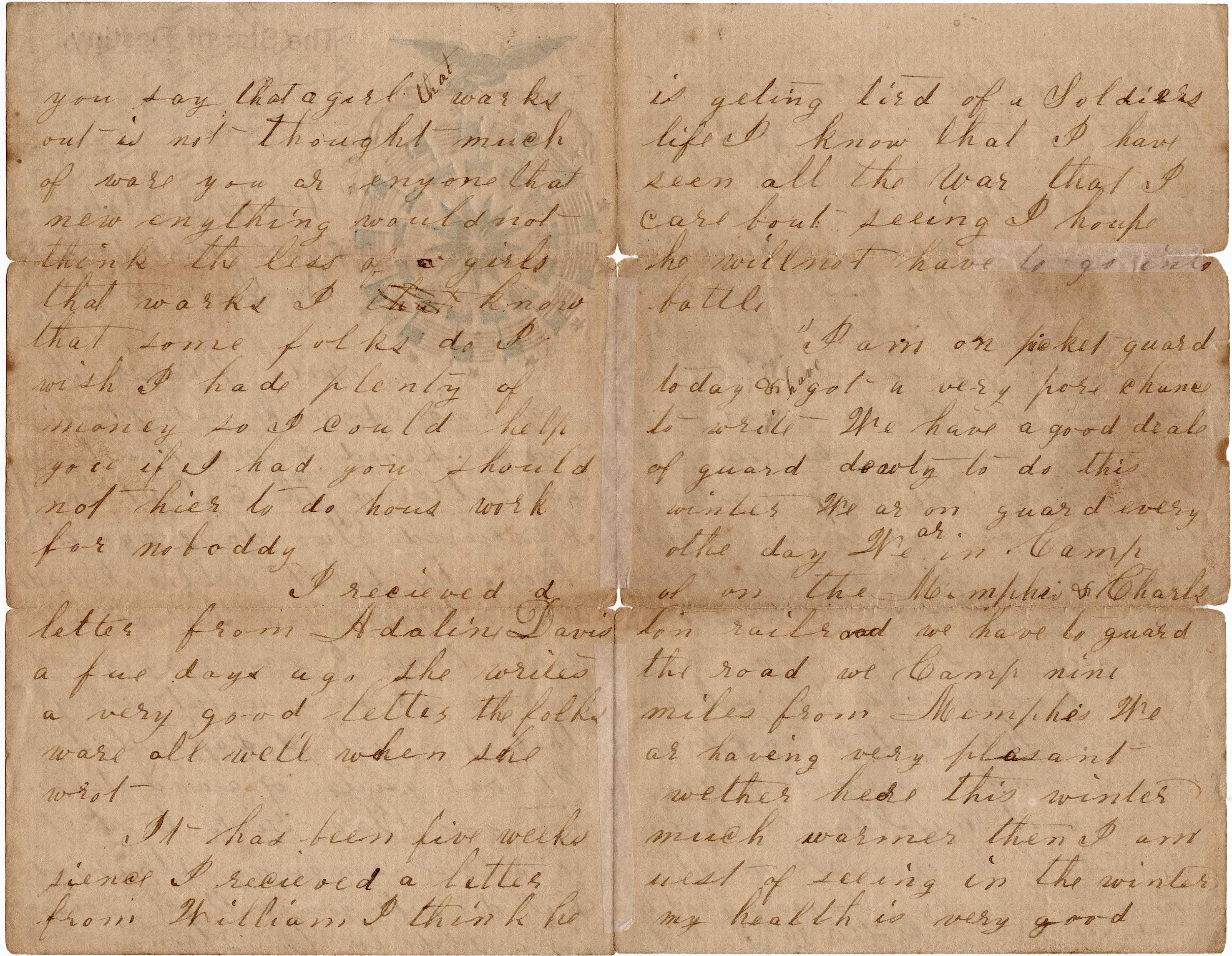
It is with pleasure I acknowledged the receipt of your kind & much esteemed letter of the 6th instant which I received two days ago—it being the first letter I had received from you since you left home. I was very glad to hear from you but sorry that you got disappointed. It was quite of an undertaking for you two girls to start off alone among strangers & I do hope you will get a chance in a shop in the spring. You say that a girl that works out in not thought much of. Were you or anyone that knew anything would not the least of girls that works. I know that some folks do. I wish I had plenty of money so I could help you, If I had, you shiould not hire to do house work for nobody.
I received a letter from Adaline Davis a few days ago. She writes a very good letter. The folks were all well when she wrote.
It has been five weeks since I received a letter from William. I think he is getting tired of a soldier’s life. I know that I have seen all the war that I care about seeing. I hope he will not have to go into battle.
I am on picket guard today and have got a very poor chance to write. We have a good deal of guard duty to do this winter. We are on guard every other day. We are in camp on the Memphis & Charleston Railroad. We have to guard the road. We camp nine miles from Memphis. We are having very pleasant weather here this winter—much warmer than I am used of seeing in the winter. My health is very good. The soldiers are all in good health here now.
Sarah, I wish this war would come to a close for I tell you, a soldier has a hard time of it. We have received a small payment of two months pay and have got five months more pay due us. i think Uncle Sam is getting pretty poor when he cannot pay us poor soldiers. What do you think about it?
I am a going to send you a five dollar bill for a New Year’s present & any time you need money, let me know it & if I have it, I will send it to you. I must now close by saying goodbye. From your brother, – W. S. Cates
P. S. Please give my love and respects to Mary J. & tell her I would like to receive a letter from her very much & will answer. So good night.
Letter 9
White’s Station, Tennessee January 27, 1863
Dear Sister,
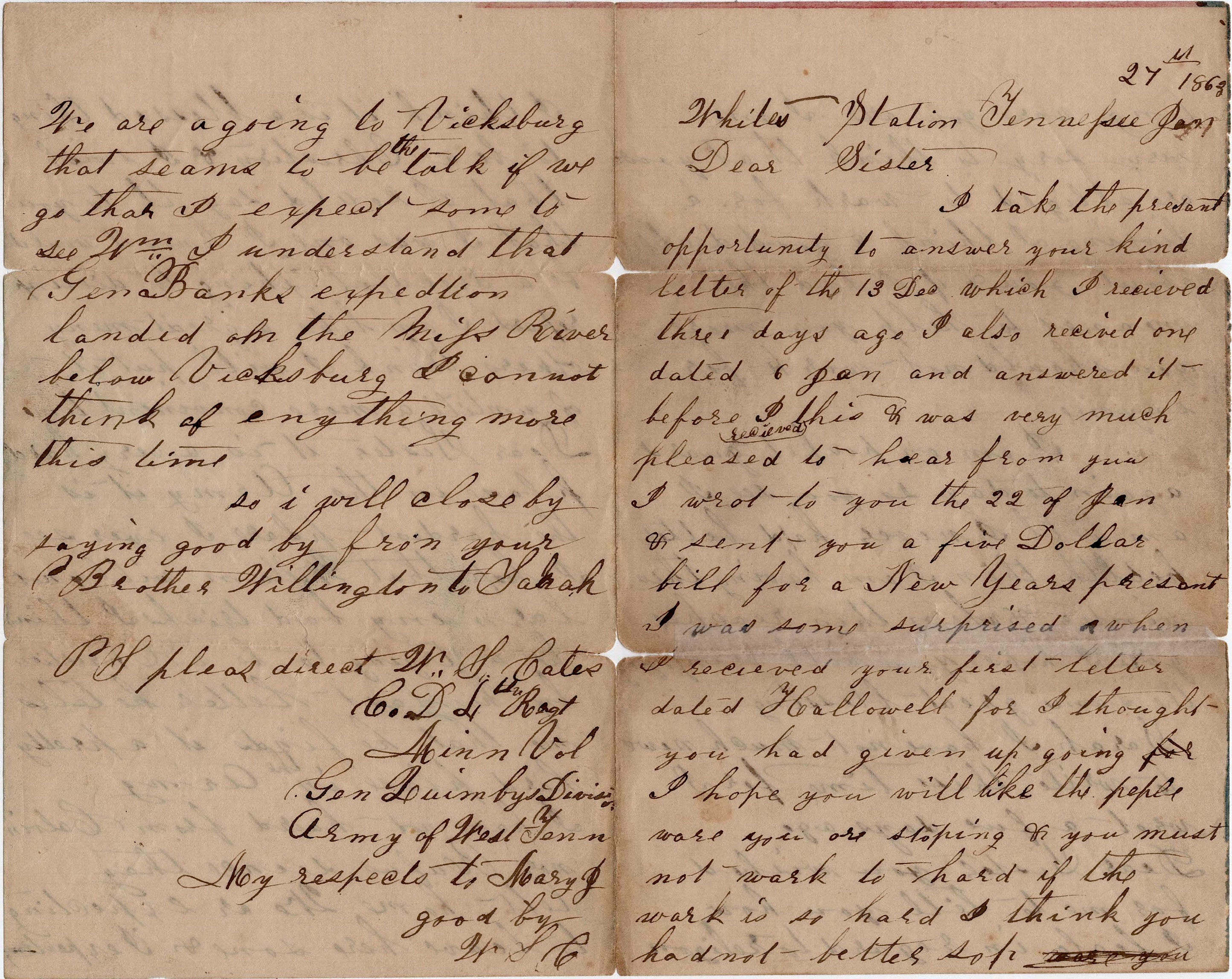
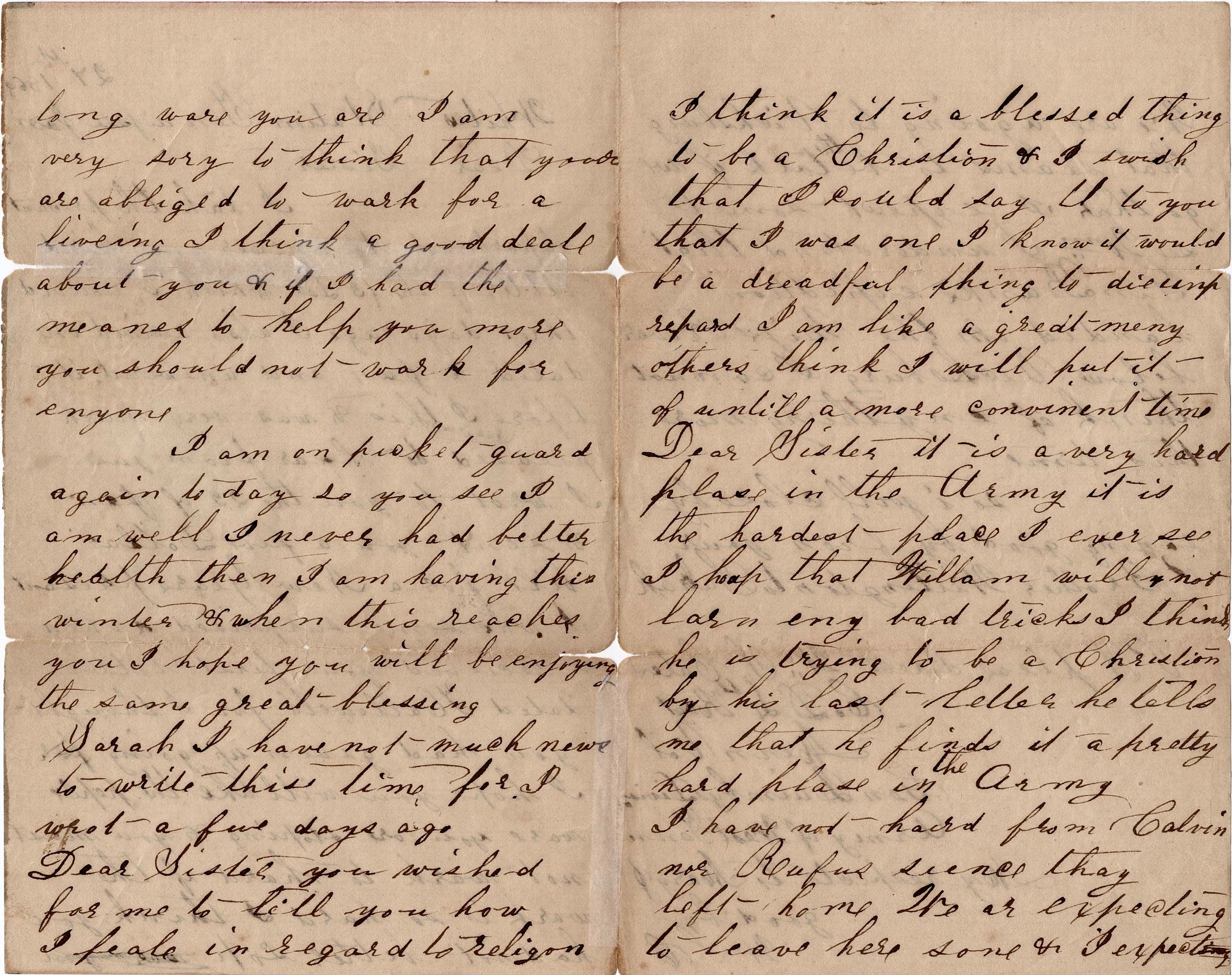
I take the present opportunity to answer your kind letter of the 13th December which I received three days ago. I also received one dated 6 January and answered it before. I was very much pleased to hear from you. I wrote to you the 22nd of January and sent you a five dollar bill for a New Year’s present. I was some surprised when I received your first letter dated Hallowell for I thought you had given up going. I hope you will like the people where you are stopping & you must not work too hard. If the work is so hard, I think you had not better stop long where you are. I am very sorry to think that you are obliged to work for a living. I think a good deal about you & if I had the money to help you more, you should not work for anyone.
I am on picket guard again today so you see I am well. I never had better health than I am having this winter & when this reaches you, I hope you will be enjoying the same great blessing.
Sarah, I have not much news to write this time for I wrote a few days ago.
Dear sister, you wished for me to tell you how I feel in regard to religion. I think it is a blessed thing to be a Christian & I wish that I could say to you that I was one. I know it would be a dreadful thing to die unprepared. I am like a great many others—think I will put it off until a more convenient time. Dear sister, it is a very hard place in the army. It is the hardest place I ever see. I hope that William will not learn any bad tricks. I think he is trying to be a Christian by his last letter. He tells me that he finds it a pretty hard place in the army.
I have not heard from Calvin nor Rufus since they left home. We are expecting to leave here soon and I expect we are a going to Vicksburg. That seems to be the talk. If we go there, I expect some to see William. I understand thatGen. Banks’ expedition landed in the Mississippi river below Vicksburg. I cannot think of anything more this time. So I will close by saying goodbye from your brother, — Wellington
Please direct to W. S. Cates, Co. D, 4th Regt. Minn. Vols., Gen. Quinby’s Division, ARmy of West Tennessee
My respects to Mary J., Goodbye, — W. S. C.
Letter 10
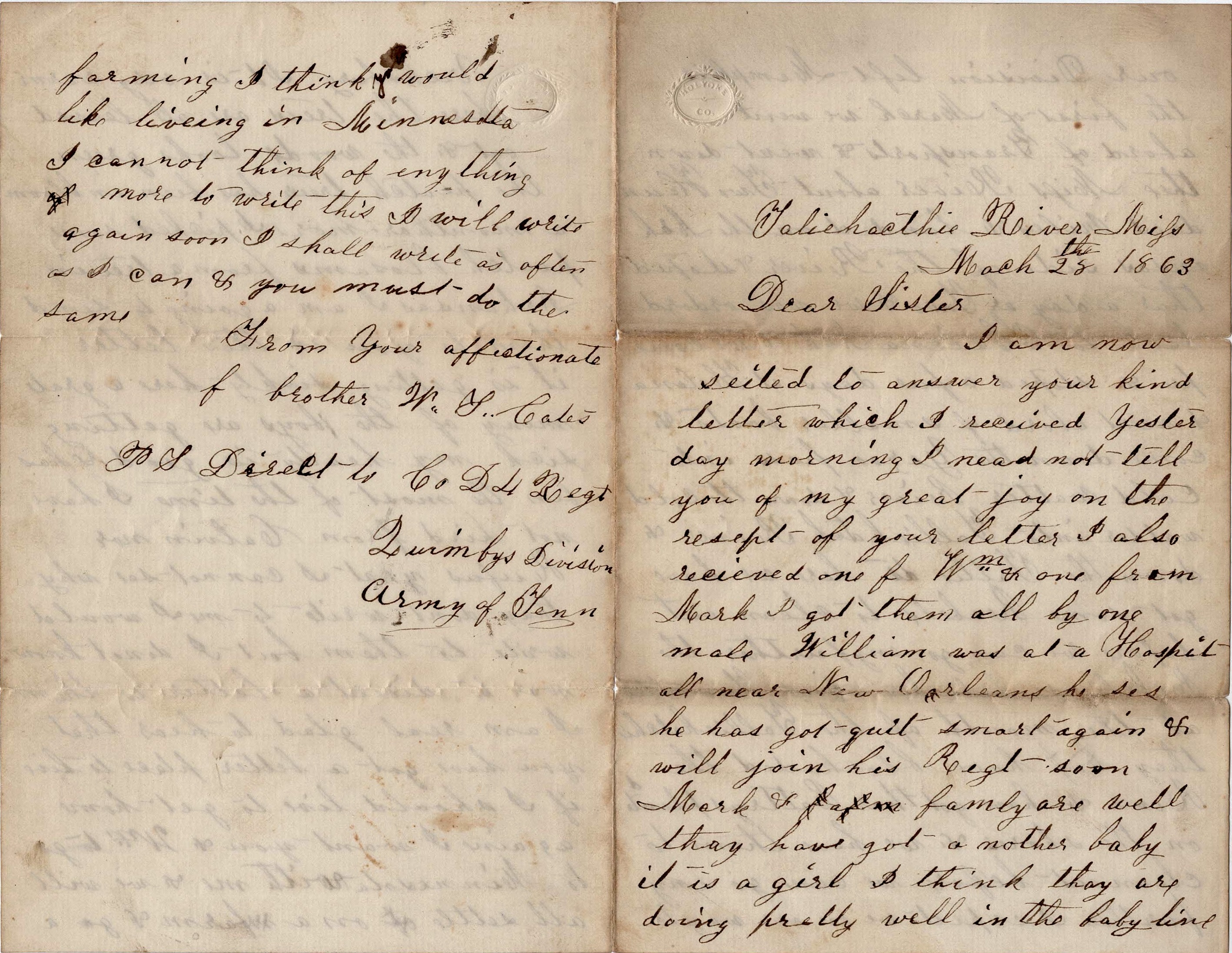
Tallahatchie River, Mississippi March 28th 1863
Dear Sister,
I am now seated to answer your kind letter which I received yesterday morning. I need not tell you of my great joy on the receipt of your letter. I also received one from William & one from Mark. I got them all by one mail. William was a hospital near New Orleans. He says he has got quite smart again and will join his regiment soon. Mark and family are well. They have got another baby. It is a girl. I think they are doing prett well in the baby line.
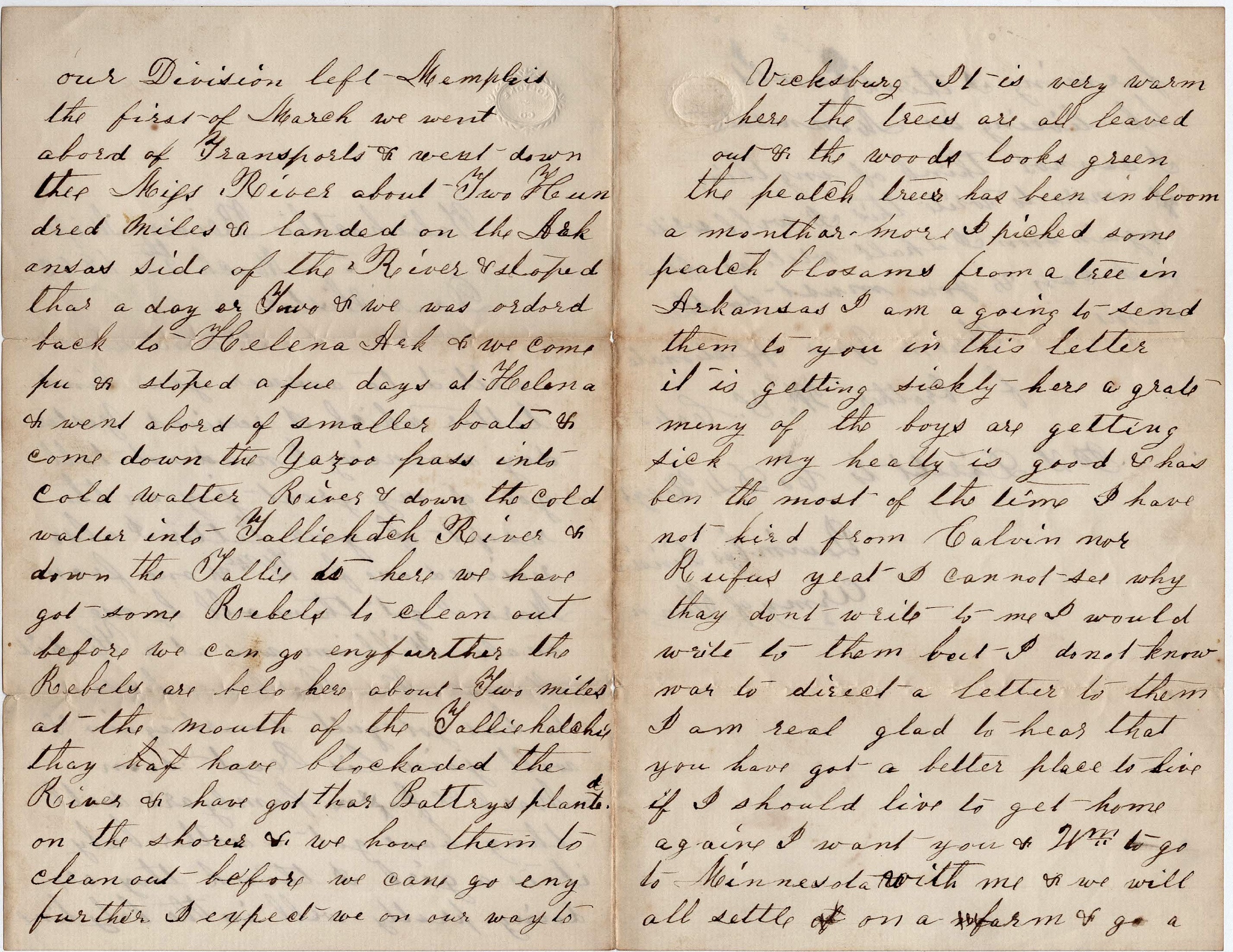
Our Division left Memphis the first of March. We went aboard of transports & went down the Mississippi River about two hundred miles & landed on the Arkansas side of the river & stopped there a day or two and we was ordered back to Helena & went aboard of smaller boats & come down the Yazoo Pass into Cold Water River and down the Cold Water into Tallahatchie River. And down the Tallahatchie to here. We have got some rebels to clean out before we can go any farther. The rebels are below here about ten miles at the mouth of the Tallahatchie. They have blockaded the river and have got the batteries planted on the shores & we have them to clean out before we can go any farther. I expect we are on our way to Vicksburg.
It is very warm here. The trees are all leafed out & the woods look green. The peach trees has been in bloom a month or more. I picked some peach blossoms from a tree in Arkansas. I am a going to send them to you in this letter.
It is getting sickly here. A great many of the boys are getting sick. My health is good and has been the most of the time. I have not heard from Calvin nor Rufus yet. I cannot see why they don’t write to me. I would write to them but I don’t know where to direct a letter to them.
I am real glad to hear that you have got a better place to live. If I should live to get home again, I want you and William to go to Minnesota with me & we will all settle on a farm and go a farming. I think I would like living in Minnesota. I cannot think of anything more to write this [time]. I will write again soon. I shall write as often as I can and you must do the same.
From your affectionate brother, — W. S. Cates
P. S. Direct to Co. D, 4th Regt. [Minn.], Quimby’s Division, Army of Tennessee
Letter 11
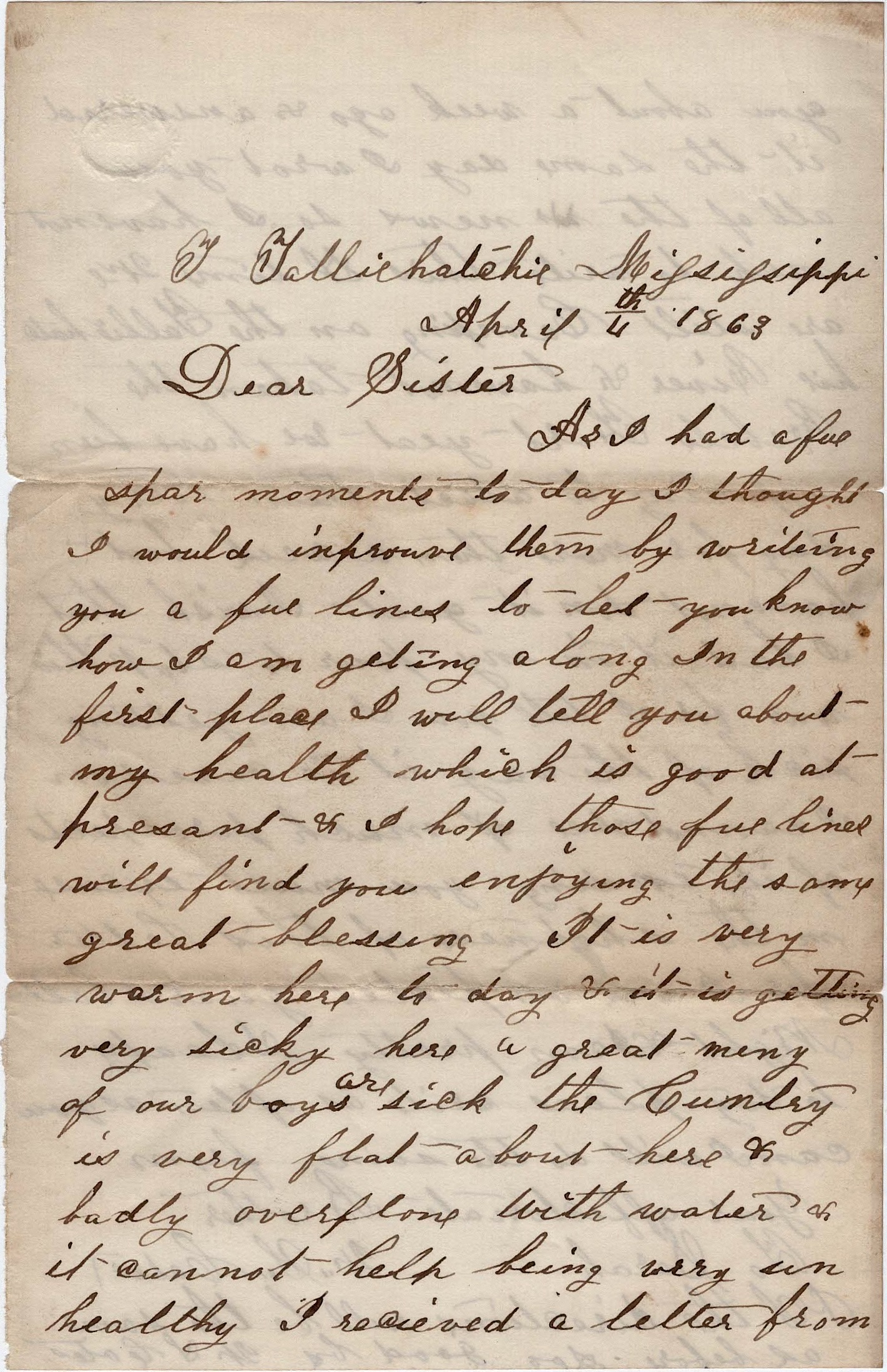
Tallahatchie, Mississippi April 4, 1863
Dear sister,
As I had a few spare moments today, I thought I would improve them by writing you a few lines to let you know how I am getting along. In the first place, I will tell you about my health which is good at present and I hope these few lines will find you enjoying the same great blessing.
It is very warm here today & it is getting very sickly here. A great many of our boys are sick. The country is very flat about here and badly overflowed with water & it cannot help being very unhealthy.
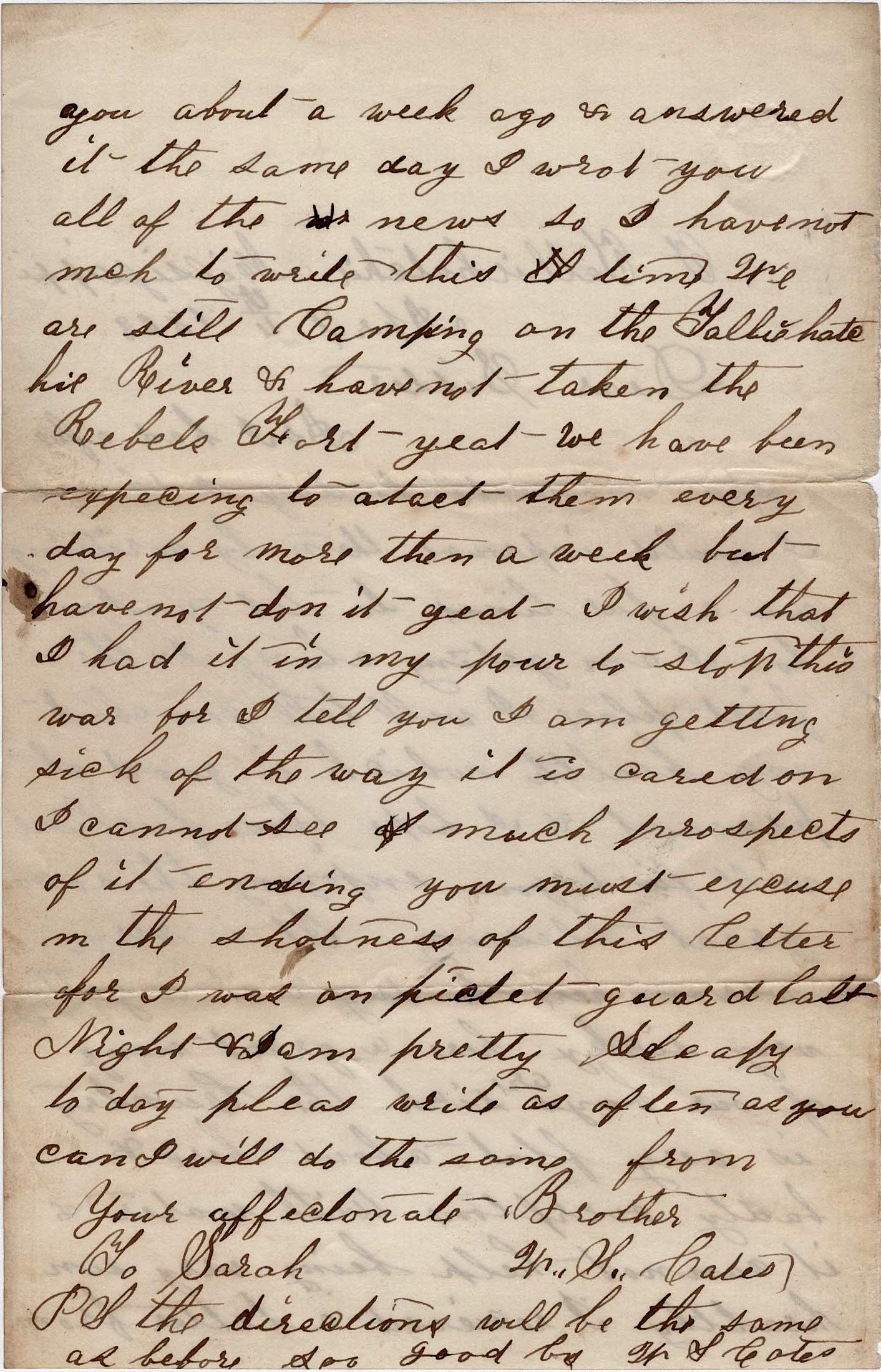
I received a letter from you about a week ago & answered it the same day. I wrote you all of the news so I haven’t much to write this time. We are still camping on the Tallahatchie RIver & have not taken the rebel’s fort yet. We have been expecting to attack them every day for more than a week but have not done it yet. I wish that I had it in my power to stop this war for I tell you, I am getting sick of the way it is carried on. I cannot see much prospects of it ending.
You must excuse the shortness of this letter for a I was on picket guard last night and I am pretty sleepy today. Please write as often as you can. I will do the same. From your affectionate brother, — W. S. Cates
To Sarah
P. S. The directions will be the same as before. So goodbye, — W. S. Cates
Letter 12
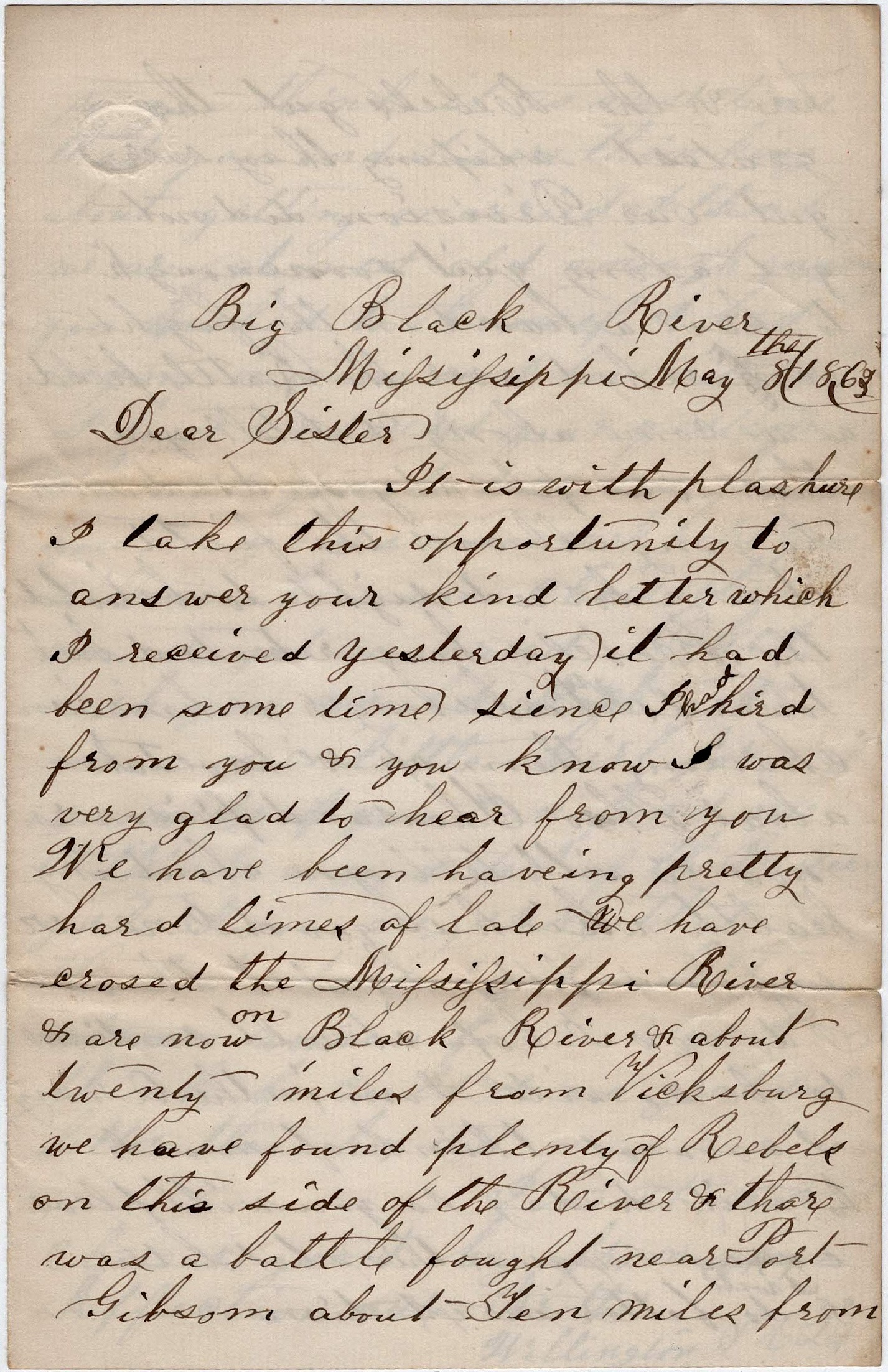
Big Black River, Mississippi May 8, 1863
Dear Sister,
It is with pleasure I take this opportunity to answer your kind letter which I received yesterday. It had been some time since I had heard from you and you know I was very glad to hear from you.
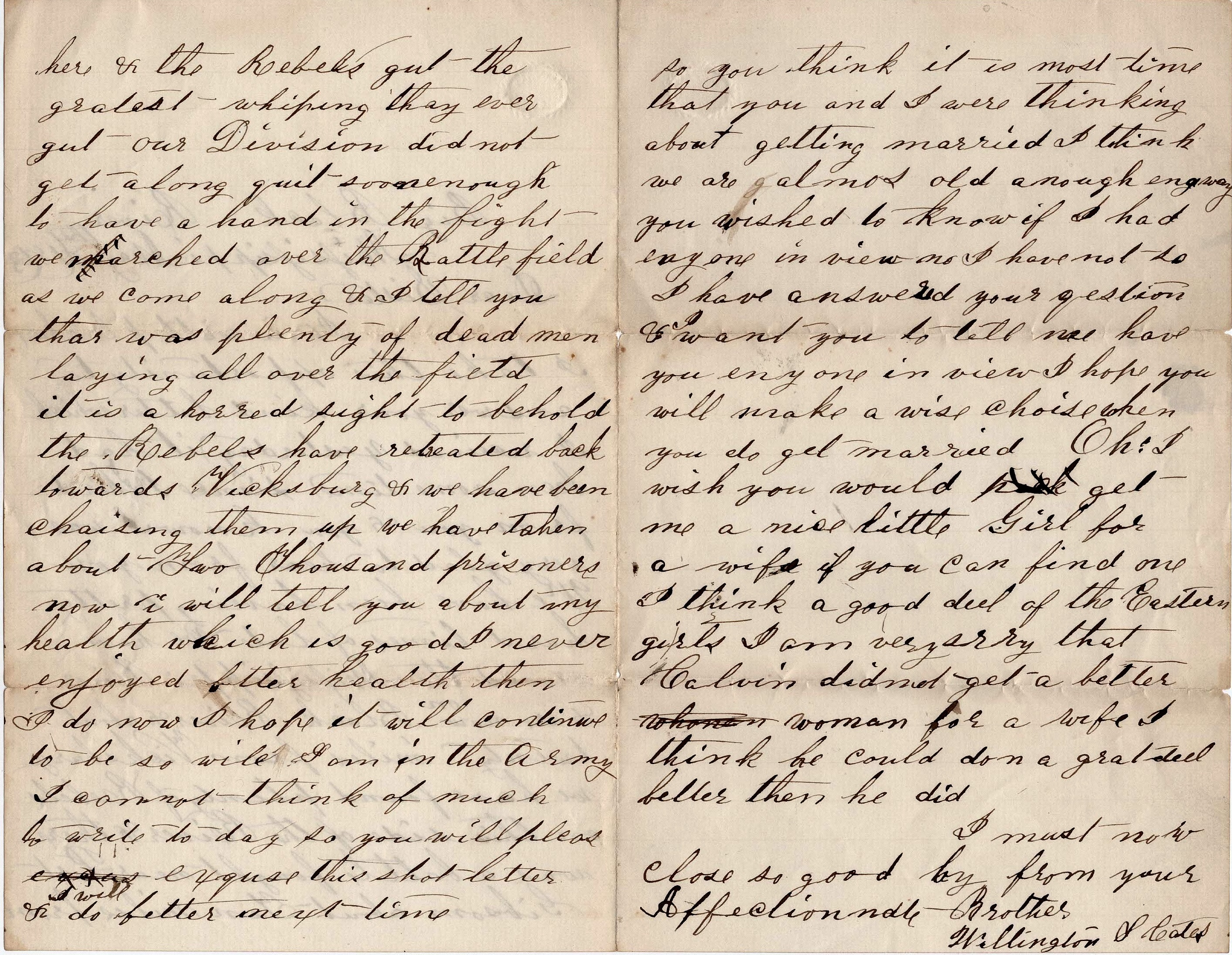
We have been having pretty hard times of late. We have crossed the Mississippi River and are now on Black River and about 20 miles from Vicksburg. We have found plenty of rebels on this side of the river and there was a battle fought near Port Gibson about ten miles from here and the rebels got the greatest whipping they ever got. Our Division did not get along quite soon enough to have a hand in the fight. We marched over the battlefield as we came along & I tell you, there was plenty of dead men laying all over the field. It is a horrid sight to behold. The rebels have retreated back towards Vicksburg & we have been chasing them up. We have taken about two thousand prisoners.
Now I’ll tell you about my health which is good. I never enjoyed better health than I do now. I hope it will continue to be so while I am in the army. I cannot think of much to write today so you will please excuse this short letter & I will do a better one next time.
So you think it is most time that you and I were thinking about getting married. I think we are almost old enough anyway. You wished to know if I had anyone in view. No, I have not. So I have answered your question & want you to tell me have you anyone in view? I hope you will make a wise choice when you do get married. Oh! I wish you would get a nice little girl for a wife if you can find [me] one. I think a good deal of the eastern girls. I am very sorry that Calvin didn’t get a better woman for a wife. I think he could done a great deal better than he did.
I must now close. So goodbye from your affectionate brother, — Wellington S. Cates
Letter 13
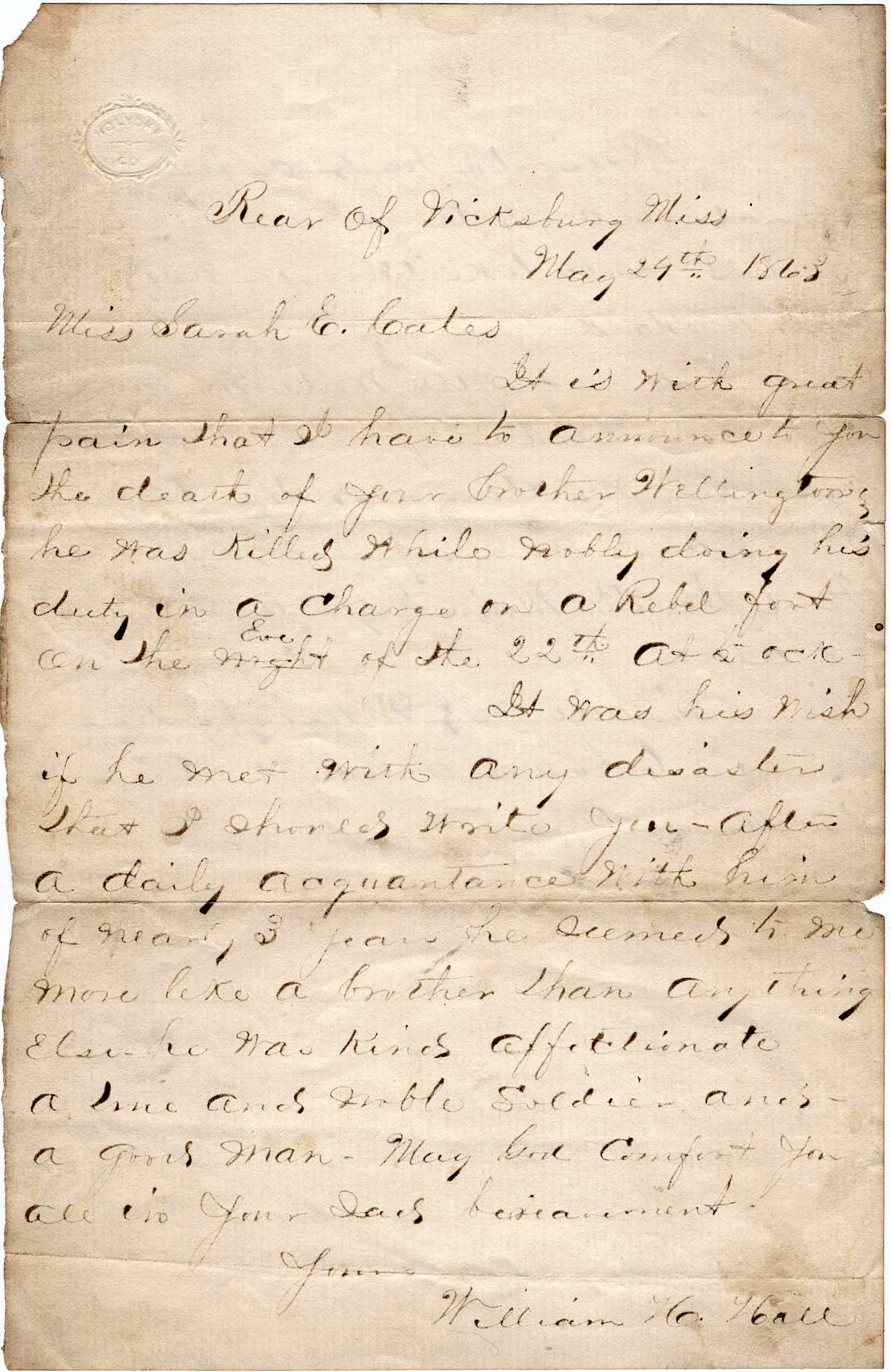
Rear of Vicksburg, Mississippi May 24th, 1863
Miss Sarah E. Cates,
It is with great plain that I have to announce to you the death of your brother Wellington. He was killed while nobly doing his duty in a charge on a rebel fort on the eve of the 22nd at 5 o’clock.
It was his wish if he met with any disaster that I should write you. After a daily acquaintance with him of nearly 3 years, he seemed to me more like brother than anything else. He was kind, affectionate, a true and noble soldier and a good man. May God comfort you all in your sad bereavement. From, — William H. Hall
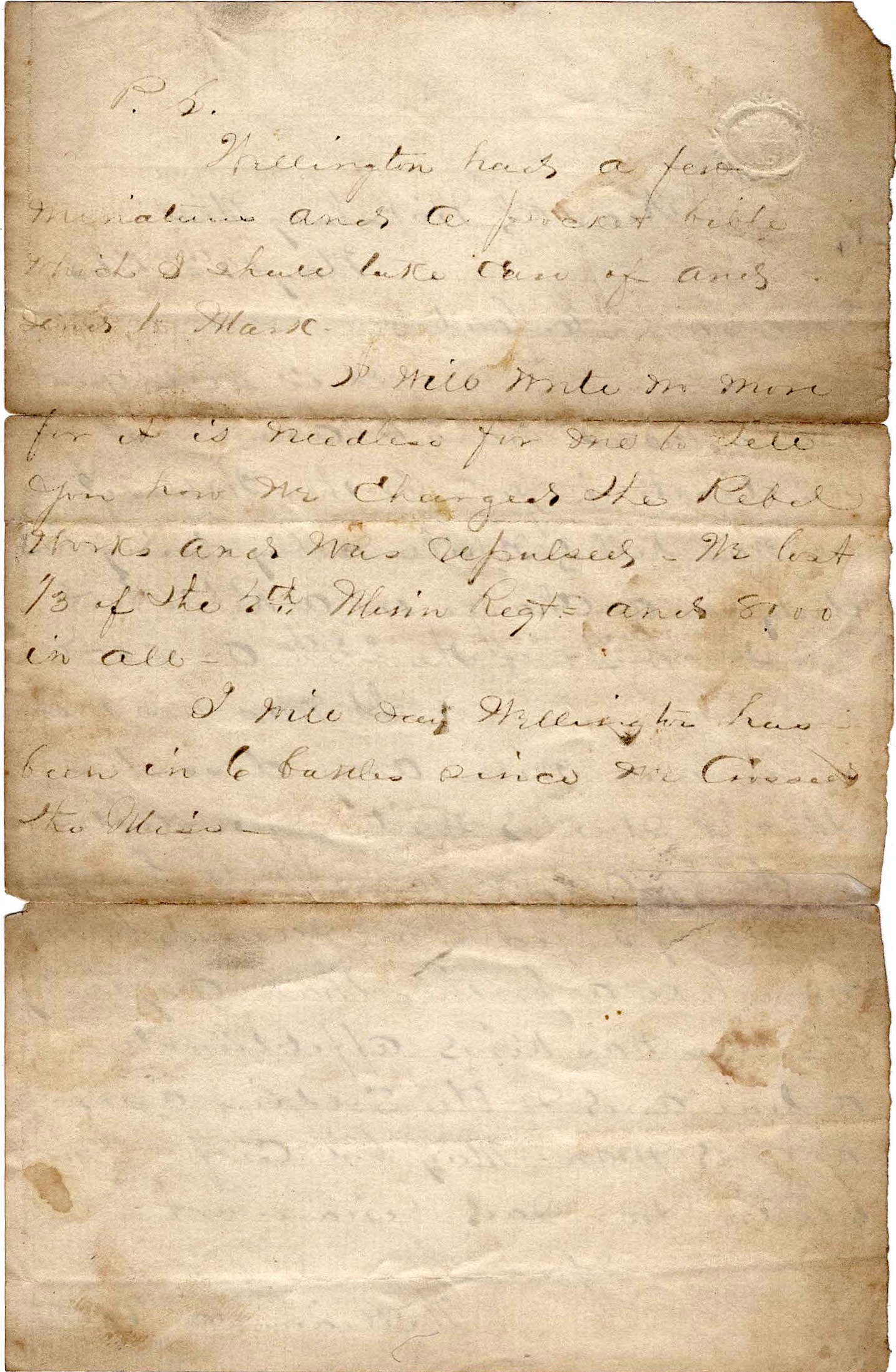
P. S. Wellington had a few miniatures and a pocket bible which I shall take care of and send to Maine. I will write no more for it is needless for me to tell you how we charged the rebel works and was repulsed. We lost one third of the 4th Minnesota Regt. and 8,000 in all. I will say Wellington has been in six battles since we crossed the Mississippi.
The following letter was written by Isaac Newton (“Newt”) Haldeman (b. 1840), the son of Isaac Haldeman (1812-1885) and Maria Miller (1823-1910) of Wapsinonoc, Muscatine county, Iowa. Newt enlisted as a corporal in Co. F, 22nd Iowa Infantry in September 1862.
Newt wrote this letter some three weeks after the surrender of Vicksburg which was followed quickly by a march to Jackson, Mississippi, and return. See also—1864: Isaac Newton Haldeman to his Sister.
T R A N S C R I P T I O N
Addressed to Minnie Haldeman, Tiffin, Seneca county, Ohio
Vicksburg [Mississippi] July 26th 1863
My dear Sister,
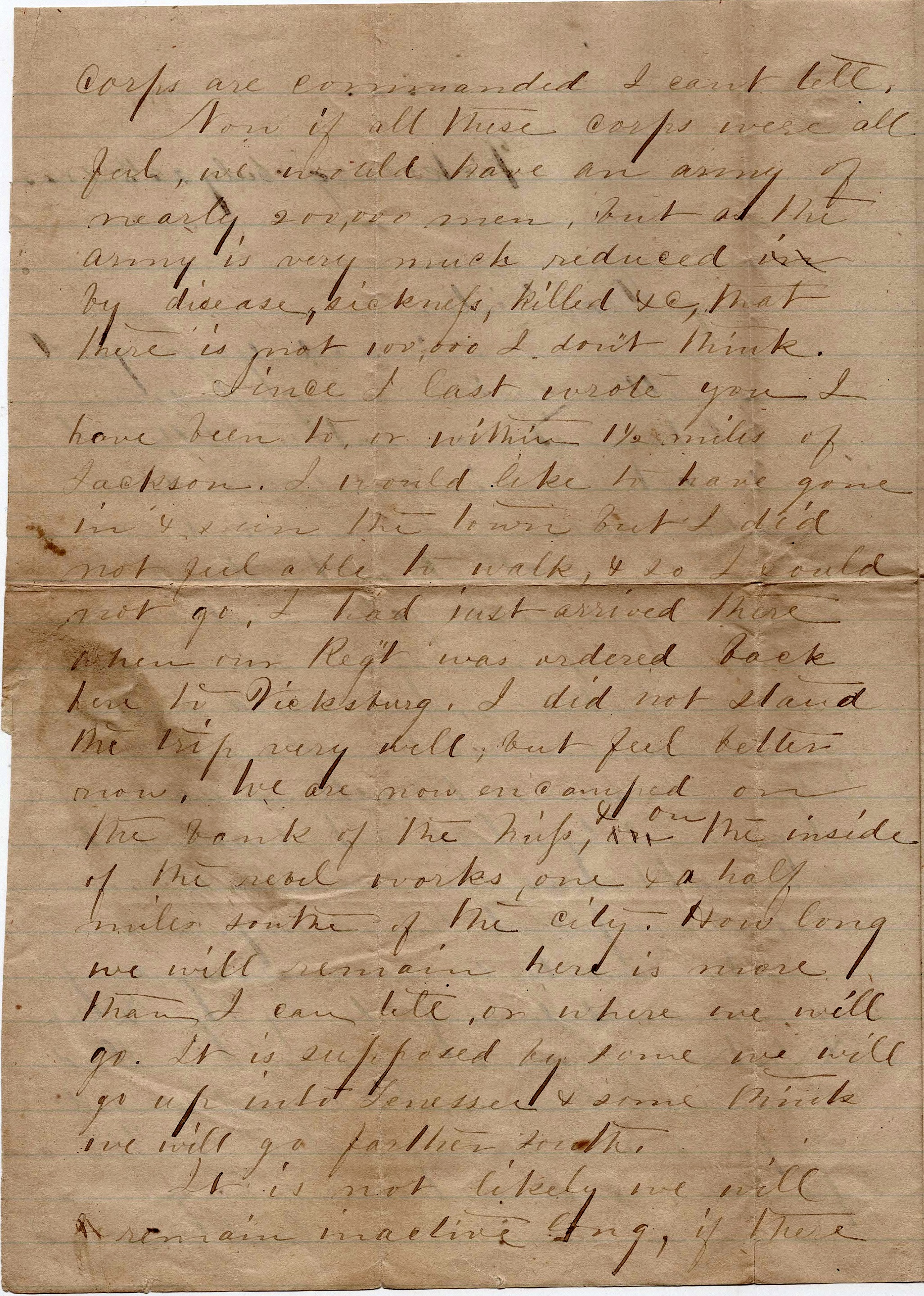
I received your good long letter last evening. I am mistaken—it was father’s letter I received last evening & yours a few nights ago. Since I last wrote you this great stronghold of the Mississippi has at last fallen, which caused the hearts of many a soldier in rear of Vicksburg to bound with joy when the “white flag” was run up over the fortifications surrounding the city. You asked me what I thought was hte number of men that composed this army. It consists of four Army Corps commanded respectively by Gen. Osterhaus, Gen. Sherman, Gen. Ord, Gen. McPherson, and Gen. Burnside’s Corps is also here, together with a portion of Gen. Herron’s Corps. By whom these last named Corps are commanded, I can’t tell. Now if all these Corps were all full, we would have an army of nearly 200,000 men, but as the army is very much reduced by disease, sickness, killed, &c., that there is not 100,000 I don’t think.
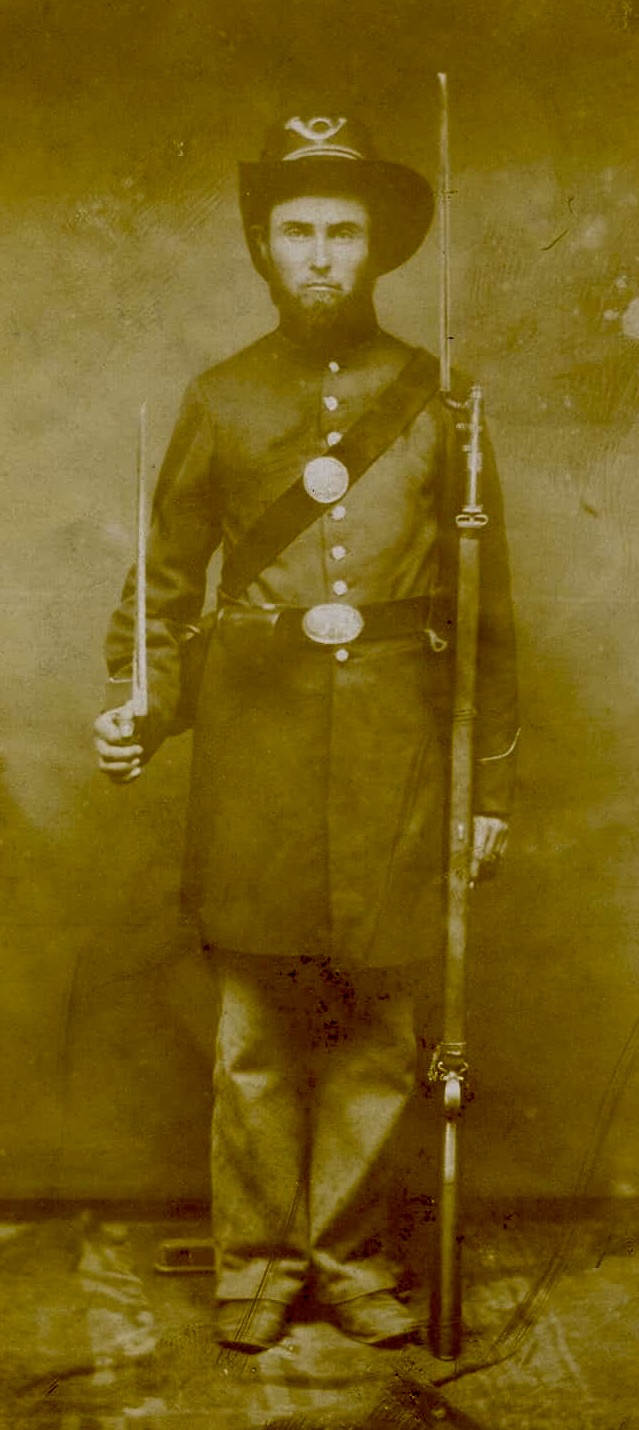
I could not find an image of Newt but here is one of William P. Marvin who served in Co. I, 22nd Iowa Infantry (Iowa Civil War Images)
Since I last wrote you I have been to, or within 1.5 miles of Jackson. I would like to have gone in and seen the town but I did not feel able to walk and so I could not go. I had just arrived there when our regiment was ordered back here to Vicksburg. I did not stand the trip very well but feel better now. We are now encamped on the bank of the Mississippi on the inside of the rebel works one and a half miles south of the city. How long we will remain here is more than I can tell, or where we will go. It is supposed by some we will go up into Tennessee and some think we will go farther south. It is not likely we will remain inactive long, if there is anything to do.
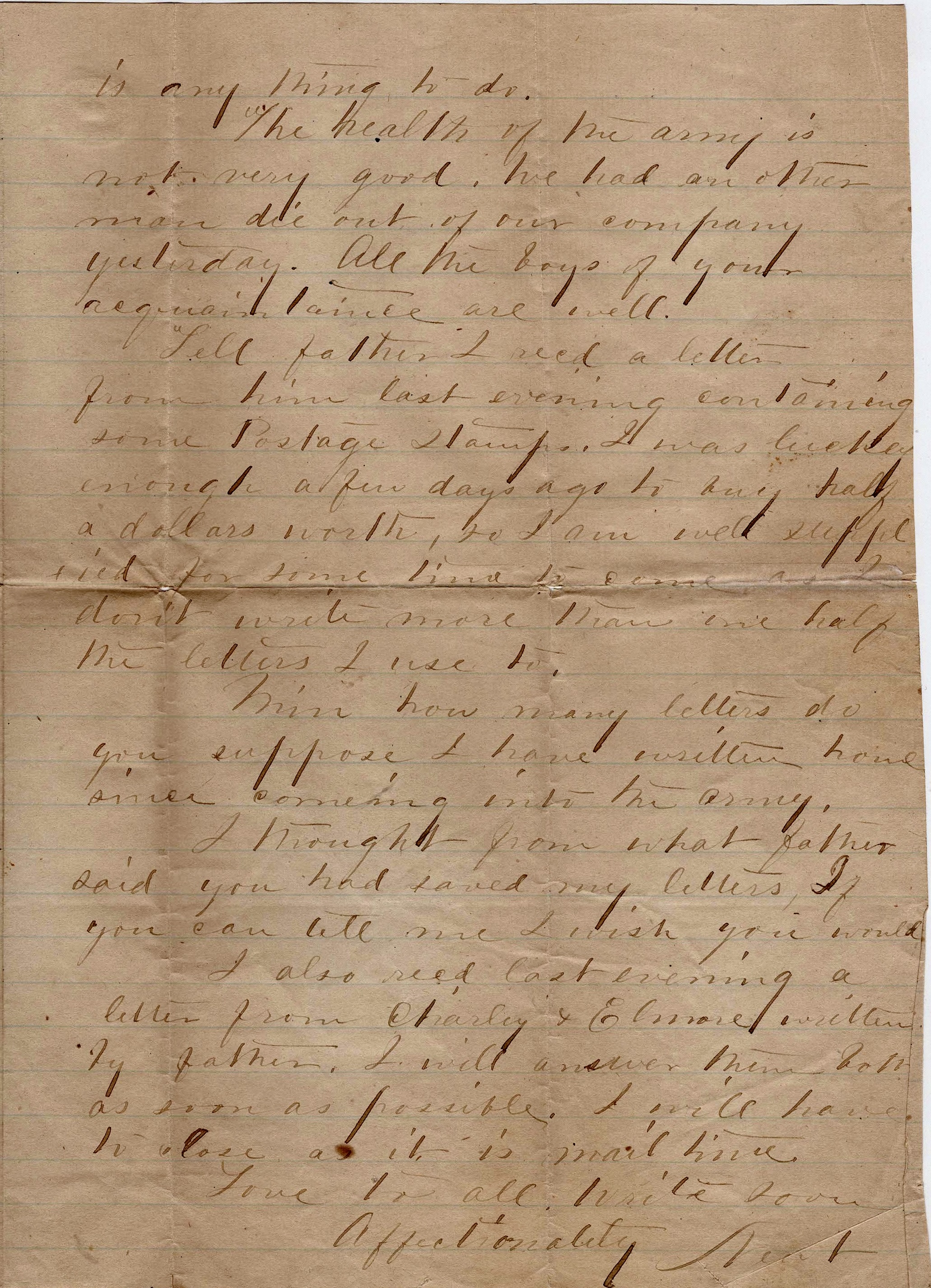
The health of the army is not very good. We had another man die out of our company yesterday. All the boys of your acquaintance are well.
Tell father I received a letter from him last evening containing some postage stamps. I was lucky enough a few days ago to buy half a dollar’s worth so I am well supplied for some time to come as I don’t write more than one half the letters I use to.
Min, how many letters do you suppose I have written home since coming into the army? I thought from what father said you had saved my letters. If you can tell me I wish you would. I also received last evening a letter from Charley and Elmore written by father. I will answer them both as soon as possible. I will have to close as it is mail time. Love to all. Write soon. Affectionately, — Newt
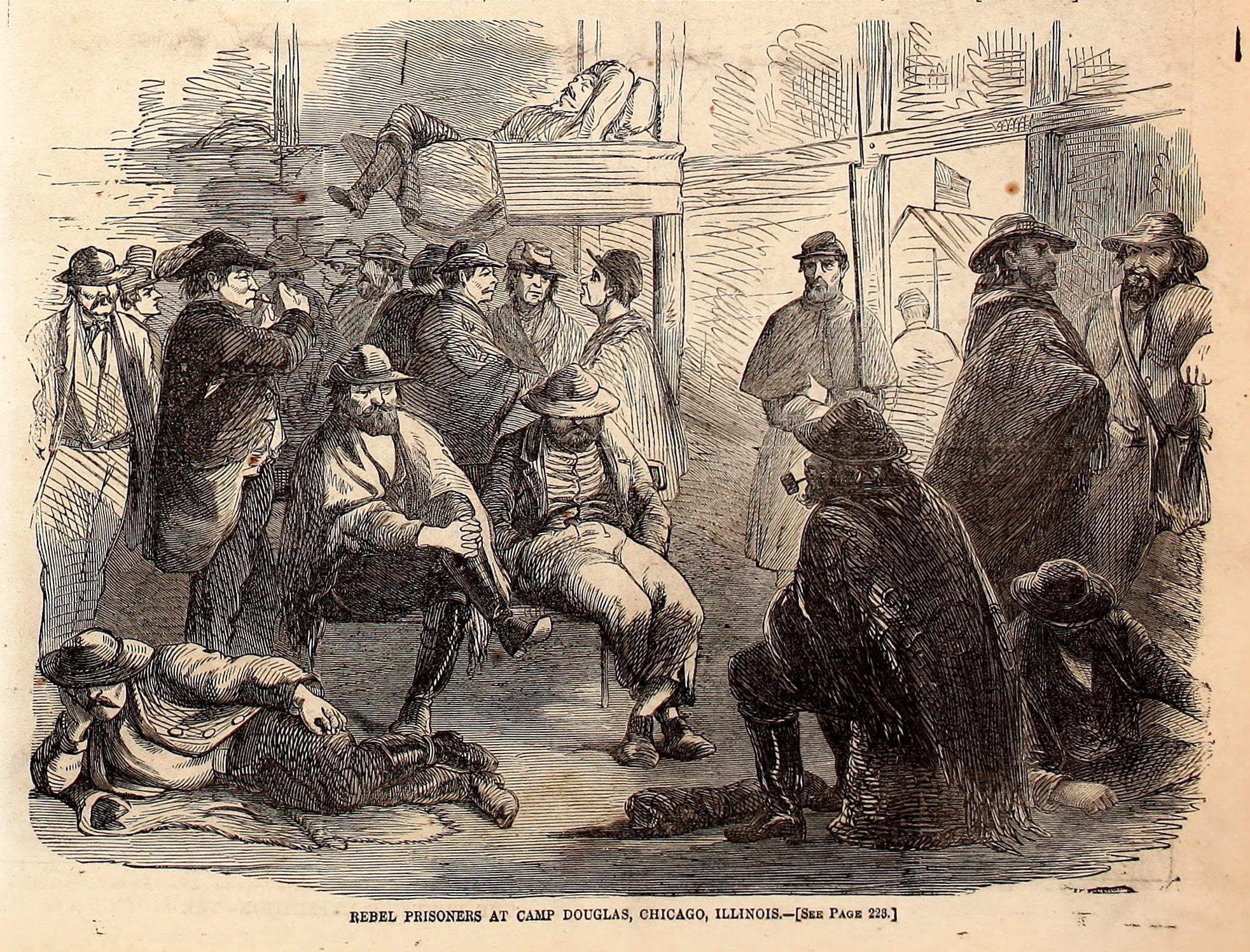
These letters were written by Truman (“True”) W. Williams (1839-1897) who grew up in Watertown, New York, the son of Asa and Louisa Keelar Williams. He was a self-taught illustrator and one of his earliest published works appeared in Harpers Weekly (April 1862) depicting rebel prisoners at Camp Douglas near Chicago (see below). In mid-December 1863, he enlisted in Co. E, 15th Illinois Infantry at Chicago. When he enlisted, he was described as standing 5′ 8″ tall, with hazel eyes, and dark hair. He was with the regiment until the spring of 1864 when he was attached to the topographical engineers. After mustering out of the service in October 1865, he pursued his career in illustrations and was best known for illustrating books for Mark Twain. [see Biographical Sketch]
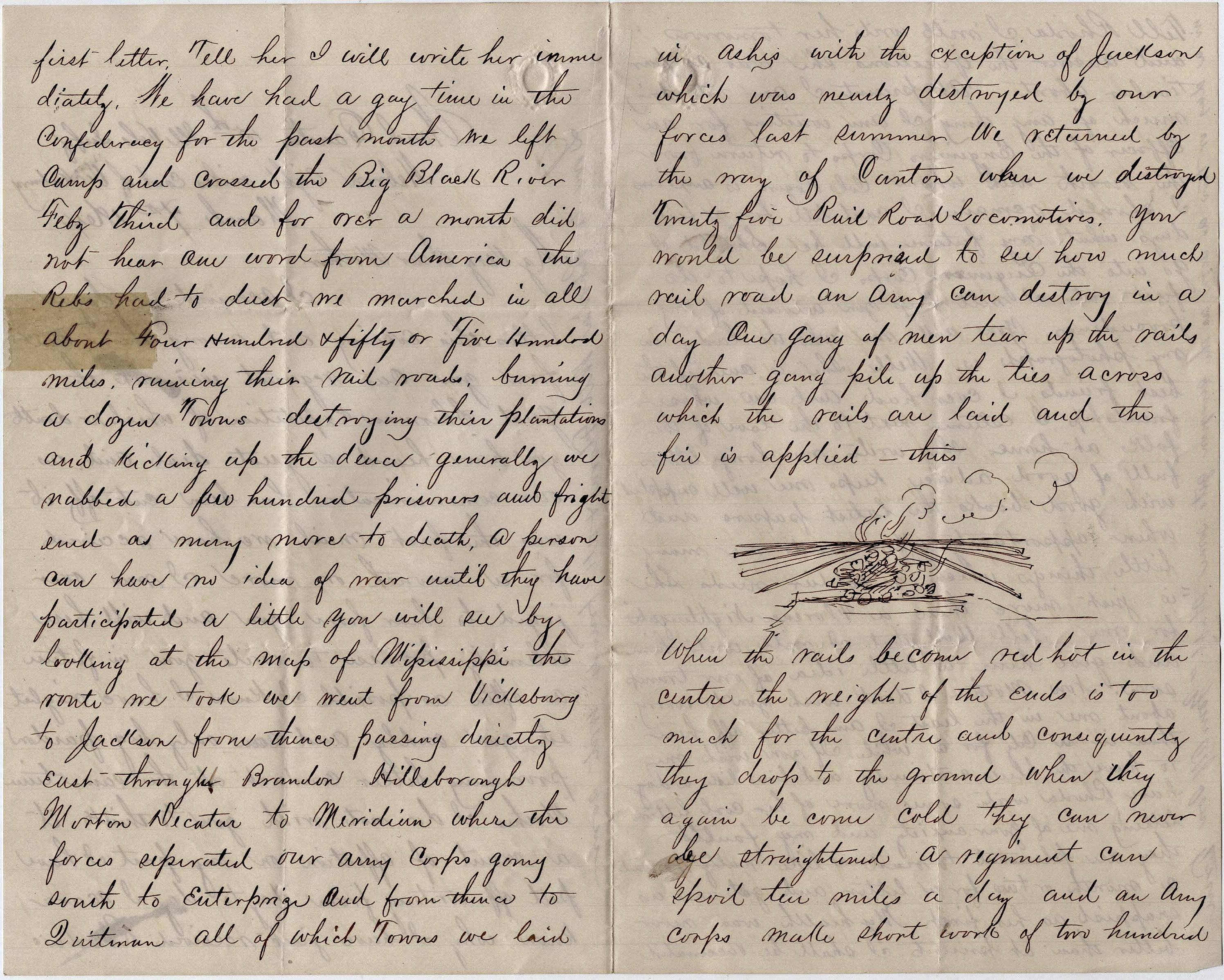
In one of the letters presented here, Truman gives us a sketch of the method used by Sherman’s army to bend the rails of the tracks torn up during his Meridian Expedition in the early spring of 1864. His sketch would have been made by direct observation. See Sherman’s Neckties.
Letter 1
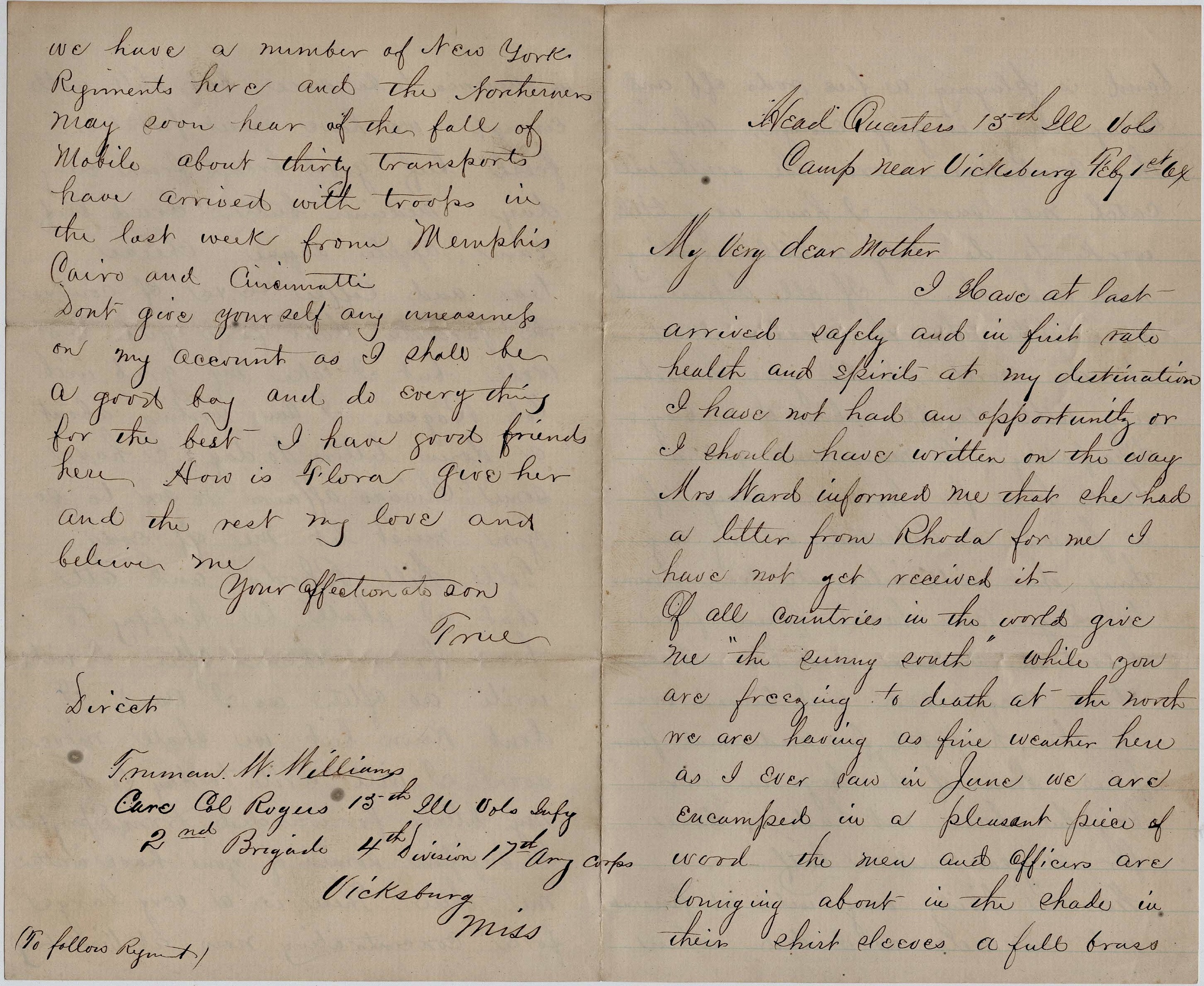
Headquarters 15th Illinois Vols. Camp near Vicksburg February 1st 1864
My very dear mother,
I have at last arrived safely and in first rate health and sprits at my destination. I have not had an opportunity or I should have written on the way, Mrs. Ward informed me that she had a letter from Rhoda for me. I have not yet received it.
Of all countries in the world, give me “the Sunny South.” While you are freezing to death at the North, we are having as fine weather here as I ever saw in June. We are encamped in a pleasant piece of wood. The men and officers are lounging about in their shirt sleeves, a full brass band is playing a few rods off, and everything is gay enough. When this cruel war is over the South will catch me sure.
I have very little work to do—only a little writing now and then. If all departments were like this, the anxious mothers at the North should give themselves very little trouble about their boy’s dissipating. A man can’t get a drink here for love or money. If a person is detected selling anything that will intoxicate even down to lager beer, he is fined five hundred dollars and his whole stock confiscated and turned over to the hospital for medicinal purposes. Some of the boys in our brigade have not had a dose for a year and a half.
We are living very well at present. Not as well as I did when in America to be sure, but still well enough. We have sweet potatoes, fresh beef, good bread fresh every day, medium butter, dried beef, ham, apple sauce, cheese, tea, and coffee, &c. &c. Of course the privates don’t fare quite as well but I take my grub with Col. Rogers. I am writing about a dozen letters today. I have some Chicago affairs to see to so you must let me off easy.
Tell Will, Rhoda, and all that I shall be happy to hear from them often. I wil write as often as I can. I don’t know but we shall move soon. I will write today to have my letters forwarded from Springfield. I suppose some of you have written me there.
There is a very large force concentrating now at Vicksburg. We have a number of New York Regiments here and the Northerners ,ay soon hear of the fall of Mobile. About 30 transports have arrived with troops in the last week from Memphis, Cairo and Cincinnati.
Don’t give yourself any uneasiness on my account as I shall be a good boy and do everything for the best. I have good friends here. How is Flora? Give her and the rest my love and believe me your affectionate son, — True
Direct to Truman W. Williams, Care of Col. Rogers, 15th Illinois Vols. Infantry, 2nd Brigade, 4th Division, 17th Army Corps, Vicksburg, Mississippi
Letter 2
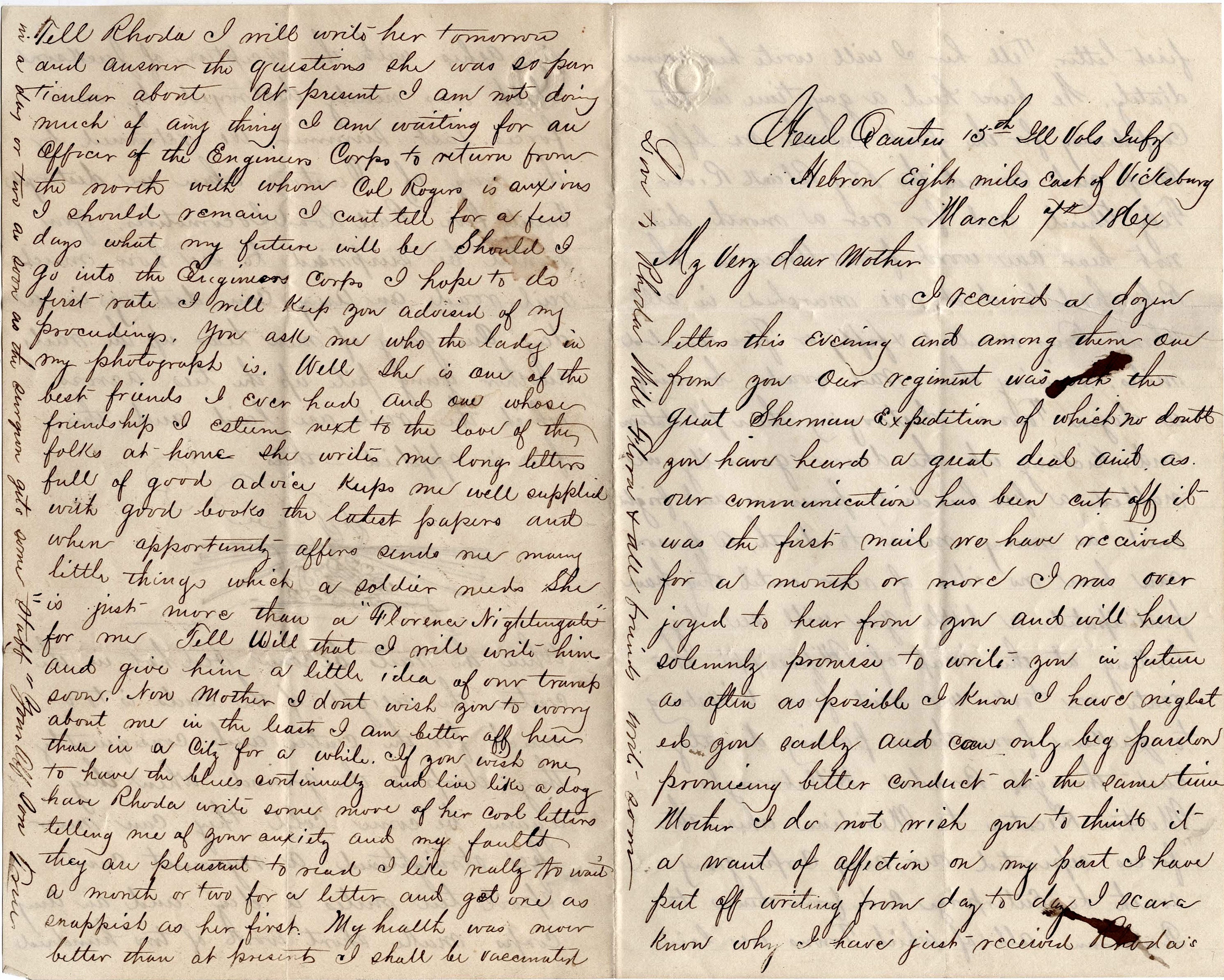
Headquarters 15th Ill. Vols. Infantry Hebron, eight miles east of Vicksburg March 7, 1864
My very dear mother,
I received a dozen letters this evening and among them one from you. Our regiment was with the great Sherman [Meridian] Expedition of which no doubt you have heard a great deal, and as our communication has been cut off, it was the first mail we have received for a month or more. I was overjoyed to hear from you and will here solemnly promise to write you in future as often as possible. I know I have neglected you sadly and can only beg pardon promising better conduct at the same time. Mother I do not wish you to think it a want of affection on my part I have put off writing from day to day. I scarce know why. I have just received Rhoda first letter. Tell her I will write to her immediately.
We have had a gay time in the Confederacy for the past month. We left camp and crossed the Big Black River February 3rd and for over a month did not hear one word from America. The rebs had to dust. We marched in all about 450 or 500 miles, ruining their railroads, burning a dozen towns, destroying their plantations and kicking up the deuce generally. We nabbed a few hundred prisoners and frightened as many more to death. A person can have no idea of war until they have participated a little. You will see by looking at the map of Mississippi the route we took. We went from Vicksburg to Jackson, from thence passing directly east through Brandon, Hillsborough, Morton, Decatur, to Meridian where the forces separated, our Army Corps going south to Enterprise and from thence to Quitman, all of which towns we laid in ashes with the exception of Jackson which was nearly destroyed by our forces last summer.
We returned by the way of Canton where we destroyed 25 railroad locomotives. You would be surprised to see how much railroad an army can destroy in a day. Our gang of men tear up the rails, another gang pile up the ties across which the rails are laid and the fire is applied—thus [sketch]
Sketch of method used by Sherman’s army to bend the track rails by heating them over a fire.
When the railrs become red hot in the center, the weight of the ends is too much for the center and consequently they drop to the ground when they again become cold. They can never be straightened. A regiment can spoil ten miles a day and an ARmy Corps make short work of two hundred.
Tell Rhoda I will write her tomorrow and answer the questions she was so particular about. At present I am not doing much of anything. I am waiting for an officer of the Engineers Corps to return from the North with whom Col. Rogers is anxious I should remain. I can’t tell for a few days what my future will be. Should I got into the Engineers Corps, I hope to do first rate. I will keep you advised of my proceedings.
You ask me who the lady in my photograph is. Well she is one of the best friends I ever had and whose friendship I esteem next to the love of the folks at home. She writes me long letters full of good advice, keeps me well supplied with good books, the latest papers, and when opportunity offers, seds me many little things which a soldier needs. She is just more than a “Florence Nightingale” for me.
Tell Will that I will write him and give him a little idea of our tramp soon. Now mother, I don’t wish you to worry about me in the least. I am better off here than in a City for a while. If you wish me to have the blues continually and live like a dog, have Rhoda write some more of her cool letters telling me of your anxiety and my faults. They are pleasant to read. I like really to wait a month or two for a letter and get one as snappish as her first. My health was never better than at present. I shall be vaccinated in a day or two as soon as the surgeon gets some”stuff.” Your affectionate son, — True
Letter 3
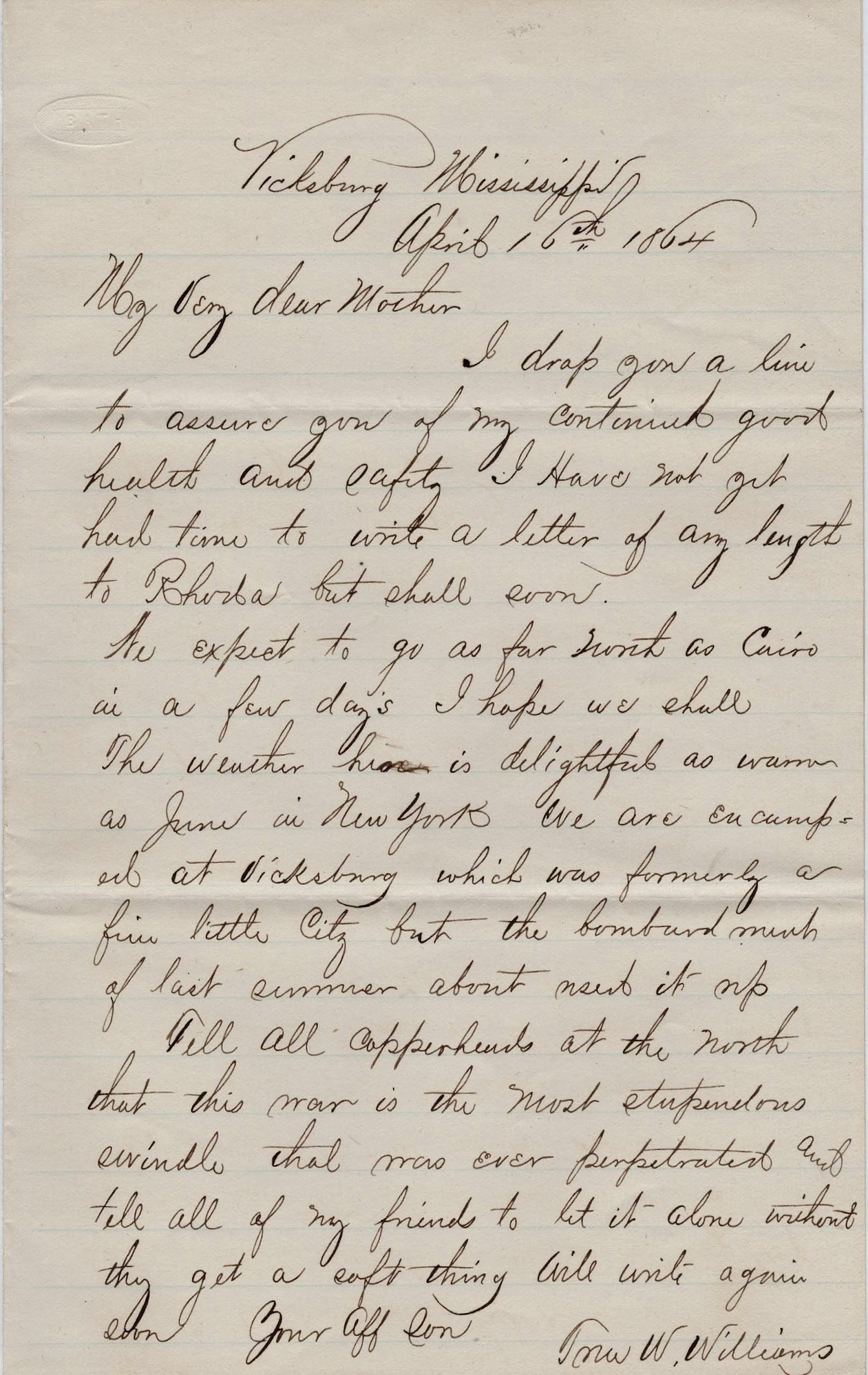
Vicksburg, Mississippi April 16th 1864
My very dear mother,
I drop you a line to assure you of my continued good health and safety. I have not yet had time to write a letter of any length to Rhoda but shall soon.
We expect to go as far north as Cairo in a few days. I hope we shall. The weather is delightful—as warm as June in New York. We are encamped at Vicksburg which was formerly a fine little city but the bombardment of last summer about used it up.
Tell all Copperheads at the North that this war is the most stupendous swindle that was ever perpetrated and tell all of my friends to let it alone without they get a soft thing. Will write again soon. Your affectionate son, Tru W. Williams
Letter 4
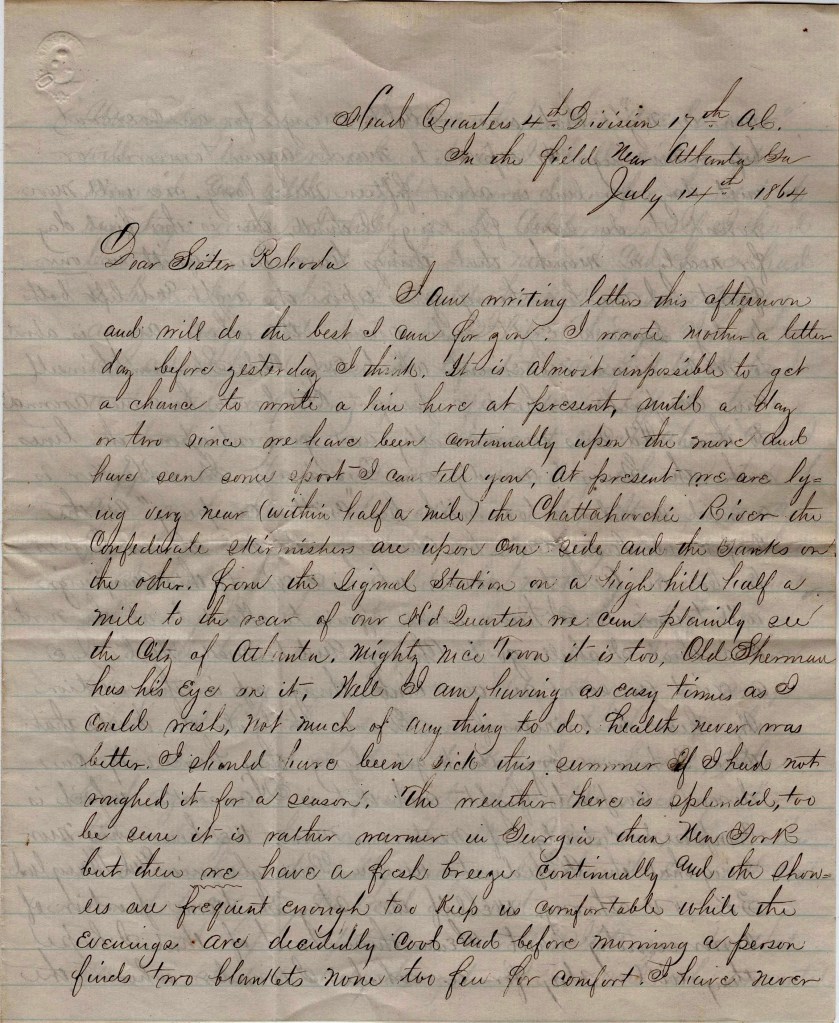
Headquarters 4th Division 17th Army Corps In the field near Atlanta, Ga. July 14, 1864
Dear Sister Rhoda,
I am writing letters this afternoon and will do the best I can for you. I wrote Mother a letter day before yesterday I think. It is almost impossible to get a chance to write a line here at present. Until a day or two since, we have been continually upon the move and have seen some sport, I can tell you. At present we are lying very near (within half a mile) of the Chattahoochee River. The Confederate skirmishers are upon one side and the Yanks on the other. From the Signal Station on a high hill half a mile to the rear of our headquarters, we can plainly see the City of Atlanta. Mighty nice town it is too. Old Sherman has his eye on it.
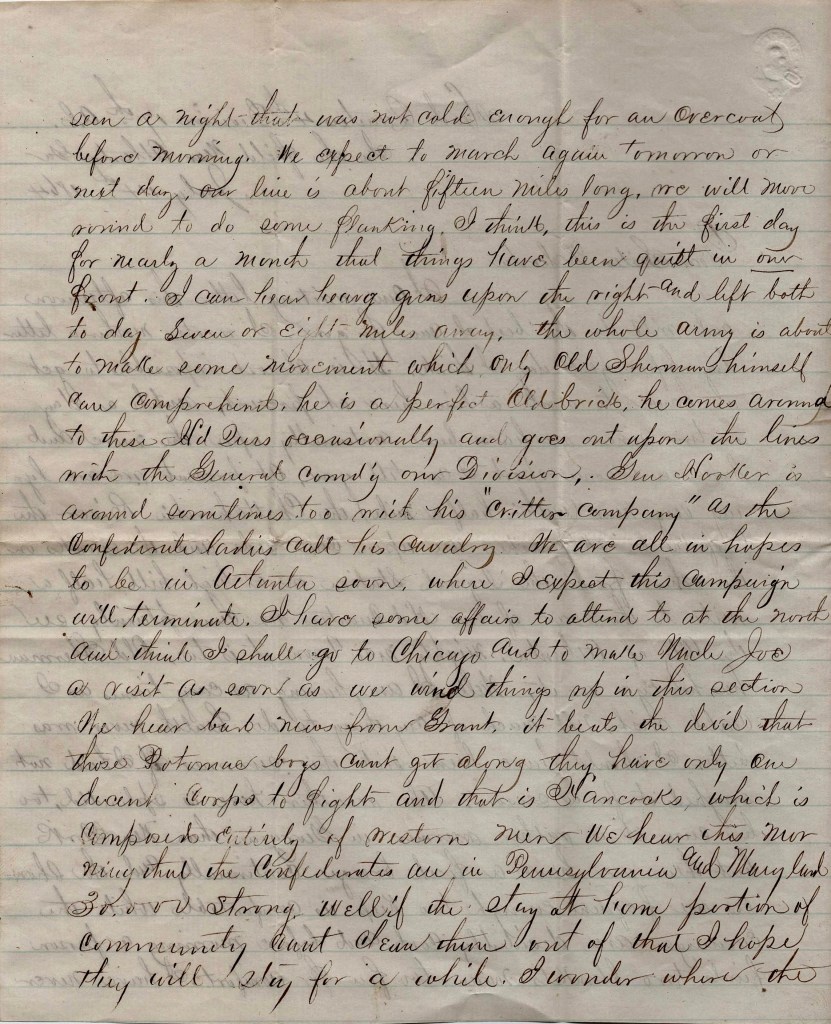
Well, I am having as easy times as I could wish. Not much of anything to do. Health never was better. I should have been sick this summer if I had not roughed it doe a season. The weather here is splendid to be sure. It is rather warmer in Georgia than New York but there we have a fresh breeze continually and the showers are frequent enough to keep us comfortable while the evenings are decidedly cool and before morning a person finds two blankets none to few for comfort. I have never seen a night that was not cold enough for an overcoat before morning.
We expect to march again tomorrow or next day. Our line is about fifteen miles long. We will move round to do some flanking, I think. This is the first day for nearly a month that things have been quiet in our front. I can hear heavy guns upon the right and left both today, seven or eight miles away. The whole army is about to make some movement which only Old Sherman himself can comprehend. He is a perfect old brick. He comes around to the headquarters occasionally and goes out upon the lines with the General commanding our Division. Gen. Hooker is around sometimes too with his “critter company” as the Confederate ladies call his cavalry.
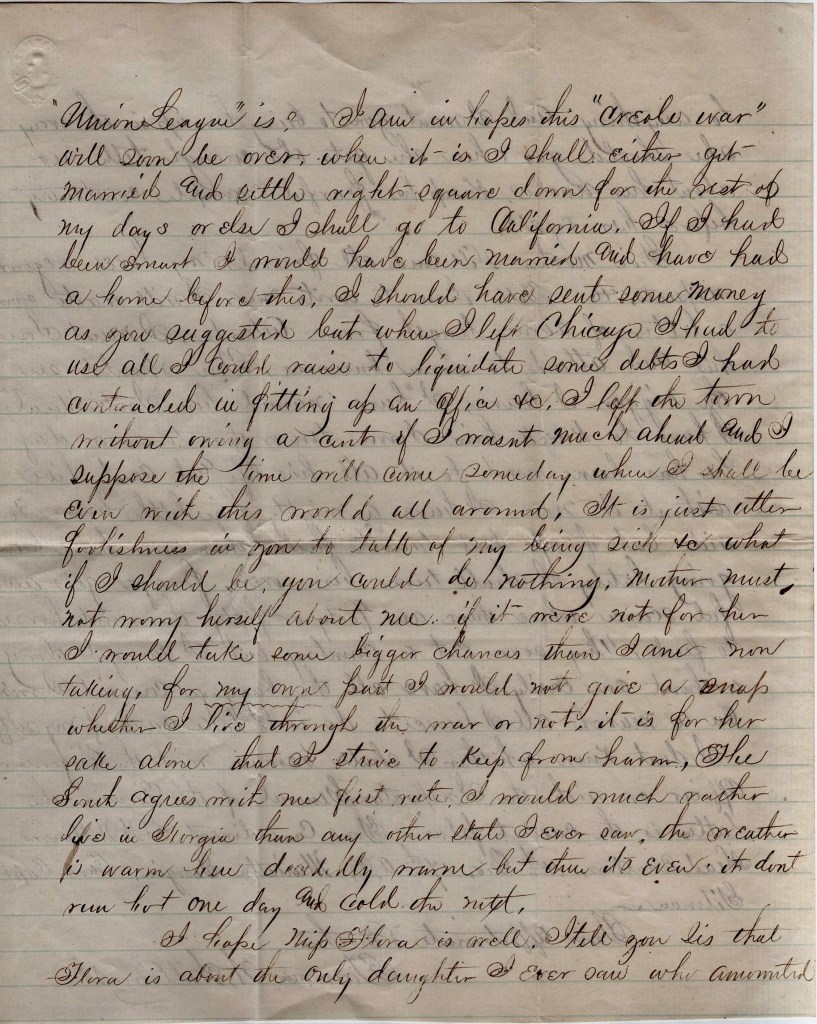
We are all in hopes to be in Atlanta soon where I expect this campaign will terminate. I have some affairs to attend to at the North and think I shall go to Chicago and to make Uncle Joe a visit as soon as we wind things up in this section. We hear bad news from Grant. It beats the devil that those Potomac boys can’t get along. They have only one decent Corps to fight and that is Hancock’s, which is composed entirely of western men. We hear this morning that the Confederates are in Pennsylvania and Maryland 30,000 strong. Well, if they stay at home portion of community can’t clear them out of that, I hope they will stay for a while. I wonder where the “Union League” is? I am in hopes this “creole war” [cruel war] will soon be over. When it is, I shall either get married and settle right square down for the rest of my days or else I shall go to California. If I had been smart, I would have been married and have had a home before this.
I should have sent some money as you suggested but when I left Chicago, I had to use all I could raise to liquidate some debts I had contracted in fitting up an office &c. I left the town without owing a cent if I wasn’t much ahead and I suppose the time will come someday when I shall be even with this world all around. It is just utter foolishness in you to talk of my being sick &c. What is I should be? You could do nothing. Mother must not worry herself about me. If it were not for her, I would take some bigger chances than I am now taking. For my own part, I would not give a snap whether I live through the war or not. It is for her sake alone that I strive to keep from harm. The South agrees with me first rate. I would much rather live in Georgia than any other state I ever saw. The weather is warm here—decidedly warm—but then it’s even. It don’t run hot one day and cold the next.
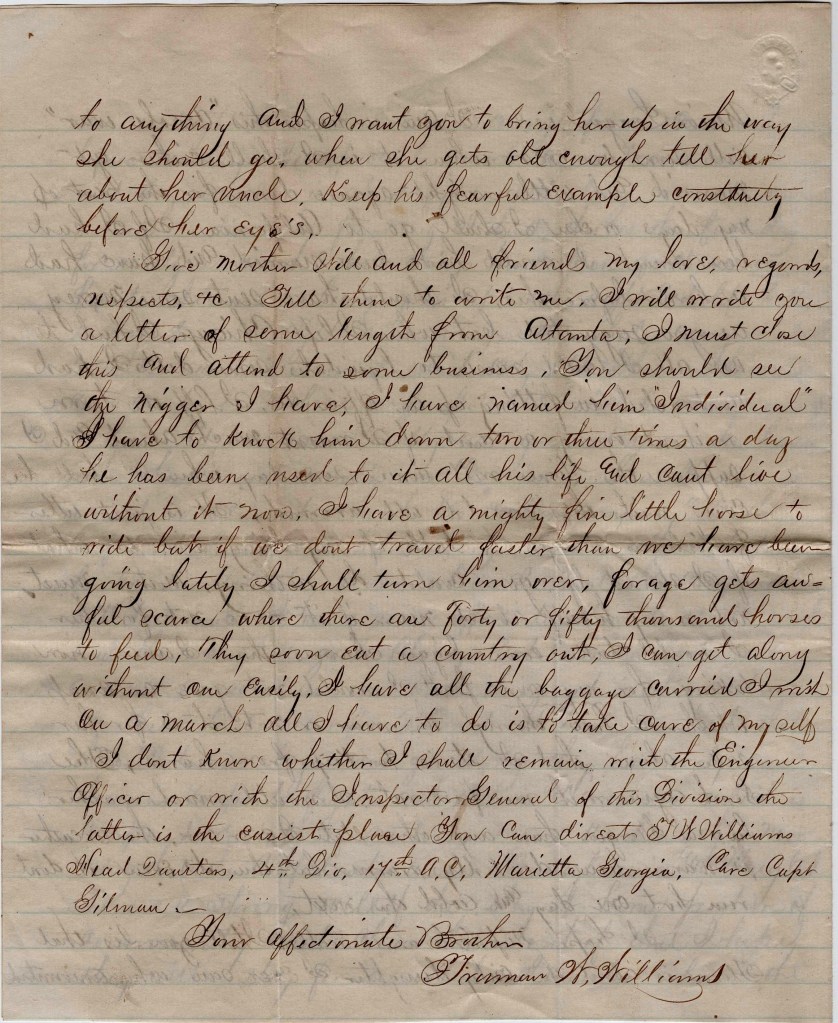
I hope Miss Flora is well. I tell you, sis, that Flora is about the only daughter I ever saw who amounted to anything and I want you to bring her up in the way she should go. When she gets old enough, tell her about her uncle. Keep his fearful enough example constantly before her eyes.
Give mother, Will, and all friends my love, regards, respects, &c. Tell them to write me. I will write you a letter of some length from Atlanta. I must close this and attend to some business. You should see the nigger I have. I have named him “Individual.” I have to knock him down two or three times a day. He has been used to it all his life and can’t live without it now. I have a mighy fine little horse to ride but if we don’t travel faster that we have been going lately, I shall turn him over. Forage gets awful scarce where there are 40 or 50,000 horses to feed. They soon eat a country out. I can get along without one easily. I have all the baggage carried I wish on a march. All I have to do is to take care of myself.
I don’t know whether I shall remain with the Engineer Officer or with the Inspector General of this Division. The latter is the easiest place. You can direct to T. W. Williams, Headquarters, 4th Division, 17th Army Corps, Marietta, Georgia. Care Capt. Gilman
This letter was written by Francis (“Frank”) Henry Whittier (1831-1867) of Cambridgeport, Middlesex county, Massachusetts. He was the son of Amos Henry Whittier (1805-1891) and Hannah Chamberlain Davis (1807-1867). Frank was married in 1853 to Adaline T. Loring (1837-1915) in May 1853 when Adaline was not yet 16. Their first child was born 6 months later; two more over the next three years. It was early December 1861 when Frank enlisted and was commissioned a 2nd Lieutenant of Co. G, 30th Massachusetts infantry. In mid-February 1862 he was promoted to 1st Lieutenant and later to Captain. By war’s end he had risen to Colonel of the regiment.
The 30th Regt. Mass. Vol. Inf. was raised by Gen. Butler in the fall of 1861 and the early part of the winter following. It was originally known as the Eastern Bay State Regiment. It was organized at Camp Chase, Lowell, and its members were mustered in on various dates from Sept. 15 to the close of the year. A controversy having arisen between Governor Andrew and Gen. Butler over the latter’s authority to raise troops in Massachusetts, the regiment left the State Jany. 13, 1862, under command of Acting Lieut. Col. French. Remaining at Fort Monroe until Feb. 2, on the 12th it reached Ship Island in the Gulf of Mexico, where Gen. Butler was assembling his forces to operate against New Orleans. Nathan A. M. Dudley was commissioned colonel, Feb. 8, and most of the other field and staff and line officers were commissioned Feb. 20. It was now officially the 30th Regiment.
After the Mississippi was opened by Farragut’s fleet in the latter part of April, 1862, the 30th was sent to New Orleans and thence to Baton Rouge, arriving June 2. It made several expeditions into the country in pursuit of guerrillas, then was sent to the front of Vicksburg but returned to Baton Rouge, July 26. It was just after the regiment returned to Baton Rouge that Francis wrote this letter.
T R A N S C R I P T I O N
Baton Rouge [Louisiana] July 28, 1862
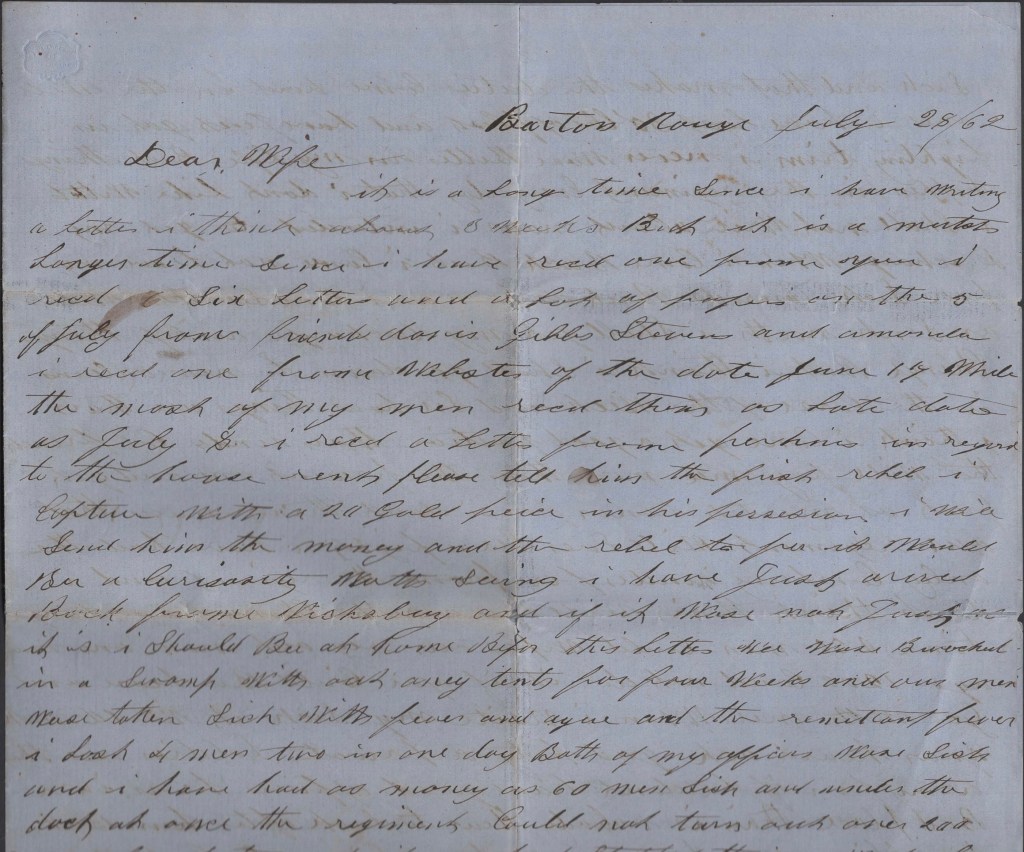
Dear Wife,
It is a long time since I have written a letter. I think about three weeks but it is a much longer time since I have received one from you. I received six letters and a lot of papers on the 5th of July from friend Davis, Gibbs, Stevens and Amanda. I received one from Webster of the date June 17th while the most of my men received them as late date as July 8th. I received a letter from Perkins in regard to the house rent. Please tell him the first rebel I capture with a 20 [dollar] gold piece in his possession, I will send him the money and the rebel too for it would be a curiosity worth seeing.
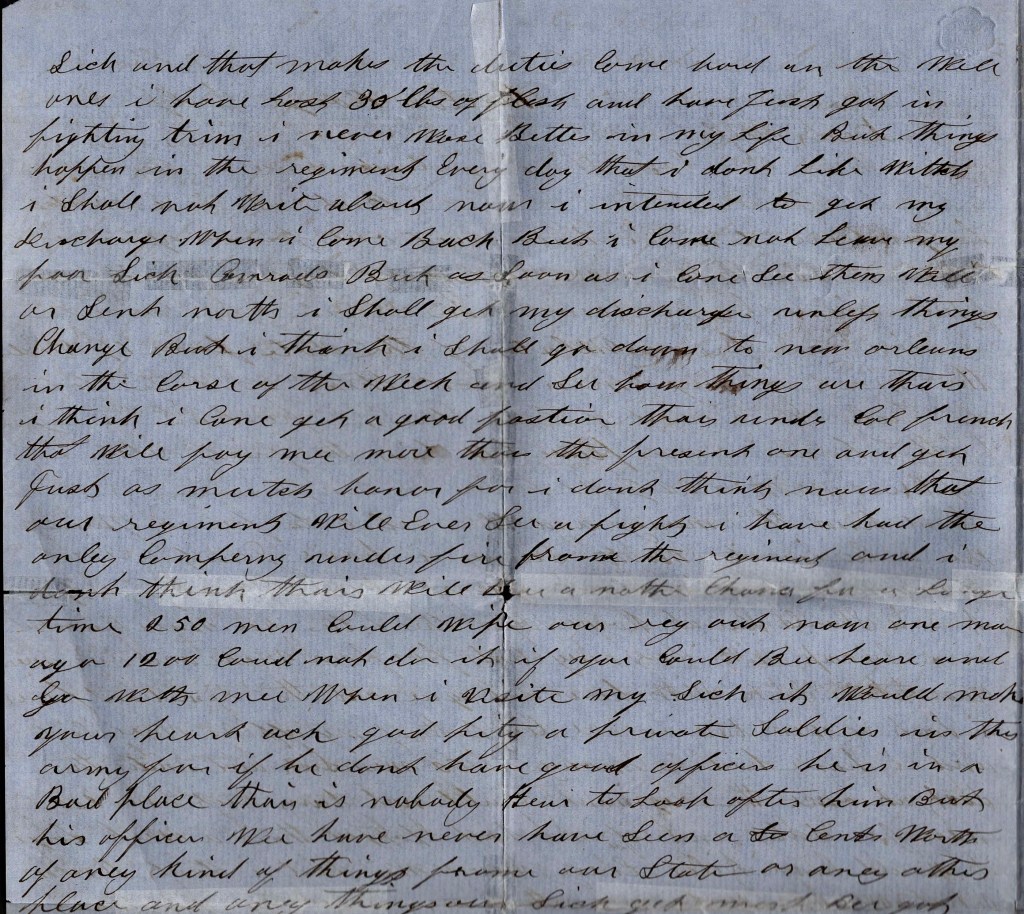
I have just arrived back from Vicksburg and if it was not just as it is, I should be at home before this letter. We were bivouacked in a swamp without any tents for four weeks and our men was taken sick with fever and ague and the remittent fever. I lost 4 men, two in one day. Both of my officers were sick and I have had as many as 60 men sick and under the doct[or’s care] at once. The regiment could not turn out over 200 men for duty and if we had stopped there a week longer, it would have killed every man we had. I don’t know what we shall do now. The men never can get their health in this climate. I have about 30 men in the hospital and as many more in quarters that cannot do duty. Yesterday at dress parade I could not march but 8 men on to line out of 98. I have to work hard all the time and can’t find time to write often now. I shall take all my time to look after my sick. My 1st Lieutenant is very sick and I don’t think he will ever do anymore duty. There is a lot of the officers sick and that makes the duties come hard on the well ones. I have lost 30 pounds of flesh and have just got in fighting trim. I never was better in my life but things happen in the regiment every day that I don’t like which I shall not write about now.
Col. Jonas H. French
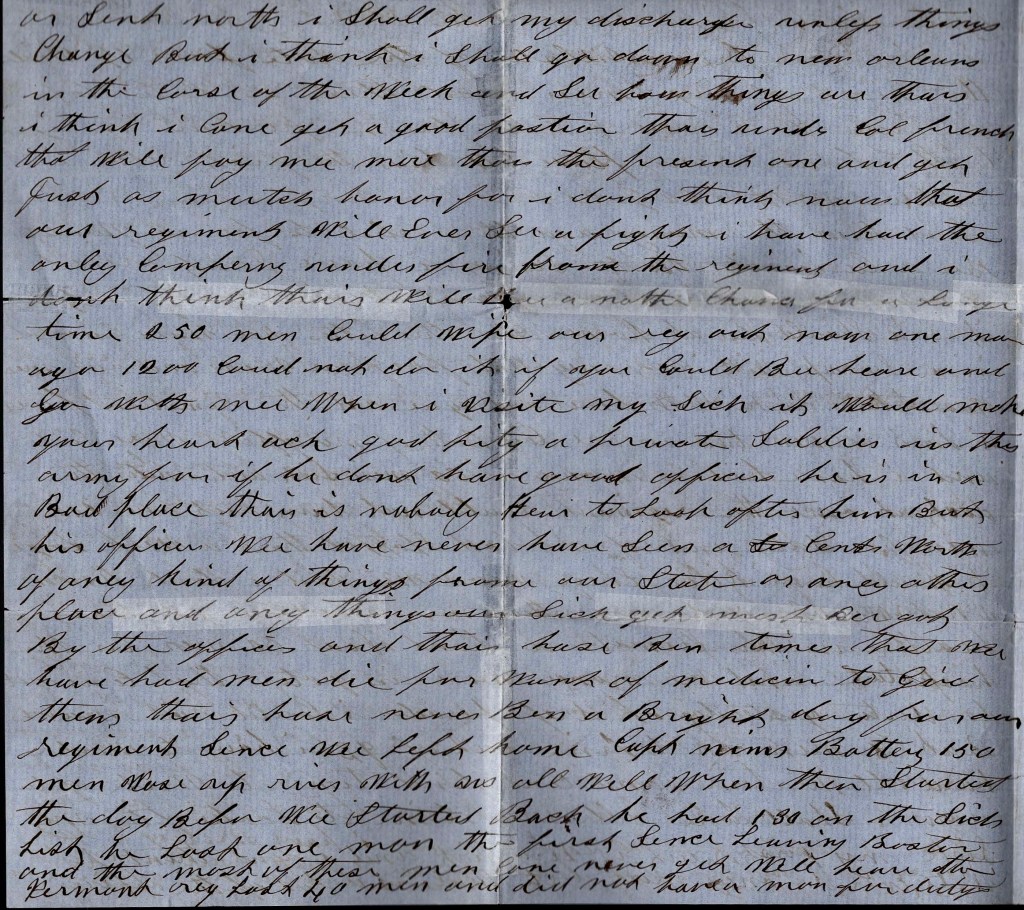
I intended to get my discharge when I came back but I cannot leave my poor sick comrades. But as soon as I can see them well or sent North, I shall get my discharge unless things change. But I think I shall go down to New Orleans in the course of the week and see how things are there. I think I can get a good position there under Col. [Jonas H.] French that will pay me more than the present one and get just as much honor for I don’t think now that our regiment will ever see a fight. I have had the only company under fire from the regiment and I don’t think there will be another chance for a longer time. 250 men could wipe our regiment out now. One month ago, 1200 could not do it. If you could be here and so with me when I visit my sick, it would make your heart ache. God pity a private soldier in the army for if he don’t have good officers, he is in a bad place. There is nobody here to look after him but his officer. We never have seen a cent worth of any kind of things from our State or any other place and any things our sick get, must be got by the officers and there has been times that we have had men die for want of medicine to give them. There has never been a bright day for our regiment since we left home.
Capt. Nims’ Battery [of] 150 men were up river with us, all well when we started. The day before we started back, he had 130 in the sick list. He lost one man—the first since leaving Boston—and the most of these men can never get well here. The Vermont Regiment lost 40 men and did not have a man fit for duty.
The day we started to come away, all the rest of the regiments were the same. Our regiment stood it the best and longest. The trip did not amount to anything. We saw the bombardment and the fleet go up by the forts and come back. It will take a large force to take the place. The rebels are 75,000 strong while the force we had to take the place was only about 4,000. I saw the Ram come down the river. I should like to give you an account of it if I had time. The same got our fleet with their [Brentches?] down [ ] under the guns of Vicksburg when we left.
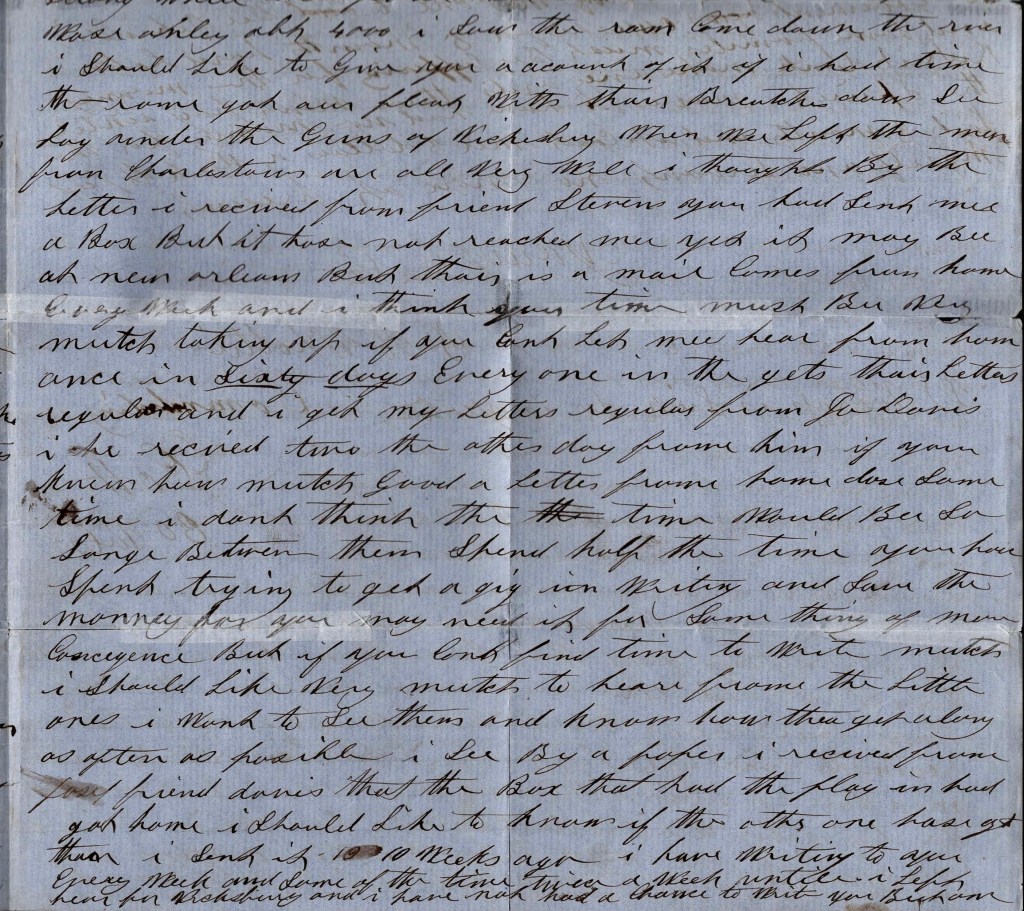
The men from Charlestown are all very well. I thought by the letter I received from friend Stevens you had sent me a box but it has not reached me yet. It may be at New Orleans but there is a mail comes from home every week and I think your time must be very much taken up if you can’t let me hear from home once in sixty days. Everyone in the [regiment] gets their letters regular and I get my letters regular from Jo Davis. I received two the other day from him. If you knew how much good a letter from home does some time, I don’t think the time would be so long between them. Spend half the time you have spent trying to get a gig in writing and save the money for you may need it for something of more consequence. But if you don’t find time to write much, I should like very much to hear from the little ones. I want to see them and know how they get along as often as possible.
I see by a paper I received from friend Davis that the box that had the flag in had got home. I should like to know if the other one has got there. I sent it 10 weeks ago. I have written to you every week and some of the time twice a week until I left here for Vicksburg and I have not had a chance to write you but am until now. Please give my respects to all the folks. Let me know about the recruiting papers before it is too late to get anything on them. Give my respects to friend Greer. I shall write to Webster and the rest of my friends next mail. It is time for the mail to close so I can’t write any more this time. I have a few more trophies to send home when I find the last got there safe.
I was in hopes to send some money but our regiment has not been paid up. Every other regiment have been paid but that is the usual luck of this one to be behind. The Government owes us for 5 months hard labor and some families must be suffering for the money. But it don’t make any [ ]. They won’t pay until the spirit moves. I have had no money for the last three months and it cost me 3 dollars a week to feed myself and servants. No more at present. Yours, &c. — F. H. Whittier
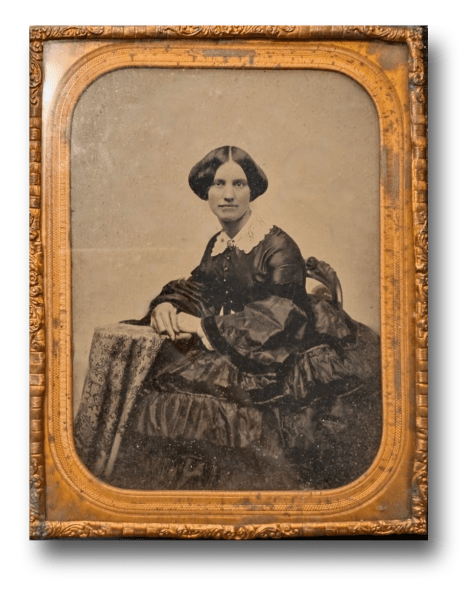
This letter was written by a young woman with the initials C. C. P. and who was most likely a resident of Rahway, New Jersey in 1859. We learn from the letter that she was traveling with a large party of other young women and gentlemen up the Mississippi River in the spring of 1859. She mentions missing her “babies” so I presume she was a married woman though she does not say anything of a husband. She also refers to a man named “Murray” who was traveling with them, perhaps as leader of the party. Might this have been Rev. Nicholas Murray, a leader in the Presbyterian church in New Jersey?
Even without knowing her identity, however, the letter provides us with interesting information about the Passenger Packet named Champion, captained by Enos B. Moore, that operated regularly between New Orleans and St. Louis in the 1857-1861 period. The author gives us a description of some of the ship’s features and of the luxuries afforded steamboat travelers just prior to the Civil War. She also mentions the spring freshet and the difficulties of getting ashore through the muddy floodwaters at Vicksburg.
Steamer Champion typically made the journey from New Orleans up the Mississippi River to St. Louis in four days but may have taken a little longer on this trip due to the strength of the current.
Flood on the Mississippi river in 1859
T R A N S C R I P T I O N
Addressed to Mrs. Mary M. DeGraw, Rahway, New Jersey
Steamer Champion Mississippi River May 8, 1859
My Dear Mary,
I do not know what to think of your long silence in any other way than that you have gone to Philadelphia. I have not had one letter from home yet, and only heard in New Orleans by telegraph. Tonight we expect to get letters from Memphis. We telegraphed at Vicksburg to have them sent to the boat so that we could go on to St. Louis instead of stopping.
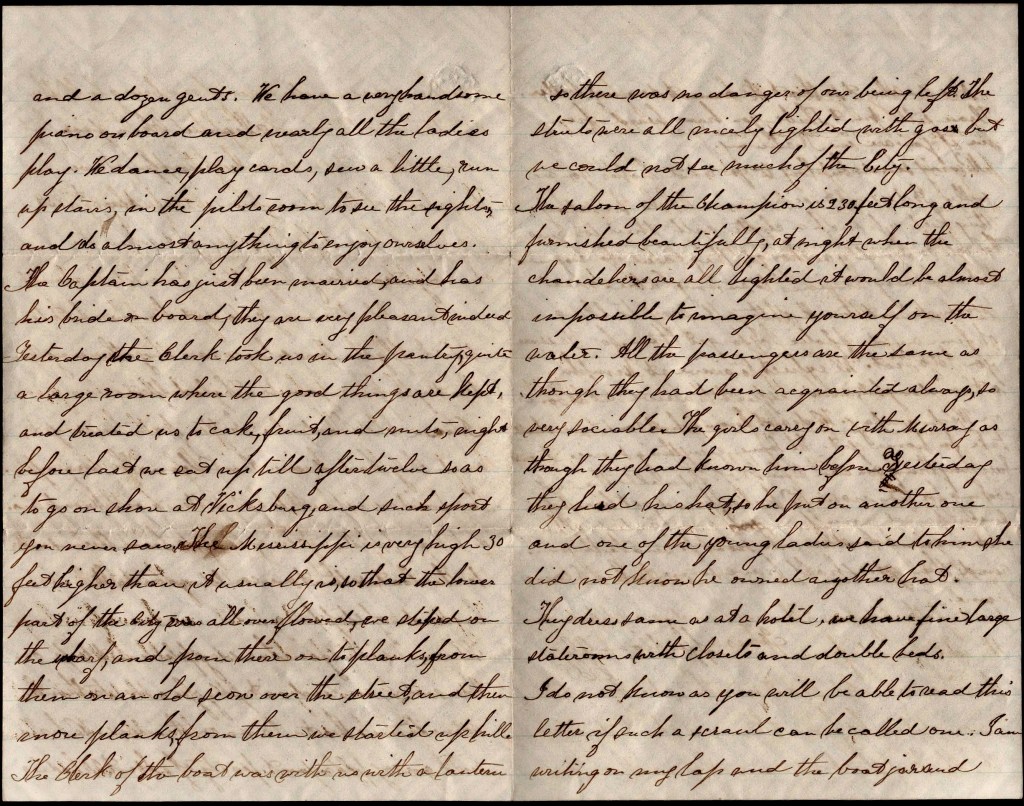
We are having such a very pleasant trip on the river. Indeed, it puzzles me to think sometimes that I am on the river. We have such a very pleasant party of about 20 ladies and a dozen gents. We have a very handsome piano on board and nearly all the ladies play. We dance, play cards, sew a little, run up stairs in the pilot’s room to see the sights, and do almost anything to enjoy ourselves.
The Captain [Enos Bascomb Moore] 1 has just been married and has his bride [Maria (Pratt) Moore] on board. They are very pleasant indeed. Yesterday the clerk [Duvall W. Young] took us in the pantry—quite a large room where the good things are kept—and treated us to cake, fruit, and nuts.
Night before last we sat up till after twelve so as to go on shore at Vicksburg and such sport you never saw. The Mississippi is very high—30 feet higher than it usually is—so that the lower part of the city was all over flowed. We stepped on the wharf and from there to planks, from them on an old scow over the street and then more planks. From them we started up hill. The clerk of the boat was with us with a lantern so there was no danger of our being left. The streets were all nicely lighted with gas but we could not see much of the city.
The saloon of the Champion is 230 feet long and furnished beautifully. At night when the chandeliers are all lighted, it would be almost impossible to imagine yourself on the water. All the passengers are the same as though they had been acquainted always—so very sociable. The girls carry on with Murray as though they had known him before. Yesterday they had his hat, so he put on another one and one of the young ladies said to him she did not know he owned another hat. They dress same as at the hotel. We have fine large staterooms with closets and double beds.
I do not know as you will be able to read this letter if such a scrawl can be called one. I am writing on my lap and the boat jars and shakes so that I cannot do any better. Please tell Aunt Phebe you have heard from me if you are in Rahway.
Murray send his love to you and hopes you are well. It does not seem much like Sunday, they keep up such a chatter with their tongues and laugh so loudly as though they cared for no one. I am very anxious to see my babies once more. Do not think with all my talking of fun and frolic I forget them for I assure you I do not. We expect to arrive at Memphis at midnight and expect to arrive at St. Louis on Wednesday. We do not know what route we shall take for home yet. We have everything so nice to eat here—everything you can think of. I smell the cake cooking for tea now. We have the most beautiful biscuit and muffins ever tasted, The cook is going to show me how to make them and then you shall have some when I come home.
Yours affectionately, — C. C. P.
1 “Captain Enos Bascomb Moore (1823-1903) spent his life piloting steamboats on the Mississippi and Ohio Rivers. He was born in 1823 to Levi and Amanda Moore. He spent his childhood on a small farm on the banks of the Ohio River, seven miles below Portsmouth. Enos and his three brothers gravitated towards river work. Enos’ daughter Mary Moore wrote in her family memoir, “Enos, who had graduated from the country school, was planning to study law at Delaware College, when a chance flatboat loaded with flour and New Orleans bound, lured him aboard; the other two brothers followed and soon all four were careering on the Mississippi.” The oldest brother William left home first and got a job working out of New Orleans for Captain R.C. Young, who operated several boats on the lower Mississippi. Not long after, William sent for Enos, and later the youngest brother Samuel. Enos’ first job was as a night watchman on the boat. Shortly afterwards he became a licensed pilot. William began chartering and operating boats on the Yazoo River, in Mississippi, and Enos invested in his enterprises. Together they built the steamer Hope, and many of the diary entries in this collection refer to money Enos sent to fund these endeavors.
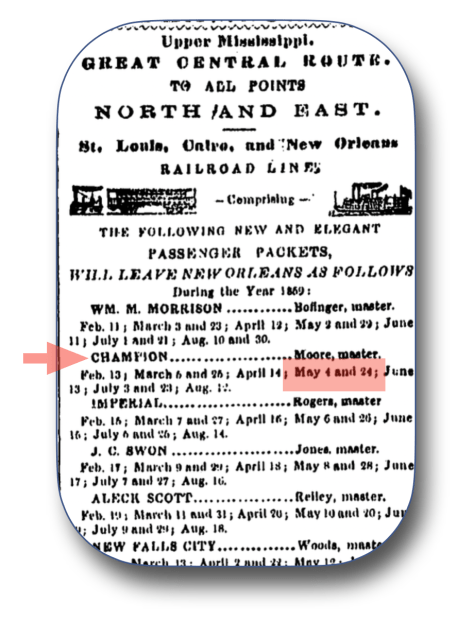
This schedule for the Upper Mississippi states that the Champion was slated to leave New Orleans on 4 May 1859.
Enos continued to pilot riverboats for Captain Young until the blockade went up at Cairo in 1861. During this period he captained the R.C. Young, which caught fire in 1855, and later (1857) the Champion with Young’s son Duvall as clerk. At the start of the war, Enos and William liquefied their assets, sold the Champion, scuttled their steamer Hope, and reportedly retreated to St. Louis with $80,000 in gold. In 1863 the brothers bought a half interest in the foundry and boiler-yard in Portsmouth Ohio. The following year they bought a fourth interest in the packet Bostonia, and in 1866 bought an additional eighth interest. In subsequent years they bought the other half interest in the foundry and machine works and merged their holdings with other pilots to form the Cincinnati, Portsmouth, Big Sandy & Pomeroy Packet Company. William managed business while Enos and Samuel piloted boats on the river. The Packet Company ran six boats, the Bostonia, Fleetwood, Telegraph, Bonanza, Morning Mail, and steamer Ohio. The side-wheeler Bonanza was the largest boat on the Ohio river at the time. The wooden hull was 265ft in length by 43ft in width, with a depth of 7ft. The ship dominated river traffic around Cincinnati from the time it was built in 1876, until the construction of the Chesapeake and Ohio Railway in the early 1890’s. Enos designed the boat and supervised its construction, then captained the vessel until he retired in 1889. Enos was married in Yazoo City, on 9 February 1859, to teacher Maria Prime Pratt (1829-1865), a native of Washington County, New York. Maria died in 1865, leaving behind two daughters, Frances and Mary.” [Source: St. Louis Mercantile Library, P-84 Captain Enos N. More Diaries & Correspondence]













 Spared & Shared 23