
The following letters were written by Allen Rufus Houghton (1832-1884), the son of Rufus Houghton (1796-1882) and Jane Bates (1805-1889) of Ashtabula county, Ohio. In the 1860 US Census, Allen was enumerated in his parents household in West Andover as a 27 year-old “Clerk.” By 1870, Allen was married to Helen Lucinda Osborn (1842-1912) and living in Jefferson, Ashtabula county as a “carpet dealer.” Allen and Helen were married on 15 June 1865 in Andover. It does not appear that Allen ever served in the military.
The 4th letter informs us that Allen sent a letter dated 27 May 1862 to the Ashtabula Sentinel for publication.
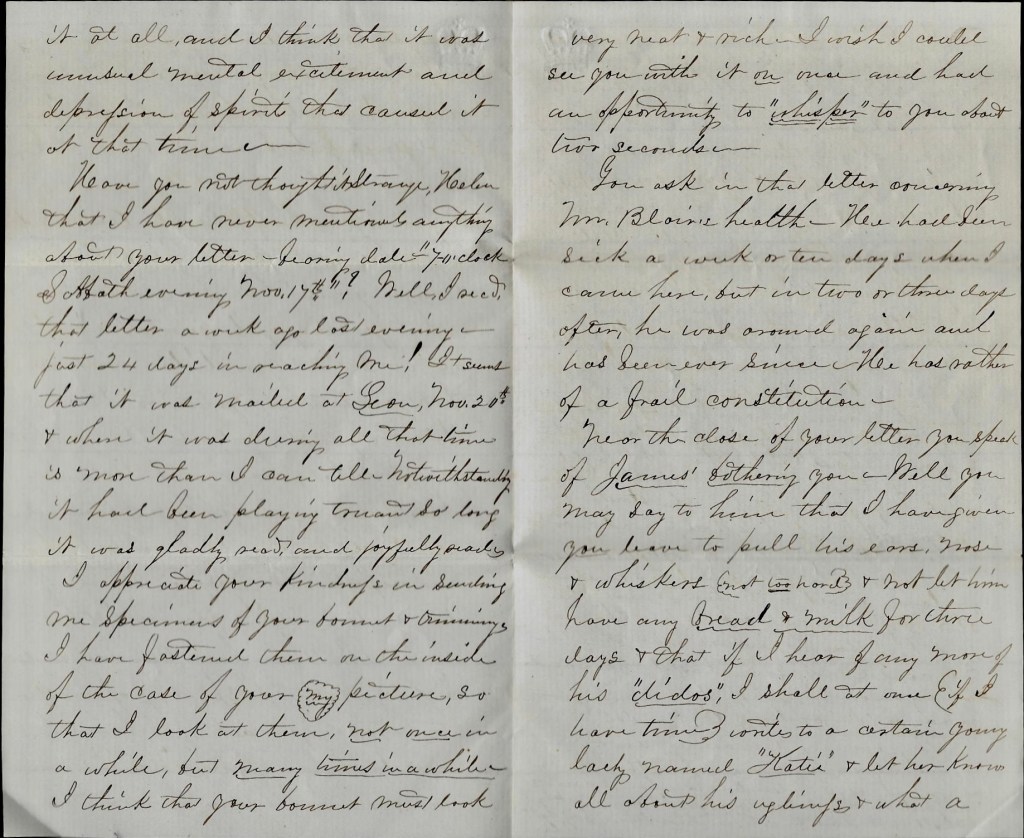
Letter 1

Virginia Hotel, Saint Louis
Friday eve, November 29th 1861
Dear Helen,
Your very welcome letter of the 14th inst. was received the Tuesday following. I will not tell you that I was glad, very glad to hear from you, but will only say that I read your letter four or five times the first day and have read it once or twice a day since…
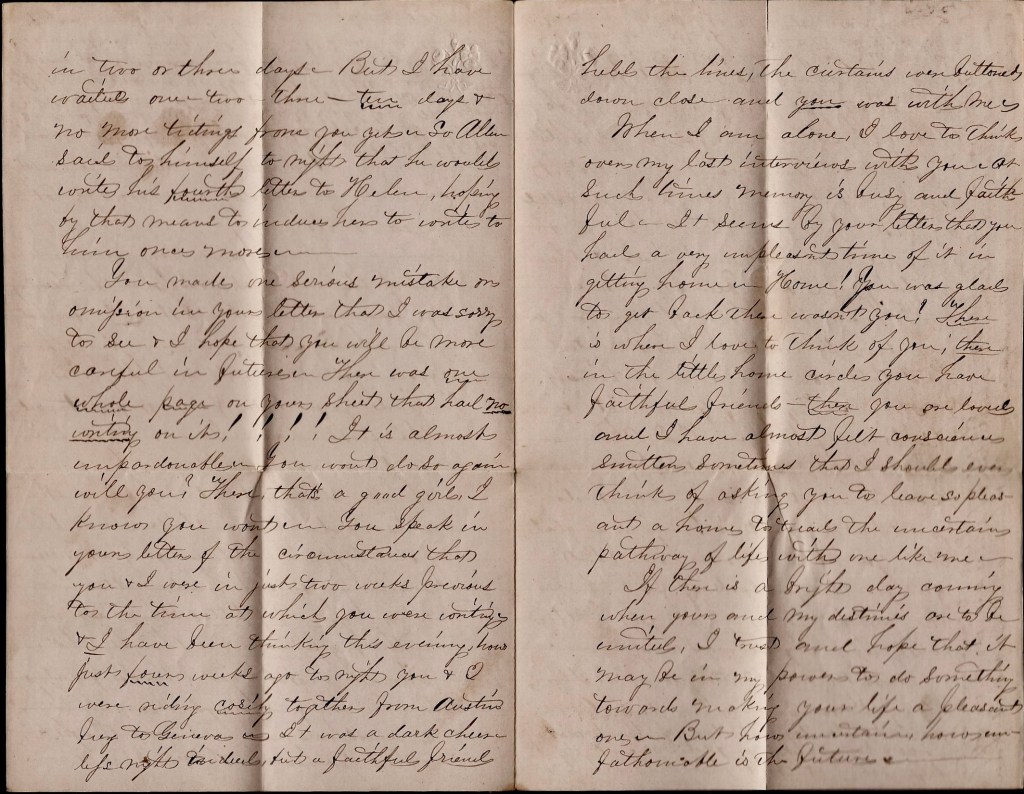
You speak in your letter of the circumstances that you and I were in just two weeks previous to the time at which you were writing and i have been thinking this evening how just four weeks ago tonight you and I were riding cosily together from Austinbury to Geneva. It was a dark, cheerless night indeed but a faithful friend held the lines, the curtains were buttoned down close, and you was with me. When I am alone, I love to think over my last interview with you at such times. emory is busy and faithful…
If there is a bright day coming when yours and my destiny’s are to be united, I trust and hope that it may be in my power to do something towards making your life a pleasant one. But how uncertain, how unfathomable is the future…
I am hlad that you visited at our house that afternoon you spoke of for I think that perhaps they may have felt a little lonely when I first went away.
Capt. [Thomas J.] Carlin’s Battery is at Rolla. Six of his company came down on the cars the other day with some of the poorest horses & took back some fresh ones. One of the boys was in at the “Virginia” [Hotel] one morning & I accidentally found out who he was. In the evening I went to the place where they were quartered and had quite a chat. They reported that Amos 1 was sick or quite unwell but would not give up & go to the hospital. I sent him a letter and cheered, &c. &c.
…good night. — Allen
1 Amos Nims served in the 2nd Independent Battery, Ohio Light Artillery and was from Ashtabula county.

Letter 2
Virginia Hotel, Saint Louis
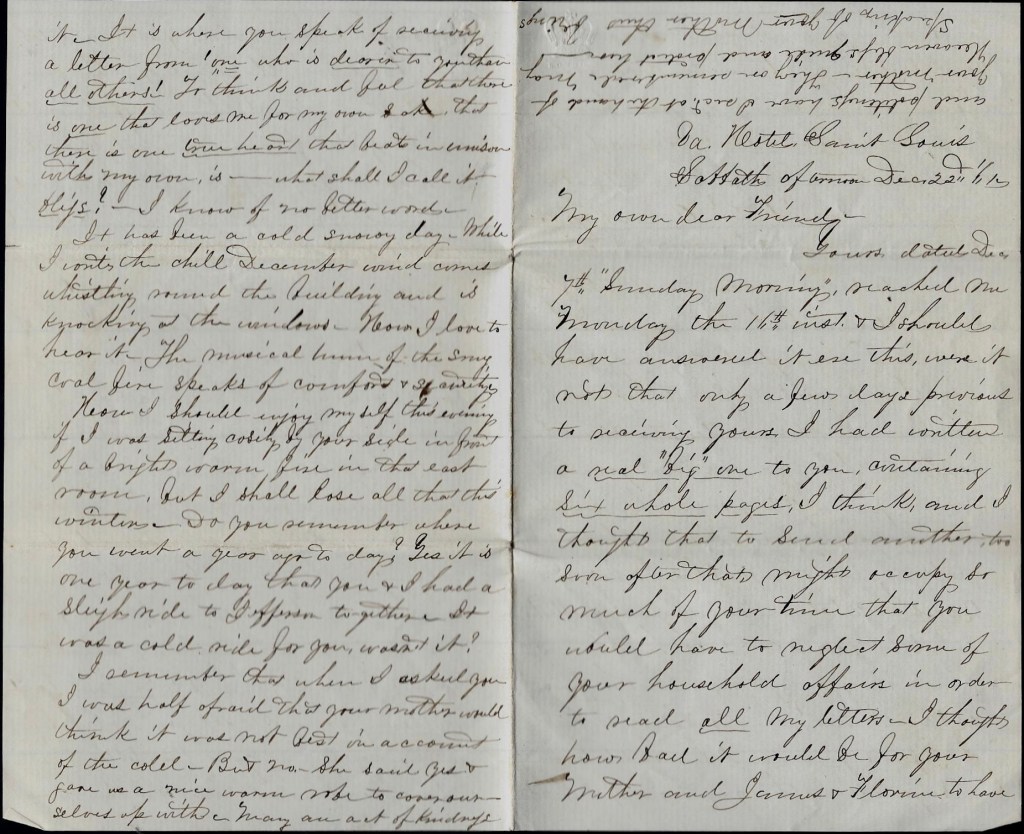
Sabbath afternoon, December 22nd 1861
My own dear friend,
…A week ago today I received a “Sentinel” containing an interesting account of the flag presentation which was marked. I was very glad to get it for the one that comes to E. D. Chapman, for some reason, failed to come that week, so that the one that you sent came just right, for which I heartily thank you. In the one that came yesterday, I notice that Jahaziel’s & cousin Statira’s marriage is published in due form. Does he take his gun along every time that he goes out with her? I would if I had a wife & gun, and I would have a bayonet on his gun too. If I had no bayonet, I would fasten a pitchfork tine on the end of the gun and then—and then—awful would be the fate of anyone that offered to harm my wife. But oh! hard is my lot! I have no wife to defend. Neither have I a gun to defend a wife with if I had one. Oh, that I had a wife! Oh, that I had a gun!
…It has been a cold, snowy day. While I write, the chill December wind comes whistling round the building and is knocking at the windows. How I love to hear it. The musical hum of the snug fire speaks of comfort and security. How I should enjoy myself this evening if I was sitting cosily by your side in front of a bright, warm fire in that east room…
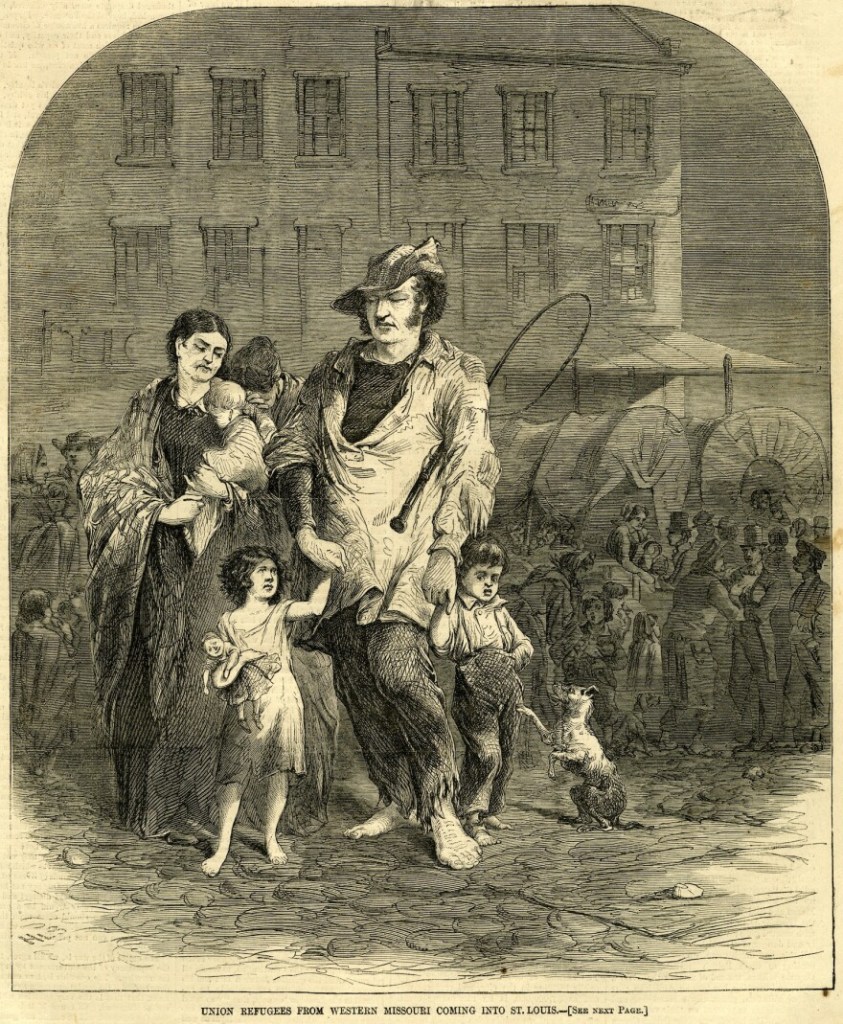
General Halleck has been “tightening up” on the wealthy secessionists here in St. Louis within the last few days. He is obliging them to “contribute” pretty freely towards the support and comfort of the numerous loyal refugees from the southwestern part of the state. Many of these refugees arrive here in a pitiable condition. Some with horses and mules & some with oxen hitched to wagons containing their families & a few articles hastily thrown in at the time of flight. On cold, windy days, I have seen the women and larger girls of a company, very thinly & scantily clad, following the wagons on horse back, when it would seem as though they must freeze. Parties of them frequently stop in the street in front of our office which is close to headquarters where they have to get papers to go over the river into Illinois. I sometimes go down & talk with them & hear their stories of narrow escapes & how they have left their farms, houses, everything that they could not seize, hastily thrown into a wagon. Some of them come from as far as the borders of Arkansas.
The evening is waning away and I must close. I have written twice as must as I intended. If you write short letters in reply, I shall not dare to write so much another time. Good night, — Allen


Letter 3
Saint Louis
January 19th 1862
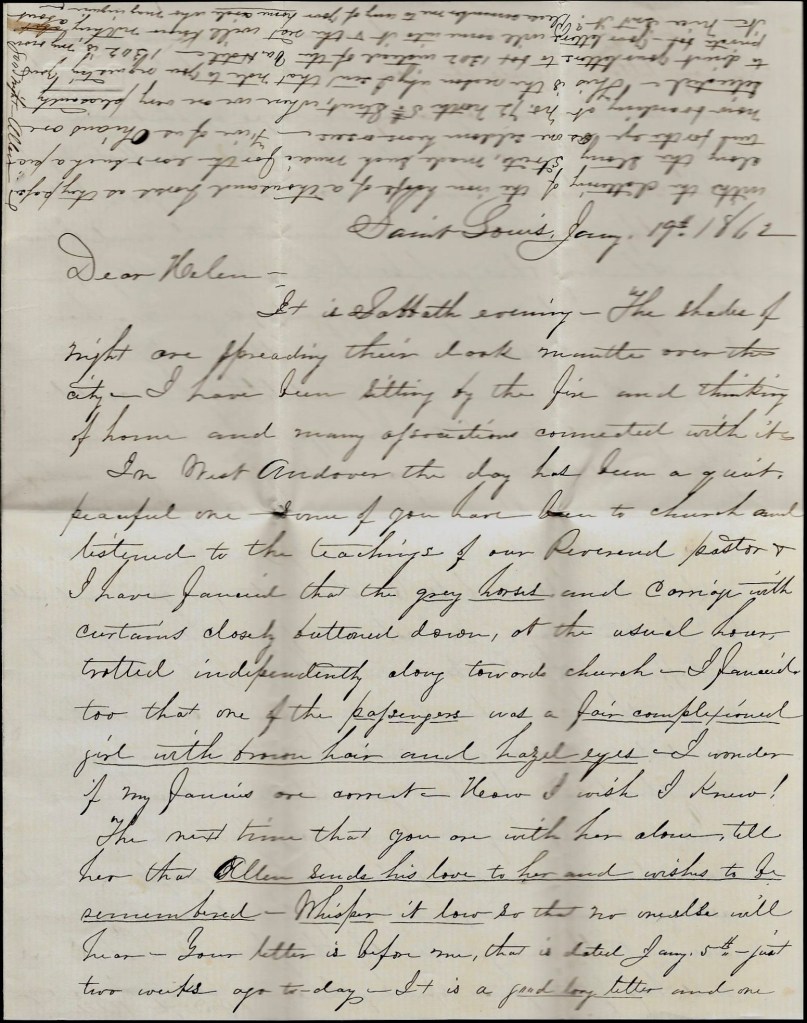
Dear Helen,
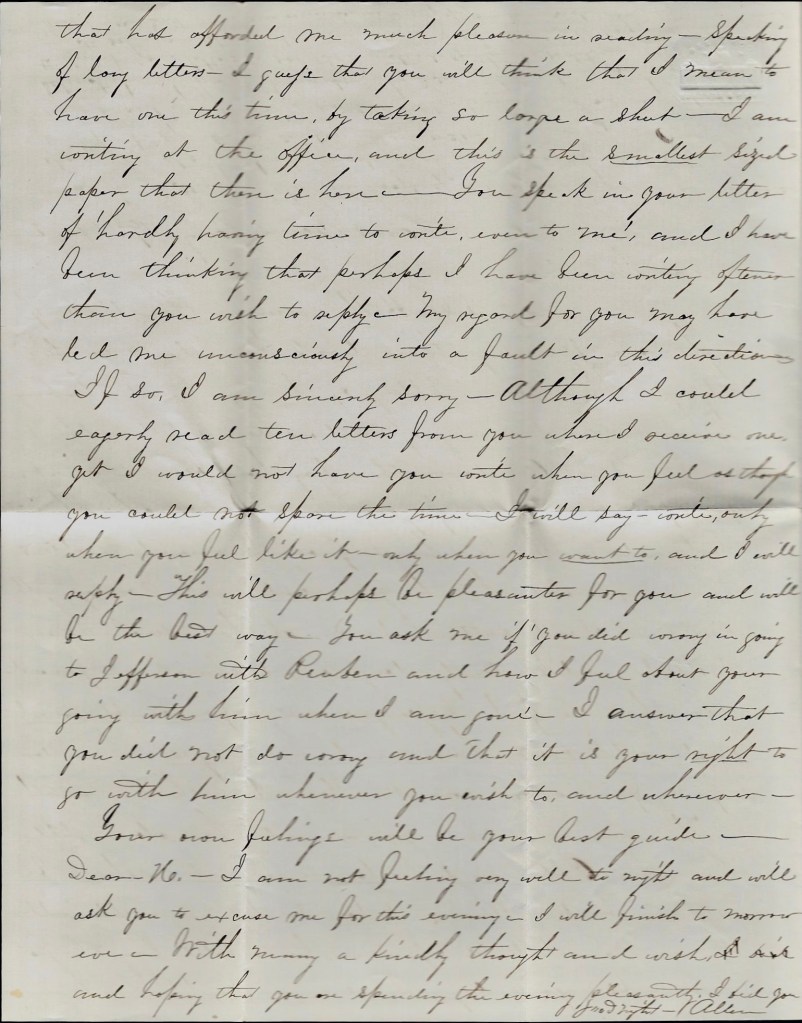
It is Sabbath evening—the shades of night are spreading their dark mantle over the city. I have been sitting by the fire and thinking of home and many associations connected with it. In West Andover the day has been a quiet, peaceful one. Some of you have been to church and listened to the teachings of our Reverend pastor & I have fastened that the grey horse and carriage with curtains closely buttoned down at the usual hour trotted independently along towards church. I fancied too that one of the passengers was a fair complexioned girl with brown hair and hazel eyes. I wonder is my fancies are correct. How I wish I knew!…
Monday eve, 20th…The 2nd Ohio Cavalry, 1200 strong, arrived at East ST. Louis opposite this city last Thursday night on their way to Leavenworth. This is the regiment that Capt. [William J.] Keen’s company is in. They had to remain on the east side of the river two or three days on account of their being so much ice that the ferry boats could not run clear across.

Several of us went over Friday to look up those that we were acquainted with. We went a part of the way on a ferry boat, walked 25 or 30 rods on the ice in the middle of the river, and took passage the rest of the way in a skiff. I found Dr. Wibert’s son. Rev. Wm. Rose of Williamsfield, Nelson [P.] Baker, & several others that I was more or less acquainted with, They succeeded in crossing yesterday—Sunday—and passed through the city and out to Camp Benton where they will stay a few days. The martial strains of the regimental bands, the clear & distinct note of the bugler, the rattling of armor, together with the clattering of iron hoofs of a thousand horses as they passed along the stony streets made such music for the ear & such a picture for the eye as one seldom hears or sees.
Five of us Ohioans are now boarding at No. 72 North 5th Street where we are pleasantly situated. This is the reason why I sent that note to you requesting you to direct your letters to Box 1302 instead of the Virginia Hotel. 1302 is my own private box. Your letters will come into it & the rest will know nothing about it. Nice, isn’t it? Please remember me to your home circle who may inquire about me. Good night, — Allen


Letter 4
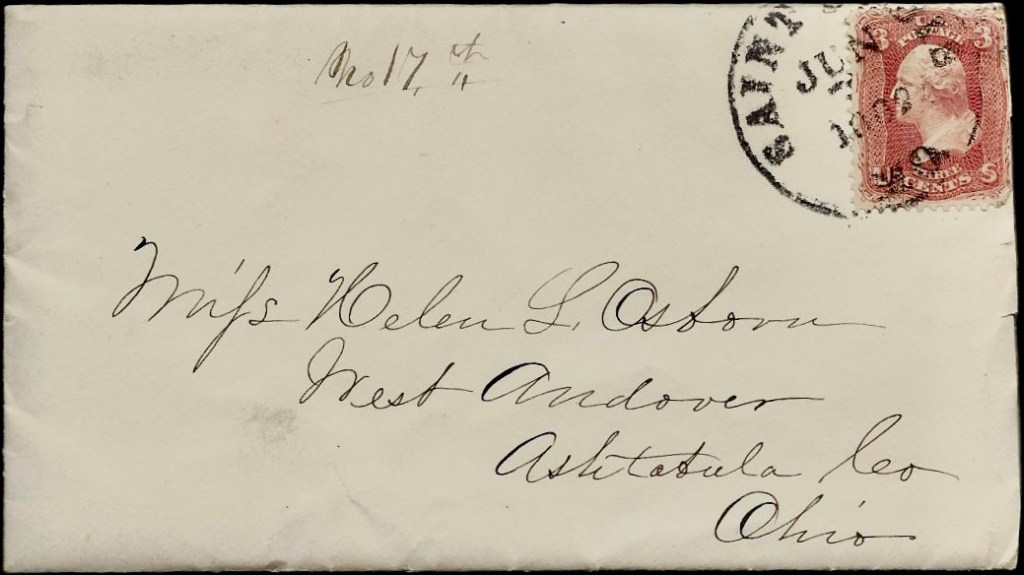
St. Louis
June 6th 1862
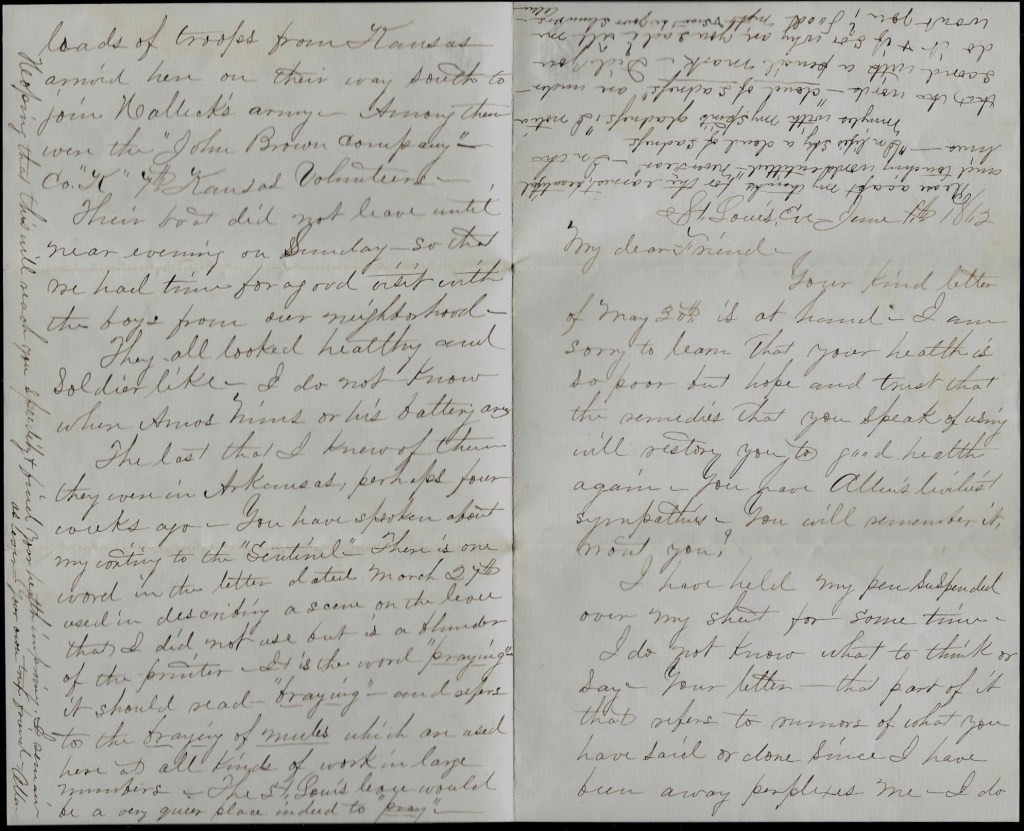
My dear friend,
Your kind letter of May 30th is at hand. I am sorry to learn that your health is so poor but hope and trust that the remedies that you speak of using will restore you to good health again…
In speaking of your festival, you ask me if I think it was wrong to allow those which wished to dance to do so. Not understanding many of the circumstances connected with the getting up of the festival and the Society that it was to benefit, I will not say that it was wrong, but if there was a respectable portion (in point of numbers) of the Society who were conscientiously opposed to dancing, it would seem to me to be a very certain method to bring about discord and unpleasant feelings.
Last Saturday, several steamer loads of troops from Kansas arrived here on their way south to join Halleck’s army. Among them were the “John Brown Company”—Co. K, 7th Kansas Volunteers. Their boat did not leave until near evening on Sunday so that we had time for a good visit with the boys from our neighborhood. They all looked healthy and soldier like. I do not know where Amos Nims or his Battery are. The last that I knew of them, they were in Arkansas, perhaps four weeks ago.
You have spoken of my writing to the “[Ashtabula] Sentinel.” There is one word in the letter dated March 27th used in describing a scene on the levee that I did not use but is a blunder of the printer. It is the word, “praying.” It should read, “braying” and refers to the braying of mules which are used here at all kinds of work in large numbers. The St. Louis levee would be a very queer place to “pray.”
Hoping this will reach you speedily & find your health improving. I remain as ever your own true friend, — Allen

Letter 5

Virginia Hotel, St. Louis
August 15, 1862
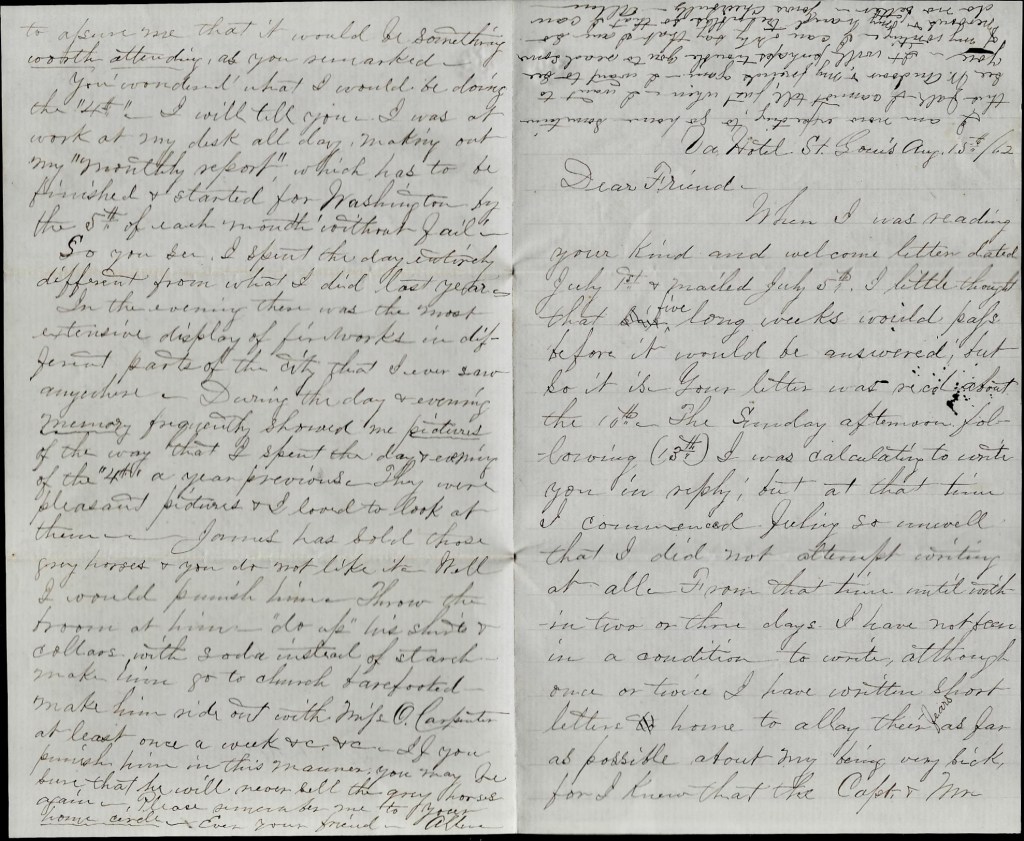
Dear Friend,
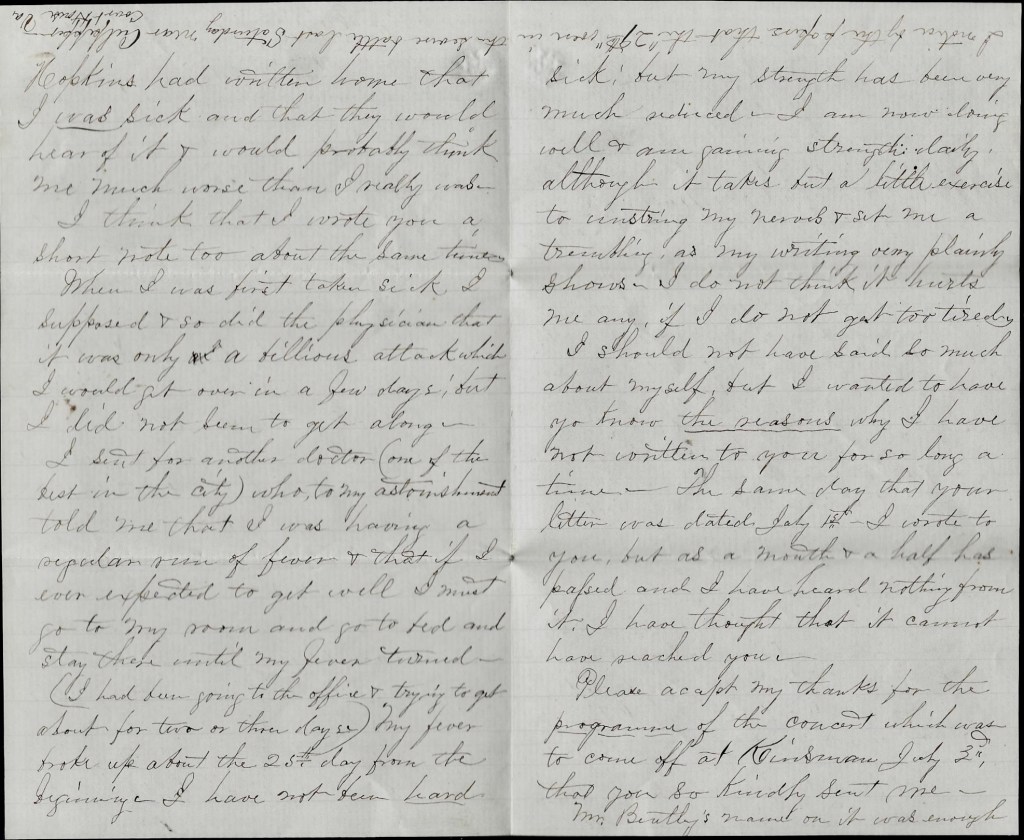
When I was reading your kind and welcome letter dated July 1st and mailed July 5th, I little thought that five long weeks would pass before it would be answered but so it is. Your letter was received about the 10th. The Sunday afternoon following (13th) I was calculating to write you in reply but at that time I commenced feeling so unwell that I did not attempt writing at all. From that time until within two or three days, I have not been in a condition to write although once or twice I have written short letters home to allay their fears as far as possible about my being sick for I knew that the Capt. and Mrs. Hopkins had written home that I was sick and that they would hear of it & would probably think me much worse that I really was…My fever broke up about the 25th day from the beginning. I have not been hard sick, but my strength has been very much reduced. I am now doing well & am gaining strength daily…
Please accept my thanks for the programme of the concert which was to come off at Kinsman July 3rd that you so kindly sent me. Mr. Bently’s name on it was enough to assure me that it would be something worth attending, as you remarked.
You wondered what I would be doing the “4th.” I will tell you. I was at work at my desk all day making out my “monthly report which has to be finished and started for Washington by the 5th of each month without fail. So you see, I spent the day entirely different from what I did last year. In the evening there was the most extensive display of fireworks in different parts of the city that I ever saw anywhere. During the day and evening, ,emory frequently showed me pictures of the way that I spent the day and evening of the “4th” a year previous. They were pleasant pictures & I loved to look at them…
I am now expecting to go home sometime this fall. I cannot tell just when. I want to see W. Andover & my friends again. I want to see you. It will perhaps trouble you to read some of my writing. I can only say that I am so nervous & my hand trembles so that I can do no better. Your cheerfully, — Allen
I notice by the papers that the “29th” were in the severe battle last Saturday near Culpeper Court House, Va.
Letter 6
Saint Louis
June 21, 1863
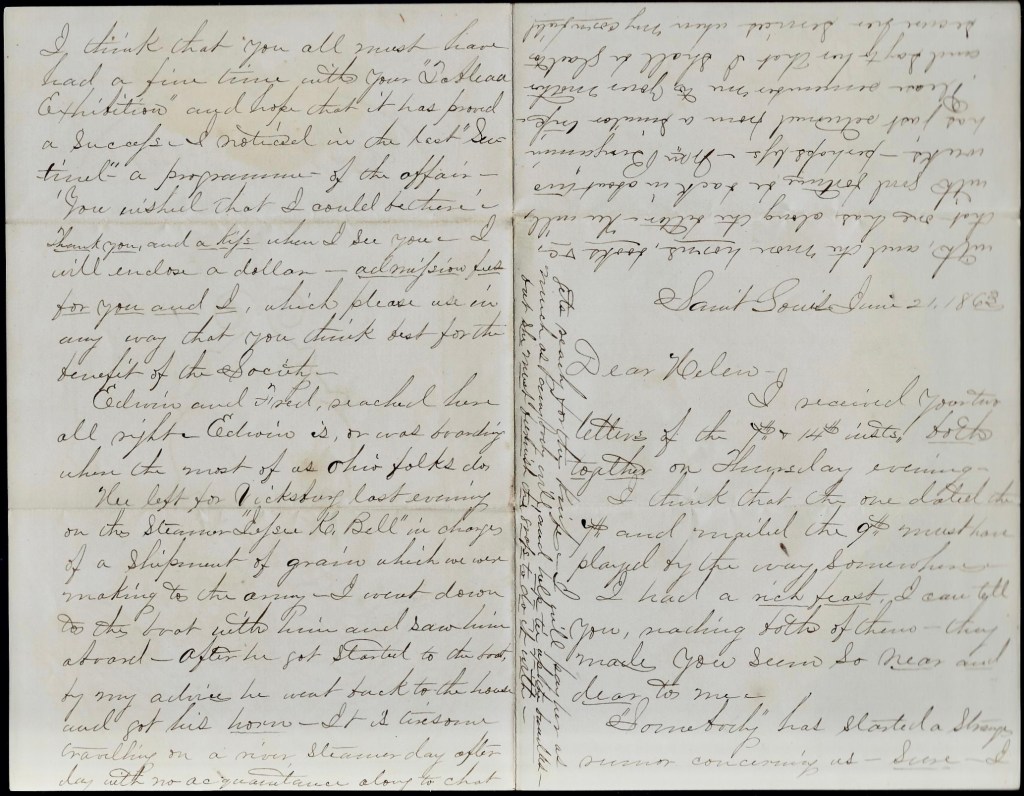
Dear Helen,
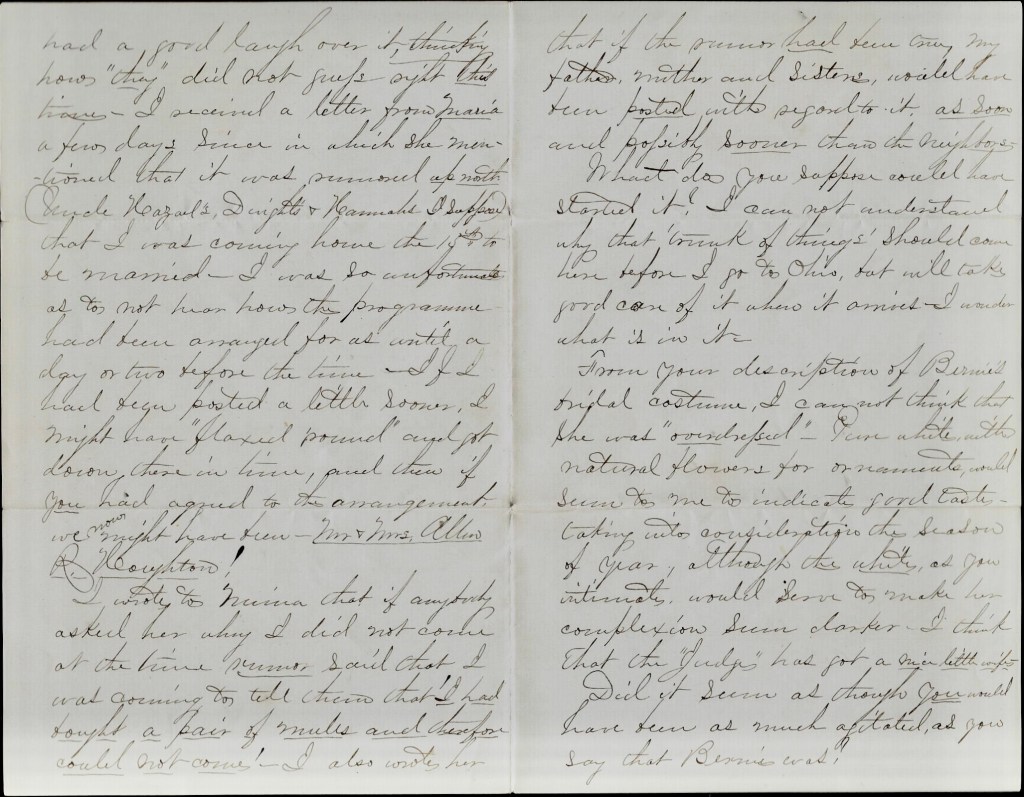
I received your two letters of the 7th and 14th insts. both together on Thursday evening…I had a rich feast I can tell you reading both of them. They made you seem so near and dear to me. Somebody has started a strange rumor concerning us—sure—I had a good laugh over it, think how “they” did not guess right this time….
Edwin and Fred reached here all right. Edwin is, or was boarding where the most of us Ohio folks do. He left for Vicksburg last evening on the Steamer Jesse K. Bell 1 in charge of a shipment of grain which we were making to the army. I went down to the boat with him and saw him aboard. After he got started to the boat, by my advice he went back to the house and got his horn. It is tiresome traveling on a river steamer day after day with no acquaintance along to chat with and the more horns, books, &c. that one has along the better. He will, with good fortune, be back in about two weeks—perhaps less.
Wm. Benjamin has just returned from a similar trip. Please remember me to your mother and say to her that I shall be glad to secure her services when my cornfield gets ready for the knife. I will pay her as much as anybody will and help tie up the bundles but she must furnish the grass to do it with…
You ask if I think of coming home this summer. I hardly think I will till sometime in the fall, unless something turns up so that I lose my situation.
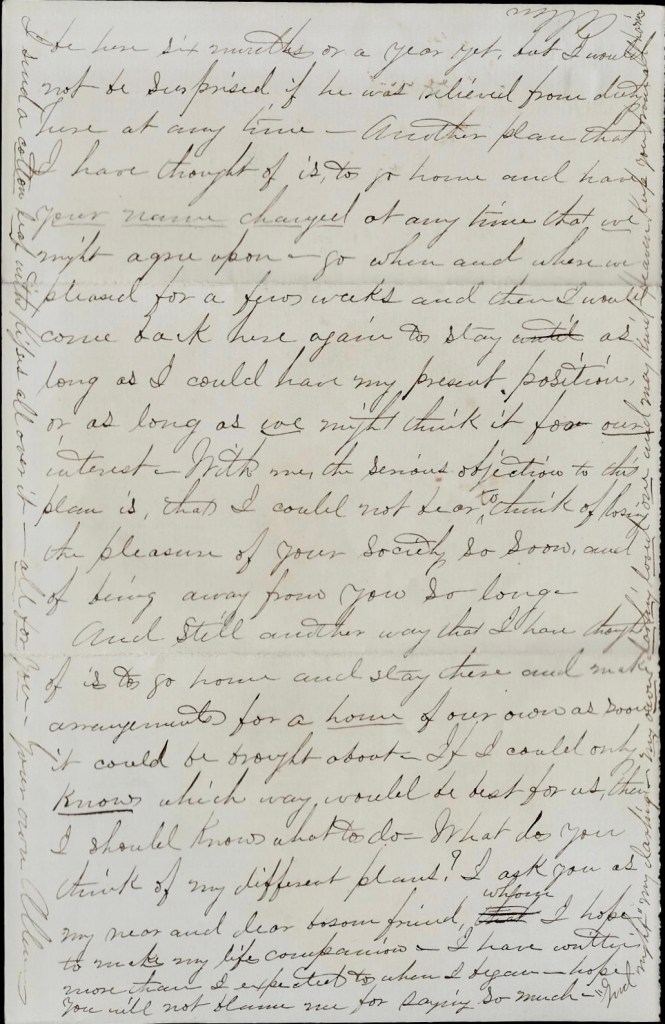
Dear friend, there is one subject that has been on my mind for the last few months a great deal of time. I want to have you something more than a friend—to call you by a nearer and dearer name—wife. I confess to you, as my bosom friend, that I am sometimes perplexed as to where the time shall be that we may choose for our nuptials. If I was sure of staying here any length of time, I have thought that I would ask that we might be married and that you come here and be with me. The Captain may be here six months or a year yet, but I would not be surprised if he was relieved from duty here at any time….
Good night my darling…—Allen
I think that the post mark on that envelope must be “Cleveland” but can not think how it should get there. I am glad to hear that Edson More is living. Several months since I heard in some way that he was killed in some battle in Virginia and supposed that it was so. He was “good, well disposed boy and I hope that he may come out all right.” Dr. Gilkey whom you mention was an old acquaintance of mine and a valued friend.
1 The steamer Jesse K. Bell burned at the wharf at St. Louis on 14 September 1863.


Letter 7

Saint Louis
April 10, 1864
My dear friend,
Your long-looked for letter dated a week ago today reached me on Friday. I had many a time looked in vain in my P. O. Box for the dainty white envelopes which I was from day to day expecting. But knowing that there was some good reason for the delay, I was willing to wait…
A week ago today the Captain’s wife started for New Orleans on a pleasure excursion in company with a few acquaintances. Will not be back for two weeks yet.
When I last wrote, I have forgotten whether I mentioned that the 7th Kansas boys were here. The regiment came down from Leavenworth two or three weeks since and were expecting to do right on down the river, but after waiting a few days for orders, they were finally ordered into camp here until they are armed, equipped and mounted. Will remain here perhaps a month or two yet.
Cowles Merrill Jr. who came on with Herbert Tourge [?] has been rejected by the examining surgeon as being unfit for the service on account of heart disease. A day or two after his rejection, he was taken down with the measles here at our boarding house. Had a pretty long time with them for a few days but is now getting along finely. Clarkson, Herbert, Captain Bootwick and some of the other Kansas boys have been here and stayed with us a night or two. I was surprised to hear that Amos [Nims] had reenlisted for I supposed that he was pretty well tired of being a soldier. Success to him.
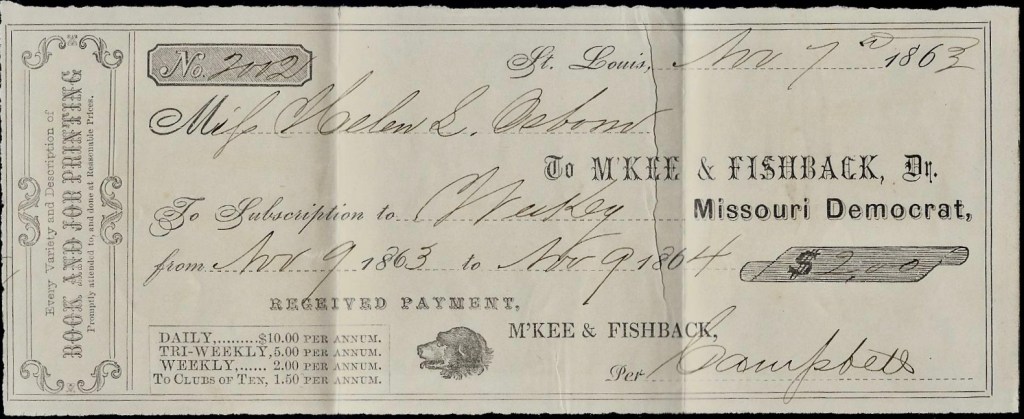
Wo is to teach our summer school? You will please accept my thanks for the lock of soft brown hair you so kindly sent me and for the love sent with it. If you miss any members of “Gordey” or if the “Democrat” does not reach you regularly, please inform me. Goodbye & good night. — Allen


Letter 8
Saint Louis
August 7, 1864
Dear Helen,
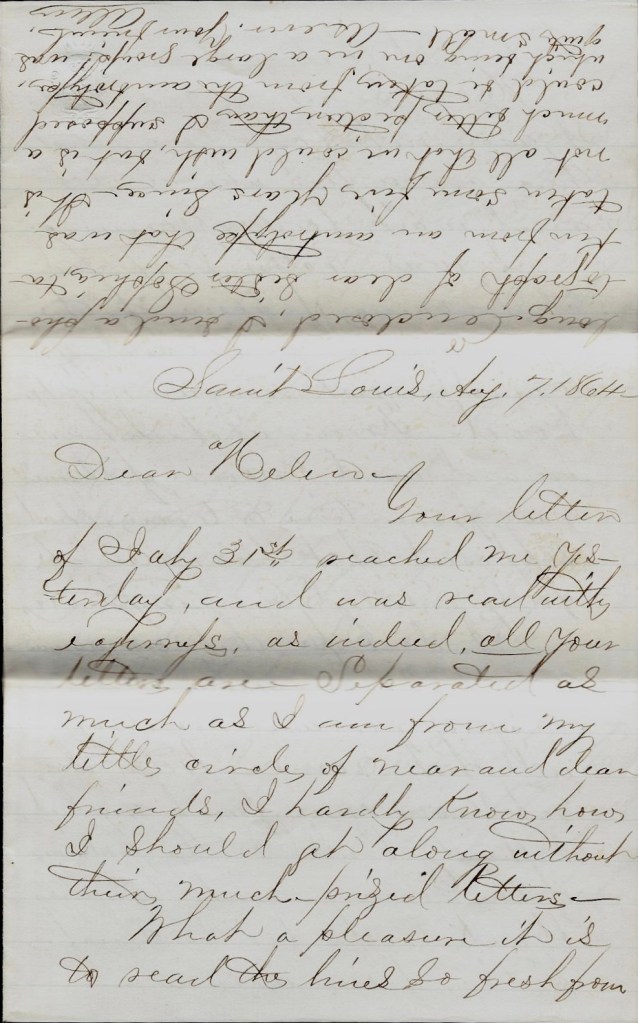
Your letter of July 31st reached me yesterday and was read with eagerness, as indeed all your letters are…
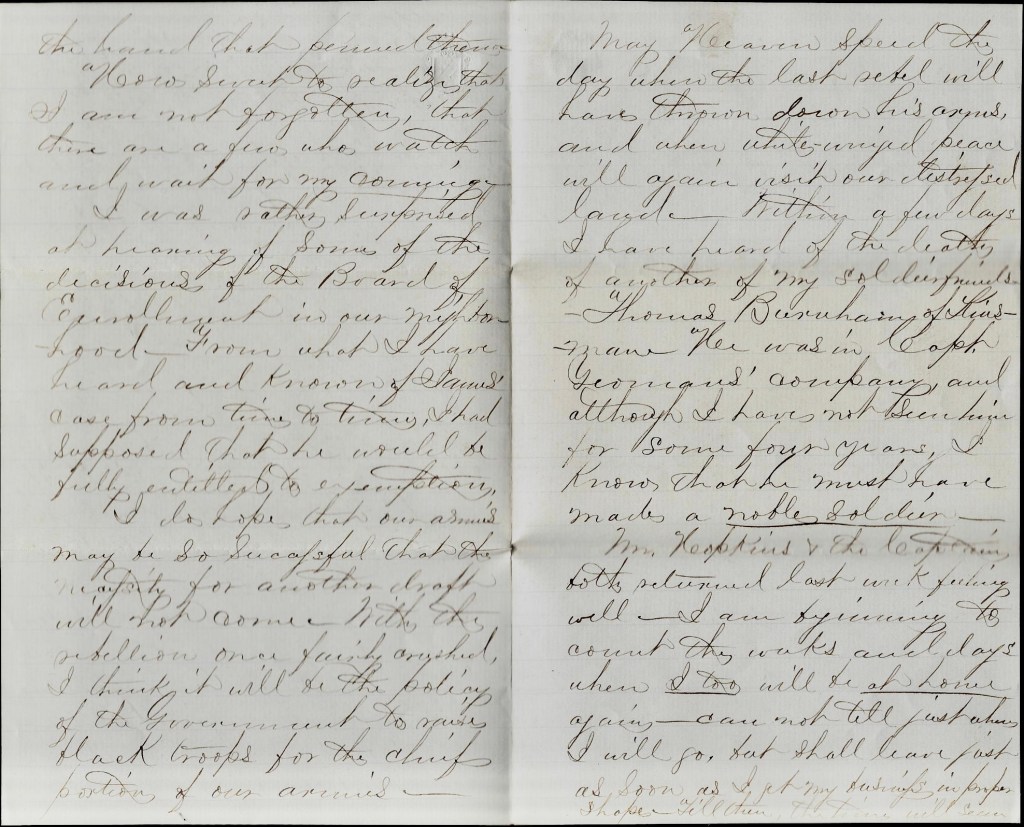
I do hope that our armies may be so successful that the necessity for another draft will not come. With the rebellion once fairly crushed, I think it will be the policy of the Grovernment to raise black troops for the chief portion of our armies.
May Heaven speed the day when the last revel will have thrown down his arms and when white winged peace will again visit our distressed land. Within a few days I have heard of the deaths of another of my soldier friends. Thomas Burnham of Kinsman. He was in Capt. Yeoman’s company and although I have not seen him four years, I know that he must have made a noble soldier.
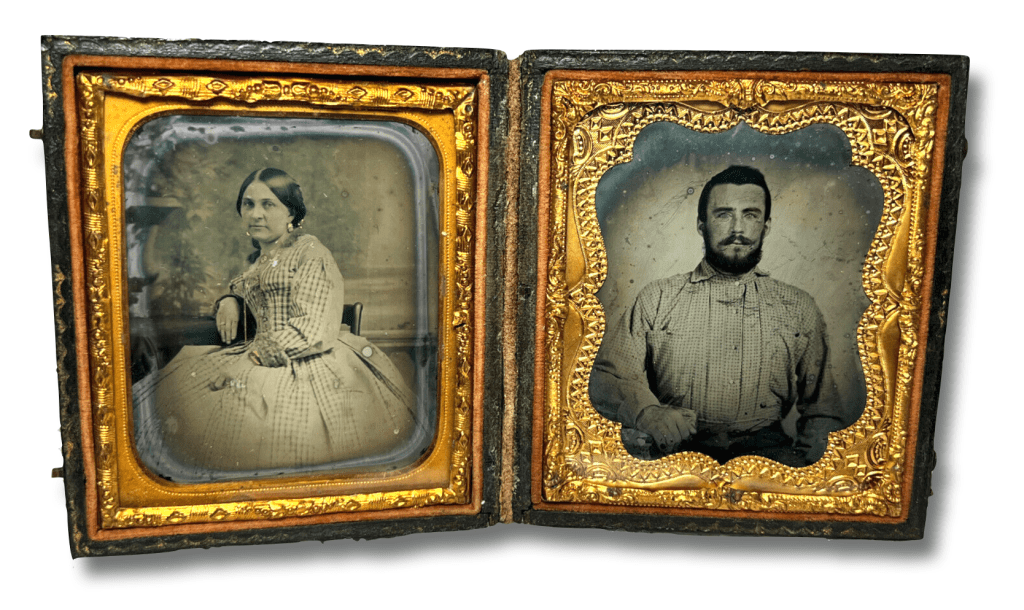
r. Hopkins and the Captain both returned last week feeling well. I am beginning to count the weeks and days when I too will be at home again. Can not tell just when I will go but shall leave just as soon as I get my business in proper shape. Till then, the time will seem long. Enclosed I send a photograph of dear sister Sophia taken from an ambrotype that was taken some five years since. It is not all that we could wish, but is a much better picture than I supposed could be taken from the ambrotype which being one in a large group was quite small. As ever, your friend, — Allen


 Spared & Shared 23