
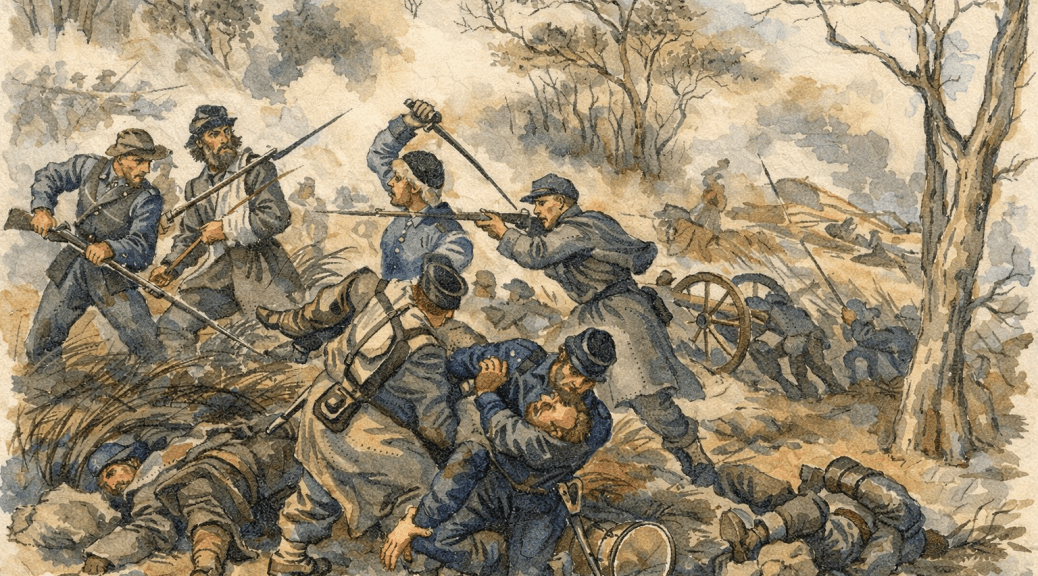
These letters were written by Erastus Gregory (1833-1863), the son of Levi Gregory (1799-1878) and Clarissa Evans (1810-18xx) of Guilford, Chenango county, New York. Erastus—a tall, lanky farmer called “Rast” by his friends—was married in 1854 to Maria Amelia (“Meel”) Place (1835-1911) and had four young children born prior to 1863. Their names were Virgil Carruth Gregory (1852-1947), Merritt Charles Gregory (1855-1920), Mary M. Gregory (1856-1920), and Hattie Jennie Gregory (1861-1954). A fifth child, Henry Gregory was born in 1863.
Erastus enlisted as a private on 24 July 1862 in Co. C, 114th New York Infantry. His letters—20 in number—begin with his description of the journey from Norwich, where the regiment was organized, to Binghamton by canal boats, and proceeding thence to Baltimore. In November, the regiment sailed for New Orleans as part of Banks’ expedition, and on its arrival there was assigned to Weitzel’s (2nd) brigade, Augur’s (1st) division, 19th corps. It was stationed for a time at Brashear City and neighboring points, and was first engaged at Fort Bisland, where it had 11 men wounded, 3 mortally. It did not participate in the Bayou Teche campaign, but joined its corps before Port Hudson, May 30, 1863, where it was actively engaged for 40 days in the siege and suffered severely in the grand assault of June 14, 1863, where Erastus was killed.
To read letters by other members of the 114th New York Infantry that have been transcribed and published on Spared & Shared, see:
Asa Holmes, Co. A, 114th New York (10 Letters)
Daniel Webster Turner, Co. A, 114th New York (3 Letters)
Elbridge LaMunion, Co. G, 114th New York (1 Letter)
Charles E. Thompson, Co. G, 114th New York (1 Letter)
Letter 1
Baltimore
September 10th 1862
Dear Friends,
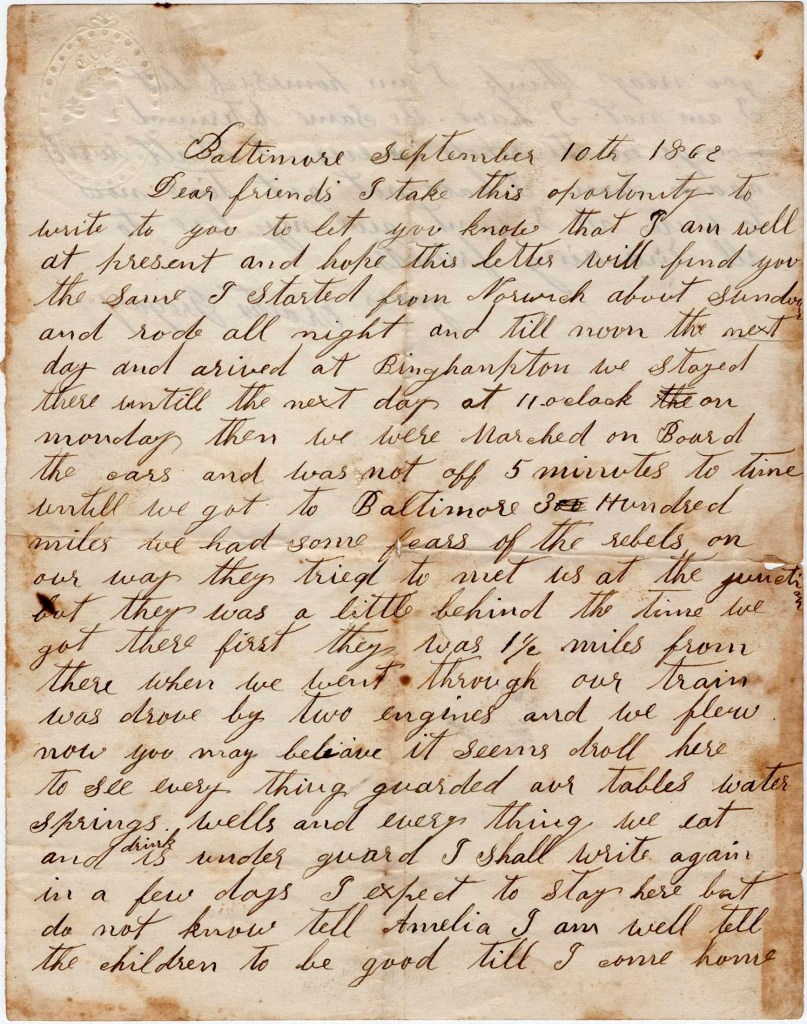
I take this opportunity to write to you to let you know that I am well at present and hope this letter will find you the same. I started from Norwich about Sunday and rode all night and till noon the next day and arrived at Binghamton. We stayed there until the next day at 11 o’clock on Monday. Then we were marched on board the cars and was not off five minutes to time until we got to Baltimore, three hundred miles. We had some fears of the rebels on our way. They tried to meet us at the junction but they was a little behind the time. We got there first. They was one and a half miles from there when we went through. Our train was drove by two engines adn we flew now, you may believe.
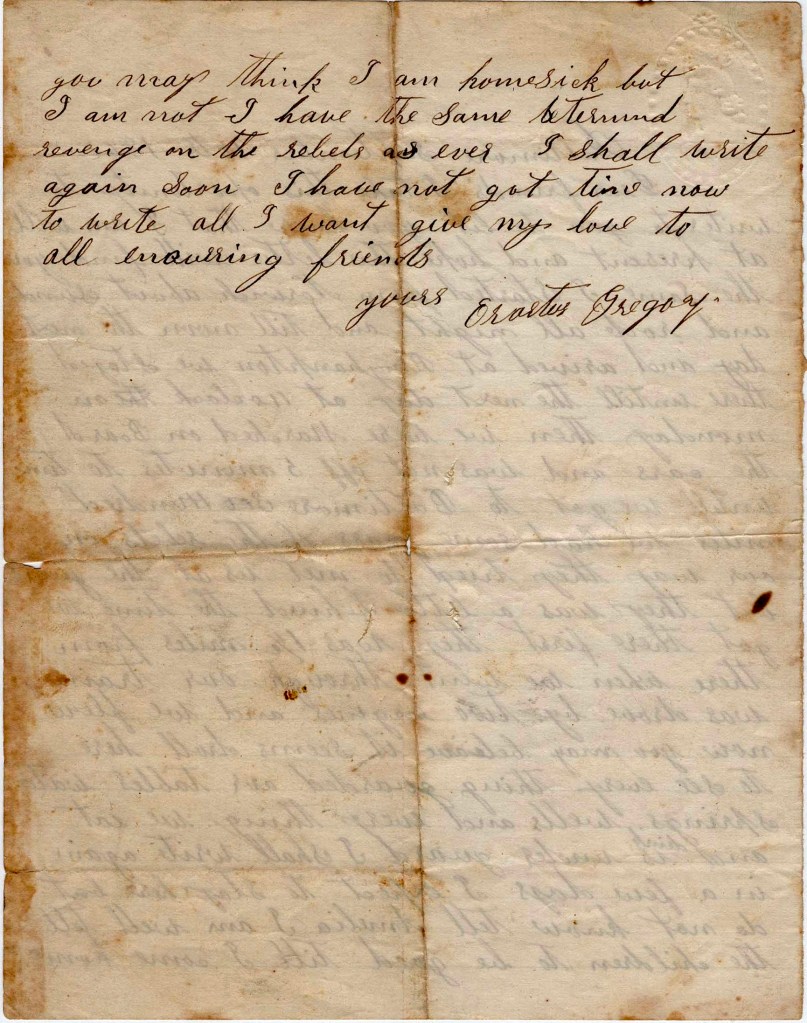
It seems droll here to see everything guarded. Our tables, water, springs, wells, and everything we eat and drink is under guard. I shall write again in a few days. I expect to stay here but do not know. Tell Amelia I am well. Tell the children to be good till I come home. You may think I am homesick but I am not. I have the same determined revenge on the rebels as ever. I shall write again soon. I have not got time now to write all I want. Give my love to all enquiring friends. Yours, — Erastus Gregory
Letter 2
Baltimore
September 12th 1862
Dear Friends,
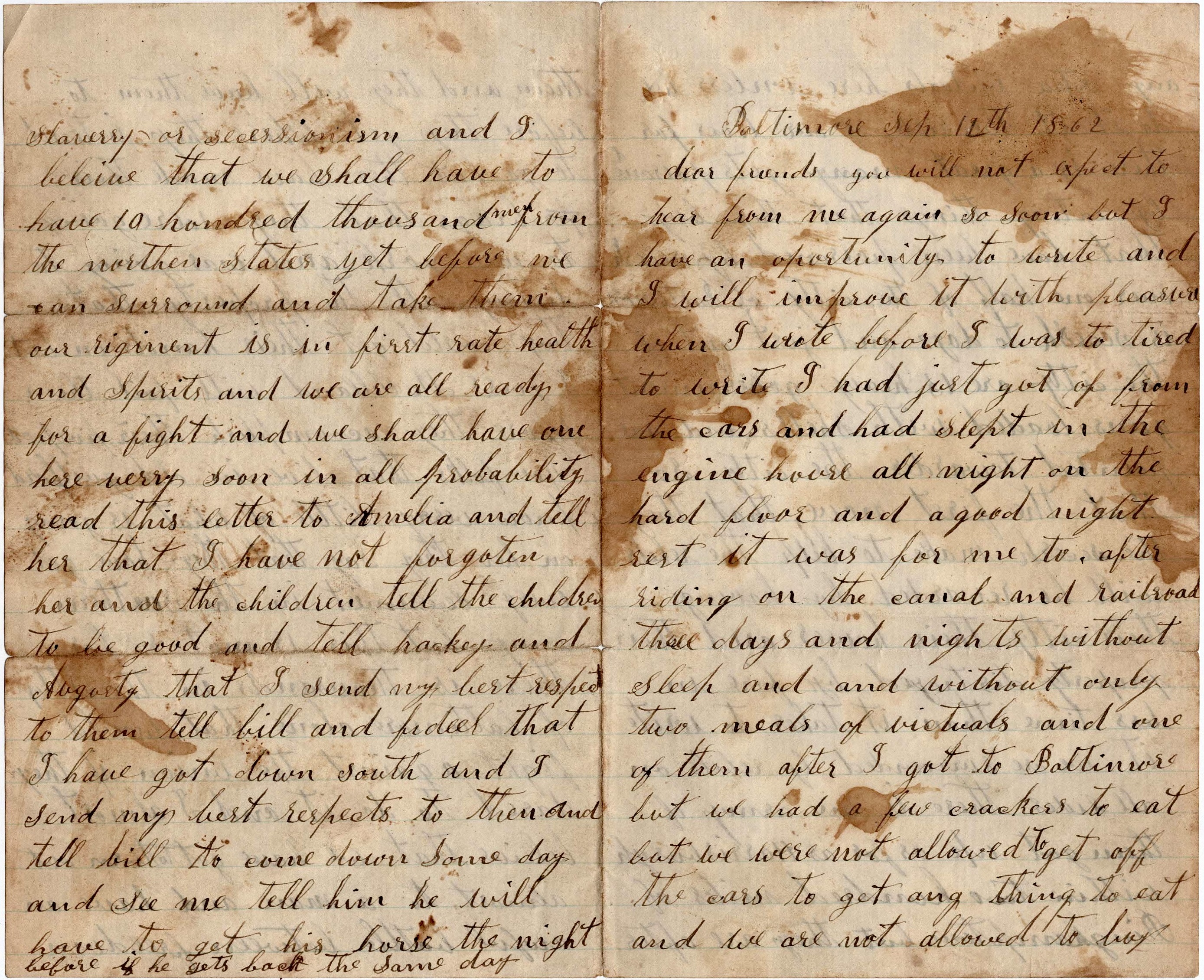
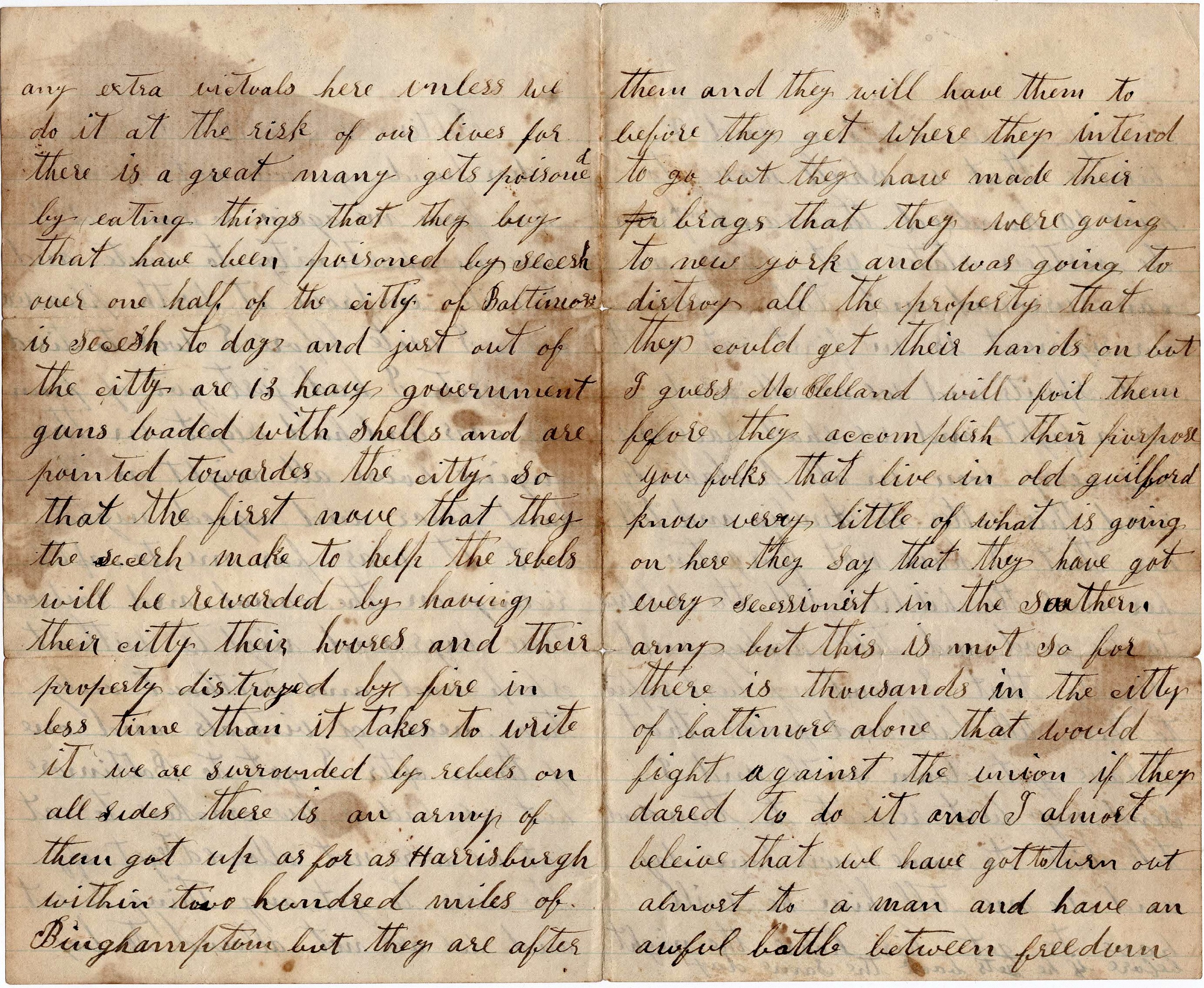
You will not expect to hear from me again so soon but I have an opportunity to write and I will improve it with pleasure. When I wrote before, I was too tired to write. I had just got off from the cars and had slept in the engine house all night on the hard floor and a good night’s rest it was for me too after riding on the canal and railroad three days and nights without sleep and without only two meals of victuals and one of them after I got to Baltimore. We had a few crackers to eat but we were not allowed to get off the cars to get anything to eat and we are not allowed to buy any extra victuals here unless we do it at the risk of or lives for there is a great many gets poisoned by eating things that they buy that has been poisoned by secesh. Over one half of the city of Baltimore is secesh today and just out of the city is 13 heavy government guns loaded with shells and are pointed towards the city so that the first move that they—the secesh—make to help the rebels will be rewarded by having their city, their houses, and their property destroyed by fire in less time than it takes to write it.
We are surrounded by revels on all sides. There us an army of them got up as far as Harrisburg within two hundred miles of Binghamton but they are after them and they will have them too before they get where they intend to go. But they have made their brags that they were going to New York and was going to destroy all the property that they could get their hands on. But I guess McClellan will foil them before they accomplish their purpose.
You folks that life in Old Guilford know very little of what is going on here. They say that they have got every secessionist in the Southern army but this is not so, for there is thousands in the City of Baltimore alone that would fight against the Union if they dared to do it. And I almost believe that we have got to turn out almost to a man and have an awful battle between freedom, slavery or secession, and I believe that we shall have to have ten hundred thousand men from the Northern states yet before we can surround and take them.
Our regiment is in first rate health and spirits and we are all ready for a fight. And we shall have one here very soon in all probability. Read this letter to Amelia and tell her that I have not forgotten her and the children. Tell the children to be good and tell Hanky [?] and Augusty that I send my best respects to them. Tell Bill and Fideel that I have got down South and I send my best respects to them and tell Bill to come down some day and see me, Tell him he will have to get his horse the night before if he gets back the same day.
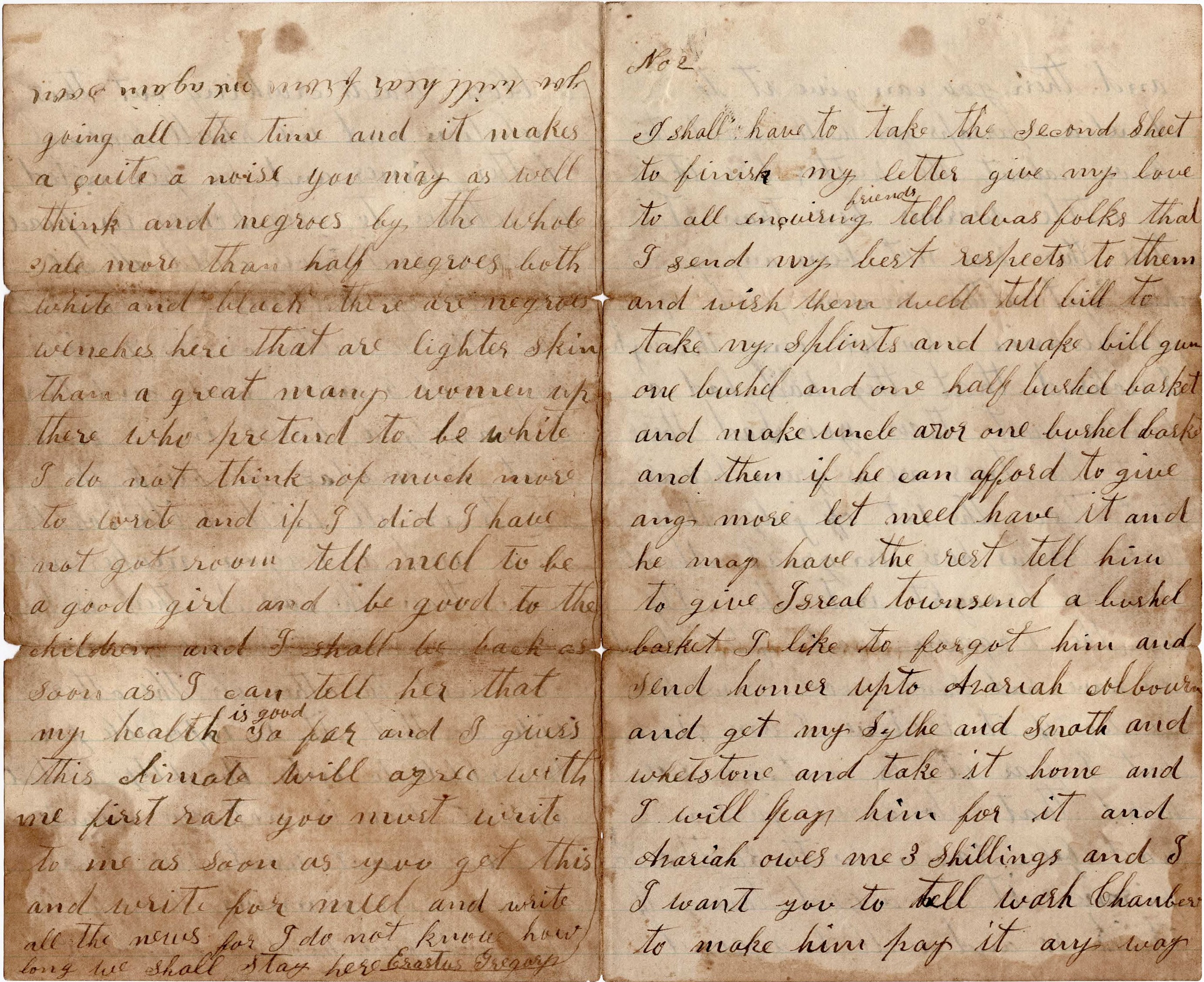
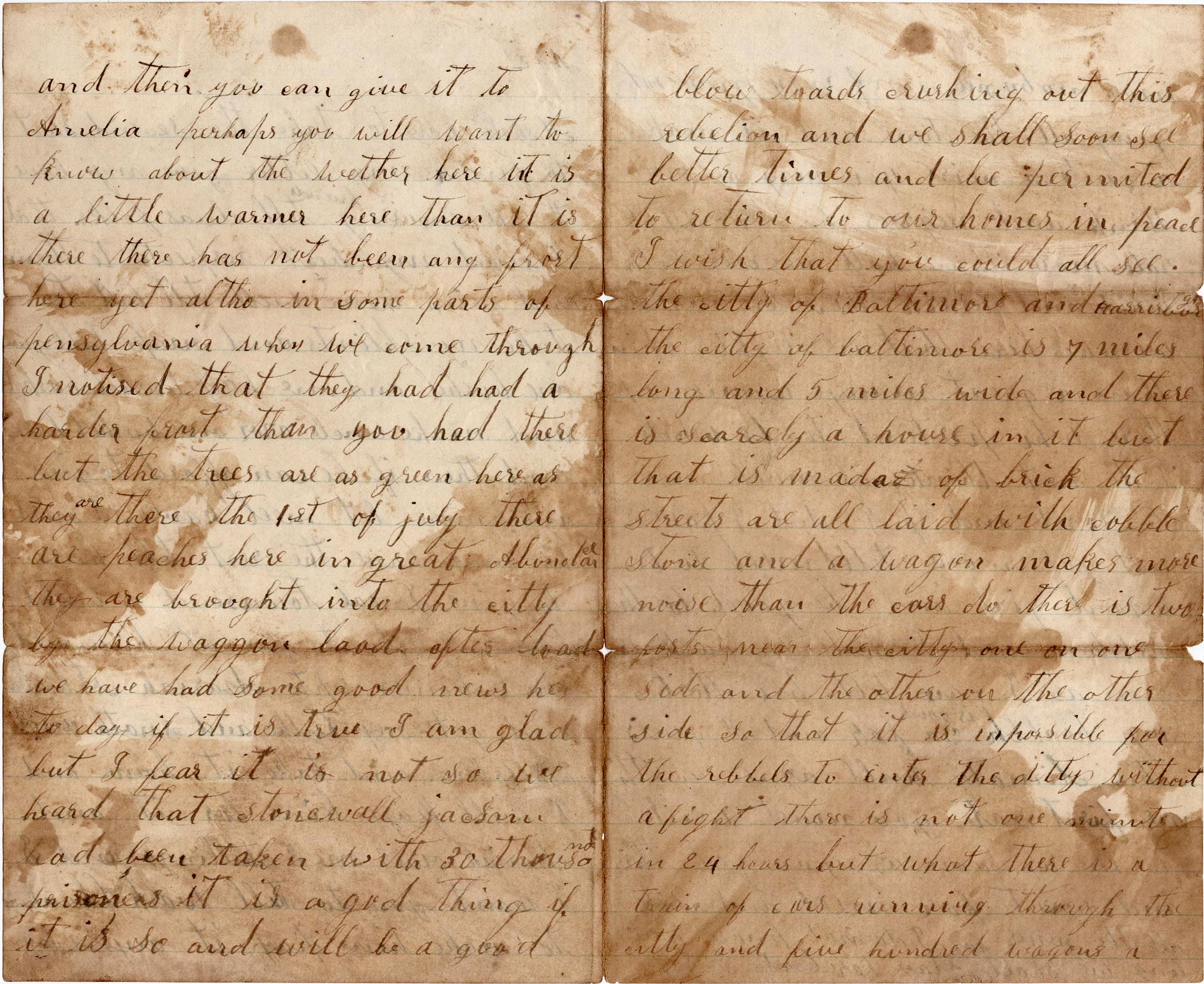
I shall have to take the 2nd sheet to finish my letter. Give my love to all enquiring friends. Tell Alva’s folks that I send my best respects to them and wish them well. Tell Bill to take my splints and make Bill gun [?] one bushel and one half bushel basket and make Uncle Azor one bushel basket and then if he can afford to give anymore, let Meel have it and he may have the rest. Tell him to give Israel Townsend a bushel basket. I like to forgot him. And send Homer up to Azariah Albour’s and get my sythe and snoth and whetstone and take it home and I will pay him for it. And Azariah owes me 3 shillings and I want you to tell Wash Chambers to make him pay it any way and then you can give it to Amelia.
Perhaps you will want to know about the weather here. It is a little warmer here than it is there. There has not been any frost here yet although in some parts of Pennsylvania when we came through I noticed that they had had a harder frost than you had there. But the trees are as green here as they are there the 1st of July. There are peaches here in great abundance. They are brought into the City by the wagon load after load.
We have had some good news here today. If it is true, I am glad. But I fear it is not so. We heard that Stonewall Jackson had been taken with 30,000 prisoners. It is a good thing if it is and will be a good blow towards crushing out this rebellion and we shall soon see better times and be permitted to return to our homes in peace.
I wish that you could all see the City of Baltimore and Harrisburg. The City of Baltimore is seven miles long and five miles wide and there is scarcely a house in it but that is made of brick. The streets are all laid with cobble stone and a wagon makes more noise than the cars do. There is two forts near the city, one on one side and the other on the other side so that it is impossible for the rebels to enter the city without a fight. There is not one minute in 24 hours but what there is a train of cars running through the city and five hundred wagons a going all the time and it makes quite a noise, you may as well think, and negroes by the wholesale. More than half [are] negroes, both white and black. There are negroe wenches here that are lighter skinned than a great many women up there who pretend to be white.
I do not think of much more to write and if I did, I have not got room. Tell Meel to be a good girl and be good to the children and I shall be back as soon as I can. Tell her that my health is good so far and I guess this climate will agree with me first rate. You must write to me as soon as you get this and write for Meel and write all the news for I do not know how long we shall stay here. — Erastus George
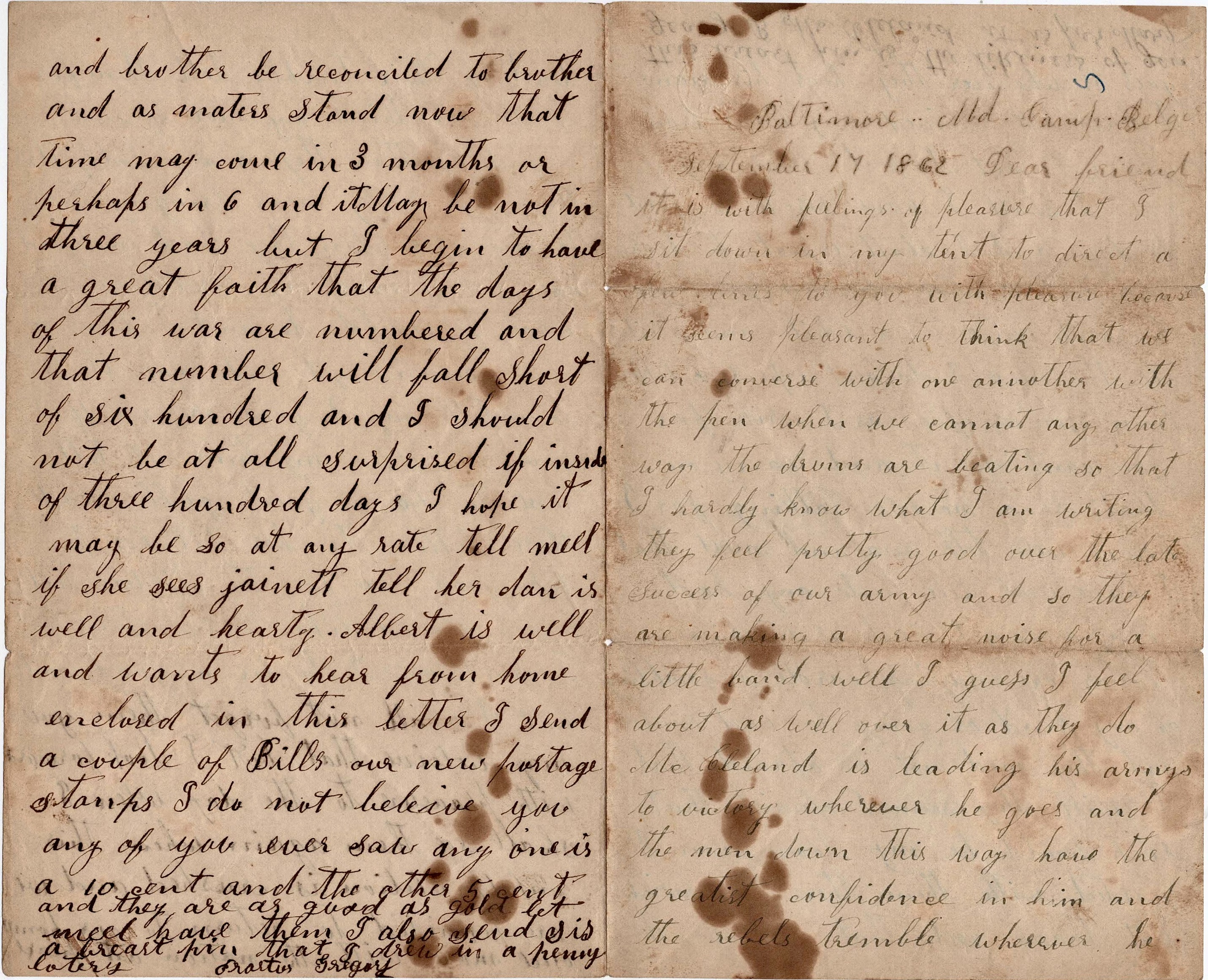
Letter 3
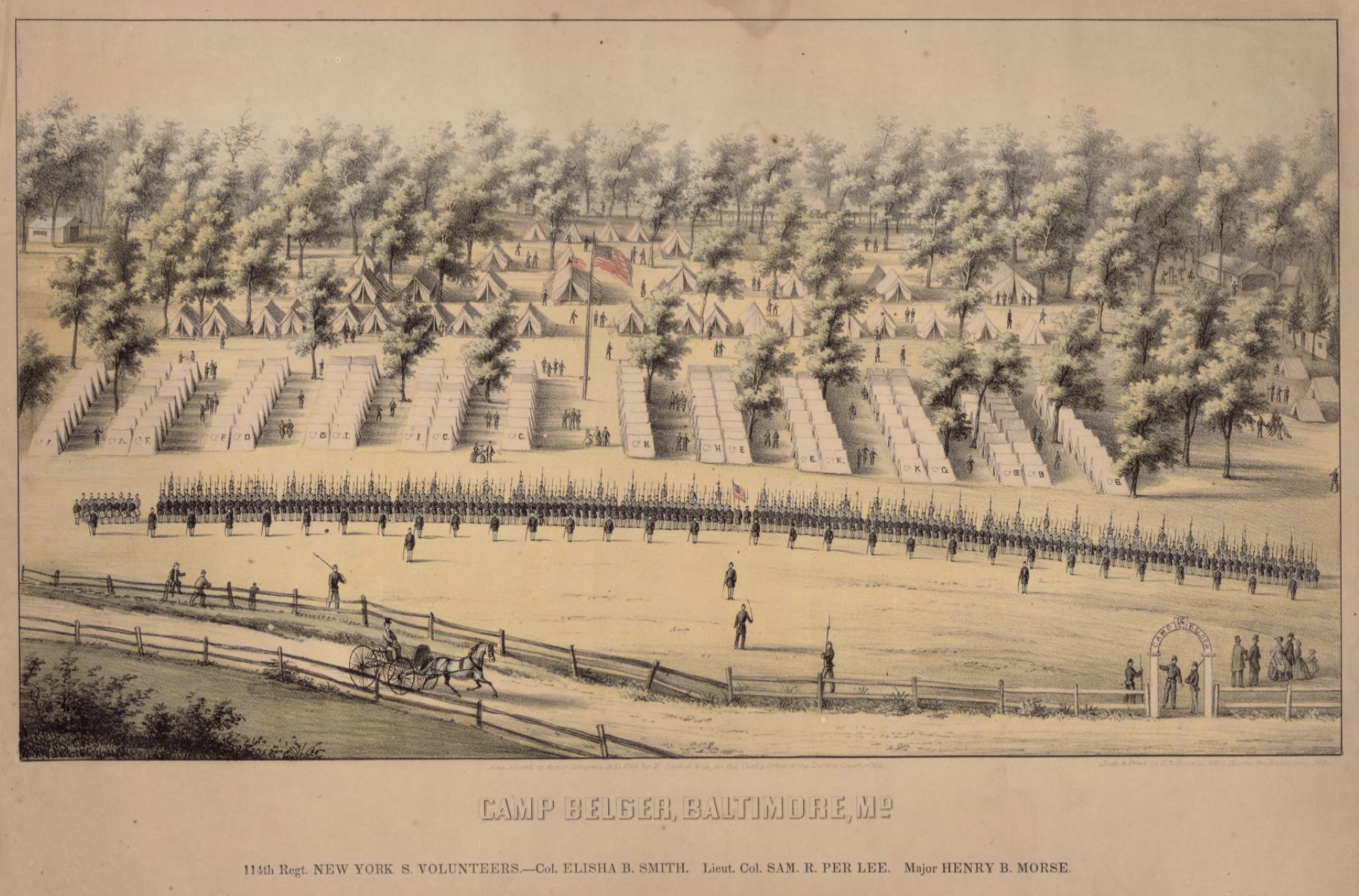
Camp Belger, Baltimore, Md.
September 17, 1862
Dear friend,
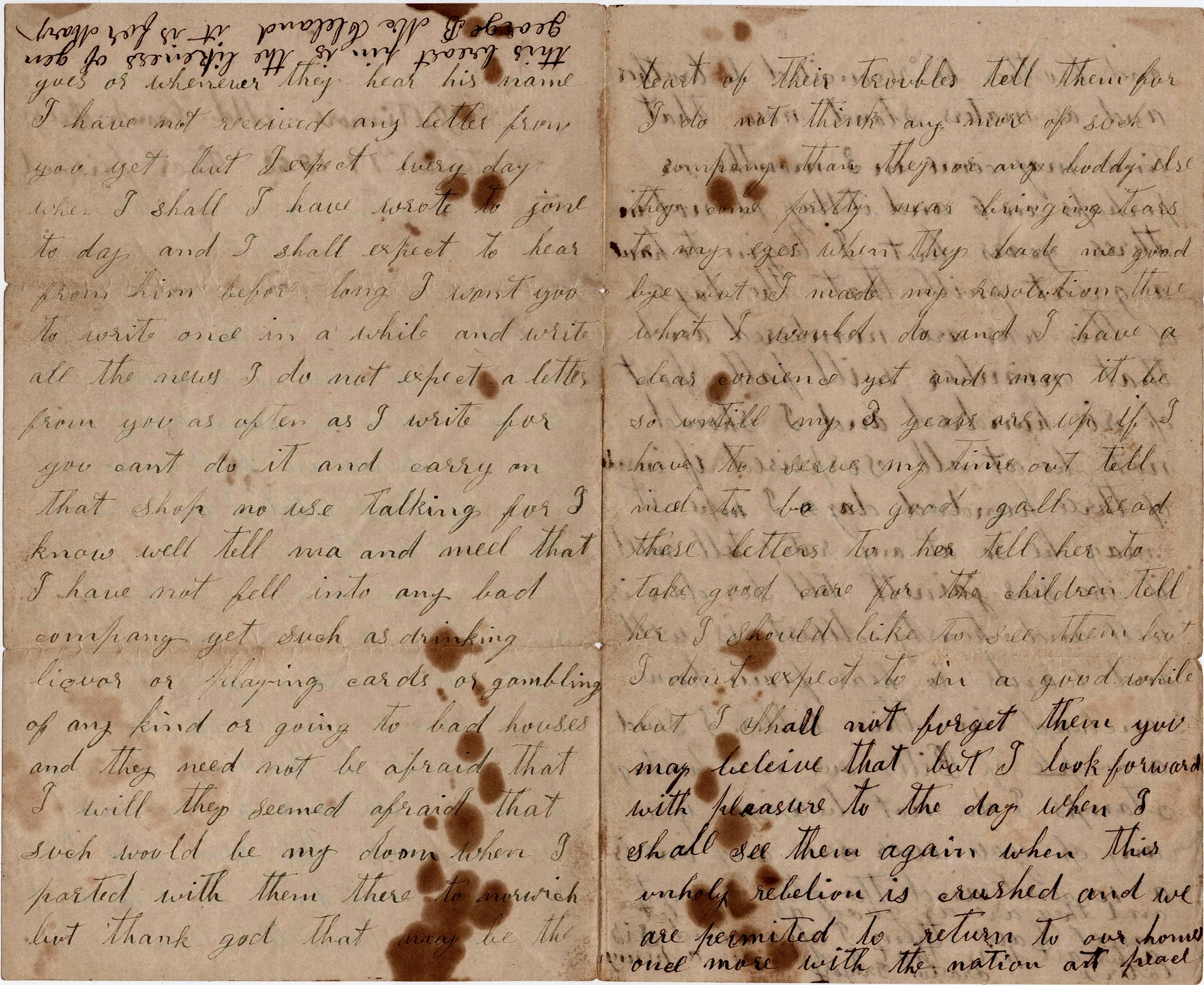
It is with feeling of pleasure that I sit down in my tent to direct a few lines to you because it seems pleasant to think that we can converse with one another with the pen when we cannot any other way. The drums are beating so that I hardly know what I am writing. They feel pretty good over the late success of our army [at South Mountain] and so they are making a great noise for a little band. Well, I guess I feel about as well over it as they do. McClellan is leading his armies to victory wherever he goes and the men down this way have the greatest confidence in him and the rebels tremble wherever he goes or wherever they hear his name.
I have not received any letter from you yet but I expect every day when I shall. I have wrote to Jone today and I shall expect to hear from him before long. I want you to write once in a while and write all the news. I do not expect a letter from you as often as I write for you can’t do it and carry on that shop. No use talking for I know well. Tell Ma and Meel that I have not fell into any bad company yet such as drinking liquor or playing cards or gambling of any kind, or going to bad houses, and they need not be afraid that I will. They seemed afraid that such would be my doom when I parted with them there to Norwich. But thank God, that may be the least of their troubles. Tell them for I do not think any more of such company than they or anybody else. They came pretty near bringing tears to my eyes when they bade me goodbye but I made my resolution there what I would do and I have a clear conscience yet. And may it be so until my 3 years are up, if I have to serve my time out.
Tell Meel to be a good gaal. Read these letters to her. Tell her to take good care of the children, Tell her I should like to see them but I don’t expect to in a good while. But I shall not forget them—you may believe that. But I look forward with pleasure to the day when I shall see them again when this unholy rebellion is crushed and we are permitted to return to our homes once more with the Nation at peace and brother be reconciled to brother. And as matters stand now, that time may come in three months or perhaps in six, and it may be not in three years, but I begin to have a great faith that the days of this war are numbered and that number shall fall short of six hundred. And I should not be at all surprised if inside of three hundred days. I hope it may be so at any rate.
Tell Meel if she sees Jainett, tell her Dan is well and hearty. Albert is well and wants to hear from home. Enclosed in this letter I send a couple of bills—our new postage stamps. I do not believe any of you ever saw any. One is a ten-cent and the other 5-cent and they are as good as gold. Let Meel have them. I also send Sis a breast pin that I drew in a penny lottery. — Erastus Gregory
Letter 4
Camp Belger, Baltimore, Md.
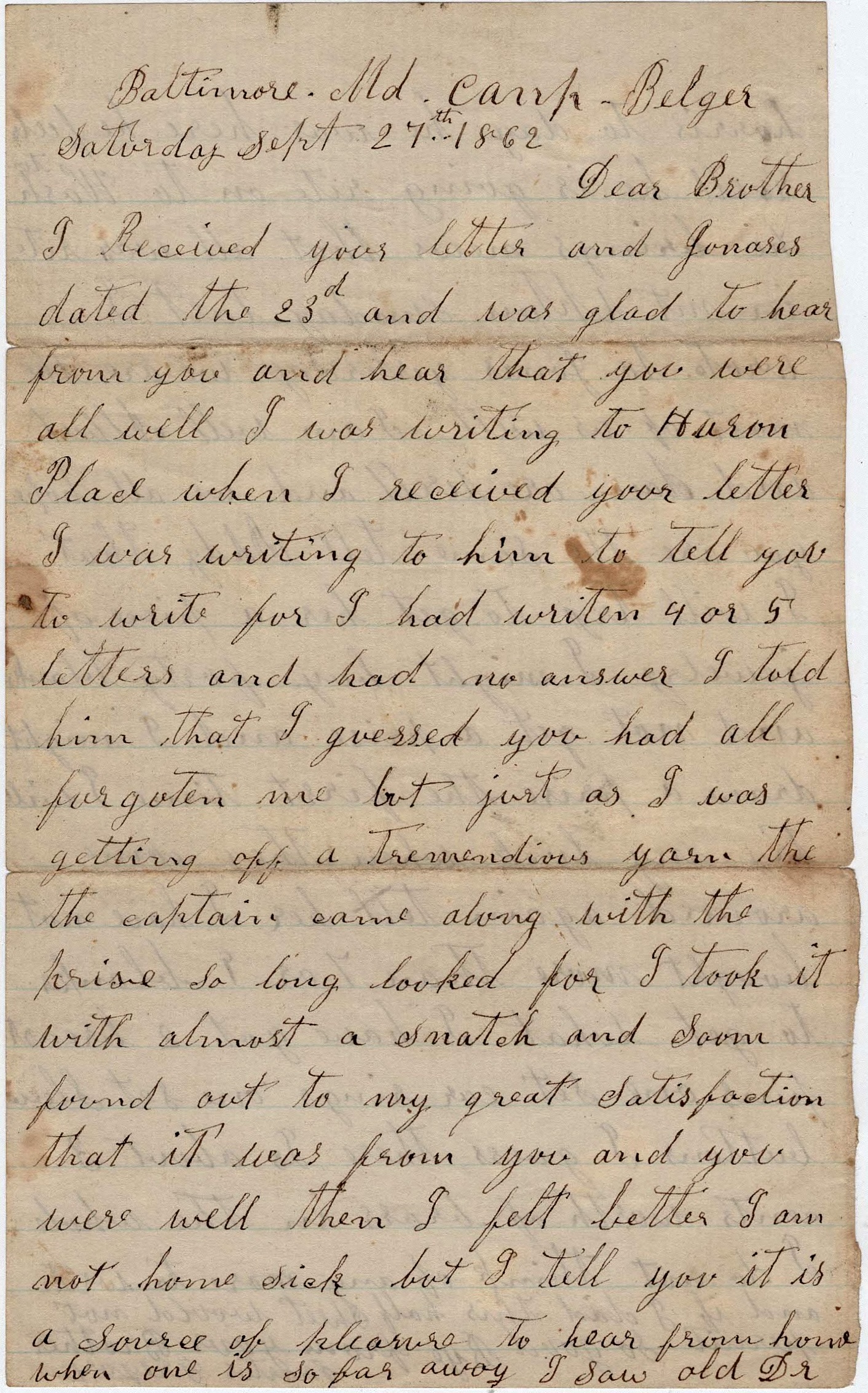
Saturday, September 27th 1862
Dear Brother,
I received your letter and Jonas’ dated the 23rd and was glad to hear from you and hear that you were all well. I was writing to Huron Place when I received your letter. I was writing to him to tell you to write for I had written four or five letters and had no answer. I told him that I guessed you had all forgotten me but just as I was getting off a tremendous yarn, the captain came along with the prize so long looked for. I took it with almost a snatch and soon found out to my great satisfaction that it was from you and you were well. Then I felt better. I am not homesick but I tell you, it is a source of pleasure to hear from home when one is so far away.
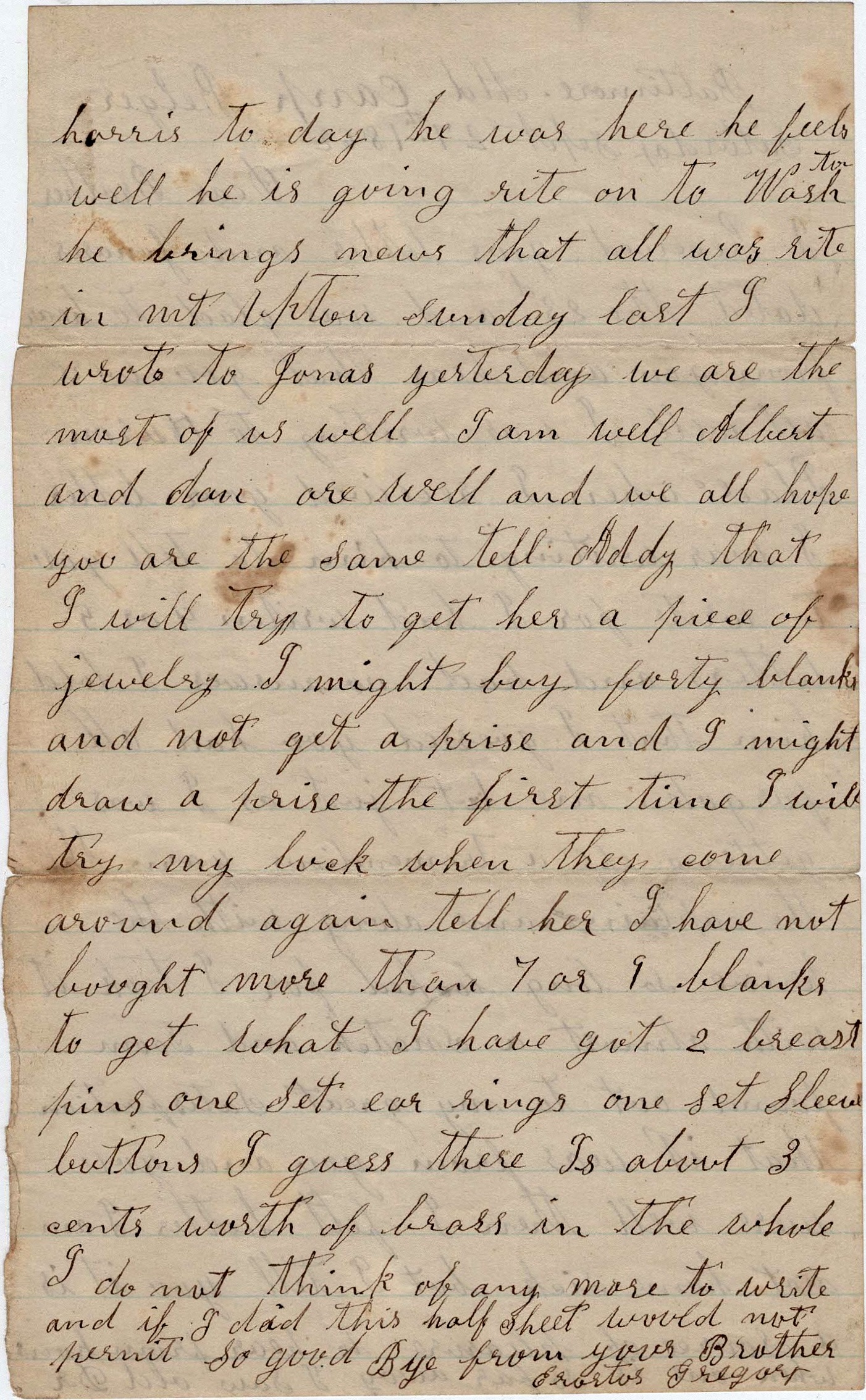
I saw old Dr. Harris today. He was here. He feels well, He is going right on to Washington. He brings news that all was right in Mt. Upton Sunday last. I wrote to Jonas yesterday. We are the most of us well. I am well. Albert and Dan are well. And we all hope you are the same. Tell Addy that I will try to get her a piece of jewelry. I might buy forty blanks and not get a prize and I might draw a prize the first time. I will try my luck when they come around again. Tell her I have not bought more than 7 or 9 blanks to get what I have go—two breast pins, one set of earrings, [and] one set sleeve buttons. I guess there is about three cents worth of brass in the whole.
I do not think of anything more to write and if I did, this half sheet would not permit. So goodbye from your brother, — Erastus Gregory
Letter 5
Camp Belger
October 6th 1862
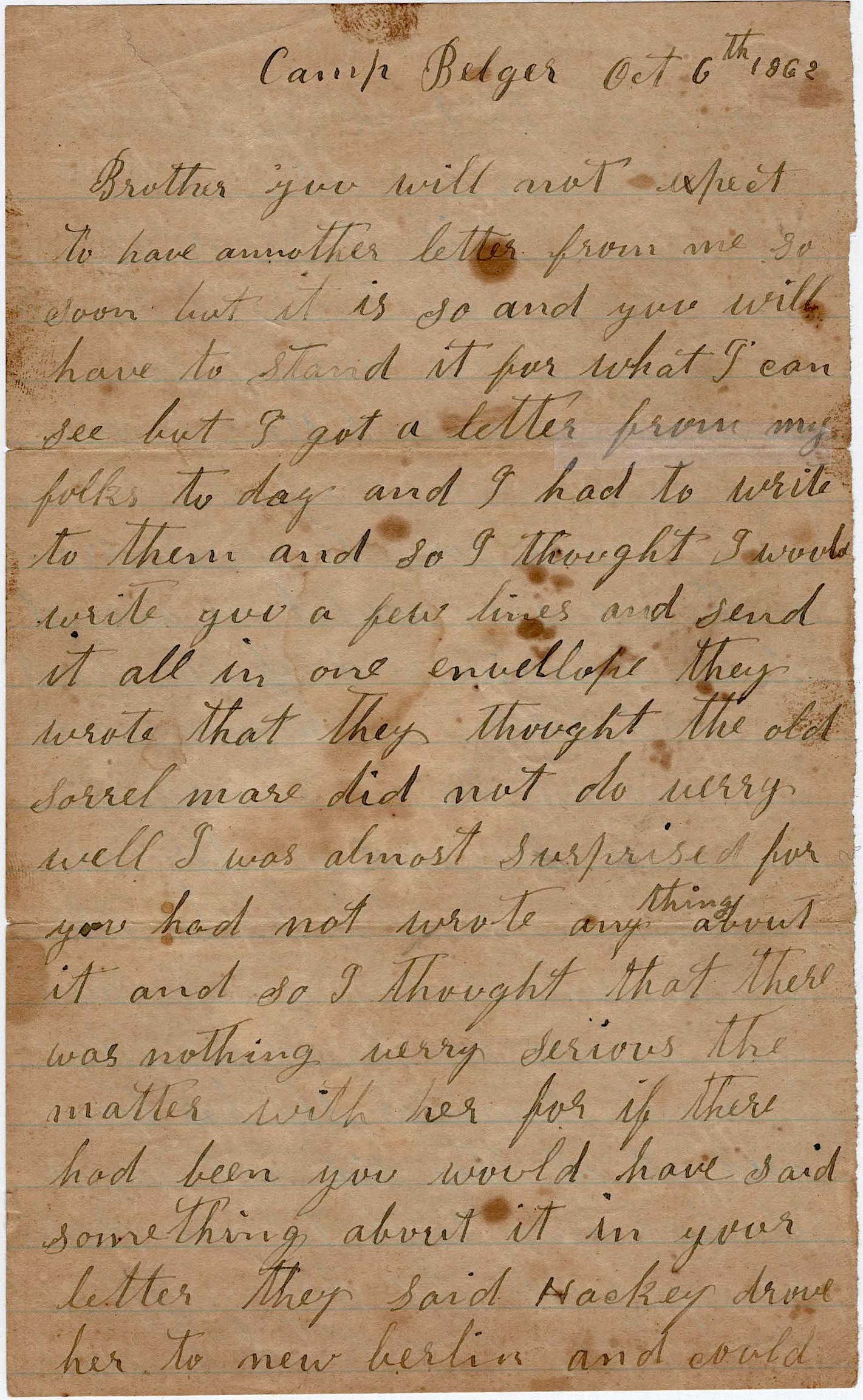
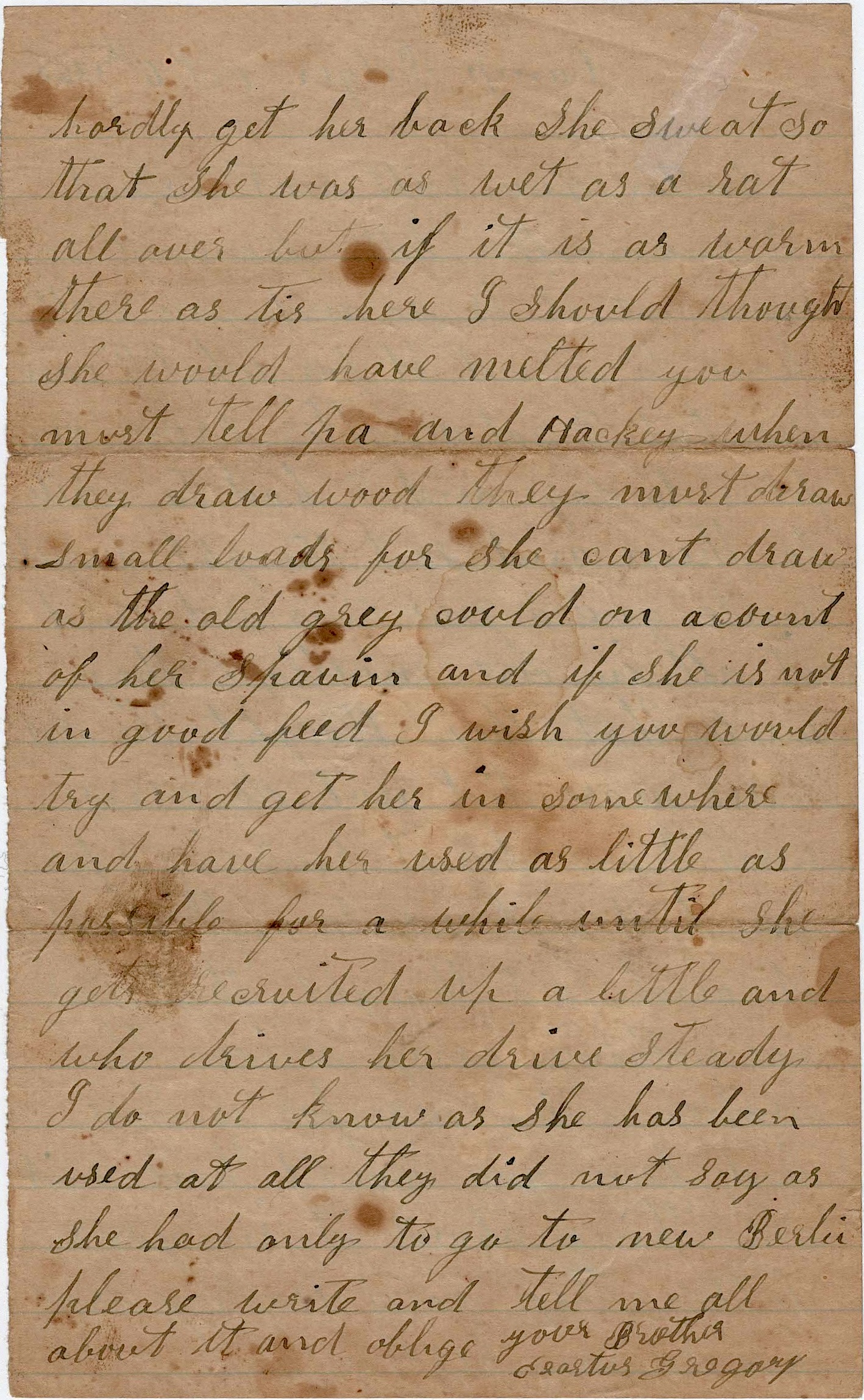
Brother, you will not expect to have another letter from me so soon but it is so and you will have to stand it for what I can see. But I got a letter from my folks today and I had to write to them and so I thought I would write you a few lines and send it all in one envelope. They wrote that they thought the old sorrel mare did not do very well. I was almost surprised for you had not wrote anything about it and so I thought that there was nothing very serious the matter with her, for if there had been you would have said something about it in your letter. They said Hackey drove here to New Berlin and could hardly get her back, she sweat so. That she was as wet as a rat all over. But if it is as warm there as tis here, I should thought she would have melted. You must tell pa and Hackey when they draw wood, they must draw small loads for she can’t draw as the old Grey could on account of her spavin and if she is not in good feed, I wish you would try and get her in somewhere and have her used as little as possible for a while until she get recruited up a little. And who drives her, drive her steady. I do not know as she has been used at all. They did not say as she had only to go to New Berlin.
Please write and tell me all about it and oblige your brother, — Erastus Gregory
Letter 6
Camp Belger
October 11, 1862
Respected Brother,
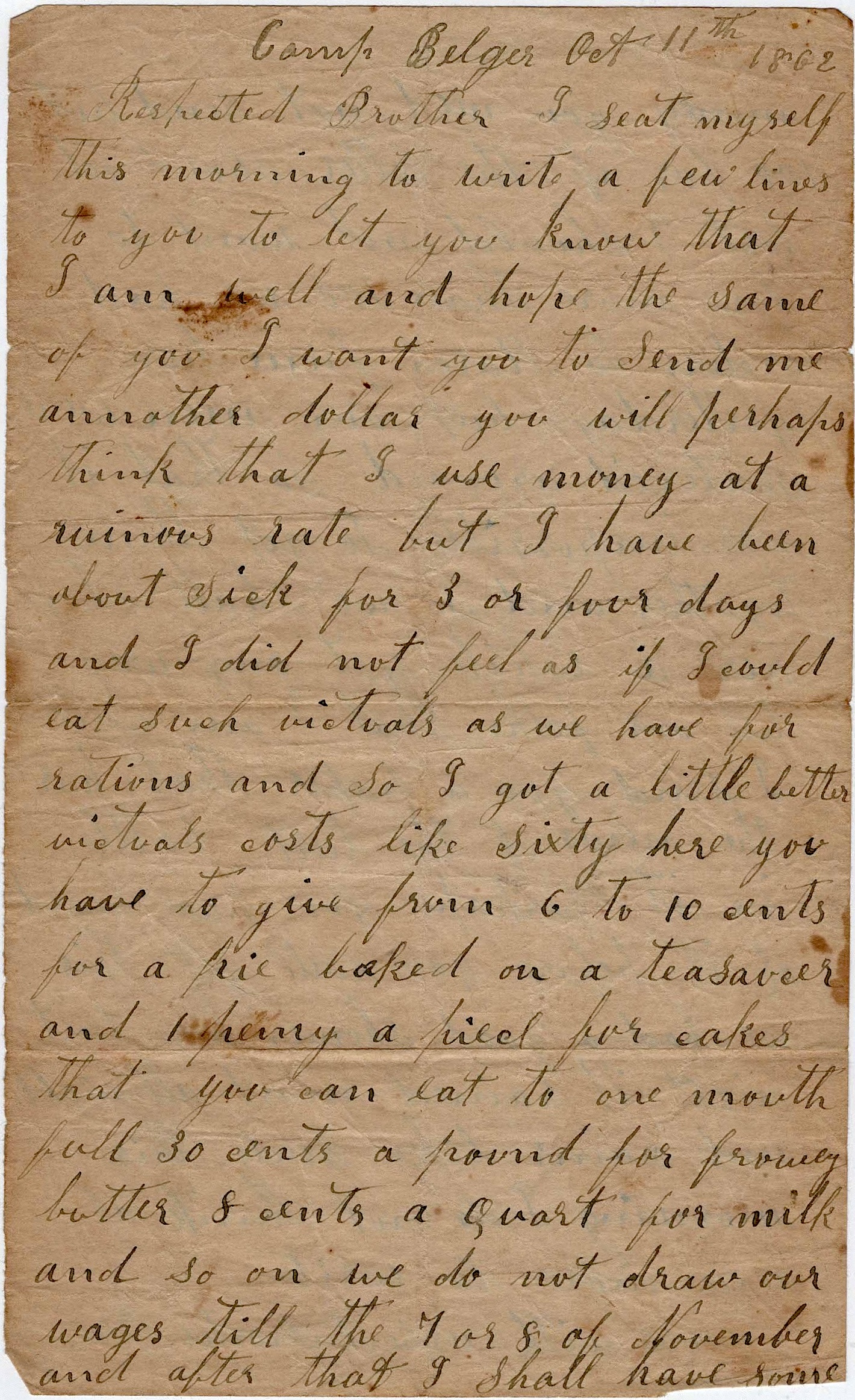
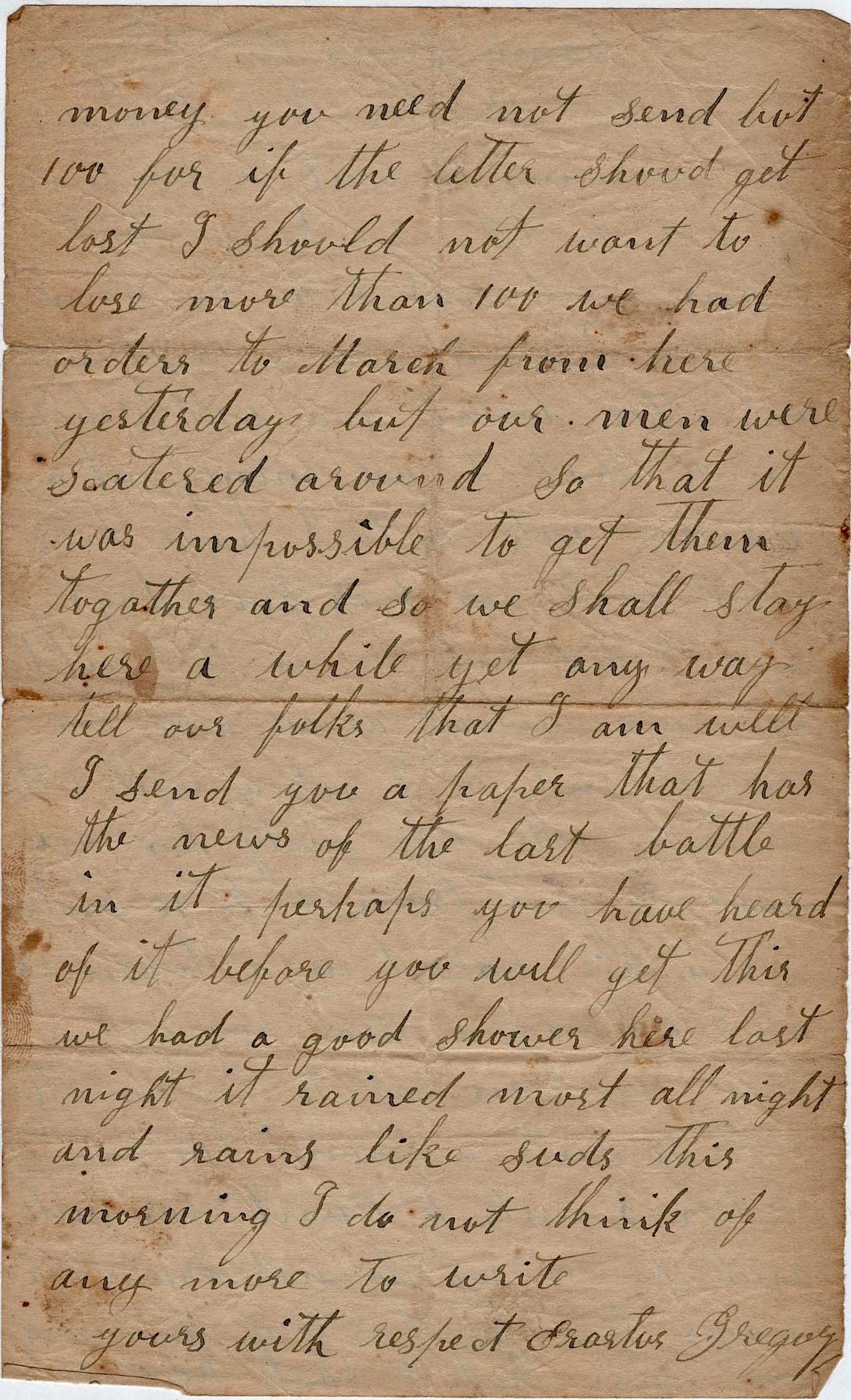
I seat myself this morning to write a few lines to you to let you know that I am well and hope the same of you. I want you to send me another dollar. You will perhaps think that I use money at a ruinous rate, but I have been about sick for three or four days and I did not feel as if I could each such victuals as we have for rations. And so I got a little better victuals—costs like sixty cents here. You have to gie from 6 to 10 cents for a pie baked on a tea saver and one penny a piece for cakes that you can eat to one mouthful, 30 cents a pound for frowey butter, 8 cents a quart for milk, and so on. We do not draw our wages till the 7th or 8th of November and after that I shall have some money. You need not send but $1 for if the letter should get lost, I shoiuld not want to lose more than $1.
We had orders to march from here yesterday but our men were scattered around so that it was impossible to get them together and so we shall stay here a while yet anyway. Tell our folks that I am well. I send you a paper that has the news of the last battle in it. Perhaps you have heard of it before you will get this.
We had a good shower here last night. It rained most all night and rains like suds this morning. I do not think of any more to write. Yours with respect, — Erastus Gregory
Letter 7
Camp Belger
October 16th 1862
Dear Brother,
I received Jonas’ and your letter and was glad to hear from you all. I have wrote back to Jonas. You wrote that you wanted to buy a colt. I hear that your company have all got to come to the war but I hope you will not have to come. If you do not, you can have the money you [illegible] and now I want you to send this letter right up to our folks for they find fault about the letters being to your house so long before they get it.
Dick, go up with this for Ratty and I will give you something. I am on guard and I have not time to write much. So good night. — Erastus Gregory
Letter 8
Camp Belger [Baltimore, Maryland]
October 24th 1862
Dear Brother,
I have this morning got through reading a letter from you dated October 20th and I can assure you that I was glad to hear that you were all well. I am well except a bad side. My old side complaint has started up anew and it is a great displeasure to me just at the present time. The doctors try a great many ways to cure it but they only make me the sorer. They have blistered and drawed until they have got my side as sore as a boil but I have hopes that I shall soon get over it. But if it should hang on as long as it did when I had it before, I should have a hard time of it down here. But I hope it will not. It is a week or more since I gave out and I have not done anything since and shall not do a great deal until it gets better.
You wrote that you heard that we were starving to death. We are not as bad off as that but our fare has been hard in the extreme for two weeks back. But it is a shade better now and I guess we shall get along. Perhaps you will ask what we have now. I will tell you. For breakfast I have bread and water. For dinner water and bread. And for supper bread and water again, and so on every day, changing every time so as to have something new. But there are some that take coffee and they change the same as those that take the water. But I have got a little of that tin left that you sent to me and so I get a little butter. I get it cheap. It is only 30 cents a pound, and so I get along very well.
You wrote that my mare was on the gain. I am glad to hear it for if she goes into the winter in good rig, she will do all the better for it and I guess she will do well enough if she is used well. And I think she will be. You wrote that Alvah had got him a horse and got it off Bill. How much did he give and what did he pay in? And what for a horse is it? And did Bill have two? And how come him by them? Write all about it if you will. I suppose. Alve thinks that he can make some man rich by and bye by giving them some old horse. But never mind. He is able. Does Alve ever ask how I get along or anything about me? Or does he ever go to my house a visiting? If he does, tell Mell to ask him for me if he is not ashamed to come there after using me as he did and if he says he is, then use him well. And if he says he is not, tell her that I say she need not ever wait on him again. Tell her to read this letter to him and if you see him, you read it to him for me and tell him that I wish him well but I shall not forget that of him until he has asked me to.
You wanted I should write about the war. I shall have to take some more paper.
I do not hear much about the war lately. But our army is pushing along South as fast as possible and a hard fight is daily expected and some of the men here that that if we can gain the next victory, that secesh will go down. And it is my trust, my hope, and my prayer that the next thirty days will overthrow this unholy rebellion and the war come to an end and we be on our way home. I do not think of much more to write.
Ye;; Hackey and Bill to write to me. Write how much hay is per ton and oats per bushel. Give my love to all enquiring friends. Tell Uncle Avor [?] how I am getting along. Albert is well at present. We had heard of Roxany’s death two or three days ago and it was bad but we had both expected it. Write Henry as soon as you can and when you write, enclose a stamp for return mail for stamps are scarce here with the soldiers. Send this letter on the hill and let them read it and all write to me and write all the news and I shall be very thankful. And now you will have to excuse mer for the present while I remain your affectionate brother, — Erastus Gregory
Letter 9
Baltimore, Maryland
Sunday, October 26th 1862
Dear brother Henry and all the rest,
I had a little spare time today and so I thought I would improve it in writing to my folks and to you. I have got partly smart again but do not feel very stout yet. But I have got so that I can walk without going all bent over. I shall not have time to write much for it is getting late but you can read Meel’s letter and so get all the news. You must tell Meel to write oftener and let a fellow know how they get along up there on the hill.
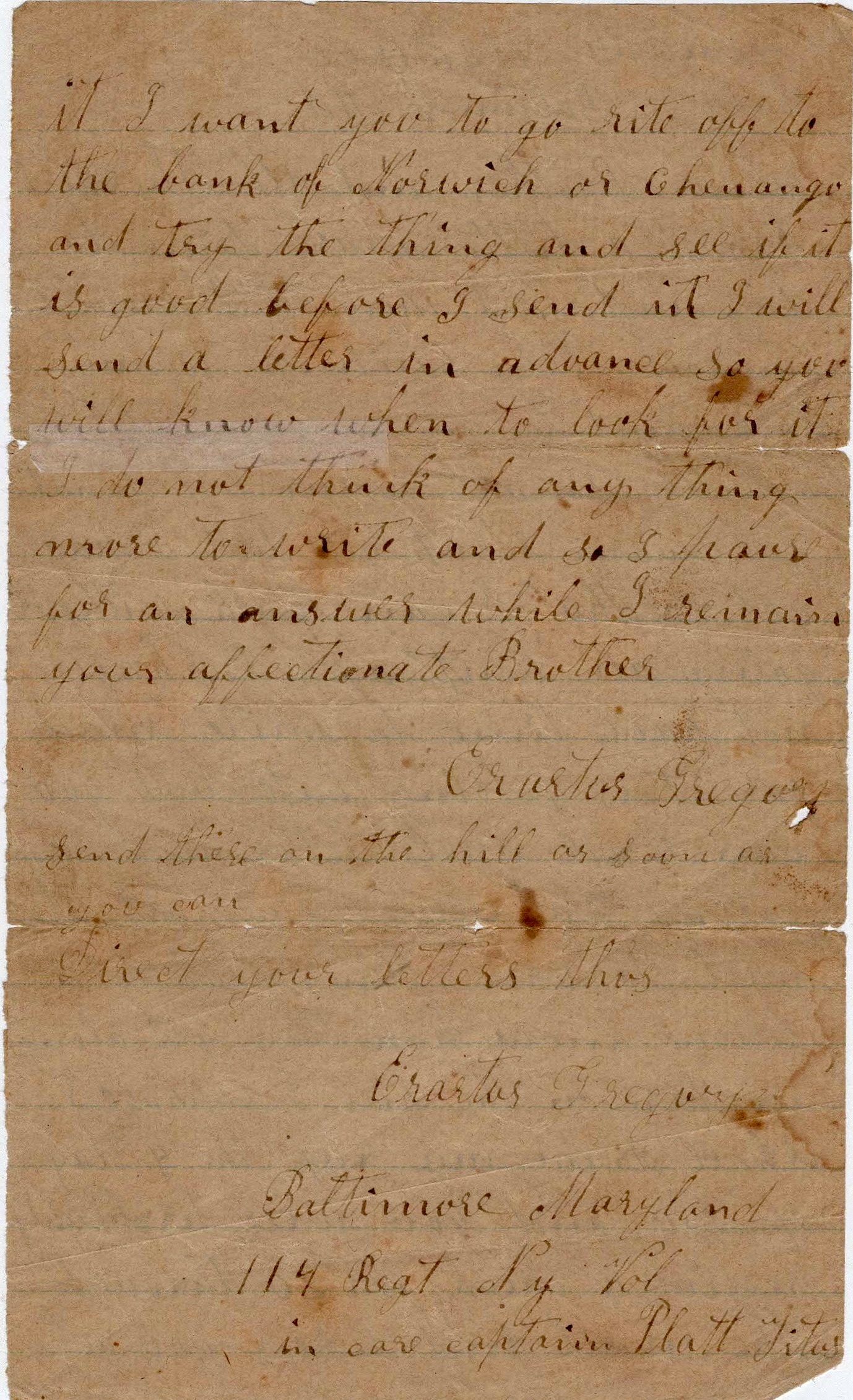
I suppose I shall draw my pay the 4th day of November and you will probably receive a check for $20 through the mail. And when you get it, I want you to go right off to the Bank of Norwich or Chenango and try the thing and see if it is good before I send in. I will send a letter in advance so you will know when to look for it.
I do not think of anything more to write and so I pause for an answer while I remain your affectionate brotyher, — Erastus Gregory
Send these on the hill as soon as you can. Direct your letters thus:
Erastus Gregory
Baltimore, Maryland
114th Regt. New York Vols.
in care of Captain Platt Titus
Letter 10
Baltimore, Maryland
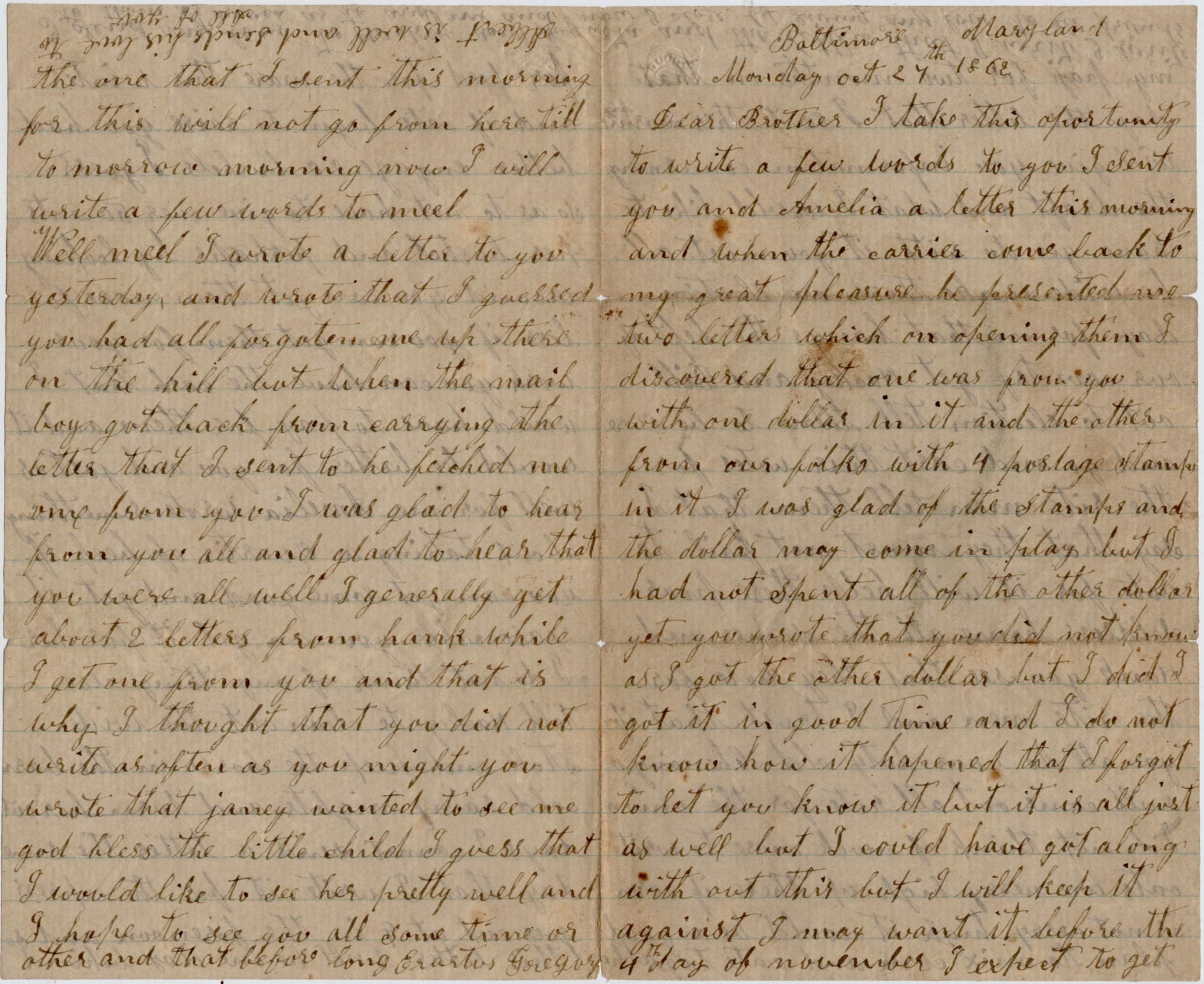
Monday, October 27th 1862
Dear Brother,
I take this opportunity to write a few words to you. I sent you and Amelia a letter this morning and when the carrier came back, to my great pleasure, he presented me two letters which on opening them I discovered that one was from you with one dollar in it and the other from our folks with four postage stamps in it. I was glad of the stamps and the dollar may come in play, but I had not spent all of the other dollar yet. You wrote that you did not know as I got the other dollar but I did. I got it in good time and I do not know how it happened that I forgot to let you know it but it is all just as well. But I could have got along without this, but I will keep it against I may want it before the 4th of November. I expect to get my pay for two months on that day. The letter that I sent this morn will give you information concerning the draft and what I would like to have you do with it.
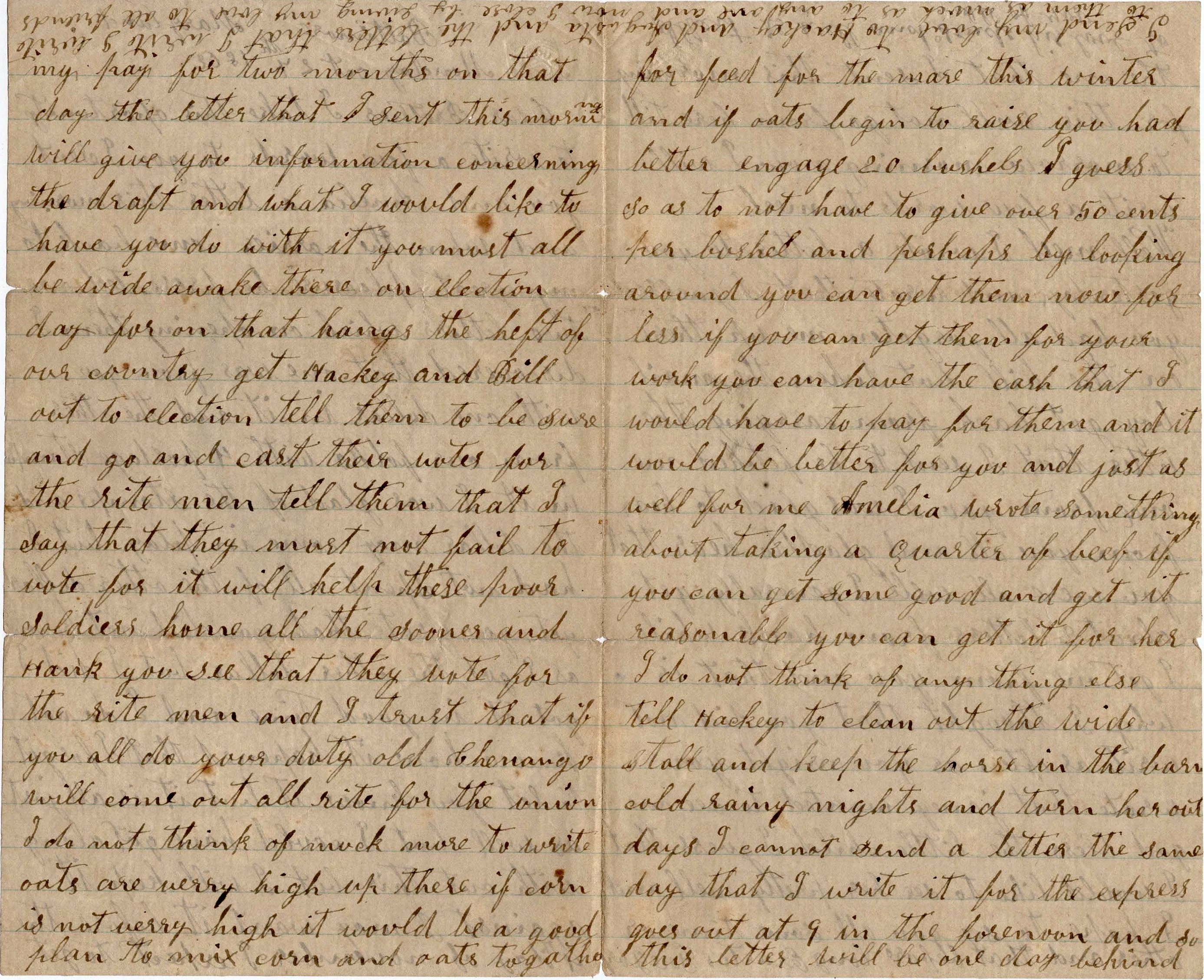
You must all be wide awake there on election day for on that hangs the heft of our country. Get Hackey and Bill out to election. Tell them to be sure and go and cast their votes for the right men. Tell them that I say that they must not fail to vote for it will help these poor soldiers home all the sooner. And Hank, you see that they vote for the right men and I trust that if you all do your duty, Old Chenango will come out all right for the Union.
I do not think of much more to write. Oats are very high up there. If corn is not very high, it would be a good plan to mix corn and oats together for feed for the mare this winter. And if oats begin to rise, you had better engage 20 bushels I guess so as to not have to give over 50 cents per bushel. And perhaps by looking around you can get them now for less. If you can get them for your work, you can have the cash that I would have to pay for them and it would be better for you and just as well for me.
Amelia wrote something about taking a quarter of beef. If you can get some good and get it reasonable, you can get it for her. I do not think of anything else. Tell Hackey to clean out the wide stall and keep the horse in the barn on cold, rainy nights, and turn her out days. I cannot send a letter the same day that I write it for the express goes out at 9 in the firenoon and so this letter will be one day behind the one that I sent this morning for this will not go from here till tomorrow morning.
Now I will write a few words to Meel. Well Meel, I wrote a letter to you yesterday and wrote that I guessed you had all forgotten me up there on the hill. But when the mail boy got back from carrying the letter that I sent to [you], he fetched me one from you. I was glad to hear from you and glad to hear that you were all well. I generally get about two letters from Hank while I get one from you and that is why I thought that you did not write as often as you might. You wrote that Janey wanted to see me. God bless the little child. I guess that I would like to see her pretty well and I hope to see you all some time or other and that before long. — Erastus Gregory
Letter 11
Fortress Monroe, Virginia
Monday, November 10th 1862
Dear Brother and all the rest,
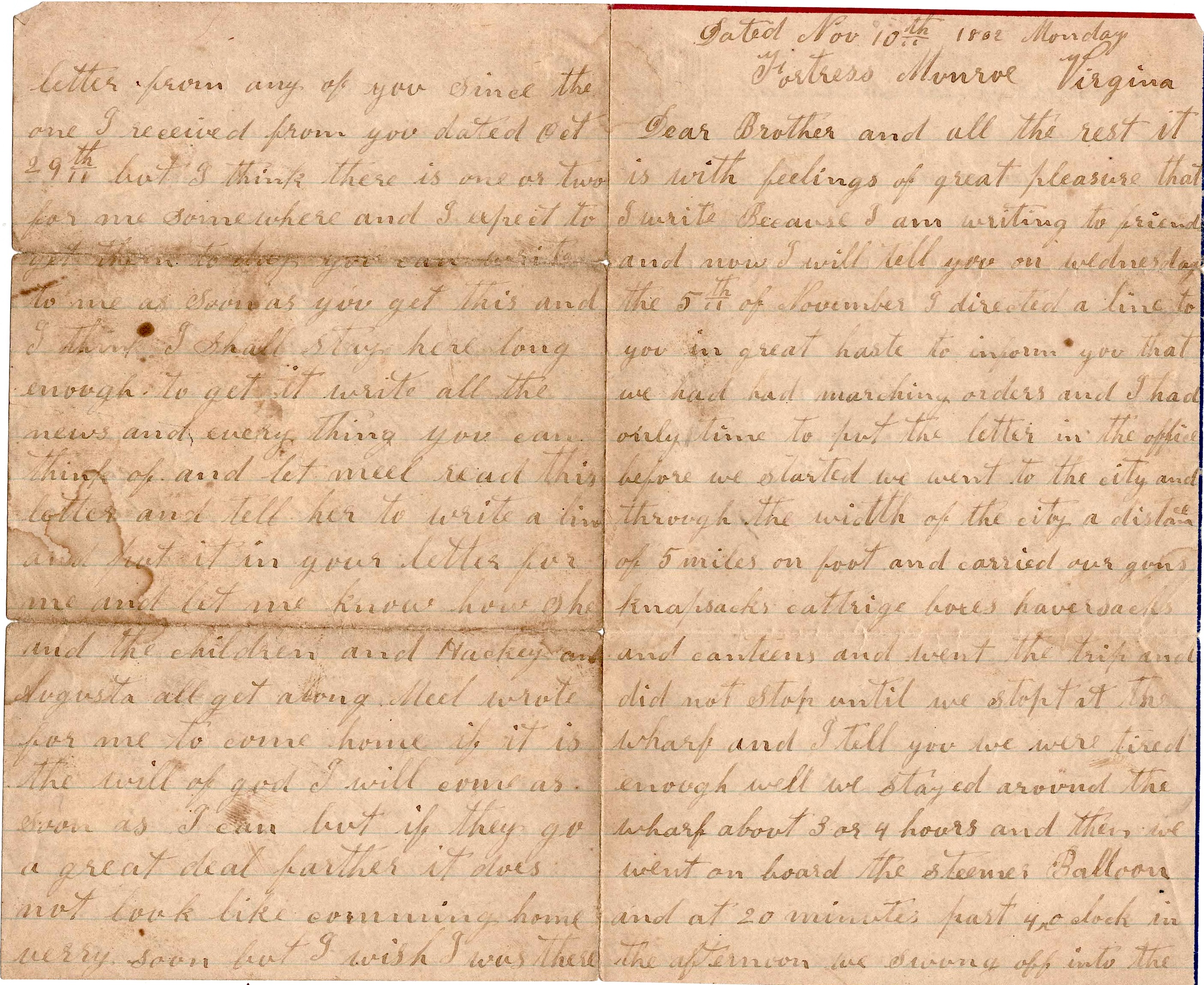
Itis with feelings of great pleasure that I write because I am writing to friends. And now I will tell you [that] on Wednesday, the 5th of November, I directed a line to you in great haste to inform you that we had had marching orders and I had only time to out the letter in the office before we started.
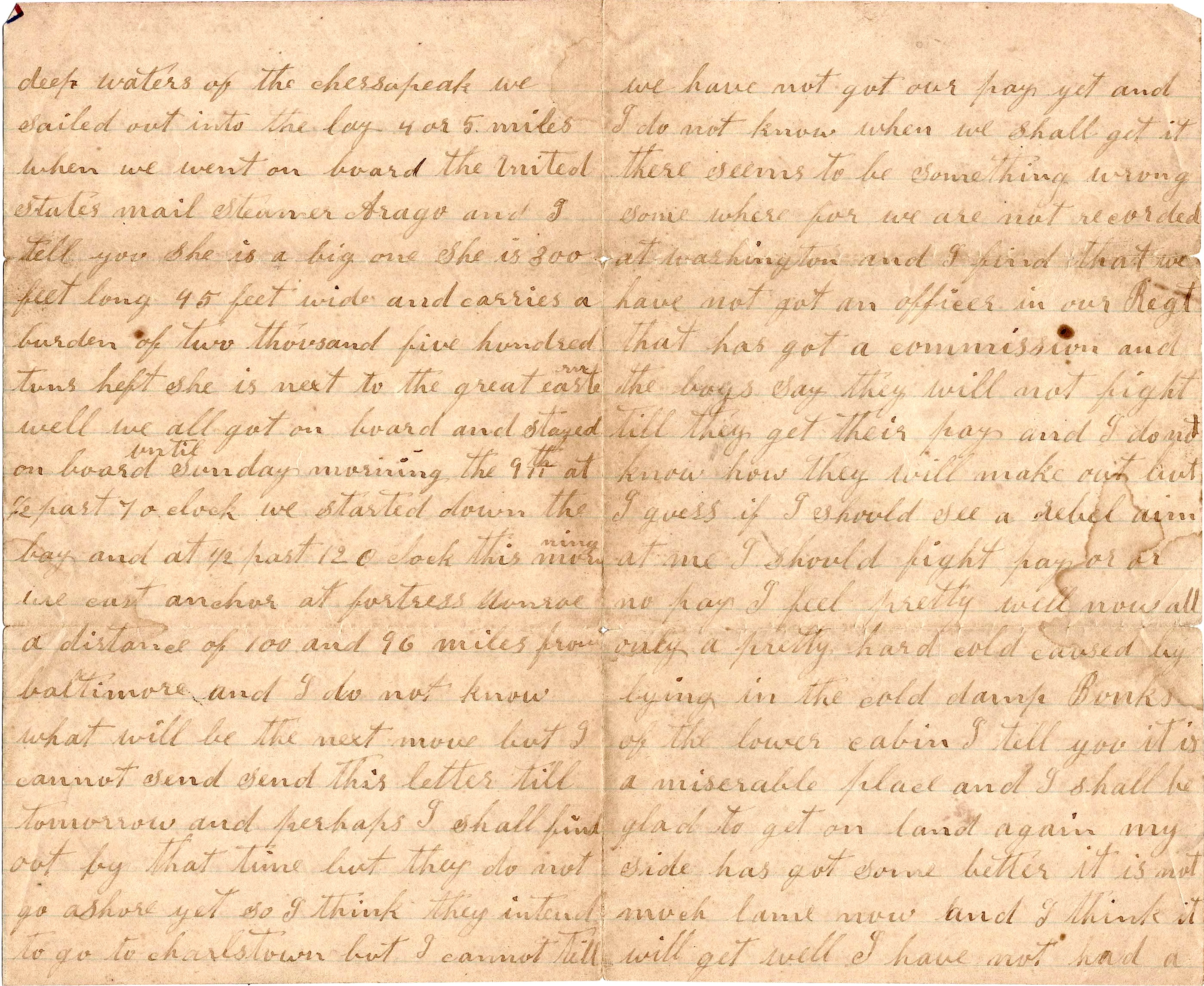
We went to the city, a distance of five miles on foot, and carried our knapsacks, cartridge boxes, haversacks, and canteens, and went the trip and did not stop until we stopped at the wharf, and I tell you, we were tired enough. Well we stayed around the wharf about three or four hours and then we went on board the steamer Balloon and at 20 minutes past 4 o’clock in the afternoon, we swung off into the deep waters of the Chesapeake. We sailed out into the bay four or five miles when we went on board the United States Mail Steamer Arago and I tell you, she is a big one. She is 300 feet long, 45 feet wide, and carried a burden of 2500 tons heft. She is next to the Great Eastern [in size].
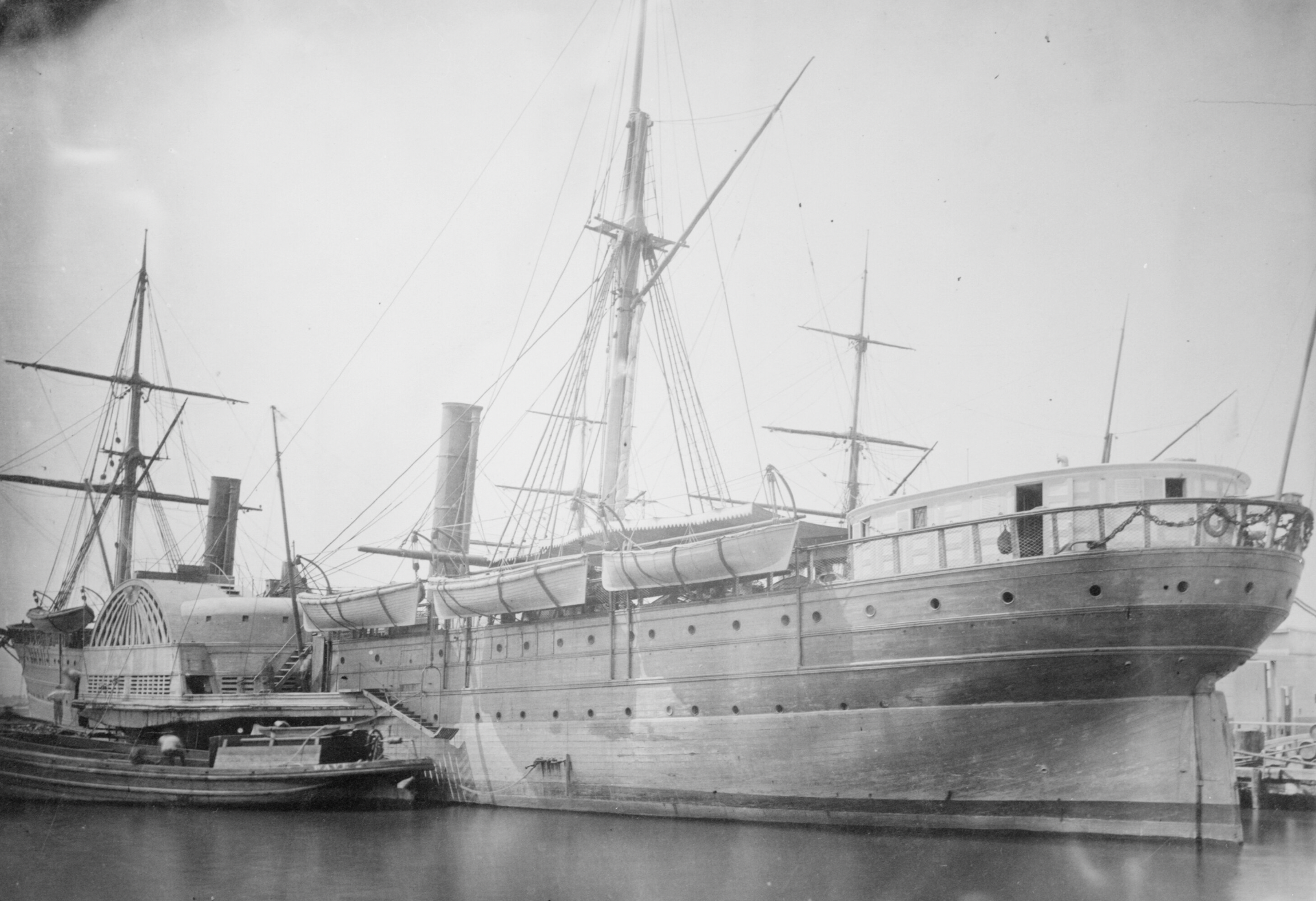
Well we all got on board and stayed on board until Sunday morning, the 9th at half past 7 o’clock [when] we started down the bay. At half past 12 o’clock this morning we cast anchor at Fortress Monroe—a distance of 196 miles from Baltimore. I do not know what will be the next move but I cannot send this letter till tomorrow and perhaps I shall find out by that time. But they do not go ashore yet so I think they intend to go to Charleston, but I cannot tell.
We have not got our pay yet and I do not know when we shall get it. There seems to be something wrong somewhere for we are not recorded at Washington and I find that we have not had an officer in our regiment that got a commission and the boys say they will not fight till they get their pay and I don’t know how they will make out but I guess if I should see a rebel aim at me, I should fight—pay or no pay.
I feel pretty well now—only a hard cold caused by being in the cold, damp bunks of the lower cabin. I tell you it is a miserable place and I shall be glad to get on land again. My side has got some better. It is not much lame now and I think it will get well. I have not had a letter from any of you since the one I received from you dated October 29th. But I think there is one or two for me somewhere and I expect to get them today. You can write to me as soon as you get them and I think I shall stay here long enough to get it. Write all the news and everything you can think of and let Meel read this letter and tell her to write a line and put it inyour letter for me. And let me know how she and the children and Hackey and Augusta all get along. Meel wrote for me to come home. If it is the will of God, I will come as soon as I can but if they go a great deal farther, it does not look like coming home very soon. But I wish I was there.
Letter 12
Fortress Monroe
November 25, 1862
Dear Brother,
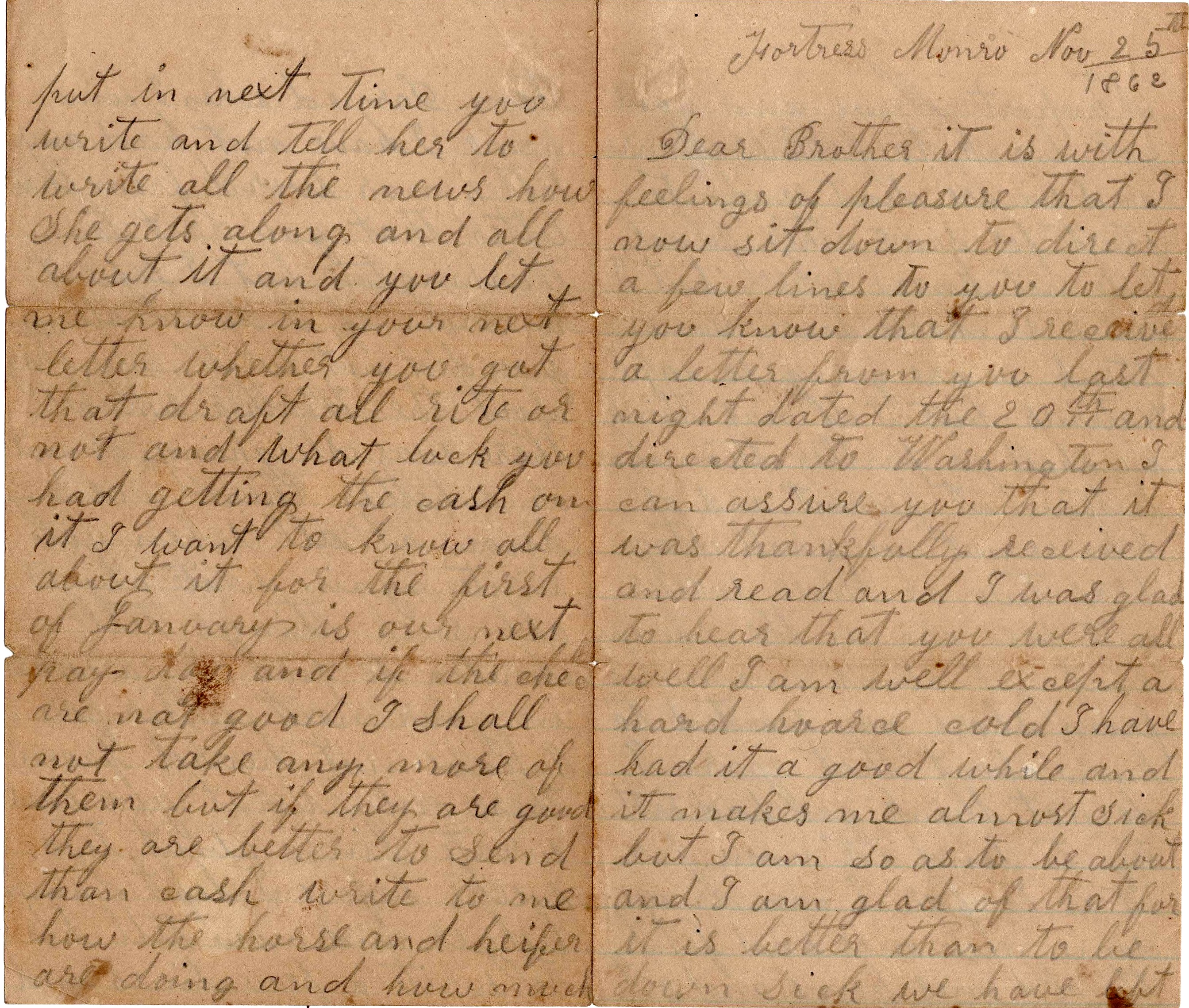
It is with feelings of pleasure that I now sit down to direct a few lines to you to let you know that I received a letter from you last night dated the 20th and directed to Washington. I can assure you that it was thankfully received and read and I was glad to hear that you were all well. I am well except a hard cold. I have had it a good while and it makes me almost sick but I am so as to be about and I am glad of that for it is better than to be down sick.
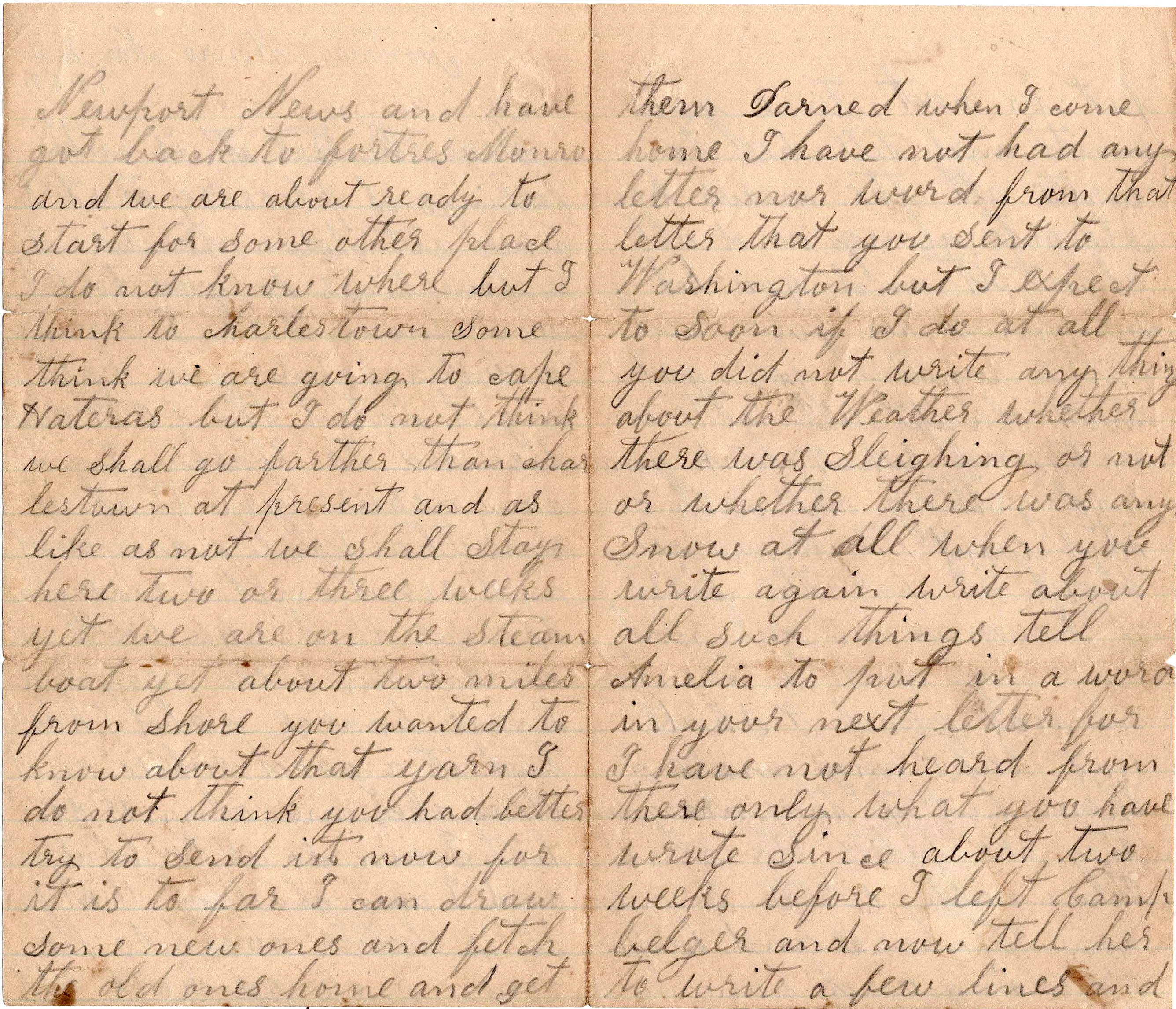
We have left Newport News and have got back to Fortress Monrow and we are about ready to start for some other place. I do not know where but I think to Charleston. Some think we are going to Cape Hatteras but I do not think we shall go farther that Charleston at present and as like as not, we shall stay here two or three weeks yet. We are on the steamboat yet about two miles from shore.
You wanted to know about that yarn. I do not think you had better try to send it now for it is too far. I can draw some news ones and fetch the old ones home and get them darned when I come home. I have not had any letter nor word from that letter that you sent to Washington but I expect to soon if I do at all. You did not write anything about the weather, whether there was sleighing or not, or whether there was any snow at all. When you write again, write about all such things. Tell Amelia to put in a word in your next letter for I have not heard from there—only what you have wrote since about two weeks after I left Camp Belger. And now tell here to write a few lines and put in the next time you write. And tell her to write all the news—how she gets along, and all about it.
And you let me know in your next letter whether you got that draft all right or not, and what luck you had getting the cash on it. I want to know all about it for the first of January is our next pay. And if the checks are not good, I shall not take any more of them. But if they are good, they are better to send than cash.
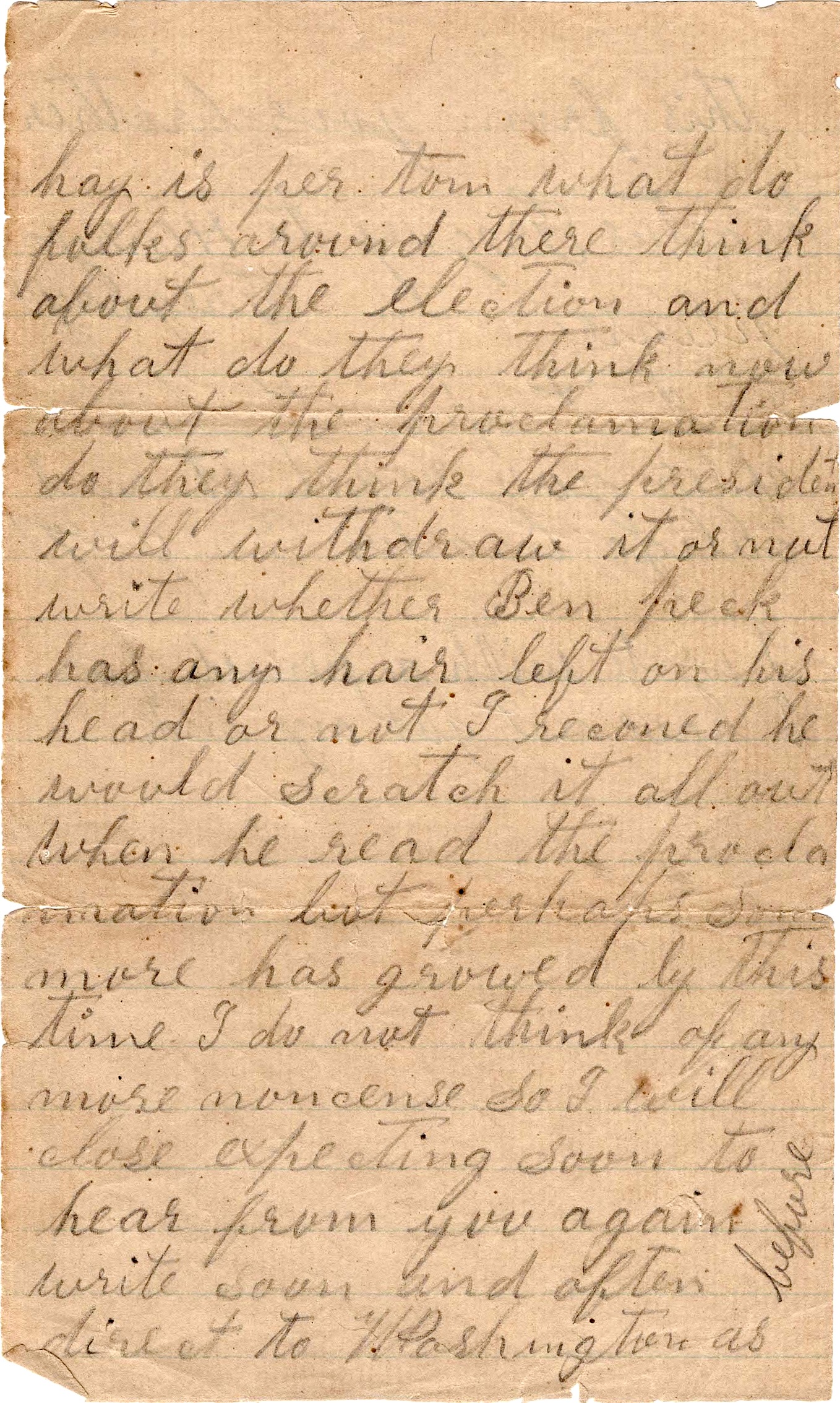
Write to me how the horse and heifer are doing, and how much hay is per ton, What do the folks around there think about the election, and what do they think now about the [Emancipation] Proclamation? Do they think the President will withdraw it or not? Write whether Ben Peck has any hair left on his head or not. I reconned he would scratch it all out when he read the Proclamation. But perhaps some more has growed by this time.
I do not think of any more nonsense so I will close, expecting soon to hear from you again. Write soon and often. Direct to Washington as before. This from your brother, — Erastus Gregory
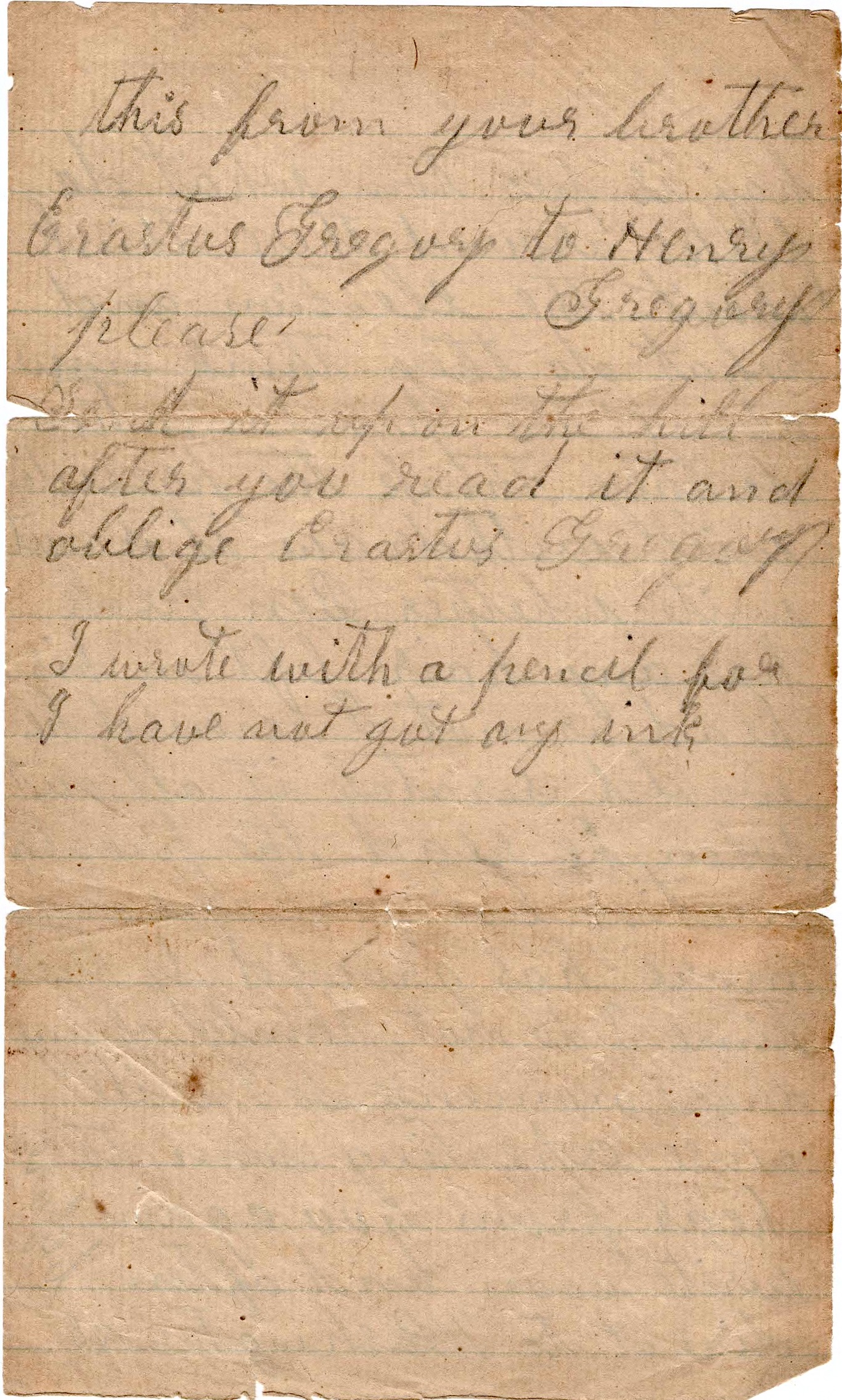
To Henry Gregory
Please, send it up on the hill after you read it and oblige Erastus Gregory. I wrote with a pencil for I have not got any ink.
Letter 13
New Orleans. La.
December [blank, but letter started on 15 December 1862]
Dear Brother,
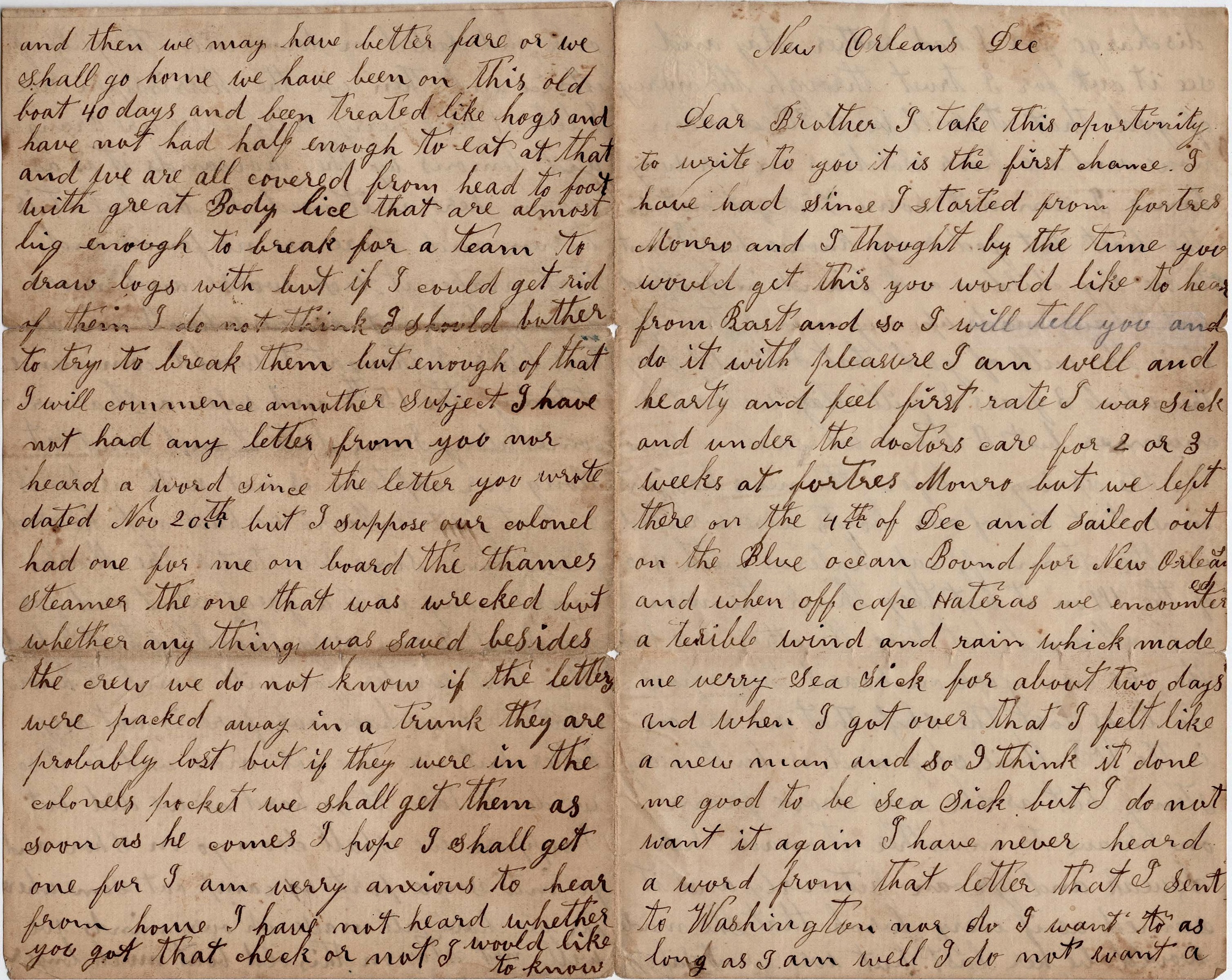
I take this opportunity to write to you. It is the first chance I have had since I started from Fortress Monroe and I thought by the time you would get this, you would like to hear from Rast [Erastus] and so I will tell you and I do it with pleasure. I am well and hearty and feel first rate. I was sick and under the doctor’s care for two or three weeks at Fortress Monroe but we left there on the 4th of December and sailed out on the blue ocean bound for New Orleans and when off Cape Hatteras we encountered a terrible wind and rain which made me very seasick for about two days and when I got over that, I felt like a new man. And so I think it done me good to be seasick but I do not want it again.
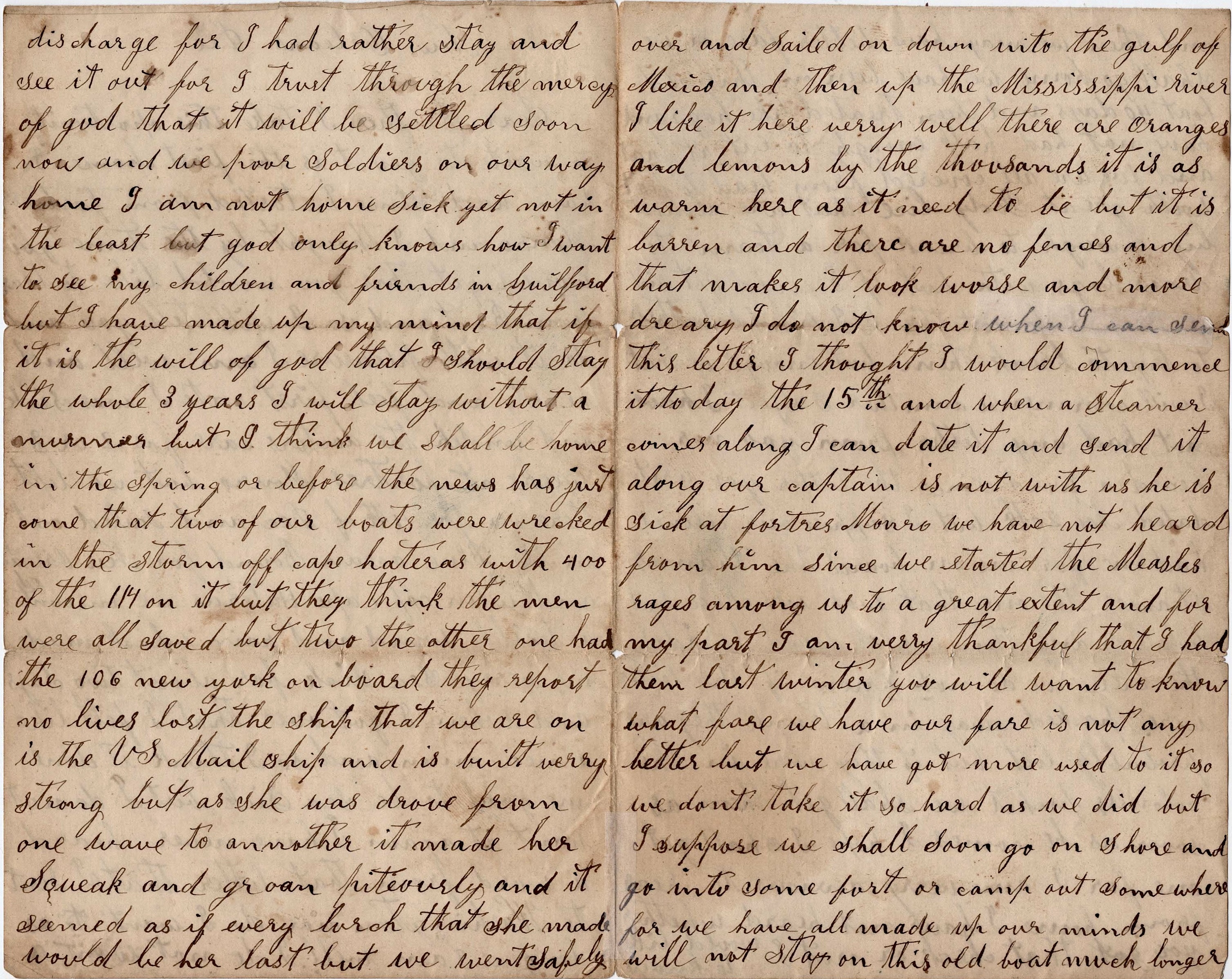
I have never heard a word from that letter that I sent to Washington nor do I want to as long as I am well. I do not want a discharge for I had rather stay and see it out for I trust through the mercy of God that it will be settled soon now and we poor soldiers on our way home. I am not home sick yet—not in the least, but God only knows how I want to see my children and friends in Guilford. But I have made up my mind that if it is the will of God that I should stay the whole three years, I will stay without a murmur. But I think we shall be home in the spring or before.
The news has just come that two of or boats were wrecked in the storm off Cape Hatteras with 400 of the 114th [New York] on it but they think the men were all saved but two. The other one had the 106th New York on board. They report no lives lost. The ship that we are on is the US Mail Ship and is built very strong but as she was drove from one wave to another, it made her squeak and groan piteously and it seemed as if every lurch that she made would be her last. But we went through safely over and sailed on down into the Gulf of Mexico and then up the Mississippi River.
I like it very well. There are oranges and lemons by the thousands. It is as warm here as it needs to be but it is barren and there are no fences and that makes it look worse and more dreary. I do not know when I can send this letter. I thought I would commence it today—the 15th—and when a steamer comes along, I can date it and send it along. Our captain is not with us. He is sick at Fortress Monroe. We have not heard from him since we started. The measles rages among us to a great extent and for my part, I am very thankful that I had them last winter.
You will want to know what fare we have. Our fare is not any better but we got more used to it so we don’t take it so hard as we did but I suppose we shall soon go on shore and go into some fort or camp out somewhere for we have all made up our minds we will not stay on this old boat much longer and then we may have better fare or we shall go home.
We have been on this old boat 40 days and been treated like hogs and have not had half enough to eat at that. And we are all covered from head to foot with great body lice that are almost big enough to break for a team to draw logs with. But if I could get rid of them, I do not think I should bother to try to break them. But enough of that. I will comence another subject.
I have not had any letter from you nor heard a word since the letter you wrote dated November 20th. But I suppose our Colonel had one for me on board the Thames steamer—the one that was wrecked. But whether anything was saved besides the crew, we do not know. If the letters were packed away in a trunk, they are probably lost. But if they were in the Colonel’s pocket, we shall get them, as soon as he comes. I hope I shall get one for I am very anxious to hear from home. I have not heard whether you got that check or not. I would like to know.
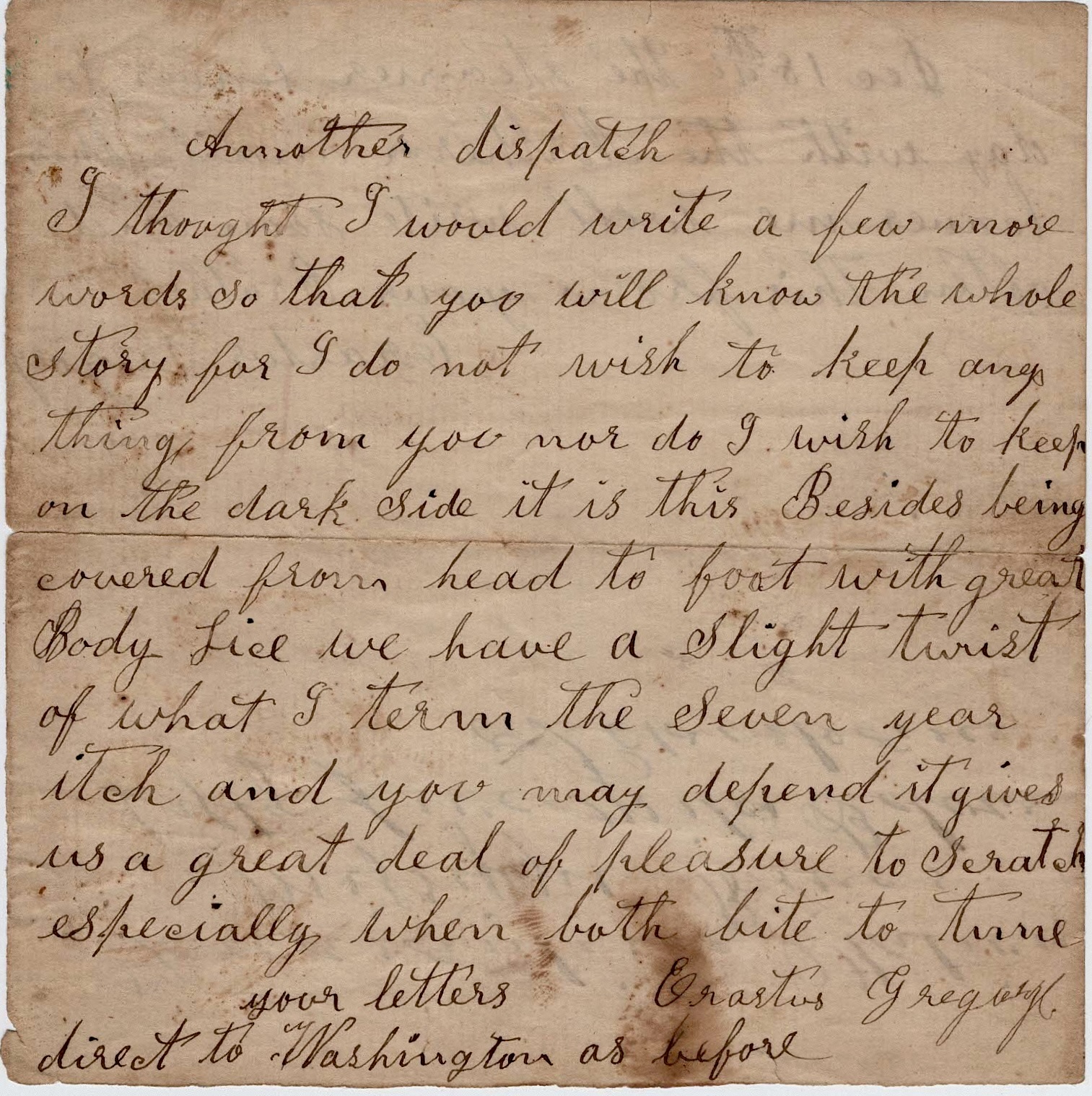
Another dispatch. I thought I would write a few more words so that you will know the whole story for I do not wish to keep anything from you nor do I wish to keep on the dark side. It is this. Besides being covered from head to foot with greeat body lice, we have a slight twist of what I term the Seven Year Itch and you may depend it gives us a great deal of pleasure to scratch—especially when both bite to time. Direct your letters to Washington as before. — Erastus Gregory
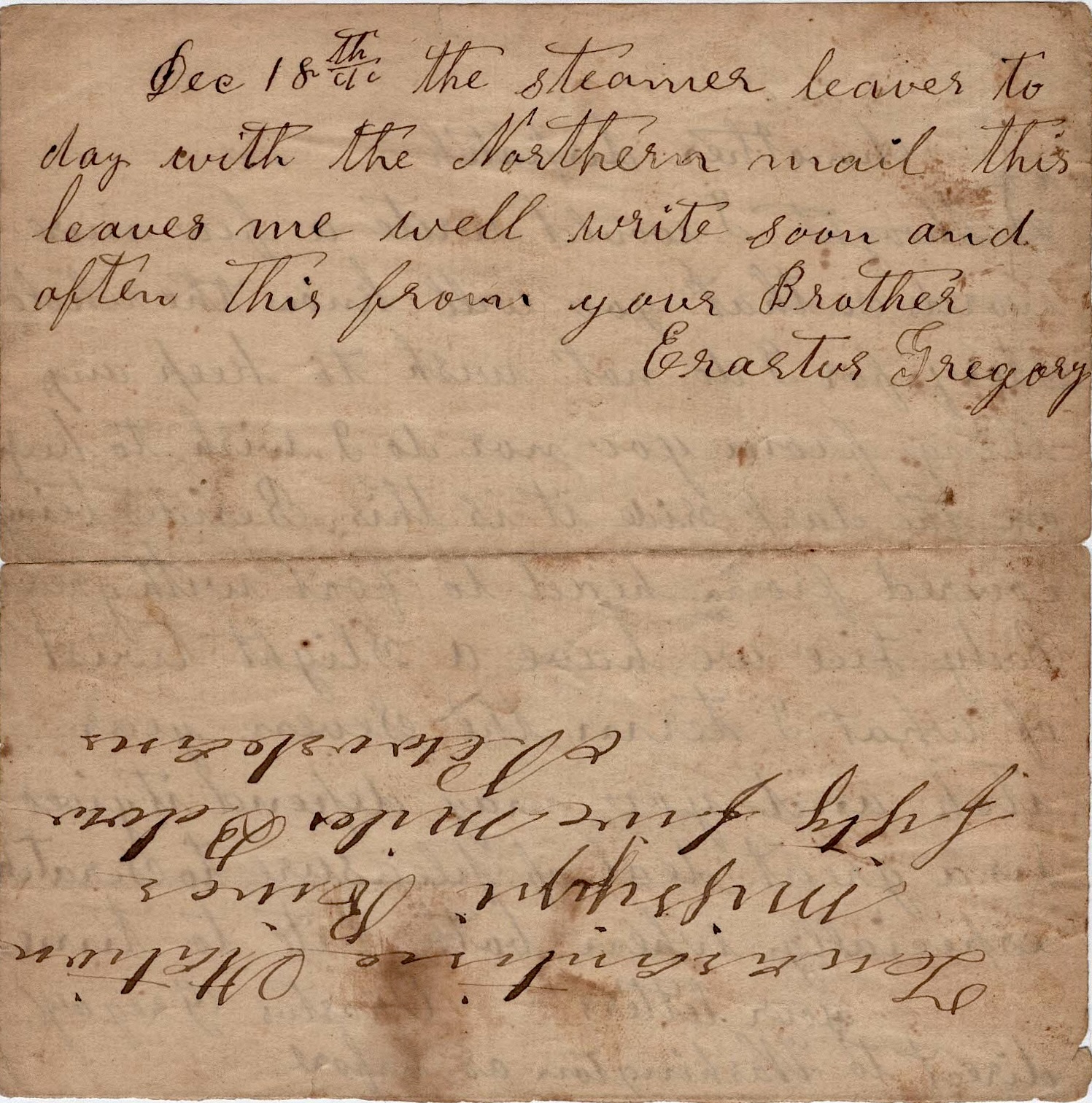
December 18th. The staemer leaves today with the northern mail. This leaves me well. Write soon and often. This from your brother, — Erastus Gregory
Quarantine Station, Mississippi River, fifty-five miles below New Orleans.
Letter 14
New Orleans, La.
Thursday, January 29th 1863
Dear Brother and all of you,
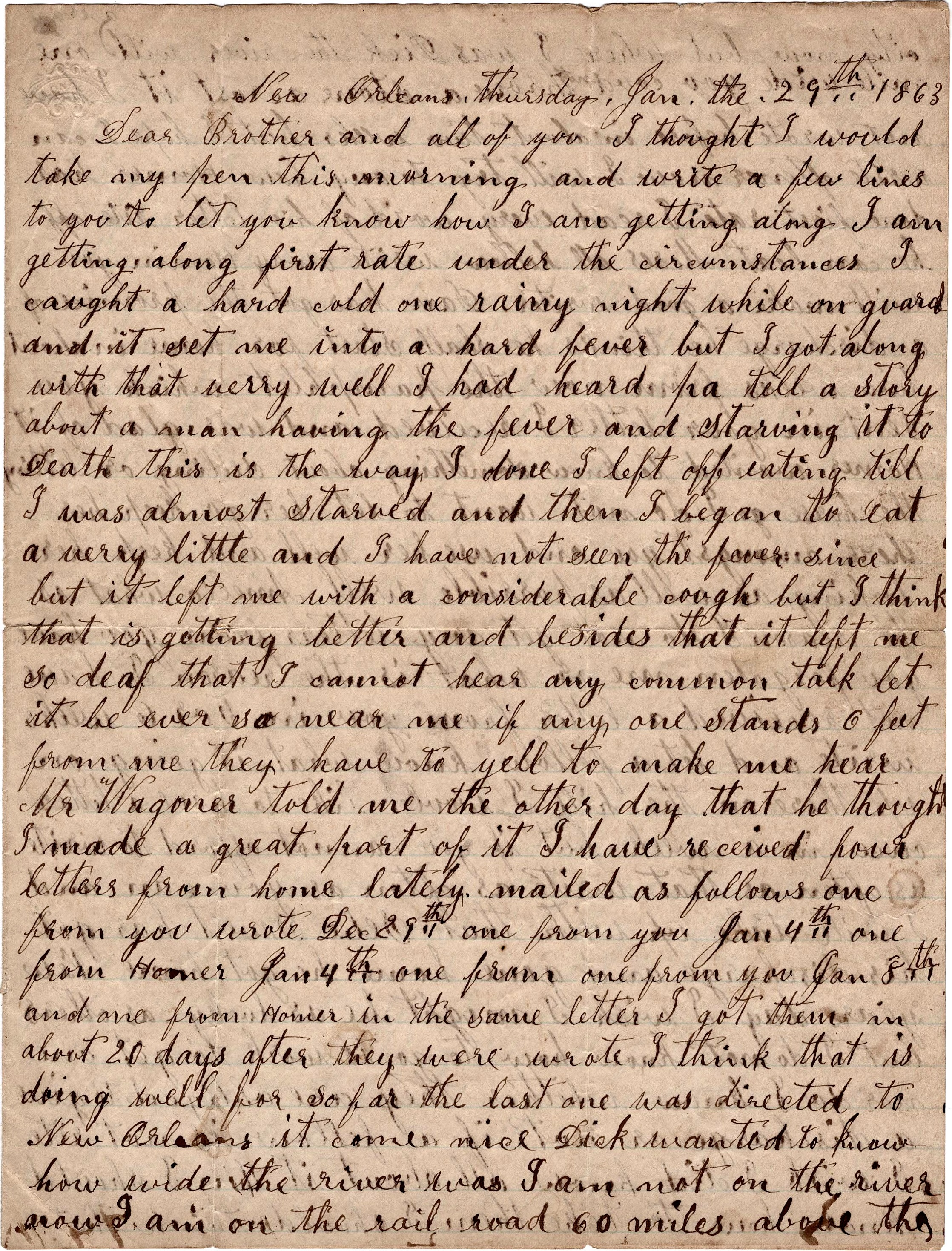
I thought I would take my pen this morning and write a few lines to you to let you know how I am getting along. I am getting along first rate under the circumstances. I caught a hard cold one rainy night while on guard and it set me into a hards fever but I got along with that very well. I had heard Pa tell a story about a man having the fever and starving it to death. This is the way I done. I left off eating till I was almost starved and then I bean to eat a very little and I have not see the fever since, but it left me with a considerable cough. But I think that is getting better. And besides that, it left me so deaf that I cannot hear any common talk, let it be ever so near me. They have to yell to make me hear. Mr. Wagoner told me the other day that he thought I made a great part of it.
I have received four letters from home lately mailed as follows. One from you, wrote December 29th; one from you, January 4th; one from Homer, January 4th; and one from you, January 8th and from Homer in the same letter. I got them in about twenty days after they were wrote. I think that is doing well for so far. The last one was directed to New Orleans. It come nice.
Dick wanted to know how wide the [Mississippi] river was, I am not on the river now. I am on the railroad 60 miles above the City now but where I wasm Dick, the river will average one mile wide. You couldn’t throw a stone across it. I have not wrote before in about two weeks but I hope I can write oftener now. I will try to anyhow.
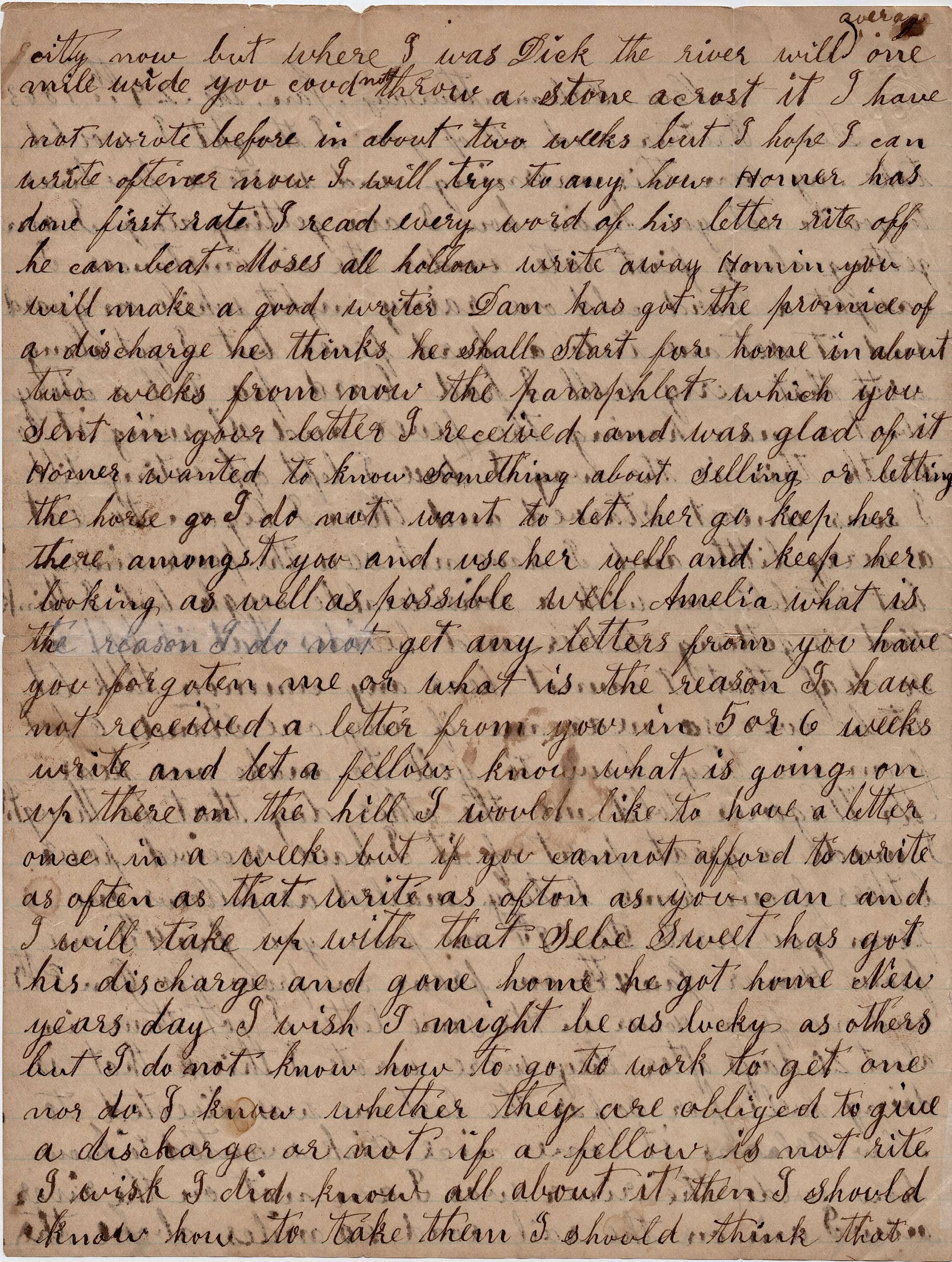
Homer has done first rate. I read every word of his letter right off. He can beat Moses all hollow. Write away Homer! You will make a good writer. Dan has got the promise of his discharge. He thinks he shall start for home in about two weeks from now. The pamphlet which you sent in your letter I received and was glad of it. Homer wanted to know something about selling or letting the horse go. I do not want to let her go. Keep her there amongst you and use her well and keep her looking as well as possible.
Well Amelia, what is the reason I do not get any letters from you. Have you forgotten me or what is the reason? I have not received a letter from you in 5 or 6 weeks. Write and let a fellow know what is going on up there on the hill. I would like to have a letter once in a week but if you cannot afford to write as often as that, write as often as you can and I will take up with that.
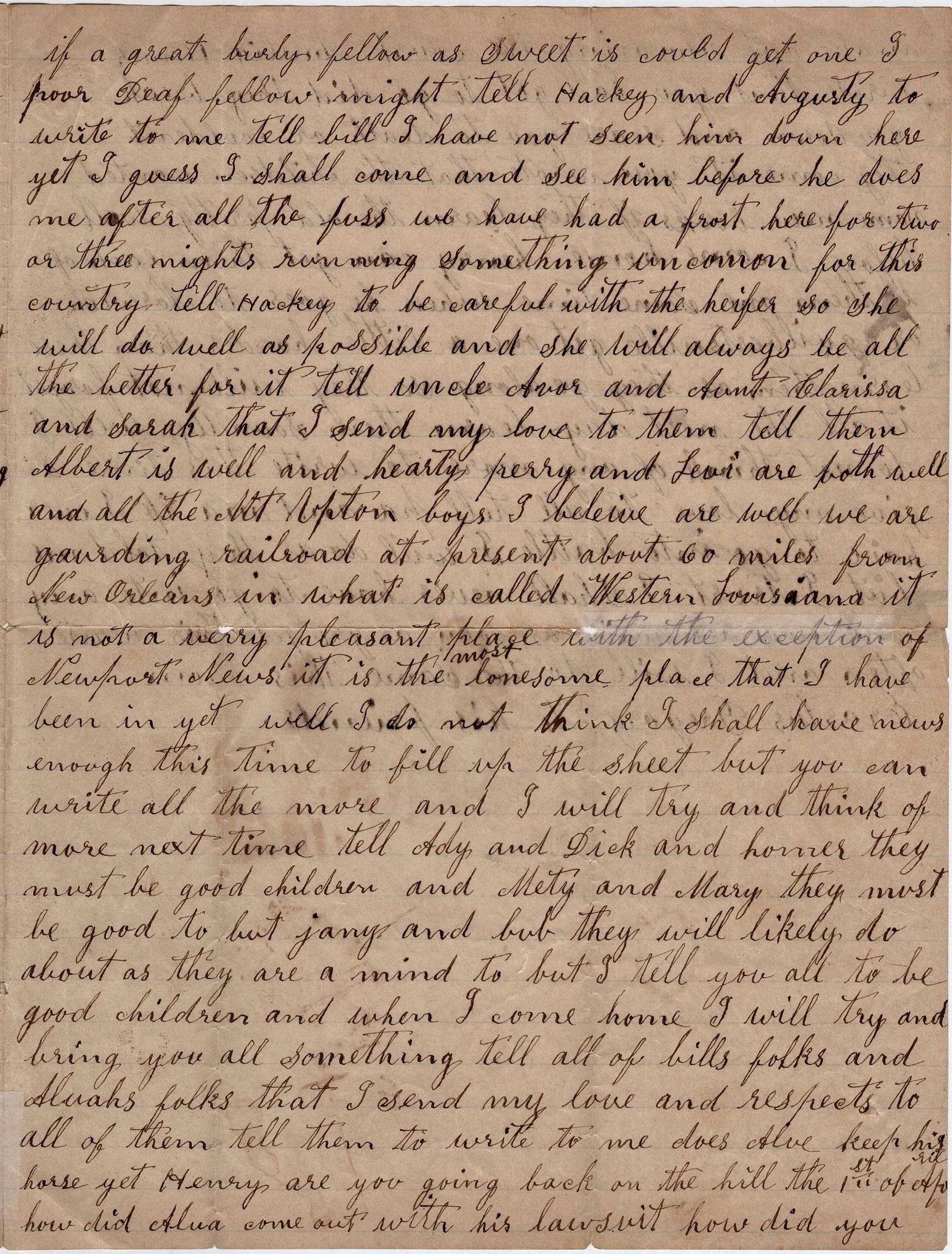
Sebe Sweet has got his discharge and gone home. He got home New Yoear’s Day. I wish I might be as lucky as others but I do not know how to go to work to get one, nor do I know whether they are obliged to give a discharge or not if a fellow is not right. I wish I did know all about it. Then I should know how to take them. I should think that if a great burley fellow [such] as Sweet could get one, I—poor deaf fellow—might. Tell Harkey and Augusta to write to me. Tell Bill I have not seen him down here yet. I guess I shall come and see him before he does me after all the fuss.
We have had a frost here for two or three nights running, something uncommon for this country. Tell Tell Harkey to be careful with the heifer so she will do well as possible and she will always be all the better for it. Tell Uncle Avor and Aunt Clarissa and Sarah that I send my love to them. Tell them Albert is well and hearty. Perry and Levi are both well and all the Mt. Upton boys, I believe, are well.
We are guarding railroad at present about 60 miles from New Orleans in what is called Western Louisiana. It is not a very pleasant place. With the exception of Newport News, it is the most lonesome place that I have been in yet.
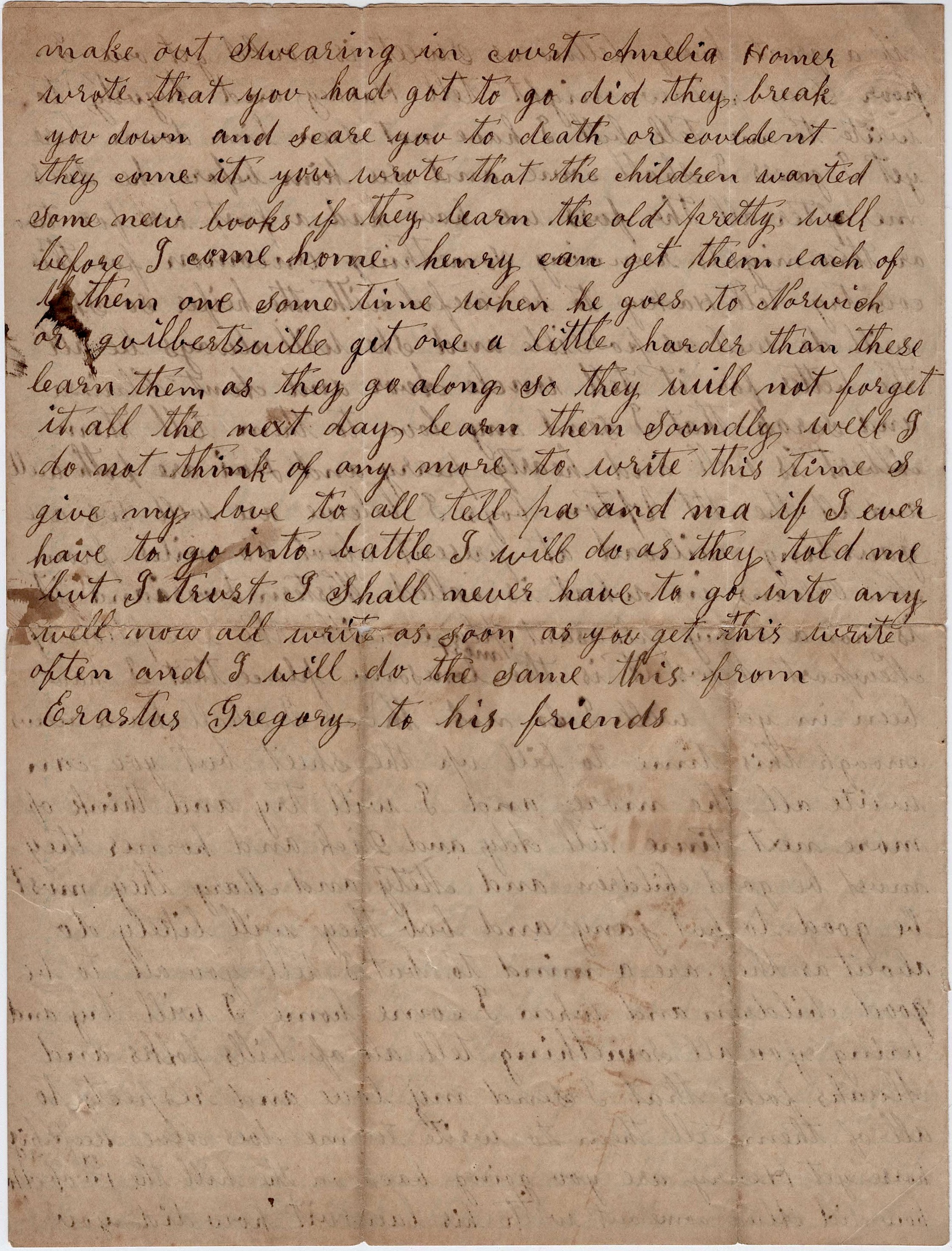
Well I do not think I shall have news enough this time to fill up the sheet. But you can write all the more and I will try and think of more next time. Telly Ady and Dick and Homer they must be good children and Mety and Mary, they must be good too. But Hany and Bob, they will likely do about as they are a mind to. But I tell you all to be good children and when I come home, I will try and bring you all something. Tell all of Bill’s folks and Alvah’s folks that I send my love and respects to all of them. Tell them to write to me. Does Alve keep his horse yet? Henry, are you going back on the hill the 1st of April? How did Alva come out with the lawsuit? How did you make out swearing in court, Amelia? Homer wrote that you had got to go. Did they break you down and scare you to death? Or couldn’t they come it?
You wrote that the children wanted some new books. If they learn the old pretty well before I come home, Henry can get them each of them one sometime when he goes to Norwich or Gilbertsville. Get one a little harder than these. Learn them as they go along so they will not forget it all the next day. Learn them soundly.
Well, I do not think of any more to write this time. Give my love to all. Tell pa and ma if I ever have to go into battle, I will do as they told me but I trust I shall never have to go into any. Well now, all write as soon as you get this. Write often and I will do the same. This from Erastus Gregory
To his friends.
Letter 15
New Orleans, La.
Sunday, February 8th 1863
Dear Brother and all the rest of you.
I have a few leisure moments and I thought I could not better improve them than in writing to you. I am usually well at present although I have a considerable cough but not near as bad as it has been. I have some medicine which I think helps me. I am pretty deaf but not as deaf as I have been.
Dan has got his discharge and he will probably be there to your house by the time you get this letter but do not let my horse go to take him to Canistota. He may say that I said the horse might go but I did not. I told him he might get Henry to go and carry him if he could but to get rid of him I told him I would not trust Hackey up there with my horse and then he stopped teasing me about it. But you be sure and not let the horse go for I had rather pay his passage on the stage.
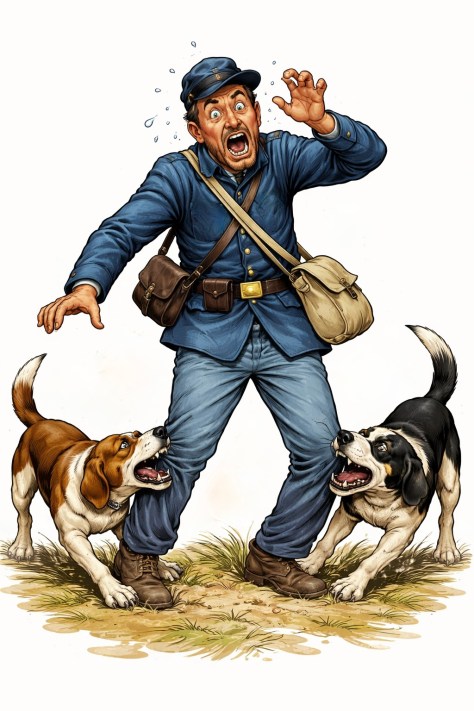
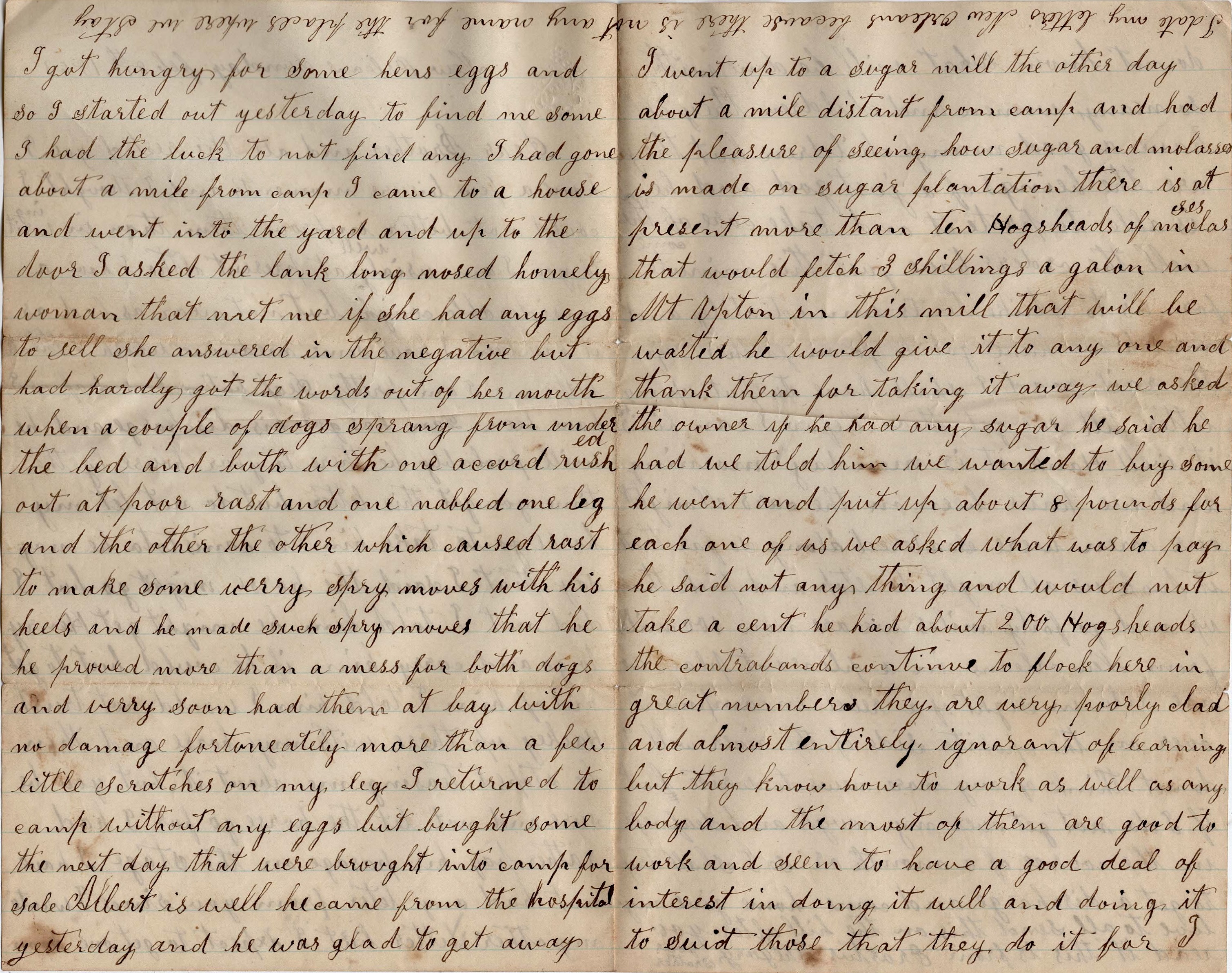
I have not had any letter from you since I wrote my other letter but I expect to get one soon. I got hungry for some eggs and so I started out yesterday to find me some. I had the luck to not find any. I had gone about a mile from camp [when] I came to a house and went into the yard and up to the door, I asked the lank, long-nosed, homely woman that met me if she had any eggs to see. She answered in the negative but had hardly got the words out of her mouth when a couple of dogs sprang from under the bed and both with one accord rushed out at poor Rast [Erastus] and one nabbed one leg and the other the other which caused Rast to make some very spry moves with his heels and he made such spry moves that he proved more than a mess for both dogs and very soon had them at bay with no damage fortunately more than a few little scratches on my leg. I returned to camp without any eggs but bought some the next day that were brought into camp for sale.
Albert is well. He came from the hospital yesterday and he was glad to get away.
I went up to a sugar mill the other day about a mile distant from camp and had the pleasure of seeing how sugar and molasses is made on a sugar plantation. There is at present more than ten hogsheads of molasses that would fetch three shillings a gallon in Mount Upton in this mill that will be wasted. He would give it to anyone and thank them for taking it away. We asked the owner if he had any sugar. He said he had. We told him we wanted to buy some. He went and put up about 8 pounds for each one of us. We asked what was to pay. He said not anything and would not take a cent. He had about 200 hogsheads.
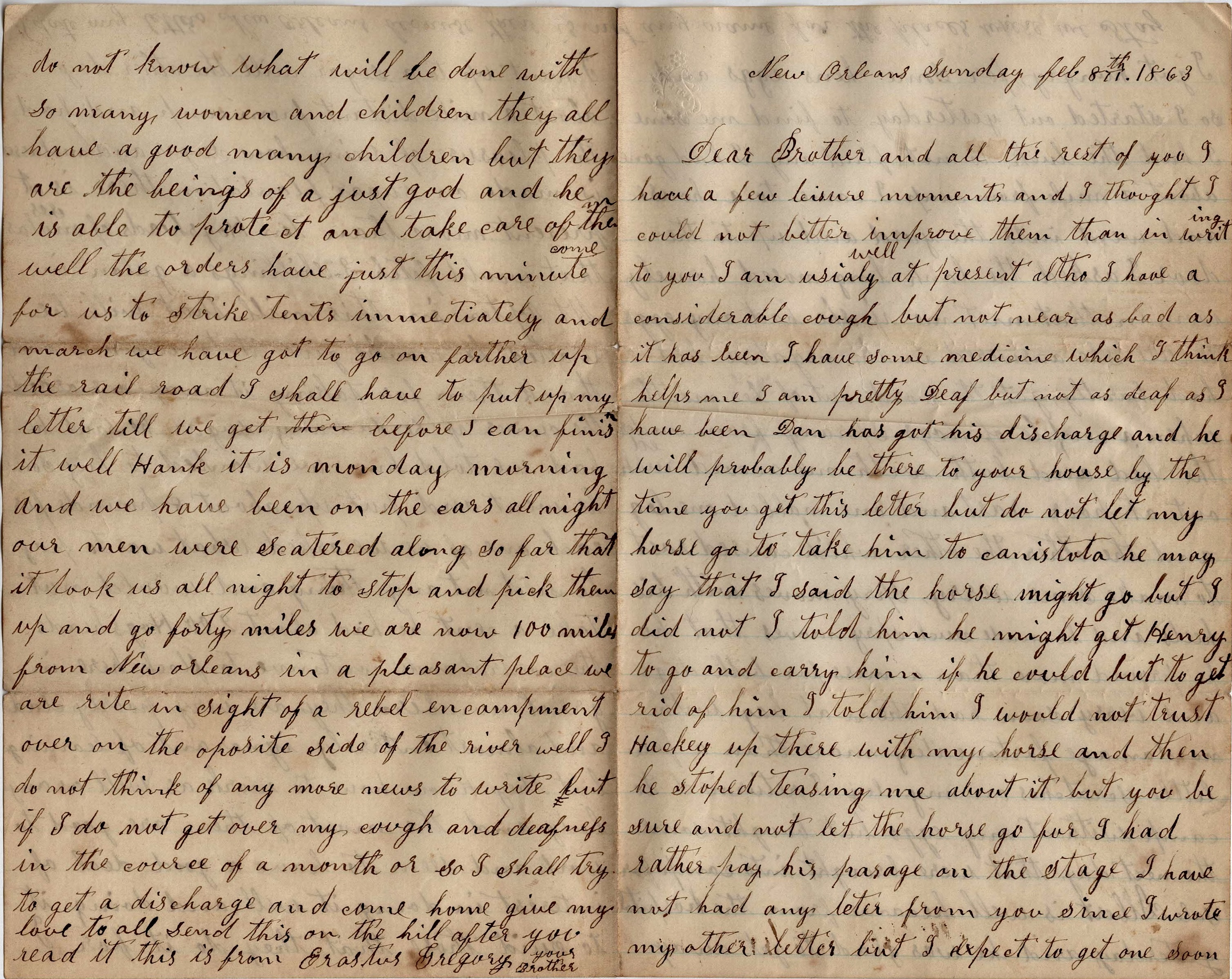
The contrabands continue to flock here in great numbers. They are very poorly clad and almost entirely ignorant of learning but they know how to work as well as anybody and the most of them are good to work and seem to have a good deal of interest in doing it well and doing it too. Said those that they do it for do not know what will be done with so many women and children. They all have a good many children but they are the beings of a just God and He is able to protect and take care of them well.
The orders have just this minute come for us to strike tents immediately and march. We have got to go on further up the railroad. I shall have to put up my letter till we get there before I can finish it.
Well, Hank, it is Monday morning and we have been on the cars all night. Our men were scattered along so far that it took us all night to stop and pick them up and go forty miles. We are now 100 miles from New Orleans in a pleasant place. we are right in sight of a rebel encampment over on the opposite side of the river.
Well, I do not think of any more news to write but if I do not get over my cough and deafness in the course of a month or so, I shall try to get a discharge and come home. Give my love to all. Send this on the hill after you read it. This is from Erastus Gregory, your brother.
Letter 16
[Editor’s Note: Erastus’s letter of 29 April 1863 describes the movements of the 114th New York Infantry throughout the Western Louisiana Campaign including the Battle of Fort Bisland on 12-13 April. The regiment had 11 men wounded in that campaign. They were attached to Weitzel’s 2nd Brigade, Augur’s 1st Division of the 19th Army Corps.]
New Orleans, La.
Wednesday, April 29th 1863
Dear Brother,
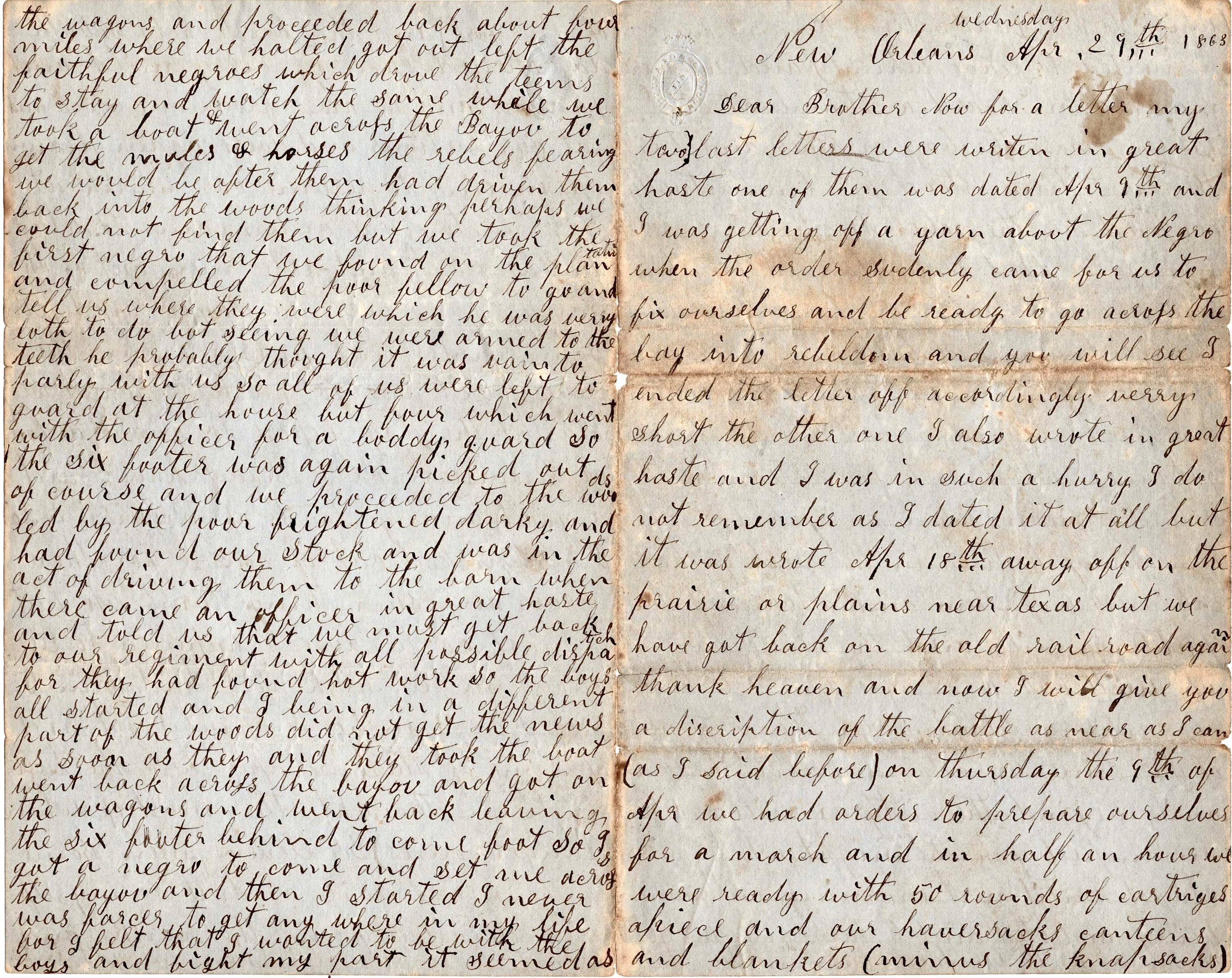
Now for a letter. My two last letters were written in haste. One of them was dated April 9th and I was getting off a yarn about the Negro when the Orderly Sergeant came for us to fix ourselves and be ready to go across the Bay into rebeldom. And you will see I ended the letter off accordingly very short. The other one I also wrote in great haste and I was in such a hurry I do not remember as I dated it at all but it was wrote April 18th away off on the prairie or plains near Texas. But we have got back on the old railroad again, thank heaven.
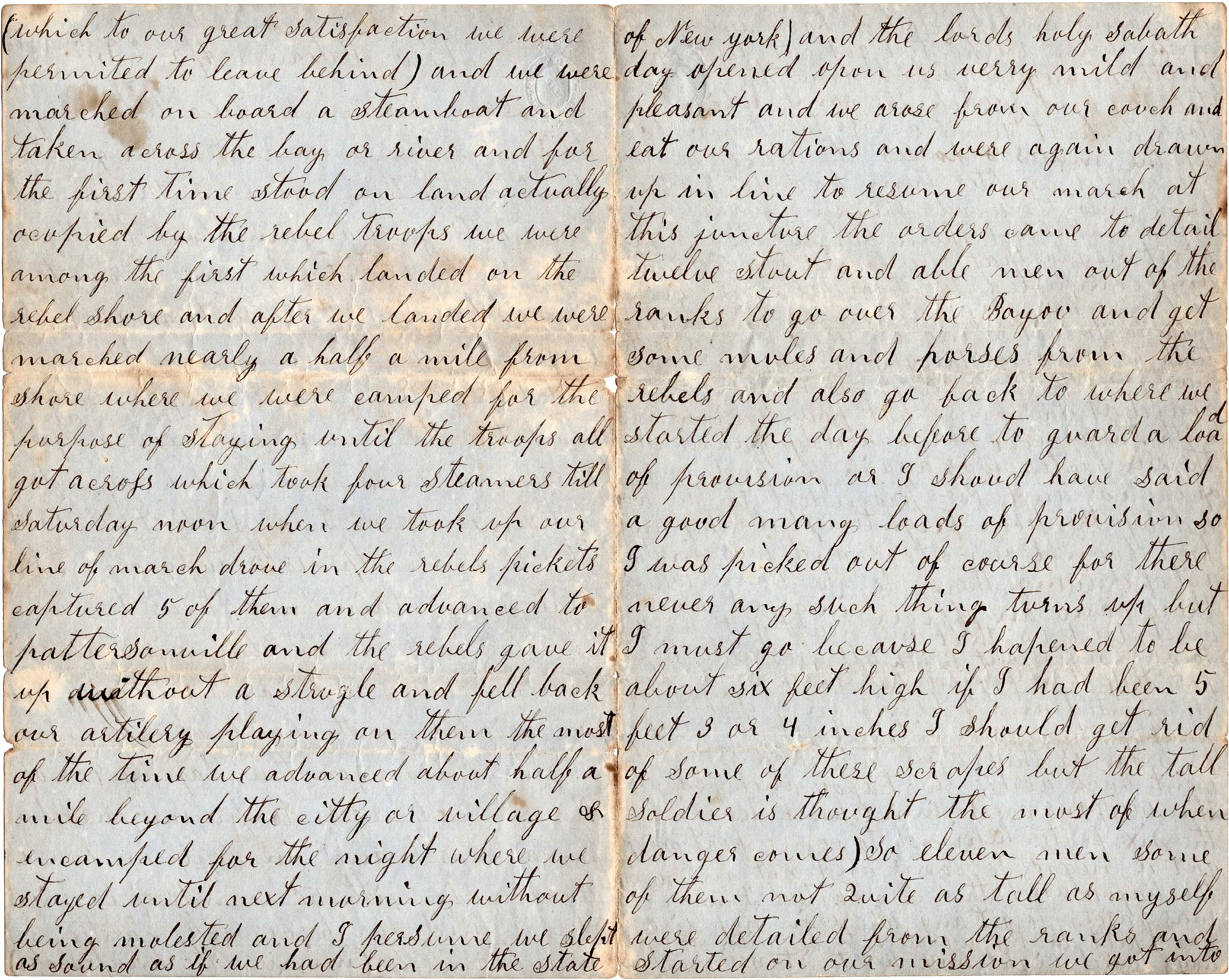
And now I will give you a description of the battle as near as I can. As I said before, on Thursday the 9th of April, we had orders to prepare ourselves for a march and in half an hour we were ready with 50 rounds of cartridges apiece and our haversacks, canteen and blankets (minus the knapsack which to our great satisfaction we were permitted to leave behind) and we were marched on board of a steamboat and taken across the bay or river and for the first time stood on land actually occupied by the rebel troops. We were among the first which landed. We were marched mearly a half a mile from shore where we were camped for the purpose of staying until the troops all got across which took four steamers till Saturday noon when we took up our line of march, drove in the rebel pickets, captured five of them, and advanced to Pattersonville and the rebels gave it up without a struggle and fell back, our artillery playing on them the most of the time.
We advanced about a mile beyond the city or village & encamped for the night where we stayed until next morning without being molested and I presume we slept as sound as if we had been in the State of New York and the Lord’s Holy Sabbath day opened upon us very mild and pleasant. We arose from our couch and eat our rations and were again drawn up in line to resume our march. At this juncture, the orders came to detail twelve stout and able men out of the ranks to go over the Bayou and get some mules and horses from the rebels and also go back to where we started the day before to guard a load or provision—or I should have said a good many loads of provisions. So I was picked out of course for there never any such thing turns up but I must go because I happened to be about six feet high. If I had been 5 feet 3 or 4 inches, I should get rid of some of these scrapes but the tall soldier is thought the most of when danger comes.
So eleven men, some of them not quite as tall as myself, were detailed from th ranks and started on our mission. We got in the wagons and proceeded back about four miles where we halted, got out, left the faithful negroes which drove the teams to stay and watch the same while we took a boat, went across the Bayou to get the mules and horses. The rebels, fearing we would be after them, had driven them back into the woods thinking perhaps we could not find them but we took the first negro that we found on the plantation and compelled the poor fellow to go and tell us where they were which he was very loathe to do. But seeing we were armed to the teeth, he probably thought it was vain to parley with us so all of us were left to guard at the house but four which went with the officer for a body guard. So the six-footer was again picked out, of course, and we proceeded to the woods led by the poor, frightened darky and found our stock and was in the act of driving them to the barn when there came an officer in great haste and told us that we must get back to our regiment with all possible dispatch for they had found hot work.
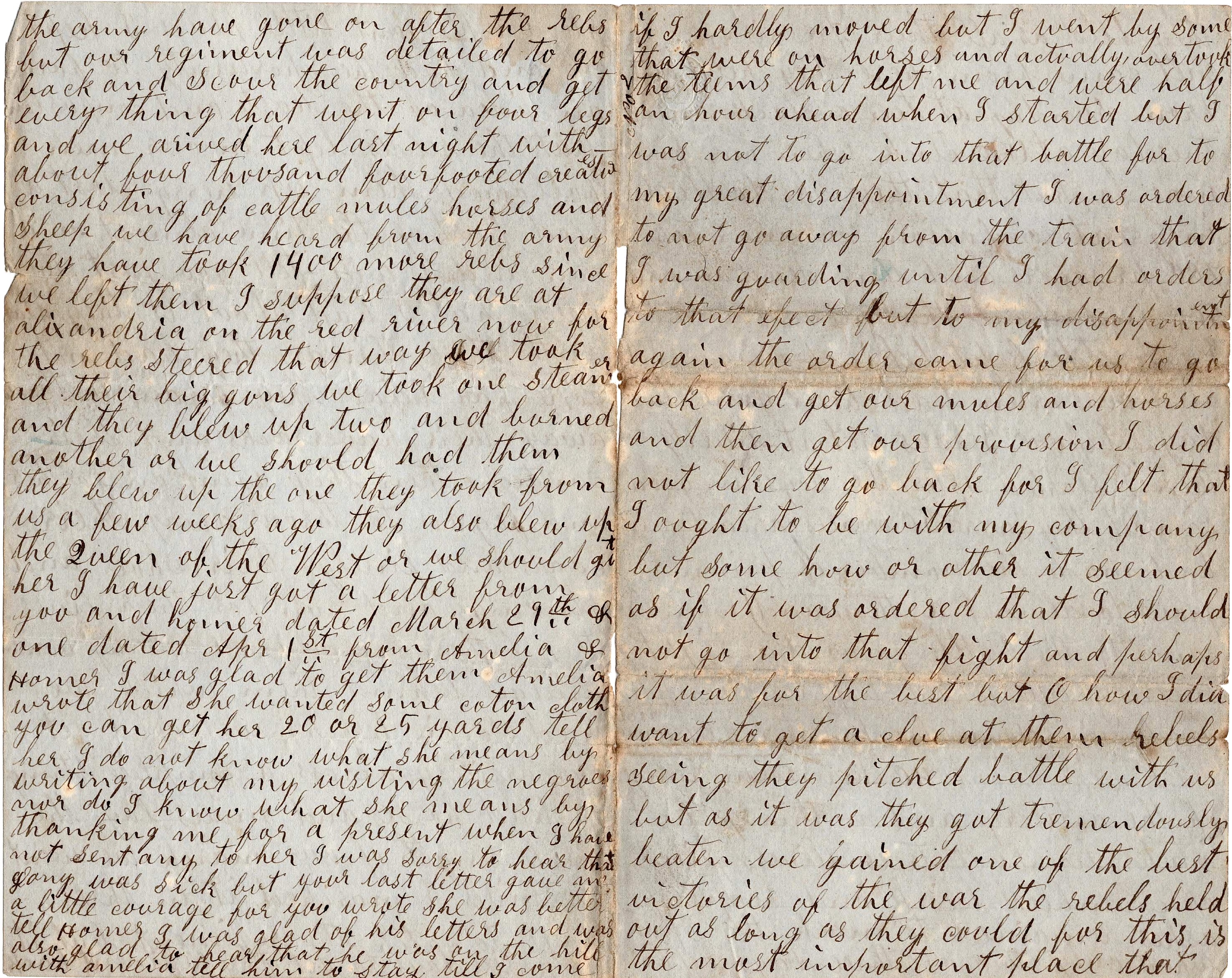
So the boys all started and I, being in a different part of the woods, did not get the news as soon as they and they took the boat, went back across the bayou, and got on the wagons and went back, leaving the six footer behind to come foot. So I got a negro to come and set me across the bayou and then I started. I never was fiercer to get anywhere in my life for I felt that I wanted to be with the boys and fight my part. It seemed as if I hardly moved but I went by some that were on horses and actually overtook the teams that left me and were half an hour ahead when I started.
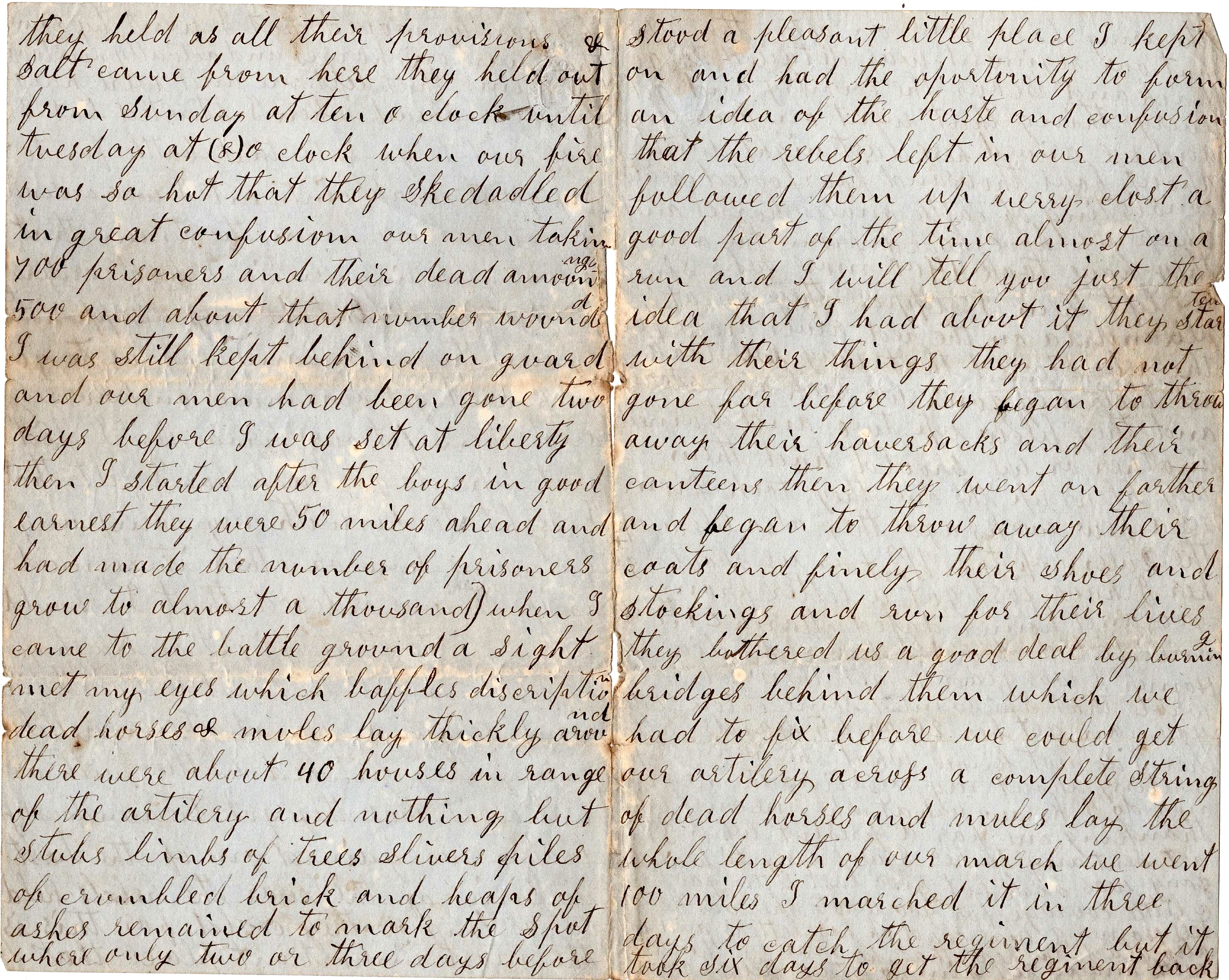
But I was not to go into that battle for to my great disappointment, I was ordered to not go away from the train that I was guarding until I had orders to that effect. But to my disappointment again, the orders came for us to go back and get our mules and horses and then get our provisions. I did not like to go back for I felt that I ought to be with my company but somehow or other it seemed as if it was ordered that I should not go into that fight and perhaps it was for the best. But Oh! how I did want to get a clue at them rebels, seeing they pitched battle with us. But as it was, they got tremendously beaten. We gained one of the best victories of the war. The rebels held out as long as they could for this is the most important place that they held as their provisions & salt came from here. They held out from Sunday at ten o’clock until Tuesday at 8 o’clock when our fire was so hot that they skedaddled in great confusion, our men taking 700 prisoners and their dead around 500 and about that [same] number wounded.
I was still kept behind on guard and our men had been gone two days before I was set at liberty. Then I started after the boys in good earnest. They were 50 miles ahead and had made the number of prisoners grow to almost a thousand. When I came to the battle ground, a sight met my eyes which baffles description. Dead horses & mules lay thickly around. There were about 40 houses in range of the artillery and nothing but stubs, limbs of trees, slivers, piles of crumbled brick, and heaps of ashes remained to mark the spot where only two or three days before stood a pleasant little place. I kept on and had the opportunity to form an idea of the haste and confusion that the rebels left in. Our men followed them up very close a good part of the time almost on a run and I will tell you just the idea that I had about it. They started with their things [but] they had not gone far before they began to throw away their haversacks and their canteens. They they went on farther and began to throw away their coats and finally their shoes and stockings and run for their lives. They bothered us a good deal by burning bridges behind them which we had to fix before we could get our artillery across. A complete string of dead horses and mules lay the whole length of our march. We went 100 miles. I marched it i three days to catch the regiment but it took six days to get the regiment back.
The army have gone on after the rebs but our regiment was detailed to go back and scour the country and get everything that went on four legs and we arrived here last night with about four thousand 4-footed creatures consisting of cattle, mules, horses, and sheep. We have heard from the army. They have took 1400 more rebs since we left them. I suppose they are at Alexandria on the Red River now for the rebs steered that way. we took all their big guns. We took one steamer and they blew up two and burned another or we should have them. They blew up the one they took from us a few weeks ago. They also blew up the Queen of the West or we should have got her.
I have just got a letter from you and Homer dated March 29th *& one dated April 1st from Amelia & Homer. I was glad to get them. Amelia wrote that she wanted some cotton cloth. You can get her 20 or 25 yards. Tell her I do not know what she means by writing about my visiting the negroes nor do I know what she means by thanking me for a present when I have not sent any to her. I was sorry to hear that Janey was sick but your last letter gave me a little courage for you wrote she was better. Tell Homer I was glad of his letters and was also glad to hear that he was on the hill with Amelia. Tell him to stay till I come home and he shall not lose anything by it. I will send he and Dick an ink stand if I can get any more.
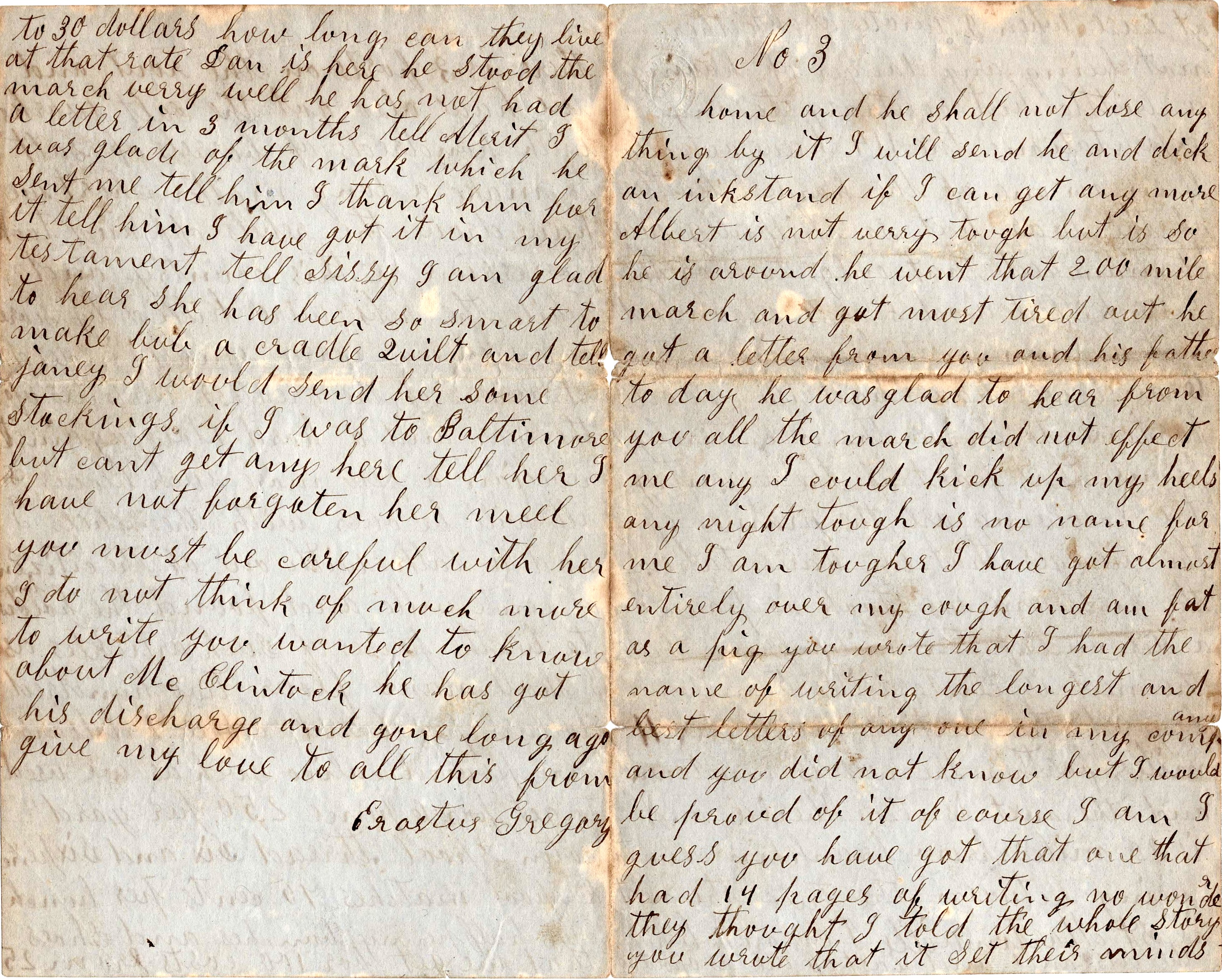
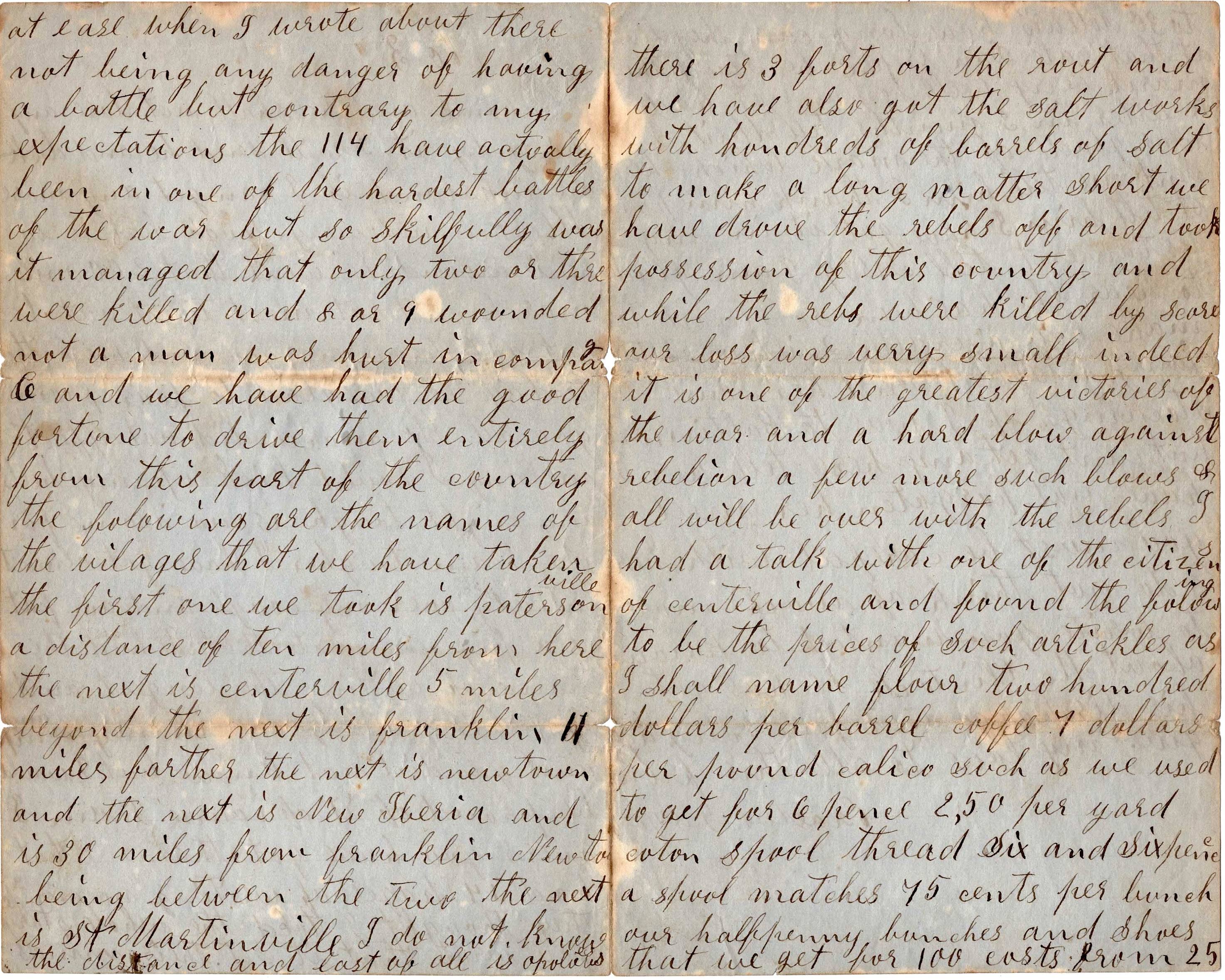
Albert is not very tough but is so he is around. He went that 200 mile march and got most tired out. He got a letter from you and his father today. He was glad to hear from you all. The march did not affect me any. I could kick up my heels any night. Tough is no name for me. I am tougher. I have got almost entirely over my cough and am fat as a pig. You wrote that I had the name of writing the longest and best letters of anyone in my company and you did not know but I would be proud of it. Of course I am. I guess you have got that one that had 14 pages of writing. No wonder they thought I told the whole story. You wrote that it set their minds at ease when I wrote about there not being any danger of having a battle. But contrary to my expectations, the 114th [New York] have actually been in one of the hardest battles of the war but so skillfully was it managed, that only two or three were killed and 8 or 9 wounded. Not a man was hurt in Company C and we have had the good fortune to drive them entirely from this part of the country.
The following are the names of the villages that we have taken. The first one we took is Pattersonville, a distance of ten miles from here. The next is Centerville, 5 miles beyond. The next is Franklin, 11 miles farther/ The next is Newtown and the next is New Iberia and is 30 miles from Franklin. Newtown being between the two. The next is St. Martinville. I do not know the distance, and last of all is Opelousas. There is three forts on the route and we have also got the salt works with hundreds of barrels of salt. To make a long matter short, we have drove the rebels off and took possession of this country and while the rebs were killed by scores, our loss was very small indeed. It is one of the greatest victories of the war and a hard blow against rebellion. A few more such blows and all will be over with the rebels.
I had a talk with one of the citizens of Centerville and found the following to be the prices of such articles as I shall name. Flour two hundred dollars per barrel. Coffee 7 dollars per pound. Calico such as we used to get for 6 pence $2.50 per yard. Cotton spool matches 75 cents per bunch our halfpenny bunches, and shoes that we get for $1 costs from 25 to 30 dollars. How long can they live at that rate?
Dan is here. He stood the march very well. He has not had a letter in three months. Tell Albert I was glad of the mark which he sent me. Tell him I thank him for it. Tell him I have got it in my testament. Tell Sissy I am glad to hear she has been so smart to make Bob a cradle quilt and tell Janey I would send her some stockings if I was to Baltimore but can’t get any here. Tell her I have not forgotten her. Meel, you must be careful with her. I do not think of much more to write. you wanted to know about McClintock. He has got his discharge and gone long ago. Give my love to all. From — Erastus Gregory
Letter 17
Opelousas, [La.]
May 18th [1863]
Dear Brother,
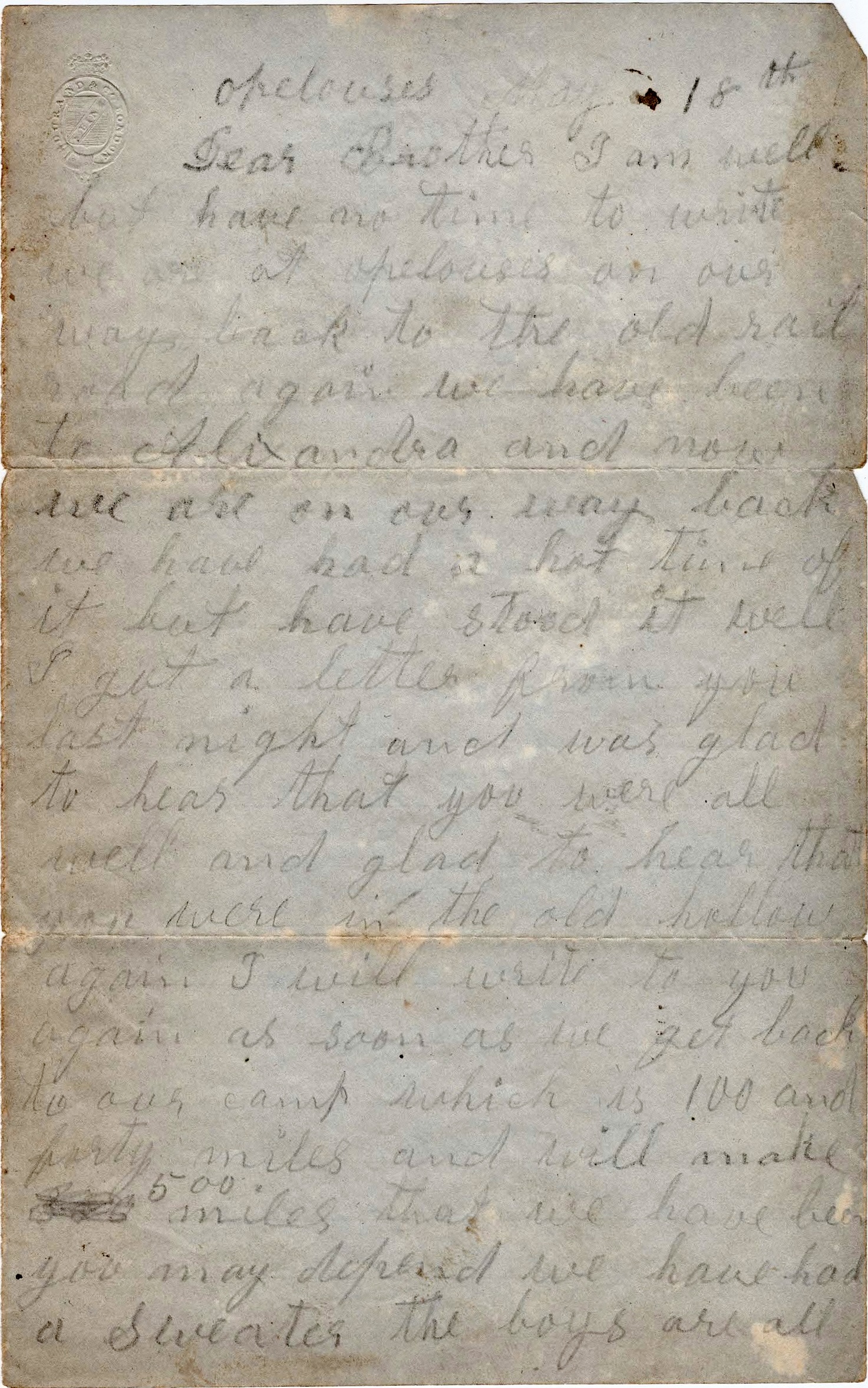
I am well but have no time to write. We are at Opelousas on our way back to the old railroad again. We have been to Alexandria and now we are on our wayback. We have had a hot time of it but have stood it well.
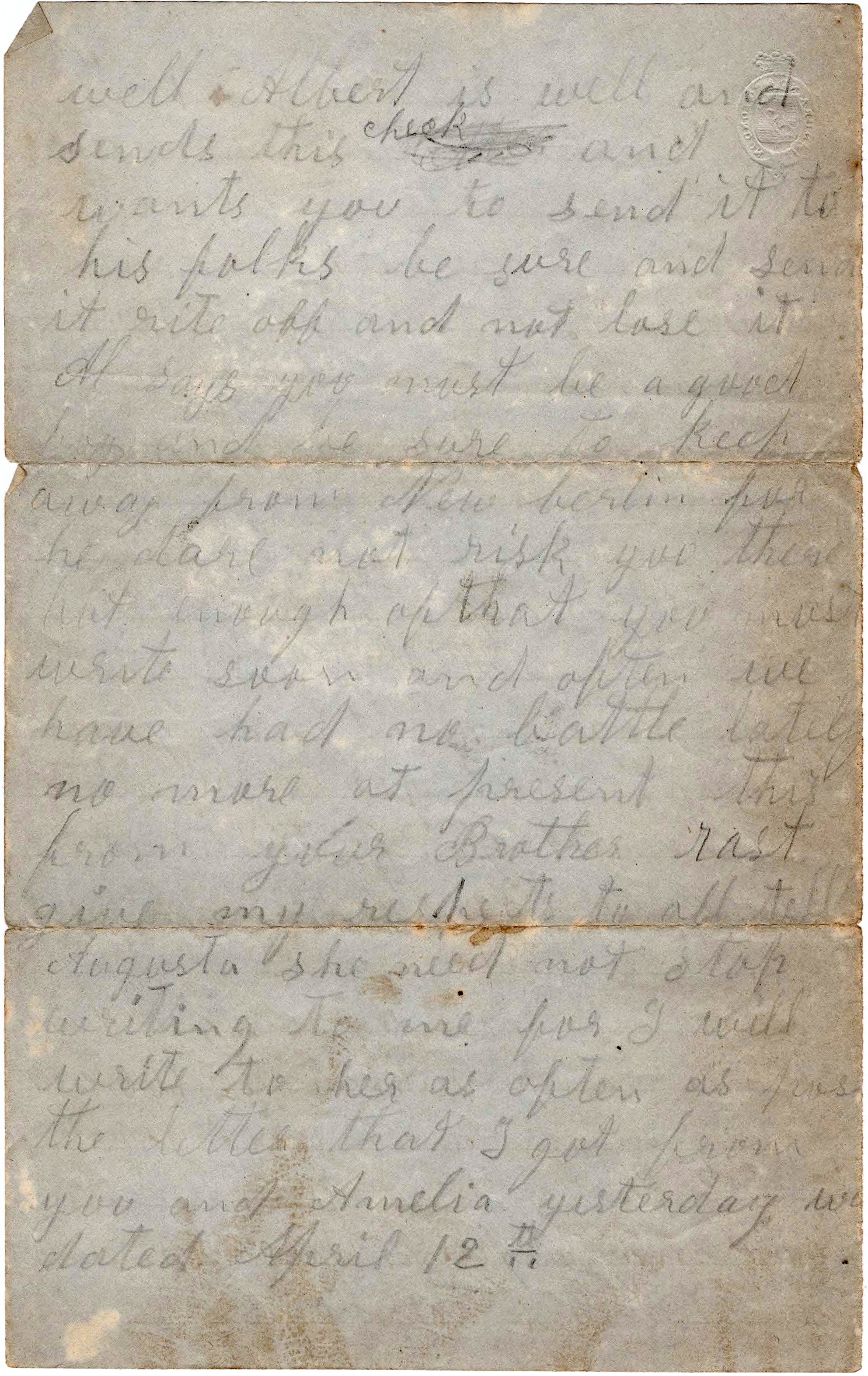
I got a letter from you last night and was glad to hear that you were all well and glad to hear that you were in the old hollow again. I will write to you again as soon as we get back to our camp which is 140 miles and will make 500 miles that we have been. You may depend we have had a sweater. The boys are all well. Albert is well and sends his check and wants you to send it to his folks. Be sure and send it right off and not lose it. Al says you must be a good boy and be sure to keep away from New Berlin for he dare not risk you there. But enough of that.
You must write son and often. We have had no battle lately. No more at present. This from your brother, — Rast
Give my respects to all. Tell Augusta she need not stop writing to me for I will write to her as often as possible. The letter that I got from you and Amelia yesterday was dated April 12th.
Letter 18
New Orleans [La.]
May 2nd 1863
Dear Brother,
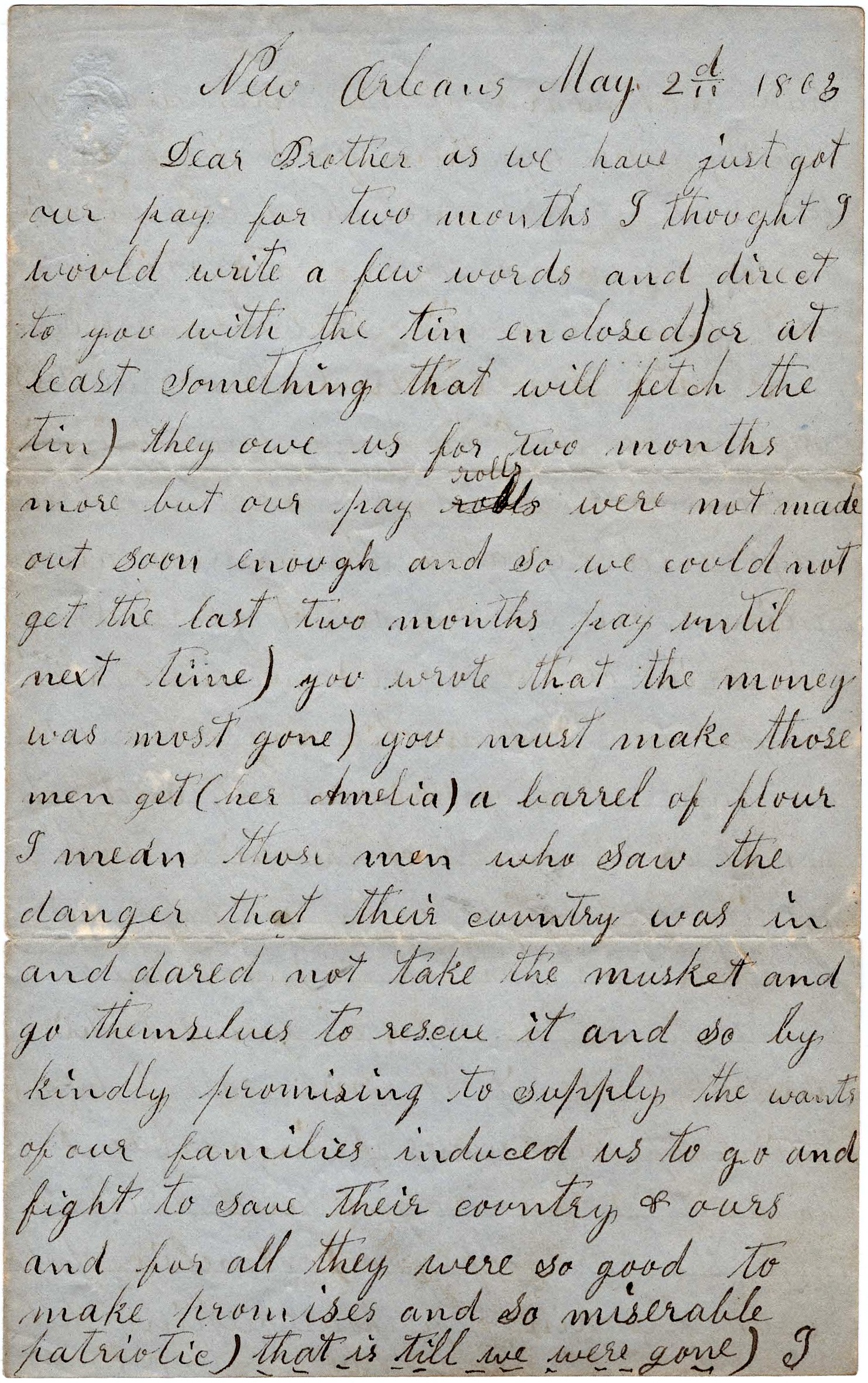
As we have just got our pay for two months, I thought I would write a few words and direct to you with the tin enclosed (or at least something that will fetch the tin). They owe us for two months more but our pay rolls were not made out soon enough and so we could not get the last two months pay until next time.
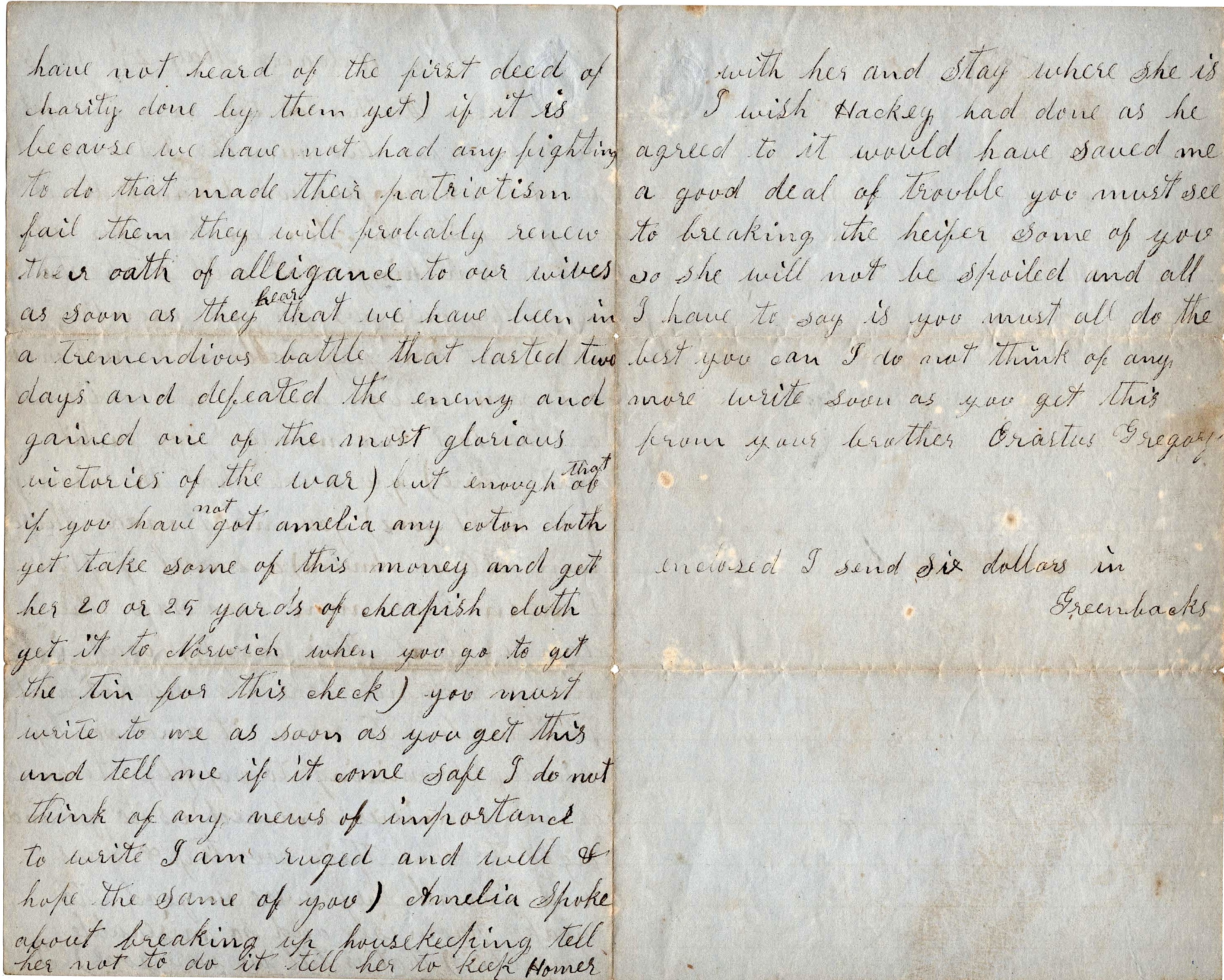
You wrote that the money was most gone. You must make those men get her (Amelia) a barrel of flour. I mean those men who saw the danger that their country was in and dared not take the musket and go themselves to rescue it and so by kindly promising to supply the wants of our families induced us to go and fight to save their country & ours. And for all they were so good [as] to make promises and so miserable patriotic—that is, till we were gone. I have not heard of the first deed of charity done by them yet. If it is because we have not had any fighting to do that made their patriotism fail them, they will probably renew their oath of allegiance to our wives as soon as they hear that we have been in a tremendous battle that lasted two days and defeated the enemy and gained one of the most glorious victories of the war. But enough of that.
If you have not got Amelia any cotton cloth yet, take some of this money and get her 20 or 25 yards of cheapish cloth. Get it to Norwich when you go to get the tin for this check. You must write to me if it comes safe. I do not think of any news of importance to write. I am rugged and well and hope the same of you. Amelia spoke about breaking up housekeeping. Tell her not to do it. Tell her to keep Homer with her and stay where she is. I wish Hackey had done as he agreed to. It would have saved me a good deal of trouble. You must see to breaking the heifer, some of you, so we will not be spoiled. And all I have to say is you must all do the best you can.
I do not think of any more. Write soon as you get this. From your brother, — Erastus Gregory
Enclosed I send six dollars in greenbacks.
Letter 19
[no location of date but presumed to be Spring or early summer, 1863]
Dear friends,
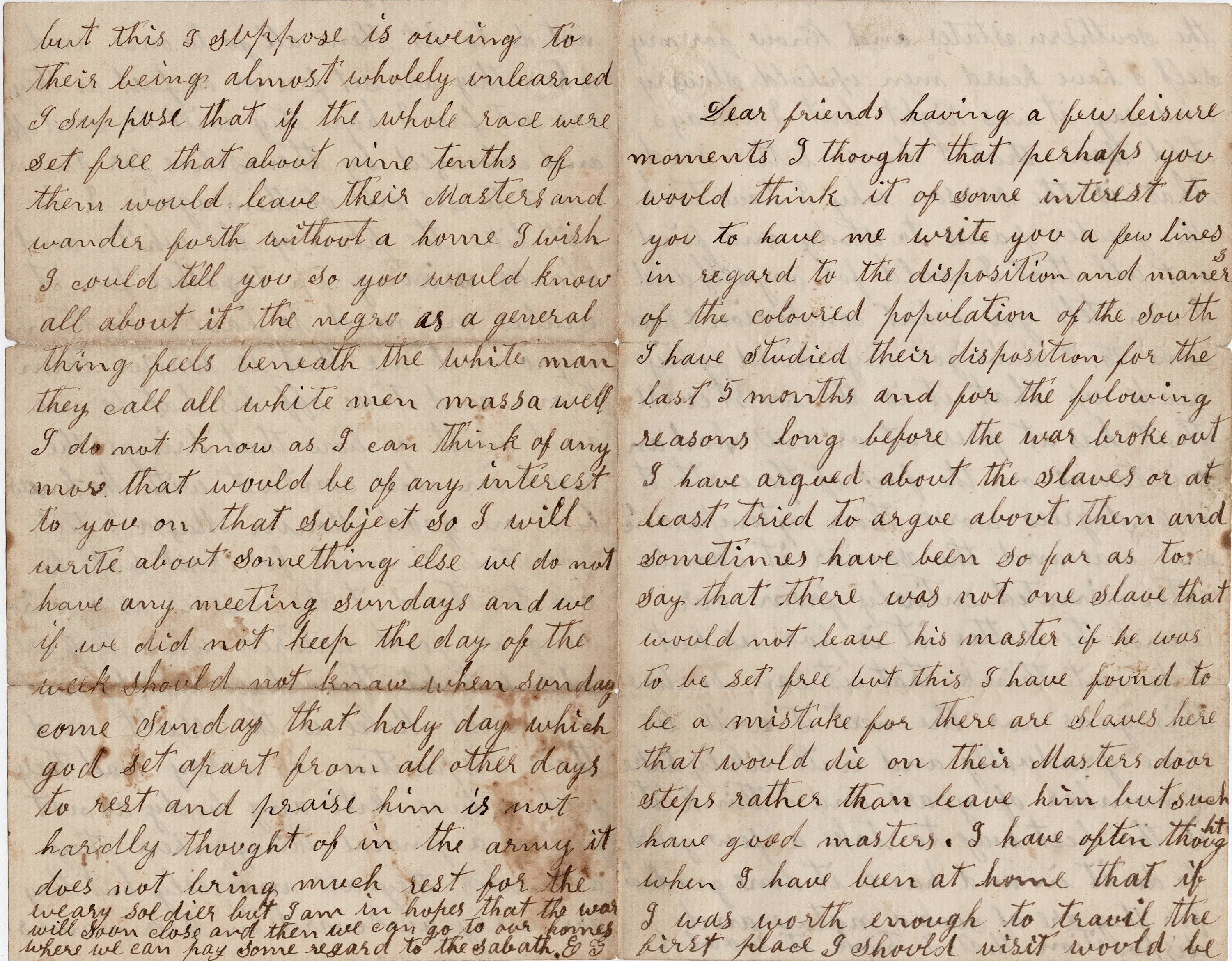
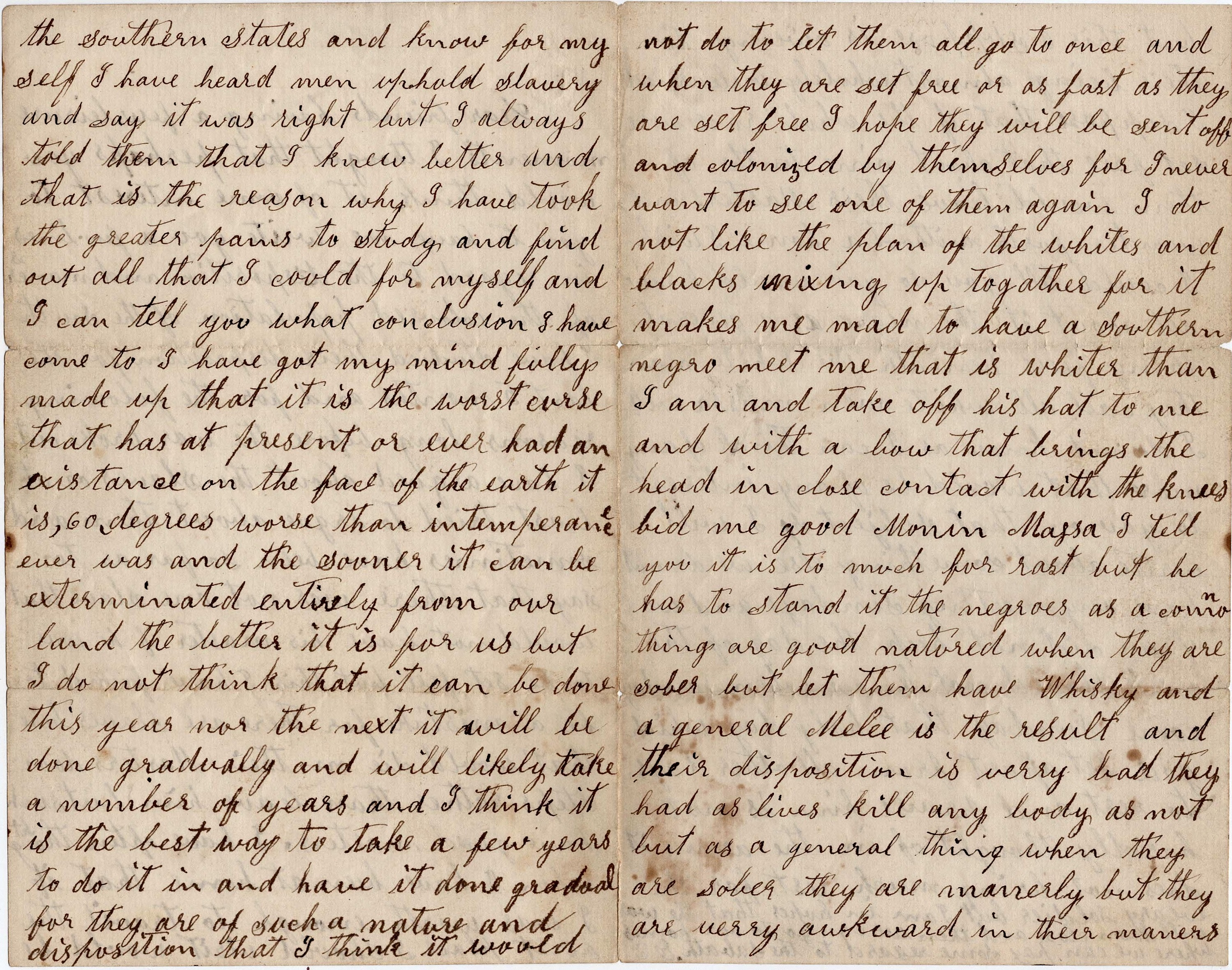
Having a few leisure moments, I thought perhaps you would think it of some interest to you to have me write you a few lines in regard to the disposition and manner of the colored population of the South. I have studied their disposition for the last five months and for the following reasons, long before the war broke out, I have argued about the slaves, or at least tried to argue about them and sometimes have been so far as to say that there was not one slave that would not leave his master if he was to be set free. But this I have found to be a mistake for there are slaves here that would die on their master’s doorsteps rather than leave him. But such have good masters.
I have often thought when I have been at home that if I was worth enough to travel, the first place I should visit would be the Southern states and know for myself. I have heard men uphold slavery and say it was right, but I always told them that I knew better and that is the reason why I have took the greater pains to study and find out all that I could for myself. And I can tell you what conclusion I have come to. I have got my mind fully made up that it is the worst curse that has at present, or ever had an existence on the face of the planet. It is 60 degrees worse than intemperance ever was and the sooner it can be exterminated entirely from our land, the better it is for us. But I do not think that it can be done this year nor the next. It will be done gradually and will likely take a number of years. And I think it is the best way to take a few years to do it in and have it done gradual for they are of such a nature and disposition that I think it would not do to let them all go to once.
And when they are set free—or as fast as they are sset free—I hope they will be sent off and colonized by themselves for I never want to see one of them again. I do not like the plan of the whites and blacks mixing up together for it makes me mad to have a Southern negro meet me that is whiter than I am and take off his hat to me and with a bow that brings the head in close contact with the knees, bid me “Good mornin’ Massa.” I tell you, it is too much for Rast. But he has to stand it.
The negroes as a common thing are good natured when they are sober, but let them have whiskey and a general melee is the result. And their disposition is very bad—they had as leave kill anybody as not. But as a general thing when they are sober, they are mannerly but they are very awkward in their manners. But this, I suppose, is owing to their being almost wholly unlearned. I suppose that if the whole race were set free, that about nine-tenths of them would leave their masters and wander forth without a home.
I wish I could tell you so you would know all about it. The negro, as a general thing, feels beneath the white man. They call all white men “massa.”
Well, I do not know as I can think of any more that would be of any interest to you on that subject so I will write about something else. We do not have any meeting Sundays and we, if we do not keep the day of the week, should not know when Sunday came. Sunday—that Holy day which God set apart from all other days to rest and praise Him—is not hardly thought of in the army. It does not bring must rest for the weary soldier but I am in hopes that the war will soon close and then we can go to our homes where we can pay some regard to the Sabbath. — E. G.
 Spared & Shared 23